

1. The investment decision begins with the programme
A board considering a roll-up should approve an investment thesis capable of surviving a change in the acquisition sequence. The first purchase establishes the operating platform, consumes financing capacity and determines which future targets are commercially useful. It also creates the starting point for later competition analysis. The relevant investment question is therefore whether a defensible programme can produce acceptable operating economics when some proposed purchases are delayed, redesigned or abandoned. This paper proposes a way to answer that question before committing to the platform acquisition.
The distinction matters for a family office buying its first operating platform, a fund underwriting several bolt-ons and a corporate acquirer entering a new country. Each can model a platform that performs adequately only after acquiring particular competitors. Such dependence belongs in the initial investment case. The proposed approach requires directors to see the platform alone, the preferred sequence and at least one feasible alternative sequence, with separate evidence supporting each. Acquisition targets outside the buyer's control should enter the model as contingent opportunities with explicit commercial assumptions.
US agencies explicitly address serial acquisitions in Guideline 8 of their 2023 Merger Guidelines. They describe examining the cumulative strategy, including acquisition history and documents concerning future incentives. This is a specific US enforcement framework; it supplies a reason to examine the programme as a whole without establishing the legal outcome of any individual transaction.[1] The management method developed here is an original governance proposal. It has not been tested on a representative transaction sample and does not estimate enforcement probabilities or investment returns.
The programme should have an economic purpose that directors can explain in operational terms. Examples for investigation include extending service coverage, funding equipment, building a specialist training capability or introducing a quality-control system. Each proposed benefit needs a mechanism, delivery cost, beneficiary and measurable result. A financial model that derives most of its improvement from stronger negotiating leverage warrants a detailed explanation of whose terms change and why. Commercial attractiveness, competition analysis and execution feasibility should each receive an explicit decision.
2. Establish the evidence boundary
The research uses primary US and UK public guidance and a specific FTC enforcement announcement, checked on 9 September 2026. The CMA updated its merger-assessment guidance on 3 September 2026. Its publication notice states that the new efficiencies section applies where the formal phase-one investigation commences on or after that date; the remaining guidance is unchanged apart from relevant numbering.[2] A live transaction should use the version applicable to its own procedure. An older internal diligence checklist therefore needs a dated legal review before directors rely on it.
No Gulf-wide merger-control rule is asserted in this paper. UAE, Saudi Arabian, Kuwaiti, Qatari, Bahraini and Omani transactions need their own jurisdictional analysis. A Gulf holding company acquiring a UK or US business may also require analysis of the acquired activities and other relevant jurisdictions. The paper does not provide filing thresholds, exemption opinions or statutory timetables for those countries. Those facts require current verification by counsel against the transaction structure, group perimeter and affected activities. A jurisdiction marked unresolved remains an open condition in the decision record.
The proposed evidence register separates a verified source fact, a company-reported figure awaiting reconciliation, a management forecast and a hypothetical sensitivity. These distinctions should be visible in working schedules and explained naturally in board prose. For instance, a claimed customer-switching rate should identify its underlying customer cohort, observation period and treatment of expired contracts. A management statement that competitors are abundant should be accompanied by named alternatives and evidence that customers can actually use them. Missing evidence should have an owner and a resolution date.
Conflicting evidence deserves a documented treatment. A sales team may describe a target as its closest competitor while a market report groups both firms inside a much larger industry. The analyst should preserve both statements, identify what each measures and ask the relevant specialist to investigate the difference. Removing the uncomfortable statement would weaken the record. The same principle applies to labour mobility, spare capacity and proposed efficiencies. A decision-ready paper explains the disagreement, the analysis performed and the uncertainty that remains.
3. Reconstruct acquisition history at operating level
The acquisition-history map proposed here records each completed, proposed, discontinued and materially restructured transaction. Its purpose is to reconstruct what changed in the operating network. Each entry should connect legal entities, sites, services, customers, specialist employees, ownership rights and integration actions. An entity list alone leaves unanswered whether two businesses retained genuinely separate commercial decision-making or became one supplier from a customer's perspective. The map should be refreshed whenever the platform acquires assets, recruits a significant operating team or changes a material commercial arrangement.
For completed deals, the record should retain the original investment rationale and compare it with subsequent operating choices. Relevant questions include whether a site closed, a service ceased, a customer contract migrated, a training programme expanded or a pricing authority moved to the group. These are proposed diligence questions, not allegations about any business. The comparison makes the programme's actual development available to directors. It also gives the next deal team a starting point for investigating claims that previous integration produced particular benefits.
For abandoned deals, record the reason accurately and preserve the source. Reasons may include valuation, unavailable finance, diligence findings, regulatory uncertainty or a seller's decision. An abandoned transaction should contribute to the history without being described as completed ownership. Informal opportunities need equally careful treatment. A short conversation with a founder is evidence of a conversation; it does not establish willingness to sell, exclusivity or a probable acquisition. The target pipeline should distinguish these stages in every capital-allocation presentation.
The acquisition map should also connect associated rights. In the proposed framework, a minority interest, board appointment, option, exclusive distribution arrangement or shared operating facility receives a separate relationship entry for specialist review. Its legal significance remains a matter for counsel. Its commercial importance can be investigated through decision rights, information access and dependence. This creates a more useful account of the platform than assuming that the percentage of shares held explains every relationship. Directors can then see which facts remain unresolved before approving further diligence.
| Record | Evidence to attach | Decision it supports |
|---|---|---|
| Completed purchase | Signed perimeter, closing date, operating changes | Starting position for the next deal |
| Abandoned target | Dated reason and supporting correspondence | Reliability of the remaining sequence |
| Minority or contractual link | Rights, access and commercial dependence | Specialist review of influence and incentives |
| Post-close change | Site, service, capacity and customer records | Test of promised and realised effects |
Author framework. Entries require evidence from actual transaction and operating records.
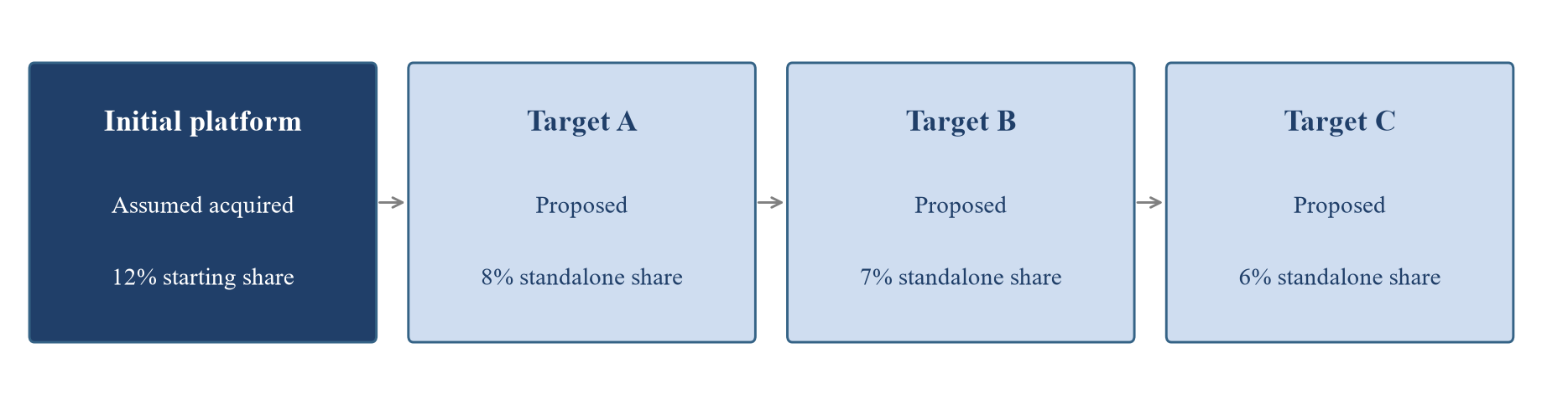
Invented programme for explanation. Only the initial platform is assumed acquired; later targets remain contingent proposals.
4. Define the competitive question before computing shares
The US guidelines describe relevant markets through product or service and geographic dimensions. They recognise that narrower markets can exist within broader ones and that ordinary commercial use of the word market can differ from the analytical definition.[3] For an investment committee, this supports a practical requirement: every concentration calculation should display its denominator, scope, source date and rationale. A single headline share, disconnected from the service a customer needs, is insufficient for the proposed programme review.
Consider the hypothetical industrial-maintenance platform used throughout this paper. Assume it provides planned maintenance and emergency specialist repairs. An annual national expenditure estimate might be useful for strategy. An emergency customer could nevertheless require a qualified crew near one industrial cluster within a short response window. Those two descriptions create different questions for investigation. The analyst should gather service-level contracts, delivery locations, response commitments, customer procurement records and evidence of substitution. The example deliberately leaves the legally relevant market unresolved; its purpose is to show what evidence could change the investment case.
The proposed market-definition workstream begins with customer decisions. What service was purchased? Which firms were invited to quote? Which met qualification requirements? Why was the winner selected? What happened when the incumbent was unavailable? Interview answers should be checked against records where obtainable, with appropriate confidentiality safeguards. A supplier advertising nationwide coverage is a lead for investigation. Its ability to deliver the exact service at the required time should be verified separately. A provider's website should not be treated as proof of available local capacity.
The analysis should retain competing definitions until the evidence supports a conclusion. A narrow service-and-location view, a broader regional view and a national strategy view can each be useful working scenarios. Directors should see how the programme changes under each and which facts support inclusion or exclusion. This is an uncertainty-management exercise. It must not become a search for the broadest denominator that makes a preferred acquisition appear acceptable. Counsel and economic specialists should challenge the alternatives before the acquisition team uses them to recommend a commitment.
The US guidance on market shares also recognises that different measures can be informative, including revenue, units, capacity and measures reflecting competitive conditions.[4] In the proposed maintenance example, annual revenue, completed emergency jobs and qualified available crew-hours would answer different questions. A workbook should reconcile each numerator to its own denominator and avoid mixing measures. An apparent share change caused by a new definition should be identified separately from a change caused by an acquisition. That distinction preserves the meaning of the time series.
5. A hypothetical cumulative concentration model
Assume a deliberately simplified service market with ten independent suppliers. Their initial percentage shares are 12, 8, 7, 6, 17, 15, 11, 9, 9 and 6. These shares sum to 100. The buyer proposes acquiring the 12 percent platform, followed by the 8, 7 and 6 percent suppliers. Every share is invented. Demand, capacity, customer choice and the market boundary are held constant solely to isolate the arithmetic effect of combining ownership. This is not an estimate for an actual market or a legal clearance screen.
Use the sum of squared percentage shares as a concentration index for the illustration. The initial value is 1,126. Combining the platform with the 8 percent target produces a 20 percent group and an index of 1,318, an increase of 192. Adding the 7 percent business produces a 27 percent group and an index of 1,598, a further increase of 280. Adding the 6 percent business produces a 33 percent group and an index of 1,922, a further increase of 324. Each step is calculated from the ownership structure immediately preceding it.
The cumulative increase from the initial market is 796. Calculating every target as though the platform still had its original 12 percent share would understate that cumulative arithmetic. A programme model should therefore recompute the combined position after each proposed closing. It should retain the unchanged independent suppliers and a clearly identified target universe. Acquisitions cannot be added twice merely because a business appears under a legacy trading name and a new legal name. Reconciliation of identifiers is an elementary but important control.
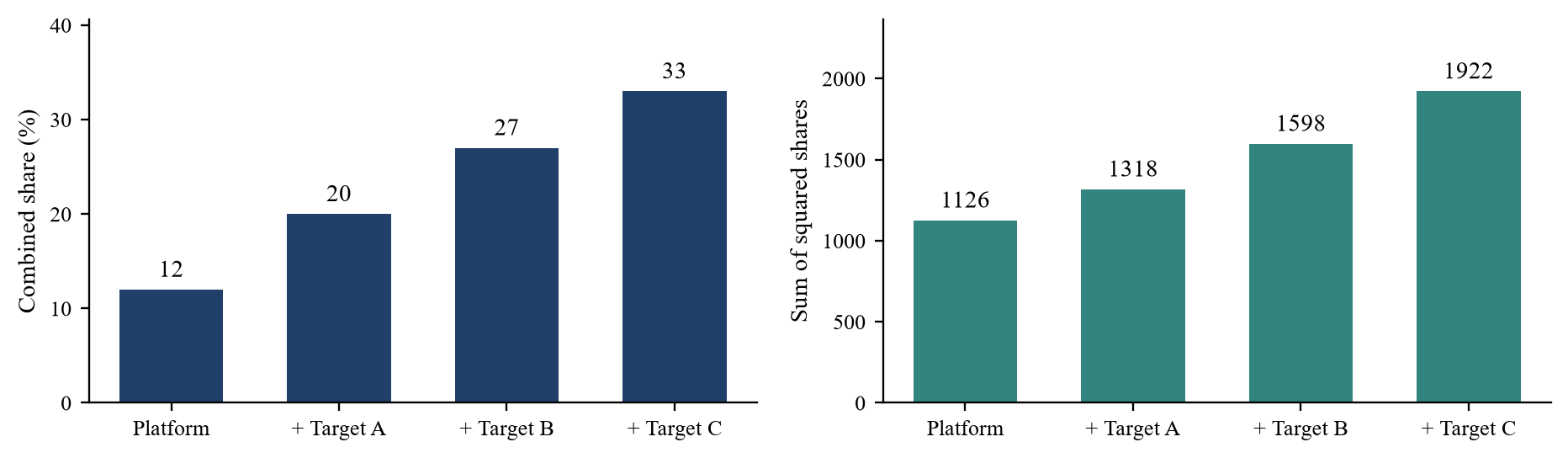
Hypothetical fixed-market model. Shares and index values are explanatory assumptions, with no legal threshold or clearance implication.
Changing the order changes the intermediate positions while leaving the final ownership combination unchanged in this fixed example. If the 6 percent supplier is acquired first, the combined share becomes 18 percent and the index rises by 144. That arithmetic supplies no reason to expect a different final legal outcome. Sequencing should be justified by operating readiness, customer benefit and financing resilience. Splitting transactions, concealing a programme or manipulating disclosure is outside the framework. The complete intended strategy should be available for accurate legal assessment and required disclosures.
The scenario also exposes the limits of concentration arithmetic. A target with a small measured share could possess an important capability, location or customer relationship. A large share could be sensitive to the observation period or classification of services. The investment committee should treat the index as one diagnostic alongside actual rivalry, capacity and evidence of customer alternatives. No threshold in this paper establishes safety. Each relevant jurisdiction's substantive standard and transaction-specific evidence require independent professional analysis.
6. Test competition for specialist labour
Guideline 10 of the US guidance addresses mergers between competing buyers, including employers. It discusses labour-market effects such as wages, working conditions and switching frictions, and states that buyer-market harm is not offset by benefits in a separate downstream product market.[5] The proposed programme review therefore includes a distinct labour workstream. It asks which workers the combining businesses seek to employ, which alternative employers are practicable and which proposed operating changes affect those options. It should not simply reuse the product-market map.
In the hypothetical maintenance example, assume the platform and three targets employ specialist technicians whose certifications and response obligations differ from those of general maintenance staff. A national count of engineers would be an incomplete description of that recruitment question. The proposed evidence request covers anonymised recruitment outcomes, certification requirements, work locations, shift patterns, travel obligations and the employers from which staff joined or to which they departed. Personal data should be minimised and handled through approved privacy and confidentiality arrangements. Unavailable worker-level evidence remains an explicit analytical limitation.
Assume, for illustration, that there are 200 suitably qualified technicians in a proposed local recruitment pool and that the platform employs 30. Target A employs 20 and Target B employs 15. Combining those employers gives 65 employees, or 32.5 percent of the hypothetical pool. This calculation is a prompt to investigate the pool definition and actual competition for workers. It does not establish a relevant labour market, a legal threshold or employer power. The denominator excludes no worker merely to support a preferred conclusion; every inclusion rule needs evidence.
The operational plan should then explain proposed changes in recruitment, training, mobility and supervision. A genuine additional training programme can be costed through instructors, places, qualification time and supported employment opportunities. A forecast reduction in staff expenditure should identify its mechanism precisely. Scheduling improvements, lower overtime, job removals and reduced compensation have different effects and should appear as separate lines. The committee should ask whether the platform remains financeable after removing benefits that lack support or raise unresolved competition concerns.
| Question | Evidence request | Unresolved issue to record |
|---|---|---|
| Who can do the work? | Certification and task requirements | Whether adjacent occupations are substitutes |
| Where can people work? | Location, travel and shift evidence | Practical mobility constraints |
| Which employers compete? | Anonymised hiring and departure records | Missing or biased observation coverage |
| What changes after acquisition? | Recruitment, training and pay proposals | Effect on worker choices and conditions |
Author framework. The example is hypothetical; local legal, employment and privacy requirements need separate review.
7. Follow customer choice through integration
The proposed customer workstream maps the choices available before and after each integration action. It should distinguish legal acquisition from operational migration. Closing a transaction does not itself explain whether a customer experiences a different service range, contracting counterparty, support arrangement or response capability. Those changes should be scheduled individually. In the hypothetical platform, combining dispatch systems might shorten some response times while moving a workshop could lengthen others. The diligence plan should specify the data required to measure both effects.
For each important service, build a customer-choice record with the requirement, actual bidders, qualification barriers and contract-renewal timing. A renewal cluster can create a concentrated period of commercial uncertainty in the investment model. Interview evidence should be representative of the question being investigated and should include documented limitations. A handful of friendly customers should not be described as proof of market-wide acceptance. Where customer contact could disclose confidential transaction information, the acquisition team should agree an appropriate process with counsel and the seller before any approach.
The framework proposes a separate integration-dependency schedule. Each planned action states which acquisition makes it possible, which approvals or contractual consents are required, what it costs and when it becomes reversible or irreversible. Migrating a billing system, terminating a lease and discontinuing a service have different dependencies. Directors should receive a version of the operating plan that defers restricted actions during any applicable standstill or hold-separate period, as advised by counsel. The financial model should use that permitted timetable rather than an assumed immediate integration date.
Customer benefits need measurable definitions. Improved response time should specify the start and end of the clock, the service cohort and the treatment of failed calls. Expanded capacity should distinguish installed equipment from staffed and qualified availability. Better quality should identify the defect or rework measure and its observation period. These are proposed management controls. They do not establish that the transaction creates any particular benefit. Their value lies in making the claim testable before capital is committed and reviewable after operating changes occur.
8. Make efficiency claims reproducible
The CMA's September 2026 guidance retains a case-by-case approach and calls for verifiable evidence. Its framework for rivalry-enhancing efficiencies considers enhanced rivalry, timeliness, likelihood, sufficiency, merger specificity and benefits to UK customers. It also distinguishes these efficiencies from relevant customer benefits considered in other parts of the process.[6] An investment committee should obtain a specialist explanation of which category a proposed benefit belongs to. A management synergy total does not answer that legal question. This paper proposes a supporting evidence ledger for the commercial analysis.
Each ledger entry should contain an operational baseline, the proposed change, implementation cost, delivery owner, timing, relevant customer group and the reason acquisition is necessary. It should include a source document and a calculation that another analyst can reproduce. A procurement saving should explain whether it comes from fewer deliveries, a changed specification, lower supplier cost or a change in bargaining terms. A revenue improvement should separate additional output, better quality, new customers and price changes. Combining these mechanisms into one percentage prevents a useful challenge of the claim.
The US guidance separately sets out criteria for procompetitive efficiencies, including merger specificity and verifiability, and rejects vague or speculative claims.[7] The proposed ledger should therefore retain alternative ways to achieve an operating improvement. These might include internal investment, a properly assessed contractual arrangement or another acquisition with different competitive effects. Whether an alternative is practically available needs evidence. A hypothetical alternative that cannot be financed, licensed or delivered on the required timetable should be described with those limitations. The board should see the work needed to evaluate it.
Assume the maintenance platform proposes annual dispatch savings of USD 1.2 million. For this invented example, the forecast combines USD 0.7 million of reduced duplicate travel, USD 0.3 million of scheduling administration and USD 0.2 million of expected overtime reduction. Each line requires its own baseline and verification method. A joint total should not enter the financing case until the analyst has considered implementation spending, timing and overlap. If reduced travel already explains part of the overtime saving, the duplication should be removed transparently.
The post-close review should preserve the original forecast and explain variance through measured drivers. A lower cost could arise from reduced service volumes, an input-price change or the planned operational improvement. Each cause has a different implication for the thesis. This framework proposes a monthly operating bridge during implementation, with the frequency adjusted to the business. It does not claim that a particular monitoring cadence produces better returns. The objective is to make the evidence available when directors reconsider the next acquisition.
9. Underwrite the sequence that can actually be financed
Assume a hypothetical platform purchase at an enterprise value of USD 60 million. The model assumes USD 24 million of acquisition debt and USD 36 million of equity funding the purchase price, plus USD 4 million of equity for fees, integration and opening liquidity. The opening equity commitment is therefore USD 40 million. These figures describe a simplified cash-free, debt-free transaction with no purchase-price adjustment. They are not valuation benchmarks, financing offers or estimates of prevailing terms. A real model would reconcile the funds flow and contractual definitions.
Assume annual standalone earnings before interest, tax, depreciation and amortisation of USD 6 million. For the cash illustration only, maintenance investment consumes USD 1.2 million, tax consumes USD 0.5 million, working-capital investment consumes USD 0.4 million and cash interest consumes USD 2.4 million. The resulting cash before scheduled principal repayment is USD 1.5 million. Scheduled principal of USD 1 million leaves USD 0.5 million. These assumptions isolate the limited cash available for subsequent commitments. They do not model every accounting or tax adjustment.
Now assume management expects the USD 1.2 million dispatch saving described earlier to begin immediately after a bolt-on. For this isolated sensitivity, treat that saving as cash and hold incremental tax and working-capital effects at zero. The planned residual cash rises from USD 0.5 million to USD 1.7 million. Assume management then commits USD 1.2 million to additional programme investment, beyond the maintenance investment already deducted, leaving planned cash of USD 0.5 million. The bolt-on purchase funding and its standalone cash flows are excluded from this isolated operating sensitivity; a complete transaction model must incorporate them before any commitment.
If the relevant integration is delayed six months, a simple straight-line illustration removes USD 0.6 million of that year's anticipated benefit. Add assumed hold-separate support and adviser costs of USD 0.25 million, plus an assumed USD 0.1 million financing-extension cost. The illustrative first-year adverse variance becomes USD 0.95 million. Against the USD 0.5 million planned cash remaining after the additional investment commitment, this produces a USD 0.45 million gap. If the additional investment can validly be deferred without other consequences, cash instead remains positive at USD 0.75 million. This is a liquidity sensitivity, not an enforcement forecast.
| Item | Amount | Calculation or assumption |
|---|---|---|
| Standalone operating earnings | 6.00 | Assumed EBITDA |
| Cash before principal | 1.50 | 6.00 less 1.20, 0.50, 0.40 and 2.40 |
| Standalone residual after principal | 0.50 | 1.50 less 1.00 |
| Planned cash with immediate benefit | 1.70 | 0.50 plus 1.20 |
| Planned cash after additional investment | 0.50 | 1.70 less assumed commitment of 1.20 |
| Six-month missed benefit | 0.60 | 1.20 multiplied by 6/12 |
| Other delay costs | 0.35 | 0.25 support plus 0.10 financing |
| Funding gap with investment maintained | 0.45 | 0.95 adverse variance less 0.50 planned cash |
USD millions. Annualised simplification; tax, working capital and financing effects require transaction-specific modelling.
The proposed investment decision should address that shortfall directly. Possible responses for investigation include additional committed equity, a smaller acquisition budget, deferred discretionary spending or a financing structure with appropriate flexibility. Each requires evidence of availability and consequences. A model should not assume a lender waives a covenant or an investor supplies more equity because the programme is strategically attractive. The committee should identify who can authorise additional capital and the conditions under which it becomes available.
Return analysis should then run on dated cash flows. This paper deliberately provides no internal-rate-of-return estimate because it does not specify a complete acquisition sequence, distributions, exit date or exit value. Adding an assumed exit multiple would create a different exercise. For a live mandate, the analyst should show the original plan, a delayed case, a case excluding the most difficult bolt-on and a case requiring additional capital. The output should expose reliance on future acquisitions before the board chooses a funding commitment.
10. Interpret enforcement evidence carefully
In May 2025, the FTC approved a final order involving Welsh Carson concerning its involvement with US Anesthesia Partners. The FTC announcement describes restrictions and notification requirements and presents allegations concerning an acquisition strategy in Texas anaesthesia services.[8] This is a specific US enforcement example. The announcement should be read together with the underlying order when assessing its exact obligations. It does not establish that another roll-up is unlawful, and this paper makes no claim about the current status of separate litigation.
The proposed lesson for diligence is to investigate the mechanism linking ownership, operating decisions and competitive effects. A case label such as healthcare roll-up contains too little information to support an investment decision in industrial maintenance, logistics or software. The analyst should identify what conduct or structure the authority actually addressed, which facts were alleged or established and what the final instrument required. A settlement, agency allegation and court judgment should each retain its correct description. Legal specialists should determine whether any principle is relevant to the transaction being considered.
Directors should also scrutinise internal language for accuracy. A statement about removing competition, controlling a local market or suppressing supplier alternatives deserves substantive review of the proposed strategy. The response should be an honest reconsideration and correction of the underlying conduct or analysis where needed. Document retention and disclosure must follow applicable duties and counsel's instructions. The programme record should accurately describe the real investment purpose and preserve material evidence. This paper recommends no method for obscuring a strategy or evading review.
11. Build a regulatory gate plan around decisions
The proposed gate plan begins before an indicative offer and continues through post-close review. At the mandate gate, directors define the services, geographies, operating objectives and excluded strategies. At the target-screening gate, the team identifies unresolved competitive and jurisdictional questions. At the commitment gate, counsel's advice, economic analysis, funding resilience and the permitted integration plan become explicit inputs. At closing, the authorised team checks that required conditions and approvals are satisfied. Post-close monitoring then informs the next acquisition decision.
Each gate needs a named decision owner and an evidence threshold. A colour status alone leaves too much room for interpretation. The proposed gate record includes the question, evidence reviewed, specialist conclusion, outstanding issue, person authorised to accept the commercial risk and expiry or refresh trigger. A favourable preliminary view can become stale after the deal perimeter changes or a customer contract is lost. The same record should therefore state what event requires the issue to return to the committee.
For a cross-border programme, a consolidated timetable should preserve country-level dependencies. Directors should see which jurisdictional analyses are complete, which filings or approvals counsel considers necessary and which facts remain unconfirmed. National-security, sector-licensing and foreign-investment questions may require distinct specialist review; this paper provides no determinations on them. The acquisition timetable should reserve time for that work. The commercial team should avoid promising a completion date that depends on unresolved external decisions.
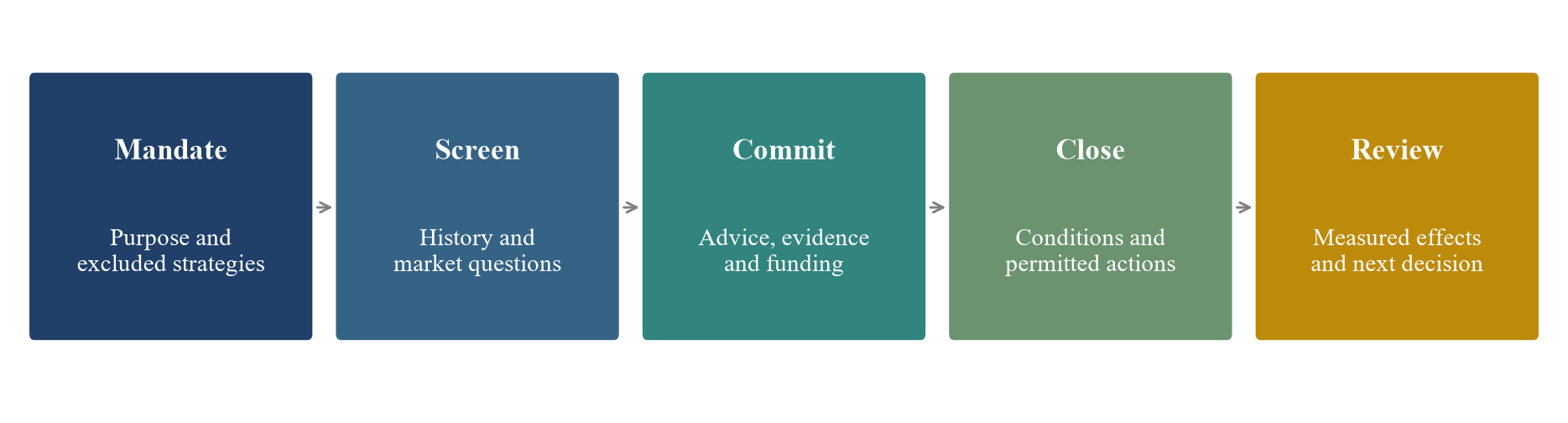
Author framework. Gates are internal governance stages; actual filing and closing requirements are jurisdiction-specific.
The gate plan should include a clear authority to pause expenditure and a procedure for returning to the board. For example, an unresolved issue may permit a bounded diligence budget while prohibiting a binding acquisition commitment. These are proposed internal controls; their suitability depends on the organisation and transaction. The decision record should distinguish permission to investigate from permission to sign. This supports disciplined use of capital without implying that an internal approval substitutes for any external legal requirement.
12. Design alternatives before the preferred target fails
An alternative sequence should begin with the operating capability the buyer needs. In the hypothetical platform, that capability might be emergency coverage in an adjacent industrial cluster. The proposed alternatives analysis would compare an acquisition, a staffed new facility and a legally assessed service arrangement. Each option needs a delivery timetable, upfront cash requirement, capacity ramp and customer qualification plan. These are hypotheses for diligence. The paper does not assert that any option is available in an actual jurisdiction or commercially preferable.
The comparison should use consistent service outputs. A new facility with no qualified crews cannot be compared with a mature acquired business solely on purchase cost. Equally, an acquired site may require replacement equipment or customer requalification. The proposed model brings each option to the same defined operational milestone before comparing cash requirements. Residual differences in risk should remain visible. A headline cost per site would otherwise hide the central question of what service capacity the capital actually creates.
Options can also differ in reversibility. An initial diligence budget can be capped. A signed lease, equipment order or binding acquisition agreement can create different obligations. The board should ask when each option becomes materially more expensive to abandon and whether that point occurs before the necessary evidence is available. This paper proposes an obligation calendar alongside the acquisition timetable. It does not suggest that contractual commitments are freely reversible. The actual rights, termination costs and permitted actions require document-level legal review.
The platform purchase should finally be tested against a programme with no further acquisitions for a defined period. Management should explain how it would invest, retain customers and meet financing obligations in that scenario. The period should reflect the investment mandate and business evidence. A platform that cannot meet agreed requirements without an unavailable target should be presented on that basis. Directors can then decide whether to change the price, funding, operating scope or investment decision with the dependence fully visible.
13. A practical mandate for the investment committee
The proposed advisory work can be specified through a small set of concrete deliverables. The first is a reconciled acquisition-history and relationship map. The second is a target-level commercial evidence pack covering customer choice, capacity and relevant workforce questions. The third is an integrated sequence model with documented assumptions and alternative cases. The fourth is a decision gate register linked to specialist advice. The fifth is a post-close measurement plan. Each deliverable should have a defined scope, evidence owner and acceptance test.
The division of responsibility deserves equal precision. Corporate-development advisers can coordinate commercial evidence, sequencing, funding analysis and execution dependencies within an agreed engagement. Qualified competition counsel and economic specialists should provide the legal and technical opinions required by the transaction. Management supplies operating records and remains accountable for its forecasts and proposed conduct. Directors approve commitments within their authority. This paper describes a proposed division of work; it makes no claim about any provider's regulatory authorisation or completion record.
Commercial acceptance should be tied to reproducibility and decision usefulness. A reviewer should be able to trace each material number to a source or an explicitly described assumption, rerun the scenario and understand which missing fact changes the recommendation. A polished presentation with an unexplained probability of clearance fails that test. An honest unresolved issue accompanied by a targeted evidence request can still be useful. The engagement should identify what remains outside scope, including formal legal advice, independent valuations or regulatory filings where these are separately commissioned.
13.1. Commissioning and accepting the first review
The first review should start with a bounded information request. Ask for the platform's legal and operating perimeter, its existing acquisition history, the current target list, a service-level revenue schedule and the financial model used for the proposed commitment. Add the principal customer and workforce data needed to identify the competitive questions. The parties should agree how sensitive information is segregated and who may see it. A missing-data log should accompany the first findings so that directors understand the evidential limits of the work they have commissioned.
A useful acceptance meeting can follow one target through the complete analysis. Select a proposed acquisition and trace its service overlap, location, customer alternatives, specialist staffing, integration dependencies and financing contribution. Ask the team to reproduce the effect of removing that target from the sequence. Then ask what new evidence would reverse the recommendation. This exercise tests whether the deliverables connect to each other. It also exposes a common modelling weakness: several schedules may use different versions of the same target perimeter, transaction date or operating forecast.
The mandate should identify who maintains the record after the initial report is delivered. A programme can change when a seller introduces another asset, a rival expands capacity, a financing proposal expires or the board changes its strategy. Each event should be assessed against the recorded refresh triggers. The proposed control is a dated change log with the affected analyses and required approvers. It leaves a clear record of which conclusions were reconsidered and which remain supported by the evidence already reviewed.
14. Limitations and conclusion
This paper presents a governance framework and a deliberately simplified example. It does not contain transaction-level empirical research, surveyed customer evidence, verified labour-market data or estimated causal effects. The concentration model fixes market boundaries and shares while ownership changes. The cash model uses selected annual assumptions and a straight-line delay sensitivity. Neither estimates regulatory outcomes, investment performance or the availability of financing. Applying the framework requires current law, actual records and specialist judgement appropriate to every relevant jurisdiction.
The core decision is whether the platform and its intended sequence remain commercially coherent when competitive effects, operating constraints and funding uncertainty are made explicit. The acquisition-history map explains how the buyer reached its current position. Customer and labour evidence identify the questions a headline industry classification can leave unresolved. The efficiency ledger makes claimed benefits testable. The cash model exposes dependence on prompt integration. The gate plan connects those analyses to named decisions before further capital becomes committed.
For a Gulf-based acquirer building an international platform, these tools provide a practical way to specify the diligence mandate. The next step is to define the proposed acquisition perimeter, gather the initial evidence and commission jurisdiction-specific advice. A board can then approve a programme with visible dependencies and documented limits. Subsequent acquisitions should return to that evidence base, incorporating what the platform actually delivered and what changed in the market. The investment thesis remains a proposition to test throughout the programme.
Appendix A
Reproducible scenario calculations
The initial ownership vector is 12, 8, 7, 6, 17, 15, 11, 9, 9 and 6 percent. Its total is 100 percent. Squaring each element and adding gives 144 + 64 + 49 + 36 + 289 + 225 + 121 + 81 + 81 + 36 = 1,126. After the first bolt-on, replace 12 and 8 with 20. The new index is 400 + 49 + 36 + 289 + 225 + 121 + 81 + 81 + 36 = 1,318. This explicitly retains the other independent suppliers.
After the second bolt-on, replace 20 and 7 with 27. The index becomes 729 + 36 + 289 + 225 + 121 + 81 + 81 + 36 = 1,598. After the third, replace 27 and the target's 6 with 33. The result is 1,089 + 289 + 225 + 121 + 81 + 81 + 36 = 1,922. The remaining 6 percent firm is a different supplier from the acquired target. Using unique identifiers is necessary to preserve that distinction in a live workbook.
For two combined shares a and b, the arithmetic increment is (a + b) squared less a squared less b squared, which equals 2ab. Applied sequentially, the increments are 2 × 12 × 8 = 192, 2 × 20 × 7 = 280 and 2 × 27 × 6 = 324. Their sum is 796. This identity explains the cumulative calculation under the fixed-share assumptions. It makes no statement about the legal interpretation of the index in any country.
The platform cash illustration uses USD millions. Starting EBITDA of 6.00 less maintenance investment of 1.20, cash tax of 0.50, working-capital investment of 0.40 and interest of 2.40 gives 1.50 before principal. Principal repayment of 1.00 leaves 0.50. Adding the full planned benefit of 1.20 and subtracting an additional investment commitment of 1.20 leaves planned cash of 0.50. The assumed adverse delay variance is 1.20 × 6/12 + 0.25 + 0.10 = 0.95. Cash with that commitment maintained is 0.50 less 0.95 = negative 0.45. If the additional investment is deferred, the result becomes positive 0.75. A live model must include the bolt-on funds flow, its standalone cash flows, seasonality, incremental taxes and contract-specific financing terms.
Appendix B
Questions to settle before a binding platform commitment
What operating capabilities does the initial purchase deliver on its own? Which later targets are essential to the base case, and what evidence supports their availability? How much committed funding exists for purchase price, integration, standalone operation and a delayed acquisition sequence? Who has authority to provide additional capital? These questions should produce documented answers before the model treats contingent purchases as part of the investment that directors can control.
What evidence supports the proposed product, service and geographic scope? Which customer and labour alternatives require further investigation? Which prior acquisitions and contractual relationships change the analysis? What specific operating changes are planned after each closing? The working group should record a source, responsible person and resolution route for every material gap. The final board paper should state the unresolved issues in ordinary language and explain their effect on the proposed decision.
Which claimed benefits have a reproducible baseline and implementation plan? Which depend on a particular acquisition or restricted integration action? What happens if the most important benefit is delayed, smaller than expected or unavailable? Which approvals, filings, consents or specialist reviews remain outstanding? The closing team should retain an explicit conditions record, and the investment committee should retain its separate commercial approval record. Both should remain connected to the version of the transaction actually being executed.
Sources
- US Department of Justice and Federal Trade Commission. 2023 Merger Guidelines, Guideline 8: serial acquisitions. Issued 18 December 2023; accessed 9 September 2026. Read the primary source
- Competition and Markets Authority. Merger assessment guidelines: publication and applicability notice. Updated 3 September 2026; accessed 9 September 2026. Read the primary source
- US Department of Justice and Federal Trade Commission. 2023 Merger Guidelines, section 4.3: Market Definition. Accessed 9 September 2026. Read the primary source
- US Department of Justice and Federal Trade Commission. 2023 Merger Guidelines, section 4.4: Calculating Market Shares and Concentration. Accessed 9 September 2026. Read the primary source
- US Department of Justice and Federal Trade Commission. 2023 Merger Guidelines, Guideline 10: competing buyers and labour markets. Accessed 9 September 2026. Read the primary source
- Competition and Markets Authority. Merger assessment guidelines, chapter 8: Countervailing factors, revised efficiencies guidance. Updated 3 September 2026; accessed 9 September 2026. Read the primary source
- US Department of Justice and Federal Trade Commission. 2023 Merger Guidelines, section 3.3: Procompetitive Efficiencies. Accessed 9 September 2026. Read the primary source
- Federal Trade Commission. FTC Approves Final Order with Welsh Carson. May 2025; accessed 9 September 2026. Read the primary source
