

1. Define the settlement decision before negotiating terms
A settlement decision begins before draft terms arrive. The board should define the corporate objective, the evidence required, the alternatives to be compared and the authority for negotiation. Without this frame, individual concessions can appear modest while their combined effect transfers strategic influence, constrains future decisions or commits the company to actions that have not passed ordinary investment scrutiny.
The relevant comparison is the complete settlement against the credible proxy-contest alternative and any feasible hybrid route. The contest case must include direct professional fees, management distraction, public-disclosure burden, customer and employee effects, voting uncertainty and the value of delayed execution. The settlement case must include director appointments, committee positions, information rights, standstill duration, nomination limits, expense reimbursement, strategic commitments, public milestones and the cost of implementing agreed actions.
Directors should identify which terms are governance arrangements and which are economic or strategic decisions. A board appointment can change committee composition and succession. A strategic-review commitment can create market expectations before diligence is complete. A capital-return promise can consume capacity needed for operations or debt reduction. These effects should be modelled together.
The framework in this paper treats settlement as a board-controlled transaction. It requires a documented purpose, a controlled term sheet, a route scorecard and an executable plan. Current legal advice remains necessary in every relevant jurisdiction.
2. Secure the first forty eight hours
The first forty eight hours should establish factual, legal and operational control. The general counsel should coordinate current advice on disclosure, privilege, record preservation, market-abuse controls, takeover rules, nomination procedures, meeting rights and applicable deadlines. The company secretary should confirm the board calendar and authority matrix. Investor relations should compile the most recent ownership, voting and engagement record. Finance and strategy should preserve the current plan and supporting evidence before new analysis changes the working files.
The company should form a small response office with one accountable executive lead. Membership normally includes legal, company secretariat, finance, strategy, investor relations, communications and the relevant operating leaders. External legal, financial, proxy, communications and shareholder-intelligence advisers should join only where their mandate and information access are clear. A large group increases leakage and slows judgement.
Document handling needs explicit rules. The team should identify privileged legal work, board material, ordinary business records, market-sensitive information and analysis that may later support public communication. Each material claim should have an owner, source and date. Drafts should be version controlled. Personal messaging channels and unrecorded side conversations should be avoided.
The chair should decide whether an immediate board call is needed. A material public approach, nomination notice, meeting requisition or disclosure trigger will usually require rapid board attention. A private exploratory letter may initially be handled under delegated authority with a prompt written update. The response office should not allow urgency to displace the board's reserved matters.
| Workstream | Accountable owner | First forty eight hour output | Board decision or oversight |
|---|---|---|---|
| Legal and governance | General counsel and company secretary | Verified approach, legal calendar, privilege protocol, disclosure assessment and authority map | Response authority, board calendar and reserved matters |
| Shareholder intelligence | Investor relations lead | Ownership map, voting history, engagement record and information gaps | Engagement priorities and escalation thresholds |
| Strategy and value | Chief financial officer and strategy lead | Current plan, activist thesis, initial value bridge and evidence register | Scope of alternatives and analytical standards |
| Operations | Relevant business leaders | Performance facts, current initiatives, delivery constraints and dependencies | Permission to accelerate or study actions |
| Communications | Communications lead | Holding lines, leak protocol, spokesperson map and channel controls | Public posture and approval rights |
| Programme control | Response office lead | Decision log, data room, meeting rhythm and thirty day plan | Overall mandate and resources |
The mandate is a governance control. Current counsel should adapt it to the company, listing venue and applicable law.
3. Define decision rights before debating the thesis
Activism response can fail when advisers, executives and directors assume different authority. The board should approve a concise responsibility map. The chair leads board process. The chief executive remains accountable for the business. The chief financial officer owns the financial fact base. The general counsel controls legal analysis, privilege and regulatory coordination. Investor relations owns the shareholder-engagement record. Communications controls external messages. The response office integrates the work without replacing these roles.
Reserved matters should include material public statements, settlement terms, director appointments, strategic reviews, asset sales, capital returns, changes to guidance and material commitments. Delegated matters can include information requests, routine engagement logistics, data validation and adviser coordination. Every delegation should specify scope, expiry and reporting.
Conflicts require early attention. A proposal involving leadership, remuneration or board composition can affect individual interests. The chair and counsel should determine whether a committee of independent directors is appropriate. Directors should receive the same core materials, while conflicted participants may need tailored involvement. The objective is a decision process that can withstand later scrutiny.
The board should choose a regular cadence. During the initial period, concise written dashboards and scheduled decision meetings are more useful than continuous informal messaging. The agenda should separate legal status, shareholder intelligence, value analysis, operating delivery, communications and decisions required. Minutes should capture the evidence considered, alternatives, conflicts and reasons for judgement.
| Decision | Prepare | Recommend | Approve | Record and assure |
|---|---|---|---|---|
| Acknowledge a private approach | General counsel and investor relations | Chief executive and chair | Delegated authority within agreed holding position | Company secretary |
| Make a material public statement | Legal, finance, investor relations and communications | Chief executive and chair | Board or authorised committee | Company secretary and disclosure controls |
| Enter a settlement | Legal, nomination committee and financial adviser | Chair or independent committee chair | Board with conflicts managed | Company secretary and external counsel |
| Launch a strategic review | Strategy, finance and relevant operations | Chief executive and chair | Board | Finance, legal and programme office |
| Commit to a sale or capital return | Finance, strategy, tax and legal | Chief executive and chief financial officer | Board and any required shareholder authority | Finance, legal and external assurance |
| Appoint a director | Nomination committee and external search support | Nomination committee chair | Board and shareholders where required | Company secretary |
The matrix is illustrative. The board should approve authorities that reflect the company constitution, delegation framework and applicable law.
4. Verify the shareholder position and route to influence
The company should verify legal ownership, economic exposure, derivatives, associates, prior filings and stated intentions using lawful sources and current advice. Claimed economic interest may differ from voting rights. Securities lending, options and swaps can affect exposure and voting. The analysis should distinguish confirmed filings, custodian information, market intelligence and estimates.
In the United States, current beneficial-ownership reporting rules and SEC interpretations for Sections 13(d) and 13(g) shape the visibility and timing of significant positions. Universal-proxy requirements affect contested director elections. [1] [2] [3] In the United Kingdom, company law, listing rules and takeover regulation can affect meeting rights, disclosure and coordinated conduct. [4] [5] The applicable position depends on facts and jurisdiction and should be verified by counsel.
Influence extends beyond the disclosed stake. The activist may have relationships with institutional investors, proxy advisers, sector specialists, former executives or other shareholders. The company should map the likely audience for each proposition. It should also identify the voting policies, stewardship priorities, portfolio constraints and engagement history of major holders.
The map should never become a substitute for direct, compliant engagement. Its purpose is to prepare relevant questions and understand where evidence is weak. The board needs to know which shareholders are likely to focus on portfolio logic, returns, governance, climate, remuneration, capital structure or execution. Engagement records should distinguish what investors actually said from interpretations of their position.
5. Establish the legal and market integrity perimeter
Every response action sits within disclosure, insider-dealing, solicitation, takeover, governance and record-keeping rules. The company should create a jurisdiction-specific legal sheet with filing thresholds, nomination windows, meeting requisition rights, proxy rules, disclosure triggers, market-sounding limits, selective-disclosure controls and acting-in-concert considerations.
Regulation FD in the United States addresses selective disclosure of material non-public information by covered issuers. [6] The UK Corporate Governance Code 2024 emphasises effective board leadership, shareholder engagement, reporting and internal controls for companies within its scope. [7] The G20/OECD Principles support equitable treatment, timely information and effective shareholder participation. [8] These frameworks support disciplined engagement and do not replace transaction-specific legal advice.
The general counsel should approve contact protocols. Participants need briefing on material non-public information, permitted topics, note-taking, escalation and follow-up. If new material information is inadvertently disclosed, the response must follow the applicable rule. A private discussion should not create one version of the strategy for the activist and another for the market.
The company should also prepare for a leak. The protocol should define who verifies the information, who assesses disclosure, who drafts and approves a response, and how employees, customers and counterparties are informed if necessary. A leak plan should be ready before the first substantive engagement.
6. Reconstruct the activist thesis in its strongest form
The response team should write the strongest credible version of the activist's argument. A fair reconstruction prevents the board from defeating a weak version while leaving the real concern unanswered. The thesis should state the value gap, diagnosis, evidence, proposed actions, expected value, timing, risks and route to influence.
Each claim should be decomposed. A request for a division sale may rest on an asserted conglomerate discount, weak margins, limited synergies and a strategic-buyer valuation. A cost proposal may combine true duplication, underinvestment, accounting differences and an unsupported peer comparison. A repurchase request may assume debt capacity that disappears under a downside case.
The team should maintain a proposition register. Directly reported facts sit apart from reconciled internal data, analytical estimates and hypotheses. Each proposition receives an accountable owner, source, confidence level and decision relevance. Contradictory evidence belongs in the same register.
This exercise should include public materials available to any shareholder: annual and interim reports, regulatory filings, presentations, transcripts, voting outcomes, remuneration reports, ownership disclosures, peer filings and public transaction evidence. The outside-in view shows how the market can reasonably understand the company. Internal data then explains constraints, opportunities and execution requirements.
7. Build a single controlled fact book
The fact book should become the common evidential base for the board, management and advisers. It includes the strategy, financial history, segment economics, cash flow, capital allocation, balance sheet, portfolio logic, operating initiatives, governance, remuneration, shareholder base, voting history, disclosure commitments, legal calendar and external consensus where lawfully obtained.
Every important metric needs a definition and reconciliation. EBITDA, free cash flow, return on invested capital, net debt and segment margin can differ across internal and external documents. The fact book should identify accounting policy, perimeter, period, currency, exceptional items and source. A number used in a board paper should reconcile to the underlying record.
Forecasts require version control. The pre-approach plan should be preserved. Any revised case should show changed assumptions, decisions and dates. This prevents the company from appearing to manufacture a new plan solely in response to pressure. It also allows the board to distinguish previously approved initiatives from newly identified opportunities.
The response office should control access. Sensitive employee, customer, transaction and legal information may require restricted workrooms. Data minimisation supports both confidentiality and speed. The fact book is designed to answer board questions, support engagement and prepare accurate disclosure; it is not a general archive.
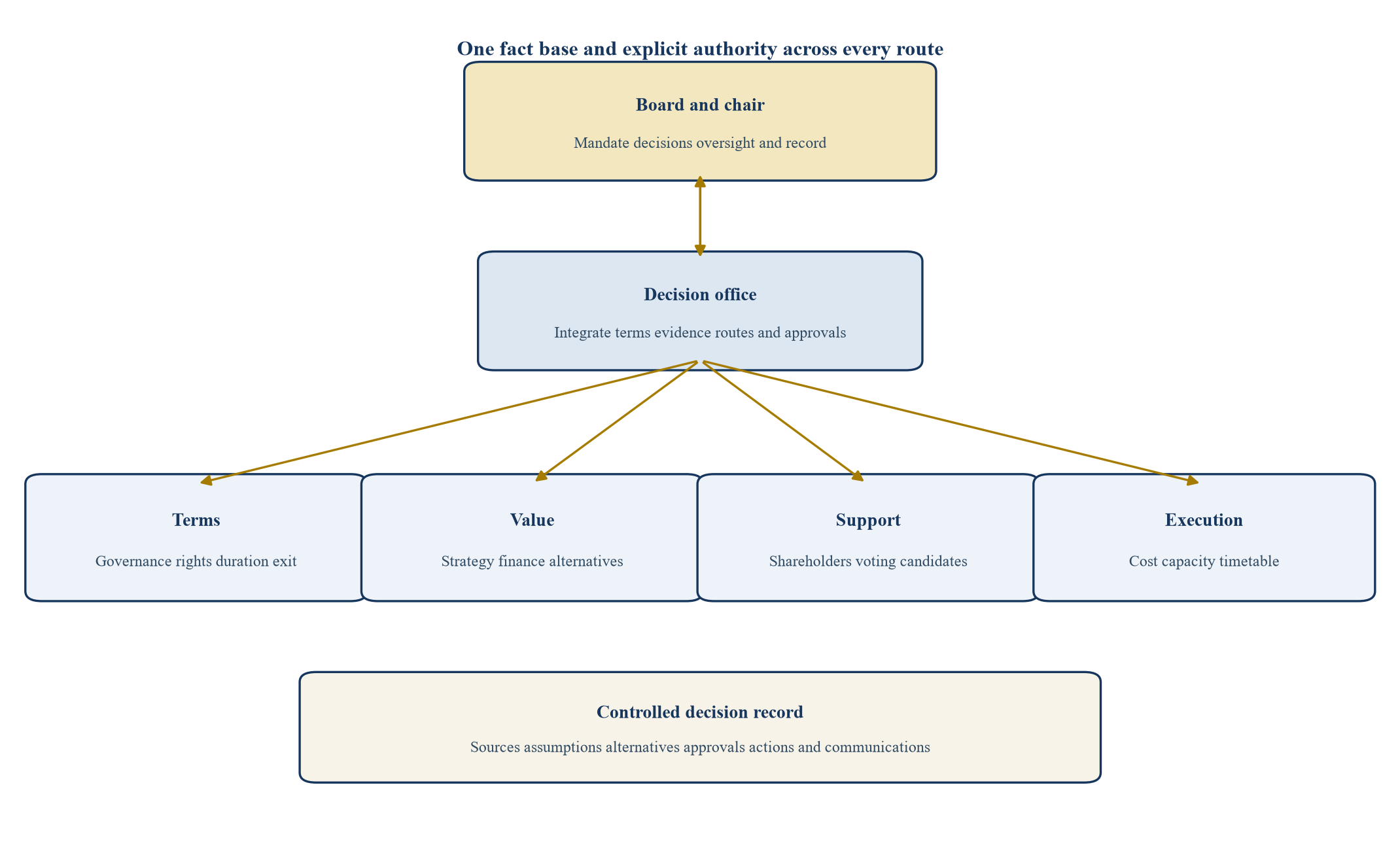
The structure is a governance framework. Roles and information rights should be adapted to the company and applicable law.
8. Test value creation across the full portfolio
The board should test the company as a long-term owner would. The analysis covers portfolio logic, operating performance, capital allocation, balance-sheet resilience, governance, incentives and disclosure. It should identify actions that create value independently of the activist campaign and proposals whose value depends on fragile assumptions.
Portfolio analysis asks whether the group improves each business relative to credible alternative ownership. Operating analysis reconciles revenue, margin, productivity, working capital and capital expenditure to specific drivers. Capital-allocation analysis reconstructs acquisitions, disposals, organic investment, debt, dividends and repurchases against original objectives and actual outcomes.
The board should avoid a single headline valuation. Trading references, discounted cash flow, sum-of-the-parts and transaction evidence can provide a range. Separation costs, tax, debt repayment, pensions, stranded overhead, customer consents and execution time must be included. Gross proceeds are not distributable value.
The analysis should identify the source of any observed valuation discount. A lower multiple may reflect business mix, cyclicality, leverage, governance, growth, liquidity or evidence quality. Applying a higher peer multiple without normalising these differences can overstate the opportunity. The board should test both the earnings base and the valuation reference, and it should use probability-weighted outcomes where execution is uncertain.
Strategic option value also deserves attention. A capability may generate limited current earnings while supporting customer access, technology, regulatory licences or future growth. The team should quantify these benefits where possible and define milestones where current evidence is insufficient. The same discipline applies to claimed synergies: each material benefit should have a mechanism, counterfactual and owner.
Governance and disclosure can also create or obscure value. An unclear portfolio can be compounded by weak segment information. A sound capital programme can lose credibility without post-investment review. The response should therefore link actions to measurable outcomes, accountable leaders, funding and milestones.
9. Develop alternatives without premature commitment
The alternatives workstream should be broad enough to test the activist thesis and disciplined enough to finish. Options may include continuing the approved plan, accelerating existing initiatives, changing the operating model, increasing disclosure, revising capital allocation, refreshing governance, partnering, separating or selling a business, or combining several actions.
Each option needs a consistent template: strategic rationale, value range, cash effect, funding, timing, dependencies, legal and tax issues, stakeholder effects, reversibility and evidence confidence. Management preference should be visible and tested. The board should understand what must be true for the option to work.
A sensitivity table should isolate the assumptions with the greatest effect on value. For a disposal these may include price, tax, stranded cost, separation cost, retained liabilities and closing delay. For operating improvement they may include delivery rate, revenue leakage, implementation cost and benefit persistence. For a repurchase they may include purchase price, funding cost, downside liquidity and foregone investment returns.
Management should identify the no-regret actions that improve control or value across several scenarios. Better segment data, tighter capital gates, customer-level profitability, working-capital discipline and succession readiness can be valuable whether the board pursues the activist proposal or a different route. These actions should still pass normal approval and resource tests.
The team should also examine interaction effects. A division sale can reduce leverage and simplify the story, while leaving stranded overhead and less diversified cash flow. A repurchase can improve per-share value at an attractive price, while reducing capacity for investment or downside protection. Cost action can improve margin, while damaging revenue or control if the implementation perimeter is poorly designed.
The 30-day goal is to identify a preferred direction and a diligence path. A complex transaction should not be announced merely to demonstrate activity. The board can communicate a clear evaluation process, evidence and timing when immediate commitment would destroy optionality.
10. Quantify scenarios and preserve downside capacity
Scenario analysis should connect operating performance, portfolio action, financing and market outcomes. The board needs a base case, a credible improvement case and downside cases. Each case should show EBITDA, cash conversion, implementation cost, proceeds, debt, liquidity, leverage, strategic capacity and potential equity value.
The hypothetical company begins with USD 4.10 billion of revenue, USD 455 million of EBITDA and USD 1.05 billion of net debt. The stated enterprise value of USD 5.05 billion implies a market capitalisation of USD 4.10 billion before other adjustments. These values are assumptions used to demonstrate the method.
Initial operating analysis identifies USD 92 million of gross annual opportunity. The response team removes duplicated estimates, revenue-risk items, unsupported benchmarks and capability investments. It retains USD 64 million of sustainable net annual benefit with USD 78 million of one-off implementation cost. The board-led plan therefore differs materially from the requested USD 120 million programme.
Cash phasing changes the result. A run-rate benefit achieved late in the year cannot be treated as full-year cash. Severance, systems, contract exits and advisory costs may precede savings. Working-capital effects can be positive or negative. The board should see monthly cash, accounting and run-rate bridges for each material workstream.
Financing capacity should be tested under volatility. Interest rates, covenant definitions, ratings objectives, seasonal cash and refinancing maturities can constrain capital returns even where a static leverage ratio appears acceptable. The board should preserve a minimum liquidity reserve and identify actions available if performance deteriorates.
A software-unit sale is modelled at USD 1.10 billion of gross consideration and USD 875 million of net proceeds after assumed tax, transaction, separation and other deductions. If USD 500 million reduces debt, net debt falls to USD 550 million before other cash movements. Pro forma EBITDA must also remove the sold unit and add only benefits supported by the delivery plan. The model should never divide reduced debt by unchanged group EBITDA.
| Measure | Current reference | Board led plan | Accelerated portfolio plan | Severe downside |
|---|---|---|---|---|
| Revenue | 4,100 | 4,160 | 3,620 after disposal | 3,690 |
| EBITDA before new actions | 455 | 465 | 405 after disposal | 370 |
| Sustainable net cost benefit | 0 | 64 | 64 | 38 |
| Pro forma EBITDA | 455 | 529 | 469 | 408 |
| Net disposal proceeds | 0 | 0 | 875 | 0 |
| Debt reduction from disposal | 0 | 0 | 500 | 0 |
| Net debt before other cash movement | 1,050 | 1,050 | 550 | 1,190 |
| Net leverage | 2.3x | 2.0x | 1.2x | 2.9x |
| One off implementation cost | 0 | 78 | 126 including separation | 96 |
| Permitted near term repurchase | 0 | 0 | Conditional after liquidity gate | 0 |
All amounts are scenario assumptions in USD millions. Equity value is illustrative and excludes market, execution and timing effects beyond the stated assumptions.
11. Separate gross opportunity from deliverable value
Activist proposals often express opportunity as a gross number. The board needs net value. A cost programme should bridge identified spend to addressable spend, actions, revenue and control risk, required reinvestment, implementation cost, cash timing and sustainable benefit. A disposal should bridge headline price to tax, fees, debt repayment, pensions, separation, stranded cost and retained liabilities.
Delivery capacity is a financial constraint. Management cannot execute an operating transformation, transaction, refinancing and public contest with unlimited effectiveness. The scenario model should reflect scarce leadership attention, systems capacity and change risk. Initiatives should be sequenced around dependencies and customer impact.
Benefits require owners and milestones. A sustainable USD 64 million annual benefit should have work packages, monthly run-rate, cash conversion, one-off cost, implementation risk and assurance. The board should receive gross and net reporting. Reclassification and delayed investment should not be reported as structural saving.
Value also depends on credibility. An achievable plan with controlled milestones may support a higher probability-weighted outcome than a larger target with weak evidence. The board should compare expected value, downside and strategic flexibility, not headline ambition alone.
12. Create a shareholder intelligence system
Shareholder intelligence should integrate the registered holder list, beneficial-ownership filings, custodial information where available, stock surveillance, voting history, engagement notes and public stewardship policies. The output is a dated ownership map with evidence confidence.
The company should segment holders by investment approach and decision process, while avoiding unsupported assumptions about their vote. Index investors, active long-only funds, event-driven investors, retail holders and strategic owners may use different research and voting channels. Proxy advisers may influence process and analysis. Every major holder should have an accountable relationship owner and an approved engagement objective.
Engagement history matters. The team should identify unresolved questions, prior commitments, voting concerns and discrepancies between investor feedback and company action. Investors may support the existing strategy while seeking better evidence, clearer milestones or governance changes. A listening programme can distinguish these positions.
The board should receive themes and evidence rather than selective anecdotes. Notes should record participants, date, questions, information provided, follow-up and any potential disclosure issue. Sentiment estimates should be labelled as estimates within internal reporting and should never be presented as confirmed voting intention.
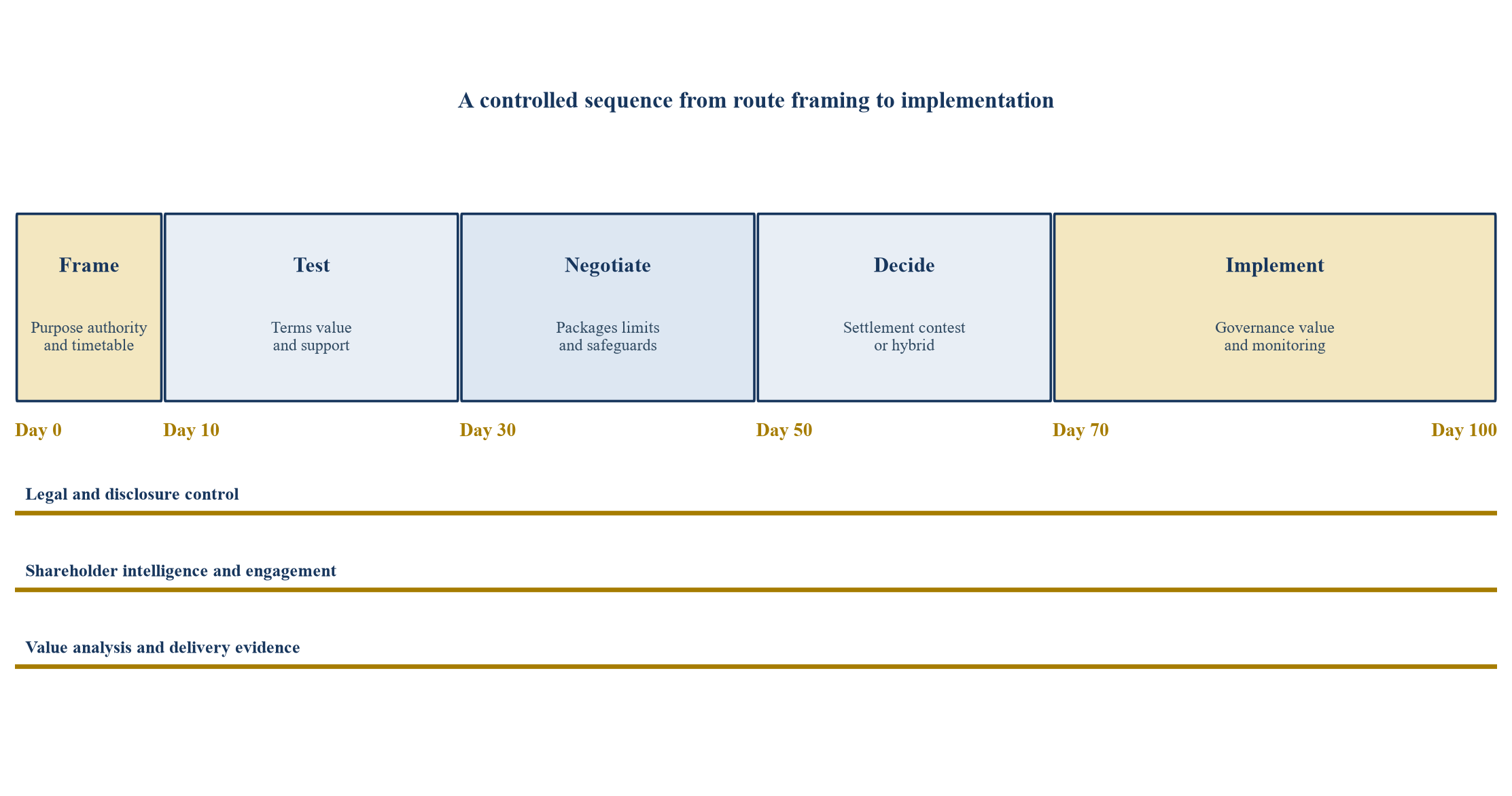
The sequence is a management planning tool. Applicable legal, nomination, solicitation and disclosure deadlines take priority.
13. Design engagement as a governed process
The first substantive meeting should have a clear objective. The company may need to understand the thesis, evidence, requested process and proposed governance route. It should decide in advance who attends, who speaks, what can be discussed and how questions will be handled.
Listening is valuable when it produces evidence. The team should ask how the activist derives its value range, which assumptions drive the proposed actions, how execution risks are treated, what ownership and voting position exists, and what outcome is sought. The company can explain current strategy and constraints using approved information. It should avoid debating every assertion in real time.
The meeting record should separate statements, questions, requested materials and commitments. Any follow-up should pass legal, financial and disclosure review. The response office should compare new information with the proposition register and inform the board of material changes.
Broader shareholder engagement should follow the same control. The company should listen to long-term owners, explain the board's process and test whether existing disclosure answers their decision needs. Engagement should not become an informal vote count based on ambiguous conversations.
14. Prepare communications before communications drive the response
The communications plan should support the board's decisions. It should contain a holding statement, question and answer pack, key facts, leak response, stakeholder map, spokesperson protocol, employee message, customer and supplier considerations, digital monitoring and approval route.
The company should communicate only what it can support. Claims about valuation, synergies, cost, shareholder support, strategic alternatives or activist motives carry legal and credibility risk. Every public number should reconcile to the controlled fact book. Forward-looking statements need the applicable review.
Narrative consistency matters across regulatory filings, results calls, investor meetings, employee communications and media. Different levels of detail may be appropriate, while the central facts and strategic logic should remain aligned. The response team should track every material external statement and update the question pack.
Silence can be appropriate during analysis. It should be an informed decision supported by monitoring and a leak protocol. A public response can be necessary when the approach is disclosed, market rumours become material, formal steps are taken or applicable rules require it.
15. Control board and management bandwidth
An activist response can consume the organisation. The board should protect business delivery through explicit work allocation. A small response office handles the campaign. Operating leaders continue to manage customers, people, cash, safety, technology and regulatory obligations.
The programme plan should identify critical business milestones during the 30 days: results, financing, major bids, customer renewals, regulatory submissions, transactions and leadership decisions. Campaign work should be scheduled around these commitments. Advisers should receive structured data requests rather than approaching operating teams independently.
Management incentives need attention. A campaign can create retention risk, defensive behaviour and short-term decision making. The board should monitor key-person exposure and succession without promising benefits that could create conflicts. Employees need factual communications that reduce distraction and preserve confidentiality.
The response office should measure its own workload. Repeated analysis, overlapping adviser requests and uncontrolled document production are warning signs. A single question log and decision calendar improve speed and reduce error.
16. Build a risk heat map linked to action
The risk register should cover market integrity, legal process, shareholder support, value evidence, business performance, financing, transaction feasibility, people, customers, cyber and information leakage. Each risk needs an owner, trigger, control, residual exposure and escalation route.
Likelihood and consequence should be assessed with evidence. A high-consequence disclosure failure may warrant immediate controls even if likelihood is low. A probable campaign escalation may be manageable if the board has a strong fact base and engagement plan. The heat map should show where additional control changes the outcome.
Risks interact. Weak quarterly performance can amplify a governance concern. A leak can force disclosure before value analysis is ready. A proposed disposal can affect credit, customers and employees. The response office should identify these chains and test combined scenarios.
The board dashboard should show movement. A static list does not reveal whether evidence, control or exposure has improved. Changes should be explained and connected to decisions.
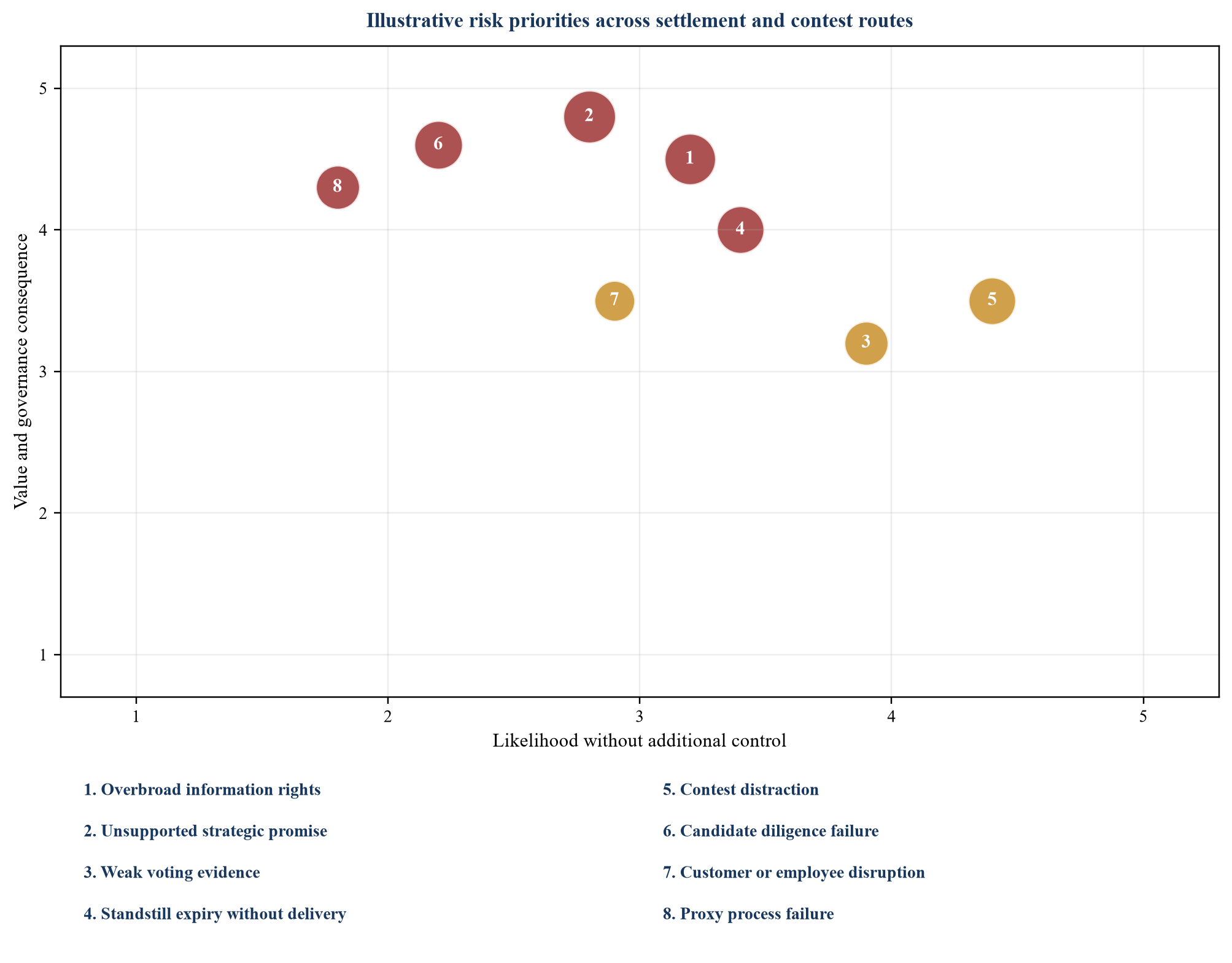
Positions are illustrative scenario judgements. Bubble size represents assumed consequence and does not represent observed loss.
17. Negotiate the complete settlement package
Settlement should be evaluated as an integrated package. Director appointments, committee roles, information access, standstill, voting commitments, confidentiality, non-disparagement, nomination restrictions, expense reimbursement, strategic reviews, capital allocation and public statements interact. A concession that appears narrow in isolation can become material when combined with other rights.
The board should approve a term architecture before negotiators exchange drafts. The architecture should identify acceptable ranges, prohibited outcomes, dependencies, approval requirements and walk-away conditions. Negotiators need authority to explore combinations without committing the company. Every material draft should be reconciled against the approved architecture and recorded with the reason for change.
Director terms require particular care. Candidate assessment should start with the skills, independence, time and experience the company needs. Appropriate diligence should cover conflicts, other mandates, confidentiality, regulatory suitability and committee implications. Appointment should not create a separate class of director loyalty. The board remains collectively responsible for the company.
A standstill buys execution time only when its duration, scope, termination and enforcement support the delivery plan. The board should test what happens at expiry, after a material breach, following a change of control and when the parties disagree over performance. Voting commitments, nomination restrictions and ownership thresholds should be reviewed with current counsel.
Strategic commitments should describe process and evidence, not predetermine an unsupported result. A commitment to review a business can set scope, governance and timing while preserving the board's ability to retain, improve, partner, separate or sell. A capital-return commitment should remain subject to liquidity, leverage, investment, regulatory and transaction-closing gates.
The company should prepare the implementation plan before signing. It should cover appointments, announcements, committee changes, information access, conflicts, confidentiality, expense payment, monitoring, dispute escalation and termination. The board should understand how every term operates during ordinary business and renewed disagreement.
18. Compare settlement contest and hybrid routes through one scorecard
The board should compare all credible routes through common criteria. The scorecard should include risk-adjusted value, strategic freedom, governance quality, direct cost, management distraction, timetable, voting support, disclosure burden, business continuity, implementation certainty and reversibility. Weightings should reflect the company rather than a generic activism playbook.
The proxy-contest case needs an evidenced voting model. Shareholder positions should be recorded as confirmed, indicated, unknown or unavailable. The company should avoid treating adviser recommendations or historical votes as certain outcomes. Universal-proxy rules in the United States allow shareholders voting by proxy in covered contests to select from company and dissident nominees on the same card, which increases the importance of candidate-specific analysis. [3]
The settlement case needs a term-by-term governance model and an execution case. The hybrid route may preserve negotiation while preparing for a contest, or reach a late settlement after support has been tested. It can improve information and bargaining clarity while incurring much of the contest cost and public exposure.
The scorecard is a decision aid. Directors still need to explain why the selected route supports the company and shareholders, how uncertainty was handled and which conditions would require reconsideration.
| Criterion | Weight | Early settlement | Proxy contest | Late settlement after contest preparation |
|---|---|---|---|---|
| Risk-adjusted value delivery | 25% | 4; agreed operating and review programme | 3; greater discretion with delayed execution | 3; narrower governance concession with delay |
| Governance and board capability | 20% | 4; two qualified directors subject to diligence | 3; shareholder vote across competing nominees | 4; one qualified director and independent review committee |
| Strategic freedom | 15% | 3; commitments and standstill terms constrain choices | 5; board retains authority subject to vote | 4; limited commitment after evidence development |
| Cost and management capacity | 15% | 5; assumed USD 6 million direct cost | 2; assumed USD 22 million direct cost | 3; assumed USD 14 million direct cost |
| Timing and execution certainty | 10% | 5; implementation starts after signing | 2; voting timetable delays decisions | 3; preparation precedes implementation |
| Shareholder support and legitimacy | 10% | 3; support inferred from engagement | 5; formal voting outcome | 4; support evidence improves during preparation |
| Reversibility and future flexibility | 5% | 3; governed by term duration and termination | 4; post-vote board retains ordinary authority | 3; settlement still creates contractual limits |
| Weighted indicative score | 100% | 4.00 | 3.35 | 3.55 |
All amounts, scores and outcomes are scenario assumptions. Scores use a five-point scale where five is more favourable to the company after considering risk.
19. Apply the framework to the hypothetical decision
The hypothetical activist reports a 6.2 per cent position and nominates three candidates for a ten-seat board. It requests a software-unit sale, USD 120 million of gross annual cost action and a USD 400 million repurchase. The company has USD 4.10 billion of revenue, USD 455 million of EBITDA, USD 1.05 billion of net debt, an assumed USD 4.00 billion market capitalisation and USD 5.05 billion enterprise value.
The board first tests the underlying thesis. Management identifies USD 92 million of gross opportunity and USD 64 million of sustainable net annual benefit after protecting revenue, controls and necessary capability. The programme requires USD 78 million of implementation cost. The gross cost request is therefore unsuitable as a public commitment, while the supported net programme can proceed with accountable owners and cash gates.
The software-unit case produces USD 1.10 billion of assumed gross consideration and USD 875 million of assumed net proceeds after tax, separation, transaction and other modelled deductions. The board determines that a strategic review is justified. It retains the ability to improve, partner, separate, sell or retain the unit until evidence supports a final decision. The capital-allocation sequence applies USD 500 million to debt repayment and allows a conditional USD 250 million return only after closing, liquidity and investment tests.
The early settlement route appoints two qualified directors after diligence, establishes a twelve-month standstill and commits the company to the supported operating programme and a software-unit strategic review. It contains no precommitted sale. The direct cost assumption is USD 6 million. The board requires defined information rights, ordinary director duties, confidentiality, conflict procedures and termination terms.
The proxy-contest route retains the company's slate and strategic discretion. It has USD 22 million of assumed direct cost before estimating management time, customer effects or opportunity cost. Voting support remains uncertain. A formal vote can provide legitimacy, although candidate-by-candidate outcomes under applicable proxy rules may produce a mixed board rather than a complete victory for either slate.
The late-settlement route follows contest preparation. It appoints one qualified director, forms an independent strategic-review committee and contains a narrower standstill. Its assumed direct cost is USD 14 million because solicitation, adviser and communications work has already begun. It benefits from improved support evidence while retaining the distraction and public exposure created during preparation.
Using the stated weights, early settlement scores 4.00, late settlement 3.55 and proxy contest 3.35. The hypothetical board selects early settlement subject to final legal documents, candidate diligence and execution safeguards. The score does not establish a general preference for settlement. A different support profile, weaker terms, stronger operating evidence or greater strategic restriction could change the route decision.
20. Execute the selected route through a 100 day roadmap
The route decision must transition from analysis to delivery. Each approved action needs an executive owner, board sponsor, value baseline, budget, milestone, risk register and reporting rhythm. The company should distinguish contractual settlement terms, announced commitments, internal stretch cases and options still under study.
The roadmap should connect each initiative to the original board decision. This link prevents the programme from becoming a collection of unrelated actions. If the decision was to improve portfolio focus and reduce leverage, the reporting should show how operating actions, disposal preparation, financing and disclosure jointly support that objective.
Benefits and risks should be reviewed on the same timetable. A cost workstream that is ahead of plan may still damage service or controls. A transaction that produces a higher price may carry greater completion risk. The dashboard should show the trade-offs that require board judgement rather than celebrating activity alone.
During days zero to ten after signing, the company should complete announcements, appointments, induction, committee assignments, information protocols, conflict procedures and programme mobilisation. Days eleven to thirty should lock baselines, approve workstream charters and confirm the strategic-review process. Days thirty-one to seventy should advance operating actions, review alternatives and report supported milestones. Days seventy-one to one hundred should test delivery, refresh risks and prepare the first formal board and shareholder update.
Operating improvement should be reported through run-rate and cash measures. The sale review needs perimeter, accounts, separation, tax, legal, customer, people and buyer plans without presuming an outcome. Debt reduction requires financing coordination. Governance change needs candidate diligence, induction, committee integration and succession alignment. Disclosure improvement needs definitions, controls and a timetable.
The board should establish stop or revise triggers. Examples include customer loss, implementation cost above approval, leverage outside the gate, valuation below the reservation range, regulatory delay or deterioration in the core plan. These triggers preserve discipline when public pressure encourages commitment escalation.
An assurance process should test reported progress. Finance validates value and cash. Internal audit or another independent control function may test selected delivery evidence. Legal and communications validate disclosure. The board remains responsible for judgement.
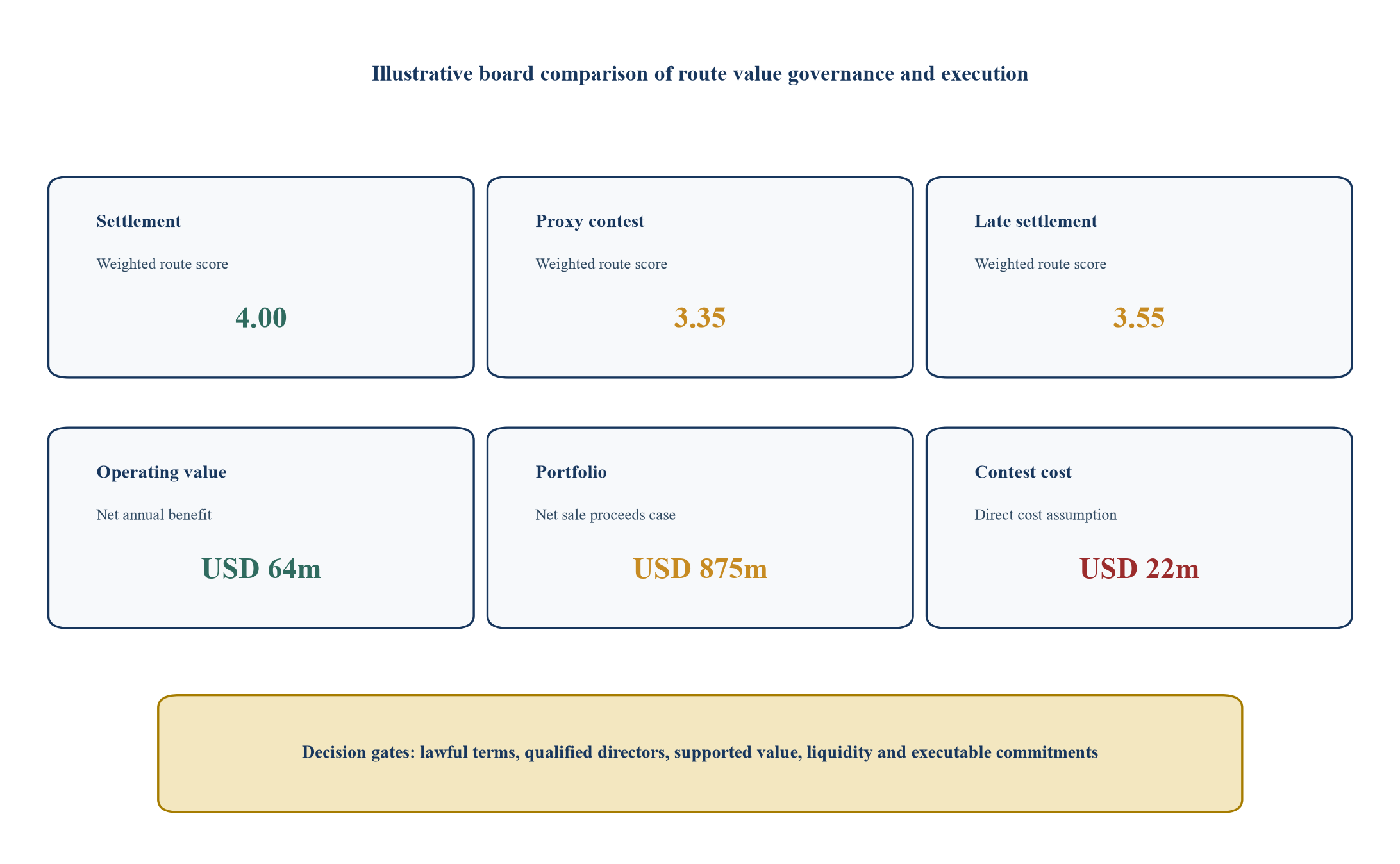
Measures and thresholds are illustrative. A company should define them against its strategy, risk appetite and disclosure obligations.
21. Use a board decision record that can withstand scrutiny
The final board paper should state the decision, alternatives considered, evidence, assumptions, legal context, shareholder views, financial analysis, stakeholder effects, risks, conflicts, adviser input and reasons. It should identify material uncertainty and the further evidence required.
The record should distinguish information available at the time from later outcomes. Good governance does not depend on hindsight. It depends on a reasonable process, relevant evidence, informed judgement and proper purpose under applicable law.
Minutes should capture challenge. Directors may agree on the action while differing on valuation, timing or risk. The record can show how those concerns were resolved or monitored. Boilerplate does not demonstrate judgement.
Public communication should be consistent with the decision record. Confidential detail may remain protected, while the central rationale, actions and milestones should align. A company weakens credibility if its public certainty exceeds its internal evidence.
22. Measure the route after the decision
The board should monitor value delivery, settlement compliance or contest readiness, shareholder engagement, business performance, financing, governance and disclosure. Measures should include net benefit realised, cash conversion, implementation cost, strategic-review milestones, leverage, liquidity, customer retention, employee turnover, investor questions and voting outcomes.
The company should also evaluate process quality. It can assess response speed, decision clarity, data accuracy, leakage, adviser coordination, management distraction and whether the board received the right information. Lessons should update the standing activism-readiness plan.
The thesis can evolve. An activist may change proposals, increase ownership, seek nominations, requisition a meeting, publish materials or disengage. Market conditions and company performance can change the value case. The dashboard should therefore track triggers rather than assume a fixed campaign.
The long-term test is whether the company makes better decisions and delivers them. A campaign that ends without operational or governance improvement can leave the underlying value gap intact. A board-led response should become part of normal strategy, capital-allocation and performance governance.
23. Recognise the limitations of a playbook
This framework cannot determine legal obligations across every jurisdiction or set the correct outcome for a specific company. Ownership structures, constitutions, listing rules, takeover regimes, fiduciary duties, market conditions and facts differ. Current legal, tax, accounting and financial advice is required.
The hypothetical case is a worked example. Its amounts, valuation, cost opportunities, sale proceeds, leverage and timing are assumptions. They are not forecasts, benchmarks or evidence about a real company. The scenario excludes many possible facts, including pensions, minority interests, regulatory capital, complex derivatives and multiple listings.
A route decision may establish control and direction. It does not complete transaction diligence, operating design, consultation, financing, regulatory approval or implementation. The board should communicate the distinction between a commitment to evaluate, a decision to prepare and a final transaction or capital-allocation approval.
The framework supports judgement through structure. It does not replace director responsibility. The quality of the outcome depends on evidence, independence, lawful process, strategic coherence and execution.
24. Conclusion
Settlement versus proxy contest is a board decision about value, governance, execution and legitimacy. The board needs control of authority, legal obligations, information, communications and negotiation. It then needs to reconstruct the strongest thesis, establish a common fact base, model the credible contest alternative and evaluate the complete settlement package.
The decision framework compares early settlement, proxy contest and late settlement through common criteria. It requires term-by-term governance analysis, support evidence, direct and indirect cost, strategic freedom, implementation capacity and reversibility. A settlement should have a 100-day operating plan before signature. A contest should have an equally detailed voting, communications and business-continuity plan.
In the hypothetical case, the board supports USD 64 million of sustainable net annual benefit with USD 78 million of implementation cost, evaluates USD 875 million of net proceeds from a possible software-unit sale and conditions any capital return on debt, liquidity and closing. Early settlement scores 4.00 against 3.35 for a contest and 3.55 for a late settlement under the stated assumptions. USD 22 million and USD 14 million are the assumed direct costs of the latter routes.
A credible decision is measured by evidence, proper purpose and execution. The board should be able to explain why the selected package serves the company, which alternatives it tested, how uncertainty affected the decision and which triggers require reconsideration.
Sources
- U.S. Securities and Exchange Commission. (2023). Modernization of Beneficial Ownership Reporting. Read the primary source
- U.S. Securities and Exchange Commission. (2025). Exchange Act Sections 13(d) and 13(g) and Regulation 13D-G Beneficial Ownership Reporting. Read the primary source
- U.S. Securities and Exchange Commission. (2021). Universal Proxy. Read the primary source
- UK Parliament. (2006). Companies Act 2006 Explanatory Notes. Read the primary source
- UK Takeover Panel. (2026). Definition of Acting in Concert. Read the primary source
- U.S. Securities and Exchange Commission. (2025). Regulation FD. Read the primary source
- Financial Reporting Council. (2024). UK Corporate Governance Code 2024. Read the primary source
- OECD. (2023). G20/OECD Principles of Corporate Governance 2023. Read the primary source
- OECD. (2025). Shareholder Meetings and Corporate Governance. Read the primary source
- Financial Reporting Council. (2026). Corporate Governance Code Guidance. Read the primary source
- U.S. Securities and Exchange Commission. (2025). Proxy Rules and Schedules 14A and 14C. Read the primary source
- European Union. (2017). Directive 2017/828 as regards the encouragement of long-term shareholder engagement. Read the primary source
- Tokyo Stock Exchange. (2026). Action to Implement Management that is Conscious of Cost of Capital and Stock Price. Read the primary source
- Singapore Exchange. (2018). Code of Corporate Governance. Read the primary source
- Securities and Futures Commission of Hong Kong. (2026). Securities and Futures Ordinance Part XV Disclosure of Interests. Read the primary source
- Australian Securities and Investments Commission. (2026). Shareholder rights and responsibilities. Read the primary source
- Australian Securities and Investments Commission. (2015). ASIC updates guidance on collective action by investors. Read the primary source
- Alberta Securities Commission. (2026). National Instrument 62-103 The Early Warning System and Related Take-Over Bid and Insider Reporting Issues. Read the primary source
