

1. Define the portfolio problem before the product shelf
A Shariah private-markets strategy should begin with the portfolio problem that the institution is trying to solve. Possible objectives include contractual income, inflation-sensitive cash flows, ownership of productive businesses, diversification from public markets, exposure to innovation, intergenerational assets, impact or access to operating opportunities. Each objective points toward different assets, terms, skills and risks. A broad call for more alternatives does not provide a product mandate.
The starting portfolio may already contain public sukuk, screened listed equities, Islamic deposits, cash-management products and direct property. That portfolio can be appropriate for its objectives. A private-market extension should identify a specific gap and explain whether the proposed vehicle improves expected cash-flow quality, diversification, access, control, duration or alignment. It should also identify what the investor gives up through illiquidity, valuation delay, concentration, complexity and higher governance demands.
Client segmentation must include liabilities and decision capacity. A family with recurring distributions, operating-company exposure and concentrated property may need a different shelf from an internationally mobile entrepreneur with surplus liquidity or an institution matching long-dated obligations. Legal structures, tax residence, currency, risk capacity, commitment discipline and succession requirements shape the usable opportunity set.
The product sponsor should write an evidence statement for each shelf addition. It should name the client purpose, portfolio role, expected holding period, return source, principal loss mechanism, liquidity route, governance structure, Shariah basis, complete cost and measurable client outcome. This statement becomes the common brief for investment, Shariah, legal, compliance, operations and relationship teams.
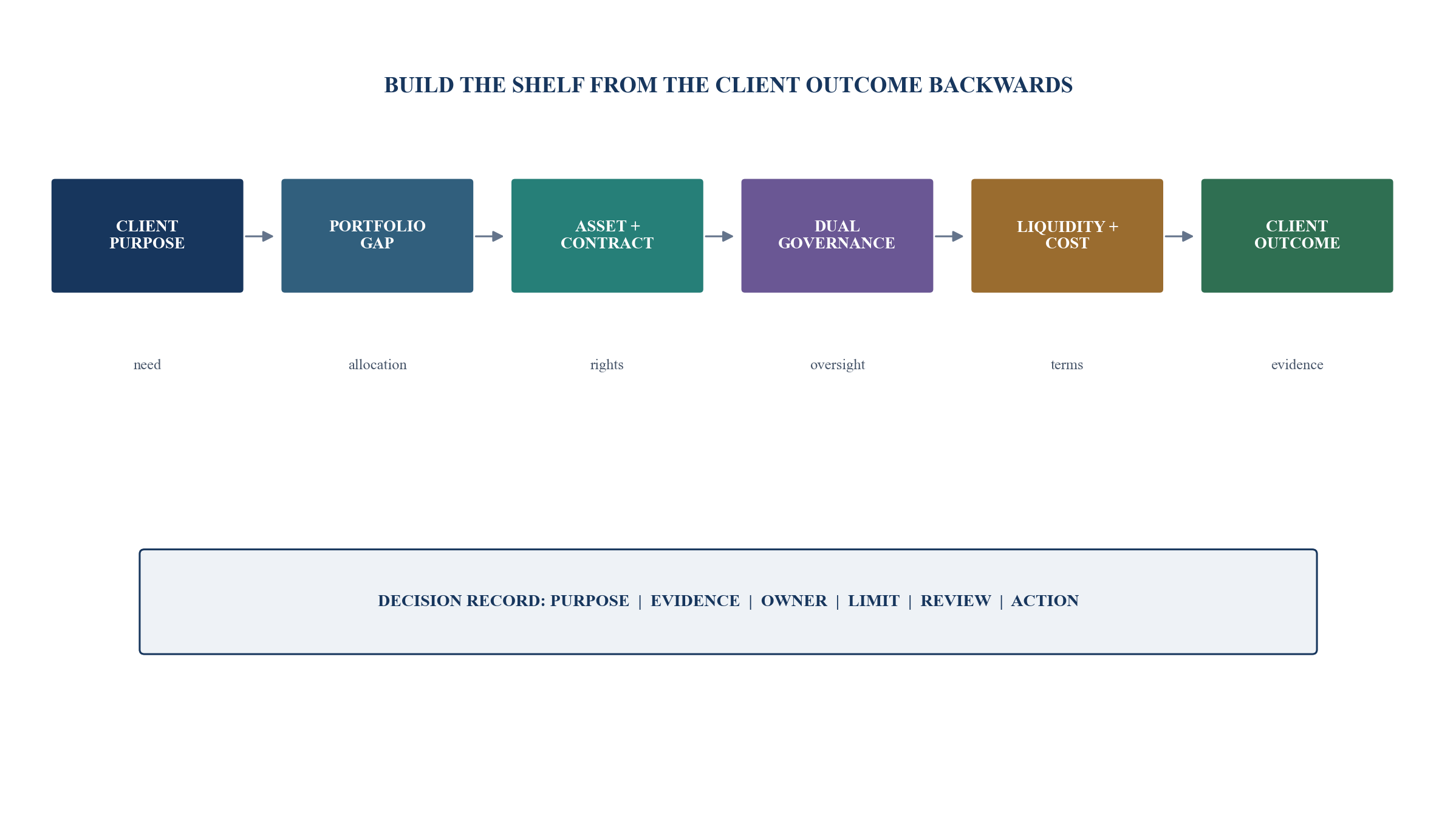
Author framework. Each link requires documented evidence, an owner and a review date.
2. Use the global market evidence as context
The Islamic Financial Services Board's 2025 stability report describes an industry spanning Islamic banking, sukuk, Islamic funds and takaful across multiple jurisdictions. The report is useful context for market structure and systemic resilience. It does not establish the availability or suitability of a particular private-market product.
Malaysia provides detailed official evidence on the Islamic fund ecosystem. Securities Commission Malaysia reported that the Islamic capital market reached RM2.7 trillion in 2025. Its annual report recorded RM274.01 billion of Islamic fund-management assets, 433 Islamic collective investment schemes and 64 fund-management companies overseeing Islamic funds. The same official release reported that total committed funds in Malaysia's venture-capital and private-equity industry reached RM30.05 billion. These datasets are distinct; they do not show how much of the private-equity figure is Shariah-compliant.
Indonesia's 2023 to 2027 capital-market roadmap includes development of the Shariah capital-market ecosystem, professional capacity, products, infrastructure and investor participation. Luxembourg for Finance identifies experience with Shariah-compliant investment funds and cross-border distribution. The UK government has used sovereign sukuk to support London's position in Islamic finance, while the FCA's product-governance framework supplies a relevant distributor-control reference for products in scope. Singapore's regulatory treatment of Islamic banking and its broader fund-management infrastructure provide another non-Gulf operating comparison.
The Gulf adds important governance and distribution evidence. The Central Bank of the UAE's Higher Shari'ah Authority sets standards and supervises internal Shari'ah committees for licensed Islamic financial institutions. Its published governance materials describe board, management, compliance and audit responsibilities. Fund and wealth structures in other financial centres can follow different rulebooks. A global shelf therefore needs a jurisdiction-specific perimeter rather than a single regional assumption.
Table 1. Global official evidence and its shelf-design use
| Market or body | Official evidence | Decision use |
|---|---|---|
| Islamic Financial Services Board | global stability, governance, disclosure and investor-protection standards | establish cross-border control themes and systemic context |
| Malaysia | Islamic market and fund data, Islamic fund-management rules, Shariah adviser framework and private-capital development | benchmark mature product and governance infrastructure |
| Indonesia | capital-market roadmap with Shariah ecosystem development | assess local product, distribution and capacity-building requirements |
| Luxembourg and European Union | cross-border fund infrastructure and investor-protection frameworks | test domicile, passport, distribution, disclosure and service-provider design |
| United Kingdom | product-governance requirements and established Islamic-finance policy infrastructure | test manufacturer-distributor responsibilities and client outcomes |
| Singapore | regulatory approach to Islamic banking within an international wealth centre | test booking-centre, tax, distribution and operating arrangements |
| Gulf financial centres | Shariah governance, fund, banking and wealth-distribution rulebooks | define local approval, committee, disclosure and distribution requirements |
Sources differ in legal status, date and scope. Market data do not establish product availability or investor suitability.
3. Separate the asset, contract and vehicle
A private-market label can conceal three separate decisions. The first concerns the economic asset: a loan, business, project, property, infrastructure concession, receivable or venture investment. The second concerns the contract through which income, ownership and loss are allocated. The third concerns the fund, partnership, trust, special-purpose vehicle, managed account or co-investment vehicle that holds the exposure.
Investment diligence should begin with the asset and its cash flows. A private-credit opportunity requires analysis of the borrower, purpose, repayment source, leverage, security, covenants, intercreditor position and recovery. A private-equity investment requires analysis of the business, governance, value-creation plan, capital structure and exit. Infrastructure and real assets require analysis of title, concession, construction, counterparties, insurance, operations and residual value.
Shariah analysis then examines the activity, contract, asset ownership, income, leverage, trading restrictions and handling of any non-compliant amounts. The applicable analysis depends on the structure and the relevant authority. A private fund may invest through equity, partnership, leasing, trade, agency or other arrangements. Similar portfolio exposures can create different rights and compliance questions when reached through different contracts.
The vehicle creates another layer. Its governing law, limited-liability design, segregation, manager powers, advisory committee, valuation policy, transfer terms, waterfall and dissolution provisions affect the investor. A Shariah opinion about a structure should be connected to the final documents, actual cash flows and continuing operations. Product approval should preserve those links.
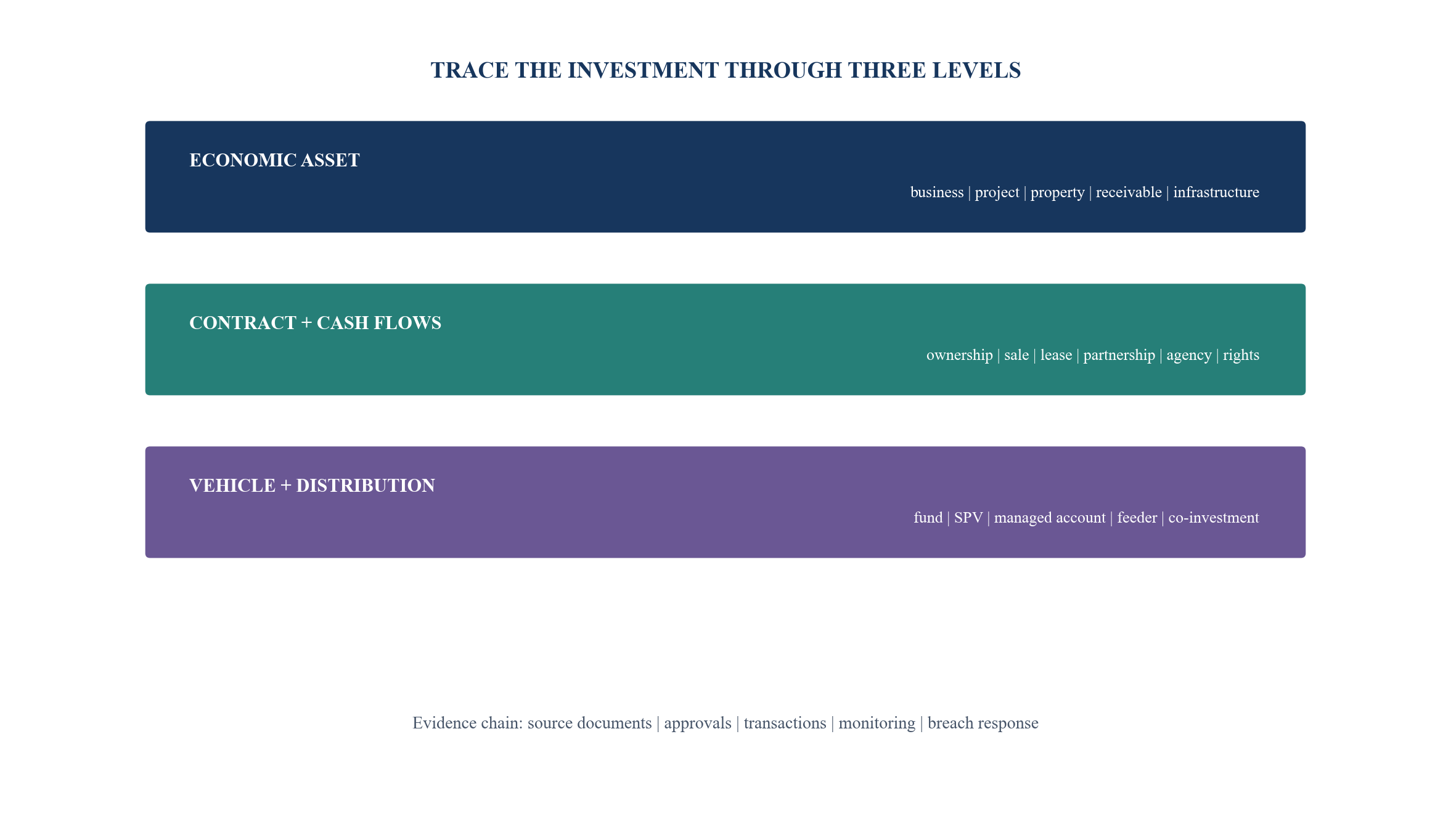
Author framework. A conclusion at one level does not replace diligence at the other levels.
4. Build a private-markets shelf by portfolio function
The shelf should organize products by portfolio function and underlying risk. Private credit can provide contractual income while exposing the investor to borrower default, illiquidity, documentation and recovery. Buyout and growth equity provide ownership and value-creation exposure with business, leverage and exit risk. Venture capital offers access to innovation with high dispersion, long holding periods and loss risk. Infrastructure and real assets can provide contracted or inflation-sensitive cash flows while introducing construction, operating, regulatory and asset-specific risks.
Real estate can appear through direct ownership, development, income vehicles, financing or operating platforms. Each route creates different cash flows and governance. Trade and asset-backed strategies can connect financing to identified transactions or assets, while requiring close review of documentation, title, counterparties and execution. Impact and waqf-featured funds add stated social objectives and distribution policies; Malaysia's framework provides one official example for collective investment schemes with a waqf feature.
A bank should avoid treating every private asset as a substitute for sukuk. Public sukuk can provide price discovery, tradability and portfolio liquidity that private funds usually lack. Private strategies may serve different roles and should be sized within a total portfolio. The product shelf should show where the investor receives contractual cash flow, ownership participation, asset exposure or a combination.
Each shelf segment needs an evidence card covering investment purpose, eligible activities, contract, vehicle, manager, Shariah governance, liquidity, valuation, leverage, concentration, currency, tax, fees, capital calls, reporting and exit. The card should also identify the closest public or conventional comparison.
Table 2. Shariah private-markets shelf map
| Shelf segment | Possible portfolio role | Core evidence | Principal decision question |
|---|---|---|---|
| private credit and asset-backed finance | contractual income and capital preservation objective | borrower cash flow, contract, security, covenants, recovery and Shariah approval | is the return supported by enforceable rights and a credible repayment source? |
| buyout and growth equity | ownership, governance and value creation | business activities, leverage, shareholder rights, plan and exit | can the manager create value within the approved activity and capital structure? |
| venture capital | access to innovation and asymmetric outcomes | screening, ownership terms, reserves, governance, failures and exits | can the client tolerate high loss rates, dispersion and duration? |
| infrastructure | long-duration or contracted cash flows | concession, counterparties, construction, operations, financing and residual value | who bears completion, demand, operating and regulatory risk? |
| income real estate | rent and asset exposure | title, tenant, lease, financing, capex, valuation and exit | is income sustainable after costs, leverage and concentration? |
| trade and working-capital strategies | self-liquidating transaction exposure | goods, sale, title, invoices, obligors, servicing and fraud controls | does each financed transaction evidence the required asset and cash flow? |
| impact or waqf-featured funds | financial and stated social outcomes | investment mandate, distribution policy, governance and impact evidence | are both financial and social claims measurable and governed? |
Structures are illustrative and require current product, legal, regulatory and Shariah verification.
5. Install a dual-governance architecture
A Shariah private-markets shelf needs conventional investment governance and Shariah governance connected through the same product lifecycle. The conventional architecture covers fiduciary duty, product governance, conflicts, manager selection, investment risk, valuation, liquidity, operations, financial crime, disclosure and suitability. The Shariah architecture covers authority, methodology, product approval, continuing review, audit, reporting and remediation.
Official frameworks demonstrate several approaches. Securities Commission Malaysia maintains rules for Islamic capital-market products, Islamic fund management and Shariah advisers. Bank Negara Malaysia's governance policy for Islamic financial institutions integrates Shariah considerations with business and risk strategy. The UAE Higher Shari'ah Authority establishes binding governance and standards for institutions within its perimeter. IFSB-6 addresses governance for Islamic collective investment schemes, while IFSB-19 addresses disclosure for sukuk and Islamic collective investment schemes.
The institution should identify the authority applicable to every role. A product may involve a fund-level Shariah board or adviser, a manager's framework, an institutional Shariah committee and a national or sector authority. The product file should record which opinion covers which entity, document, activity and period. It should also address differences between recognized methodologies and the treatment of changes.
Independence, competence and information access matter. The Shariah reviewer needs the final contracts, investment policy, asset data, leverage, cash flows, fees and operating changes. The investment committee needs the Shariah conditions that affect eligible assets, financing, liquidity and exits. Operations need executable rules for screening, pre-trade approval, monitoring, purification where applicable, breach response and reporting.
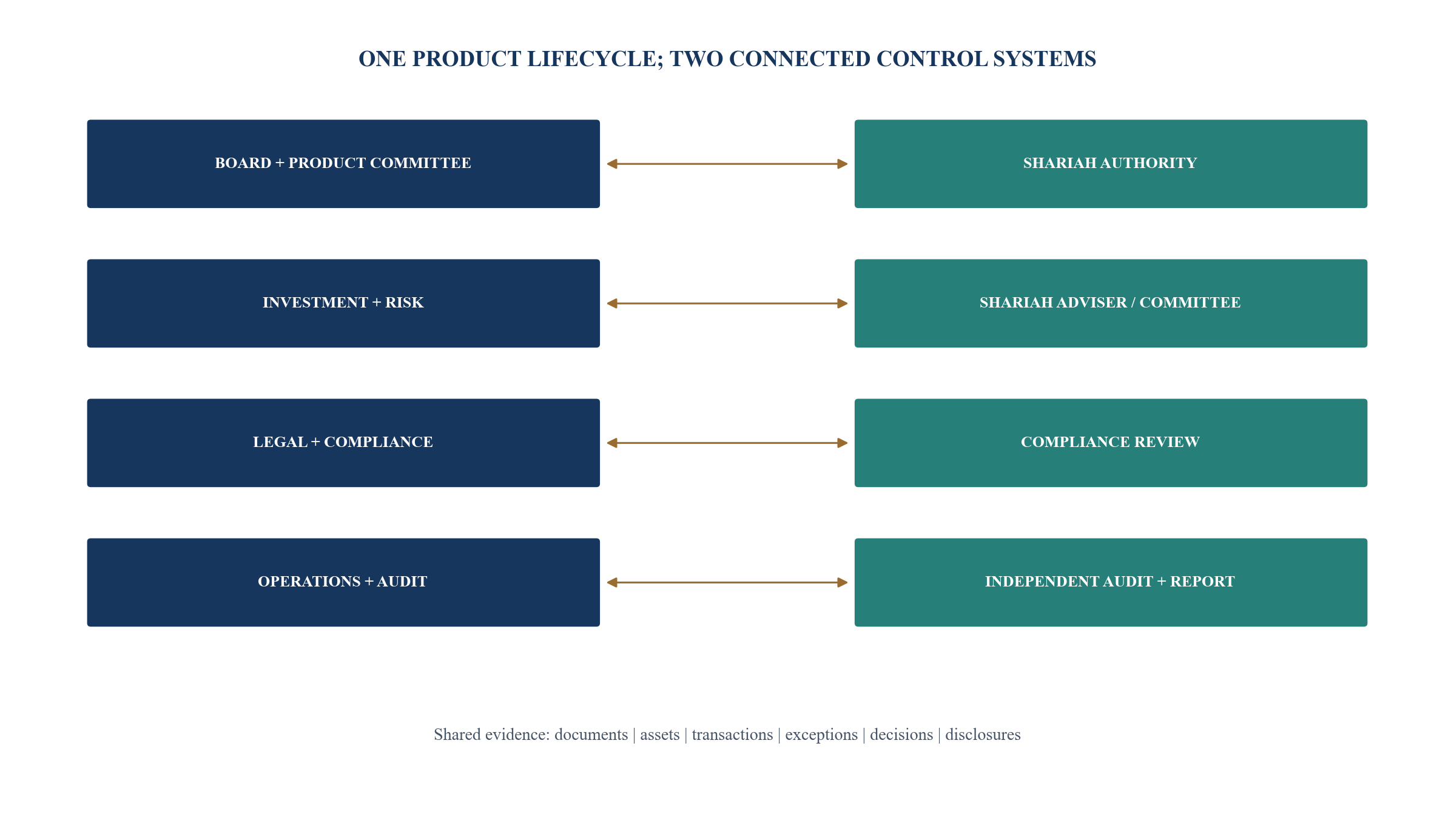
Author framework. Responsibilities and authorities depend on the institution, product and jurisdiction.
6. Make screening operational at asset and transaction level
Screening must operate at the level relevant to the investment. Listed-equity screens often use business-activity and financial-ratio criteria supported by market data. Private investments require more direct evidence because company information, contracts and financing arrangements can be less standardized and less frequent.
For a business investment, the manager should document revenue activities, subsidiaries, customers, treasury arrangements, debt, guarantees, derivatives, insurance, cash holdings and planned changes. A private-credit transaction requires evidence about the financing purpose, asset or service, contract sequence, ownership or agency roles, pricing, security and cash movements. A real-asset transaction requires title, lease, financing, insurance and operating contracts.
The screen should distinguish an initial eligibility opinion from continuing compliance. Private companies change business lines, acquire subsidiaries, refinance and alter treasury policies. Funds call capital, recycle proceeds, use subscription facilities and enter hedges. The monitoring plan should define data, frequency, thresholds, reviewers and escalation.
Technology can improve document collection, rule mapping and exception routing. Human accountability remains necessary for interpretation, incomplete data, contractual changes and conflicts. The institution should retain the source document, rule applied, reviewer, decision, conditions and effective date.
Table 3. Asset and transaction screening record
| Review area | Evidence | Decision output |
|---|---|---|
| business activities | revenue by activity, subsidiaries, customers and planned changes | eligible, conditional, excluded or further evidence required |
| capital structure | debt, preferred instruments, guarantees, covenants and refinancing | approved structure and monitoring conditions |
| contract sequence | executed contracts, asset ownership, agency, sale, lease and settlement | validated transaction steps and responsible parties |
| treasury and liquidity | cash accounts, placements, hedges and short-term facilities | permitted instruments, limits and escalation |
| fees and income | management, arrangement, performance, late-payment and ancillary income | approved fee basis and treatment of exceptions |
| insurance and risk transfer | policy type, availability, scope and rationale | approved approach with documented conditions |
| continuing change | acquisitions, new products, refinancing and amendments | re-approval trigger and client-disclosure consequence |
The exact tests depend on the relevant Shariah authority, product and jurisdiction.
7. Underwrite the manager beyond the compliance certificate
Shariah governance is one dimension of manager selection. The investor still needs to assess team, strategy, sourcing, underwriting, portfolio construction, value creation, loss experience, valuation, operations, cyber security, conflicts, reporting and realized outcomes. A certificate or opinion does not answer those questions.
The manager should demonstrate how its investment process implements the approved mandate. Evidence includes screening procedures, committee minutes, transaction checklists, asset-monitoring records, breach logs, adviser access, audit reports and investor disclosures. The review should identify which decisions require pre-clearance and which can be monitored after execution.
Private-market structures may create tensions between investment execution and review timing. Competitive transactions can move quickly, while Shariah analysis may require complete documents and transaction sequences. A manager can address this through pre-approved parameters, early adviser engagement, standard forms, defined exceptions and documented conditional approvals. Speed should not obscure unresolved structure.
Track record analysis should preserve product boundaries. A conventional strategy run by the same team may provide evidence about sourcing and operations, while it may not evidence the performance or compliance of a new Shariah strategy. Gross, net, realized and unrealized results should be reconciled to cash flows and fees. Any modelled track record should be identified as such.
8. Design liquidity around commitments and exits
Private-market liquidity begins before subscription. The client needs a commitment budget, capital-call reserve, currency plan and pacing model. A fund interest can remain transferable only with manager consent, eligibility checks and an available buyer. Net asset value does not create executable liquidity.
The shelf should distinguish open-ended, evergreen and closed-ended structures. Open-ended private-market funds can use notice periods, gates, queues, side pockets and liquidity-management tools. Evergreen funds may recycle capital and offer periodic liquidity without a fixed termination. Closed-ended funds draw commitments and return capital through realizations. Each design creates different planning needs.
Shariah considerations can influence liquidity instruments, financing and secondary transfers. The product file should identify permitted cash-management tools, subscription facilities, hedging arrangements and transfer mechanics. A secondary sale also requires analysis of the asset mix, rights transferred and applicable rules.
The bank should show liquidity as layers: client cash reserve, unfunded commitment, fund dealing terms, asset realization and secondary transfer. Stress testing should combine delayed exits, larger calls, currency movement, distribution interruption and client liabilities. Any numerical stress case should be presented as a management assumption.
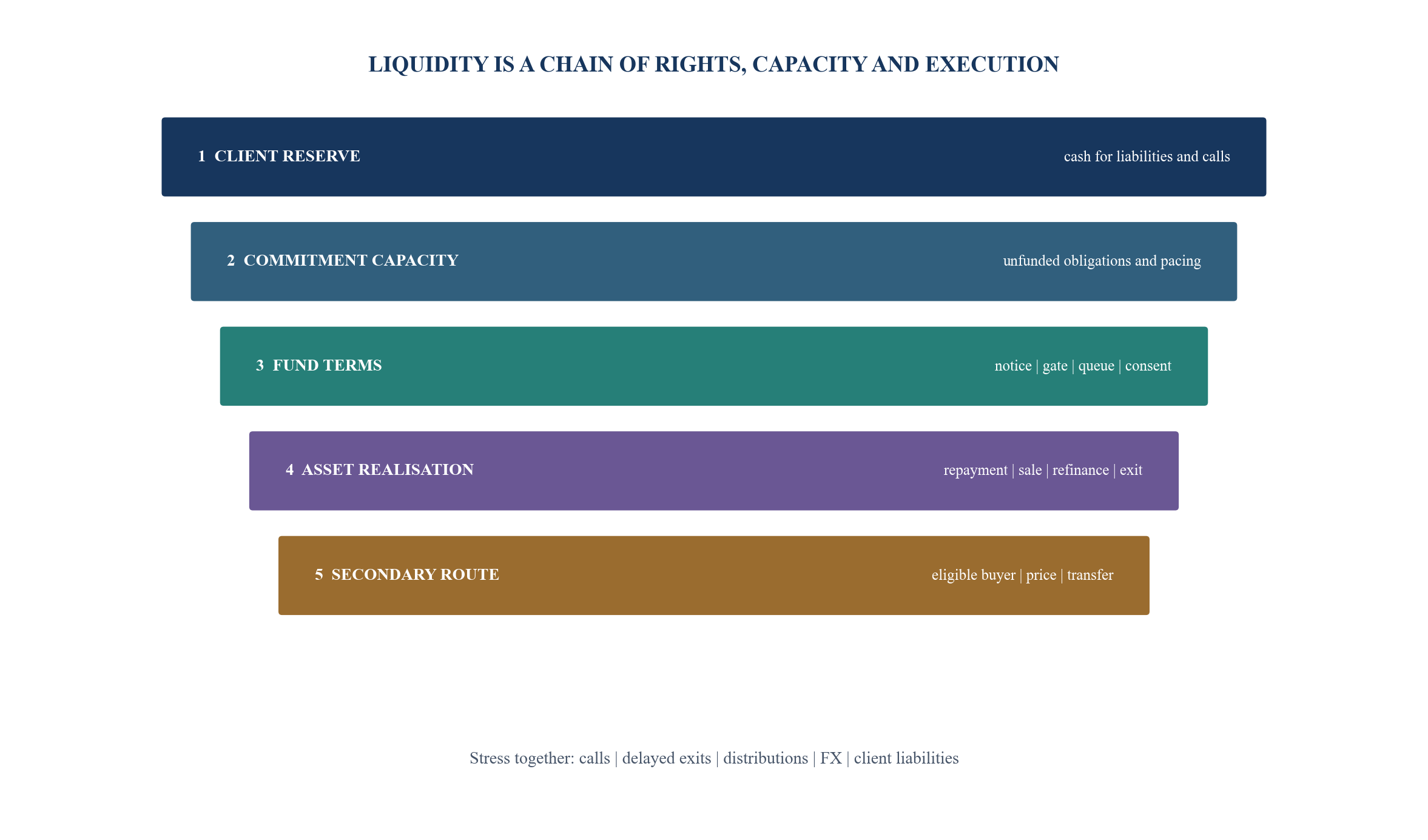
Author framework. Liquidity rights require verification from current governing documents and operating evidence.
9. Control valuation and performance reporting
Private assets are valued less frequently than listed instruments and often with more judgment. The product committee should understand who values each asset, which methodology is used, how inputs are sourced, who challenges the result and when an external valuation occurs. Shariah governance and valuation governance solve different problems and both need evidence.
The valuation policy should address debt instruments, equity, real estate, infrastructure and early-stage companies. It should specify market inputs, comparable transactions, discounted cash flow, impairment, foreign exchange, accrued income and post-balance-sheet events. Conflicts arise when fees, fundraising or performance compensation depend on reported values.
Client reporting should separate capital called, invested cost, current value, distributions, remaining commitment, fees and currency effects. Internal rate of return and multiples can be informative when definitions and cash flows are clear. They can be misleading when used without realization status, benchmark context and valuation quality.
The bank should reconcile manager reports to custody, capital-account statements and cash. Material valuation changes, stale valuations and audit qualifications require escalation. A relationship manager should not convert an indicative value into a liquidity claim.
10. Build the complete fee waterfall
The investor's cost can arise at distributor, feeder, fund, manager, asset and transaction levels. Relevant items include advisory or discretionary fees, platform charges, feeder administration, management fees, performance allocation, organizational expenses, transaction fees, monitoring fees, financing costs, hedging, custody, Shariah advisory, audit, tax and transfer costs.
Some fees can be offset or shared; the governing documents determine the result. The bank should calculate a complete fee bridge from gross asset return to client return using documented terms. Fee calculations should address the investment period, called capital, invested capital, net asset value, hurdle, catch-up, carried interest, recycling and crystallization.
The Shariah review should cover the nature and basis of relevant fees and cash flows. Investment review should assess alignment and value. Distribution review should identify inducements, conflicts and client disclosure under the applicable regime. These reviews should use the same fee inventory.
The worked fee waterfall should be labelled as an assumption unless populated with current verified terms. Sensitivity testing can show how duration, gross return, management fees, performance allocation and feeder costs affect the client result. A low entry minimum can coexist with a high total cost.
Table 4. Complete private-markets fee waterfall
| Layer | Possible cost | Evidence and control |
|---|---|---|
| client service | advisory, discretionary or platform fee | mandate, service scope, conflicts and client disclosure |
| access vehicle | feeder management, administration, audit and legal | feeder documents, allocation basis and economies of scale |
| underlying fund | management fee, performance allocation and expenses | governing documents, side letter, fee model and reconciliation |
| transactions | arrangement, acquisition, monitoring, break and exit fees | fee policy, offsets, related parties and allocation |
| financing and currency | facility, profit, hedging and cash-management cost | approved instruments, counterparties, limits and attribution |
| asset operations | property, project, insurance, servicing and professional costs | budgets, contracts, procurement and related-party review |
| transfer and exit | consent, valuation, legal, tax and secondary discount | executable route, approvals and complete proceeds bridge |
Amounts and percentages require product-specific verification; no market fee level is assumed here.
11. Map cross-border distribution before product launch
A globally manufactured fund can encounter different rules at domicile, manager, adviser, distributor, booking centre and client residence. The product team should map each entity and activity. Marketing, reverse enquiry, advice, execution, custody and portfolio management can have different perimeters.
The Shariah architecture can also vary. One market may recognize a central authority, another may rely on an institutional board or adviser, and another may leave the term to product documents within general financial regulation. The bank should state whose opinion it relies on and how differences are handled. A product approved in one market should not automatically enter another shelf.
The cross-border matrix should cover client classification, financial-promotion route, private-placement conditions, fund registration, adviser status, data transfer, anti-money-laundering controls, sanctions, tax reporting, beneficial ownership and complaints. It should record document language and investor eligibility.
Operational routing matters. Subscription money, capital calls and distributions can cross currencies, correspondent banks and custody systems. The bank should identify cut-offs, rejected-payment handling, source-of-funds evidence and reconciliation. Client communication should explain which entity provides each service.
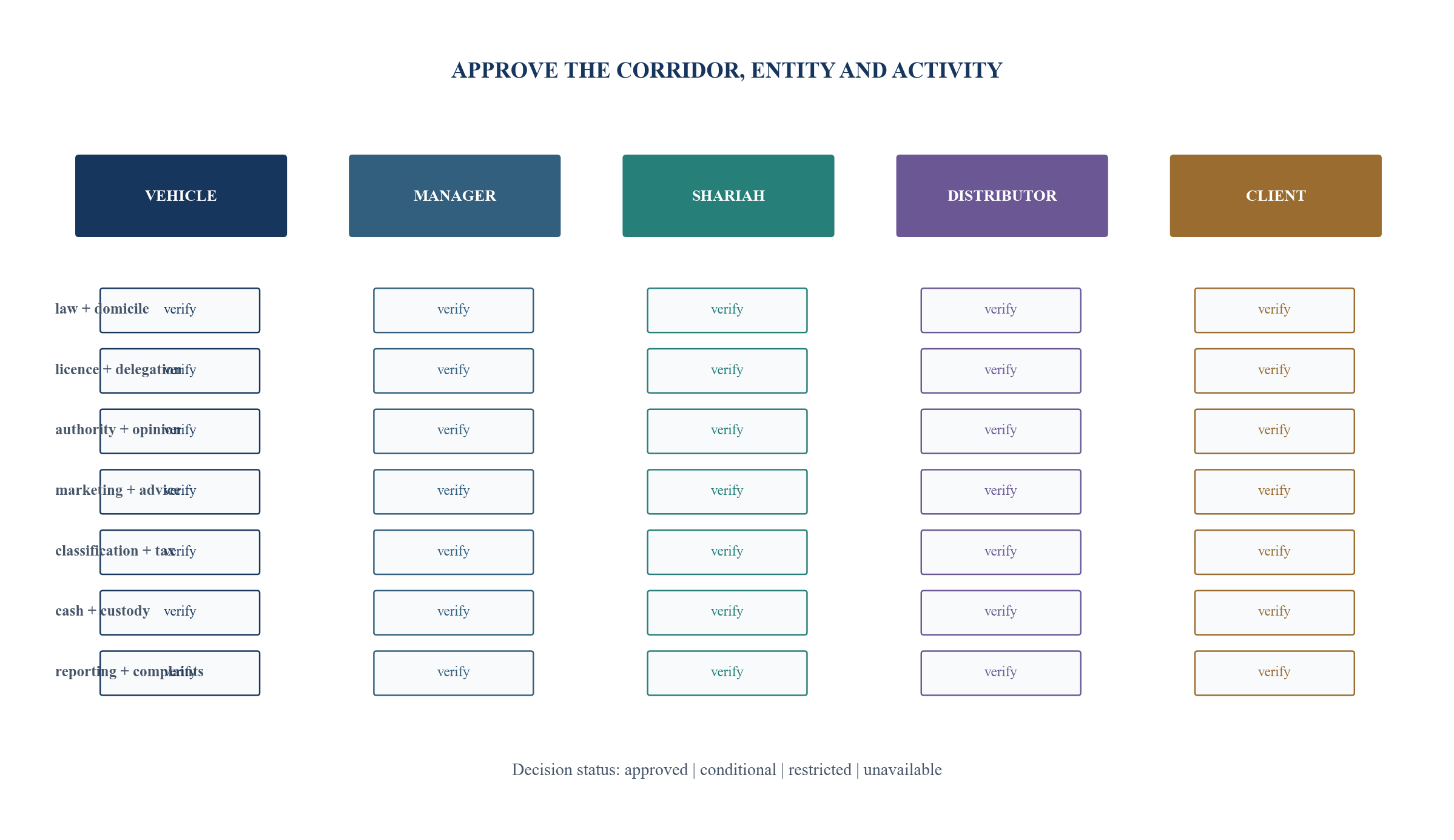
Author framework. Every corridor needs current jurisdiction-specific verification.
12. Integrate product governance and suitability
Product governance begins with an identified target market and a negative target market. The institution should specify client type, knowledge, risk capacity, loss tolerance, time horizon, liquidity, objectives and distribution channel. The FCA's PROD framework provides one official example of manufacturer and distributor responsibilities for products within scope, including product approval, target market, information exchange and review.
A Shariah preference is an additional client requirement. The suitability record should establish the client's stated requirements and explain the product's governance basis in language the client can understand. The adviser should avoid presenting one interpretation as universally accepted when relevant differences exist.
Private-market suitability should address commitment capacity, concentration, currency, valuation frequency and expected holding period. The client may need capital after a change in residence, family event, business requirement or market stress. The portfolio analysis should consider these liabilities rather than treating wealth as permanent risk capacity.
The recommendation should compare the proposed private-market product with the best available alternative. That comparison can include public sukuk, screened equities, cash, listed real assets, direct assets and other private funds. It should explain the incremental benefit, cost, risk and governance burden.
13. Give relationship managers an evidence card
Relationship managers need a concise product view that preserves complexity without using unexplained technical language. The evidence card should state the portfolio role, underlying assets, contract and rights, vehicle, manager, Shariah authority and opinion scope, liquidity, capital calls, valuation, leverage, currency, complete fees, key risks and exit route.
The card should show the evidence date and owner. A product can change through amendments, refinancing, manager succession, new investments or revised Shariah guidance. Stale materials should not remain in the active sales process.
Approved language should distinguish compliance governance from investment merit. The relationship manager can explain the documented Shariah basis and review process. Investment performance, capital preservation, liquidity and impact claims require their own evidence.
Training should cover ordinary operations and failure scenarios. Examples include a delayed capital call, non-compliant activity discovered after investment, disputed valuation, unavailable exit, manager conflict, late report or change in Shariah opinion. The RM should know what to tell the client, who owns the response and what activity is paused.
14. Establish breach, purification and change procedures
The product file should define what constitutes a Shariah exception or breach under the applicable framework. It should specify detection, notification, decision authority, remediation, treatment of income, investor disclosure and reporting. The required response depends on the facts and relevant authority.
Private investments can create difficult remediation choices because an immediate sale may be unavailable or harmful. The governing documents should address how the manager handles a portfolio company that changes activity or financing. The institution should know whether the manager has discretion, a cure period, a sale obligation or another approved route.
Purification or charitable disposition, where required by the applicable framework, needs a documented calculation, source data, approval and audit trail. It should not become a substitute for prevention or remediation. The client should understand whether the fund, distributor or investor performs the calculation and action.
Changes to contracts, leverage, hedging, cash instruments, valuation, manager, Shariah adviser, investment policy or jurisdiction can trigger re-approval. The product committee should define materiality and stop conditions at launch.
Table 5. Exception and change-control workflow
| Stage | Required record | Decision owner |
|---|---|---|
| detection | source event, affected asset, amount, dates and preliminary classification | operations or investment team |
| assessment | applicable opinion, rule, contract, facts and financial effect | Shariah authority with legal and investment input |
| containment | paused activity, cash control, communication restriction and evidence preservation | management under approved escalation |
| remediation | cure, restructuring, disposal, income treatment or other approved action | designated committee or authority |
| disclosure | investor, regulator, auditor and report obligations | legal, compliance and product owner |
| closure | completed actions, residual exposure, lessons and control change | independent review and accountable executive |
| re-approval | revised documents, process, limits and training | product committee and relevant Shariah authority |
Treatment requires product-specific Shariah and legal advice.
15. Monitor the shelf with management information
Management information should combine investment, Shariah, client and operating outcomes. Investment measures include called and invested capital, concentration, leverage, valuation changes, realized proceeds, losses and currency. Shariah measures include review coverage, pending approvals, exceptions, remediation time, audit findings and disclosure status.
Client measures include allocations against limits, unfunded commitments, liquidity reserves, reporting delivery, complaints and understanding. Operating measures include capital-call processing, cash breaks, stale data, document exceptions, cyber events and provider incidents. Fee measures reconcile gross asset performance to client performance.
The dashboard should prioritize exceptions and decisions. A green product status should require current evidence across all domains. One unresolved rights, governance, valuation or liquidity issue can require a restriction even when other measures perform well.
The board or product committee should receive trend and concentration views. Relevant concentrations include manager, adviser, Shariah scholar, administrator, fund domicile, asset, country, currency and exit year. A diverse list of products can rely on the same small operating network.
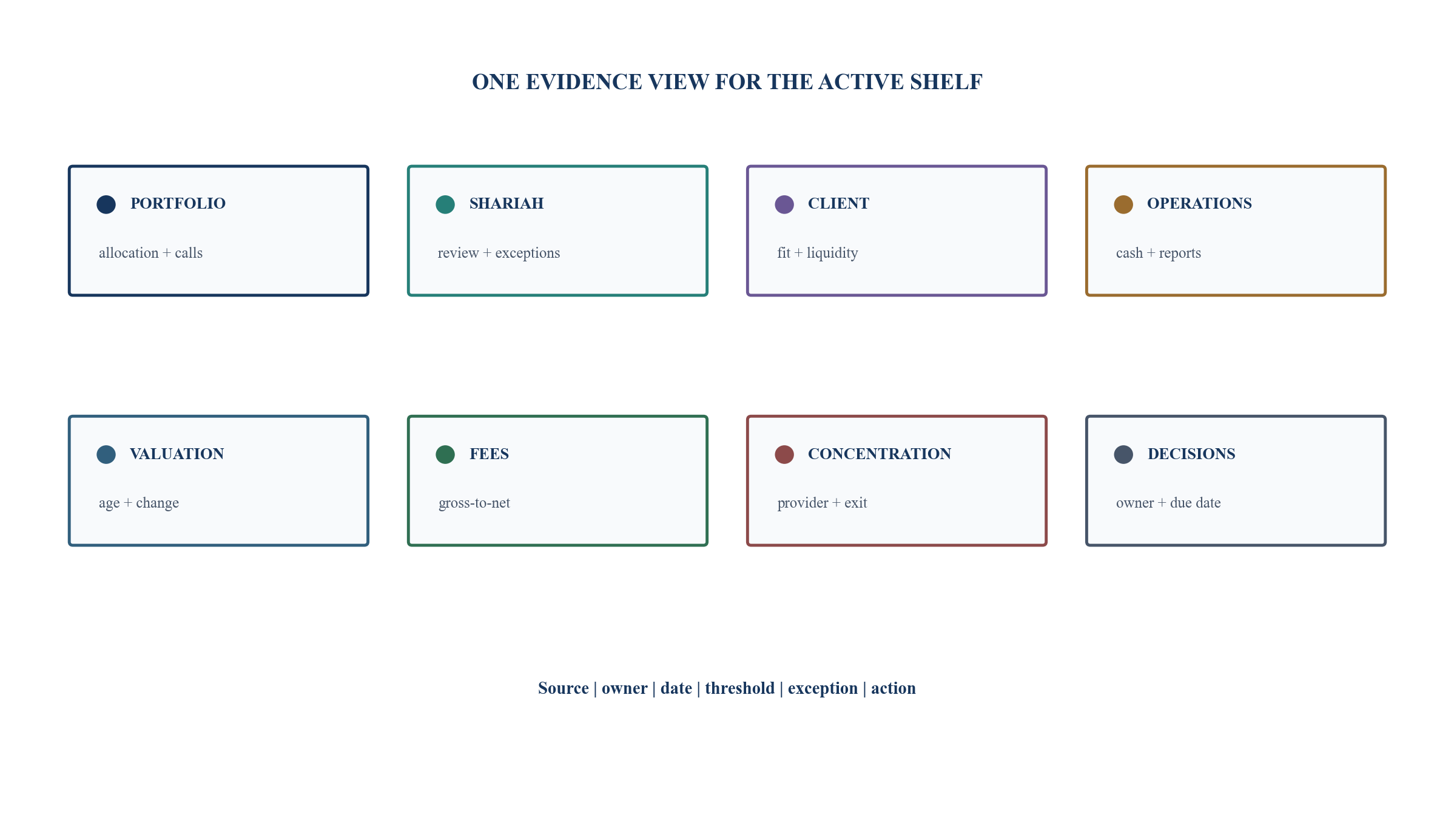
Author framework. Status indicators require current production data and documented thresholds.
16. Test the architecture through client cases
Worked cases make the trade-offs visible. Table 6 contains three hypothetical cases. Every allocation, threshold, client fact and decision is a management assumption for method demonstration and does not describe a real client or recommendation.
The first case involves a family investment company seeking contractual income beyond public sukuk. A private-credit fund can add differentiated borrower exposure, yet requires underwriting of the manager, contracts, defaults, valuation, illiquidity and financing structure. The decision depends on the entire portfolio and commitment reserve.
The second case involves an entrepreneur seeking technology ownership through venture capital. The client may value access and Shariah screening while underestimating loss rates, follow-on reserves and duration. A diversified fund and a direct co-investment create different governance and concentration.
The third case involves a multi-generational family seeking infrastructure and impact exposure across jurisdictions. The structure requires asset, concession, financing, Shariah, tax, distribution and reporting analysis. A stated impact objective needs measurable indicators and accountability.
Table 6. Hypothetical client cases
| Case | Stated purpose | Principal evidence gap | Illustrative decision process |
|---|---|---|---|
| family investment company with a public sukuk allocation | add contractual private income | manager loss experience, financing contracts, recovery and liquidity | compare public and private routes; size within cash reserve and duration |
| technology entrepreneur seeking venture exposure | own screened innovation businesses | portfolio construction, failure rates, follow-on capital and exit | compare diversified fund and co-investment; cap concentration and commitments |
| multi-generational family seeking infrastructure and impact | link long-term assets to stated outcomes | concession, construction, financing, governance, impact evidence and cross-border tax | complete corridor review; approve only documented asset, control and reporting chain |
All client facts and proposed actions are hypothetical management assumptions; the cases demonstrate the framework and are not recommendations.
17. Use a seven-gate product approval
Gate one validates the client purpose, portfolio gap and closest alternative. Gate two establishes the asset, contract, rights and vehicle. Gate three completes manager and operational due diligence. Gate four completes Shariah authority, opinion, continuing controls and breach process. Gate five establishes legal, regulatory, tax and cross-border distribution. Gate six validates suitability, disclosures, fees, RM materials and operating readiness. Gate seven authorizes a limited launch and monitoring thresholds.
Each gate should have required evidence and stop conditions. Possible stop conditions include unclear asset ownership, incomplete contracts, unresolved prohibited activity, inadequate adviser independence, weak valuation, unverified track record, insufficient capital-call planning, unavailable exit, incomplete fee data or an unapproved distribution corridor.
A limited launch can cap clients, jurisdictions, commitments, managers, asset types and currencies. Expansion should depend on completed subscriptions, capital calls, reporting, reviews and incident tests. Committee approval should identify residual risks and accountable owners.
The decision record should survive staff changes. It should contain source documents, opinions, minutes, conditions, expiry dates and monitoring results. A product should leave the active shelf when its evidence is stale or conditions are breached.
18. Implement through a 180-day sequence
Days 0 to 30 should define client segments, portfolio gaps, priority private-market functions and target jurisdictions. The institution should map existing products, concentrations, Shariah authorities and distribution routes. It should agree its shelf taxonomy and evidence standards.
Days 31 to 60 should establish the dual-governance architecture, authority matrix, product-approval gates, screening rules, breach process and core documents. Investment, Shariah, legal, compliance, operations, tax and technology teams should agree ownership and escalation.
Days 61 to 90 should complete manager sourcing and due diligence for a narrow pilot shelf. The team should construct fee models, liquidity and commitment tests, cross-border matrices and client evidence cards. Product claims should remain within verified source material.
Days 91 to 120 should build the client journey, suitability workflow, reporting, training, capital-call process and monitoring dashboard. The institution should test ordinary and failure events across the entire operating chain.
Days 121 to 150 should run a controlled launch within approved corridors and limits. Every subscription, exception, call and report should be reviewed. Days 151 to 180 should compare client outcomes and operating evidence with the business case, then expand, remediate, maintain limits or withdraw.
19. Assign accountable ownership
The board owns the institution's strategy and risk appetite. The product committee owns the shelf decision and conditions. Investment teams own asset and manager diligence. The Shariah authority owns opinions within its mandate. Legal owns instrument, contract and jurisdictional analysis. Compliance owns regulatory perimeter, distribution controls and financial crime. Operations own cash, documents, capital calls, reconciliation and reporting. Risk provides independent challenge. Internal audit tests the control environment.
Relationship management owns accurate client communication within approved materials. It does not own interpretation of missing evidence. Product claims should have named source owners and expiry dates.
Service-provider agreements should provide information, notification, audit and transition rights. Outsourcing an adviser, administrator, valuation agent or technology platform does not remove the institution's responsibility to understand the client service.
Conflicts should be visible. They can arise through proprietary products, feeder economics, placement fees, related-party transactions, valuation, manager ownership or recurring adviser relationships. The product file should show identification, mitigation, disclosure and independent approval.
20. Measure whether the shelf creates durable client value
The shelf succeeds when it improves client portfolios within a controlled operating model. Relevant measures include portfolio role achieved, diversification, cash-flow performance, losses, commitment completion, realized exits, valuation quality, total cost, client understanding and service reliability. Shariah measures include review coverage, exception frequency, remediation, reporting and audit results.
Product count and subscription volume can conceal weak outcomes. Management should compare actual performance, cost, liquidity and exceptions with the decision case. It should also compare private-market results with the public or conventional alternative identified at approval.
The international evidence supports a practical conclusion. Islamic investment markets contain established governance, disclosure and product frameworks across multiple jurisdictions. Private-market expansion requires the institution to apply those frameworks to assets that are less liquid, less standardized and more dependent on manager execution.
The governing question for a private bank or wealth platform is concise: can it show the client purpose, economic asset, contractual rights, Shariah authority, investment evidence, liquidity plan, complete cost, cross-border route and response when facts change? A complete evidence chain supports a disciplined shelf decision. Missing links require further work before distribution.
References
- Islamic Financial Services Board, Islamic Financial Services Industry Stability Report 2025, May 2025, https://www.ifsb.org/publication-document/islamic-financial-services-industry-stability-report-2025/
- Islamic Financial Services Board, IFSB-6: Guiding Principles on Governance for Islamic Collective Investment Schemes, supporting FAQ, https://www.ifsb.org/wp-content/uploads/2023/10/FAQs-for-IFSB-6_En.pdf
- Islamic Financial Services Board, IFSB-19: Guiding Principles on Disclosure Requirements for Islamic Capital Market Products, https://www.ifsb.org/wp-content/uploads/2023/10/IFSB-19-Guiding-Principles-on-Disclosure-of-ICM-Products-final.pdf
- Islamic Financial Services Board, IFSB-21: Core Principles for Islamic Finance Regulation, Islamic Capital Market Segment, https://www.ifsb.org/wp-content/uploads/2023/10/IFSB-21-December-2018_En.pdf
- Islamic Financial Services Board, IFSB-24: Guiding Principles for Investor Protection in Islamic Capital Markets, https://www.ifsb.org/wp-content/uploads/2023/10/IFSB-24_En.pdf
- Securities Commission Malaysia, Annual Report 2025, https://www.sc.com.my/annual-report-2025
- Securities Commission Malaysia, Malaysian Capital Market Hits Record RM4.3 trillion in 2025, 22 April 2026, https://www.sc.com.my/resources/media/media-release/malaysian-capital-market-hits-record-rm43-trillion-in-2025
- Securities Commission Malaysia, Islamic Capital Market Products and Services Guidelines, revised 30 March 2026, https://www.sc.com.my/regulation/guidelines/islamic-capital-market-products-and-services
- Securities Commission Malaysia, Islamic Capital Market statistics, updated 31 May 2026, https://www.sc.com.my/analytics/islamic-capital-market
- Securities Commission Malaysia, Capital Market Masterplan 2026-2030, https://www.sc.com.my/capital-market-masterplan
- Securities Commission Malaysia, Waqf-Featured Fund Framework, https://www.sc.com.my/development/icm/developmental-initiatives/waqf-featured-fund-framework
- Bank Negara Malaysia, Policy Document on Shariah Governance, effective 1 April 2020, https://www.bnm.gov.my/-/policy-document-on-shariah-governance
- Indonesia Financial Services Authority, Indonesia Capital Market Roadmap 2023-2027, https://ojk.go.id/en/berita-dan-kegiatan/publikasi/Documents/Pages/Indonesia-Capital-Market-Roadmap-2023-2027/Indonesia%20Capital%20Market%20Roadmap%202023-2027.pdf
- Luxembourg for Finance, Islamic Finance, https://www.luxembourgforfinance.com/publication/islamic-finance/
- Luxembourg for Finance, Leading on Sustainability, https://www.luxembourgforfinance.com/en/publication-article/leading-on-sustainability/
- UK Financial Conduct Authority, PROD 3 Product Governance: MiFID, accessed August 2026, https://handbook.fca.org.uk/handbook/prod3
- HM Treasury, Debt Management Report 2025-26, Sovereign Sukuk section, https://www.gov.uk/government/publications/debt-management-report-2025-26/debt-management-report-2025-26-accessible
- Monetary Authority of Singapore, Guidelines on the Application of Banking Regulations to Islamic Banking, https://www.mas.gov.sg/regulation/guidelines/guidelines-on-application-of-banking-regulations-to-islamic-banking
- Central Bank of the UAE, Higher Shari'ah Authority, updated 27 April 2026, https://www.centralbank.ae/en/our-operations/islamic-finance/shariah/
- Central Bank of the UAE Rulebook, Shari'ah Governance for Islamic Financial Institutions, https://rulebook.centralbank.ae/en/entiresection/2825
- Accounting and Auditing Organization for Islamic Financial Institutions, Shari'ah Standards, https://aaoifi.com/shariah-standards-3/?lang=en
- Accounting and Auditing Organization for Islamic Financial Institutions, FAS 50: Financial Reporting for Islamic Investment Institutions including Investment Funds, https://aaoifi.com/announcement/aaoifi-accounting-board-issues-financial-accounting-standard-fas-50-financial-reporting-for-islamic-investment-institutions-including-investment-funds/?lang=en
About the Author
Chennakeshav Adya is an independent researcher and Managing Partner of Matchpoint Partners. His work examines strategy, capital formation, valuation, transactions and operating execution across private and public markets.
