

1. Define the acquisition decision
A buyer evaluating an established government contractor needs to know which earnings can continue under new ownership and how much cash those earnings can release. The transaction memorandum should identify the contracts supporting the purchase price, the cost of completing them and the evidence required before lending against their proceeds. Customer names and aggregate order books provide a starting inventory. The acquisition decision requires a reconciled explanation of the rights and operating obligations beneath those totals.
The proposed review begins with the target legal entity. Identify which entity signs each contract, employs the delivery team, owns the necessary intellectual property and receives payment. A consolidated presentation can combine a parent company's marketing relationship with a subsidiary's contract and another affiliate's invoicing activity. That combination needs an explicit bridge. The buyer should understand what it is acquiring, which resources remain outside the perimeter and which approvals are needed to continue the contracted work after completion.
This paper examines the purchase of an operating services business with government and government-related customers. It focuses on revenue quality, acquisition financing and transaction conditions. A successful procurement bid is one part of that assessment. The buyer also needs to evaluate the remaining delivery burden, the funding attached to each commitment, documentary acceptance, collection experience and the conditions governing future work. These questions apply to a platform acquisition and to an add-on whose largest public customer could materially change the combined group's cash profile.
Agree the analysis date and forecast horizon before comparing numbers. A three-year order book, current receivables and next year's revenue represent different populations. Keep a separate opening balance for work already performed. Split future work into identifiable periods and attach the original contract or order reference to every material line. A reconciliation should explain movements caused by delivery, cancellation, scope changes and currency translation. Without that bridge, an apparent increase in contract cover can conceal a change in the definition used by management.
The numerical case below is invented to demonstrate this process. It contains no actual acquisition target or customer information. Its operating assumptions, margins, funding terms and renewal outcomes have been chosen for analysis. They describe neither observed GCC contract economics nor an available financing proposal. A real investment decision requires direct access to the target's records, qualified legal and accounting advice, and an agreed scope for customer confirmation. Any conclusion must remain bounded by the evidence actually obtained.
2. Identify the customer and applicable procurement regime
Classify the actual counterparty before relying on the word sovereign. The diligence file should distinguish a ministry, a public agency, an emirate-level entity, a state-owned commercial company and a private prime contractor supplying a government programme. Record the legal name on the executed agreement, its organisational basis and the entity responsible for payment. If a presentation claims government support, obtain the specific support instrument and ask counsel to identify the beneficiary, conditions, expiry and enforceable obligations. This paper assumes no government guarantee.
The UAE federal procurement framework illustrates why scope matters. Federal Law No. 11 of 2023 identifies covered federal entities in Article 3 and exclusions in Article 4. Those exclusions include construction, specified medical purchases and qualifying public-private partnership projects, among other categories. A transaction team should therefore establish whether that framework governs the particular entity and purchase. Applying it across every UAE government-related customer would leave material questions unanswered. Separate emirate-level or sector-specific arrangements require their own review. [2]
Saudi timing requires particular care at the date of this paper. The official gazette published a replacement Government Tenders and Procurement Law on 4 September 2026. Article 101 provides that it operates after 120 days from publication; Articles 99 and 100 address implementing regulations and replacement of the prior law. That interval has not elapsed on 10 September 2026. Article 12 of the published replacement also distinguishes procurement planning and budget coordination from a commitment created by publication of a plan. These are features of the published text. Counsel must establish the operative rules and transitional treatment for each transaction and contract. [1]
Build a regime record with the procurement start date, award date, execution date and subsequent amendments. Retain the actual tender documents and governing terms. A later legislative change does not answer every question about an older procurement. In the United Kingdom, the government's transitional guidance explains that procurements commenced under previous legislation continue under that legislation, with the associated contract-management arrangements addressed in the guidance. That example supports a practical requirement to date the evidence accurately; its rules are not imported into a GCC contract. [8]
Use a jurisdiction matrix to assign work to the appropriate specialist. It should identify the contract, relevant public body, proposed governing framework, evidence supporting that classification and any unresolved exclusions. An uncertainty can affect the scope of further diligence, the timetable for signing or a condition to completion. Record the specific consequence. A general disclaimer at the back of a report cannot tell the acquisition committee whether a material contract is transferable or whether the forecast assumes a renewal process the customer cannot use.
3. Trace procurement authority and funding
For each material contract, identify the person or body authorised to approve the purchase, sign the agreement, approve changes, accept performance and release payment. The same individual need not perform every role. Request the relevant delegations and limits through a lawful, agreed diligence process. Record the date and scope of each approval. The review should distinguish evidence supplied by the target from independent confirmation obtained with the seller's and customer's permission.
A budget allocation needs to be connected to the specific purchase. Ask which financial period it covers, whether a commitment has been recorded and what additional action is required before the supplier can proceed. A general programme budget may include multiple suppliers, internal expenditure and activities outside the target's scope. The acquisition model should use only the portion supported by the relevant contract and funding evidence. Where that evidence cannot be obtained, identify the amount affected and model the consequences of deferred commencement or cancellation.
United States federal contracting provides a precise comparative example. FAR clause 52.232-18 makes the government's payment obligation contingent on appropriated funds becoming available for the contract and the contractor receiving the specified notice, confirmed in writing. Its application depends on the contract and federal rules. It demonstrates a funding condition that an acquirer should read directly wherever it appears. It does not establish the terms of a Saudi, UAE or other public contract. [4]
The proposed budget authority matrix connects documents to an acquisition consequence. Use it as a work allocation and exception register. Completion of a row means the named evidence was reviewed and its implications recorded. It does not mean the adviser has independently certified a public authority's internal controls. If a document is unavailable because of confidentiality or security restrictions, counsel and the buyer should agree a permitted alternative or reflect the unresolved exposure in the transaction decision.
| Decision | Evidence to obtain | Acquisition question |
|---|---|---|
| Award and execution | Award record, signed contract and applicable delegation | Is the target the valid contracting supplier? |
| Funding commitment | Contract-specific funding record and relevant period | Which work can proceed on the evidenced funding? |
| Additional scope | Approved change, revised price and funding | Does the forecast include unsupported variation income? |
| Acceptance | Named acceptance role and completed records | What remains before invoicing or payment? |
| Renewal | Permitted route, required approvals and signed instrument | Which future periods remain conditional? |
| Ownership change | Contract terms and qualified consent assessment | What must occur before acquisition completion? |
Each row is a diligence question. Actual authority and legal effect require contract-specific verification.
The authority review should also cover instructions given during delivery. An operational contact may ask for additional users, an accelerated schedule or a different technical specification. Capture the request, the supplier's response and the process used to approve commercial terms. The acquisition team needs to understand whether the target has performed extra work before establishing its right to payment. That issue can affect historical earnings, remaining costs and the proposed working-capital adjustment simultaneously.
Access restrictions deserve a documented response. The seller may legitimately be unable to disclose a full contract or funding record to every bidder. Consider a restricted adviser review, a suitably scoped customer confirmation or redacted evidence that preserves the necessary commercial terms. Do not fabricate comfort where these routes are unavailable. The committee should receive the exposure, the missing evidence and the consequence of proceeding. That allows the buyer to make an informed decision about price, financing or withdrawal.
4. Reconstruct the forward order book
Start with management's complete forward schedule and retain its original definitions. In the hypothetical case, that schedule totals USD 120 million over the next 36 months. The amount combines signed funded work, signed commitments awaiting funding, unexercised options, proposed variations and framework opportunities without call-offs. These categories are deliberately disjoint. Each line appears once. Opening receivables for work already completed sit outside the schedule and are reviewed separately.
The illustrative breakdown is USD 60 million of signed funded work, USD 18 million awaiting funding, USD 22 million of unexercised options, USD 8 million of unapproved variations and USD 12 million of framework opportunities. For this acquisition analysis, the initial supported forward-work category is USD 60 million. Its inclusion remains subject to performance, termination, consent and collection diligence. The other USD 60 million remains visible in conditional schedules, with the particular evidence needed to move each line identified.
The classification should avoid a false impression of precision. A single probability attached to the entire USD 120 million would combine legally and commercially different uncertainties. Funding for signed work, approval of an additional scope and success in obtaining a future call-off need separate explanations. Use event-based scenarios where evidence does not support a probability estimate. A number described as weighted backlog should retain the underlying unweighted amount, event, source of the weight and approval record.
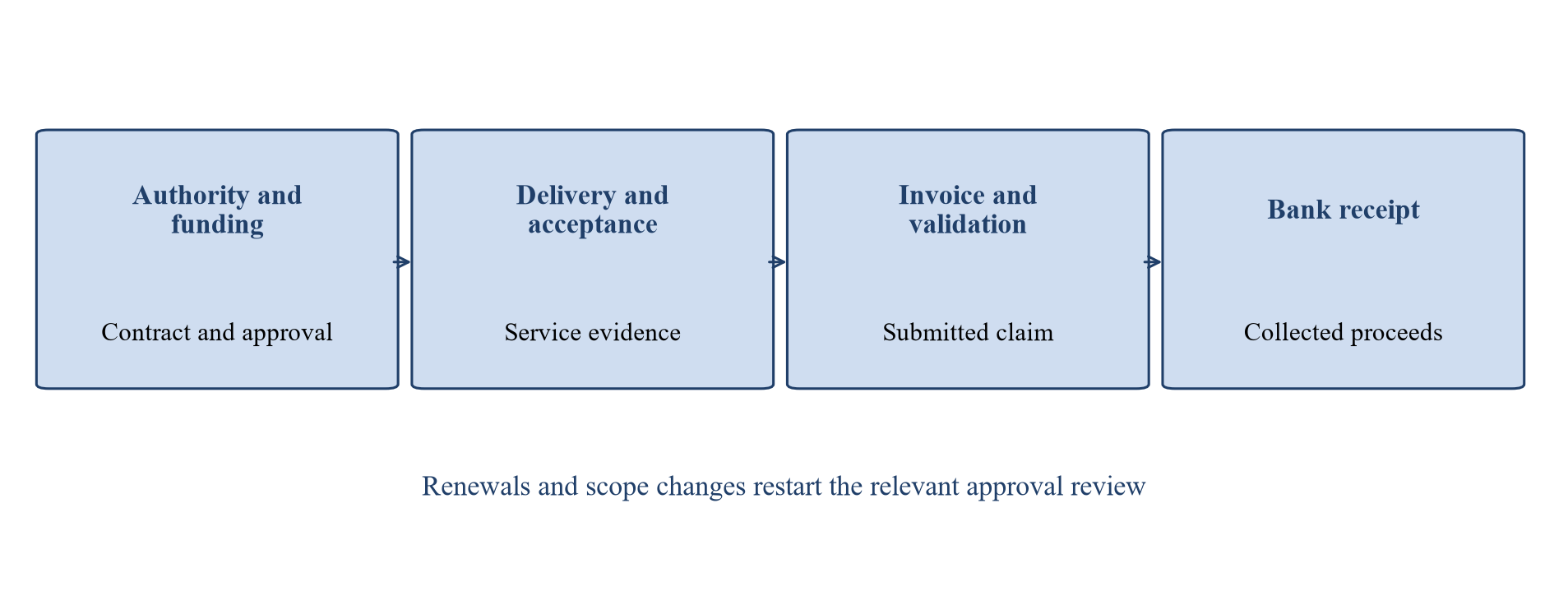
Original acquisition diligence framework. Every transition should be supported by evidence for the same contract and delivery period.
Reconcile the order book to a separate 12-month revenue forecast. The hypothetical management forecast is USD 44 million: USD 24 million from the funded category, USD 6 million from signed work awaiting funding, USD 9 million from options, USD 3 million from variations and USD 2 million from future framework call-offs. These are the next-year portions of the 36-month schedule. They are not amounts to add to that schedule. The remaining periods should reconcile to the balance of each category.
The initial core case uses USD 24 million of next-year revenue from signed funded work. Subsequent scenarios add only the selected renewal amount. The USD 11 million associated with funding, variation and framework assumptions is excluded from those scenarios and retained in a separate opportunity schedule. This treatment gives the committee a clear view of the dependence being tested. It does not assert that those opportunities have no value or that the funded category is certain to be delivered and collected.
| Evidence category | Next 36 months | Next 12 months | Treatment in the model |
|---|---|---|---|
| Signed and funded work | 60.00 | 24.00 | Core operating case |
| Signed work awaiting funding | 18.00 | 6.00 | Separate conditional case |
| Unexercised renewal options | 22.00 | 9.00 | Tested at selected renewal fractions |
| Unapproved variations | 8.00 | 3.00 | Separate conditional case |
| Framework opportunities without call-offs | 12.00 | 2.00 | Separate conditional case |
| Total management schedule | 120.00 | 44.00 | Reconciled starting population |
USD millions. The forecast column is a subset of the 36-month column. Opening receivables are excluded from both.
5. Test acceptance and the route to cash
Choose a sample that can explain the target's commercial process. Include large contracts, recent awards, amended scopes, overdue balances and completed work awaiting acceptance. Follow each selected item from its original terms through delivery records, customer approval, invoice submission and bank receipt. Record dates as well as values. The time between delivery and acceptance can require funding before an invoice appears in the aged receivables report.
The IFRS Foundation's public overview explains that revenue recognition under IFRS 15 follows identification of the contract and performance obligations, determination and allocation of the transaction price, and satisfaction of those obligations. It also addresses estimates of variable consideration. The acquisition review should reconcile management's forward schedule, reported revenue and cash using the target's accounting policies and qualified accounting advice. This paper does not provide an accounting opinion on any balance. [9]
Acceptance criteria should be operationally testable. A facilities-management contract could require agreed service records, while an implementation contract could depend on technical tests and documented user acceptance. Identify the remaining requirements for the actual purchase. Obtain evidence of rejection, partial acceptance, remedial work and any agreement to waive a condition. The reviewer should understand whether an invoice dispute concerns administrative information, delivered quality, scope or price, because each issue has a different resolution path.
An invoice date alone cannot describe collection performance. Track delivery, submission, rejection, resubmission, validation and receipt separately. Calculate elapsed days consistently and retain the original timestamp when an invoice is resubmitted. A reporting system that starts its clock again after each correction can conceal the actual cash cycle. Test bank receipts against invoice references and identify partial payments, offsets, credit notes and amounts received on behalf of another group entity.
UK payment guidance offers a bounded legal comparison. For qualifying contracts, the Procurement Act framework implies payment terms tied to receipt of a valid, undisputed invoice, with a later specified due date addressed in the rules. The guidance explains the 30-day requirement, disputed or invalid invoices and stated exclusions. It should be read with the applicable procurement regime and contract. A legal payment deadline provides a compliance benchmark; the forecast also needs observed collection evidence and a stress case for delay. [6]
Opening receivables need their own acquisition treatment. The hypothetical business has USD 6 million of opening invoices from past performance. They are absent from the USD 120 million forward schedule and the USD 44 million future revenue forecast. Their collection is part of the cash model through the opening working-capital balance. Confirm that the acquisition price mechanism treats these balances consistently with the agreed working-capital target, debt definitions and any specific exclusion for a disputed amount.
Review the cost still required to collect the money. Remedial delivery, missing certification, subcontractor settlement or customer transition work may remain after revenue has been booked. Record that expenditure against the relevant contract. The acquisition model should include it once, in the appropriate period. If the seller has already recognised a provision, establish whether the same liability is being deducted again through a separate price adjustment. The objective is a complete economic bridge with explicit treatment of every item.
6. Examine changes and continued performance
Create a register of all scope and price changes affecting the material contracts. It should contain the request, internal approval, customer approval, revised delivery terms and invoicing treatment. Reconcile it to the finance forecast and the operating team's delivery plan. A change discussed in correspondence may have commercial significance while its formal status remains unresolved. Identify exactly what was agreed, by whom, under which authority and on what date.
The UAE federal implementing regulations provide a useful document checklist within their scope. Article 37 addresses contract amendments and signed annexes, with specified matters referred to the procurement manual and delegation matrix. Article 38 addresses renewals, signed documentation, limits set through the manual and circumstances involving renewed competition or exceptions. An acquirer should obtain the applicable instruments and approvals. This paper does not assign a numerical renewal limit from a manual that has not been examined. [3]
The United Kingdom's contract-modification guidance provides a separate comparison. For public or convertible contracts within the relevant rules, a modification needs a permitted basis under the Act; the guidance also addresses notices and publication requirements. It distinguishes contracts outside those particular modification restrictions. The diligence team should identify the applicable route and evidence for each change, using advice appropriate to the contract. An analysis written for another jurisdiction cannot establish permission to extend a GCC arrangement. [7]
Performance after an expiry date warrants direct investigation. Obtain the existing agreement, any extension instrument and the authority for ongoing instructions. Determine how the supplier is being paid during that period and whether its staff, subcontractors and insurance arrangements remain suitable. Where there is no verified basis for continued work, show the exposure and the expenditure already committed. The acquisition committee needs an answer before it treats those months as repeatable earnings.
Changes can alter margin without changing headline revenue. An additional location, more demanding service level or accelerated implementation date can require extra labour and equipment. Rebuild the cost-to-complete schedule using the revised obligation. Compare procurement savings assumed by the buyer with the contract's customer commitments and supplier terms. Any expected improvement should have a named operating action and implementation cost. The contract review should explain whether the buyer can actually make that change after completion.
7. Underwrite renewal as a dated customer decision
A renewal assumption should identify the work being continued, the period covered and the action that makes it effective. Retain a calendar of expiry dates, notice periods, procurement decisions and customer approvals. Link that calendar to the forecast and acquisition financing. A renewal occurring after signing but before completion can be a material transaction event. A renewal expected after completion creates an operating and capital-allocation decision for the buyer.
FAR clause 52.217-9 illustrates the distinction between preliminary intent and exercise of an option. Under the clause, the government's preliminary notice does not commit it to extending the contract; the actual option involves written notice within the specified contractual arrangements. That is a United States federal clause example. For every target contract, review the wording actually included and the relevant law, including any separate funding or approval conditions. [5]
Evidence of customer satisfaction can inform the commercial assessment. Review service scores, complaints, remedial plans and permitted customer interviews. Keep those findings separate from evidence that a renewal instrument has been executed. Where management supplies an assumed renewal probability, request its basis, comparable historical population and treatment of changed circumstances. A small number of past renewals may not support a precise forecast for a different procurement cycle. This paper assigns no probability to any renewal outcome.
Test the cost structure if work ends or contracts at a lower level. Identify employees who can be redeployed, leases that continue, minimum subcontractor commitments and equipment with limited alternative use. The timing of those adjustments matters. A model that immediately removes every associated cost can overstate the cash retained after losing a customer. Ask the operating team for a sequenced response with contractual evidence for the savings, and model transition costs before accepting them.
Renewal concentration should be measured by decision period as well as customer. Several contracts can expire within the same quarter, rely on the same procurement team or depend on the same budget programme. Separate legal customers may share a common funding source or service policy. Record those dependencies explicitly and test a combined event. The buyer should see the cash and staffing consequences of overlapping decisions without assuming that every renewal is independent.
Use the renewal analysis to define transaction conditions. Depending on the facts and negotiated agreement, a buyer might require execution of a specified renewal before completion, defer part of the consideration or accept a smaller financed acquisition. Those are proposed structures for discussion with advisers. Their feasibility depends on the seller, lender, contract and applicable law. None of them substitutes for the necessary customer action or creates a right to continued public-sector spending.
8. Connect renewal outcomes to acquisition debt
The hypothetical core business earns USD 24 million of annual revenue from its signed, funded work. Assume that the costs of delivering that revenue, including the existing central overhead, leave USD 4.8 million of earnings before interest, tax, depreciation and amortisation. This earnings measure is abbreviated to EBITDA. No cost saving from the acquisition is included. The model also assumes USD 0.8 million of maintenance investment, USD 0.6 million of cash tax and USD 0.4 million of normal working-capital absorption during the year.
After those deductions, the core case has USD 3 million available for debt service. This is a defined model measure, calculated before scheduled acquisition-debt principal and interest. The proposed annual debt service is USD 3.6 million. Dividing the available cash by that payment gives a debt-service coverage ratio of approximately 0.83 times. The core case therefore has a USD 0.6 million annual shortfall before discretionary distributions or additional investment. These amounts are hypothetical and do not establish a lender's required covenant or pricing.
Now add the assumed renewal of USD 9 million of next-year work from the option category. Suppose its incremental contribution after delivery costs is 35%, or USD 3.15 million. The model assumes existing central overhead can support that work and charges no additional maintenance investment. It deducts another USD 0.45 million of working capital and USD 0.3 million of cash tax. These are simplified scenario inputs. Their relationship to capacity, tax and actual contract terms would require independent work in a real acquisition.
The renewal adds USD 2.4 million of cash available for debt service. The full-renewal case therefore produces USD 33 million of revenue, USD 7.95 million of EBITDA and USD 5.4 million of cash before debt service. Coverage is 1.50 times. The USD 11 million of other conditional next-year opportunities remains excluded. The full-renewal result depends on the stated renewal and operating assumptions; it is not a finding that the target will receive the work or that a lender would approve the proposed debt.
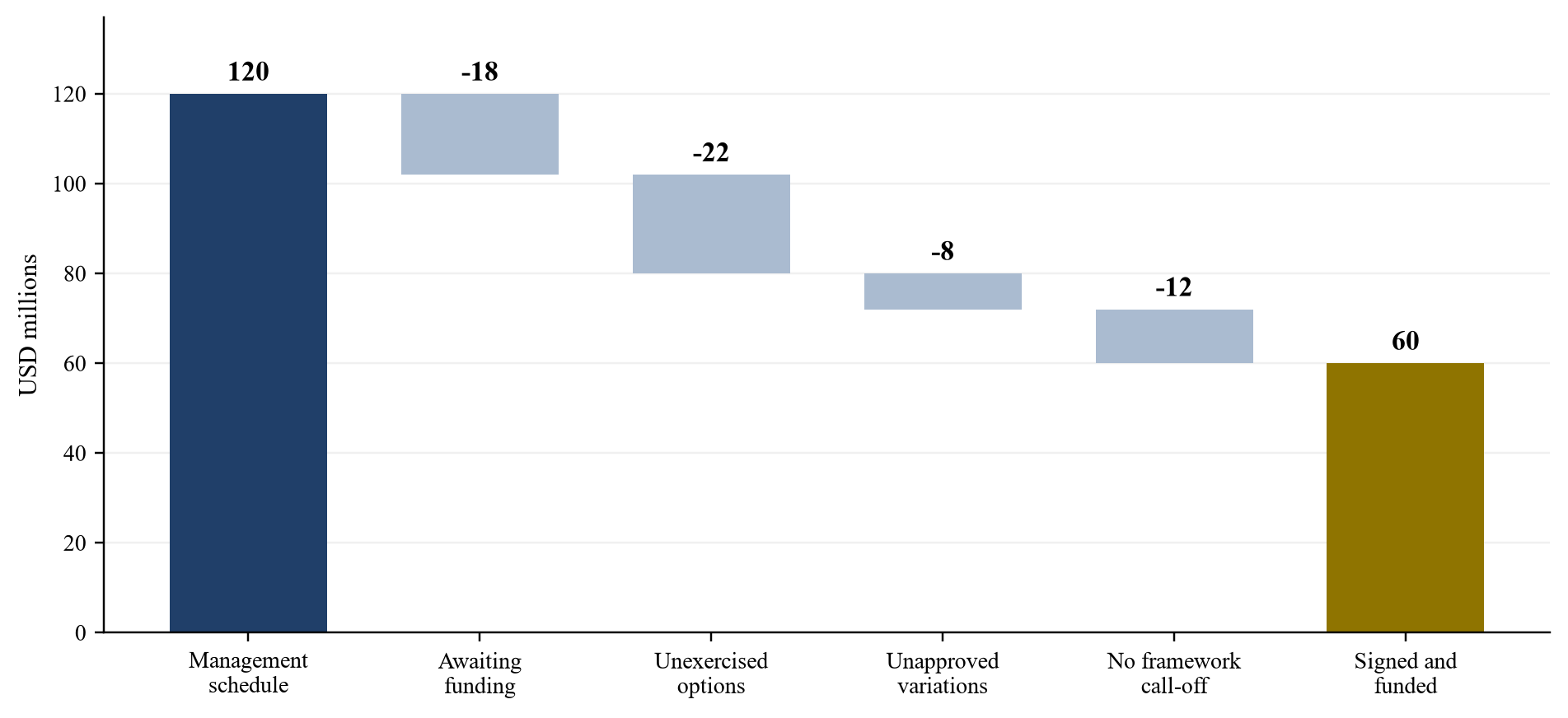
USD millions across 36 months. Each deduction is a distinct category retained in the conditional schedules; the final category remains subject to delivery and contract diligence.
An intermediate case retains half the renewal revenue. For this sensitivity alone, incremental contribution, working capital and cash tax vary proportionately with that revenue. It produces USD 28.5 million of revenue, USD 6.375 million of EBITDA and USD 4.2 million of cash before debt service. Coverage is approximately 1.17 times. A half-renewal case is a quantity assumption, not a 50% probability of full renewal. Actual partial awards could carry different margins or stranded costs, so the linear relationship requires separate testing.
The financing discussion should begin with the gap between the cases. A debt schedule that requires the full renewal may need a smaller initial commitment, delayed drawdown, additional equity or a different amortisation profile. Model each alternative with its costs and conditions. A lower payment in the first year can shift a repayment requirement into a later period. Review the full debt maturity and refinancing exposure rather than treating a short-term coverage improvement as a completed financing solution.
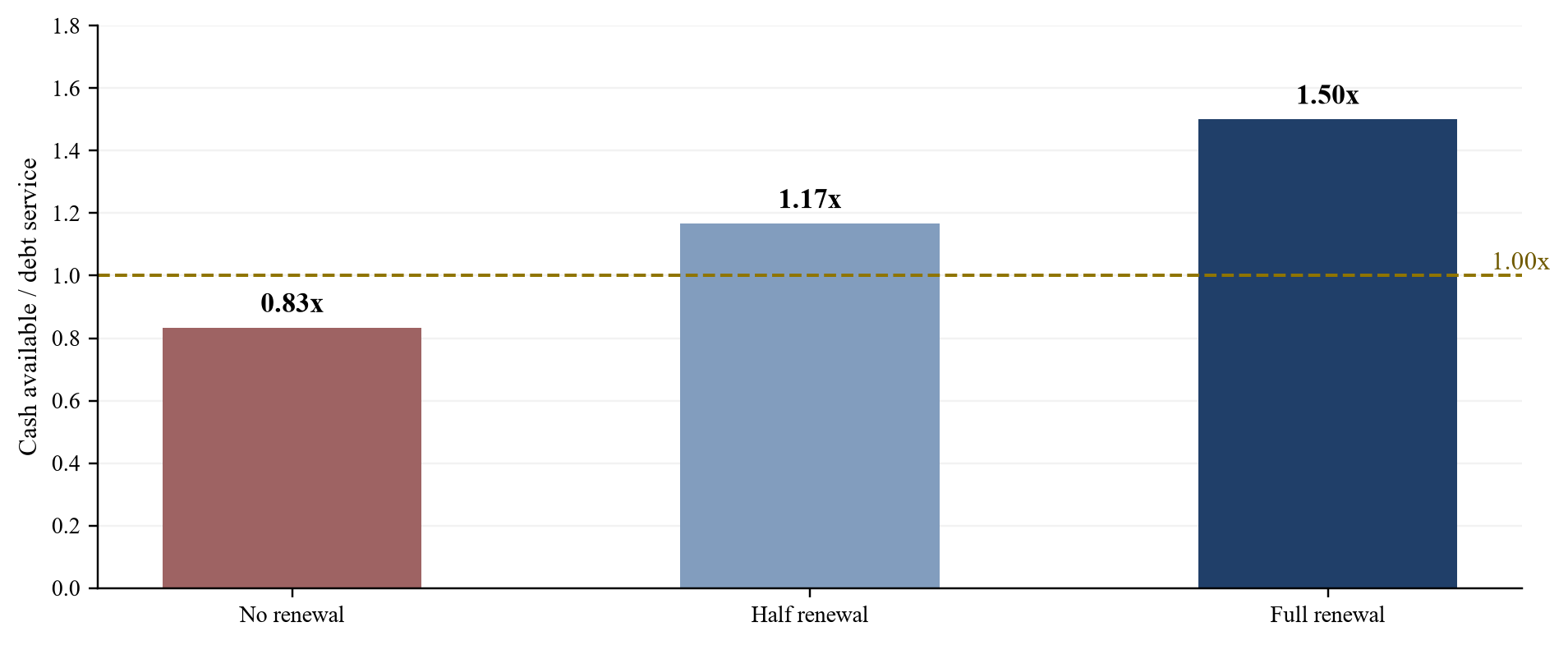
Renewal fractions refer to the USD 9 million option-revenue assumption and are not probabilities. Cash after operating deductions is divided by USD 3.6 million annual debt service.
9. Test liquidity within the reporting period
Annual coverage can leave an important timing question unresolved. Consider the full-renewal case, with USD 5.4 million available before USD 3.6 million of debt service. For a separate timing illustration, assume those flows are distributed evenly across quarters. Quarterly cash after scheduled debt service is USD 0.45 million. The business starts with USD 1.2 million of unrestricted cash and requires a hypothetical minimum balance of USD 0.6 million to maintain its chosen operating buffer.
Assume that USD 2.4 million of the opening receivables would normally be collected during the first quarter. These invoices relate to prior performance and are already part of the opening USD 6 million balance. The normal operating cash forecast incorporates their expected collection and the replacement of working capital through ongoing activity. In the stress case, their receipt shifts to the second quarter. Deduct that delayed receipt once from the normal first-quarter forecast; do not add it to future revenue or also charge an unexplained additional working-capital adjustment.
First-quarter cash before new funding becomes USD 1.2 million plus USD 0.45 million, less USD 2.4 million. The result is negative USD 0.75 million. Restoring the minimum cash balance requires USD 1.35 million of additional funding before its financing costs. A negative calculated balance indicates that the assumed payments cannot all be made from the available cash. The transaction requires an identified source, a change in payment obligations or another evidenced response before relying on that scenario.
If a bridge of USD 1.35 million is drawn for 90 days at an invented annual simple rate of 12%, interest is approximately USD 0.03995 million on a 365-day basis. Assume interest is paid at repayment and that there are no fees, security costs or additional covenants. At the end of the second quarter, collection of the USD 2.4 million, another USD 0.45 million of normal net cash and repayment of bridge principal and interest leave approximately USD 2.06005 million. This result depends on full collection at the assumed time.
| Cash movement | First quarter | Second quarter |
|---|---|---|
| Opening cash | 1.20000 | 0.60000 |
| Normal cash after scheduled debt service | 0.45000 | 0.45000 |
| Receipt delayed from its normal period | -2.40000 | 2.40000 |
| Bridge borrowing or principal repayment | 1.35000 | -1.35000 |
| Bridge interest paid | 0.00000 | -0.03995 |
| Closing cash | 0.60000 | 2.06005 |
USD millions. Full-renewal operating case, quarter-end timing, interest paid at repayment. Amounts rounded for display.
The quarter-end illustration can miss an earlier cash trough. A real acquisition-finance model should use weekly or daily timing around payroll, taxes, supplier settlements and debt payments. Specify the date on which funding becomes accessible and test any conditions to drawing it. A signed facility with unavailable collateral or an unmet condition cannot be counted as cash at that date. Include commitment fees, interest payment dates, security restrictions and any interaction with an existing borrowing base.
Run permanent-loss and longer-delay cases separately. If the USD 2.4 million is disputed and never collected, its second-quarter inflow must be removed. If the delay coincides with a lost renewal, rebuild both the operating case and timing schedule without assuming the full-renewal quarterly surplus. Avoid adding independent stress adjustments that overlap the same invoice or expense. The model should identify the event behind each change and permit a reviewer to follow it through earnings, working capital and financing.
10. Translate findings into price and deal terms
An acquisition price should explain how much value depends on evidenced current operations and how much relies on future decisions. Using an entirely hypothetical eight-times EBITDA sensitivity, USD 4.8 million of core earnings produces USD 38.4 million, while USD 7.95 million including the full renewal produces USD 63.6 million. The difference is USD 25.2 million. The multiple is an analytical choice with no claim about market transactions, valuation practice for this sector or an appropriate price for an actual company.
That calculation exposes the consequence of capitalising the renewal assumption. It does not value the finite renewal itself. A single year's incremental work cannot establish indefinitely recurring earnings. The buyer should review contract duration, subsequent replacement work, customer concentration, capital requirements and the period over which cash is expected. A discounted cash-flow analysis would require its own explicit forecasts, discount-rate basis and terminal-value assumptions. The simple multiple sensitivity provides a question for diligence and negotiation, not a substitute valuation opinion.
Reconcile enterprise value to the consideration paid for equity. Identify cash accessible to the buyer, financial debt, lease treatment, debt-like obligations, working-capital adjustments and transaction expenses according to the negotiated definitions. Government-contract liabilities may require specific treatment where performance security, advances or remedial obligations remain outstanding. The legal agreement and financial model should use the same definitions. A familiar headline multiple can conceal very different cash required at completion if these items are left unresolved.
Deferred consideration can be linked to observable events, subject to negotiation and legal advice. Possible events include an approved renewal, delivery of specified services or collection of identified invoices. The buyer and seller should agree the measurement period, access to records, treatment of credits and disputes, and how post-completion decisions affect the calculation. A payment contingent on revenue can reward work that consumes cash; a collected-cash measure still needs a clear treatment of delivery costs and extraordinary support from the buyer.
Review incentives under the proposed structure. If management remains in place, its targets should not encourage acceptance of unapproved scope to meet an earn-out. If the buyer controls delivery resources, the seller may reasonably seek protection against actions that obstruct an agreed performance measure. Those issues need contract drafting and a practical operating protocol. The financial model should show both the potential consideration and the cash required to generate the result on which it depends.
Use specific completion conditions for matters that cannot be resolved through price alone. A necessary change-of-control consent, supplier qualification or permission to use essential systems may determine whether the buyer can operate the business. Confirm the actual contract and legal requirements. A seller indemnity provides a negotiated claim against a counterparty; its recoverability, timing and limits need examination. It does not perform the operational or customer action required for the business to continue its services.
11. Map political and operational dependencies
Record public-sector dependencies as observable relationships. Identify the programme funding the contract, the operational need being served, the customer team making procurement decisions and the facilities or systems necessary for delivery. Ask how a change in programme priorities could affect scope, timing or renewal. Use documented developments and defined scenarios. This paper makes no prediction about a particular government's budget choices, public policy or willingness to honour an obligation.
The target's legal-customer concentration should be supplemented by a funding and programme view. Two subsidiaries of a public group may pay separately while relying on the same approval process. Several unrelated public bodies may use one platform or central procurement arrangement. A concentration schedule should show those relationships without asserting a common default risk unless evidence supports it. The acquisition committee can then select plausible combined scenarios and understand the exposure each one tests.
Consider the service's operating role. The review should establish what happens if delivery is interrupted, which party controls a replacement and what resources must remain in place during a transition. Examine obligations concerning customer data, continuity, intellectual property, permits and subcontractor access. A buyer that expects to integrate systems or relocate personnel needs to identify the relevant restrictions before assigning integration savings. The legal and technical work should be coordinated around specific operating changes.
The quality of customer relationships should be documented through permitted channels. Request evidence of service performance, procurement communications and the responsibilities of named contacts. A relationship depending heavily on one individual calls for a continuity assessment, including the transfer of institutional knowledge within the target. The analysis should avoid unsupported claims that personal access secures future business. Procurement and integrity requirements remain part of the review even where a relationship is longstanding.
Integrity diligence should examine the target's agents, consultants and intermediaries in relation to the contracts supporting the acquisition. Review the services described, fee basis, approvals and evidence of work performed. Escalate concerns to qualified advisers using a confidential process. This is a proposed diligence scope, with no allegation about a particular business or public official. Any finding should distinguish a document gap, an unresolved explanation and a substantiated issue, with the evidence and legal assessment kept separate.
Operational resilience has a direct cash dimension. A disruption may delay acceptance while the target continues to pay its staff and subcontractors. Insurance, performance security and contractual remedies need to be evaluated on their actual terms. The acquisition case should include the period before any recovery becomes available. Where the response depends on support from the buyer, specify the amount, timing and approved source of that support instead of assuming the group will supply unlimited liquidity.
12. Commission the work and govern the investment decision
A retained acquisition-diligence mandate should specify the decision it supports. For a buyer considering a government-facing target, the scope can include the contract inventory, forward-work reconciliation, customer and programme concentration, renewal scenarios and integration with the acquisition model. Identify the legal, accounting, tax, technical and procurement specialists responsible for matters outside the commercial review. Fees, confidentiality, access rights and deliverables should be agreed in writing before work starts.
Begin with an evidence request designed around the target's largest cash exposures. Obtain the contract list, amendments, forward revenue schedule, opening receivables, delivery records, cost-to-complete estimates and relevant financial statements. Request management's definitions and reconciliation methodology. The proposed output is a traceable contract file and a model with explicit assumptions. A broad data-room download needs a review plan before it can support an investment conclusion.
Set the materiality threshold in relation to the acquisition. A contract may be important because of its revenue, contribution, working-capital requirement, renewal date or ability to affect other services. The threshold should guide the depth of review and the matters escalated to the committee. Retain a reason for excluding any item from detailed testing. Sampling can support a bounded conclusion about the items reviewed; it should not be described as verification of every contract in the business.
Hold a joint reconciliation session with the commercial, finance and operating teams. Select a material contract and compare the sales forecast, delivery plan, accounting records and bank receipts. Resolve inconsistent dates and definitions in the actual model. Where agreement cannot be reached, retain the competing treatments and their numerical effect. The committee should receive an exception with a quantified decision consequence instead of an apparently settled number that conceals disagreement.
Before signing, circulate the core case, the renewal cases and the liquidity stress alongside the unresolved evidence register. Identify which matters change price, debt capacity, completion conditions or the decision to proceed. Each proposed condition should have an owner, required document and deadline. A committee can approve a bounded risk with adequate information; the adviser should record that decision without converting an accepted uncertainty into a verified fact.
Between signing and completion, refresh material contracts and cash balances. Check new amendments, customer disputes, collections, expiry dates and any changes in authority or procurement rules. Confirm that agreed conditions have actually been met. A review performed at the start of an auction can become stale before the buyer takes control. The refresh should concentrate on changes capable of affecting the approved investment case and preserve the original evidence trail.
After completion, use the same contract-level definitions in management reporting. Track funded forward work, delivery obligations, acceptance delays, overdue invoices and renewal milestones. Compare cash realised with the acquisition case and explain deviations by event. This gives the buyer a continuing basis for decisions about staffing, capital expenditure, debt payments and further acquisitions. The commercial value of the diligence lies in decisions supported by evidence throughout ownership.
Matchpoint Partners can be approached to discuss a defined M&A advisory engagement covering acquisition screening, commercial evidence coordination and transaction modelling. The appropriate scope depends on the target, jurisdictions, access and specialist requirements. This research offers no lending commitment, custody of investment capital or discretionary investment service. A prospective client should state the acquisition objective, proposed capital commitment, target geography and decision timetable so that responsibilities and engagement terms can be considered.
Appendix A. Reproduce the hypothetical calculations
The forward-work schedule contains five disjoint categories totalling USD 120 million over 36 months. The respective next-year amounts total USD 44 million. The next-year column is contained within the longer schedule. It must never be added to the USD 120 million total. The USD 6 million of opening receivables is separate because it relates to past performance. This population control is essential when the same contract appears in order books, accounting balances and cash forecasts.
Let r represent the fraction of the assumed USD 9 million renewal included in next year's operating case. The scenarios use r equal to zero, one-half and one. Revenue is 24 plus 9r, measured in USD millions. EBITDA is 4.8 plus 3.15r. Maintenance investment is 0.8. Cash tax is 0.6 plus 0.3r, and normal working-capital absorption is 0.4 plus 0.45r. Cash available before debt service is therefore 3 plus 2.4r. Divide that amount by the hypothetical annual debt service of 3.6.
The resulting cash amounts are USD 3 million, USD 4.2 million and USD 5.4 million. Coverage is approximately 0.83, 1.17 and 1.50 times respectively. The linear sensitivity assumes that contribution, incremental tax and working capital vary proportionately with renewal revenue. The selected fractions describe amounts of work awarded. They do not estimate probabilities, expected returns or market demand. Fixed and stranded costs require a separate operating analysis if the actual contract behaves differently.
For the timing case, use the full-renewal annual cash amount and divide the normal net cash after scheduled debt service evenly across four quarters. Opening cash of USD 1.2 million plus quarterly net cash of USD 0.45 million, less a USD 2.4 million receipt delay, gives negative USD 0.75 million. The gap to USD 0.6 million minimum cash is USD 1.35 million. The bridge-interest calculation is 1.35 multiplied by 12%, multiplied by 90 and divided by 365, or approximately USD 0.03995 million.
Second-quarter closing cash is 0.6 plus 0.45 plus 2.4, less 1.35 and the unrounded bridge interest. This produces approximately USD 2.06005 million. The example assumes full collection, no bridge fees and repayment at the end of that quarter. Preserve unrounded values in a working model. Rebuild the schedule when payment dates, financing conditions or operating performance change. The calculations demonstrate dependence on assumptions and do not validate those assumptions for a real business.
Appendix B. Prepare the contract review file
Assign one stable identifier to each contract and use it across the legal, commercial and financial work. Record the target entity, customer entity, procurement regime, currency, contract term, delivery scope and payment mechanism. Link the relevant tender, award, executed agreement, funding evidence and amendments. Keep the original documents unchanged, subject to the agreed confidentiality and access controls. Extracted summaries should state their source location and reviewer.
Maintain a separate schedule for each material judgement. A renewal schedule should identify the next required action and its evidence. A receivables schedule should reconcile invoices to payments and unresolved deductions. A cost-to-complete schedule should show the remaining resources needed to perform. A consent schedule should capture the proposed ownership and operating changes. Connect these schedules through the contract identifier so that a revised assumption reaches every affected part of the acquisition model.
The exception record should specify the question, evidence requested, evidence received, conclusion within scope and unresolved consequence. Record the person responsible for further work and the date of the next decision. When a customer confirmation is proposed, obtain permission and agree its scope. Confidentiality restrictions should be handled through the authorised process. The absence of a response is an unresolved evidence item and should not be described as confirmation of management's position.
Keep a source and legal-version register alongside the model. The official materials cited here provide selected examples available on 10 September 2026. Their relevance depends on jurisdiction, entity, purchase type, procurement history and contract wording. The Saudi commencement interval is a particular reason to refresh the applicable-law assessment before acting. The UK and US examples illustrate specific mechanisms. They do not determine the legal position of contracts elsewhere.
The final decision paper should state what was reviewed, which contracts remain outside the tested population and the sensitivity of the transaction to unresolved matters. It should identify the approved purchase-price basis, financing assumptions and conditions to completion. This record allows the buyer to distinguish evidence obtained during diligence from risks knowingly accepted in the investment decision. Subsequent reporting should preserve that distinction when comparing actual performance with the original acquisition case.
Sources
- Umm Al-Qura, Government Tenders and Procurement Law, published 4 September 2026; Articles 12, 58 and 99–101. Arabic official text, accessed 10 September 2026. Read the primary source
- UAE Ministry of Finance, Federal Law No. 11 of 2023 on Procurements in the Federal Government, Articles 3–4. English publication, accessed 10 September 2026. Read the primary source
- UAE Ministry of Finance, Cabinet Resolution No. 122 of 2024, implementing regulations for federal procurement; Articles 36–38. English publication, accessed 10 September 2026. Read the primary source
- United States General Services Administration, Federal Acquisition Regulation 52.232-18, Availability of Funds. Accessed 10 September 2026. Read the primary source
- United States General Services Administration, Federal Acquisition Regulation 52.217-9, Option to Extend the Term of the Contract. Accessed 10 September 2026. Read the primary source
- UK Cabinet Office, Guidance on Electronic Invoicing and Payment under the Procurement Act 2023. Accessed 10 September 2026. Read the primary source
- UK Cabinet Office, Guidance on Contract Modifications under the Procurement Act 2023. Accessed 10 September 2026. Read the primary source
- UK Cabinet Office, Guidance on Transitional and Saving Arrangements under the Procurement Act 2023. Accessed 10 September 2026. Read the primary source
- IFRS Foundation, IFRS 15 Revenue from Contracts with Customers, public overview. Accessed 10 September 2026. Read the primary source
