

1. Treat the sponsor operating model as a system of attention and authority
A sponsor owns more decisions than any single deal team can personally supervise. Portfolio companies differ in size, maturity, leverage, geographic reach, management depth, technology dependence and exposure to shocks. The operating model determines how limited sponsor attention is allocated across those differences. It specifies who observes, who challenges, who decides, who supports and who escalates. Without that system, coverage becomes a function of relationships, recent noise and the availability of individual partners.
The purpose of sponsor involvement is to improve the quality and speed of consequential decisions while preserving management accountability. Management runs the company. The board governs the company, approves reserved matters and oversees risk. The sponsor exercises its ownership and contractual rights, appoints directors, supplies specialist capability and decides fund-level matters. These roles overlap at points of high consequence, yet they should remain legible. Ambiguity creates shadow management, duplicated work and delayed escalation.
The G20/OECD Principles describe the board's responsibilities as strategic guidance, effective monitoring of management and accountability to the company and shareholders. They also place risk appetite, internal control, major capital expenditure, acquisitions and divestitures within board oversight [1][2]. Those principles are a useful foundation for private ownership. A sponsor operating model adds the portfolio layer: how the owner compares risk and opportunity across companies, how it assigns people, and how it acts when evidence moves outside an agreed range.
The model should answer five questions for every portfolio company. What must be true for the investment case to succeed? Which decisions are reserved to the board or shareholder? What information provides early evidence? Which trigger changes the intensity of coverage? Which capability can resolve the issue? The answer becomes a compact company mandate, supported by an auditable portfolio register.
An effective model has four linked planes. The fund plane protects mandate, concentration and liquidity. The sponsor plane allocates partner and operating resources. The board plane governs each company. The management plane executes the operating plan. Information travels upward in a standard form; decisions and resources travel downward through defined authority. Escalation connects the planes when ordinary cadence cannot contain the issue.
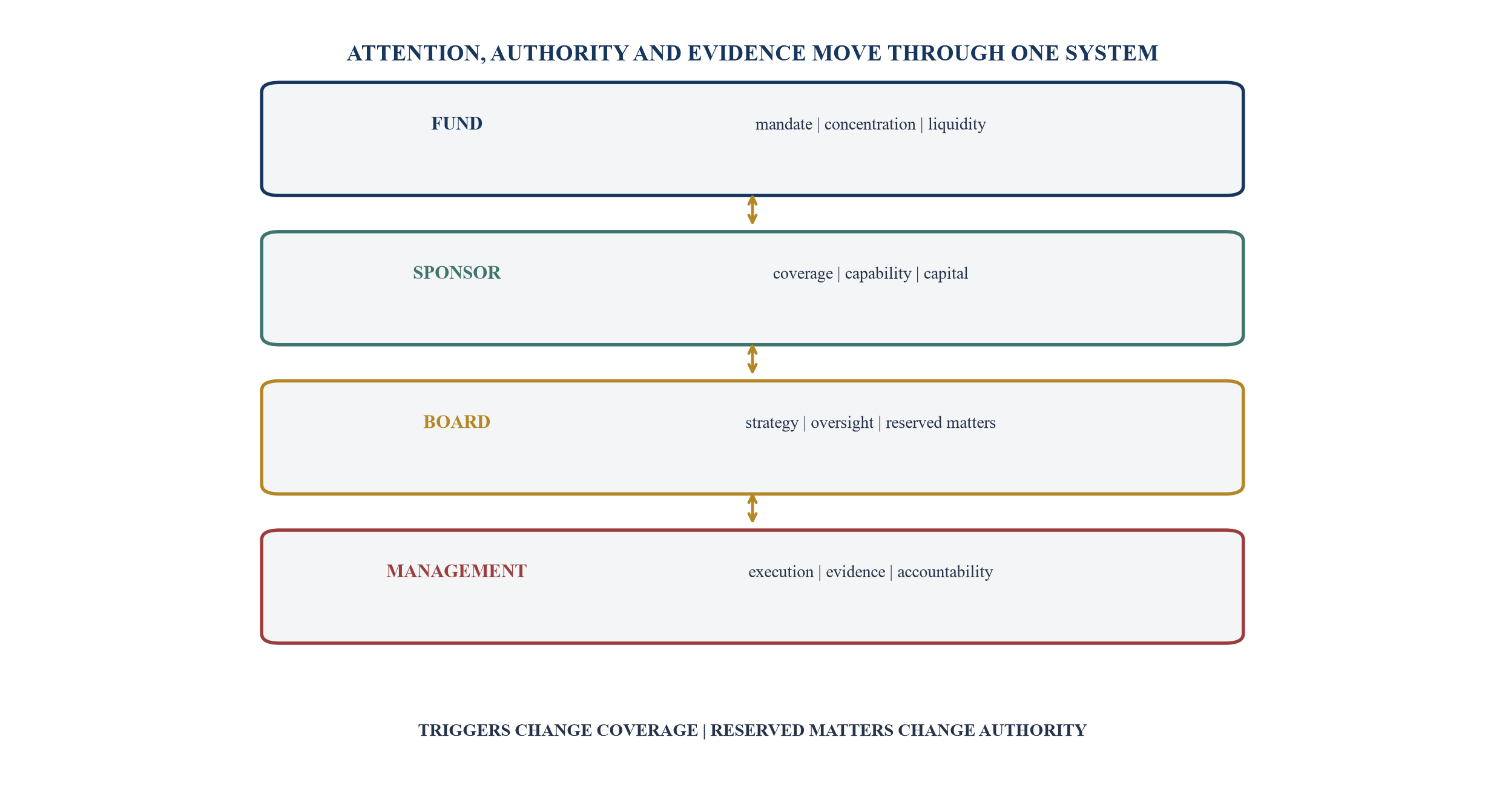
The model is a governance design aid. Actual authority follows law, constitutional documents, financing documents and approved delegations.
2. Establish the investment mandate and ownership contract
Coverage begins with a concise ownership contract for each company. The contract translates the investment committee case into a current statement of value, risk and authority. It identifies the entry thesis, value-creation priorities, capital structure, expected holding period, principal uncertainties, board composition, shareholder rights, lender constraints and exit routes. It should be updated after completion because the signed transaction, closing balance sheet and first operating evidence often differ from the bid model.
The contract should distinguish assumptions from validated facts. A revenue synergy remains an assumption until customer behaviour supports it. A cost initiative remains a programme until the run-rate is visible in accounts and service quality is intact. A management assessment remains provisional until the board observes execution. This discipline prevents the portfolio model from treating an optimistic underwriting case as an operating baseline.
Ownership rights need to be mapped to decision authority. Shareholder agreements, articles, financing documents, management delegations and board terms can allocate consent rights differently. The sponsor should maintain a reserved-matters register covering capital, acquisitions, disposals, material contracts, debt, budgets, senior appointments, litigation, related-party transactions and changes to strategy. The register should identify approval level, monetary threshold, notice period, supporting evidence and emergency route.
The ownership contract also defines the sponsor promise to management. The sponsor may offer access to capital, commercial networks, operating expertise, talent or transaction support. Those capabilities should be described as available resources with an activation process. Vague claims of value-add create frustration when management cannot access the relevant person or when the sponsor intervenes without a defined request.
At fund level, the contract supports consistency with mandate and investor obligations. ILPA's principles emphasise alignment, governance and transparency, including critical matters such as conflicts, valuation, strategy, leverage and material portfolio risks [3][4]. The operating model should connect company information to the fund governance required for concentration, valuation, liquidity, conflicts and limited-partner reporting.
Table 1. Decision-rights matrix for sponsor, board and management
| Decision domain | Management role | Board role | Sponsor or shareholder role | Minimum evidence |
|---|---|---|---|---|
| annual strategy and budget | propose integrated plan and accountable owners | challenge, approve and monitor | test consistency with investment mandate and capital envelope | baseline, scenarios, cash, risk and initiative economics |
| capital expenditure | prepare business case and execute approved spend | approve within reserved thresholds and review delivery | consent where shareholder or financing rights require | return case, downside, funding, procurement and post-investment review |
| acquisitions and disposals | originate, diligence and integrate under mandate | approve strategy, valuation, risk and execution | approve reserved matters and portfolio allocation | valuation, financing, diligence, integration and exit effect |
| debt and liquidity | manage cash, covenant compliance and lender reporting | approve funding plan and monitor resilience | decide shareholder capital and fund exposure | thirteen-week cash, covenant forecast, stress case and alternatives |
| chief executive and key leadership | maintain succession and performance evidence | appoint, evaluate and replace under authority | nominate directors and exercise consent rights | role mandate, scorecard, succession map and transition plan |
| crisis response | contain operations and report facts | direct governance response and protect stakeholders | allocate specialist support and decide capital or ownership actions | incident facts, legal duties, cash effect, options and decision log |
The matrix is illustrative. Company law, licences, constitutional documents, financing terms and approved delegations determine actual authority.
3. Segment the portfolio by value opportunity, risk and organisational maturity
Equal coverage is rarely efficient. A stable, well-capitalised company with a complete leadership team does not need the same sponsor intensity as a leveraged carve-out, an integration programme or a business approaching covenant pressure. Segmentation creates a reasoned basis for attention. It also allows the sponsor to explain why one company receives an operating partner, another receives a quarterly strategic review, and a third enters a recovery cadence.
The segmentation model should use independent dimensions. Value opportunity measures the magnitude and timing of executable upside. Risk measures the likelihood and consequence of deviation, including liquidity, leverage, customer concentration, regulation, safety, cyber and leadership. Organisational maturity measures the company's ability to diagnose, decide and deliver without additional sponsor infrastructure. Combining the dimensions exposes situations that headline financial performance can conceal.
A company with high opportunity and strong maturity may require targeted specialist support rather than intensive general oversight. A company with moderate opportunity and weak controls may require foundational work before acceleration. A high-risk company with weak maturity requires direct board attention and a short evidence cycle. A low-risk company nearing exit requires diligence readiness and transaction governance even if current trading is strong.
Segmentation should be dynamic. The sponsor should refresh it at least quarterly and after a material event. Triggers include a forecast miss, covenant headroom change, management departure, acquisition, control failure, regulatory inquiry, cyber incident, customer loss or credible exit approach. The company can move between coverage tiers when evidence changes. Movement should be documented with a reason, owner and review date.
Scores should support judgement rather than replace it. A numerical total can hide a severe single-point risk. The model should therefore contain non-compensating red flags: imminent liquidity failure, material legal breach, loss of licence, serious safety event, unavailable financial records or executive misconduct. Any red flag overrides an aggregate score and moves the issue to the appropriate authority.
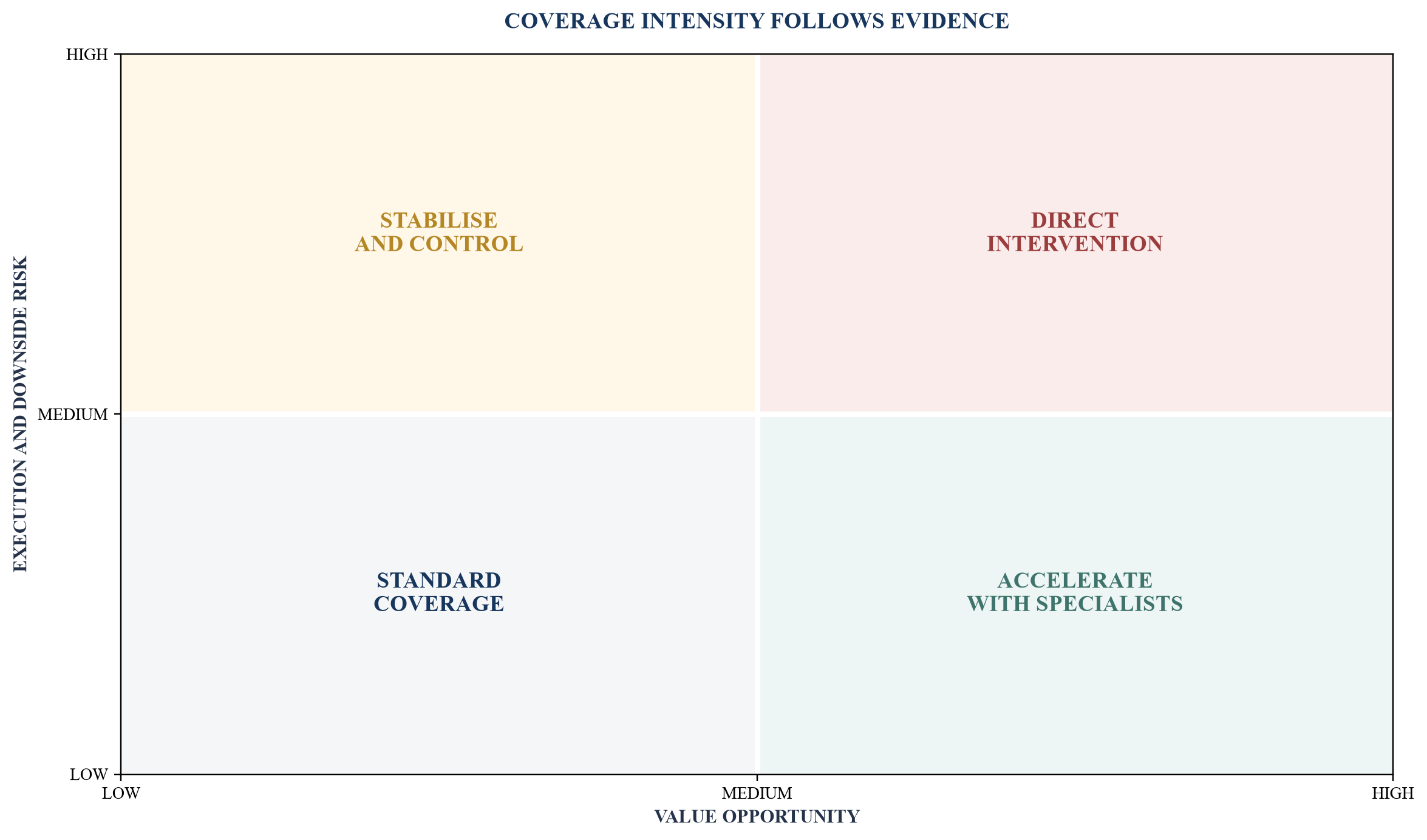
Positioning is illustrative. A third maturity dimension and non-compensating red flags should inform the final coverage tier.
4. Define coverage tiers and a minimum governance standard
Segmentation becomes operational through coverage tiers. A standard tier can use monthly performance reporting, quarterly board meetings and periodic sponsor reviews. An acceleration tier adds initiative-level specialists, fortnightly programme checks and explicit resource decisions. A stabilisation tier introduces short-cycle cash and risk reporting, board-led remediation and tighter reserved matters. A direct-intervention tier activates crisis governance, daily or weekly evidence, independent advisers and a documented transition back to ordinary management.
Every tier should sit above a minimum governance standard. The minimum includes current constitutional and financing documents, an approved delegation of authority, a functioning board calendar, timely financial reporting, a risk register, compliance ownership, incident escalation, data protection, cyber controls, insurance review, legal-entity records and a secure board archive. The minimum also includes a clear strategy, budget, cash forecast and value-creation plan. A company should not be classified as low risk when these basics are absent.
Coverage needs named people and capacity. Each company should have a sponsor lead, board chair or lead director, finance contact and operating lead. Backup coverage matters because transactions, travel and conflicts can make the primary person unavailable. The sponsor should record expected time, meeting cadence, required expertise and active workstreams. A portfolio view reveals over-allocation, key-person concentration and companies with nominal coverage but little practical capacity.
The sponsor should separate observation from intervention. Standard dashboards and board packs provide observation. Intervention begins when the sponsor or board changes resources, authority, cadence or operating priorities. This distinction matters for accountability and for legal analysis of director duties, shadow-director risk and regulated activities. Every intervention should have a mandate, owner, duration, decision route and exit condition.
Coverage cost should be visible. Operating partners, consultants, interim executives, technology programmes and transaction advisers consume company or fund resources. ILPA guidance treats operating-adviser costs and related governance as matters requiring transparency [3][4]. The sponsor should document who bears cost, how conflicts are managed, how scope is approved and what evidence demonstrates value.
Table 2. Portfolio coverage tiers and operating requirements
| Coverage tier | Typical condition | Sponsor cadence | Company evidence | Exit condition |
|---|---|---|---|---|
| standard | stable execution, adequate headroom and mature leadership | monthly information review; quarterly strategic review | board pack, monthly accounts, cash, risks and value-plan progress | remains within agreed ranges for two review cycles |
| acceleration | material executable upside with manageable risk | fortnightly initiative review plus specialist workstreams | initiative economics, owner, milestones, resources and realised value | capability transferred and benefits sustained |
| stabilisation | repeated misses, control weakness or limited headroom | weekly performance, cash and remediation review | thirteen-week cash, root cause, recovery actions and assurance | risk contained, forecast credible and governance restored |
| direct intervention | severe liquidity, legal, leadership or operating threat | crisis cadence set by board and incident needs | verified fact base, option set, authority log and stakeholder plan | board approves transition to a lower-intensity tier |
| exit readiness | credible sale, refinancing or listing route | weekly diligence and decision cadence during active process | vendor diligence, data room, forecasts, contracts and approvals | transaction completes or readiness plan returns to ordinary cadence |
Cadences are illustrative starting points. Company risk, regulation, contractual rights and events determine actual frequency.
5. Convert the investment thesis into a company value-creation plan
The value-creation plan is the operating spine of sponsor coverage. It should identify the limited set of initiatives expected to improve enterprise value, resilience or strategic options. Each initiative needs a baseline, economic mechanism, accountable executive, delivery milestones, resources, dependencies, risk controls and evidence of realised value. A long list of activities weakens focus and makes escalation subjective.
The plan should distinguish value creation from value recognition. Margin improvement, cash conversion, customer retention, pricing, capacity, product quality and capital productivity create economic value. Reporting improvements, management depth, governance, data quality and a coherent strategic narrative help buyers and lenders recognise that value. Both matter. Exit readiness cannot manufacture weak economics, and strong economics may receive a discount when evidence is incomplete.
The board should approve the value bridge and its assumptions. The bridge can decompose enterprise-value movement into operating performance, cash generation, capital structure, portfolio change and market multiple. Management should receive credit for controllable delivery. Sponsor decisions on leverage, acquisitions and timing should remain visible. This supports fair accountability and discourages interventions that optimise one metric while damaging the wider case.
Initiatives should contain leading and lagging measures. A commercial transformation might track validated pipeline quality, price realisation, retention and contribution margin before revenue appears. An operations programme might track throughput, service levels, defects, maintenance and working capital before EBITDA. A digital programme should connect adoption and process change to cost, revenue, risk or capital outcomes.
The sponsor portfolio view should aggregate common drivers without forcing identical plans. Standard categories enable comparison: growth, margin, cash, capital, talent, technology, risk, M&A and exit. Company-specific definitions preserve relevance. Every reported benefit should reconcile to financial or operating records and show implementation cost, timing and sustainability.
6. Build a portfolio heat map that combines performance, risk and evidence quality
A portfolio heat map should direct attention before a problem becomes irreversible. Financial variance alone arrives too late for many risks. The heat map should combine outcome measures, leading indicators, liquidity, covenant headroom, customer concentration, talent, controls, regulatory exposure, cyber resilience and evidence quality. Evidence quality deserves a separate dimension because an unavailable or unreliable number is itself a risk.
Each indicator needs a defined green, amber and red range. Thresholds should reflect the business model and financing terms. A project company may focus on schedule, cost-to-complete and contractor claims. A regulated financial company may prioritise capital, liquidity, conduct and compliance. A consumer company may need weekly demand, inventory and gross-margin signals. Portfolio consistency comes from the governance of definitions rather than identical metrics.
The map should show trend and duration. One amber month can reflect timing. Three deteriorating months can reveal a structural issue. A red liquidity indicator requires immediate action regardless of duration. The sponsor should specify which triggers automatically change coverage tier and which require board judgement. Every override should have a written rationale and review date.
Qualitative evidence should be disciplined. Management confidence, employee sentiment, customer conversations and adviser views can add context, but they should not replace verified data. The board pack should identify the source, date, sample and limitation. Conflicting evidence should be surfaced. Repeated forecast revisions, incomplete packs and delayed answers can indicate weak control even while headline results remain within budget.
The heat map should also expose sponsor-side risk. Missing directors, overloaded operating partners, unresolved conflicts, delayed capital decisions and weak handoffs can impair outcomes. The owner should review its own readiness alongside company performance. A transparent portfolio register makes this responsibility visible.
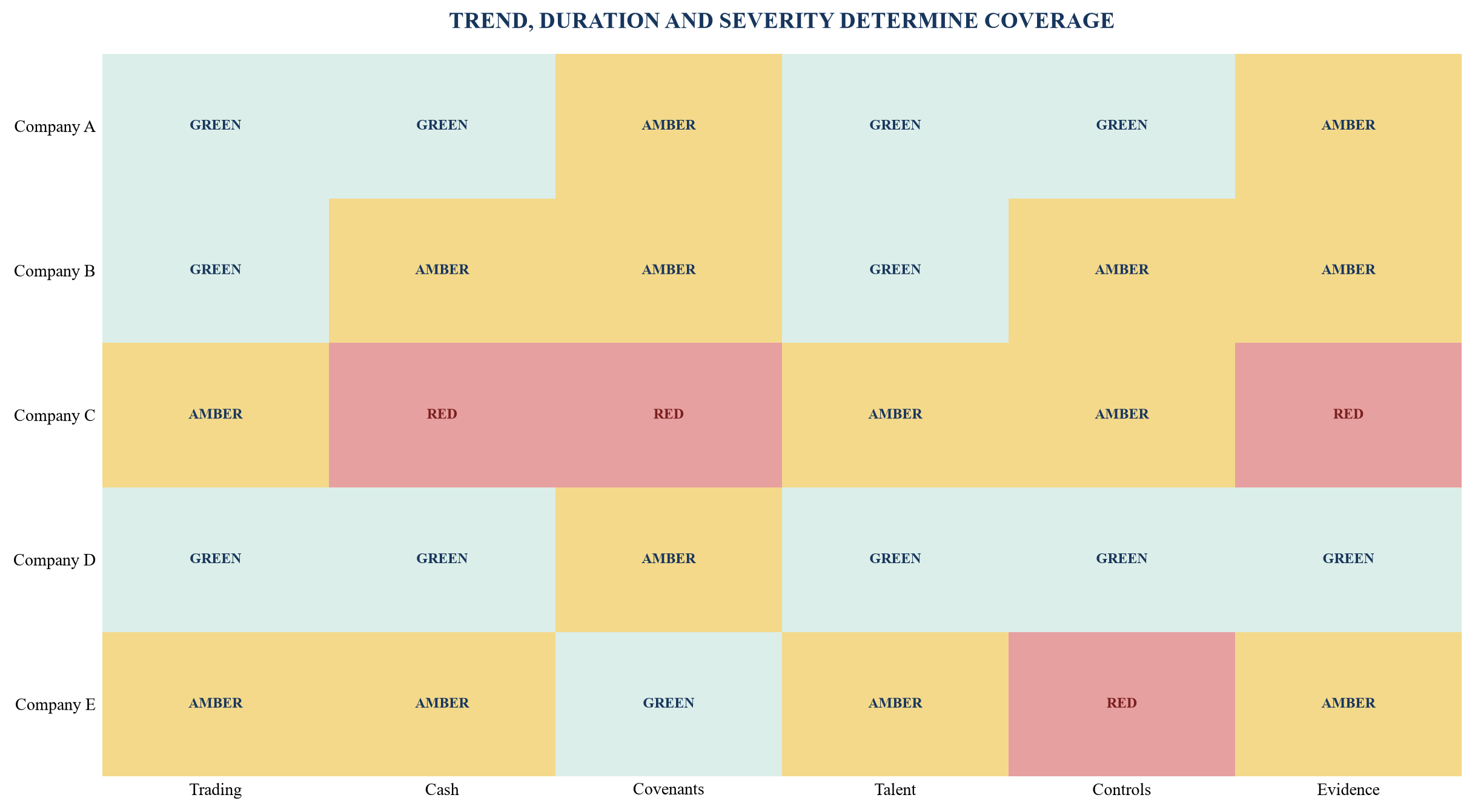
Scores and companies are hypothetical. A material non-compensating red flag overrides the aggregate state.
7. Design observable triggers before intervention is needed
Intervention should begin from agreed evidence rather than surprise or personality. The sponsor and board should define trigger families during ordinary conditions. Financial triggers include liquidity runway, covenant headroom, recurring forecast error, margin compression and working-capital deterioration. Commercial triggers include customer loss, pricing failure, pipeline conversion and concentration. Operating triggers include capacity, quality, safety, project delay and supplier interruption. Governance triggers include late accounts, control failures, regulatory breach, litigation and executive turnover.
Thresholds should reflect consequence and reversibility. A slowly deteriorating margin may allow a diagnostic period. A missed payroll, licence threat or serious safety event requires immediate escalation. The model should specify who receives notice, how quickly facts are verified, which interim authority applies and when the board meets. A trigger is useful only when it changes an action.
The sponsor should avoid automatic operational control for every variance. Management should have a defined opportunity to diagnose and recover within its delegation. The board can request a recovery plan with a dated evidence path. Sponsor specialists can support the work without displacing ownership. Escalation increases when the issue crosses a second threshold, the recovery plan lacks credibility or management fails to report accurately.
Triggers must account for interdependence. A revenue miss can become a liquidity issue when leverage is high. A cyber incident can become a regulatory and customer event. A delayed acquisition integration can affect covenants, talent and exit timing. The trigger register should identify linked indicators and common decision owners. This reduces the risk that separate committees view only part of the problem.
Every trigger should close. Closure requires verified containment, root-cause correction, sustainable performance and an approved return to ordinary cadence. Removing a red flag because the reporting period ended leaves latent risk. The board should record residual risk and monitor it for an agreed period.
Table 3. Trigger and intervention register
| Trigger family | Early signal | Escalation threshold | Immediate action | Closure evidence |
|---|---|---|---|---|
| liquidity and leverage | headroom narrows or forecast variance repeats | minimum cash or covenant buffer is breached or projected to breach | validate cash, freeze discretionary uses, engage board and lenders as appropriate | credible funded plan, restored headroom and tested forecast accuracy |
| commercial | retention, price or conversion falls outside range | material customer loss or sustained contribution decline | customer fact base, account actions and scenario update | retained revenue, validated replacement economics and stable margin |
| operations | throughput, quality or schedule deteriorates | safety, service or cost-to-complete threshold is crossed | contain harm, appoint incident owner and secure specialist support | root cause closed, controls tested and performance sustained |
| governance and reporting | board information is late or incomplete | accounts unreliable, control fails or legal duty is threatened | preserve records, obtain independent verification and convene authority | corrected records, control assurance and accountable owner |
| leadership | critical role has no successor or performance declines | departure, misconduct or inability to execute recovery | activate succession, protect continuity and clarify delegated authority | role filled, transition complete and board confidence restored |
| transaction | diligence issue, financing gap or integration delay | deal condition, synergy case or exit timetable becomes untenable | re-underwrite options and decision deadlines | revised case approved or transaction stopped with lessons recorded |
Thresholds are hypothetical examples. Company-specific documents, risk appetite and professional advice determine actual triggers.
8. Use an escalation ladder that preserves management accountability
Escalation should change one or more of four variables: cadence, evidence, capability and authority. The first level increases observation through a more frequent report or a focused diagnostic. The second adds support through an operating partner or specialist. The third changes governance through a board committee, recovery office or tighter delegation. The fourth considers leadership, capital structure, restructuring or ownership action. Each level should have an explicit purpose and end state.
The ladder protects management by making intervention predictable. Executives understand the evidence that will be requested, the decisions that remain theirs and the conditions for returning to normal coverage. It protects the board by recording when duties require stronger action. It protects the sponsor by preventing informal operating instructions from bypassing governance. The ladder should be incorporated into board terms, delegations and incident protocols where appropriate.
An escalation memorandum can be short. It should state the verified issue, affected obligations, immediate containment, proposed coverage tier, decision rights, workstream owners, advisers, communication plan, budget and review date. It should identify conflicts and privilege where legal advice is involved. The board or authorised committee approves the intervention and receives a decision log.
Sponsor personnel should distinguish advice from instruction. An operating partner can test a plan, provide benchmarks, source capability and support execution. The board decides reserved matters. Management remains accountable for operations unless formal authority changes. Where the sponsor appoints an interim executive or directs a restructuring, the legal and governance consequences require specific advice and documentation.
De-escalation deserves the same discipline. The intervention should end when evidence demonstrates containment, capability and a credible forward plan. A post-intervention review should record decisions, costs, value protected, unresolved risks and changes to the minimum standard. The sponsor then transfers ownership back to ordinary management and board cadence.
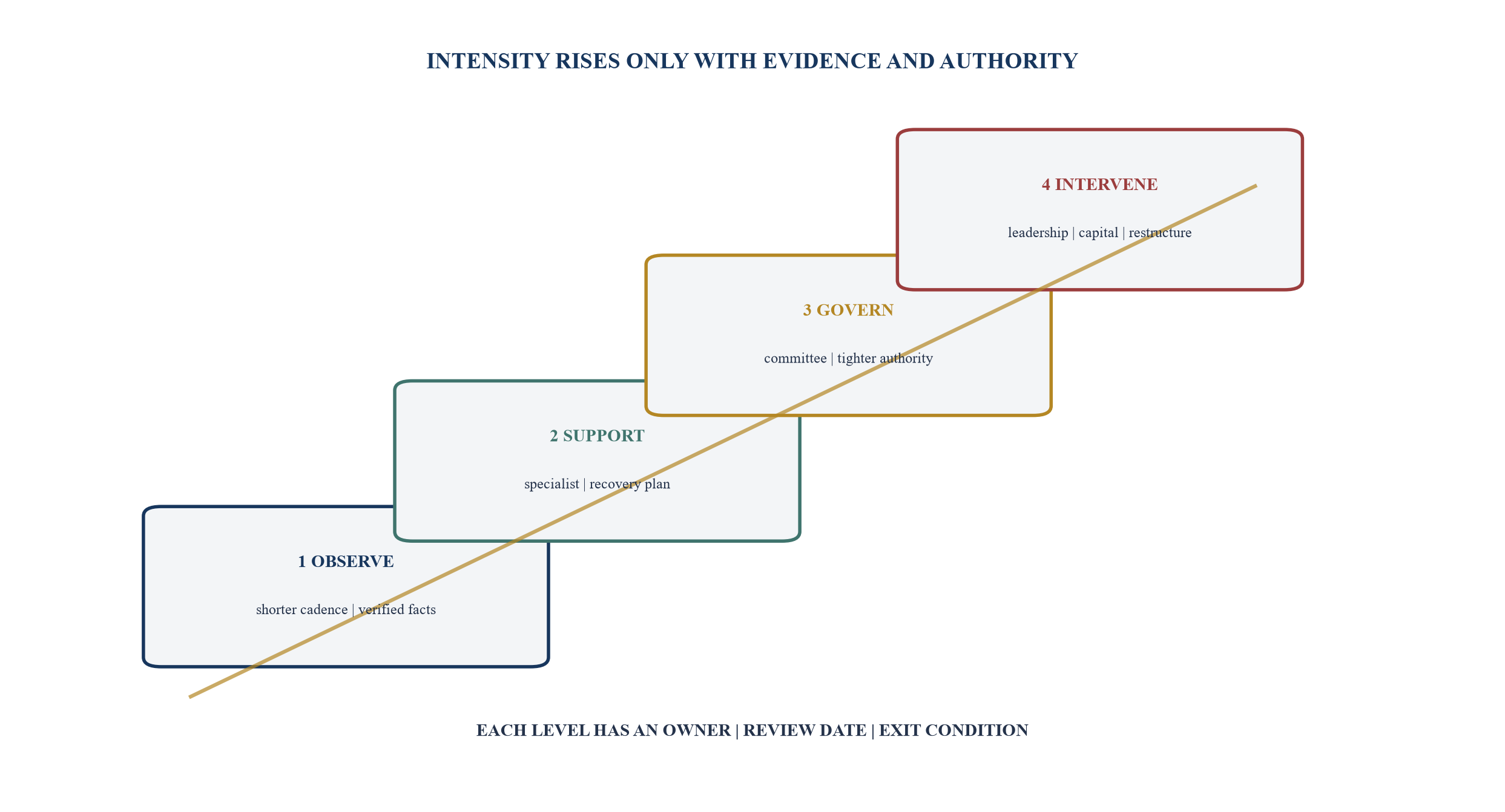
The ladder is an illustrative governance sequence. Severe events may move directly to the level required by law, safety, liquidity or fiduciary duty.
9. Allocate operating-partner and specialist capacity against decision value
Operating resources should be allocated where they can change an important decision or accelerate a validated initiative. Availability alone is an insufficient reason. The sponsor should maintain a capability bench covering finance, commercial, operations, talent, technology, cyber, procurement, supply chain, data, sustainability, M&A, integration, restructuring and exit. Every deployment should begin with a defined problem, sponsor, company owner and expected evidence.
The capability model can combine internal operating partners, portfolio-company leaders, external advisers and temporary executives. Internal capacity supports continuity and portfolio learning. External specialists provide depth, independence or local knowledge. Portfolio-company leaders can share practices when confidentiality and incentives permit. Interim executives can supply accountable capacity during transition. The sponsor should choose the model based on need, authority, time and cost.
Deployments should have work orders. A work order states the decision or outcome, scope, data access, deliverables, company owner, adviser role, timetable, cost, conflict checks and success measures. It also states what the specialist cannot decide. This prevents an open-ended advisory presence from weakening management and allows the board to judge whether the intervention created value.
Knowledge should remain after the specialist leaves. The work should produce definitions, processes, tools, trained owners and an evidence archive. Repeatedly solving the same basic reporting or procurement problem across portfolio companies suggests a missing sponsor platform. The sponsor can build shared standards while keeping company accountability clear.
Capacity planning belongs in the portfolio review. The sponsor should compare expected hours and critical skills with available people over the next quarter. Transactions, refinancings and exits create predictable peaks. A central view helps avoid assigning the same specialist to several high-risk situations and identifies capabilities that justify a framework arrangement or hire.
Table 4. Specialist capability bench and activation logic
| Capability | Activation evidence | Typical mandate | Company owner | Completion evidence |
|---|---|---|---|---|
| finance and liquidity | unreliable forecast, limited headroom or covenant pressure | cash control, forecast rebuild, financing options and lender evidence | chief financial officer and board finance lead | reconciled forecast, approved funding plan and sustained accuracy |
| commercial | retention, pricing, pipeline or concentration outside plan | customer economics, pricing architecture and account recovery | chief commercial officer | validated retention, realised price and contribution improvement |
| operations and procurement | quality, schedule, cost or supplier risk | root cause, operating system, sourcing and benefits verification | chief operating officer | stable service, realised net benefits and embedded control |
| talent and organisation | leadership gap, unclear accountability or weak succession | role mandates, organisation design, succession and search | chief executive and nomination committee | filled roles, clear decisions and transition evidence |
| technology, data and cyber | material transformation dependency or control weakness | architecture, delivery governance, security and value realisation | technology executive and risk owner | tested controls, adoption and economic outcome |
| transaction and integration | add-on, carve-out, refinancing or exit route | diligence, value case, separation, integration and transaction readiness | transaction executive and board sponsor | approved case, controlled execution and reconciled value evidence |
Capability deployment should follow the verified company need, approved scope and applicable conflict rules.
10. Build boards around the investment case and risk profile
Board composition should reflect the decisions the company must make during the hold period. Industry knowledge, finance, operations, technology, regulation, talent and transaction experience can each be relevant. The chair must convert those perspectives into clear decisions and accountable follow-through. A board filled only with sponsor representatives may lack independent challenge or operating depth. A board overloaded with advisers may diffuse authority.
The sponsor should maintain a board skills matrix against the current value-creation plan and risk register. Gaps can be addressed through directors, observers, committee advisers or time-bound specialists. The chosen role should match the authority required. Independence and conflicts need explicit assessment. A director owes duties under the governing law and should act through the company governance framework rather than as a messenger for one constituency.
Board agendas should follow value and risk. Routine reporting can be distributed in advance. Meeting time should focus on decisions, deviations, capital, customers, talent, risk and the forward plan. Papers should state the requested decision, alternatives, management recommendation, evidence, downside and implementation owner. Minutes should capture the substance of challenge, decision and follow-up without becoming a transcript.
Committees can deepen work on audit, risk, remuneration, nomination, transactions or transformation. The OECD notes that specialised committees can support the board while the full board retains responsibility [2]. Committee mandates, membership, information rights and escalation routes should be clear. A temporary committee can govern a specific integration or recovery without creating permanent complexity.
Board effectiveness should be reviewed. Attendance, preparation, quality of challenge, decision speed, follow-through, access to management and conflict handling are observable. The sponsor can conduct an annual evaluation and an event-driven review after a transaction, crisis or leadership change. The output should be a small set of actions with owners and dates.
11. Standardise information rights, reporting and decision evidence
The sponsor operating model depends on timely, comparable and decision-useful information. A minimum reporting pack should contain financial performance, cash, covenant headroom, forecast, customers, operations, people, risk, compliance, value-plan initiatives and decisions required. Definitions should reconcile to source systems. The company should identify preliminary data and explain material changes from prior reports.
Standardisation should reduce repeated manual work. A common portfolio taxonomy can map revenue, EBITDA, cash, leverage, headcount, customers and initiatives while preserving company-specific charts. Automated extraction can improve speed when controls, access and reconciliation are adequate. The sponsor should avoid a central data project that consumes management effort without improving a decision.
Information rights require secure implementation. The sponsor should define who can access company data, for what purpose and under which confidentiality, privacy, competition and insider restrictions. Cross-portfolio sharing can create antitrust or confidentiality risk. Clean teams, restricted folders and need-to-know permissions may be required during transactions or competitive benchmarking. Legal advice should guide sensitive cases.
Decision evidence should survive personnel changes. The archive should contain board papers, minutes, models, approvals, material contracts, adviser reports, covenant records, regulatory correspondence and intervention logs. Version control and naming standards enable later review. The archive also supports valuation, audit, lender diligence, limited-partner reporting and exit.
Forecast quality is a leading governance signal. The board should compare forecasts submitted at successive dates with actual results, identify bias and test whether management acts on new information. A credible forecast includes assumptions, ranges and cash consequences. Repeated optimistic revisions should affect coverage even when final results remain within covenant.
12. Make liquidity, leverage and covenant headroom the early-warning core
Liquidity can convert an operating issue into a loss of strategic control. The sponsor should require a thirteen-week cash forecast for companies with material leverage, seasonal working capital, project exposure or limited headroom. The forecast should reconcile opening cash, receipts, payments, facilities, restrictions and minimum operating needs. It should show base, downside and severe-but-plausible cases.
Covenant reporting should include current calculation, forecast headroom, definitions, cure rights, reporting dates and sensitivity to earnings, working capital, interest rates and foreign exchange. Management should identify judgemental add-backs and one-off adjustments. The board should understand when a projected breach becomes a notification or negotiation matter under financing documents.
The sponsor needs a portfolio capital register. It should show debt maturity, interest basis, hedging, amortisation, security, guarantees, restricted cash, shareholder instruments, covenant tests and refinancing milestones. This allows fund-level comparison and timely allocation of financing support. It also exposes concentration in lenders, maturities and market windows.
Intervention begins before cash is exhausted. Management can tighten collections, inventory, procurement, capex and discretionary spend while protecting essential operations. The board can consider refinancing, covenant reset, asset sale, new equity or restructuring. Each option should show value transfer, timing, conditions and stakeholder consequences. The sponsor decides fund capital through its own mandate and conflicts process.
Evidence quality matters intensely in distress. A forecast that excludes taxes, retention payments, disputed suppliers or project losses can create false confidence. Independent review may be appropriate. Communications with lenders, employees, regulators and customers should be controlled through authorised people and legal advice.
13. Treat leadership, succession and incentives as portfolio infrastructure
The sponsor operating model depends on executives who can run the company under concentrated ownership. Each critical role should have a written mandate linked to the value-creation plan, decision authority and evidence expectations. The board should assess current capability, capacity, behaviour and succession. A strong individual in a role designed incorrectly can still fail.
The chief executive relationship requires clarity. The board sets expectations, evaluates performance, supports decisions and changes leadership when needed. Sponsor personnel should avoid multiple informal instruction channels. A lead director or chair can consolidate feedback and protect decision quality. Material concerns should be documented and addressed promptly rather than accumulated until a sudden replacement.
Succession should cover emergency and planned scenarios. Emergency succession identifies who can assume authority tomorrow, what permissions and communications are needed, and which external support is available. Planned succession defines the future role, search process, assessment, handover and stakeholder plan. Critical roles below the executive team may need the same discipline where knowledge or licences are concentrated.
Management incentives should connect ownership economics to controllable value creation. Metrics, vesting, leaver treatment, dilution, governance and exit proceeds should be understood. The sponsor should monitor whether an incentive design encourages excess leverage, short-term revenue, delayed maintenance or transaction volume. Board discretion should be governed and supported by evidence.
Talent data should enter the heat map carefully. Regretted turnover, vacancy duration, engagement, performance distribution, succession coverage and critical-skill capacity can be useful. Sensitive personal information requires controlled access. The board should use aggregate evidence for portfolio comparison and company-specific facts for decisions.
14. Govern digital transformation, artificial intelligence and cyber risk as value decisions
Technology programmes should enter the sponsor model through business outcomes, architecture risk and control. A digital initiative should state the customer, process or decision it changes; the baseline; the expected revenue, cost, cash or risk effect; the required data and integration; and the owner of adoption. Technology delivery alone does not demonstrate value.
Artificial-intelligence use adds model, data, privacy, intellectual-property, bias, security and accountability questions. The board should know which high-impact decisions use automated systems, which data enters them, who validates outputs and how human oversight works. A portfolio standard can define inventory, risk classification, approval, monitoring and incident response while allowing company-specific implementation.
Cybersecurity is a governance issue across every tier. NIST's Cybersecurity Framework 2.0 adds a Govern function alongside Identify, Protect, Detect, Respond and Recover, emphasising organisational context, roles, policy, oversight and supply-chain risk [15]. The sponsor can use a common baseline for asset inventory, identity, backups, vulnerabilities, incident readiness and third-party exposure. A red cyber trigger should activate board and legal protocols, not remain solely within information technology.
Portfolio leverage can support technology procurement, standards and specialist access. It can also increase concentration when companies share providers, cloud environments or advisers. The sponsor should map common dependencies and test whether a single incident could affect several assets. Contract, insurance and recovery evidence should be available.
Digital diligence should continue through the hold period and exit. Architecture, code ownership, licences, data rights, security findings, model governance, vendor concentration, technology costs and programme benefits are frequent transaction questions. Maintaining the evidence improves both risk control and buyer confidence.
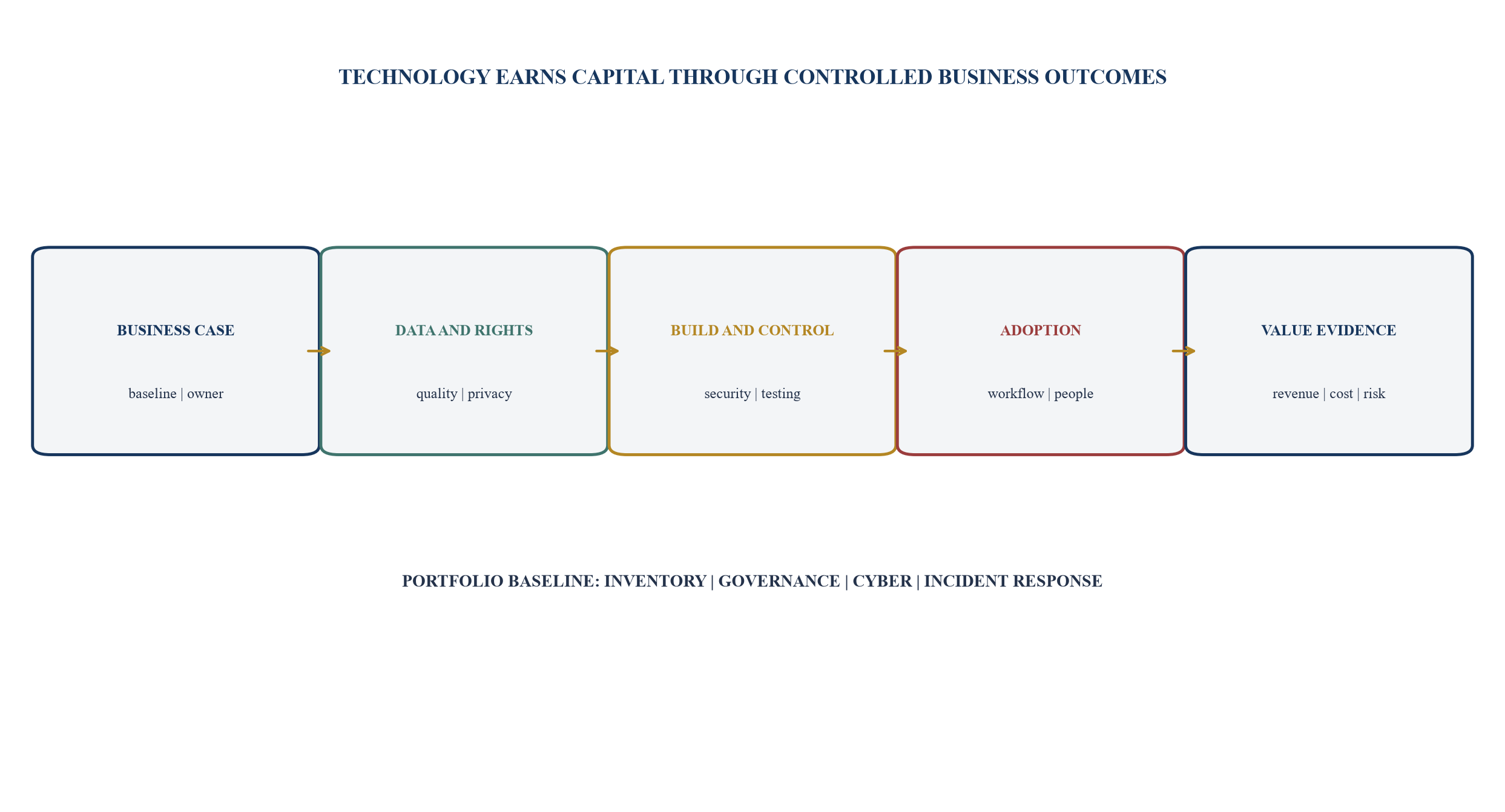
The chain is an illustrative portfolio standard and should be adapted to technology, sector and regulation.
15. Apply the model within the United Arab Emirates, ADGM and DIFC
The United Arab Emirates contains several corporate and regulatory regimes. A portfolio company may be incorporated onshore, in a commercial free zone, in Abu Dhabi Global Market or in Dubai International Financial Centre. It may also hold a sector licence and operate through subsidiaries in several emirates. The sponsor should map legal entity, regulator, licence, board authority, shareholder rights, employment, data and insolvency regime before applying a standard intervention.
The Securities and Commodities Authority's governance framework for public joint-stock companies addresses board responsibility, executive management, committees, conflicts, risk, compliance, audit and disclosure. The Authority reported amendments aligning governance requirements with the federal Commercial Companies legislation and adding board obligations concerning internal control and risk management [5][6]. These requirements directly apply to companies within their scope. Private companies can still use the underlying accountability disciplines where appropriate.
ADGM and DIFC have their own company and financial-services frameworks. Regulated entities require specific governance, approved-person, risk, compliance and reporting arrangements. A sponsor director or operating partner should understand which matters require regulator engagement and which individuals hold formal responsibilities. The intervention protocol should preserve those roles and obtain qualified advice before changing management, control or outsourcing.
The sponsor should also consider beneficial ownership, sanctions, anti-money laundering, related-party transactions, data protection and economic-substance obligations as applicable. Records should show the authorised legal entity and decision maker. Group-level programmes cannot assume that one approval covers every entity.
The practical output is a UAE entity-and-authority map. It identifies jurisdiction, licence, governing law, regulator, directors, committees, authorised signatories, reserved matters, financing consents, filings and incident contacts. The map should be reviewed after acquisitions, restructurings and leadership changes.
16. Extend jurisdictional precision across Saudi Arabia and the wider Gulf
Regional portfolios require a common operating philosophy and local legal precision. Saudi Arabia, Qatar, Bahrain, Oman and Kuwait each have company, capital-market, competition, labour, data and sector rules. Listed and regulated companies face additional governance requirements. The sponsor should use local counsel and regulated advisers to determine the requirements for the actual company and decision.
Saudi Arabia's Capital Market Authority publishes Corporate Governance Regulations addressing shareholder rights, boards, committees, conflicts, controls and disclosure for companies within scope [7]. The Saudi Companies Law and implementing instruments govern corporate authority more broadly [8]. A sponsor should map board and shareholder approvals, related-party treatment, director obligations and filings before intervention or transaction decisions.
Bahrain's Central Bank High-Level Controls module reinforces collective board oversight, risk governance, risk appetite and delineated responsibilities for boards, committees, senior management, finance, audit, risk and compliance in licensed institutions [9]. Qatar, Oman and Kuwait also maintain corporate-governance frameworks through their respective market and regulatory authorities [10][11][12]. These regimes demonstrate why a generic portfolio dashboard cannot replace entity-specific governance.
The model should preserve local management capacity. A regional functional lead can establish standards, share expertise and compare evidence. Country management remains accountable for licences, stakeholders, employment and operations. The board should decide where regional authority sits and how conflicts between group optimisation and local obligations are resolved.
Cross-border cash, guarantees, management fees, data transfer, intellectual property and personnel movements require structured review. The sponsor operating model should route each matter through tax, legal, regulatory and financing workstreams before execution. A portfolio company should never discover a consent or restriction only when funds, data or people have already moved.
Table 5. GCC governance and intervention map
| Jurisdiction lens | Governance focus | Intervention question | Evidence register | Specialist route |
|---|---|---|---|---|
| UAE onshore and SCA scope | company authority, boards, committees, controls and disclosure | which board, shareholder, regulator or lender approval applies? | entity chart, articles, licences, delegations and filings | UAE corporate, regulatory, tax and restructuring advisers |
| ADGM | common-law company framework and FSRA requirements where regulated | does the action affect control, approved persons or regulated governance? | constitutional documents, permissions, controlled functions and notices | ADGM legal and regulatory specialists |
| DIFC | DIFC company law and DFSA requirements where regulated | which duties, permissions, data or insolvency rules shape the response? | registers, licences, committees, outsourcing and incident records | DIFC legal, DFSA and restructuring specialists |
| Saudi Arabia | Companies Law, CMA rules where applicable and sector regulation | which reserved matter, related-party, competition or disclosure route applies? | approvals, ownership, board records, filings and regulator correspondence | Saudi legal, capital-market and sector advisers |
| Bahrain and Qatar | company and sector governance, including financial-regulator controls | which board and control functions must own the issue? | licence, risk appetite, committee mandates and reporting record | local regulatory, legal and financial specialists |
| Oman and Kuwait | company, capital-market and sector requirements | how do governance, disclosure and approval duties affect timing? | authority map, filings, consents and decision log | local legal, market and transaction advisers |
This table identifies diligence domains only. Applicable law, regulation and professional advice determine requirements for each entity and event.
17. Govern add-on acquisitions and integration through the operating model
An add-on acquisition changes portfolio risk, management capacity and capital allocation. The sponsor should assign a transaction owner, board sponsor and integration executive before signing. The investment case should show stand-alone value, price, financing, synergies, integration cost, dis-synergies, customer and talent risk, systems work and required management time. Completion is a milestone; realised value is the outcome.
The operating model should place the acquisition in the heat map. A large or complex add-on may move a stable company into acceleration or stabilisation coverage. The board should set an integration cadence, reserved decisions and evidence standard. Material dependencies need named owners. A synergy should be credited only when it is recurring, net of cost and supported by financial records.
Cross-border transactions require additional work on merger control, foreign investment, licences, data, tax, employment and financing. The timetable should separate signing, conditions, completion and integration. The sponsor should avoid operational direction before control lawfully transfers. Clean-team arrangements may be required for competitively sensitive information.
Integration governance should contain a small number of value and risk workstreams: customers, people, operations, technology, finance, controls and legal entities. Each workstream has a baseline, decision rights, milestones, resources and risks. The integration office consolidates evidence without becoming a parallel management structure. The board resolves conflicts and capital decisions.
The post-investment review should compare the approved case with actual purchase price, costs, retained customers, synergies, cash and return. It should identify which diligence assumptions proved accurate and which operating capabilities were missing. Those lessons improve the next transaction and the sponsor's capability bench.
18. Use the model during downside, restructuring and leadership failure
Downside reveals whether the sponsor model can act under uncertainty. The first task is a verified fact base: cash, liabilities, contracts, security, covenants, legal duties, licences, customers, employees, critical suppliers and realistic trading scenarios. Management should preserve records and avoid unsupported reassurance. The board should obtain independent advice when solvency, misconduct, litigation or regulatory obligations may be engaged.
The sponsor should separate operating recovery, financing, leadership and ownership decisions. Operating actions can improve cash, margin or service. Financing actions can extend runway or alter stakeholder rights. Leadership action can restore accountability. Ownership action can provide capital, sell, merge or restructure. Combining these choices in a single optimistic plan obscures dependencies and value transfer.
A recovery office can establish daily or weekly cadence, cash controls, decision logs and workstream ownership. Its mandate should preserve board authority and legal duties. The office should report verified actuals, forecast changes, blockers and decisions required. Advisers should have explicit roles, cost approvals and information protocols.
Leadership failure requires fair evidence and continuity. The board should identify the decision failures, capability gaps or conduct concerns; protect critical operations; and activate succession. Sponsor disappointment alone is an insufficient process. Employment, regulatory and governance advice may be required. The communication plan should address employees, customers, lenders and regulators with accurate authorised information.
Restructuring choices should compare stakeholder recoveries, execution risk, funding needs, operational consequences and strategic value. The sponsor may face conflicts across funds, instruments or portfolio companies. Those conflicts should be disclosed and governed. The intervention closes only when authority, liquidity, controls and leadership can sustain the approved path.
19. Build exit readiness as a continuous evidence discipline
Exit readiness begins when the investment is acquired. Buyers and lenders will test earnings quality, customers, contracts, forecasts, tax, legal entities, licences, technology, cyber, data, people, environmental matters, litigation and controls. The sponsor operating model should assign evidence owners during the hold period. A late data-room exercise cannot reconstruct decisions and rights that were never recorded.
The board should maintain an exit-readiness scorecard. It can assess financial track record, value-creation evidence, management depth, commercial quality, legal and regulatory records, technology, risk, tax, sustainability, data room and transaction capacity. Each red or amber item needs an owner, action and target date. The score should distinguish missing evidence from substantive weakness.
The equity story should reconcile to the accounts and operating record. Claimed growth needs customer and revenue evidence. Claimed margin improvement needs a transparent bridge. Claimed technology value needs adoption and economic results. Add-on performance needs purchase price, integration cost and realised synergies. The sponsor should avoid a narrative that exceeds the evidence buyers can verify.
Exit routes may include strategic sale, sponsor sale, continuation vehicle, refinancing, partial liquidity or public listing. Each route has different governance, disclosure, management and timing requirements. The board can maintain route-specific readiness while preserving ordinary execution. A credible unsolicited approach can then be evaluated without destabilising the company.
Transaction readiness also requires capacity. Management must continue running the business while answering diligence. The sponsor should define workstreams, advisers, clean teams, disclosure governance and decision gates. The same portfolio coverage system used during ownership can support a controlled transaction and a complete handover.
20. Apply the framework to a hypothetical five-company portfolio
Consider a hypothetical regional sponsor with five portfolio companies and a limited operating team. Company A is a mature services business with stable cash and strong management. Company B has a credible digital-growth programme and adequate controls. Company C is a leveraged project business with forecast volatility and weak cash evidence. Company D is preparing an add-on acquisition. Company E has received preliminary buyer interest. All values, scores and timing in this example are assumptions created solely to demonstrate the framework.
The initial model gives every company the same monthly meeting and assigns one operating partner across all five. The revised segmentation identifies different decision needs. Company A moves to standard coverage with a quarterly strategy review. Company B receives a twelve-week acceleration mandate with a technology and commercial specialist. Company C enters stabilisation with weekly cash, covenant and project evidence. Company D receives transaction and integration governance. Company E begins exit-readiness work while maintaining operating cadence.
The heat map identifies Company C's evidence quality as red even though reported EBITDA remains near budget. A rebuilt cash forecast reveals supplier and tax payments missing from the original model. The board tightens cash authority and appoints an independent finance specialist. The sponsor evaluates financing options without committing fund capital until the revised case and stakeholder consequences are understood.
Company B's programme initially reports milestones rather than value. The specialist reconnects adoption to customer conversion, service cost and working capital. The board funds the next phase only after usage and unit economics meet an agreed gate. Company D's acquisition is approved subject to customer-retention, integration-cost and financing thresholds. Company E resolves contract and cyber evidence gaps before launching a process.
After one quarter, the sponsor reviews outcomes and capacity. Company C has a reliable forecast and funded recovery path but remains under weekly monitoring. Company B has transferred programme ownership to management. Company D has completed within the approved perimeter and enters integration cadence. Company E has a complete first-stage data room. The model demonstrates differentiated attention with explicit authority and exit conditions.
Table 6. Hypothetical portfolio coverage and intervention decision
| Company | Verified starting state | Coverage decision | Specialist deployment | Ninety-day evidence |
|---|---|---|---|---|
| A: mature services | stable cash, credible forecast and complete team | standard coverage | targeted annual commercial challenge | strategy refreshed and ordinary cadence sustained |
| B: digital acceleration | clear opportunity, adequate headroom and weak value measurement | acceleration | technology and commercial specialists for twelve weeks | adoption linked to customer, cost and cash outcomes |
| C: leveraged projects | narrow headroom, volatile projects and unreliable cash evidence | stabilisation | finance, project-control and financing support | reconciled cash, funded recovery and improving forecast accuracy |
| D: add-on acquisition | stable core with transaction and integration workload | transaction coverage | diligence and integration capability | approval conditions met and integration evidence operating |
| E: potential exit | strong trading with contract and cyber evidence gaps | exit readiness | vendor diligence, legal and cyber support | first-stage data room and route decision complete |
| sponsor platform | one operating partner serving all situations | quarterly capacity allocation | external bench activated against work orders | no critical conflict, uncovered company or overloaded specialist |
All companies, scores, actions and outcomes are hypothetical management assumptions used solely to demonstrate the method.
21. Execute a one-hundred-day sponsor operating-model implementation
Days zero to twenty establish the baseline. The sponsor inventories portfolio companies, ownership rights, boards, financing, value-creation plans, current reporting, risks, active interventions and available operating capacity. Each company receives a sponsor lead and a verified ownership contract. The team identifies missing authority documents, data and critical red flags.
Days twenty-one to forty-five define the model. The sponsor approves segmentation criteria, non-compensating red flags, coverage tiers, minimum governance standard, trigger register and escalation ladder. It creates standard board and portfolio information requirements. Legal and regulatory advisers review the decision-rights and intervention framework for relevant jurisdictions.
Days forty-six to seventy-five apply the model company by company. Boards approve or refresh delegations, calendars, risk registers and value-creation plans. The sponsor scores every company, assigns coverage and confirms capacity. Active interventions receive written mandates, budgets, owners, review dates and exit conditions. The central team builds the secure portfolio register and evidence archive.
Days seventy-six to one hundred test the cadence. The sponsor holds its first comparative portfolio review, challenges evidence, resolves capacity conflicts and activates selected specialists. Each board receives the coverage decision and its implications. Red and amber issues enter an action register. The sponsor reviews its own performance: decision speed, capital availability, adviser mobilisation and consistency of communication.
The model then operates quarterly and through events. Segmentation is refreshed, triggers are reviewed, interventions close or intensify, board capability is reassessed and exit readiness advances. Annual review tests whether the minimum standard and capability bench remain fit for the portfolio. Success means every material intervention has verified evidence, legitimate authority, accountable execution and a defined path back to ordinary governance.
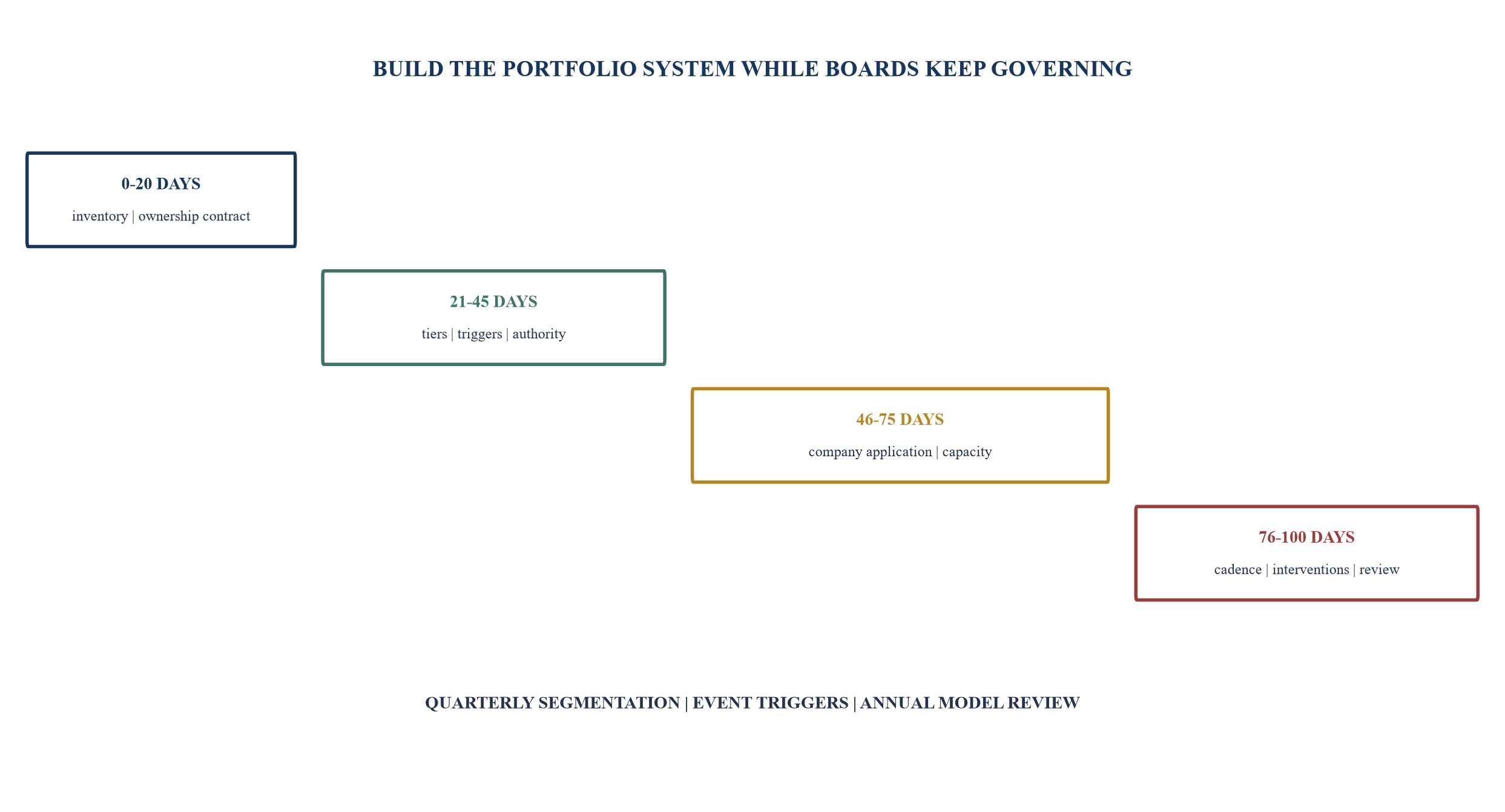
Timing is an illustrative management sequence. Portfolio size, governance changes, regulation and active events determine the actual calendar.
Sources and further reading
- Organisation for Economic Co-operation and Development, G20/OECD Principles of Corporate Governance 2023 Official source
- Organisation for Economic Co-operation and Development, Responsibilities of the Board Official source
- Institutional Limited Partners Association, ILPA Principles 3.0 Official source
- Institutional Limited Partners Association, Principles and Best Practices Official source
- United Arab Emirates Securities and Commodities Authority, Public Joint-Stock Company Governance Guide amendments Official source
- United Arab Emirates Securities and Commodities Authority, Annual Report 2021 Official source
- Saudi Capital Market Authority, Corporate Governance Regulations Official source
- Saudi Arabia Ministry of Commerce, Companies Law implementation announcement Official source
- Central Bank of Bahrain, High-Level Controls Module Official source
- Qatar Financial Markets Authority, Legislation Decisions and Governance Codes Official source
- Oman Capital Market Authority, Corporate Governance Code for Public Listed Companies Official source
- Kuwait Capital Markets Authority, Executive Bylaws and Corporate Governance Official source
- Abu Dhabi Global Market, Companies Regulations 2020 Official source
- Dubai Financial Services Authority, General Module Official source
- National Institute of Standards and Technology, Cybersecurity Framework 2.0 Official source
- Financial Reporting Council, UK Corporate Governance Code 2024 Official source
- Financial Reporting Council, Corporate Governance Code Guidance Official source
- International Corporate Governance Network, Global Governance Principles Official source
- International Finance Corporation, Corporate Governance Methodology Official source
- International Organization for Standardization, ISO 31000 Risk Management Official source
- Committee of Sponsoring Organizations of the Treadway Commission, Enterprise Risk Management Official source
- Basel Committee on Banking Supervision, Corporate Governance Principles for Banks Official source
- Financial Stability Board, Guidance on Supervisory Interaction with Financial Institutions on Risk Culture Official source
- International Organization of Securities Commissions, Objectives and Principles of Securities Regulation Official source
- Monetary Authority of Singapore, Code of Corporate Governance 2018 Official source
- Australian Securities Exchange Corporate Governance Council, Corporate Governance Principles and Recommendations Official source
- United States Securities and Exchange Commission, Investment Adviser Fiduciary Interpretation Official source
- United States Department of Justice and Federal Trade Commission, Merger Guidelines 2023 Official source
- European Commission, Merger Control Procedures Official source
- Organisation for Economic Co-operation and Development, OECD Due Diligence Guidance for Responsible Business Conduct Official source
