

1. Define the capital-choice mandate
Choose between minority strategic capital, shared control and full sale through explicit family, value and execution objectives.
The succession team should reconcile family objectives, ownership, strategy, capital need, succession timing and buyer evidence. Each conclusion records the accountable body, source, timing, candidate or owner, evidence, dependency, control and unresolved exception. The immediate output is a capital-choice charter.
Management continuity must be proved through operating outcomes while ownership choices remain explicit. Reviewers test capability, authority, relationships, stakeholder confidence and downside response against native records and observed performance. Company strategy, role requirements, family objectives and governing law control every conclusion.
Material gaps require an owner, corrective action, test, advice and decision date. Consequences should flow through leadership capacity, customer delivery, cash, financing, value, control, fairness and transaction timing. Residual risk remains visible until authority is operable, stakeholders are protected and the relevant governing bodies approve the next gate.
2. Separate family objectives
Record liquidity, control, legacy, employment, governance, risk and timing priorities for each authorised owner group.
The succession team should reconcile family interviews, constitution, ownership map, wealth needs and approvals. Each conclusion records the accountable body, source, timing, candidate or owner, evidence, dependency, control and unresolved exception. The immediate output is a family objective map.
Management continuity must be proved through operating outcomes while ownership choices remain explicit. Reviewers test capability, authority, relationships, stakeholder confidence and downside response against native records and observed performance. Company strategy, role requirements, family objectives and governing law control every conclusion.
Material gaps require an owner, corrective action, test, advice and decision date. Consequences should flow through leadership capacity, customer delivery, cash, financing, value, control, fairness and transaction timing. Residual risk remains visible until authority is operable, stakeholders are protected and the relevant governing bodies approve the next gate.
3. Define enterprise requirements
Quantify growth capital, capability, market access, technology, leadership and balance-sheet needs independent of transaction preference.
The succession team should reconcile strategy, business plan, capability gaps, forecast and management assessment. Each conclusion records the accountable body, source, timing, candidate or owner, evidence, dependency, control and unresolved exception. The immediate output is an enterprise requirement brief.
Management continuity must be proved through operating outcomes while ownership choices remain explicit. Reviewers test capability, authority, relationships, stakeholder confidence and downside response against native records and observed performance. Company strategy, role requirements, family objectives and governing law control every conclusion.
Material gaps require an owner, corrective action, test, advice and decision date. Consequences should flow through leadership capacity, customer delivery, cash, financing, value, control, fairness and transaction timing. Residual risk remains visible until authority is operable, stakeholders are protected and the relevant governing bodies approve the next gate.
4. Establish the baseline value
Develop a supportable stand-alone valuation before attributing buyer synergies, control or transaction terms.
The succession team should reconcile historic results, forecast, market evidence, capital structure and valuation standards. Each conclusion records the accountable body, source, timing, candidate or owner, evidence, dependency, control and unresolved exception. The immediate output is a stand-alone valuation range.
Management continuity must be proved through operating outcomes while ownership choices remain explicit. Reviewers test capability, authority, relationships, stakeholder confidence and downside response against native records and observed performance. Company strategy, role requirements, family objectives and governing law control every conclusion.
Material gaps require an owner, corrective action, test, advice and decision date. Consequences should flow through leadership capacity, customer delivery, cash, financing, value, control, fairness and transaction timing. Residual risk remains visible until authority is operable, stakeholders are protected and the relevant governing bodies approve the next gate.
5. Map transaction alternatives
Compare minority investment, staged investment, joint control, majority recapitalisation and full sale on consistent dimensions.
The succession team should reconcile capital need, buyer appetite, rights, funding, tax and regulatory facts. Each conclusion records the accountable body, source, timing, candidate or owner, evidence, dependency, control and unresolved exception. The immediate output is an alternatives architecture.
Management continuity must be proved through operating outcomes while ownership choices remain explicit. Reviewers test capability, authority, relationships, stakeholder confidence and downside response against native records and observed performance. Company strategy, role requirements, family objectives and governing law control every conclusion.
Material gaps require an owner, corrective action, test, advice and decision date. Consequences should flow through leadership capacity, customer delivery, cash, financing, value, control, fairness and transaction timing. Residual risk remains visible until authority is operable, stakeholders are protected and the relevant governing bodies approve the next gate.
6. Define control precisely
Distinguish legal control, accounting control, negative control, board influence and practical operating power.
The succession team should reconcile voting rights, reserved matters, board rights, contracts, funding and IFRS analysis. Each conclusion records the accountable body, source, timing, candidate or owner, evidence, dependency, control and unresolved exception. The immediate output is a control determination.
Management continuity must be proved through operating outcomes while ownership choices remain explicit. Reviewers test capability, authority, relationships, stakeholder confidence and downside response against native records and observed performance. Company strategy, role requirements, family objectives and governing law control every conclusion.
Material gaps require an owner, corrective action, test, advice and decision date. Consequences should flow through leadership capacity, customer delivery, cash, financing, value, control, fairness and transaction timing. Residual risk remains visible until authority is operable, stakeholders are protected and the relevant governing bodies approve the next gate.
7. Design the strategic-investor thesis
Identify the investor capabilities, channels, technology, supply, brand or geography that can create measurable value.
The succession team should reconcile strategy, capability gaps, candidate evidence, customer data and synergy analysis. Each conclusion records the accountable body, source, timing, candidate or owner, evidence, dependency, control and unresolved exception. The immediate output is a strategic investor scorecard.
Management continuity must be proved through operating outcomes while ownership choices remain explicit. Reviewers test capability, authority, relationships, stakeholder confidence and downside response against native records and observed performance. Company strategy, role requirements, family objectives and governing law control every conclusion.
Material gaps require an owner, corrective action, test, advice and decision date. Consequences should flow through leadership capacity, customer delivery, cash, financing, value, control, fairness and transaction timing. Residual risk remains visible until authority is operable, stakeholders are protected and the relevant governing bodies approve the next gate.
8. Test investor strategic fit
Evaluate objectives, time horizon, competitive position, culture, reputation, capital capacity and governance behaviour.
The succession team should reconcile public filings, references, portfolio, interviews, financing and diligence. Each conclusion records the accountable body, source, timing, candidate or owner, evidence, dependency, control and unresolved exception. The immediate output is an investor fit assessment.
Management continuity must be proved through operating outcomes while ownership choices remain explicit. Reviewers test capability, authority, relationships, stakeholder confidence and downside response against native records and observed performance. Company strategy, role requirements, family objectives and governing law control every conclusion.
Material gaps require an owner, corrective action, test, advice and decision date. Consequences should flow through leadership capacity, customer delivery, cash, financing, value, control, fairness and transaction timing. Residual risk remains visible until authority is operable, stakeholders are protected and the relevant governing bodies approve the next gate.
Table 1. Capital-choice architecture
| Path | Primary benefit | Primary exposure |
|---|---|---|
| minority | capital with retained control | governance friction |
| joint control | shared capability and risk | deadlock |
| majority | liquidity with retained upside | reduced authority |
| full sale | value and clean liquidity | complete control transfer |
Illustrative programme design; company-specific facts and authorised advice govern.
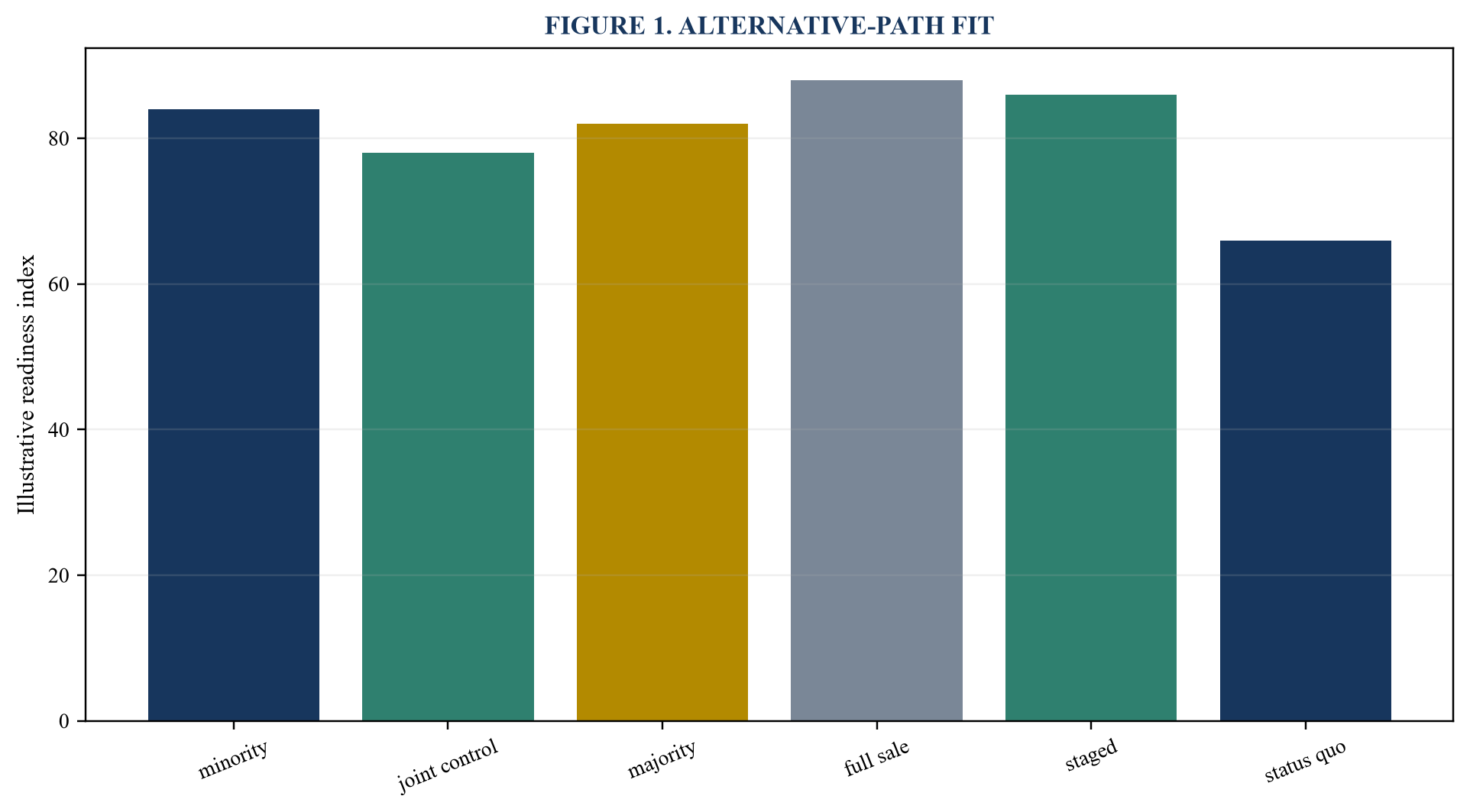
Values are illustrative readiness indices and require company-specific evidence.
9. Value strategic contributions
Separate cash consideration from measurable commercial contributions and contingent promises.
The succession team should reconcile contracts, operating model, forecast, milestones, probability and accountability. Each conclusion records the accountable body, source, timing, candidate or owner, evidence, dependency, control and unresolved exception. The immediate output is a strategic contribution valuation.
Management continuity must be proved through operating outcomes while ownership choices remain explicit. Reviewers test capability, authority, relationships, stakeholder confidence and downside response against native records and observed performance. Company strategy, role requirements, family objectives and governing law control every conclusion.
Material gaps require an owner, corrective action, test, advice and decision date. Consequences should flow through leadership capacity, customer delivery, cash, financing, value, control, fairness and transaction timing. Residual risk remains visible until authority is operable, stakeholders are protected and the relevant governing bodies approve the next gate.
10. Design minority economics
Set price, security, preferences, anti-dilution, dividends, information and future funding terms consistent with risk.
The succession team should reconcile valuation, cap table, forecast, rights, funding plan and market evidence. Each conclusion records the accountable body, source, timing, candidate or owner, evidence, dependency, control and unresolved exception. The immediate output is a minority investment term sheet.
Management continuity must be proved through operating outcomes while ownership choices remain explicit. Reviewers test capability, authority, relationships, stakeholder confidence and downside response against native records and observed performance. Company strategy, role requirements, family objectives and governing law control every conclusion.
Material gaps require an owner, corrective action, test, advice and decision date. Consequences should flow through leadership capacity, customer delivery, cash, financing, value, control, fairness and transaction timing. Residual risk remains visible until authority is operable, stakeholders are protected and the relevant governing bodies approve the next gate.
11. Calibrate governance rights
Allocate board seats, observers, committees, information, consent and escalation without disabling ordinary management.
The succession team should reconcile ownership, strategy, risk, law, accounting control and investor needs. Each conclusion records the accountable body, source, timing, candidate or owner, evidence, dependency, control and unresolved exception. The immediate output is a governance rights schedule.
Management continuity must be proved through operating outcomes while ownership choices remain explicit. Reviewers test capability, authority, relationships, stakeholder confidence and downside response against native records and observed performance. Company strategy, role requirements, family objectives and governing law control every conclusion.
Material gaps require an owner, corrective action, test, advice and decision date. Consequences should flow through leadership capacity, customer delivery, cash, financing, value, control, fairness and transaction timing. Residual risk remains visible until authority is operable, stakeholders are protected and the relevant governing bodies approve the next gate.
12. Limit reserved matters
Protect fundamental investor interests through clear thresholds, materiality, response times and expiry rules.
The succession team should reconcile risk map, business plan, delegation, financing and legal analysis. Each conclusion records the accountable body, source, timing, candidate or owner, evidence, dependency, control and unresolved exception. The immediate output is a reserved-matters matrix.
Management continuity must be proved through operating outcomes while ownership choices remain explicit. Reviewers test capability, authority, relationships, stakeholder confidence and downside response against native records and observed performance. Company strategy, role requirements, family objectives and governing law control every conclusion.
Material gaps require an owner, corrective action, test, advice and decision date. Consequences should flow through leadership capacity, customer delivery, cash, financing, value, control, fairness and transaction timing. Residual risk remains visible until authority is operable, stakeholders are protected and the relevant governing bodies approve the next gate.
13. Protect commercial information
Use clean teams, ring-fencing, role-based access and competition controls where the investor is a market participant.
The succession team should reconcile data map, competitive overlaps, antitrust advice, systems and access logs. Each conclusion records the accountable body, source, timing, candidate or owner, evidence, dependency, control and unresolved exception. The immediate output is a strategic information protocol.
Management continuity must be proved through operating outcomes while ownership choices remain explicit. Reviewers test capability, authority, relationships, stakeholder confidence and downside response against native records and observed performance. Company strategy, role requirements, family objectives and governing law control every conclusion.
Material gaps require an owner, corrective action, test, advice and decision date. Consequences should flow through leadership capacity, customer delivery, cash, financing, value, control, fairness and transaction timing. Residual risk remains visible until authority is operable, stakeholders are protected and the relevant governing bodies approve the next gate.
14. Govern related-party arrangements
Price supply, distribution, licensing, services and procurement on supportable terms with conflict controls.
The succession team should reconcile contracts, benchmarks, transfer pricing, board process and audit evidence. Each conclusion records the accountable body, source, timing, candidate or owner, evidence, dependency, control and unresolved exception. The immediate output is a related-party commercial framework.
Management continuity must be proved through operating outcomes while ownership choices remain explicit. Reviewers test capability, authority, relationships, stakeholder confidence and downside response against native records and observed performance. Company strategy, role requirements, family objectives and governing law control every conclusion.
Material gaps require an owner, corrective action, test, advice and decision date. Consequences should flow through leadership capacity, customer delivery, cash, financing, value, control, fairness and transaction timing. Residual risk remains visible until authority is operable, stakeholders are protected and the relevant governing bodies approve the next gate.
15. Plan future financing
Define participation rights, pay-to-play, dilution, debt capacity, investor support and consequences of funding gaps.
The succession team should reconcile capital plan, scenarios, security terms, approvals and liquidity. Each conclusion records the accountable body, source, timing, candidate or owner, evidence, dependency, control and unresolved exception. The immediate output is a future funding protocol.
Management continuity must be proved through operating outcomes while ownership choices remain explicit. Reviewers test capability, authority, relationships, stakeholder confidence and downside response against native records and observed performance. Company strategy, role requirements, family objectives and governing law control every conclusion.
Material gaps require an owner, corrective action, test, advice and decision date. Consequences should flow through leadership capacity, customer delivery, cash, financing, value, control, fairness and transaction timing. Residual risk remains visible until authority is operable, stakeholders are protected and the relevant governing bodies approve the next gate.
16. Create liquidity routes
Specify founder secondary, redemption, permitted transfers, tag, drag, put, call, IPO and later sale mechanics.
The succession team should reconcile ownership objectives, valuation, funding, law and market routes. Each conclusion records the accountable body, source, timing, candidate or owner, evidence, dependency, control and unresolved exception. The immediate output is a shareholder liquidity map.
Management continuity must be proved through operating outcomes while ownership choices remain explicit. Reviewers test capability, authority, relationships, stakeholder confidence and downside response against native records and observed performance. Company strategy, role requirements, family objectives and governing law control every conclusion.
Material gaps require an owner, corrective action, test, advice and decision date. Consequences should flow through leadership capacity, customer delivery, cash, financing, value, control, fairness and transaction timing. Residual risk remains visible until authority is operable, stakeholders are protected and the relevant governing bodies approve the next gate.
Table 2. Minority rights design
| Right | Purpose | Control |
|---|---|---|
| information | monitor investment | scope and security |
| board | governance voice | skills and conflicts |
| consent | protect fundamentals | materiality and expiry |
| liquidity | future exit | executable routes |
Illustrative programme design; company-specific facts and authorised advice govern.
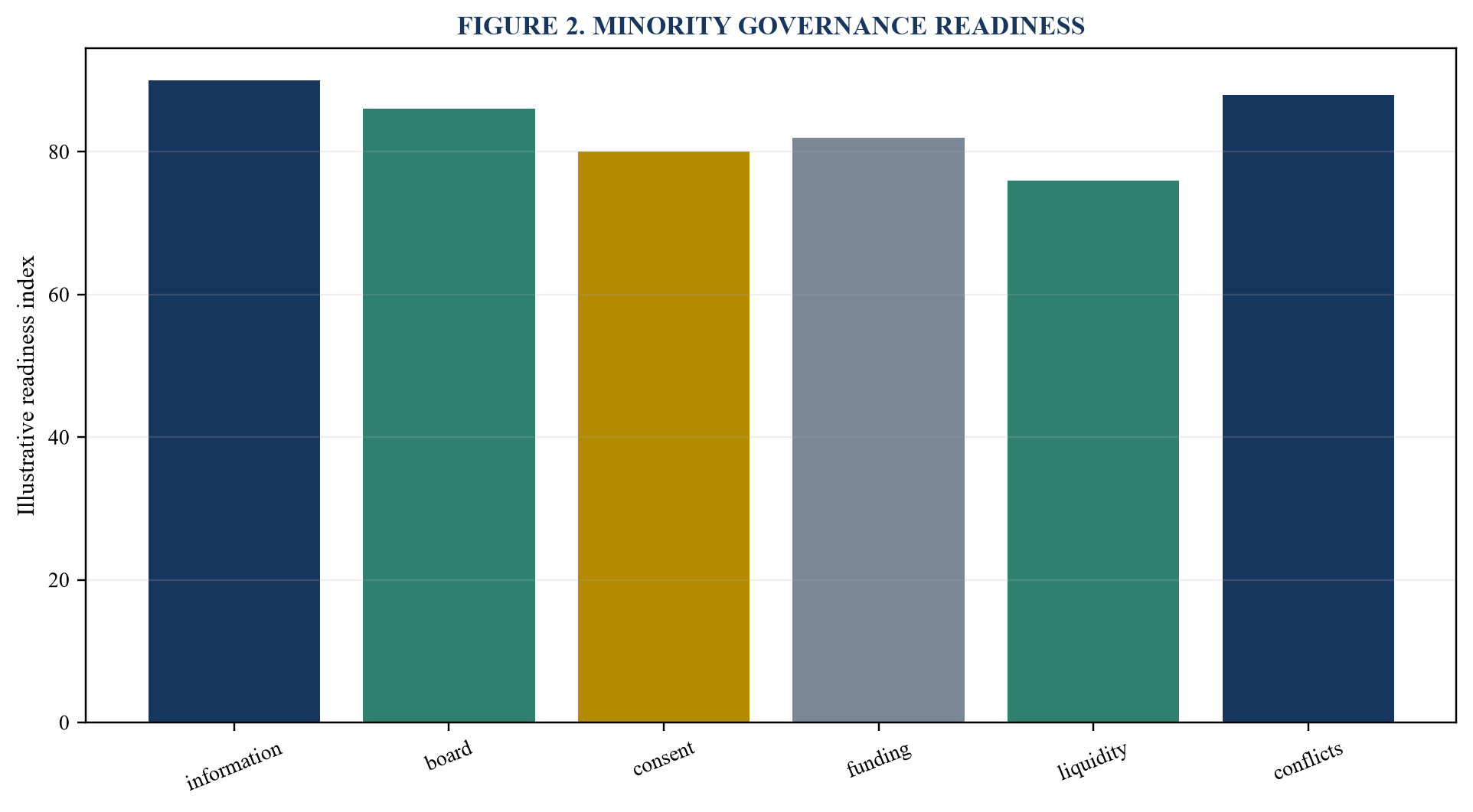
Values are illustrative readiness indices and require company-specific evidence.
17. Design staged control
Set objective milestones for increasing ownership, changing governance or proceeding to a full acquisition.
The succession team should reconcile performance metrics, option terms, valuation formula, approvals and integration readiness. Each conclusion records the accountable body, source, timing, candidate or owner, evidence, dependency, control and unresolved exception. The immediate output is a staged-acquisition roadmap.
Management continuity must be proved through operating outcomes while ownership choices remain explicit. Reviewers test capability, authority, relationships, stakeholder confidence and downside response against native records and observed performance. Company strategy, role requirements, family objectives and governing law control every conclusion.
Material gaps require an owner, corrective action, test, advice and decision date. Consequences should flow through leadership capacity, customer delivery, cash, financing, value, control, fairness and transaction timing. Residual risk remains visible until authority is operable, stakeholders are protected and the relevant governing bodies approve the next gate.
18. Price options and contingent rights
Model exercise triggers, valuation dates, floors, caps, funding, security and behavioural incentives.
The succession team should reconcile forecast, volatility, option terms, scenarios, tax and accounting. Each conclusion records the accountable body, source, timing, candidate or owner, evidence, dependency, control and unresolved exception. The immediate output is an option economics model.
Management continuity must be proved through operating outcomes while ownership choices remain explicit. Reviewers test capability, authority, relationships, stakeholder confidence and downside response against native records and observed performance. Company strategy, role requirements, family objectives and governing law control every conclusion.
Material gaps require an owner, corrective action, test, advice and decision date. Consequences should flow through leadership capacity, customer delivery, cash, financing, value, control, fairness and transaction timing. Residual risk remains visible until authority is operable, stakeholders are protected and the relevant governing bodies approve the next gate.
19. Evaluate a full sale
Assess value certainty, control transfer, employee outcomes, legacy, liability and execution against family objectives.
The succession team should reconcile buyer universe, valuation, deal terms, diligence, tax and transition plan. Each conclusion records the accountable body, source, timing, candidate or owner, evidence, dependency, control and unresolved exception. The immediate output is a full-sale decision case.
Management continuity must be proved through operating outcomes while ownership choices remain explicit. Reviewers test capability, authority, relationships, stakeholder confidence and downside response against native records and observed performance. Company strategy, role requirements, family objectives and governing law control every conclusion.
Material gaps require an owner, corrective action, test, advice and decision date. Consequences should flow through leadership capacity, customer delivery, cash, financing, value, control, fairness and transaction timing. Residual risk remains visible until authority is operable, stakeholders are protected and the relevant governing bodies approve the next gate.
20. Build the buyer universe
Segment strategic, sponsor, sovereign, family-office and management buyers by fit, funding and regulatory feasibility.
The succession team should reconcile market map, transaction evidence, ownership rules, financing and outreach intelligence. Each conclusion records the accountable body, source, timing, candidate or owner, evidence, dependency, control and unresolved exception. The immediate output is a qualified buyer map.
Management continuity must be proved through operating outcomes while ownership choices remain explicit. Reviewers test capability, authority, relationships, stakeholder confidence and downside response against native records and observed performance. Company strategy, role requirements, family objectives and governing law control every conclusion.
Material gaps require an owner, corrective action, test, advice and decision date. Consequences should flow through leadership capacity, customer delivery, cash, financing, value, control, fairness and transaction timing. Residual risk remains visible until authority is operable, stakeholders are protected and the relevant governing bodies approve the next gate.
21. Quantify synergies carefully
Identify buyer-specific revenue, cost, capital and risk effects with ownership, timing and implementation evidence.
The succession team should reconcile operating data, buyer capabilities, benchmarks, integration plan and sensitivities. Each conclusion records the accountable body, source, timing, candidate or owner, evidence, dependency, control and unresolved exception. The immediate output is a buyer synergy model.
Management continuity must be proved through operating outcomes while ownership choices remain explicit. Reviewers test capability, authority, relationships, stakeholder confidence and downside response against native records and observed performance. Company strategy, role requirements, family objectives and governing law control every conclusion.
Material gaps require an owner, corrective action, test, advice and decision date. Consequences should flow through leadership capacity, customer delivery, cash, financing, value, control, fairness and transaction timing. Residual risk remains visible until authority is operable, stakeholders are protected and the relevant governing bodies approve the next gate.
22. Allocate synergy value
Use competitive tension, alternatives and execution evidence to negotiate how buyer-specific value is shared.
The succession team should reconcile valuation, bidder data, process design, financing, risk and negotiation record. Each conclusion records the accountable body, source, timing, candidate or owner, evidence, dependency, control and unresolved exception. The immediate output is a value-sharing strategy.
Management continuity must be proved through operating outcomes while ownership choices remain explicit. Reviewers test capability, authority, relationships, stakeholder confidence and downside response against native records and observed performance. Company strategy, role requirements, family objectives and governing law control every conclusion.
Material gaps require an owner, corrective action, test, advice and decision date. Consequences should flow through leadership capacity, customer delivery, cash, financing, value, control, fairness and transaction timing. Residual risk remains visible until authority is operable, stakeholders are protected and the relevant governing bodies approve the next gate.
23. Compare consideration forms
Evaluate cash, shares, rollover, vendor finance, earn-outs and deferred payments through value and risk.
The succession team should reconcile terms, buyer credit, security, market volatility, tax and liquidity needs. Each conclusion records the accountable body, source, timing, candidate or owner, evidence, dependency, control and unresolved exception. The immediate output is a consideration comparison.
Management continuity must be proved through operating outcomes while ownership choices remain explicit. Reviewers test capability, authority, relationships, stakeholder confidence and downside response against native records and observed performance. Company strategy, role requirements, family objectives and governing law control every conclusion.
Material gaps require an owner, corrective action, test, advice and decision date. Consequences should flow through leadership capacity, customer delivery, cash, financing, value, control, fairness and transaction timing. Residual risk remains visible until authority is operable, stakeholders are protected and the relevant governing bodies approve the next gate.
24. Model retained exposure
Measure value, dilution, governance, liquidity and downside when the family retains or rolls equity.
The succession team should reconcile pro forma ownership, rights, forecast, financing and exit assumptions. Each conclusion records the accountable body, source, timing, candidate or owner, evidence, dependency, control and unresolved exception. The immediate output is a retained-equity model.
Management continuity must be proved through operating outcomes while ownership choices remain explicit. Reviewers test capability, authority, relationships, stakeholder confidence and downside response against native records and observed performance. Company strategy, role requirements, family objectives and governing law control every conclusion.
Material gaps require an owner, corrective action, test, advice and decision date. Consequences should flow through leadership capacity, customer delivery, cash, financing, value, control, fairness and transaction timing. Residual risk remains visible until authority is operable, stakeholders are protected and the relevant governing bodies approve the next gate.
Table 3. Consideration comparison
| Form | Value driver | Risk |
|---|---|---|
| cash | certainty | funding |
| buyer shares | upside participation | market and liquidity |
| rollover | future enterprise value | minority exposure |
| earn-out | performance upside | measurement conflict |
Illustrative programme design; company-specific facts and authorised advice govern.
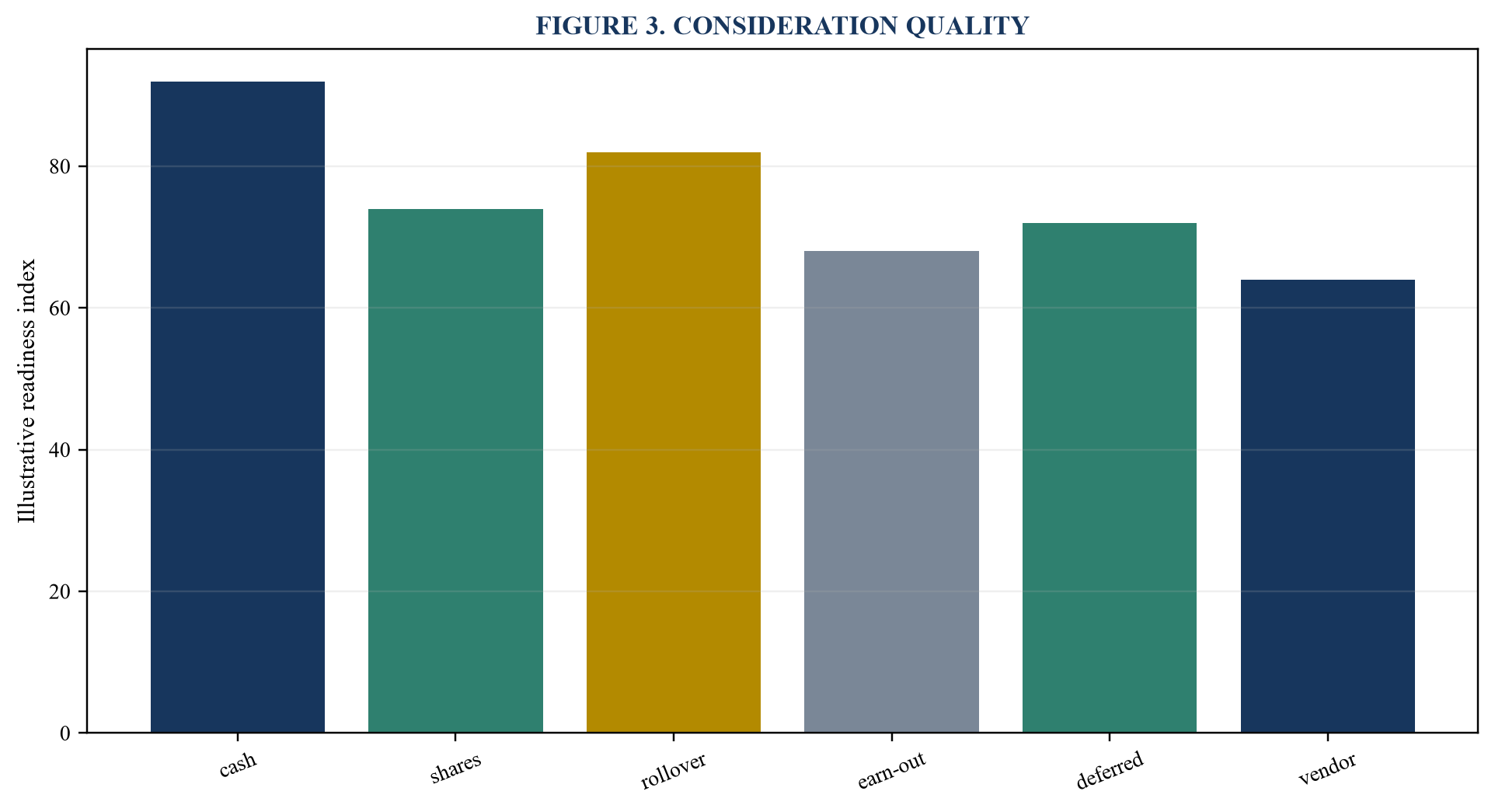
Values are illustrative readiness indices and require company-specific evidence.
25. Assess tax and estate effects
Compare transaction, income, gains, inheritance and estate consequences by owner, structure and timing.
The succession team should reconcile ownership, residence, basis, consideration, structure and qualified advice. Each conclusion records the accountable body, source, timing, candidate or owner, evidence, dependency, control and unresolved exception. The immediate output is a transaction tax map.
Management continuity must be proved through operating outcomes while ownership choices remain explicit. Reviewers test capability, authority, relationships, stakeholder confidence and downside response against native records and observed performance. Company strategy, role requirements, family objectives and governing law control every conclusion.
Material gaps require an owner, corrective action, test, advice and decision date. Consequences should flow through leadership capacity, customer delivery, cash, financing, value, control, fairness and transaction timing. Residual risk remains visible until authority is operable, stakeholders are protected and the relevant governing bodies approve the next gate.
26. Test competition and foreign-investment risk
Identify filing, standstill, remedies, information and timetable risks for minority and control transactions.
The succession team should reconcile overlaps, ownership, thresholds, jurisdictions, investor identity and counsel. Each conclusion records the accountable body, source, timing, candidate or owner, evidence, dependency, control and unresolved exception. The immediate output is a regulatory feasibility map.
Management continuity must be proved through operating outcomes while ownership choices remain explicit. Reviewers test capability, authority, relationships, stakeholder confidence and downside response against native records and observed performance. Company strategy, role requirements, family objectives and governing law control every conclusion.
Material gaps require an owner, corrective action, test, advice and decision date. Consequences should flow through leadership capacity, customer delivery, cash, financing, value, control, fairness and transaction timing. Residual risk remains visible until authority is operable, stakeholders are protected and the relevant governing bodies approve the next gate.
27. Determine accounting consequences
Assess control, significant influence, joint control, consolidation, equity method and acquisition accounting implications.
The succession team should reconcile rights, contracts, governance, IFRS 3, IFRS 10, IFRS 11 and IAS 28. Each conclusion records the accountable body, source, timing, candidate or owner, evidence, dependency, control and unresolved exception. The immediate output is an accounting treatment paper.
Management continuity must be proved through operating outcomes while ownership choices remain explicit. Reviewers test capability, authority, relationships, stakeholder confidence and downside response against native records and observed performance. Company strategy, role requirements, family objectives and governing law control every conclusion.
Material gaps require an owner, corrective action, test, advice and decision date. Consequences should flow through leadership capacity, customer delivery, cash, financing, value, control, fairness and transaction timing. Residual risk remains visible until authority is operable, stakeholders are protected and the relevant governing bodies approve the next gate.
28. Plan financing certainty
Verify buyer funds, investment committee approvals, debt commitments, conditions and foreign-exchange capacity.
The succession team should reconcile proof of funds, financing documents, approvals, syndication and market risk. Each conclusion records the accountable body, source, timing, candidate or owner, evidence, dependency, control and unresolved exception. The immediate output is a financing certainty certificate.
Management continuity must be proved through operating outcomes while ownership choices remain explicit. Reviewers test capability, authority, relationships, stakeholder confidence and downside response against native records and observed performance. Company strategy, role requirements, family objectives and governing law control every conclusion.
Material gaps require an owner, corrective action, test, advice and decision date. Consequences should flow through leadership capacity, customer delivery, cash, financing, value, control, fairness and transaction timing. Residual risk remains visible until authority is operable, stakeholders are protected and the relevant governing bodies approve the next gate.
29. Design the decision process
Set family, shareholder, board and management roles, conflicts, independent advice and approval gates.
The succession team should reconcile governing documents, authority, interests, timetable and advice. Each conclusion records the accountable body, source, timing, candidate or owner, evidence, dependency, control and unresolved exception. The immediate output is a transaction governance protocol.
Management continuity must be proved through operating outcomes while ownership choices remain explicit. Reviewers test capability, authority, relationships, stakeholder confidence and downside response against native records and observed performance. Company strategy, role requirements, family objectives and governing law control every conclusion.
Material gaps require an owner, corrective action, test, advice and decision date. Consequences should flow through leadership capacity, customer delivery, cash, financing, value, control, fairness and transaction timing. Residual risk remains visible until authority is operable, stakeholders are protected and the relevant governing bodies approve the next gate.
30. Control conflicts
Identify personal liquidity, employment, buyer relationships, adviser incentives and related-party interests.
The succession team should reconcile interest register, mandates, compensation, negotiations and disclosures. Each conclusion records the accountable body, source, timing, candidate or owner, evidence, dependency, control and unresolved exception. The immediate output is a transaction conflict register.
Management continuity must be proved through operating outcomes while ownership choices remain explicit. Reviewers test capability, authority, relationships, stakeholder confidence and downside response against native records and observed performance. Company strategy, role requirements, family objectives and governing law control every conclusion.
Material gaps require an owner, corrective action, test, advice and decision date. Consequences should flow through leadership capacity, customer delivery, cash, financing, value, control, fairness and transaction timing. Residual risk remains visible until authority is operable, stakeholders are protected and the relevant governing bodies approve the next gate.
31. Structure market testing
Choose bilateral, targeted or broad competition based on confidentiality, buyer depth and value discovery.
The succession team should reconcile buyer map, sensitivity, timetable, information readiness and objectives. Each conclusion records the accountable body, source, timing, candidate or owner, evidence, dependency, control and unresolved exception. The immediate output is a market-testing plan.
Management continuity must be proved through operating outcomes while ownership choices remain explicit. Reviewers test capability, authority, relationships, stakeholder confidence and downside response against native records and observed performance. Company strategy, role requirements, family objectives and governing law control every conclusion.
Material gaps require an owner, corrective action, test, advice and decision date. Consequences should flow through leadership capacity, customer delivery, cash, financing, value, control, fairness and transaction timing. Residual risk remains visible until authority is operable, stakeholders are protected and the relevant governing bodies approve the next gate.
32. Prepare decision-grade diligence
Build evidence on earnings, cash, customers, technology, people, contracts, tax, legal and governance.
The succession team should reconcile data room, reconciliations, quality of earnings, risk logs and owner responses. Each conclusion records the accountable body, source, timing, candidate or owner, evidence, dependency, control and unresolved exception. The immediate output is a vendor diligence pack.
Management continuity must be proved through operating outcomes while ownership choices remain explicit. Reviewers test capability, authority, relationships, stakeholder confidence and downside response against native records and observed performance. Company strategy, role requirements, family objectives and governing law control every conclusion.
Material gaps require an owner, corrective action, test, advice and decision date. Consequences should flow through leadership capacity, customer delivery, cash, financing, value, control, fairness and transaction timing. Residual risk remains visible until authority is operable, stakeholders are protected and the relevant governing bodies approve the next gate.
Table 4. Process architecture
| Stage | Required evidence | Decision gate |
|---|---|---|
| prepare | objectives and diligence | market ready |
| test | qualified buyer feedback | credible alternatives |
| negotiate | funded terms | preferred path |
| close | conditions and approvals | value protected |
Illustrative programme design; company-specific facts and authorised advice govern.
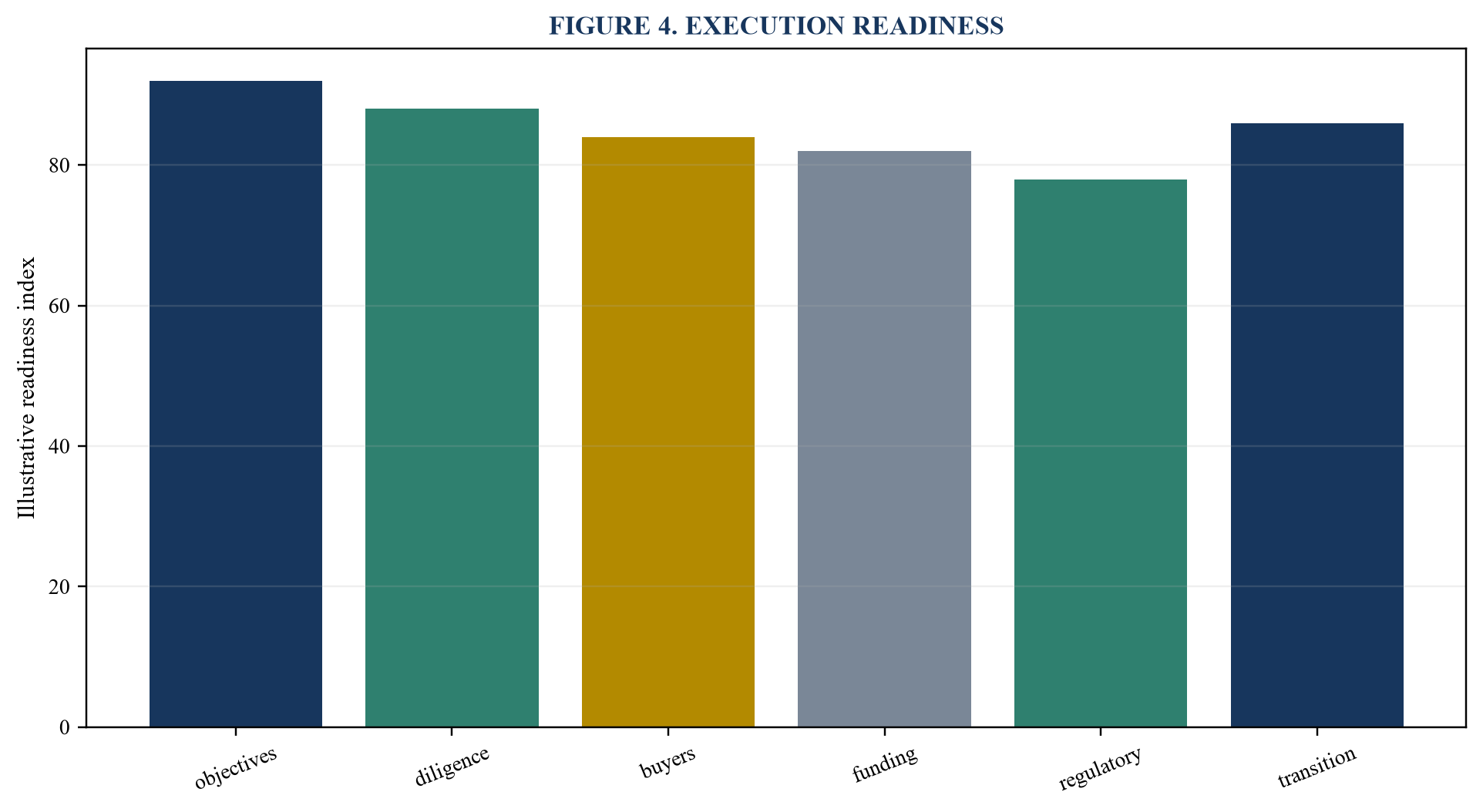
Values are illustrative readiness indices and require company-specific evidence.
33. Protect value during the process
Maintain performance, key people, customer trust, cash control and confidentiality through signing and closing.
The succession team should reconcile operating plan, communications, retention, leak protocol and monitoring. Each conclusion records the accountable body, source, timing, candidate or owner, evidence, dependency, control and unresolved exception. The immediate output is a value-preservation plan.
Management continuity must be proved through operating outcomes while ownership choices remain explicit. Reviewers test capability, authority, relationships, stakeholder confidence and downside response against native records and observed performance. Company strategy, role requirements, family objectives and governing law control every conclusion.
Material gaps require an owner, corrective action, test, advice and decision date. Consequences should flow through leadership capacity, customer delivery, cash, financing, value, control, fairness and transaction timing. Residual risk remains visible until authority is operable, stakeholders are protected and the relevant governing bodies approve the next gate.
34. Compare integration burden
Assess whether a strategic partnership, joint control or full sale can realise value without unacceptable disruption.
The succession team should reconcile operating model, systems, culture, synergy plan, governance and leadership capacity. Each conclusion records the accountable body, source, timing, candidate or owner, evidence, dependency, control and unresolved exception. The immediate output is an integration burden assessment.
Management continuity must be proved through operating outcomes while ownership choices remain explicit. Reviewers test capability, authority, relationships, stakeholder confidence and downside response against native records and observed performance. Company strategy, role requirements, family objectives and governing law control every conclusion.
Material gaps require an owner, corrective action, test, advice and decision date. Consequences should flow through leadership capacity, customer delivery, cash, financing, value, control, fairness and transaction timing. Residual risk remains visible until authority is operable, stakeholders are protected and the relevant governing bodies approve the next gate.
35. Negotiate legacy protections
Translate brand, sites, employees, family roles, purpose and community commitments into measurable terms.
The succession team should reconcile family objectives, buyer plan, contracts, monitoring and remedies. Each conclusion records the accountable body, source, timing, candidate or owner, evidence, dependency, control and unresolved exception. The immediate output is a legacy protection schedule.
Management continuity must be proved through operating outcomes while ownership choices remain explicit. Reviewers test capability, authority, relationships, stakeholder confidence and downside response against native records and observed performance. Company strategy, role requirements, family objectives and governing law control every conclusion.
Material gaps require an owner, corrective action, test, advice and decision date. Consequences should flow through leadership capacity, customer delivery, cash, financing, value, control, fairness and transaction timing. Residual risk remains visible until authority is operable, stakeholders are protected and the relevant governing bodies approve the next gate.
36. Define walk-away conditions
Approve value, control, liability, financing, regulatory and conduct thresholds that terminate negotiations.
The succession team should reconcile objectives, valuation, risk appetite, alternatives and board authority. Each conclusion records the accountable body, source, timing, candidate or owner, evidence, dependency, control and unresolved exception. The immediate output is a walk-away matrix.
Management continuity must be proved through operating outcomes while ownership choices remain explicit. Reviewers test capability, authority, relationships, stakeholder confidence and downside response against native records and observed performance. Company strategy, role requirements, family objectives and governing law control every conclusion.
Material gaps require an owner, corrective action, test, advice and decision date. Consequences should flow through leadership capacity, customer delivery, cash, financing, value, control, fairness and transaction timing. Residual risk remains visible until authority is operable, stakeholders are protected and the relevant governing bodies approve the next gate.
37. Run downside scenarios
Test underperformance, blocked exit, buyer distress, strategic conflict, integration failure and regulatory delay.
The succession team should reconcile financial model, rights, funding, timetable and response plans. Each conclusion records the accountable body, source, timing, candidate or owner, evidence, dependency, control and unresolved exception. The immediate output is a transaction downside stress test.
Management continuity must be proved through operating outcomes while ownership choices remain explicit. Reviewers test capability, authority, relationships, stakeholder confidence and downside response against native records and observed performance. Company strategy, role requirements, family objectives and governing law control every conclusion.
Material gaps require an owner, corrective action, test, advice and decision date. Consequences should flow through leadership capacity, customer delivery, cash, financing, value, control, fairness and transaction timing. Residual risk remains visible until authority is operable, stakeholders are protected and the relevant governing bodies approve the next gate.
38. Select the preferred path
Score value, control, legacy, liquidity, capability, risk, timing and reversibility using verified evidence.
The succession team should reconcile alternatives analysis, stakeholder objectives, models, diligence and advice. Each conclusion records the accountable body, source, timing, candidate or owner, evidence, dependency, control and unresolved exception. The immediate output is a capital-choice decision matrix.
Management continuity must be proved through operating outcomes while ownership choices remain explicit. Reviewers test capability, authority, relationships, stakeholder confidence and downside response against native records and observed performance. Company strategy, role requirements, family objectives and governing law control every conclusion.
Material gaps require an owner, corrective action, test, advice and decision date. Consequences should flow through leadership capacity, customer delivery, cash, financing, value, control, fairness and transaction timing. Residual risk remains visible until authority is operable, stakeholders are protected and the relevant governing bodies approve the next gate.
39. Sequence signing and transition
Coordinate approvals, documents, funding, communications, governance activation and operational handover.
The succession team should reconcile closing checklist, conditions, authorities, integration plan and evidence. Each conclusion records the accountable body, source, timing, candidate or owner, evidence, dependency, control and unresolved exception. The immediate output is a transaction execution roadmap.
Management continuity must be proved through operating outcomes while ownership choices remain explicit. Reviewers test capability, authority, relationships, stakeholder confidence and downside response against native records and observed performance. Company strategy, role requirements, family objectives and governing law control every conclusion.
Material gaps require an owner, corrective action, test, advice and decision date. Consequences should flow through leadership capacity, customer delivery, cash, financing, value, control, fairness and transaction timing. Residual risk remains visible until authority is operable, stakeholders are protected and the relevant governing bodies approve the next gate.
40. Issue the strategic-capital conclusion
Present alternatives, value, rights, synergies, risks, approvals, conditions and implementation recommendation.
The succession team should reconcile verified objectives, models, diligence, market evidence, advice and consents. Each conclusion records the accountable body, source, timing, candidate or owner, evidence, dependency, control and unresolved exception. The immediate output is a board and shareholder capital-choice paper.
Management continuity must be proved through operating outcomes while ownership choices remain explicit. Reviewers test capability, authority, relationships, stakeholder confidence and downside response against native records and observed performance. Company strategy, role requirements, family objectives and governing law control every conclusion.
Material gaps require an owner, corrective action, test, advice and decision date. Consequences should flow through leadership capacity, customer delivery, cash, financing, value, control, fairness and transaction timing. Residual risk remains visible until authority is operable, stakeholders are protected and the relevant governing bodies approve the next gate.
Table 5. Capital-choice certificate
| Dimension | Required conclusion | Evidence |
|---|---|---|
| value | risk-adjusted proceeds | valuation and terms |
| control | rights are operable | governance schedule |
| legacy | priority outcomes protected | binding commitments |
| execution | funded and approvable | closing plan |
Illustrative programme design; company-specific facts and authorised advice govern.
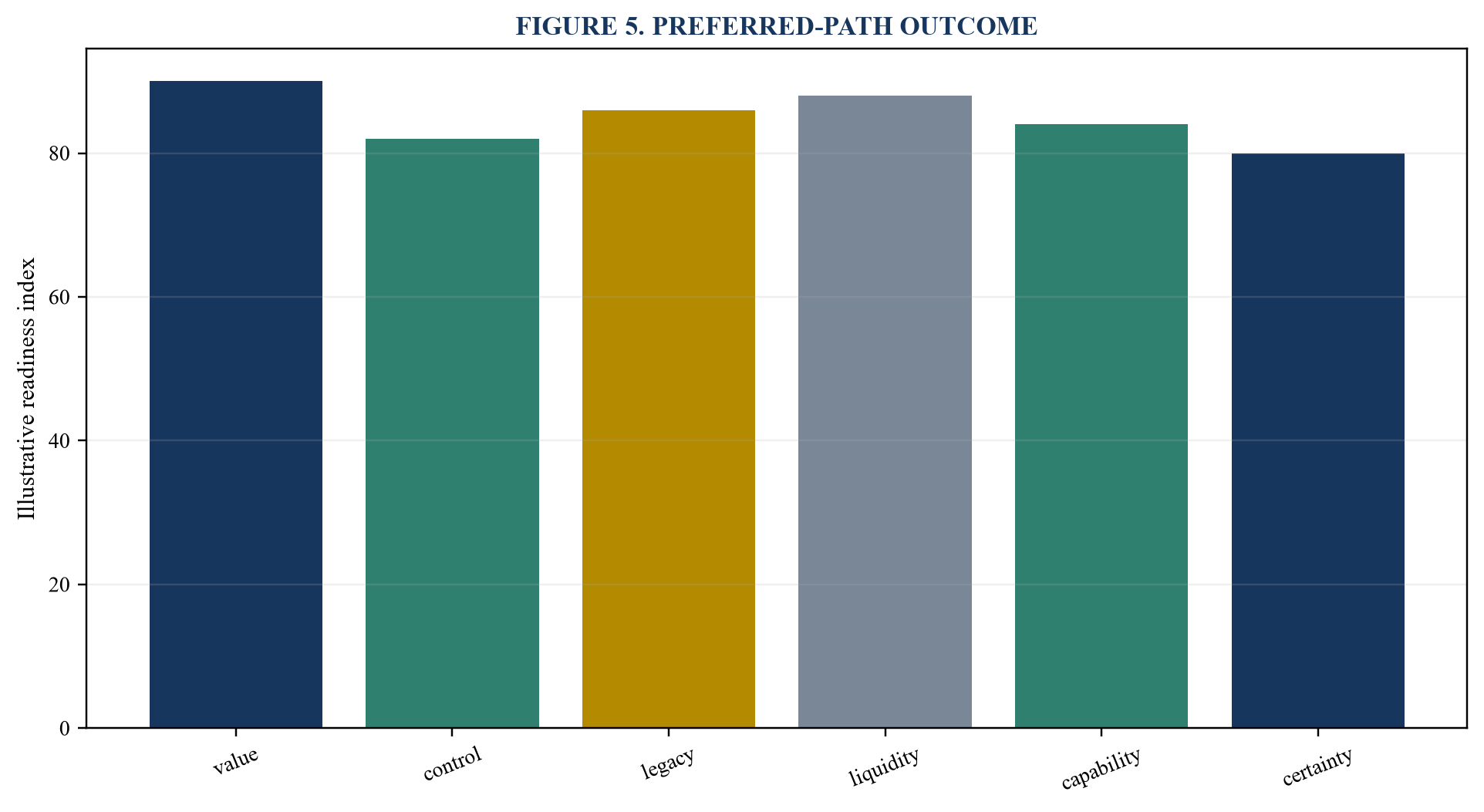
Values are illustrative readiness indices and require company-specific evidence.
References
- IFRS Foundation, IFRS 3 Business Combinations, https://www.ifrs.org/issued-standards/list-of-standards/ifrs-3-business-combinations/
- IFRS Foundation, IFRS 10 Consolidated Financial Statements, https://www.ifrs.org/issued-standards/list-of-standards/ifrs-10-consolidated-financial-statements/
- IFRS Foundation, IFRS 11 Joint Arrangements, https://www.ifrs.org/issued-standards/list-of-standards/ifrs-11-joint-arrangements/
- IFRS Foundation, IAS 28 Investments in Associates and Joint Ventures, https://www.ifrs.org/issued-standards/list-of-standards/ias-28-investments-in-associates-and-joint-ventures/
- IFRS Foundation, IFRS 13 Fair Value Measurement, https://www.ifrs.org/issued-standards/list-of-standards/ifrs-13-fair-value-measurement/
- IFRS Foundation, IAS 24 Related Party Disclosures, https://www.ifrs.org/issued-standards/list-of-standards/ias-24-related-party-disclosures/
- International Valuation Standards Council, International Valuation Standards, https://www.ivsc.org/standards/
- International Valuation Standards Council, IVS 200 Businesses and Business Interests, https://training.ivsc.org/valuing-businesses-ivs-200/
- OECD, G20 OECD Principles of Corporate Governance 2023, https://doi.org/10.1787/ed750b30-en
- OECD, Rights and Equitable Treatment of Shareholders, https://www.oecd.org/en/publications/g20-oecd-principles-of-corporate-governance-2023_ed750b30-en/full-report/component-5.html
- OECD, Disclosure and Transparency, https://www.oecd.org/en/publications/g20-oecd-principles-of-corporate-governance-2023_ed750b30-en/full-report/component-7.html
- US Federal Trade Commission and Department of Justice, Merger Guidelines 2023, https://www.ftc.gov/reports/merger-guidelines-2023
- US Federal Trade Commission, Merger Review, https://www.ftc.gov/enforcement/merger-review
- European Commission, EU Merger Regulation, https://competition-policy.ec.europa.eu/mergers/legislation_en
- European Commission, Consolidated Jurisdictional Notice, https://competition-policy.ec.europa.eu/mergers/legislation/jurisdictional-notice_en
- UK Competition and Markets Authority, Merger Assessment Guidelines, https://www.gov.uk/government/publications/merger-assessment-guidelines
- UK Government, National Security and Investment Act 2021, https://www.legislation.gov.uk/ukpga/2021/25/contents
- United Arab Emirates, Federal Decree-Law No. 32 of 2021 on Commercial Companies, https://uaelegislation.gov.ae/en/legislations/1542
- United Arab Emirates, Federal Decree-Law No. 36 of 2023 Regulating Competition, https://uaelegislation.gov.ae/
- United Arab Emirates, Federal Decree-Law No. 37 of 2022 Concerning Family Businesses, https://uaelegislation.gov.ae/en/legislations/1608
- International Finance Corporation, Family Business Governance Handbook, https://www.ifc.org/en/insights-reports/2011/ifc-family-business-governance-handbook
- Financial Reporting Council, Wates Corporate Governance Principles for Large Private Companies, https://www.frc.org.uk/library/standards-codes-policy/corporate-governance/the-wates-corporate-governance-principles-for-large-private-companies/
- IOSCO, Principles for Financial Benchmarks, https://www.iosco.org/library/pubdocs/pdf/IOSCOPD415.pdf
- International Organization for Standardization, ISO 31000 Risk Management Guidelines, https://www.iso.org/iso-31000-risk-management.html
- United Nations Commission on International Trade Law, Model Law on International Commercial Mediation 2018, https://uncitral.un.org/en/texts/mediation/modellaw/commercial_conciliation
- World Bank Group, Corporate Governance Development Framework, https://www.ifc.org/en/what-we-do/sector-expertise/corporate-governance
