

1. Set the board's resilience mandate
The integration team should define the acquisition thesis, continuity tolerances, savings ambition, decision rights and evidence required before supplier consolidation. The required output is a board-approved supply-chain integration mandate. Record the affected flow, customer consequence, dependencies, capacity, recovery time, owner, evidence and confidence [1][2].
Translate the conclusion into a controlled sourcing decision covering demand, qualified capacity, lead time, inventory, route, quality, contract, cyber, substitution, recovery, cash and deadline. Reconcile the relevant functional views.
The principal risk is that procurement savings can be authorised without a common definition of critical service or acceptable disruption. Quantify revenue and margin at risk, time to survive, time to recover, capacity shortfall, switching cost, working capital, disruption cash use, customer exposure and residual risk across base, adverse and remediated cases.
Retain contracts, forecasts, dependency maps, quality, capacity, supplier, trial, recovery, approval and limitation evidence. Refresh after material changes; assign exception owners and deadlines.
2. Separate synergy from resilience decisions
The integration team should record price, volume, specification and process benefits separately from dependency, capacity and recovery consequences. The required output is a dual-track synergy and resilience ledger. Record the affected flow, customer consequence, dependencies, capacity, recovery time, owner, evidence and confidence [1][3].
Translate the conclusion into a controlled sourcing decision covering demand, qualified capacity, lead time, inventory, route, quality, contract, cyber, substitution, recovery, cash and deadline. Reconcile the relevant functional views.
The principal risk is that a positive saving can conceal an asymmetric interruption loss. Quantify revenue and margin at risk, time to survive, time to recover, capacity shortfall, switching cost, working capital, disruption cash use, customer exposure and residual risk across base, adverse and remediated cases.
Retain contracts, forecasts, dependency maps, quality, capacity, supplier, trial, recovery, approval and limitation evidence. Refresh after material changes; assign exception owners and deadlines.
3. Map products to customer promises
The integration team should connect products and services to contracts, service levels, regulated duties, revenue, margin and customer consequences. The required output is a customer-to-supply dependency map. Record the affected flow, customer consequence, dependencies, capacity, recovery time, owner, evidence and confidence [2][4].
Translate the conclusion into a controlled sourcing decision covering demand, qualified capacity, lead time, inventory, route, quality, contract, cyber, substitution, recovery, cash and deadline. Reconcile the relevant functional views.
The principal risk is that teams can prioritise spend size while overlooking a low-cost input that protects material revenue. Quantify revenue and margin at risk, time to survive, time to recover, capacity shortfall, switching cost, working capital, disruption cash use, customer exposure and residual risk across base, adverse and remediated cases.
Retain contracts, forecasts, dependency maps, quality, capacity, supplier, trial, recovery, approval and limitation evidence. Refresh after material changes; assign exception owners and deadlines.
4. Build the combined supplier universe
The integration team should reconcile legal entities, sites, categories, contracts, purchase orders, subcontractors, platforms and intercompany supply. The required output is a verified combined supplier register. Record the affected flow, customer consequence, dependencies, capacity, recovery time, owner, evidence and confidence [5][6].
Translate the conclusion into a controlled sourcing decision covering demand, qualified capacity, lead time, inventory, route, quality, contract, cyber, substitution, recovery, cash and deadline. Reconcile the relevant functional views.
The principal risk is that duplicate names and fragmented systems can hide common counterparties or unmanaged suppliers. Quantify revenue and margin at risk, time to survive, time to recover, capacity shortfall, switching cost, working capital, disruption cash use, customer exposure and residual risk across base, adverse and remediated cases.
Retain contracts, forecasts, dependency maps, quality, capacity, supplier, trial, recovery, approval and limitation evidence. Refresh after material changes; assign exception owners and deadlines.
5. Trace deeper-tier dependencies
The integration team should identify critical raw materials, components, software, utilities, tooling, logistics and service providers beyond tier one. The required output is a tiered dependency network. Record the affected flow, customer consequence, dependencies, capacity, recovery time, owner, evidence and confidence [1][7].
Translate the conclusion into a controlled sourcing decision covering demand, qualified capacity, lead time, inventory, route, quality, contract, cyber, substitution, recovery, cash and deadline. Reconcile the relevant functional views.
The principal risk is that two tier-one suppliers can depend on the same sub-tier bottleneck. Quantify revenue and margin at risk, time to survive, time to recover, capacity shortfall, switching cost, working capital, disruption cash use, customer exposure and residual risk across base, adverse and remediated cases.
Retain contracts, forecasts, dependency maps, quality, capacity, supplier, trial, recovery, approval and limitation evidence. Refresh after material changes; assign exception owners and deadlines.
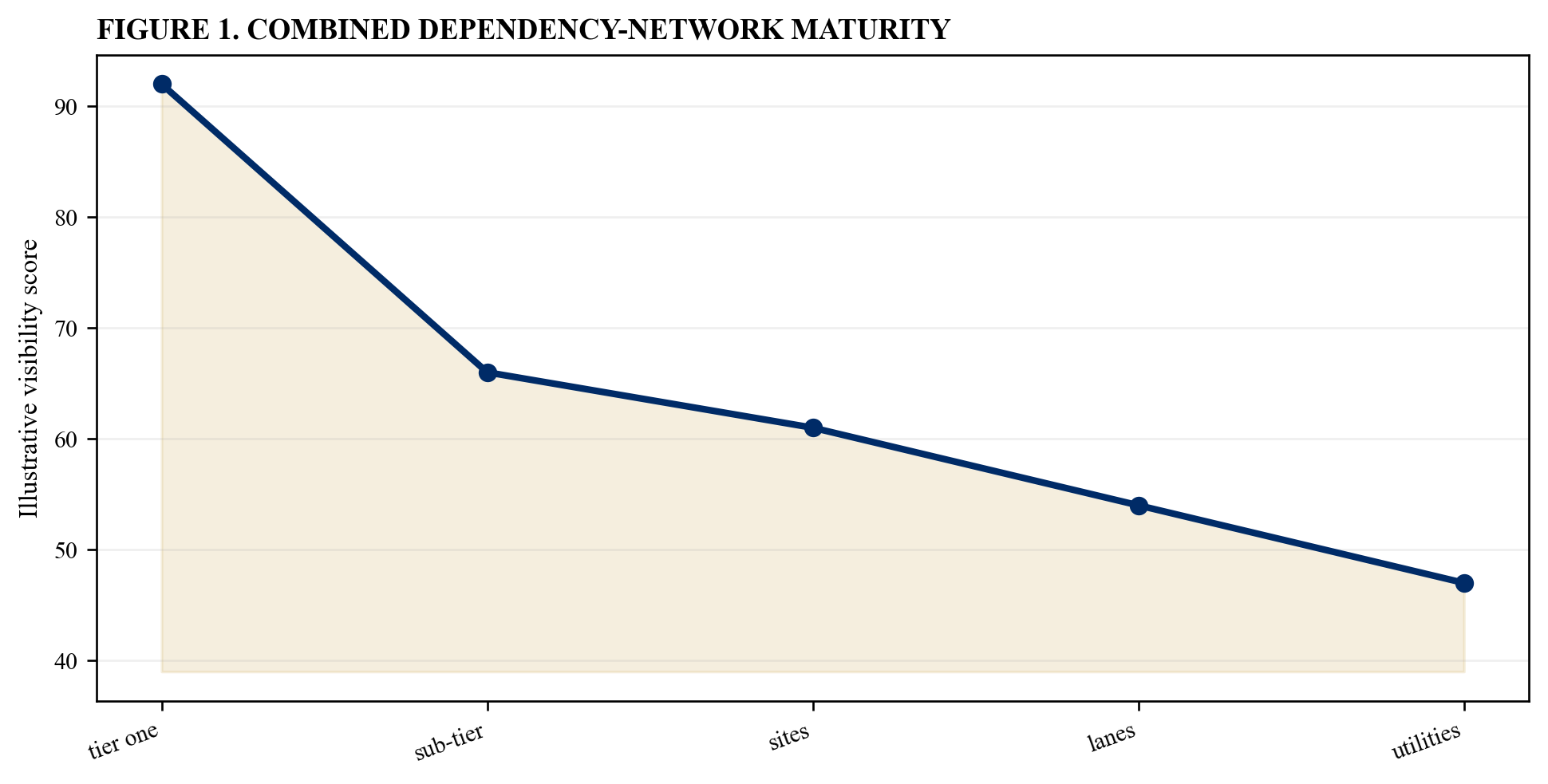
Illustrative analytical scenario; verified company and transaction evidence should replace index values.
6. Identify economic common control
The integration team should test ownership, financing, management, manufacturing, intellectual property, infrastructure and geographic links between vendors. The required output is an independence and common-control assessment. Record the affected flow, customer consequence, dependencies, capacity, recovery time, owner, evidence and confidence [7][8].
Translate the conclusion into a controlled sourcing decision covering demand, qualified capacity, lead time, inventory, route, quality, contract, cyber, substitution, recovery, cash and deadline. Reconcile the relevant functional views.
The principal risk is that nominally separate vendors can fail together. Quantify revenue and margin at risk, time to survive, time to recover, capacity shortfall, switching cost, working capital, disruption cash use, customer exposure and residual risk across base, adverse and remediated cases.
Retain contracts, forecasts, dependency maps, quality, capacity, supplier, trial, recovery, approval and limitation evidence. Refresh after material changes; assign exception owners and deadlines.
7. Classify criticality
The integration team should rank inputs by safety, regulatory, customer, revenue, margin, recovery, substitutability and reputational consequence. The required output is a critical-input tiering model. Record the affected flow, customer consequence, dependencies, capacity, recovery time, owner, evidence and confidence [2][9].
Translate the conclusion into a controlled sourcing decision covering demand, qualified capacity, lead time, inventory, route, quality, contract, cyber, substitution, recovery, cash and deadline. Reconcile the relevant functional views.
The principal risk is that high-spend categories can absorb attention while low-spend failure points remain unprotected. Quantify revenue and margin at risk, time to survive, time to recover, capacity shortfall, switching cost, working capital, disruption cash use, customer exposure and residual risk across base, adverse and remediated cases.
Retain contracts, forecasts, dependency maps, quality, capacity, supplier, trial, recovery, approval and limitation evidence. Refresh after material changes; assign exception owners and deadlines.
8. Set impact tolerances
The integration team should define maximum tolerable outage, backlog, defect, lead-time, cash and customer effects for each critical flow. The required output is a supply-chain tolerance schedule. Record the affected flow, customer consequence, dependencies, capacity, recovery time, owner, evidence and confidence [4][10].
Translate the conclusion into a controlled sourcing decision covering demand, qualified capacity, lead time, inventory, route, quality, contract, cyber, substitution, recovery, cash and deadline. Reconcile the relevant functional views.
The principal risk is that continuity plans can lack measurable thresholds for action. Quantify revenue and margin at risk, time to survive, time to recover, capacity shortfall, switching cost, working capital, disruption cash use, customer exposure and residual risk across base, adverse and remediated cases.
Retain contracts, forecasts, dependency maps, quality, capacity, supplier, trial, recovery, approval and limitation evidence. Refresh after material changes; assign exception owners and deadlines.
Table 1. Critical-flow tolerance matrix
| Flow | Tolerance evidence | Decision |
|---|---|---|
| customer service | maximum interruption | protect or redesign |
| regulated input | licence and safety consequence | dual source |
| digital service | recovery and dependency | segregate or replicate |
| material | time to survive | buffer or substitute |
Illustrative structure; verified transaction evidence and specialist review govern.
9. Reconcile demand and capacity
The integration team should combine order books, forecasts, seasonality, product changes and downside cases with supplier and logistics capacity. The required output is a demand-capacity bridge. Record the affected flow, customer consequence, dependencies, capacity, recovery time, owner, evidence and confidence [2][11].
Translate the conclusion into a controlled sourcing decision covering demand, qualified capacity, lead time, inventory, route, quality, contract, cyber, substitution, recovery, cash and deadline. Reconcile the relevant functional views.
The principal risk is that volume aggregation can exceed qualified capacity or compress recovery headroom. Quantify revenue and margin at risk, time to survive, time to recover, capacity shortfall, switching cost, working capital, disruption cash use, customer exposure and residual risk across base, adverse and remediated cases.
Retain contracts, forecasts, dependency maps, quality, capacity, supplier, trial, recovery, approval and limitation evidence. Refresh after material changes; assign exception owners and deadlines.
10. Test supplier financial health
The integration team should review liquidity, leverage, profitability, customer concentration, insurance, funding access and ownership support. The required output is a supplier financial resilience file. Record the affected flow, customer consequence, dependencies, capacity, recovery time, owner, evidence and confidence [12][13].
Translate the conclusion into a controlled sourcing decision covering demand, qualified capacity, lead time, inventory, route, quality, contract, cyber, substitution, recovery, cash and deadline. Reconcile the relevant functional views.
The principal risk is that price pressure can weaken the supplier whose continuity supports the synergy case. Quantify revenue and margin at risk, time to survive, time to recover, capacity shortfall, switching cost, working capital, disruption cash use, customer exposure and residual risk across base, adverse and remediated cases.
Retain contracts, forecasts, dependency maps, quality, capacity, supplier, trial, recovery, approval and limitation evidence. Refresh after material changes; assign exception owners and deadlines.
11. Verify operational capacity
The integration team should evidence rated, demonstrated and surge capacity together with yield, uptime, maintenance, labour and utility constraints. The required output is a capacity assurance record. Record the affected flow, customer consequence, dependencies, capacity, recovery time, owner, evidence and confidence [2][11].
Translate the conclusion into a controlled sourcing decision covering demand, qualified capacity, lead time, inventory, route, quality, contract, cyber, substitution, recovery, cash and deadline. Reconcile the relevant functional views.
The principal risk is that contracted capacity can exceed demonstrated output. Quantify revenue and margin at risk, time to survive, time to recover, capacity shortfall, switching cost, working capital, disruption cash use, customer exposure and residual risk across base, adverse and remediated cases.
Retain contracts, forecasts, dependency maps, quality, capacity, supplier, trial, recovery, approval and limitation evidence. Refresh after material changes; assign exception owners and deadlines.
12. Assess quality and process capability
The integration team should compare specifications, certifications, defect history, process control, traceability, change management and corrective action. The required output is a quality equivalence assessment. Record the affected flow, customer consequence, dependencies, capacity, recovery time, owner, evidence and confidence [9][14].
Translate the conclusion into a controlled sourcing decision covering demand, qualified capacity, lead time, inventory, route, quality, contract, cyber, substitution, recovery, cash and deadline. Reconcile the relevant functional views.
The principal risk is that consolidation can transfer volume before the receiving process is stable. Quantify revenue and margin at risk, time to survive, time to recover, capacity shortfall, switching cost, working capital, disruption cash use, customer exposure and residual risk across base, adverse and remediated cases.
Retain contracts, forecasts, dependency maps, quality, capacity, supplier, trial, recovery, approval and limitation evidence. Refresh after material changes; assign exception owners and deadlines.
13. Map tooling and intellectual property
The integration team should identify ownership, location, condition, duplication, access, maintenance and transfer rights for critical tooling and know-how. The required output is a tooling and knowledge-control map. Record the affected flow, customer consequence, dependencies, capacity, recovery time, owner, evidence and confidence [6][15].
Translate the conclusion into a controlled sourcing decision covering demand, qualified capacity, lead time, inventory, route, quality, contract, cyber, substitution, recovery, cash and deadline. Reconcile the relevant functional views.
The principal risk is that a supplier switch can fail because the buyer lacks usable tools, drawings, licences or tacit knowledge. Quantify revenue and margin at risk, time to survive, time to recover, capacity shortfall, switching cost, working capital, disruption cash use, customer exposure and residual risk across base, adverse and remediated cases.
Retain contracts, forecasts, dependency maps, quality, capacity, supplier, trial, recovery, approval and limitation evidence. Refresh after material changes; assign exception owners and deadlines.
14. Model lead-time and inventory exposure
The integration team should reconcile procurement, production, inspection, transport, customs and recovery time with safety stock and obsolescence. The required output is a time-to-survive model. Record the affected flow, customer consequence, dependencies, capacity, recovery time, owner, evidence and confidence [1][16].
Translate the conclusion into a controlled sourcing decision covering demand, qualified capacity, lead time, inventory, route, quality, contract, cyber, substitution, recovery, cash and deadline. Reconcile the relevant functional views.
The principal risk is that nominal inventory can expire before an alternative source becomes productive. Quantify revenue and margin at risk, time to survive, time to recover, capacity shortfall, switching cost, working capital, disruption cash use, customer exposure and residual risk across base, adverse and remediated cases.
Retain contracts, forecasts, dependency maps, quality, capacity, supplier, trial, recovery, approval and limitation evidence. Refresh after material changes; assign exception owners and deadlines.
15. Map logistics corridors
The integration team should trace ports, airports, roads, canals, border processes, warehouses and carriers across base and alternative routes. The required output is a lane and chokepoint map. Record the affected flow, customer consequence, dependencies, capacity, recovery time, owner, evidence and confidence [1][17].
Translate the conclusion into a controlled sourcing decision covering demand, qualified capacity, lead time, inventory, route, quality, contract, cyber, substitution, recovery, cash and deadline. Reconcile the relevant functional views.
The principal risk is that supplier diversity can still rely on one transport corridor. Quantify revenue and margin at risk, time to survive, time to recover, capacity shortfall, switching cost, working capital, disruption cash use, customer exposure and residual risk across base, adverse and remediated cases.
Retain contracts, forecasts, dependency maps, quality, capacity, supplier, trial, recovery, approval and limitation evidence. Refresh after material changes; assign exception owners and deadlines.
16. Assess geopolitical and trade exposure
The integration team should test sanctions, export controls, tariffs, local-content rules, conflict, expropriation and policy change. The required output is a geopolitical exposure matrix. Record the affected flow, customer consequence, dependencies, capacity, recovery time, owner, evidence and confidence [18][19].
Translate the conclusion into a controlled sourcing decision covering demand, qualified capacity, lead time, inventory, route, quality, contract, cyber, substitution, recovery, cash and deadline. Reconcile the relevant functional views.
The principal risk is that a cost-efficient source can become unavailable or unlawful. Quantify revenue and margin at risk, time to survive, time to recover, capacity shortfall, switching cost, working capital, disruption cash use, customer exposure and residual risk across base, adverse and remediated cases.
Retain contracts, forecasts, dependency maps, quality, capacity, supplier, trial, recovery, approval and limitation evidence. Refresh after material changes; assign exception owners and deadlines.
Table 2. Common-failure matrix
| Dependency | Evidence | Control |
|---|---|---|
| ownership | ultimate parent | independent source |
| site | production coordinates | geographic separation |
| sub-tier | bill-of-material trace | alternate component |
| lane | route and carrier | tested alternative |
Illustrative structure; verified transaction evidence and specialist review govern.
17. Assess climate and natural-hazard exposure
The integration team should map flood, drought, heat, wildfire, storm, water and energy dependencies across sites and lanes. The required output is a physical-risk and adaptation file. Record the affected flow, customer consequence, dependencies, capacity, recovery time, owner, evidence and confidence [1][20].
Translate the conclusion into a controlled sourcing decision covering demand, qualified capacity, lead time, inventory, route, quality, contract, cyber, substitution, recovery, cash and deadline. Reconcile the relevant functional views.
The principal risk is that common geography can transmit one hazard across several suppliers. Quantify revenue and margin at risk, time to survive, time to recover, capacity shortfall, switching cost, working capital, disruption cash use, customer exposure and residual risk across base, adverse and remediated cases.
Retain contracts, forecasts, dependency maps, quality, capacity, supplier, trial, recovery, approval and limitation evidence. Refresh after material changes; assign exception owners and deadlines.
18. Map critical materials
The integration team should identify strategic minerals, chemicals, semiconductors, energy inputs and other scarce materials embedded in the combined portfolio. The required output is a critical-material dependency register. Record the affected flow, customer consequence, dependencies, capacity, recovery time, owner, evidence and confidence [7][21].
Translate the conclusion into a controlled sourcing decision covering demand, qualified capacity, lead time, inventory, route, quality, contract, cyber, substitution, recovery, cash and deadline. Reconcile the relevant functional views.
The principal risk is that scarcity can sit several tiers upstream from the contracted supplier. Quantify revenue and margin at risk, time to survive, time to recover, capacity shortfall, switching cost, working capital, disruption cash use, customer exposure and residual risk across base, adverse and remediated cases.
Retain contracts, forecasts, dependency maps, quality, capacity, supplier, trial, recovery, approval and limitation evidence. Refresh after material changes; assign exception owners and deadlines.
19. Assess cyber supply-chain risk
The integration team should evaluate access, software provenance, vulnerabilities, incident response, recovery, remote support and fourth-party dependencies. The required output is a cyber supplier-risk baseline. Record the affected flow, customer consequence, dependencies, capacity, recovery time, owner, evidence and confidence [22][23].
Translate the conclusion into a controlled sourcing decision covering demand, qualified capacity, lead time, inventory, route, quality, contract, cyber, substitution, recovery, cash and deadline. Reconcile the relevant functional views.
The principal risk is that supplier consolidation can enlarge the blast radius of one compromised vendor. Quantify revenue and margin at risk, time to survive, time to recover, capacity shortfall, switching cost, working capital, disruption cash use, customer exposure and residual risk across base, adverse and remediated cases.
Retain contracts, forecasts, dependency maps, quality, capacity, supplier, trial, recovery, approval and limitation evidence. Refresh after material changes; assign exception owners and deadlines.
20. Protect operational technology
The integration team should separate and control vendor access to manufacturing, logistics, building, energy and safety systems. The required output is an operational-technology access plan. Record the affected flow, customer consequence, dependencies, capacity, recovery time, owner, evidence and confidence [22][24].
Translate the conclusion into a controlled sourcing decision covering demand, qualified capacity, lead time, inventory, route, quality, contract, cyber, substitution, recovery, cash and deadline. Reconcile the relevant functional views.
The principal risk is that integration connectivity can create new paths into critical operations. Quantify revenue and margin at risk, time to survive, time to recover, capacity shortfall, switching cost, working capital, disruption cash use, customer exposure and residual risk across base, adverse and remediated cases.
Retain contracts, forecasts, dependency maps, quality, capacity, supplier, trial, recovery, approval and limitation evidence. Refresh after material changes; assign exception owners and deadlines.
21. Test responsible-sourcing evidence
The integration team should review human-rights, labour, environment, conflict-minerals, grievance and remediation evidence by risk and tier. The required output is a responsible-business due-diligence file. Record the affected flow, customer consequence, dependencies, capacity, recovery time, owner, evidence and confidence [25][26].
Translate the conclusion into a controlled sourcing decision covering demand, qualified capacity, lead time, inventory, route, quality, contract, cyber, substitution, recovery, cash and deadline. Reconcile the relevant functional views.
The principal risk is that rationalisation can concentrate purchasing with a supplier whose upstream harms are poorly understood. Quantify revenue and margin at risk, time to survive, time to recover, capacity shortfall, switching cost, working capital, disruption cash use, customer exposure and residual risk across base, adverse and remediated cases.
Retain contracts, forecasts, dependency maps, quality, capacity, supplier, trial, recovery, approval and limitation evidence. Refresh after material changes; assign exception owners and deadlines.
22. Review contract protections
The integration team should compare capacity, service, audit, data, cyber, continuity, allocation, change, termination, step-in and transition terms. The required output is a supplier contract protection matrix. Record the affected flow, customer consequence, dependencies, capacity, recovery time, owner, evidence and confidence [5][6].
Translate the conclusion into a controlled sourcing decision covering demand, qualified capacity, lead time, inventory, route, quality, contract, cyber, substitution, recovery, cash and deadline. Reconcile the relevant functional views.
The principal risk is that commercial leverage can be overstated when rights are weak or non-transferable. Quantify revenue and margin at risk, time to survive, time to recover, capacity shortfall, switching cost, working capital, disruption cash use, customer exposure and residual risk across base, adverse and remediated cases.
Retain contracts, forecasts, dependency maps, quality, capacity, supplier, trial, recovery, approval and limitation evidence. Refresh after material changes; assign exception owners and deadlines.
23. Test change-of-control and assignment
The integration team should identify consent, renegotiation, price reset, termination and exclusivity consequences triggered by the merger. The required output is a contract continuity schedule. Record the affected flow, customer consequence, dependencies, capacity, recovery time, owner, evidence and confidence [5][15].
Translate the conclusion into a controlled sourcing decision covering demand, qualified capacity, lead time, inventory, route, quality, contract, cyber, substitution, recovery, cash and deadline. Reconcile the relevant functional views.
The principal risk is that critical supply can become contestable at close. Quantify revenue and margin at risk, time to survive, time to recover, capacity shortfall, switching cost, working capital, disruption cash use, customer exposure and residual risk across base, adverse and remediated cases.
Retain contracts, forecasts, dependency maps, quality, capacity, supplier, trial, recovery, approval and limitation evidence. Refresh after material changes; assign exception owners and deadlines.
24. Measure concentration correctly
The integration team should calculate spend, volume, capacity, revenue-at-risk, common-owner, site, country, lane, technology and sub-tier concentration. The required output is a multidimensional concentration stack. Record the affected flow, customer consequence, dependencies, capacity, recovery time, owner, evidence and confidence [1][7].
Translate the conclusion into a controlled sourcing decision covering demand, qualified capacity, lead time, inventory, route, quality, contract, cyber, substitution, recovery, cash and deadline. Reconcile the relevant functional views.
The principal risk is that a single spend metric can report diversification where economic dependency is concentrated. Quantify revenue and margin at risk, time to survive, time to recover, capacity shortfall, switching cost, working capital, disruption cash use, customer exposure and residual risk across base, adverse and remediated cases.
Retain contracts, forecasts, dependency maps, quality, capacity, supplier, trial, recovery, approval and limitation evidence. Refresh after material changes; assign exception owners and deadlines.
Table 3. Concentration stack
| Measure | Test | Escalation |
|---|---|---|
| spend | share by supplier | commercial review |
| capacity | share of qualified output | reserve capacity |
| revenue | customer value at risk | board trigger |
| recovery | time versus tolerance | buffer or redesign |
Illustrative structure; verified transaction evidence and specialist review govern.
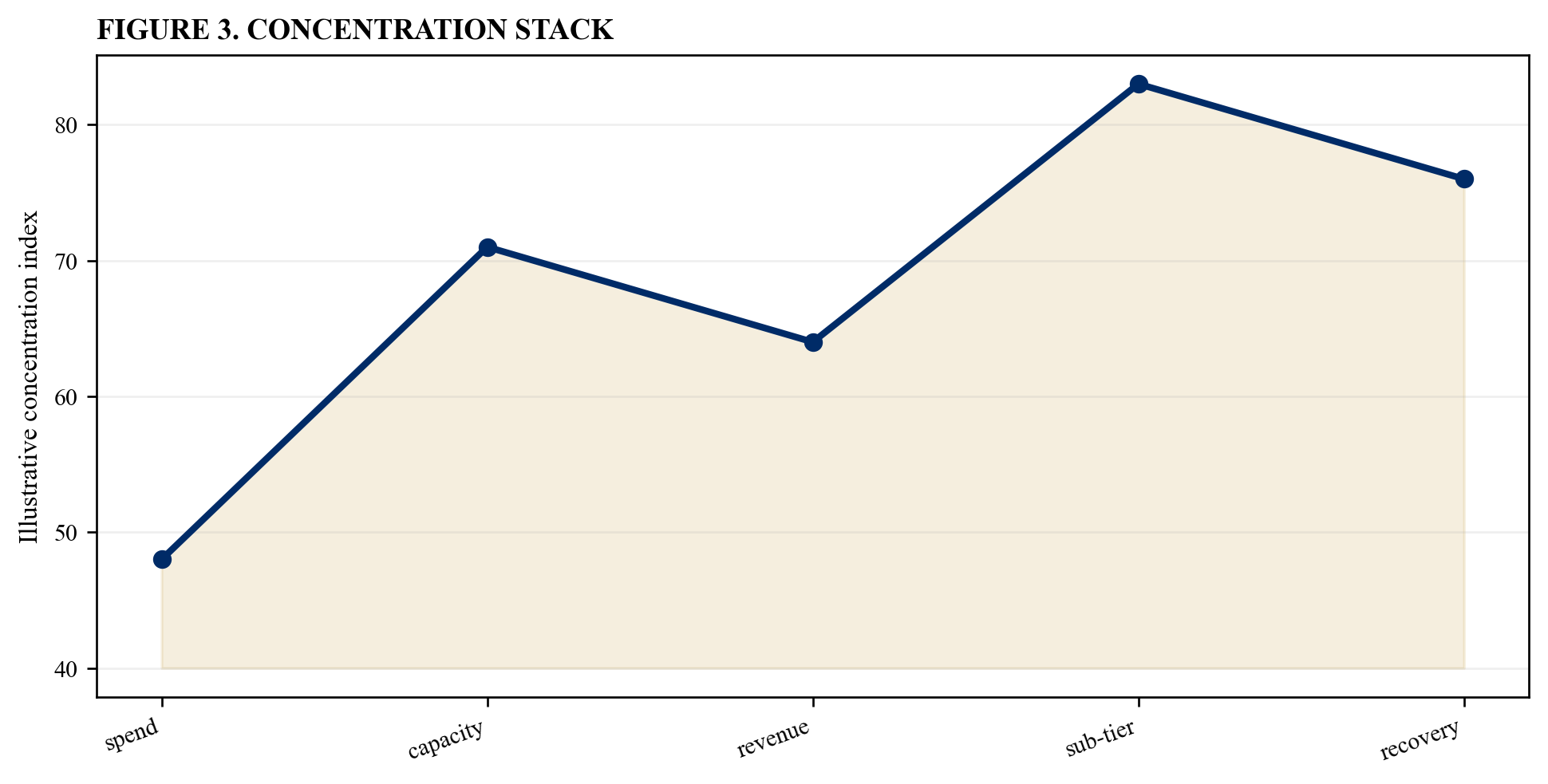
Illustrative analytical scenario; verified company and transaction evidence should replace index values.
25. Estimate switching cost and time
The integration team should quantify qualification, redesign, tooling, validation, regulatory approval, inventory, dual running and customer consent. The required output is a substitution cost and lead-time model. Record the affected flow, customer consequence, dependencies, capacity, recovery time, owner, evidence and confidence [2][14].
Translate the conclusion into a controlled sourcing decision covering demand, qualified capacity, lead time, inventory, route, quality, contract, cyber, substitution, recovery, cash and deadline. Reconcile the relevant functional views.
The principal risk is that an alternative supplier can exist commercially while remaining unusable within the disruption window. Quantify revenue and margin at risk, time to survive, time to recover, capacity shortfall, switching cost, working capital, disruption cash use, customer exposure and residual risk across base, adverse and remediated cases.
Retain contracts, forecasts, dependency maps, quality, capacity, supplier, trial, recovery, approval and limitation evidence. Refresh after material changes; assign exception owners and deadlines.
26. Build qualified alternatives
The integration team should verify alternate sources through due diligence, samples, capacity reservations, audits, contracts and production trials. The required output is an alternative-source readiness file. Record the affected flow, customer consequence, dependencies, capacity, recovery time, owner, evidence and confidence [2][23].
Translate the conclusion into a controlled sourcing decision covering demand, qualified capacity, lead time, inventory, route, quality, contract, cyber, substitution, recovery, cash and deadline. Reconcile the relevant functional views.
The principal risk is that a vendor list can be mistaken for recoverable capacity. Quantify revenue and margin at risk, time to survive, time to recover, capacity shortfall, switching cost, working capital, disruption cash use, customer exposure and residual risk across base, adverse and remediated cases.
Retain contracts, forecasts, dependency maps, quality, capacity, supplier, trial, recovery, approval and limitation evidence. Refresh after material changes; assign exception owners and deadlines.
27. Design buffers deliberately
The integration team should set inventory, reserved capacity, tooling, data, cash and logistics buffers according to consequence and recovery time. The required output is a risk-priced buffer policy. Record the affected flow, customer consequence, dependencies, capacity, recovery time, owner, evidence and confidence [3][16].
Translate the conclusion into a controlled sourcing decision covering demand, qualified capacity, lead time, inventory, route, quality, contract, cyber, substitution, recovery, cash and deadline. Reconcile the relevant functional views.
The principal risk is that uniform working-capital reduction can remove protection from critical flows. Quantify revenue and margin at risk, time to survive, time to recover, capacity shortfall, switching cost, working capital, disruption cash use, customer exposure and residual risk across base, adverse and remediated cases.
Retain contracts, forecasts, dependency maps, quality, capacity, supplier, trial, recovery, approval and limitation evidence. Refresh after material changes; assign exception owners and deadlines.
28. Use demand management and substitution
The integration team should define prioritisation, allocation, product substitution, repair, reuse and customer communication actions. The required output is a demand-response playbook. Record the affected flow, customer consequence, dependencies, capacity, recovery time, owner, evidence and confidence [3][21].
Translate the conclusion into a controlled sourcing decision covering demand, qualified capacity, lead time, inventory, route, quality, contract, cyber, substitution, recovery, cash and deadline. Reconcile the relevant functional views.
The principal risk is that supply interventions alone can be too slow during a severe shortage. Quantify revenue and margin at risk, time to survive, time to recover, capacity shortfall, switching cost, working capital, disruption cash use, customer exposure and residual risk across base, adverse and remediated cases.
Retain contracts, forecasts, dependency maps, quality, capacity, supplier, trial, recovery, approval and limitation evidence. Refresh after material changes; assign exception owners and deadlines.
29. Model the savings-to-resilience frontier
The integration team should compare unit cost, cash, service, quality, concentration and recovery across sourcing configurations. The required output is a risk-adjusted sourcing decision model. Record the affected flow, customer consequence, dependencies, capacity, recovery time, owner, evidence and confidence [1][3].
Translate the conclusion into a controlled sourcing decision covering demand, qualified capacity, lead time, inventory, route, quality, contract, cyber, substitution, recovery, cash and deadline. Reconcile the relevant functional views.
The principal risk is that the lowest apparent unit cost can destroy more enterprise value under plausible disruption. Quantify revenue and margin at risk, time to survive, time to recover, capacity shortfall, switching cost, working capital, disruption cash use, customer exposure and residual risk across base, adverse and remediated cases.
Retain contracts, forecasts, dependency maps, quality, capacity, supplier, trial, recovery, approval and limitation evidence. Refresh after material changes; assign exception owners and deadlines.
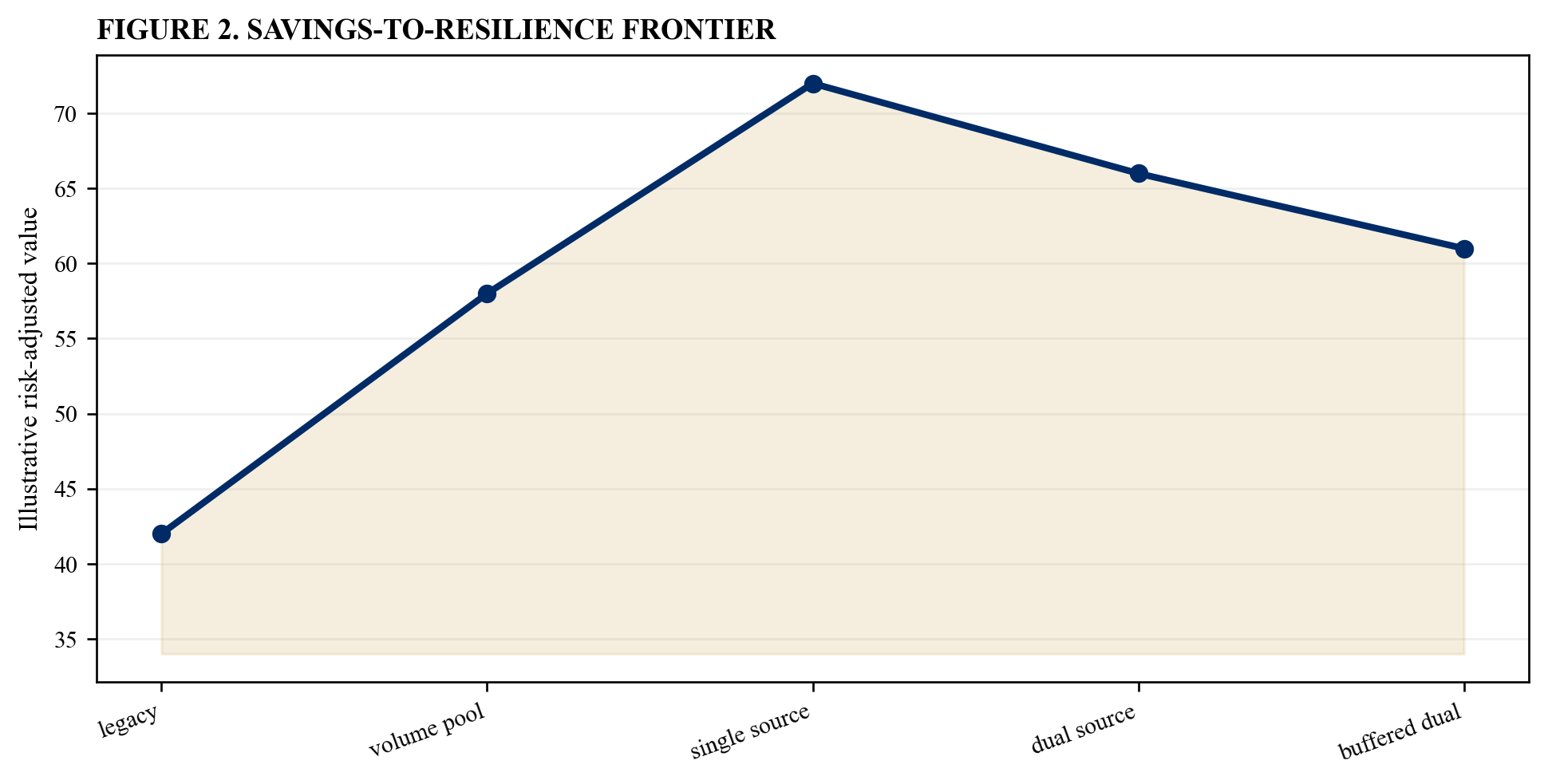
Illustrative analytical scenario; verified company and transaction evidence should replace index values.
30. Quantify disruption cash flow
The integration team should model lost contribution, penalties, expedited freight, requalification, inventory, working capital and recovery by scenario. The required output is a disruption value-at-risk model. Record the affected flow, customer consequence, dependencies, capacity, recovery time, owner, evidence and confidence [12][13].
Translate the conclusion into a controlled sourcing decision covering demand, qualified capacity, lead time, inventory, route, quality, contract, cyber, substitution, recovery, cash and deadline. Reconcile the relevant functional views.
The principal risk is that integration committees can compare certain savings with unquantified interruption exposure. Quantify revenue and margin at risk, time to survive, time to recover, capacity shortfall, switching cost, working capital, disruption cash use, customer exposure and residual risk across base, adverse and remediated cases.
Retain contracts, forecasts, dependency maps, quality, capacity, supplier, trial, recovery, approval and limitation evidence. Refresh after material changes; assign exception owners and deadlines.
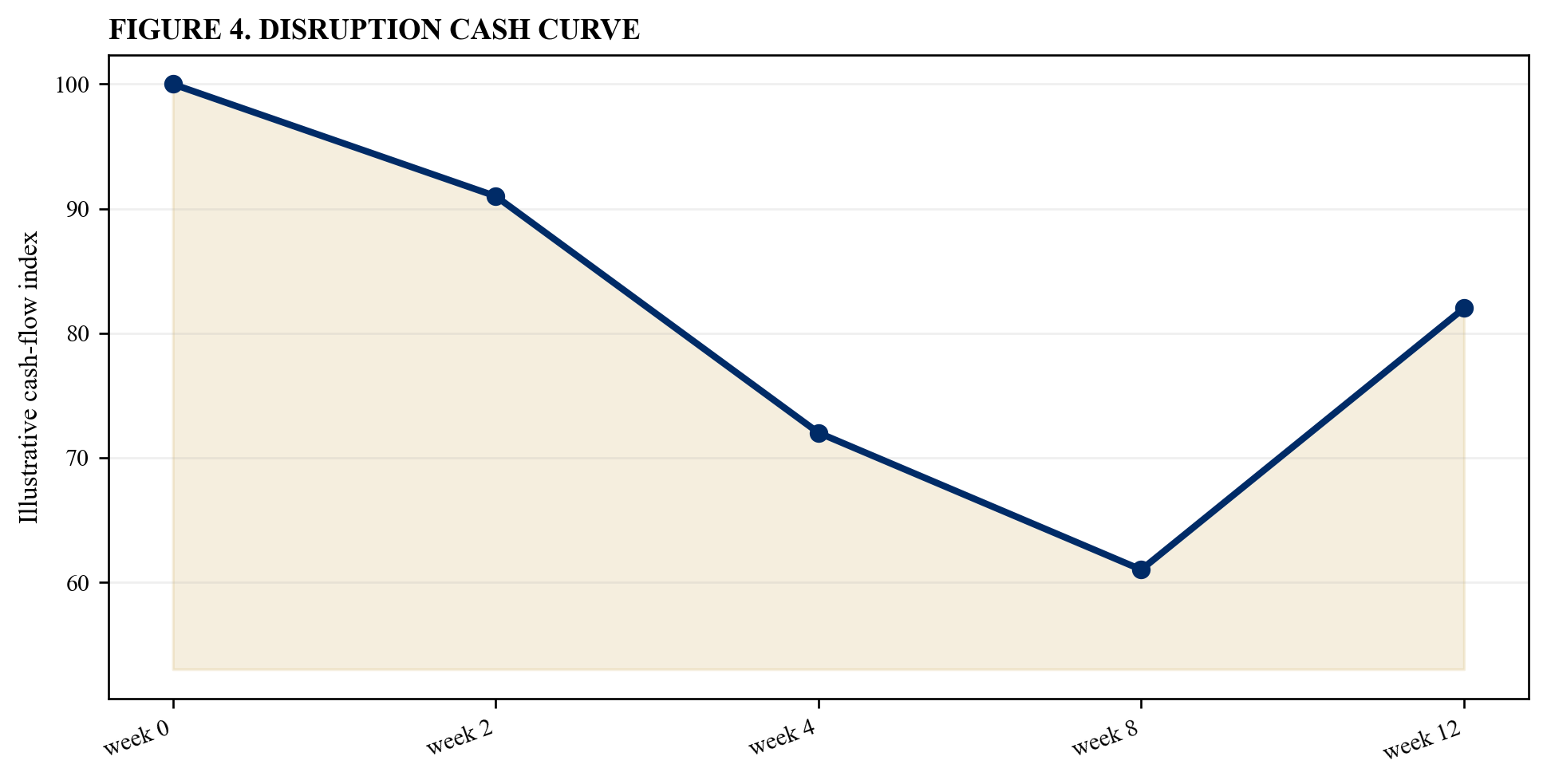
Illustrative analytical scenario; verified company and transaction evidence should replace index values.
31. Challenge procurement synergies
The integration team should reconcile addressable spend, baseline, volume, specification, inflation, implementation cost, timing, leakage and continuity effects. The required output is an evidence-backed synergy bridge. Record the affected flow, customer consequence, dependencies, capacity, recovery time, owner, evidence and confidence [5][12].
Translate the conclusion into a controlled sourcing decision covering demand, qualified capacity, lead time, inventory, route, quality, contract, cyber, substitution, recovery, cash and deadline. Reconcile the relevant functional views.
The principal risk is that gross category targets can double-count benefits or ignore resilience expenditure. Quantify revenue and margin at risk, time to survive, time to recover, capacity shortfall, switching cost, working capital, disruption cash use, customer exposure and residual risk across base, adverse and remediated cases.
Retain contracts, forecasts, dependency maps, quality, capacity, supplier, trial, recovery, approval and limitation evidence. Refresh after material changes; assign exception owners and deadlines.
32. Sequence rationalisation waves
The integration team should start with reversible, lower-criticality categories and advance only after alternatives, buffers, controls and recovery evidence pass. The required output is a gated consolidation roadmap. Record the affected flow, customer consequence, dependencies, capacity, recovery time, owner, evidence and confidence [2][4].
Translate the conclusion into a controlled sourcing decision covering demand, qualified capacity, lead time, inventory, route, quality, contract, cyber, substitution, recovery, cash and deadline. Reconcile the relevant functional views.
The principal risk is that a broad supplier cut can remove options before the combined estate is understood. Quantify revenue and margin at risk, time to survive, time to recover, capacity shortfall, switching cost, working capital, disruption cash use, customer exposure and residual risk across base, adverse and remediated cases.
Retain contracts, forecasts, dependency maps, quality, capacity, supplier, trial, recovery, approval and limitation evidence. Refresh after material changes; assign exception owners and deadlines.
Table 4. Consolidation gate
| Gate | Required evidence | Failure action |
|---|---|---|
| criticality | customer and operational impact | hold |
| capacity | qualified demonstrated output | dual run |
| continuity | alternative and buffer | remediate |
| economics | net risk-adjusted value | redesign |
Illustrative structure; verified transaction evidence and specialist review govern.
33. Protect Day-One continuity
The integration team should freeze unapproved supplier, specification, routing, access and inventory changes while critical dependencies are reconciled. The required output is a Day-One continuity protocol. Record the affected flow, customer consequence, dependencies, capacity, recovery time, owner, evidence and confidence [4][10].
Translate the conclusion into a controlled sourcing decision covering demand, qualified capacity, lead time, inventory, route, quality, contract, cyber, substitution, recovery, cash and deadline. Reconcile the relevant functional views.
The principal risk is that close can trigger simultaneous changes across procurement, systems, plants and suppliers. Quantify revenue and margin at risk, time to survive, time to recover, capacity shortfall, switching cost, working capital, disruption cash use, customer exposure and residual risk across base, adverse and remediated cases.
Retain contracts, forecasts, dependency maps, quality, capacity, supplier, trial, recovery, approval and limitation evidence. Refresh after material changes; assign exception owners and deadlines.
34. Govern supplier transitions
The integration team should assign accountable owners, milestones, evidence, tolerances, exception rights and rollback for each transferred flow. The required output is a supplier-transition control file. Record the affected flow, customer consequence, dependencies, capacity, recovery time, owner, evidence and confidence [2][14].
Translate the conclusion into a controlled sourcing decision covering demand, qualified capacity, lead time, inventory, route, quality, contract, cyber, substitution, recovery, cash and deadline. Reconcile the relevant functional views.
The principal risk is that commercial handover can outpace operational readiness. Quantify revenue and margin at risk, time to survive, time to recover, capacity shortfall, switching cost, working capital, disruption cash use, customer exposure and residual risk across base, adverse and remediated cases.
Retain contracts, forecasts, dependency maps, quality, capacity, supplier, trial, recovery, approval and limitation evidence. Refresh after material changes; assign exception owners and deadlines.
35. Test response and recovery
The integration team should exercise shortage, cyber, quality, logistics, site-loss and supplier-failure scenarios with internal and external participants. The required output is an exercised recovery record. Record the affected flow, customer consequence, dependencies, capacity, recovery time, owner, evidence and confidence [10][23].
Translate the conclusion into a controlled sourcing decision covering demand, qualified capacity, lead time, inventory, route, quality, contract, cyber, substitution, recovery, cash and deadline. Reconcile the relevant functional views.
The principal risk is that written plans can fail when communications, data, authority or alternate capacity are tested. Quantify revenue and margin at risk, time to survive, time to recover, capacity shortfall, switching cost, working capital, disruption cash use, customer exposure and residual risk across base, adverse and remediated cases.
Retain contracts, forecasts, dependency maps, quality, capacity, supplier, trial, recovery, approval and limitation evidence. Refresh after material changes; assign exception owners and deadlines.
36. Monitor leading indicators
The integration team should track financial distress, delivery, quality, capacity, labour, cyber, geopolitical, climate, logistics and deeper-tier signals. The required output is a supplier early-warning dashboard. Record the affected flow, customer consequence, dependencies, capacity, recovery time, owner, evidence and confidence [1][12].
Translate the conclusion into a controlled sourcing decision covering demand, qualified capacity, lead time, inventory, route, quality, contract, cyber, substitution, recovery, cash and deadline. Reconcile the relevant functional views.
The principal risk is that lagging service metrics can show failure only after customer impact begins. Quantify revenue and margin at risk, time to survive, time to recover, capacity shortfall, switching cost, working capital, disruption cash use, customer exposure and residual risk across base, adverse and remediated cases.
Retain contracts, forecasts, dependency maps, quality, capacity, supplier, trial, recovery, approval and limitation evidence. Refresh after material changes; assign exception owners and deadlines.
37. Set escalation triggers
The integration team should define thresholds for capacity shortfall, concentration, inventory cover, quality, supplier distress, cyber incidents and recovery failure. The required output is a board and management escalation protocol. Record the affected flow, customer consequence, dependencies, capacity, recovery time, owner, evidence and confidence [4][10].
Translate the conclusion into a controlled sourcing decision covering demand, qualified capacity, lead time, inventory, route, quality, contract, cyber, substitution, recovery, cash and deadline. Reconcile the relevant functional views.
The principal risk is that material exceptions can be normalised inside a savings programme. Quantify revenue and margin at risk, time to survive, time to recover, capacity shortfall, switching cost, working capital, disruption cash use, customer exposure and residual risk across base, adverse and remediated cases.
Retain contracts, forecasts, dependency maps, quality, capacity, supplier, trial, recovery, approval and limitation evidence. Refresh after material changes; assign exception owners and deadlines.
38. Stress the common-failure case
The integration team should combine supplier insolvency, shared sub-tier loss, corridor closure, cyber disruption and demand surge. The required output is a compounded dependency scenario. Record the affected flow, customer consequence, dependencies, capacity, recovery time, owner, evidence and confidence [1][7].
Translate the conclusion into a controlled sourcing decision covering demand, qualified capacity, lead time, inventory, route, quality, contract, cyber, substitution, recovery, cash and deadline. Reconcile the relevant functional views.
The principal risk is that several moderate exposures can align into one severe interruption. Quantify revenue and margin at risk, time to survive, time to recover, capacity shortfall, switching cost, working capital, disruption cash use, customer exposure and residual risk across base, adverse and remediated cases.
Retain contracts, forecasts, dependency maps, quality, capacity, supplier, trial, recovery, approval and limitation evidence. Refresh after material changes; assign exception owners and deadlines.
39. Reconcile value after each wave
The integration team should compare realised saving, cash, service, quality, concentration, resilience investment and residual exposure. The required output is a post-wave value and resilience review. Record the affected flow, customer consequence, dependencies, capacity, recovery time, owner, evidence and confidence [3][12].
Translate the conclusion into a controlled sourcing decision covering demand, qualified capacity, lead time, inventory, route, quality, contract, cyber, substitution, recovery, cash and deadline. Reconcile the relevant functional views.
The principal risk is that reported savings can persist after service and working-capital costs move elsewhere. Quantify revenue and margin at risk, time to survive, time to recover, capacity shortfall, switching cost, working capital, disruption cash use, customer exposure and residual risk across base, adverse and remediated cases.
Retain contracts, forecasts, dependency maps, quality, capacity, supplier, trial, recovery, approval and limitation evidence. Refresh after material changes; assign exception owners and deadlines.
40. Issue the supply-chain resilience certificate
The integration team should approve dependency evidence, savings, capacity, alternatives, buffers, recovery, obligations and residual risk. The required output is a retained board and integration-ready resilience certificate. Record the affected flow, customer consequence, dependencies, capacity, recovery time, owner, evidence and confidence [1][2].
Translate the conclusion into a controlled sourcing decision covering demand, qualified capacity, lead time, inventory, route, quality, contract, cyber, substitution, recovery, cash and deadline. Reconcile the relevant functional views.
The principal risk is that supplier consolidation can be declared complete without proving continuity. Quantify revenue and margin at risk, time to survive, time to recover, capacity shortfall, switching cost, working capital, disruption cash use, customer exposure and residual risk across base, adverse and remediated cases.
Retain contracts, forecasts, dependency maps, quality, capacity, supplier, trial, recovery, approval and limitation evidence. Refresh after material changes; assign exception owners and deadlines.
Table 5. Resilience certificate
| Conclusion | Record | Approval test |
|---|---|---|
| dependency | tiered network | failure points known |
| economics | net synergy bridge | risk adjusted |
| recovery | exercise evidence | within tolerance |
| governance | owners and triggers | residual risk accepted |
Illustrative structure; verified transaction evidence and specialist review govern.
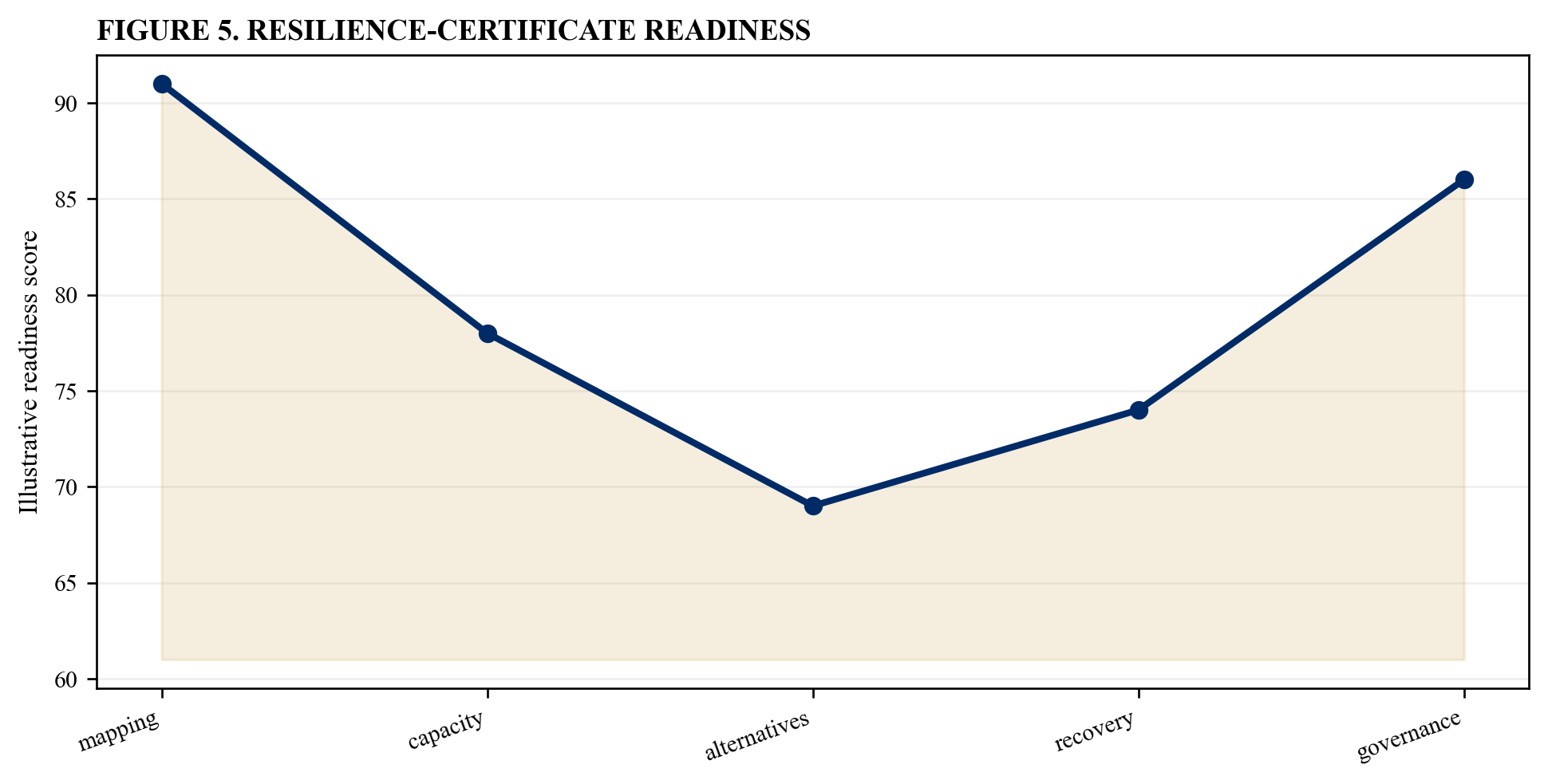
Illustrative analytical scenario; verified company and transaction evidence should replace index values.
References
- UK Government Office for Science, Global Supply Chains: A Foresight Report on Risk and Resilience, https://www.gov.uk/government/publications/global-supply-chains-a-foresight-report-on-risk-and-resilience
- UK Department for Business and Trade, Supply Chains Resilience Framework, https://www.gov.uk/government/publications/supply-chain-resilience
- UK Department for Business and Trade, Critical Imports and Supply Chains Strategy, https://www.gov.uk/government/publications/uk-critical-imports-and-supply-chains-strategy
- UK Cabinet Office, UK Government Resilience Framework, https://www.gov.uk/government/publications/the-uk-government-resilience-framework
- International Financial Reporting Standards Foundation, IFRS 3 Business Combinations, https://www.ifrs.org/issued-standards/list-of-standards/ifrs-3-business-combinations/
- US Securities and Exchange Commission, Regulation S-K Item 101, https://www.ecfr.gov/current/title-17/chapter-II/part-229/section-229.101
- European Union, Regulation EU 2024/1252 Critical Raw Materials Act, https://eur-lex.europa.eu/eli/reg/2024/1252
- US Department of Justice and Federal Trade Commission, 2023 Merger Guidelines, https://www.justice.gov/atr/merger-guidelines/overview
- International Organization for Standardization, ISO 9001 Quality Management Systems overview, https://www.iso.org/iso-9001-quality-management.html
- UK Government, Core Resilience Guidance, https://www.gov.uk/government/collections/core-resilience-guidance
- US Government Accountability Office, Defense Supplier Base: Challenges and Policy Considerations, https://www.gao.gov/products/gao-22-104765
- US Securities and Exchange Commission, Management's Discussion and Analysis, Regulation S-K Item 303, https://www.ecfr.gov/current/title-17/chapter-II/part-229/section-229.303
- International Monetary Fund, Corporate Vulnerabilities in Global Supply Chains, https://www.imf.org/en/Publications/WP/Issues/2023/09/22/Corporate-Vulnerabilities-in-Global-Supply-Chains-539094
- US Food and Drug Administration, Quality Systems and Supplier Controls, https://www.fda.gov/medical-devices/postmarket-requirements-devices/quality-system-qs-regulationmedical-device-good-manufacturing-practices
- World Intellectual Property Organization, WIPO Intellectual Property Handbook, https://www.wipo.int/publications/en/details.jsp?id=275
- UK Government, United Kingdom Food Security Report 2024: Food Supply Chain Resilience, https://www.gov.uk/government/statistics/united-kingdom-food-security-report-2024/united-kingdom-food-security-report-2024-theme-3-food-supply-chain-resilience
- United Nations Conference on Trade and Development, Review of Maritime Transport, https://unctad.org/topic/transport-and-trade-logistics/review-of-maritime-transport
- UK Government, Export Control Joint Unit Guidance, https://www.gov.uk/guidance/export-controls-military-goods-software-and-technology
- US Department of the Treasury, Sanctions Programs and Country Information, https://ofac.treasury.gov/sanctions-programs-and-country-information
- Intergovernmental Panel on Climate Change, Sixth Assessment Report Working Group II, https://www.ipcc.ch/report/ar6/wg2/
- European Commission, European Critical Raw Materials Act, https://commission.europa.eu/topics/competitiveness/green-deal-industrial-plan/european-critical-raw-materials-act_en
- National Institute of Standards and Technology, Cybersecurity Supply Chain Risk Management Practices SP 800-161 Revision 1 Update 1, https://doi.org/10.6028/NIST.SP.800-161r1-upd1
- National Institute of Standards and Technology, Cybersecurity Supply Chain Risk Management Due Diligence Assessment Quick-Start Guide SP 1326, https://doi.org/10.6028/NIST.SP.1326
- UK National Cyber Security Centre, Supply Chain Security Guidance, https://www.ncsc.gov.uk/collection/supply-chain-security
- Organisation for Economic Co-operation and Development, Due Diligence Guidance for Responsible Business Conduct, https://www.oecd.org/en/topics/sub-issues/due-diligence-guidance-for-responsible-business-conduct.html
- European Commission, Conflict Minerals Regulation, https://policy.trade.ec.europa.eu/development-and-sustainability/conflict-minerals-regulation_en
