

1. The decision after the acquisition
The board should approve a reporting process at the same time as it approves the acquisition case. That process needs to explain which promised benefits have occurred, what evidence supports their attribution to the transaction, and how much cash remains after implementation. A later presentation showing a percentage of a synergy target is useful only when its numerator, denominator and measurement period are explicit. The recommendations in this paper concern the first full reporting cycle after an acquisition. They are proposed management controls, subject to adaptation to the actual transaction and reporting obligations.
An institutional investor may need this information before supporting another acquisition. A family office acquiring an operating business may use it to decide whether to retain the integration team or release further capital. A lender may need a more restricted calculation under its executed facility agreement. Each user has a distinct decision. The same underlying evidence can support several analyses, but the resulting measures should retain their own definitions. A covenant adjustment, an investor presentation and an audited accounting subtotal do not become interchangeable because they refer to the same cost reduction.
The term auditable describes the ability to reconstruct a claim from evidence and test it against stated criteria. It does not represent an audit opinion on the hypothetical example. In the system proposed here, a reviewer can move from a published number to the approved calculation, the recorded exception decisions and the original transaction records. The reviewer can also identify records that were unavailable. Management remains accountable for its representation, including its choice of baseline and its treatment of adverse effects.
This paper's contribution is a worked reporting-control case. It follows a single acquisition from approval through first-year performance, cash reconciliation, an attribution challenge and release approval. Its numerical assumptions are invented to expose measurement problems. It supplies no empirical estimate of acquisition success, typical synergy delivery or achievable advisory revenue. Readers applying the method should replace each input with verified company evidence and obtain accounting, legal and assurance advice appropriate to the entity, listing venue and proposed communication.
2. The reporting requirements and proposals
IFRS 3 establishes principles for recognising and measuring a business combination and for disclosing its nature and financial effects. Those requirements provide the accounting context for an acquisition. A management-designed benefit schedule requires its own assessment of purpose and classification; the existence of such a schedule does not make it a prescribed IFRS statement. The accounting team should identify the reporting entity, acquisition date and relevant accounting requirements before connecting management measures to the financial statements. [1]
The IASB's Business Combinations, Disclosures, Goodwill and Impairment project remains under redeliberation in the project record reviewed on 10 September 2026. The July 2026 meeting considered an updated disclosure package and directed staff to explore further the type of subsequent-performance information that might be required. These are ongoing proposals. This paper does not describe them as enacted amendments or assign them an effective date. A reporting policy should track the current project separately from requirements already applicable to the company. [2], [3]
IFRS 18 is issued and applies to annual periods beginning on or after 1 January 2027, with earlier application permitted. Its presentation changes include specified profit subtotals and disclosures about management-defined performance measures. The classification of a particular measure requires attention to the standard's criteria, including its use in public communications and its representation of management's view of performance. A deal team's informal label does not determine the classification. The financial-reporting team should document its conclusion before the measure enters a public presentation. [4]
The June 2026 IFRIC discussion adds a specific caution. Its tentative agenda decision concluded that including hypothetical income or expenses does not, by itself, disqualify a measure from being a management-defined performance measure under IFRS 18; all relevant criteria still apply. It also addressed clear, non-misleading description. The current project page continued to identify the next stage as feedback on that tentative decision when reviewed for this paper. This remains a tentative decision, with a stated consultation deadline of 9 September 2026, and requires monitoring before reliance on any final outcome. [5], [6]
For a company subject to US reporting rules, the SEC's non-GAAP interpretations address misleading labels, reconciliation and the limits of certain business-combination communication exceptions. A transaction-related exemption does not automatically extend to every later filing or presentation. The paper therefore proposes a communication-by-communication review, with securities counsel confirming applicability. Those US requirements are not treated as rules for every GCC acquirer. The location of an investor alone does not establish the reporting regime governing an issuer's statement. [8]
| Information | Classification question | Evidence to retain |
|---|---|---|
| Acquisition accounting | Which recognition and disclosure rules apply? | Accounting policy and transaction analysis |
| Management benefit measure | What does the measure represent and where is it used? | Definition, calculation and communication list |
| Forecast annual run-rate | Which future period and conditions are assumed? | Dated assumptions and implementation schedule |
| Covenant adjustment | What does the executed agreement permit? | Contract definition and lender certificate |
| Proposed IFRS amendments | Has a final requirement been issued? | Dated standard-setting status review |
Proposed decision register. Applicable obligations require entity-specific professional assessment; proposal status is current to 10 September 2026.
3. Preserve the original investment case
The first control is a frozen approval record. It should contain the deal rationale, the original benefit calculations, implementation expenditure, assumptions about timing and the board's decision. A later forecast belongs in a new version linked to that record. Replacing the approval spreadsheet with a more recent forecast would remove the basis for evaluating the original decision. The proposed system retains both records and requires an explanation of every material difference between them.
The approval record needs enough detail to expose dependencies. A procurement saving may depend on combining purchasing volumes, obtaining consent to assign contracts and meeting a supplier's minimum commitment. A property saving may require a lease exit that remains under negotiation. The expected date of each dependency should accompany the financial amount. A reviewer should be able to distinguish a contractual right already obtained from a management intention and understand how either entered the approved calculation.
Use a stable identity for each benefit initiative. That identity should survive changes in the manager, business-unit name or reporting system. An acquisition can reorganise cost centres and migrate customer records during its first year. Without a retained mapping, the team may be unable to connect the new operating structure to the baseline used in approval. Record the entities, accounts, counterparties and measurement period included in each initiative. Any later change to that perimeter should carry a dated approval and a bridge to the previous view.
The system should preserve rejected assumptions as well as approved ones. A board may exclude a proposed cross-selling benefit because customer consent or capacity is uncertain. If the same opportunity later appears in the integration forecast, the new calculation should disclose its origin and the evidence that changed the decision. A rejected item should not silently reappear under another label. Conversely, a new opportunity can be tracked without rewriting the record of what supported the purchase price.
For a cross-border acquisition by a GCC investor, the approval pack should identify the actual legal entities and reporting currencies. Translation into a group reporting currency needs a documented convention. Operational restrictions and contractual rights require separate local review. This paper makes no assumption that a UAE parent can implement a Saudi, Qatari, Kuwaiti or overseas subsidiary's integration action merely by approving a group plan. The benefit owner should identify the consent, capacity and legal evidence needed for the proposed action in the relevant jurisdiction.
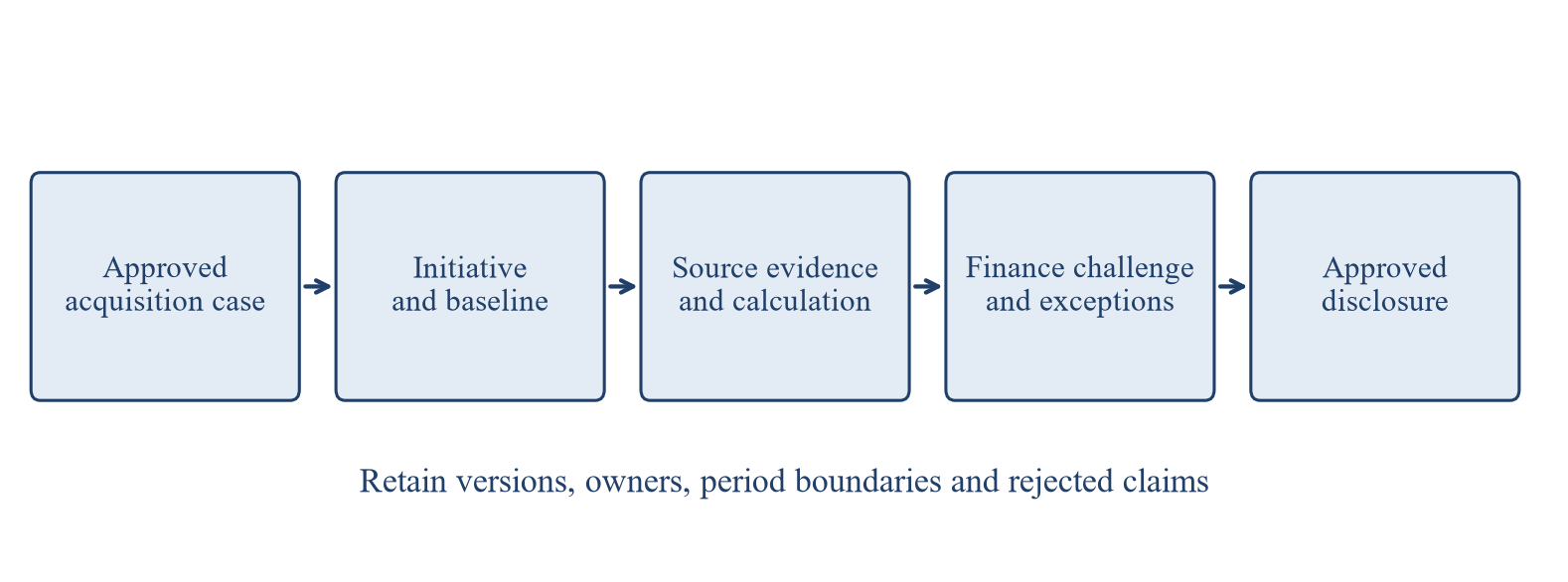
Analytical control design. Each arrow requires a retained record; the diagram does not represent an implemented company system or an assurance conclusion.
4. Establish a baseline that can be challenged
A baseline should describe what the combined businesses would have incurred or earned under the selected comparison conditions. This is an attribution construct, and some elements will remain estimates. The source records for historical expenditure can be verified; the counterfactual path without the acquisition usually requires assumptions. The disclosure should identify that distinction. A bank payment proves that cash moved. It does not establish the amount that would have been paid if the transaction had never occurred.
The proposed baseline policy separates price, volume, mix and perimeter changes. Suppose a purchasing category costs less because the acquired business orders fewer units. Counting the entire spending decline as a procurement synergy would attribute a volume reduction to a negotiated price improvement. A useful calculation holds the selected volume and specification constant when measuring price, then shows volume and mix effects separately. The chosen convention needs to be stated before results are known and applied to unfavourable movements as well as favourable ones.
Historical data need a completeness check. The team should reconcile the selected accounts to an identified accounting extract and explain exclusions. An initiative using supplier invoices also needs credit notes, rebates and contract amendments. A payroll initiative needs a record of relevant roles and employment dates, with access limited to authorised reviewers. The operational owner should confirm whether an apparent reduction transfers cost elsewhere in the group. The finance reviewer should examine that transfer before accepting the net benefit.
The counterfactual should be proportionate to the decision. A contractually fixed rental payment can provide a relatively direct comparison for a documented lease exit. A revenue expansion requires a more uncertain assessment of customer behaviour, capacity and alternative sales opportunities. Management should state the limitations of the chosen method and show a sensitivity where the uncertainty affects the decision. A complex statistical model is not automatically more persuasive than a transparent calculation with identifiable assumptions and accessible source records.
Changes to the baseline should follow a controlled exception process. A genuine error in historical data may justify correction. A change in management's current expectations belongs in the forecast. The record should identify which occurred, why it matters and who approved the treatment. Where a reported comparative changes, the team should retain both versions and consider the relevant reporting consequences with its advisers. A corrected baseline should not erase the history of an earlier public statement.
5. Define the hypothetical acquisition case
Consider an invented acquisition with a board-approved gross annual synergy target of USD 12.00 million. The target comprises USD 5.00 million from procurement, USD 3.00 million from property consolidation, USD 2.00 million from support functions and USD 2.00 million of additional revenue contribution after the specified variable delivery costs. The figures represent a proposed recurring annual rate after implementation. They do not represent first-year income, bank cash, a transaction valuation or an observed market benchmark.
For the illustrative first reporting year, assume the accepted gross in-period benefits are USD 3.20 million, USD 1.50 million, USD 0.90 million and USD 0.80 million respectively. Their sum is USD 6.40 million. These figures are inputs selected for the example. Differences from the annual target reflect the invented implementation schedule and delivery outcomes. The paper does not derive those outcomes from a real acquisition or attach probabilities to them. In a live engagement, each amount would require the baseline and evidence procedures described above.
Assume recurring adverse effects of USD 1.10 million during that year. These comprise USD 0.60 million of retained support costs and USD 0.50 million of additional service and customer-retention expenditure. Subtracting them from gross benefits gives USD 5.30 million of net recurring benefit before the one-off implementation expense specified later. A company would need to examine the substance and classification of each item. The example's categories are management-analysis conventions and do not determine accounting treatment for a real business.
At the year-end measurement date, assume the gross annual rate supported by the implemented operating configuration is USD 9.60 million: procurement USD 4.40 million, property USD 2.40 million, support functions USD 1.40 million and revenue contribution USD 1.40 million. A separately assumed recurring annual leakage rate of USD 1.20 million gives a net annual rate of USD 8.40 million. These forward-looking rate measures remain conditional on the stated activity and operating assumptions. They are not amounts already earned throughout the preceding year.
The gross year-end rate of USD 9.60 million is 80% of the approved gross annual target of USD 12.00 million. That comparison is meaningful only on the stated common gross annual-rate basis. Dividing the in-period net benefit or the first-year cash balance by the same target answers a different question. The proposed disclosure should show the relevant measures beside each other with their definitions and dates, allowing readers to evaluate delivery and liquidity without combining unlike quantities.
| Workstream | Approved annual target | First-year gross benefit | Year-end gross annual rate |
|---|---|---|---|
| Procurement | 5.00 | 3.20 | 4.40 |
| Property | 3.00 | 1.50 | 2.40 |
| Support functions | 2.00 | 0.90 | 1.40 |
| Revenue contribution | 2.00 | 0.80 | 1.40 |
| Total | 12.00 | 6.40 | 9.60 |
USD million. Approved target and year-end rate are gross annual rates; first-year benefit covers the actual illustrative year. All values are invented assumptions.
6. Reconcile benefit contribution to accounting profit
The illustrative USD 5.30 million net recurring benefit is measured before specified one-off implementation expenses. Assume USD 2.00 million of such expenses is recognised during the year. The resulting incremental contribution before the example's additional depreciation is USD 3.30 million. Assume new depreciation of USD 0.40 million associated with integration investment. The illustrative incremental operating-profit contribution is then USD 2.90 million. This is a simplified management bridge, with accounting classifications held fixed as assumptions for the case.
The bridge should not be presented as the company's complete profit and loss account. The example contains only the selected acquisition-related differences and excludes the businesses' underlying standalone results, financing costs and other transactions. An actual financial-statement reconciliation would start from the relevant reported measure, identify every adjustment and use the entity's applicable accounting policies. The sum of selected initiative records is insufficient to establish that a reported accounting subtotal is complete or correctly classified.
The cost owner should document the difference between an implementation expense and a recurring operating cost. A recurring support function cannot be removed from the benefit measure simply because management intends to eliminate it later. The proposed policy accepts a change only when its current treatment and the conditions for future removal are explicit. Where a cost remains in the ledger but is excluded from a public management measure, the financial-reporting team should assess the definition, reconciliation and potential for misleading presentation.
Depreciation illustrates another boundary. A new system may reduce staffing expenditure while creating an asset whose cost is recognised over time. The acquisition case needs the investment payment, and the accounting view needs the applicable expense recognition. Counting the staff reduction without identifying the investment would omit part of the economic cost. Subtracting both the entire investment and its depreciation in a single operating-profit measure would combine different bases. The bridge should make the treatment and period visible to the reviewer.
The controls proposed here also require a reconciliation between the initiative ledger and the consolidated accounting perimeter. Intercompany charges can move an expense between legal entities without changing group profit. A centralised service may appear as a saving in a subsidiary while the parent records the replacement cost. Management should identify the group-level effect and any separately relevant entity-level effect. The evidence register should preserve the elimination or allocation entry used to reach each view, with a reviewer responsible for checking the boundary.
7. Follow the incremental cash
Assume cash implementation payments of USD 2.40 million during the illustrative year, an incremental working-capital absorption of USD 0.70 million, integration capital expenditure of USD 1.20 million and an incremental cash-tax allowance of USD 0.50 million. Starting from net recurring benefits of USD 5.30 million gives incremental net cash of USD 0.50 million after these amounts. The tax allowance is an invented fixed cash input. It is not a UAE, Saudi, UK or other jurisdiction's tax calculation or effective rate.
The difference between the USD 2.00 million implementation expense and USD 2.40 million cash payment is assumed to be a USD 0.40 million reduction in an opening implementation accrual. That settlement is separate from the USD 0.70 million working-capital movement, which concerns operating receivables, inventory and payables and expressly excludes the implementation accrual. Keeping these boundaries explicit avoids counting the same payable movement twice. A live analysis would reconcile each movement to opening and closing balances and dated payments.
The same answer can be reconstructed from operating profit. Add the non-cash depreciation of USD 0.40 million to the USD 2.90 million incremental operating-profit contribution. Deduct the additional USD 0.40 million accrual settlement, USD 0.70 million operating working-capital absorption, USD 1.20 million capital expenditure and USD 0.50 million cash-tax allowance. The result is again USD 0.50 million. Agreement between the two routes is a calculation check. It does not validate the invented inputs or prove causal attribution.
The annual result should be accompanied by a dated liquidity analysis. The example does not model payment dates within the year, a revolving facility, debt repayment or restrictions on moving cash between entities. A positive annual total can coexist with a financing requirement before savings accumulate. The proposed reporting pack should identify the month of minimum liquidity and distinguish committed funding from a possible refinancing or shareholder contribution. A synergy announcement supplies no evidence that a particular source of funding is available.
Cash should be traced to the account and entity that receive it. A saving in a foreign subsidiary may improve local liquidity while remaining unavailable for an investor distribution or parent-company debt payment. The team should investigate actual banking arrangements, contractual restrictions and applicable tax or legal requirements with qualified advisers. This paper supplies no assumed repatriation route. An investor should ask for the amount, timing and conditions of accessible cash relevant to its decision, supported by the actual transaction documents.
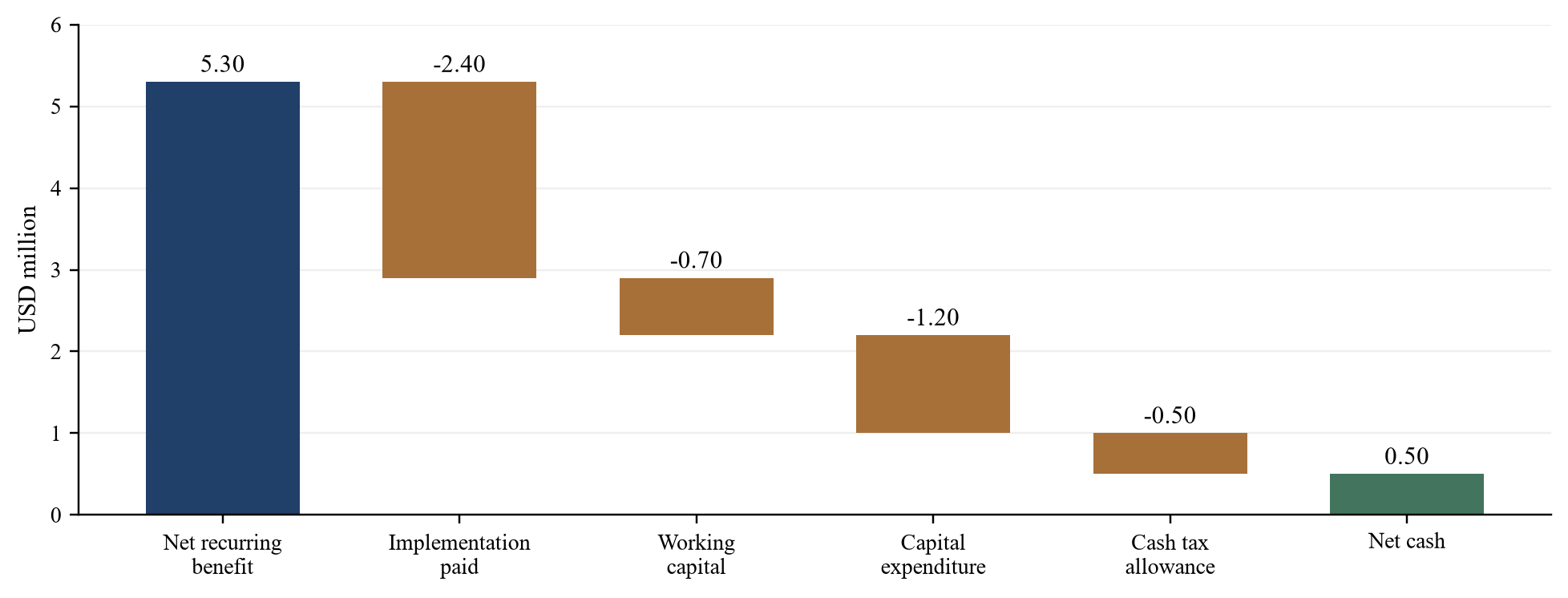
USD million for the illustrative first year. Cash implementation payments include a separate accrual settlement. Working capital excludes that accrual. No financing flows or intra-year liquidity profile are modelled.
8. Test attribution before accepting the benefit
An evidence review should test the causal claim made by management. Consider a separate, hypothetical procurement example with one million units purchased in the current year at USD 8.60 per unit. Assume the comparison price for the same specification and terms is USD 10.00 per unit. The price benefit at current-year volume is USD 1.40 million. If the previous year involved 1.20 million units at USD 10.00, the historical spending reduction is USD 3.40 million. Of that reduction, USD 2.00 million arises from purchasing fewer units. These calculations do not establish why volume fell.
This independent illustration is not an additional initiative to add to the earlier acquisition totals. It shows how a measured spending movement can contain more than one effect. The reviewer should examine whether the price comparison reflects a signed agreement, a temporary rebate, a changed product specification or another condition. Management should also investigate quality, service and inventory consequences. A price reduction accompanied by higher waste or emergency freight may have a different net effect from the invoice calculation alone.
Revenue attribution requires particular care because a new customer order can reflect several causes. A transaction may provide access to a distribution relationship, but sales staff, pricing changes and general demand also affect the outcome. The proposed benefit record should identify the precise mechanism claimed, the comparison used and the associated delivery costs. Gross sales should not be added directly to a cost-saving total when the stated measure is an earnings contribution. The paper's hypothetical revenue figures already deduct their specified variable delivery costs.
The reviewer should look for displacement within the group. A sale transferred between subsidiaries may appear as new business in one unit while group revenue remains unchanged. A consolidated measure should remove that duplication. An initiative may also depend on selling a service that replaces another product with a different margin. The evidence pack should show the relevant customer, product and period mapping and explain any limitations in identifying that effect. Customer records should be handled within the applicable access and confidentiality arrangements.
Some benefits cannot be attributed precisely with available evidence. The proposed response is to retain the uncertainty in the record and restrict the claim accordingly. Management can present the observed operating change and explain why the acquisition's incremental contribution remains unresolved. An internal confidence label should not be converted into a statistical probability without a defensible estimation method. A reviewer should be able to see the unresolved issue, its potential financial effect and the action required to obtain better evidence.
9. Build the evidence register around a claim
The evidence register should connect each reported claim with the calculation that produces it. A useful entry identifies the initiative, reporting period, baseline version, source extract, calculation owner and review decision. It should also record the point at which the extract was taken and the reconciliation establishing its completeness. A filename alone does not establish that the file contains the relevant population or that the calculation used the reviewed version. The proposed record therefore includes both a reference to the source and the reason it supports the claim.
Evidence should remain accessible to authorised reviewers after people and systems change. Store the approved calculation and its input snapshot together, with a change history and access controls. A link to a live dashboard may become insufficient if the dashboard refreshes and overwrites the period originally reported. The period-close record should retain the data necessary to reconstruct that period's result. Retention periods, personal-data handling and legal access should be set with the relevant specialists and the company's actual obligations.
The register should include exceptions rather than hiding them in correspondence. Each exception needs a description, affected amount or scope, current decision and responsible owner. If the amount cannot be estimated, say so in the internal record and identify the reason. Do not replace a missing estimate with zero. The reporting team should decide how the uncertainty affects the proposed communication, taking account of its nature and materiality within the relevant context.
Review signatures should indicate what was reviewed. An operational owner may confirm that a lease was vacated or a purchasing arrangement implemented. Finance may confirm arithmetic and reconciliation to an accounting extract. Legal may assess whether a statement creates a disclosure problem. These approvals have different meanings. A signature labelled simply approved can obscure that distinction. The proposed register records the scope of each review and any unresolved conditions, so the release approver knows which questions remain open.
| Record element | Purpose | Review question |
|---|---|---|
| Claim and period | State exactly what management proposes to report | Is this a realised amount or a forecast rate? |
| Baseline version | Preserve the selected comparison | Who approved changes and why? |
| Source population | Identify records included and excluded | Does the extract reconcile to a complete population? |
| Calculation and allocations | Reproduce the stated amount | Are overlaps, costs and currency effects treated consistently? |
| Exceptions and decision | Retain disputed or missing evidence | What amount is excluded or still uncertain? |
| Release reference | Link evidence to the actual communication | Does the published wording match the approved basis? |
Suggested fields for management's control design. Records and approvals in an actual engagement must be supported by the company's evidence.
10. Respond when a reported benefit is challenged
Return to the hypothetical acquisition. Assume a reviewer challenges USD 0.60 million of the first-year revenue contribution because management cannot yet distinguish it from pre-existing customer activity. Under the proposed evidence policy, remove that amount provisionally from the accepted acquisition-attributed benefit schedule while the investigation proceeds. Gross accepted benefit falls from USD 6.40 million to USD 5.80 million. With recurring adverse effects still fixed at USD 1.10 million, accepted net recurring benefit falls to USD 4.70 million.
Holding the other illustrative cash assumptions constant produces an attributed net cash contribution of negative USD 0.10 million. This is a change in the amount supported by the attribution analysis. It does not itself reverse a customer payment, change a bank balance or establish an accounting error. The reporting team should distinguish the observed company cash flows from management's estimate of the incremental cash caused by the acquisition. Treating an evidence challenge as a new physical cash outflow would misdescribe the event.
Now assume a separate additional supplier settlement of USD 0.50 million becomes payable and is paid within the same hypothetical period. Under the simplified case, that payment reduces the revised attributed net cash contribution to negative USD 0.60 million. The calculation holds the cash-tax allowance and all other inputs fixed to isolate the effect. It contains no assertion about actual tax deductibility, the probability of the settlement or the appropriate accounting treatment of an actual claim. Those questions would need separate evidence and review.
The approval record should show the earlier measure, the challenge, the decision to exclude the unsupported amount and the revised result. Management should assess whether prior communications require correction or additional explanation under the applicable rules. The protocol should specify who receives the exception and who may authorise any release. An unresolved dispute between a delivery owner and finance should reach the designated decision-maker with both positions and supporting records preserved.
An evidence challenge to an in-period amount should also prompt review of any related forward-looking statement. It does not justify mechanically deducting the same amount from an annual run-rate, because the periods and assumptions differ. The team should trace the affected initiative through the forecast model and reassess its prospective contribution. The result may be a revised estimate, a wider range or withdrawal of the measure pending evidence. Each outcome should be explained on its own basis, without silently rebasing the original acquisition target.
11. Keep impairment analysis connected and distinct
IAS 36 addresses whether the carrying amount of an asset or cash-generating unit exceeds its recoverable amount. The IFRS Foundation's overview describes recoverable amount by reference to value in use and fair value less disposal costs, and explains that goodwill is assessed through the relevant cash-generating unit or units. Goodwill is subject to annual impairment assessment. A synergy schedule contributes information to management's review, but achievement of a selected benefit target does not by itself resolve the recoverability assessment. [7]
A company could achieve procurement savings while losing customer demand elsewhere in the acquired operation. Conversely, a delayed integration initiative could coexist with stronger independent cash generation. The proposed system therefore connects the benefit register to the forecast assumptions used by the valuation and accounting teams, with differences explained. It should identify which initiatives affect the relevant business units, their timing and whether the forecast already incorporates them. Adding a separate synergy amount to a forecast containing the same effect would duplicate the assumed benefit.
The acquisition approval case, the annual budget and an impairment model may serve different purposes. The responsible specialists should document the applicable requirements and valuation basis for each. Management should not import a discount rate, growth assumption or restructuring benefit across models solely because it appeared in the original deal presentation. This paper does not calculate recoverable amount, allocate goodwill or prescribe an impairment conclusion. It proposes that the reporting process make the relationship among those models inspectable.
The evidence register can record an adverse delivery signal for the accounting team without predetermining its conclusion. A lost contract, delayed systems migration or newly identified cost can require a forecast update. The team should retain the date on which the information became available and where it was considered. A process that reports positive benefits promptly while deferring adverse information would give reviewers an incomplete view. The board should ask how the reporting cycle captures both types of evidence on a consistent timetable.
12. Assign responsibility and define assurance scope
The delivery owner should be responsible for the operational initiative and its evidence. The measurement owner should maintain the definition and calculation. Finance should review the reconciliation and reporting classification, while the designated disclosure approver decides whether the claim is ready for its intended communication. These responsibilities can sit in different teams or be combined in a smaller organisation, provided the review and challenge arrangements remain explicit. The proposed design does not prescribe a universal organisational chart or staffing number.
For companies within the UK Corporate Governance Code's scope, Provision 29 applies for financial years beginning on or after 1 January 2026. It addresses board monitoring and review of the internal-control framework and reporting on the effectiveness of material controls at the balance-sheet date. The Code covers financial, operational, reporting and compliance controls on its comply-or-explain basis. This provides a relevant governance example for an applicable issuer. It is not a universal statutory requirement for a privately held GCC company. [9]
The FRC's June 2026 explanation of auditor responsibilities makes the assurance boundary clear. The financial-statement audit opinion does not cover the Provision 29 statement. The auditor's responsibilities for reading and considering that statement as other information do not constitute an assurance engagement on it. A company's benefit register and internal sign-offs should therefore describe the actual work performed. Calling the schedule externally audited requires a basis in the relevant engagement and report; inclusion near audited accounts is insufficient. [10]
An investor considering an additional review should agree the subject matter, criteria, reporting period and intended users with the proposed provider. The mandate should distinguish factual checking, agreed procedures, accounting advice and an assurance conclusion. A reviewer may be able to verify a supplier payment while remaining unable to establish the counterfactual benefit. The engagement should identify that limitation before work begins. This paper offers no assurance opinion and assumes no auditor appointment or acceptance of the proposed criteria.
Incentives deserve explicit attention. A delivery team may have compensation linked to reported benefits, and an adviser may have fees tied to a transaction or claimed outcome. The company should identify relevant conflicts and agree the scope of independent challenge. An investor commissioning support should ask which party prepared the original acquisition case, who owns the source data and who may revise the baseline. The review record should make those relationships visible without claiming that a particular structure removes every source of bias.
13. Operate a reporting calendar with release authority
The proposed reporting calendar begins with a dated data cutoff and ends with the exact approved public wording. It should allow time for operational submission, finance reconciliation, exception resolution and release approval. The dates in Figure 3 are illustrative internal offsets from a period end. They are not statutory deadlines, a claim about common market practice or a commitment by any adviser. Each organisation needs a calendar that fits its actual reporting obligations and the availability of reliable evidence.
At submission, the initiative owner should provide the calculation, evidence and changes from the previous period. Finance then checks the source population, arithmetic, classifications and overlap with other initiatives. Exceptions should be assigned to an owner and resolved or escalated before release. The approver should receive the current measure together with material exclusions and qualifications. A late change to a source extract should trigger a documented assessment of which calculations and disclosures need to be repeated.
The release record should include the exact version of the presentation, annual-report passage or lender certificate that was approved. A change in wording can alter meaning even when the number remains unchanged. For example, achieved, contracted and expected describe different evidence states. The proposed control requires a comparison between the approved measure definition and the final communication. Related versions on the website, in translated materials or in presentation slides should be checked against the same approved basis.
Corrections should preserve the previous record and identify the replacement. Management should assess who received the earlier statement and which communication obligations apply. The control owner should also investigate the source of the error and decide whether other periods or measures are affected. A corrected total alone may leave the underlying process defect unresolved. The board should receive a concise explanation of the failure, its known scope and the specific action taken, with uncertain effects clearly identified.
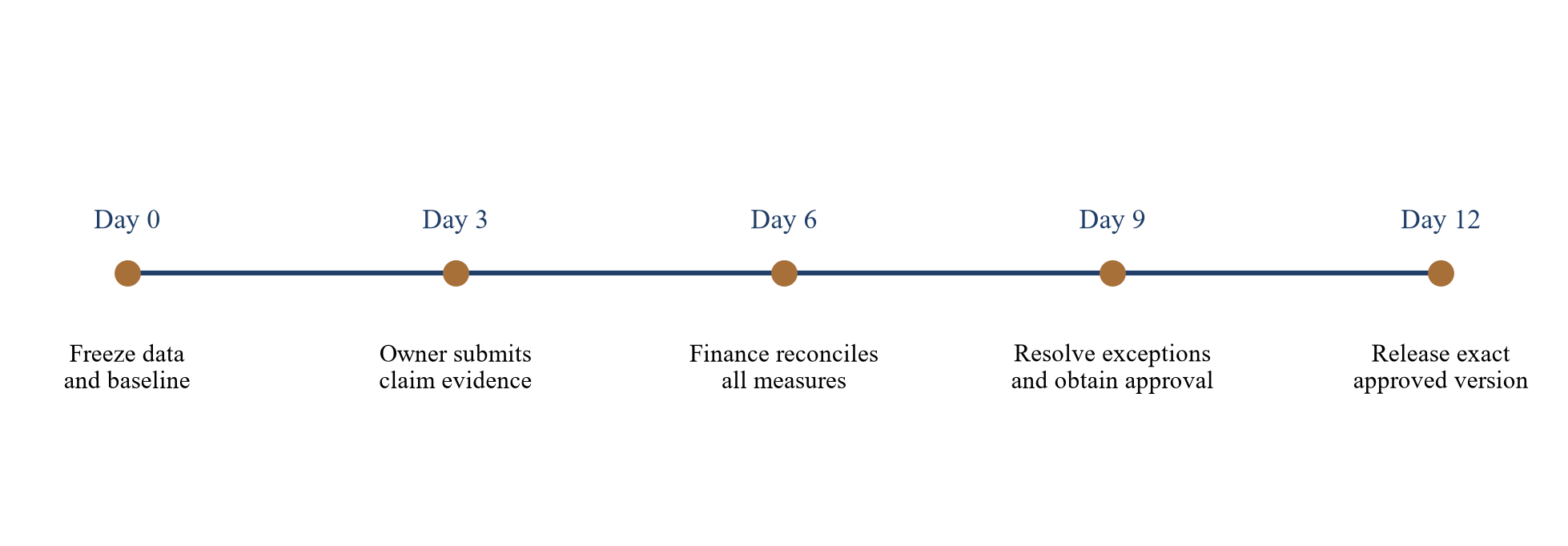
Proposed internal workflow using days after period end. The offsets are invented for planning and do not represent statutory deadlines or a required reporting timetable.
14. Commission a focused advisory engagement
A paying client should commission the work around a defined capital-allocation or reporting decision. An acquirer may need to test whether the next integration tranche remains justified. A family office may want a reconstruction of benefits after replacing an operating management team. An institutional investor may need questions for a portfolio review. A lender may require a separate examination of a proposed covenant calculation. These are potential use cases for an agreed mandate; the paper contains no evidence that a particular client has commissioned or paid for them.
The initial scope should identify the acquisition, period, claims and source systems to be examined. It should state who provides access, who owns accounting and legal decisions, and which deliverables are expected. A practical package could include a definition register, a baseline reconciliation, a tested sample of material claims, an exception record and a draft reporting schedule. Sample selection and coverage should be documented. A sample review should not be described as verification of the entire benefit population.
The commercial terms should distinguish advisory fees from investment principal and any transaction financing. A retained adviser can support analysis and coordination within the agreed scope and applicable permissions. The investor retains its capital decision, and a statutory auditor or other specialist retains responsibility for its own engagement. No amount in the hypothetical model represents an advisory fee, a recommended retainer or a return available to an investor. Those terms require direct agreement and appropriate verification.
The client should know what would cause the work to pause or its scope to change. Missing source extracts, restrictions on customer information, a disputed baseline or an unexpected reporting issue may prevent a requested conclusion. The engagement should specify how those matters are escalated and how additional work is authorised. A concise deliverable describing an unresolved issue can be more decision-useful than an unsupported total. The scope should require the adviser to state what was examined and what remains outside the evidence.
15. Use the system to decide what happens next
The hypothetical acquisition produces four distinct headline measures: the original gross annual target of USD 12.00 million, a year-end gross annual rate of USD 9.60 million, first-year net recurring benefit of USD 5.30 million and incremental net cash of USD 0.50 million under the initial assumptions. The board should evaluate each against its stated purpose. The current annual rate informs the next forecast. The in-period contribution informs performance assessment. The cash bridge informs liquidity. None supplies a complete investment valuation on its own.
The attribution challenge demonstrates why the supporting record matters. Removing USD 0.60 million from the accepted benefit schedule changes the amount management can substantiate. It also raises a question about the related forecast, which needs its own reassessment. The additional supplier settlement represents a separate payment event. Recording those events distinctly gives the committee an intelligible explanation of what changed and why. The same discipline applies when better evidence supports restoring a previously excluded benefit.
The proposed approval test is whether the claim can be reconstructed, its limitations understood and its wording matched to its evidence. A favourable total should remain subject to those checks. An adverse result should reach the relevant decision-maker with the same discipline. The next action may be to continue implementation, revise a forecast, obtain missing records, change a funding plan or amend a disclosure. The evidence should identify which action is supported and who has authority to take it.
Readers should use this framework as a design for examination and decision-making. Its illustrative records, dates and amounts are not a completed company control system or a promise of acquisition value. The work begins with the actual approval case and ends with a reviewed statement whose meaning survives inspection of the underlying records. The board's assessment remains transaction-specific, and any accounting, legal or assurance conclusion requires the appropriate professional work on verified facts.
Appendix A. Calculation audit and model limitations
All acquisition-case amounts below are USD million. The approved gross annual target is 5.00 + 3.00 + 2.00 + 2.00 = 12.00. Accepted first-year gross benefits are 3.20 + 1.50 + 0.90 + 0.80 = 6.40. Subtracting recurring adverse effects of 0.60 + 0.50 = 1.10 gives net recurring benefits of 5.30. The model treats revenue contribution as already net of the specified variable delivery costs; those costs must not be deducted again in this bridge.
Subtracting recognised implementation expense of 2.00 from 5.30 gives 3.30 before the additional depreciation input. Subtracting depreciation of 0.40 gives incremental operating profit of 2.90. These are selected management-analysis differences, not complete financial statements. The model assumes the stated classifications and does not determine the accounting treatment of a real transaction, lease, software investment, restructuring obligation or supplier settlement.
The cash route is 5.30 - 2.40 - 0.70 - 1.20 - 0.50 = 0.50. The equivalent operating-profit route is 2.90 + 0.40 - 0.40 - 0.70 - 1.20 - 0.50 = 0.50. The first positive 0.40 adds back non-cash depreciation; the following negative 0.40 settles an opening implementation accrual. The operating working-capital input excludes that accrual. No financing proceeds, interest, debt repayments, dividends or restrictions on moving cash are included.
Year-end gross annual rates total 4.40 + 2.40 + 1.40 + 1.40 = 9.60. Deducting a separately assumed annual leakage rate of 1.20 gives a net annual rate of 8.40. Gross annual-rate attainment is 9.60 / 12.00 = 80%. The year-end annual rate is conditional on maintaining the selected operating configuration and is not added to first-year benefits. The model contains no probability-weighted forecast, discount rate, acquisition price or investment-return calculation.
Provisional exclusion of the disputed 0.60 revenue contribution gives accepted gross benefits of 5.80 and net recurring benefits of 4.70. Holding the other cash inputs fixed gives attributed net cash of negative 0.10. This evidence adjustment does not move bank cash. An additional assumed cash settlement of 0.50 reduces the revised attributed net cash to negative 0.60. No automatic adjustment is made to the forward annual rate or the fixed cash-tax allowance. Those would require separate analysis in an actual case.
The independent procurement example uses current volume of 1.00 million units, comparison price of USD 10.00 and actual price of USD 8.60. Current spending is USD 8.60 million and the comparison at current volume is USD 10.00 million, giving a price benefit of USD 1.40 million. Previous volume of 1.20 million units at USD 10.00 gives spending of USD 12.00 million. The historical reduction of USD 3.40 million comprises the selected price effect of USD 1.40 million and volume effect of USD 2.00 million. These values are not added to the acquisition case.
Sources
- IFRS Foundation. IFRS 3 Business Combinations. Standard overview, reviewed 10 September 2026. Read the primary source
- IFRS Foundation. Business Combinations, Disclosures, Goodwill and Impairment. Current project stage, reviewed 10 September 2026. Read the primary source
- International Accounting Standards Board. IASB Update July 2026. Agenda Paper 18, meeting of 21 July 2026. Read the primary source
- IFRS Foundation. IFRS 18 Presentation and Disclosure in Financial Statements. Issued standard overview and effective date. Read the primary source
- IFRS Interpretations Committee. IFRIC Update June 2026. Tentative agenda decision on management-defined performance measures and hypothetical income and expenses. Read the primary source
- IFRS Foundation. Management-defined Performance Measures, Hypothetical Income and Expenses. Current project stage, reviewed 10 September 2026. Read the primary source
- IFRS Foundation. IAS 36 Impairment of Assets. Standard overview, reviewed 10 September 2026. Read the primary source
- US Securities and Exchange Commission. Non-GAAP Financial Measures, Compliance and Disclosure Interpretations. Sections 100-102; reviewed 10 September 2026. Read the primary source
- Financial Reporting Council. UK Corporate Governance Code 2024. Application and Provision 29, printed pages 5 and 13. Read the primary source
- Financial Reporting Council. Mythbuster on the auditor's responsibilities for the Provision 29 statement. June 2026, pages 1-2. Read the primary source
