

1. Establish the synergy-control mandate
The integration leadership should define the PMO's authority over value definitions, evidence, reporting, challenge and escalation. The required output is a board-approved synergy-control charter. Record the value perimeter, financial definition, operating driver, accountable owner, timing, evidence, dependencies, control implications, decision rationale and review date [1][2].
Test the initiative across both businesses and reconcile its counterfactual baseline to approved budgets, management reporting and relevant financial records. Distinguish run-rate, in-period earnings, cash, working capital, capital expenditure and enterprise-value effects. Apply documented business judgement to verified evidence.
The principal risk is that programme administration can replace financial accountability. Compare the original deal case, current forecast and actual performance through a controlled value bridge. Record market, volume, price, mix, inflation, currency, scope, accounting and integration effects separately.
Retain initiative charters, approvals, baseline versions, operational records, invoices, contracts, payroll or system evidence, ledger mappings, cash support, cost-to-achieve, dis-synergies, forecast changes, challenges and exceptions. Reforecast when verified delivery, timing, external conditions or control readiness changes.
2. Translate the deal thesis into value drivers
The integration leadership should decompose strategic claims into operational drivers, financial lines, cash effects and decision dates. The required output is a thesis-to-ledger map. Record the value perimeter, financial definition, operating driver, accountable owner, timing, evidence, dependencies, control implications, decision rationale and review date [3][4].
The principal risk is that headline value can remain disconnected from executable work. Compare the original deal case, current forecast and actual performance through a controlled value bridge. Record market, volume, price, mix, inflation, currency, scope, accounting and integration effects separately.
Table 1. Synergy financial-control chain
| Control layer | Required evidence | Decision |
|---|---|---|
| thesis | value-driver map | scope |
| baseline | reconciled counterfactual | approve |
| delivery | owner and milestones | intervene |
| verification | ledger, cash and persistence | certify |
Illustrative control structure; verified transaction evidence and specialist review govern.
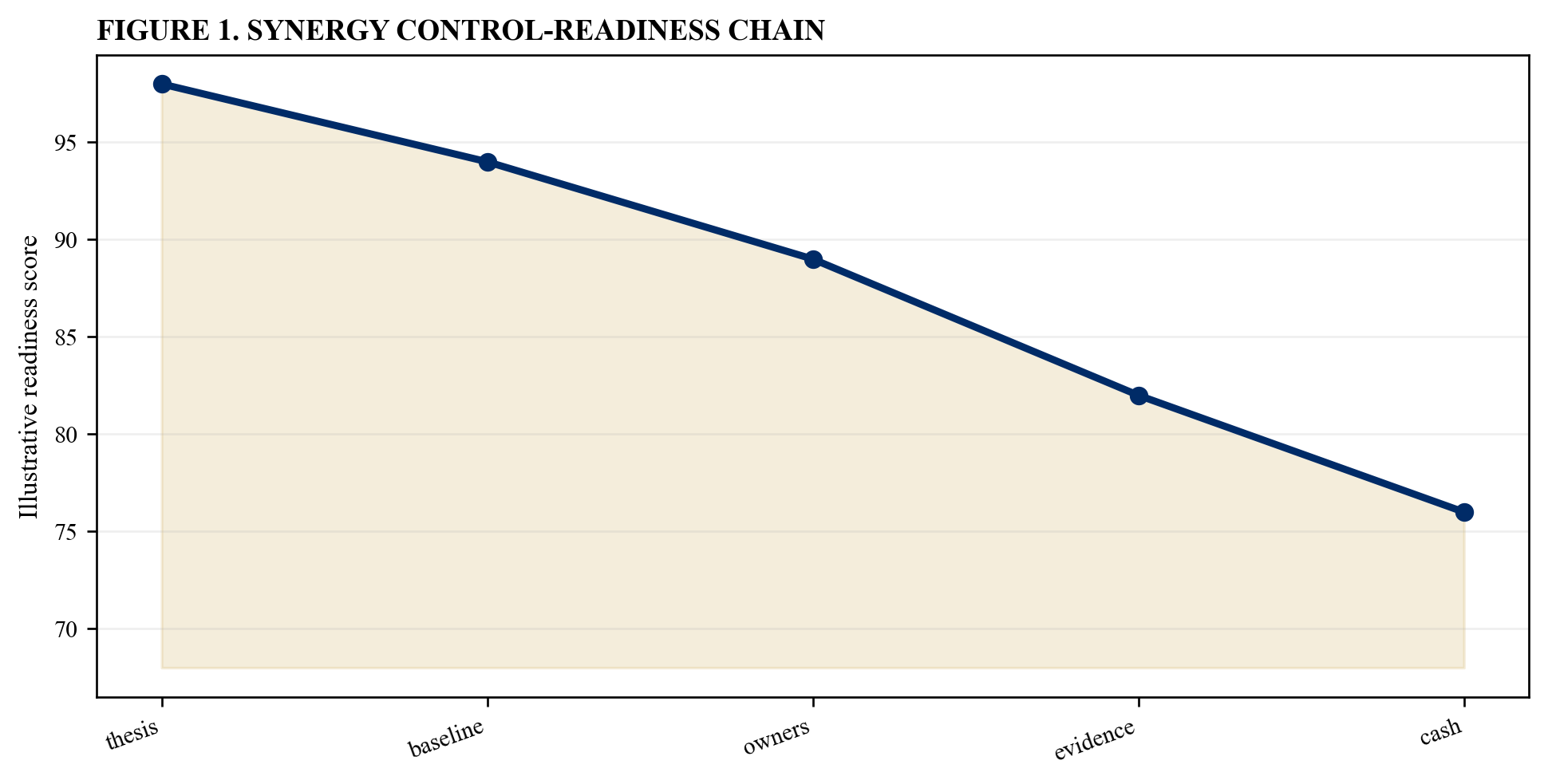
Illustrative analytical scenario; verified transaction evidence should replace index values.
3. Protect pre-close boundaries
The integration leadership should separate lawful planning from operational control, customer allocation, pricing coordination and premature implementation. The required output is a clean-team and readiness protocol. Record the value perimeter, financial definition, operating driver, accountable owner, timing, evidence, dependencies, control implications, decision rationale and review date [5][6].
The principal risk is that synergy planning can become unlawful pre-closing coordination. Compare the original deal case, current forecast and actual performance through a controlled value bridge. Record market, volume, price, mix, inflation, currency, scope, accounting and integration effects separately.
4. Define the controlled taxonomy
The integration leadership should classify cost reduction, revenue, working capital, capital expenditure, tax, financing, cost avoidance and dis-synergies. The required output is a synergy definition manual. Record the value perimeter, financial definition, operating driver, accountable owner, timing, evidence, dependencies, control implications, decision rationale and review date [7][8].
The principal risk is that unlike measures can be aggregated into a misleading total. Compare the original deal case, current forecast and actual performance through a controlled value bridge. Record market, volume, price, mix, inflation, currency, scope, accounting and integration effects separately.
5. Freeze the counterfactual baseline
The integration leadership should record the approved stand-alone plan, period, volume, price, inflation, foreign exchange, scope and accounting policies. The required output is a version-controlled baseline pack. Record the value perimeter, financial definition, operating driver, accountable owner, timing, evidence, dependencies, control implications, decision rationale and review date [1][9].
The principal risk is that a moving baseline can manufacture apparent benefits. Compare the original deal case, current forecast and actual performance through a controlled value bridge. Record market, volume, price, mix, inflation, currency, scope, accounting and integration effects separately.
6. Reconcile baselines to reported information
The integration leadership should bridge initiative baselines to budgets, forecasts, management accounts, segment data and the general ledger. The required output is a baseline reconciliation. Record the value perimeter, financial definition, operating driver, accountable owner, timing, evidence, dependencies, control implications, decision rationale and review date [10][11].
The principal risk is that delivery can be measured against numbers finance cannot reproduce. Compare the original deal case, current forecast and actual performance through a controlled value bridge. Record market, volume, price, mix, inflation, currency, scope, accounting and integration effects separately.
7. Separate value dimensions
The integration leadership should distinguish run-rate, in-period earnings, cash, working capital, net present value and enterprise-value implications. The required output is a multidimensional value ledger. Record the value perimeter, financial definition, operating driver, accountable owner, timing, evidence, dependencies, control implications, decision rationale and review date [7][12].
The principal risk is that one initiative can be counted repeatedly across value lenses. Compare the original deal case, current forecast and actual performance through a controlled value bridge. Record market, volume, price, mix, inflation, currency, scope, accounting and integration effects separately.
8. Assign accountable business owners
The integration leadership should name the executive, initiative owner, finance verifier, functional controller and delivery team. The required output is an ownership and segregation matrix. Record the value perimeter, financial definition, operating driver, accountable owner, timing, evidence, dependencies, control implications, decision rationale and review date [2][13].
The principal risk is that collective ownership can leave benefits unclaimed and costs unchallenged. Compare the original deal case, current forecast and actual performance through a controlled value bridge. Record market, volume, price, mix, inflation, currency, scope, accounting and integration effects separately.
9. Create initiative charters
The integration leadership should document scope, baseline, actions, milestones, dependencies, cost, risk, value logic and verification tests. The required output is a controlled initiative charter. Record the value perimeter, financial definition, operating driver, accountable owner, timing, evidence, dependencies, control implications, decision rationale and review date [1][14].
The principal risk is that ambiguous initiatives can change after performance is known. Compare the original deal case, current forecast and actual performance through a controlled value bridge. Record market, volume, price, mix, inflation, currency, scope, accounting and integration effects separately.
10. Set approval and change control
The integration leadership should define materiality, authority, evidence, versioning and retrospective-change restrictions. The required output is an initiative approval gate. Record the value perimeter, financial definition, operating driver, accountable owner, timing, evidence, dependencies, control implications, decision rationale and review date [2][15].
The principal risk is that uncontrolled edits can erase misses or expand claims. Compare the original deal case, current forecast and actual performance through a controlled value bridge. Record market, volume, price, mix, inflation, currency, scope, accounting and integration effects separately.
11. Build the value bridge
The integration leadership should reconcile baseline to actual through synergy, dis-synergy, market, volume, price, mix, inflation, currency and scope effects. The required output is a driver-based value bridge. Record the value perimeter, financial definition, operating driver, accountable owner, timing, evidence, dependencies, control implications, decision rationale and review date [9][16].
The principal risk is that external movements can be attributed to integration. Compare the original deal case, current forecast and actual performance through a controlled value bridge. Record market, volume, price, mix, inflation, currency, scope, accounting and integration effects separately.
Table 2. Illustrative value bridge
| Bridge component | Treatment | Control |
|---|---|---|
| baseline | frozen stand-alone case | version |
| synergy | approved incremental effect | evidence |
| external factors | price, volume, FX, market | separate |
| actual | reported and reconciled result | verify |
Illustrative control structure; verified transaction evidence and specialist review govern.
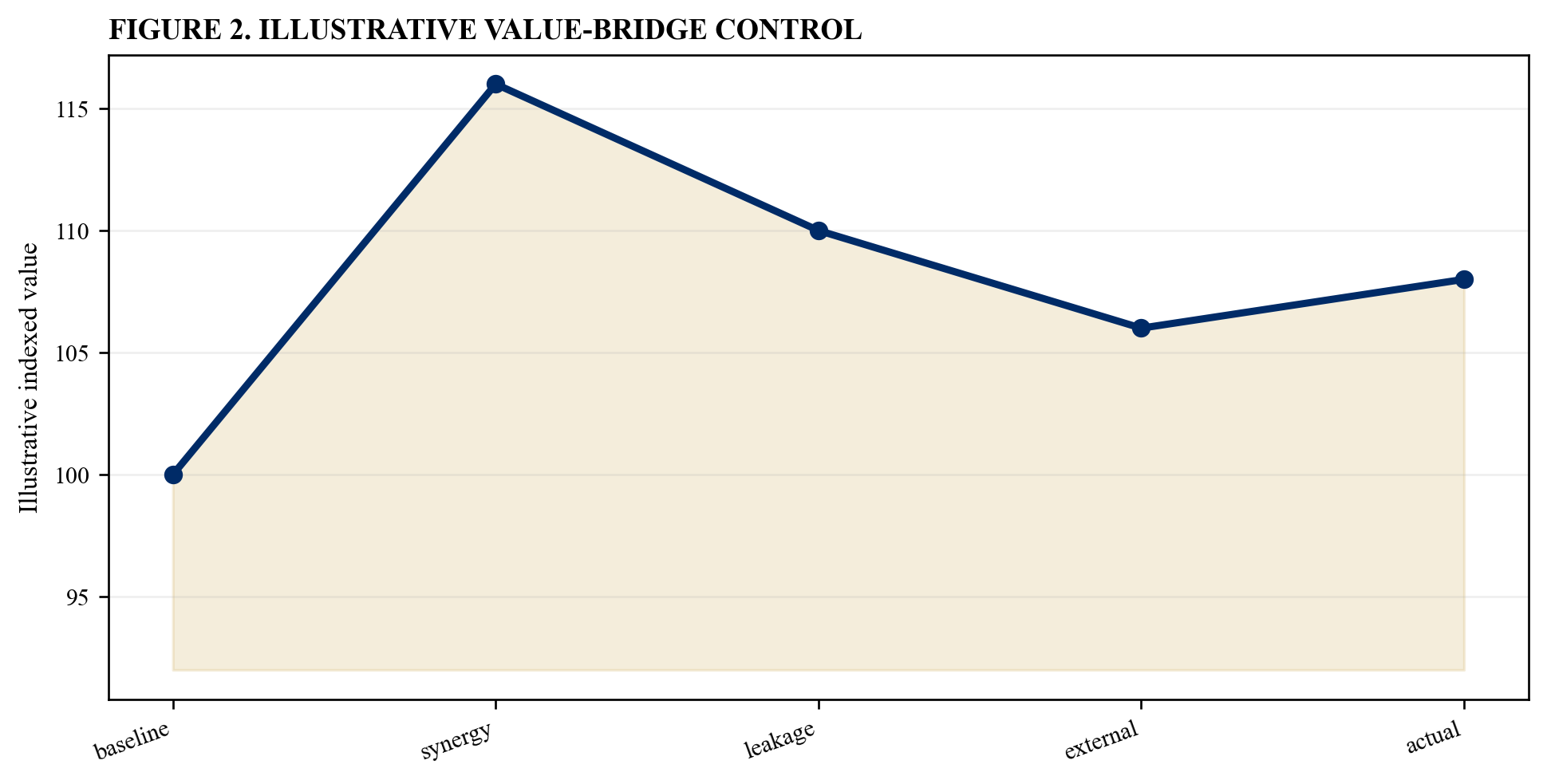
Illustrative analytical scenario; verified transaction evidence should replace index values.
12. Prevent overlap and double counting
The integration leadership should map mutually exclusive value pools, shared dependencies, programme interactions and ownership boundaries. The required output is a benefit-overlap register. Record the value perimeter, financial definition, operating driver, accountable owner, timing, evidence, dependencies, control implications, decision rationale and review date [7][17].
The principal risk is that multiple teams can claim the same headcount, spend or revenue. Compare the original deal case, current forecast and actual performance through a controlled value bridge. Record market, volume, price, mix, inflation, currency, scope, accounting and integration effects separately.
13. Record implementation costs
The integration leadership should capture one-time cash and non-cash costs, capitalisation, restructuring, retention, technology, advisers and disruption. The required output is a cost-to-achieve ledger. Record the value perimeter, financial definition, operating driver, accountable owner, timing, evidence, dependencies, control implications, decision rationale and review date [3][18].
The principal risk is that gross benefits can conceal the funding required to realise them. Compare the original deal case, current forecast and actual performance through a controlled value bridge. Record market, volume, price, mix, inflation, currency, scope, accounting and integration effects separately.
14. Recognise dis-synergies and leakage
The integration leadership should measure customer loss, productivity decline, duplicate operations, stranded cost, service disruption and delayed delivery. The required output is a value-leakage register. Record the value perimeter, financial definition, operating driver, accountable owner, timing, evidence, dependencies, control implications, decision rationale and review date [19][20].
The principal risk is that negative integration effects can disappear outside the headline case. Compare the original deal case, current forecast and actual performance through a controlled value bridge. Record market, volume, price, mix, inflation, currency, scope, accounting and integration effects separately.
15. Define the evidence hierarchy
The integration leadership should rank executed decisions, operational records, invoices, payroll, contracts, ledger entries, cash and supported forecasts. The required output is an evidence-standard matrix. Record the value perimeter, financial definition, operating driver, accountable owner, timing, evidence, dependencies, control implications, decision rationale and review date [1][2].
The principal risk is that management assertion can be treated as realised value. Compare the original deal case, current forecast and actual performance through a controlled value bridge. Record market, volume, price, mix, inflation, currency, scope, accounting and integration effects separately.
Table 3. Benefit evidence hierarchy
| Evidence state | Example | Permitted claim |
|---|---|---|
| planned | approved initiative | forecast |
| implemented | executed change | enabled |
| verified | driver and ledger support | realised earnings |
| cash realised | bank or balance evidence | realised cash |
Illustrative control structure; verified transaction evidence and specialist review govern.
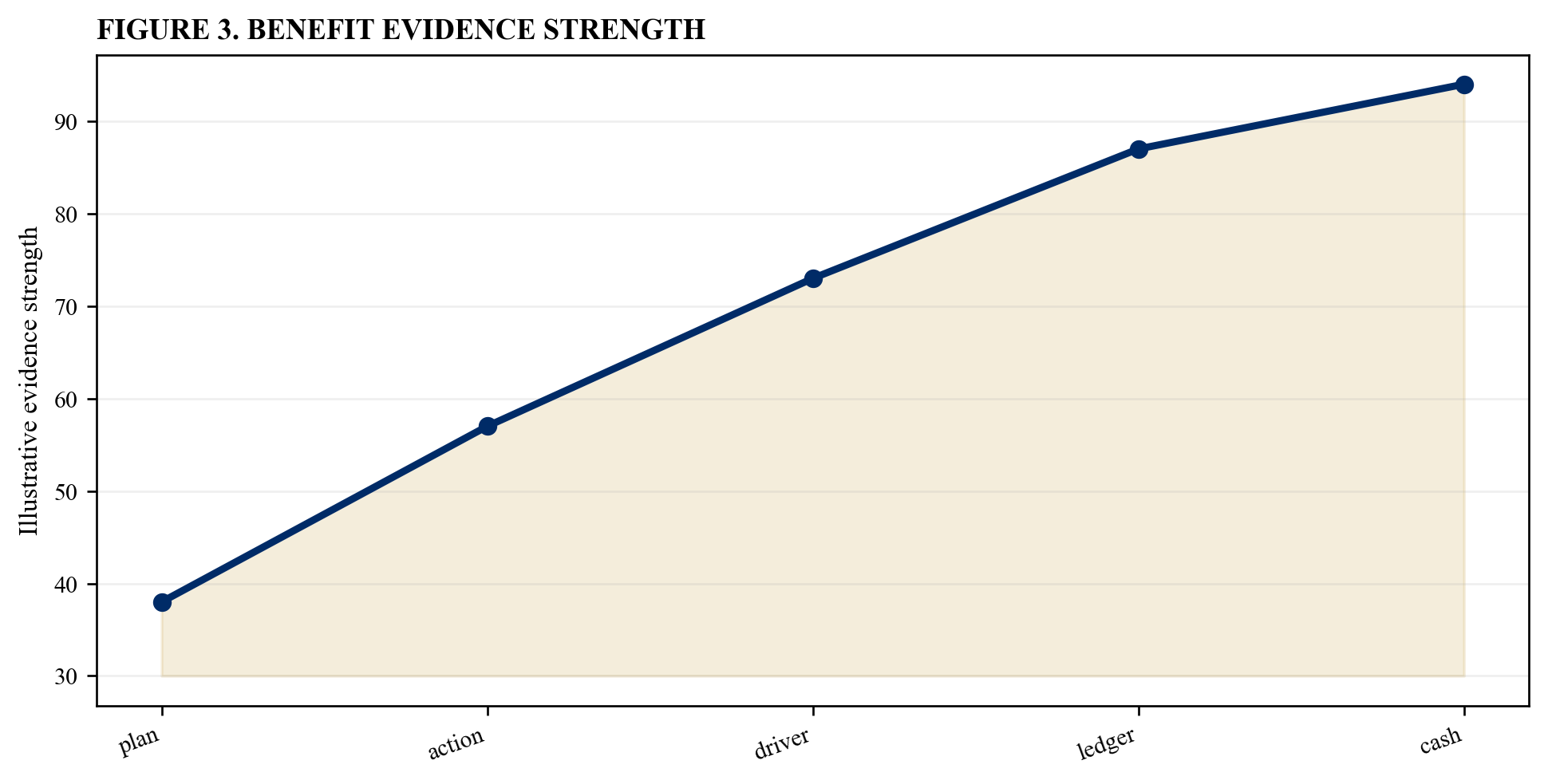
Illustrative analytical scenario; verified transaction evidence should replace index values.
16. Verify operational drivers
The integration leadership should test quantities, unit economics, timing, capacity, service and persistence before accepting financial effects. The required output is a driver-verification file. Record the value perimeter, financial definition, operating driver, accountable owner, timing, evidence, dependencies, control implications, decision rationale and review date [13][21].
The principal risk is that accounting movements can lack an operational cause. Compare the original deal case, current forecast and actual performance through a controlled value bridge. Record market, volume, price, mix, inflation, currency, scope, accounting and integration effects separately.
17. Reconcile to the general ledger
The integration leadership should map benefits and costs to accounts, cost centres, entities, periods, eliminations and accounting treatment. The required output is a ledger-reconciliation schedule. Record the value perimeter, financial definition, operating driver, accountable owner, timing, evidence, dependencies, control implications, decision rationale and review date [10][22].
The principal risk is that PMO totals can diverge from reported performance. Compare the original deal case, current forecast and actual performance through a controlled value bridge. Record market, volume, price, mix, inflation, currency, scope, accounting and integration effects separately.
18. Verify realised cash
The integration leadership should trace cash effects through payments, receipts, working-capital balances, financing flows and timing. The required output is a cash-evidence bridge. Record the value perimeter, financial definition, operating driver, accountable owner, timing, evidence, dependencies, control implications, decision rationale and review date [12][23].
The principal risk is that earnings benefits can fail to convert into liquidity. Compare the original deal case, current forecast and actual performance through a controlled value bridge. Record market, volume, price, mix, inflation, currency, scope, accounting and integration effects separately.
19. Govern revenue synergies
The integration leadership should separate contracted, ordered, delivered, recognised and collected value from pipeline and opportunity. The required output is a revenue-synergy ladder. Record the value perimeter, financial definition, operating driver, accountable owner, timing, evidence, dependencies, control implications, decision rationale and review date [24][25].
The principal risk is that pipeline can be reported as realised revenue. Compare the original deal case, current forecast and actual performance through a controlled value bridge. Record market, volume, price, mix, inflation, currency, scope, accounting and integration effects separately.
20. Control cost synergies
The integration leadership should verify position removal, spend cessation, contract change, consumption, service impact and stranded cost. The required output is a cost-removal certificate. Record the value perimeter, financial definition, operating driver, accountable owner, timing, evidence, dependencies, control implications, decision rationale and review date [13][26].
The principal risk is that budget reduction can precede economic removal. Compare the original deal case, current forecast and actual performance through a controlled value bridge. Record market, volume, price, mix, inflation, currency, scope, accounting and integration effects separately.
21. Measure working-capital benefits
The integration leadership should separate sustainable process improvement from payment timing, seasonality, factoring and transaction-date distortion. The required output is a working-capital normalisation. Record the value perimeter, financial definition, operating driver, accountable owner, timing, evidence, dependencies, control implications, decision rationale and review date [23][27].
The principal risk is that temporary balance-sheet movements can be called permanent value. Compare the original deal case, current forecast and actual performance through a controlled value bridge. Record market, volume, price, mix, inflation, currency, scope, accounting and integration effects separately.
22. Control procurement claims
The integration leadership should link sourcing decisions to addressable spend, price, volume, specification, supplier performance and resilience. The required output is a procurement-value bridge. Record the value perimeter, financial definition, operating driver, accountable owner, timing, evidence, dependencies, control implications, decision rationale and review date [28][29].
The principal risk is that negotiated rates can be claimed without realised purchasing behaviour. Compare the original deal case, current forecast and actual performance through a controlled value bridge. Record market, volume, price, mix, inflation, currency, scope, accounting and integration effects separately.
23. Verify workforce benefits
The integration leadership should reconcile roles, vacancies, severance, retention, contractors, overtime, redeployment and capability risk. The required output is a workforce-value schedule. Record the value perimeter, financial definition, operating driver, accountable owner, timing, evidence, dependencies, control implications, decision rationale and review date [13][30].
The principal risk is that headcount movements can overstate durable savings. Compare the original deal case, current forecast and actual performance through a controlled value bridge. Record market, volume, price, mix, inflation, currency, scope, accounting and integration effects separately.
24. Govern technology benefits
The integration leadership should link application retirement, licence change, cloud consumption, migration cost, control readiness and service outcomes. The required output is a technology-benefit certificate. Record the value perimeter, financial definition, operating driver, accountable owner, timing, evidence, dependencies, control implications, decision rationale and review date [31][32].
The principal risk is that planned decommissioning can be counted before safe retirement. Compare the original deal case, current forecast and actual performance through a controlled value bridge. Record market, volume, price, mix, inflation, currency, scope, accounting and integration effects separately.
25. Measure footprint and asset benefits
The integration leadership should verify exits, consolidation, lease effects, impairments, restoration, capex and operational capacity. The required output is an asset-exit value bridge. Record the value perimeter, financial definition, operating driver, accountable owner, timing, evidence, dependencies, control implications, decision rationale and review date [33][34].
The principal risk is that headline property savings can omit exit and continuity costs. Compare the original deal case, current forecast and actual performance through a controlled value bridge. Record market, volume, price, mix, inflation, currency, scope, accounting and integration effects separately.
26. Control tax and financing benefits
The integration leadership should separate operational delivery from structure, jurisdiction, interest, covenant, distributable reserve and substance. The required output is a specialist-reviewed value schedule. Record the value perimeter, financial definition, operating driver, accountable owner, timing, evidence, dependencies, control implications, decision rationale and review date [35][36].
The principal risk is that benefits can depend on unavailable relief or financing capacity. Compare the original deal case, current forecast and actual performance through a controlled value bridge. Record market, volume, price, mix, inflation, currency, scope, accounting and integration effects separately.
27. Manage stranded costs
The integration leadership should identify shared-service, fixed-cost, separation, minimum-volume and residual-capacity exposure. The required output is a stranded-cost elimination plan. Record the value perimeter, financial definition, operating driver, accountable owner, timing, evidence, dependencies, control implications, decision rationale and review date [13][20].
The principal risk is that removed activity can leave the underlying cost intact. Compare the original deal case, current forecast and actual performance through a controlled value bridge. Record market, volume, price, mix, inflation, currency, scope, accounting and integration effects separately.
28. Sequence dependencies
The integration leadership should map prerequisites, critical paths, resource constraints, regulatory permissions and customer impacts. The required output is a value-critical-path map. Record the value perimeter, financial definition, operating driver, accountable owner, timing, evidence, dependencies, control implications, decision rationale and review date [14][37].
The principal risk is that the forecast can assume benefits before enabling decisions are complete. Compare the original deal case, current forecast and actual performance through a controlled value bridge. Record market, volume, price, mix, inflation, currency, scope, accounting and integration effects separately.
29. Set verification states
The integration leadership should use proposed, approved, implemented, evidenced, finance-verified, cash-realised and sustained statuses. The required output is a controlled status model. Record the value perimeter, financial definition, operating driver, accountable owner, timing, evidence, dependencies, control implications, decision rationale and review date [1][2].
The principal risk is that binary complete labels can hide evidence gaps. Compare the original deal case, current forecast and actual performance through a controlled value bridge. Record market, volume, price, mix, inflation, currency, scope, accounting and integration effects separately.
Table 4. Verification status and authority
| Status | Accountable role | Minimum evidence |
|---|---|---|
| approved | executive sponsor | charter and baseline |
| implemented | business owner | executed action |
| finance verified | controller | value reconciliation |
| sustained | PMO and finance | observation test |
Illustrative control structure; verified transaction evidence and specialist review govern.
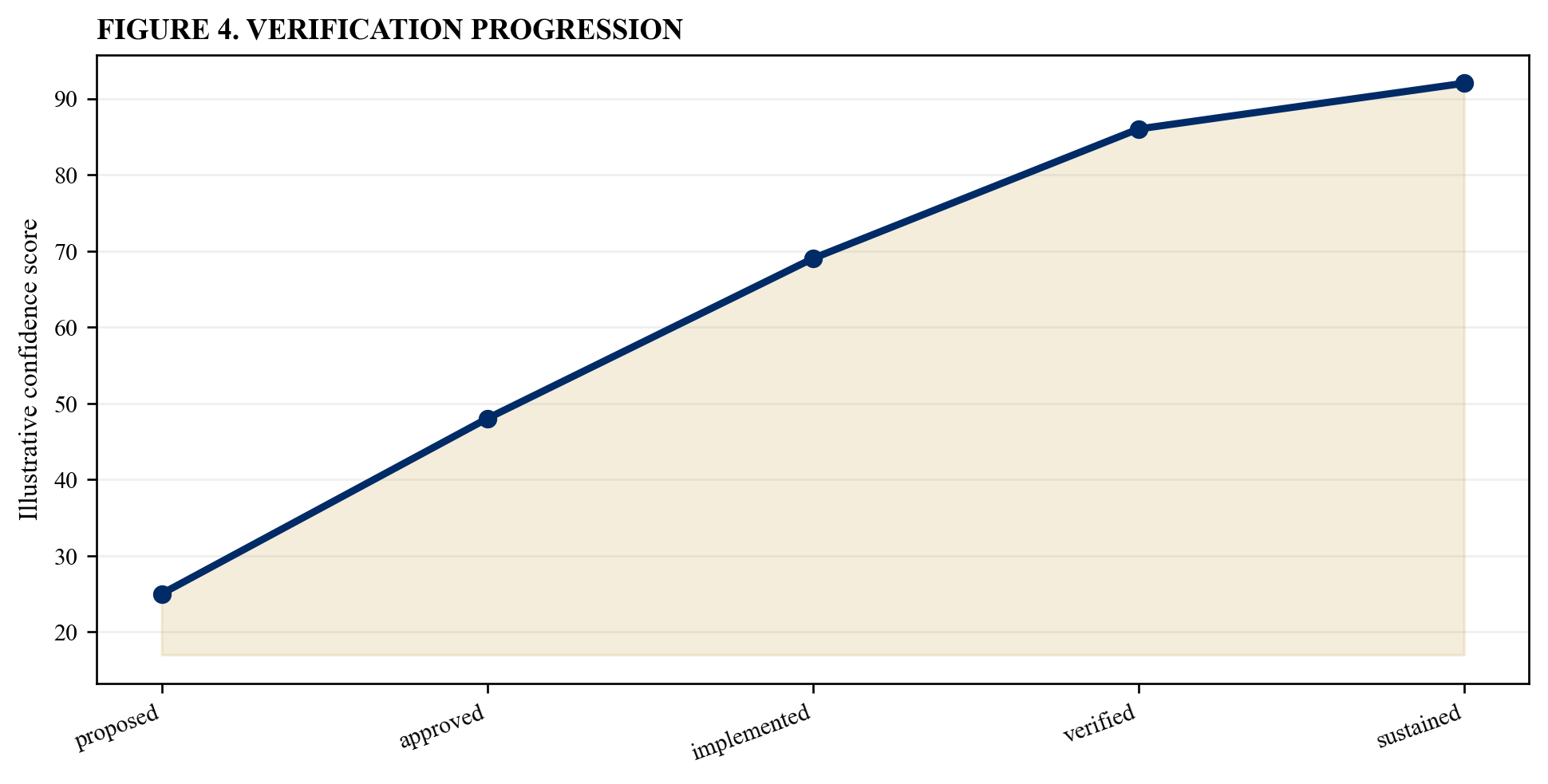
Illustrative analytical scenario; verified transaction evidence should replace index values.
30. Test persistence
The integration leadership should require benefits to survive defined observation windows, volume changes, service tests and control operation. The required output is a sustainability test. Record the value perimeter, financial definition, operating driver, accountable owner, timing, evidence, dependencies, control implications, decision rationale and review date [2][21].
The principal risk is that short-lived movements can be annualised into run-rate claims. Compare the original deal case, current forecast and actual performance through a controlled value bridge. Record market, volume, price, mix, inflation, currency, scope, accounting and integration effects separately.
31. Reforecast with controlled attribution
The integration leadership should update timing, confidence, value, cost and dependencies through approved change records. The required output is a versioned synergy forecast. Record the value perimeter, financial definition, operating driver, accountable owner, timing, evidence, dependencies, control implications, decision rationale and review date [9][15].
The principal risk is that forecast revisions can obscure delivery against the original case. Compare the original deal case, current forecast and actual performance through a controlled value bridge. Record market, volume, price, mix, inflation, currency, scope, accounting and integration effects separately.
32. Integrate risk and internal control
The integration leadership should connect material initiatives to risks, controls, deficiencies, remediation and accountable monitoring. The required output is a synergy risk-control matrix. Record the value perimeter, financial definition, operating driver, accountable owner, timing, evidence, dependencies, control implications, decision rationale and review date [2][38].
The principal risk is that value delivery can weaken financial or operational control. Compare the original deal case, current forecast and actual performance through a controlled value bridge. Record market, volume, price, mix, inflation, currency, scope, accounting and integration effects separately.
33. Create a finance challenge cadence
The integration leadership should review evidence, exceptions, changes, cash, forecast and unresolved ownership at a fixed rhythm. The required output is a finance-led challenge forum. Record the value perimeter, financial definition, operating driver, accountable owner, timing, evidence, dependencies, control implications, decision rationale and review date [1][13].
The principal risk is that reporting cadence can become a status ritual. Compare the original deal case, current forecast and actual performance through a controlled value bridge. Record market, volume, price, mix, inflation, currency, scope, accounting and integration effects separately.
34. Escalate exceptions by value and urgency
The integration leadership should define thresholds for slippage, evidence failure, cost overrun, leakage, control weakness and legal risk. The required output is an escalation matrix. Record the value perimeter, financial definition, operating driver, accountable owner, timing, evidence, dependencies, control implications, decision rationale and review date [2][14].
The principal risk is that material deterioration can remain buried in initiative detail. Compare the original deal case, current forecast and actual performance through a controlled value bridge. Record market, volume, price, mix, inflation, currency, scope, accounting and integration effects separately.
35. Align incentives with verified outcomes
The integration leadership should base recognition and rewards on controlled definitions, net value, sustainability and conduct. The required output is an incentive-control schedule. Record the value perimeter, financial definition, operating driver, accountable owner, timing, evidence, dependencies, control implications, decision rationale and review date [2][39].
The principal risk is that reward structures can encourage premature or inflated claims. Compare the original deal case, current forecast and actual performance through a controlled value bridge. Record market, volume, price, mix, inflation, currency, scope, accounting and integration effects separately.
36. Report to the board through reconciled views
The integration leadership should present original case, current forecast, realised value, cash, costs, leakage, evidence and residual risk. The required output is a board value-delivery dashboard. Record the value perimeter, financial definition, operating driver, accountable owner, timing, evidence, dependencies, control implications, decision rationale and review date [38][40].
The principal risk is that aggregate green status can conceal economic underperformance. Compare the original deal case, current forecast and actual performance through a controlled value bridge. Record market, volume, price, mix, inflation, currency, scope, accounting and integration effects separately.
37. Govern external synergy reporting
The integration leadership should reconcile public claims to permitted accounting, pro forma and non-GAAP presentation requirements. The required output is a disclosure-control file. Record the value perimeter, financial definition, operating driver, accountable owner, timing, evidence, dependencies, control implications, decision rationale and review date [7][11].
The principal risk is that external communication can outrun verifiable financial evidence. Compare the original deal case, current forecast and actual performance through a controlled value bridge. Record market, volume, price, mix, inflation, currency, scope, accounting and integration effects separately.
38. Connect delivery to acquisition performance
The integration leadership should compare the approved strategic objective, acquisition-date assumptions and subsequent operating evidence. The required output is an acquisition-performance bridge. Record the value perimeter, financial definition, operating driver, accountable owner, timing, evidence, dependencies, control implications, decision rationale and review date [3][4].
The principal risk is that initiative completion can be confused with deal success. Compare the original deal case, current forecast and actual performance through a controlled value bridge. Record market, volume, price, mix, inflation, currency, scope, accounting and integration effects separately.
39. Issue the synergy-control certificate
The integration leadership should reconcile scope, baseline, ownership, evidence, realised value, cash, costs, leakage, forecast and exceptions. The required output is an auditable synergy-control certificate. Record the value perimeter, financial definition, operating driver, accountable owner, timing, evidence, dependencies, control implications, decision rationale and review date [1][2].
The principal risk is that leadership can close the programme without a defensible record. Compare the original deal case, current forecast and actual performance through a controlled value bridge. Record market, volume, price, mix, inflation, currency, scope, accounting and integration effects separately.
Table 5. Synergy-control certificate
| Conclusion | Evidence | Acceptance |
|---|---|---|
| value perimeter | taxonomy and baseline | approved |
| delivery | owners and milestones | controlled |
| realisation | ledger, cash and costs | verified |
| residual risk | forecast and exceptions | accepted |
Illustrative control structure; verified transaction evidence and specialist review govern.
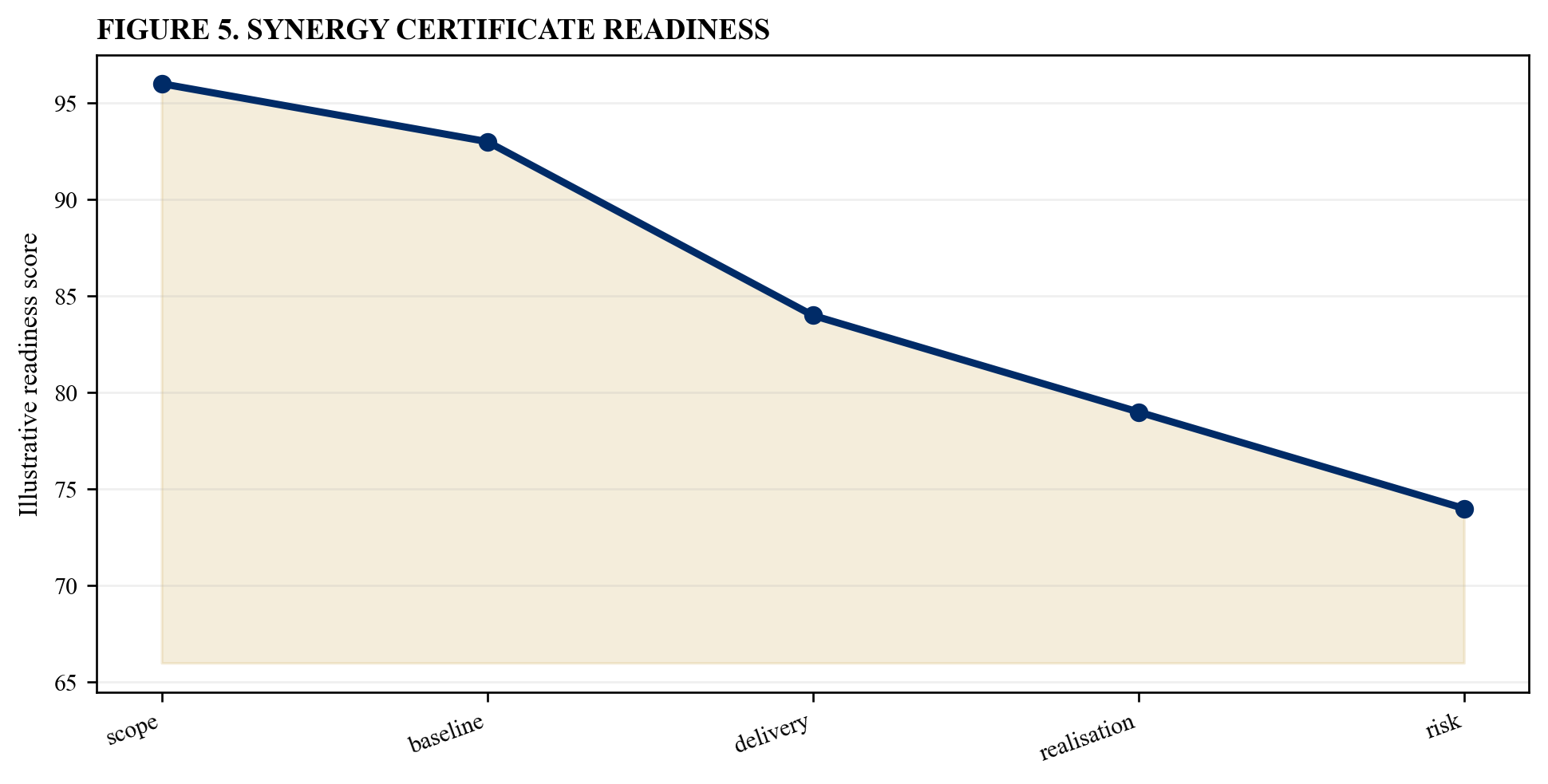
Illustrative analytical scenario; verified transaction evidence should replace index values.
40. Institutionalise value-delivery learning
The integration leadership should retain definitions, evidence patterns, forecast accuracy, control failures and lessons for future transactions. The required output is an acquisition value-control archive. Record the value perimeter, financial definition, operating driver, accountable owner, timing, evidence, dependencies, control implications, decision rationale and review date [2][40].
The principal risk is that each deal can repeat prior measurement errors. Compare the original deal case, current forecast and actual performance through a controlled value bridge. Record market, volume, price, mix, inflation, currency, scope, accounting and integration effects separately.
References
- Committee of Sponsoring Organizations of the Treadway Commission, Internal Control; Integrated Framework, https://www.coso.org/guidance-on-ic
- Financial Reporting Council, UK Corporate Governance Code 2024, https://www.frc.org.uk/library/standards-codes-policy/corporate-governance/uk-corporate-governance-code/
- IFRS Foundation, IFRS 3 Business Combinations, https://www.ifrs.org/issued-standards/list-of-standards/ifrs-3-business-combinations/
- IFRS Foundation, IASB Update April 2026; Business Combinations Disclosures, Goodwill and Impairment, https://www.ifrs.org/news-and-events/updates/iasb/2026/iasb-update-april-2026/
- Federal Trade Commission, Avoiding Antitrust Pitfalls during Pre-Merger Negotiations and Due Diligence, https://www.ftc.gov/enforcement/competition-matters/2018/03/avoiding-antitrust-pitfalls-during-pre-merger-negotiations-due-diligence
- UK Competition and Markets Authority, Interim Measures in Merger Investigations, https://www.gov.uk/government/publications/interim-measures-and-derogations-guidance-and-templates
- US Securities and Exchange Commission, Financial Disclosures about Acquired and Disposed Businesses, https://www.sec.gov/resources-small-businesses/small-business-compliance-guides/financial-disclosures-about-acquired-disposed-businesses
- IFRS Foundation, IFRS Accounting Taxonomy, https://www.ifrs.org/issued-standards/ifrs-taxonomy/
- IFRS Foundation, IFRS 18 Presentation and Disclosure in Financial Statements, https://www.ifrs.org/issued-standards/list-of-standards/ifrs-18-presentation-and-disclosure-in-financial-statements/
- IFRS Foundation, Conceptual Framework for Financial Reporting, https://www.ifrs.org/issued-standards/list-of-standards/conceptual-framework/
- US Securities and Exchange Commission, Non-GAAP Financial Measures Compliance and Disclosure Interpretations, https://www.sec.gov/rules-regulations/staff-guidance/corporation-finance-interpretations/non-gaap-financial-measures
- IFRS Foundation, IAS 7 Statement of Cash Flows, https://www.ifrs.org/issued-standards/list-of-standards/ias-7-statement-of-cash-flows/
- Committee of Sponsoring Organizations of the Treadway Commission, Monitoring Internal Control Systems, https://www.coso.org/monitoring-internal-control-system
- UK Government Infrastructure and Projects Authority, Project Routemap, https://www.gov.uk/government/publications/improving-infrastructure-delivery-project-initiation-routemap
- International Organization for Standardization, ISO 9001 Quality Management Systems, https://www.iso.org/iso-9001-quality-management.html
- UK Government, The Green Book, https://www.gov.uk/government/publications/the-green-book-appraisal-and-evaluation-in-central-government
- International Organization for Standardization, ISO 8000 Data Quality, https://www.iso.org/committee/50798/x/catalogue/
- IFRS Foundation, IAS 37 Provisions Contingent Liabilities and Contingent Assets, https://www.ifrs.org/issued-standards/list-of-standards/ias-37-provisions-contingent-liabilities-and-contingent-assets/
- IFRS Foundation, IAS 36 Impairment of Assets, https://www.ifrs.org/issued-standards/list-of-standards/ias-36-impairment-of-assets/
- IFRS Foundation, IFRS 8 Operating Segments, https://www.ifrs.org/issued-standards/list-of-standards/ifrs-8-operating-segments/
- UK Statistics Authority, Code of Practice for Statistics, https://code.statisticsauthority.gov.uk/
- Public Company Accounting Oversight Board, AS 2201 Audit of Internal Control over Financial Reporting, https://pcaobus.org/oversight/standards/auditing-standards/details/AS2201
- IFRS Foundation, IFRS 9 Financial Instruments, https://www.ifrs.org/issued-standards/list-of-standards/ifrs-9-financial-instruments/
- IFRS Foundation, IFRS 15 Revenue from Contracts with Customers, https://www.ifrs.org/issued-standards/list-of-standards/ifrs-15-revenue-from-contracts-with-customers/
- US Securities and Exchange Commission, Revenue Recognition, https://www.sec.gov/resources-for-investors/investor-alerts-bulletins/investor-bulletins/revenue-recognition
- IFRS Foundation, IAS 19 Employee Benefits, https://www.ifrs.org/issued-standards/list-of-standards/ias-19-employee-benefits/
- IFRS Foundation, IAS 2 Inventories, https://www.ifrs.org/issued-standards/list-of-standards/ias-2-inventories/
- UK Government Commercial Function, Sourcing Playbook, https://www.gov.uk/government/publications/the-sourcing-playbook
- UK Government Commercial Function, Supplier Code of Conduct, https://www.gov.uk/government/publications/supplier-code-of-conduct
- International Labour Organization, Guidelines on Responsible Business Conduct in Restructuring, https://www.ilo.org/
- UK National Cyber Security Centre, Cloud Security Guidance, https://www.ncsc.gov.uk/collection/cloud
- UK Government Service Manual, Retiring Your Service, https://www.gov.uk/service-manual/technology/retiring-your-service
- IFRS Foundation, IFRS 16 Leases, https://www.ifrs.org/issued-standards/list-of-standards/ifrs-16-leases/
- IFRS Foundation, IAS 16 Property Plant and Equipment, https://www.ifrs.org/issued-standards/list-of-standards/ias-16-property-plant-and-equipment/
- OECD, Transfer Pricing Guidelines for Multinational Enterprises and Tax Administrations, https://www.oecd.org/tax/transfer-pricing/oecd-transfer-pricing-guidelines-for-multinational-enterprises-and-tax-administrations-20769717.htm
- IFRS Foundation, IAS 12 Income Taxes, https://www.ifrs.org/issued-standards/list-of-standards/ias-12-income-taxes/
- UK Government Infrastructure and Projects Authority, Project Delivery Functional Standard, https://www.gov.uk/government/publications/project-delivery-functional-standard
- Financial Reporting Council, Guidance on Risk Management Internal Control and Related Financial and Business Reporting, https://www.frc.org.uk/library/standards-codes-policy/corporate-governance/
- OECD, G20 OECD Principles of Corporate Governance 2023, https://www.oecd.org/corporate/principles-corporate-governance/
- IFRS Foundation, Business Combinations; Disclosures Goodwill and Impairment Project, https://www.ifrs.org/projects/work-plan/goodwill-and-impairment/
