

1. Define the enduring service outcome
The project team should state the user need, essential service, performance envelope, capacity, accessibility, resilience and public-policy objective. The required output is a technology-neutral service charter. Record the accountable party, evidence, assumption, contractual right, service and cash-flow consequence, approval and review date [1][2].
Test the proposed treatment against user needs, asset and software inventories, vendor evidence, standards, architecture, interoperability, cybersecurity, competition, affordability, lender requirements and applicable law. Preserve the source, version, date, dependency and reason for every material judgement.
The principal risk is that the contract can preserve a product while losing the public outcome. Quantify effects on service quality, availability, lifecycle cost, demand, revenue, migration, operating resilience, debt-service coverage, equity returns, public liabilities and residual value. Compare the chosen response with credible refresh, modularity, procurement, transfer, reserve and shared-risk alternatives.
Translate the conclusion into output specifications, architecture constraints, lifecycle obligations, change rights, price and benefit rules, funding, monitoring, dispute, exit and handback provisions. Refresh it when service needs, standards, supplier support, security threats, technology economics or market alternatives change.
2. Separate technology from service
The project team should distinguish equipment, software, data, interfaces, communications, operating process and service output. The required output is a layered service-technology map. Record the accountable party, evidence, assumption, contractual right, service and cash-flow consequence, approval and review date [3][4].
Test the proposed treatment against user needs, asset and software inventories, vendor evidence, standards, architecture, interoperability, cybersecurity, competition, affordability, lender requirements and applicable law. Preserve the source, version, date, dependency and reason for every material judgement.
The principal risk is that an equipment refresh can be confused with a change in contracted service. Quantify effects on service quality, availability, lifecycle cost, demand, revenue, migration, operating resilience, debt-service coverage, equity returns, public liabilities and residual value. Compare the chosen response with credible refresh, modularity, procurement, transfer, reserve and shared-risk alternatives.
Translate the conclusion into output specifications, architecture constraints, lifecycle obligations, change rights, price and benefit rules, funding, monitoring, dispute, exit and handback provisions. Refresh it when service needs, standards, supplier support, security threats, technology economics or market alternatives change.
3. Create the technology baseline
The project team should inventory assets, versions, vendors, licences, support dates, dependencies, security status and replacement cost. The required output is an evidence-dated technology register. Record the accountable party, evidence, assumption, contractual right, service and cash-flow consequence, approval and review date [5][6].
Test the proposed treatment against user needs, asset and software inventories, vendor evidence, standards, architecture, interoperability, cybersecurity, competition, affordability, lender requirements and applicable law. Preserve the source, version, date, dependency and reason for every material judgement.
The principal risk is that parties can dispute what was included and serviceable at financial close. Quantify effects on service quality, availability, lifecycle cost, demand, revenue, migration, operating resilience, debt-service coverage, equity returns, public liabilities and residual value. Compare the chosen response with credible refresh, modularity, procurement, transfer, reserve and shared-risk alternatives.
Translate the conclusion into output specifications, architecture constraints, lifecycle obligations, change rights, price and benefit rules, funding, monitoring, dispute, exit and handback provisions. Refresh it when service needs, standards, supplier support, security threats, technology economics or market alternatives change.
4. Classify obsolescence risk
The project team should separate wear-out, support withdrawal, standards change, security exposure, economic inefficiency and disruptive substitution. The required output is an obsolescence taxonomy. Record the accountable party, evidence, assumption, contractual right, service and cash-flow consequence, approval and review date [7][8].
Test the proposed treatment against user needs, asset and software inventories, vendor evidence, standards, architecture, interoperability, cybersecurity, competition, affordability, lender requirements and applicable law. Preserve the source, version, date, dependency and reason for every material judgement.
The principal risk is that a single technology risk label can conceal very different control and funding needs. Quantify effects on service quality, availability, lifecycle cost, demand, revenue, migration, operating resilience, debt-service coverage, equity returns, public liabilities and residual value. Compare the chosen response with credible refresh, modularity, procurement, transfer, reserve and shared-risk alternatives.
Translate the conclusion into output specifications, architecture constraints, lifecycle obligations, change rights, price and benefit rules, funding, monitoring, dispute, exit and handback provisions. Refresh it when service needs, standards, supplier support, security threats, technology economics or market alternatives change.
5. Map lifecycle and contract horizons
The project team should compare useful life, support life, licence term, debt tenor, concession term and handback horizon. The required output is a horizon-mismatch map. Record the accountable party, evidence, assumption, contractual right, service and cash-flow consequence, approval and review date [9][10].
Test the proposed treatment against user needs, asset and software inventories, vendor evidence, standards, architecture, interoperability, cybersecurity, competition, affordability, lender requirements and applicable law. Preserve the source, version, date, dependency and reason for every material judgement.
The principal risk is that short-lived components can sit inside long-lived financing without funded replacement. Quantify effects on service quality, availability, lifecycle cost, demand, revenue, migration, operating resilience, debt-service coverage, equity returns, public liabilities and residual value. Compare the chosen response with credible refresh, modularity, procurement, transfer, reserve and shared-risk alternatives.
Translate the conclusion into output specifications, architecture constraints, lifecycle obligations, change rights, price and benefit rules, funding, monitoring, dispute, exit and handback provisions. Refresh it when service needs, standards, supplier support, security threats, technology economics or market alternatives change.
6. Design outcome-based specifications
The project team should set measurable outputs and constraints while allowing solution choice and innovation. The required output is an output specification. Record the accountable party, evidence, assumption, contractual right, service and cash-flow consequence, approval and review date [1][11].
Test the proposed treatment against user needs, asset and software inventories, vendor evidence, standards, architecture, interoperability, cybersecurity, competition, affordability, lender requirements and applicable law. Preserve the source, version, date, dependency and reason for every material judgement.
The principal risk is that prescriptive requirements can lock both parties into procurement-era technology. Quantify effects on service quality, availability, lifecycle cost, demand, revenue, migration, operating resilience, debt-service coverage, equity returns, public liabilities and residual value. Compare the chosen response with credible refresh, modularity, procurement, transfer, reserve and shared-risk alternatives.
Translate the conclusion into output specifications, architecture constraints, lifecycle obligations, change rights, price and benefit rules, funding, monitoring, dispute, exit and handback provisions. Refresh it when service needs, standards, supplier support, security threats, technology economics or market alternatives change.
7. Retain necessary architecture constraints
The project team should define safety, security, interoperability, data, accessibility, resilience and regulatory boundaries. The required output is an architecture guardrail schedule. Record the accountable party, evidence, assumption, contractual right, service and cash-flow consequence, approval and review date [12][13].
Test the proposed treatment against user needs, asset and software inventories, vendor evidence, standards, architecture, interoperability, cybersecurity, competition, affordability, lender requirements and applicable law. Preserve the source, version, date, dependency and reason for every material judgement.
The principal risk is that technology neutrality can permit incompatible or weakly governed solutions. Quantify effects on service quality, availability, lifecycle cost, demand, revenue, migration, operating resilience, debt-service coverage, equity returns, public liabilities and residual value. Compare the chosen response with credible refresh, modularity, procurement, transfer, reserve and shared-risk alternatives.
Translate the conclusion into output specifications, architecture constraints, lifecycle obligations, change rights, price and benefit rules, funding, monitoring, dispute, exit and handback provisions. Refresh it when service needs, standards, supplier support, security threats, technology economics or market alternatives change.
8. Use modular and open interfaces
The project team should separate replaceable components through documented APIs, protocols, data models and physical interfaces. The required output is a modularity and interface plan. Record the accountable party, evidence, assumption, contractual right, service and cash-flow consequence, approval and review date [14][15].
Test the proposed treatment against user needs, asset and software inventories, vendor evidence, standards, architecture, interoperability, cybersecurity, competition, affordability, lender requirements and applicable law. Preserve the source, version, date, dependency and reason for every material judgement.
The principal risk is that monolithic architecture can make a modest refresh require full-system replacement. Quantify effects on service quality, availability, lifecycle cost, demand, revenue, migration, operating resilience, debt-service coverage, equity returns, public liabilities and residual value. Compare the chosen response with credible refresh, modularity, procurement, transfer, reserve and shared-risk alternatives.
Translate the conclusion into output specifications, architecture constraints, lifecycle obligations, change rights, price and benefit rules, funding, monitoring, dispute, exit and handback provisions. Refresh it when service needs, standards, supplier support, security threats, technology economics or market alternatives change.
Table 1. Obsolescence taxonomy
| Type | Typical trigger | Primary response |
|---|---|---|
| wear-out | condition | planned refresh |
| support withdrawal | vendor date | migration |
| standards change | external rule | compatibility upgrade |
| disruption | market shift | shared review |
Illustrative analytical structure; verified project and jurisdiction evidence governs.
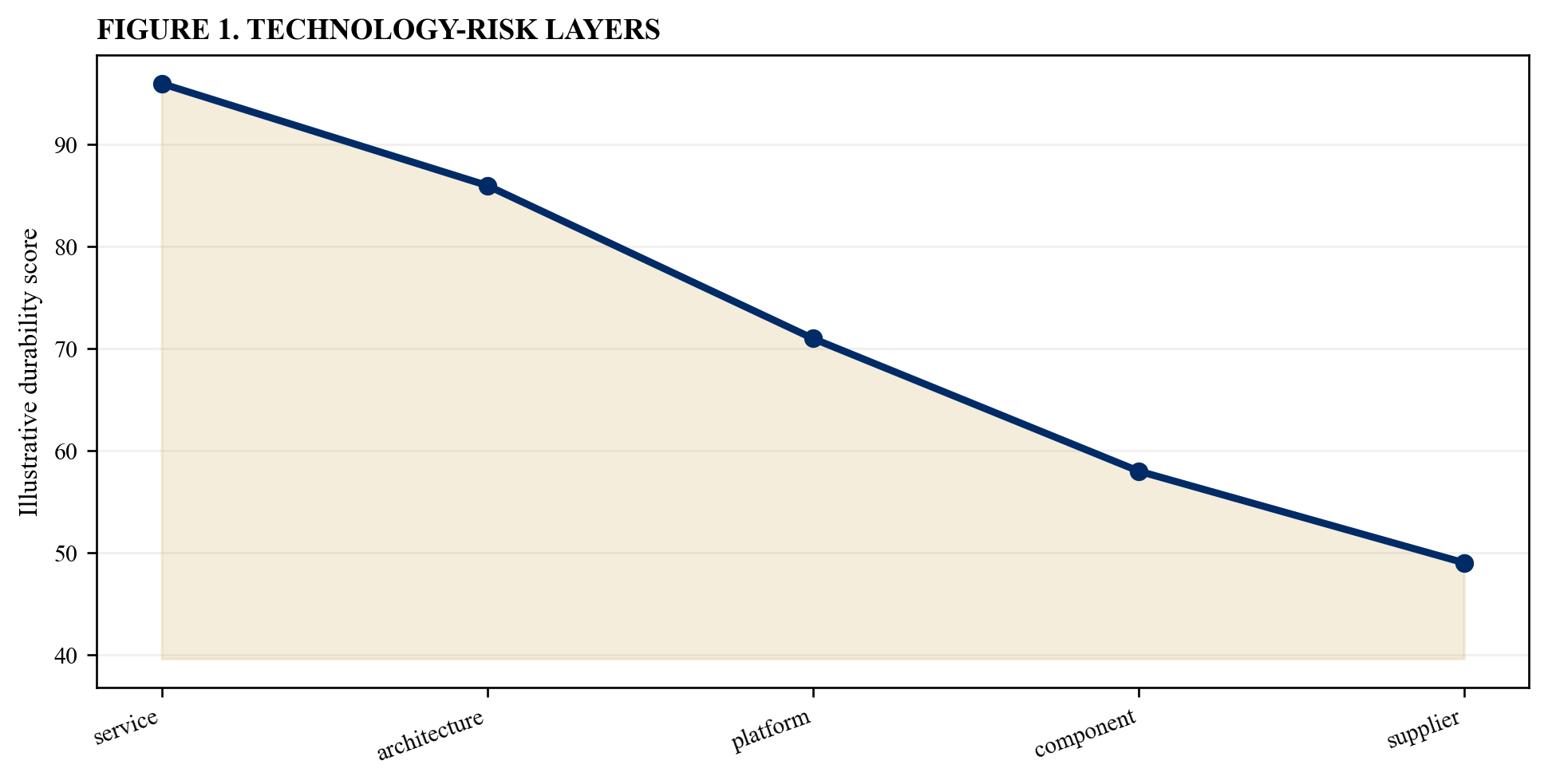
Illustrative analytical scenario; verified project evidence should replace values.
9. Protect interoperability
The project team should test conformance, backward compatibility, integration, data exchange and independent component substitution. The required output is an interoperability assurance plan. Record the accountable party, evidence, assumption, contractual right, service and cash-flow consequence, approval and review date [16][17].
Test the proposed treatment against user needs, asset and software inventories, vendor evidence, standards, architecture, interoperability, cybersecurity, competition, affordability, lender requirements and applicable law. Preserve the source, version, date, dependency and reason for every material judgement.
The principal risk is that nominal standards compliance can fail in actual multi-vendor operation. Quantify effects on service quality, availability, lifecycle cost, demand, revenue, migration, operating resilience, debt-service coverage, equity returns, public liabilities and residual value. Compare the chosen response with credible refresh, modularity, procurement, transfer, reserve and shared-risk alternatives.
Translate the conclusion into output specifications, architecture constraints, lifecycle obligations, change rights, price and benefit rules, funding, monitoring, dispute, exit and handback provisions. Refresh it when service needs, standards, supplier support, security threats, technology economics or market alternatives change.
10. Build the technology roadmap
The project team should forecast service growth, standards, vendor support, security requirements and plausible substitution. The required output is a rolling technology roadmap. Record the accountable party, evidence, assumption, contractual right, service and cash-flow consequence, approval and review date [18][19].
Test the proposed treatment against user needs, asset and software inventories, vendor evidence, standards, architecture, interoperability, cybersecurity, competition, affordability, lender requirements and applicable law. Preserve the source, version, date, dependency and reason for every material judgement.
The principal risk is that the project can treat change as exceptional until multiple upgrades become urgent together. Quantify effects on service quality, availability, lifecycle cost, demand, revenue, migration, operating resilience, debt-service coverage, equity returns, public liabilities and residual value. Compare the chosen response with credible refresh, modularity, procurement, transfer, reserve and shared-risk alternatives.
Translate the conclusion into output specifications, architecture constraints, lifecycle obligations, change rights, price and benefit rules, funding, monitoring, dispute, exit and handback provisions. Refresh it when service needs, standards, supplier support, security threats, technology economics or market alternatives change.
11. Define ordinary refresh obligations
The project team should allocate planned replacement, patching, supported versions, consumables and routine efficiency improvements. The required output is a baseline refresh schedule. Record the accountable party, evidence, assumption, contractual right, service and cash-flow consequence, approval and review date [5][20].
Test the proposed treatment against user needs, asset and software inventories, vendor evidence, standards, architecture, interoperability, cybersecurity, competition, affordability, lender requirements and applicable law. Preserve the source, version, date, dependency and reason for every material judgement.
The principal risk is that ordinary lifecycle cost can be reclassified as a compensable contract change. Quantify effects on service quality, availability, lifecycle cost, demand, revenue, migration, operating resilience, debt-service coverage, equity returns, public liabilities and residual value. Compare the chosen response with credible refresh, modularity, procurement, transfer, reserve and shared-risk alternatives.
Translate the conclusion into output specifications, architecture constraints, lifecycle obligations, change rights, price and benefit rules, funding, monitoring, dispute, exit and handback provisions. Refresh it when service needs, standards, supplier support, security threats, technology economics or market alternatives change.
12. Set minimum supported-state rules
The project team should require maintained versions, security updates, vendor support or documented equivalent capability. The required output is a supported-state standard. Record the accountable party, evidence, assumption, contractual right, service and cash-flow consequence, approval and review date [6][21].
Test the proposed treatment against user needs, asset and software inventories, vendor evidence, standards, architecture, interoperability, cybersecurity, competition, affordability, lender requirements and applicable law. Preserve the source, version, date, dependency and reason for every material judgement.
The principal risk is that a functioning system can remain exposed, unsupported and unfinanceable. Quantify effects on service quality, availability, lifecycle cost, demand, revenue, migration, operating resilience, debt-service coverage, equity returns, public liabilities and residual value. Compare the chosen response with credible refresh, modularity, procurement, transfer, reserve and shared-risk alternatives.
Translate the conclusion into output specifications, architecture constraints, lifecycle obligations, change rights, price and benefit rules, funding, monitoring, dispute, exit and handback provisions. Refresh it when service needs, standards, supplier support, security threats, technology economics or market alternatives change.
13. Create upgrade bands
The project team should divide minor, medium and major changes by cost, risk, service impact and approval route. The required output is an upgrade-band matrix. Record the accountable party, evidence, assumption, contractual right, service and cash-flow consequence, approval and review date [22][23].
Test the proposed treatment against user needs, asset and software inventories, vendor evidence, standards, architecture, interoperability, cybersecurity, competition, affordability, lender requirements and applicable law. Preserve the source, version, date, dependency and reason for every material judgement.
The principal risk is that every improvement can enter a slow bespoke variation process. Quantify effects on service quality, availability, lifecycle cost, demand, revenue, migration, operating resilience, debt-service coverage, equity returns, public liabilities and residual value. Compare the chosen response with credible refresh, modularity, procurement, transfer, reserve and shared-risk alternatives.
Translate the conclusion into output specifications, architecture constraints, lifecycle obligations, change rights, price and benefit rules, funding, monitoring, dispute, exit and handback provisions. Refresh it when service needs, standards, supplier support, security threats, technology economics or market alternatives change.
14. Cap predictable technology exposure
The project team should define included refresh allowances, cost caps, exceptions and indexation for foreseeable change. The required output is a capped upgrade obligation. Record the accountable party, evidence, assumption, contractual right, service and cash-flow consequence, approval and review date [3][24].
Test the proposed treatment against user needs, asset and software inventories, vendor evidence, standards, architecture, interoperability, cybersecurity, competition, affordability, lender requirements and applicable law. Preserve the source, version, date, dependency and reason for every material judgement.
The principal risk is that unbounded private exposure can inflate bids or deter finance. Quantify effects on service quality, availability, lifecycle cost, demand, revenue, migration, operating resilience, debt-service coverage, equity returns, public liabilities and residual value. Compare the chosen response with credible refresh, modularity, procurement, transfer, reserve and shared-risk alternatives.
Translate the conclusion into output specifications, architecture constraints, lifecycle obligations, change rights, price and benefit rules, funding, monitoring, dispute, exit and handback provisions. Refresh it when service needs, standards, supplier support, security threats, technology economics or market alternatives change.
15. Price repeatable change
The project team should establish unit rates, margins, open-book rules, competition thresholds and validity periods. The required output is a pre-priced change schedule. Record the accountable party, evidence, assumption, contractual right, service and cash-flow consequence, approval and review date [22][25].
Test the proposed treatment against user needs, asset and software inventories, vendor evidence, standards, architecture, interoperability, cybersecurity, competition, affordability, lender requirements and applicable law. Preserve the source, version, date, dependency and reason for every material judgement.
The principal risk is that small upgrades can accumulate opaque transaction costs and excessive margins. Quantify effects on service quality, availability, lifecycle cost, demand, revenue, migration, operating resilience, debt-service coverage, equity returns, public liabilities and residual value. Compare the chosen response with credible refresh, modularity, procurement, transfer, reserve and shared-risk alternatives.
Translate the conclusion into output specifications, architecture constraints, lifecycle obligations, change rights, price and benefit rules, funding, monitoring, dispute, exit and handback provisions. Refresh it when service needs, standards, supplier support, security threats, technology economics or market alternatives change.
16. Benchmark technology cost and performance
The project team should compare total cost, service levels, energy use, availability and support with credible market references. The required output is a benchmarking protocol. Record the accountable party, evidence, assumption, contractual right, service and cash-flow consequence, approval and review date [26][27].
Test the proposed treatment against user needs, asset and software inventories, vendor evidence, standards, architecture, interoperability, cybersecurity, competition, affordability, lender requirements and applicable law. Preserve the source, version, date, dependency and reason for every material judgement.
The principal risk is that headline hardware price can conceal migration, integration, licensing and operating cost. Quantify effects on service quality, availability, lifecycle cost, demand, revenue, migration, operating resilience, debt-service coverage, equity returns, public liabilities and residual value. Compare the chosen response with credible refresh, modularity, procurement, transfer, reserve and shared-risk alternatives.
Translate the conclusion into output specifications, architecture constraints, lifecycle obligations, change rights, price and benefit rules, funding, monitoring, dispute, exit and handback provisions. Refresh it when service needs, standards, supplier support, security threats, technology economics or market alternatives change.
Table 2. Upgrade bands
| Band | Commercial treatment | Governance |
|---|---|---|
| minor | included baseline | operator notice |
| medium | unit rates or cap | joint approval |
| major | open-book or competition | authority approval |
| disruptive | economic-balance review | expert process |
Illustrative analytical structure; verified project and jurisdiction evidence governs.
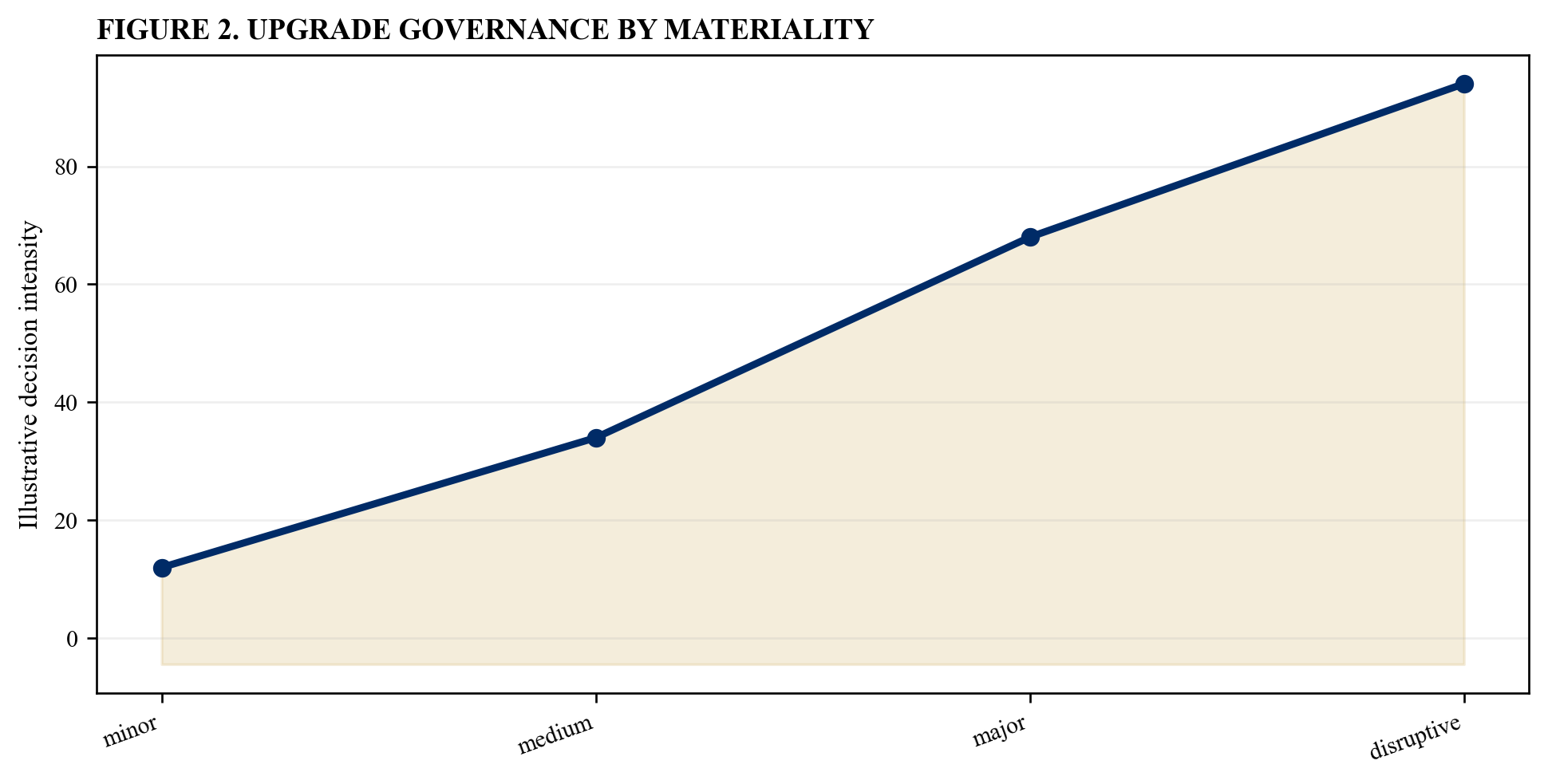
Illustrative analytical scenario; verified project evidence should replace values.
17. Use market testing where contestable
The project team should recompete separable services or components with transition protections and objective evaluation. The required output is a market-testing plan. Record the accountable party, evidence, assumption, contractual right, service and cash-flow consequence, approval and review date [25][28].
Test the proposed treatment against user needs, asset and software inventories, vendor evidence, standards, architecture, interoperability, cybersecurity, competition, affordability, lender requirements and applicable law. Preserve the source, version, date, dependency and reason for every material judgement.
The principal risk is that incumbency and integration dependence can make periodic competition artificial. Quantify effects on service quality, availability, lifecycle cost, demand, revenue, migration, operating resilience, debt-service coverage, equity returns, public liabilities and residual value. Compare the chosen response with credible refresh, modularity, procurement, transfer, reserve and shared-risk alternatives.
Translate the conclusion into output specifications, architecture constraints, lifecycle obligations, change rights, price and benefit rules, funding, monitoring, dispute, exit and handback provisions. Refresh it when service needs, standards, supplier support, security threats, technology economics or market alternatives change.
18. Govern authority-initiated change
The project team should define request, impact assessment, option appraisal, affordability, approval, delivery and acceptance. The required output is an authority-change protocol. Record the accountable party, evidence, assumption, contractual right, service and cash-flow consequence, approval and review date [22][29].
Test the proposed treatment against user needs, asset and software inventories, vendor evidence, standards, architecture, interoperability, cybersecurity, competition, affordability, lender requirements and applicable law. Preserve the source, version, date, dependency and reason for every material judgement.
The principal risk is that policy-led upgrades can proceed without an agreed price or service consequence. Quantify effects on service quality, availability, lifecycle cost, demand, revenue, migration, operating resilience, debt-service coverage, equity returns, public liabilities and residual value. Compare the chosen response with credible refresh, modularity, procurement, transfer, reserve and shared-risk alternatives.
Translate the conclusion into output specifications, architecture constraints, lifecycle obligations, change rights, price and benefit rules, funding, monitoring, dispute, exit and handback provisions. Refresh it when service needs, standards, supplier support, security threats, technology economics or market alternatives change.
19. Govern operator-initiated innovation
The project team should require a business case, compatibility evidence, service protection, savings calculation and approval route. The required output is an innovation proposal protocol. Record the accountable party, evidence, assumption, contractual right, service and cash-flow consequence, approval and review date [3][30].
Test the proposed treatment against user needs, asset and software inventories, vendor evidence, standards, architecture, interoperability, cybersecurity, competition, affordability, lender requirements and applicable law. Preserve the source, version, date, dependency and reason for every material judgement.
The principal risk is that useful improvements can be delayed or private changes can transfer hidden risk. Quantify effects on service quality, availability, lifecycle cost, demand, revenue, migration, operating resilience, debt-service coverage, equity returns, public liabilities and residual value. Compare the chosen response with credible refresh, modularity, procurement, transfer, reserve and shared-risk alternatives.
Translate the conclusion into output specifications, architecture constraints, lifecycle obligations, change rights, price and benefit rules, funding, monitoring, dispute, exit and handback provisions. Refresh it when service needs, standards, supplier support, security threats, technology economics or market alternatives change.
20. Share innovation benefits
The project team should allocate verified capex, operating savings, revenue, performance gain and residual value. The required output is a benefit-sharing waterfall. Record the accountable party, evidence, assumption, contractual right, service and cash-flow consequence, approval and review date [3][31].
Test the proposed treatment against user needs, asset and software inventories, vendor evidence, standards, architecture, interoperability, cybersecurity, competition, affordability, lender requirements and applicable law. Preserve the source, version, date, dependency and reason for every material judgement.
The principal risk is that the party funding innovation can lack incentive when another party captures the gain. Quantify effects on service quality, availability, lifecycle cost, demand, revenue, migration, operating resilience, debt-service coverage, equity returns, public liabilities and residual value. Compare the chosen response with credible refresh, modularity, procurement, transfer, reserve and shared-risk alternatives.
Translate the conclusion into output specifications, architecture constraints, lifecycle obligations, change rights, price and benefit rules, funding, monitoring, dispute, exit and handback provisions. Refresh it when service needs, standards, supplier support, security threats, technology economics or market alternatives change.
21. Allocate disruptive substitution risk
The project team should test whether technology changes demand, comparative cost, regulation or the relevance of the underlying service. The required output is a disruption-risk allocation. Record the accountable party, evidence, assumption, contractual right, service and cash-flow consequence, approval and review date [2][3].
Test the proposed treatment against user needs, asset and software inventories, vendor evidence, standards, architecture, interoperability, cybersecurity, competition, affordability, lender requirements and applicable law. Preserve the source, version, date, dependency and reason for every material judgement.
The principal risk is that an efficient asset can become economically stranded through change outside the project. Quantify effects on service quality, availability, lifecycle cost, demand, revenue, migration, operating resilience, debt-service coverage, equity returns, public liabilities and residual value. Compare the chosen response with credible refresh, modularity, procurement, transfer, reserve and shared-risk alternatives.
Translate the conclusion into output specifications, architecture constraints, lifecycle obligations, change rights, price and benefit rules, funding, monitoring, dispute, exit and handback provisions. Refresh it when service needs, standards, supplier support, security threats, technology economics or market alternatives change.
22. Define economic-balance safeguards
The project team should set thresholds, evidence and remedies where unforeseeable technology change causes material uncompensated impact. The required output is an economic-balance mechanism. Record the accountable party, evidence, assumption, contractual right, service and cash-flow consequence, approval and review date [3][29].
Test the proposed treatment against user needs, asset and software inventories, vendor evidence, standards, architecture, interoperability, cybersecurity, competition, affordability, lender requirements and applicable law. Preserve the source, version, date, dependency and reason for every material judgement.
The principal risk is that minor market evolution can trigger opportunistic renegotiation or severe disruption can have no workable route. Quantify effects on service quality, availability, lifecycle cost, demand, revenue, migration, operating resilience, debt-service coverage, equity returns, public liabilities and residual value. Compare the chosen response with credible refresh, modularity, procurement, transfer, reserve and shared-risk alternatives.
Translate the conclusion into output specifications, architecture constraints, lifecycle obligations, change rights, price and benefit rules, funding, monitoring, dispute, exit and handback provisions. Refresh it when service needs, standards, supplier support, security threats, technology economics or market alternatives change.
23. Control supplier concentration
The project team should map critical vendors, subcontractors, proprietary dependencies, financial health, support commitments and substitutes. The required output is a supplier-continuity register. Record the accountable party, evidence, assumption, contractual right, service and cash-flow consequence, approval and review date [32][33].
Test the proposed treatment against user needs, asset and software inventories, vendor evidence, standards, architecture, interoperability, cybersecurity, competition, affordability, lender requirements and applicable law. Preserve the source, version, date, dependency and reason for every material judgement.
The principal risk is that a concession can depend on one vendor whose incentives and solvency are outside project control. Quantify effects on service quality, availability, lifecycle cost, demand, revenue, migration, operating resilience, debt-service coverage, equity returns, public liabilities and residual value. Compare the chosen response with credible refresh, modularity, procurement, transfer, reserve and shared-risk alternatives.
Translate the conclusion into output specifications, architecture constraints, lifecycle obligations, change rights, price and benefit rules, funding, monitoring, dispute, exit and handback provisions. Refresh it when service needs, standards, supplier support, security threats, technology economics or market alternatives change.
24. Secure source and configuration continuity
The project team should use escrow, repository access, documentation, keys, build processes, configuration baselines and step-in rights. The required output is a technology-continuity package. Record the accountable party, evidence, assumption, contractual right, service and cash-flow consequence, approval and review date [34][35].
Test the proposed treatment against user needs, asset and software inventories, vendor evidence, standards, architecture, interoperability, cybersecurity, competition, affordability, lender requirements and applicable law. Preserve the source, version, date, dependency and reason for every material judgement.
The principal risk is that the authority or replacement operator can own assets without the means to operate them. Quantify effects on service quality, availability, lifecycle cost, demand, revenue, migration, operating resilience, debt-service coverage, equity returns, public liabilities and residual value. Compare the chosen response with credible refresh, modularity, procurement, transfer, reserve and shared-risk alternatives.
Translate the conclusion into output specifications, architecture constraints, lifecycle obligations, change rights, price and benefit rules, funding, monitoring, dispute, exit and handback provisions. Refresh it when service needs, standards, supplier support, security threats, technology economics or market alternatives change.
Table 3. Continuity controls
| Dependency | Control | Fallback |
|---|---|---|
| software | source and build access | escrow release |
| vendor | support and substitution | step-in |
| licence | transfer and survival | transition right |
| data | portable format | verified export |
Illustrative analytical structure; verified project and jurisdiction evidence governs.
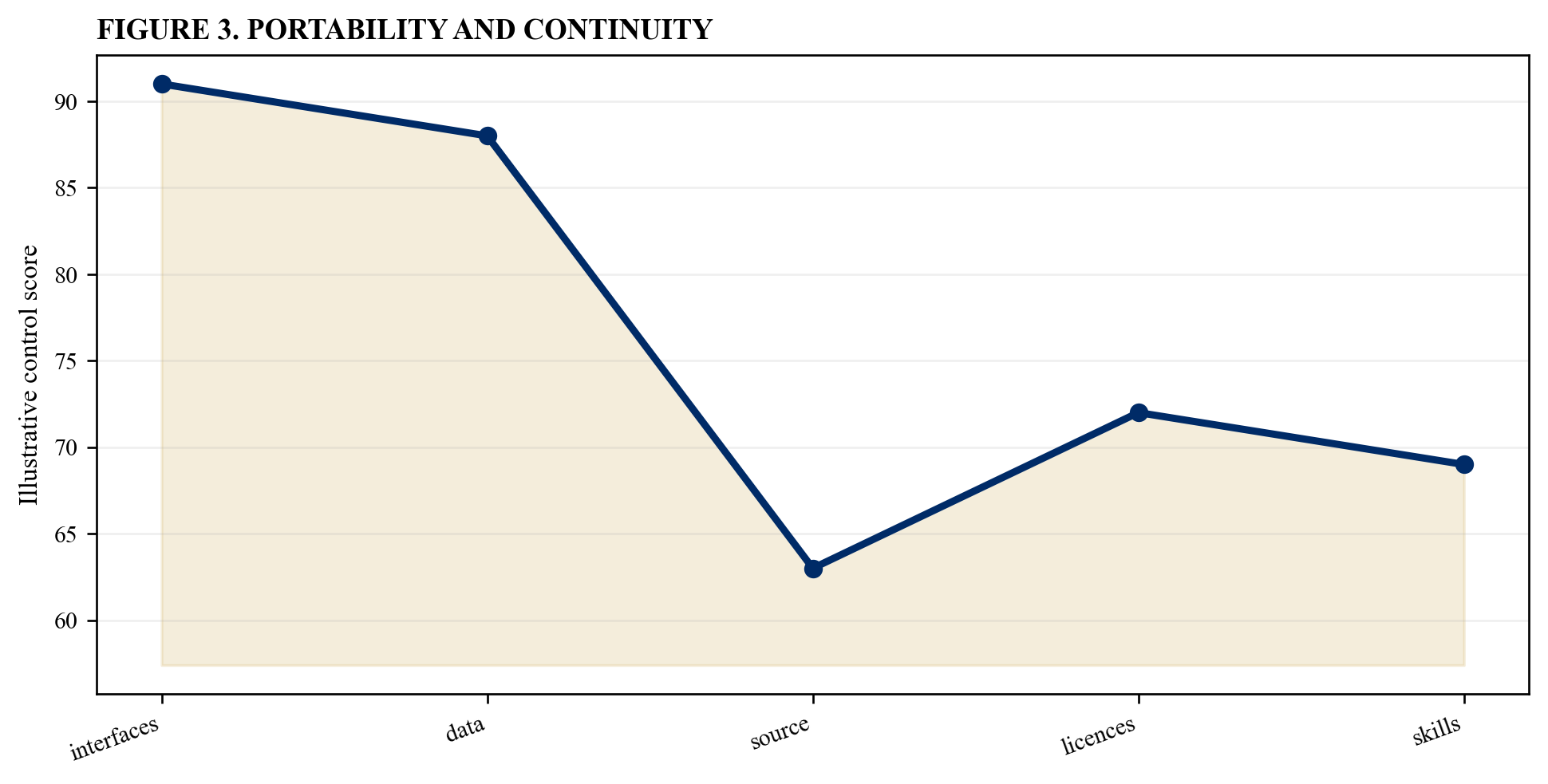
Illustrative analytical scenario; verified project evidence should replace values.
25. Govern software and licence rights
The project team should define term, users, environments, renewal, audit, transfer, termination and post-expiry operation. The required output is a licence-rights matrix. Record the accountable party, evidence, assumption, contractual right, service and cash-flow consequence, approval and review date [5][36].
Test the proposed treatment against user needs, asset and software inventories, vendor evidence, standards, architecture, interoperability, cybersecurity, competition, affordability, lender requirements and applicable law. Preserve the source, version, date, dependency and reason for every material judgement.
The principal risk is that licence restrictions can block scale, transition, refinancing or handback. Quantify effects on service quality, availability, lifecycle cost, demand, revenue, migration, operating resilience, debt-service coverage, equity returns, public liabilities and residual value. Compare the chosen response with credible refresh, modularity, procurement, transfer, reserve and shared-risk alternatives.
Translate the conclusion into output specifications, architecture constraints, lifecycle obligations, change rights, price and benefit rules, funding, monitoring, dispute, exit and handback provisions. Refresh it when service needs, standards, supplier support, security threats, technology economics or market alternatives change.
26. Protect data ownership and portability
The project team should define data classes, control, access, format, lineage, retention, export and deletion. The required output is a data-rights schedule. Record the accountable party, evidence, assumption, contractual right, service and cash-flow consequence, approval and review date [14][37].
Test the proposed treatment against user needs, asset and software inventories, vendor evidence, standards, architecture, interoperability, cybersecurity, competition, affordability, lender requirements and applicable law. Preserve the source, version, date, dependency and reason for every material judgement.
The principal risk is that operational dependence can persist after contract rights end because usable data cannot move. Quantify effects on service quality, availability, lifecycle cost, demand, revenue, migration, operating resilience, debt-service coverage, equity returns, public liabilities and residual value. Compare the chosen response with credible refresh, modularity, procurement, transfer, reserve and shared-risk alternatives.
Translate the conclusion into output specifications, architecture constraints, lifecycle obligations, change rights, price and benefit rules, funding, monitoring, dispute, exit and handback provisions. Refresh it when service needs, standards, supplier support, security threats, technology economics or market alternatives change.
27. Integrate cybersecurity lifecycle
The project team should require secure design, patching, identity, monitoring, vulnerability management, incident response and recovery. The required output is a cyber-lifecycle plan. Record the accountable party, evidence, assumption, contractual right, service and cash-flow consequence, approval and review date [21][38].
Test the proposed treatment against user needs, asset and software inventories, vendor evidence, standards, architecture, interoperability, cybersecurity, competition, affordability, lender requirements and applicable law. Preserve the source, version, date, dependency and reason for every material judgement.
The principal risk is that technology refresh can introduce unmanaged exposure or unsupported systems can accumulate critical risk. Quantify effects on service quality, availability, lifecycle cost, demand, revenue, migration, operating resilience, debt-service coverage, equity returns, public liabilities and residual value. Compare the chosen response with credible refresh, modularity, procurement, transfer, reserve and shared-risk alternatives.
Translate the conclusion into output specifications, architecture constraints, lifecycle obligations, change rights, price and benefit rules, funding, monitoring, dispute, exit and handback provisions. Refresh it when service needs, standards, supplier support, security threats, technology economics or market alternatives change.
28. Control artificial intelligence and automation
The project team should define approved uses, data provenance, model performance, human oversight, audit, update and fallback. The required output is an AI assurance schedule. Record the accountable party, evidence, assumption, contractual right, service and cash-flow consequence, approval and review date [39][40].
Test the proposed treatment against user needs, asset and software inventories, vendor evidence, standards, architecture, interoperability, cybersecurity, competition, affordability, lender requirements and applicable law. Preserve the source, version, date, dependency and reason for every material judgement.
The principal risk is that adaptive systems can change behaviour without a traceable contractual decision. Quantify effects on service quality, availability, lifecycle cost, demand, revenue, migration, operating resilience, debt-service coverage, equity returns, public liabilities and residual value. Compare the chosen response with credible refresh, modularity, procurement, transfer, reserve and shared-risk alternatives.
Translate the conclusion into output specifications, architecture constraints, lifecycle obligations, change rights, price and benefit rules, funding, monitoring, dispute, exit and handback provisions. Refresh it when service needs, standards, supplier support, security threats, technology economics or market alternatives change.
29. Model energy and compute economics
The project team should forecast power, cooling, connectivity, cloud, edge, storage and processing requirements. The required output is a technology operating-cost model. Record the accountable party, evidence, assumption, contractual right, service and cash-flow consequence, approval and review date [18][27].
Test the proposed treatment against user needs, asset and software inventories, vendor evidence, standards, architecture, interoperability, cybersecurity, competition, affordability, lender requirements and applicable law. Preserve the source, version, date, dependency and reason for every material judgement.
The principal risk is that a technically current solution can become economically obsolete through changing unit cost. Quantify effects on service quality, availability, lifecycle cost, demand, revenue, migration, operating resilience, debt-service coverage, equity returns, public liabilities and residual value. Compare the chosen response with credible refresh, modularity, procurement, transfer, reserve and shared-risk alternatives.
Translate the conclusion into output specifications, architecture constraints, lifecycle obligations, change rights, price and benefit rules, funding, monitoring, dispute, exit and handback provisions. Refresh it when service needs, standards, supplier support, security threats, technology economics or market alternatives change.
30. Build the integrated lifecycle model
The project team should connect refresh capex, maintenance, licences, efficiency, downtime, change cost and residual value. The required output is a technology-adjusted financial model. Record the accountable party, evidence, assumption, contractual right, service and cash-flow consequence, approval and review date [9][24].
Test the proposed treatment against user needs, asset and software inventories, vendor evidence, standards, architecture, interoperability, cybersecurity, competition, affordability, lender requirements and applicable law. Preserve the source, version, date, dependency and reason for every material judgement.
The principal risk is that technical roadmaps and financing assumptions can use inconsistent replacement cycles. Quantify effects on service quality, availability, lifecycle cost, demand, revenue, migration, operating resilience, debt-service coverage, equity returns, public liabilities and residual value. Compare the chosen response with credible refresh, modularity, procurement, transfer, reserve and shared-risk alternatives.
Translate the conclusion into output specifications, architecture constraints, lifecycle obligations, change rights, price and benefit rules, funding, monitoring, dispute, exit and handback provisions. Refresh it when service needs, standards, supplier support, security threats, technology economics or market alternatives change.
31. Stress correlated technology failure
The project team should combine vendor exit, cyber incident, support expiry, component shortage, migration delay and demand shift. The required output is a compound technology stress. Record the accountable party, evidence, assumption, contractual right, service and cash-flow consequence, approval and review date [32][38].
Test the proposed treatment against user needs, asset and software inventories, vendor evidence, standards, architecture, interoperability, cybersecurity, competition, affordability, lender requirements and applicable law. Preserve the source, version, date, dependency and reason for every material judgement.
The principal risk is that single-variable sensitivities can understate simultaneous service and liquidity pressure. Quantify effects on service quality, availability, lifecycle cost, demand, revenue, migration, operating resilience, debt-service coverage, equity returns, public liabilities and residual value. Compare the chosen response with credible refresh, modularity, procurement, transfer, reserve and shared-risk alternatives.
Translate the conclusion into output specifications, architecture constraints, lifecycle obligations, change rights, price and benefit rules, funding, monitoring, dispute, exit and handback provisions. Refresh it when service needs, standards, supplier support, security threats, technology economics or market alternatives change.
32. Fund refresh and major upgrades
The project team should compare lifecycle reserve, included opex, capex facility, authority payment, refinancing and shared investment. The required output is a technology-funding waterfall. Record the accountable party, evidence, assumption, contractual right, service and cash-flow consequence, approval and review date [24][31].
Test the proposed treatment against user needs, asset and software inventories, vendor evidence, standards, architecture, interoperability, cybersecurity, competition, affordability, lender requirements and applicable law. Preserve the source, version, date, dependency and reason for every material judgement.
The principal risk is that necessary upgrades can lack cash even when contract responsibility appears clear. Quantify effects on service quality, availability, lifecycle cost, demand, revenue, migration, operating resilience, debt-service coverage, equity returns, public liabilities and residual value. Compare the chosen response with credible refresh, modularity, procurement, transfer, reserve and shared-risk alternatives.
Translate the conclusion into output specifications, architecture constraints, lifecycle obligations, change rights, price and benefit rules, funding, monitoring, dispute, exit and handback provisions. Refresh it when service needs, standards, supplier support, security threats, technology economics or market alternatives change.
Table 4. Illustrative lifecycle funding
| Requirement | Share of lifecycle cost | Funding route |
|---|---|---|
| routine refresh | 28 | service payment |
| major upgrade | 34 | reserve and facility |
| authority change | 23 | change payment |
| disruption reserve | 15 | shared contingent layer |
Illustrative analytical structure; verified project and jurisdiction evidence governs.
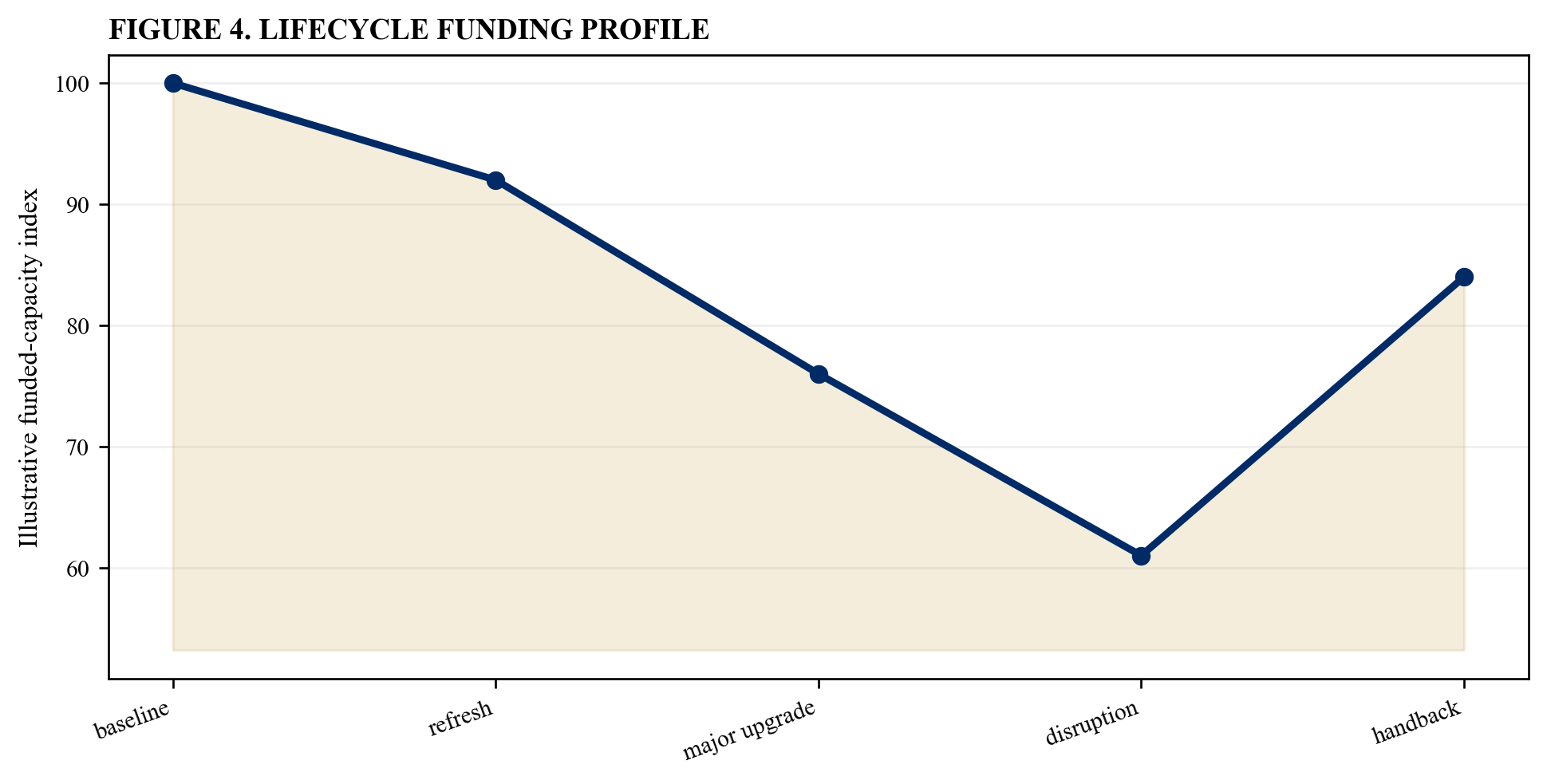
Illustrative analytical scenario; verified project evidence should replace values.
33. Align debt with technology risk
The project team should test debt tenor, amortisation, reserve, covenant, insurance, step-in and residual-value assumptions. The required output is a technology-adjusted debt case. Record the accountable party, evidence, assumption, contractual right, service and cash-flow consequence, approval and review date [9][33].
Test the proposed treatment against user needs, asset and software inventories, vendor evidence, standards, architecture, interoperability, cybersecurity, competition, affordability, lender requirements and applicable law. Preserve the source, version, date, dependency and reason for every material judgement.
The principal risk is that long debt can depend on short-lived technology and concentrated suppliers. Quantify effects on service quality, availability, lifecycle cost, demand, revenue, migration, operating resilience, debt-service coverage, equity returns, public liabilities and residual value. Compare the chosen response with credible refresh, modularity, procurement, transfer, reserve and shared-risk alternatives.
Translate the conclusion into output specifications, architecture constraints, lifecycle obligations, change rights, price and benefit rules, funding, monitoring, dispute, exit and handback provisions. Refresh it when service needs, standards, supplier support, security threats, technology economics or market alternatives change.
34. Maintain a controlled document set
The project team should keep contracts, variations, specifications, registers, interfaces, licences, tests and acceptance records current. The required output is a shared technology contract record. Record the accountable party, evidence, assumption, contractual right, service and cash-flow consequence, approval and review date [4][28].
Test the proposed treatment against user needs, asset and software inventories, vendor evidence, standards, architecture, interoperability, cybersecurity, competition, affordability, lender requirements and applicable law. Preserve the source, version, date, dependency and reason for every material judgement.
The principal risk is that parties can manage different versions of the operating bargain. Quantify effects on service quality, availability, lifecycle cost, demand, revenue, migration, operating resilience, debt-service coverage, equity returns, public liabilities and residual value. Compare the chosen response with credible refresh, modularity, procurement, transfer, reserve and shared-risk alternatives.
Translate the conclusion into output specifications, architecture constraints, lifecycle obligations, change rights, price and benefit rules, funding, monitoring, dispute, exit and handback provisions. Refresh it when service needs, standards, supplier support, security threats, technology economics or market alternatives change.
35. Monitor leading indicators
The project team should track support horizon, patch lag, incidents, cost variance, performance gap, vendor health and substitution signals. The required output is a technology early-warning dashboard. Record the accountable party, evidence, assumption, contractual right, service and cash-flow consequence, approval and review date [6][19].
Test the proposed treatment against user needs, asset and software inventories, vendor evidence, standards, architecture, interoperability, cybersecurity, competition, affordability, lender requirements and applicable law. Preserve the source, version, date, dependency and reason for every material judgement.
The principal risk is that intervention can begin only after service failure or emergency procurement. Quantify effects on service quality, availability, lifecycle cost, demand, revenue, migration, operating resilience, debt-service coverage, equity returns, public liabilities and residual value. Compare the chosen response with credible refresh, modularity, procurement, transfer, reserve and shared-risk alternatives.
Translate the conclusion into output specifications, architecture constraints, lifecycle obligations, change rights, price and benefit rules, funding, monitoring, dispute, exit and handback provisions. Refresh it when service needs, standards, supplier support, security threats, technology economics or market alternatives change.
36. Define escalation and dispute routes
The project team should assign expert determination, technical panel, commercial negotiation, mediation and formal dispute paths. The required output is a technology dispute ladder. Record the accountable party, evidence, assumption, contractual right, service and cash-flow consequence, approval and review date [2][29].
Test the proposed treatment against user needs, asset and software inventories, vendor evidence, standards, architecture, interoperability, cybersecurity, competition, affordability, lender requirements and applicable law. Preserve the source, version, date, dependency and reason for every material judgement.
The principal risk is that general dispute procedures can be too slow for time-critical upgrades. Quantify effects on service quality, availability, lifecycle cost, demand, revenue, migration, operating resilience, debt-service coverage, equity returns, public liabilities and residual value. Compare the chosen response with credible refresh, modularity, procurement, transfer, reserve and shared-risk alternatives.
Translate the conclusion into output specifications, architecture constraints, lifecycle obligations, change rights, price and benefit rules, funding, monitoring, dispute, exit and handback provisions. Refresh it when service needs, standards, supplier support, security threats, technology economics or market alternatives change.
37. Plan transition and exit assistance
The project team should require inventories, documentation, data export, knowledge transfer, licences, suppliers and parallel operation. The required output is an exit-assistance plan. Record the accountable party, evidence, assumption, contractual right, service and cash-flow consequence, approval and review date [10][37].
Test the proposed treatment against user needs, asset and software inventories, vendor evidence, standards, architecture, interoperability, cybersecurity, competition, affordability, lender requirements and applicable law. Preserve the source, version, date, dependency and reason for every material judgement.
The principal risk is that competition at expiry can fail because the incumbent controls operational continuity. Quantify effects on service quality, availability, lifecycle cost, demand, revenue, migration, operating resilience, debt-service coverage, equity returns, public liabilities and residual value. Compare the chosen response with credible refresh, modularity, procurement, transfer, reserve and shared-risk alternatives.
Translate the conclusion into output specifications, architecture constraints, lifecycle obligations, change rights, price and benefit rules, funding, monitoring, dispute, exit and handback provisions. Refresh it when service needs, standards, supplier support, security threats, technology economics or market alternatives change.
38. Set technology handback condition
The project team should define supported state, remaining life, security, interoperability, documentation, licences and accepted technical debt. The required output is a technology handback standard. Record the accountable party, evidence, assumption, contractual right, service and cash-flow consequence, approval and review date [10][12].
Test the proposed treatment against user needs, asset and software inventories, vendor evidence, standards, architecture, interoperability, cybersecurity, competition, affordability, lender requirements and applicable law. Preserve the source, version, date, dependency and reason for every material judgement.
The principal risk is that the authority can inherit assets that meet physical condition tests while being digitally obsolete. Quantify effects on service quality, availability, lifecycle cost, demand, revenue, migration, operating resilience, debt-service coverage, equity returns, public liabilities and residual value. Compare the chosen response with credible refresh, modularity, procurement, transfer, reserve and shared-risk alternatives.
Translate the conclusion into output specifications, architecture constraints, lifecycle obligations, change rights, price and benefit rules, funding, monitoring, dispute, exit and handback provisions. Refresh it when service needs, standards, supplier support, security threats, technology economics or market alternatives change.
39. Rehearse replacement and recovery
The project team should test component substitution, vendor failure, data restoration, manual fallback and operator transition. The required output is a technology continuity exercise. Record the accountable party, evidence, assumption, contractual right, service and cash-flow consequence, approval and review date [34][38].
Test the proposed treatment against user needs, asset and software inventories, vendor evidence, standards, architecture, interoperability, cybersecurity, competition, affordability, lender requirements and applicable law. Preserve the source, version, date, dependency and reason for every material judgement.
The principal risk is that contractual step-in rights can prove unusable during a real failure. Quantify effects on service quality, availability, lifecycle cost, demand, revenue, migration, operating resilience, debt-service coverage, equity returns, public liabilities and residual value. Compare the chosen response with credible refresh, modularity, procurement, transfer, reserve and shared-risk alternatives.
Translate the conclusion into output specifications, architecture constraints, lifecycle obligations, change rights, price and benefit rules, funding, monitoring, dispute, exit and handback provisions. Refresh it when service needs, standards, supplier support, security threats, technology economics or market alternatives change.
40. Issue the technology-investibility certificate
The project team should reconcile service outcomes, architecture, lifecycle, upgrades, cost, rights, cyber, finance and handback. The required output is an auditable technology-investibility certificate. Record the accountable party, evidence, assumption, contractual right, service and cash-flow consequence, approval and review date [1][3].
Test the proposed treatment against user needs, asset and software inventories, vendor evidence, standards, architecture, interoperability, cybersecurity, competition, affordability, lender requirements and applicable law. Preserve the source, version, date, dependency and reason for every material judgement.
The principal risk is that approval can rest on isolated technical schedules without a coherent lifecycle bargain. Quantify effects on service quality, availability, lifecycle cost, demand, revenue, migration, operating resilience, debt-service coverage, equity returns, public liabilities and residual value. Compare the chosen response with credible refresh, modularity, procurement, transfer, reserve and shared-risk alternatives.
Translate the conclusion into output specifications, architecture constraints, lifecycle obligations, change rights, price and benefit rules, funding, monitoring, dispute, exit and handback provisions. Refresh it when service needs, standards, supplier support, security threats, technology economics or market alternatives change.
Table 5. Technology-investibility certificate
| Decision | Evidence | Owner |
|---|---|---|
| service | outcome charter | authority |
| architecture | interfaces and standards | technical |
| lifecycle | roadmap and funding | operator and finance |
| exit | portable handback | joint |
Illustrative analytical structure; verified project and jurisdiction evidence governs.
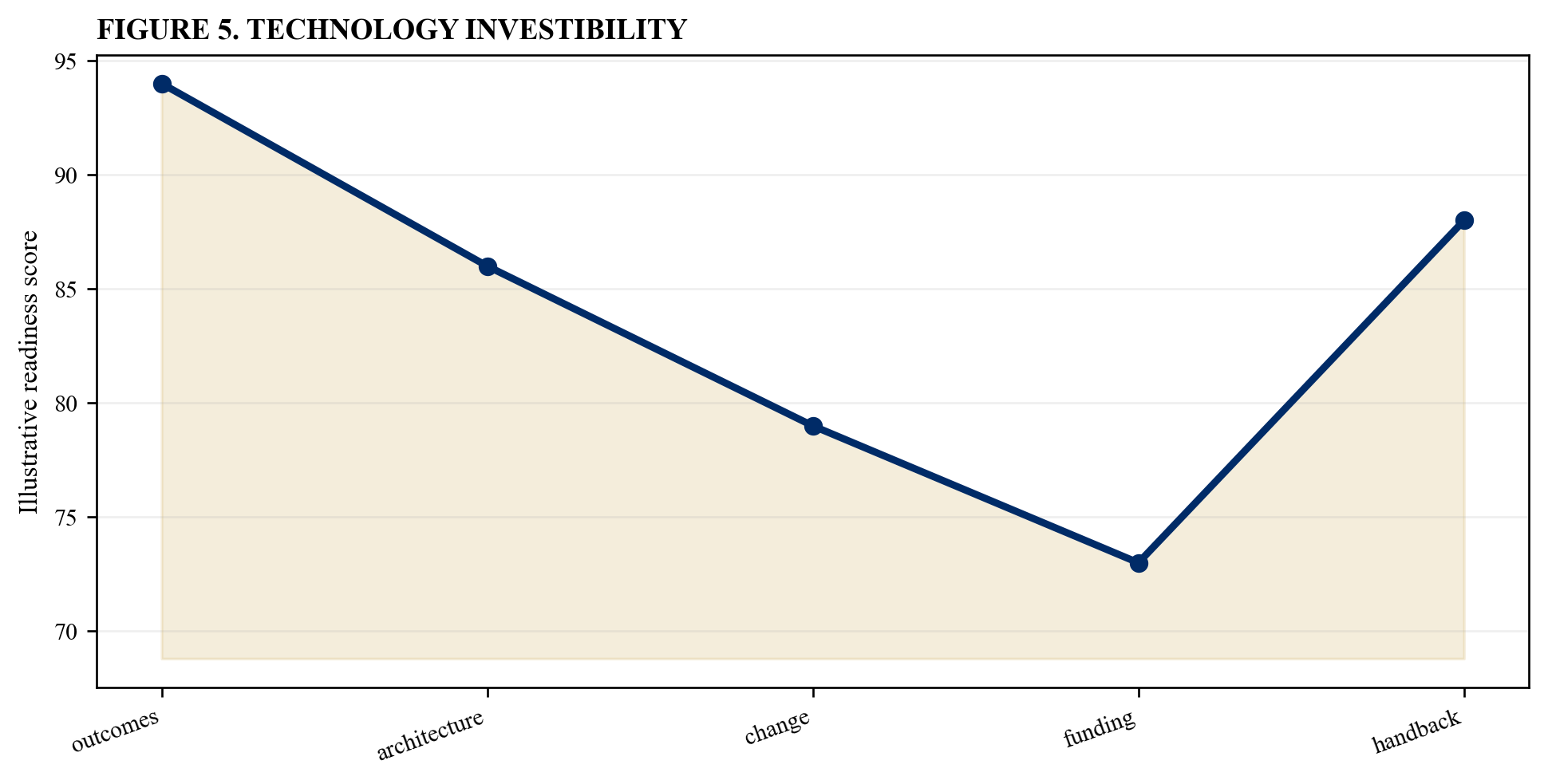
Illustrative analytical scenario; verified project evidence should replace values.
References
- World Bank Group, PPP Reference Guide Version 3, https://ppp.worldbank.org/sites/default/files/2024-08/PPP%20Reference%20Guide%20Version%203.pdf
- World Bank PPP Resource Center, Managing Technological Change, https://ppp.worldbank.org/node/7616
- World Bank Group, PPP Contracts in an Age of Disruption, https://ppp.worldbank.org/sites/default/files/2024-04/10028%20-%20PPP%20Contracts%20in%20An%20Age%20of%20Disruption%20%28October%202023%29.pdf
- UK National Infrastructure and Service Transformation Authority, PFI Document Stocktake, https://www.gov.uk/government/publications/pfi-contract-management-document-stocktake/nista-pfi-contract-management-guidance-document-stocktake
- ISO, ISO IEC 19770-1 IT Asset Management, https://committee.iso.org/sites/jtc1sc7/home/projects/flagship-standards/isoiec-19770-12017.html
- ISO, ISO IEC TS 19770-10:2025, https://www.iso.org/standard/86588.html
- World Bank PPP Resource Center, Changing Technological Environment, https://ppp.worldbank.org/changing-technological-environment
- OECD, Digital Transformation of Public Procurement, https://www.oecd.org/en/publications/digital-transformation-of-public-procurement_79651651-en.html
- ISO, ISO 55001 Asset Management, https://www.iso.org/standard/83054.html
- World Bank PPP Resource Center, Contract Expiry and Asset Handover, https://ppp.worldbank.org/contract-expiry-and-asset-handover
- World Bank PPP Resource Center, Structuring the PPP Contract, https://ppp.worldbank.org/structuring-ppp-contract
- ISO, ISO IEC IEEE 42010 Architecture Description, https://www.iso.org/standard/74393.html
- NIST, Cybersecurity Framework 2.0, https://www.nist.gov/cyberframework
- European Commission, European Interoperability Framework, https://ec.europa.eu/isa2/eif_en/
- Open Group, TOGAF Standard, https://www.opengroup.org/togaf
- ISO, ISO IEC 19941 Cloud Interoperability and Portability, https://www.iso.org/standard/66639.html
- OECD, Digital Government Interoperability, https://www.oecd.org/en/topics/digital-government.html
- OECD, Going Digital Toolkit, https://goingdigital.oecd.org/
- World Bank, Digital Development, https://www.worldbank.org/en/topic/digitaldevelopment
- ISO IEC, Software Lifecycle Processes, https://www.iso.org/standard/63712.html
- NIST, Secure Software Development Framework, https://csrc.nist.gov/Projects/ssdf
- UK Treasury, PFI Change Protocol Principles, https://assets.publishing.service.gov.uk/government/uploads/system/uploads/attachment_data/file/759768/pfi_change_protocol_principles.pdf
- UK NISTA, PFI Contract Management Strategy, https://www.gov.uk/government/publications/pfi-contract-management-strategy/nista-pfi-contract-management-guidance-contract-strategy
- World Bank PPP Resource Center, Government Support, https://ppp.worldbank.org/government-support
- UK Cabinet Office, Sourcing Playbook, https://www.gov.uk/government/publications/the-sourcing-playbook
- UK NISTA, PFI Benchmarking and Market Testing Guidance, https://www.gov.uk/government/collections/pfi-contract-management-guidance
- European Commission, Life Cycle Costing, https://green-business.ec.europa.eu/green-public-procurement/life-cycle-costing_en
- World Bank PPP Resource Center, Managing PPP Contracts, https://ppp.worldbank.org/managing-ppp-contracts
- World Bank PPP Resource Center, Renegotiation, https://ppp.worldbank.org/renegotiation
- OECD, Public Procurement for Innovation, https://www.oecd.org/gov/public-procurement/innovation/
- World Bank PPP Resource Center, Translating Risk Allocation into Contract Structure, https://ppp.worldbank.org/translating-risk-allocation-contract-structure
- OECD, Managing Risks in Public Procurement, https://www.oecd.org/gov/public-procurement/risk-management/
- ISO, ISO 22301 Business Continuity, https://www.iso.org/standard/75106.html
- UK National Cyber Security Centre, Supply Chain Security Guidance, https://www.ncsc.gov.uk/collection/supply-chain-security
- ISO, ISO IEC 27001 Information Security, https://www.iso.org/standard/27001
- World Intellectual Property Organization, Software and Intellectual Property, https://www.wipo.int/software/en/
- OECD, Enhancing Access to and Sharing of Data, https://www.oecd.org/en/publications/enhancing-access-to-and-sharing-of-data_276aaca8-en.html
- NIST, Guide for Cybersecurity Event Recovery, https://csrc.nist.gov/publications/detail/sp/800-184/final
- OECD, AI Principles, https://oecd.ai/en/ai-principles
- NIST, AI Risk Management Framework, https://www.nist.gov/itl/ai-risk-management-framework
