

1. Define the title question and transaction perimeter
The transaction team should identify every share, asset, right, contract and business capability that the bidder expects to acquire, together with the selling entity and proposed transfer route. Evidence should come from indicative offer, perimeter schedule, group chart, asset register, draft agreement and current legal advice. The controlling question is what exactly must be owned, transferable and usable for the bid case to work. The answer should be dated, attributed and linked to the legal entity, asset, liability or operating dependency it describes [104][109][110][118].
The controlled output is a transaction perimeter and title-question memorandum. It should state the source, calculation method, owner, exceptions, required approvals and the next irreversible deadline. This allows a board, officeholder, creditor or buyer to reproduce the conclusion when facts change.
The principal risk is that a broad business description can conceal assets held by affiliates, founders, financiers or customers. The team should quantify the effect on liquidity, stand-alone earnings, creditor recoveries, operating continuity and completion probability. A material exception should update the perimeter and funding plan.
2. Establish authority and the insolvency route
This workstream requires the company and its advisers to verify the powers of directors, shareholders, office holders, secured creditors and courts for the proposed sale and release sequence, using constitutions, appointments, board records, court orders, security documents and process notices. The practical test is who may market, disclose, sell, release and bind each relevant entity. Analysis should use one cut-off date so that cash, claims, contracts, people and transaction documents reconcile [109][117][118][120].
Decision-makers should maintain an authority and sale-route matrix. It should distinguish legal ownership from economic allocation, current evidence from forecast assumptions and committed funding from indications. Qualified advisers retain responsibility for legal, insolvency, tax, pensions, accounting and regulatory judgements.
Execution can fail when an apparently signed transfer can exceed authority or conflict with enforcement control. Each dependency needs a control, evidence threshold, escalation route and decision time. The transaction remains viable only while the funded separation plan can absorb a credible delay or shortfall.
3. Build the title-and-encumbrance evidence map
The readiness team should connect each material asset to its asserted owner, legal evidence, public notice record, operating location, security position and proposed release. The evidence base includes register extracts, deeds, contracts, ledgers, asset records, confirmations, inspections and specialist reports. The central question is which evidence proves ownership and freedom to transfer at the relevant timestamp. Conclusions should remain at entity and dependency level because the failing group may have pooled cash, shared rights and cross-guarantees [90][110][111][121].
The required deliverable is a source-linked evidence map. It should connect the proposed sale documents to the stand-alone operating model and the residual estate. Every material assumption should show its source and sensitivity.
The downside is that teams can collect documents without resolving contradictions between them. Management should test the base case and a combined downside against minimum cash, customer continuity and the completion timetable. Unsupported benefits should not be treated as available funding.
4. Grade evidence by source recency and legal effect
The seller should rank official copies, registry searches, executed instruments, third-party confirmations, internal records and oral assertions by reliability and currency. Relevant evidence includes source metadata, retrieval dates, certified copies, signatures, filing history and confirmations. The decision asks which propositions are proven, provisional, contradicted or unavailable. A reliable answer links financial analysis to title, transfer mechanics, operating capability and the applicable approval process [90][110][121][122].
The decision pack should contain an evidence-grade register. It should show calculation dates, owners, dependencies and the documents that implement the conclusion. This creates a defensible record for later scrutiny and post-completion reconciliation.
A material failure occurs when an old or secondary document can create false confidence during a compressed process. The response should identify a funded cure, alternative perimeter or fallback route. Continuing without one can reduce going-concern value and creditor recovery.
Table 1. Evidence-grade framework
| Grade | Typical source | Decision use | Control |
|---|---|---|---|
| A | official copy or direct confirmation | may support completion | timestamp and retain |
| B | executed instrument | scope and obligation analysis | authenticate and reconcile |
| C | internal record | working hypothesis | corroborate |
| D | oral or stale assertion | question only | do not price as proven |
Values and scores are analytical scenarios; transaction evidence should replace model values.
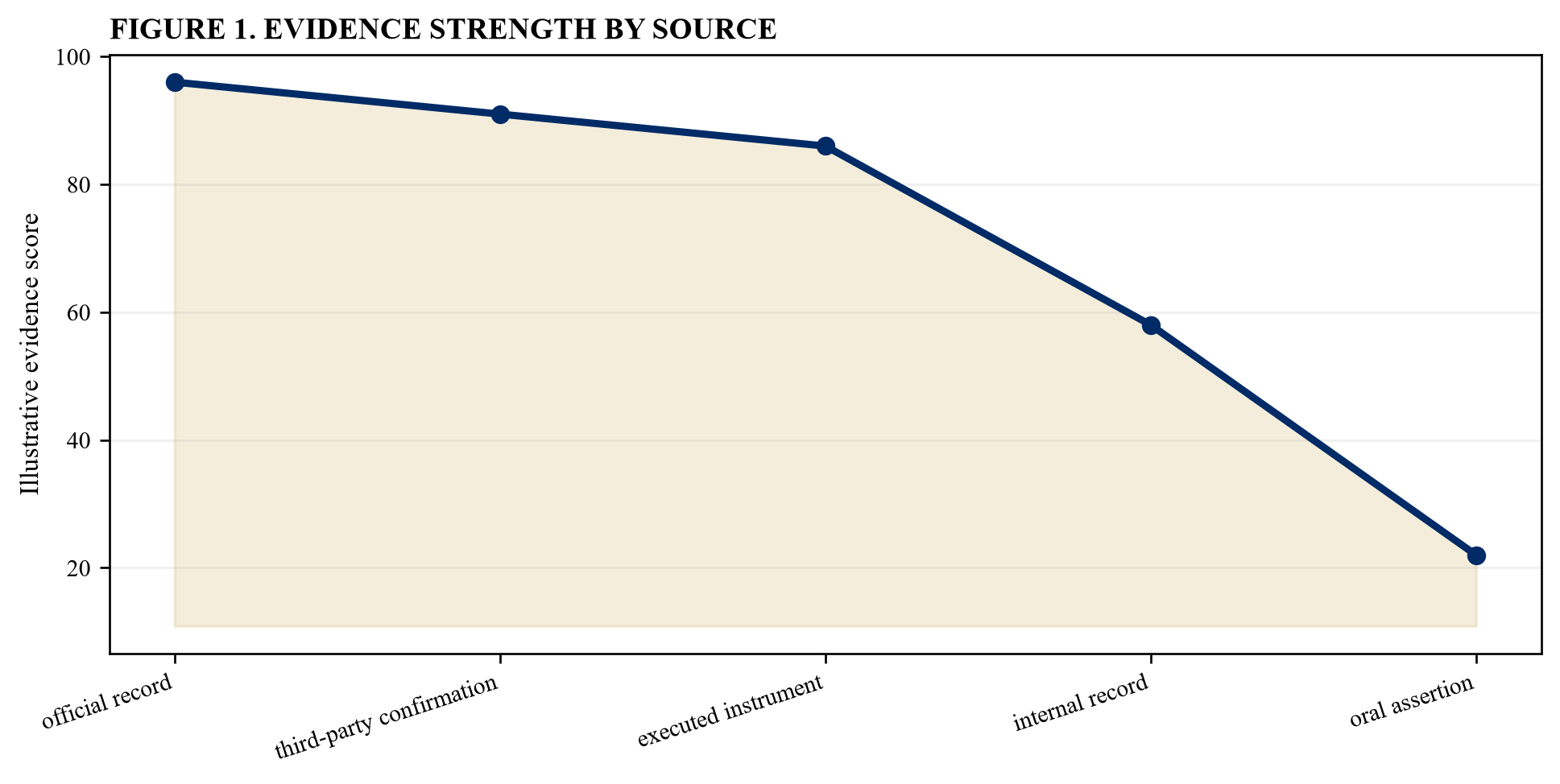
Illustrative analytical scenario; transaction evidence should replace model values.
5. Reconcile legal owner beneficial owner and operating user
The transaction team should separate registered title, beneficial interest, possession, custody, use and economic benefit for each asset. Evidence should come from title records, trust documents, intercompany agreements, site records, insurance and accounting evidence. The controlling question is who owns the asset and who controls or depends on it in practice. The answer should be dated, attributed and linked to the legal entity, asset, liability or operating dependency it describes [90][104][111][121].
The controlled output is an ownership-control reconciliation. It should state the source, calculation method, owner, exceptions, required approvals and the next irreversible deadline. This allows a board, officeholder, creditor or buyer to reproduce the conclusion when facts change.
The principal risk is that possession or accounting recognition may be mistaken for transferable ownership. The team should quantify the effect on liquidity, stand-alone earnings, creditor recoveries, operating continuity and completion probability. A material exception should update the perimeter and funding plan.
6. Verify shares and fully diluted ownership
This workstream requires the company and its advisers to trace issued shares, options, warrants, convertibles, preferences, nominee arrangements and transfer restrictions, using statutory books, filings, certificates, subscription documents, shareholder agreements and cap tables. The practical test is what equity interest can be delivered and what approvals or releases are required. Analysis should use one cut-off date so that cash, claims, contracts, people and transaction documents reconcile [104][110][123][124].
Decision-makers should maintain a fully diluted ownership and transfer schedule. It should distinguish legal ownership from economic allocation, current evidence from forecast assumptions and committed funding from indications. Qualified advisers retain responsibility for legal, insolvency, tax, pensions, accounting and regulatory judgements.
Execution can fail when purchase proceeds can be allocated against an incomplete or disputed capital structure. Each dependency needs a control, evidence threshold, escalation route and decision time. The transaction remains viable only while the funded separation plan can absorb a credible delay or shortfall.
7. Trace share pledges and transfer restrictions
The readiness team should identify pledges, charges, liens, negative covenants, pre-emption, drag, tag and consent rights affecting the shares. The evidence base includes security instruments, shareholder agreements, registers, financing documents and confirmations. The central question is which party can block or redirect a share transfer. Conclusions should remain at entity and dependency level because the failing group may have pooled cash, shared rights and cross-guarantees [110][111][123][124].
The required deliverable is a share-encumbrance and consent matrix. It should connect the proposed sale documents to the stand-alone operating model and the residual estate. Every material assumption should show its source and sensitivity.
The downside is that a clean cap table may omit contractual or security constraints. Management should test the base case and a combined downside against minimum cash, customer continuity and the completion timetable. Unsupported benefits should not be treated as available funding.
8. Search company charges and financing security
The seller should search each relevant entity and former name across applicable company and secured-transactions registers. Relevant evidence includes official registry results, filing images, satisfaction entries, migration records and search certificates. The decision asks what security has been notified publicly and whether any filing remains open. A reliable answer links financial analysis to title, transfer mechanics, operating capability and the applicable approval process [110][111][121][125].
The decision pack should contain a dated registry-search pack. It should show calculation dates, owners, dependencies and the documents that implement the conclusion. This creates a defensible record for later scrutiny and post-completion reconciliation.
A material failure occurs when an outstanding filing may be stale while an unregistered or differently registered interest may still require analysis. The response should identify a funded cure, alternative perimeter or fallback route. Continuing without one can reduce going-concern value and creditor recovery.
9. Read the security instruments behind the registers
The transaction team should analyse charging clauses, secured obligations, all-monies language, after-acquired assets, proceeds, crystallisation, covenants and enforcement powers. Evidence should come from executed debentures, mortgages, pledges, assignments, amendments, facility documents and legal opinions. The controlling question is which assets and obligations are actually captured by each instrument. The answer should be dated, attributed and linked to the legal entity, asset, liability or operating dependency it describes [110][111][125][126].
The controlled output is an instrument-level security coverage schedule. It should state the source, calculation method, owner, exceptions, required approvals and the next irreversible deadline. This allows a board, officeholder, creditor or buyer to reproduce the conclusion when facts change.
The principal risk is that register descriptions can be too compressed to determine scope, priority or release requirements. The team should quantify the effect on liquidity, stand-alone earnings, creditor recoveries, operating continuity and completion probability. A material exception should update the perimeter and funding plan.
10. Reconcile fixed and floating charge coverage
This workstream requires the company and its advisers to map asset classes, acquisition dates, disposals, substitutions, proceeds and crystallisation events to the operative security language, using security instruments, asset registers, bank data, notices, filings and insolvency records. The practical test is which assets fall within fixed, floating or no effective security. Analysis should use one cut-off date so that cash, claims, contracts, people and transaction documents reconcile [110][111][117][126].
Decision-makers should maintain a security-coverage model. It should distinguish legal ownership from economic allocation, current evidence from forecast assumptions and committed funding from indications. Qualified advisers retain responsibility for legal, insolvency, tax, pensions, accounting and regulatory judgements.
Execution can fail when the parties may assume an asset is free because it is absent from a short-form filing description. Each dependency needs a control, evidence threshold, escalation route and decision time. The transaction remains viable only while the funded separation plan can absorb a credible delay or shortfall.
Table 2. Illustrative security coverage
| Asset class | Book value | Clearly covered | Unresolved |
|---|---|---|---|
| land | 42 | 39 | 3 |
| equipment | 28 | 19 | 9 |
| inventory | 21 | 12 | 9 |
| receivables | 34 | 26 | 8 |
Values and scores are analytical scenarios; transaction evidence should replace model values.
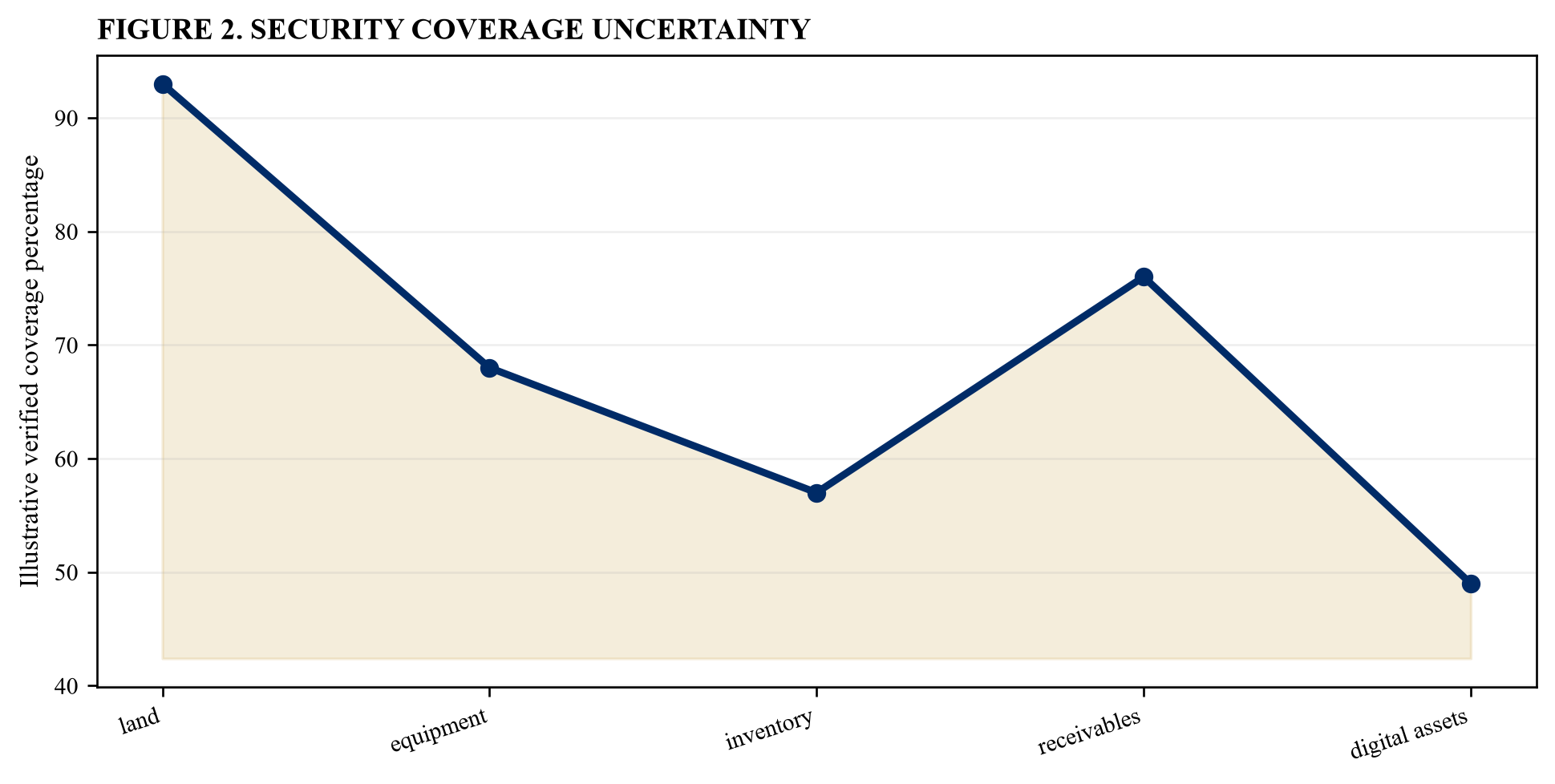
Illustrative analytical scenario; transaction evidence should replace model values.
11. Map intercreditor priority and enforcement control
The readiness team should identify priority, standstill, voting, enforcement, turnover and release powers among secured and structurally senior creditors. The evidence base includes intercreditor agreements, security trust deeds, facilities, hedging documents and confirmations. The central question is who controls enforcement and who must consent to the sale and discharge. Conclusions should remain at entity and dependency level because the failing group may have pooled cash, shared rights and cross-guarantees [109][110][111][126].
The required deliverable is a creditor-control and priority map. It should connect the proposed sale documents to the stand-alone operating model and the residual estate. Every material assumption should show its source and sensitivity.
The downside is that paying one lender may not produce authority to release another creditor's interest. Management should test the base case and a combined downside against minimum cash, customer continuity and the completion timetable. Unsupported benefits should not be treated as available funding.
12. Confirm payoff release and filing mechanics
The seller should calculate discharge amounts and specify the executed documents, filing actions, conditions and timing needed for effective release. Relevant evidence includes payoff letters, release deeds, filing forms, bank instructions, court orders and legal confirmations. The decision asks what proves that each security interest has been discharged at completion. A reliable answer links financial analysis to title, transfer mechanics, operating capability and the applicable approval process [107][109][110][121].
The decision pack should contain a lender-by-lender release protocol. It should show calculation dates, owners, dependencies and the documents that implement the conclusion. This creates a defensible record for later scrutiny and post-completion reconciliation.
A material failure occurs when a promise to file after closing can leave the buyer exposed during the gap. The response should identify a funded cure, alternative perimeter or fallback route. Continuing without one can reduce going-concern value and creditor recovery.
13. Verify bank account control and cash collateral
The transaction team should identify ownership, mandates, pledges, set-off, control agreements, blocked balances, sweeps and client-money restrictions. Evidence should come from bank confirmations, mandates, statements, facilities, security documents and regulatory records. The controlling question is which cash and collection accounts the buyer can control at completion. The answer should be dated, attributed and linked to the legal entity, asset, liability or operating dependency it describes [109][111][126][127].
The controlled output is a bank-control and cash-availability matrix. It should state the source, calculation method, owner, exceptions, required approvals and the next irreversible deadline. This allows a board, officeholder, creditor or buyer to reproduce the conclusion when facts change.
The principal risk is that reported cash can be inaccessible or automatically swept after the transfer. The team should quantify the effect on liquidity, stand-alone earnings, creditor recoveries, operating continuity and completion probability. A material exception should update the perimeter and funding plan.
14. Prove land and property title
This workstream requires the company and its advisers to obtain official title evidence, identify the legal estate, registered proprietor, mortgages, restrictions, notices, easements and filed documents, using official copies, title plans, index-map searches, leases, deeds, local searches and property advice. The practical test is what land interest is owned and what burdens or rights affect its use and transfer. Analysis should use one cut-off date so that cash, claims, contracts, people and transaction documents reconcile [90][121][122][128].
Decision-makers should maintain a property-title and restriction schedule. It should distinguish legal ownership from economic allocation, current evidence from forecast assumptions and committed funding from indications. Qualified advisers retain responsibility for legal, insolvency, tax, pensions, accounting and regulatory judgements.
Execution can fail when an address search or online copy may omit affected titles or lack evidential status. Each dependency needs a control, evidence threshold, escalation route and decision time. The transaction remains viable only while the funded separation plan can absorb a credible delay or shortfall.
15. Reconcile leases licences and informal occupation
The readiness team should identify every site occupied under lease, licence, concession, tenancy at will, sharing arrangement or undocumented practice. The evidence base includes executed agreements, rent records, landlord confirmations, site plans, insurance and inspection. The central question is what right permits occupation and whether it transfers or requires consent. Conclusions should remain at entity and dependency level because the failing group may have pooled cash, shared rights and cross-guarantees [90][118][121][128].
The required deliverable is an occupation-right and consent map. It should connect the proposed sale documents to the stand-alone operating model and the residual estate. Every material assumption should show its source and sensitivity.
The downside is that operational dependence on a site can rest on a revocable or non-transferable arrangement. Management should test the base case and a combined downside against minimum cash, customer continuity and the completion timetable. Unsupported benefits should not be treated as available funding.
16. Check equipment ownership and serial-number evidence
The seller should match material machinery, vehicles and specialist equipment to invoices, serial numbers, registrations, asset ledgers and physical inspection. Relevant evidence includes purchase documents, fixed-asset register, photographs, maintenance files, insurance and registry results. The decision asks which identified units belong to the seller and are present and usable. A reliable answer links financial analysis to title, transfer mechanics, operating capability and the applicable approval process [111][125][129][130].
The decision pack should contain a serial-level equipment title schedule. It should show calculation dates, owners, dependencies and the documents that implement the conclusion. This creates a defensible record for later scrutiny and post-completion reconciliation.
A material failure occurs when generic asset descriptions can hide missing, substituted, leased or third-party equipment. The response should identify a funded cure, alternative perimeter or fallback route. Continuing without one can reduce going-concern value and creditor recovery.
17. Identify finance leases and hire purchase
The transaction team should separate owned equipment from leased, financed, rented, bailed or conditional-sale assets and calculate transfer or payoff requirements. Evidence should come from finance agreements, invoices, asset records, payment history, lessor confirmations and site inspection. The controlling question is what ownership path and cash treatment applies to each financed asset. The answer should be dated, attributed and linked to the legal entity, asset, liability or operating dependency it describes [104][111][125][129].
The controlled output is an equipment-finance and release schedule. It should state the source, calculation method, owner, exceptions, required approvals and the next irreversible deadline. This allows a board, officeholder, creditor or buyer to reproduce the conclusion when facts change.
The principal risk is that accounting presentation may differ from legal title and termination economics. The team should quantify the effect on liquidity, stand-alone earnings, creditor recoveries, operating continuity and completion probability. A material exception should update the perimeter and funding plan.
18. Test retention-of-title and consignment inventory
This workstream requires the company and its advisers to identify supplier terms, consignment, bailment, warehouse liens, reclamation rights and transformation of goods, using purchase terms, invoices, inventory records, warehouse agreements, supplier confirmations and inspection. The practical test is which stock is owned and capable of sale or use by the buyer. Analysis should use one cut-off date so that cash, claims, contracts, people and transaction documents reconcile [111][125][129][130].
Decision-makers should maintain an inventory title-and-claim register. It should distinguish legal ownership from economic allocation, current evidence from forecast assumptions and committed funding from indications. Qualified advisers retain responsibility for legal, insolvency, tax, pensions, accounting and regulatory judgements.
Execution can fail when physical possession and book inventory can include goods owned by suppliers or customers. Each dependency needs a control, evidence threshold, escalation route and decision time. The transaction remains viable only while the funded separation plan can absorb a credible delay or shortfall.
19. Verify inventory location condition and third-party custody
The readiness team should reconcile quantities and ownership across sites, warehouses, processors, logistics providers and customer premises. The evidence base includes count sheets, warehouse receipts, custody contracts, dispatch data, confirmations and inspection. The central question is where each material stock pool sits and what rights govern release. Conclusions should remain at entity and dependency level because the failing group may have pooled cash, shared rights and cross-guarantees [111][125][129][130].
The required deliverable is a location-and-custody evidence schedule. It should connect the proposed sale documents to the stand-alone operating model and the residual estate. Every material assumption should show its source and sensitivity.
The downside is that stock may exist yet remain inaccessible, damaged, commingled or subject to a custodian lien. Management should test the base case and a combined downside against minimum cash, customer continuity and the completion timetable. Unsupported benefits should not be treated as available funding.
20. Trace receivables ownership and assignments
The seller should map invoices, assignments, factoring, securitisation, recourse, set-off, collection accounts and customer notices. Relevant evidence includes subledgers, contracts, financing documents, bank flows, notices and confirmations. The decision asks who owns each receivable and its proceeds at completion. A reliable answer links financial analysis to title, transfer mechanics, operating capability and the applicable approval process [111][125][126][127].
The decision pack should contain a receivables title and collection-control bridge. It should show calculation dates, owners, dependencies and the documents that implement the conclusion. This creates a defensible record for later scrutiny and post-completion reconciliation.
A material failure occurs when the buyer may value cash flows already sold, charged or vulnerable to set-off. The response should identify a funded cure, alternative perimeter or fallback route. Continuing without one can reduce going-concern value and creditor recovery.
21. Map factoring securitisation and set-off
The transaction team should look through legal form to financing purpose, assignment scope, eligibility, reserves, recourse and dilution. Evidence should come from factoring and securitisation documents, borrowing-base reports, customer terms, ledger data and cash receipts. The controlling question is what value and cash rights remain within the sale perimeter. The answer should be dated, attributed and linked to the legal entity, asset, liability or operating dependency it describes [104][111][125][126].
The controlled output is a receivables financing and set-off model. It should state the source, calculation method, owner, exceptions, required approvals and the next irreversible deadline. This allows a board, officeholder, creditor or buyer to reproduce the conclusion when facts change.
The principal risk is that nominal receivables can materially exceed the cash rights transferable to the buyer. The team should quantify the effect on liquidity, stand-alone earnings, creditor recoveries, operating continuity and completion probability. A material exception should update the perimeter and funding plan.
22. Verify intellectual-property ownership and registered interests
This workstream requires the company and its advisers to trace creation, assignment, registration, renewal, licences, security and disputes for patents, trade marks, designs and copyright, using official registers, employment and contractor agreements, assignment deeds, filings, repositories and invoices. The practical test is which rights are owned, enforceable, encumbered and transferable. Analysis should use one cut-off date so that cash, claims, contracts, people and transaction documents reconcile [111][123][125][131].
Decision-makers should maintain an intellectual-property chain-of-title schedule. It should distinguish legal ownership from economic allocation, current evidence from forecast assumptions and committed funding from indications. Qualified advisers retain responsibility for legal, insolvency, tax, pensions, accounting and regulatory judgements.
Execution can fail when core technology may belong to a founder, contractor, affiliate or secured creditor. Each dependency needs a control, evidence threshold, escalation route and decision time. The transaction remains viable only while the funded separation plan can absorb a credible delay or shortfall.
Table 3. Digital chain-of-title tests
| Asset | Primary evidence | Common gap | Completion control |
|---|---|---|---|
| source code | repository plus assignments | contractor rights | confirm and assign |
| data | rights and lawful-source map | restricted reuse | licence or exclusion |
| domain | registrar control | personal account | verified transfer |
| cloud | tenant and billing control | affiliate dependency | new tenant and credentials |
Values and scores are analytical scenarios; transaction evidence should replace model values.
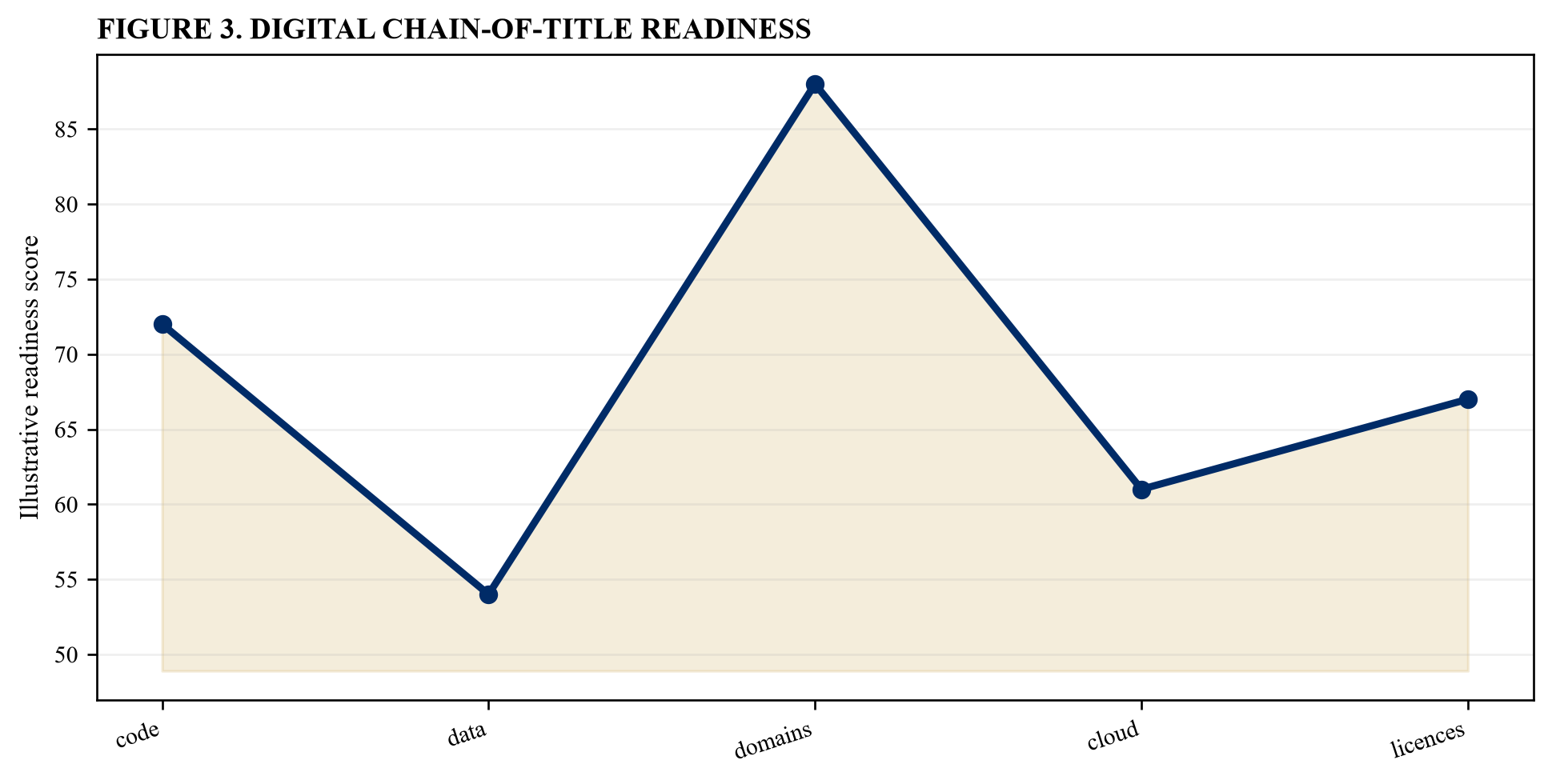
Illustrative analytical scenario; transaction evidence should replace model values.
23. Trace software data and domain rights
The readiness team should identify ownership and licences for source code, models, databases, training data, domains, cloud environments and operational credentials. The evidence base includes repositories, contracts, access logs, data maps, registrar records, invoices and technical inspection. The central question is what digital rights and control the buyer receives on day one. Conclusions should remain at entity and dependency level because the failing group may have pooled cash, shared rights and cross-guarantees [118][123][131][132].
The required deliverable is a digital-asset title and access matrix. It should connect the proposed sale documents to the stand-alone operating model and the residual estate. Every material assumption should show its source and sensitivity.
The downside is that business continuity can fail even where legal ownership exists but access or licence rights do not transfer. Management should test the base case and a combined downside against minimum cash, customer continuity and the completion timetable. Unsupported benefits should not be treated as available funding.
24. Check licences permits and change-of-control restrictions
The seller should inventory each operating permission, holder, territory, condition, transfer rule and consent requirement. Relevant evidence includes official registers, licences, compliance files, notices, correspondence and legal advice. The decision asks whether the buyer can lawfully use the assets and operate after completion. A reliable answer links financial analysis to title, transfer mechanics, operating capability and the applicable approval process [117][118][123][133].
The decision pack should contain a permission-transfer critical path. It should show calculation dates, owners, dependencies and the documents that implement the conclusion. This creates a defensible record for later scrutiny and post-completion reconciliation.
A material failure occurs when asset title can transfer without the authority needed to operate it. The response should identify a funded cure, alternative perimeter or fallback route. Continuing without one can reduce going-concern value and creditor recovery.
25. Map customer and supplier contract transfer rights
The transaction team should screen assignment, novation, change-of-control, termination, set-off, lien and retention rights in critical contracts. Evidence should come from executed contracts, amendments, notices, waivers, performance data and counterparty confirmations. The controlling question is which commercial rights and obligations transfer and on what conditions. The answer should be dated, attributed and linked to the legal entity, asset, liability or operating dependency it describes [118][123][125][133].
The controlled output is a contract-continuity and consent matrix. It should state the source, calculation method, owner, exceptions, required approvals and the next irreversible deadline. This allows a board, officeholder, creditor or buyer to reproduce the conclusion when facts change.
The principal risk is that a valuable asset package can be stranded from the contracts that create its cash flow. The team should quantify the effect on liquidity, stand-alone earnings, creditor recoveries, operating continuity and completion probability. A material exception should update the perimeter and funding plan.
26. Search litigation judgments liens and enforcement
This workstream requires the company and its advisers to identify filed and threatened proceedings, judgments, attachment, execution, injunctions, undertakings and preservation orders, using court and tribunal searches, counsel letters, claim files, board records and public notices. The practical test is what claims can attach to assets, proceeds or transfer mechanics. Analysis should use one cut-off date so that cash, claims, contracts, people and transaction documents reconcile [96][109][118][134].
Decision-makers should maintain a disputes-and-enforcement title schedule. It should distinguish legal ownership from economic allocation, current evidence from forecast assumptions and committed funding from indications. Qualified advisers retain responsibility for legal, insolvency, tax, pensions, accounting and regulatory judgements.
Execution can fail when a late order can defeat an otherwise complete release plan. Each dependency needs a control, evidence threshold, escalation route and decision time. The transaction remains viable only while the funded separation plan can absorb a credible delay or shortfall.
27. Identify tax customs and statutory claims
The readiness team should map taxes, customs duties, statutory liens, rates, employee claims, penalties and authority powers that may affect assets or proceeds. The evidence base includes authority statements, returns, assessments, customs records, payroll, advice and correspondence. The central question is which statutory claims can prime, attach, restrict or create completion cash needs. Conclusions should remain at entity and dependency level because the failing group may have pooled cash, shared rights and cross-guarantees [109][117][118][135].
The required deliverable is a statutory-claim and clearance matrix. It should connect the proposed sale documents to the stand-alone operating model and the residual estate. Every material assumption should show its source and sensitivity.
The downside is that private sale wording may not eliminate public-law consequences. Management should test the base case and a combined downside against minimum cash, customer continuity and the completion timetable. Unsupported benefits should not be treated as available funding.
28. Assess environmental and asset-following liabilities
The seller should identify contamination, waste, decommissioning, restoration, permits and obligations linked to ownership, occupation or operation. Relevant evidence includes environmental reports, permits, title, site history, monitoring, insurance and regulator correspondence. The decision asks what burden follows the site or limits its future use and value. A reliable answer links financial analysis to title, transfer mechanics, operating capability and the applicable approval process [92][93][95][136].
The decision pack should contain an environmental title-and-remediation model. It should show calculation dates, owners, dependencies and the documents that implement the conclusion. This creates a defensible record for later scrutiny and post-completion reconciliation.
A material failure occurs when a clean contractual allocation may not bind regulators or cure physical conditions. The response should identify a funded cure, alternative perimeter or fallback route. Continuing without one can reduce going-concern value and creditor recovery.
29. Map employee pension and benefit claims affecting assets or continuity
The transaction team should identify statutory and contractual claims, scheme security, contribution arrears, guarantees and rights tied to facilities or business transfer. Evidence should come from payroll, scheme documents, trustee records, security filings, claims and specialist advice. The controlling question is what workforce-related claim or dependency can affect asset use, proceeds or continuity. The answer should be dated, attributed and linked to the legal entity, asset, liability or operating dependency it describes [112][113][119][137].
The controlled output is a people-claim and continuity schedule. It should state the source, calculation method, owner, exceptions, required approvals and the next irreversible deadline. This allows a board, officeholder, creditor or buyer to reproduce the conclusion when facts change.
The principal risk is that asset value can depend on capability that leaves or on claims with statutory leverage. The team should quantify the effect on liquidity, stand-alone earnings, creditor recoveries, operating continuity and completion probability. A material exception should update the perimeter and funding plan.
30. Verify insurance and loss-payee rights
This workstream requires the company and its advisers to confirm policyholder, insured assets, lenders, loss payees, claims, proceeds assignments, deductibles and transfer provisions, using policies, endorsements, broker confirmations, premium evidence, claims files and financing documents. The practical test is who receives insurance proceeds and whether cover survives the transfer. Analysis should use one cut-off date so that cash, claims, contracts, people and transaction documents reconcile [99][100][101][102].
Decision-makers should maintain an insurance-rights and recovery matrix. It should distinguish legal ownership from economic allocation, current evidence from forecast assumptions and committed funding from indications. Qualified advisers retain responsibility for legal, insolvency, tax, pensions, accounting and regulatory judgements.
Execution can fail when the buyer may acquire damaged assets while proceeds flow to a lender or seller. Each dependency needs a control, evidence threshold, escalation route and decision time. The transaction remains viable only while the funded separation plan can absorb a credible delay or shortfall.
31. Confirm asset registers against site inspection
The readiness team should test material records through labelled photographs, serial checks, geolocation, custody evidence, maintenance status and exception sampling. The evidence base includes asset ledger, inspection protocol, photographs, third-party confirmations and operations interviews. The central question is whether recorded assets exist, match description and remain under seller control. Conclusions should remain at entity and dependency level because the failing group may have pooled cash, shared rights and cross-guarantees [94][129][130][138].
The required deliverable is a physically verified asset register. It should connect the proposed sale documents to the stand-alone operating model and the residual estate. Every material assumption should show its source and sensitivity.
The downside is that a clean spreadsheet can conceal absence, substitution, damage or third-party possession. Management should test the base case and a combined downside against minimum cash, customer continuity and the completion timetable. Unsupported benefits should not be treated as available funding.
32. Reconcile title evidence to accounting records and tax
The seller should bridge legal ownership and security evidence to fixed assets, inventory, receivables, leases, depreciation, impairment and tax bases. Relevant evidence includes financial statements, ledgers, tax records, invoices, registers, valuations and confirmations. The decision asks where legal and accounting populations differ and why. A reliable answer links financial analysis to title, transfer mechanics, operating capability and the applicable approval process [104][125][129][135].
The decision pack should contain a title-to-ledger reconciliation. It should show calculation dates, owners, dependencies and the documents that implement the conclusion. This creates a defensible record for later scrutiny and post-completion reconciliation.
A material failure occurs when assets can be recognised for accounting purposes without transferable legal ownership. The response should identify a funded cure, alternative perimeter or fallback route. Continuing without one can reduce going-concern value and creditor recovery.
33. Build the exception register
The transaction team should record every missing, stale, contradictory or adverse item with value, criticality, owner, deadline, remedy and decision authority. Evidence should come from evidence map, Q and A log, searches, model, adviser reports and management responses. The controlling question is which gaps change price, structure, timetable or willingness to close. The answer should be dated, attributed and linked to the legal entity, asset, liability or operating dependency it describes [108][121][122][138].
The controlled output is an authorised title-exception register. It should state the source, calculation method, owner, exceptions, required approvals and the next irreversible deadline. This allows a board, officeholder, creditor or buyer to reproduce the conclusion when facts change.
The principal risk is that unresolved issues can disappear inside email traffic and broad diligence summaries. The team should quantify the effect on liquidity, stand-alone earnings, creditor recoveries, operating continuity and completion probability. A material exception should update the perimeter and funding plan.
34. Quantify unavailable disputed and encumbered value
This workstream requires the company and its advisers to estimate value at risk, replacement cost, delay, cure cost, downside cash and probability for each exception, using valuation model, evidence grades, market data, legal analysis, operating plan and scenarios. The practical test is how title uncertainty changes recoverable value and funding need. Analysis should use one cut-off date so that cash, claims, contracts, people and transaction documents reconcile [104][109][111][138].
Decision-makers should maintain a probability-weighted encumbrance adjustment. It should distinguish legal ownership from economic allocation, current evidence from forecast assumptions and committed funding from indications. Qualified advisers retain responsibility for legal, insolvency, tax, pensions, accounting and regulatory judgements.
Execution can fail when headline enterprise value can include assets the buyer cannot obtain or use. Each dependency needs a control, evidence threshold, escalation route and decision time. The transaction remains viable only while the funded separation plan can absorb a credible delay or shortfall.
35. Compare bids after title and release adjustments
The readiness team should bridge each bid through asset exclusions, encumbrance payoff, cure, working capital, delay and completion probability on common definitions. The evidence base includes bid terms, title map, payoff evidence, funding commitments, timelines and scenarios. The central question is which bid produces the highest reliable net value and deliverability. Conclusions should remain at entity and dependency level because the failing group may have pooled cash, shared rights and cross-guarantees [104][107][109][138].
The required deliverable is a comparable title-adjusted bid bridge. It should connect the proposed sale documents to the stand-alone operating model and the residual estate. Every material assumption should show its source and sensitivity.
The downside is that the highest price can produce the lowest recovery when releases are uncertain or expensive. Management should test the base case and a combined downside against minimum cash, customer continuity and the completion timetable. Unsupported benefits should not be treated as available funding.
Table 4. Illustrative title-adjusted bid bridge
| Measure | Bid A | Bid B | Bid C |
|---|---|---|---|
| headline price | 120 | 114 | 108 |
| unavailable value | -8 | -3 | 0 |
| payoff and cure | -23 | -14 | -9 |
| probability-weighted net value | 67 | 76 | 82 |
Values and scores are analytical scenarios; transaction evidence should replace model values.
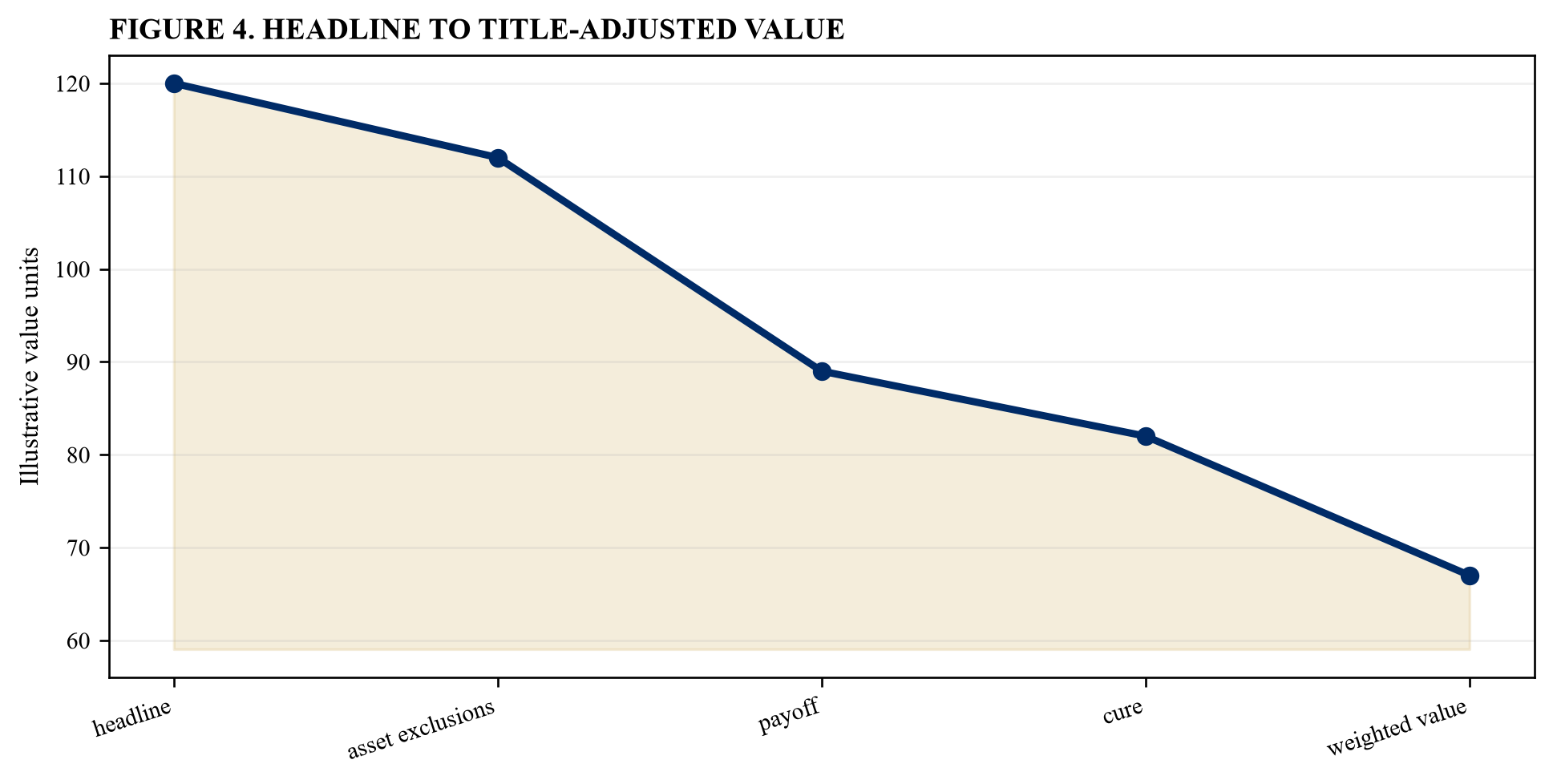
Illustrative analytical scenario; transaction evidence should replace model values.
36. Design preconditions direct payments and escrows
The seller should match each title risk to a condition, direct payoff, release, escrow, holdback, insurance, covenant, indemnity or walk right. Relevant evidence includes exception register, legal advice, funding model, negotiation record and counterparty credit assessment. The decision asks which mechanism makes title delivery sufficiently certain. A reliable answer links financial analysis to title, transfer mechanics, operating capability and the applicable approval process [105][106][107][109].
The decision pack should contain a remedy-to-risk allocation matrix. It should show calculation dates, owners, dependencies and the documents that implement the conclusion. This creates a defensible record for later scrutiny and post-completion reconciliation.
A material failure occurs when generic warranties can be weak where the seller has limited credit or time. The response should identify a funded cure, alternative perimeter or fallback route. Continuing without one can reduce going-concern value and creditor recovery.
37. Build the completion release matrix
The transaction team should list every asset, security interest, claimant, payoff amount, release form, filing, signatory, timestamp, dependency and fallback. Evidence should come from executed releases, payoff letters, filing forms, court orders, consents and confirmations. The controlling question is what must occur simultaneously for clean and usable title. The answer should be dated, attributed and linked to the legal entity, asset, liability or operating dependency it describes [107][109][110][121].
The controlled output is a completion release matrix. It should state the source, calculation method, owner, exceptions, required approvals and the next irreversible deadline. This allows a board, officeholder, creditor or buyer to reproduce the conclusion when facts change.
The principal risk is that one omitted signature or filing condition can compromise the entire transfer chain. The team should quantify the effect on liquidity, stand-alone earnings, creditor recoveries, operating continuity and completion probability. A material exception should update the perimeter and funding plan.
38. Control funds flow and simultaneous release
This workstream requires the company and its advisers to sequence sources, payments, escrow, releases, documents, account control and confirmation so cash moves only against authorised evidence, using funding agreements, bank instructions, signed documents, completion statement and control checklist. The practical test is whether every payment produces its required title or release result. Analysis should use one cut-off date so that cash, claims, contracts, people and transaction documents reconcile [107][109][110][127].
Decision-makers should maintain a controlled funds-flow and evidence book. It should distinguish legal ownership from economic allocation, current evidence from forecast assumptions and committed funding from indications. Qualified advisers retain responsibility for legal, insolvency, tax, pensions, accounting and regulatory judgements.
Execution can fail when cash can leave while an encumbrance, asset or consent remains outstanding. Each dependency needs a control, evidence threshold, escalation route and decision time. The transaction remains viable only while the funded separation plan can absorb a credible delay or shortfall.
39. Govern unresolved title items through closing
The readiness team should assign an owner, evidence threshold, deadline, escalation and authorised fallback to every open item and freeze changes near completion. The evidence base includes exception register, completion checklist, issue log, approvals and transaction timetable. The central question is which gaps are cured, priced, allocated, waived or stop the deal. Conclusions should remain at entity and dependency level because the failing group may have pooled cash, shared rights and cross-guarantees [108][109][121][138].
The required deliverable is an authorised closing-control dashboard. It should connect the proposed sale documents to the stand-alone operating model and the residual estate. Every material assumption should show its source and sensitivity.
The downside is that commercial momentum can turn a conditional assumption into an undocumented waiver. Management should test the base case and a combined downside against minimum cash, customer continuity and the completion timetable. Unsupported benefits should not be treated as available funding.
40. Register transfers and close residual gaps in the first hundred days
The seller should complete post-close filings, record changes, perfect security, update custodians, transfer access and evidence closure of residual items. Relevant evidence includes completion book, registry receipts, confirmations, access tests, operating records and board reporting. The decision asks who owns each closure action and what proves completion. A reliable answer links financial analysis to title, transfer mechanics, operating capability and the applicable approval process [107][108][110][121].
The decision pack should contain a hundred-day title closure and value-protection plan. It should show calculation dates, owners, dependencies and the documents that implement the conclusion. This creates a defensible record for later scrutiny and post-completion reconciliation.
A material failure occurs when title defects can fall out of governance after ownership changes while their economic effect persists. The response should identify a funded cure, alternative perimeter or fallback route. Continuing without one can reduce going-concern value and creditor recovery.
Table 5. Title-control implementation
| Horizon | Priority | Evidence of control |
|---|---|---|
| 48 hours | perimeter, authority and searches | dated evidence map |
| days 3 to 7 | instruments and physical checks | reconciled exceptions |
| to completion | payoff, release and funds flow | signed evidence book |
| day 1 to 100 | registrations and residual closure | receipts, confirmations and accountable owners |
Values and scores are analytical scenarios; transaction evidence should replace model values.
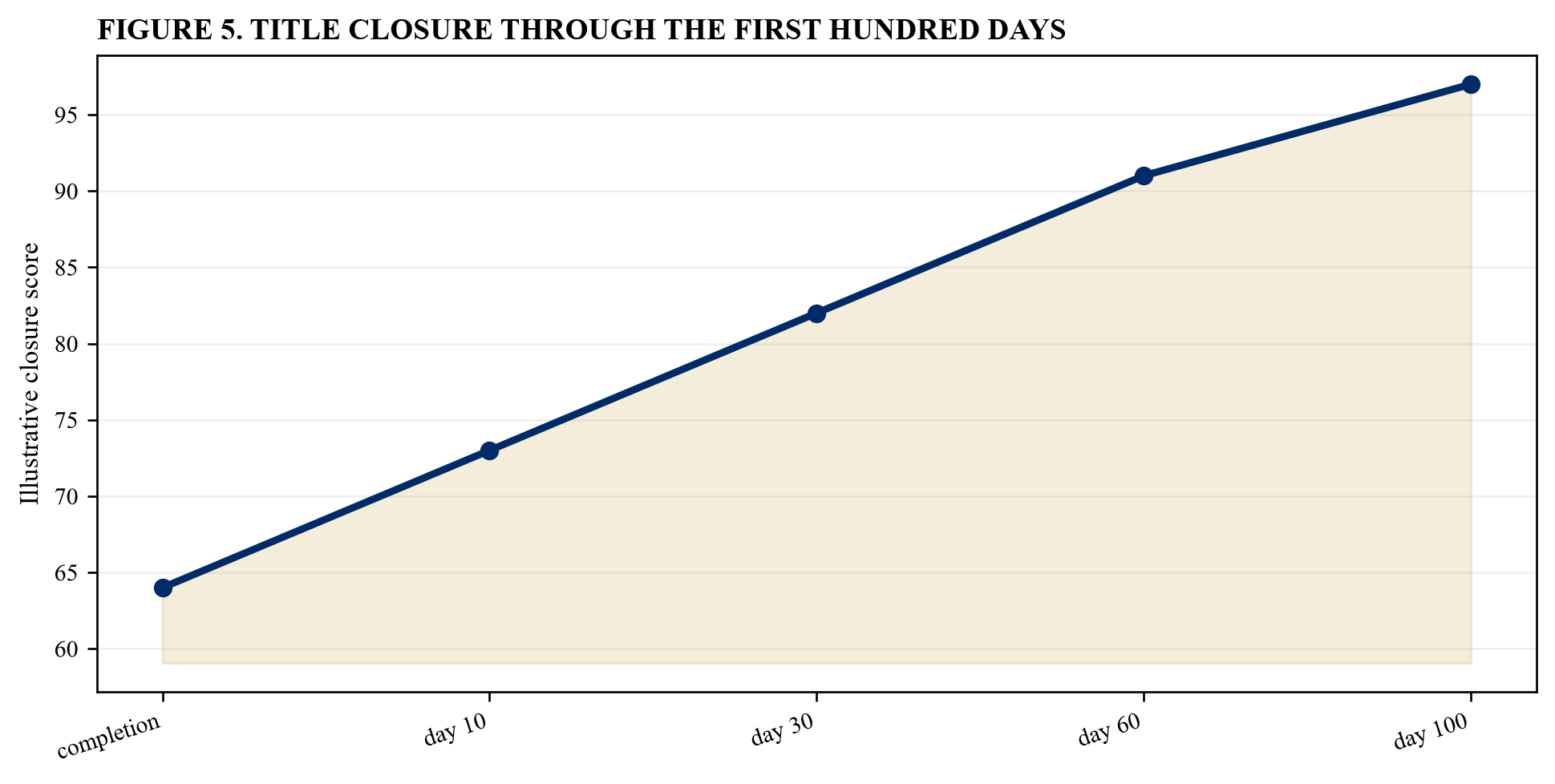
Illustrative analytical scenario; transaction evidence should replace model values.
References
- UK Parliament, Insolvency Act 1986, https://www.legislation.gov.uk/ukpga/1986/45/contents
- UK Parliament, Insolvency Rules 2016, https://www.legislation.gov.uk/uksi/2016/1024/contents
- UNCITRAL, Model Law on Enterprise Group Insolvency, https://uncitral.un.org/en/MLEGI
- World Bank, Principles for Effective Insolvency and Creditor Debtor Regimes, https://www.worldbank.org/en/brief/2026/02/24/the-world-bank-principles-for-effective-insolvency-and-creditor-rights
- UK Government, Corporate Financial Distress Guidance, https://www.gov.uk/government/publications/the-sourcing-and-consultancy-playbooks/corporate-financial-distress-guidance-note-html
- UK Insolvency Service, Spotting the Signs of Company Distress, https://www.gov.uk/guidance/director-information-hub-spotting-the-signs-of-company-distress
- UK Government, Put Your Company into Administration, https://www.gov.uk/put-your-company-into-administration
- UNCITRAL, Legislative Guide on Insolvency Law, https://uncitral.un.org/en/texts/insolvency/legislativeguides/insolvency_law
- UK Companies House, Search the Register, https://find-and-update.company-information.service.gov.uk/
- UK Parliament, Companies Act 2006, https://www.legislation.gov.uk/ukpga/2006/46/contents
- SEC, Search Filings, https://www.sec.gov/search-filings
- IFRS Foundation, IFRS 13 Fair Value Measurement, https://www.ifrs.org/issued-standards/list-of-standards/ifrs-13-fair-value-measurement/
- International Valuation Standards Council, Standards, https://www.ivsc.org/standards/
- ISO, ISO 9001 Quality Management, https://www.iso.org/standard/62085.html
- ISO, ISO 22301 Business Continuity, https://www.iso.org/standard/75106.html
- COSO, Internal Control Framework, https://www.coso.org/guidance-on-ic
- IFRS Foundation, IFRS Accounting Standards, https://www.ifrs.org/issued-standards/list-of-standards/
- PCAOB, Audit Evidence AS 1105, https://pcaobus.org/oversight/standards/auditing-standards/details/AS1105
- IAASB, International Standards on Auditing, https://www.iaasb.org/publications
- NIST, Digital Evidence and Forensics, https://www.nist.gov/programs-projects/digital-and-multimedia-forensics
- UK National Archives, Records Management, https://www.nationalarchives.gov.uk/information-management/
- ISO, ISO 15489 Records Management, https://www.iso.org/standard/62542.html
- UK Government, Managing Public Money, https://www.gov.uk/government/publications/managing-public-money
- US GAO, Standards for Internal Control, https://www.gao.gov/products/gao-14-704g
- UK Companies House, People with Significant Control, https://www.gov.uk/guidance/people-with-significant-control-pscs
- FATF, Beneficial Ownership of Legal Persons, https://www.fatf-gafi.org/en/publications/Fatfrecommendations/Guidance-Beneficial-Ownership-Legal-Persons.html
- FATF, Recommendations, https://www.fatf-gafi.org/en/publications/Fatfrecommendations/Fatf-recommendations.html
- UK Government, Director Responsibilities, https://www.gov.uk/company-director-responsibilities
- Delaware Code, General Corporation Law, https://delcode.delaware.gov/title8/c001/
- WIPO, Intellectual Property and Business, https://www.wipo.int/sme/en/
- HM Land Registry, Search the Register, https://www.gov.uk/get-information-about-property-and-land/search-the-register
- HM Land Registry, How to Read a Title Register and Plan, https://www.gov.uk/government/publications/how-to-read-a-title-register-and-title-plan
- UK Companies House, Register a Charge, https://www.gov.uk/government/publications/register-particulars-of-a-charge-mr01
- US Code, Bankruptcy Code Section 506, https://uscode.house.gov/view.xhtml?req=granuleid:USC-prelim-title11-section506
- UNCITRAL, Model Law on Secured Transactions, https://uncitral.un.org/en/texts/securityinterests/modellaw/secured_transactions
- World Bank, Secured Transactions and Collateral Registries, https://www.worldbank.org/en/topic/financialsector/brief/collateral-registries
- FCA, Client Assets, https://www.fca.org.uk/firms/client-money-assets
- UK Finance, Confirmation of Payee, https://www.ukfinance.org.uk/policy-and-guidance/guidance/confirmation-payee
- Federal Reserve, Account Services, https://www.frbservices.org/financial-services/accounting
- IFRS Foundation, IAS 7 Statement of Cash Flows, https://www.ifrs.org/issued-standards/list-of-standards/ias-7-statement-of-cash-flows/
- UK Government, Cash Flow Forecasting Guidance, https://www.gov.uk/guidance/cash-flow-forecasting
- Loan Market Association, Documents and Guidelines, https://www.lma.eu.com/documents-guidelines/documents
- Federal Reserve, Supervision and Regulation, https://www.federalreserve.gov/supervisionreg.htm
- US Code, Bankruptcy Code Section 507, https://uscode.house.gov/view.xhtml?req=granuleid:USC-prelim-title11-section507
- IFRS Foundation, IFRS 15 Revenue, https://www.ifrs.org/issued-standards/list-of-standards/ifrs-15-revenue-from-contracts-with-customers/
- SEC, Revenue Recognition Staff Accounting Bulletin 116, https://www.sec.gov/files/sab116.pdf
- UK Parliament, Contracts Rights of Third Parties Act 1999, https://www.legislation.gov.uk/ukpga/1999/31/contents
- UNIDROIT, Principles of International Commercial Contracts, https://www.unidroit.org/instruments/commercial-contracts/unidroit-principles-2016/
- UK Government, Supplier Failure Contingency Planning, https://www.gov.uk/government/publications/corporate-financial-distress
- ISO, ISO 28000 Security and Resilience, https://www.iso.org/standard/79612.html
- IFRS Foundation, IAS 2 Inventories, https://www.ifrs.org/issued-standards/list-of-standards/ias-2-inventories/
- IFRS Foundation, IAS 1 Presentation of Financial Statements, https://www.ifrs.org/issued-standards/list-of-standards/ias-1-presentation-of-financial-statements/
- PCAOB, Auditing Inventories AS 2510, https://pcaobus.org/oversight/standards/auditing-standards/details/AS2510
- UK Parliament, Transfer of Undertakings Regulations 2006, https://www.legislation.gov.uk/uksi/2006/246/contents
- UK Government, Transfers of Employment Contracts, https://www.gov.uk/transfers-takeovers/transfers-of-employment-contracts
- US Department of Labor, WARN Act, https://www.dol.gov/agencies/eta/layoffs/warn
- UK Government, Right to Work Checks, https://www.gov.uk/check-job-applicant-right-to-work
- IFRS Foundation, IAS 19 Employee Benefits, https://www.ifrs.org/issued-standards/list-of-standards/ias-19-employee-benefits/
- The Pensions Regulator, Employers, https://www.thepensionsregulator.gov.uk/en/employers
- Pension Protection Fund, Section 179 Guidance, https://www.ppf.co.uk/section-179-valuation-guidance
- PBGC, Plan Terminations, https://www.pbgc.gov/employers-practitioners/plan-terminations
- UK Government, Corporation Tax, https://www.gov.uk/corporation-tax
- OECD, Transfer Pricing Guidelines, https://www.oecd.org/tax/transfer-pricing/oecd-transfer-pricing-guidelines-for-multinational-enterprises-and-tax-administrations-20769717.htm
- IRS, Businesses, https://www.irs.gov/businesses
- European Commission, Taxation and Customs, https://taxation-customs.ec.europa.eu/index_en
- FCA, Financial Services Register, https://register.fca.org.uk/
- FCA, Submit a Change in Control Notification, https://www.fca.org.uk/firms/change-control/submit-notification
- Ofgem, Licences and Licence Conditions, https://www.ofgem.gov.uk/energy-policy-and-regulation/industry-licensing
- Ofcom, Licensing, https://www.ofcom.org.uk/spectrum/frequencies/licensing/
- UK CMA, Merging Your Business, https://www.gov.uk/guidance/merging-your-business
- European Union, Council Regulation 139/2004, https://eur-lex.europa.eu/eli/reg/2004/139/oj
- UK Government, National Security and Investment Act Guidance, https://www.gov.uk/guidance/national-security-and-investment-act-guidance-on-acquisitions
- US Treasury, CFIUS Laws and Guidance, https://home.treasury.gov/policy-issues/international/the-committee-on-foreign-investment-in-the-united-states-cfius/cfius-laws-and-guidance
- UK Government, UK Sanctions List, https://www.gov.uk/government/publications/the-uk-sanctions-list
- OFAC, Sanctions Programs, https://ofac.treasury.gov/sanctions-programs-and-country-information
- FinCEN, Customer Due Diligence, https://www.fincen.gov/resources/statutes-and-regulations/cdd-final-rule
- WIPO, Global Brand Database, https://branddb.wipo.int/
- WIPO, PATENTSCOPE, https://patentscope.wipo.int/
- UK IPO, Search for a Patent, https://www.gov.uk/search-for-patent
- ISO, ISO IEC 25010 Systems and Software Quality, https://www.iso.org/standard/78176.html
- NIST, Cybersecurity Framework 2.0, https://www.nist.gov/cyberframework
- NIST, Secure Software Development Framework, https://csrc.nist.gov/Projects/ssdf
- CISA, Software Bill of Materials, https://www.cisa.gov/sbom
- ICO, Data Sharing Code of Practice, https://ico.org.uk/for-organisations/uk-gdpr-guidance-and-resources/data-sharing/data-sharing-a-code-of-practice/
- European Union, General Data Protection Regulation, https://eur-lex.europa.eu/eli/reg/2016/679/oj
- European Data Protection Board, Guidelines, https://www.edpb.europa.eu/our-work-tools/general-guidance/guidelines-recommendations-best-practices_en
- UK Parliament, Data Use and Access Act 2025, https://www.legislation.gov.uk/ukpga/2025/18/contents
- CISA, Cybersecurity Performance Goals, https://www.cisa.gov/cross-sector-cybersecurity-performance-goals
- NIST, Incident Response, https://csrc.nist.gov/pubs/sp/800/61/r3/final
- HM Land Registry, Official Copies, https://www.gov.uk/government/publications/official-copies-of-register-or-plan-registration-oc1
- UK Government, Commercial Property Standard Enquiries, https://www.gov.uk/government/publications/commercial-property-standard-enquiries
- UK Environment Agency, Environmental Permits, https://www.gov.uk/guidance/environmental-permits-how-to-apply
- US EPA, Environmental Permitting, https://www.epa.gov/permits
- UK HSE, Managing Risks and Risk Assessment, https://www.hse.gov.uk/simple-health-safety/risk/
- ISO, ISO 14001 Environmental Management, https://www.iso.org/standard/60857.html
- UK Courts and Tribunals, Find a Court or Tribunal, https://www.gov.uk/find-court-tribunal
- PACER, Public Access to Court Electronic Records, https://pacer.uscourts.gov/
- SEC, Enforcement, https://www.sec.gov/enforcement
- FCA, Insurance Conduct of Business Sourcebook, https://www.handbook.fca.org.uk/handbook/ICOBS/
- EIOPA, Solvency II, https://www.eiopa.europa.eu/browse/regulation-and-policy/solvency-ii_en
- NAIC, Insurance Topics, https://content.naic.org/insurance-topics
- UK Government, Employers Liability Insurance, https://www.gov.uk/employers-liability-insurance
- European Commission, Restructuring and Insolvency Directive, https://eur-lex.europa.eu/eli/dir/2019/1023/oj
- IFRS Foundation, IFRS 3 Business Combinations, https://www.ifrs.org/issued-standards/list-of-standards/ifrs-3-business-combinations/
- UK Parliament, Misrepresentation Act 1967, https://www.legislation.gov.uk/ukpga/1967/7/contents
- UK Parliament, Sale of Goods Act 1979, https://www.legislation.gov.uk/ukpga/1979/54/contents
- UK Law Society, Completion Code, https://www.lawsociety.org.uk/topics/property/completion-code
- ISO, ISO 37301 Compliance Management Systems, https://www.iso.org/standard/75080.html
- United States Code, 11 USC 363 Use Sale or Lease of Property, https://uscode.house.gov/view.xhtml?edition=prelim&num=0&req=granuleid%3AUSC-prelim-title11-section363
- Companies House, Register a Charge for a Limited Company, https://www.gov.uk/guidance/register-a-charge-mortgage-for-a-limited-company
- UNCITRAL, Legislative Guide on Secured Transactions, https://uncitral.un.org/en/texts/securityinterests/legislativeguides/secured_transactions
- UK Government, Business Transfers Takeovers and TUPE: Insolvent Businesses, https://www.gov.uk/transfers-takeovers/insolvent-businesses
- The Pensions Regulator, Clearance, https://www.thepensionsregulator.gov.uk/en/document-library/scheme-management-detailed-guidance/communications-and-reporting-detailed-guidance/clearance
- HM Revenue and Customs, Transfer of a Business as a Going Concern, https://www.gov.uk/guidance/insolvency-practitioner-s-handbook/18-transfer-of-a-business-as-a-going-concern
- HM Revenue and Customs, VAT Notice 700/9 Transfer of a Business as a Going Concern, https://www.gov.uk/guidance/transfer-a-business-as-a-going-concern-and-vat-notice-7009
- United States Environmental Protection Agency, Potentially Responsible Party Search Manual Chapter 3, https://www.epa.gov/sites/default/files/2017-10/documents/prp-man-chap3-17.pdf
- UK Insolvency Service, Requirements for Independent Scrutiny of Disposals in Administration, https://www.gov.uk/government/publications/requirements-for-independent-scrutiny-of-the-disposal-of-assets-in-administration-including-pre-pack-sales
- United States Code, 11 USC 365 Executory Contracts and Unexpired Leases, https://uscode.house.gov/view.xhtml?edition=prelim&num=0&req=granuleid%3AUSC-prelim-title11-section365
- The Pensions Regulator, Material Detriment Employer Insolvency and Employer Resources, https://www.thepensionsregulator.gov.uk/en/document-library/scheme-management-detailed-guidance/administration-detailed-guidance/material-detriment-test
- UK Parliament, Administration Restrictions on Disposal to Connected Persons Regulations 2021, https://www.legislation.gov.uk/uksi/2021/427/contents/made
- HM Land Registry, Search the Register, https://www.gov.uk/get-information-about-property-and-land/search-the-register
- HM Land Registry, Portal Guidance for Official Copies, https://www.gov.uk/guidance/land-registry-portal-how-to-request-official-copies
- UK Intellectual Property Office, Search for a Trade Mark, https://www.gov.uk/search-for-trademark
- Companies House, Company Information Service, https://find-and-update.company-information.service.gov.uk/
- UNCITRAL, Model Law on Secured Transactions, https://uncitral.un.org/en/texts/securityinterests/modellaw/secured_transactions
- UNCITRAL, Guide on the Implementation of a Security Rights Registry, https://uncitral.un.org/en/texts/securityinterests/legislativeguides/security_rights_registry
- United States Code, 11 USC 363 Cash Collateral and Sale Provisions, https://uscode.house.gov/view.xhtml?edition=prelim&num=0&req=granuleid%3AUSC-prelim-title11-section363
- HM Land Registry, About Our Services, https://www.gov.uk/government/organisations/land-registry/about/about-our-services
- UK Civil Aviation Authority, Aircraft Mortgages Register, https://www.caa.co.uk/commercial-industry/aircraft/airworthiness/aircraft-registration/aircraft-mortgages/
- UK Ship Register, Register a Vessel, https://www.gov.uk/register-a-boat/the-uk-ship-register
- WIPO, Global Brand Database, https://branddb.wipo.int/
- UK Information Commissioner's Office, Data Sharing Code of Practice, https://ico.org.uk/for-organisations/uk-gdpr-guidance-and-resources/data-sharing/data-sharing-a-code-of-practice/
- UK Government, Licence Finder, https://www.gov.uk/licence-finder
- HM Courts and Tribunals Service, Find a Court or Tribunal, https://www.gov.uk/find-court-tribunal
- HM Revenue and Customs, Check if You Owe HMRC, https://www.gov.uk/check-income-tax-current-year
- Environment Agency, Environmental Permits Guidance, https://www.gov.uk/guidance/environmental-permits-how-to-apply
- UK Government, Business Transfers and Takeovers, https://www.gov.uk/transfers-takeovers
- ISO, ISO 37301 Compliance Management Systems, https://www.iso.org/standard/75080.html
