

1. Define the exit decision
A board does not approve TSA exit merely because a contract reaches its scheduled end. It approves the transfer of operating responsibility from a temporary provider to a recipient-controlled capability. The decision requires evidence that the business can continue serving customers, collecting cash, meeting regulatory obligations, protecting data and producing reliable financial information after the service ends.
Each TSA service therefore needs a defined recipient outcome. Payroll exit means employees are paid accurately and on time from the recipient's authorised system. Finance exit means opening balances, master data, interfaces, controls and reporting are reconciled. Customer-platform exit means orders, entitlements, billing and support work without an unapproved dependency on the provider. A technical deployment without the full operating outcome is incomplete.
The board should govern a portfolio of exit decisions. Services differ in criticality, architecture, data sensitivity, change complexity and fallback options. A low-risk reporting service can exit through a simple transfer. A tightly integrated identity, manufacturing, treasury or customer service may require a controlled dual run, independent recovery capability and a board-approved cutover window.
The approval unit should be small enough to expose risk and large enough to represent a complete service. Approving an application alone can miss manual work, data feeds and controls. Approving an entire function at once can hide one unsafe dependency among many complete activities. Service outcomes provide a practical middle level for governance.
The exit decision should state the service, owner, impact tolerance, acceptance evidence, residual dependency, contingency, maximum rollback period and financial consequence. This creates a record that can withstand operational, audit and investor scrutiny.
2. Understand what a TSA does and does not solve
A TSA allocates temporary responsibilities after legal completion. It can preserve access to people, systems, facilities, data processing and operational routines while the recipient builds or procures replacements. It can also define service levels, pricing, change control, incident handling, liability and termination.
The agreement does not create the recipient's end-state capability. It may preserve a legacy configuration that was designed for an integrated group. It may exclude projects, enhancements, new markets, security changes or regulatory work. Service levels can reflect reasonable efforts rather than a commercial managed-service standard. Provider personnel may prioritise the retained business when resources are constrained.
The contractual schedule can conceal technical coupling. One named service may rely on several applications, interfaces, databases, licences, accounts and teams. A provider may need access to recipient data after the apparent service exit because another service remains active. A receiving system may technically operate while its data lineage, reconciliation or recovery process remains incomplete.
The operating programme must therefore decompose the TSA into capabilities and dependencies. Contractual expiry remains an important constraint, but readiness is proved through the recipient operating model and tested evidence.
Both parties should maintain one interpretation of the schedule. Disputes often arise when a recipient views an activity as included and the provider views it as project work or an omitted service. A controlled catalogue, decision log and change process reduce ambiguity before it affects continuity. Commercial disagreements should be escalated without delaying urgent operational protection.
3. Build a service and dependency map
The exit baseline should list every service, recipient, provider, service owner, business process, application, interface, data set, identity domain, facility, supplier, control and jurisdiction. The map should include services supplied in both directions and informal support that may not appear in the signed schedule.
Mapping should begin with important business services and customer outcomes. The FCA requires in-scope firms to identify the people, processes, technology, facilities and information needed to deliver important business services, including relevant third parties. Its March 2026 observations emphasise dynamic mapping, governance and quantitative impact measures alongside time-based tolerances. [1] These principles provide a useful design discipline even where the transaction parties are outside the FCA perimeter.
Dependencies should be directional. A billing platform may depend on customer master data from one system, pricing from another, identity services from the provider and a bank interface controlled by the recipient. The exit sequence must respect those directions. Retiring identity before dependent applications are migrated can create immediate failure.
Each dependency should record the source of evidence and its confidence. Architecture documents can be stale. Configuration scans, access logs, interface monitoring, contract records and reconciled data flows provide stronger evidence. Unknown dependencies should be treated as programme risks with discovery actions and owners.
The map should also distinguish hard and soft dependencies. A hard dependency prevents service operation, such as authentication or a required data feed. A soft dependency reduces efficiency or assurance, such as a reporting tool that can be replaced temporarily by a controlled manual process. This distinction supports sequence, contingency and funding decisions.
| Field | Required record | Evidence | Exit use | Failure signal |
|---|---|---|---|---|
| Service outcome | Customer or control result delivered | Process map and owner approval | Defines acceptance | Activity listed without outcome |
| Dependency | System, data, person, supplier or facility | Scan, log, contract or interview | Determines sequence | Undocumented shared component |
| Impact tolerance | Maximum tolerable disruption and loss | Risk approval and scenario test | Sets cutover limits | Generic severity label only |
| End-state capability | Recipient-owned or contracted replacement | Design, build record and contract | Proves independence | TSA copied without redesign |
| Exit evidence | Test, reconciliation and control result | Signed evidence pack | Supports approval | Project status used as proof |
| Fallback | Rollback, manual work-around or extension | Tested recovery plan | Limits downside | Expiry date is the only response |
Original framework. The service register should reconcile to the signed agreement, operating map and technology inventory.
4. Design the target operating model first
Exit design should start with the operating model required after the TSA. The recipient must decide which capabilities it will own, outsource, share under a durable commercial arrangement or discontinue. This decision controls architecture, people, contracts, data and cost.
A copy of the provider's organisation can be excessive or incomplete. The separated business may have different products, jurisdictions, customers and reporting obligations. It may choose a cloud platform instead of a replicated data centre, a managed security service instead of an internal team, or regional operations instead of a group hub. These choices change both the migration path and the control environment.
The target model should identify accountable executives, process owners, system owners, data owners and control owners. Responsibility for a service cannot sit with a project office after exit. The enduring organisation needs budget, competence, access and escalation rights.
The model should include normal operations, peak volumes, incidents, month-end, year-end, regulatory reporting and disaster recovery. A replacement that works during a quiet test period can fail at quarter-end or during a customer incident. Capacity and resilience therefore belong in the design baseline.
Design authority should remain connected to the transaction thesis. A separation intended to create a more focused and agile business can be undermined if the recipient inherits every legacy process. Conversely, aggressive simplification can remove controls or capabilities that investors assumed would exist. Operating choices should reconcile to the financial case and disclosed strategy.
5. Translate the contract into an exit architecture
The TSA should be converted into a service-by-service control sheet. Scope, exclusions, volumes, service levels, charges, duration, extension rights, change rules, incident obligations, audit rights, data terms, intellectual-property rights and termination assistance should be visible beside the operating plan.
Recent public agreements show the range of structures. Kenvue's amended TSA with Johnson & Johnson describes a general service-period deadline of twenty-four months, with a defined extension where regulatory approvals delay transition. [2] The Jacobs and Amentum TSA filed in 2024 includes an administrative fee and formal service schedules. [3] Western Digital disclosed that transition support for Sandisk covered twelve functional areas for periods up to eighteen months, with mechanisms for additions, extensions, termination, governance and dispute resolution. [4] These documents are transaction-specific evidence of contractual design, not universal benchmarks.
The control sheet should identify the last date for notice, the price of extension, the process for omitted services and the consequences of partial exit. A programme that discovers an extension requirement after the notice deadline loses negotiating leverage.
Service-level obligations need measurable definitions. Terms such as materially consistent, reasonable assistance or normal course can be appropriate contractual standards but provide weak programme metrics. The operating plan should translate them into volumes, response times, recovery objectives, evidence retention and escalation thresholds without implying rights that the agreement does not grant.
Contract and build milestones should be linked. Supplier selection, licence transfer, data extraction, testing and cutover must finish before the contractual stop or an approved extension. Legal teams should receive evidence of technical progress early enough to exercise rights.
6. Treat data separation as a controlled transaction
Data separation is more than file movement. The parties must determine what data belongs to the recipient, what the provider may retain, what must be restricted, which records are shared and how historical context will be preserved. The result should support operations, rights, audit, litigation, tax, privacy and regulatory obligations.
The data map should cover source, owner, purpose, lawful basis, jurisdiction, classification, retention, quality, lineage, transformation and destination. It should distinguish structured records, documents, messages, logs, models, backups and derived data. Shared tables and data lakes often require row-level or attribute-level separation rather than a simple database copy.
The UK Information Commissioner's Office states that data sharing following a merger or acquisition should form part of due diligence, that data-protection principles and documentation apply, and that technical advice is needed where different systems create risks of loss, corruption or degradation. [5] Those issues also arise in demergers because control and processing responsibilities change.
Migration evidence should include extraction totals, transformation rules, rejection logs, control totals, sample verification, reconciliation to financial or operational records, security validation and business-owner acceptance. Deletion or retention by the provider should be evidenced separately. A successful import does not prove complete or lawful separation.
Historical data can create a difficult trade-off between operating usefulness and migration burden. The recipient may need detailed history for customer service, warranty, model performance, tax or litigation. Moving every record can increase cost, privacy exposure and testing. A documented archive-access solution can be suitable where ownership, access, retention, retrieval time and eventual disposition are clear.
7. Separate identity and access without creating blind spots
Identity is a critical dependency because it controls users, service accounts, privileged access, applications and data. The recipient needs an independent identity authority, joiner-mover-leaver process, authentication policy, privileged-access control and emergency-access procedure before dependent services exit.
NIST's zero-trust architecture removes implicit trust based on network location or asset ownership and requires authentication and authorisation before access to enterprise resources. [6] In a separation, this means that inherited network reach or parent credentials should not become the permanent access model. User, device, service and application identities need explicit policies.
Identity migration should distinguish workforce users, customers, suppliers, robots, interfaces, databases, certificates, keys and API clients. Service accounts are frequently overlooked because they do not appear in employee lists. Expired certificates or unrotated keys can cause delayed failure after a seemingly successful cutover.
The parties should reduce standing cross-company access as services exit. Access logs should be monitored during transition, and residual provider access should have a named purpose, expiry and owner. Break-glass access should be tested and independently reviewed.
Privileged access needs separate governance because administrators can change configurations, extract data or disable controls. The recipient should establish its own privileged-access vault, approval workflow, session logging and emergency process. Shared administrator credentials should be retired. Where vendor personnel retain access, contractual authority and technical enforcement should agree.
8. Sequence applications, infrastructure and interfaces
Applications should be grouped by business service and dependency chain rather than migrated as an unrelated list. The programme should identify systems of record, systems of engagement, analytics, integration, infrastructure, monitoring, backup and recovery.
Four broad exit patterns are available. The recipient can clone a segregated instance, migrate to an existing platform, implement a new platform or retain a durable third-party service. Each pattern has different data, licence, control and timing implications. A clone can be fast but preserve technical debt. A new platform can improve the end state but increase implementation risk.
Interfaces require particular discipline. A system can pass standalone tests while failing when real upstream timing, data quality or downstream acknowledgements are introduced. Interface inventory should include direction, frequency, protocol, schema, authentication, error handling, volume and business owner.
Infrastructure decisions should address networks, cloud accounts, domains, devices, monitoring, batch scheduling, storage, backup and recovery. The recipient should own observability before cutover so that it can diagnose failure without relying on the provider.
Decommissioning should be planned beside migration. Duplicate interfaces, dormant accounts, temporary network routes and abandoned environments expand cost and risk. Each exit work package should state what the provider will retire, what the recipient will retain and how both parties will confirm that no required record or service is lost.
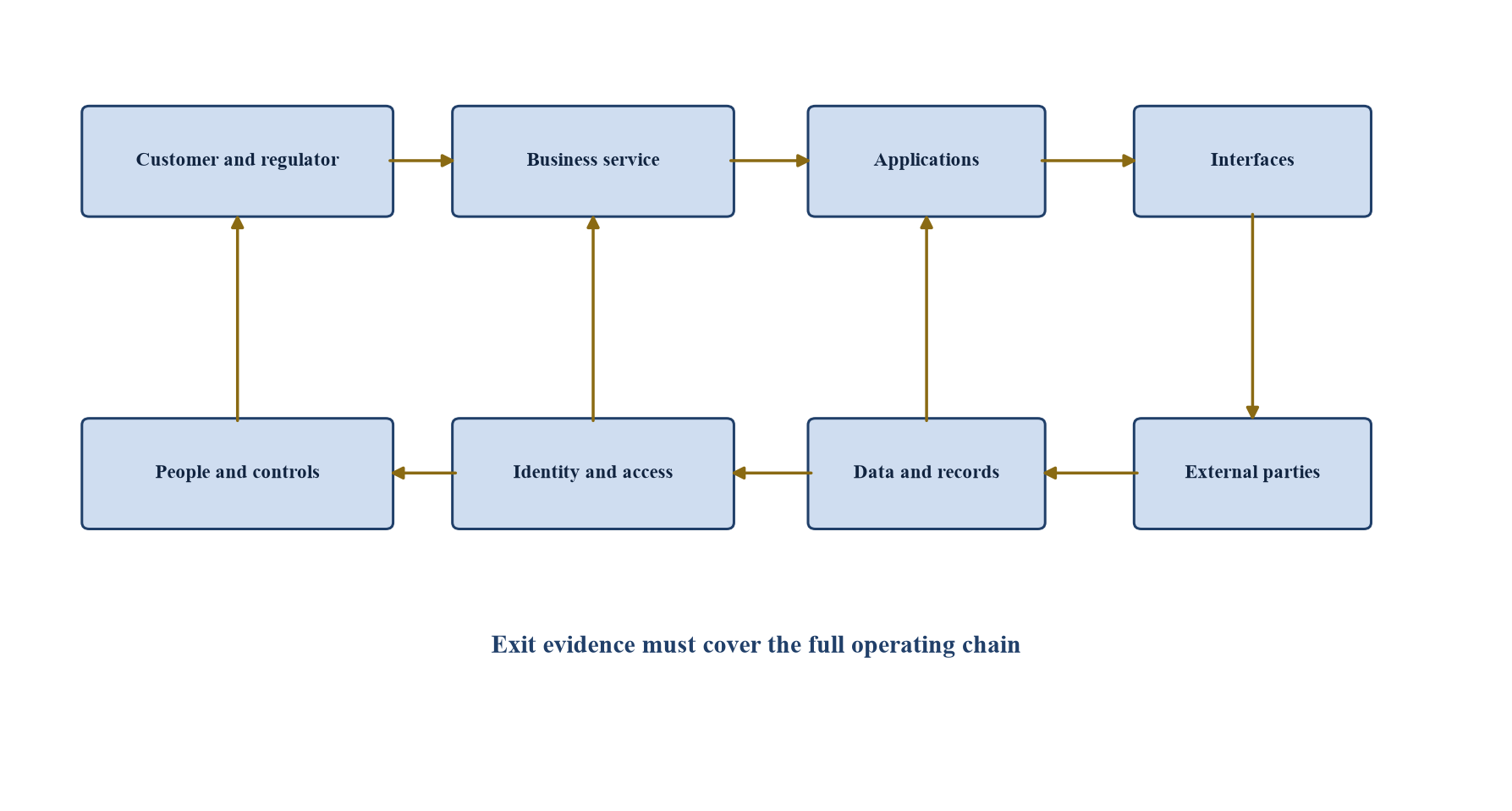
Original framework. Exit sequence should follow service outcomes and directional dependencies.
9. Build cyber security into the separation perimeter
Separation changes the attack surface. New domains, networks, cloud accounts, remote connections, data transfers and suppliers are introduced while teams are under delivery pressure. Temporary exceptions can become persistent vulnerabilities if they are not recorded and closed.
NIST CSF 2.0 organises cyber-risk outcomes around Govern, Identify, Protect, Detect, Respond and Recover. [7] The framework is useful for assessing both the transition state and the recipient's end state. Asset inventory, access control, data security, platform security, monitoring, incident response and recovery should be tested within the separation programme.
CISA's cross-sector performance goals identify a prioritised baseline of practices for organisations and critical infrastructure, including identity protection, backups and other high-impact controls. [8] A live programme should select controls appropriate to sector, threat and regulatory obligations rather than treating a generic checklist as sufficient.
The recipient needs its own incident command, contact lists, logging, detection, vulnerability management, backup and recovery. The provider and recipient also need a joint incident protocol while the TSA remains active. The protocol should establish decision rights, evidence preservation, regulator and customer communications, cost and post-incident review.
Public-company obligations can shorten the decision window. The SEC's 2023 cyber rules require disclosure of a material incident generally within four business days after materiality is determined and annual information about cyber-risk management, strategy and governance. [12] Separation governance should route facts quickly to the legal and disclosure teams without allowing disclosure considerations to interfere with containment and recovery.
10. Connect exit to privacy, records and legal hold
Personal data, confidential information, legal records and intellectual property require explicit handling. The separation agreement, TSA, data-processing terms and local law should align on controller and processor roles, instructions, sub-processors, locations, incident notice, retention, audit and deletion.
The data team should not assume that every historical record can be copied. Purpose limitation, confidentiality, contractual restrictions, bank secrecy, health information and export controls can constrain transfer. Some records may need redaction, segregation, pseudonymisation or controlled access.
Legal hold and investigation data require continuity. The parties should preserve searchability, chain of custody and responsible ownership. Deleting provider copies before confirming recipient completeness can impair obligations; indefinite retention creates privacy and confidentiality exposure.
Exit evidence should include a data-transfer record, unresolved exceptions, retention schedule, provider deletion certificate where appropriate and business-owner approval. These records should remain accessible after programme closure.
11. Rebuild finance and control capability
Finance separation affects customer and supplier masters, chart of accounts, bank accounts, treasury, tax, payroll, fixed assets, consolidation, planning, reporting and internal control. Technical migration should be reconciled to opening balances and transaction populations.
The recipient needs a close calendar and control matrix for the first independent reporting periods. Interfaces between operational and financial systems should be tested with representative volumes, currencies, taxes, cut-off events, credits and exceptions. Manual work-arounds should have owners, capacity limits and review controls.
IFRS 5 requires separate presentation of certain assets and liabilities classified as held for sale and the results of discontinued operations. [9] Applicable reporting will depend on the transaction and jurisdiction, but the operational separation plan should support the accounting perimeter and traceability of information.
Control testing should cover access, segregation of duties, master-data changes, journal approval, reconciliations, revenue, purchasing, payroll, cash and reporting. A clean technology test without financial reconciliation cannot support finance exit.
12. Protect operational continuity
Operational continuity should be expressed through service outcomes and impact tolerances. A time-based recovery target is useful, but it may not capture transaction backlogs, customer harm, safety, market integrity, financial loss or regulatory deadlines.
The FCA distinguishes impact tolerance from recovery time and encourages additional metrics such as customer categories, transaction values, volumes and estimated losses. [10] A separation programme can apply the same logic to define maximum outage, maximum unreconciled transactions, maximum data loss, maximum customer backlog and maximum manual-processing duration.
Scenario tests should be severe but plausible. Examples include failed data load, identity outage, corrupted interface, unavailable provider expert, supplier delay, cyber incident during cutover, month-end failure and rollback after partial processing. Tests should include decision-makers and communications, not only technical teams.
Continuity evidence should show that the recipient can remain within approved tolerances, recover the service and process the backlog. A system restored after six hours can still create unacceptable harm if three days are required to reconcile missed transactions.
| Evidence domain | Minimum proof | Quantitative measure | Accountable owner | Exit blocker |
|---|---|---|---|---|
| Process | End-to-end scenario completed | Success rate and backlog clearance | Business service owner | Critical step lacks capacity |
| Data | Population and control totals reconciled | Completeness, accuracy and rejected records | Data owner | Material unexplained variance |
| Technology | Capacity, monitoring and recovery tested | Availability, latency, recovery and data loss | Technology owner | Recovery exceeds tolerance |
| Control | Key controls operated with evidence | Exceptions and remediation closure | Control owner | Financial or regulatory control fails |
| People | Roles staffed and access approved | Coverage, training and escalation response | Functional executive | Single unmitigated dependency |
| Supplier | Contract, support and termination rights active | Service levels and unresolved obligations | Commercial owner | Required consent or licence absent |
Original framework. Evidence should be proportionate to service criticality and jurisdiction.
13. Secure supplier and licence rights
The recipient can build a technically sound platform and still be unable to operate it because contracts, licences or consents remain with the provider. Supplier diligence should identify assignability, change-of-control terms, user metrics, territorial rights, minimum commitments, audit rights, data terms, support and termination.
New contracts should be effective before cutover and should cover implementation as well as steady-state service. A vendor may agree to production support but exclude migration defects. The recipient should understand whether the provider or vendor holds configuration knowledge and whether documentation can be transferred.
Commercial concentration can shift during separation. A provider that previously represented a small part of group spend may become critical to the recipient. Financial diligence, resilience, security, subcontracting and termination plans should be recalibrated for the recipient's dependency. Contract signature should not substitute for operational onboarding and testing.
Licence metrics should be tested against the target model. Named users, processors, transactions, revenue, devices, environments and affiliates can produce different costs. Parallel environments during migration may require temporary licences that do not appear in the end-state budget.
Supplier exit and concentration risk should be assessed. DORA requires financial entities using ICT services for critical or important functions to maintain comprehensive, documented, tested and periodically reviewed exit plans that permit exit without business disruption, regulatory impairment or detriment to service continuity and quality. [11] The principle is directly relevant to replacement providers selected during a demerger.
14. Transfer knowledge and decision authority
Service delivery depends on tacit knowledge, exception handling and decision authority. Documentation alone rarely captures why a process deviates, which customer needs special treatment or how an ageing system is recovered.
The programme should identify critical roles, named experts, decision rights, recurring cycles, known defects, supplier contacts and escalation paths. Knowledge transfer should use observation, paired operation, reverse shadowing and recipient-led execution. Attendance at a training session is weak evidence; successful recipient-led service under realistic conditions is stronger.
Retention arrangements may be needed for provider and recipient personnel. Their purpose, duration, milestone and cost should be explicit. Reliance on one individual should trigger a succession or external-support plan.
Decision authority should transfer before the person who historically exercised it leaves. The recipient needs approved policies, delegated authorities, bank mandates, system roles and regulatory appointments. A capable team without authority cannot operate independently.
15. Define exit tests before build completion
Acceptance tests should be designed early because they shape architecture and evidence. The service owner should define what must be true for exit, the data required, the scenario, the tolerance and the approver.
Testing should progress from components to interfaces, end-to-end processes, performance, security, recovery and operational rehearsal. Representative production-like data should be used lawfully and securely. Test environments should reflect volumes, configuration and dependencies closely enough to support the conclusion.
Defects need severity, owner, target date and retest evidence. A waiver should state the residual risk, duration, compensating control and approval. High-severity defects should not disappear inside an average pass rate.
The final evidence pack should include requirements traceability, results, reconciliations, defects, waivers, capacity, resilience, access approval, operating procedures, training, supplier readiness and business-owner acceptance. Project completion percentage is not acceptance evidence.
16. Engineer cutover and rollback
Cutover converts tested capability into live responsibility. The runbook should specify sequence, entry criteria, data freeze, extraction, migration, validation, interface activation, business checks, communications, decision points, rollback and command structure.
Each step needs a named operator, expected duration, evidence and latest safe completion time. Dependencies should be visible on one integrated plan. Teams should rehearse the runbook and measure actual duration rather than relying on estimates.
Rollback must be technically and operationally possible. If transactions are processed in the new environment, returning to the provider can require data synchronisation and accounting decisions. The rollback point may therefore occur before the full business test is complete. The board should understand when the decision becomes irreversible.
Post-cutover stabilisation should include enhanced monitoring, daily reconciliation, issue triage, vendor presence and senior decision coverage. Exit is complete after the service operates reliably and the provider dependency is removed or formally bounded.
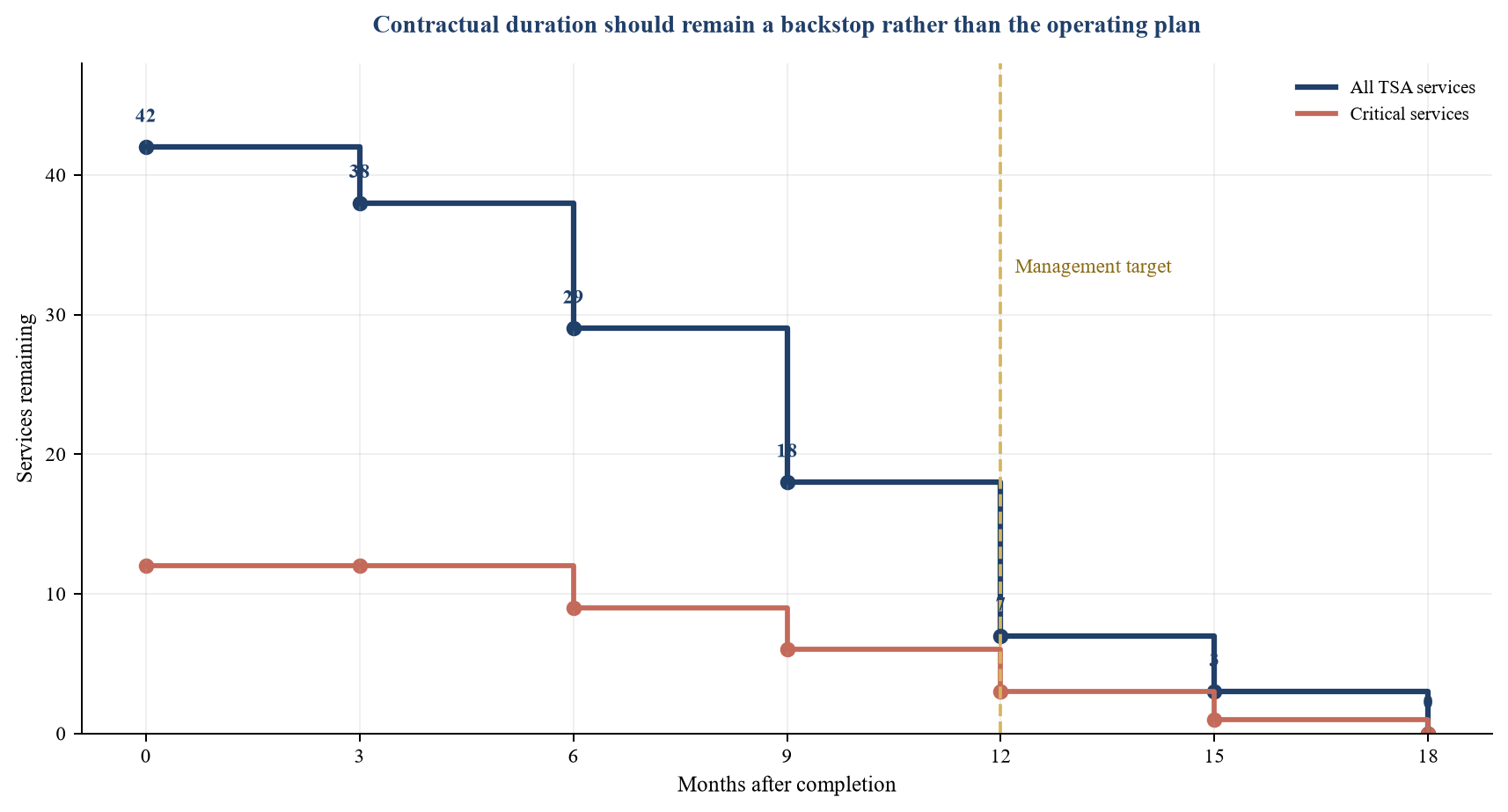
Original scenario. Service counts and timing are wholly hypothetical.
17. Govern the exit portfolio
Governance should combine transaction, business, technology, risk and finance perspectives. The board or delegated transaction committee approves risk appetite, funding, material waivers, extensions and final exit for critical services.
An executive steering committee should review the integrated dependency map, milestones, cost, risks and decisions. Service owners should approve requirements and evidence. A separation management office should maintain configuration control, schedule, cross-workstream dependencies and reporting.
Independent challenge is valuable for material services. Internal audit, risk, cyber security, privacy, finance control or external specialists can test whether evidence supports the claimed readiness. Independence should be proportionate and should not remove accountability from management.
Reporting should show outcomes, not activity. Useful measures include services exited, critical dependencies closed, tests passed within tolerance, unresolved severe defects, data reconciliation, supplier readiness, extension exposure, cash spent and residual provider access.
Governance should control baseline changes. Scope, architecture, cutover date and acceptance criteria can change as facts emerge. Each material change should record the reason, cost, risk, dependency and approver. This prevents a late scope reduction from being reported as delivery progress and preserves an auditable explanation of the final outcome.
18. Model TSA economics and incentives
TSA pricing can use cost recovery, cost-plus, fixed fees, unit rates or other negotiated mechanisms. The recipient should compare temporary charges with the cost of replacement and exit. A low TSA charge can reduce urgency even when the provider carries increasing risk and stranded cost.
The provider's cost can become stranded as recipient volumes decline. Shared licences, infrastructure and teams may not scale down in line with charges. The provider therefore needs a resource-removal plan tied to service exits.
Extension pricing should recognise incremental effort and risk without creating a coercive structure. Automatic price increases can motivate exit, but they can also encourage premature cutover if readiness governance is weak. Extension approval should remain an explicit risk and value decision.
The economic model should include TSA fees, build expenditure, dual-run cost, termination cost, stranded provider cost, delay, contingency and operational downside. EBITDA presentation and cash funding should remain separate.
19. Fund the exit and protect liquidity
Separation expenditure is often front-loaded while benefit arrives later. The recipient may pay TSA fees, implementation suppliers, new licences, duplicated infrastructure, retention and working capital at the same time.
The funding plan should map committed and forecast cash by month, currency and legal entity. It should include tax, deposits, prepayments, capital expenditure, operating expense and contingency. Contractual commitments should be distinguished from management estimates.
Operational failure can create liquidity pressure through delayed billing, lost sales, customer compensation, remediation, emergency support and regulatory consequences. The severe-but-plausible scenario should be funded, not merely described.
Liquidity gates should use minimum cash and headroom thresholds. If the downside breaches the approved floor, management should resize scope, add funding, sequence differently or negotiate a bounded extension.
20. Apply the framework to a hypothetical separation
Consider a hypothetical industrial-technology group separating a digital-services business with USD 1.25 billion of annual revenue. At completion, the provider supplies forty-two TSA services across technology, finance, human resources, procurement, facilities, legal, data and operations. Twelve services support critical customer or control outcomes.
The contractual envelope is eighteen months. Management targets exit from thirty-five services by month twelve, leaving seven bounded services for the final period. Opening annualised TSA charges are USD 74 million. The assumed end-state recurring service cost is USD 69 million after redesign and sourcing.
The one-time separation budget is USD 128 million: USD 52 million for applications and data, USD 24 million for infrastructure and cyber security, USD 18 million for operating-model and control work, USD 14 million for people and knowledge transfer, USD 12 million for dual run and cutover, and USD 8 million for contingency.
The programme identifies five high-risk dependency chains: identity, customer billing, product entitlements, finance close and service monitoring. Each chain receives an impact tolerance, end-to-end test, fallback and executive owner. All values, timings and results in this case are assumptions created solely to demonstrate the method.
| Item | Opening or base case | Month 12 | End state | Decision use |
|---|---|---|---|---|
| TSA services remaining | 42 | 7 | 0 | Dependency burn-down |
| Critical services remaining | 12 | 3 | 0 | Board attention |
| Annualised TSA charges | 74 | 16 | 0 | Temporary earnings and cash |
| Annualised replacement cost | 0 | 58 | 69 | Sustainable cost base |
| Cumulative separation cash | 0 | 111 | 128 | Funding requirement |
| Provider annualised stranded cost | 39 | 17 | 6 | Resource-removal programme |
| Unresolved severe defects | 19 | 3 | 0 | Readiness gate |
Original scenario. All amounts are assumed USD millions and do not represent a forecast or market benchmark.
21. Test the hypothetical downside
The base case assumes a controlled weekend cutover for customer billing and identity at month ten. The service remains inside a four-hour customer-access tolerance and a twelve-hour billing-recovery tolerance. Reconciliations are completed before the next collection file.
The severe-but-plausible case assumes an identity configuration error, delayed rollback and a corrupted outbound billing interface. Customer access is impaired for eighteen hours, billing is delayed for five days and emergency remediation is required. The assumed cash effect is USD 31 million before recovery: USD 17 million of delayed collections, USD 6 million of lost or credited revenue, USD 5 million of remediation and USD 3 million of other working-capital and communication costs.
The scenario does not assign a probability. It tests whether controls, fallback, communications and liquidity can absorb a defined event. Management may choose a lower-risk sequence, an additional rehearsal or a bounded extension if evidence does not support the original cutover.
The decision should compare delay cost with failure exposure. A three-month extension assumed at USD 6 million of additional TSA fees and USD 4 million of dual-run cost can be rational if it closes a credible USD 31 million liquidity exposure and protects customers. The comparison remains company-specific.
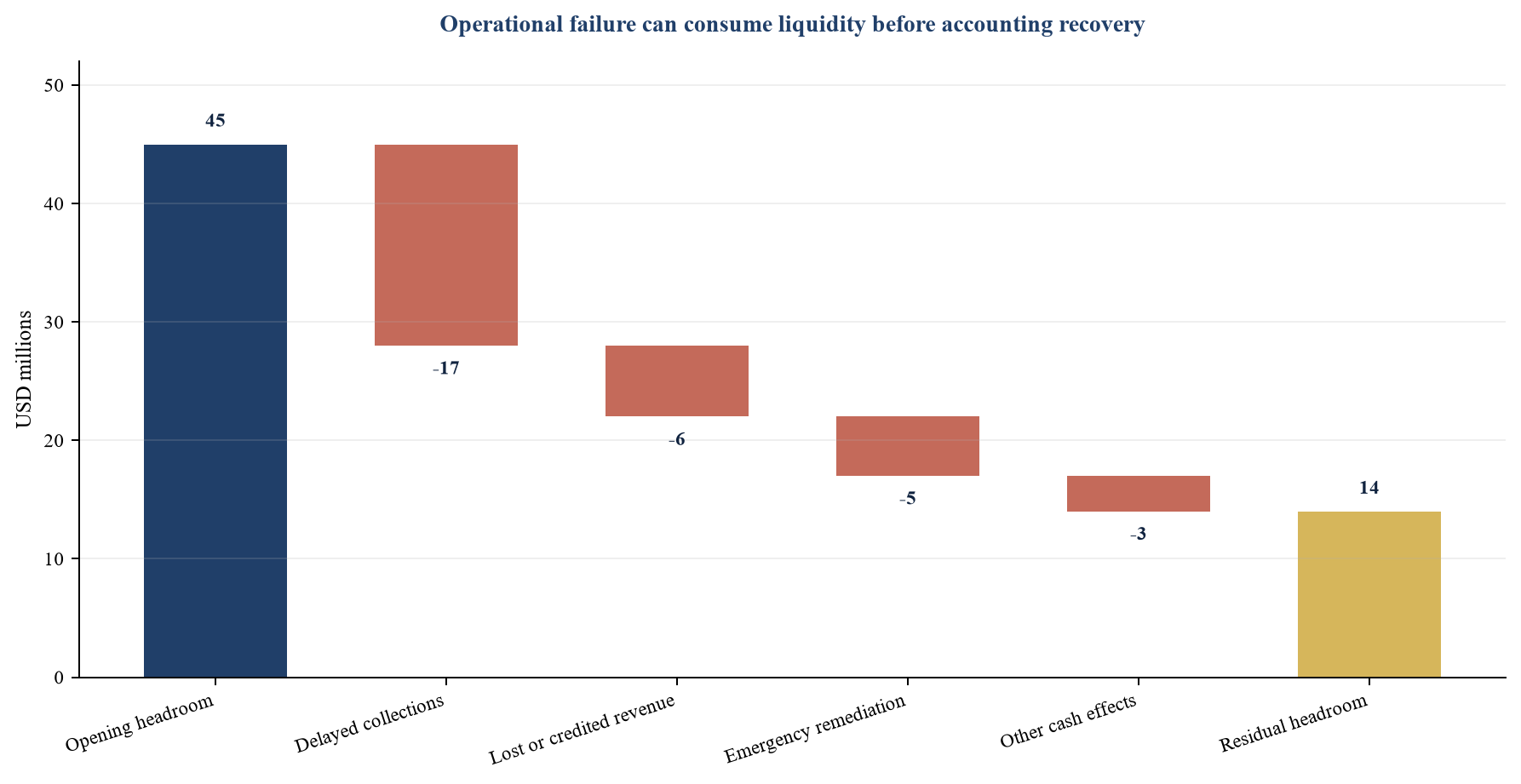
Original scenario. All values are assumed USD millions and exclude probability weighting.
22. Use a risk heat map and decision gates
Risk should combine consequence and evidence weakness. A high-consequence service with unproven recovery requires further work even if the implementation date is on schedule. Bubble size can represent cash exposure, customer population or another material measure.
The board should approve entry into final cutover only when critical dependencies are known, severe defects are closed or explicitly accepted, impact tolerances are met, liquidity remains above threshold and rollback is viable. A red service should not be averaged away by many green services.
Gate breaches should lead to defined responses: remediate, resequence, reduce scope, add funding, extend a service or change the operating model. The response should be chosen before commercial pressure peaks.
After exit, the programme should verify provider access removal, data disposition, resource release, actual run-rate cost and stable service performance. This closure gate prevents operational and financial residue from surviving the formal programme.
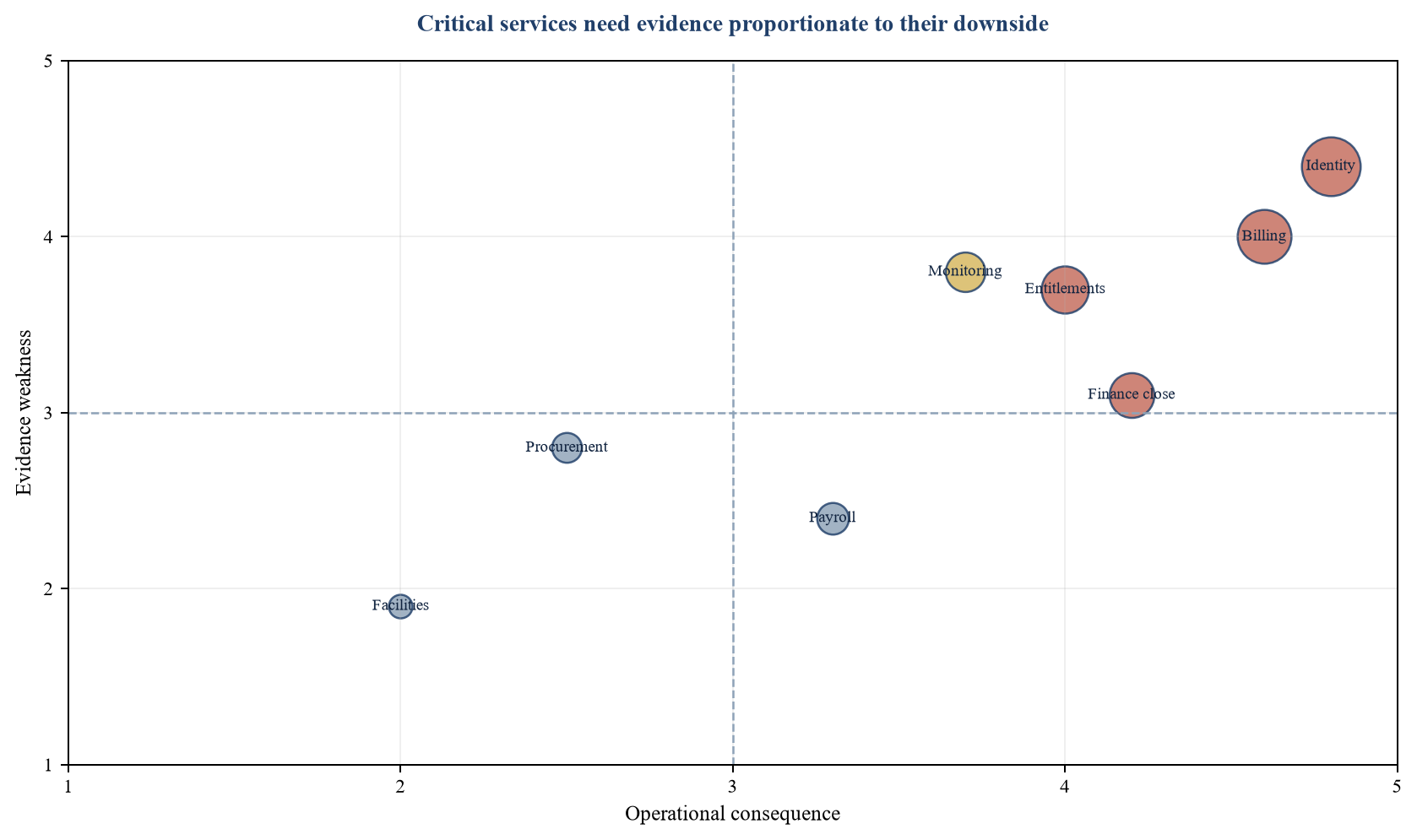
Original framework. Position and bubble size are hypothetical and should be replaced with transaction evidence.
| Gate | Required evidence | Principal decision | Failure signal | Management response |
|---|---|---|---|---|
| Architecture freeze | Service and dependency map, target model and contracts | Approve exit route and sequence | Critical dependency remains unknown | Extend discovery and resequence |
| Build readiness | Configured capability, supplier rights, staffed ownership | Authorise integrated testing | Required licence, role or control absent | Remediate before testing |
| Cutover readiness | End-to-end tests, reconciliation, recovery and liquidity | Authorise live cutover | Tolerance breached or rollback unproved | Delay, reduce scope or extend TSA |
| Stabilisation | Service performance, issue closure and control operation | End heightened support | Persistent severe incident or backlog | Retain command structure and funding |
| TSA termination | Recipient independence and provider release evidence | Terminate service and access | Residual operational dependency | Approve bounded support with exit date |
| Programme closure | Data disposition, cost run rate and stranded-cost evidence | Close programme accountability | Savings or access exist only on paper | Maintain ownership and reporting |
Original framework. Thresholds should reflect the business, sector, jurisdictions and approved risk appetite.
23. Execute a phased roadmap
Phase one establishes governance, service inventory, impact tolerances, contractual deadlines and discovery. The programme reconciles the signed schedules with actual support and identifies critical dependency chains.
Phase two defines the target operating model, architecture, data perimeter, supplier strategy, organisation and control environment. It converts each service into a funded work package with acceptance evidence.
Phase three builds and configures the capability. Data is cleansed and rehearsed, interfaces are established, identities are prepared, contracts become effective and operating procedures are written. Component testing begins early.
Phase four performs integrated, performance, security, recovery and operational testing. Recipient teams lead the service, defects are closed and the cutover runbook is rehearsed. The board receives a service-specific readiness record.
Phase five cuts over in controlled waves, stabilises service, reconciles data and closes residual access. The provider releases resources as evidence permits. Actual cost, performance and incidents are compared with the approved case.
The roadmap should remain dynamic. A newly discovered dependency can change sequence without changing the end objective. Governance quality is demonstrated by timely evidence-based changes rather than adherence to an obsolete date.
24. Conclusion
TSA exit is an operating transfer supported by a contract. The recipient must control the people, processes, technology, information, suppliers, controls and funding required to deliver each service. The provider must be able to remove access, infrastructure and resources without harming its retained business.
The strongest programmes design from the end-state service outcome backwards. They map dependencies, define impact tolerances, build measurable acceptance evidence, rehearse severe scenarios and preserve a viable fallback. They treat data, identity, finance, cyber security and supplier rights as operating requirements rather than technical appendices.
They also maintain commercial discipline throughout delivery. Every extension, waiver and scope change is assessed against customer continuity, legal obligations, funding and the transaction case. Actual performance after cutover is measured against the approved design, allowing management to correct cost, capacity or control gaps before they become embedded in the new organisation.
The hypothetical case shows how an eighteen-month contractual envelope can support a twelve-month management target while preserving a controlled final period. It also shows that a cutover problem can consume material liquidity even when the underlying service is eventually restored. These values are assumptions, not forecasts.
Board confidence depends on evidence at service level. A programme can report high completion while one critical dependency remains unsafe. Exit should occur when the recipient can operate inside approved tolerances, the provider can end its obligations cleanly and both parties understand the residual financial and operational risk.
Sources
- Financial Conduct Authority, Operational resilience: insights and observations one year on, published 27 March 2026, accessed 16 September 2026. Read the primary source
- US Securities and Exchange Commission, Johnson & Johnson and Kenvue Form of Transition Services Agreement, Exhibit 10.10, filed 2024, accessed 16 September 2026. Read the primary source
- US Securities and Exchange Commission, Jacobs Solutions and Amentum Transition Services Agreement, Exhibit 10.2, dated 27 September 2024, accessed 16 September 2026. Read the primary source
- US Securities and Exchange Commission, Western Digital Form 8-K concerning the Sandisk separation and Transition Services Agreement, filed 21 February 2025, accessed 16 September 2026. Read the primary source
- Information Commissioner's Office, Due diligence when sharing data following mergers and acquisitions, accessed 16 September 2026. Read the primary source
- National Institute of Standards and Technology, Special Publication 800-207 Zero Trust Architecture, published August 2020, accessed 16 September 2026. Read the primary source
- National Institute of Standards and Technology, Cybersecurity Framework 2.0, published February 2024, accessed 16 September 2026. Read the primary source
- Cybersecurity and Infrastructure Security Agency, Cross-Sector Cybersecurity Performance Goals, accessed 16 September 2026. Read the primary source
- IFRS Foundation, IFRS 5 Non-current Assets Held for Sale and Discontinued Operations, accessed 16 September 2026. Read the primary source
- Financial Conduct Authority, Operational resilience: insights and observations for firms, published 28 May 2024, accessed 16 September 2026. Read the primary source
- European Union, Regulation EU 2022/2554 on digital operational resilience for the financial sector, Article 28, Official Journal 27 December 2022, accessed 16 September 2026. Read the primary source
- US Securities and Exchange Commission, Cybersecurity Risk Management, Strategy, Governance, and Incident Disclosure, Release 33-11216, effective 5 September 2023, accessed 16 September 2026. Read the primary source
