

1. Define the consolidation thesis
The board decision is whether acquiring several UK sites creates a controllable route to energised, customer-usable and billable capacity. The transaction thesis should state which sites, connection rights, planning positions, customers and operating capabilities justify consolidation. It should also identify the evidence required before consideration, debt or construction capital is committed. [1][2]
The principal failure mode is to treat queue capacity as an asset class detached from the project that supports it. A connection agreement can be conditional, modified, re-ordered, subject to securities or dependent on network works. A site can retain a connection position while lacking planning, land, equipment, finance or a credible end user. A buyer can therefore pay for megawatts that never reach service.
The recommended response is a site-by-site acquisition thesis. Current operating cash receives operating value. Ready, funded and customer-backed capacity receives conversion value after remaining capital and timing. Earlier-stage connection positions receive contingent option value. The committee should see how each proposed synergy changes the probability, date, cost or cash yield of energisation.
| Value layer | Evidence | Principal failure | Deal treatment |
|---|---|---|---|
| land control | title, lease, option, easements and access | connection is detached from usable land | closing condition or exclusion |
| planning | permission, conditions and judicial-review status | lawful build cannot proceed | milestone consideration |
| connection path | agreement, queue status, readiness and dependencies | capacity is re-ordered, modified or lost | contingent value and covenant |
| network works | accepted design, programme and cost allocation | energisation is delayed or repriced | schedule and capex adjustment |
| customer demand | executed commitments and deployment plan | site lacks a credible end user | contract-specific value |
| operating platform | people, systems, utility and customer controls | consolidation interrupts service | integration protection |
Proposed diligence map; governing contracts and regulatory decisions determine actual rights.
2. Fix the legal and operating perimeter
The diligence team should map every project company, parcel, planning permission, connection agreement, security, network dependency, equipment contract, customer commitment, employee, data set and liability. A platform presentation can combine entities with different ownership, grid counterparties, milestones and consent requirements. Shared services can sit outside the proposed transaction.
The perimeter should distinguish owned rights, contractual options, applications, accepted offers, existing agreements, Gate 1 positions, Gate 2 positions, distribution and transmission connections, private-wire arrangements and operating assets. Change-of-control, assignment, modification and termination provisions should be reviewed with the relevant network documents. The buyer should confirm which obligations and securities transfer.
Each dependency should become a closing condition, permanent contract, transitional service or valuation exclusion. The day-one map should identify who can communicate with NESO, the transmission owner or distribution network operator, satisfy milestones, manage planning, fund securities, operate the site and respond to incidents. Value dependent on a missing consent should remain conditional. [3][4]
3. Reconstruct the connection chronology
The buyer should rebuild each site's chronology from initial application through offer, acceptance, modification, readiness submission, reform treatment, connection date, network works and current status. Original documents, correspondence and registers should be preserved. Management summaries should be reconciled to counterparties and authoritative records.
Connections reform replaced a simple chronological queue with gated readiness and strategic alignment processes. NESO reports that the former queue exceeded 700 GW and that reform re-ordered the pipeline to prioritise projects that are ready and needed. The treatment of one demand project depends on its agreement and the applicable process; portfolio averages cannot establish site status. [5][6]
The acquisition model should therefore contain one verified timeline per site. Any unresolved step should show the effect on connection date, required evidence, security, capital and customer delivery. A historical queue position may inform context while the current agreement and reform outcome govern the value case.
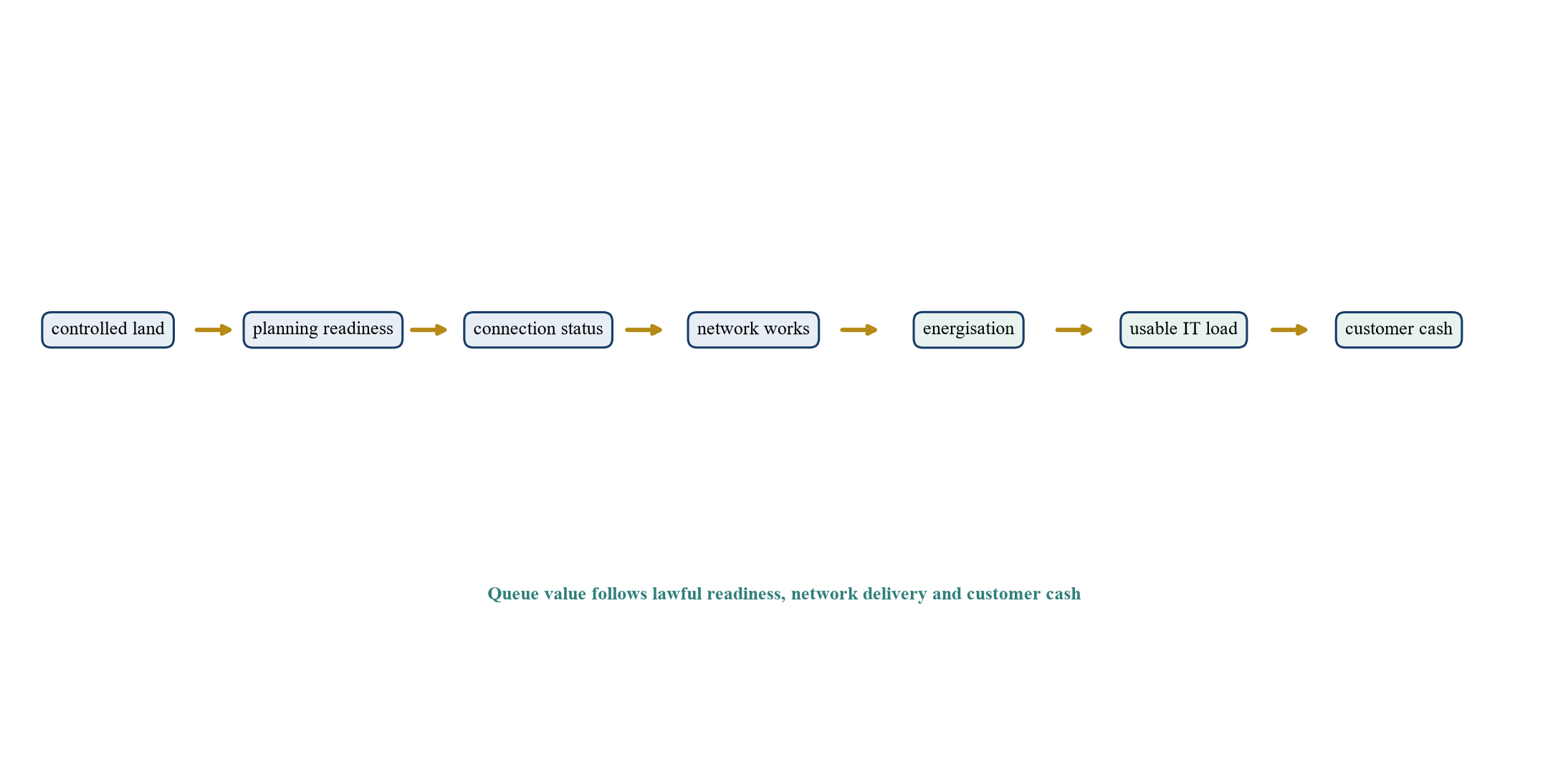
Analytical framework; actual status follows project-specific agreements and current rules.
4. Verify current reform status
The transaction team should use current Ofgem, NESO and network evidence because connection rules and implementation continue to develop. Ofgem's July 2026 consultation proposed a commitment fee and data-centre-specific milestones designed to identify viable projects. The proposed milestones include evidence of a credible end user, procurement of long-lead electrical equipment and financial and technical capability. The consultation status and final decisions must be checked at the time of a transaction. [1][7]
The buyer should avoid assuming that a proposal already applies or that the final rule will match the consultation. It should model the proposed financial and evidence requirements as scenarios while verifying the existing contractual position. Where a site depends on a pending policy decision, the purchase agreement should allocate the effect.
Regulatory monitoring should cover demand connections reform, queue curation, strategic planning and alternative connection arrangements. A named owner should update the diligence record through signing and closing. Material rule changes should trigger valuation, financing and customer-schedule review.
5. Test readiness and Gate 2 evidence
Readiness is a project state supported by land, planning, programme, technical and financial evidence. It should not be reduced to a label. The buyer should inspect the exact readiness submission, supporting documents, declarations, acceptance and continuing obligations for each site.
Planning and land evidence should match the connected project, capacity, location and phase. Equipment procurement should support the required delivery sequence. Financing evidence should cover the full remaining capital plan. Customer evidence should identify a credible end user without breaching confidentiality or competition controls.
The buyer should test whether post-acquisition changes to ownership, design, capacity, location, phasing or date require a modification or further approval. A platform synergy that moves capacity between sites or changes design may affect the existing connection treatment. The integration plan should preserve compliance before optimisation. [6][8]
| Readiness claim | Evidence | Failure risk | Transaction response |
|---|---|---|---|
| controlled site | title, lease or qualifying option | land right expires or is conditional | closing condition |
| planning-ready project | permission and discharged conditions | consent does not cover current design | redesign and timing adjustment |
| retained connection position | authoritative agreement or register evidence | portfolio deck overstates status | verified-capacity schedule |
| technical capability | design, team and equipment programme | project cannot meet milestones | funded delivery plan |
| financial capability | committed equity, debt and security plan | securities or capex cannot be funded | financing condition |
| credible end user | executed or evidenced customer demand | speculative capacity remains unsupported | contingent value |
Proposed control; project-specific requirements should be confirmed with current guidance and counterparties.
6. Separate queue position from network deliverability
A retained position does not prove that the physical network can energise the site on the stated date. The project may depend on transmission reinforcement, distribution works, substations, generation, protection, land access and coordinated outages. Several projects can share the same upstream dependencies.
The buyer should obtain the accepted connection design, works, programme, assumptions, cost allocation and dependency map. It should compare the contractual date with current engineering and delivery evidence. Long-lead transformers, switchgear and cable routes should be supported by procurement and permitting.
Valuation should use an evidenced energisation probability and date. Capacity dependent on incomplete upstream works should carry schedule and cost scenarios. The buyer should not count the same network reinforcement as an independent synergy across several acquired sites.
7. Quantify queue inflation and curation
Ofgem reported that contracted demand offers rose from 41 GW to 125 GW between November 2024 and June 2025, driven largely by data-centre projects, with at least 80 GW attributed to the sector. Ofgem expressed concern that non-viable projects can delay ready developments and distort network planning. These are system-level observations; they do not determine the viability of a specific target. [1][2]
The buyer should compare each target site with the evidence Ofgem proposes to use for curation: financial commitment, credible end user, long-lead equipment and technical capability. A large portfolio queue can include mutually exclusive sites, duplicate customer demand or projects that management does not intend to fund concurrently.
The base case should include the projects the buyer can finance and deliver. Alternative sites can retain option value with an explicit decision date and carrying cost. Queue capacity that the combined group cannot support should be exited, sold or excluded according to governing rights and approvals.
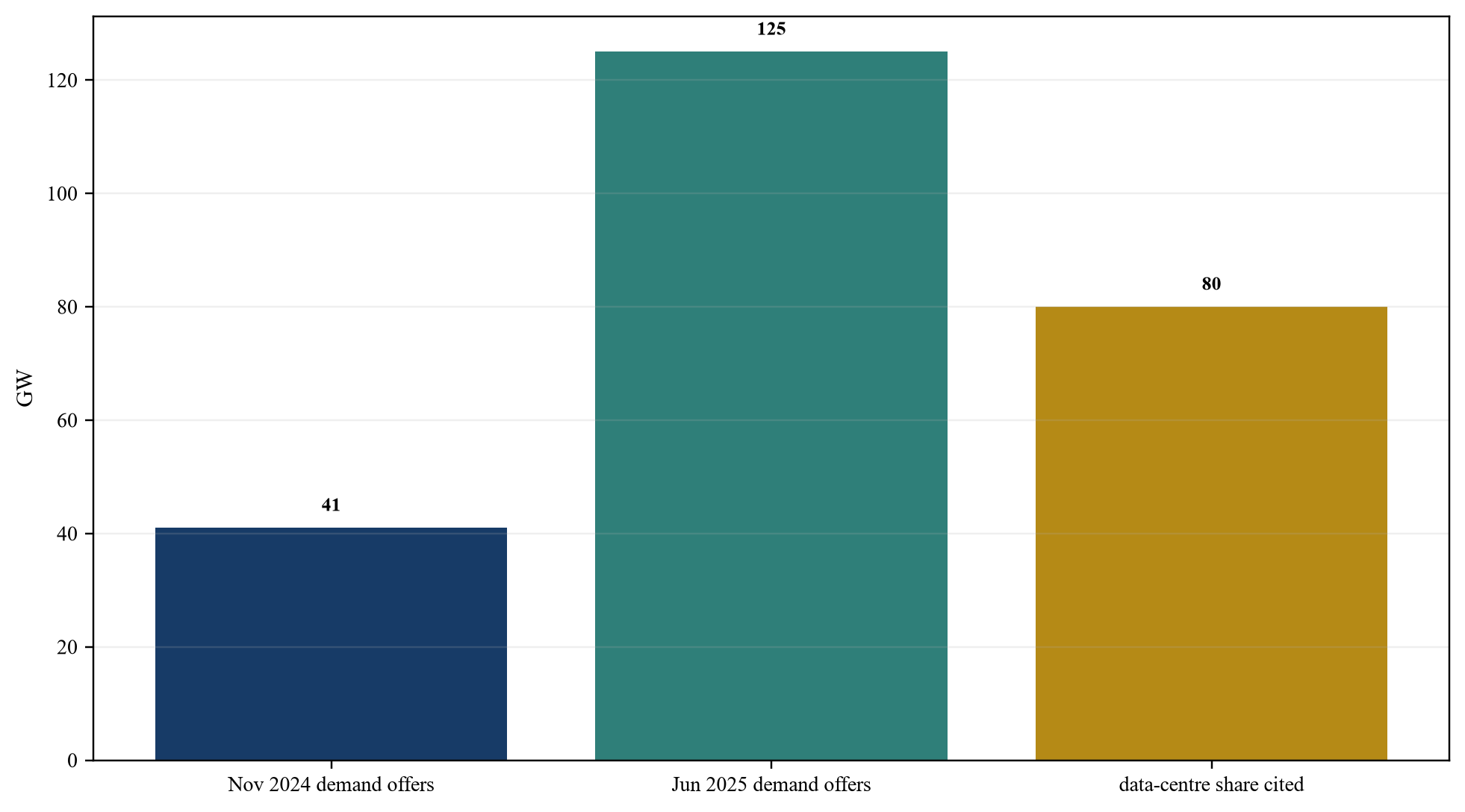
Ofgem reported 41 GW in November 2024 and 125 GW in June 2025; at least 80 GW was attributed to data-centre projects.
8. Model commitment fees and securities
Financial commitments can improve queue discipline while creating liquidity and forfeiture risk. Ofgem's July 2026 consultation proposed a refundable fee paid when a relevant data-centre project accepts an offer and forfeited if the project exits early, with a proposed range expressed per megawatt. The final policy and applicability require current verification. [1][7]
The buyer should identify existing securities, letters of credit, cash collateral, network charges and possible future fees by site. It should determine who funds them, when they are returned, the events that cause forfeiture and how they interact with transaction financing. A headline acquisition price that excludes connection security can understate capital required.
Commitment-fee scenarios should enter sources and uses, liquidity and downside value. A portfolio can require simultaneous financial support across several sites before customer cash begins. The board should define which options merit continued funding and when capital is withdrawn.
9. Verify land, planning and judicial-review risk
Connection value requires a lawful and durable site. The buyer should reconcile title, leases, options, easements, access, planning permission, conditions, environmental assessment, community commitments and challenge periods. The planned facility must match the connected capacity and development phasing.
Planning risk includes design changes, height, noise, backup generation, water, traffic, landscape, biodiversity, heat rejection and construction logistics. A planning consent can remain conditional on material pre-commencement obligations. Expansion may require a new or varied permission.
The valuation model should separate consented buildable capacity, consented capacity requiring conditions, pending applications and speculative expansion. Land and planning should share the same phase identifiers as the connection model. A queue position attached to land without a credible planning path should remain contingent. [9][10]
10. Validate customer demand without double counting
The buyer should map each credible end user to site, phase, load, design, target date, alternatives and contractual status. One customer may consider several sites before committing. Several developers may cite the same market demand. Customer pipeline should therefore be de-duplicated.
Executed contracts should be tested for conditions, termination, ramp, price, energy pass-through, security and service requirements. Letters of intent and demand letters can support planning while remaining outside financeable revenue. Confidential customer evidence may require clean-team review.
The platform case should show contracted, qualified, prospective and speculative demand. Only executed obligations and evidenced delivery should support base cash. Customer alternatives and portability should inform re-leasing scenarios. Aggregate UK or global demand forecasts provide context rather than target proof. [11][12]
| Class | Evidence | Model treatment | Control |
|---|---|---|---|
| active service | acceptance, invoice and collection | operating cash | contract-to-cash reconciliation |
| executed future commitment | signed contract and deployment plan | risk-adjusted conversion cash | condition and credit review |
| qualified negotiation | identified customer, design and timetable | pipeline scenario | de-duplication and approval |
| indicative interest | non-binding expression | option support only | no debt sizing |
| market estimate | third-party or management forecast | strategic context | clearly identified estimate |
| duplicate or incompatible demand | competing sites or dates | excluded | portfolio demand register |
Proposed classification; executed terms govern actual cash rights.
11. Rebuild the capacity conversion ladder
Each site's capacity should move through defined stages: applied, accepted, retained under current arrangements, firm deliverable, energised, facility load, customer-usable IT load, contracted load and billable load. Redundancy, cooling and auxiliary systems reduce gross facility power to sellable IT load.
The team should preserve source definitions and prohibit unmatched comparison. A price per retained connection MW cannot be compared directly with a price per billable IT MW. Each stage should carry an expected date, remaining capital, evidence confidence and dependency.
The consolidated portfolio should show which sites compete for the same customer, equipment or capital. Management-estimated capacity can support planning when labelled as an estimate. Investment value should follow verified stages and the combined group's ability to fund conversion.
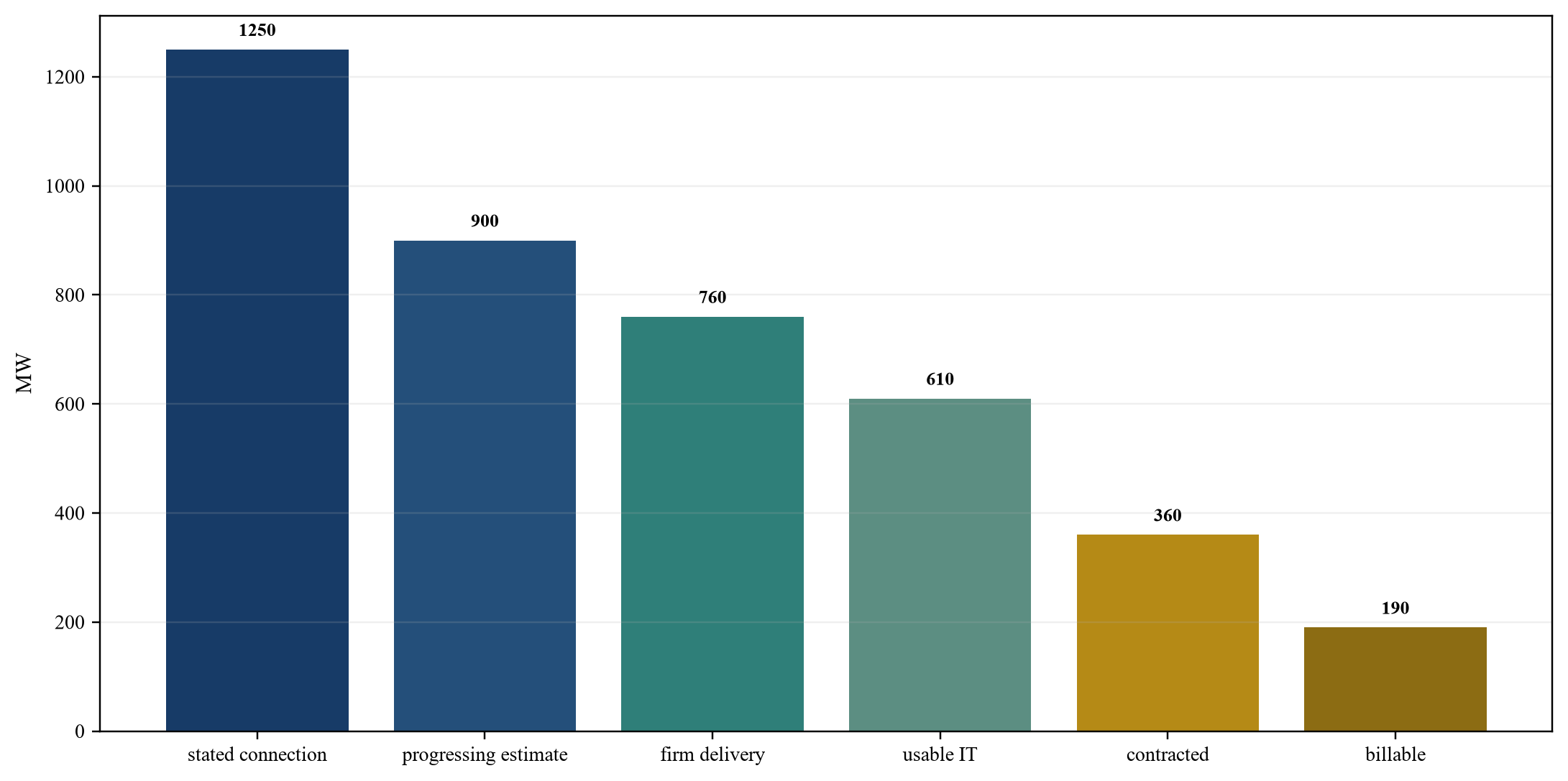
Wholly hypothetical megawatts; values do not describe an identified platform.
12. Reconcile design, cooling and water
Connection capacity does not establish the IT load a site can support. Electrical topology, redundancy, cooling, water, heat rejection, ambient conditions, building geometry and customer density determine usable capacity. A platform can own several grid positions that require different technical solutions.
The buyer should review design maturity, cooling technology, water supply, discharge, backup generation, air permits, noise and environmental commitments. High-density AI workloads may require liquid cooling and substantial electrical modification. Customer design changes can alter planning and commissioning.
Remaining capex should reflect site-specific design. Portfolio standardisation can create procurement and operating benefit where planning, grid and customer requirements permit it. A generic prototype should not override local constraints. [13][14]
13. Build the integrated construction programme
The conversion schedule should link network works, site enabling, substations, buildings, electrical systems, cooling, network, customer fit-out, testing and acceptance. Separate schedules can hide interfaces. Long-lead equipment and network dependencies should have verified procurement and delivery dates.
The buyer should inspect design maturity, contracts, purchase orders, contractor capacity, commissioning plans and cost-to-complete. The schedule should show which activities can proceed before certainty on grid and planning. Abortive cost should be visible.
Platform consolidation can improve procurement, programme management and contractor utilisation. It can also concentrate exposure to one design, vendor or delivery team. Synergies should reflect actual compatible volumes and committed execution rather than gross portfolio MW.
14. Model energy cost and flexible connection structures
Customer economics depend on electricity tariffs, network charges, losses, demand, energy procurement, pass-through and flexibility. Alternative connection arrangements may accelerate service by accepting operational constraints, yet they can affect customer service and financing.
The buyer should model firm and flexible capacity separately. Curtailment, load shifting, storage, backup generation and workload relocation require technical and contractual capability. A flexible arrangement should not be valued as uninterrupted capacity unless the customer accepts the operating profile.
Energy margin should be separated from pass-through revenue. Contract timing mismatches, demand charges and network cost can create exposure. Renewable claims require contractual and retirement evidence. [3][15]
15. Prove operating reliability and cyber resilience
An operating platform must preserve power, cooling, network, physical security, incident response, billing and customer communication. The buyer should review outages, maintenance, redundancy, common-mode failure, service credits, staffing, vendor support, backup and recovery.
Data centres are treated by the UK government as critical national infrastructure, which increases the importance of resilience and coordination. The transaction should identify applicable obligations and customer standards without assuming that designation creates a particular commercial right. [16]
Cyber diligence should cover operational technology, building systems, identity, remote access, network segregation, logs, vendors and recovery. Findings should enter remediation cost, insurance and customer communications. The integration plan should preserve local operating expertise and tested restoration. [17]
| Dimension | Evidence | Warning indicator | Decision gate |
|---|---|---|---|
| connection | current agreement and dependency map | status or date is unverified | no unconditional value |
| planning | valid permission and condition tracker | design mismatch or open challenge | funded remedy |
| engineering | accepted design and commissioning plan | usable IT load is management-only | independent review |
| customer | executed obligation and credit | duplicate or conditional demand | contingent value |
| resilience | tests, incidents and recovery | common-mode failure | remediation reserve |
| cyber | access, logs, segregation and recovery | uncontrolled vendor access | closing or day-one control |
Proposed board control; professional reviews remain project-specific.
16. Reconcile contract, billing and cash
The financial diligence team should rebuild revenue from customer, site, billable IT load, contract price, energy, services, credits and commencement date. It should reconcile capacity and meter evidence to invoices, receivables and bank cash. Connection or planning pipeline should remain separate from operating revenue.
Future contracted load should be tied to network, construction and customer milestones. A delay can increase capitalised interest and postpone cash while securities and development costs continue. The model should capture customer remedies and operator credits.
Quality of earnings should separate recurring infrastructure margin, energy pass-through, managed services, installation, reimbursements and one-time items. Valuation should follow durable cash after sustaining capital. [18][19]
17. Build the complete capital plan
Sources and uses should include consideration, assumed debt, connection security, possible commitment fees, land, planning, network contributions, utility works, construction, customer fit-out, sustaining capital, integration, working capital and reserves. Each item should map to a site and phase.
The buyer should distinguish sunk expenditure, recoverable security, committed cost and optional expansion. Remaining capital should use independent engineering and procurement evidence. Customer contributions and incentives should show conditions, timing and recapture.
Capital release should follow readiness, planning, network, customer and construction gates. The consolidated group should retain liquidity if several sites require security and long-lead procurement before billing. Options beyond funding capacity should be prioritised or removed.
| Use | Closing | Committed follow-on | Contingent | Control |
|---|---|---|---|---|
| equity purchase | 1,480 | 0 | 220 | verified rights and milestones |
| debt repayment and fees | 410 | 0 | 0 | closing funds flow |
| connection security and fees | 95 | 180 | 120 | current rule and project gates |
| contracted conversion capex | 0 | 920 | 180 | planning, grid and customer evidence |
| optional expansion | 0 | 0 | 760 | funded portfolio priority |
| liquidity and reserves | 165 | 120 | 0 | board and lender control |
| total | 2,150 | 1,220 | 1,280 | phased authority |
Wholly hypothetical GBP millions; the table is not a financing recommendation.
18. Structure financing around delivery risk
Operating sites can support debt through contracted cash, adjusted for concentration and renewal. Development sites require construction and completion structures aligned with network, planning and customer milestones. Queue positions without a clear route to cash should not determine leverage.
The financing model should test commitment fees, securities, delayed works, capitalised interest, construction overrun, customer delay and covenant headroom. Security should capture the entities that own land, connection rights, buildings and contracts, subject to assignment limits.
Staged equity, construction facilities, asset-level debt, customer prepayments and contingent seller consideration can allocate risk. Long-dated debt should follow long-dated contracted cash. The buyer should preserve reserves for a reform or energisation delay.
19. Value queue capacity in layers
Valuation should begin with current collected cash and sustaining needs. It should add customer-backed conversion capacity after remaining capex and timing. Ready but uncontracted capacity can receive market-informed option value. Earlier queue capacity should be probability-weighted and bounded by carrying cost.
Price per MW should function as a reconciliation. The denominator must state whether it is connection, firm delivery, facility load, usable IT, contracted or billable load. Comparable transactions should be adjusted for geography, planning, power date, customer, density, energy economics and capex.
The DCF should run by site and phase. Each value increment should identify land, planning, connection, network, customer and funding evidence. Value should fall if reform, milestone, security or network evidence weakens. [20][21]
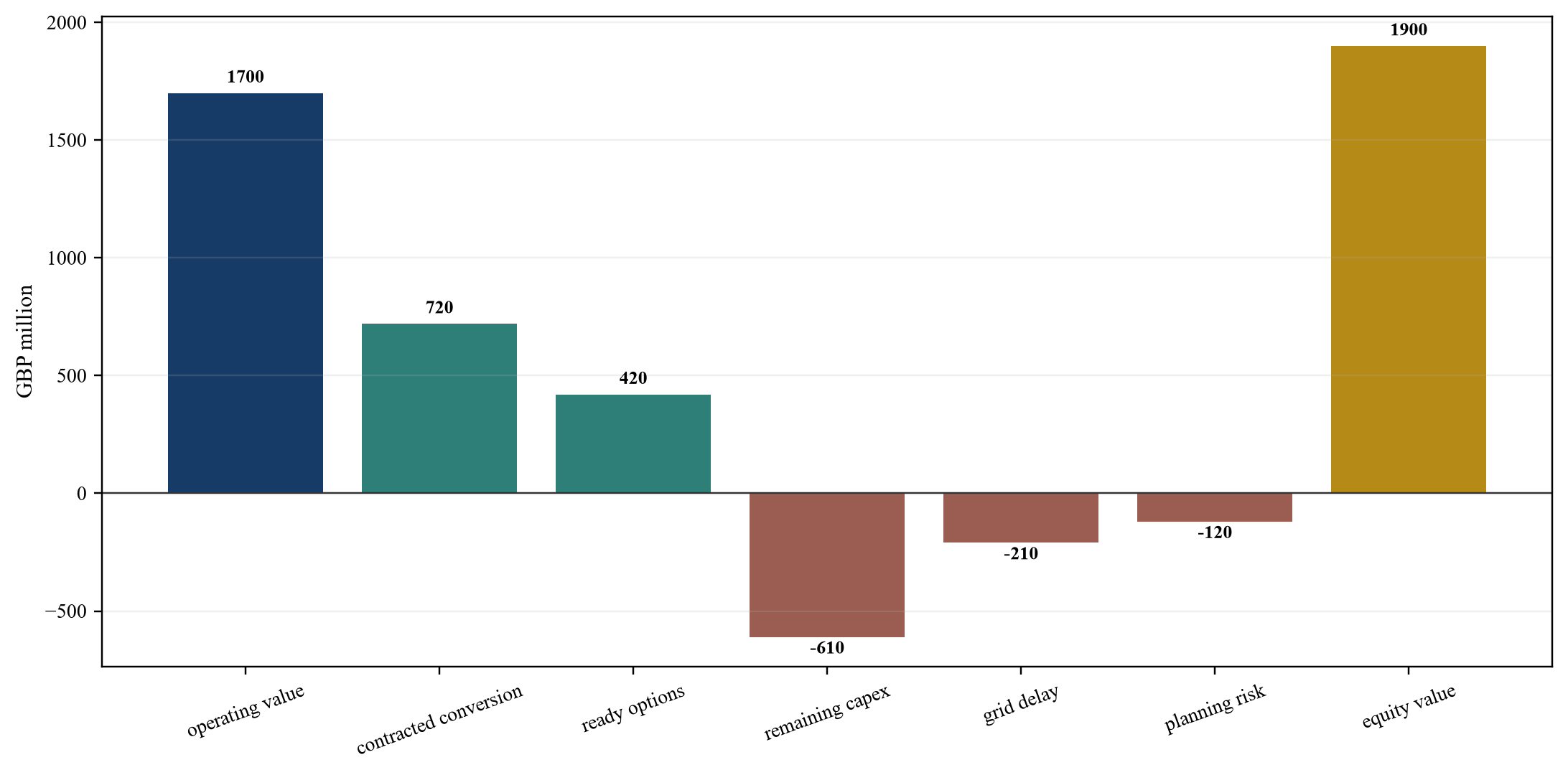
Wholly hypothetical GBP millions; this is not a valuation opinion.
20. Test energisation probability and value sensitivity
The central sensitivity should connect probability and timing of energisation with customer conversion. A nominal connection date has limited value if planning, network works or financing remain unresolved. A strong customer contract cannot produce cash without physical delivery.
The model should test capacity retention, two- and four-year delays, reduced usable IT load, commitment-fee forfeiture, customer deferral and construction inflation. Compound cases reveal whether the platform has enough liquidity to keep priority sites alive.
The board should define stop, continue and accelerate rules. Sites with superior evidence and customer cash can receive capital. Weaker options should face a deadline for planning, readiness, customer or financing evidence. Portfolio size alone should not prevent disciplined withdrawal.
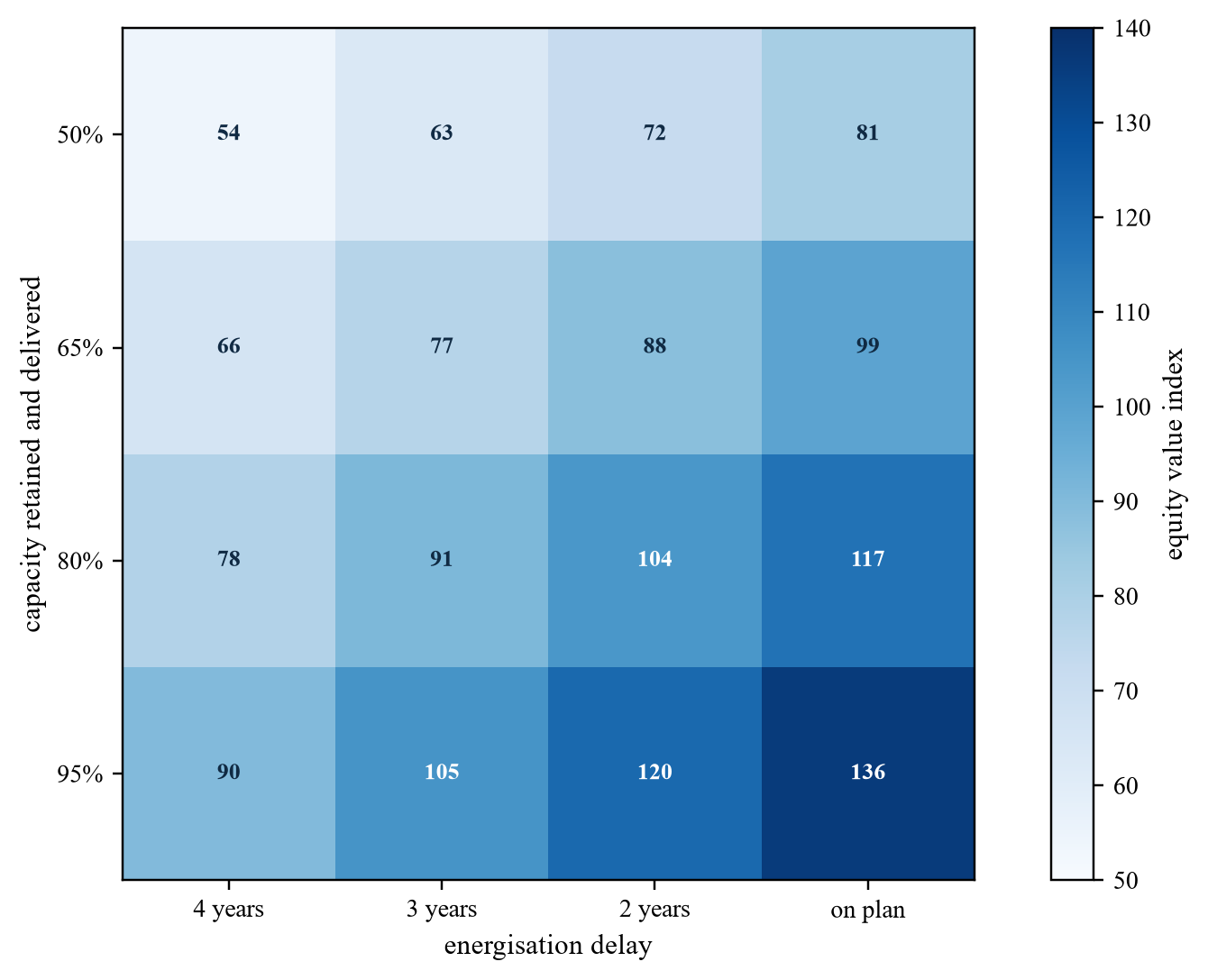
Wholly hypothetical value indices; the figure is not a valuation opinion.
21. Quantify consolidation synergies
Platform synergies can arise from portfolio customer coverage, engineering, procurement, operating systems, utility engagement and capital access. They can also create dis-synergy through duplicate queue positions, customer conflicts, change-of-control consents and concentrated vendor exposure.
Each synergy should have a baseline, cost, timing, dependency and owner. Procurement savings require compatible specifications and real orders. Faster connection requires an approved mechanism, not corporate scale. Customer expansion requires a site and executed obligation.
Value should be recognised when the combined group controls the action and measurable cash. Queue positions released by one project do not automatically transfer to another. Integration cost and possible forfeiture should enter the same bridge.
| Item | Evidence | Cash mechanism | Approval gate |
|---|---|---|---|
| shared engineering | compatible designs and workload | lower design and owner cost | approved common standard |
| equipment procurement | committed volume and vendor bids | lower cost or earlier slots | signed procurement plan |
| customer portfolio | verified cross-site demand | higher contracted conversion | executed customer terms |
| operating platform | staffing and systems plan | avoided duplicate overhead | continuity-tested transition |
| financing scale | committed lender terms | lower capital cost | covenant and security approval |
| queue rationalisation | governing rights and exit cost | reduced security and carrying cost | site-priority decision |
Proposed transaction control; actual value requires project-specific evidence.
22. Address merger control and national-security review
The Competition and Markets Authority assesses mergers using current guidance, evidence on rivalry, market definition, entry, vertical effects and efficiencies. Data-centre platform consolidation may require analysis of local capacity, connectivity, customer alternatives and access to scarce inputs. The updated September 2026 merger-assessment guidance should be checked against the transaction timetable. [22]
The National Security and Investment Act may also require assessment depending on activities, assets and parties. The buyer should obtain transaction-specific advice, consider mandatory notification categories and preserve a filing timetable. Critical infrastructure, customers and technology can increase information sensitivity. [23]
Clean teams should control customer, pricing, capacity and strategic information before closing. Approval conditions should enter financing and the long-stop date. The integration plan should not presume control or customer coordination before legal completion.
23. Protect data, models and decision rights
AI and data tools can reconcile connection documents, planning conditions, network dependencies, construction schedules and customer demand. They can also create false certainty when inputs are stale, duplicated or legally misunderstood. The buyer should retain source, version, owner, transformation and exception history.
Models should support probability, schedule and cash analysis while leaving legal, engineering and investment decisions with accountable professionals. Overrides should be documented. The board should see evidence confidence alongside valuation.
Post-close systems should preserve access, cybersecurity, customer segregation, utility correspondence and recovery. The NCSC Cyber Assessment Framework provides a structured reference for essential functions and resilience. Contractual and regulatory requirements remain specific to the platform. [17][24]
24. Execute integration without losing connection value
Day one should preserve project-company control, land rights, planning compliance, network communications, securities, milestones, customer obligations, operating continuity and cyber access. Authority should be explicit by site. No integration change should cause a missed connection or planning milestone.
The first phase should reconcile the portfolio register and stabilise controls. The second should prioritise capital and procurement across evidence-backed sites. The third can capture operating and customer synergies. Optional projects should follow clear funding and exit decisions.
The integration leader should report current capacity status, milestones, planning, network works, securities, capex, customers, incidents and liquidity. Independent legal and engineering review should challenge material changes. [25][26]
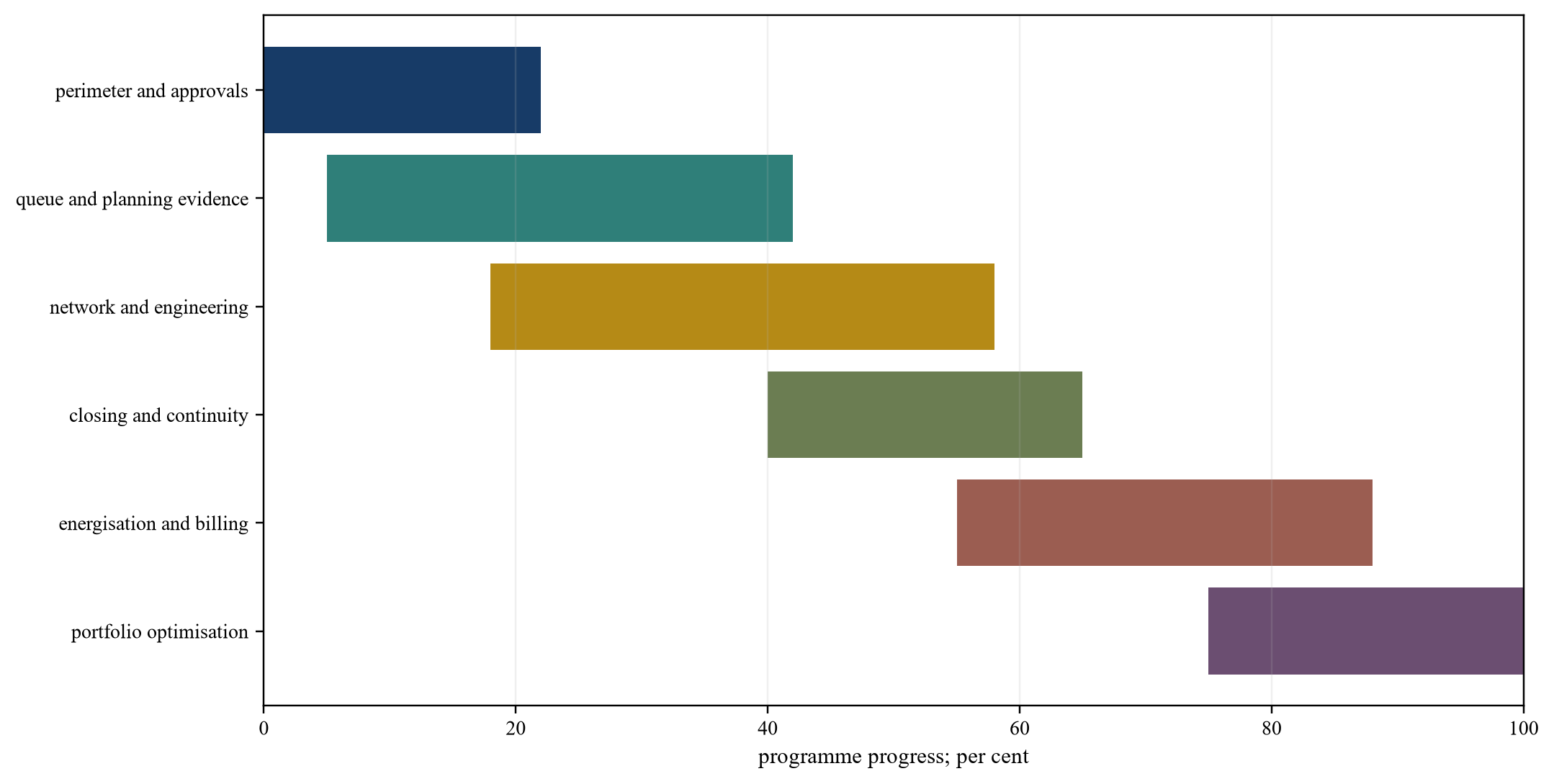
Illustrative sequence; actual timing depends on approvals, connection rules, planning, network delivery and customer acceptance.
Implementation detail: converting grid position into transaction value
The transaction team should maintain one site-phase ledger. Each row should contain the legal entity, land parcel, planning reference, connection agreement, counterparty, capacity, voltage, point of connection, status, milestones, security, network works, date, design, usable IT load, customer, capex, billing and cash. Source documents should be linked.
The ledger should distinguish application, offer, accepted agreement, current reform treatment, firm delivery, energisation and customer service. Portfolio presentations can remain useful after reconciliation. The model should not overwrite source definitions.
Connection chronology should be independently reconstructed. The team should compare agreements, modifications, readiness declarations, counterpart correspondence and authoritative registers. If evidence conflicts, the lower-confidence or later value should remain unresolved until the counterparty confirms it.
Planning chronology should use the same phase identifiers. A permission for one design or capacity should not be assumed to cover a revised high-density facility. Conditions, obligations and challenge periods should map to the construction schedule.
Network dependencies should be modelled as a graph. Each site can depend on a substation, circuit, transmission reinforcement, generation assumption and outage programme. Shared dependencies should be visible across the portfolio. The critical path should follow the slowest complete chain.
The readiness model should identify evidence already accepted and evidence management expects to provide. Management expectation should be labelled. The acquisition agreement should protect value if the expected status is not confirmed.
Commitment fees and securities should have a cash calendar. The model should show posting, renewal, return, forfeiture and funding source. Several simultaneous projects can create a liquidity peak before revenue begins.
Customer demand should be de-duplicated. A customer-site matrix should show capacity, date, design, alternatives and contractual status. Pipeline probability should reflect executed terms, deposits, technical work and customer credit. Aggregate demand remains context.
Engineering should convert grid MW to customer-usable IT MW. Redundancy, losses, cooling, water, auxiliary load and maintenance should be explicit. Tested capability should replace design estimates as sites commission.
Construction should integrate off-site and on-site programmes. Network, substation, building, electrical, cooling, fibre, security, customer fit-out and testing should converge. Procurement evidence should support long-lead dates.
Cost-to-complete should include network contributions, securities, land, planning, equipment, construction, owner cost, commissioning, contingency, escalation and tax. Sunk cost should not justify further investment without a viable completion case.
The capital-allocation model should rank sites by evidence, customer cash, cost, timing and downside. High-priority sites should receive funds to protect milestones. Lower-priority options should face defined evidence deadlines and exit rules.
Valuation should use layers. Operating assets follow collected cash. Contracted conversion follows remaining capex and timing. Ready uncontracted sites are options. Earlier queue positions receive limited value based on rights, evidence, carrying cost and exitability.
Comparable analysis should normalise the denominator. Connection MW, firm delivered MW, facility MW, usable IT MW and billable MW are not interchangeable. Planning, customer, network, design and remaining capital should be adjusted.
Debt should follow durable cash. Development facilities should use conditions linked to planning, network, construction and customer milestones. Queue options should be primarily equity funded unless lenders accept the specific risk.
The merger-control workstream should test capacity concentration and customer alternatives in relevant areas and services. Efficiencies should be evidenced, transaction-specific and cognisable under current guidance. National-security review should start early.
Integration should preserve project deadlines. Entity rationalisation, contract assignment, system migration and vendor change should wait until connection and planning effects are understood. A control calendar should notify owners before each milestone.
AI-supported analysis can identify inconsistent dates, duplicate customers and correlated dependencies. Material findings should be reviewed by legal, engineering, planning, commercial and finance owners. Models should retain uncertainty rather than convert missing evidence into a single precise date.
Red-team cases should combine queue reform, planning delay, network slippage, customer deferral and inflation. The model should find the first liquidity or covenant failure. Corrective actions should include staging, customer funding, reduced scope, site substitution and withdrawal.
The investment committee should receive the perimeter, chronology, current status, planning, network dependencies, securities, customer register, engineering conversion, cost, financing, valuation, approvals and integration plan. Every unresolved item should carry a cash effect, owner, deadline and decision rule.
The connection-date model should retain at least three dates for every site: the contractual date, the delivery team's current evidence-based estimate and the date used in the financial case. Differences between them should be explained through named dependencies. This prevents an old agreement date from flowing silently into customer revenue, debt draws and valuation. A movement in one dependency should update construction sequencing, capitalised interest, customer remedies and liquidity in the same controlled model.
The platform should also maintain a milestone evidence room. Each contractual or proposed readiness milestone should link to the document, responsible entity, submission date, acceptance evidence, next action and consequence of failure. The room should distinguish evidence created by the target from evidence confirmed by the relevant authority or network party. Before signing and closing, the buyer should repeat the confirmation process for all value-critical sites and record any change.
Planning and connection scenarios should be coherent. A site cannot use a planning-central case with a grid-downside case if the associated design, capacity and phasing no longer match. Each scenario should carry one internally consistent site plan, connection capacity, technical design, construction programme, customer ramp and financing case. This makes the downside operationally executable and allows the board to identify the permits, funding and customer discussions required for a response.
Portfolio rationalisation should include the cost of retaining options. Land-option payments, planning consultants, network securities, possible commitment fees, project teams, design work and procurement deposits consume cash before service. The buyer should calculate annual carrying cost and the next evidence event for each site. An option with no affordable route to its next gate should not retain value merely because its headline connection capacity is large.
The network-counterparty plan should preserve formal and informal knowledge. Correspondence, meeting records, technical assumptions and responsible contacts can explain why a date or configuration exists. The buyer should obtain these records lawfully and create a controlled engagement protocol around signing and closing. Relationship value can support execution, while only the agreement and authoritative decisions establish enforceable rights.
Customer communication should be sequenced with merger control, confidentiality and operational continuity. Priority customers may need assurance about ownership, capital, design and delivery. The buyer should prepare fact-based messages that do not promise a connection date beyond verified evidence. Any request to change capacity, density or commencement should enter the same governance process as a grid or planning modification.
The post-close assurance programme should test whether the acquisition thesis is converting into evidence. Quarterly review should compare planned and current connection status, milestones, planning, procurement, network works, capital, customer commitments and billable load. Variances should be attributed to source evidence and assigned to an owner. The board should update site priority and funding when evidence changes rather than preserve the original ranking for organisational convenience.
The transaction documentation should connect these controls to enforceable remedies. Capacity or status warranties should use the controlled site schedule and state the evidence date. Interim covenants should protect agreements, planning, securities, land and customer contracts between signing and closing. Material changes should trigger disclosure, renewed diligence and the agreed price or termination mechanism. Post-close indemnities, retention accounts or contingent consideration should match the specific risk and realistic recovery route.
Finally, the buyer should maintain a decision archive. The archive should record the evidence available, assumptions approved, alternatives rejected, conflicts, professional advice and final authority for each material capital decision. This record supports governance when connection rules, network dates or customer plans change. It also allows the combined platform to compare forecast conversion with realised energisation, billing and cash, improving subsequent acquisition and development decisions.
25. Use an investment-committee decision matrix
The approval question is whether the platform controls an evidenced and financeable path to energised customer cash. The committee should see which value exists today, which requires execution and which remains an option. Regulatory reform and management estimates should be stated clearly.
Conditions should cover rights and consents needed before closing. Consideration mechanisms should protect unconfirmed capacity. Post-close capital should follow evidence gates. The acquisition should retain enough liquidity to preserve high-priority projects through delay.
Approval should state maximum price, contingent value, capital envelope, financing conditions, site priorities, customer and network milestones, integration authority, downside action and stop rules. Board reporting should follow conversion from current connection status to collected cash.
| Finding | Cash consequence | Deal response | Accountable owner |
|---|---|---|---|
| current queue status is unconfirmed | capacity value can be lost | closing confirmation and contingent price | legal and power leads |
| planning does not match design | delay and redesign capital | condition, reprice and funded remedy | planning and engineering leads |
| network works are late | billing and debt service move | schedule protection and liquidity reserve | delivery lead |
| customer demand is duplicated | contracted conversion is overstated | de-duplicate and exclude | commercial lead |
| combined downside exhausts liquidity | milestones and value fail | lower debt and prioritise sites | finance lead |
| evidenced sites convert to cash | financeable platform value | approve subject to gates | investment committee |
Proposed decision framework; it is not an investment recommendation.
Sources
- Ofgem, Ofgem Acts to Free Up Grid Capacity by Tackling Speculative Data Centre Projects, Read the primary source
- Ofgem, Proposed Data Centre Connection Reforms, Read the primary source
- Ofgem, Connect Update: Demand Connections Reform, Read the primary source
- Ofgem, Connections, Read the primary source
- National Energy System Operator, Connections Reform Results, Read the primary source
- National Energy System Operator, Gated Modification Guidance, Read the primary source
- Ofgem, Demand Connections Reform Call for Input, Read the primary source
- National Energy System Operator, Transition to Connections Reform, Read the primary source
- UK Government, National Planning Policy Framework, Read the primary source
- Planning Inspectorate, Find a National Infrastructure Project, Read the primary source
- International Energy Agency, Energy and AI: Executive Summary, Read the primary source
- UK Government, AI Opportunities Action Plan, Read the primary source
- Environment Agency, Water Resources Planning Guideline, Read the primary source
- UK Government, Environmental Permitting Guidance, Read the primary source
- Ofgem, Electricity Network Charges, Read the primary source
- UK Government, Data Centres to Be Given Massive Boost and Protections from Cyber Criminals and IT Blackouts, Read the primary source
- National Cyber Security Centre, Cyber Assessment Framework, Read the primary source
- IFRS Foundation, IFRS 15 Revenue from Contracts with Customers, Read the primary source
- IFRS Foundation, IAS 7 Statement of Cash Flows, Read the primary source
- IFRS Foundation, IFRS 13 Fair Value Measurement, Read the primary source
- IFRS Foundation, IAS 36 Impairment of Assets, Read the primary source
- Competition and Markets Authority, Merger Assessment Guidelines, Read the primary source
- UK Government, National Security and Investment Act Guidance, Read the primary source
- National Cyber Security Centre, Principles of Supply Chain Security, Read the primary source
- ISO, ISO 22301 Security and Resilience: Business Continuity Management Systems, Read the primary source
- Ofgem, Major Reform Package to Accelerate Grid Connections, Read the primary source
