

Introduction
The UK quantum ecosystem combines university research, specialist companies, public programmes and private capital. The National Quantum Strategy commits GBP 2.5 billion to quantum research, innovation, skills and commercialisation over the decade beginning in 2024, with an expectation of additional private co-investment. The National Quantum Strategy Missions set capability milestones extending to 2035. These policies create opportunity, and they also make transactions unusually dependent on people, institutions and public-interest considerations.
Quantum M&A cannot be evaluated as an ordinary purchase of software code or laboratory equipment. A target's performance may depend on a small group that understands device behaviour, control sequences, error mechanisms, fabrication tolerances and experimental failure. University facilities, licences and research appointments can sit outside the acquired legal entity. Public grants may contain conditions that require review. Immigration sponsorship, security permissions and export controls can affect who may access technology and where work may be performed.
The transaction objective is therefore broader than retaining named founders. It is to preserve the organisation's ability to reproduce results, make technical decisions, train successors, protect intellectual property, use required facilities and continue its research programme after control changes. This paper provides a framework for doing so.
1 Define the capability the buyer intends to preserve
The board should begin with a capability statement. It should identify what the target can do, the evidence supporting that claim, the people and assets required to repeat it, and the milestone that the combined company intends to reach. A statement such as “acquire a leading quantum team” is too broad for valuation or integration.
A useful statement might specify an integrated trapped-ion control capability, a neutral-atom error-correction programme, a photonic component manufacturing method, a quantum-software compiler or an application team with validated domain workflows. The board should then test acquisition against licensing, partnership, minority investment, sponsored research, targeted hiring and internal development.
The counterfactual matters. A buyer may pay for speed, scarcity, exclusivity or a lower probability of technical failure. Each rationale produces different evidence requirements. The transaction case should identify which capability would remain unavailable, delayed or more expensive without the acquisition.
2 Treat talent as a network rather than a list
Critical-person schedules often overemphasise founders and executives. Quantum capability can depend on a network spanning experimental physicists, device engineers, control specialists, software engineers, technicians, programme managers and external collaborators. The loss of a mid-level calibration specialist or laboratory manager can interrupt a programme even when senior scientists remain.
The buyer should map technical authority, workflow dependencies and substitution capacity. For each capability, diligence should identify who can diagnose failure, approve design changes, operate specialist equipment, explain undocumented choices, manage suppliers, interpret test data and train a successor. A network map should distinguish high visibility from operational centrality.
Retention planning should address teams and interfaces. Individual awards can encourage competition or signal unequal treatment. Team-wide instruments, milestone-linked pools, career pathways and protected research resources can support continuity when the value depends on collective output.
3 Separate explicit knowledge from tacit knowledge
Patents, laboratory notebooks, source code, test records and design files capture only part of a scientific capability. Tacit knowledge includes judgement about unstable devices, calibration shortcuts, supplier variability, failed experiments, measurement artefacts and the conditions under which a result can be reproduced.
The buyer should test whether another qualified team can use the target's records to repeat a defined result. The test can be conducted in a protected diligence environment and should respect export-control, confidentiality and university obligations. Gaps should become pre-close remediation items, transition covenants or consideration conditions.
Knowledge transfer should have observable outputs. Examples include complete experiment records, validated build instructions, cross-trained successors, independent reproduction and an exception register explaining unresolved anomalies. Attendance at handover meetings is insufficient evidence of transfer.
4 Map the scientific operating system
The capability map should connect research questions, technical workstreams, decision rights, people, intellectual property, facilities, equipment, suppliers, data, software and external partners. It should show which dependencies sit inside the target and which remain with a university, founder, contractor, cloud provider or public institution.
The map should distinguish the current product, the next engineering milestone and longer-term research options. This prevents the buyer from valuing a future roadmap without funding the systems required to reach it. It also reveals duplicated or incompatible workstreams in the buyer and target.
Every critical node should have an accountable owner, a substitute and a continuity measure. A node without a substitute may require a retention condition, documented transfer plan, supplier alternative or integration hold point.
5 Diligence university relationships as transaction assets
University relationships can include equity, patent ownership, exclusive or non-exclusive licences, sponsored research, consultancy, secondments, academic appointments, student projects, laboratory access, equipment use and rights to future improvements. These arrangements should be reviewed separately because they may have different parties, terms and change-of-control consequences.
The buyer should confirm licence scope, field, geography, exclusivity, sublicensing, assignment, prosecution control, improvement rights, royalties, milestone payments and termination. It should distinguish rights owned by the company from rights licensed by a university or other institution. It should also establish whether facilities and researchers can continue supporting the programme after closing.
The UK government's independent review of university spinouts emphasises transparent intellectual-property and equity arrangements, founder incentives and continuing support. A buyer should examine the actual agreements and working practices rather than applying a general assumption about UK university terms.
6 Preserve research relationships beyond the contract
A signed licence does not reproduce the informal flow of expertise between a spinout and an academic group. Researchers may discuss unexpected results, share equipment, advise students, identify recruits and shape grant proposals. Consolidation can weaken these relationships if the buyer changes publication, access, confidentiality or priority rules abruptly.
Management should agree a post-close relationship charter with the relevant institution where appropriate. It can specify research themes, access, publication review, conflict management, data handling, student supervision, funding, governance and escalation. The charter should respect academic independence and existing contractual rights.
Relationship health should be monitored through deliverables, facility access, joint milestones, recruitment, grant activity and issue resolution. The buyer should avoid treating goodwill as a permanent asset without an operating plan.
7 Reconcile public funding and programme continuity
Quantum companies can participate in grants, collaborative research, procurement programmes and publicly supported facilities. Diligence should identify the legal instrument, recipient, partners, eligible costs, milestones, reporting, audit, intellectual-property terms, publication obligations, subsidy conditions and change-of-control provisions for each programme.
The buyer should confirm whether control, ownership, location, access or scope changes require notification or consent. It should distinguish signed funding from announced programmes and reimbursable awards from unrestricted cash. Remaining funding should be reconciled to remaining obligations and co-funding requirements.
Public-programme value should be recognised only when continuity is evidenced. A grant may fund valuable learning without creating recurring revenue. Its transaction value may lie in technical evidence, collaboration and option creation rather than cash contribution.
8 Integrate national-security review early
Quantum Technologies is one of the sectors covered by the UK's mandatory notification regime under the National Security and Investment Act. The government's guidance states that second-generation quantum technologies can have national-security importance and defines relevant development and production activities. Transaction counsel should determine whether the proposed acquisition meets the legal conditions for notification.
The filing analysis should begin during screening. The buyer should map ownership, governance, access, technology, customers, sites, data, personnel and international links. Potential remedies or operating conditions should be assessed against the capability thesis. A transaction that restricts essential people or information from the combined programme may have a lower strategic value.
The timetable should include notification preparation, review and possible information requests. Long-stop dates, financing commitments, employee communication and integration planning should reflect the realistic regulatory path.
9 Assess innovation competition
The Competition and Markets Authority's merger guidance recognises non-price competition, innovation and future rivalry. Quantum markets can contain differentiated research paths, limited current revenue and uncertain future products. Market-share measures may therefore provide an incomplete picture of competitive significance.
Diligence should ask whether the target is an important independent research path, a disruptive entrant, a route to customers or a source of future competition. The buyer should map overlapping capabilities, partnerships, talent markets, cloud channels and likely entry. Internal documents should state the genuine transaction rationale and counterfactual.
Efficiency claims should be evidenced. Combining teams can accelerate engineering or remove duplicated capital expenditure, but integration can also eliminate competing technical hypotheses. The board should preserve a defined experimental path when scientific uncertainty makes early convergence destructive.
10 Control technology and information transfer
UK strategic-export controls can apply to goods, software, technology, data, information and technical assistance. Quantum computers and enabling technologies can fall within control regimes. The buyer should classify controlled items and determine how the transaction affects access, transfer, remote collaboration, cloud systems and international travel.
The information-access plan should identify repositories, users, locations, devices and approvals. Pre-close diligence may require clean teams, redaction or controlled demonstrations. Post-close integration may need technical control plans and role-based access until licences or classifications are confirmed.
Export-control analysis should be connected to valuation. If the combined company cannot transfer required technology to the intended engineering team or market, the operating model and synergy case require revision.
11 Protect immigration and sponsorship continuity
Specialist quantum teams are internationally mobile. The buyer should map nationality, immigration status, sponsor, expiry, dependent considerations, travel requirements and location commitments for critical roles while limiting access to sensitive personal data.
UK sponsor guidance addresses changes in direct ownership and transfers involving sponsored workers. The legal consequence depends on transaction structure and circumstances. Immigration advisers should confirm the required notifications, licences and timelines before employee communications are finalised.
Retention offers should account for practical mobility. A cash award may not resolve uncertainty about sponsorship, laboratory location, family relocation or the ability to continue international collaboration. Each critical role needs a lawful and credible work-location plan.
12 Choose the transaction perimeter deliberately
A share acquisition can preserve the employing entity and many contracts, subject to their terms. A business or asset transfer can change the employer and may engage the Transfer of Undertakings (Protection of Employment) Regulations. Government guidance states that TUPE can protect employees when a business changes employer, while a share takeover generally leaves the same company as employer.
Structure should follow the capability perimeter. Excluding a laboratory agreement, university licence, software repository or technical team can separate assets that operate together. The buyer should map every capability dependency to the entity or agreement that will transfer.
Tax, liability, financing, regulatory and accounting considerations also influence structure. Qualified advisers should confirm the transaction-specific position. The capability map provides the commercial test against which proposed exclusions can be evaluated.
13 Build an intellectual-property chain of title
The buyer should trace relevant intellectual property from creation to current ownership or licence. The review should cover employee and consultant assignments, university rights, sponsored-research terms, joint development, open-source software, background intellectual property and future improvements.
Patent quality should be connected to the product. Claims, jurisdictions, prosecution status, remaining term, freedom to operate and detectability of infringement matter more than counts. Trade secrets require evidence of confidentiality, access controls, documentation and continuing secrecy.
The chain-of-title schedule should identify every missing assignment, consent or ambiguity. Closing conditions, covenants, indemnities, escrows and valuation adjustments should be tailored to the operational importance of each item.
14 Evaluate publication and scientific-reputation risk
Publication is part of scientific career development, recruitment and credibility. A buyer may need confidentiality and patent-review controls, yet an overly restrictive policy can damage retention and university relationships. The operating model should distinguish commercially sensitive information from publishable research and set predictable review timelines.
Technical claims used in marketing or valuation should be traceable to documented experiments and appropriate review. Reputational harm can arise when commercial announcements overstate scientific evidence. A scientific-review council can provide a formal route for assessing external claims.
The buyer should examine pending papers, conference commitments, peer-review obligations and attribution disputes. These items can affect employee trust and the credibility of the combined company.
15 Design retention around motivation and capability
Retention has financial and non-financial components. Quantum researchers may value scientific autonomy, equipment, budget, team quality, publication, external collaboration, technical leadership and a credible route to impact. The buyer should test these factors through structured management and employee discussions.
Financial instruments can include cash retention, restricted shares, options, milestone pools and transaction bonuses. Awards should align with the period and capability being protected. A programme requiring five years of development may not be secured by a twelve-month payment.
The retention plan should cover critical teams, successor development and fair allocation. It should be costed in the purchase-price and integration model. Board approval should distinguish consideration paid to sellers from employment-related retention expense.
16 Use technical milestones without distorting science
Milestone consideration can price uncertainty, but poorly specified milestones can encourage narrow optimisation or disputes. A quantum milestone should define the system, test conditions, measurement method, data access, independent review, permitted changes, timing and treatment of partial success.
Milestones should reflect the acquisition thesis. If value depends on reproducible logical performance, payment should not rely solely on physical-qubit count. If value depends on a manufacturable control system, the test should include repeatability, yield, cost and integration.
Researchers should not bear transaction risk that they cannot control. Seller earn-outs, company milestones and employee retention awards may need separate conditions. The combined design should support rigorous experimentation and truthful reporting.
17 Value capability components separately
The buyer should allocate value to achieved technology, intellectual property, specialist teams, university and facility relationships, customers, programmes, grants, physical assets and strategic options. Each component should have an evidence gate and downside treatment.
This is a decision allocation rather than an accounting purchase-price allocation. Its purpose is to reveal where the investment thesis is concentrated. A high talent allocation requires a funded retention and succession plan. A high university-relationship allocation requires durable rights and operating governance.
Option value should be capped and scenario tested. Public-policy ambition and market forecasts do not establish target-specific cash flow. The board should understand how much value remains if milestones are delayed, key teams decline offers or collaboration rights narrow.
18 A hypothetical GBP 480 million transaction
Consider a wholly hypothetical strategic acquisition of a UK quantum spinout for GBP 480 million. Management allocates GBP 180 million to verified technology and intellectual property, GBP 120 million to specialist teams and tacit knowledge, GBP 70 million to university and facility relationships, GBP 55 million to customer and programme access, GBP 30 million to grants and option rights, and GBP 25 million to other net assets and strategic option value.
Management proposes GBP 260 million at closing, GBP 90 million in technical milestone consideration, GBP 75 million of team-wide retention instruments, GBP 35 million held against university, licence and consent continuity, and GBP 20 million linked to customer and programme continuity. The total equals GBP 480 million, although accounting treatment and employment expense could differ.
These figures are management assumptions created only to demonstrate the framework. They are not observed transaction terms, valuation advice, forecasts or probability-weighted outcomes. Independent financial, technical, legal, tax and accounting analysis would be required for an actual transaction.
19 Stress the hypothetical value bridge
The first downside assumes that only 75% of talent-attributed value remains because a critical control team declines retention. The second assumes a delayed university consent that postpones facility access. The third assumes that a public programme continues with narrower rights. The fourth combines these stresses with a twelve-month roadmap delay.
Management should measure the effect on value, cash requirement, milestone timing and strategic alternatives. Consideration can be protected through holdbacks and objective milestones, while operating risk requires funded alternatives such as substitute facilities, external recruitment, parallel research and licence renegotiation.
Downside planning should avoid assigning arbitrary probabilities where evidence is unavailable. The board can compare defined scenarios and identify the decision threshold at which price, structure or the transaction itself should change.
20 Build a scientific-governance model
The combined company needs one accountable technical roadmap and a mechanism for protecting valid competing hypotheses. A scientific council can review evidence, resolve architecture decisions, approve external technical claims and monitor research integrity. Its authority should be explicit and connected to the investment committee and board.
Decision rights should identify who can stop an experiment, change a platform, redirect capital, approve publication, commit customer milestones and retire a technical path. Founders can hold important roles, but the system should not depend indefinitely on informal authority.
Governance should include conflicts, data integrity, safety, export control and ethical responsibilities. Minutes should record evidence, assumptions and dissent rather than only decisions.
21 Sequence integration around evidence
The first integration phase should secure people, systems, records, facilities and regulatory controls. The second should reconcile capability maps and baselines. The third should approve the combined roadmap and capital allocation. The fourth should transfer knowledge, develop successors and validate operating continuity.
Immediate organisational consolidation can destroy useful information. The buyer should preserve laboratory notebooks, version histories, instrument configurations, issue trackers and failed-experiment records before changing systems. Customer and university contacts should have named continuity owners.
Integration gates should be evidence based. A laboratory migration should occur only after qualification; a duplicated technical path should close only after the board understands its option value; and a milestone should be announced only after review.
22 Measure retention as capability continuity
Headcount retention is an incomplete measure. The board should monitor critical capability coverage, team stability, successor readiness, knowledge-transfer completion, facility availability, experiment reproducibility, roadmap progress, recruitment and voluntary attrition.
Measures should be defined before closing so that the baseline is credible. A team can remain employed while becoming disengaged or fragmented. Structured pulse checks, milestone quality, collaboration activity and internal mobility can provide additional evidence, subject to lawful and proportionate use.
The board dashboard should connect people measures to technical and commercial outcomes. This allows management to distinguish a temporary morale issue from a capability failure requiring immediate intervention.
23 Learn carefully from the Oxford Ionics transaction
IonQ announced completion of its acquisition of Oxford Ionics in September 2025. IonQ stated that the transaction added a UK team, proprietary trapped-ion technology and a UK base for collaboration with universities, research institutions and public-sector partners. Oxford University Innovation described the company's origins in university research and the support of the Oxford spinout ecosystem.
This public evidence illustrates the strategic relevance of technology, team, geography and university connections in a quantum acquisition. It does not disclose the complete employee-retention arrangements, university licences, regulatory analysis or integration controls. No conclusion about those undisclosed terms should be drawn.
The appropriate lesson is methodological: public announcements can identify the stated thesis, while transaction underwriting requires access to contracts, technical evidence, people dependencies and post-close operating plans.
24 Establish approval gates
The board should require a verified capability statement, reproduced technical evidence, a dependency map, intellectual-property chain of title, university-rights schedule, regulatory path, critical-team plan, funded integration roadmap and downside liquidity analysis before approval.
Conditions should be prioritised by capability impact. A minor documentation gap can be remediated after closing. A missing core licence, uncertain mandatory notification, inaccessible facility or unretained critical team can invalidate the transaction thesis.
The approval paper should state residual risks and owners. It should also define the evidence that would cause management to renegotiate, delay or withdraw.
25 A 100-day operating agenda
During days 0 to 10, management should secure access, confirm critical roles, preserve evidence and maintain regulatory controls. By day 30, it should reconcile the capability and rights maps, finalise retention arrangements and confirm external relationship owners. By day 60, it should approve the combined technical roadmap, capital plan and scientific governance. By day 100, it should report reproducibility, successor coverage, university continuity, programme status and customer evidence.
The agenda should remain proportionate to the target and transaction. It is a control sequence rather than a universal timetable. Complex regulatory, laboratory or licence dependencies may require longer staged integration.
Each report should distinguish completed activity from verified outcome. Signing a retention agreement is an activity; maintaining the critical team and delivering the next validated milestone are outcomes.
26 Reconcile facilities, equipment and site continuity
Quantum research can depend on specialist laboratories, vibration control, cryogenic systems, lasers, vacuum equipment, fabrication tools, cleanrooms, test instruments and safety arrangements. Ownership of the target's shares does not establish uninterrupted access to every facility. Some equipment may be leased, shared, hosted by a university, funded under a grant or subject to booking and permitted-use conditions.
The buyer should create an asset-and-access register linking each technical milestone to the required site, equipment, operator, maintenance contract, calibration record and replacement lead time. The register should distinguish owned assets from contractual access and informal accommodation. It should identify environmental, safety, security and insurance requirements that could change under the proposed ownership structure.
Site consolidation should follow qualification. Moving equipment or transferring an experiment can alter performance, introduce delay and consume scarce specialist attention. The integration budget should include duplicate operation, recommissioning, validation, spares and contingency access. Where a university facility is essential, the buyer should confirm capacity, priority, commercial terms and the institution's ability to support the planned work. A credible substitute requires demonstrated technical equivalence and a funded timetable rather than a list of possible laboratories.
27 Underwrite suppliers and technical partners
The acquired capability may depend on custom components, specialist materials, foundry runs, cryogenic equipment, optical assemblies, electronics, software libraries and external engineering services. Small suppliers can hold design knowledge or process history that is absent from the target's records. A change in ownership, volume or location can also alter willingness to supply.
Supplier diligence should map each component to performance, qualification status, lead time, intellectual-property rights, tooling, quality records, alternative sources and contractual terms. The buyer should identify single-source dependencies and determine whether substitution would require redesign or a new technical validation. Framework agreements, purchase orders and collaborative development arrangements should be reviewed for assignment, change of control, confidentiality, exclusivity and termination.
Post-close supplier engagement should preserve technical continuity while protecting sensitive information. The buyer can establish joint quality reviews, controlled design records, inventory buffers and funded second-source programmes. Supplier risk should be reflected in milestone dates and working capital. An acquisition model that assumes immediate scale without accounting for long-lead components, low-yield processes or constrained vendor capacity can overstate both technical progress and commercial readiness.
28 Protect customers and collaborators during integration
Quantum customers often participate in research, benchmarking, application discovery or funded experimentation. Their value to the target may include data, domain expertise and technical feedback in addition to revenue. The buyer should classify each relationship by legal commitment, funding, access, intellectual-property terms, security, workload evidence, decision rights and expected next step.
Customer continuity should have named owners before announcement. The team should identify consent requirements, competing obligations, government or university involvement, confidentiality limits and the effect of the buyer's ownership on willingness to continue. Sensitive customers may need information barriers or revised access controls. Claims that the transaction expands capability should be limited to what the combined roadmap and contracts support.
Integration should preserve experimental traceability. Benchmark results, problem definitions, input data, configurations and customer acceptance should remain linked. This protects technical learning and prevents the combined company from treating exploratory work as contracted demand. Consideration linked to customer continuity should use objective measures such as executed extensions, paid milestones, retained funded programmes or agreed deployments. A non-binding expression of interest should receive limited weight until customer behaviour and budget are evidenced.
29 Fund the combined roadmap and downside case
Scientific retention depends on credible funding. Employees and external partners can lose confidence when the buyer promises an ambitious roadmap without allocating capital to facilities, equipment, suppliers, recruitment and parallel experimentation. The acquisition approval should therefore include a multi-year operating and investment plan linked to technical gates.
The cash model should separate purchase consideration, retention expense, laboratory and facility investment, integration costs, regulatory mitigation, working capital and contingency. It should show committed liquidity under central and downside cases. Delays can increase cost through duplicated teams, extended leases, additional prototype cycles and deferred commercial revenue. These effects should be modelled explicitly rather than absorbed into a generic synergy line.
Capital release should follow evidence. Early funding can secure critical resources and protect optionality; later tranches can depend on reproducibility, engineering maturity and customer proof. The board should define which programmes will continue, combine, pause or stop and who has authority to change that allocation. A credible downside case preserves core capability while reducing discretionary expansion. If the buyer cannot fund the minimum scientific programme through a realistic delay, the transaction structure or price requires reconsideration.
30 Prepare a capability continuity memorandum
Before signing, management should consolidate the diligence into a capability continuity memorandum. The document should state the capability being acquired, its evidence, dependencies, value allocation, regulatory path, critical teams, external rights, facilities, suppliers, customers, funding and integration gates. It should record unresolved issues and the conditions under which the board's conclusion would change.
The memorandum should reconcile technical, legal, financial and people evidence. A patent schedule should connect to the product architecture; the retention plan should connect to the dependency network; university consents should connect to the research roadmap; and consideration should connect to achieved and future capability. Contradictions should remain visible until resolved.
The memorandum can become the operating baseline after closing. Management should update it when milestones are tested, people leave, rights change or the roadmap is revised. This creates continuity between transaction approval and integration accountability. It also reduces reliance on deal-team memory after advisers depart. The board receives a single, evidence-led view of whether the asset it approved remains intact, whether the next capital tranche is justified and whether remedial action is required.
Conclusion
UK quantum consolidation can combine capital, engineering systems and routes to market with scarce scientific capability. Value survives only when the acquisition preserves the network that produces and advances the science. Legal ownership, employment continuity and patent transfer are necessary elements; they do not alone establish capability continuity.
An effective buyer maps teams, authority, tacit knowledge, university relationships, facilities, public programmes, intellectual property, regulation and customers into one transaction model. It allocates value to each component, protects uncertain value through milestones and holdbacks, funds team-wide retention and succession, and sequences integration around evidence. This approach gives the board a disciplined basis for deciding whether consolidation accelerates research and commercialisation or merely transfers ownership of a fragile system.
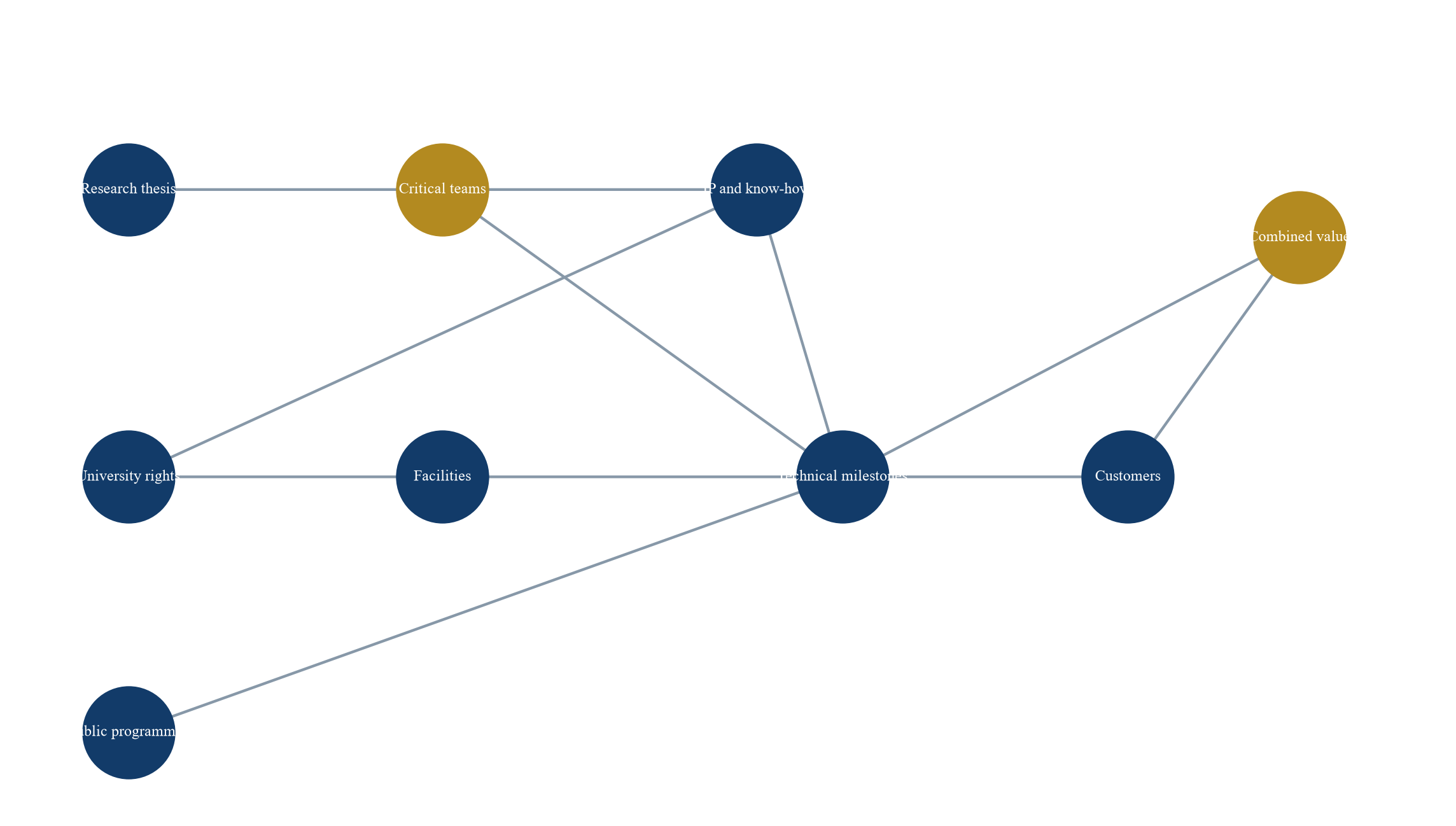
Proposed dependency map for transaction diligence.
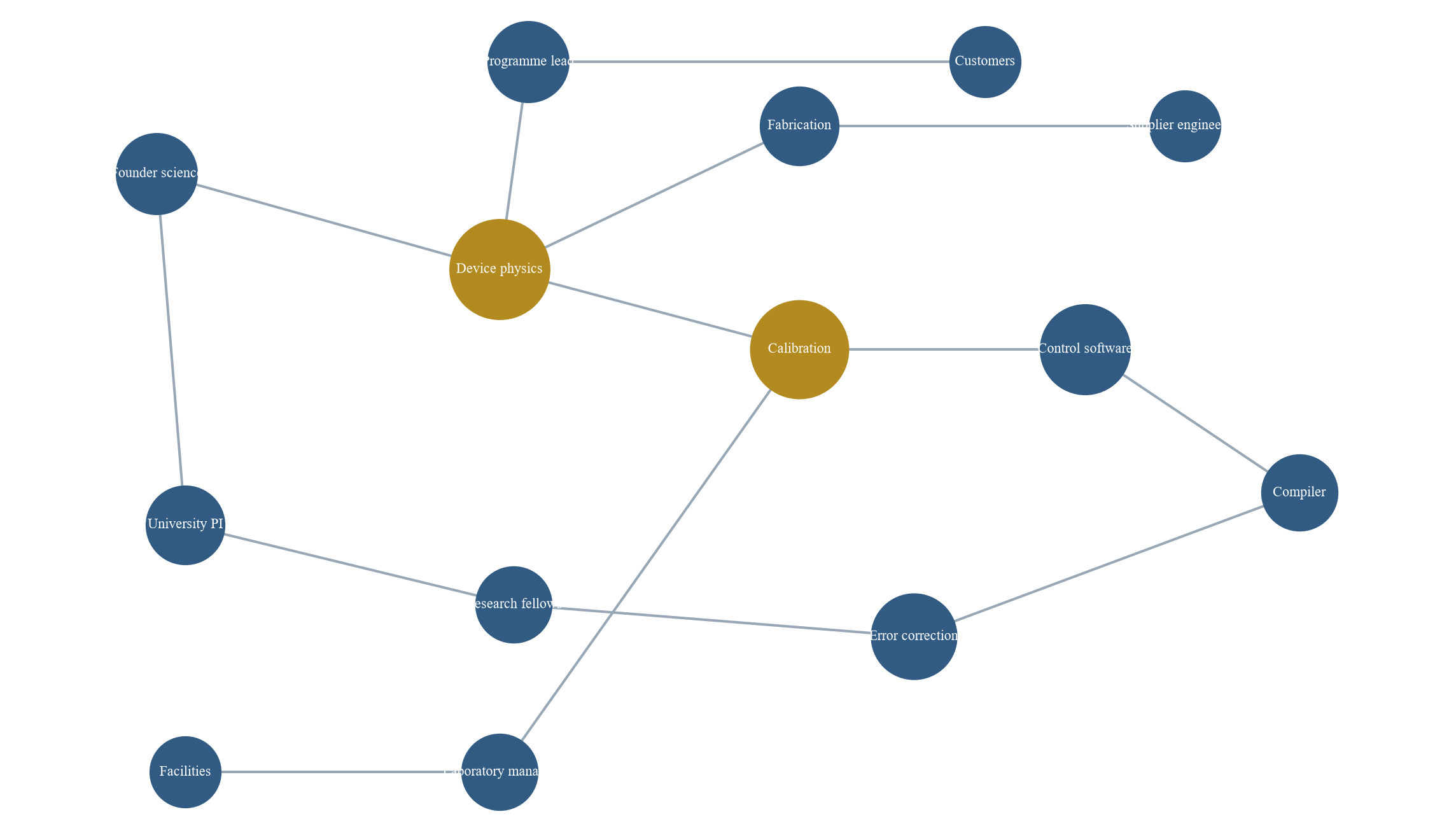
Illustrative network; larger nodes indicate higher technical centrality rather than seniority.
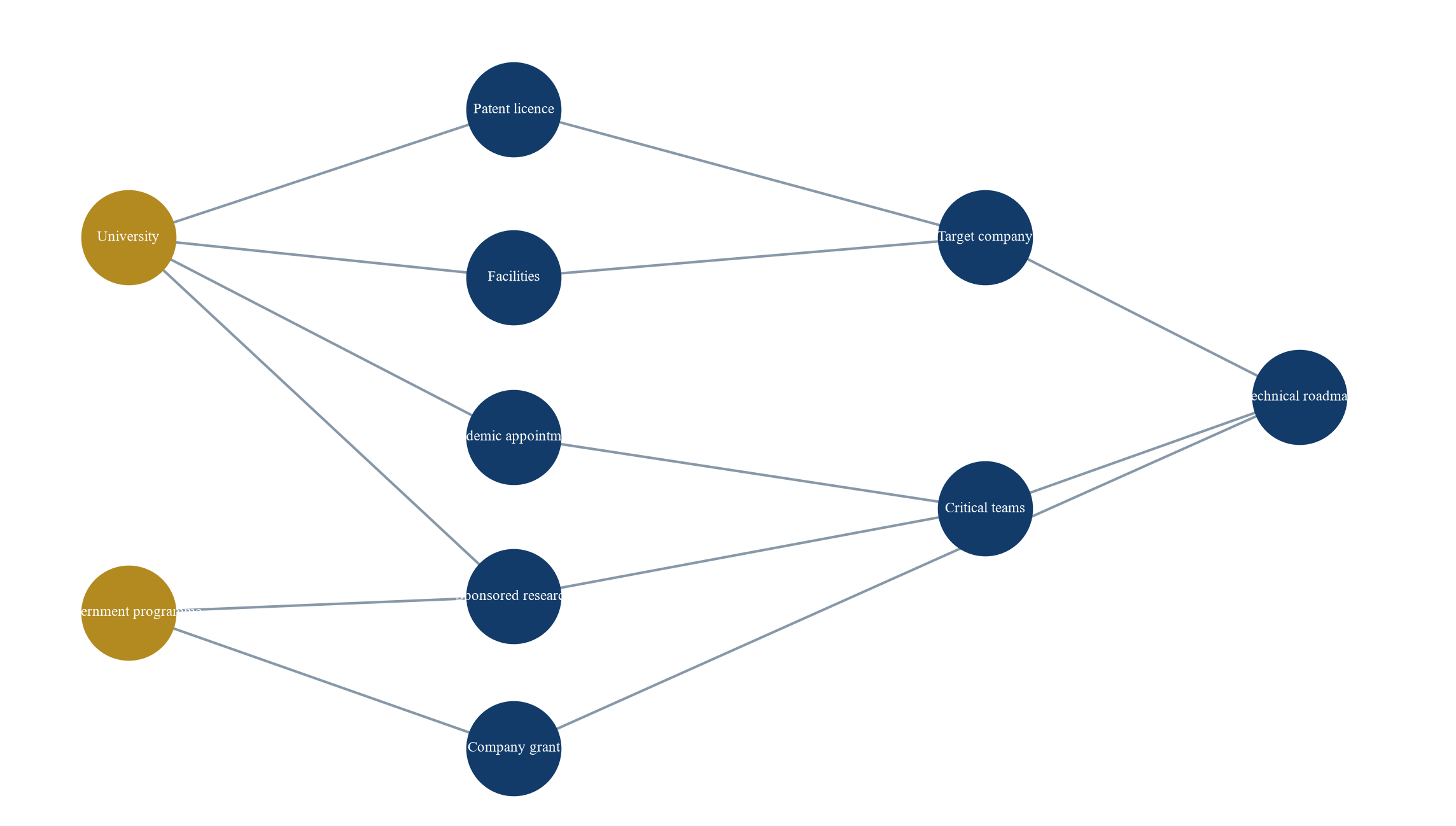
Proposed diligence architecture; each connection requires agreement-level evidence.
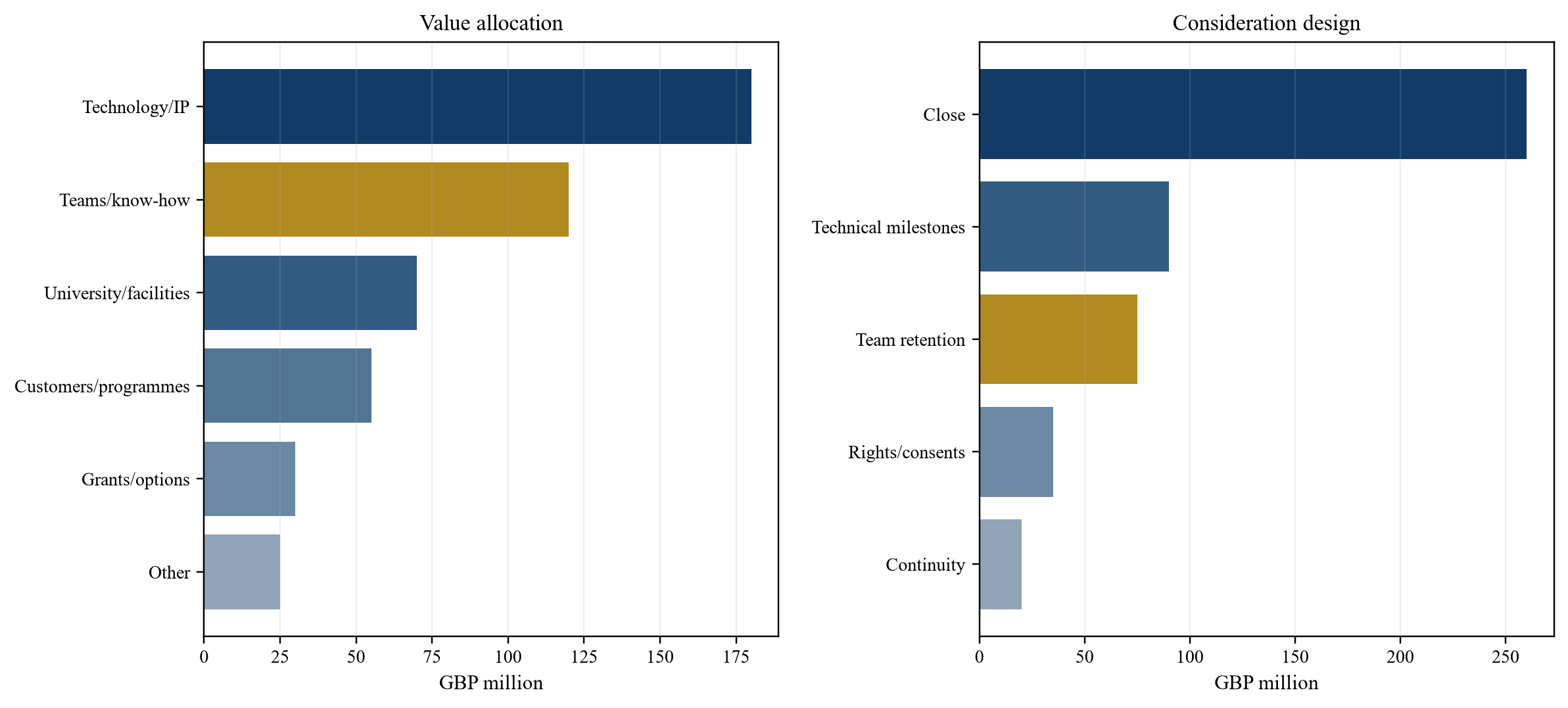
Wholly hypothetical management assumptions; GBP million.
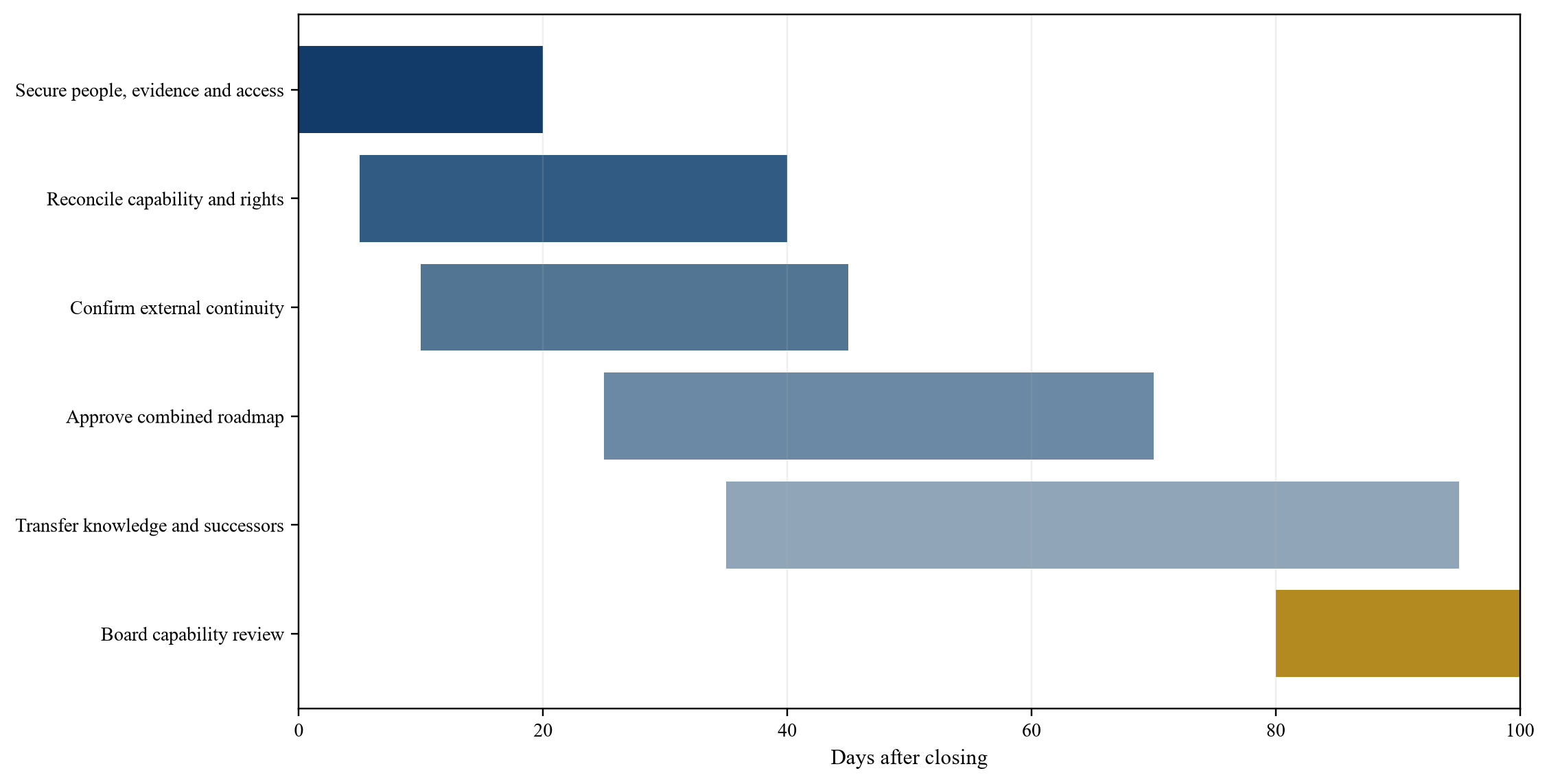
Sequencing protects evidence, people and external relationships before organisational consolidation.
| Capability | Required roles | Evidence | Continuity test |
|---|---|---|---|
| Device performance | Device physicists, fabrication and calibration | Multi-device test records and failure analysis | Independent reproduction under controlled conditions |
| Control system | Electronics, optical control and software | Architecture, version history and interface tests | Successor team operates and diagnoses system |
| Error correction | Theorists, experimentalists and decoder engineers | Code assumptions, experiment data and resource estimates | Milestone repeated with reviewed measurement method |
| Product operation | Reliability, cloud, support and security | Uptime, incidents, release and support records | Service continues through controlled change |
| Technical roadmap | Technical authority and programme leadership | Costed milestones, dependencies and decision history | Combined board approves one accountable roadmap |
Proposed evidence framework.
| Relationship | Diligence questions | Required evidence | Transaction treatment |
|---|---|---|---|
| Patent licence | Scope, exclusivity, assignment, sublicensing and improvements | Executed licence, schedules and prosecution files | Consent condition, covenant or value adjustment |
| Sponsored research | Scope, funding, publications, IP and termination | Agreement, statements of work and reports | Continuity plan and post-close charter |
| Facilities | Access, priority, equipment, safety and cost | Facility and equipment agreements | Alternative facility and qualification plan |
| Academic appointments | Time, conflicts, confidentiality and supervision | Appointment and consultancy terms | Agreed operating boundaries |
| Student and fellow work | Ownership, publication, supervision and data | Project terms and assignments | Rights remediation and ethical continuity |
Actual contracts and qualified advice determine the transaction-specific position.
| Risk | Evidence | Retention response | Capability measure |
|---|---|---|---|
| Founder authority concentration | Decision and escalation map | Defined role, successor and governance | Decisions transferred without programme delay |
| Specialist-team loss | Network and market mapping | Team-wide pool, career path and funded programme | Critical capability coverage |
| Immigration disruption | Lawful status and sponsor review | Timely sponsor and work-location plan | Continuous lawful deployment |
| Scientific disengagement | Interviews and research-plan review | Protected budget, publication path and council | Milestone quality and collaboration activity |
| Tacit-knowledge loss | Documentation and reproduction test | Structured transfer and independent repeat | Reproducibility and successor readiness |
Proposed design principles rather than employment advice.
| Value component | Amount | Evidence gate | Consideration protection |
|---|---|---|---|
| Verified technology and IP | GBP 180 million | Reproduced tests and chain of title | Technical milestone consideration |
| Specialist teams and know-how | GBP 120 million | Critical-team acceptance and transfer plan | Team-wide retention instruments |
| University and facility relationships | GBP 70 million | Rights, consent and access continuity | GBP 35 million rights holdback shared with other consents |
| Customer and programme access | GBP 55 million | Contract and programme continuity | GBP 20 million continuity payment shared with programmes |
| Grants and option rights | GBP 30 million | Award terms and remaining obligations | Limited upfront value and specific covenants |
| Other net assets and option value | GBP 25 million | Asset verification and board-approved option plan | Capped upfront allocation |
Wholly hypothetical management assumptions; not observed deal terms.
| Gate | Core question | Evidence | Decision consequence |
|---|---|---|---|
| National security | Is notification mandatory and can the thesis operate under likely conditions? | Technology, ownership, access and customer map | Filing, mitigation, timetable or structure change |
| Competition | Does the target represent important present or future rivalry? | Capability, innovation, channel and counterfactual evidence | Remedy analysis and thesis adjustment |
| Export control | Which technology, software and assistance are controlled? | Classifications, licences and access records | Information perimeter and operating model |
| University consent | Do licences, facilities or collaborations require consent? | Executed agreements and correspondence | Closing condition, holdback or alternative |
| Immigration sponsorship | Can sponsored specialists continue lawfully? | Role, status, sponsor and structure analysis | Licence, notification and timing plan |
Qualified advisers should confirm current transaction-specific requirements.
| Measure | Day 10 | Day 30 | Day 60 | Day 100 |
|---|---|---|---|---|
| People | Critical roles confirmed | Retention and sponsorship plan active | Successors assigned | Capability coverage reported |
| Evidence | Repositories secured | Baselines reconciled | Reproduction tests underway | Exceptions and results reported |
| External relationships | Owners assigned | Rights and consents mapped | Charters and remedies active | Continuity evidenced |
| Roadmap | Existing plans preserved | Dependencies reconciled | Combined roadmap approved | Milestone quality reviewed |
| Regulation | Access controls maintained | Filing and licence plan current | Mitigation funded | Compliance dashboard active |
Proposed outcome measures.
| Area | Green evidence | Amber condition | Red condition |
|---|---|---|---|
| Capability | Result reproduced with transferable system | Gap is bounded, funded and testable | Core claim cannot be reproduced or transferred |
| Talent | Critical teams accept credible roles and succession | Limited gaps have funded recruitment and transfer | Essential team or authority will not continue |
| University | Rights, consent and facilities support the roadmap | Time-bounded consent or substitute is credible | Core licence or facility is unavailable |
| Regulation | Viable filing, access and operating path | Defined mitigation with acceptable economics | Required ownership or access is unlikely to be permitted |
| Economics | Price reflects evidence and downside funding | Option value is capped and milestone linked | Value depends on unsupported forecasts or fragile goodwill |
Proposed decision framework.
Sources
- Department for Science, Innovation and Technology, National Quantum Strategy, 2023. Read the primary source
- Department for Science, Innovation and Technology, National Quantum Strategy Missions, updated 2025. Read the primary source
- Department for Science, Innovation and Technology, UK Quantum Skills Taskforce Report, updated 24 June 2025. Read the primary source
- UK Research and Innovation, Quantum Technologies. Read the primary source
- UK Research and Innovation, Centre for Quantum Commercialisation Skills, 2026. Read the primary source
- UK Research and Innovation, Investing in Quantum Technology Fellowships for Future Success. Read the primary source
- HM Government, Digital and Technologies Sector Plan Year One Update, 2026. Read the primary source
- Cabinet Office, Independent Review of University Spin-out Companies, 2023. Read the primary source
- HM Treasury, Knowledge Asset Spinouts Guide. Read the primary source
- Investment Security Unit, National Security and Investment Act: Details of the 17 Types of Notifiable Acquisitions. Read the primary source
- The National Security and Investment Act 2021 (Notifiable Acquisition) Regulations 2021. Read the primary source
- Competition and Markets Authority, Merger Assessment Guidelines, updated 3 September 2026. Read the primary source
- Competition and Markets Authority, Mergers: Guidance on the CMA's Jurisdiction and Procedure. Read the primary source
- Export Control Joint Unit, UK Strategic Export Controls, updated 23 April 2026. Read the primary source
- Export Control Joint Unit, UK Strategic Export Control List. Read the primary source
- Department for Business and Trade, Military End-use Controls. Read the primary source
- UK Visas and Immigration, Workers and Temporary Workers: Sponsor Duties and Compliance, 2026. Read the primary source
- HM Government, Business Transfers, Takeovers and TUPE. Read the primary source
- Department for Business, Innovation and Skills, Employment Rights on the Transfer of an Undertaking. Read the primary source
- Intellectual Property Office, Intellectual Property and Your Work. Read the primary source
- UK Research and Innovation, Good Research Resource Hub. Read the primary source
- UK Research and Innovation, Terms and Conditions for Research Grants. Read the primary source
- IonQ, IonQ Completes Acquisition of Oxford Ionics, 17 September 2025. Read the primary source
- IonQ, Agreement to Acquire Oxford Ionics, 9 June 2025. Read the primary source
- Oxford University Innovation, Quantum Leap: The Story Behind the University of Oxford's Highest-value Quantum Computing Spinout Acquisition, 17 September 2025. Read the primary source
- University of Oxford, Annual Report and Accounts 2024/25. Read the primary source
- Oxford University Innovation, A Better Future Through Innovation: Impact Report 2025. Read the primary source
- Engineering and Physical Sciences Research Council, National Quantum Computing Centre. Read the primary source
- National Quantum Computing Centre, Technology Programme. Read the primary source
- Royal Academy of Engineering, Spotlight on Spinouts. Read the primary source
- HM Government, Research Collaboration Advice Team Guidance. Read the primary source
- National Cyber Security Centre, Secure Innovation Guidance. Read the primary source
