

1. Define the acquisition decision
The board decision is whether the target controls a defensible path from scarce power and suitable land to contracted, billable and collectible customer service. The work should begin with the proposed transaction perimeter, investment horizon, target customers, desired risk allocation, financing capacity and operating model. Every value claim should connect to source evidence, a conversion requirement, an accountable owner and a cash consequence. [1][2]
The principal failure mode is a headline price per megawatt applied to unlike capacity. Utility capacity may remain conditional. Energised power may lack a commissioned data hall. Contracted customer load may await design, equipment, notice to proceed or service commencement. Billable load may carry concentration, credit, renewal and service-level risk. A buyer that values all stages as current cash pays today for several uncompleted projects.
The recommended response is a layered acquisition thesis. Land and interconnection rights establish location value. Funded and permitted infrastructure establishes conversion value. Executed customer obligations establish backlog value. Active billing and collected cash establish operating value. Technology-specific equipment and merchant compute remain separate exposures. The investment committee should approve a price, protection package and capital plan for each layer rather than one blended narrative.
| Value layer | Evidence required | Principal failure | Deal treatment |
|---|---|---|---|
| land and site control | title, lease, easements and zoning | site cannot support planned use | closing condition or exclusion |
| utility and interconnection | executed agreements, studies and milestones | capacity is conditional or delayed | milestone value and covenant |
| customer-usable capacity | commissioned electrical and cooling systems | gross power cannot become IT load | engineering adjustment |
| customer contracts | executed terms, credit and deployment schedule | commitment is cancellable or delayed | contract-specific value |
| billable operations | service commencement, invoices and cash | backlog does not convert to revenue | operating cash valuation |
| hardware and compute | title, useful life, utilisation and price exposure | obsolescence or falling compute price | separate valuation and downside |
Proposed diligence register; project-specific legal, utility and engineering review remains necessary.
2. Fix the legal and operating perimeter
The diligence team should map every entity, property, utility account, interconnection right, generation arrangement, permit, customer agreement, equipment item, employee, data set and liability. Site ownership alone does not establish control over transmission upgrades, substation capacity, water rights, tax incentives or customer equipment. Shared infrastructure, affiliate contracts and seller-provided systems can leave material dependencies outside the acquired group.
The perimeter should distinguish owned assets, leased assets, contractual rights, regulated service, customer-funded improvements and third-party equipment. Change-of-control consents, assignment limits, utility security, landlord rights, equipment liens and customer step-in rights can alter both closing certainty and post-close control. A schedule of excluded assets and continuing services should be reconciled to the operating model.
The buyer should convert each dependency into a closing condition, transitional arrangement, permanent agreement or valuation exclusion. A day-one control matrix should name the party able to operate the site, dispatch power, manage incidents, invoice customers and access critical systems. Any value dependent on a consent or future agreement should remain outside unconditional consideration until the requirement is met. [3][4]
3. Standardise the megawatt vocabulary
Data-centre operators use power measures for different commercial and technical purposes. Gross utility capacity can include future or conditional supply. Customer-usable or sellable power estimates the critical IT load supportable by completed infrastructure. Contracted capacity refers to executed customer commitments, which may include non-billable future deployments. Billable capacity reflects service already commenced. Public filings increasingly distinguish these measures because conversion timing directly affects revenue and capital allocation. [5][6]
The diligence data model should retain the target's source definitions while mapping them to one controlled taxonomy. It should record gross utility rights, firm deliverable capacity, energised capacity, total facility load, critical IT load, commissioned sellable capacity, executed contracted load, installed customer load, billable load and collected cash. Redundancy configuration, power-usage effectiveness and design density should be explicit.
The buyer should prohibit arithmetic that compares unmatched measures. A price per utility megawatt cannot be compared directly with a price per billable IT megawatt. Capacity should be analysed by site, phase, expected in-service date, redundancy, customer, contract and evidence status. The bridge between stages becomes the foundation for capex, schedule, valuation and financing.
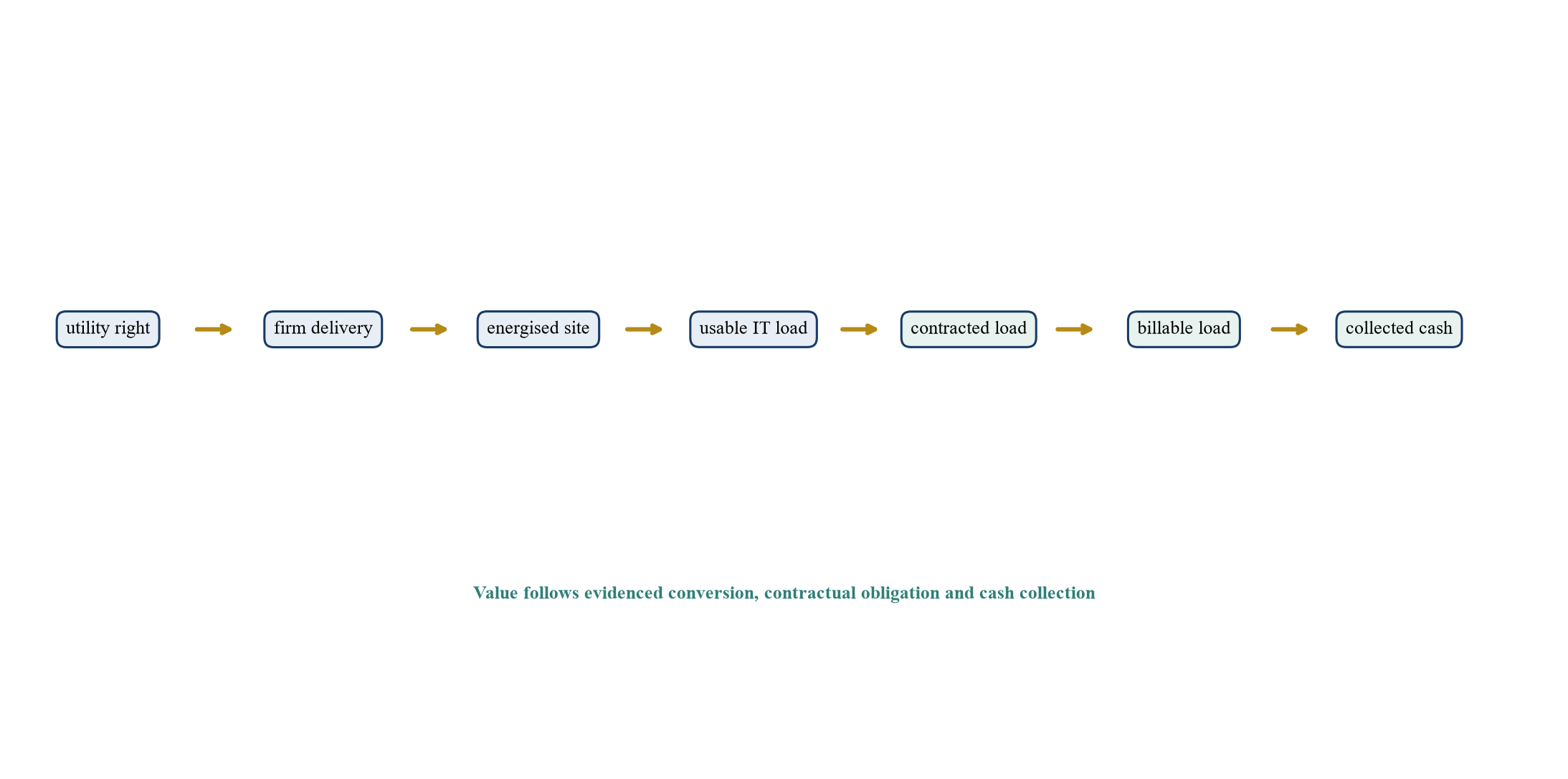
Analytical framework; each stage requires transaction-specific evidence.
4. Verify land, zoning and physical suitability
Land value depends on usable acreage, legal control, zoning, environmental condition, access, flood and climate risk, fibre routes, water, generation proximity, transmission topology and community acceptance. Large parcels can have limited buildable area after setbacks, wetlands, rights of way, substation space, stormwater and security requirements. A site marketed as powered land may still require extensive civil and utility work.
The buyer should reconcile title, surveys, easements, leases, zoning decisions, environmental studies, geotechnical reports, water and sewer arrangements, tax incentives and development agreements. Expansion rights should be tested against neighbouring uses, noise, backup generation, air permits and local approval. Incentives should enter value only when eligibility, compliance and recapture provisions are understood.
Site value should therefore be based on buildable, permittable and serviceable capacity by phase. Unsupported future acreage remains an option. Remediation, transmission routes, water infrastructure and off-site works belong in the sources-and-uses model. A legal land right without a viable technical and permitting path should not receive the same value as construction-ready powered land. [7][8]
5. Establish utility rights and firm deliverability
The most important power question is what the utility or market operator is contractually and physically obliged to deliver, when, at which voltage, under which upgrade programme and subject to what curtailment. An executed service agreement may still contain milestones, deposits, construction dependencies, study assumptions or termination rights. A substation nameplate does not prove coincident firm delivery to the target.
The diligence team should obtain utility applications, studies, service agreements, construction schedules, deposits, transmission and distribution upgrade responsibilities, curtailment rules, rate schedules and correspondence. Each site should show current energisation, committed increments, upstream constraints, expected in-service dates and remedies. FERC proceedings concerning large loads and co-location demonstrate that tariff treatment, reliability and cost allocation can change the commercial path. [9][10]
The valuation model should probability-weight capacity that remains conditional and should delay cash until the full delivery chain is complete. Deposits and upgrade expenditure should be reconciled to remaining obligations. Firm power, interruptible power and behind-the-meter supply require separate operating and financing cases. A buyer should preserve termination, price adjustment or contingent consideration where deliverability is not established.
6. Test grid, generation and co-location dependencies
Large AI loads can affect regional reliability, resource adequacy and interconnection planning. NERC identifies emerging large-load characteristics that can influence voltage, frequency, harmonics, restoration and forecasting. Co-located generation can reduce some delivery constraints while creating questions about network service, backup supply, export rights, dispatch, outage coordination and consumer cost allocation. [11][12]
The buyer should model normal, contingency and restoration conditions. It should test generator outage, transmission outage, extreme weather, fuel constraints, delayed upgrades and customer load ramps. On-site generation, storage and demand flexibility should be valued through permitted capability, fuel and maintenance evidence rather than stated optionality. Utility and market rules should govern the dispatch assumptions.
Grid value is location-specific. A megawatt in a constrained market with completed network upgrades may command a different value from a megawatt dependent on future generation and transmission. The model should identify who bears upgrade costs, congestion, losses, standby charges and curtailment. Changes in compute price do not remove those physical obligations; they can reduce the revenue available to carry them.
| Power claim | Required evidence | Cash risk | Valuation response |
|---|---|---|---|
| requested load | application and study status | no committed service | option value only |
| awarded capacity | executed utility terms and security | milestones can fail | probability and timing adjustment |
| firm deliverable load | completed upstream works and service obligation | network or schedule slippage | milestone protection |
| energised facility | commissioning and meter records | unusable internal distribution | conversion capex adjustment |
| critical IT load | tested electrical and cooling systems | lower sellable capacity | engineering haircut |
| contracted customer load | executed customer obligation | deployment or credit delay | contract-specific value |
| billable load | service acceptance, invoice and collection | revenue quality or concentration | operating cash valuation |
Proposed diligence map; governing tariffs and contracts determine actual rights.
7. Reconcile demand with public system evidence
US data-centre electricity demand has expanded materially. DOE reported that data centres used about 176 TWh in 2023, with a 2028 range of 325 to 580 TWh in its 2024 report. The 2025 update extended the horizon and emphasised substantial scenario uncertainty. IEA analysis identifies data centres as a major component of US electricity-demand growth, while EIA expects especially rapid near-term load growth in regions including PJM and ERCOT. These system forecasts support the need for site-specific power diligence; they do not prove demand for an individual asset. [1][2][13]
The buyer should compare target forecasts with utility, regional and national evidence without importing aggregate growth mechanically. Duplicate customer requests, alternative sites, speculative phases and unfinanced developments can inflate pipeline measures. Demand should be reconciled by customer, workload, location, redundancy, commencement date and contractual status.
Management forecasts should be classified as estimates. The base case should use executed commitments and evidenced conversion capacity. Prospective hyperscaler, model developer, enterprise and cloud demand can support a pipeline case after credit, technical requirements and competing alternatives are assessed. Merchant demand belongs in a downside-sensitive scenario.
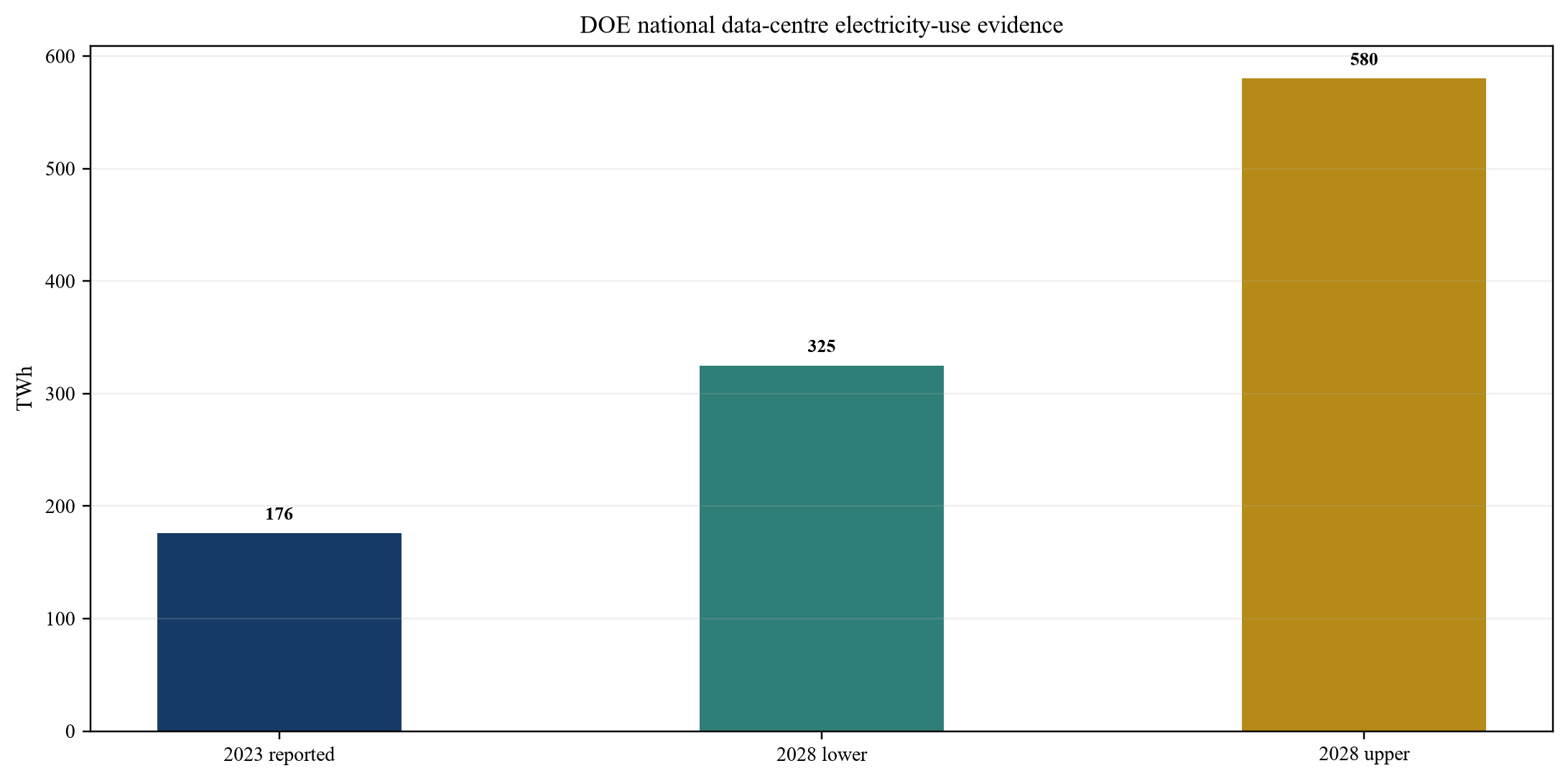
2023 is reported by DOE; 2028 is the DOE 2024 report range. Values are national system estimates, not target forecasts.
8. Underwrite customer contracts megawatt by megawatt
An executed customer contract can provide visibility while leaving material design, deployment and credit risk. The diligence team should extract contracted load, location, phase, commencement, term, ramp, take-or-pay obligation, termination, renewal, pricing, escalation, energy pass-through, capex responsibility, security, service levels, credits, change rights and step-in provisions. The contract schedule should reconcile to facility design and the financial model.
The legal label matters less than enforceable cash. A customer may reserve capacity subject to conditions precedent, design approval, equipment delivery or a notice to proceed. A take-or-pay structure can still contain delay relief, force majeure, service dependencies and damage caps. Customer-funded capex can reduce sponsor funding while creating credits, ownership questions or repayment obligations.
Each contracted megawatt should receive an evidence score and expected billing date. Value should reflect customer credit, concentration, contract duration, ramp, price formula, residual site flexibility and remedies. Contracts designed around one customer's architecture can create re-leasing cost. A portfolio of smaller agreements can diversify credit while increasing sales and operating complexity. [5][6][14]
9. Separate compute-price exposure from infrastructure cash
Compute prices can decline because accelerators improve, model architectures change, utilisation rises, competition grows or customers procure capacity differently. The effect on a data-centre asset depends on contract structure. A fixed infrastructure payment with energy pass-through may be less directly exposed than merchant GPU-hour revenue. A revenue-share, minimum-spend or bundled compute agreement can transmit price and utilisation risk to the operator.
The buyer should map revenue to the economic unit actually sold: space, kilowatts, megawatts, availability, energy, managed service, accelerator time, tokens, storage, network or a combination. It should then identify which party owns hardware, chooses refresh cycles, funds upgrades, schedules workloads and absorbs utilisation changes. The model should apply compute-price scenarios only to the cash flows exposed to compute economics.
Falling unit compute cost can increase demand through broader adoption, yet this relationship is uncertain and cannot be assumed for a target. The acquisition case should test price decline, efficiency gains, customer consolidation, workload portability and architecture change separately. Durable infrastructure value arises from scarce, usable and flexible capacity under enforceable contracts, not from a permanent assumption about one hardware generation.
| Commercial model | Direct compute-price exposure | Principal diligence question | Valuation treatment |
|---|---|---|---|
| powered shell lease | low to indirect | can the customer deploy and pay? | contracted infrastructure cash |
| wholesale colocation | indirect | are power, cooling and SLA obligations durable? | contract and renewal value |
| managed infrastructure | moderate | who funds refresh and bears utilisation? | margin and capex scenarios |
| dedicated GPU service | high | how do price, utilisation and hardware life interact? | technology-specific DCF |
| merchant GPU cloud | very high | can price and utilisation cover refresh and debt? | separate high-volatility value |
| revenue share | variable | which revenue definition and audit rights apply? | scenario and contingent value |
Proposed risk map; actual allocation follows executed contracts.
10. Diligence hardware, density and obsolescence
AI facilities can require rapidly changing rack density, network fabric, liquid cooling, power distribution and maintenance. A site compatible with one accelerator generation may need substantial modification for another. Hardware ownership, liens, warranties, replacement rights and residual value must be separated from the real estate and power platform.
The team should create an equipment ledger covering owner, location, serial identifier, specification, commissioning date, useful life, warranty, maintenance, security interest, customer dedication and disposal. It should reconcile equipment to capacity, energy consumption and revenue. Customer-contributed assets and landlord-owned improvements need clear access and end-of-term treatment.
Obsolescence should enter the model through refresh capex, downtime, residual value and reconfiguration cost. A lower compute price can reduce the value of older hardware before it materially affects a long-term powered-shell contract. The buyer should avoid financing short-lived equipment with debt shaped around long-lived land and utility rights unless cash and collateral remain aligned.
11. Verify cooling, water and environmental capacity
Higher-density computing can change cooling architecture, water use, electrical distribution and heat rejection. The critical question is whether the site can support the contracted design across ambient conditions and future density without losing sellable capacity. Nameplate cooling equipment does not establish sustained operation at required redundancy and efficiency.
The diligence team should review design basis, cooling topology, water sources, discharge, permits, treatment, drought restrictions, thermal tests, commissioning, maintenance and expansion. Air permits for backup generation, refrigerant management, noise and local environmental commitments should be included. Water and power interactions should be measured by operating condition rather than one annual ratio.
Conversion capex should include piping, heat exchangers, cooling distribution units, pumps, towers, chillers, controls and customer interfaces. If the target markets future high-density capacity, the buyer should require complete engineering and an executable construction path. Sustainability claims should be reconciled to measured energy, water and emissions boundaries. [15][16]
12. Rebuild the construction and commissioning schedule
Revenue conversion depends on a linked schedule across utility delivery, substations, buildings, electrical systems, cooling, network, security, customer fit-out, testing and service acceptance. Independent workstream schedules can conceal interface gaps. Long-lead transformers, switchgear, generators, cooling equipment and network components may set the critical path.
The buyer should reconcile contracts, purchase orders, design maturity, permits, manufacturing slots, site progress, commissioning plans and customer deployment. Cost-to-complete should include owner costs, contingencies, escalation, taxes, spares, testing and remedial work. Schedule confidence should reflect actual design and procurement evidence.
Consideration and acquisition financing should follow conversion milestones. Capacity awaiting major construction can be priced through staged funding, earn-outs or seller support. The base case should delay billing until the facility and customer achieve contractual service commencement. Accelerated cases should not fund debt capacity unless the evidence is sufficient.
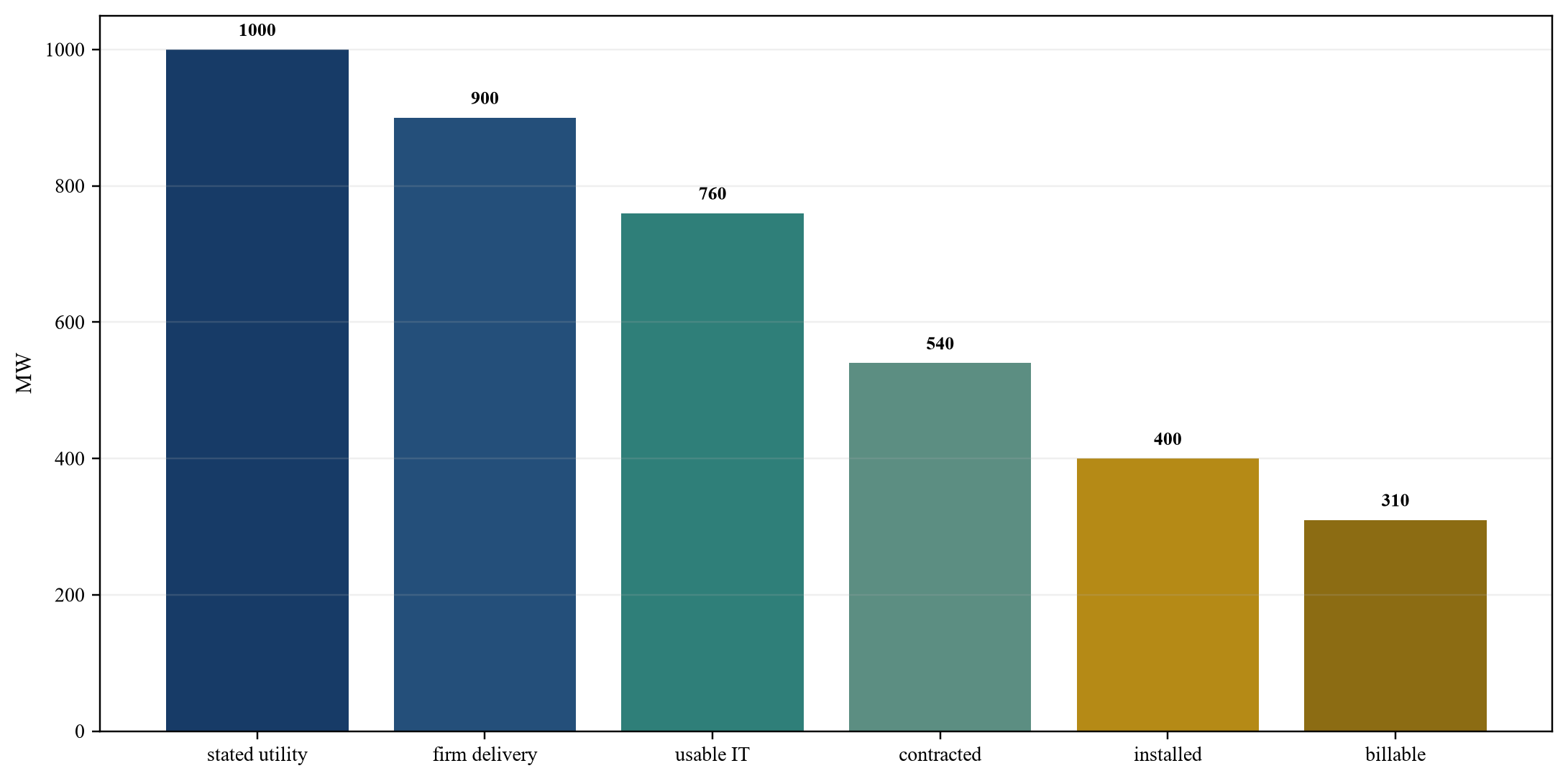
Wholly hypothetical megawatts; values do not describe an identified platform.
13. Model energy procurement and operating cost
Energy cost can be passed through, fixed, indexed, hedged, bundled or retained by the operator. The buyer should reconcile utility tariffs, demand charges, transmission, riders, fuel clauses, taxes, renewable instruments, hedges, on-site generation and customer billing. Contract timing mismatches can create margin volatility even when energy is nominally recoverable.
The operating model should use interval load, ramp, coincidence, losses, power-usage effectiveness and tariff structure. It should include minimum bills, ratchets, backup supply, maintenance, curtailment and imbalance. Renewable claims require boundary, ownership and retirement evidence. Hedges should be tested for volume, basis, credit and accounting.
The acquisition model should distinguish customer energy cash from operator margin. Pass-through revenue can increase reported revenue without equivalent enterprise value. Fixed energy pricing can create upside or loss depending on load and market conditions. Contract changes after closing should require controlled commercial and risk approval.
14. Prove operating reliability and service quality
Customers buy continuous service, power quality, thermal control, physical security and connectivity. The buyer should review incidents, maintenance, redundancy, load testing, capacity excursions, service credits, insurance, staffing, vendor support and emergency response. Reported uptime should reconcile to contract definitions and customer records.
Reliability depends on common-mode failure, human operation and restoration, not only redundant equipment counts. Shared substations, control systems, fuel, water, network routes and maintenance practices can defeat nominal redundancy. AI workloads may also have load characteristics that require utility and equipment coordination.
The model should convert service history into cash through credits, churn, remediation capex, insurance and renewal. Material defects should become closing remedies, reserves or price adjustments. Post-close integration should preserve operating authority and incident response before changing systems or vendors. [11][17]
15. Reconcile revenue, billing and cash collection
The financial diligence team should rebuild revenue from customer, site, contracted load, billable load, price formula, energy, services, credits and commencement date. It should reconcile contracts to meter or capacity records, invoices, receivables and bank cash. Non-recurring customer funding, construction reimbursement and energy pass-through require separate presentation.
Backlog is not revenue. Contracted capacity awaiting construction, customer equipment or service acceptance should remain in a conversion schedule. Billable capacity should reconcile to active service and collection. Credits, disputed invoices, ramp concessions and related-party terms should be visible.
The quality-of-earnings analysis should identify recurring infrastructure margin, variable energy, managed service, compute, installation, reimbursement and one-time items. The valuation model should follow durable cash after sustaining capex. Accounting presentation cannot replace the underlying contract and operating economics. [18][19]
| Stage | Source evidence | Key control | Financial output |
|---|---|---|---|
| executed contract | signed agreement and amendments | authority and condition review | committed MW and price |
| design allocation | approved technical schedule | capacity and density match | conversion capex |
| installation | customer and facility records | equipment and load verification | expected commencement |
| acceptance | test and service certificate | contractual criteria met | billing start |
| invoice | contract formula and meter data | price, energy and credit check | recognised and billed amount |
| collection | bank and receivable ledger | customer and invoice match | realised cash |
Proposed quality-of-revenue control.
16. Price customer concentration and credit
Large AI campuses may depend on one or two customers. Long contracts can support financing while concentrating counterparty, renewal, architecture and negotiation risk. The buyer should assess customer financial capacity, parent support, security, cross-default, termination, dispute history and strategic alternatives. It should also identify whether several contracts ultimately depend on the same cloud or model ecosystem.
Concentration should be measured across contracted MW, billable MW, revenue, EBITDA, receivables, capex and site dedication. A customer can represent a smaller share of current revenue and a much larger share of future capital. Credit support should be evaluated against remaining construction, contract liability and recovery cost.
The downside model should test delayed deployment, partial ramp, default, renegotiation, non-renewal and re-leasing. Re-leasing may require new cooling, electrical and network work. Diversification value should be supported by alternative customer demand and site flexibility rather than a generic market-growth assumption.
17. Build the complete capital plan
The transaction sources and uses should separate acquisition consideration, assumed debt, utility deposits, sustaining capex, committed construction, customer-specific fit-out, expansion, technology refresh, working capital, reserves and fees. Remaining capital should be tied to site phases and contracts. Customer funding, tax incentives and utility contributions require eligibility and timing evidence.
The buyer should reconcile engineering quantities, procurement, contingency and schedule. Sustaining capital preserves safety and service. Conversion capital turns utility rights into customer-usable infrastructure. Growth capital creates optional future capacity. Hardware refresh supports technology-specific revenue. Combining these categories can overstate free cash and debt capacity.
Capital release should follow permits, utility milestones, customer obligations, procurement and commissioning. The financing package should preserve liquidity for delays and redesign. An acquisition that consumes all available capital at closing can strand valuable sites before they become billable.
| Use | Closing | Committed follow-on | Contingent | Control |
|---|---|---|---|---|
| equity purchase | 2,650 | 0 | 250 | title and customer milestones |
| debt repayment and fees | 620 | 0 | 0 | closing funds flow |
| sustaining and remediation | 90 | 140 | 0 | engineering acceptance |
| contracted conversion capex | 0 | 1,150 | 180 | utility and customer gates |
| optional expansion | 0 | 0 | 900 | permits and contracted demand |
| liquidity and reserves | 210 | 120 | 0 | board and lender controls |
| total | 3,570 | 1,410 | 1,330 | phased investment authority |
Wholly hypothetical USD millions; the table is not a financing recommendation.
18. Structure acquisition and project financing
Debt capacity should follow billable and strongly contracted infrastructure cash, adjusted for concentration, completion and contract risk. Land and utility rights can support collateral value, yet lenders require a path to cash, enforceable security, permits, insurance and step-in. Hardware and merchant compute may need shorter tenor, lower leverage or separate financing.
The financing model should test interest, amortisation, construction draws, capitalised interest, covenants, reserves, completion support and customer delays. It should identify which entity owns land, interconnection, buildings, equipment and contracts. Structural subordination can separate collateral from revenue.
The buyer can use staged equity, construction facilities, asset-level debt, customer prepayments, equipment finance and contingent seller consideration. The governing principle is duration alignment. Long-lived infrastructure should support long-duration cash. Short-lived hardware and volatile compute should not determine the solvency of the durable power platform.
19. Value the platform in separate layers
Valuation should begin with current collected cash, sustaining needs and contract duration. It should then add committed conversion value, customer-backed growth and site options subject to evidence. Hardware and merchant compute require their own useful-life, utilisation, price and refresh assumptions. One enterprise-value multiple can conceal these differences.
The contracted-megawatt method should function as a reconciliation rather than an independent shortcut. Price per billable MW can cross-check operating cash. Price per contracted MW must deduct remaining capex, timing and contract risk. Price per firm utility MW must reflect conversion cost, permits, site suitability and demand. Requested or speculative capacity should receive limited option value.
The DCF should show site, phase, customer and technology cash. Market evidence should be normalised for power definition, contract quality, geography, development status, leverage and transaction structure. The buyer should explain every value increment between current operations and optional capacity. [20][21]
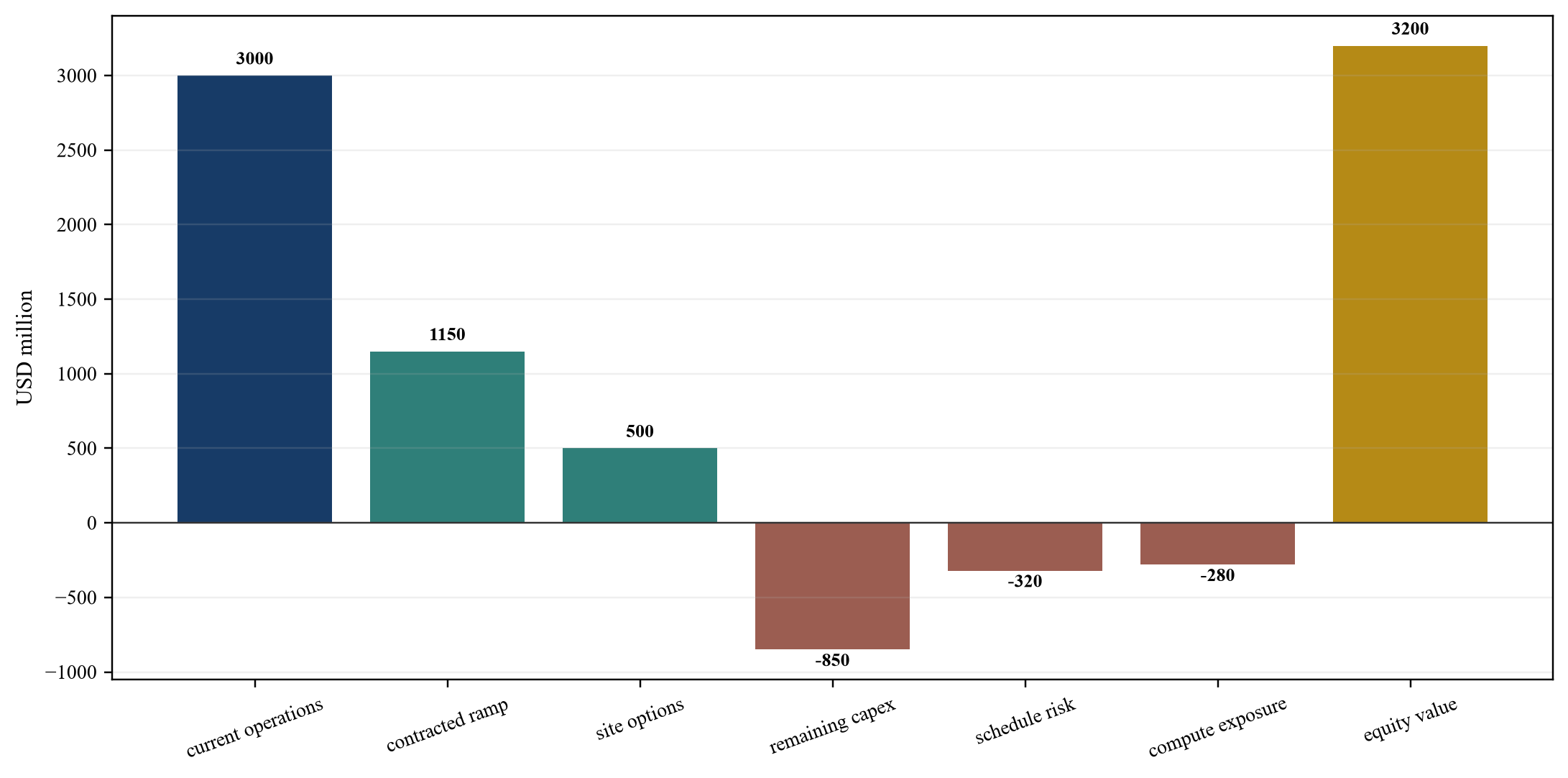
Wholly hypothetical USD millions; this is not a valuation opinion.
20. Quantify compute-price and conversion sensitivities
Compute-price decline should affect the revenue streams exposed to GPU-hour, token or managed-compute economics. Customer infrastructure contracts may instead be affected through renewal, credit or renegotiation. The model should avoid applying one price shock to all cash. It should identify the commercial mechanism through which a compute change reaches the target.
The most important combined sensitivity often links deployment timing, remaining capex and customer concentration. A delayed customer can postpone revenue while construction interest and utility obligations continue. A compute-price shock can weaken a merchant customer at the same time that re-leasing requires redesign. The first liquidity and covenant failure matters more than a remote terminal multiple.
The investment committee should receive a two-dimensional sensitivity for conversion and exposed compute economics, alongside compound operational cases. Stop rules should identify when the buyer delays a phase, requires customer funding, reduces debt, redirects capacity or exercises contractual remedies.
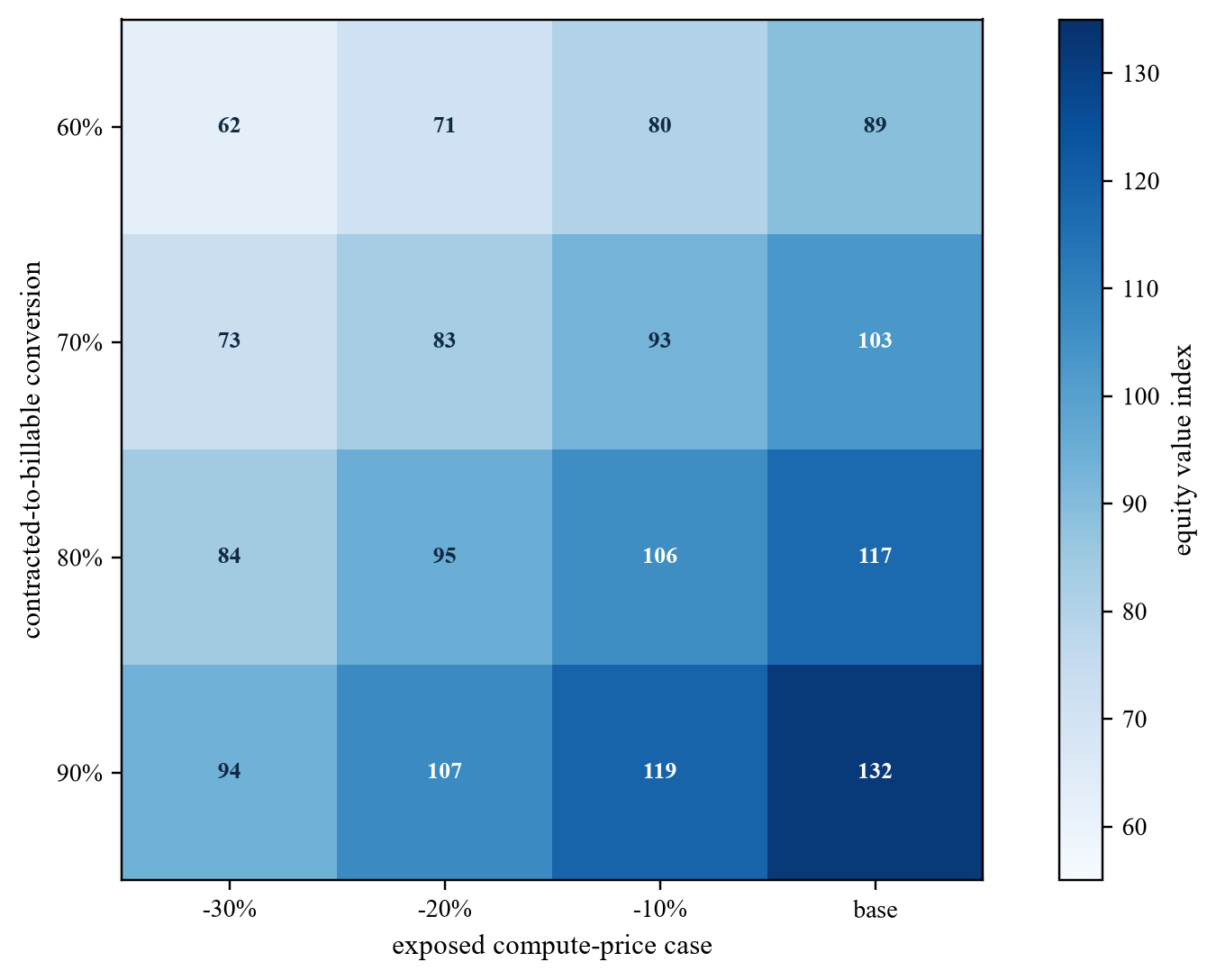
Wholly hypothetical index values; the figure is not a valuation opinion.
21. Test synergies and portfolio value
Acquisition synergies can arise from customer cross-selling, procurement, network routes, operating teams, energy management, development capability and capital access. They can also require systems integration, contract consent and additional capex. A portfolio can improve resilience through geographic diversity while increasing common-customer and common-vendor concentration.
The buyer should separate cost removal, avoided future cost, revenue expansion, financing benefit and strategic option value. Each synergy should have a baseline, owner, cost, timing, dependency and cash measure. Customer and utility relationships should not be assumed transferable without evidence.
Value should be recognised when the buyer controls the action and the cash is measurable. Market-wide demand and a larger development pipeline are not transaction synergies. Revenue synergy should remain outside debt sizing until customer evidence exists. Integration costs and dis-synergies should enter the same bridge.
| Item | Evidence | Cash mechanism | Approval gate |
|---|---|---|---|
| procurement scale | comparable bids and volumes | lower equipment or service cost | signed sourcing plan |
| operating platform | staffing and system design | avoided duplicate cost | continuity-tested transition |
| energy optimisation | interval load and tariff model | lower demand or imbalance cost | utility and customer compatibility |
| customer expansion | written demand and site fit | additional contracted load | executed customer obligation |
| financing benefit | committed term sheets | lower capital cost | closing and covenant approval |
| redesign and migration | engineering and vendor plan | incremental cost and downtime | funded integration budget |
Proposed transaction control; values require deal-specific evidence.
22. Address competition, foreign investment and approvals
US merger review can examine concentration, vertical foreclosure, access to critical inputs, entrenchment and serial acquisition. Data-centre transactions may involve local capacity, interconnection, cloud ecosystems, specialised services or customer dependencies. DOJ and FTC guidance requires a fact-specific analysis. FTC work on large AI partnerships also highlights access to compute, switching costs and information flows. [22][23]
The buyer should identify relevant product and geographic markets, competitors, capacity constraints, customer alternatives, vertical links and sensitive information. Utility and FERC approvals, state regulation, permits and foreign-investment review may apply depending on assets and parties. Contractual exclusivity and most-favoured terms should be assessed.
Approval risk should enter the transaction timetable, financing, information controls and remedies. Clean teams can protect competitively sensitive customer, pricing and capacity data. The integration plan should not presume control before closing. A long-stop date and remedy standard should reflect the actual approval path.
23. Protect data, cybersecurity and AI governance
Data centres operate critical physical and digital systems. The buyer should assess access control, operational technology, building management, energy systems, network, monitoring, customer segregation, vendor access, incident response, backup and recovery. Customer obligations can exceed generic policy requirements.
AI can support energy forecasting, cooling optimisation, predictive maintenance, anomaly detection and capacity planning. Models should have defined purpose, data lineage, validation, monitoring, access and human accountability. An optimisation model should not override safety, utility or customer constraints without authorised control.
The post-close plan should preserve logs, credentials, licences, source data, model documentation and recovery. Cyber findings should translate into remediation cost, customer disclosure, insurance and operating risk. NIST frameworks provide useful governance structures, while contractual and regulatory obligations remain site- and customer-specific. [24][25]
24. Execute integration without interrupting service
Day one should preserve safety, power, cooling, network, incident response, customer communication, billing, cash and regulatory compliance. Operating authority and escalation should be explicit by site. Changes to control systems, vendors, staffing and maintenance should follow tested transition plans.
The first phase should stabilise data definitions and reconcile power, capacity, contracts and cash. The second should complete committed construction and customer ramps. The third can capture portfolio procurement and operating improvements. Optional expansion should follow evidence on power, permits, customer demand and capital.
Each phase should have entry, exit and stop gates. A named integration leader should report site readiness, customer milestones, capex, schedule, incidents, service credits, liquidity and unresolved approvals. The board should preserve an independent challenge function for material model and engineering assumptions.
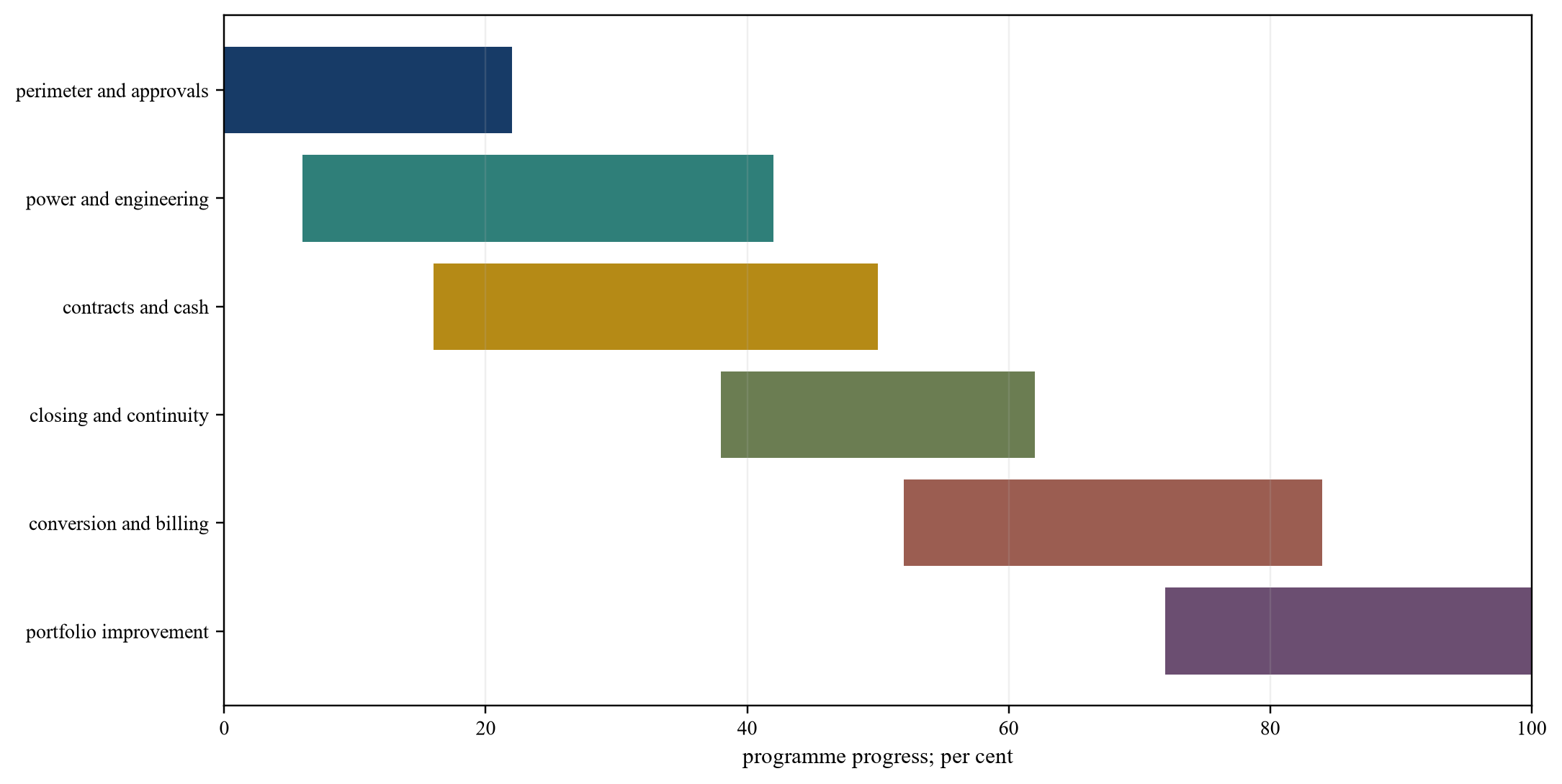
Illustrative sequence; actual timing depends on approvals, utility delivery, construction and customer acceptance.
Implementation detail: building a contracted-megawatt acquisition model
The transaction team should establish one controlled site-phase register. Each row carries the legal site, parcel, utility account, interconnection reference, gross utility right, firm delivery, energisation, redundancy, critical IT design, commissioned usable load, customer, contract, installed load, billable load, invoice and collection. Original identifiers and definitions should be preserved.
The power model should distinguish requested, awarded, firm, energised and usable capacity. Requested capacity can show strategic pipeline while remaining outside base value. Awarded capacity needs milestone, deposit and upgrade evidence. Firm delivery requires an enforceable service path and completed dependencies. Energised power must pass through commissioned internal infrastructure before it becomes customer-usable.
The engineering model should convert facility load to critical IT load. It should show cooling, electrical losses, redundancy, auxiliary systems, maintenance and ambient conditions. Power-usage effectiveness is one input rather than a complete conversion formula. The model should retain design and tested capability by phase.
The contract model should map each customer obligation to a specific site, load, design and billing schedule. Contracted capacity awaiting customer equipment or facility delivery should remain in backlog. Service commencement should follow contractual acceptance. The model should calculate recurring infrastructure, energy, managed service, credits and other cash separately.
The compute-exposure map should identify who owns accelerators, sets price, schedules workloads and funds refresh. A powered-shell landlord may face customer credit and renewal exposure without direct GPU-hour pricing. A managed GPU operator can face immediate price, utilisation and obsolescence risk. Mixed contracts should be decomposed by cash mechanism.
Validation should reconcile management capacity metrics to engineering and customer evidence. SEC filings show that operators themselves distinguish gross utility, leasable, leased and billable capacity. The buyer should reproduce those bridges at site and customer level. Differences should remain visible rather than being forced into one reported figure.
Demand analysis should remove duplicates. One customer may request capacity across several regions or operators before committing. Pipeline probability should reflect executed documents, deposits, design work, credit, deployment plan and competing alternatives. Aggregate industry forecasts should provide context and should not substitute for target evidence.
Construction schedules should be integrated. Utility delivery, substation, shell, electrical, cooling, network, security, customer fit-out and testing must converge. The critical path should use purchase orders and manufacturing information. Each delay should flow to capitalised interest, billing, customer remedies and liquidity.
Cost-to-complete should be independently reconstructed. It should include owner-furnished equipment, customer interfaces, utility contributions, escalation, contingency, commissioning, spares, tax and insurance. Customer-funded items should show ownership and any credit against future fees. Incentives should show receipt timing and recapture.
Energy economics should use interval data. Demand charges, ratchets, coincident peaks, losses, power factor, pass-through timing and hedges can materially change margin. The model should retain customer and operator cash separately. Renewable attributes should be connected to contracts and retirement evidence.
Reliability analysis should identify common modes. Two feeds can share upstream equipment. Redundant cooling can share water or controls. Several fibre routes can enter through one duct bank. Tested restoration, maintenance and incident records provide stronger evidence than design labels alone.
Customer concentration should include future capital. A customer may represent a modest portion of current revenue and most of the remaining construction. Credit support should be compared with unspent capex, contract liability and re-leasing cost. Parent guarantees, deposits and equipment liens require legal confirmation.
The valuation model should carry separate schedules for current operations, contracted conversion, uncontracted expansion, hardware and compute services. Current operations can be valued through durable cash. Contracted conversion requires remaining capex and timing. Uncontracted expansion is an option. Hardware value follows useful life and market evidence. Compute cash requires price and utilisation scenarios.
Comparable transaction analysis should normalise the power denominator. A price per MW based on gross utility capacity cannot be compared with one based on critical IT or billable load. Geography, energy cost, contract duration, customer credit, density, development status and remaining capex should be adjusted before drawing conclusions.
Financing should follow cash layers. Operating infrastructure can support term debt. Committed conversion can support construction draws with completion conditions. Customer-specific hardware may support equipment finance. Merchant compute requires adequate equity and liquidity. Cross-defaults should not allow one volatile layer to destabilise durable sites without explicit board approval.
The competition workstream should start early. It should identify capacity concentration in relevant local and service markets, vertical links to cloud or AI customers, exclusivity and data access. Clean-team protocols should control sensitive capacity, price and customer information. Remedies and approval timing should enter bid certainty.
Integration should retain site expertise. Facility engineers, operators, customer teams and utility relationships carry tacit knowledge. Retention, authority and escalation should be agreed before closing. System migrations should follow parallel testing and recovery planning.
AI-supported diligence can reconcile documents, detect anomalies, forecast load and simulate conversion. Material exceptions should be reviewed by engineering, commercial, legal and finance owners. Models should record source, version, assumptions, overrides and realised results. Human decision rights remain explicit.
Red-team analysis should combine failures. A utility delay can coincide with customer redesign and construction inflation. A compute-price shock can weaken a customer while hardware value declines. A cooling redesign can reduce usable MW and delay service. The model should identify the first liquidity, covenant or contract failure and the available intervention.
The investment committee should receive one evidence ledger. It should show perimeter, land, power, grid, permits, engineering, contracts, billable cash, capex, schedule, energy, operations, concentration, financing, valuation, approvals, cybersecurity and integration. Each unresolved item should have an owner, deadline, cash effect and decision rule.
25. Use an investment-committee decision matrix
The approval question is whether the buyer controls durable power and a financeable path to customer cash at an acceptable price. The evidence should establish legal perimeter, firm deliverability, usable capacity, contract obligations, remaining capital, operating reliability, downside liquidity and post-close control. The decision paper should show where value depends on future execution.
The committee should distinguish conditions that must be satisfied before closing, matters protected through consideration, funded post-close work and options that remain outside the base case. A strong strategic market can support investment without validating a specific site, customer or price. Each conclusion should be attributable to reviewed evidence.
Approval should therefore state the maximum price, required protections, capital envelope, financing conditions, integration authority, customer and utility milestones, downside actions and stop rules. The board should monitor conversion from utility right to collected cash rather than celebrate contracted megawatts in isolation.
| Finding | Cash consequence | Deal response | Accountable owner |
|---|---|---|---|
| utility capacity remains conditional | delayed or lost development value | milestone consideration and termination right | power and legal leads |
| usable IT load is below plan | lower sellable capacity and revenue | engineering adjustment and redesign budget | engineering lead |
| customer contract is conditional | backlog may not become cash | exclude, stage or require credit support | commercial lead |
| compute exposure is bundled | price and obsolescence volatility | separate valuation and financing | technology and finance leads |
| downside breaches liquidity | funding or covenant failure | lower debt and increase reserves | finance lead |
| durable power converts to governed cash | financeable operating value | approve subject to evidence gates | investment committee |
Proposed decision framework; it is not an investment recommendation.
Sources
- U.S. Department of Energy, 2024 United States Data Center Energy Usage Report announcement, Read the primary source
- International Energy Agency, Energy and AI: Executive Summary, Read the primary source
- U.S. Securities and Exchange Commission, EDGAR Company Filings, Read the primary source
- Financial Accounting Standards Board, Accounting Standards Codification Topic 805: Business Combinations, Read the primary source
- U.S. Securities and Exchange Commission, Core Scientific 2025 Form 10-K, Read the primary source
- U.S. Securities and Exchange Commission, Digital Realty 2025 Form 10-K, Read the primary source
- U.S. Environmental Protection Agency, Brownfields Program, Read the primary source
- Federal Emergency Management Agency, National Risk Index, Read the primary source
- Federal Energy Regulatory Commission, PJM Large Load Co-Location Fact Sheet, Read the primary source
- Federal Energy Regulatory Commission, Electric Power Markets, Read the primary source
- North American Electric Reliability Corporation, Characteristics and Risks of Emerging Large Loads, Read the primary source
- North American Electric Reliability Corporation, 2025 Long-Term Reliability Assessment, Read the primary source
- U.S. Energy Information Administration, Data-Centre Power Demand and Regional Electricity Outlook, Read the primary source
- U.S. Securities and Exchange Commission, Core Scientific Contract and Capacity Disclosures, Read the primary source
- U.S. Department of Energy, Data Center Resource Hub, Read the primary source
- U.S. Environmental Protection Agency, ENERGY STAR Data Centers, Read the primary source
- National Institute of Standards and Technology, Cybersecurity Framework, Read the primary source
- Financial Accounting Standards Board, Revenue Recognition Topic 606, Read the primary source
- U.S. Securities and Exchange Commission, Financial Reporting Manual, Read the primary source
- Financial Accounting Standards Board, Fair Value Measurement Topic 820, Read the primary source
- IFRS Foundation, IFRS 13 Fair Value Measurement, Read the primary source
- U.S. Department of Justice and Federal Trade Commission, 2023 Merger Guidelines, Read the primary source
- Federal Trade Commission, Staff Report on Large AI Partnerships and Investments, Read the primary source
- National Institute of Standards and Technology, Artificial Intelligence Risk Management Framework, Read the primary source
- National Institute of Standards and Technology, Security and Privacy Controls for Information Systems and Organizations, Read the primary source
- U.S. Department of Energy, Clean Energy Resources to Meet Data Center Electricity Demand, Read the primary source
