

1. Define the credit decision
The decision question is which funded exposure is acceptable before final utility energisation and which evidence must precede each draw. The evidence record should begin with project perimeter, capital structure, grid path, construction schedule, customer commitments, bridge power and takeout plan. Each item should carry a source, date, legal holder, responsible party and reconciliation status. Market demand and national policy provide context. Executed project documents determine rights, timing, cost and cash. [1][2]
The principal failure is that construction progress can be mistaken for repayment readiness when grid service remains conditional. This matters because construction debt converts each advance into funded exposure before stable operating cash exists. The model should expose the dependency, the observable event that confirms or rejects it and the cash consequence of delay or failure.
The recommended response is to define the funded-risk limit, evidence gates, stop-draw events and recovery objective before commitment. Management estimates can support scenarios when they remain clearly identified as assumptions. The base case should retain only evidenced rights, committed funding and costed obligations. The downside should combine related construction, grid, customer and financing risks.
The credit committee should record funded exposure, value at risk, remaining cost, available liquidity, the earliest warning indicator and the intervention available before the next draw. This turns a forecast completion date into a governed sequence of evidence and decisions.
2. Adopt a grid-milestone dictionary
The decision question is how request, study, facilities agreement, network work, backfeed, commissioning and final service are distinguished. The evidence record should begin with utility and system-operator tariffs, studies, agreements, notices, designs, invoices and test protocols. Each item should carry a source, date, legal holder, responsible party and reconciliation status. Market demand and national policy provide context. Executed project documents determine rights, timing, cost and cash. [3][4]
The principal failure is that one energisation date can conceal legal, engineering and operational steps with different owners and dependencies. This matters because construction debt converts each advance into funded exposure before stable operating cash exists. The model should expose the dependency, the observable event that confirms or rejects it and the cash consequence of delay or failure.
The recommended response is to approve one milestone register with exact evidence, owner, predecessor, forecast and consequence. Management estimates can support scenarios when they remain clearly identified as assumptions. The base case should retain only evidenced rights, committed funding and costed obligations. The downside should combine related construction, grid, customer and financing risks.
The credit committee should record funded exposure, value at risk, remaining cost, available liquidity, the earliest warning indicator and the intervention available before the next draw. This turns a forecast completion date into a governed sequence of evidence and decisions.
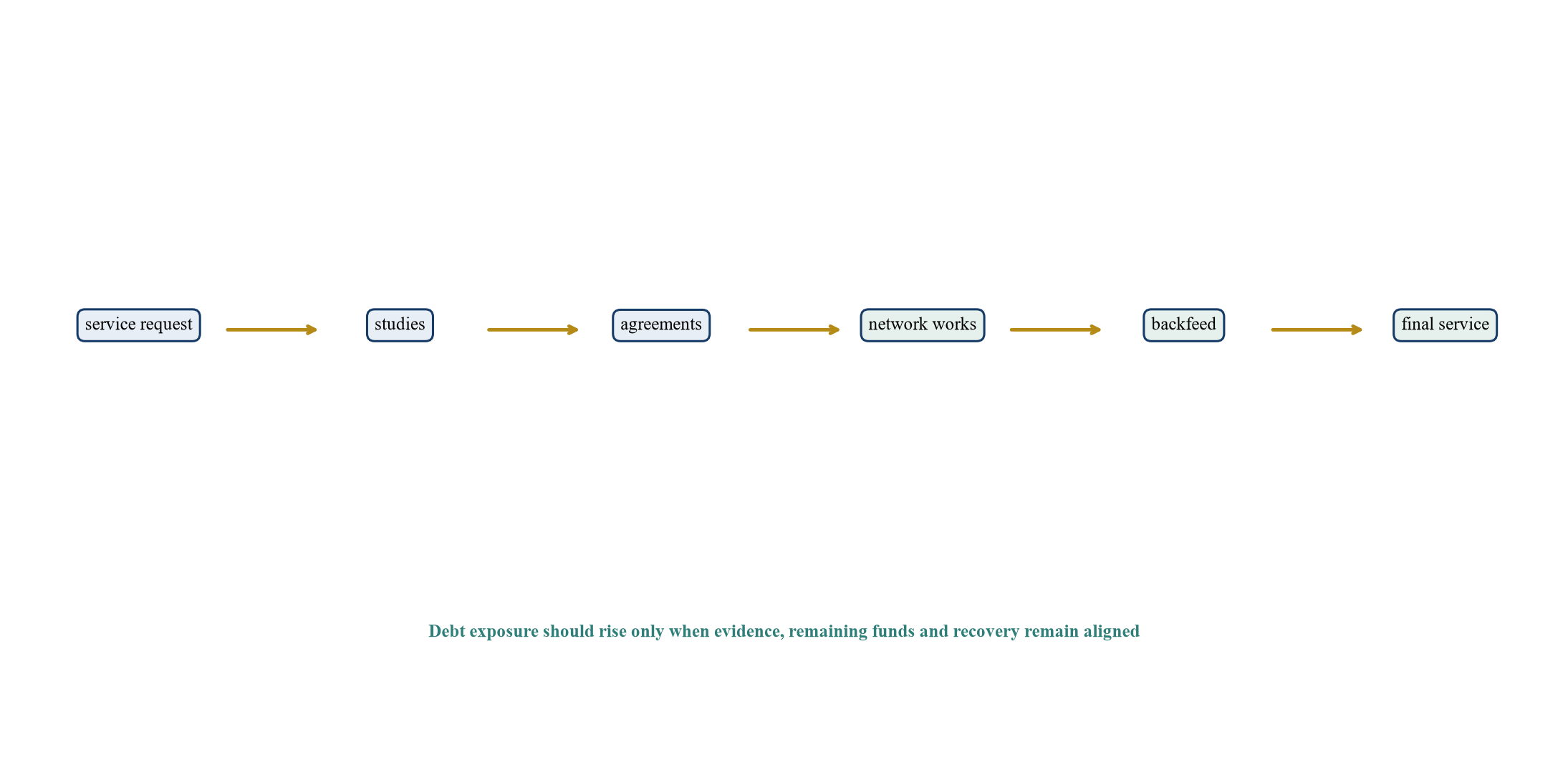
Analytical framework; executed utility and finance documents control each gate.
| Milestone | Minimum evidence | Financing use |
|---|---|---|
| service request | accepted application and scope | initial feasibility |
| study result | issued study and required upgrades | budget and schedule |
| facilities agreement | executed obligations and payments | enforceable project path |
| network works | design, procurement and progress | draw cap |
| backfeed | written authorisation and test conditions | commissioning only |
| final service | operating approval and delivered capacity | completion and conversion |
Proposed definitions; utility and system-operator documents control treatment.
3. Fix the legal and physical perimeter
The decision question is which entities, land rights, utility rights, permits, equipment, contracts and accounts support the loan. The evidence record should begin with title, leases, easements, permits, entity records, utility documents, equipment contracts and insurance. Each item should carry a source, date, legal holder, responsible party and reconciliation status. Market demand and national policy provide context. Executed project documents determine rights, timing, cost and cash. [5][6]
The principal failure is that valuable rights or equipment can sit outside the collateral group or expire before completion. This matters because construction debt converts each advance into funded exposure before stable operating cash exists. The model should expose the dependency, the observable event that confirms or rejects it and the cash consequence of delay or failure.
The recommended response is to map each asset and right to legal holder, location, security, transfer and expiry. Management estimates can support scenarios when they remain clearly identified as assumptions. The base case should retain only evidenced rights, committed funding and costed obligations. The downside should combine related construction, grid, customer and financing risks.
The credit committee should record funded exposure, value at risk, remaining cost, available liquidity, the earliest warning indicator and the intervention available before the next draw. This turns a forecast completion date into a governed sequence of evidence and decisions.
4. Define borrower and security architecture
The decision question is which borrower, guarantor, collateral, account control, assignment and step-in rights support repayment. The evidence record should begin with organisational documents, security instruments, depositary arrangements, material contracts and legal opinions. Each item should carry a source, date, legal holder, responsible party and reconciliation status. Market demand and national policy provide context. Executed project documents determine rights, timing, cost and cash. [7][8]
The principal failure is that a lender can fund project value without enforceable control over the rights needed to finish or transfer it. This matters because construction debt converts each advance into funded exposure before stable operating cash exists. The model should expose the dependency, the observable event that confirms or rejects it and the cash consequence of delay or failure.
The recommended response is to bind land, contracts, equipment, accounts, insurance and sponsor support to an enforceable security package. Management estimates can support scenarios when they remain clearly identified as assumptions. The base case should retain only evidenced rights, committed funding and costed obligations. The downside should combine related construction, grid, customer and financing risks.
The credit committee should record funded exposure, value at risk, remaining cost, available liquidity, the earliest warning indicator and the intervention available before the next draw. This turns a forecast completion date into a governed sequence of evidence and decisions.
5. Rebuild sources and uses
The decision question is how land, design, utility, network, equipment, construction, financing, reserves and contingencies are funded. The evidence record should begin with executed contracts, budgets, invoices, utility estimates, financing terms and sponsor evidence. Each item should carry a source, date, legal holder, responsible party and reconciliation status. Market demand and national policy provide context. Executed project documents determine rights, timing, cost and cash. [7][9]
The principal failure is that a headline project cost can omit utility upgrades, escalation, financing carry, bridge power or owner costs. This matters because construction debt converts each advance into funded exposure before stable operating cash exists. The model should expose the dependency, the observable event that confirms or rejects it and the cash consequence of delay or failure.
The recommended response is to reconcile every use to committed debt, funded equity, remaining equity and documented contingency. Management estimates can support scenarios when they remain clearly identified as assumptions. The base case should retain only evidenced rights, committed funding and costed obligations. The downside should combine related construction, grid, customer and financing risks.
The credit committee should record funded exposure, value at risk, remaining cost, available liquidity, the earliest warning indicator and the intervention available before the next draw. This turns a forecast completion date into a governed sequence of evidence and decisions.
| Use | Required evidence | Principal control |
|---|---|---|
| land and rights | title, lease and easement | collateral and transfer |
| utility and network | executed agreement and estimate | milestone reserve |
| equipment | contract, title and inspection | vesting and assignment |
| construction | certified work and lien waiver | supervised disbursement |
| financing cost | debt model and invoices | interest reserve |
| contingency | risk register and approval | controlled release |
Proposed control schedule; transaction documents determine eligibility.
6. Prove cost to complete
The decision question is whether undrawn debt, remaining equity, contingency and recoveries cover all remaining obligations. The evidence record should begin with quantity survey, independent-engineer report, committed contracts, change orders, forecast and claims. Each item should carry a source, date, legal holder, responsible party and reconciliation status. Market demand and national policy provide context. Executed project documents determine rights, timing, cost and cash. [7][10]
The principal failure is that percentage complete can appear healthy while remaining funds are insufficient for the critical path. This matters because construction debt converts each advance into funded exposure before stable operating cash exists. The model should expose the dependency, the observable event that confirms or rejects it and the cash consequence of delay or failure.
The recommended response is to run a monthly balanced-budget test before every advance. Management estimates can support scenarios when they remain clearly identified as assumptions. The base case should retain only evidenced rights, committed funding and costed obligations. The downside should combine related construction, grid, customer and financing risks.
The credit committee should record funded exposure, value at risk, remaining cost, available liquidity, the earliest warning indicator and the intervention available before the next draw. This turns a forecast completion date into a governed sequence of evidence and decisions.
7. Sequence sponsor equity
The decision question is when sponsor cash, land value, subordinated funding and contingency support enter before or alongside debt. The evidence record should begin with bank statements, escrow, contributed assets, funding notices and subordination agreements. Each item should carry a source, date, legal holder, responsible party and reconciliation status. Market demand and national policy provide context. Executed project documents determine rights, timing, cost and cash. [7][11]
The principal failure is that nominal equity can consist of revalued land or future commitments that do not absorb current overruns. This matters because construction debt converts each advance into funded exposure before stable operating cash exists. The model should expose the dependency, the observable event that confirms or rejects it and the cash consequence of delay or failure.
The recommended response is to define eligible equity, evidence cash contribution and require replenishment when the budget becomes unbalanced. Management estimates can support scenarios when they remain clearly identified as assumptions. The base case should retain only evidenced rights, committed funding and costed obligations. The downside should combine related construction, grid, customer and financing risks.
The credit committee should record funded exposure, value at risk, remaining cost, available liquidity, the earliest warning indicator and the intervention available before the next draw. This turns a forecast completion date into a governed sequence of evidence and decisions.
8. Design drawdown gates
The decision question is which conditions, certifications, lien controls and milestone tests permit each construction advance. The evidence record should begin with draw request, invoices, inspection, title update, lien waivers, budget and covenant certificate. Each item should carry a source, date, legal holder, responsible party and reconciliation status. Market demand and national policy provide context. Executed project documents determine rights, timing, cost and cash. [7][12]
The principal failure is that uncontrolled draws can increase exposure faster than verified value and completion certainty. This matters because construction debt converts each advance into funded exposure before stable operating cash exists. The model should expose the dependency, the observable event that confirms or rejects it and the cash consequence of delay or failure.
The recommended response is to tie each advance to completed work, clean title, current budget, remaining funds and grid progress. Management estimates can support scenarios when they remain clearly identified as assumptions. The base case should retain only evidenced rights, committed funding and costed obligations. The downside should combine related construction, grid, customer and financing risks.
The credit committee should record funded exposure, value at risk, remaining cost, available liquidity, the earliest warning indicator and the intervention available before the next draw. This turns a forecast completion date into a governed sequence of evidence and decisions.
| Gate | Evidence | Stop-draw trigger |
|---|---|---|
| budget | balanced sources and uses | funding shortfall |
| progress | engineer-certified work | material variance |
| title | search, waiver and security | lien or ownership gap |
| grid | current milestone evidence | delay or scope change |
| customer | aligned delivery and acceptance | termination or credit event |
| liquidity | reserve and equity support | minimum cash breach |
Proposed lender control; actual conditions require negotiated documents.
9. Use independent technical certification
The decision question is which engineer, utility and specialist evidence verifies design, progress, cost and performance. The evidence record should begin with appointment scope, reports, inspections, test results, qualifications and conflicts. Each item should carry a source, date, legal holder, responsible party and reconciliation status. Market demand and national policy provide context. Executed project documents determine rights, timing, cost and cash. [9][13]
The principal failure is that borrower reporting can combine forecast and observed progress without independent challenge. This matters because construction debt converts each advance into funded exposure before stable operating cash exists. The model should expose the dependency, the observable event that confirms or rejects it and the cash consequence of delay or failure.
The recommended response is to define reliance, materiality, site access, testing and exception escalation in the engineer mandate. Management estimates can support scenarios when they remain clearly identified as assumptions. The base case should retain only evidenced rights, committed funding and costed obligations. The downside should combine related construction, grid, customer and financing risks.
The credit committee should record funded exposure, value at risk, remaining cost, available liquidity, the earliest warning indicator and the intervention available before the next draw. This turns a forecast completion date into a governed sequence of evidence and decisions.
10. Verify utility and system-operator evidence
The decision question is which studies, agreements, payments, works and approvals support the scheduled service. The evidence record should begin with executed utility documents, queue status, study results, upgrade plan, invoices, correspondence and tariff. Each item should carry a source, date, legal holder, responsible party and reconciliation status. Market demand and national policy provide context. Executed project documents determine rights, timing, cost and cash. [2][3]
The principal failure is that a forecast service date can be quoted without an enforceable delivery obligation or completed dependencies. This matters because construction debt converts each advance into funded exposure before stable operating cash exists. The model should expose the dependency, the observable event that confirms or rejects it and the cash consequence of delay or failure.
The recommended response is to separate rights, estimates, works, acceptance and operating permission in the grid schedule. Management estimates can support scenarios when they remain clearly identified as assumptions. The base case should retain only evidenced rights, committed funding and costed obligations. The downside should combine related construction, grid, customer and financing risks.
The credit committee should record funded exposure, value at risk, remaining cost, available liquidity, the earliest warning indicator and the intervention available before the next draw. This turns a forecast completion date into a governed sequence of evidence and decisions.
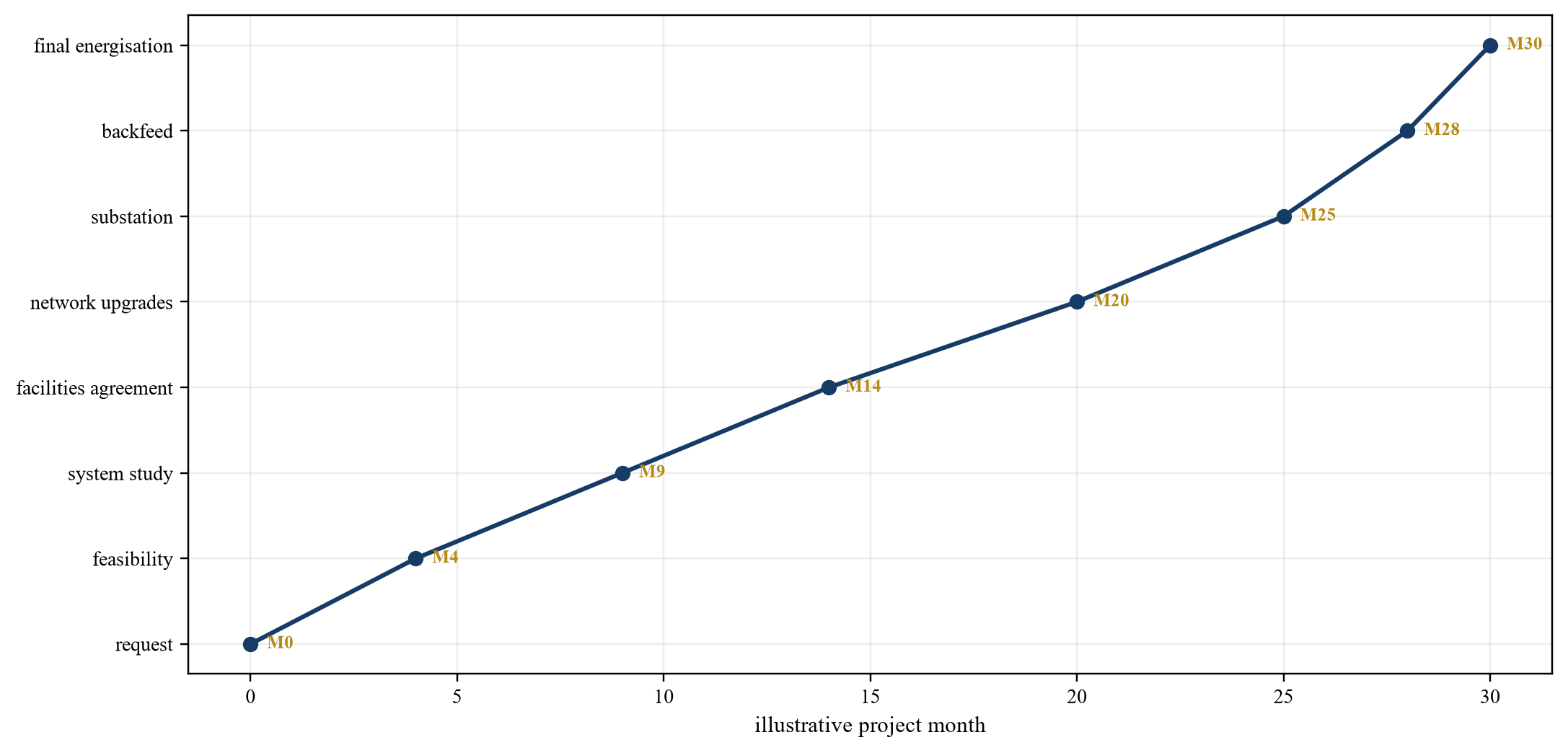
Analytical framework; actual sequence varies by utility, system operator and project.
11. Diligence bridge power
The decision question is whether temporary generation and storage can lawfully, reliably and economically support the planned load. The evidence record should begin with permits, emissions, fuel, interconnection, equipment, redundancy, operating plan, contracts and test evidence. Each item should carry a source, date, legal holder, responsible party and reconciliation status. Market demand and national policy provide context. Executed project documents determine rights, timing, cost and cash. [14][15]
The principal failure is that temporary power can be modelled as firm utility service while capacity, duration, fuel or permits are constrained. This matters because construction debt converts each advance into funded exposure before stable operating cash exists. The model should expose the dependency, the observable event that confirms or rejects it and the cash consequence of delay or failure.
The recommended response is to limit eligible service to verified bridge capability and price every operating and replacement obligation. Management estimates can support scenarios when they remain clearly identified as assumptions. The base case should retain only evidenced rights, committed funding and costed obligations. The downside should combine related construction, grid, customer and financing risks.
The credit committee should record funded exposure, value at risk, remaining cost, available liquidity, the earliest warning indicator and the intervention available before the next draw. This turns a forecast completion date into a governed sequence of evidence and decisions.
| Dimension | Evidence | Cash consequence |
|---|---|---|
| capacity and duration | tested output and operating limits | eligible service load |
| fuel | supply, storage and logistics | variable cost and interruption |
| emissions and permits | approvals and monitoring | operating constraint |
| redundancy | topology and failover test | customer service risk |
| interconnection | protection and utility consent | lawful operation |
| exit | demobilisation and restoration | residual cost |
Proposed checklist; permits and executed contracts determine usable capacity.
12. Align customer contracts
The decision question is how delivery dates, capacity ramps, acceptance, credits, termination and payment depend on power readiness. The evidence record should begin with executed customer contracts, technical schedules, notices, deposits, acceptance and pipeline evidence. Each item should carry a source, date, legal holder, responsible party and reconciliation status. Market demand and national policy provide context. Executed project documents determine rights, timing, cost and cash. [16][17]
The principal failure is that contracted megawatts can fail to create cash when conditions, fit-out or utility service remain unmet. This matters because construction debt converts each advance into funded exposure before stable operating cash exists. The model should expose the dependency, the observable event that confirms or rejects it and the cash consequence of delay or failure.
The recommended response is to map every customer obligation to facility, power, commissioning and billing milestones. Management estimates can support scenarios when they remain clearly identified as assumptions. The base case should retain only evidenced rights, committed funding and costed obligations. The downside should combine related construction, grid, customer and financing risks.
The credit committee should record funded exposure, value at risk, remaining cost, available liquidity, the earliest warning indicator and the intervention available before the next draw. This turns a forecast completion date into a governed sequence of evidence and decisions.
13. Control the construction schedule
The decision question is which civil, electrical, mechanical, utility, network and customer paths determine completion. The evidence record should begin with baseline schedule, critical path, progress, procurement, change control, interfaces and recovery plan. Each item should carry a source, date, legal holder, responsible party and reconciliation status. Market demand and national policy provide context. Executed project documents determine rights, timing, cost and cash. [9][18]
The principal failure is that separate schedules can hide shared dependencies and float consumption. This matters because construction debt converts each advance into funded exposure before stable operating cash exists. The model should expose the dependency, the observable event that confirms or rejects it and the cash consequence of delay or failure.
The recommended response is to maintain one integrated schedule with logic, ownership, float and lender-approved recovery thresholds. Management estimates can support scenarios when they remain clearly identified as assumptions. The base case should retain only evidenced rights, committed funding and costed obligations. The downside should combine related construction, grid, customer and financing risks.
The credit committee should record funded exposure, value at risk, remaining cost, available liquidity, the earliest warning indicator and the intervention available before the next draw. This turns a forecast completion date into a governed sequence of evidence and decisions.
14. Manage long-lead equipment
The decision question is which transformers, switchgear, generators, UPS, cooling and control components constrain the path. The evidence record should begin with purchase orders, vendor drawings, manufacturing status, inspections, logistics, warranties and spares. Each item should carry a source, date, legal holder, responsible party and reconciliation status. Market demand and national policy provide context. Executed project documents determine rights, timing, cost and cash. [5][19]
The principal failure is that payments can precede delivery while substitution, delay and title remain unresolved. This matters because construction debt converts each advance into funded exposure before stable operating cash exists. The model should expose the dependency, the observable event that confirms or rejects it and the cash consequence of delay or failure.
The recommended response is to use vesting, inspection, insurance, storage, assignment and milestone payment controls. Management estimates can support scenarios when they remain clearly identified as assumptions. The base case should retain only evidenced rights, committed funding and costed obligations. The downside should combine related construction, grid, customer and financing risks.
The credit committee should record funded exposure, value at risk, remaining cost, available liquidity, the earliest warning indicator and the intervention available before the next draw. This turns a forecast completion date into a governed sequence of evidence and decisions.
15. Define energisation and commissioning tests
The decision question is which backfeed, protection, load, failover, integrated-system and utility tests prove usable service. The evidence record should begin with test scripts, witnesses, results, defects, utility authorisation and retest records. Each item should carry a source, date, legal holder, responsible party and reconciliation status. Market demand and national policy provide context. Executed project documents determine rights, timing, cost and cash. [3][13]
The principal failure is that equipment completion can be recorded before the system safely delivers the contracted service. This matters because construction debt converts each advance into funded exposure before stable operating cash exists. The model should expose the dependency, the observable event that confirms or rejects it and the cash consequence of delay or failure.
The recommended response is to define objective test thresholds and block release until exceptions are closed or protected. Management estimates can support scenarios when they remain clearly identified as assumptions. The base case should retain only evidenced rights, committed funding and costed obligations. The downside should combine related construction, grid, customer and financing risks.
The credit committee should record funded exposure, value at risk, remaining cost, available liquidity, the earliest warning indicator and the intervention available before the next draw. This turns a forecast completion date into a governed sequence of evidence and decisions.
16. Separate completion tests
The decision question is how mechanical, substantial, utility, customer and financial completion differ. The evidence record should begin with construction contract, utility documents, customer acceptance, operating record and financing terms. Each item should carry a source, date, legal holder, responsible party and reconciliation status. Market demand and national policy provide context. Executed project documents determine rights, timing, cost and cash. [7][16]
The principal failure is that one completion certificate can trigger conversion despite unresolved grid, customer or cash conditions. This matters because construction debt converts each advance into funded exposure before stable operating cash exists. The model should expose the dependency, the observable event that confirms or rejects it and the cash consequence of delay or failure.
The recommended response is to use separate tests and specify the consequence of each. Management estimates can support scenarios when they remain clearly identified as assumptions. The base case should retain only evidenced rights, committed funding and costed obligations. The downside should combine related construction, grid, customer and financing risks.
The credit committee should record funded exposure, value at risk, remaining cost, available liquidity, the earliest warning indicator and the intervention available before the next draw. This turns a forecast completion date into a governed sequence of evidence and decisions.
| Test | Evidence | Typical consequence |
|---|---|---|
| mechanical completion | installed systems and punch list | testing permitted |
| utility energisation | authorised delivered capacity | grid operation permitted |
| integrated commissioning | witnessed failover and load tests | facility serviceability |
| customer acceptance | contract test and sign-off | billing begins |
| financial completion | coverage, reserves and no default | debt conversion |
| final completion | defects closed and obligations satisfied | retention release |
Proposed hierarchy; finance and project documents control consequences.
17. Build the debt-service case
The decision question is how construction interest, operating ramp, customer cash and permanent debt create coverage. The evidence record should begin with draw schedule, interest, reserve, operating model, customer billing, tax and takeout terms. Each item should carry a source, date, legal holder, responsible party and reconciliation status. Market demand and national policy provide context. Executed project documents determine rights, timing, cost and cash. [20][21]
The principal failure is that a stable-state DSCR can hide weak coverage during ramp and delay. This matters because construction debt converts each advance into funded exposure before stable operating cash exists. The model should expose the dependency, the observable event that confirms or rejects it and the cash consequence of delay or failure.
The recommended response is to calculate monthly cash and forward coverage through the full construction and conversion period. Management estimates can support scenarios when they remain clearly identified as assumptions. The base case should retain only evidenced rights, committed funding and costed obligations. The downside should combine related construction, grid, customer and financing risks.
The credit committee should record funded exposure, value at risk, remaining cost, available liquidity, the earliest warning indicator and the intervention available before the next draw. This turns a forecast completion date into a governed sequence of evidence and decisions.
18. Size interest and operating reserves
The decision question is which interest, fees, operating loss, fuel, maintenance and delay costs require funded liquidity. The evidence record should begin with debt terms, draw model, bridge-power cost, staffing, customer ramp and downside schedule. Each item should carry a source, date, legal holder, responsible party and reconciliation status. Market demand and national policy provide context. Executed project documents determine rights, timing, cost and cash. [7][20]
The principal failure is that reserves can cover scheduled interest while omitting operating burn and utility delay. This matters because construction debt converts each advance into funded exposure before stable operating cash exists. The model should expose the dependency, the observable event that confirms or rejects it and the cash consequence of delay or failure.
The recommended response is to size reserves to a coherent delay case and control every release. Management estimates can support scenarios when they remain clearly identified as assumptions. The base case should retain only evidenced rights, committed funding and costed obligations. The downside should combine related construction, grid, customer and financing risks.
The credit committee should record funded exposure, value at risk, remaining cost, available liquidity, the earliest warning indicator and the intervention available before the next draw. This turns a forecast completion date into a governed sequence of evidence and decisions.
19. Set contingency and overrun support
The decision question is how design maturity, procurement, utility scope, claims and schedule affect required protection. The evidence record should begin with risk register, cost plan, contract form, bids, changes, insurance and sponsor capacity. Each item should carry a source, date, legal holder, responsible party and reconciliation status. Market demand and national policy provide context. Executed project documents determine rights, timing, cost and cash. [7][9]
The principal failure is that a percentage contingency can be consumed by known scope gaps before genuine unknowns occur. This matters because construction debt converts each advance into funded exposure before stable operating cash exists. The model should expose the dependency, the observable event that confirms or rejects it and the cash consequence of delay or failure.
The recommended response is to separate allocated and unallocated contingency and require timely equity cure. Management estimates can support scenarios when they remain clearly identified as assumptions. The base case should retain only evidenced rights, committed funding and costed obligations. The downside should combine related construction, grid, customer and financing risks.
The credit committee should record funded exposure, value at risk, remaining cost, available liquidity, the earliest warning indicator and the intervention available before the next draw. This turns a forecast completion date into a governed sequence of evidence and decisions.
20. Design covenants and stop-draw events
The decision question is which budget, schedule, utility, customer, liquidity and technical failures require intervention. The evidence record should begin with facility agreement, reporting, certificates, model, milestones and cure rights. Each item should carry a source, date, legal holder, responsible party and reconciliation status. Market demand and national policy provide context. Executed project documents determine rights, timing, cost and cash. [7][12]
The principal failure is that financial covenants alone can react after technical value has already deteriorated. This matters because construction debt converts each advance into funded exposure before stable operating cash exists. The model should expose the dependency, the observable event that confirms or rejects it and the cash consequence of delay or failure.
The recommended response is to use forward-looking milestone, cost-to-complete, liquidity and customer tests. Management estimates can support scenarios when they remain clearly identified as assumptions. The base case should retain only evidenced rights, committed funding and costed obligations. The downside should combine related construction, grid, customer and financing risks.
The credit committee should record funded exposure, value at risk, remaining cost, available liquidity, the earliest warning indicator and the intervention available before the next draw. This turns a forecast completion date into a governed sequence of evidence and decisions.
21. Govern liquidity during delay
The decision question is how cash, reserves, equity, insurance, claims and curtailment support a delayed project. The evidence record should begin with account balances, funding commitments, forecast, invoices, fuel contracts and downside actions. Each item should carry a source, date, legal holder, responsible party and reconciliation status. Market demand and national policy provide context. Executed project documents determine rights, timing, cost and cash. [20][22]
The principal failure is that a profitable completed project can fail because liquidity expires before utility service arrives. This matters because construction debt converts each advance into funded exposure before stable operating cash exists. The model should expose the dependency, the observable event that confirms or rejects it and the cash consequence of delay or failure.
The recommended response is to maintain a rolling minimum-liquidity forecast with committed actions and decision dates. Management estimates can support scenarios when they remain clearly identified as assumptions. The base case should retain only evidenced rights, committed funding and costed obligations. The downside should combine related construction, grid, customer and financing risks.
The credit committee should record funded exposure, value at risk, remaining cost, available liquidity, the earliest warning indicator and the intervention available before the next draw. This turns a forecast completion date into a governed sequence of evidence and decisions.
22. Apply the hypothetical financing case
The decision question is how a USD 1.44 billion project and 50:50 debt-equity structure behave across grid milestones. The evidence record should begin with the stated hypothetical cost, capacity, bridge-power, reserve, contingency and timing assumptions. Each item should carry a source, date, legal holder, responsible party and reconciliation status. Market demand and national policy provide context. Executed project documents determine rights, timing, cost and cash. [1][7]
The principal failure is that one base case can conceal exposure growth and sponsor funding needs during delay. This matters because construction debt converts each advance into funded exposure before stable operating cash exists. The model should expose the dependency, the observable event that confirms or rejects it and the cash consequence of delay or failure.
The recommended response is to show sources, uses, monthly draws, remaining funds, grid evidence and takeout under each case. Management estimates can support scenarios when they remain clearly identified as assumptions. The base case should retain only evidenced rights, committed funding and costed obligations. The downside should combine related construction, grid, customer and financing risks.
The credit committee should record funded exposure, value at risk, remaining cost, available liquidity, the earliest warning indicator and the intervention available before the next draw. This turns a forecast completion date into a governed sequence of evidence and decisions.
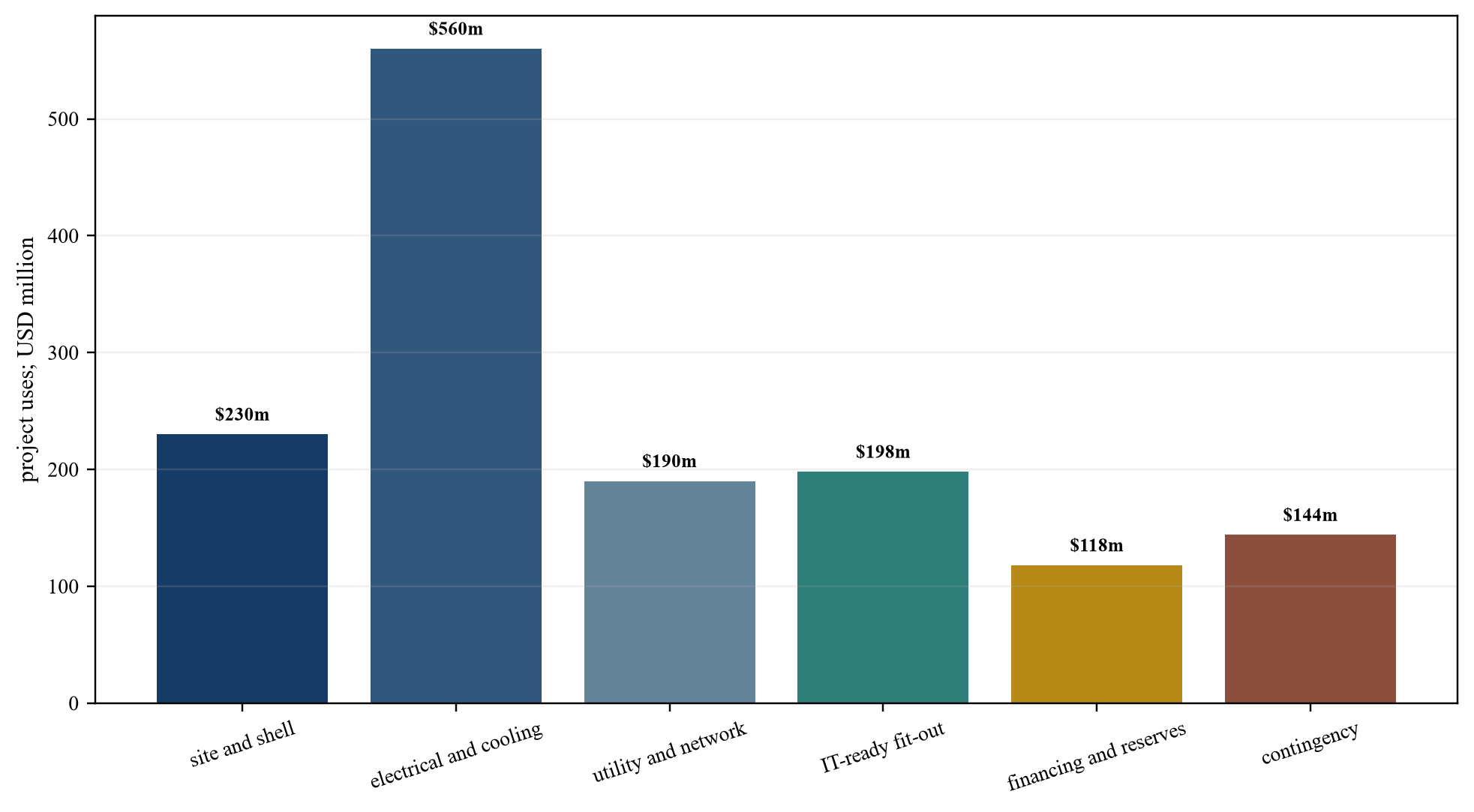
Wholly hypothetical USD millions; figures do not describe an identified project.
| Metric | Central assumption | Delay or range |
|---|---|---|
| customer-usable capacity | 96 MW | 72-96 MW |
| total project cost | USD 1.44bn | USD 1.44bn-1.61bn |
| construction debt | USD 720m | capped at USD 720m |
| sponsor equity | USD 720m | USD 720m plus cures |
| final utility energisation | month 30 | month 36-48 |
| bridge-power capacity | 36 MW | 24-36 MW |
| interest and operating reserve | USD 118m | USD 118m plus equity |
| contingency | USD 144m | controlled release |
| conversion DSCR | 1.35x | 1.20x-1.35x |
Wholly hypothetical; figures do not describe an identified project or financing.
23. Map drawdowns to grid milestones
The decision question is how debt exposure increases as land, equipment, construction and utility evidence mature. The evidence record should begin with hypothetical draw schedule, grid register, engineer certificates and sponsor funding. Each item should carry a source, date, legal holder, responsible party and reconciliation status. Market demand and national policy provide context. Executed project documents determine rights, timing, cost and cash. [3][10]
The principal failure is that drawn debt can approach commitment while final utility works remain outside lender control. This matters because construction debt converts each advance into funded exposure before stable operating cash exists. The model should expose the dependency, the observable event that confirms or rejects it and the cash consequence of delay or failure.
The recommended response is to cap cumulative draws at evidence-weighted milestone limits. Management estimates can support scenarios when they remain clearly identified as assumptions. The base case should retain only evidenced rights, committed funding and costed obligations. The downside should combine related construction, grid, customer and financing risks.
The credit committee should record funded exposure, value at risk, remaining cost, available liquidity, the earliest warning indicator and the intervention available before the next draw. This turns a forecast completion date into a governed sequence of evidence and decisions.
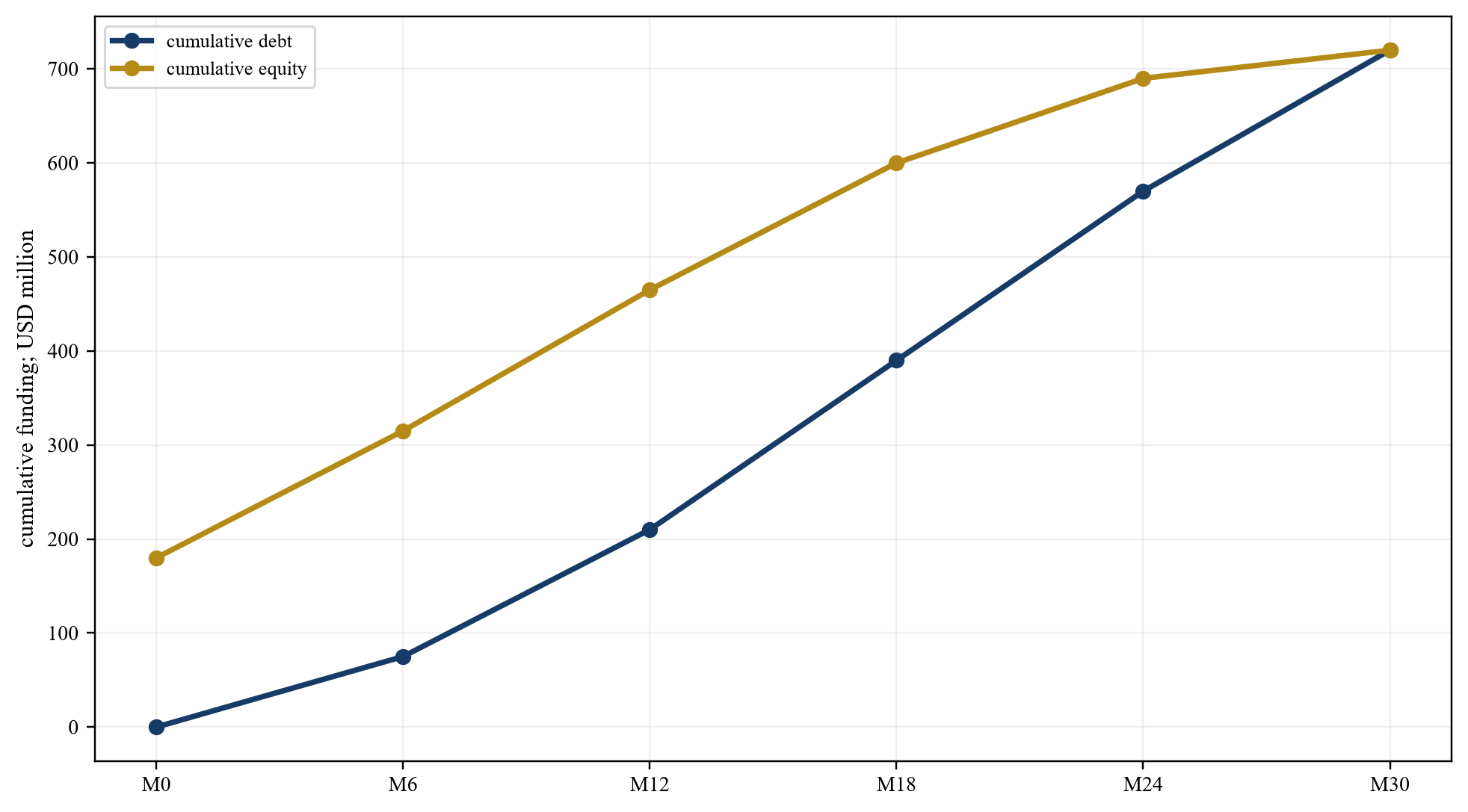
Wholly hypothetical USD millions; figures do not describe an identified financing.
24. Stress energisation delay
The decision question is which combinations of delay, cost overrun, bridge-power cost, customer credits and higher rates impair repayment. The evidence record should begin with scenario model, utility evidence, construction forecast, contracts, liquidity and takeout terms. Each item should carry a source, date, legal holder, responsible party and reconciliation status. Market demand and national policy provide context. Executed project documents determine rights, timing, cost and cash. [20][22]
The principal failure is that single-variable sensitivities can miss compounding delay and cash effects. This matters because construction debt converts each advance into funded exposure before stable operating cash exists. The model should expose the dependency, the observable event that confirms or rejects it and the cash consequence of delay or failure.
The recommended response is to run coherent six, twelve and eighteen-month delay cases with stated management actions. Management estimates can support scenarios when they remain clearly identified as assumptions. The base case should retain only evidenced rights, committed funding and costed obligations. The downside should combine related construction, grid, customer and financing risks.
The credit committee should record funded exposure, value at risk, remaining cost, available liquidity, the earliest warning indicator and the intervention available before the next draw. This turns a forecast completion date into a governed sequence of evidence and decisions.
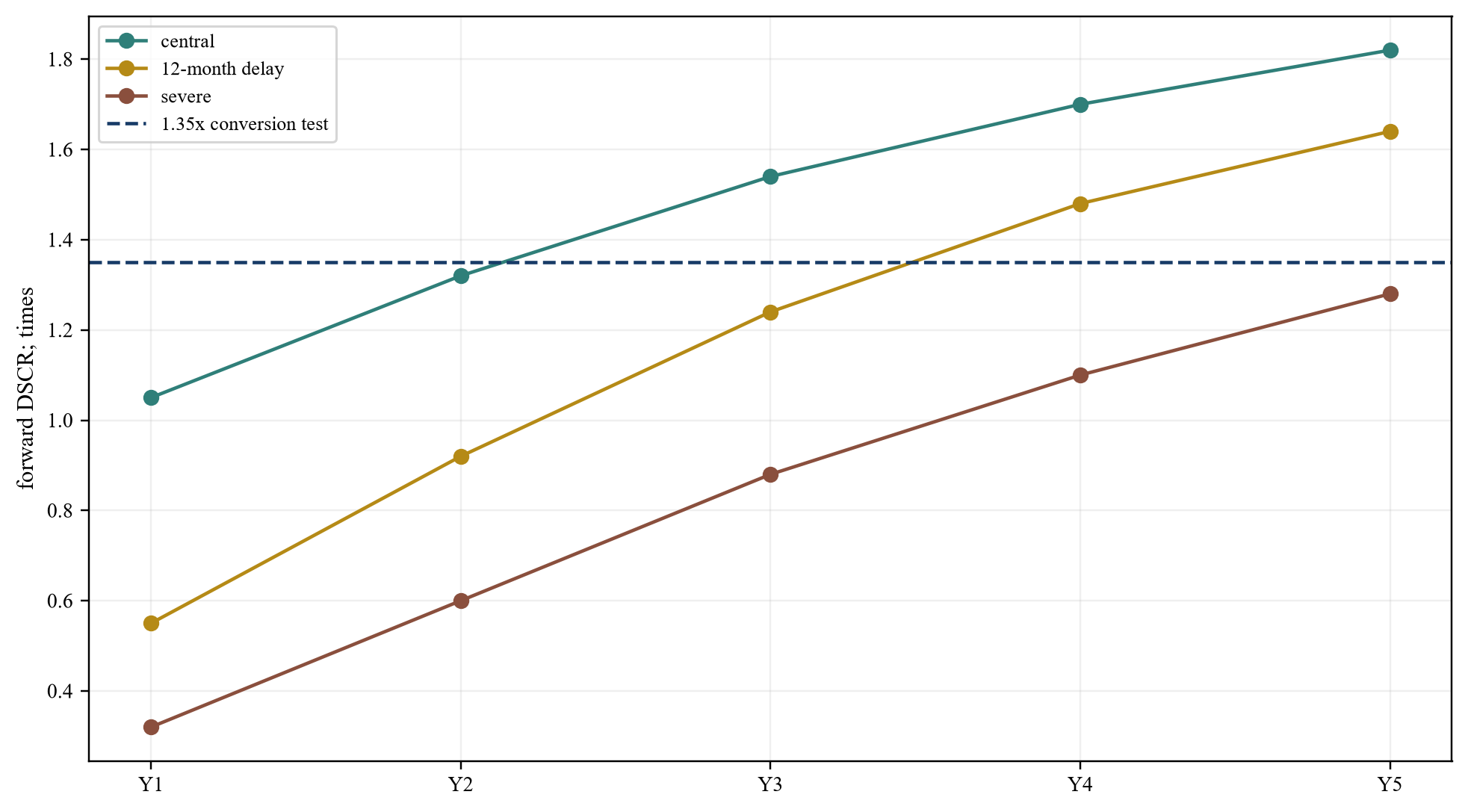
Wholly hypothetical; coverage is shown for central, twelve-month delay and severe cases.
25. Plan downside recovery
The decision question is whether completion, sale, step-in, mothballing or enforcement preserves the highest recoverable value. The evidence record should begin with collateral, contracts, remaining cost, marketability, permits, utility rights and specialist advice. Each item should carry a source, date, legal holder, responsible party and reconciliation status. Market demand and national policy provide context. Executed project documents determine rights, timing, cost and cash. [7][23]
The principal failure is that book value can overstate recovery when incomplete works and grid rights require more capital. This matters because construction debt converts each advance into funded exposure before stable operating cash exists. The model should expose the dependency, the observable event that confirms or rejects it and the cash consequence of delay or failure.
The recommended response is to estimate net recovery by route, time, cost and execution probability. Management estimates can support scenarios when they remain clearly identified as assumptions. The base case should retain only evidenced rights, committed funding and costed obligations. The downside should combine related construction, grid, customer and financing risks.
The credit committee should record funded exposure, value at risk, remaining cost, available liquidity, the earliest warning indicator and the intervention available before the next draw. This turns a forecast completion date into a governed sequence of evidence and decisions.
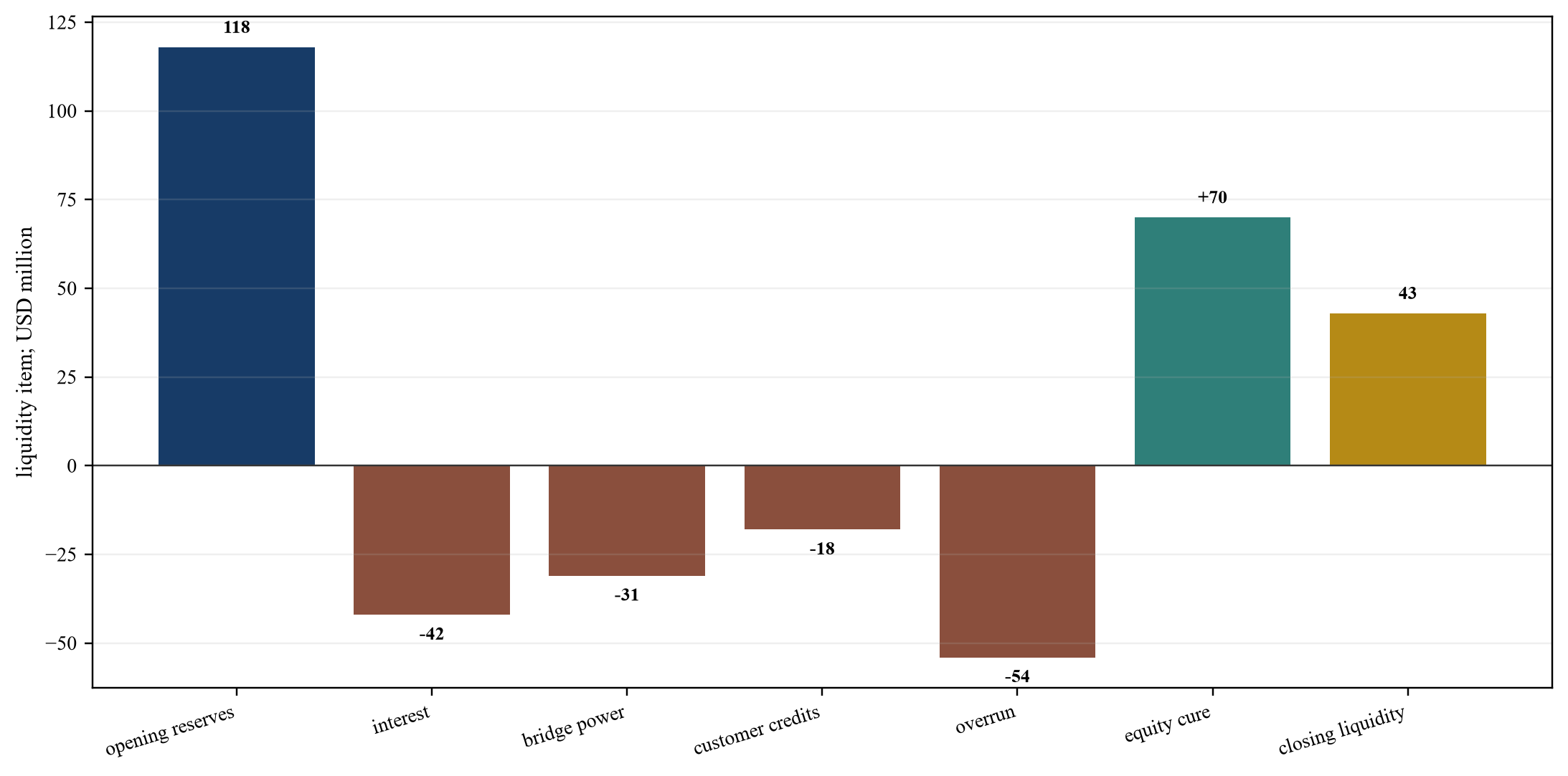
Wholly hypothetical USD millions; this is not a financing recommendation.
26. Define permanent-financing conversion
The decision question is which utility, construction, customer, operating and coverage conditions permit takeout. The evidence record should begin with commitment, completion tests, operating history, valuation, title, insurance and covenant certificate. Each item should carry a source, date, legal holder, responsible party and reconciliation status. Market demand and national policy provide context. Executed project documents determine rights, timing, cost and cash. [7][21]
The principal failure is that a takeout can be assumed before its conditions and expiry align with construction reality. This matters because construction debt converts each advance into funded exposure before stable operating cash exists. The model should expose the dependency, the observable event that confirms or rejects it and the cash consequence of delay or failure.
The recommended response is to treat permanent debt as conditional until every material conversion requirement is evidenced. Management estimates can support scenarios when they remain clearly identified as assumptions. The base case should retain only evidenced rights, committed funding and costed obligations. The downside should combine related construction, grid, customer and financing risks.
The credit committee should record funded exposure, value at risk, remaining cost, available liquidity, the earliest warning indicator and the intervention available before the next draw. This turns a forecast completion date into a governed sequence of evidence and decisions.
27. Translate diligence into finance documents
The decision question is which condition, representation, covenant, reserve, guarantee and remedy allocates each risk. The evidence record should begin with diligence findings, model, engineer report, utility documents, customer contracts and draft facility. Each item should carry a source, date, legal holder, responsible party and reconciliation status. Market demand and national policy provide context. Executed project documents determine rights, timing, cost and cash. [7][12]
The principal failure is that material dependencies can remain in the credit paper without becoming enforceable controls. This matters because construction debt converts each advance into funded exposure before stable operating cash exists. The model should expose the dependency, the observable event that confirms or rejects it and the cash consequence of delay or failure.
The recommended response is to attach each dependency to a document term, evidence item, owner and deadline. Management estimates can support scenarios when they remain clearly identified as assumptions. The base case should retain only evidenced rights, committed funding and costed obligations. The downside should combine related construction, grid, customer and financing risks.
The credit committee should record funded exposure, value at risk, remaining cost, available liquidity, the earliest warning indicator and the intervention available before the next draw. This turns a forecast completion date into a governed sequence of evidence and decisions.
28. Reach the credit decision
The decision question is whether evidence-gated draws, funded delay liquidity, completion protections and recovery justify commitment. The evidence record should begin with grid register, balanced budget, sponsor support, customer schedule, downside cases and legal package. Each item should carry a source, date, legal holder, responsible party and reconciliation status. Market demand and national policy provide context. Executed project documents determine rights, timing, cost and cash. [1][24]
The principal failure is that the strategic value of AI infrastructure can displace project-specific repayment and recovery evidence. This matters because construction debt converts each advance into funded exposure before stable operating cash exists. The model should expose the dependency, the observable event that confirms or rejects it and the cash consequence of delay or failure.
The recommended response is to approve a commitment and draw profile tied to verified milestones and funded downside actions. Management estimates can support scenarios when they remain clearly identified as assumptions. The base case should retain only evidenced rights, committed funding and costed obligations. The downside should combine related construction, grid, customer and financing risks.
The credit committee should record funded exposure, value at risk, remaining cost, available liquidity, the earliest warning indicator and the intervention available before the next draw. This turns a forecast completion date into a governed sequence of evidence and decisions.
| Decision | Evidence required | Possible action |
|---|---|---|
| commitment | balanced budget and grid path | approve or resize |
| each draw | progress, title, funds and milestone | fund, defer or stop |
| bridge operation | permits, tests, fuel and contracts | limit eligible service |
| delay response | liquidity, equity and recovery | cure, restructure or enforce |
| conversion | energisation, acceptance and coverage | convert or extend |
| unresolved dependency | quantified cash and legal allocation | protect or decline |
Proposed governance; transaction-specific approvals remain necessary.
Sources
- U.S. Department of Energy, *2024 United States Data Center Energy Usage Report*. Read the primary source
- Federal Energy Regulatory Commission, *Interconnection of Large Loads to the Interstate Transmission System, Docket RM26-4-000*. Read the primary source
- PJM Interconnection, *Manual 14H: New Service Requests Cycle Process*. Read the primary source
- PJM Interconnection, *Application and Forms*. Read the primary source
- U.S. Securities and Exchange Commission, *Digital Realty Trust 2025 Form 10-K*. Read the primary source
- U.S. Securities and Exchange Commission, *Equinix 2025 Form 10-K*. Read the primary source
- Office of the Comptroller of the Currency, *Commercial Real Estate Lending, Comptroller's Handbook*. Read the primary source
- Federal Deposit Insurance Corporation, *Commercial Real Estate Lending*. Read the primary source
- Federal Deposit Insurance Corporation, *Construction and Land Development Lending Core Analysis*. Read the primary source
- Federal Deposit Insurance Corporation, *Loans, Section 3.2*. Read the primary source
- Office of the Comptroller of the Currency, *Lending and Loan Portfolio Risk Management*. Read the primary source
- Federal Deposit Insurance Corporation, *Acquisition, Development, and Construction Lending*. Read the primary source
- North American Electric Reliability Corporation, *Characteristics and Risks of Emerging Large Loads*. Read the primary source
- North American Electric Reliability Corporation, *Large Loads Action Plan*. Read the primary source
- U.S. Environmental Protection Agency, *Stationary Engines and Reciprocating Internal Combustion Engines*. Read the primary source
- IFRS Foundation, *IFRS 15 Revenue from Contracts with Customers*. Read the primary source
- IFRS Foundation, *IFRS 16 Leases*. Read the primary source
- Occupational Safety and Health Administration, *Construction Industry*. Read the primary source
- U.S. Department of Energy, *Transformer Resilience and Advanced Components*. Read the primary source
- IFRS Foundation, *IFRS 9 Financial Instruments*. Read the primary source
- Office of the Comptroller of the Currency, *Commercial Credit Handbooks*. Read the primary source
- Federal Reserve, *Supervisory Guidance on Commercial Real Estate Risk*. Read the primary source
- IFRS Foundation, *IFRS 13 Fair Value Measurement*. Read the primary source
- Federal Energy Regulatory Commission, *FERC Takes Action on Large Load Interconnection*. Read the primary source
- Lawrence Berkeley National Laboratory, *Queued Up: 2024 Edition*. Read the primary source
- Federal Energy Regulatory Commission, *Order No. 2023: Improvements to Generator Interconnection Procedures and Agreements*. Read the primary source
