

1. Frame the valuation decision
The decision question is whether the asset earns durable cash from present service, contracted conversion and financeable expansion. The analysis should begin with audited cash, executed contracts, customer acceptance, metered power, engineering records and approved capital plans. Each item needs a source, period, owner and reconciliation to the financial model. External market growth provides context; it does not establish the cash earned by a particular facility, contract or customer.
The principal valuation failure is that a market narrative can capitalise uncommitted demand and unavailable power as current value. This can move value through revenue, operating cost, capital expenditure, timing, tax, liquidity and the cost of capital. The model should expose those paths instead of embedding them in one growth rate or terminal multiple. Management estimates can be used for planning when they are clearly identified as assumptions and remain separate from observed evidence.
The recommended response is to separate operating value, conversion value, expansion value and strategic option value. Central, upside and downside cases should state the contract mechanism, capacity consequence, required capital, timing and responsible decision owner. The board should see the earliest observable indicator, the value at risk and the action available before it releases capital or accepts leverage.
2. Separate facility economics from compute economics
The decision question is which party buys processors and software, bears technology risk and pays the data-centre owner. The analysis should begin with service descriptions, customer contracts, equipment ownership, metering, cloud architecture and responsibility matrices. Each item needs a source, period, owner and reconciliation to the financial model. External market growth provides context; it does not establish the cash earned by a particular facility, contract or customer.
The principal valuation failure is that a decline in compute cost can be mistaken for an equal decline in rent even when the facility sells committed power or space. This can move value through revenue, operating cost, capital expenditure, timing, tax, liquidity and the cost of capital. The model should expose those paths instead of embedding them in one growth rate or terminal multiple. Management estimates can be used for planning when they are clearly identified as assumptions and remain separate from observed evidence.
The recommended response is to trace the economic unit from customer workload to contracted facility charge. Central, upside and downside cases should state the contract mechanism, capacity consequence, required capital, timing and responsible decision owner. The board should see the earliest observable indicator, the value at risk and the action available before it releases capital or accepts leverage.
3. Adopt a capacity dictionary
The decision question is how stated megawatts convert into usable, contracted, installed, billable and collected service. The analysis should begin with utility agreements, substations, commissioning, redundancy design, cooling limits, contracts, invoices and receipts. Each item needs a source, period, owner and reconciliation to the financial model. External market growth provides context; it does not establish the cash earned by a particular facility, contract or customer.
The principal valuation failure is that reported capacity can mix land-bank potential, utility allocation, construction and operating load. This can move value through revenue, operating cost, capital expenditure, timing, tax, liquidity and the cost of capital. The model should expose those paths instead of embedding them in one growth rate or terminal multiple. Management estimates can be used for planning when they are clearly identified as assumptions and remain separate from observed evidence.
The recommended response is to reconcile each capacity layer with one definition, owner, source and date. Central, upside and downside cases should state the contract mechanism, capacity consequence, required capital, timing and responsible decision owner. The board should see the earliest observable indicator, the value at risk and the action available before it releases capital or accepts leverage.
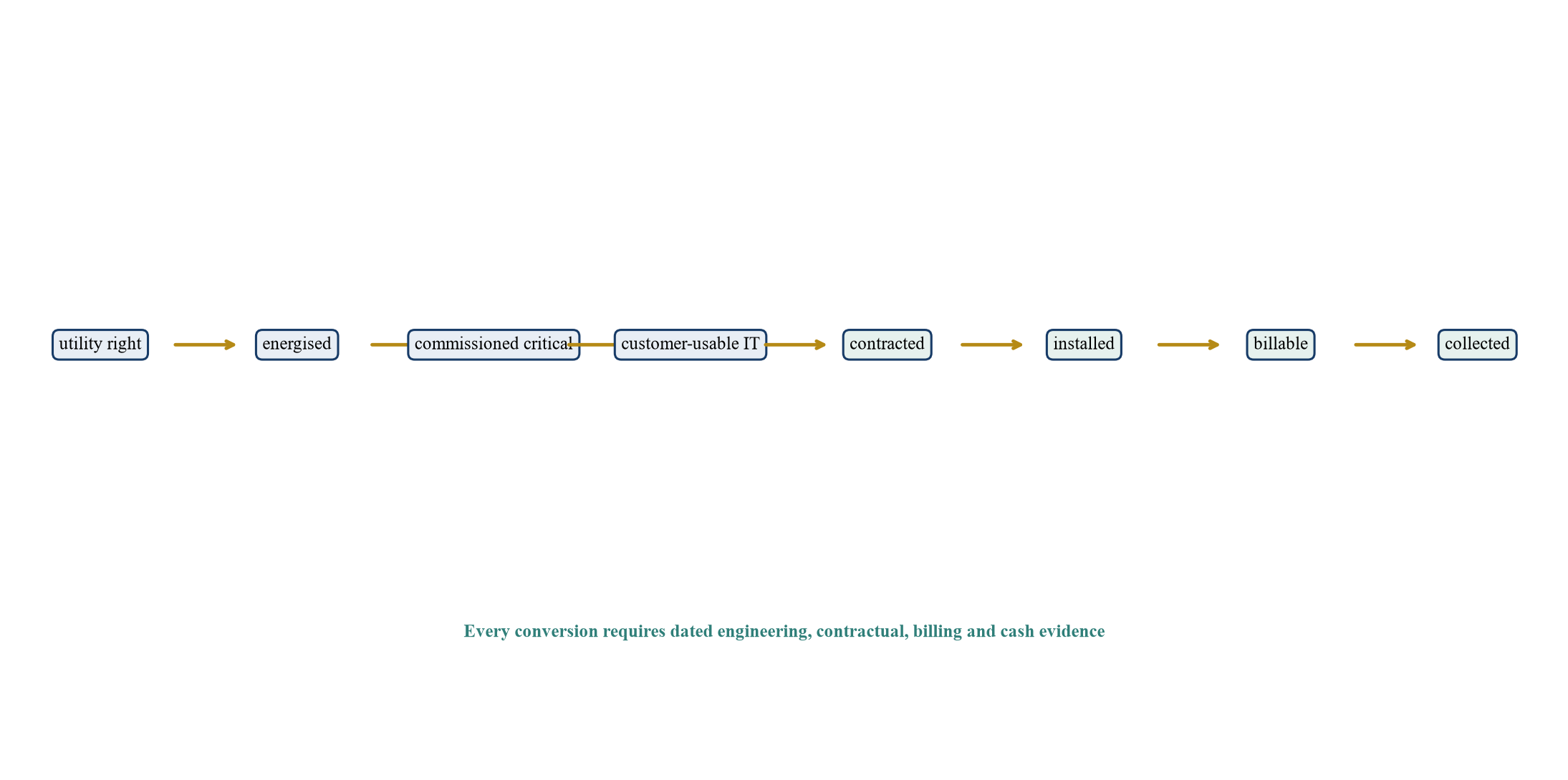
Analytical framework; transaction-specific engineering and contracts determine conversion.
| Layer | Evidence | Valuation use |
|---|---|---|
| utility right | executed service and delivery terms | dependency and option |
| commissioned critical | completed and tested systems | operating capacity |
| customer-usable IT | density, redundancy and cooling-adjusted | saleable denominator |
| contracted | executed customer commitment | conversion value |
| installed | accepted customer equipment and service | ramp evidence |
| billable | invoice supported by accepted service | operating revenue |
| collected | reconciled cash receipt | cash-quality test |
Proposed definitions; engineering and contracts determine actual treatment.
4. Map the customer-contract transmission channels
The decision question is which price, volume, minimum, escalation, renewal and pass-through clauses transmit a compute-cost change. The analysis should begin with executed agreements, amendments, order forms, service schedules, invoices, credits and renewal notices. Each item needs a source, period, owner and reconciliation to the financial model. External market growth provides context; it does not establish the cash earned by a particular facility, contract or customer.
The principal valuation failure is that average revenue per kilowatt can conceal different contract exposure and customer options. This can move value through revenue, operating cost, capital expenditure, timing, tax, liquidity and the cost of capital. The model should expose those paths instead of embedding them in one growth rate or terminal multiple. Management estimates can be used for planning when they are clearly identified as assumptions and remain separate from observed evidence.
The recommended response is to model every material contract according to its enforceable cash mechanism. Central, upside and downside cases should state the contract mechanism, capacity consequence, required capital, timing and responsible decision owner. The board should see the earliest observable indicator, the value at risk and the action available before it releases capital or accepts leverage.
5. Classify customer and service archetypes
The decision question is how hyperscale, wholesale, retail colocation, managed hosting, interconnection and powered-shell services respond differently. The analysis should begin with customer master data, product catalogue, contracts, rack and power records, sales pipeline and collections. Each item needs a source, period, owner and reconciliation to the financial model. External market growth provides context; it does not establish the cash earned by a particular facility, contract or customer.
The principal valuation failure is that one demand elasticity can be applied to customers with incompatible economics and switching costs. This can move value through revenue, operating cost, capital expenditure, timing, tax, liquidity and the cost of capital. The model should expose those paths instead of embedding them in one growth rate or terminal multiple. Management estimates can be used for planning when they are clearly identified as assumptions and remain separate from observed evidence.
The recommended response is to build archetype-specific revenue, churn, density and capital assumptions. Central, upside and downside cases should state the contract mechanism, capacity consequence, required capital, timing and responsible decision owner. The board should see the earliest observable indicator, the value at risk and the action available before it releases capital or accepts leverage.
| Archetype | Typical charging unit | Compute-cost channel | Principal valuation test |
|---|---|---|---|
| hyperscale build-to-suit | committed MW | renewal and expansion | credit, term and residual use |
| wholesale colocation | kW or MW commitment | utilisation and price | ramp, minimum and renewal |
| retail colocation | rack, cabinet and power | density and churn | customer cohort economics |
| interconnection | cross-connect or port | network demand | ecosystem and migration cost |
| managed hosting | service bundle | direct efficiency and competition | hardware and service margin |
| powered shell | lease and power rights | tenant capital and take-up | fit-out, credit and reletting |
Illustrative classification; executed terms govern each exposure.
6. Measure utilisation quality
The decision question is whether occupied capacity produces durable margin and collected cash at an appropriate capital burden. The analysis should begin with commissioned capacity, installed equipment, meters, billing, collections, support tickets and service credits. Each item needs a source, period, owner and reconciliation to the financial model. External market growth provides context; it does not establish the cash earned by a particular facility, contract or customer.
The principal valuation failure is that headline utilisation can count reservations, testing load or low-margin legacy contracts. This can move value through revenue, operating cost, capital expenditure, timing, tax, liquidity and the cost of capital. The model should expose those paths instead of embedding them in one growth rate or terminal multiple. Management estimates can be used for planning when they are clearly identified as assumptions and remain separate from observed evidence.
The recommended response is to publish physical, contractual, billing and cash utilisation as separate measures. Central, upside and downside cases should state the contract mechanism, capacity consequence, required capital, timing and responsible decision owner. The board should see the earliest observable indicator, the value at risk and the action available before it releases capital or accepts leverage.
7. Construct alternative compute-cost paths
The decision question is how a lower cost per unit of useful computation could develop without treating one path as a forecast. The analysis should begin with processor performance, software efficiency, cloud prices, workload mix and customer disclosures. Each item needs a source, period, owner and reconciliation to the financial model. External market growth provides context; it does not establish the cash earned by a particular facility, contract or customer.
The principal valuation failure is that precision in a technology forecast can create false confidence in long-dated cash flows. This can move value through revenue, operating cost, capital expenditure, timing, tax, liquidity and the cost of capital. The model should expose those paths instead of embedding them in one growth rate or terminal multiple. Management estimates can be used for planning when they are clearly identified as assumptions and remain separate from observed evidence.
The recommended response is to use transparent indices, ranges, trigger points and regular re-estimation. Central, upside and downside cases should state the contract mechanism, capacity consequence, required capital, timing and responsible decision owner. The board should see the earliest observable indicator, the value at risk and the action available before it releases capital or accepts leverage.
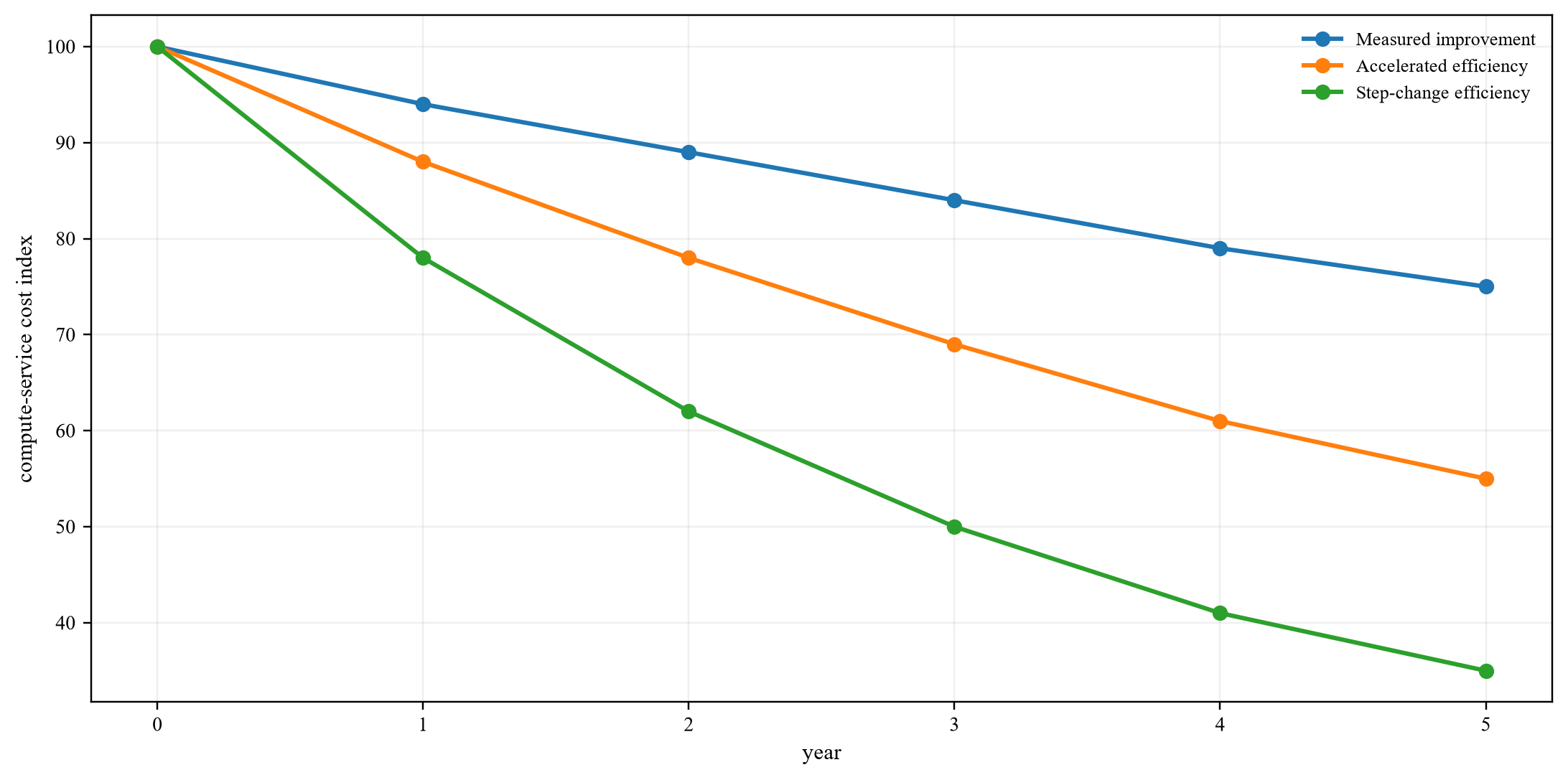
Wholly hypothetical indices; these are scenario assumptions rather than forecasts.
| Path | Year-five index | Possible demand response | Possible facility effect |
|---|---|---|---|
| measured improvement | 75 | broader but gradual adoption | stable ramp; selective density capex |
| accelerated efficiency | 55 | strong workload expansion | higher density; mixed MW demand |
| step-change efficiency | 35 | rapid new use with consolidation risk | winners by power, network and design |
Hypothetical indices; no path is a forecast.
8. Estimate demand elasticity by workload
The decision question is whether lower unit cost expands inference, training, storage, networking or enterprise workloads enough to offset efficiency. The analysis should begin with customer cohort history, workload telemetry where contractually permitted, bookings, cancellations and industry evidence. Each item needs a source, period, owner and reconciliation to the financial model. External market growth provides context; it does not establish the cash earned by a particular facility, contract or customer.
The principal valuation failure is that aggregate demand growth can hide falling demand from a particular customer or facility generation. This can move value through revenue, operating cost, capital expenditure, timing, tax, liquidity and the cost of capital. The model should expose those paths instead of embedding them in one growth rate or terminal multiple. Management estimates can be used for planning when they are clearly identified as assumptions and remain separate from observed evidence.
The recommended response is to estimate response by workload, customer, location and contract. Central, upside and downside cases should state the contract mechanism, capacity consequence, required capital, timing and responsible decision owner. The board should see the earliest observable indicator, the value at risk and the action available before it releases capital or accepts leverage.
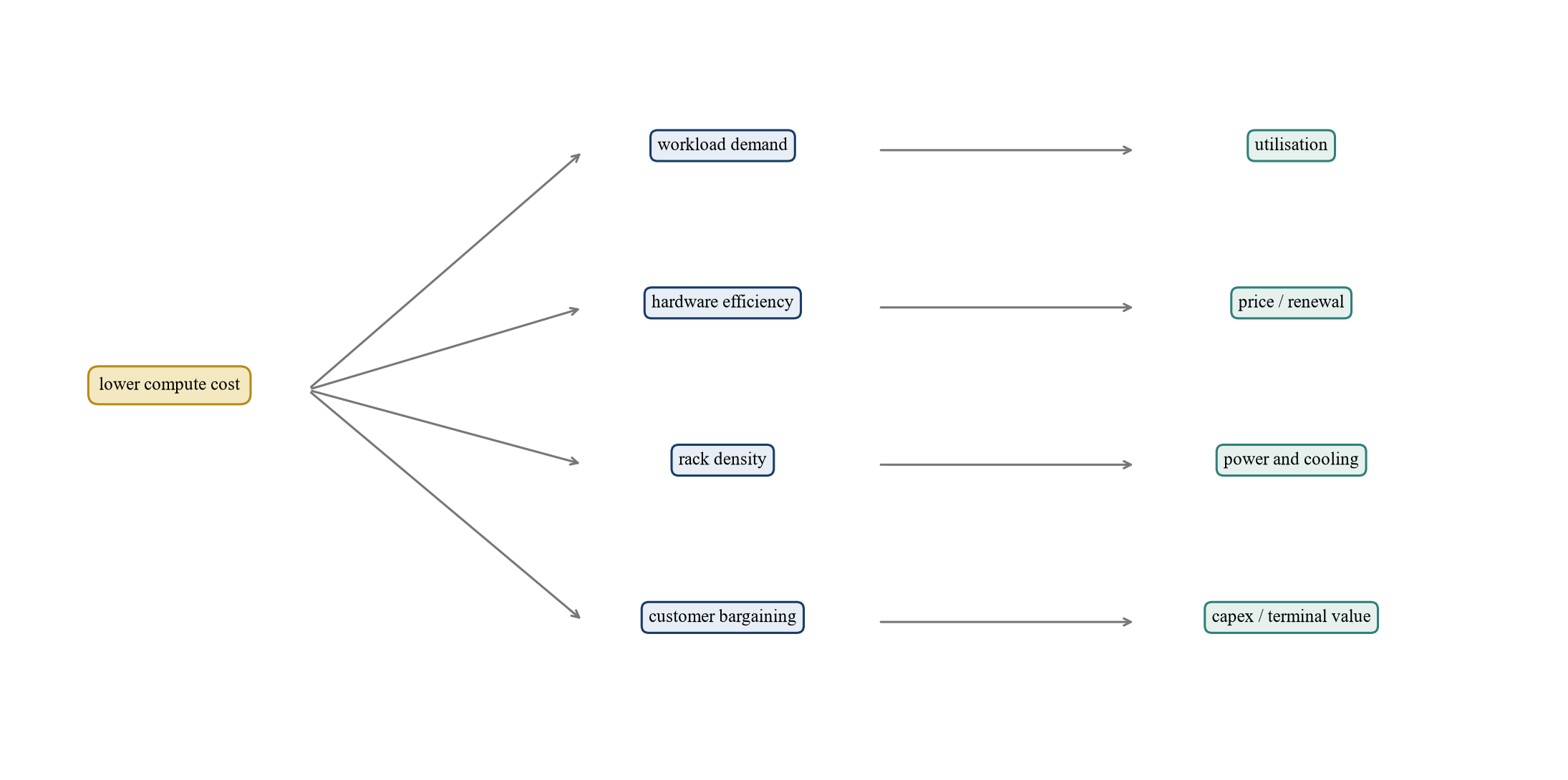
Proposed causal map; each arrow requires transaction-specific evidence.
9. Model density and facility compatibility
The decision question is whether rising kilowatts per rack can be served by electrical, cooling, floor, fire and operational systems. The analysis should begin with design drawings, nameplates, commissioning, thermal studies, rack inventories and customer specifications. Each item needs a source, period, owner and reconciliation to the financial model. External market growth provides context; it does not establish the cash earned by a particular facility, contract or customer.
The principal valuation failure is that portfolio megawatts can remain available while commercially relevant high-density capacity is scarce. This can move value through revenue, operating cost, capital expenditure, timing, tax, liquidity and the cost of capital. The model should expose those paths instead of embedding them in one growth rate or terminal multiple. Management estimates can be used for planning when they are clearly identified as assumptions and remain separate from observed evidence.
The recommended response is to value density-compatible service separately and cost retrofit constraints. Central, upside and downside cases should state the contract mechanism, capacity consequence, required capital, timing and responsible decision owner. The board should see the earliest observable indicator, the value at risk and the action available before it releases capital or accepts leverage.
10. Underwrite power availability and price
The decision question is whether utility rights, delivery dates, tariffs, generation mix and network constraints support each cash scenario. The analysis should begin with utility contracts, interconnection studies, tariffs, FERC and regional operator records, metering and bills. Each item needs a source, period, owner and reconciliation to the financial model. External market growth provides context; it does not establish the cash earned by a particular facility, contract or customer.
The principal valuation failure is that an executed customer contract can precede deliverable utility capacity or expose the owner to volatile power cost. This can move value through revenue, operating cost, capital expenditure, timing, tax, liquidity and the cost of capital. The model should expose those paths instead of embedding them in one growth rate or terminal multiple. Management estimates can be used for planning when they are clearly identified as assumptions and remain separate from observed evidence.
The recommended response is to model physical availability, timing, basis, pass-through and curtailment separately. Central, upside and downside cases should state the contract mechanism, capacity consequence, required capital, timing and responsible decision owner. The board should see the earliest observable indicator, the value at risk and the action available before it releases capital or accepts leverage.
11. Test interconnection and network value
The decision question is how carrier density, cloud on-ramps, latency and cross-connect economics affect retention and pricing. The analysis should begin with network maps, cross-connect inventory, traffic, customer dependencies, prices and service records. Each item needs a source, period, owner and reconciliation to the financial model. External market growth provides context; it does not establish the cash earned by a particular facility, contract or customer.
The principal valuation failure is that power-only valuation can miss durable network effects or duplicate connectivity capital. This can move value through revenue, operating cost, capital expenditure, timing, tax, liquidity and the cost of capital. The model should expose those paths instead of embedding them in one growth rate or terminal multiple. Management estimates can be used for planning when they are clearly identified as assumptions and remain separate from observed evidence.
The recommended response is to measure network revenue, customer dependence and replacement difficulty. Central, upside and downside cases should state the contract mechanism, capacity consequence, required capital, timing and responsible decision owner. The board should see the earliest observable indicator, the value at risk and the action available before it releases capital or accepts leverage.
12. Model renewal, churn and migration
The decision question is when customers can renegotiate, consolidate, relocate or change architecture under each scenario. The analysis should begin with contract expiry, renewal notice, installation history, migration cost, service quality and customer strategy. Each item needs a source, period, owner and reconciliation to the financial model. External market growth provides context; it does not establish the cash earned by a particular facility, contract or customer.
The principal valuation failure is that long average tenure can mask a concentrated renewal wall. This can move value through revenue, operating cost, capital expenditure, timing, tax, liquidity and the cost of capital. The model should expose those paths instead of embedding them in one growth rate or terminal multiple. Management estimates can be used for planning when they are clearly identified as assumptions and remain separate from observed evidence.
The recommended response is to forecast contract-level renewal with explicit timing and probability. Central, upside and downside cases should state the contract mechanism, capacity consequence, required capital, timing and responsible decision owner. The board should see the earliest observable indicator, the value at risk and the action available before it releases capital or accepts leverage.
13. Assess customer concentration and credit
The decision question is how a small number of customers influence price, capital, utilisation and financing. The analysis should begin with customer revenue, margin, receivables, parent support, ratings, security and contract remedies. Each item needs a source, period, owner and reconciliation to the financial model. External market growth provides context; it does not establish the cash earned by a particular facility, contract or customer.
The principal valuation failure is that investment-grade customer names can obscure entity, termination and concentration risk. This can move value through revenue, operating cost, capital expenditure, timing, tax, liquidity and the cost of capital. The model should expose those paths instead of embedding them in one growth rate or terminal multiple. Management estimates can be used for planning when they are clearly identified as assumptions and remain separate from observed evidence.
The recommended response is to link credit and bargaining power to revenue and covenant cases. Central, upside and downside cases should state the contract mechanism, capacity consequence, required capital, timing and responsible decision owner. The board should see the earliest observable indicator, the value at risk and the action available before it releases capital or accepts leverage.
14. Reconcile expansion and reliability capital
The decision question is which expenditure sustains service, converts contracts and creates new saleable capacity. The analysis should begin with condition assessments, capex ledgers, construction contracts, schedules, permits, commissioning and customer milestones. Each item needs a source, period, owner and reconciliation to the financial model. External market growth provides context; it does not establish the cash earned by a particular facility, contract or customer.
The principal valuation failure is that growth capex can include deferred maintenance or infrastructure unavailable to the target workload. This can move value through revenue, operating cost, capital expenditure, timing, tax, liquidity and the cost of capital. The model should expose those paths instead of embedding them in one growth rate or terminal multiple. Management estimates can be used for planning when they are clearly identified as assumptions and remain separate from observed evidence.
The recommended response is to classify sustaining, compliance, conversion, density, resilience and expansion capital. Central, upside and downside cases should state the contract mechanism, capacity consequence, required capital, timing and responsible decision owner. The board should see the earliest observable indicator, the value at risk and the action available before it releases capital or accepts leverage.
| Class | Purpose | Value treatment | Release evidence |
|---|---|---|---|
| sustaining | preserve service | operating cash requirement | condition and maintenance plan |
| compliance | meet law and code | unavoidable requirement | permit and remediation scope |
| reliability | protect uptime | risk-adjusted cash | failure and resilience evidence |
| conversion | deliver contracted load | contracted growth | customer and commissioning milestones |
| density retrofit | serve higher-density workloads | scenario value | design, customer and return |
| expansion | create new saleable capacity | contingent growth | land, power, permit, demand and funding |
Proposed classification; transaction-specific engineering controls amounts.
15. Model technological and economic obsolescence
The decision question is when an operating hall loses competitiveness despite remaining physically functional. The analysis should begin with density, cooling, efficiency, reliability, network, certifications, customer pipeline and retrofit economics. Each item needs a source, period, owner and reconciliation to the financial model. External market growth provides context; it does not establish the cash earned by a particular facility, contract or customer.
The principal valuation failure is that straight-line depreciation can understate commercial obsolescence or overstate required replacement. This can move value through revenue, operating cost, capital expenditure, timing, tax, liquidity and the cost of capital. The model should expose those paths instead of embedding them in one growth rate or terminal multiple. Management estimates can be used for planning when they are clearly identified as assumptions and remain separate from observed evidence.
The recommended response is to use facility-generation cohorts and cash-based impairment indicators. Central, upside and downside cases should state the contract mechanism, capacity consequence, required capital, timing and responsible decision owner. The board should see the earliest observable indicator, the value at risk and the action available before it releases capital or accepts leverage.
16. Build the discounted-cash-flow model
The decision question is how contract cash, utilisation, price, power, operating cost, capex, tax and working capital create value. The analysis should begin with monthly customer cash, operating records, tax basis, capital schedules and financing assumptions. Each item needs a source, period, owner and reconciliation to the financial model. External market growth provides context; it does not establish the cash earned by a particular facility, contract or customer.
The principal valuation failure is that a top-down revenue growth rate can disconnect value from capacity and contracts. This can move value through revenue, operating cost, capital expenditure, timing, tax, liquidity and the cost of capital. The model should expose those paths instead of embedding them in one growth rate or terminal multiple. Management estimates can be used for planning when they are clearly identified as assumptions and remain separate from observed evidence.
The recommended response is to build from customer and capacity cohorts with auditable scenario drivers. Central, upside and downside cases should state the contract mechanism, capacity consequence, required capital, timing and responsible decision owner. The board should see the earliest observable indicator, the value at risk and the action available before it releases capital or accepts leverage.
17. Use megawatt multiples with discipline
The decision question is which capacity definition, cash maturity, geography and capital obligation make a comparable transaction relevant. The analysis should begin with public filings, transaction disclosures, operating metrics, capacity definitions and remaining capex. Each item needs a source, period, owner and reconciliation to the financial model. External market growth provides context; it does not establish the cash earned by a particular facility, contract or customer.
The principal valuation failure is that enterprise value per stated megawatt can reward undeveloped power and ignore liabilities. This can move value through revenue, operating cost, capital expenditure, timing, tax, liquidity and the cost of capital. The model should expose those paths instead of embedding them in one growth rate or terminal multiple. Management estimates can be used for planning when they are clearly identified as assumptions and remain separate from observed evidence.
The recommended response is to normalise multiples to commissioned, usable and billable capacity and reconcile to DCF. Central, upside and downside cases should state the contract mechanism, capacity consequence, required capital, timing and responsible decision owner. The board should see the earliest observable indicator, the value at risk and the action available before it releases capital or accepts leverage.
| Method | Strength | Principal limitation | Required reconciliation |
|---|---|---|---|
| DCF | links contracts and capital to cash | sensitive to long-term assumptions | scenario and terminal-value bridge |
| EV per MW | rapid market comparison | capacity definitions differ | commissioned, usable and billable MW |
| EBITDA multiple | cash-oriented comparison | maturity and capex differ | leases, power, capex and growth |
| replacement cost | tests scarcity and recreation | cost can exceed economic value | time, utility feasibility and demand |
| transaction evidence | observes control value | disclosure and cycle vary | date, perimeter, synergies and liabilities |
Each method requires consistent perimeter and capacity definitions.
18. Apply replacement cost and land-power evidence
The decision question is what it would cost and how long it would take to recreate land, power, buildings, systems and network position. The analysis should begin with land evidence, utility works, engineering quantities, procurement, labour, permits and commissioning. Each item needs a source, period, owner and reconciliation to the financial model. External market growth provides context; it does not establish the cash earned by a particular facility, contract or customer.
The principal valuation failure is that replacement cost can exceed economic value where customer demand or returns are insufficient. This can move value through revenue, operating cost, capital expenditure, timing, tax, liquidity and the cost of capital. The model should expose those paths instead of embedding them in one growth rate or terminal multiple. Management estimates can be used for planning when they are clearly identified as assumptions and remain separate from observed evidence.
The recommended response is to use depreciated replacement cost as a cross-check with time and feasibility adjustments. Central, upside and downside cases should state the contract mechanism, capacity consequence, required capital, timing and responsible decision owner. The board should see the earliest observable indicator, the value at risk and the action available before it releases capital or accepts leverage.
19. Govern AI-assisted valuation
The decision question is how models extract contracts, reconcile capacity, detect anomalies and simulate scenarios under accountable review. The analysis should begin with data lineage, model cards, validation, access controls, exception logs and reviewer approvals. Each item needs a source, period, owner and reconciliation to the financial model. External market growth provides context; it does not establish the cash earned by a particular facility, contract or customer.
The principal valuation failure is that automated summaries can propagate source errors or conceal model uncertainty. This can move value through revenue, operating cost, capital expenditure, timing, tax, liquidity and the cost of capital. The model should expose those paths instead of embedding them in one growth rate or terminal multiple. Management estimates can be used for planning when they are clearly identified as assumptions and remain separate from observed evidence.
The recommended response is to assign human owners, preserve citations and validate consequential outputs. Central, upside and downside cases should state the contract mechanism, capacity consequence, required capital, timing and responsible decision owner. The board should see the earliest observable indicator, the value at risk and the action available before it releases capital or accepts leverage.
20. Define the hypothetical portfolio
The decision question is how the worked case converts 360 stated megawatts into billable capacity and cash. The analysis should begin with the illustrative capacity ladder, contract mix, capital plan, operating costs and debt. Each item needs a source, period, owner and reconciliation to the financial model. External market growth provides context; it does not establish the cash earned by a particular facility, contract or customer.
The principal valuation failure is that a single 360 MW denominator would overstate current operating scale. This can move value through revenue, operating cost, capital expenditure, timing, tax, liquidity and the cost of capital. The model should expose those paths instead of embedding them in one growth rate or terminal multiple. Management estimates can be used for planning when they are clearly identified as assumptions and remain separate from observed evidence.
The recommended response is to value only the capacity layer supported by the relevant evidence. Central, upside and downside cases should state the contract mechanism, capacity consequence, required capital, timing and responsible decision owner. The board should see the earliest observable indicator, the value at risk and the action available before it releases capital or accepts leverage.
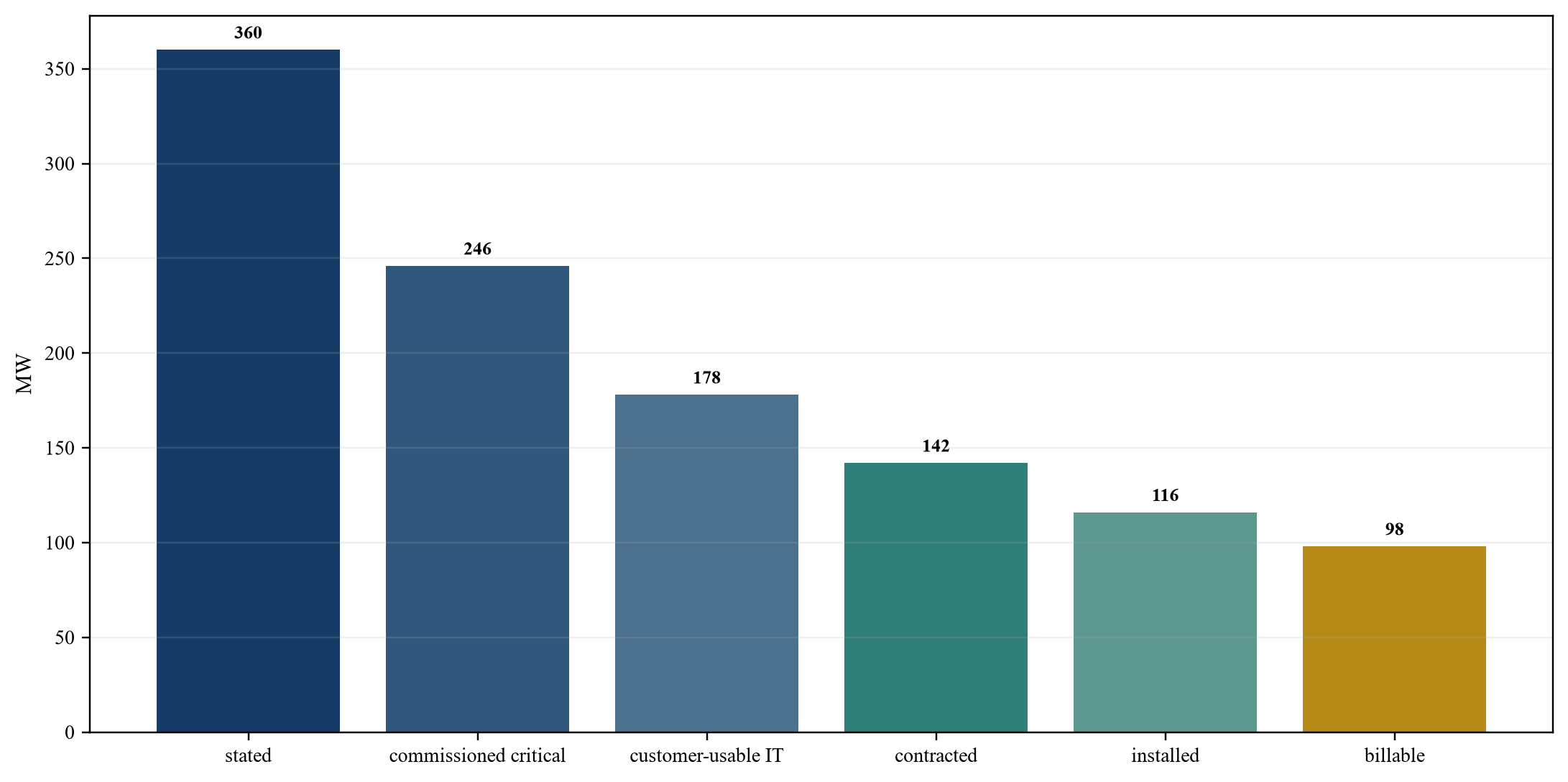
Wholly hypothetical megawatts; figures do not describe an identified portfolio.
21. Translate scenarios into cash
The decision question is how compute-cost indices change demand, renewal price, density, power, capex and margin. The analysis should begin with central, demand-led and efficiency-led assumptions with explicit elasticities and contract lags. Each item needs a source, period, owner and reconciliation to the financial model. External market growth provides context; it does not establish the cash earned by a particular facility, contract or customer.
The principal valuation failure is that a lower cost index can be applied directly to data-centre revenue without an economic channel. This can move value through revenue, operating cost, capital expenditure, timing, tax, liquidity and the cost of capital. The model should expose those paths instead of embedding them in one growth rate or terminal multiple. Management estimates can be used for planning when they are clearly identified as assumptions and remain separate from observed evidence.
The recommended response is to calculate each channel independently and show interactions. Central, upside and downside cases should state the contract mechanism, capacity consequence, required capital, timing and responsible decision owner. The board should see the earliest observable indicator, the value at risk and the action available before it releases capital or accepts leverage.
| Driver | Central | Demand-led upside | Efficiency-led downside |
|---|---|---|---|
| billable load in year five | 142 MW | 165 MW | 118 MW |
| renewal price change | 0% | +4% | -9% |
| average power density | +28% | +45% | +20% |
| five-year capital | USD 2.1bn | USD 2.5bn | USD 1.7bn |
| expansion delay | 9 months | 3 months | 24 months |
| terminal utilisation | 86% | 92% | 74% |
Wholly hypothetical; values do not describe an identified company.
22. Bridge enterprise value to equity value
The decision question is how operating assets, contracted conversion, expansion, debt, leases, tax and contingencies reach equity value. The analysis should begin with DCF outputs, debt, cash, lease obligations, committed capex and transaction adjustments. Each item needs a source, period, owner and reconciliation to the financial model. External market growth provides context; it does not establish the cash earned by a particular facility, contract or customer.
The principal valuation failure is that headline enterprise value can conceal funding obligations and debt-like items. This can move value through revenue, operating cost, capital expenditure, timing, tax, liquidity and the cost of capital. The model should expose those paths instead of embedding them in one growth rate or terminal multiple. Management estimates can be used for planning when they are clearly identified as assumptions and remain separate from observed evidence.
The recommended response is to show a transparent bridge with downside liquidity. Central, upside and downside cases should state the contract mechanism, capacity consequence, required capital, timing and responsible decision owner. The board should see the earliest observable indicator, the value at risk and the action available before it releases capital or accepts leverage.
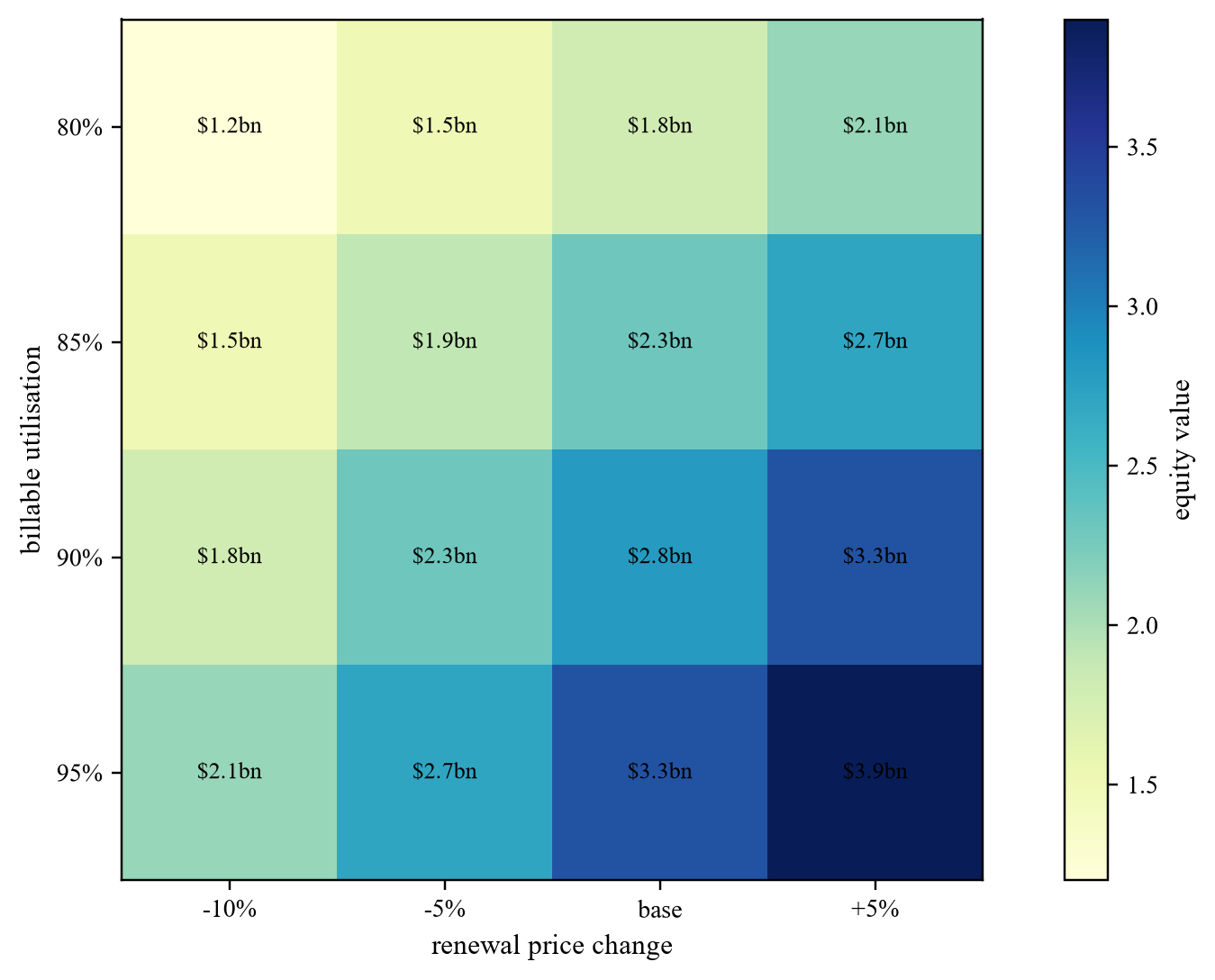
Wholly hypothetical USD billions; this is not a valuation opinion.
23. Run sensitivity and tornado analysis
The decision question is which assumptions explain the greatest change in value and covenant resilience. The analysis should begin with contract renewal, billable capacity, price, power cost, capex, delay, exit yield and terminal growth. Each item needs a source, period, owner and reconciliation to the financial model. External market growth provides context; it does not establish the cash earned by a particular facility, contract or customer.
The principal valuation failure is that many small sensitivities can distract from a few decisive exposures. This can move value through revenue, operating cost, capital expenditure, timing, tax, liquidity and the cost of capital. The model should expose those paths instead of embedding them in one growth rate or terminal multiple. Management estimates can be used for planning when they are clearly identified as assumptions and remain separate from observed evidence.
The recommended response is to rank variables by equity and debt-service impact and assign evidence priorities. Central, upside and downside cases should state the contract mechanism, capacity consequence, required capital, timing and responsible decision owner. The board should see the earliest observable indicator, the value at risk and the action available before it releases capital or accepts leverage.
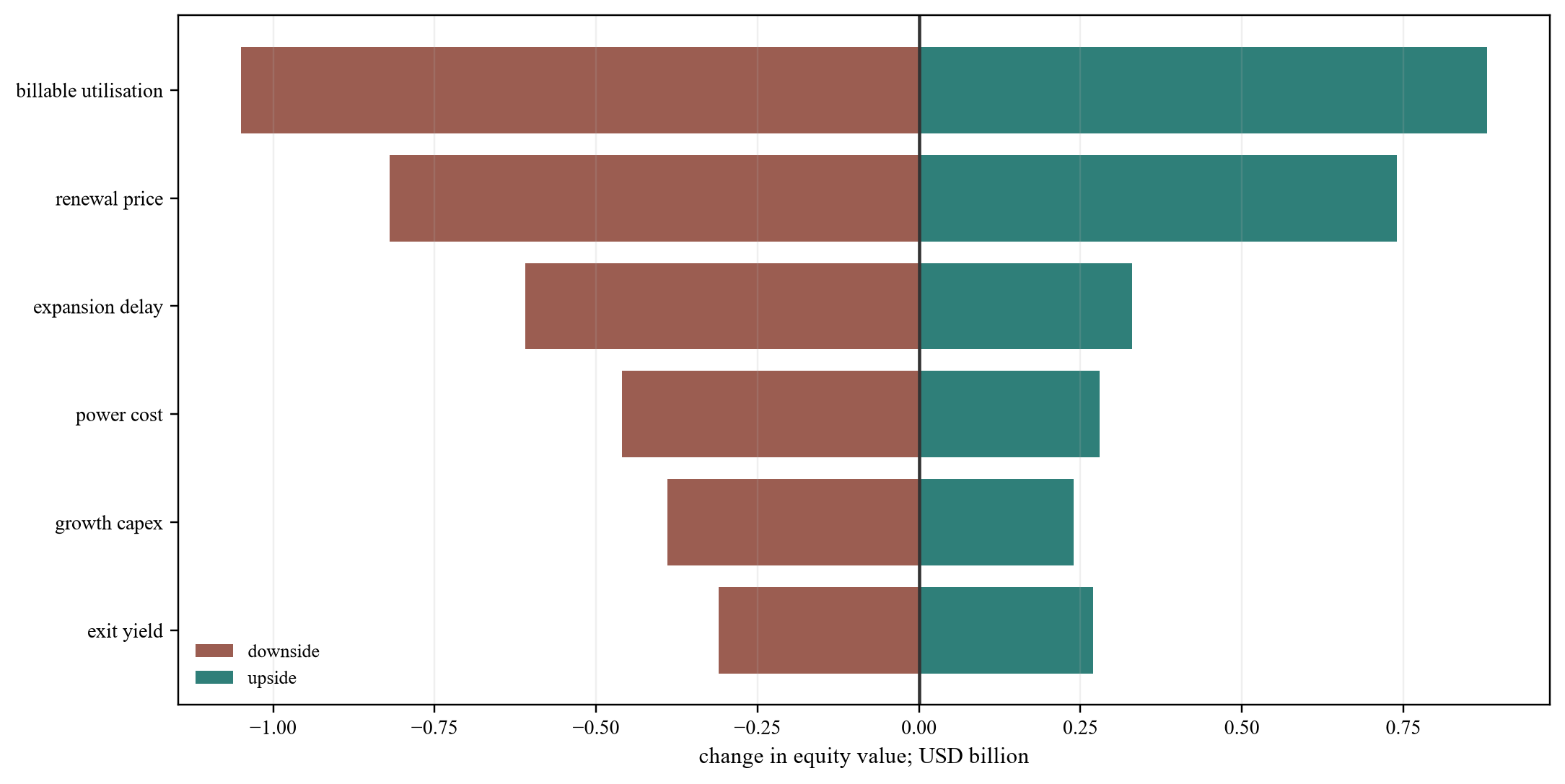
Wholly hypothetical sensitivities around the central case.
24. Size debt to resilient cash
The decision question is what leverage, amortisation, reserve and covenant structure survives realistic downside. The analysis should begin with contracted EBITDA, maintenance capital, taxes, working capital, interest, maturity and liquidity. Each item needs a source, period, owner and reconciliation to the financial model. External market growth provides context; it does not establish the cash earned by a particular facility, contract or customer.
The principal valuation failure is that debt can be sized to projected expansion that lacks power, customer acceptance or funding. This can move value through revenue, operating cost, capital expenditure, timing, tax, liquidity and the cost of capital. The model should expose those paths instead of embedding them in one growth rate or terminal multiple. Management estimates can be used for planning when they are clearly identified as assumptions and remain separate from observed evidence.
The recommended response is to base leverage on resilient cash and stage growth debt against milestones. Central, upside and downside cases should state the contract mechanism, capacity consequence, required capital, timing and responsible decision owner. The board should see the earliest observable indicator, the value at risk and the action available before it releases capital or accepts leverage.
25. Translate findings into transaction terms
The decision question is which price adjustments, escrows, earn-outs, indemnities, conditions and covenants allocate uncertainty. The analysis should begin with diligence findings, legal rights, financing requirements and integration plan. Each item needs a source, period, owner and reconciliation to the financial model. External market growth provides context; it does not establish the cash earned by a particular facility, contract or customer.
The principal valuation failure is that valuation caveats can disappear from definitive agreements. This can move value through revenue, operating cost, capital expenditure, timing, tax, liquidity and the cost of capital. The model should expose those paths instead of embedding them in one growth rate or terminal multiple. Management estimates can be used for planning when they are clearly identified as assumptions and remain separate from observed evidence.
The recommended response is to attach each material uncertainty to a quantified protection and owner. Central, upside and downside cases should state the contract mechanism, capacity consequence, required capital, timing and responsible decision owner. The board should see the earliest observable indicator, the value at risk and the action available before it releases capital or accepts leverage.
26. Set board gates for expansion
The decision question is when land, power, permitting, customer demand, design, funding and returns permit capital release. The analysis should begin with approved business cases, utility evidence, customer commitments, engineering and financing. Each item needs a source, period, owner and reconciliation to the financial model. External market growth provides context; it does not establish the cash earned by a particular facility, contract or customer.
The principal valuation failure is that strategic urgency can accelerate spending before dependencies are secured. This can move value through revenue, operating cost, capital expenditure, timing, tax, liquidity and the cost of capital. The model should expose those paths instead of embedding them in one growth rate or terminal multiple. Management estimates can be used for planning when they are clearly identified as assumptions and remain separate from observed evidence.
The recommended response is to use sequential gates with stop, redesign and repricing decisions. Central, upside and downside cases should state the contract mechanism, capacity consequence, required capital, timing and responsible decision owner. The board should see the earliest observable indicator, the value at risk and the action available before it releases capital or accepts leverage.
| Gate | Minimum evidence | Stop or redesign trigger |
|---|---|---|
| land and control | title, lease, access and environmental baseline | unresolved control or remediation |
| power | executed rights, delivery path and price | speculative timing or unaffordable upgrade |
| customer | enforceable commitment and credit | non-binding pipeline or concentrated option |
| design | density, cooling, resilience and cost | incompatible target workload |
| funding | committed sources, liquidity and covenant headroom | reliance on unfinanced growth |
| construction | fixed scope, schedule, interfaces and contingency | critical-path dependency unresolved |
| commissioning | tested systems and customer acceptance | failed performance or acceptance |
Proposed governance; each investment requires project-specific approval.
27. Monitor post-close value and refinancing
The decision question is which leading indicators identify variance before cash and covenant failure. The analysis should begin with capacity conversion, bookings, renewals, metering, incidents, capex, collections and liquidity. Each item needs a source, period, owner and reconciliation to the financial model. External market growth provides context; it does not establish the cash earned by a particular facility, contract or customer.
The principal valuation failure is that quarterly financial reporting can reveal problems after intervention options narrow. This can move value through revenue, operating cost, capital expenditure, timing, tax, liquidity and the cost of capital. The model should expose those paths instead of embedding them in one growth rate or terminal multiple. Management estimates can be used for planning when they are clearly identified as assumptions and remain separate from observed evidence.
The recommended response is to operate a monthly evidence dashboard tied to board actions. Central, upside and downside cases should state the contract mechanism, capacity consequence, required capital, timing and responsible decision owner. The board should see the earliest observable indicator, the value at risk and the action available before it releases capital or accepts leverage.
28. Reach a defensible conclusion
The decision question is whether the asset remains valuable across transparent compute-cost and operating scenarios. The analysis should begin with reconciled evidence, scenario results, protections, financing and accountable approvals. Each item needs a source, period, owner and reconciliation to the financial model. External market growth provides context; it does not establish the cash earned by a particular facility, contract or customer.
The principal valuation failure is that one point estimate can hide incompatible paths and concentrated risk. This can move value through revenue, operating cost, capital expenditure, timing, tax, liquidity and the cost of capital. The model should expose those paths instead of embedding them in one growth rate or terminal multiple. Management estimates can be used for planning when they are clearly identified as assumptions and remain separate from observed evidence.
The recommended response is to approve a value range, protection package and trigger-based operating plan. Central, upside and downside cases should state the contract mechanism, capacity consequence, required capital, timing and responsible decision owner. The board should see the earliest observable indicator, the value at risk and the action available before it releases capital or accepts leverage.
Sources
- U.S. Department of Energy, *DOE Releases New Report Evaluating Increase in Electricity Demand from Data Centers*, 2024. Read the primary source
- Lawrence Berkeley National Laboratory, *2024 United States Data Center Energy Usage Report*, 2024. Read the primary source
- International Energy Agency, *Energy and AI*, 2025. Read the primary source
- U.S. Energy Information Administration, *Electric Power Monthly*. Read the primary source
- Federal Energy Regulatory Commission, *Electric Power Markets*. Read the primary source
- Federal Energy Regulatory Commission, *Reliability Primer*. Read the primary source
- PJM Interconnection, *Load Forecast Report*. Read the primary source
- North American Electric Reliability Corporation, *Long-Term Reliability Assessment*. Read the primary source
- U.S. Environmental Protection Agency, *ENERGY STAR for Data Centers*. Read the primary source
- National Institute of Standards and Technology, *AI Risk Management Framework*. Read the primary source
- National Institute of Standards and Technology, *Cybersecurity Framework 2.0*. Read the primary source
- Cybersecurity and Infrastructure Security Agency, *Cross-Sector Cybersecurity Performance Goals*. Read the primary source
- U.S. Securities and Exchange Commission, *Equinix, Inc. filings*. Read the primary source
- U.S. Securities and Exchange Commission, *Digital Realty Trust, Inc. filings*. Read the primary source
- U.S. Securities and Exchange Commission, *American Tower Corporation filings*. Read the primary source
- U.S. Securities and Exchange Commission, *NVIDIA Corporation filings*. Read the primary source
- U.S. Securities and Exchange Commission, *Microsoft Corporation filings*. Read the primary source
- U.S. Securities and Exchange Commission, *Amazon.com, Inc. filings*. Read the primary source
- U.S. Securities and Exchange Commission, *Alphabet Inc. filings*. Read the primary source
- Federal Accounting Standards Advisory Board, *Accounting Standards and Other Pronouncements*. Read the primary source
- Financial Accounting Standards Board, *Accounting Standards Codification*. Read the primary source
- Internal Revenue Service, *Publication 946, How To Depreciate Property*. Read the primary source
- U.S. Census Bureau, *Quarterly Construction Spending*. Read the primary source
- Bureau of Labor Statistics, *Producer Price Indexes*. Read the primary source
- Federal Reserve Board, *Financial Accounts of the United States*. Read the primary source
- U.S. Department of Justice and Federal Trade Commission, *Merger Guidelines*, 2023. Read the primary source
