

1. Define the transaction decision
Specify whether the work supports a board investment, financing, acquisition, sale, fairness analysis or post-close plan. The valuation date, standard, premise, currency, legal entities, control rights and expected buyer contribution should be explicit.
Controlled evidence includes approved mandate; valuation date; governing standard; legal perimeter; decision rights. The immediate decision is to agree the question, evidence threshold and accountable committee before modelling value. Definitions should remain consistent across operating reports, transaction workpapers, forecasts and valuation.
The analytical unit should remain stable from source record to valuation conclusion. Reviewers should see the population, exclusions, period, owner and reconciliation to finance. Where evidence is incomplete, the model should retain a range and identify the action needed to narrow it. Comparisons should preserve product, customer, site, complexity and market conditions; aggregation should not conceal adverse cohorts or delayed consequences.
2. Map the conventional-business economic system
Map demand, price, volume, mix, capacity, labour, materials, energy, maintenance, logistics, quality, inventory, receivables, payables, capital expenditure and tax. AI affects enterprise value through these operating relationships.
Controlled evidence includes native operating ledgers; contracts; production or service records; financial statements. The immediate decision is to identify the limiting constraint and the route from workflow change to cash. Definitions should remain consistent across operating reports, transaction workpapers, forecasts and valuation.
Evidence should distinguish observation, estimate, management plan and transaction judgement. A supported claim includes timing, full cost, dependency, transferability and a cash consequence. Sensitivity should show how the conclusion changes when adoption, demand, quality or persistence underperforms. Material assumptions need validation dates, accountable owners and explicit expiry conditions so that stale expectations do not survive into pricing or financing decisions.
3. Establish the controlled perimeter
Define business units, sites, products, services, customers, channels, suppliers, employees, systems, models and periods. Acquisitions and regional operations often carry incompatible definitions that can create false uplift.
Controlled evidence includes population rules; identifiers; system lineage; reconciliation exceptions; change log. The immediate decision is to lock the included population and preserve excluded cases with reasons. Definitions should remain consistent across operating reports, transaction workpapers, forecasts and valuation.
The operating team and finance team should use the same definitions. Native records should support aggregate dashboards, and sample testing should follow representative cases from input through outcome and cash. Exceptions, failed cases and client concessions remain part of the population. Reconciliation should cover opening and closing balances, acquisitions, disposals, foreign exchange, allocation changes and manual adjustments that could otherwise mimic operating improvement.
4. Build the AI value taxonomy
Classify each claim as revenue, price, volume, mix, cost, working capital, capital intensity, resilience, compliance, capability or strategic option. Classification prevents one outcome from appearing in several valuation bridges.
Controlled evidence includes claim owner; workflow; baseline; economic account; timing; cash consequence. The immediate decision is to assign one primary value route and record secondary effects separately. Definitions should remain consistent across operating reports, transaction workpapers, forecasts and valuation.
Decision makers need both upside and downside. The analysis should state which party controls conversion, what investment remains, when cash appears, which risks survive and whether the result continues after a change of ownership. Unsupported precision should be replaced with bounded scenarios. The committee should record the decision consequence of each range, including price, structure, funding, covenant, integration and monitoring implications.
Table 1. AI value taxonomy and primary valuation route
| Claim class | Operating evidence | Primary treatment |
|---|---|---|
| revenue | customer action, price, volume and contribution | cash-flow growth |
| cost | controlled effort, spend or funded action | margin or cash flow |
| working capital | repeatable balance and cash evidence | cash release |
| capital intensity | asset need, maintenance and service consequence | investment profile |
| resilience | exposure, control effect and loss consequence | risk or cash flow |
| capability | rights, people, systems and transferability | cash flow or supported multiple |
Replace illustrative classifications with company-specific evidence and approved transaction treatment.
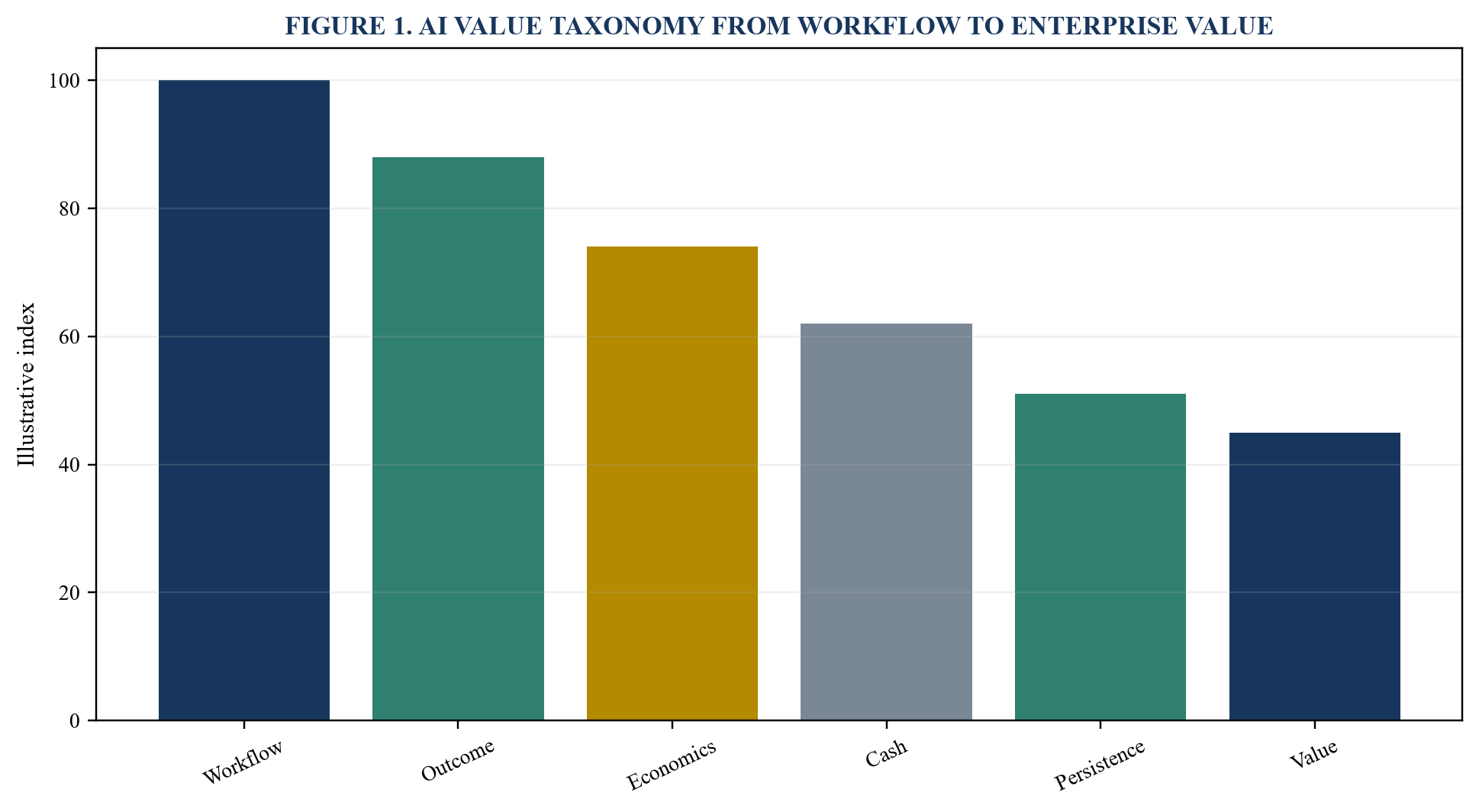
A claim should travel once through operating evidence, economics, cash, persistence and valuation.
5. Create the workflow evidence ledger
Trace every material claim from user and model through input, task, output, review, operational acceptance, customer consequence, invoice and cash. Negative cases and abandoned pilots belong in the same ledger.
Controlled evidence includes event logs; source data; reviewer actions; exceptions; accepted output; cash record. The immediate decision is to require reproducibility and downside treatment for broken evidence links. Definitions should remain consistent across operating reports, transaction workpapers, forecasts and valuation.
The analytical unit should remain stable from source record to valuation conclusion. Reviewers should see the population, exclusions, period, owner and reconciliation to finance. Where evidence is incomplete, the model should retain a range and identify the action needed to narrow it. Comparisons should preserve product, customer, site, complexity and market conditions; aggregation should not conceal adverse cohorts or delayed consequences.
6. Freeze the baseline protocol
State the pre-change population, period, complexity, input quality, staffing, output definition, error, review, cycle time, cost and customer outcome. Seasonality, price changes, acquisitions and process redesign can otherwise be misattributed to AI.
Controlled evidence includes pre-specified measures; matched periods; comparable cohorts; financial reconciliation. The immediate decision is to approve adjustments before results are inspected and retain reported and normalised views. Definitions should remain consistent across operating reports, transaction workpapers, forecasts and valuation.
Evidence should distinguish observation, estimate, management plan and transaction judgement. A supported claim includes timing, full cost, dependency, transferability and a cash consequence. Sensitivity should show how the conclusion changes when adoption, demand, quality or persistence underperforms. Material assumptions need validation dates, accountable owners and explicit expiry conditions so that stale expectations do not survive into pricing or financing decisions.
7. Identify causality and contribution
Randomised rollout, phased adoption, matched groups, interrupted time series and transaction-level controls can support attribution. A before-and-after comparison alone can confuse AI with demand, staffing, pricing or product changes.
Controlled evidence includes treatment assignment; adoption logs; comparable controls; uncertainty; spillovers. The immediate decision is to select the strongest practical design and state the remaining attribution limit. Definitions should remain consistent across operating reports, transaction workpapers, forecasts and valuation.
The operating team and finance team should use the same definitions. Native records should support aggregate dashboards, and sample testing should follow representative cases from input through outcome and cash. Exceptions, failed cases and client concessions remain part of the population. Reconciliation should cover opening and closing balances, acquisitions, disposals, foreign exchange, allocation changes and manual adjustments that could otherwise mimic operating improvement.
8. Measure adoption by task and cohort
Licences and logins do not establish operating adoption. Measure eligible work, actual use, appropriate use, override, review, failure, output acceptance and continued use by role, site, product and customer cohort.
Controlled evidence includes eligible denominator; user and workflow events; quality; client acceptance; duration. The immediate decision is to use adoption as a bridge variable rather than as an enterprise-value endpoint. Definitions should remain consistent across operating reports, transaction workpapers, forecasts and valuation.
Decision makers need both upside and downside. The analysis should state which party controls conversion, what investment remains, when cash appears, which risks survive and whether the result continues after a change of ownership. Unsupported precision should be replaced with bounded scenarios. The committee should record the decision consequence of each range, including price, structure, funding, covenant, integration and monitoring implications.
9. Separate task productivity from enterprise productivity
Faster drafting, diagnosis, scheduling or analysis can coexist with unchanged throughput when sales, approvals, equipment, customer demand or downstream capacity remain constrained. Released effort needs an operating destination.
Controlled evidence includes task time; end-to-end cycle; bottleneck utilisation; output; rework; cash. The immediate decision is to value only the portion converted through throughput, avoided cost, service or funded action. Definitions should remain consistent across operating reports, transaction workpapers, forecasts and valuation.
The analytical unit should remain stable from source record to valuation conclusion. Reviewers should see the population, exclusions, period, owner and reconciliation to finance. Where evidence is incomplete, the model should retain a range and identify the action needed to narrow it. Comparisons should preserve product, customer, site, complexity and market conditions; aggregation should not conceal adverse cohorts or delayed consequences.
10. Build the revenue evidence bridge
Revenue may arise from improved conversion, retention, cross-sell, uptime, service levels, speed, product quality or a new offering. Each route needs a customer action, contractual basis and contribution measure.
Controlled evidence includes customer cohorts; orders; price; volume; churn; credits; contribution; collection. The immediate decision is to separate observed revenue from pipeline, management plan and buyer opportunity. Definitions should remain consistent across operating reports, transaction workpapers, forecasts and valuation.
Evidence should distinguish observation, estimate, management plan and transaction judgement. A supported claim includes timing, full cost, dependency, transferability and a cash consequence. Sensitivity should show how the conclusion changes when adoption, demand, quality or persistence underperforms. Material assumptions need validation dates, accountable owners and explicit expiry conditions so that stale expectations do not survive into pricing or financing decisions.
11. Test price and willingness to pay
An AI label rarely proves pricing power. Controlled price tests, renewals, win-loss evidence, negotiated contracts and customer outcomes can show whether differentiated service supports realised price after discounts and concessions.
Controlled evidence includes quoted and realised price; discounts; renewal; churn; customer segment; service level. The immediate decision is to model price with elasticity, competitive response and customer concentration. Definitions should remain consistent across operating reports, transaction workpapers, forecasts and valuation.
The operating team and finance team should use the same definitions. Native records should support aggregate dashboards, and sample testing should follow representative cases from input through outcome and cash. Exceptions, failed cases and client concessions remain part of the population. Reconciliation should cover opening and closing balances, acquisitions, disposals, foreign exchange, allocation changes and manual adjustments that could otherwise mimic operating improvement.
12. Reconcile volume, mix and cannibalisation
Automation can raise output while shifting customers toward lower-priced products, reducing service hours or cannibalising existing revenue. Volume should be assessed with mix, contribution and capacity requirements.
Controlled evidence includes units; product and customer mix; substitution; contribution; capacity consumption. The immediate decision is to bridge gross growth to incremental contribution after cannibalisation and constraints. Definitions should remain consistent across operating reports, transaction workpapers, forecasts and valuation.
Decision makers need both upside and downside. The analysis should state which party controls conversion, what investment remains, when cash appears, which risks survive and whether the result continues after a change of ownership. Unsupported precision should be replaced with bounded scenarios. The committee should record the decision consequence of each range, including price, structure, funding, covenant, integration and monitoring implications.
13. Translate capacity release into economics
Time or machine capacity released by automation is an operating observation. Cash follows through additional demand, redeployment, avoided hiring, reduced external spend, overtime removal or a deliberate cost action.
Controlled evidence includes hours or machine time; skill; location; demand; redeployment; hiring; cost action. The immediate decision is to retain unconverted capacity as an operating opportunity rather than realised value. Definitions should remain consistent across operating reports, transaction workpapers, forecasts and valuation.
The analytical unit should remain stable from source record to valuation conclusion. Reviewers should see the population, exclusions, period, owner and reconciliation to finance. Where evidence is incomplete, the model should retain a range and identify the action needed to narrow it. Comparisons should preserve product, customer, site, complexity and market conditions; aggregation should not conceal adverse cohorts or delayed consequences.
14. Construct the EBITDA bridge
Reconcile revenue, price, volume, mix, labour, materials, energy, technology, review, rework, insurance and implementation into reported and sustainable EBITDA. Classification must agree with financial statements.
Controlled evidence includes general ledger; management accounts; cost allocations; run-rate date; owner; support. The immediate decision is to separate observed run rate, funded action, forecast, synergy and unresolved risk. Definitions should remain consistent across operating reports, transaction workpapers, forecasts and valuation.
Evidence should distinguish observation, estimate, management plan and transaction judgement. A supported claim includes timing, full cost, dependency, transferability and a cash consequence. Sensitivity should show how the conclusion changes when adoption, demand, quality or persistence underperforms. Material assumptions need validation dates, accountable owners and explicit expiry conditions so that stale expectations do not survive into pricing or financing decisions.
Table 2. EBITDA-bridge classification
| Class | Evidence threshold | Valuation treatment |
|---|---|---|
| observed run rate | reconciled results and stable population | base earnings or cash flow |
| funded conversion | approved action, owner, cost and timing | probability-weighted bridge |
| management forecast | supported demand and operating plan | scenario |
| buyer synergy | buyer capability and integration action | separate case |
| unresolved risk | exposure and incomplete mitigation | downside or protection |
Replace illustrative classifications with company-specific evidence and approved transaction treatment.
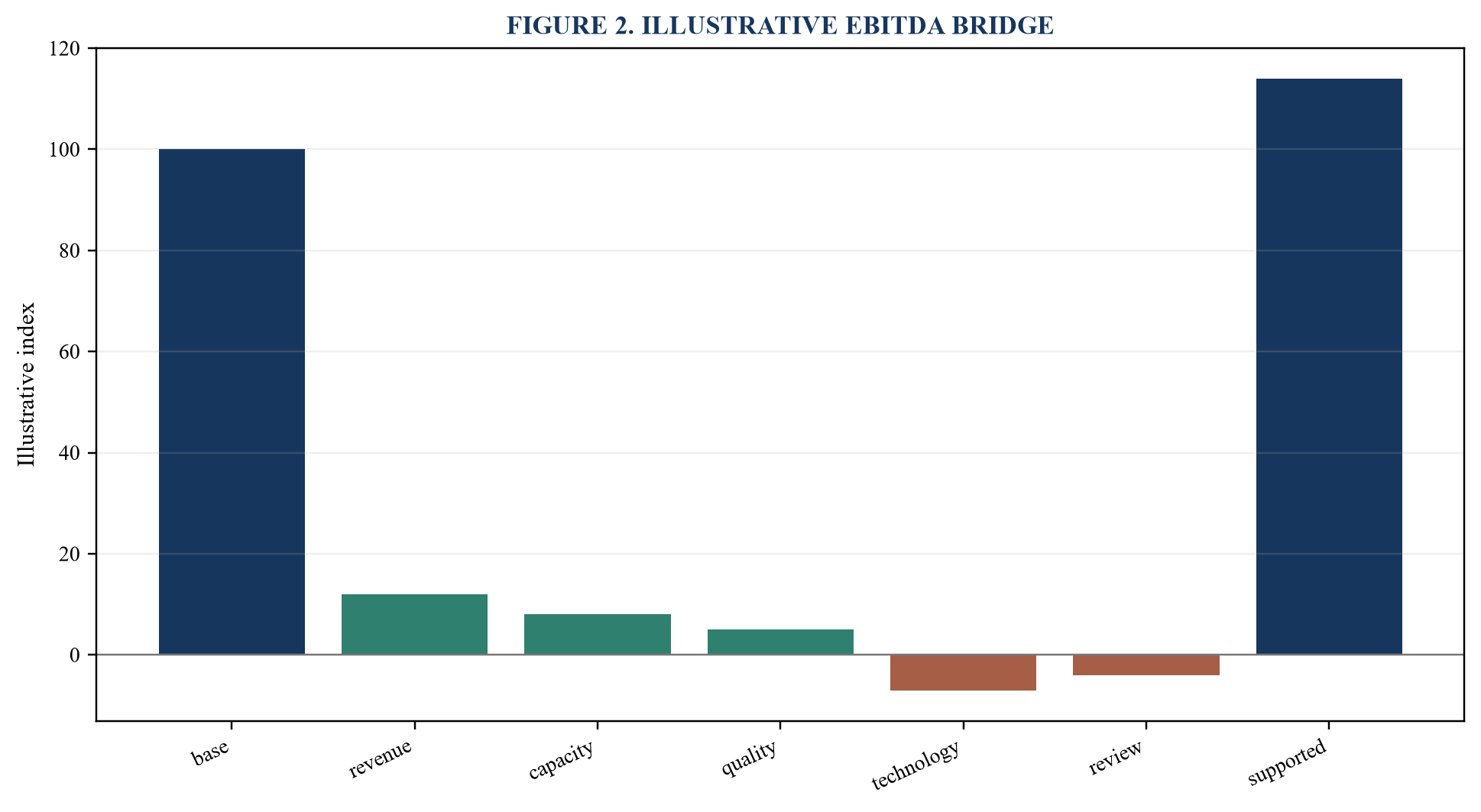
Replace values with reconciled company evidence and separate funded actions from forecasts.
15. Measure quality, safety and customer outcomes
Productivity gains can be destroyed by defects, returns, downtime, claims, recalls, regulatory breaches or customer dissatisfaction. Average model accuracy is insufficient for high-consequence operating decisions.
Controlled evidence includes severity-weighted defects; acceptance; returns; incidents; service credits; remediation cost. The immediate decision is to require equal or better controlled outcomes and include review and failure cost. Definitions should remain consistent across operating reports, transaction workpapers, forecasts and valuation.
The operating team and finance team should use the same definitions. Native records should support aggregate dashboards, and sample testing should follow representative cases from input through outcome and cash. Exceptions, failed cases and client concessions remain part of the population. Reconciliation should cover opening and closing balances, acquisitions, disposals, foreign exchange, allocation changes and manual adjustments that could otherwise mimic operating improvement.
16. Build the working-capital bridge
AI can affect forecasting, inventory, procurement, scheduling, invoicing, collections and dispute resolution. Reported improvements may also come from demand changes, delayed purchasing or one-off collection drives.
Controlled evidence includes inventory by class; forecast error; ageing; DSO; DPO; disputes; write-offs; cash. The immediate decision is to value repeatable cash release separately from temporary balance-sheet movement. Definitions should remain consistent across operating reports, transaction workpapers, forecasts and valuation.
Decision makers need both upside and downside. The analysis should state which party controls conversion, what investment remains, when cash appears, which risks survive and whether the result continues after a change of ownership. Unsupported precision should be replaced with bounded scenarios. The committee should record the decision consequence of each range, including price, structure, funding, covenant, integration and monitoring implications.
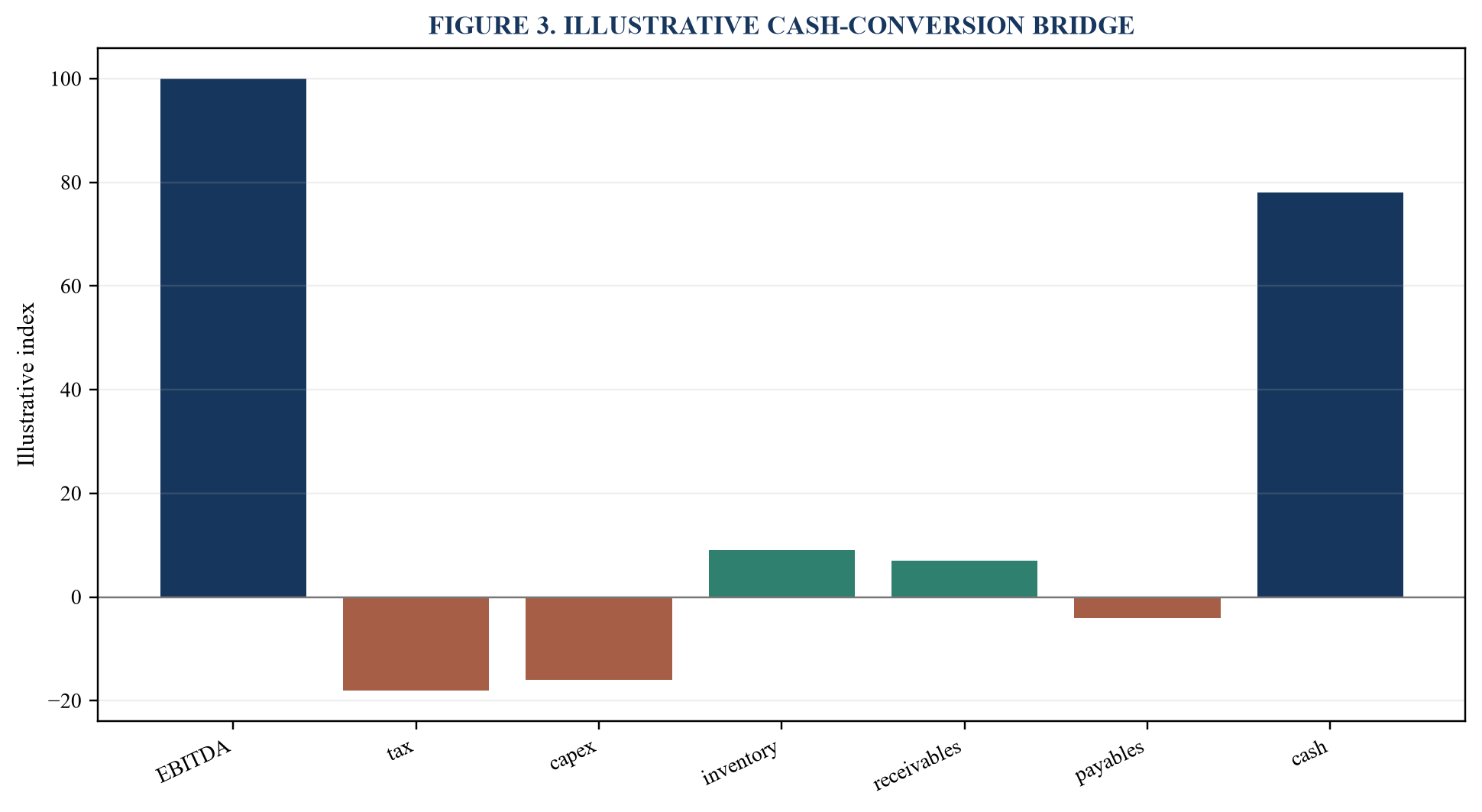
Working-capital benefit should distinguish recurring operating improvement from one-off release.
17. Assess capital expenditure and maintenance
Predictive maintenance, design optimisation and asset scheduling can defer or avoid capital expenditure, but underinvestment can transfer failure into later periods. Replacement cycles and capacity needs remain operating facts.
Controlled evidence includes asset register; failure history; maintenance plan; utilisation; approved capex; service risk. The immediate decision is to distinguish deferral, avoidance, productivity investment and buyer-required catch-up. Definitions should remain consistent across operating reports, transaction workpapers, forecasts and valuation.
The analytical unit should remain stable from source record to valuation conclusion. Reviewers should see the population, exclusions, period, owner and reconciliation to finance. Where evidence is incomplete, the model should retain a range and identify the action needed to narrow it. Comparisons should preserve product, customer, site, complexity and market conditions; aggregation should not conceal adverse cohorts or delayed consequences.
18. Reconcile full technology cost
Include software, models, data, integration, compute, connectivity, security, evaluation, monitoring, human review, training, change, remediation, insurance and vendor exit. Pilot pricing rarely represents steady-state cost.
Controlled evidence includes contracts; usage; support; internal labour; implementation; renewal; exit obligations. The immediate decision is to show direct, allocated, incremental and steady-state cost views. Definitions should remain consistent across operating reports, transaction workpapers, forecasts and valuation.
Evidence should distinguish observation, estimate, management plan and transaction judgement. A supported claim includes timing, full cost, dependency, transferability and a cash consequence. Sensitivity should show how the conclusion changes when adoption, demand, quality or persistence underperforms. Material assumptions need validation dates, accountable owners and explicit expiry conditions so that stale expectations do not survive into pricing or financing decisions.
19. Govern data and intellectual-property rights
Value depends on lawful and transferable rights to data, prompts, code, models, outputs, process knowledge and customer material. A functioning workflow may lose value if licences or consents end on a sale.
Controlled evidence includes contracts; licences; provenance; consent; retention; location; export; change of control. The immediate decision is to map ownership, permitted use, portability and deletion for every critical asset. Definitions should remain consistent across operating reports, transaction workpapers, forecasts and valuation.
The operating team and finance team should use the same definitions. Native records should support aggregate dashboards, and sample testing should follow representative cases from input through outcome and cash. Exceptions, failed cases and client concessions remain part of the population. Reconciliation should cover opening and closing balances, acquisitions, disposals, foreign exchange, allocation changes and manual adjustments that could otherwise mimic operating improvement.
20. Test workforce and organisational capability
Sustainable benefit can depend on frontline adoption, domain judgement, process ownership, data engineering, review and exception handling. Removing roles without preserving learning and accountability can weaken capability.
Controlled evidence includes role map; skills; adoption; overrides; training; attrition; key-person dependency; outcomes. The immediate decision is to separate transferable organisational capability from individual heroics. Definitions should remain consistent across operating reports, transaction workpapers, forecasts and valuation.
Decision makers need both upside and downside. The analysis should state which party controls conversion, what investment remains, when cash appears, which risks survive and whether the result continues after a change of ownership. Unsupported precision should be replaced with bounded scenarios. The committee should record the decision consequence of each range, including price, structure, funding, covenant, integration and monitoring implications.
21. Validate models and decision controls
The control level should follow consequence. Define intended use, validation, human authority, thresholds, abstention, override, monitoring, change approval, rollback and incident response.
Controlled evidence includes model inventory; versions; evaluation sets; drift; overrides; incidents; approvals. The immediate decision is to link residual model risk to operating limits, reserves, protection or delayed value. Definitions should remain consistent across operating reports, transaction workpapers, forecasts and valuation.
The analytical unit should remain stable from source record to valuation conclusion. Reviewers should see the population, exclusions, period, owner and reconciliation to finance. Where evidence is incomplete, the model should retain a range and identify the action needed to narrow it. Comparisons should preserve product, customer, site, complexity and market conditions; aggregation should not conceal adverse cohorts or delayed consequences.
22. Assess cyber and operational resilience
AI introduces attack surfaces through data pipelines, model interfaces, vendors, identities and automated actions. Resilience includes fallback processes, recovery objectives, monitoring, access control and exercised incident response.
Controlled evidence includes architecture; access; vendor map; tests; incidents; recovery exercises; insurance. The immediate decision is to measure avoided disruption only where exposure, control effect and loss consequence are supported. Definitions should remain consistent across operating reports, transaction workpapers, forecasts and valuation.
Evidence should distinguish observation, estimate, management plan and transaction judgement. A supported claim includes timing, full cost, dependency, transferability and a cash consequence. Sensitivity should show how the conclusion changes when adoption, demand, quality or persistence underperforms. Material assumptions need validation dates, accountable owners and explicit expiry conditions so that stale expectations do not survive into pricing or financing decisions.
23. Test vendor and infrastructure concentration
Critical workflows may depend on one model, cloud, data source, integrator or specialist. Price changes, service interruption, export restrictions or model retirement can change economics and continuity.
Controlled evidence includes contract term; minimums; portability; substitutes; migration time; switching cost; service levels. The immediate decision is to reflect concentration in cost, downtime scenarios, covenant design and terminal value. Definitions should remain consistent across operating reports, transaction workpapers, forecasts and valuation.
The operating team and finance team should use the same definitions. Native records should support aggregate dashboards, and sample testing should follow representative cases from input through outcome and cash. Exceptions, failed cases and client concessions remain part of the population. Reconciliation should cover opening and closing balances, acquisitions, disposals, foreign exchange, allocation changes and manual adjustments that could otherwise mimic operating improvement.
24. Measure persistence and competitive decay
A benefit persists when demand, workflow integration, rights, people, controls and economics survive model changes and competitor response. Generic capabilities can pass through to customers as lower prices.
Controlled evidence includes cohorts; renewal; contribution; model changes; competitor offers; price; reinvestment. The immediate decision is to apply explicit fade, reinvestment and terminal assumptions supported by observed durability. Definitions should remain consistent across operating reports, transaction workpapers, forecasts and valuation.
Decision makers need both upside and downside. The analysis should state which party controls conversion, what investment remains, when cash appears, which risks survive and whether the result continues after a change of ownership. Unsupported precision should be replaced with bounded scenarios. The committee should record the decision consequence of each range, including price, structure, funding, covenant, integration and monitoring implications.
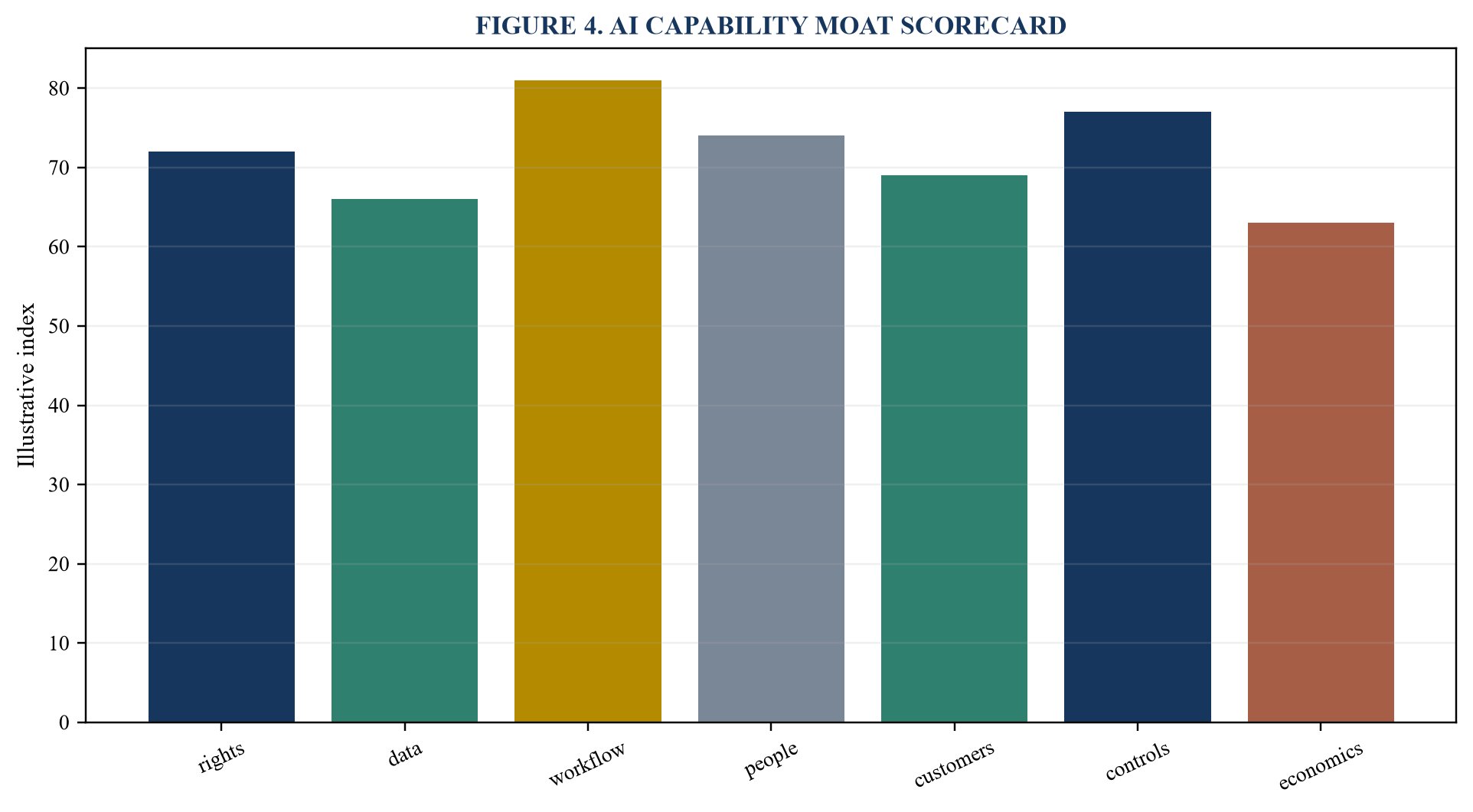
Scores are conceptual and require supported company-specific assessment.
25. Identify intangible capability
AI-enabled value may reside in software, data, customer relationships, contracts, trained workforce, methods, brand, licences and assembled processes. Accounting recognition and economic importance answer different questions.
Controlled evidence includes separability; contractual rights; control; useful life; replacement cost; cash contribution. The immediate decision is to map assets for valuation and purchase accounting without double counting goodwill. Definitions should remain consistent across operating reports, transaction workpapers, forecasts and valuation.
The analytical unit should remain stable from source record to valuation conclusion. Reviewers should see the population, exclusions, period, owner and reconciliation to finance. Where evidence is incomplete, the model should retain a range and identify the action needed to narrow it. Comparisons should preserve product, customer, site, complexity and market conditions; aggregation should not conceal adverse cohorts or delayed consequences.
26. Apply accounting and disclosure discipline
Revenue recognition, capitalisation, impairment, provisions, principal-agent treatment and business-combination accounting follow applicable standards and facts. Management labels should not replace accounting analysis.
Controlled evidence includes contracts; policies; technical papers; audit evidence; recognised and unrecognised intangibles. The immediate decision is to reconcile transaction measures to reported accounts and explain every adjustment. Definitions should remain consistent across operating reports, transaction workpapers, forecasts and valuation.
Evidence should distinguish observation, estimate, management plan and transaction judgement. A supported claim includes timing, full cost, dependency, transferability and a cash consequence. Sensitivity should show how the conclusion changes when adoption, demand, quality or persistence underperforms. Material assumptions need validation dates, accountable owners and explicit expiry conditions so that stale expectations do not survive into pricing or financing decisions.
27. Test transferability under a change of control
A buyer should confirm that contracts, licences, data rights, employees, vendors, systems and operating approvals survive ownership change. Capability that depends on seller intervention is not fully transferred.
Controlled evidence includes consents; assignment; retention; transition services; access; portability; buyer prerequisites. The immediate decision is to separate standalone transfer from buyer-dependent integration and synergy. Definitions should remain consistent across operating reports, transaction workpapers, forecasts and valuation.
The operating team and finance team should use the same definitions. Native records should support aggregate dashboards, and sample testing should follow representative cases from input through outcome and cash. Exceptions, failed cases and client concessions remain part of the population. Reconciliation should cover opening and closing balances, acquisitions, disposals, foreign exchange, allocation changes and manual adjustments that could otherwise mimic operating improvement.
28. Select the valuation method
Income, market and cost approaches answer different questions. Discounted cash flow can model timing and risk; market evidence provides a reasonableness range; cost can inform replacement but may miss economic benefit.
Controlled evidence includes forecast; discount rate; terminal assumptions; transactions; comparability; replacement inputs. The immediate decision is to use methods consistently and explain why the selected approach reflects the asset and decision. Definitions should remain consistent across operating reports, transaction workpapers, forecasts and valuation.
Decision makers need both upside and downside. The analysis should state which party controls conversion, what investment remains, when cash appears, which risks survive and whether the result continues after a change of ownership. Unsupported precision should be replaced with bounded scenarios. The committee should record the decision consequence of each range, including price, structure, funding, covenant, integration and monitoring implications.
29. Build the enterprise-value bridge
Begin with supported standalone value and add observed recurring cash, funded conversion and durable capability with their costs and risks. Buyer-specific actions remain a separate case.
Controlled evidence includes base earnings; cash adjustments; investment; tax; persistence; risk; valuation date. The immediate decision is to prevent one benefit from entering both cash flow and multiple without a clear rationale. Definitions should remain consistent across operating reports, transaction workpapers, forecasts and valuation.
The analytical unit should remain stable from source record to valuation conclusion. Reviewers should see the population, exclusions, period, owner and reconciliation to finance. Where evidence is incomplete, the model should retain a range and identify the action needed to narrow it. Comparisons should preserve product, customer, site, complexity and market conditions; aggregation should not conceal adverse cohorts or delayed consequences.
Table 3. Enterprise-value bridge
| Bridge item | Required evidence | Control |
|---|---|---|
| base value | reported and normalised cash economics | valuation-date reconciliation |
| recurring uplift | cohorts, contribution and collection | persistence test |
| capacity conversion | demand, redeployment or funded cost action | timing and fragmentation |
| capability | rights, people, workflow and controls | transferability |
| full investment | technology, change, control and reinvestment | no omitted cost |
| residual risk | customer, model, vendor and execution exposure | downside or structure |
Replace illustrative classifications with company-specific evidence and approved transaction treatment.
30. Construct multiple sensitivity
A higher multiple can be supported by durable growth, cash conversion, lower risk and transferable capability. Market enthusiasm or an AI label alone does not establish comparability.
Controlled evidence includes peer definitions; transactions; growth; margin; cash conversion; concentration; rights; control. The immediate decision is to show value across earnings and multiple ranges with explicit evidence thresholds. Definitions should remain consistent across operating reports, transaction workpapers, forecasts and valuation.
Evidence should distinguish observation, estimate, management plan and transaction judgement. A supported claim includes timing, full cost, dependency, transferability and a cash consequence. Sensitivity should show how the conclusion changes when adoption, demand, quality or persistence underperforms. Material assumptions need validation dates, accountable owners and explicit expiry conditions so that stale expectations do not survive into pricing or financing decisions.
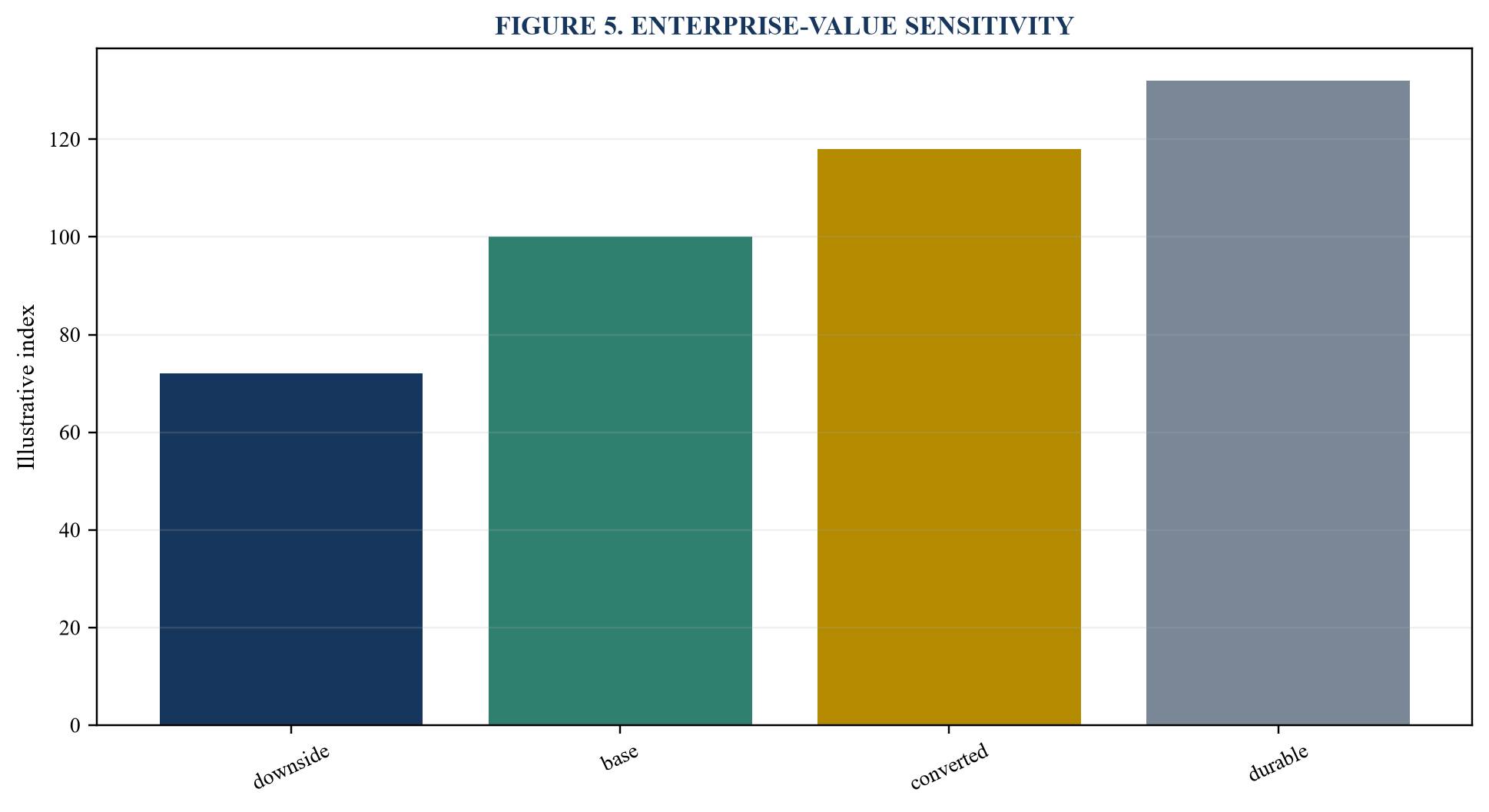
Value should be shown across supported earnings and multiple ranges rather than a single unsupported premium.
31. Build downside and failure cases
Scenarios should include weak adoption, low demand conversion, customer resistance, quality failure, higher review cost, vendor repricing, cyber events, employee loss and faster competitive imitation.
Controlled evidence includes driver ranges; correlations; timing; mitigation; liquidity; covenant headroom. The immediate decision is to connect downside to cash, financing capacity, protection and decision triggers. Definitions should remain consistent across operating reports, transaction workpapers, forecasts and valuation.
The operating team and finance team should use the same definitions. Native records should support aggregate dashboards, and sample testing should follow representative cases from input through outcome and cash. Exceptions, failed cases and client concessions remain part of the population. Reconciliation should cover opening and closing balances, acquisitions, disposals, foreign exchange, allocation changes and manual adjustments that could otherwise mimic operating improvement.
32. Protect terminal value
Terminal value should reflect reinvestment, model replacement, data maintenance, control cost, competitive decay, customer bargaining power and useful lives. A temporary productivity gain should not become perpetual growth.
Controlled evidence includes steady-state economics; reinvestment; fade; useful life; market growth; return on capital. The immediate decision is to use a terminal state that the operating evidence can support. Definitions should remain consistent across operating reports, transaction workpapers, forecasts and valuation.
Decision makers need both upside and downside. The analysis should state which party controls conversion, what investment remains, when cash appears, which risks survive and whether the result continues after a change of ownership. Unsupported precision should be replaced with bounded scenarios. The committee should record the decision consequence of each range, including price, structure, funding, covenant, integration and monitoring implications.
33. Separate standalone value from buyer synergy
Buyer distribution, data, technology, procurement, financing or management can accelerate value. Those benefits depend on buyer action and may be shared through price only after probability, cost and timing are assessed.
Controlled evidence includes buyer capability; integration plan; cost; owner; timing; dependencies; sharing rationale. The immediate decision is to preserve a standalone case and a separately approved synergy bridge. Definitions should remain consistent across operating reports, transaction workpapers, forecasts and valuation.
The analytical unit should remain stable from source record to valuation conclusion. Reviewers should see the population, exclusions, period, owner and reconciliation to finance. Where evidence is incomplete, the model should retain a range and identify the action needed to narrow it. Comparisons should preserve product, customer, site, complexity and market conditions; aggregation should not conceal adverse cohorts or delayed consequences.
34. Design transaction structure for uncertainty
Earn-outs, holdbacks, escrow, warranties, covenants, staged consideration and transition services can allocate measurable uncertainty. Metrics require stable definitions and resistance to buyer-controlled distortion.
Controlled evidence includes metric definition; systems; access; accounting policy; dispute process; buyer obligations. The immediate decision is to match protection to the evidence gap and keep unmeasurable risk in price or structure. Definitions should remain consistent across operating reports, transaction workpapers, forecasts and valuation.
Evidence should distinguish observation, estimate, management plan and transaction judgement. A supported claim includes timing, full cost, dependency, transferability and a cash consequence. Sensitivity should show how the conclusion changes when adoption, demand, quality or persistence underperforms. Material assumptions need validation dates, accountable owners and explicit expiry conditions so that stale expectations do not survive into pricing or financing decisions.
35. Build the buyer evidence room
The evidence room should link claims to native contracts, operating records, model documentation, security evidence, employee capability, financial reconciliations and open issues. Summaries should preserve lineage.
Controlled evidence includes index; owner; date; version; source; redaction; access; unresolved question. The immediate decision is to allow a reviewer to reproduce the bridge from workflow event to cash and value. Definitions should remain consistent across operating reports, transaction workpapers, forecasts and valuation.
The operating team and finance team should use the same definitions. Native records should support aggregate dashboards, and sample testing should follow representative cases from input through outcome and cash. Exceptions, failed cases and client concessions remain part of the population. Reconciliation should cover opening and closing balances, acquisitions, disposals, foreign exchange, allocation changes and manual adjustments that could otherwise mimic operating improvement.
Table 4. Buyer evidence room
| Module | Core evidence | Buyer question |
|---|---|---|
| commercial | customers, contracts, price, retention and pipeline | what revenue persists? |
| operations | workflow, capacity, quality and acceptance | what outcome changed? |
| technology | architecture, models, data, rights and incidents | what transfers safely? |
| people | roles, skills, adoption and dependency | who sustains capability? |
| finance | ledger, cash, cost, capex and working capital | what reached cash? |
| valuation | bridge, scenarios, support and approvals | what belongs in value? |
Replace illustrative classifications with company-specific evidence and approved transaction treatment.
36. Classify valuation adjustments
Observed run rate, funded conversion, forecast, synergy and risk belong in separate classes. Each adjustment needs amount, source, period, cohort, owner, confidence, transferability and sensitivity.
Controlled evidence includes adjustment register; evidence links; approval; accounting treatment; valuation consequence. The immediate decision is to apply consistent treatment across diligence, quality of earnings, valuation and financing. Definitions should remain consistent across operating reports, transaction workpapers, forecasts and valuation.
Decision makers need both upside and downside. The analysis should state which party controls conversion, what investment remains, when cash appears, which risks survive and whether the result continues after a change of ownership. Unsupported precision should be replaced with bounded scenarios. The committee should record the decision consequence of each range, including price, structure, funding, covenant, integration and monitoring implications.
37. Establish board and lender reporting
Boards and lenders need a concise set of stable measures covering adoption, quality, revenue, margin, cash, investment, incidents, concentration, capability and downside. Technology activity belongs beside economics.
Controlled evidence includes definitions; source systems; reconciliation; thresholds; owner; exceptions; trend. The immediate decision is to connect leading indicators to cash, covenant capacity and funded management actions. Definitions should remain consistent across operating reports, transaction workpapers, forecasts and valuation.
The analytical unit should remain stable from source record to valuation conclusion. Reviewers should see the population, exclusions, period, owner and reconciliation to finance. Where evidence is incomplete, the model should retain a range and identify the action needed to narrow it. Comparisons should preserve product, customer, site, complexity and market conditions; aggregation should not conceal adverse cohorts or delayed consequences.
38. Execute the one-hundred-day plan
Sequence baseline repair, priority workflow testing, commercial conversion, controls, workforce changes and reporting. The plan should preserve service continuity and distinguish buyer actions from inherited capability.
Controlled evidence includes workstreams; milestones; resources; client consent; risk; benefit; accountable owner. The immediate decision is to release investment and valuation recognition only as evidence gates are passed. Definitions should remain consistent across operating reports, transaction workpapers, forecasts and valuation.
Evidence should distinguish observation, estimate, management plan and transaction judgement. A supported claim includes timing, full cost, dependency, transferability and a cash consequence. Sensitivity should show how the conclusion changes when adoption, demand, quality or persistence underperforms. Material assumptions need validation dates, accountable owners and explicit expiry conditions so that stale expectations do not survive into pricing or financing decisions.
Table 5. One-hundred-day evidence plan
| Period | Primary work | Decision gate |
|---|---|---|
| days 1–30 | freeze perimeter, baselines and evidence ledger | approve priority claims |
| days 31–60 | reproduce outcomes, economics, rights and controls | approve funded conversion |
| days 61–100 | validate cohorts, cash, transferability and downside | approve valuation treatment |
Replace illustrative classifications with company-specific evidence and approved transaction treatment.
39. Identify red flags
Red flags include unsupported time savings, gross benefits without full cost, improving EBITDA without cash, unconverted capacity, hidden review, customer concessions, unclear rights, vendor lock-in and management-only dashboards.
Controlled evidence includes sample testing; reconciliation gaps; exceptions; incidents; customer evidence; contract rights. The immediate decision is to trace clusters to root causes and quantify downside without double counting. Definitions should remain consistent across operating reports, transaction workpapers, forecasts and valuation.
The operating team and finance team should use the same definitions. Native records should support aggregate dashboards, and sample testing should follow representative cases from input through outcome and cash. Exceptions, failed cases and client concessions remain part of the population. Reconciliation should cover opening and closing balances, acquisitions, disposals, foreign exchange, allocation changes and manual adjustments that could otherwise mimic operating improvement.
40. Set the decision standard
A valuation claim is decision-ready when an independent reviewer can reproduce the baseline, intervention, adoption, outcome, economics, cash consequence, transferability and persistence for a defined population and period.
Controlled evidence includes complete evidence chain; uncertainty; downside; owner; approval; valuation treatment. The immediate decision is to record what is observed, funded, forecast, buyer-specific and unresolved. Definitions should remain consistent across operating reports, transaction workpapers, forecasts and valuation.
Decision makers need both upside and downside. The analysis should state which party controls conversion, what investment remains, when cash appears, which risks survive and whether the result continues after a change of ownership. Unsupported precision should be replaced with bounded scenarios. The committee should record the decision consequence of each range, including price, structure, funding, covenant, integration and monitoring implications.
41. Conclusion
AI can increase the value of a conventional business when controlled workflow change produces accepted customer or operating outcomes and converts into durable cash, lower risk or transferable capability. Evidence quality governs recognition.
Controlled evidence includes workflow-to-cash ledger; valuation bridge; rights; controls; persistence; downside. The immediate decision is to use one reconciled language across operations, finance, diligence, valuation and transaction structure. Definitions should remain consistent across operating reports, transaction workpapers, forecasts and valuation.
The analytical unit should remain stable from source record to valuation conclusion. Reviewers should see the population, exclusions, period, owner and reconciliation to finance. Where evidence is incomplete, the model should retain a range and identify the action needed to narrow it. Comparisons should preserve product, customer, site, complexity and market conditions; aggregation should not conceal adverse cohorts or delayed consequences.
References
- Bank for International Settlements, AI adoption, productivity and employment: evidence from European firms, https://www.bis.org/publications/working-paper-1325-ai-adoption-productivity-and-employment-evidence-european-firms
- Bank for International Settlements, Annual Economic Report 2026, Progress and peril, https://www.bis.org/publ/arpdf/ar2026e1.htm
- Bank for International Settlements, The geography of AI firms, https://www.bis.org/publications/working-paper-1343-geography-ai-firms
- United States Securities and Exchange Commission, SEC Roundtable on Artificial Intelligence in the Financial Industry, https://www.sec.gov/newsroom/meetings-events/sec-roundtable-artificial-intelligence-financial-industry
- IFRS Foundation, IFRS 3 Business Combinations, https://www.ifrs.org/issued-standards/list-of-standards/ifrs-3-business-combinations/
- IFRS Foundation, IFRS 13 Fair Value Measurement, https://www.ifrs.org/issued-standards/list-of-standards/ifrs-13-fair-value-measurement/
- IFRS Foundation, IAS 36 Impairment of Assets, https://www.ifrs.org/issued-standards/list-of-standards/ias-36-impairment-of-assets/
- IFRS Foundation, IAS 38 Intangible Assets, https://www.ifrs.org/issued-standards/list-of-standards/ias-38-intangible-assets/
- IFRS Foundation, IFRS 15 Revenue from Contracts with Customers, https://www.ifrs.org/issued-standards/list-of-standards/ifrs-15-revenue-from-contracts-with-customers/
- IFRS Foundation, Intangible Assets: other potential test cases including data resources and artificial intelligence-related data and solutions, https://www.ifrs.org/content/dam/ifrs/meetings/2026/january/iasb/ap17d-other-potential-test-cases-data-ai.pdf
- IFRS Foundation, Intangible Assets: exploring user information needs, approach and staff desktop research, https://www.ifrs.org/content/dam/ifrs/meetings/2026/may/iasb/ap17a-approach-staff-desktop-research.pdf
- International Valuation Standards Council, International Valuation Standards, https://ivsc.org/standards/
- International Valuation Standards Council, Reforming Intangible Reporting, https://ivsc.org/reforming-intangible-reporting-a-converging-view-from-standard-setters-and-investors/
- National Institute of Standards and Technology, Artificial Intelligence Risk Management Framework 1.0, https://www.nist.gov/publications/artificial-intelligence-risk-management-framework-ai-rmf-10
- National Institute of Standards and Technology, Generative Artificial Intelligence Profile, https://nvlpubs.nist.gov/nistpubs/ai/NIST.AI.600-1.pdf
- National Institute of Standards and Technology, Cybersecurity Framework 2.0, https://www.nist.gov/cyberframework
- International Organization for Standardization, ISO/IEC 42001 Artificial intelligence management systems, https://www.iso.org/standard/81230.html
- European Union, Regulation (EU) 2024/1689 laying down harmonised rules on artificial intelligence, https://eur-lex.europa.eu/eli/reg/2024/1689/oj
- United Kingdom Information Commissioner's Office, Guidance on AI and data protection, https://ico.org.uk/for-organisations/uk-gdpr-guidance-and-resources/artificial-intelligence/guidance-on-ai-and-data-protection/
- United Kingdom Competition and Markets Authority, AI Foundation Models technical update report, https://www.gov.uk/government/publications/ai-foundation-models-technical-update-report
- United States Federal Trade Commission, Keep Your AI Claims in Check, https://www.ftc.gov/business-guidance/blog/2023/02/keep-your-ai-claims-check
- Organisation for Economic Co-operation and Development, OECD AI Principles, https://oecd.ai/en/ai-principles
- Organisation for Economic Co-operation and Development, The impact of artificial intelligence on productivity, distribution and growth, https://www.oecd.org/en/publications/the-impact-of-artificial-intelligence-on-productivity-distribution-and-growth_8d900037-en.html
- World Intellectual Property Organization, Trade secrets, https://www.wipo.int/tradesecrets/en/
- United States Bureau of Labor Statistics, Productivity and Costs, https://www.bls.gov/productivity/
- International Labour Organization, Generative AI and jobs, https://www.ilo.org/publications/generative-ai-and-jobs-refined-global-index-occupational-exposure
