

1. The valuation decision under pressure
A board considering a distressed sale needs several values because each value answers a different question. Going-concern value estimates the economics of a business that can keep operating under a supportable plan. An orderly sale value reflects a process with customary exposure to buyers and adequate diligence. A forced-sale outcome reflects the seller's actual time, liquidity and bargaining constraints. Break-up proceeds reflect the disposal of assets or business units after allowing for leakage, claims and execution costs. The value of preserving options measures whether funding a controlled process creates expected decision value after its costs and downside are recognised.
Confusing these measures can produce a false choice. A high going-concern valuation may be irrelevant when the company cannot fund the period needed to achieve it. A low forced-sale bid may reveal severe seller constraints without establishing the fair value of the underlying assets. IFRS 13 defines fair value through an orderly transaction between market participants and requires little or no weight to be placed on a transaction shown to be disorderly [3]. IVS treats forced sale as a description of circumstances rather than a separate basis of value [1][2]. The board therefore needs an explicit bridge from economic value to executable proceeds.
This paper presents that bridge. It separates the valuation bases, maps the evidence required for each, models the cost and value of time, and links the result to stakeholder recoveries. The numerical case is hypothetical. Its purpose is to show how assumptions drive a decision, with no prediction of a specific sale, legal outcome or creditor recovery.
2. A value stack for distressed decisions
The proposed value stack contains five layers. The first layer is operating value under a credible plan. The second is market-participant value under normal exposure and diligence. The third is executable transaction value under the available timetable and buyer universe. The fourth is net distributable value after funding, transaction costs, leakage and priority claims. The fifth is the value of keeping alternative paths open while information improves.
Each layer needs its own label and date. A report that states a single enterprise value without identifying the premise, standard, process conditions and deductions cannot support a distressed-sale decision. The gap between layers may be larger than the valuation range within any one layer. Time pressure can restrict diligence. Liquidity pressure can shorten marketing. Contract and licence requirements can narrow the buyer universe. Security releases, employee obligations, tax and separation work can reduce distributable proceeds even when the headline price remains unchanged.
The board pack should show the bridge in both directions. Starting with going-concern value, it should identify the deductions needed to reach executable proceeds. Starting with a received bid, it should identify the constraints embedded in the price and test whether a funded extension could remove them. This structure makes debate specific. Directors can decide which assumptions require evidence, which constraints can be changed, and which risks belong in the sale documents or completion plan.
Table 1. Proposed value stack for a distressed decision
| Measure | Question answered | Core evidence | Use in decision |
|---|---|---|---|
| Going-concern value | What is the supported operating business worth? | Funded plan and operating evidence | Value at risk if continuity fails |
| Orderly transaction value | What would market participants pay with customary exposure? | Market evidence and adequate diligence | Benchmark for process and bids |
| Forced-sale proceeds | What can be realised under actual constraints? | Deadline, buyer access and sale terms | Current executable fallback |
| Break-up value | What can separate assets or units realise? | Title, transferability and realisation costs | Alternative perimeter and downside |
| Process-option value | What is gained by funding a controlled process? | Alternative outcomes, cost and milestones | Funding and stop decision |
Proposed decision taxonomy. Accounting, statutory and professional valuation terms retain their defined meanings.
3. Going concern is a premise with conditions
Going-concern value depends on a business remaining operational long enough to generate forecast cash flows. The premise requires a credible liquidity runway, access to critical employees and systems, continuity of material contracts, workable supplier terms, required licences, and funding for maintenance and working capital. The FRC's 2025 guidance brings together company-law, accounting, auditing and governance considerations for going-concern, solvency and liquidity assessments [11]. It emphasises company-specific analysis and disclosure of how conclusions were reached.
The valuation model should therefore begin with a survival case rather than a revenue forecast alone. Management should reconcile cash, borrowing availability, covenant headroom, payroll, tax, critical suppliers, customer collections and transaction costs by week. Forecast improvements require evidence of implementation authority and funding. A restructuring action that has not been approved or financed belongs in a separate scenario. IAS 36 distinguishes value in use from fair value less costs of disposal and requires attention to the basis and reliability of estimates [12]. Those accounting measures have defined purposes; a board sale analysis may need additional transaction scenarios.
Going-concern value can remain economically relevant even when immediate survival is uncertain. It establishes what may be lost if the business fragments, key people depart, customers terminate, or permits cease to transfer. It also helps identify the amount worth spending to preserve continuity. The board should avoid treating the number as current executable proceeds until the conditions supporting it have been evidenced.
4. Orderly transaction value
IFRS 13 defines fair value as an exit price in an orderly transaction between market participants at the measurement date [3]. An orderly transaction assumes exposure to the market for a period that permits customary marketing activities. The standard's guidance on reduced market activity focuses attention on whether observed transactions are orderly. Evidence of compulsion, inadequate market exposure or limited diligence affects the weight placed on a transaction price.
For a distressed business, an orderly transaction scenario needs more than an extended calendar. The seller must have funding to trade through the process. Buyers need access to reliable commercial, financial, legal, operational and technical evidence. The process must reach a plausible set of qualified bidders. Required regulatory, lender and counterparty consents must fit the timetable. Management must retain enough operating capacity to protect revenue and service delivery while supporting diligence.
Orderly transaction value may use an income, market or asset approach, depending on the business and evidence. The result should remain separate from a fairness opinion, accounting measurement, statutory valuation or solvency conclusion unless the relevant professional has performed that work for the defined purpose. A board can use the value as a benchmark for assessing bids and process choices. The board should also see a direct reconciliation from that benchmark to the actual constraints of the sale.
5. Forced sale describes the circumstances
IVS explains that a forced sale occurs where the seller is compelled to sell, a proper marketing period is unavailable, or buyers cannot conduct adequate diligence [1][2]. The obtainable price depends on the nature of the pressure, the reason for the restricted process and the consequences of failing to sell within the available period. Those facts make a generic forced-sale discount unreliable. The same company can produce different outcomes under a four-week bilateral negotiation, a court-supervised auction, a lender enforcement, or a managed wind-down.
The analysis should decompose the constraint rather than applying a single percentage reduction. Relevant components include lost buyer coverage, financing uncertainty, information gaps, execution risk, warranty limitations, required capital expenditure, customer concentration, transfer restrictions and bidder perception of the seller's deadline. Some components affect expected cash flows. Others affect the discount rate, transaction structure or price adjustment. Several create contingent value rights, holdbacks or purchase-price allocations rather than a lower headline price.
A received bid remains useful evidence. It establishes what one buyer will offer under stated terms at a particular time. The board should retain the bid assumptions, diligence access, financing evidence, conditions, required protections and completion timetable. A comparison with other value measures becomes credible when those terms are visible.
6. Liquidation and break up value
Liquidation value estimates the amount realised when assets are sold separately [2]. An orderly liquidation allows a reasonable period to find purchasers. A forced disposal provides less time and may restrict inspection, testing or transfer preparation. Asset recoveries depend on location, condition, title, encumbrances, market depth, removal costs, specialist use and the ability to transfer associated contracts or permits.
Break-up analysis needs a complete perimeter. Cash may be trapped or subject to set-off. Receivables may face disputes, dilution, retention or collection delay. Inventory may be obsolete, customer-specific or expensive to relocate. Plant may have greater value in place than after removal. Intellectual property may depend on employees, licences, data rights or continuing operations. Real estate may contain environmental, planning or occupancy issues. Intercompany balances can change the entity-level distribution.
The model should show gross proceeds, costs to realise, taxes, priority claims, secured claims and time to cash. The US Trustee guidance for estate sales requires analysis of value, liens, sale costs and tax consequences when assessing whether a sale produces a meaningful distribution [10]. UNCITRAL similarly treats going-concern sales and reorganisations as mechanisms that may preserve estate value, subject to the applicable insolvency framework [6]. These sources support a disciplined comparison without determining the result for a particular jurisdiction.
7. The value of preserving alternatives
A controlled process can preserve the ability to sell the business to a strategic buyer, complete a sponsor transaction, execute a management solution, sell divisions, refinance, restructure or liquidate. The value of that flexibility depends on the additional outcomes created, the quality of information gained, the cost of funding the period, and the downside if the extension fails.
This paper calls the difference process-option value. It is a decision metric. It is not an accounting fair-value measure, a traded option price or a legal entitlement. The calculation compares the weighted net value of a controlled process with the net value of an immediate forced sale. Management sets scenario weights for planning and discloses them as assumptions. The board should also inspect every outcome separately because an average can hide a severe downside.
Option preservation has operational conditions. A bridge facility may prime or dilute existing stakeholders. Management attention may shift from customers to diligence. Suppliers may tighten terms. Employees may leave. Market rumours may reduce revenue. A delayed process can improve competitive tension and evidence quality while increasing cash burn and business deterioration. The decision model must show both effects over time.
8. Evidence that supports each value
Going-concern value requires a reconciled operating forecast, a weekly cash model, financing availability, covenant analysis, customer and supplier continuity, workforce retention, capex needs and scenario tests. Orderly transaction value requires market-participant assumptions, comparable evidence, a supportable forecast, a credible buyer universe and customary process conditions. Forced-sale value requires the exact deadline, source of compulsion, available buyer access, information limitations, proposed warranties, financing conditions and consequences of a failed sale.
Liquidation value requires an asset register tied to title, security, location, condition, transferability, taxes and realisation costs. Process-option value requires a map of alternative routes, incremental funding, milestones, decision dates, outcome-specific net proceeds and residual downside. Stakeholder recovery requires the legal entity perimeter, security and guarantee map, ranking, priority claims, set-off, costs and jurisdiction-specific advice.
The evidence map should identify source, owner, cut-off date, reviewer and unresolved contradiction. A model cell can reference a schedule, contract, valuation report or management assumption. Assumptions should remain visible. Where two sources disagree, the pack should show the difference and how it changes the decision. This discipline reduces the risk that a sophisticated model hides weak inputs.
Table 2. Evidence required for each valuation layer
| Layer | Minimum evidence | Principal sensitivity | Review owner |
|---|---|---|---|
| Operating value | Forecast, cash, contracts, people and capex | Revenue continuity and funding | Management and financial adviser |
| Market benchmark | Comparable evidence and market-participant assumptions | Multiple, discount rate and normalisation | Qualified valuation specialist |
| Executable proceeds | Bids, terms, financing and approvals | Time, conditions and buyer depth | Transaction team |
| Net distribution | Costs, claims, security and priority | Perimeter and legal ranking | Legal, tax and restructuring advisers |
| Preserved alternatives | Routes, milestones, funding and downside | Process duration and deterioration | Board and advisers |
Proposed responsibility map. Management should adapt it to the transaction and applicable professional requirements.
9. The transaction perimeter
Valuation depends on what is being sold. A share sale transfers the entity with its assets, liabilities, contracts and history, subject to the transaction documents and applicable law. An asset sale can select assets and assumed liabilities, but transfer requirements, taxes, employees, permits, data, contracts and separation services can change value. A business-unit sale may depend on shared systems, property, brands and licences. A sale through an insolvency process may provide statutory mechanisms, with jurisdiction-specific requirements and risks.
The perimeter should be defined at asset, liability, contract and legal-entity level. The model must reconcile the enterprise-value headline with debt, debt-like items, cash, working capital, pension or employee obligations, tax, provisions, leases, transaction costs and separation costs. An unclear perimeter makes bids incomparable. One buyer may quote for the operating assets, another for shares, and a third for selected contracts and employees.
The board should require a bid bridge that normalises these differences. Each bid should show headline consideration, assumed liabilities, retained liabilities, adjustments, contingent payments, funding certainty, conditions and time to cash. This prevents a nominally higher offer with greater leakage or completion risk from appearing superior without evidence.
10. Time as an operating variable
Time affects value through buyer discovery, diligence, financing, negotiation, approvals and business performance. Additional weeks can allow more bidders to understand the asset and reduce uncertainty. The same weeks can consume liquidity, increase supplier arrears and expose the company to customer or employee loss. The relationship is often curved. Early time can create value; later time can destroy it after the available buyer set and evidence quality have plateaued.
The model should calculate weekly cash need alongside weekly process benefit. Process milestones include data-room readiness, first-round bids, management access, financing evidence, regulatory assessment, definitive documents and completion. Operating milestones include customer renewals, payroll, supplier support, insurance, licences and cyber continuity. The board can then identify the last date on which each route remains executable.
A long-stop date should connect to cash and legal facts. It should not be chosen solely by reference to an advisory timetable. The board should see what happens if an expected receipt slips, a buyer requests more diligence, or a consent takes longer. The decision to fund more time becomes a staged investment with defined information and value milestones.
11. Liquidity and bridge funding
Bridge funding buys time and can protect going-concern value. Its economic cost includes interest, fees, security, priority, covenants, control rights and the amount drawn. Its strategic cost may include restrictions on sale paths or distributions. Its benefit depends on the alternatives that remain available after the funding is provided.
The funding case should use a 13-week cash model or another horizon appropriate to the facts. Receipts should be linked to customer evidence and collection history. Payments should identify critical and deferrable items, while complying with legal duties and advice. The model should include transaction costs, retention measures, cure payments and downside headroom. Availability conditions must be separated from committed cash.
The board should compare the incremental bridge at risk with the increase in weighted net proceeds and the downside outcome. A positive modeled option value can still be unacceptable if the bridge cannot be raised, its terms transfer control, or the downside harms creditors. The decision remains subject to directors' duties, insolvency law, finance documents and professional advice in the relevant jurisdictions.
12. Buyer universe and competitive tension
Buyer depth influences price, terms and certainty. Strategic buyers may value synergies, market access, capacity, licences, data or technology. Sponsors may value cash generation and a path to operational improvement. Competitors may face merger-control limits. Customers or suppliers may value continuity. Management teams may require third-party financing. Distressed investors may focus on liabilities, priority and control.
The universe should be screened for strategic rationale, funding, antitrust, foreign-investment review, conflicts, timing and access restrictions. A long list does not establish competition. The board needs evidence of qualified engagement: signed confidentiality agreements, data-room activity, management questions, financing work and bids. The CMA's merger guidelines use counterfactual analysis and can consider whether an alternative purchaser would have existed in an exiting-firm scenario [8]. Regulatory feasibility therefore belongs in the value model.
The seller should avoid over-disclosing sensitive information to competitors. Clean teams, staged access and aggregation may be required. The process plan should identify which information each bidder needs to value the business and when it may be released. Better access can reduce uncertainty while increasing confidentiality and competition risks.
13. Forecast normalisation
Distress can depress revenue, inflate costs and distort working capital. A going-concern forecast should separate temporary disruption from structural decline. Customer losses caused by service failures may be reversible or permanent. Supplier premiums may fall after recapitalisation. Emergency professional fees may cease. Deferred maintenance may require catch-up spending. Underinvestment may have reduced current costs while damaging future performance.
Normalisation should use transaction-level evidence where possible. Revenue bridges should track customers, products, price, volume, churn and pipeline conversion. Gross-margin analysis should reconcile purchase prices, labour, logistics and inventory movements. Operating expenses should identify one-offs, owner items, restructuring costs and costs needed to support the forecast. Working capital should reflect actual collection and payment behaviour under stress.
The board should see a base case and specified downside cases. Management actions should have owners, timing, funding and evidence of feasibility. The valuation should identify whether a change affects cash flow, multiple, discount rate or transaction adjustment. Using the same risk in several places can create double counting.
14. Discount rates and multiples under distress
A higher discount rate can reflect greater uncertainty, but it cannot repair an incoherent forecast. Distress affects operating cash flows, financing availability, capital structure and the probability of alternative outcomes. The model should first make scenario-specific cash flows explicit. It can then apply a discount rate consistent with the risk that remains within each scenario.
Market multiples need comparable definitions. Reported enterprise value may include lease liabilities, pension deficits or other items differently. EBITDA may be adjusted inconsistently. Transactions may reflect control, synergies, unusual financing or different market conditions. A distressed comparable may have been completed through an orderly process or under severe compulsion. Its label alone does not establish comparability.
The board pack should show the selected range, evidence, adjustments and sensitivity. It should distinguish a market benchmark from an executable bid. A low bid may arise from limited competition, restricted warranties, funding uncertainty or the buyer's required return. The analytical response is to identify the source of the gap and whether the process can change it.
15. Synergy and buyer specific value
Strategic buyers may avoid duplicated costs, accelerate market entry, obtain scarce capacity, protect supply or combine technology. These benefits can support a price above standalone value. The seller should estimate synergy pools from observable operational facts and identify the investment, timing and execution risk needed to realise them. Buyer-specific value should remain separate from market-participant value when the benefit is unavailable to typical buyers.
The sale process can capture a share of synergy through competition. A single bidder may retain most of the benefit. Multiple qualified bidders with different strategic rationales can improve price discovery. The seller's leverage depends on time, credible alternatives and the cost to the bidder of losing the opportunity.
The board should analyse synergies by buyer archetype and avoid presenting speculative benefits as certain consideration. A bid may include contingent value tied to integration, customer retention or regulatory approval. The model should discount or scenario-test those payments according to their terms and evidence, with legal and tax review.
16. Separation value and dis synergies
A carve-out can create value by matching business units with different buyers. It can also destroy shared economics. Systems, property, procurement, treasury, brands, licences, data, people and contracts may support several units. Separation can require transition services, duplicated functions, stranded costs and capital expenditure. The buyer may discount for these dependencies or require the seller to retain them.
The valuation should map stand-alone costs and one-time separation costs for each perimeter. Shared revenue, cross-selling and bundled contracts also need allocation. A division's historical accounts may not reflect the resources needed to operate independently. The model should reconcile carve-out EBITDA with a fully loaded stand-alone case and show the duration and cost of transition services.
Break-up value should therefore be built from executable packages, not an arithmetic sum of optimistic unit values. The board should test sequencing. Selling one unit first may remove cash generation, collateral or operational support needed for the others. A whole-business sale may preserve more value even when individual headline valuations appear higher.
17. Contracts licences and permits
Contracts can transfer automatically, require consent, terminate on insolvency or change control, or remain with the seller. Licences and permits may attach to an entity, asset, site or qualified operator. Data rights and intellectual-property licences may restrict transfer or use. These conditions affect both buyer universe and price.
The evidence pack should identify material contracts, clauses, consent owners, lead times and commercial consequences. It should show which rights are essential to going-concern operation, which can be replaced, and which create a break-up dependency. The valuation model should apply scenario-specific assumptions for transfer, replacement cost and lost revenue.
Legal conclusions belong to qualified counsel. The financial model should capture the economic effect of counsel's advice and maintain a clear source trail. A buyer's proposed treatment should be compared with the seller's evidence and the transaction documents.
18. Claims contingent liabilities and warranties
Distressed sellers may offer limited warranties and weaker recourse. Buyers respond through price reductions, escrow, insurance, indemnities, holdbacks or narrower perimeters. The value impact depends on the underlying exposure and the protection available. A broad discount without a claims schedule can transfer value unnecessarily.
Management should reconcile litigation, tax, employee, environmental, product, cyber, regulatory and contractual matters. Each item needs status, amount or range where supportable, timing, insurance, legal assessment and proposed transaction treatment. Unknown exposures should be addressed through evidence searches and diligence procedures rather than a statement that none exist.
The model should distinguish expected cash costs, remote downside, purchase-price adjustments and retained liabilities. Scenario analysis can show the effect of unresolved matters. The board should understand whether a bidder's protection is proportionate to the evidence and whether an alternative structure can allocate risk more efficiently.
19. Governance and decision rights
The board owns the decision within the applicable legal framework. A distressed process also involves lenders, shareholders, insolvency practitioners, regulators, employees, pension trustees, customers and other stakeholders. Authority can change as covenants are breached, security is enforced or a formal process begins.
The governance map should identify who can approve funding, exclusivity, bids, information release, transaction documents and completion. It should record conflicts and connected-party relationships. UK rules require independent scrutiny or creditor approval for certain substantial disposals to connected persons within the first eight weeks of administration [4][5]. Other jurisdictions have different requirements.
Minutes should record the options considered, evidence, assumptions, advice, stakeholder effects and reasons for the decision. The valuation pack should be version-controlled and dated. Changes in liquidity or bids can alter the relevant decision quickly. A clear audit trail helps reviewers understand what the board knew at each point.
20. Relevant alternatives in restructuring
Restructuring analysis often compares a proposed plan with the most likely outcome if the plan is not approved. The UK Part 26A framework permits cross-class cram down only when statutory conditions are met, including that dissenting members of a class are no worse off than in the relevant alternative [7]. This makes the definition and valuation of the alternative consequential.
A relevant-alternative analysis should specify the process, timing, funding, operating performance, buyer response, costs and stakeholder waterfall. Liquidation should not be used automatically where a sale, administration, refinancing or another restructuring is more likely. Evidence should support the chosen scenario and explain rejected alternatives.
The board's transaction analysis can use the same discipline even outside a court process. Each route receives a complete operating and financial narrative. The model then compares net outcomes and execution risks. Legal standards and burdens of proof remain jurisdiction-specific.
21. Merger control and foreign investment
A distressed buyer may need merger clearance or foreign-investment approval. The timeline, information burden and remedy risk can make a bidder less executable than its headline price suggests. A failing-firm argument also requires evidence. The CMA considers likelihood of exit, alternative purchasers and the competitive effect of exit in its framework [8]. The authority avoids unsupported precision in counterfactual forecasting.
The seller should screen bidders before granting exclusivity. The analysis should cover jurisdictional thresholds, theories of harm, overlaps, critical technologies, national-security issues, remedy appetite and long-stop dates. The valuation model can include probability-free scenarios such as clearance on expected terms, clearance with remedies, extended review and prohibition. Management may apply decision weights for planning, with the assumptions disclosed.
Regulatory risk also affects the credible buyer universe. A strategic bidder with high synergy may produce lower expected net value when clearance risk and delay are considered. A lower sponsor bid may provide greater certainty. The board should compare both on a consistent basis.
22. Sale mechanics across jurisdictions
The legal mechanism affects title transfer, liens, contracts, liabilities, process transparency and challenge risk. Section 363 of the US Bankruptcy Code permits sales outside the ordinary course after notice and hearing and contains conditions for sales free and clear of interests [9]. UK administration, restructuring plans and connected-person rules use different procedures [4][5][7]. UNCITRAL provides legislative guidance on insolvency objectives and cross-border coordination [6].
The valuation should reflect the mechanism selected. Court or creditor approvals can add time and evidence requirements. A statutory sale may improve title or liability treatment in some respects while creating publicity, challenge or process constraints. Credit bidding can affect auction dynamics. Contract assignment rules can change the perimeter.
Cross-border groups require entity-by-entity analysis. Assets, employees, licences, cash and claims may sit in different jurisdictions. The board should obtain local advice and avoid applying one jurisdiction's process assumptions to the whole group.
23. The hypothetical case
The model uses a hypothetical company with USD 140 million of book assets across cash, receivables, inventory, property, plant and equipment, and intellectual property. The company faces a near-term liquidity deadline. Management can pursue an immediate forced disposal or fund a controlled process. The asset values, recovery rates, claims, costs, scenario weights and outcomes are author assumptions. They have no empirical calibration.
The immediate asset-disposal case applies forced recovery rates by asset class and deducts USD 15.6 million of transaction, closure, claim and execution costs. The controlled case models four outcomes: a strategic going-concern sale, a sponsor sale, a management and asset combination, and delayed liquidation. Each outcome deducts process cost and bridge or stabilisation funding.
The model compares net distributable value, process-option value and stakeholder waterfall. It also tests process duration and buyer depth. The results demonstrate the sensitivity of the decision to stated assumptions. They do not establish market value, fair value, solvency, creditor entitlement or the appropriate course for any company.
Table 3. Hypothetical immediate disposal assumptions
| Asset class | Book amount USDm | Forced recovery | Forced proceeds USDm |
|---|---|---|---|
| Cash | 4.0 | 100% | 4.00 |
| Trade receivables | 28.0 | 62% | 17.36 |
| Inventory | 34.0 | 48% | 16.32 |
| Property plant and equipment | 52.0 | 55% | 28.60 |
| Intellectual property | 22.0 | 15% | 3.30 |
All figures are author assumptions. Gross modeled proceeds are USD 69.58 million and net proceeds after USD 15.6 million of costs are USD 53.98 million.
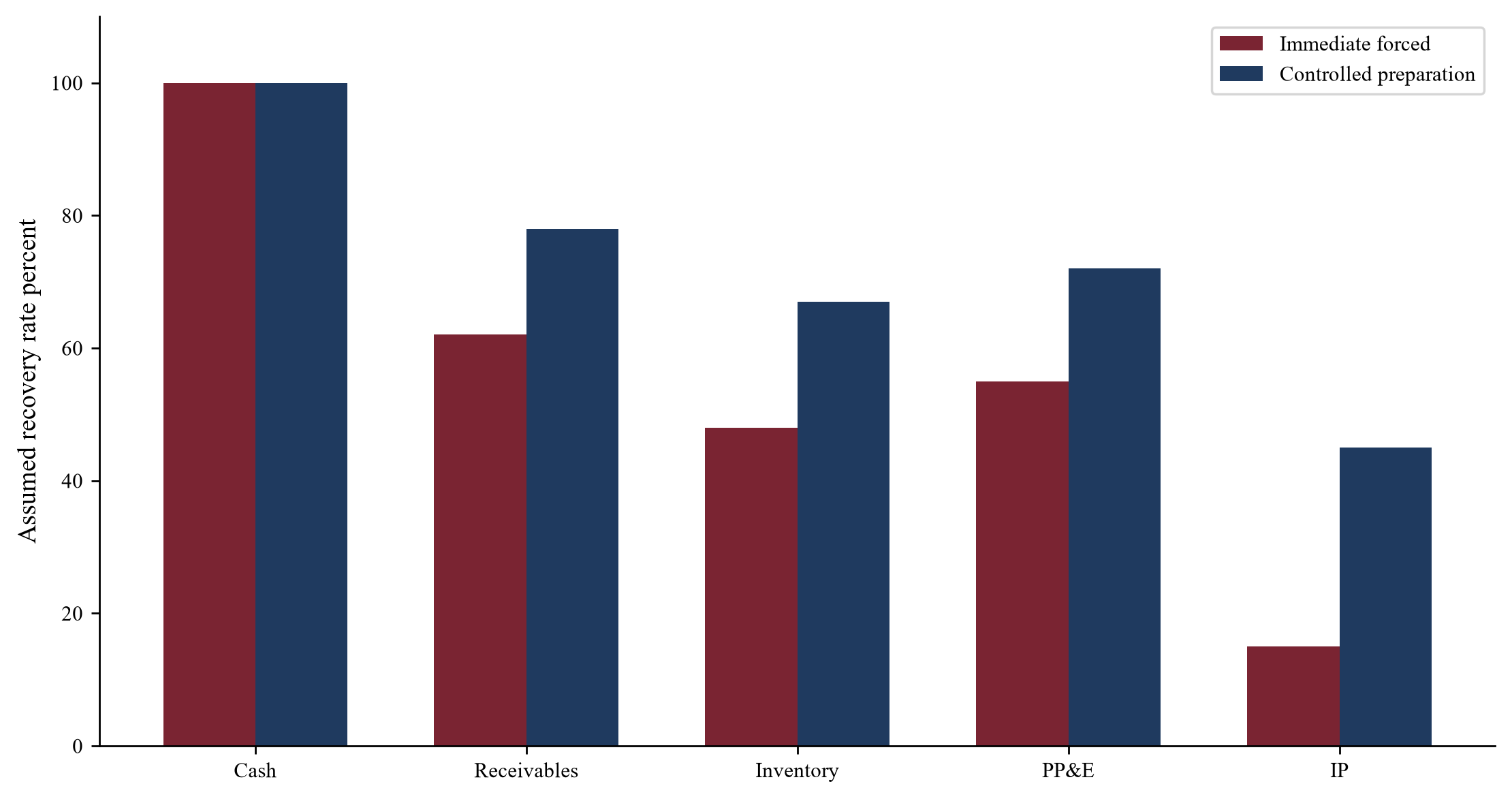
Author assumptions. Controlled rates show a comparative preparation case and are not independent valuations.
24. Immediate disposal assumptions
Cash is modeled at full value. Receivables recover 62 percent, inventory 48 percent, property, plant and equipment 55 percent, and intellectual property 15 percent. These rates produce gross proceeds of USD 69.58 million. After USD 15.6 million of assumed costs, the immediate net value is USD 53.98 million.
The differences between book amount and proceeds reflect the scenario's short timetable, incomplete diligence and separate asset sales. The model does not apply a single distress discount. Each class has an explicit recovery assumption. Management can replace these with appraisals, bids, collection analyses and title evidence.
Costs should be expanded in a live case. They may include advisers, auction or broker fees, employee obligations, closure, environmental work, contract termination, tax, security releases, storage, removal, transition and administrative expenses. Timing matters because a nominal recovery received after several months may require further funding.
Table 4. Hypothetical controlled process outcomes
| Outcome | Decision weight | Gross value USDm | Net value USDm |
|---|---|---|---|
| Strategic going-concern sale | 35% | 132.0 | 116.5 |
| Sponsor going-concern sale | 30% | 108.0 | 92.5 |
| Management and asset combination | 20% | 79.0 | 63.5 |
| Delayed liquidation | 15% | 51.0 | 36.0 |
Author assumptions. Weights are planning inputs rather than estimated probabilities. Weighted net value is USD 86.62 million.
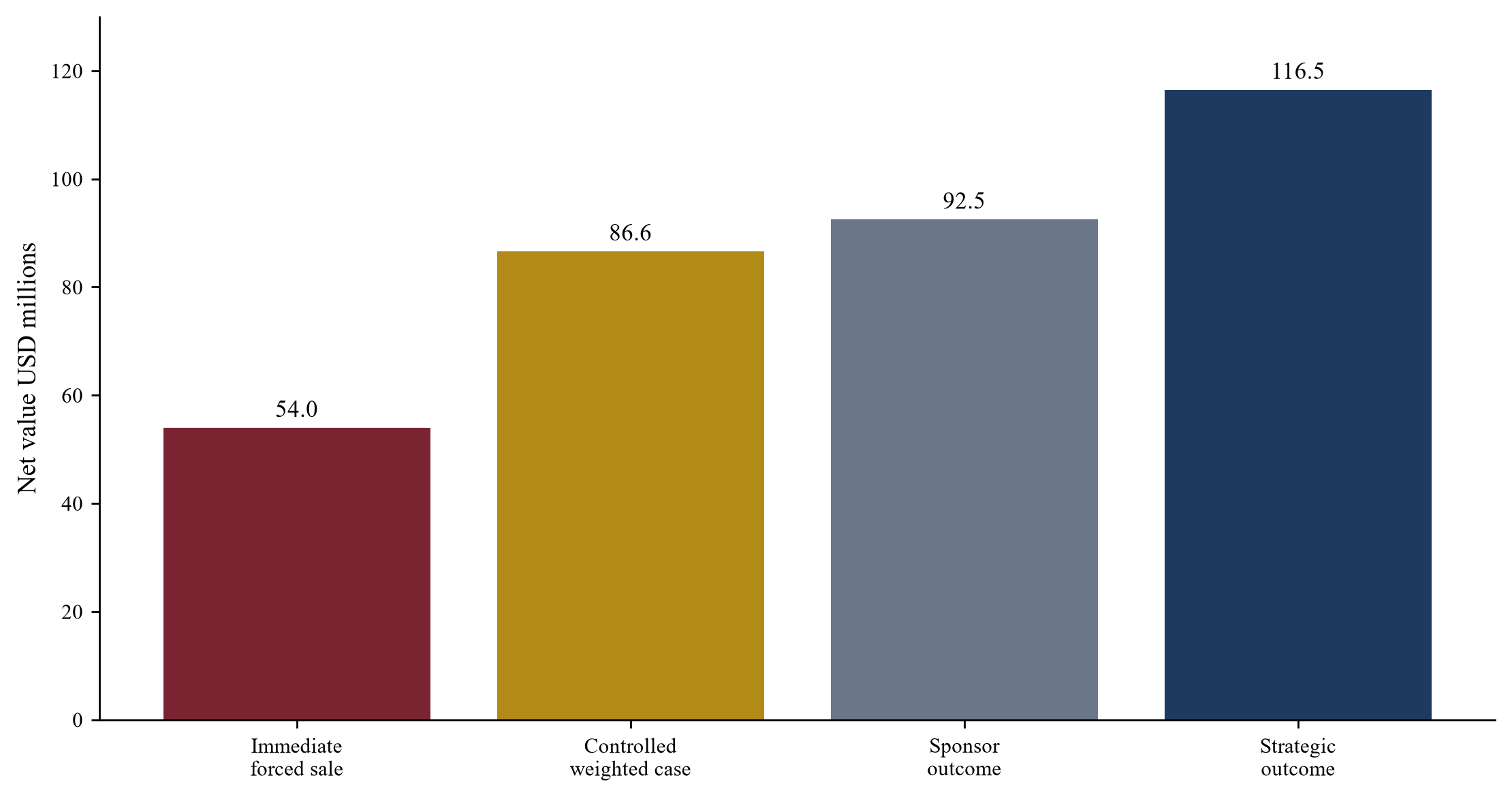
Author assumptions. The modeled process-option value versus immediate sale is USD 32.64 million.
25. Controlled process outcomes
The controlled case assigns decision weights of 35 percent to a strategic sale, 30 percent to a sponsor sale, 20 percent to a management and asset combination, and 15 percent to delayed liquidation. These are planning weights chosen by the author. They are not estimated probabilities.
Gross values range from USD 51 million to USD 132 million. Each outcome includes process costs and USD 8.5 million of bridge and stabilisation funding, except that delayed liquidation uses a slightly lower process cost. The weighted net result is USD 86.62 million. Compared with the immediate net result of USD 53.98 million, the modeled process-option value is USD 32.64 million.
The average result is informative only when every outcome remains visible. The delayed-liquidation case produces USD 36 million after modeled costs. A board may reject the controlled route if that downside is unacceptable, funding is unavailable, duties require another course, or operational deterioration is more severe than assumed. The model supports questions; it does not answer them without company evidence and advice.
Author assumptions. The simplified curve allows process benefits to peak before additional burn and deterioration reduce value.
26. Duration and buyer depth sensitivity
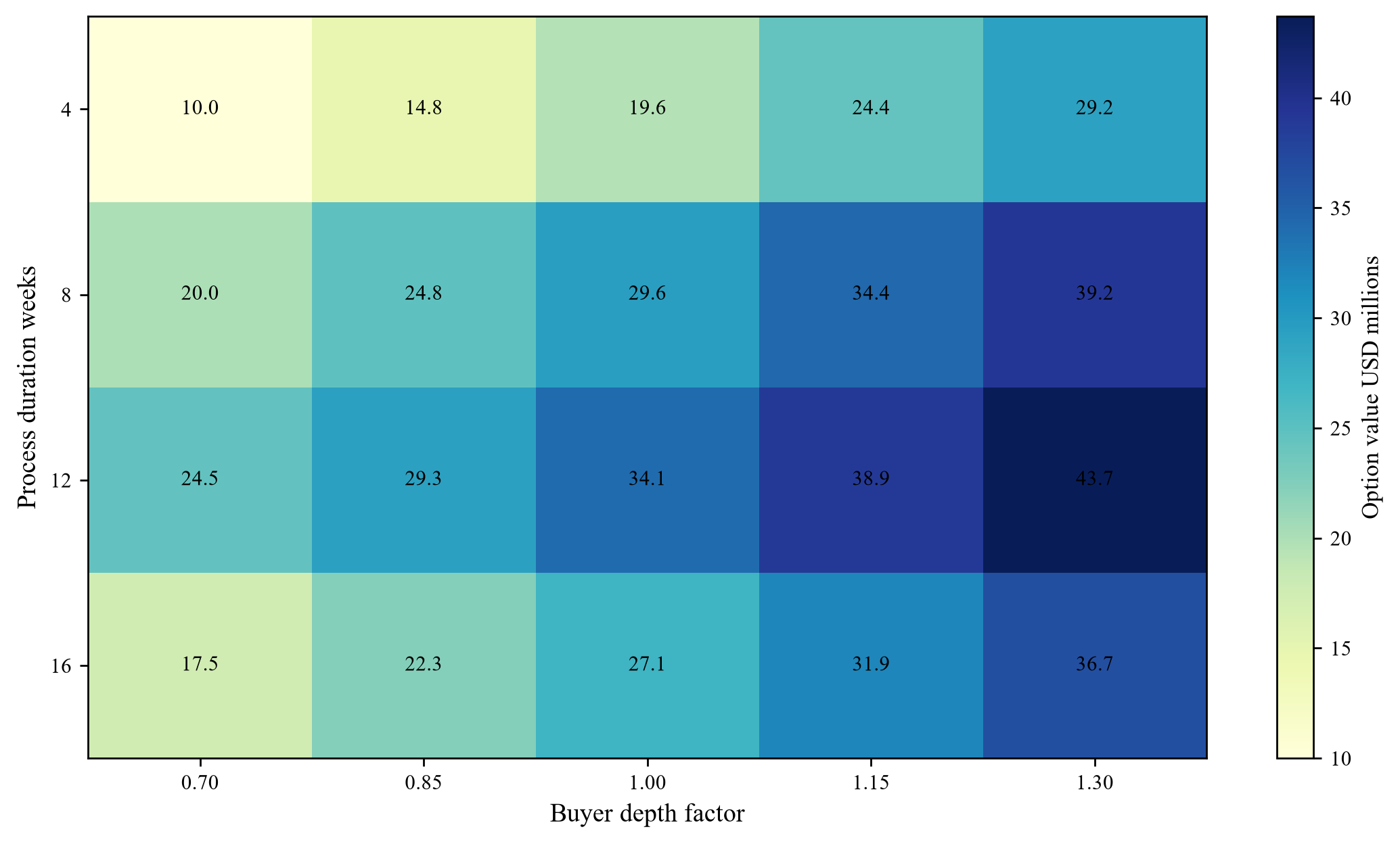
The sensitivity grid combines process durations of four, eight, twelve and sixteen weeks with buyer-depth factors from 0.70 to 1.30. The buyer-depth factor represents the modeled quality and breadth of qualified demand relative to the base case. It is a compact scenario input rather than an observed market statistic.
At four weeks, limited diligence and buyer discovery reduce the controlled net value. Eight and twelve weeks provide more opportunity to improve information and competition. Sixteen weeks introduces additional deterioration and cash burn in the simplified model. Greater buyer depth improves value across each duration.
The grid identifies conditions under which funding more time adds value. It also shows that time alone cannot compensate for a weak buyer universe. Management should replace the response curve with weekly cash forecasts, bidder evidence and operational milestones. The board can approve funding in stages and stop when evidence fails to support the next period.
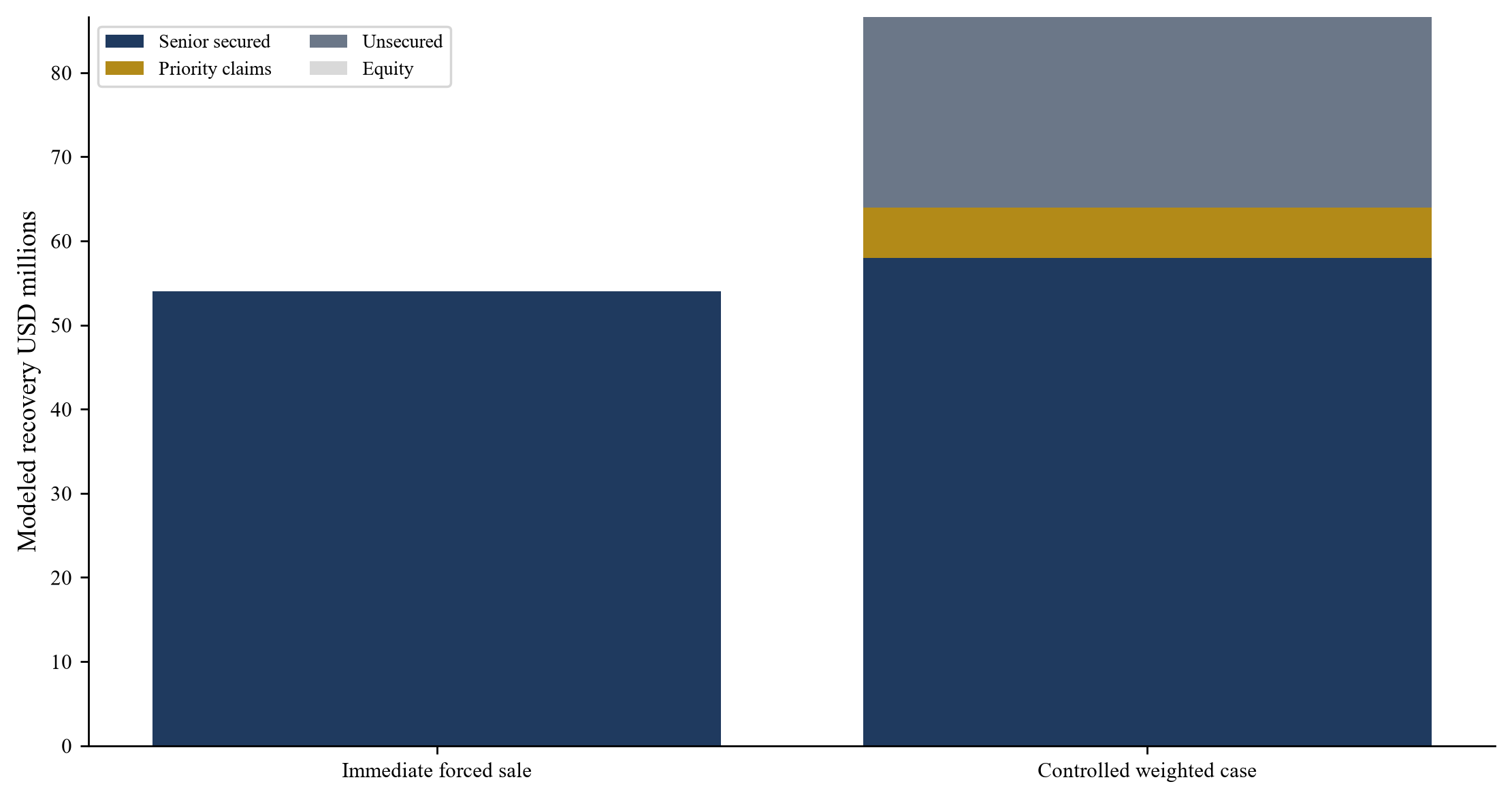
Author assumptions. This economic illustration does not determine legal priority or entitlement.
27. Stakeholder waterfall
Enterprise proceeds do not equal stakeholder recovery. The model compares USD 58 million of senior secured claims, USD 6 million of priority claims and USD 30 million of unsecured claims. The immediate net value of USD 53.98 million remains below the modeled senior secured amount. The controlled weighted case reaches USD 86.62 million and therefore creates value for claims below the senior secured layer in the simplified waterfall.
Real distributions depend on legal entity, security, guarantees, priority, set-off, costs, taxes and the governing insolvency regime. The table is an economic illustration. It does not determine legal ranking or entitlement. Bridge funding may rank ahead of existing claims and should be modeled consistently rather than deducted twice.
The waterfall changes negotiation incentives. Stakeholders who receive no value in one scenario may support an alternative that creates a recovery. Stakeholders fully covered in both scenarios may focus on certainty and timing. The board should see these effects while continuing to act within its duties and advice.
28. Risk control matrix
The decision process can fail through premise confusion, double-counted risk, optimistic funding, stale bids, unsupported scenario weights, omitted claims, unclear perimeter or a hidden downside. Each failure mode needs an early indicator, control owner and retained evidence. The model version should identify who changed each assumption and why.
Independent review should test arithmetic, source links, scenario logic, value bridges and stakeholder waterfalls. Legal, tax, accounting and valuation specialists should review matters within their scope. The board should receive a concise exception report with the sensitivity that matters to the decision.
A model can be internally correct and still commercially wrong because the buyer universe, forecast or cost estimate is weak. Review should therefore cover evidence quality as well as formulas. The pack should distinguish management estimates, adviser analyses, third-party reports and received bids.
Table 5. Proposed decision risk controls
| Failure mode | Early indicator | Control | Evidence retained |
|---|---|---|---|
| Premise confusion | One value used for every decision | Label basis, circumstances and purpose | Valuation instruction and bridge |
| Unsupported runway | Funding shown before conditions are met | Separate committed and conditional liquidity | Facility terms and draw evidence |
| Stale buyer evidence | Bid survives after terms or facts change | Date and normalise every bid | Bid bridge and correspondence |
| Hidden downside | Average shown without outcome cases | Present every outcome and stop condition | Scenario table and minutes |
| Double-counted risk | Same issue reduces cash flow and multiple | Map each risk to one primary treatment | Assumption register |
| Incomplete waterfall | Enterprise value presented as recovery | Reconcile costs, security and claims | Entity-level distribution model |
Proposed controls. Qualified advisers should adapt them to the company, valuation purpose and jurisdiction.
29. Implementation roadmap
Days one and two establish authority, liquidity, perimeter and the immediate fallback. Days three to five reconcile the operating forecast, asset register, claims and stakeholder map. Days six to ten test buyers, regulatory paths, separability and funding. The next phase builds bids, diligence evidence and transaction documents against staged decision dates.
Each board meeting should receive an updated liquidity forecast, bid comparison, value bridge, option-cost schedule, regulatory status, stakeholder waterfall and risk log. The pack should identify assumptions that changed since the prior meeting. A decision to continue should state the funded period, required milestones and stop conditions.
The roadmap must adapt to the applicable process. Statutory timetables, consultation, approvals and creditor rights remain controlling. Management should obtain qualified advice before implementing a distressed sale or restructuring.
Table 6. Proposed staged board decision cadence
| Stage | Decision | Evidence required | Stop condition |
|---|---|---|---|
| Days 1 to 2 | Protect liquidity and define fallback | Cash, authority, perimeter and immediate proceeds | No funded operating route |
| Days 3 to 5 | Fund evidence and buyer testing | Forecast, assets, claims and qualified universe | Value case lacks support |
| Days 6 to 10 | Select process and bidders | Indicative bids, approvals and bridge terms | Expected net gain does not cover risk |
| Following weeks | Continue, transact or stop | Binding terms, diligence, funding and milestones | Liquidity or execution condition fails |
Management framework only. Legal duties, statutory processes and approved funding terms remain controlling.
30. Board decision protocol
The board should begin with the current executable fallback and its net proceeds. It should then define the alternative process, incremental funding, milestones and downside. Each value should carry a premise, date, source and sensitivity. Received bids should be normalised for perimeter, assumed liabilities, conditions, timing and certainty.
The decision paper should answer six questions. What happens if the company acts now? Which operating capabilities and rights disappear under that route? What additional routes become available with more time? What cash and control are required to preserve them? Which evidence must arrive before the next funding decision? How do net proceeds distribute across stakeholders under each scenario?
A board that can answer these questions has a usable valuation framework. The numbers may still change. The governance process will show why they changed and what that means for the decision.
31. Limitations
This paper provides a general decision framework. It is not legal, tax, accounting, insolvency, investment or valuation advice. The cited materials apply in their stated contexts and may change. Jurisdiction-specific rules, professional standards, transaction documents and facts determine the appropriate analysis.
All numerical inputs are author assumptions. Decision weights are not statistical probabilities. Recovery rates are not market observations. The sensitivity functions are simplified. The case excludes many items that may be material, including currency, tax attributes, pensions, derivatives, intercompany claims, environmental liabilities, customer compensation, regulatory remedies and cross-border recognition.
The model should be rebuilt with verified company evidence and reviewed by qualified advisers before use. No reader should rely on the illustrative results as a prediction of price, recovery or completion.
32. Conclusion
Distressed valuation becomes decision-useful when it separates the premise of value from the circumstances of sale and the cash available for distribution. Going-concern value identifies the economics that continuity may preserve. Orderly transaction value provides a market-participant benchmark. Forced-sale and break-up cases show executable proceeds under actual constraints. Process-option value tests whether funding more time creates expected value after costs and downside.
The board's central task is to connect each number to evidence, timetable, funding and legal process. A transparent bridge allows directors and stakeholders to see which constraints destroy value and which actions can change them. The result is a valuation pack that supports a staged decision under pressure.
References
- International Valuation Standards Council. New edition of the International Valuation Standards published. 24 January 2024; effective 31 January 2025; accessed 6 September 2026. https://ivsc.org/new-edition-of-the-international-valuation-standards-ivs-published/
- International Valuation Standards Council. Standards glossary. Accessed 6 September 2026. https://ivsc.org/standards-glossary/
- IFRS Foundation. IFRS 13 Fair Value Measurement. Accessed 6 September 2026. https://www.ifrs.org/issued-standards/list-of-standards/ifrs-13-fair-value-measurement/
- UK Government. Corporate Financial Distress Guidance Note. Updated 15 June 2026; accessed 6 September 2026. https://www.gov.uk/government/publications/the-sourcing-and-consultancy-playbooks/corporate-financial-distress-guidance-note-html
- The Insolvency Service. Requirements for independent scrutiny of the disposal of assets in administration, including pre-pack sales. Published 30 April 2021; accessed 6 September 2026. https://www.gov.uk/government/publications/requirements-for-independent-scrutiny-of-the-disposal-of-assets-in-administration-including-pre-pack-sales
- United Nations Commission on International Trade Law. Legislative Guide on Insolvency Law. Accessed 6 September 2026. https://uncitral.un.org/en/texts/insolvency/legislativeguides/insolvency_law
- UK Parliament. Corporate Insolvency and Governance Act 2020 explanatory notes on Part 26A restructuring plans. Accessed 6 September 2026. https://www.legislation.gov.uk/ukpga/2020/12/notes/division/3/index.htm
- Competition and Markets Authority. Merger Assessment Guidelines. Updated 3 September 2026; accessed 6 September 2026. https://www.gov.uk/government/publications/merger-assessment-guidelines/merger-assessment-guidelines-html-version
- United States Congress. 11 U.S.C. section 363, use, sale or lease of property. Accessed 6 September 2026. https://www.law.cornell.edu/uscode/text/11/363
- United States Trustee Program. Sale of Estate Property guidance. Accessed 6 September 2026. https://www.justice.gov/ust/ust-regions-r21/file/01r21_ch7_tfr_tdr.pdf/dl
- Financial Reporting Council. Guidance on the Going Concern Basis of Accounting and Related Reporting including Solvency and Liquidity Risks. Published 25 February 2025; accessed 6 September 2026. https://www.frc.org.uk/library/standards-codes-policy/accounting-and-reporting/annual-corporate-reporting/guidance-on-going-concern-basis/
- IFRS Foundation. IAS 36 Impairment of Assets. Accessed 6 September 2026. https://www.ifrs.org/content/dam/ifrs/publications/pdf-standards/english/2021/issued/part-a/ias-36-impairment-of-assets.pdf
