

1. Start with the financing job
Venture debt should finance a defined job. Common uses include extending runway to a product or revenue milestone, funding equipment, financing a controlled acquisition, supporting working capital or protecting against a delayed equity round. “More cash” is an incomplete mandate.
The board should name the milestone, amount, timing, expected value creation and fallback. It should state whether the debt finances an investment that can be stopped, a recurring operating loss or a liability that cannot be deferred.
The repayment source matters from the beginning. It can be operating cash, a future equity round, asset proceeds, acquisition financing or an exit. A repayment source that depends entirely on a favourable financing market exposes the company to refinancing risk.
The financing decision should compare venture debt, equity, revenue finance, asset finance, customer prepayment, grants and a slower operating plan. The right answer can combine several sources.
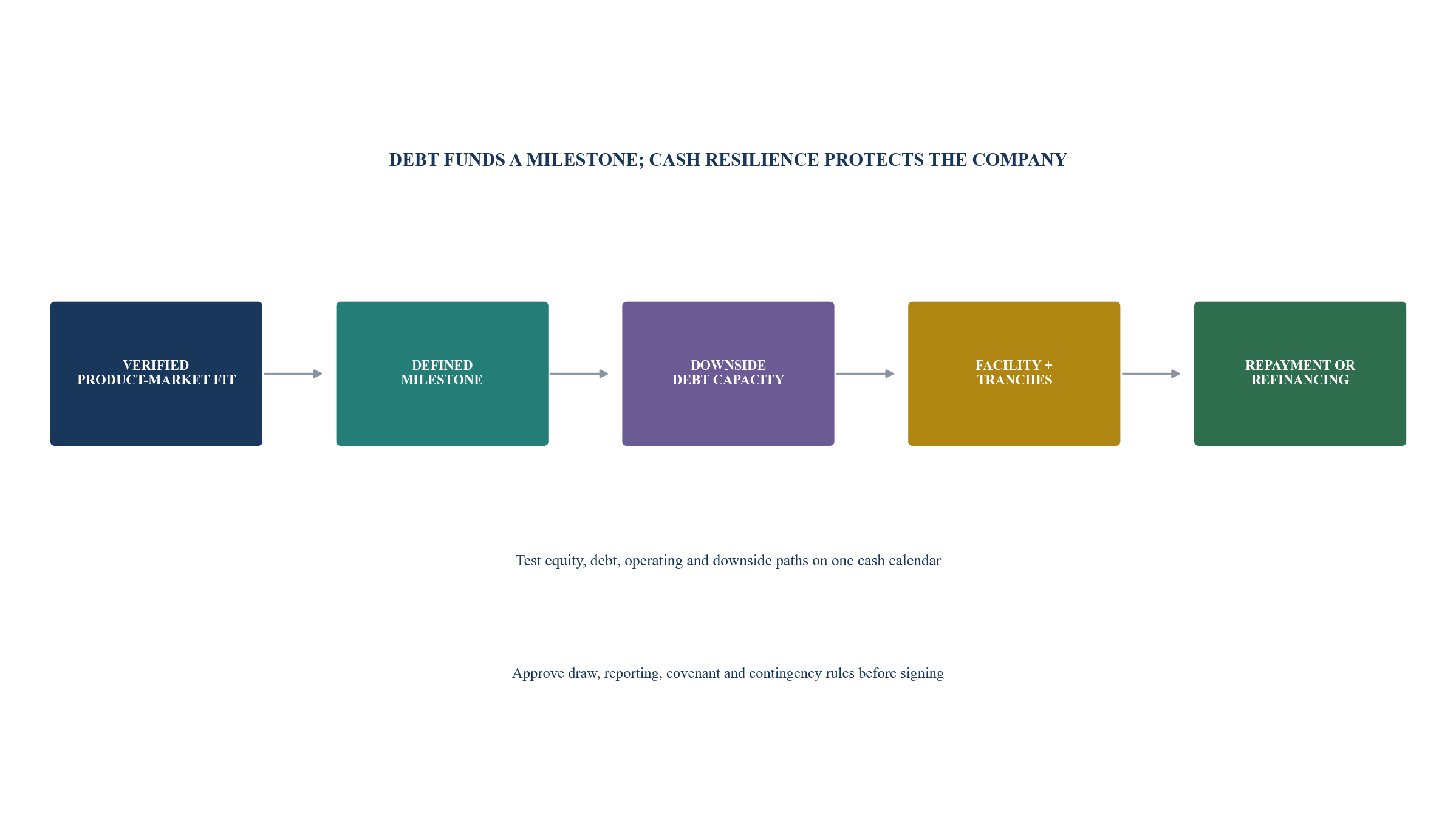
Author framework. The facility should connect a defined financing job to a credible repayment route.
2. Define product-market fit as evidence
Product-market fit is not a founder declaration. For financing, it should be expressed through customer behaviour, unit economics, delivery reliability and a repeatable route to growth.
Evidence can include contracted and collected revenue, retention, cohort expansion, usage, gross margin, sales conversion, implementation time, customer concentration, service attainment and contribution cash. The relevant measures depend on the business model.
The lender also considers the equity syndicate, cash runway, management, sector, technology, intellectual property, regulation and future capital access. The British Business Bank states that venture debt often considers previously raised equity and the capacity to raise future capital rather than relying only on conventional cash flow or collateral.[1]
HSBC Innovation Banking describes the product as supporting fast-growing, often loss-making companies around Series A to C to reach strategic milestones.[2] These stage labels are indicative; the borrower needs company-specific credit evidence.
Table 1. Product-market-fit and debt-readiness scorecard
| Dimension | Evidence | Debt-readiness question |
|---|---|---|
| Customer need | renewals, usage, references, backlog and collection | do customers repeatedly pay for the product? |
| Revenue quality | contracts, invoice ageing, concentration and churn | can revenue support a reliable forecast? |
| Unit economics | gross margin, contribution, acquisition cost and payback | does growth improve or consume cash per cohort? |
| Delivery | implementation, capacity, service and support records | can the company scale without uncontrolled delivery cost? |
| Capital support | cap table, investor reserves, financing history and board plan | is there a credible capital route through maturity? |
| Governance | board, reporting, controls, compliance and information rights | can the borrower meet lender reporting and consent duties? |
| Downside resilience | cash, cost flexibility, asset value and contingency plan | can the company survive slower growth or delayed financing? |
The board and lender should use verified evidence and company-specific thresholds.
3. Understand the lender's economic model
A venture lender receives contractual income and may receive equity-linked upside. Interest, upfront fees, commitment fees, end-of-term charges, prepayment amounts and warrants can all contribute to return.
Hercules Capital describes its objective as generating current income from debt and capital appreciation from warrant and equity investments. Its 2025 filing describes structured debt as debt with equity, warrant, option or other rights and focuses on senior secured instruments for venture- and institution-backed companies.[3]
The lender therefore underwrites repayment, downside recovery and optionality. Security can cover assets, bank accounts, intellectual property or share pledges subject to the transaction and law. Covenants and consent rights allow intervention when performance deteriorates.
Borrowers should model every source of lender return. A low cash coupon can be offset by fees, end-of-term charges, warrant dilution or restricted prepayment. A facility with favourable headline pricing can become expensive when a delayed draw incurs commitment fees or a short interest-only period accelerates amortisation.
4. Separate commitment, availability and cash drawn
A headline facility size is not necessarily available on signing. Facilities can include an initial tranche and later tranches tied to revenue, equity financing, regulatory, product, clinical or lender-discretion conditions.
The company should create a tranche register. Each tranche needs an amount, draw window, objective condition, evidence source, lender discretion, fee and expiry. The board should identify which capital is committed and which remains conditional.
An undrawn facility can serve as insurance. Its value depends on whether the company can still draw when conditions deteriorate. A material-adverse-change clause, minimum cash requirement or lender discretion can reduce that protection.
Draw timing changes interest and runway. Drawing early increases cash and carrying cost. Drawing late preserves cost and risks missing a condition or window. The decision should follow the milestone cash calendar.
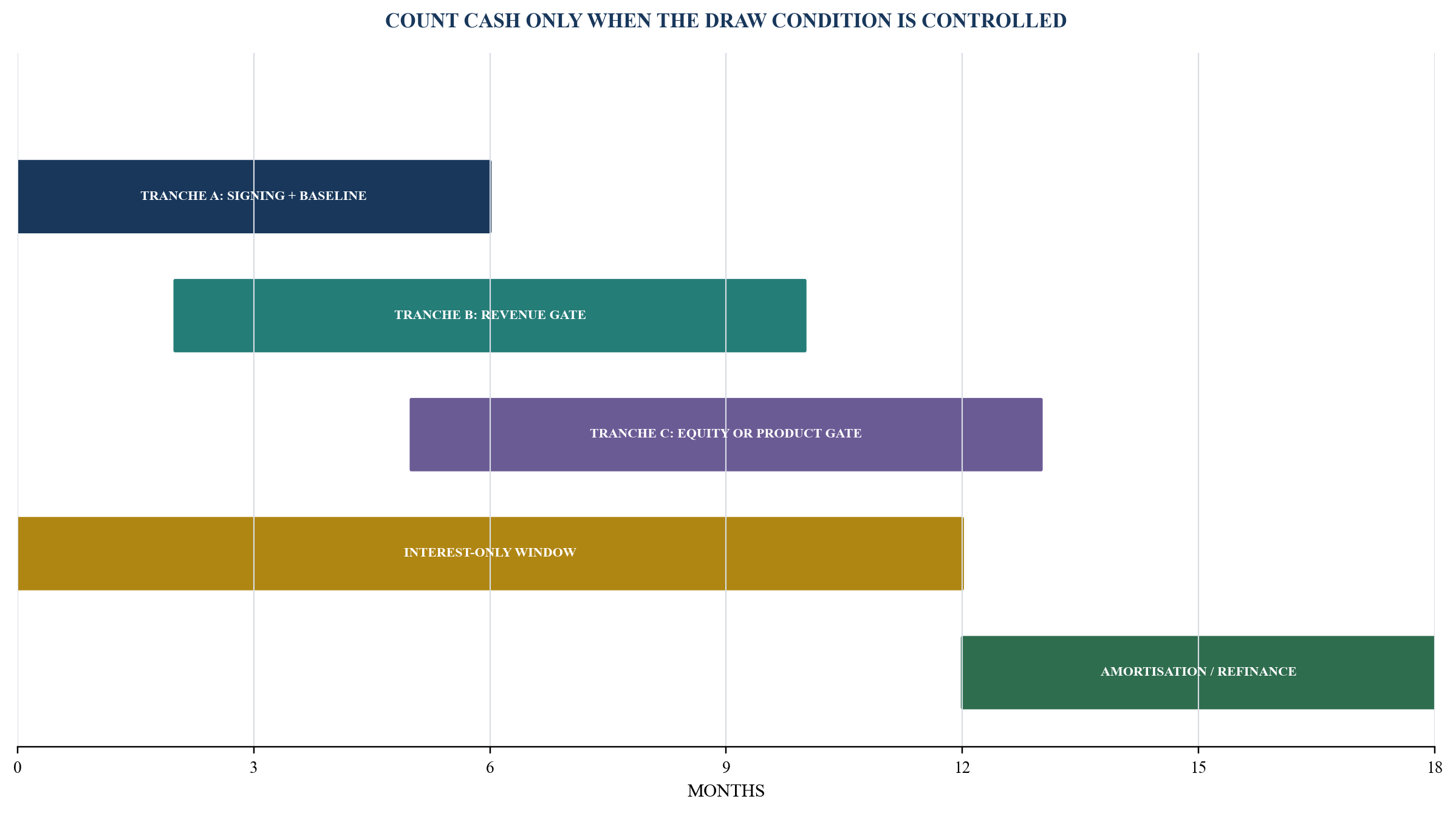
Author framework. Conditional tranches should not be counted as cash until their draw conditions are satisfied.
Table 2. Venture-debt facility term map
| Term | Economic effect | Diligence question |
|---|---|---|
| Commitment and tranches | maximum potential capital split into availability windows | which amounts are committed, conditional or discretionary? |
| Interest | cash or capitalised periodic cost, often linked to a benchmark or floor | what is the effective rate under each benchmark scenario? |
| Interest-only period | defers principal cash outflow | what performance or financing condition extends or shortens it? |
| Amortisation and maturity | determines principal cash burden and refinancing date | can the downside plan fund payments without assumed equity? |
| Fees and end-of-term charge | adds cash cost at signing, undrawn period, repayment or maturity | what is paid under draw, no-draw, prepay and maturity cases? |
| Warrants or equity rights | creates potential dilution and lender upside | what security, strike, duration, adjustment and exit rights apply? |
| Security and priority | allocates recovery and control in downside | which assets, subsidiaries and accounts enter the collateral package? |
| Covenants and consents | creates reporting, operating and intervention rights | which actions require consent and what creates default? |
Terms vary by borrower, lender, jurisdiction and market; qualified advisers should review the documents.
5. Size from milestone capital and downside capacity
Facility size should not begin with the lender's maximum offer. It should begin with the cash required to reach a milestone and the amount the company can carry through a downside.
The milestone model states the operating investment, timing and evidence required for the next financing or cash-flow event. It includes contingency for slower sales, collections, hiring and delivery.
The downside model assumes delayed revenue, lower gross margin, continued essential investment and a later equity round. It includes interest, fees, amortisation and minimum cash. The facility should not turn a commercial delay into an immediate solvency event.
A useful board rule is to size debt at the minimum of four constraints: capital needed for the milestone, amount offered under firm terms, amount serviceable in the downside and amount repayable or refinanceable under a credible plan.
6. Price the complete economic cost
The cash cost includes interest, fees, legal and diligence expense, end-of-term charges, hedging where applicable and prepayment economics. The equity-linked cost includes warrants, conversion or value participation.
Warrant cost is uncertain because future share value is uncertain. The board can model dilution at the current fully diluted cap table, next-round valuations and exit scenarios. It should also assess anti-dilution and adjustment provisions.
The alternative-equity cost should use the actual security terms. New preferred equity can have liquidation preference, participation, anti-dilution, consent and board rights. Comparing a debt coupon with the headline dilution of common shares misses both products' full economics.
Table 3. Total-cost bridge for venture debt and equity
| Cost layer | Venture debt | New equity |
|---|---|---|
| Upfront cash | fees, legal, diligence and initial interest | legal, placement and transaction expense |
| Periodic cash | interest, monitoring and principal after any interest-only period | generally no contractual repayment; dividends depend on terms |
| End-of-term cash | principal, end charge, prepayment or make-whole | no maturity; preference applies in an exit under terms |
| Ownership effect | warrants, options, conversion or participation | issued shares, options and fully diluted ownership |
| Control | covenants, security, consents, default and enforcement | board, reserved matters, information and shareholder rights |
| Downside | fixed claim and possible enforcement | residual claim with preference and protection under terms |
| Upside | lender equity-linked participation where included | investor participation in enterprise value |
Every element should be measured under signed terms and consistent company scenarios.
7. Model runway as a cash calendar
Runway should be a monthly cash calendar, not cash divided by average burn. Customer receipts, payroll, tax, capital expenditure, interest, fees and principal occur on different dates.
The model should show cash before financing, each tranche, minimum cash and covenant headroom. It should distinguish contractual availability from management expectations.
Seasonal collections, annual prepayments and project acceptance can create temporary cash peaks. Debt-service capacity should be tested through the trough.
The model should include a no-debt operating case. This reveals whether debt finances incremental value or simply postpones an unavoidable restructuring.
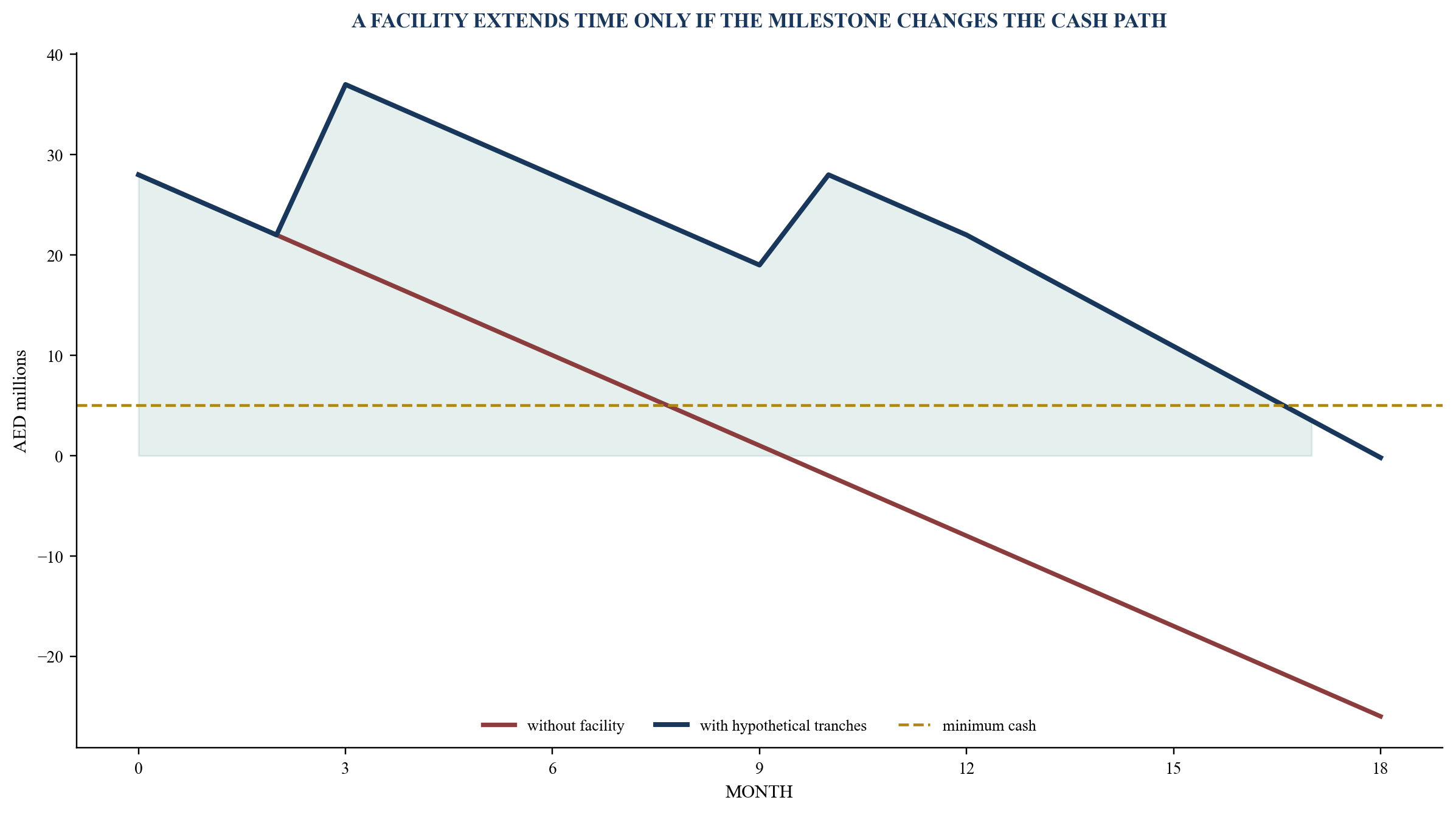
Every value is a hypothetical management assumption in AED millions for method illustration.
8. Design covenants around the risk
Covenants can include minimum cash, liquidity, revenue, recurring revenue, leverage, burn, milestone, reporting, permitted debt, liens, acquisitions, disposals, dividends and change of control. Definitions matter more than labels.
Minimum cash can protect the lender and reduce the usable facility. A covenant tested against unrestricted cash may exclude blocked, customer or subsidiary balances. Cure rights and grace periods should be explicit.
Revenue covenants can be unsuitable for volatile businesses unless thresholds, measurement periods and adjustments match the model. Milestone covenants can create ambiguity if evidence or approval is subjective.
The company should model headroom before signing. It should know the earliest breach month in the base, downside and severe cases and the operational action needed to preserve compliance.
9. Treat security and negative covenants as strategic terms
Security gives the lender rights in downside. Intellectual property, bank accounts, receivables, equipment, shares and subsidiary assets may enter the collateral package under applicable law and agreed exclusions.
Negative covenants can limit new debt, liens, acquisitions, disposals, investments, distributions, affiliate transactions, account movements and changes to the business. These terms can affect ordinary growth and the next financing.
The board should map every planned activity against consent requirements. A product acquisition, overseas subsidiary, equipment lease, receivables facility or strategic partnership may require lender approval.
Intercreditor terms matter when the company already has asset finance, working capital or customer-specific facilities. Priority, standstill, enforcement and proceeds allocation need current legal advice.
10. Protect the next equity round
Venture debt often assumes future equity capacity. The company should model how the next investor will view outstanding debt, required repayment, covenants, warrants and maturity.
New investors may resist having their capital used primarily to repay an earlier lender. The financing plan should show how much new money funds growth after repayment and fees.
Debt can improve the next-round valuation if it funds verified progress. It can weaken negotiating leverage when maturity approaches, cash falls or covenants narrow flexibility.
The board should start the next capital process with sufficient runway. A target date based on the final cash month leaves little room for diligence, investor approval, documentation or a market delay.
11. Work a hypothetical software case
Consider a hypothetical enterprise-software company with AED 42 million of annualised recurring revenue, 84 per cent gross revenue retention, 118 per cent net revenue retention and negative AED 2.7 million monthly free cash flow. It seeks capital to complete two integrations, build regional sales capacity and reach AED 65 million of annualised recurring revenue.
Every operating and financing value below is a hypothetical management assumption. The example demonstrates the method and does not represent an actual company or financing offer.
Table 4. Hypothetical venture-debt operating case
| Measure | Signing | Month 12 plan | Downside month 12 | Evidence gate |
|---|---|---|---|---|
| Annualised recurring revenue, AEDm | 42 | 65 | 52 | contracts, billing and cohort reconciliation |
| Net revenue retention | 118% | 120% | 105% | customer-level revenue bridge |
| Gross margin | 72% | 76% | 68% | direct delivery-cost ledger |
| Monthly free cash flow, AEDm | (2.7) | (0.8) | (2.2) | bank, ledger and driver forecast |
| Cash before debt, AEDm | 28 | 4 | (10) | monthly cash calendar |
| Tranche A, AEDm | 18 | 18 | 18 | drawable at signing |
| Tranche B, AEDm | 0 | 12 | 0 | conditional on revenue and retention gate |
| Interest and fees paid to month 12, AEDm | 0.8 | 3.1 | 2.6 | facility model and statement |
| Cash after financing, AEDm | 45.2 | 25.9 | 5.4 | reconciled cash forecast |
| Next equity round | none | AED 80m in month 15 | delayed beyond month 18 | board-approved financing plan |
All amounts and percentages are hypothetical management assumptions.
The base case reaches the operating milestone and retains meaningful cash. The downside does not unlock the conditional tranche and approaches minimum liquidity. That case requires earlier cost action or equity, despite the headline facility being AED 30 million.
12. Stress the event that repays the debt
A future equity round should be tested for timing, amount, valuation and usable proceeds after debt. An acquisition or exit should be tested for completion, consideration form, escrow and waterfall. Operating repayment should be tested against collected cash.
The company should maintain at least four cases: base milestone, delayed milestone, lower growth and severe financing delay. Each case should show covenant, liquidity and maturity dates.
A debt-funded milestone can fail while the underlying company remains valuable. The facility documents determine whether the board still has time to replan or must negotiate under default pressure.
Refinancing risk should be treated as a dated operating risk rather than a distant capital-markets assumption. The company should identify when a replacement lender would need audited accounts, current management reporting, legal diligence, security releases and credit approval. That timetable can begin months before the contractual maturity date. A facility that appears to provide twelve months of runway can provide substantially less decision time once lender diligence, documentation and funding conditions are included.
The repayment analysis should also distinguish enterprise value from cash availability. A company may have attractive strategic value, strong intellectual property and credible growth prospects while lacking the cash required for an interest payment, an amortisation instalment or an end-of-term charge. Boards therefore need a cash-based repayment bridge for each scenario. It should show unrestricted cash, receipts, operating disbursements, debt service, transaction costs and the residual amount available to discharge principal.
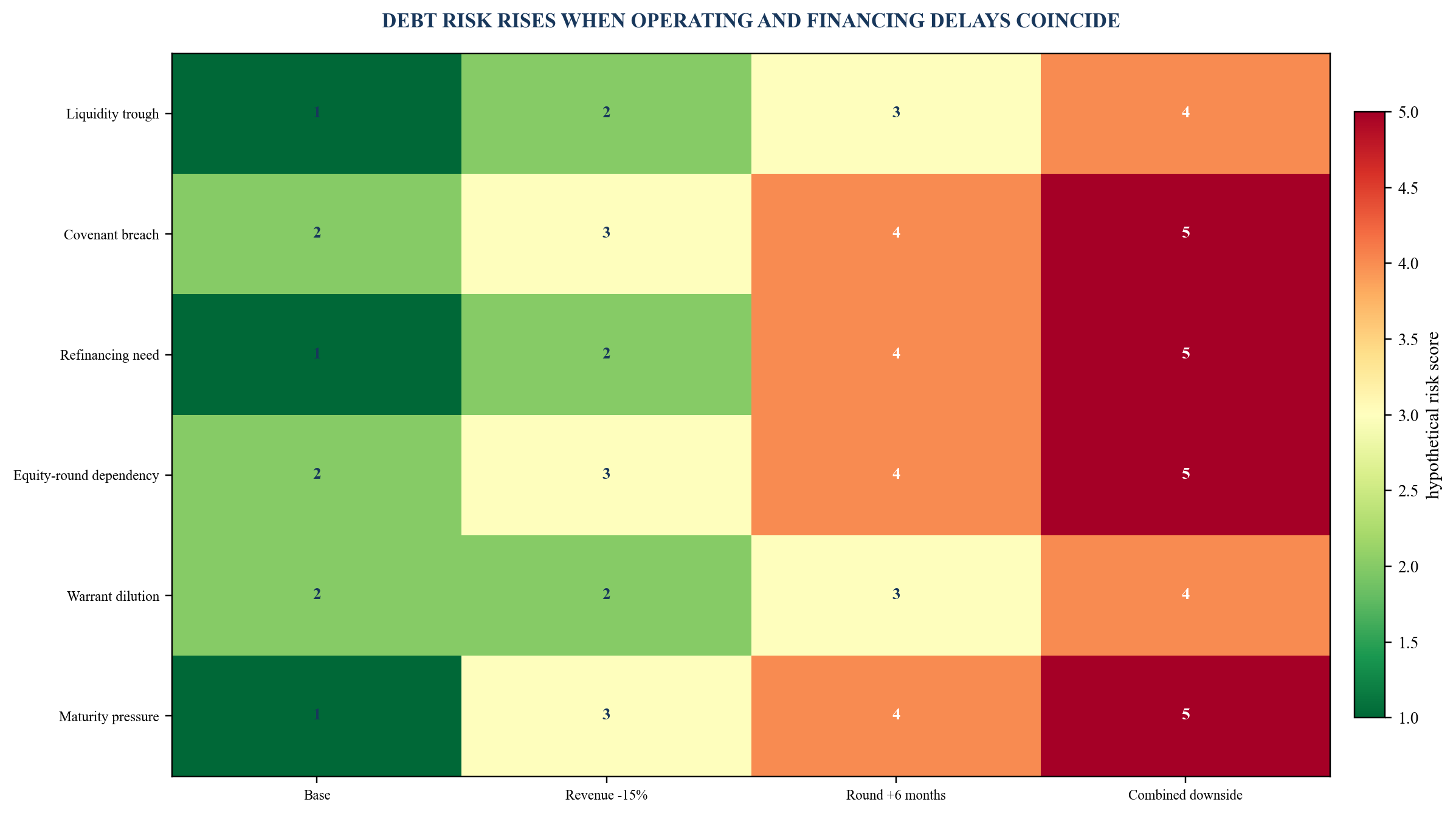
Scores are hypothetical management assumptions from one to five; five indicates higher risk.
13. Compare regional and international availability
Product availability varies by jurisdiction, lender, company stage and sector. A public announcement of a programme does not establish borrower eligibility or offered terms.
Hub71 announced a partnership with Stride Ventures to foster venture-debt access for startups in Abu Dhabi.[4] Emirates Development Bank publishes financing for advanced-technology adoption and SME growth, including long-term repayment structures for eligible businesses and projects.[5]
The EIB offers long-term venture debt with bullet repayment and equity-risk-linked remuneration for eligible innovative companies and describes secured, unsecured and subordinated structures.[6] Its TechEU platform positions the product as complementary to venture capital.[7]
These examples show that growth debt exists across institutional, commercial and development-finance channels. Each channel has a mandate, eligibility test, diligence process, documentation and return requirement.
Cross-border companies should map the proposed borrower, guarantors, operating entities, intellectual-property owner and principal cash accounts before approaching lenders. A lender willing to finance a parent company in one jurisdiction may require guarantees, share security, account control or contractual protections over subsidiaries in other jurisdictions. The practical value of an international facility therefore depends on legal enforceability, tax and withholding treatment, currency exposure, cash movement and the lender's ability to obtain its intended security package.
Currency deserves separate treatment. Revenue, operating costs, debt drawdown, interest and repayment may be denominated in different currencies. A facility can preserve headline runway and create cash volatility when exchange rates move. The monthly model should translate each currency at an observed base rate, apply stated stress assumptions and show whether hedging, matched cash balances or contractual pricing can reduce the mismatch. All exchange-rate scenarios remain management assumptions until documented with market data and executed hedges.
Development-finance, bank and specialist-fund products can also differ in purpose. Some facilities finance research, technology adoption, equipment or eligible project expenditure. Others provide general corporate growth capital. The use-of-proceeds covenant should match the operating plan. A low-cost facility with a narrow eligible-use definition can deliver less usable liquidity than a higher-cost facility that finances the actual milestone.
14. Build a lender process before requesting terms
The company should prepare a financing memorandum, historical and forecast financials, monthly cash model, customer and unit-economics evidence, cap table, equity financing history, product roadmap, legal structure, intellectual property, security map and proposed milestone.
A lender matrix should record mandate, sector, geography, ticket, seniority, collateral, pricing, equity-linked economics, covenant style, decision timetable and portfolio conflicts.
Indicative terms should be normalised. One lender may quote a larger commitment with conditional tranches. Another may quote a smaller fully committed amount. Coupon, benchmark, floor, fees, warrant, end charge, amortisation and consent rights should sit on one comparison sheet.
The company should control information and communications. Financing discussions can include sensitive customer, product and shareholder information. Access should be staged and documented.
Process design affects both terms and execution risk. Lenders should receive a consistent forecast date, capital structure, requested facility and milestone case. Management should record each clarification and update all bidders when a material assumption changes. This creates a comparable record and reduces the risk that apparently competing term sheets rely on different information.
The work plan should place legal documentation alongside commercial selection. Security diligence, corporate-authority checks, existing shareholder consents, intercreditor issues and intellectual-property ownership can delay closing after a term sheet is signed. Early legal review identifies structural obstacles while the company still has financing alternatives. Management should maintain a decision log covering rejected terms, negotiated protections, outstanding conditions and accountable owners.
15. Build a monthly covenant and liquidity close
Debt creates an operating calendar. Finance should close cash, debt, interest, covenant measures, forecast and certificate preparation on a repeatable timetable.
Definitions should follow the agreement. Annualised recurring revenue, revenue, EBITDA, liquidity, permitted cash and indebtedness can differ from internal reporting.
The board should receive actual, forecast and headroom. A covenant that is currently compliant can still require action when the forecast shows a breach within three months.
Table 5. Monthly venture-debt dashboard
| Measure | Actual | 90-day forecast | Threshold | Board action |
|---|---|---|---|---|
| Unrestricted cash | bank and ledger close | receipts, payroll, tax and debt service | minimum liquidity covenant | preserve cash, accelerate collection or raise capital |
| Recurring revenue | contract and billing bridge | cohort and pipeline plan | revenue covenant where applicable | correct forecast, sales plan or seek amendment |
| Free cash flow | cash-flow statement | driver-based downside | board limit and runway | control hiring, projects and discretionary spending |
| Debt service | lender statement | interest, fees and principal calendar | payment dates | reserve cash and confirm payment authority |
| Tranche availability | condition evidence | expected gate date | draw window and conditions | draw, extend, replace or remove from plan |
| Covenant headroom | agreement definitions | base and downside | warning threshold before breach | escalate, cure, renegotiate or refinance |
| Maturity runway | months to maturity | financing process plan | board-approved minimum lead time | start equity, refinance, sale or repayment process |
Thresholds and definitions must follow the executed facility documents.
16. Plan for amendment and distress before they occur
Performance can fall below plan. The company should understand notice, cure, waiver, default interest, draw stop, acceleration and enforcement provisions before signing.
Early engagement can preserve options when the company has reliable information and a credible remediation plan. A lender may seek additional fees, pricing, warrants, covenants, repayment or equity support in an amendment.
The board should identify who can negotiate, approve and sign amendments. It should maintain a current stakeholder map for lenders, equity investors, critical customers and employees.
Directors need current legal advice when solvency risk increases. Duties, payment decisions, asset transfers and new financing can change under the applicable jurisdiction and facts.
17. Protect operating flexibility
The facility should be tested against the company's planned decisions. Hiring, pricing, international expansion, acquisitions, product investment, capex, leases and partner contracts can affect cash or require consent.
Foreign-currency debt creates exchange risk when revenue and cash are in another currency. Benchmark-linked interest creates rate risk. The board should show both in the cash model.
Customer prepayments and restricted cash should be classified carefully. Cash that is legally or contractually unavailable cannot support debt service.
Insurance, cyber-security, data, intellectual property and compliance undertakings can create continuing requirements. Owners and evidence should be assigned before closing.
18. Run a 180-day financing and execution programme
The first thirty days establish the milestone, debt capacity and evidence room. The next thirty compare lenders and normalise terms. Documentation, security and board approval follow only after the operating model can support the facility.
After closing, the programme moves immediately into covenant reporting, draw governance and milestone delivery. Waiting until the first certificate is due increases execution risk.
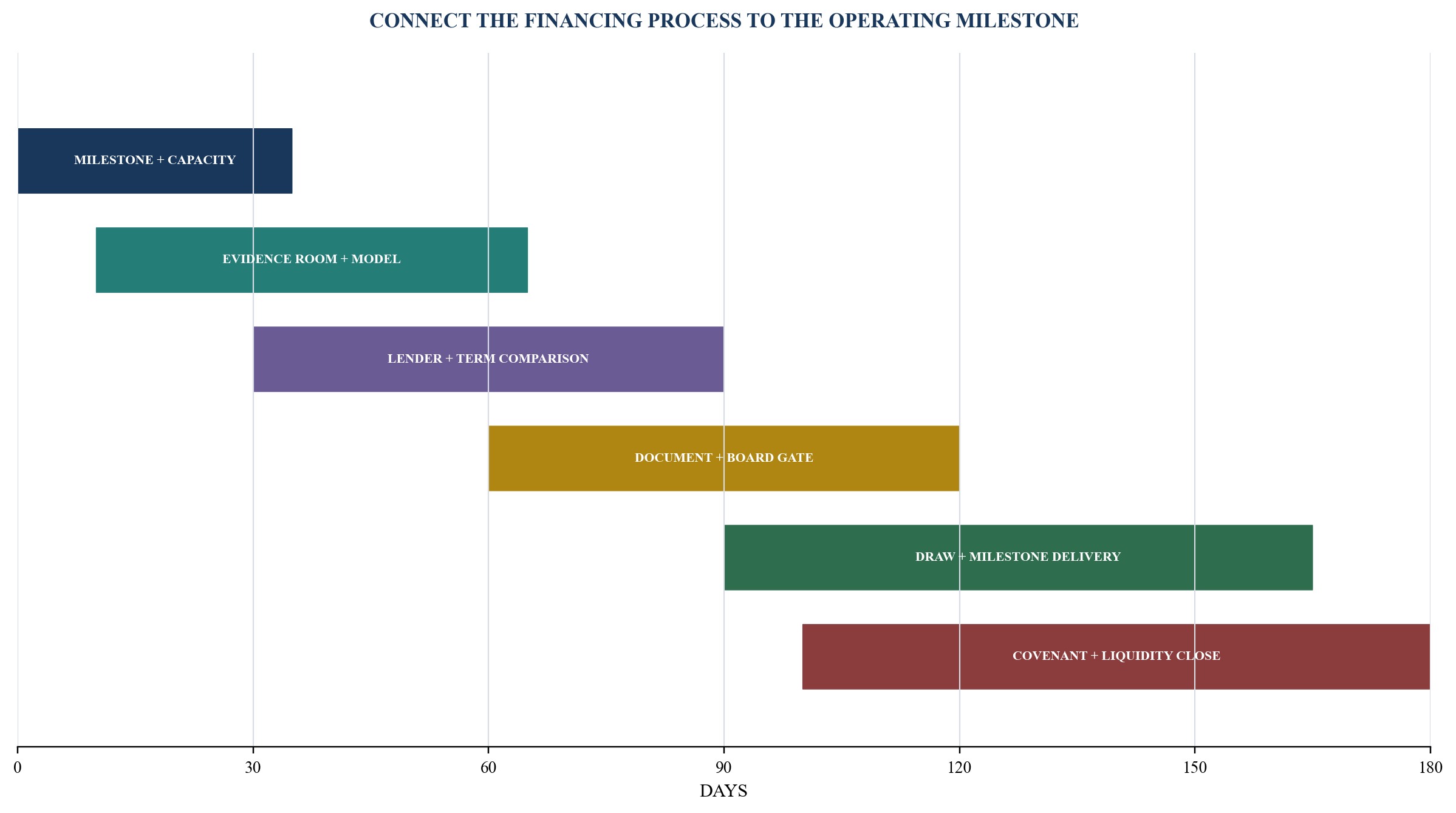
Author framework. Timing should be adapted to company evidence, lender process and legal requirements.
19. Diligence the facility and the company together
The lender diligences company risk. The board should diligence the facility's effect on the company. The same data room can support both when evidence is reconciled.
Management should verify customer revenue, unit economics, cash, cap table, intellectual property, legal structure, regulation, tax and existing obligations. The facility workstream adds repayment, collateral, covenant and consent analysis.
Table 6. Venture-debt diligence register
| Workstream | Company evidence | Facility test |
|---|---|---|
| Capital and ownership | cap table, rights, options, investor reserves and approvals | quantify warrant dilution, consent and future financing effects |
| Financial | audited accounts, monthly ledger, cash, forecast and tax | reproduce runway, debt service, fees and downside headroom |
| Commercial | contracts, cohorts, retention, pipeline and collections | verify product-market fit and milestone credibility |
| Technology and IP | ownership, licences, security, resilience and roadmap | identify collateral, exclusions and value risk |
| Legal and regulation | entities, licences, disputes, compliance and jurisdictions | confirm borrowing, security, guarantee and consent capacity |
| Existing finance | debt, leases, grants, customer cash and liens | map priority, permitted debt and intercreditor requirements |
| Facility documents | term sheet, loan, security, warrant and disclosure documents | compare economics, covenants, default, cure and enforcement |
| Governance | board paper, delegated authority, reporting and contingency plan | establish draw, covenant, amendment and repayment controls |
Scope should follow the company, facility, lender and jurisdictions.
20. Apply a board gate that can reject debt
The board paper should state the financing job, milestone, facility amount, committed and conditional tranches, complete economic cost, security, covenants, cash runway, next financing, downside and fallback.
It should show the latest month for a new equity or refinancing process, the earliest potential covenant pressure and management actions. Hypothetical assumptions should remain separate from contracted and observed evidence.
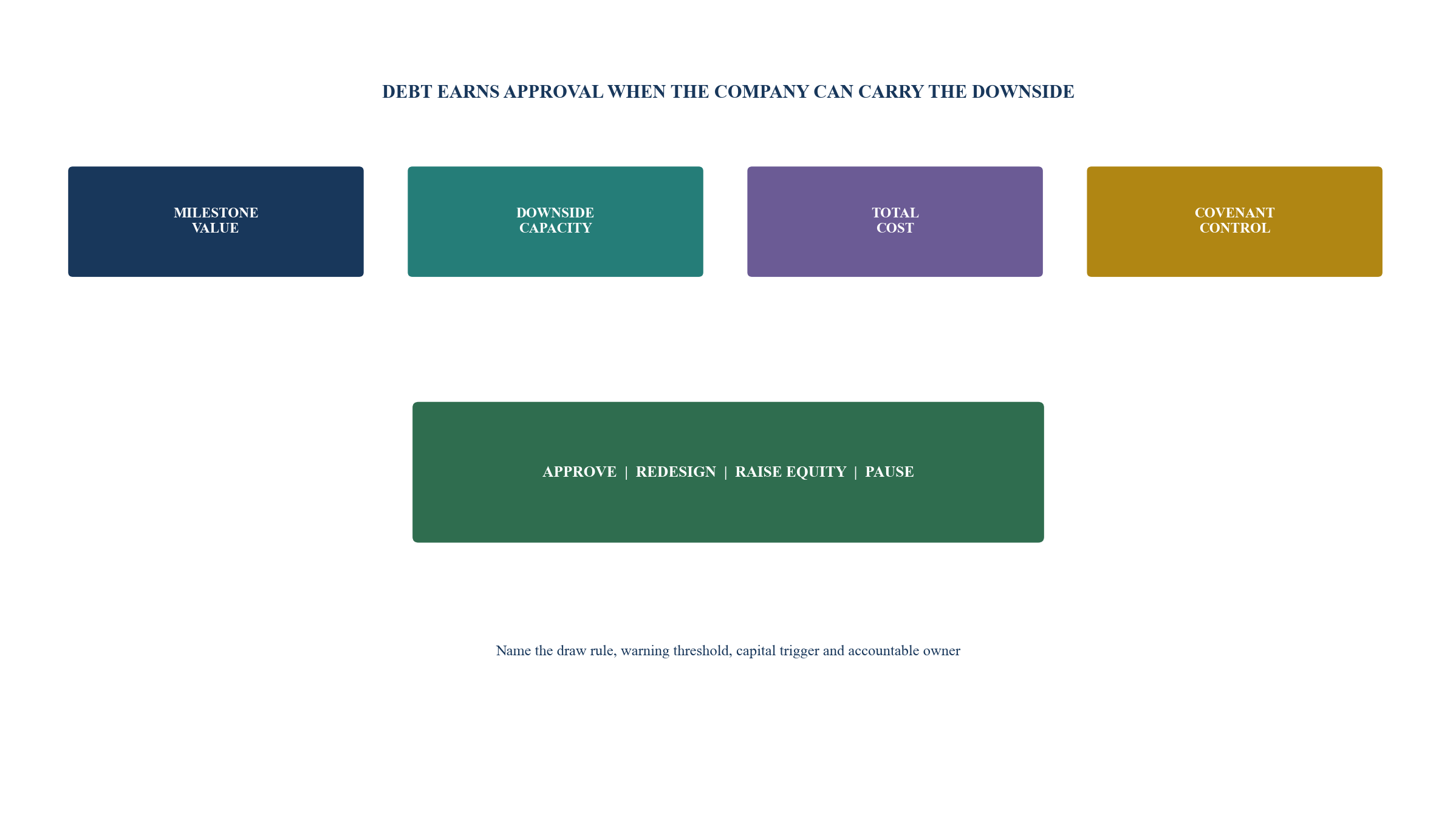
Author framework. Approval requires alignment across value, capacity, control and downside resilience.
The board can approve, reduce, restructure or reject the facility. Equity can be the safer form of capital when product-market fit is weak, runway is short, repayment depends on an uncertain round or lender control would impair the operating plan.
Conclusion
Venture debt can fund a valuable milestone and defer equity dilution after product-market fit. Its effectiveness depends on verifiable customer economics, an institutional capital base, a credible repayment or refinancing path and sufficient liquidity for a downside.
The complete cost includes interest, fees, end-of-term amounts, prepayment economics, warrants, security, covenants and management constraints. Headline commitment is less important than firm draw availability and cash delivered when required.
A disciplined board sizes debt from the minimum of milestone need and downside capacity. It integrates tranches into the monthly cash calendar, stress-tests the next equity event and begins covenant reporting before closing.
Debt should extend strategic choice. It should not convert a financing delay into a loss of control.
References
- British Business Bank, What is venture debt?, https://www.british-business-bank.co.uk/business-guidance/guidance-articles/finance/what-is-venture-debt
- HSBC Innovation Banking, Venture Debt FAQs, https://www.hsbcinnovationbanking.com/au/en/resources/venture-debt-faqs
- Hercules Capital, Annual Report on Form 10-K for the year ended 31 December 2025, https://www.sec.gov/Archives/edgar/data/1280784/000128078426000009/htgc-20251231.htm
- Hub71, Hub71 and Stride Ventures Join Forces to Foster Innovation in Abu Dhabi, https://www.hub71.com/index.php/latest-news/press-release/hub71-and-stride-ventures-join-forces-to-foster-innovation-in-abu-dhabi
- Emirates Development Bank, Advanced Technology Adoption Finance, https://edb.gov.ae/en/solutions/advanced-technology-adoption-finance
- European Investment Bank, Venture debt, https://www.eib.org/en/products/equity/venture-debt/index.htm
- European Investment Bank, TechEU platform, https://www.eib.org/en/projects/topics/innovation-digital-and-human-capital/techeu/platform.htm
- Silicon Valley Bank, State of the Markets H1 2025, https://www.svb.com/globalassets/library/uploadedfiles/reports/state-of-the-markets-h1-2025.pdf
- Silicon Valley Bank, When is Venture Debt Right for Your Business?, https://www.svb.com/startup-insights/venture-debt/when-is-venture-debt-right-for-your-business/
- European Investment Bank, Sidekick Health secures EUR 35 million venture debt, 30 April 2025, https://www.eib.org/en/press/all/2025-196-sidekick-health-secures-eur35-million-venture-debt-from-eib-to-accelerate-rd-and-global-expansion
- Emirates Development Bank, Emirates Growth Fund, https://www.edb.gov.ae/en/solutions/emirates-growth-fund
About the Author
Chennakeshav Adya is an independent researcher and Managing Partner of Matchpoint Partners. His work examines strategy, capital formation, valuation, transactions and operating execution across private and public markets.
