

1. Underwrite the workflow, not the software label
Vertical software is built around the processes, data, rules and users of a particular industry. A healthcare platform may coordinate appointments, clinical records, billing and compliance. Construction software can manage tenders, projects, labour, cost and evidence. Legal, logistics, hospitality, insurance and property platforms each sit inside different operating systems. The credit value comes from the borrower's position in a workflow, the economic cost of failure and the durability of customer payment.
The label “software” can hide different risks. A system of record with embedded data, integrations and regulatory obligations can be difficult to replace. A point solution that automates one task may be vulnerable when a general-purpose AI model or incumbent suite performs the same task at lower cost. A product can contain both. The lender should therefore map modules, users, data, integrations, outcomes and revenue rather than assign one disruption score to the company.
The Bank of England's July 2026 Financial Stability Report identifies rapid AI advances, uncertain monetisation and potential shocks to software-sector business models as relevant to debt sustainability and loan-level decisions.[1] The BIS Annual Economic Report 2026 similarly discusses the uncertain pace of AI adoption, productivity and labour displacement.[2] These sources support a forward-looking credit question: which borrower cash flows remain durable if AI capability and price improve faster than the management plan assumes?
Venture debt adds timing sensitivity. The borrower may still be cash-flow negative. Interest and amortisation consume runway while product and go-to-market investment remain necessary. A deterioration in retention can reduce cash, valuation and refinancing access at the same time. Underwriting should connect product exposure to cohorts, liquidity and debt service before leverage and maturity are set.
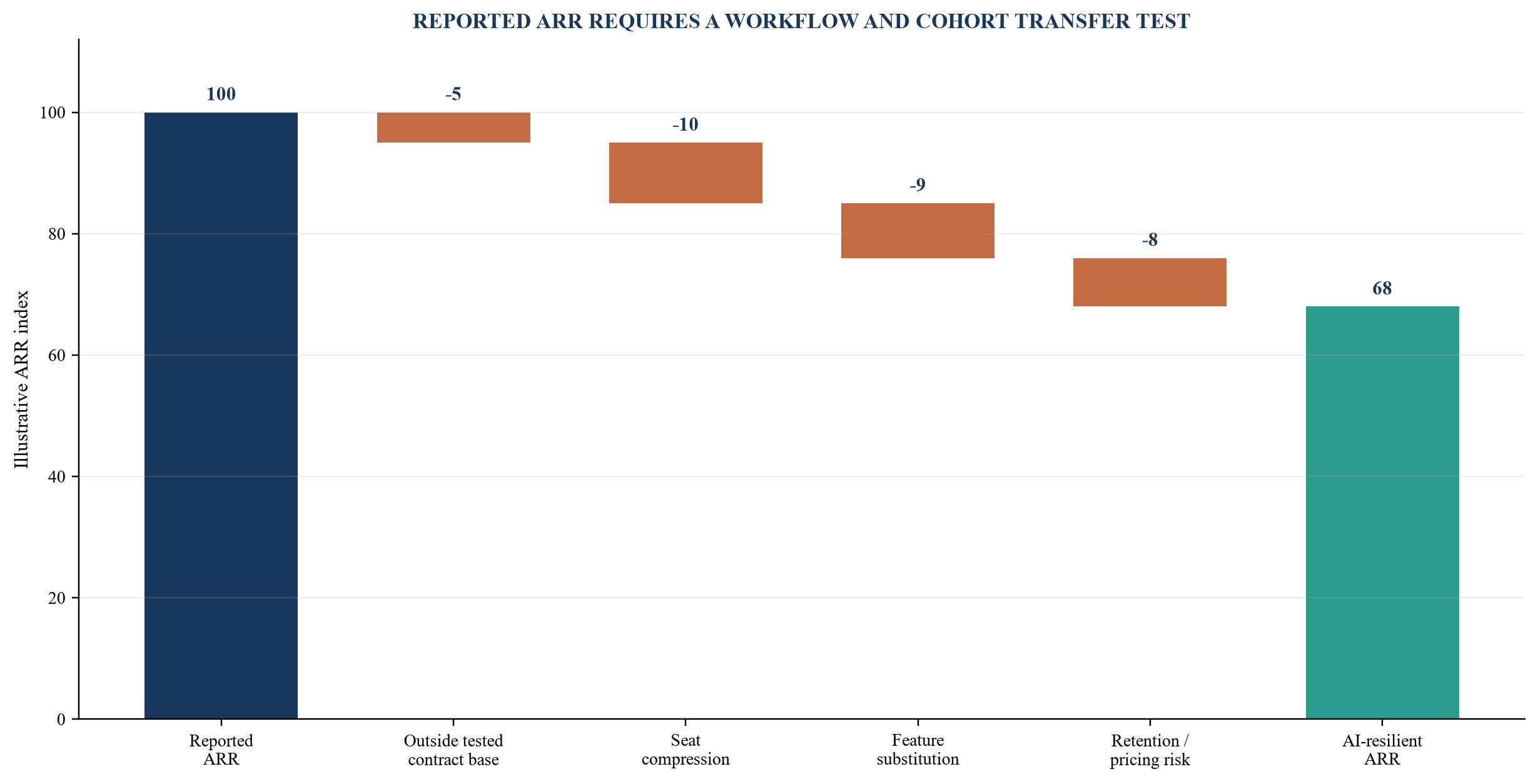
The illustrative bridge deducts recurring revenue exposed to weak workflow control, seat compression, replacement and uneconomic servicing.
Table 1. Recurring-revenue evidence hierarchy
| Measure | Evidence required | Credit use | Principal limitation |
|---|---|---|---|
| contracted ARR | signed order, effective terms and renewal date | starting contract base | cancellation and non-renewal rights |
| billed recurring revenue | invoice and product ledger | confirms invoicing | billing does not prove collection |
| collected recurring revenue | bank and receivables evidence | cash conversion | timing and dispute effects |
| gross retention | beginning cohort less losses and contraction | durability test | can hide new-customer dependence |
| net retention | gross retention plus expansion | growth within installed base | expansion may be price or seat dependent |
| AI-resilient ARR | module, workflow, cohort and substitution tests | stressed borrowing and covenant base | requires periodic judgement and evidence |
Credit reliance should increase only as contractual, billing, collection and cohort evidence reconcile.
2. Define venture debt repayment before sizing leverage
A facility can be repaid from operating cash flow, available cash, an equity round, a strategic transaction, asset proceeds or refinancing. Each source has a different certainty and control profile. The lender should state the primary and secondary repayment sources and show when each becomes available under the base and downside cases.
Cash runway is not a repayment source by itself. It is a buffer that management can invest, conserve or consume. A borrower with eighteen months of runway and a twenty-four-month bullet maturity has a funding gap unless the plan reaches positive free cash flow or a credible capital event occurs. The debt model should include the lender's cash outflows, fees, warrants where applicable, interest, amortisation and minimum-cash requirements.
Equity dependence should be explicit. British Business Bank research shows the importance and cyclicality of UK equity finance and venture returns.[3][4] A lender should avoid assuming that the next round occurs at the planned date, valuation or size. The downside case can delay the round, reduce valuation and increase investor diligence while preserving the company's need to invest in product and sales.
Debt capacity should be sized to the lower of liquidity capacity and durable cash-flow capacity. Liquidity capacity asks how much debt can be serviced without exhausting the operating plan. Durable cash-flow capacity asks how much debt the tested recurring-revenue base supports after churn, gross-margin, cost and working-capital stress. The resulting amount may be below a headline multiple of ARR.
The sizing record should show the effect of the facility itself. New debt can accelerate sales, product development or an acquisition, but it also changes cash burn, fixed charges and management incentives. The model should identify the measurable milestone that the additional investment is expected to reach and the evidence available if the milestone is missed. A tranche tied to that evidence can be safer than funding the entire amount at closing. Fees and end-of-term payments should be included in the effective cash requirement, and any warrant economics should be considered when comparing debt with equity.
3. Separate AI augmentation from substitution
AI exposure is not uniformly negative. A vertical platform may use AI to reduce manual processing, improve decisions, create a better interface, detect anomalies or produce industry-specific outputs. These improvements can increase customer value and gross margin. The lender should identify whether the borrower owns the workflow, data rights, distribution and feedback needed to retain that value.
Substitution risk arises when customers can achieve the same outcome through a horizontal suite, general-purpose model, internal development or a new competitor. It is highest where the product performs a narrow text, search, classification or reporting task with limited proprietary data and shallow integration. It is lower where the platform controls transaction records, permissions, audit evidence, regulated processes, physical operations or multi-party coordination.
The analysis should be module-specific. A legal platform may have a durable matter-management system and a vulnerable drafting add-on. A property platform may own rent collection and accounting while its marketing-content tool becomes commoditised. Module revenue, usage and cost should therefore be available at a level that supports the credit judgement.
The borrower should provide a product roadmap with customer evidence. Roadmap claims need prototypes, usage, willingness-to-pay, conversion, retention or productivity data. A plan to “add AI” is insufficient where the competitive response is already affecting pricing or seats. The lender should assess whether new capability defends existing revenue, creates incremental revenue or merely raises cost to maintain parity.
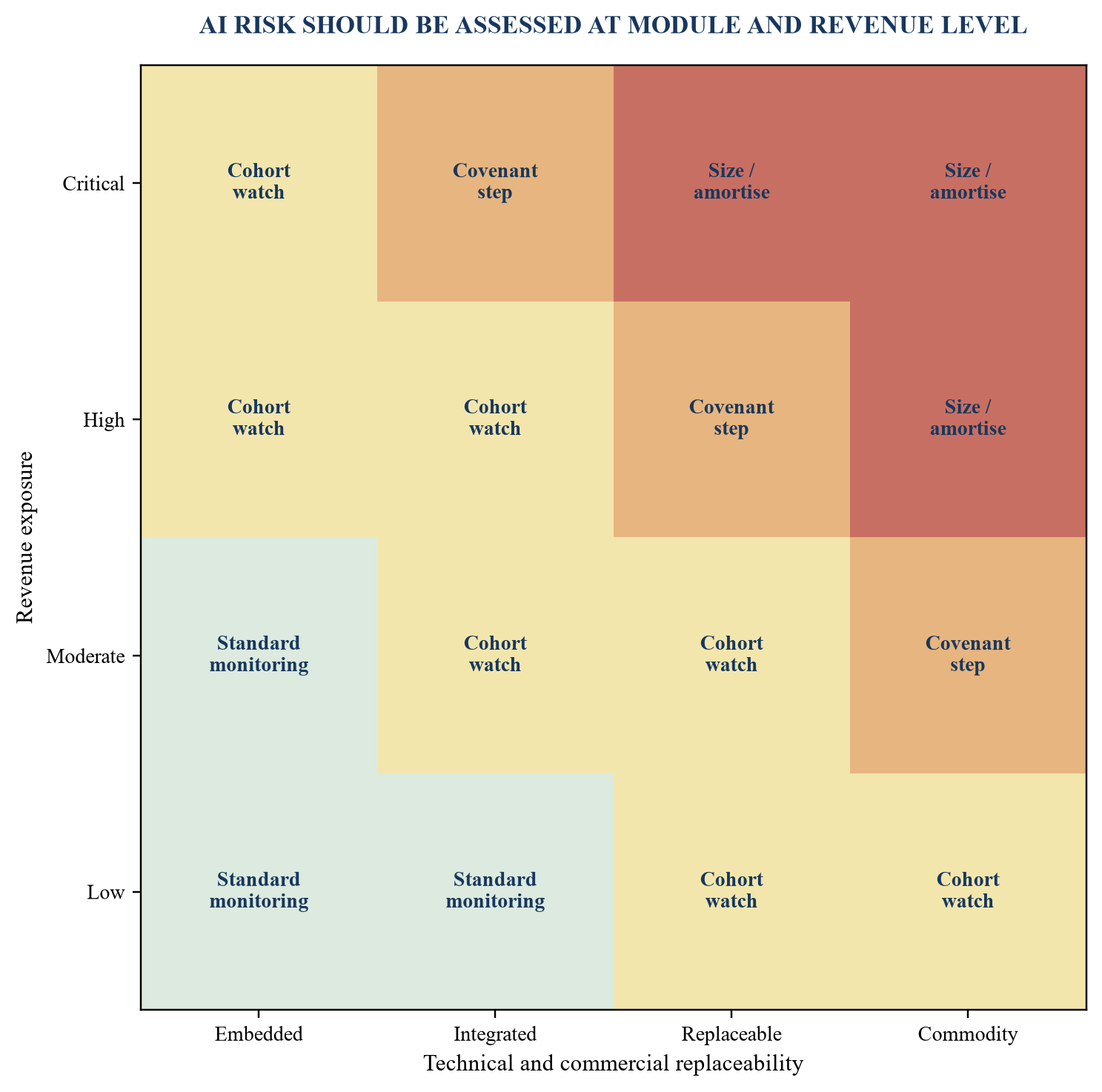
Workflow control and replaceability determine the appropriate monitoring and credit response.
Table 2. AI exposure factors by product layer
| Factor | Lower displacement exposure | Higher displacement exposure | Evidence |
|---|---|---|---|
| workflow position | system of record or transaction control | optional point feature | architecture and customer interviews |
| proprietary data | lawful, unique and continually refreshed | public or easily replicated data | data map and rights review |
| integration | multiple critical systems and roles | standalone browser task | integration inventory and usage |
| outcome accountability | audited, regulated or financially consequential | low-consequence assistance | customer process and contract |
| pricing basis | outcome or transaction value | seats for automatable tasks | cohort pricing and invoices |
| replacement path | complex migration and validation | prompt or simple API substitution | competitor and build analysis |
The lender should connect each factor to revenue, customer behaviour, cost and an observable indicator.
4. Reconstruct ARR from contracts to cash
ARR should be built from active recurring contracts rather than a management dashboard alone. The lender should obtain a contract-level schedule with customer, entity, product, currency, start, renewal, notice, committed value, variable usage, discounts, implementation, services, invoicing, collection and status. The schedule should reconcile to billing, the general ledger and cash receipts.
Implementation, professional services, hardware, pass-through and usage revenue need separate treatment. Some usage revenue is highly recurring and durable; some is cyclical or concentrated. The lender should define the recurring base used for leverage and covenants, including treatment of committed minimums, overages, multi-year prepaid contracts, foreign exchange and contracted price increases.
Cancellation and termination rights matter. A multi-year order can allow termination for convenience, service failure, regulatory change, budget withdrawal or a named product event. Auto-renewal can require notice and may not represent a firm commitment. Side letters, credits and service concessions can change economics outside the main contract.
Cash conversion should be analysed by cohort. Deferred revenue may support liquidity while creating future service obligations. Receivables can reflect timing, disputes or weak collections. A lender relying on recurring revenue should understand whether reported ARR produces cash before or after the cost to deliver and support it.
The reconciliation should be repeated for at least two historical reporting dates and the latest month. This reveals whether management definitions change as the business evolves. Acquisitions, discontinued products, migrations and foreign-exchange translation should be shown as discrete movements. Backdated cancellations, unprocessed credits and renewal concessions can make a period-end dashboard appear stronger than the contract and cash evidence. The lender should require a controlled calculation workbook with locked definitions, source-system references and a named finance owner. Changes to that workbook should require explanation in the compliance certificate.
5. Price seat compression separately from customer churn
AI can reduce the number of users required to perform a workflow even when the customer remains. A seat-priced product can therefore experience contraction without logo churn. The lender should separate customer losses, seat reductions, product downgrades, price changes, usage reductions and foreign exchange in the retention bridge.
Seat exposure should be mapped to tasks and roles. If a module is used primarily by staff whose workload can be automated, the borrower should explain whether pricing can move to transactions, outcomes, data or enterprise access. Contract rights, customer acceptance and competitive alternatives determine whether the change is executable.
Management may argue that productivity creates more demand and preserves seats. That can occur, though it requires evidence. The lender should examine customers that have adopted AI, changed staffing or renegotiated contracts. Early adopter behaviour can provide a leading indicator even when annual renewal data remains limited.
The credit model should include a contraction rate for exposed cohorts. This rate can vary by module, customer size, industry, renewal date and adoption readiness. It should feed ARR, billings, cash receipts and covenant headroom. Treating all contraction as churn can delay detection because logo retention may remain strong while economics weaken.
6. Stress cohorts rather than the aggregate growth rate
Aggregate growth can mask divergent cohorts. New sales may offset deterioration in older customers, one large enterprise can hide weakness elsewhere and price increases can conceal declining usage. A cohort view separates customers by start period, product, channel, geography, size, industry and AI exposure.
For each cohort, the lender should track beginning recurring revenue, renewal, churn, contraction, expansion, pricing, usage, gross margin, support cost, receivables and complaints. The same measures should be calculated for customers using the borrower's AI features and for customers adopting competing tools. The objective is to detect whether the product is becoming more or less central.
Stress should apply several channels at once. A vulnerable cohort may experience lower renewal, fewer seats, price pressure and higher support or inference cost. Sales cycles can lengthen as customers reassess build-versus-buy options. New bookings can decline while cash collections lag. These effects should be phased according to contract renewal dates rather than applied instantly.
The downside should preserve operational realism. Management may reduce hiring, marketing or discretionary spend, but aggressive cuts can impair product response and customer success. The model should distinguish savings available within one quarter from changes that require consultation, contract expiry or restructuring cost.
The stress should also distinguish exposure discovery from exposure crystallisation. A new model release may reveal that a workflow can be automated, yet contractual revenue can continue until renewal. Sales pipeline and valuation may react before cash receipts fall. This sequence affects the lender's intervention window. Early indicators can include competitive losses, lower feature usage, procurement questions and seat audits. Later indicators include contraction, credits, churn and collection delay. Monitoring both groups reduces dependence on a covenant that triggers only after cash deterioration is established.
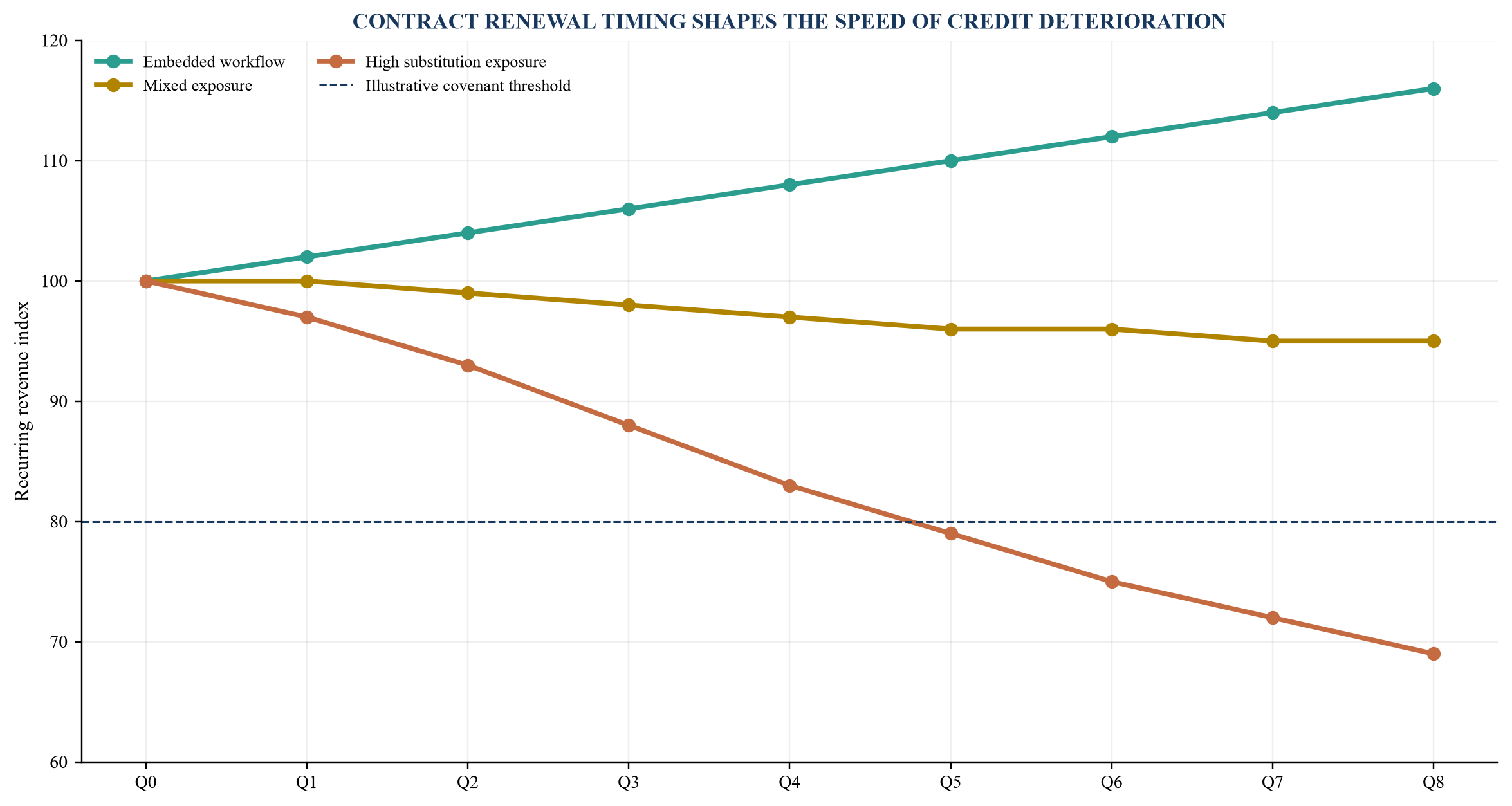
The illustrative paths show how recurring revenue can diverge by workflow resilience even when the starting base is similar.
Table 3. Cohort stress design
| Stress channel | Base evidence | Downside treatment | Cash-flow link |
|---|---|---|---|
| logo renewal | renewal history and pipeline | lower renewal for exposed modules | contracted billing loss |
| seat contraction | role and licence data | reduced seats at renewal | ARR and invoice reduction |
| pricing | discounts and negotiations | lower increase or price reset | billings and margin |
| new bookings | qualified pipeline and sales cycle | delayed close and lower conversion | reduced future collections |
| gross margin | hosting, model and support costs | higher unit inference or service cost | lower contribution cash |
| collections | ageing and disputes | slower receipts and higher bad debt | runway and minimum cash |
Stress inputs should have an evidence owner and flow into cash as contracts renew.
7. Test competitive response and customer build risk
The competitive set should include existing vertical vendors, horizontal suites, model providers, systems integrators and customer-built solutions. AI can lower the cost of creating interfaces, automations and narrow applications. It can also increase the value of trusted distribution, domain data and integrated workflows. The lender should assess both effects.
Customer interviews should be evidence-led. Questions can cover the workflow outcome, alternatives, implementation, switching, data, governance, adoption of AI, expected seat changes and renewal intent. Management should not select only enthusiastic references. Lost deals, churned customers, discounts and support escalations often provide stronger downside evidence.
Build risk depends on customer capability and governance. A large enterprise may develop internal tools but face security, model, data and support obligations. A small customer may use a horizontal assistant for a narrow task yet retain the vertical platform for records, transactions and compliance. The lender should identify which layer customers are likely to replace.
Competitive monitoring can be built into reporting. Relevant indicators include win rate, loss reasons, proof-of-concept length, discounting, feature usage, seat counts, API volume, customer development activity and competitor launches. The facility should require concise evidence rather than an unstructured technology narrative.
8. Model gross margin after AI adoption
Software gross margin can change as AI inference, data processing, human review and customer support expand. A new feature may increase revenue while consuming variable model cost. The borrower should show cost by product and customer cohort, including cloud, model, data, third-party API, implementation and support.
Inference pricing may decline, but usage can rise. The credit model should test cost per task, tasks per customer, model mix, caching, routing and minimum commitments. Vendor concentration and contract terms matter. A product that depends on one model provider may face pricing, availability, data or functionality changes.
Human-in-the-loop operations should be visible. Review can be necessary for accuracy, regulation or customer confidence. If service staff perform hidden quality control, the platform may have a services cost that scales with usage. Management's automation plan should be reconciled to actual intervention rates and exception volumes.
Gross-margin covenants are uncommon in many venture-debt facilities, but margin can be an early warning indicator. A reporting trigger can require explanation and a remediation plan when the tested recurring-revenue contribution falls below an agreed level. The cash model should use contribution margin appropriate to the product rather than a company-wide headline.
Capitalised development can also affect the credit view. Accounting policy may defer part of engineering expenditure while cash leaves the business immediately. The lender should reconcile operating profit, capitalised development, capital expenditure and cash burn. Product maintenance required to preserve existing revenue should not be treated as optional growth investment. Where AI creates a faster release cycle, the borrower may need sustained spending on evaluation, security, data and model changes. A cash-based measure avoids overstating debt capacity through accounting presentation and makes the cost of product defence visible.
9. Build a lender-controlled liquidity model
Liquidity should be modelled monthly through maturity and at least one refinancing period beyond it. Sources include opening unrestricted cash, collections, committed equity, undrawn facility amounts and permitted asset proceeds. Uses include payroll, suppliers, tax, capital expenditure, interest, fees, amortisation, leases and restructuring.
Restricted cash, customer funds and pledged accounts should be separated. The lender should verify bank balances and account control. Cash held by foreign subsidiaries can face transfer, tax or operating constraints. Minimum liquidity should reflect payroll, critical suppliers, customer continuity and the time required to implement a downside plan.
Draw conditions can preserve flexibility. A delayed-draw tranche may be available only if recurring revenue, retention, liquidity and no-default tests are met. This avoids funding into evidence of deterioration while giving the borrower committed capital for an approved plan. The definition should be objective enough to administer.
The liquidity model should include management actions with timing and cost. Hiring freezes, marketing reductions, contractor cuts, price changes and restructuring each have different cash effects. The lender should distinguish actions already approved from contingent options and assess whether cuts undermine product defence.
10. Design covenants around observable deterioration
A covenant package should identify deterioration early enough for corrective action. The strongest measures are defined, reproducible and connected to cash. Tested recurring revenue, gross retention, net retention, customer concentration, minimum liquidity and cash burn can provide complementary signals.
Definitions matter more than the number. Tested recurring revenue should specify eligible contracts, currencies, cancellations, concessions, services, usage, disputed amounts, related parties and AI-exposed adjustments. Retention should define cohorts and treatment of price, seats, acquisitions and product migration. The reporting workbook should reproduce the calculation from source data.
Thresholds can step over time as the company scales or approaches profitability. A covenant set at signing can become irrelevant if the business mix changes. The facility may allow an agreed budget reset or acquisition adjustment with lender consent and evidence. Unilateral management reclassification should not alter the test.
The consequences should be graduated. A small reporting variance may require information and a plan. A sustained operating breach can stop further drawings, restrict acquisitions or distributions, introduce cash controls, increase amortisation or trigger an event of default. The ladder should preserve a path to cure while protecting liquidity.
Financial covenants should be paired with negative and affirmative undertakings. The borrower may agree to preserve intellectual property, maintain insurance, pay taxes, comply with law, protect data, notify material incidents and maintain its principal business. Restrictions can address additional debt, security, disposals, acquisitions, distributions, related-party payments and changes of control. The drafting should contain baskets that support ordinary operations. A lender needs notice of a material technology or customer event, while the borrower needs enough freedom to release products, replace suppliers and respond to competition.
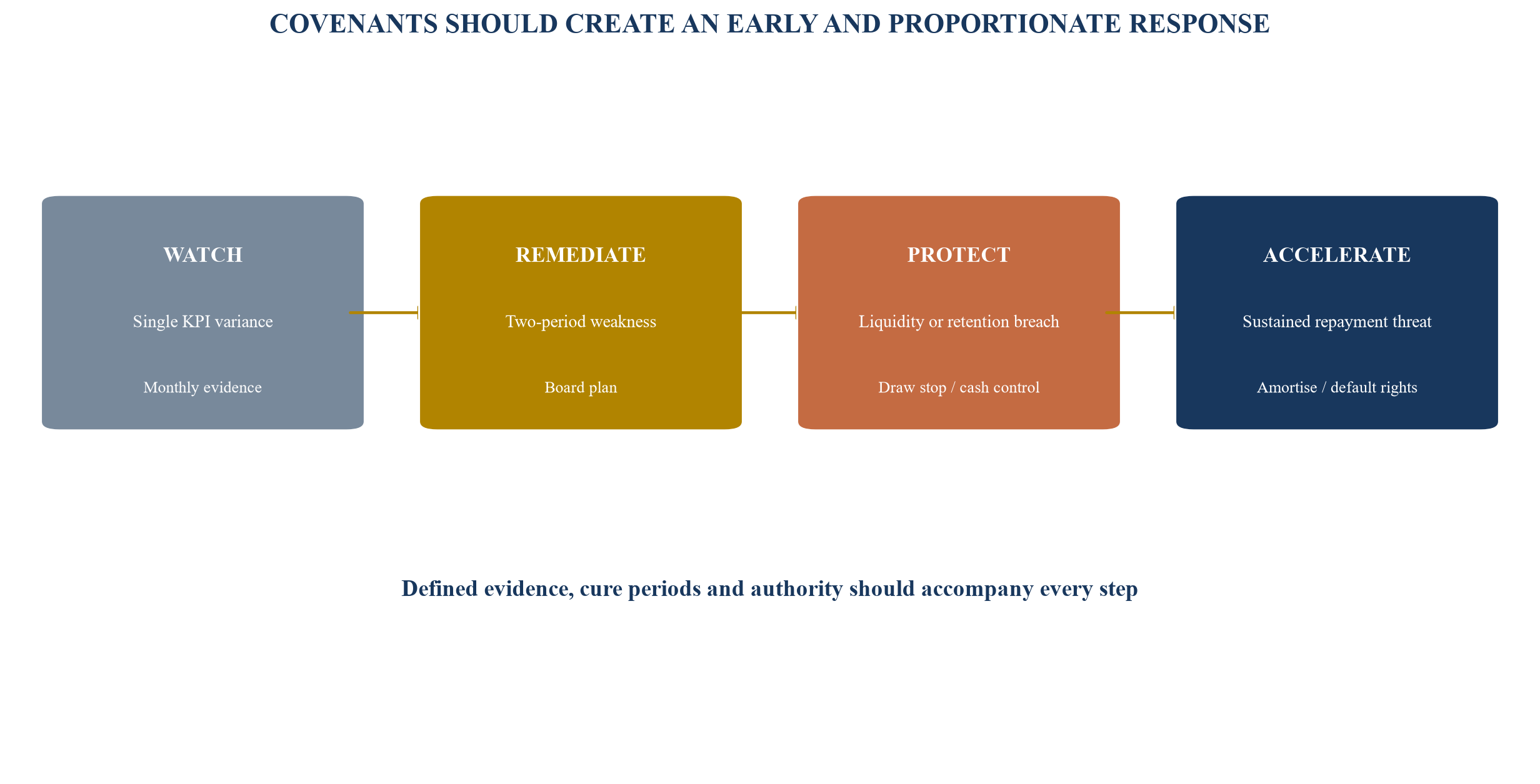
The response increases as evidence moves from an early indicator to a sustained liquidity or repayment threat.
Table 4. Covenant and reporting architecture
| Test | Calculation | Frequency | Graduated response |
|---|---|---|---|
| tested recurring revenue | eligible recurring contract base after defined exclusions | monthly | information, draw stop, amortisation |
| gross retention | beginning cohort less churn and contraction | monthly or quarterly | plan, pricing restriction, draw stop |
| minimum liquidity | unrestricted controlled cash | continuous or monthly | cash control and equity cure |
| cash burn | operating cash use over defined period | monthly | budget reset and cost action |
| customer concentration | largest customers as share of tested revenue | quarterly | consent for further concentration |
| reporting timeliness | complete agreed data package | monthly | default after notice and cure |
Each test should have a source, frequency, cure rule and defined consequence.
11. Match amortisation to the downside path
An interest-only period can preserve runway while the company invests. It also leaves principal outstanding when disruption may be most visible. The lender should compare straight-line amortisation, sculpted amortisation, cash-sweep, milestone-based step-up and bullet structures against the cohort stress.
The timing of renewal matters. If most exposed contracts renew in months twelve to eighteen, a maturity before evidence emerges can create refinancing dependence. A maturity after those renewals can provide better information but may coincide with lower cash. Amortisation can begin before the exposure peak or step up if retention falls.
A cash sweep can share upside without a rigid fixed schedule. The definition should preserve approved operating needs and avoid stripping cash required to support customers. Excess cash can be measured after minimum liquidity, permitted capital expenditure and agreed growth investment.
Prepayment economics should reflect the lender's return and borrower flexibility. A strategic sale, equity round or refinancing may repay early. Make-whole, minimum return, end-of-term fee and warrant terms should be modelled as part of the total repayment, not treated as peripheral documentation.
12. Stress debt service and refinancing together
Debt service should be tested under a base case, moderate AI compression, severe substitution and delayed equity or refinancing case. Each scenario should show recurring revenue, collections, gross margin, operating cost, liquidity, interest, amortisation and ending cash.
Interest coverage can be weak or negative for a growth company, so fixed-charge coverage may become meaningful only later. The lender should use liquidity and operating indicators during the loss-making period and transition to cash-flow coverage as the company matures. The documentation should state when the test changes.
Refinancing capacity depends on more than maturity revenue. A future lender will examine retention, growth, margin, concentration, security, runway and equity support. The downside case should estimate the leverage and amortisation a refinancing lender may accept. A balloon amount exceeding that capacity requires another repayment source.
The model should also test interest-rate and foreign-exchange sensitivity where relevant. Sterling revenue with dollar model, cloud or debt costs can create margin volatility. Hedging may be limited for an early-stage company, so the facility size and liquidity buffer should absorb a defined move.
Scenario outputs should identify the earliest month of covenant pressure, minimum cash, total equity need, principal outstanding at maturity and recovery sensitivity. The investment committee should see which assumption drives failure. If a small change in renewal timing causes a liquidity breach, the structure has limited tolerance. The response may be lower initial leverage, a longer availability period, earlier amortisation, a committed equity contribution or a larger minimum-cash buffer. Scenario design is useful when it changes the transaction terms or monitoring plan; an extensive model without an identified decision can create false precision.
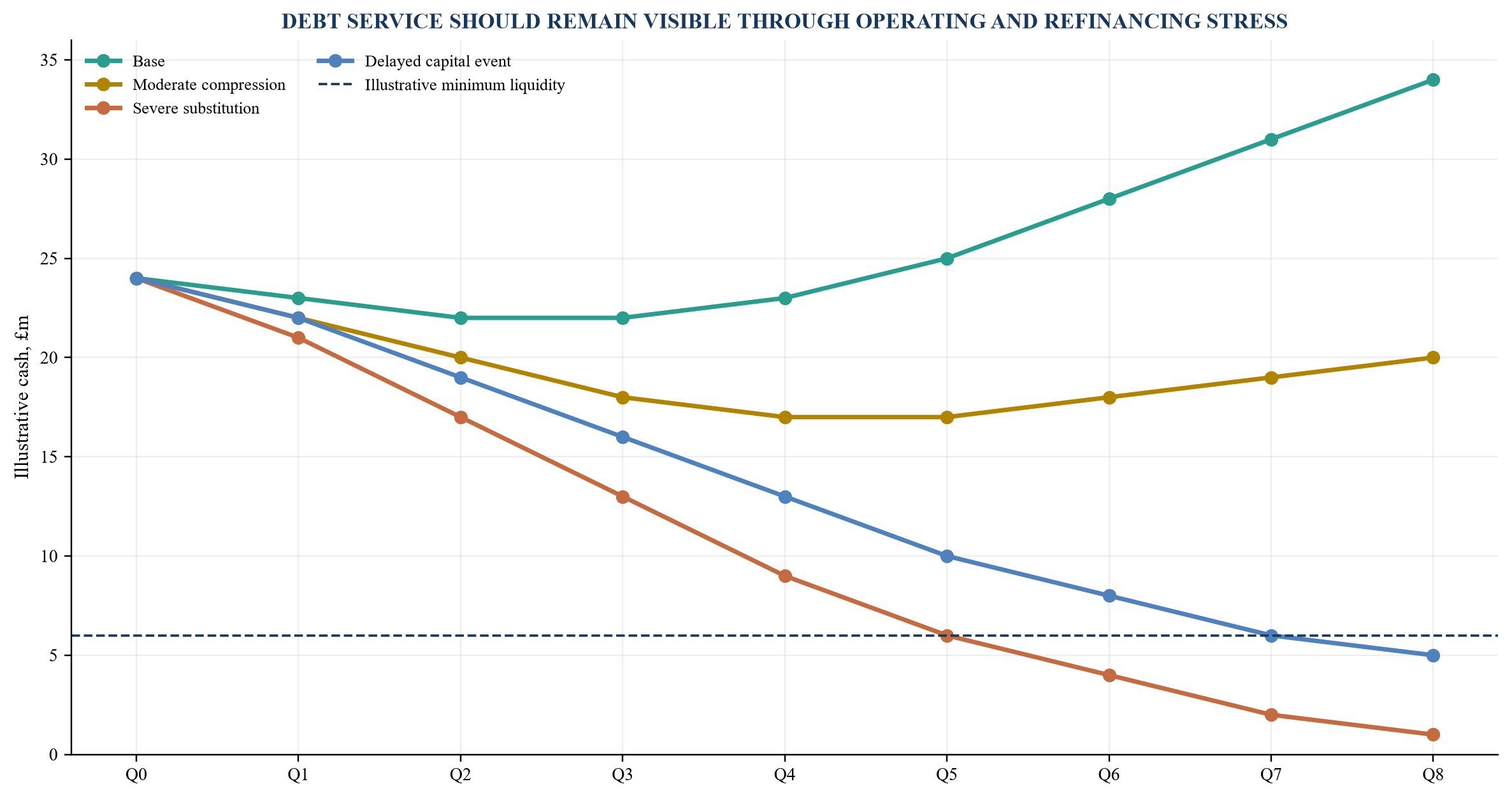
The illustrative paths compare minimum liquidity after scheduled debt service under four operating and financing cases.
Table 5. Illustrative debt-service scenario set
| Scenario | Commercial assumption | Financing assumption | Required lender response |
|---|---|---|---|
| base | retention and new bookings follow evidence-backed plan | equity or refinance available after proof point | ordinary monitoring |
| moderate compression | exposed seats contract at renewal | financing delayed one quarter | cost plan and tighter reporting |
| severe substitution | churn, contraction and margin pressure combine | no new debt and down-round equity | draw stop, cash control, amortisation step |
| delayed capital event | operating case broadly holds | equity or sale delayed twelve months | preserve liquidity and extend only for value |
| provider shock | product remains relevant but model or cloud cost rises | covenant capacity tightens | vendor transition and margin cure |
| concentration loss | one major customer exits | valuation and refinance multiple decline | pre-agreed cash action and strategic review |
Assumptions are hypothetical and should be replaced with borrower-specific evidence.
13. Secure the assets that preserve enterprise value
The security package depends on structure, existing claims and law. It may include debentures over the borrower's assets, share security, account control, intellectual-property security and guarantees. UK charge registration and priority need current legal advice and timely execution.[5] Security value should be assessed through an enforcement scenario rather than its document title.
Software collateral includes code, data rights, domains, contracts, receivables, licences, documentation and the organisation needed to operate them. Open-source obligations, employee and contractor assignments, third-party components and customer restrictions can affect transfer. The lender should review the intellectual-property chain and material licences.
Data may be valuable but constrained by privacy, contract and purpose. The ICO's AI and data-protection guidance emphasises governance, transparency, lawfulness, security and individual rights.[6] A lender should avoid assuming that customer data can be freely sold or reused after enforcement. The value lies in a lawful operating business and transferable customer relationships.
Intercreditor and account arrangements matter where the borrower uses working-capital, card, cloud or equipment facilities. Cash can be subject to set-off or control. The lender should map all claims, negative pledges, liens, retention of title and permitted security before setting recovery expectations.
Recovery should be considered at several points in the downside. A going-concern sale before severe customer loss may preserve subscriptions, staff and integrations. A later sale can depend on code, data and a smaller customer base. An insolvency process adds administrator cost, continuity funding and consent uncertainty. The lender should estimate value net of the cash required to keep the platform operating through a process. This exercise informs security, information rights and the point at which a strategic review should begin. It also tests whether the proposed loan is supportable without relying on an optimistic enterprise-value multiple.
14. Test technology and model dependencies
The borrower should maintain an architecture map covering source code, infrastructure, data, models, APIs, identity, observability, deployment, backups and recovery. Critical third parties need contracts, service levels, security, audit, data, termination and exit analysis. In July 2026 UK authorities began oversight of the first designated critical third parties to the financial sector, illustrating the systemic importance of concentrated technology providers.[7]
The FCA and Bank of England's 2024 AI survey found substantial use of third-party AI, automated decision-making and varying levels of firm understanding.[8] A vertical-software lender should ask similar questions at borrower level: which models are embedded, who is accountable, what data is sent, how outputs are tested, how providers can change and what happens during failure?
Model performance should be monitored against the product outcome. Accuracy alone may be insufficient. The borrower should track hallucination, exception, review, latency, cost, customer acceptance and incident data. Material model changes should have approval and rollback. Where regulated customers rely on outputs, audit and explainability can affect adoption and liability.
Cyber risk can rise as AI accelerates code discovery and attack capability. The Bank of England and BIS have highlighted frontier-AI cyber and operational-resilience risks.[1][9] The lender should review secure development, access, vulnerabilities, incident response, recovery and customer obligations. A cyber event can impair collections, trigger credits and consume liquidity before insurance responds.
15. Preserve management flexibility through documentation
A lender gains little from a covenant package that prevents the borrower from responding to disruption. The facility should permit agreed product investment, model-provider changes, pricing experiments and customer migrations within defined risk and liquidity boundaries. Consent rights should focus on actions that change credit exposure materially.
Budgets can include an approved strategic reserve for product defence. Use of that reserve may require board approval, milestone reporting and minimum liquidity. This gives management room to act while preserving evidence and accountability. Unplanned acquisitions, large capital expenditure, distributions and related-party transfers can remain restricted.
Equity cures should be designed carefully. New cash can restore liquidity, but a temporary accounting reclassification should not erase operating deterioration. The cure can address minimum cash or a defined covenant amount, with limits on frequency and a requirement that funds remain in the business.
Information rights should be proportionate and machine-reproducible. Monthly reporting can include contract and cohort bridges, bookings, pipeline, cash, burn, receivables, product usage, AI exposure indicators and compliance certificates. The lender should protect confidential customer and personal data through access and minimisation.
16. Establish a disciplined downside playbook
The lender and board should agree the information and action path before stress occurs. Early steps include verifying data, freezing additional drawings, increasing reporting and reviewing the budget. The next stage may involve cost actions, pricing, customer retention, equity outreach, asset sale or strategic alternatives.
Timing is central. A company with twelve months of cash can lose several months while stakeholders debate the forecast. The covenant ladder should trigger before minimum liquidity is reached. Management should maintain an updated thirteen-week cash flow when a threshold is crossed and provide bank, receivable, payroll and supplier evidence.
A strategic process can preserve value where product, customers and team remain attractive. Potential buyers may include vertical incumbents, horizontal platforms, private equity, customers and data or workflow specialists. The lender should understand consent, security release, customer contracts and regulatory issues before relying on a sale.
Enforcement is a final control, not the operating plan. Software enterprise value can decline rapidly if staff leave, service deteriorates or customers lose confidence. The downside playbook should preserve continuity and a funded path to a consensual solution where that offers greater recovery.
17. Apply an investment-committee decision standard
The credit paper should state the workflow thesis, AI exposure, tested recurring revenue, cohort evidence, margin, liquidity, repayment sources, downside cases, security, covenants and monitoring. Each conclusion should identify evidence, uncertainty and the condition required before funding.
The committee should see a bridge from reported ARR to the revenue used for sizing. It should understand which modules and cohorts drive each adjustment. It should also see the monthly cash path through maturity and the amount that remains to be refinanced under each scenario.
Approval conditions can include contract and cash reconciliation, intellectual-property evidence, provider review, equity funding, customer reference completion, security perfection and an agreed covenant workbook. Conditions should be capable of objective closure and preserved in the deal file.
Accepted risks need owners and monitoring. A product-roadmap dependency can have a milestone and customer evidence. A concentration risk can have renewal timing and contingency. A provider dependency can have exit tests. The committee's decision should remain connected to these obligations after closing.
18. Make AI displacement a measurable credit variable
AI displacement should be monitored through commercial evidence rather than narrative. The core indicators are module usage, seat counts, renewal, contraction, pricing, win and loss reasons, customer build activity, inference and support cost, product incidents and roadmap adoption. These measures connect technology change to repayment capacity.
The framework creates five linked records. The ARR exposure bridge establishes the eligible recurring base. The substitution matrix identifies vulnerable modules. Cohort stress phases risk through renewals and cash. The covenant ladder defines graduated control. Debt-service scenarios determine leverage, amortisation and liquidity.
The lender should refresh the analysis when capability, competition, pricing or customer behaviour changes materially. A static closing assessment can become stale before maturity. Periodic evidence review allows the borrower to demonstrate improved resilience and can support covenant flexibility when performance strengthens.
The review can use a consistent quarterly schedule. Management updates module exposure, cohort performance, competitor evidence, model cost, product incidents and the twelve-month cash forecast. Finance reconciles the recurring-revenue base and covenant calculations. Product and commercial leaders explain material movements. The board records actions and funding implications. The lender then classifies the position as ordinary monitoring, watch, remediation or protection. This process keeps judgement visible and reduces the risk that a technology narrative overrides cash evidence.
A well-designed venture-debt package can finance a strong vertical-software company through rapid technology change. Its defensibility comes from workflow evidence, customer cash flows, liquidity and an executable response to downside. These are the elements that determine whether debt extends strategic runway or accelerates a funding problem.
Documentation should also preserve the audit trail behind each credit adjustment. Contract extracts, cohort reconciliations, module assessments, customer evidence, model-cost records and cash forecasts should be dated, owned and reproducible. This allows a lender to distinguish a genuine improvement in resilience from a change in reporting definition. It also gives management a practical route to earn covenant flexibility when the evidence improves, while preserving a clear escalation path when deterioration becomes sustained.
The final structure should remain understandable to management, directors, investors, lenders and any successor capital provider reviewing the same evidence.
References
- Bank of England, “Financial Stability Report, July 2026,” including the macrofinancial implications of AI, software-sector exposure and debt sustainability. https://www.bankofengland.co.uk/financial-stability-report/2026/july-2026
- Bank for International Settlements, “Annual Economic Report 2026,” progress, productivity, adoption and displacement analysis. https://www.bis.org/publ/arpdf/ar2026e.pdf
- British Business Bank, “Small Business Finance Markets 2025/26.” https://www.british-business-bank.co.uk/sites/g/files/sovrnj166/files/2026-03/report-small-business-finance-markets-2026.pdf
- British Business Bank, “UK Venture Capital Financial Returns 2025.” https://www.british-business-bank.co.uk/about/research-and-publications/uk-venture-capital-financial-returns-2025
- UK Government, “Register a charge at Companies House,” statutory filing guidance. https://www.gov.uk/guidance/register-a-charge-mr01
- Information Commissioner's Office, “Guidance on AI and data protection.” https://ico.org.uk/for-organisations/uk-gdpr-guidance-and-resources/artificial-intelligence/guidance-on-ai-and-data-protection/
- Bank of England, “UK financial regulators to begin overseeing Critical Third Parties announced by HM Treasury,” 10 July 2026. https://www.bankofengland.co.uk/news/2026/july/uk-financial-regulators-to-begin-overseeing-critical-third-parties-announced-by-hmt
- Financial Conduct Authority and Bank of England, “Research Note: AI in UK financial services,” reporting the 2024 survey. https://www.fca.org.uk/publications/research-notes/ai-uk-financial-services
- Bank for International Settlements, “A Mythos moment? Frontier AI and cyber risk,” BIS Bulletin, July 2026. https://www.bis.org/publications/bulletin-129-mythos-moment-frontier-ai-and-cyber-risk
- Financial Conduct Authority, “AI: artificial intelligence in financial services,” current policy and supervisory resources. https://www.fca.org.uk/firms/ai-financial-services
- Prudential Regulation Authority, “SS1/23 Model risk management principles for banks.” https://www.bankofengland.co.uk/prudential-regulation/publication/2023/may/model-risk-management-principles-for-banks-supervisory-statement
- Financial Conduct Authority, “Operational resilience,” policy and firm expectations. https://www.fca.org.uk/firms/operational-resilience
- Competition and Markets Authority, “AI Foundation Models,” competition and consumer-protection programme. https://www.gov.uk/cma-cases/ai-foundation-models-initial-review
- UK Government, “AI Opportunities Action Plan,” January 2025. https://www.gov.uk/government/publications/ai-opportunities-action-plan
- Office for National Statistics, “Business insights and impact on the UK economy,” business technology and AI adoption datasets. https://www.ons.gov.uk/economy/economicoutputandproductivity/output/datasets/businessinsightsandimpactontheukeconomy
- IFRS Foundation, “IFRS 15 Revenue from Contracts with Customers.” https://www.ifrs.org/issued-standards/list-of-standards/ifrs-15-revenue-from-contracts-with-customers/
- IFRS Foundation, “IFRS 9 Financial Instruments.” https://www.ifrs.org/issued-standards/list-of-standards/ifrs-9-financial-instruments/
- IFRS Foundation, “IAS 36 Impairment of Assets.” https://www.ifrs.org/issued-standards/list-of-standards/ias-36-impairment-of-assets/
- National Cyber Security Centre, “AI and cyber security: what you need to know.” https://www.ncsc.gov.uk/guidance/ai-and-cyber-security-what-you-need-to-know
- National Cyber Security Centre, “Guidelines for secure AI system development.” https://www.ncsc.gov.uk/collection/guidelines-secure-ai-system-development
