
Introduction
Circular infrastructure converts a disposal problem into several potential sources of cash flow. A materials-recovery facility may charge for accepting mixed waste, sell sorted paper, metals and plastics, and receive payments linked to producer-responsibility rules. An anaerobic-digestion or landfill-gas asset may collect a gate fee, sell gas or electricity, and generate environmental attributes. A plastics processor may combine tolling income, recycled-resin sales and policy-supported demand. The same physical plant can therefore face three markets at once.
This structure complicates M&A. Waste revenue can look contractual until contamination, minimum-volume exceptions or municipal reprocurement are examined. Commodity revenue can look diversified while depending on one grade, one export route or one buyer specification. Policy income can appear recurring while its eligibility, price and transferability remain exposed to rule changes, verification and market balance. Costs and liabilities also cross the three streams. A permit failure can interrupt gate fees, commodity output and credits simultaneously.
The transaction question is specific: how should an acquirer value, diligence and contract for a circular asset whose earnings depend on waste, commodity and policy markets? The answer begins with a physical and legal perimeter. It proceeds through revenue disaggregation, operating and data diligence, scenario valuation, purchase-agreement protection and a post-close control plan. The framework is designed for corporate buyers, infrastructure and private-equity investors, lenders, boards and advisers evaluating operating plants or platforms.
1. Start with the physical system
The plant should be mapped from inbound material to every output, residue and emission. The map should show collection points, transfer stations, weighbridges, pre-treatment, process equipment, storage, quality testing, product dispatch, residual disposal and environmental controls. Each step should be tied to a legal entity, permit, contract, employee group, information system and balance-sheet item.
This exercise reveals dependencies that a legal-entity chart can miss. A target may own the process equipment while an affiliate owns the land, permit, fleet or customer contract. A shared laboratory may certify product quality. A seller may retain the trading desk that places recovered commodities. The asset can appear operationally complete and remain unable to function independently after closing.
The World Bank's waste work documents the scale and uneven management of municipal solid waste, including material that is not managed in an environmentally safe manner.[1] The acquisition case must be grounded in the plant's own catchment, composition, collection system and regulatory setting. Global waste growth does not establish that a particular facility has secure or suitable feedstock.
2. Define the three revenue markets
Waste-market income arises because a customer pays to collect, transfer, treat or dispose of material. The unit can be a household, tonne, lift, route, capacity reservation or service period. Commodity income arises from recovered materials, energy, fuels, nutrients or other products. Policy income arises from credits, certificates, producer-responsibility payments, grants, tax attributes or regulated demand.
The categories should be separated even when invoices combine them. A municipal contract may include collection, processing and commodity-revenue sharing. A gas offtake may include a physical energy price and environmental-attribute transfer. A packaging scheme may compensate verified recycling while commodity title remains with the processor. Each component should be identified by legal basis, counterparty, pricing formula, volume driver, settlement process and termination right.
The separation is analytical. The three streams remain operationally linked. Waste quantity and composition determine recoverable yield. Product quality determines commodity acceptance. Custody, measurement and eligible end use determine policy value. The valuation should model those links rather than assigning three unrelated growth rates.
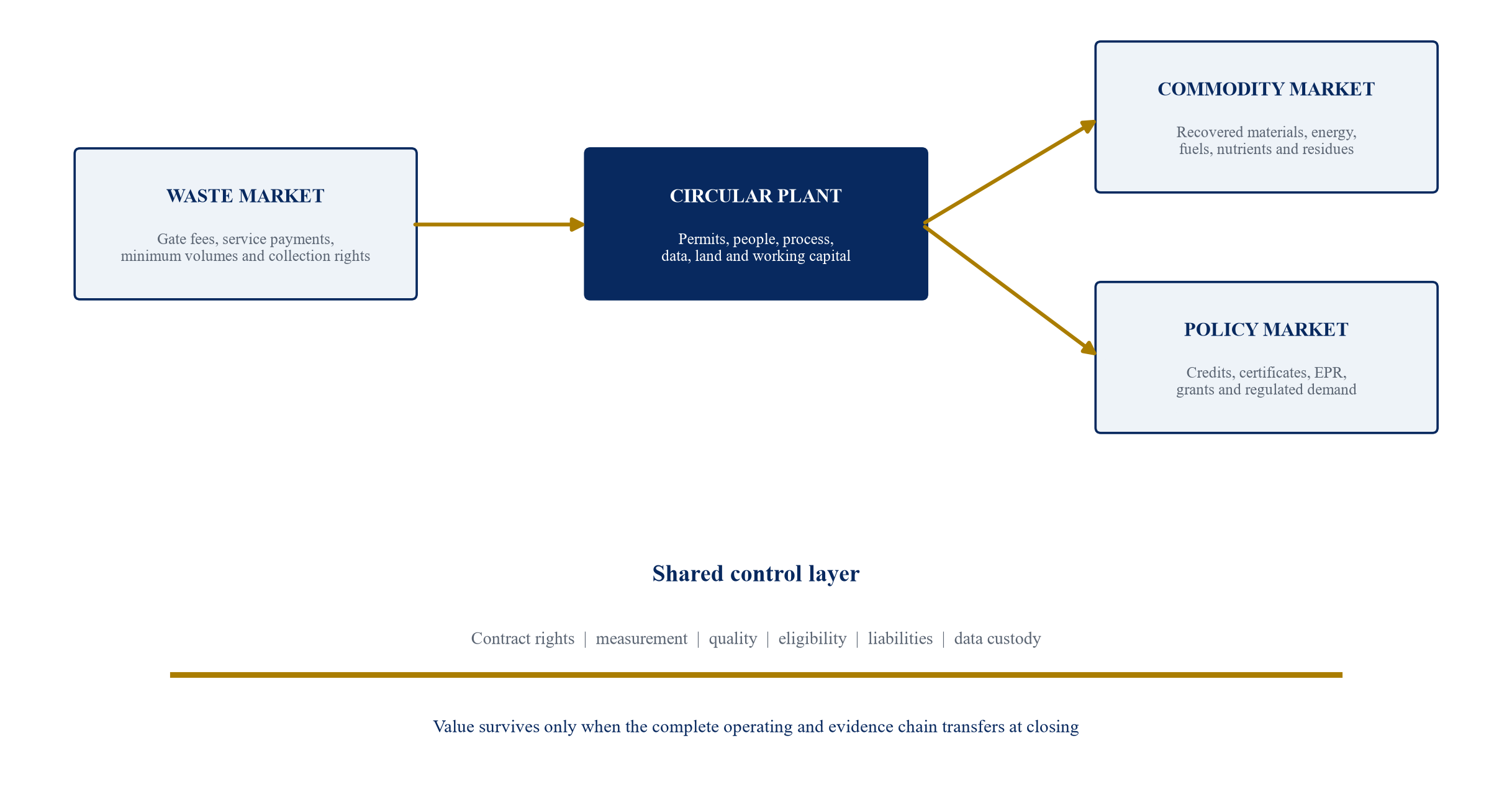
Conceptual framework; the legal and operational perimeter must be established for each transaction.
3. Build a contract inventory before normalising earnings
The buyer should inventory every contract that affects material flow or cash conversion. The list should include waste supply, municipal service, collection, haulage, land, utilities, maintenance, labour, product offtake, commodity brokerage, credit marketing, verification, residue disposal, insurance, finance and information technology. Each contract should record the contracting entity, term, renewal, pricing, volume, quality, exclusivity, indexation, change-of-control treatment, termination, security and dispute history.
A contract can support several revenue streams. A waste agreement may transfer title to recyclables and environmental attributes. A gas purchase agreement may require delivery to a specified grid point and assign renewable attributes. A policy-credit marketer may control registration and sale while the plant retains compliance liability. The contract inventory should therefore trace rights by cash-flow component rather than by document title.
Normalised earnings should be calculated only after the inventory. Revenue recognised during a short favourable commodity period, a temporary credit programme or an expiring waste contract should not be capitalised as though it were equally durable. The adjustment should be linked to observable contract and market evidence.
4. Test waste supply as quantity, quality and service
Waste contracts should be analysed in three dimensions. Quantity covers committed, forecast and delivered tonnes, seasonality, minimums, diversions and catchment competition. Quality covers composition, contamination, moisture, prohibited material and testing. Service covers collection frequency, route performance, customer standards, complaint handling and penalties.
Headline tonnage can be misleading. A plant may receive enough gross material and still lack recoverable content. Contamination can increase processing cost, reduce throughput, damage equipment and create more residual disposal. A contractual minimum may contain exceptions for force majeure, changes in law, customer behaviour or competing public policy. A municipality may also retain broad rights at reprocurement.
The diligence model should reconcile contracted tonnes to weighbridge records and invoices, then reconcile input composition to saleable output and residue. Monthly mass-balance variance is a core transaction metric. Persistent unexplained variance can indicate measurement weakness, theft, incorrect yield assumptions or poor inventory control.
5. Distinguish gate-fee durability from volume growth
Gate fees can provide a floor to revenue when the customer pays for treatment irrespective of recovered commodity prices. The floor is durable only when the contract allocates quantity, contamination, inflation, energy, disposal and change-in-law risk clearly. A fixed nominal gate fee with rising residue cost may lose economic value even if revenue remains stable.
The buyer should separate contractual escalation from assumed repricing. Indexation may use consumer inflation, labour, fuel, disposal charges or a composite. Caps, floors, lags and reset rights determine real protection. Reprocurement can remove the benefit at renewal. Customer concentration should be measured by contribution margin and replacement difficulty, not revenue alone.
Volume growth should be treated as a catchment decision. New waste may require routes, transfer capacity, permits, labour or pre-treatment. Growth can dilute quality and increase residue. The investment case should quantify incremental contribution after collection and disposal, together with capital expenditure required to accept the material.
6. Reconcile commodity output to qualified yield
Recovered-commodity revenue equals qualified saleable output multiplied by realised net price. Qualified output is not the same as gross process output. It should deduct moisture, contamination, downgrades, internal use, rejects, inventory loss and customer claims. The model should reconcile each major product from input through production, stock and sale.
Commodity contracts should specify grade, test method, delivery point, freight, title transfer, price index, premium or discount, settlement period, minimum lot, rejection and claim rights. A published index may not match the plant's actual grade or location. Realised price should be compared with the relevant benchmark after freight, quality and brokerage.
The acquirer should review product complaints, debit notes, rejected loads and ageing inventory. A plant can report production that is difficult to sell. Inventory should be tested for quality degradation and net realisable value. Concentrated exposure to one buyer or export route should be reflected in the downside case.
7. Identify policy income by legal foundation
Policy-linked income should be classified by its legal foundation. A regulation can create an obligation on producers or fuel suppliers. An administrative programme can issue tradable credits. A grant can reimburse eligible capital expenditure. A tax rule can create a deduction or credit. A voluntary certificate can depend on private standards and buyer demand.
The EU Waste Framework Directive establishes the waste hierarchy and extended producer responsibility principles.[2] Regulation (EU) 2025/40 creates a harmonised packaging framework with phased requirements, including recyclability and producer obligations.[3] The revised Waste Framework Directive introduced common textile EPR rules and food-waste targets.[4] In the United Kingdom, packaging EPR guidance states that end-of-life costs shift toward producers placing packaging on the market.[7]
These instruments can change demand and payment flows, but they do not guarantee income to a particular plant. The buyer must establish whether the target is an eligible operator, contracted service provider, compliance scheme participant or commodity seller. The entitlement, calculation, verification, collection risk and change process should be documented.
8. Treat credits as measured claims
Environmental credits are claims created by rules, methodologies and verified activity. The asset should have a registry account, approved pathway, measurement system, evidence archive and defined title. The buyer should reconcile production records to issued credits, transfers, sales, retirements and unsold balances.
The United States Environmental Protection Agency explains that renewable natural gas can arise from landfills, wastewater, livestock and organic-waste operations.[8] EPA guidance also describes Renewable Fuel Standard pathways for landfill gas and the potential for qualifying agricultural biogas to generate RINs or state-level low-carbon credits when requirements are met.[9][10] Eligibility depends on feedstock, process, end use, registration and evidence.
Credit revenue should be modelled after issuance delay, invalidation risk, marketing fees, buyer discount and working capital. A receivable is different from an estimated unissued credit. Purchase-price adjustments should distinguish issued inventory, verified but unissued production and future expected generation.
9. Observe policy-credit price formation
Policy markets can be transparent enough to observe trading activity and still remain volatile. California's Air Resources Board publishes monthly and weekly LCFS transfer information, including reported volumes and prices.[11][12] The weekly snapshot for 25 to 31 May 2026 reported volume-weighted averages and ranges; these figures describe that period and cannot be treated as a permanent price.[12]
The valuation should use an observable forward curve where available, contracted prices for enforceable volumes, and scenario bands for uncontracted exposure. It should consider banking, borrowing, compliance demand, programme amendments, pathway changes and competing credit supply. A statutory ceiling or clearance-market price does not establish the price at which ordinary volumes can be sold.
Policy income can also be correlated with commodity economics. High fossil-fuel or virgin-material prices may improve both physical product and credit demand; rapid technology adoption may reduce credit scarcity. The buyer should avoid assuming independent diversification without testing historical and structural relationships.
10. Map the revenue dependency chain
Each revenue line should be connected to its upstream conditions. Gate-fee income may require customer service and permitted capacity. Commodity income requires process availability, qualified yield and a buyer. Policy income may require eligible feedstock, verified custody, qualified output and an approved end use. One broken condition can reduce several streams.
The dependency map should identify common failure points. The weighbridge may support billing, mass balance and policy evidence. A laboratory may support commodity acceptance and credit qualification. The permit may govern both waste intake and product classification. Shared points deserve enhanced diligence and post-close redundancy.
Correlation should be reflected in scenarios. A contamination event can increase gate-fee penalties, reduce commodity yield, disqualify credits and raise disposal cost at the same time. Modelling each effect separately and combining only average outcomes can understate tail risk.
11. Establish the legal transaction perimeter
The acquisition perimeter should cover the assets, liabilities, rights and people required to operate the plant. The buyer should distinguish share acquisition, business acquisition and asset acquisition consequences. The accounting classification and tax result require specialist advice, while the commercial decision begins with operational completeness.
IFRS 3 requires recognition of identifiable assets acquired and liabilities assumed in a business combination and recognises contractual or legal intangible assets separately from goodwill when the criteria are met.[16] Operating licences, customer contracts, offtake rights, technology, registry rights and data can therefore have transaction and accounting significance. The seller's historic balance sheet may not display all of them.
The perimeter should also identify excluded items. Retained land, fleet, employees, laboratories, software, trading relationships or guarantees require replacement agreements. Transitional services should specify scope, service level, data access, cybersecurity, cost, duration and exit.
Table 1. Three-market revenue perimeter and transaction evidence
| Market | Primary cash-flow driver | Essential evidence | Main downside | Valuation treatment |
|---|---|---|---|---|
| Waste | Qualified inbound volume and service price | Customer contracts; weighbridge records; composition tests; route and permit data | Diversion; contamination; reprocurement; residue cost | Contracted cash flow with renewal and quality scenarios |
| Commodity | Qualified output and realised net price | Mass balance; product tests; sales invoices; claims; inventory and freight | Price fall; quality downgrade; buyer concentration; export disruption | Benchmark-linked cash flow after yield, quality and logistics deductions |
| Policy | Eligible verified activity and programme price | Legal entitlement; registration; methodology; verification; registry and sale records | Rule change; invalidation; issuance delay; oversupply | Contracted or issued value plus probability-weighted future income |
| Shared operating layer | Availability, conversion yield and evidence integrity | Maintenance; downtime; laboratory; data lineage; permits; staff capability | Common-cause failure across all three markets | Integrated downside and capital-expenditure case |
The table separates cash-flow components for analysis while preserving their operating interdependence.
12. Test permits and change of control
Permits should be reviewed for holder, location, waste codes, capacity, operating conditions, monitoring, financial assurance, transferability and change-of-control requirements. The legal entity named on a permit may differ from the target. Expansion assumptions should be checked against current authorised capacity and planning conditions.
The buyer should examine inspections, notices, complaints, exceedances, remediation, fire events, odour and community disputes. An absence of recorded fines does not establish compliance. Operating data should be reconciled to permit reports and regulator correspondence. Material gaps should be resolved through conditions precedent, remediation covenants, indemnities or purchase-price protection.
Change of control can affect permits, grants, registry accounts and key contracts. The closing plan should list every consent, notification and re-registration, with responsible party and lead time. A delayed registry transfer can interrupt credit monetisation after legal completion.
13. Diligence environmental liabilities by pathway
Circular assets can inherit contamination, closure, aftercare, fire, leachate, emissions and residual-disposal liabilities. The diligence should trace each waste and residue pathway from acceptance to final destination. Third-party disposal does not remove responsibility if contractors, documentation or sites are non-compliant.
IAS 37 addresses provisions and contingent liabilities, including the use of estimates where outcomes are uncertain.[19] The transaction model should separately identify recognised provisions, disclosed contingencies and operational risks that have not produced an accounting liability. The commercial exposure can exceed the carrying amount.
Site assessments should consider historic use, storage areas, drainage, tanks, asbestos, groundwater and adjacent land. Closure and restoration obligations should be costed on current scope and timing. Financial assurance, insurance and contractual recourse should be verified rather than assumed.
14. Treat residues as a costed output
Every circular process produces material that is not sold. Residues can include fines, rejects, digestate, ash, wastewater, contamination, filter media and off-specification products. The valuation should model quantity, classification, transport, destination, price and capacity for each material.
Residue cost can be correlated with feedstock quality and policy. Higher contamination increases disposal and lowers saleable yield. Landfill taxes or restrictions can raise cost. A policy that increases collection can send more low-quality material to plants before downstream capacity expands. The buyer should test whether contracts pass these costs to customers.
The diligence should verify outlets and remaining permitted capacity. A low historic cost from one nearby site may be fragile. Alternative destinations and transport should be included in the downside case.
15. Reconstruct the mass balance
A reliable mass balance connects opening inventory, inbound tonnes, process losses, outputs, residues, dispatch and closing inventory. It should operate by material category and period. The buyer should reconcile the mass balance to weighbridge, production, laboratory, sales and registry systems.
Variance thresholds should reflect measurement error and process characteristics. Persistent or directional gaps require investigation. The plant may use different moisture bases for inbound and outbound material. Scales may be calibrated at different dates. Inventory surveys may rely on estimated density. Each source of uncertainty should be explicit.
The mass balance supports several decisions: sustainable throughput, recoverable yield, commodity margin, disposal cost, credit eligibility and working capital. It is therefore a central diligence workstream rather than an engineering appendix.
16. Audit data lineage and control
Data lineage should show how a physical event becomes an invoice, commodity sale, regulatory report and credit. The buyer should identify source devices, manual entries, interfaces, adjustments, approval and retention. Shared spreadsheets, administrator access and undocumented overrides can create material control risk.
Sample testing should begin with selected inbound loads and follow them through billing, processing, output, sale and policy evidence. Reverse testing should begin with selected revenue entries or credits and return to the physical source. Exceptions should be quantified and assessed for recurrence.
Cybersecurity and operational technology matter because weighbridges, plant controls and laboratory systems affect revenue and compliance. The closing plan should preserve system access, backups, vendor support, certificates and domain ownership. Data transfer should comply with contractual and privacy obligations.
17. Normalise maintenance and availability
Reported EBITDA can be overstated when maintenance is deferred or capitalised aggressively. The buyer should review planned and unplanned downtime, work orders, critical spares, original-equipment support, refractory or membrane life, corrosion, fire protection and obsolescence. Availability should be reconciled to throughput and customer penalties.
Maintenance capital expenditure should be separated from growth expenditure. A plant can report strong recent cash flow by postponing overhaul. The valuation should include a lifecycle schedule and a catch-up adjustment where condition evidence supports it.
The performance model should test process bottlenecks rather than nameplate capacity. Sorting, digestion, upgrading, compression, storage, grid connection or residue handling can constrain output. Expansion value belongs in the price only when the bottleneck, permit, capital cost and timetable are evidenced.
18. Review people and operating knowledge
Plant performance can depend on a small group of operators, laboratory staff, traders, compliance specialists and maintenance technicians. The transaction should identify critical roles, shift coverage, licences, retention risk, succession and contractor reliance. A central group function may serve several seller assets.
The buyer should distinguish documented process from tacit knowledge. Standard operating procedures, maintenance histories, recipes, quality responses and regulator relationships should transfer. Retention arrangements should be designed around needed capability and local employment law.
Management forecasts should be traced to accountable owners. Commercial teams may forecast waste intake, operations may forecast yield and traders may forecast price. The investment model requires a single reconciled operating plan with defined responsibility.
19. Separate reported EBITDA into quality tiers
Earnings should be disaggregated into contracted, market-exposed and policy-contingent components. Contracted waste revenue may still carry volume and renewal risk. Commodity margin may include inventory gains. Policy revenue may include issued credits, estimates and one-off grants. The classification should reflect evidence rather than accounting label.
One-off items should be identified in both directions. Fire, outage or exceptional disposal may depress a period, while insurance proceeds, grant income, credit true-ups or favourable inventory movements may raise it. Normalisation should preserve recurring compliance, maintenance and data costs.
The buyer should present bridge schedules from statutory results to transaction EBITDA and from transaction EBITDA to free cash flow. Each adjustment should have an owner, evidence, duration and sensitivity. Unsupported add-backs should remain outside the base case.
20. Model the three streams jointly
The operating model should begin with inbound volume and composition. It should calculate processing availability, product yield, residue, qualified sales, eligible policy activity, working capital and capital expenditure. Price scenarios should then be applied to the resulting volumes.
Joint modelling prevents impossible combinations. A downside case should not keep commodity and policy volumes unchanged when contaminated feedstock reduces yield. An upside policy price should not create extra credits without eligible production. Gate-fee growth should not exceed permitted capacity without capital expenditure.
The base, downside and severe cases should combine plausible physical and market conditions. The buyer can also use a probability-weighted decision case, while preserving discrete cases for covenant and liquidity testing.
21. Use a hypothetical valuation bridge
The following illustration is a management-model example rather than a market forecast. Assume a plant produces 100 units of maintainable EBITDA before transaction adjustments. Diligence identifies 8 units of expiring policy support, 5 units of favourable commodity inventory timing and 4 units of under-maintenance. It also identifies 6 units of contractually indexed gate-fee improvement and 3 units of verified yield improvement available after a funded upgrade.
The adjusted stand-alone case would remove unsupported or non-recurring benefits and include evidenced improvements only when timing and cost are modelled. A buyer may then apply different discount rates or valuation methods to waste, commodity and policy cash flows, while reconciling them to one enterprise value. The purpose is transparency, not mechanical precision.
Consideration can be structured around uncertainty. Issued credits and contracted cash flow can support closing value. Future policy income, permit expansion or seller forecast synergies can support earn-outs or contingent payments if the metric is measurable and controllable.
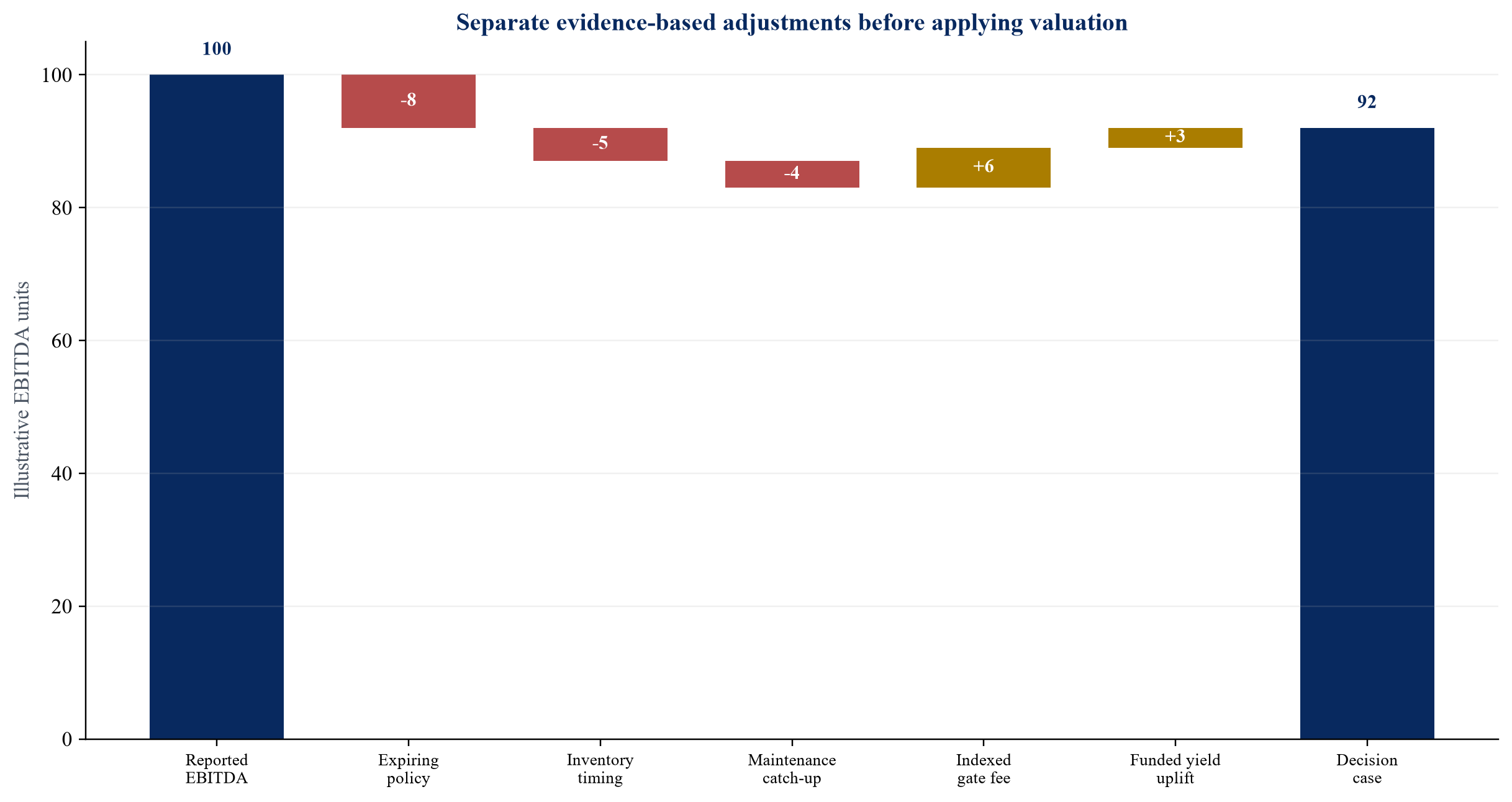
Illustrative management-model assumptions only; amounts are not observed market data or a valuation of an identified business.
22. Apply market-participant assumptions
IFRS 13 defines fair value using assumptions that market participants would use under current market conditions.[17] Transaction valuation may serve a different decision purpose, but the discipline remains useful: assumptions should reflect available evidence, risk and transferability rather than buyer enthusiasm.
The acquirer should distinguish stand-alone value, buyer-specific synergies and option value. Shared procurement, trading, route density or policy capability may create synergies. These benefits require implementation cost, timing, organisational capacity and regulatory approval. They should not be used to conceal weakness in the target's stand-alone economics.
Terminal value deserves special scrutiny when policy income is material. The model should not extend a temporary programme indefinitely. It should state the assumed legal regime, credit price, eligible output, compliance demand and replacement economics after the explicit forecast period.
23. Use different discount logic for different risks
A single weighted-average cost of capital can obscure materially different cash-flow risks. Contracted municipal service income, spot commodity sales and uncontracted credits may warrant different scenario treatment, discounting or both. Double counting should be avoided: a risk incorporated in cash flow should not be fully added again to the discount rate.
The model can use a sum-of-the-parts framework and then reconcile to enterprise value. Waste service cash flow may be valued through contract period and renewal scenarios. Commodity cash flow can use cycle-normalised margins and downside prices. Policy cash flow can use contracted, issued and scenario-weighted components.
The reconciliation should deduct debt-like items, working-capital shortfall, required maintenance, remediation and closure obligations. It should also identify assets that are surplus or unavailable to the buyer.
24. Stress policy change as a transition path
Policy risk should be modelled as more than an immediate zero. Regulatory changes often include consultation, effective dates, grandfathering, revised methodologies, caps or transition periods. The downside case should reflect plausible pathways and the asset's ability to adapt.
The European Commission's 2025 and 2026 circular-economy measures illustrate continuing rule development across packaging, textiles, food waste, end-of-waste criteria and product responsibility.[3][4][5] These measures can create opportunities for infrastructure while also changing eligibility, reporting and competitive supply.
The buyer should maintain a policy register that records legal instrument, competent authority, current status, effective dates, dependencies and owner. External legal advice should focus on transaction-critical interpretations. Management should retain accountability for operational compliance.
25. Review commodity cycles and structural shifts
Historical commodity prices should be normalised across enough periods to capture cycle and dislocation. The buyer should analyse local realised price, benchmark, freight, grade adjustment and volume. A simple average can conceal a structural change in export policy, recycled-content demand or processing technology.
Policy can alter commodity markets. Minimum recycled-content rules may support demand for qualified recyclate. End-of-waste criteria can affect product classification and market access. Design changes can reduce material use or change recoverability. Virgin-material prices can compress or expand recycled margins.
The investment case should identify the target's competitive position by product quality, consistency, location, customer qualification and cost. A plant producing a difficult-to-use grade should not receive the same terminal assumptions as a qualified supplier with long customer approvals.
26. Build a diligence heatmap around value at risk
The heatmap should rank issues by enterprise-value impact, probability, time to resolve and contractual remedy. High-impact items include feedstock rights, permits, environmental liabilities, common-cause equipment failure, mass-balance integrity, credit eligibility and major customer change of control.
Red flags should trigger quantified work. A weak mass balance should lead to sample reconciliation and an uncertainty range. An expiring contract should lead to renewal evidence and replacement economics. A permit issue should lead to legal interpretation, regulator process and operating impact. Labels without quantified consequences do not support a decision.
The heatmap should remain live through signing and closing. New inspections, credit issuances, commodity claims and customer notices can change the position. The purchase agreement should define update obligations and materiality.
Table 2. Circular M&A diligence heatmap
| Workstream | Decision question | Evidence | Red-flag consequence | Transaction response |
|---|---|---|---|---|
| Waste supply | Will qualified input remain available after control transfer? | Contracts; delivery history; composition; diversion rights; catchment map | Throughput and gate-fee loss | Consent condition; price adjustment; replacement plan |
| Commodity | Can output meet buyer specification at cycle-normalised margin? | Tests; claims; invoices; freight; inventory; customer approvals | Downgrade, rejection or buyer loss | Working-capital adjustment; earn-out; capex covenant |
| Policy | Does the target own transferable and verifiable entitlement? | Law; registration; methodology; registry; verifier reports | Credit invalidation or delayed cash | Specific warranty; escrow; contingent value |
| Permit and site | Can the plant operate within current and forecast scope? | Permit; inspections; monitoring; land and environmental reports | Curtailment, remediation or closure cost | Condition precedent; indemnity; remediation reserve |
| Plant and data | Are availability, yield and evidence systems reliable? | Work orders; mass balance; calibration; access logs; backups | Correlated revenue failure | Maintenance adjustment; TSA; retention and control plan |
Priority should be based on value at risk and remedy, not document volume.
27. Translate findings into purchase-price mechanics
Different risks require different mechanisms. A known maintenance backlog can adjust enterprise value. A closing working-capital deficit can be settled through completion accounts. An uncertain historic environmental exposure can use a specific indemnity, escrow or insurance. Future policy or expansion value can use contingent consideration.
The mechanism should align with measurement. An earn-out based on reported EBITDA can create disputes where commodity price, policy credits and buyer integration actions affect the result. More specific metrics, such as issued eligible credits, contracted tonnes or verified output, may be clearer when accompanied by accounting policies and buyer covenants.
Caps, baskets, survival periods and knowledge qualifiers should be assessed against risk characteristics and local law. A short general warranty period may be unsuitable for a later environmental claim or credit invalidation. Legal drafting should follow quantified diligence findings.
28. Draft representations around the evidence chain
Representations should cover permits, waste acceptance, environmental compliance, product quality, policy registration, registry balances, verification, data integrity, title, contracts and disclosed claims. They should address whether credits or environmental attributes have been sold, pledged, retired or double counted.
The disclosure process should identify exceptions with sufficient detail. A broad data-room disclosure can leave uncertainty about seller knowledge and buyer remedy. The buyer should preserve the key evidence relied upon at signing and closing.
Specific covenants may be required between signing and closing. These can restrict unusual credit sales, contract amendments, inventory changes, capital deferral, waste diversion or settlement of regulatory matters. The ordinary-course definition should reflect the target's three-market operation.
29. Secure consents and continuity
The closing checklist should include customer, land, permit, utility, registry, verifier, finance and technology consents. It should record notice form, approval standard, submission date, responsible party and fallback. The buyer should not assume that a share sale avoids all consent requirements.
Operational continuity requires access to bank accounts, customer billing, weighbridges, plant controls, laboratories, trading platforms and registry systems. User credentials should transfer through controlled processes. Third-party licences should be reviewed for assignment and change of control.
Cash conversion can be disrupted even when the plant continues operating. Credit issuance, invoice approval and commodity settlement may depend on seller personnel or systems. Transitional arrangements should include the complete order-to-cash and evidence cycle.
30. Decide integration or separation by control system
Integration should be planned around value drivers. Central commodity trading may improve placement and price. Shared compliance can strengthen policy monitoring. Route integration can reduce logistics cost. Procurement and maintenance can improve scale. Each initiative should identify benefit, cost, timing, dependency and accountable owner.
Separation may preserve licences, customer trust, local accountability or ring-fenced financing. The buyer may retain the target's operating systems while integrating finance and governance. A rushed system migration can damage mass balance and policy evidence.
The roadmap should distinguish Day One continuity, first-100-day controls and later value creation. Day One should preserve safe operation, permits, billing, registry access and customer service. Later phases can standardise data, procurement, trading and capital planning.
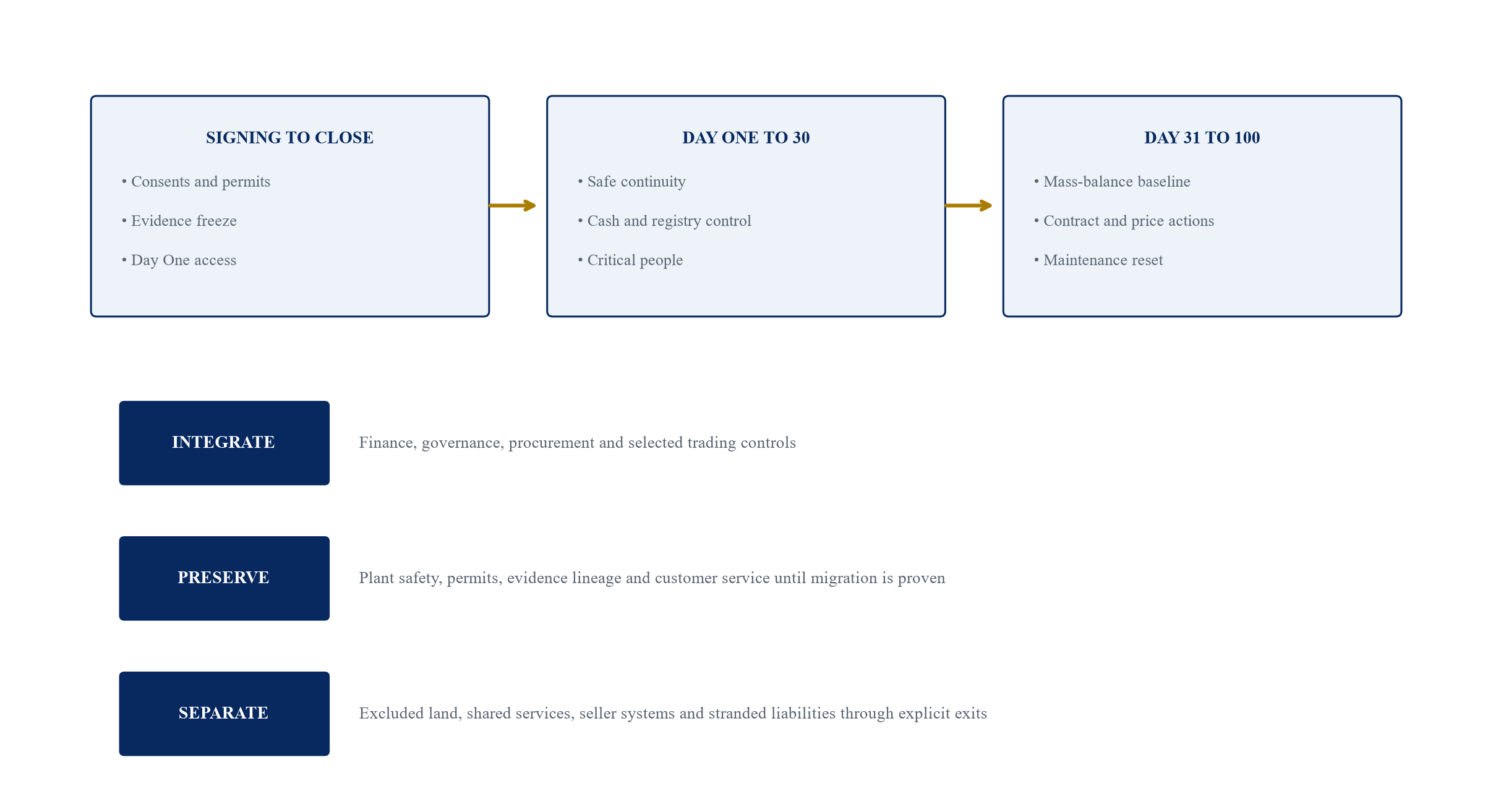
Illustrative sequence; timing depends on transaction perimeter, consents and operational risk.
31. Protect Day One cash and compliance
Day One controls should identify who can accept waste, amend prices, approve loads, release products, trade commodities, submit regulatory reports, create credits, transfer registry balances and pay suppliers. Authority should be documented before closing.
Bank mandates, invoice details and customer communications should be tested. Fraud controls matter during ownership change because counterparties receive new payment instructions. Registry and trading access should use named accounts, multifactor authentication and approval thresholds.
The buyer should establish an opening inventory and credit position. Physical stock, issued credits, receivables and obligations should reconcile to completion accounts. Disputed or ineligible items should be isolated.
32. Establish a post-close performance dashboard
The dashboard should connect operating activity to cash flow. Core measures include qualified inbound tonnes, contamination, plant availability, recovery yield, product quality, realised net price, residue rate, gate-fee contribution, issued credits, issuance delay, credit price, working capital and free cash flow.
Measures should be reported by material, site and customer where material. A blended group metric can conceal deterioration. Thresholds should trigger defined action, such as supplier engagement, maintenance, repricing, alternative outlet or compliance review.
The board should receive a bridge from operational variance to EBITDA and cash. This keeps integration activity tied to the acquisition thesis. It also identifies whether value creation comes from sustainable operating improvement, favourable markets or policy movement.
33. Allocate risk to the party that can control it
Waste suppliers can control declared material, collection practice and delivery. The plant controls acceptance, processing, maintenance and evidence. Commodity buyers control acceptance within contract terms. Policy administrators control programme decisions, while the operator controls compliance and reporting. Risk allocation should follow these capabilities.
Some risks cannot be fully transferred. Systemic commodity price or policy change may remain with the equity owner. The transaction should price retained risk and preserve liquidity. Contractual language cannot create a creditworthy remedy where the counterparty lacks capacity.
The buyer should examine risk aggregation. Several contracts may appear to transfer risk to different parties while depending on one guarantor, insurer or public authority. The economic concentration should be reported.
Table 3. Risk allocation and transaction response matrix
| Risk | Best operational owner | Buyer protection | Post-close control | Residual exposure |
|---|---|---|---|---|
| Waste quantity and quality | Supplier, collector and plant acceptance team | Contract rights; consent; price or escrow for identified gap | Sampling, supplier scorecards and catchment plan | Weather, behaviour and systemic catchment change |
| Commodity price and acceptance | Trading team and product buyer within contract | Normalised valuation; offtake warranty; inventory adjustment | Grade control, outlet diversification and hedge policy | Market cycle, basis and counterparty failure |
| Policy eligibility and issuance | Operator, verifier and registry administrator | Specific warranty; indemnity; contingent consideration | Evidence lineage, audits and policy register | Rule change and market balance |
| Environmental and closure liability | Operator and responsible historic party | Specific indemnity; escrow; insurance where effective | Monitoring, financial assurance and remediation plan | Long-tail discovery and legal change |
| Integration execution | Buyer | Synergy excluded from seller value unless evidenced | Named owners, milestones and benefit tracking | Buyer capability and implementation delay |
Contractual protection should complement operational control and quantified valuation; it cannot replace them.
34. Use a transaction decision framework
The investment committee should answer five questions. First, does the transaction perimeter contain everything required to operate and monetise the plant? Second, are the three revenue streams supported by transferable contracts, eligible activity and reliable evidence? Third, does the downside model capture common-cause physical and regulatory failures? Fourth, are known liabilities and capital needs reflected in price and documents? Fifth, can the buyer control Day One and execute the value plan?
The decision paper should state conditions for approval and walk-away points. Conditions can include permit consent, contract renewal, registry transfer, remediation, financing and key-person retention. A walk-away point should be tied to value or legal capability, not general discomfort.
The committee should receive the base case, downside, severe case and liquidity requirement. It should also see how consideration changes when uncertain value is deferred or contingent. This supports a decision that is explicit about risk ownership.
35. Sequence the transaction work
The first phase establishes perimeter, material flow and major contracts. The second reconstructs mass balance, earnings quality, liabilities and capital needs. The third builds valuation scenarios and negotiates risk allocation. The fourth secures consents and prepares Day One. Workstreams should run in parallel with a single issue register.
Early diligence should focus on facts that can change the transaction. Examples include an untransferable permit, missing feedstock rights, invalid credits, material contamination or a plant condition requiring major capital. Discovering these late wastes time and weakens negotiation.
The timetable should allow regulator and customer processes. Signing should not occur with unresolved operating continuity unless the purchase agreement creates a credible condition and long-stop structure. Completion readiness should be tested through a detailed cutover rehearsal.
36. Recognise the limits of the framework
Circular businesses vary widely by technology, waste stream, jurisdiction and policy. A municipal materials-recovery facility, hazardous-waste treatment plant, battery recycler and renewable-natural-gas project have different licences, processes and markets. The framework should be adapted with technical, environmental, legal, tax and accounting expertise.
Public policy and market information can change after publication. Official programme rules, current legislation and transaction-specific permits should be checked at the decision date. Historical credit and commodity prices are evidence of past trading, not forecasts.
The hypothetical financial bridge illustrates structure only. It does not provide market multiples, transaction pricing or investment advice. A valuation requires asset-specific cash flow, risk, capital structure, tax and market evidence.
Conclusion
A circular plant can earn from waste service, recovered commodities and policy mechanisms. Those revenues share one physical process and one evidence chain. The M&A analysis should therefore separate the streams for valuation while reconnecting them for operating risk.
The buyer should establish the complete transaction perimeter, inventory transferable rights, reconstruct the mass balance, test product and policy eligibility, quantify liabilities, normalise maintenance and model common-cause downside. Consideration and contractual protection should follow the resulting evidence. Day One controls should preserve permits, safety, billing, registry access and data lineage before integration changes begin.
The central decision is whether the acquired system can continue to turn qualified material into qualified products and defensible cash flow after control transfers. When the answer is evidenced across contracts, operations, policy and data, the buyer can distinguish durable value from temporary market support.
FREQUENTLY ASKED QUESTIONS
1. Why should a circular asset be analysed as three markets?
Waste service, recovered commodity and policy-linked income have different counterparties, pricing and legal foundations. Separating them reveals risk and valuation, while an integrated model captures their physical dependency.
2. What is the most important early diligence test?
The buyer should establish the physical and legal transaction perimeter, then reconcile inbound material to output, residue, invoices and policy evidence. This exposes missing assets, rights and data.
3. Can contracted gate fees support the full valuation?
Only the evidenced margin should support value. Volume exceptions, contamination, indexation, residue cost, renewal and customer concentration can materially change the economics.
4. How should environmental credits be valued?
Issued and transferable credits can be valued using observable evidence. Future generation should reflect eligibility, production, verification, issuance delay, programme change and price scenarios.
5. Why is the mass balance important in M&A?
It connects physical input with saleable output, residues, billing and credits. Weak reconciliation can overstate yield, inventory, policy income and sustainable throughput.
6. Which liabilities commonly sit outside reported EBITDA?
Maintenance backlog, remediation, closure, financial assurance, residue disposal, permit compliance, credit invalidation and working-capital needs may require separate valuation or purchase-agreement treatment.
7. When should uncertain value use contingent consideration?
Contingent consideration can be appropriate when future value depends on a measurable event such as issued credits, contract renewal or permitted capacity, provided definitions and buyer conduct rules are clear.
8. Are the financial examples market forecasts?
No. They are hypothetical management-model assumptions used to explain transaction mechanics. They require replacement with current asset-specific evidence before any decision.
References
- World Bank, What a Waste 2.0: A Global Snapshot of Solid Waste Management to 2050, https://datatopics.worldbank.org/what-a-waste/
- European Commission, Waste Framework Directive, accessed 3 October 2026, https://environment.ec.europa.eu/topics/waste-and-recycling/waste-framework-directive_en
- EUR-Lex, Regulation (EU) 2025/40 on packaging and packaging waste, 2025, https://eur-lex.europa.eu/legal-content/EN/ALL/?uri=CELEX:32025R0040
- European Commission, Revised Waste Framework Directive enters into force, 16 October 2025, https://environment.ec.europa.eu/news/revised-waste-framework-directive-enters-force-2025-10-16_en
- European Commission, Research and innovation projects supporting the upcoming Circular Economy Act, 28 July 2026, https://research-and-innovation.ec.europa.eu/news/all-research-and-innovation-news/research-and-innovation-projects-supporting-upcoming-circular-economy-act-2026-07-28_en
- OECD, Extended Producer Responsibility: Basic facts and key principles, 2024, https://doi.org/10.1787/67587b0b-en
- UK Department for Environment, Food & Rural Affairs and PackUK, Extended producer responsibility for packaging, updated 25 August 2026, https://www.gov.uk/government/collections/extended-producer-responsibility-for-packaging
- United States Environmental Protection Agency, Renewable Natural Gas, accessed 3 October 2026, https://www.epa.gov/lmop/renewable-natural-gas
- United States Environmental Protection Agency, Information about Renewable Fuel Standard for Landfill Gas Energy Projects, accessed 3 October 2026, https://www.epa.gov/lmop/information-about-renewable-fuel-standard-landfill-gas-energy-projects
- United States Environmental Protection Agency, Renewable Natural Gas from Agricultural-Based AD/Biogas Systems, accessed 3 October 2026, https://www.epa.gov/agstar/renewable-natural-gas-agricultural-based-adbiogas-systems
- California Air Resources Board, Monthly LCFS Credit Transfer Activity Reports, accessed 3 October 2026, https://ww2.arb.ca.gov/resources/documents/monthly-lcfs-credit-transfer-activity-reports
- California Air Resources Board, Weekly LCFS Credit Transfer Activity Reports, accessed 3 October 2026, https://ww2.arb.ca.gov/resources/documents/weekly-lcfs-credit-transfer-activity-reports
- California Air Resources Board, Call for Credits to be Pledged for Sale in the 2026 LCFS Credit Clearance Market, 6 April 2026, https://ww2.arb.ca.gov/sites/default/files/2026-04/Call%20for%20Credits%20to%20be%20Pledged%20for%20Sale%20in%20the%202026%20CCM.pdf
- IEA Bioenergy, Annual Report 2024, 2025, https://www.ieabioenergy.com/wp-content/uploads/2025/06/IEA-Bioenergy-Annual-Report-2024.pdf
- IEA Bioenergy, Mobilizing Sustainable Bioenergy Supply Chains, 2015, https://www.ieabioenergy.com/blog/publications/mobilizing-sustainable-bioenergy-supply-chains/
- IFRS Foundation, IFRS 3 Business Combinations, https://www.ifrs.org/content/dam/ifrs/publications/pdf-standards/english/2022/issued/part-a/ifrs-3-business-combinations.pdf
- IFRS Foundation, IFRS 13 Fair Value Measurement, accessed 3 October 2026, https://www.ifrs.org/issued-standards/list-of-standards/ifrs-13-fair-value-measurement/
- IFRS Foundation, IAS 36 supporting material, accessed 3 October 2026, https://www.ifrs.org/supporting-implementation/supporting-materials-by-ifrs-standards/ias-36/
- IFRS Foundation, IAS 37 Provisions, Contingent Liabilities and Contingent Assets, https://www.ifrs.org/content/dam/ifrs/publications/pdf-standards/english/2022/issued/part-a/ias-37-provisions-contingent-liabilities-and-contingent-assets.pdf
- European Commission, New EU rules on packaging enter into application, 11 August 2026, https://environment.ec.europa.eu/news/new-eu-rules-packaging-enter-application-2026-08-11_en
- EUR-Lex, Commission Notice C/2026/3702 Guidance for Regulation (EU) 2025/40, 5 June 2026, https://eur-lex.europa.eu/legal-content/EN/ALL/?uri=PI_COM:C(2026)3702
- UK Legislation, Producer Responsibility Obligations (Packaging and Packaging Waste) Regulations 2024, point in time 1 January 2026, https://www.legislation.gov.uk/uksi/2024/1332/part/8/2026-01-01
- OECD, Extended producer responsibility and economic instruments, accessed 3 October 2026, https://www.oecd.org/en/topics/extended-producer-responsibility-and-economic-instruments.html
- European Commission, End-of-Life Vehicles, accessed 3 October 2026, https://environment.ec.europa.eu/topics/waste-and-recycling/end-life-vehicles_en
About the Author
Chennakeshav (CK) is a corporate finance and investment banking executive with 25+ years of global experience in deal origination, structuring and execution across M&A, growth capital and corporate strategy. He has led value-creation mandates for founders, corporates and funds — bridging the boardroom view to hands-on execution and close.
His career spans Morgan Stanley, HSBC, Lloyds Banking Group, EWEC, ADQ portfolio companies and Emirates Growth Fund, across TMT, real estate, fintech, deeptech, cleantech, infrastructure and energy. He has partnered with C-suite leaders, private equity and venture funds, sovereign wealth funds and family offices to finance complex fund raises and scale-up ventures, and has led M&A due diligence, post-merger integration and business-transformation initiatives to create value.
At Matchpoint Partners he is Managing Partner, leading the firm's corporate finance, M&A and capital-raising practice. He holds an MBA from London Business School, an engineering degree from VTU and a Master of Laws (LLM, in progress) from UCL London.
An active start-up mentor, CK mentors at Techstars, DIFC FinTech Hive, Startup Grind, Founder Institute and IN5, serves as Entrepreneur Mentor in Residence (EMiR) at London Business School, and judges the Entrepreneurship World Cup.
