

1 Frame the purchase of advice as a contingent investment
An owner selling a company buys a package of judgment, preparation, access, negotiation and process management. The purchase is contingent because the most important output, an acceptable completed transaction, depends on buyers, financing, shareholder choices and approvals as well as adviser conduct. An adviser can execute a sound process and still receive no acceptable bid. A weak process can close if a motivated buyer already exists. The selection question is therefore about observable capability and a plausible mechanism by which the proposed work can improve the seller's choices, rather than about a promise of a price or a date.
“Scale” can mean several things. A global firm may have offices, sector bankers, financing desks, research and relationships with multinational acquirers. It may also have a large administrative platform whose minimum economics shape the staffing offered to a mid-market seller. A boutique may be small in headcount but deep in one sector, geography or transaction structure; it may draw on lawyers, lenders and local partners for functions outside its own licence or expertise. The owner should ask which people and resources are committed to this sale, which are contingent on another internal decision, and who is accountable when work crosses teams.
Size of the transaction enters the equation through expected workload, buyer universe and adviser economics. It does not create a universal dividing line. Two businesses with the same indicative enterprise value can require different teams: one may be a clean domestic software sale to a known acquirer; another may be a regulated cross-border carve-out with stranded assets and financing dependencies. A larger sale may justify international coverage but still need a narrowly skilled lead. The relevant choice is a work architecture and incentive package for a defined transaction.
This paper offers a selection method for that architecture. It does not rank named firms or estimate how a particular mandate would have performed under another adviser. Its figures, matrices and fictional contexts are analytical aids. Contractual terms, permissions and tax consequences require qualified review in the jurisdictions and activities actually involved.
2 Specify the transaction before comparing proposals
The seller should begin with a short transaction specification. It should identify the assets and liabilities likely to be transferred, the owners who must approve a sale, the operating jurisdictions, financial-reporting quality, regulatory perimeter, expected consideration forms and the preferred exit route. The specification should be explicit about non-price objectives, such as management retention, speed, confidentiality, a buyer's operating plan or a minority shareholder's liquidity. Without it, two advisers can present attractive but incomparable pitches.
The specification should also state what is uncertain. An owner may know the broad value range while lacking audited carve-out accounts. It may wish to sell a regional business although contracts and intellectual property sit in several entities. It may contemplate a dual-track capital raise and sale without knowing whether financing is available. These are scope questions that drive the adviser team's workload. A firm quoting a low success fee against a narrow assignment cannot be compared with one proposing to build the equity story, resolve perimeter issues and run a cross-border auction until the services are aligned.
Decision rights matter from the first week. A founder, family council, fund investment committee and board may each have a role in approving materials, outreach, valuation guidance and final terms. The adviser should know who can authorise buyer contact, who may disclose sensitive information and what happens when shareholders disagree. A global reach claim has limited value if the owner cannot approve a coherent offer. A specialised adviser cannot compensate for unresolved internal authority either.
The seller can issue the same core brief to each finalist, request an itemised workplan and ask them to explain any proposed departure from the brief. That practice makes differences visible: one firm may bring a strong international buyer map; another may identify an overlooked diligence risk. The owner can then decide whether the difference matters for this asset, at this stage, under this fee and staffing proposal.
3 Read the research as evidence about mechanisms
Song, Wei and Zhou studied advisers in historical US mergers and acquisitions and tested whether boutique status reflected specialisation or scale [1]. Their findings vary by which side the adviser represented and by deal features. Some target-side boutique associations concern completion; acquirer-side evidence includes premium and duration patterns. The paper is valuable because it treats boutique status as a classification requiring care. It does not show that a private UAE seller should appoint a boutique below a stated price or a global bank above it.
Alexandridis and co-authors studied a later US buy-side sample and report associations between boutique advice and acquirer returns, with stronger patterns in particular deal contexts [2]. Bidder returns measure a buyer outcome, not the selling owner's net proceeds. The sample cannot resolve how an adviser would price a private family business or distribute its information to a GCC buyer set. Any inference for a seller would require both a transfer mechanism and local data that the study does not provide.
Golubov, Petmezas and Travlos examined top-tier bidder advisers in historical acquisitions [3]. Their public-target result is often read as a reputation premium. The pattern is not uniform across private and subsidiary targets, and bidder announcement returns are not seller proceeds. Chemmanur, Ertugrul and Krishnan link individual bankers to acquisition outcomes, highlighting that human capital can matter within a brand [4]. That literature reinforces the practical need to assess the named team, while leaving a private seller's counterfactual unobserved.
Bao and Edmans also investigate whether investment banks are associated with differences in bidder returns [9]. A study of European banking mergers examines financial advisers in a sector-specific setting [10]. Those designs extend the set of plausible mechanisms and contexts; neither supplies the fee-adjusted result for a privately held seller in the UAE. The distinction between the empirical unit and the decision at hand matters: an acquirer's announcement return and a seller's realised proceeds can move differently in the same transaction.
These studies make an important distinction: observed association is not a promise of causation. Firms and clients select one another. Complex, large or high-profile deals may attract a global platform because they need one; specialised transactions may select boutiques precisely because a niche is difficult. A simple comparison of completed prices could reflect target quality, market timing or buyer competition. This paper uses the studies to form questions for diligence. It reports no own transaction dataset or estimated threshold.
4 Separate the brand from the people assigned
The seller should request a staffing schedule that names the accountable senior banker, day-to-day lead, analysts, sector specialists, cross-border colleagues and any financing team. The schedule should say what each person will produce, how often each will meet the owner and who can approve work. A famous franchise may have excellent specialists that are unavailable to a smaller mandate. A boutique may promise partner attention that disappears when several engagements converge. Both risks require present capacity evidence.
Ask each finalist to describe comparable assignments at the level of individual contribution. A group-level tombstone may show that a transaction closed without showing who built the buyer list, negotiated bids or handled late diligence. References should state the client side, task, stage entered, transaction perimeter and proposed team's role. Confidentiality may limit names and terms; the adviser can provide a permissioned reference, anonymised but checkable work sample or dated description of the task it performed. An unverifiable claim remains an open item.
Staffing is also an incentive issue. The senior person who sells the mandate may receive internal credit for winning it while a different team executes. A written commitment can require specified senior involvement at preparation, outreach, indication-of-interest, final bid and negotiation gates. It can identify acceptable substitutes and a remedy if the core team changes. The owner should meet the day-to-day lead before appointment and ask the people who will prepare the information to explain the hardest facts in the business.
Individual capability is not a substitute for organisational support. A banker with superb relationships may need analysts, compliance, research, financing and cross-border colleagues to run the agreed process. The seller should test both the person and the committed support. That is a more useful comparison than assuming that every resource listed in a presentation is assigned to the mandate.
5 Test buyer reach as a route, not a list
An adviser may claim access to hundreds of strategic buyers, funds or family offices. The raw number has little decision value. The seller needs a short buyer thesis that explains why each priority party could own or finance the asset, who makes the investment decision, whether the relationship is current and how a permitted introduction would occur. The adviser should state which buyers it already knows, which need a fresh route, and which create conflicts or confidentiality concerns.
Reach should be evaluated against the actual sale route. A global bank may be effective when the likely buyer set spans several regulated markets and needs sector or financing desks. A specialist may have a stronger route to a few operators who understand a particular technology or founder-led business. A broad auction can create price tension when several credible buyers exist; it can also expose sensitive information and exhaust management. A bilateral route may suit confidentiality but leave price discovery incomplete. The adviser should present the trade-off for this asset rather than treat audience size as a quality score.
The owner can use a staged map. The first stage contains a small set of buyer archetypes and evidence for each thesis. The second identifies named candidates only after conflicts, competition sensitivity and disclosure rules are reviewed. The third records authorised contact, response and reason for progression or rejection. A buyer should not be counted as “covered” merely because its logo appears in the pitch. The map should distinguish a reachable decision-maker from a general sector relationship.
Financing can alter reach. A strategic buyer may require acquisition debt; a sponsor may need co-investment or lenders; a management buyout may need several capital layers. A global bank's financing relationships may be valuable if they can be mobilised without steering the seller toward a conflicted solution. A specialist adviser may coordinate third-party financing efficiently. The owner should ask for the transaction-specific plan and conflict treatment, not a generic statement that capital is available.
6 Map specialist support to the deal's hard problems
Platform value emerges when a required specialist solves a problem at the right time. Examples include sector valuation of an unusual revenue model, project-finance analysis, a carve-out separation plan, regulatory ownership restrictions, structured consideration or a financing package for buyers. The adviser proposal should map each hard problem to a named person, output, due date and decision. A list of internal desks without such a commitment cannot be priced as delivered work.
The same discipline applies to a boutique. Its focus may deliver sharper positioning and senior attention, but work outside its capacity must have an agreed handoff. The seller should know whether legal, tax, financial diligence, sector engineering, environmental review or financing is provided by independent advisers, referred partners or members of an alliance. Each relationship has a cost, confidentiality path and conflict implication. Coordination should have an owner even when the service is not performed in-house.
A useful test is to ask each adviser for a risk-to-work-product map. If revenue recognition is disputed, what data will be collected and how will the equity story address it? If a licence is non-transferable, who determines the viable transaction perimeter? If one buyer will require a different financing structure, who models its deliverability? A bidder can identify these problems late, but late discovery can reduce leverage and delay a close. Early identification can be valuable regardless of firm size.
The response should be commercial as well as technical. An adviser should estimate the effort and third-party budget needed for each workstream, make assumptions explicit and tell the owner when a scope change requires a fresh decision. A bidder network cannot rescue an asset whose information is inconsistent. Conversely, perfect preparation without a credible route to buyers can consume money without creating options. The owner is purchasing the combination.
7 Compare the same deliverables and review gates
Table 1 treats the adviser proposals as service offers. Its fields are deliberately observable. A board can require each finalist to fill the same cells and attach a source for material claims. A blank is not a negative score if a firm cannot disclose a confidential client; it is a request for a permissible substitute or a clearly recorded uncertainty. The table should be used alongside a discussion of judgment, discretion and fit.
Table 1. Conditional adviser-comparison matrix
| Decision dimension | Evidence to request | Seller decision question |
|---|---|---|
| Named team and senior time | Role schedule, availability, replacement clause | Who will own each gate? |
| Buyer access | Buyer-specific thesis and permitted introduction route | Which credible buyers can this team reach now? |
| Specialist capability | Named person, scoped output, start date | Which hard transaction problem will be solved? |
| Financing support | Funding-route options and conflict statement | Does capital access expand executable bids? |
| Preparation | Financial bridge, data-room plan, issues register | What must be complete before outreach? |
| Negotiation and closing | Bid comparison, condition tracker, handoff protocol | Who manages late-stage dependencies? |
| Fees and expenses | Worked calculations under common scenarios | What proceeds remain under each outcome? |
| Conflicts and permissions | Legal entity, register check and conflict update | Is the proposed service lawful and independent? |
Author-developed procurement matrix; it records proposed evidence and deliverables, not observed adviser performance.
The owner should add columns for source, date, reviewer and accepted gaps. It should also set review gates: approval of the transaction story, approval of initial buyers, review of written indications, approval of final-bid invitees, selection of preferred bidder and sign-to-close oversight. Deliverables at each gate reduce the chance that a low fee buys only an introduction while the seller expected a managed sale.
The matrix is not a mechanical score. A particularly strong buyer route may outweigh a missing in-house sector specialist if the seller has a credible independent adviser for that work. A comprehensive platform may justify a higher fee if its incremental deliverables address a costly execution barrier. Those judgments should be written down, with uncertainties and ownership, so that the board can see how the conclusion was reached.
8 Track work from appointment to completion
Figure 1 lays out an illustrative mandate timeline. It is a sequence of decisions rather than a promised duration. Preparation can be shorter when accounts, contracts and a sale perimeter are ready; it can be much longer when carve-out data must be created. Outreach timing depends on the approved buyer list, disclosure protocol and owner decisions. Diligence, financing and regulatory work can run in parallel, but only after responsible people and information rights are clear.
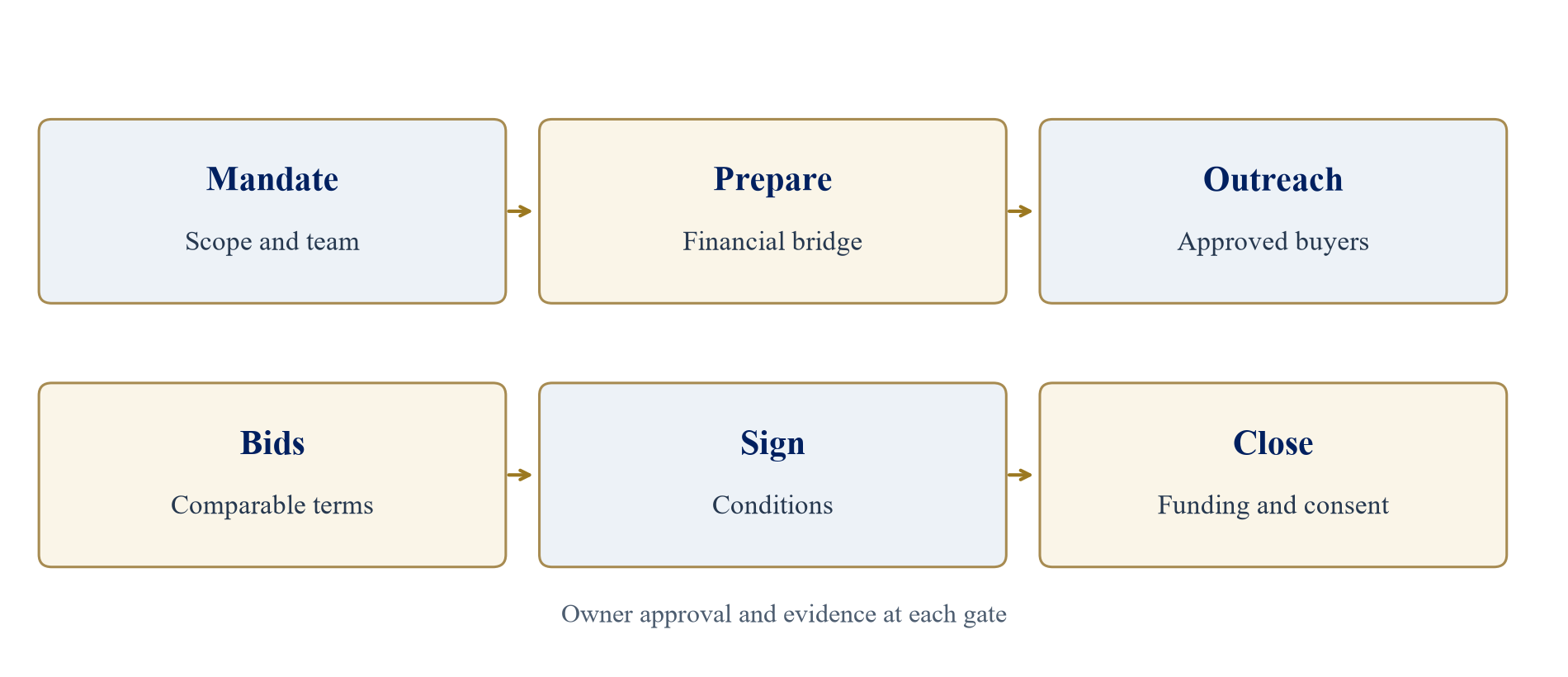
Author-developed process map. Durations are intentionally absent because no transaction-specific timetable has been verified.
The timeline should identify dependencies that the adviser controls and those it coordinates. The adviser can prepare the information memorandum, maintain an outreach log and compare bids. The owner must approve disclosures and negotiate an acceptable outcome. Lawyers advise on documents, tax and legal permissions; buyers arrange their financing; authorities decide any required clearance. A clear dependency map protects the seller from attributing every delay to a single actor and makes a missed adviser deliverable visible.
A weekly issues record can capture the planned gate, required output, owner, actual status, evidence and next action. It should track decisions as well as documents. If a buyer requests exclusivity before providing financing evidence, the adviser should explain the commercial consequence and possible conditions. If a board defers approval, the record should show the decision date and reason. Process control is a service a seller can specify and assess across adviser types.
9 Calculate net seller proceeds before comparing fees
The owner should compare adviser economics under identical transaction assumptions. Let cash paid at completion be C; seller debt repaid from that cash be D; transaction expenses borne by the seller be X; and the adviser's fee under the relevant contract be F. A simple pre-tax completion-proceeds illustration is C minus D minus X minus F. Actual proceeds can also reflect working-capital adjustments, escrow, earn-outs, rollover equity, shareholder loans, taxes and timing. The owner and counsel should model those items for the real transaction.
The fee comparison must use the same value definition. One contract may apply a percentage to equity value; another may define transaction value to include assumed debt, deferred consideration, non-cash securities or an intra-group transfer. A lower percentage can produce a higher invoice on a broader base. A minimum fee or retainer that is not creditable against success fees can matter greatly if the sale is delayed or withdrawn. The seller should request worked invoices for at least a clean cash sale, a debt-assumption sale, a partial sale and a no-close outcome.
The incremental-fee test is simple. If Adviser A costs an additional amount ΔF after considering retainer credits, expenses and closing triggers, the seller needs more than ΔF of realised additional value, or an equivalent risk-adjusted benefit, to improve net proceeds. The expression does not claim that A can create that value. It identifies the economic burden that a service difference must overcome. A price increase payable only in contingent consideration may not cover a fee payable in cash at completion.
Figure 2 is a bridge rather than a performance forecast. It keeps the uncertain uplift, incremental execution costs and fee difference in separate boxes. A board should write assumptions and decision dates next to the boxes. It should not take an adviser pitch about a richer buyer pool as an observed uplift.
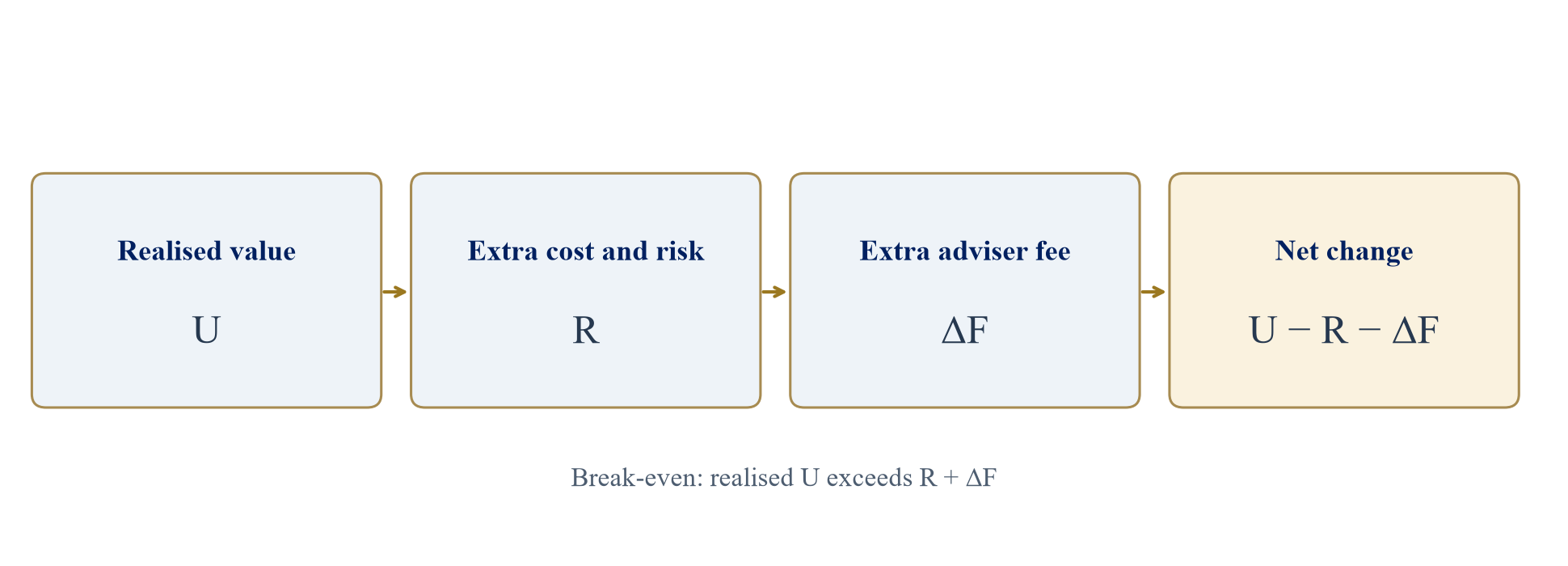
Author-developed symbolic calculation; no adviser uplift, probability or market fee is estimated.
10 Treat size as an interaction, not a cutoff
Transaction size can change the feasible set of advisers. A small mandate may be below a global firm's minimum fee or senior attention threshold; a large transaction may demand a breadth of distribution, financing and risk management that a single narrow team cannot supply. Those are possible mechanisms, not empirically measured thresholds here. The owner should ask each firm directly about minimum economics, allocation rules, conflicts and the named people's time. A quote for the mandate is more informative than an assumed industry rule.
The effect of size interacts with complexity. A modest but highly regulated business may benefit from the specialist attention of a boutique and the additional permission or financing capacity of other professionals. A large but straightforward domestic sale may attract numerous credible advisers without needing the full resources of a global bank. The relevant dimensions include buyer geography, sector specificity, number of owner approvals, funding needs, disclosure sensitivity and separation work. A two-dimensional buyer-and-work map is more informative than a one-dimensional enterprise-value band.
The owner should also consider the sale's place in the adviser's own portfolio. For one firm it may be a flagship mandate with senior leadership committed; for another it may be a routine transaction assigned to a junior team. “Attention” needs operational definition: scheduled senior reviews, direct negotiation attendance, turnaround commitments and replacement rules. Small firms can overcommit; large firms can allocate substantial senior resources. The proposition must be evidenced for the current assignment.
No published source reviewed here provides a validated UAE private sell-side amount at which a boutique becomes inferior or a global platform starts to pay for itself. Even a consented cohort would need to control for selection and deal complexity. The sensible present practice is to model a range of sale outcomes and ask whether the proposed additional work could change the probability, price, terms or risk enough to justify its fee. The answer remains case-specific and uncertain.
11 Run three distinct mandate contexts through the same questions
Table 2 presents fictional sales to expose how a single label can hide different assignments. No company, adviser or outcome in the table is observed. In Context A, a profitable founder-owned software business has clean accounts and a few plausible strategic acquirers. A specialist could have deep buyer relationships and founder attention; a global platform could offer a wider cross-border map. The seller should ask which approach reaches credible decision-makers without releasing sensitive product information too early.
In Context B, a regional engineering business has contracts, guarantees and working-capital demands spread across countries. The valuable work may be a contract-by-contract earnings bridge and buyer financing analysis rather than an enormous outreach list. A boutique with operating-sector depth could lead if it can coordinate those functions. A larger institution could lead if its sector, debt and cross-border teams are genuinely staffed. Both proposals need an agreed route to reconcile risks before a buyer discounts the asset in diligence.
In Context C, a financial-services carve-out faces licence, technology-separation and continuing-service issues. A global bank may mobilise regulated-sector coverage and international buyers. A narrow expert may see the key separation problem earlier and work with a coordinated team. The owner needs legal review of entity permissions, data transfer and buyer suitability. The comparison tests the proposed work architecture; it does not prescribe a winning adviser class.
Table 2. Fictional mandate contexts and adviser tests
| Sale context | Critical execution work | Specialist-adviser question | Global-platform question |
|---|---|---|---|
| Founder-owned software company | Protect sensitive data while reaching acquirers with product fit | Which named decision-makers can the team access? | Which additional buyers and sector people are committed? |
| Regional engineering contractor | Reconcile project earnings, guarantees and buyer financing | Who builds the contract-risk bridge and financing route? | Which sector and debt teams will deliver named outputs? |
| Regulated financial-services carve-out | Define separation, permission and transition services | How are licensed and technical specialists coordinated? | Who owns the cross-team handoffs and conflicts? |
Entirely hypothetical examples for decision design; no price, adviser performance or transaction outcome is observed.
All three contexts should be sent to advisers in a consistent format only when they match the real transaction. The seller can add actual asset facts, ask for a written process proposal and compare the points where firms disagree. Disagreement can be valuable: it may reveal a hidden risk or a different buyer route. The board should document why one view is more credible, what evidence supports it and which issue remains uncertain.
12 Price the real contract, including tail and termination
The fee letter is part of the production system. It tells the adviser what work is paid for, how success is defined and what happens if the owner pauses, changes scope or closes with a buyer after termination. A retainer may fund preparation, be creditable against a success fee or remain additional. Expenses may be capped or passed through. A fee might trigger at signing, completion, a later contingent payment or another event. The seller should understand those differences before asking which headline percentage is lower.
A public US transaction filing illustrates why fee architecture deserves attention. KORE Group disclosed a financial-adviser arrangement with retainer, opinion and completion-contingent components [7]. That filing shows how a real disclosed contract can separate payment events; its amount and structure are not a benchmark for a private UAE mandate. A seller should derive its own calculation from the proposed engagement letter, legal advice and actual transaction structure.
The definition of “transaction value” should be tested against assumed debt, seller loan repayment, management rollover, retained shares, earn-outs, escrow, working-capital adjustment and a sale to an affiliate. The legal consequences of a tail depend on its words. The owner should ask which parties are covered, how the list is recorded and updated, how long the period lasts, whether a completed transaction must be materially similar to the mandated one and what fee is payable if another adviser performs later work. The result should be written in example invoices.
The fee should also be linked to deliverables and staffing, without confusing payment with control of the owner. A retainer may be justified by substantive preparation even if no sale follows. A large success fee may incentivise closing but can create pressure around price, contingencies or buyer selection. The seller should specify review gates and approvals. Negotiation of fee terms belongs with contract counsel; this paper provides commercial questions, not legal drafting instructions.
13 Examine conflicts when capital and M&A advice intersect
A global platform may have lending, underwriting, trading, asset-management or prior advisory relationships with a potential acquirer. A boutique may have investors, referral partners, shareholders or other live client mandates that create incentives. Neither organisational form is inherently conflict-free. The seller should ask which legal entity will act, what other economic interests could touch the buyer universe and how new conflicts will be detected as the process evolves.
The DFSA's January 2026 thematic review discusses conflicts of interest across DIFC firms [5]. It is a regulator publication within that perimeter, not a universal rule for all advisers. Public registers for DIFC and ADGM entities provide a way to check a named entity's publicly recorded status and activities where relevant [6, 8]. These checks do not establish that a particular team is conflict-free or permitted in every jurisdiction. The actual agreement, activity and location need transaction-specific legal review.
A conflict record should cover buyer and lender relationships, any fee from financing, fairness opinions, referrals and information-sharing within a group. It should state who evaluates a new conflict, what disclosures can be made, how confidential information is separated and whether the owner can approve, restrict or terminate the affected work. An adviser should explain the consequence of a preferred buyer becoming a financing client during the process. The seller can make that question concrete before granting the mandate.
Conflict analysis connects directly to value. A financing desk may increase the number of executable bids; it may also have incentives over lending terms or fees. A specialist adviser may rely on third-party capital providers; referral economics should be visible. The owner can preserve the benefit of resources while requiring transparent decision rights and a documented basis for recommendations. The most useful proposal is one that identifies its actual trade-offs.
14 Protect confidential information while creating competition
Buyer reach can increase value only if the seller can control information. A broad international process may expose commercial data to competitors, employees, lenders and regulators. A narrow process can preserve confidentiality while reducing price discovery. The adviser should propose a disclosure ladder: anonymised teaser, confidentiality agreement, controlled information memorandum, deeper diligence after credible interest and restricted access to sensitive records. Competition-law and other information-sharing rules require legal advice for the actual parties.
Each firm should explain how it will qualify a buyer before disclosing more information. The screen can ask for strategic rationale, decision authority, financing route, timetable, regulatory feasibility and tolerance for the proposed sale perimeter. A famous name on a list is not equivalent to an executable bid. The record should show who approved contact, what was shared and how responses were evaluated. This is especially important when family shareholders, employees or a government-linked counterparty could be affected by rumours.
An adviser with numerous relationships may face several potential confidentiality pathways. The owner should ask whether information will move to other offices or product teams and what permissions and walls apply. A small firm should explain its own document security, subcontractor controls and partner arrangements. Neither a global data room nor a small-team promise removes the need for a transaction-specific protocol.
The process should preserve an option to widen or narrow outreach. The board can authorise a first wave, inspect credible feedback and decide whether more buyers improve expected value enough to justify added exposure and management time. Adviser proposals can be evaluated on how they create that reversible decision, including triggers for a route change. A fixed claim that every sale needs a wide auction or a private bilateral approach is too blunt for the owner’s particular risk.
15 Compare bids on economic and execution terms
Price is one bid dimension. A high headline value can depend on aggressive earn-out conditions, uncertain financing, broad indemnities, prolonged regulatory approvals or a large rollover obligation. The adviser should show a common bid-comparison template that separates cash at closing, deferred cash, contingent consideration, assumed debt, working-capital adjustments, tax exposures, conditions, exclusivity and closing certainty. It should identify which terms are verified, which are buyer assertions and which require specialist advice.
The buyer's funding route is a critical variable. A sponsor may need committed acquisition debt; a strategic buyer may have its own balance sheet but still require board approval; a management team may depend on several providers. The adviser should request financing evidence appropriate to the stage and avoid presenting non-binding indications as funded offers. Financing support from a large platform could be valuable if it changes the executable bid set. A specialist could secure the same benefit through independent lenders. The source and cost of that capability should be explicit.
Negotiation quality also includes protecting fallback options. An adviser may persuade a seller to grant exclusivity to secure a strong bid; the owner should know what diligence, funding, timetable and termination protections it receives. A broad process may create leverage but can exhaust bidders if deadlines or information requests are poorly managed. The seller should judge whether the proposed team can compare offers, maintain constructive competition and explain why a seemingly lower bid might yield higher risk-adjusted proceeds.
These are deliverables that can be compared before appointment. Ask for a redacted bid-summary template, a proposed financing-evidence checklist and a decision memo format. A proposal that explains how offers will be turned into a board decision is stronger evidence of process design than a generic promise to “maximise value.” It remains a proposal, not proof that value will be achieved.
16 Align specialist, financing and legal handoffs
Most private sales need several professions. The investment-banking adviser can coordinate commercial work but should not be presented as replacing legal, tax, accounting, technical or regulatory advice. A global firm may have more internal specialists; a boutique may work with external professionals. The owner should see a handoff map that states who owns the question, which specialist provides the answer and how the result enters the sale materials or bid negotiation.
Handoffs are most valuable when they occur before a buyer uses uncertainty to renegotiate. If audited earnings and management accounts differ, the financial adviser and accountant should reconcile them before broad outreach. If a licence or contract needs consent, counsel should assess the route before the timetable is sold to bidders. If a buyer will rely on project cash flows, sector and debt specialists should test the funding assumptions before a headline offer is treated as executable. The adviser should maintain a single issues register so that each answer has an owner and date.
The proposed coordination cost belongs in the fee comparison. A platform may include some internal work in its mandate price while charging separately for other services. A boutique's lower fee may be accompanied by third-party costs the owner would incur anyway. Neither structure is automatically cheaper. Table 3 asks for the full list of deliverables and cost triggers, including the work the seller must fund separately.
The owner should protect professional independence where it matters. An adviser with a financing mandate may present financing options; a lawyer or accountant should provide its own professional judgment. The adviser-selection file should record that the workstreams have suitable expertise and clear responsibilities. The result is a coherent execution team selected for the actual asset, not an abstract contest between organisational forms.
Table 3. Fee and deliverables checklist for a sell-side mandate
| Item | Evidence or calculation to request | Decision consequence |
|---|---|---|
| Entity and team | Signing entity, accountable lead, named workstreams | Verify responsibility and permission route |
| Preparation | Financial bridge, information memorandum, data-room plan | Define paid work before outreach |
| Buyer process | Approved universe, contact log, response and bid templates | Make distribution and control inspectable |
| Specialist support | Named resources, external advisers, cost ownership | Capture full execution budget |
| Retainer and expenses | Invoice dates, credit, cap and approvals | Model no-close and delayed-close cost |
| Success fee | Value base, minimum, signing and closing triggers | Compare identical sale scenarios |
| Deferred value | Earn-out, escrow, rollover and later payments | Check cash timing and fee burden |
| Termination and tail | Notice, dated party list, scope and duration | Model later-sale obligations |
| Conflicts and changes | Disclosure, consent, team replacement and new work | Preserve owner decision rights |
Author-developed contract-review questions; legal drafting and fee arithmetic require the actual proposal.
17 Design a disciplined shortlist and interview
The shortlist can include several adviser structures without assuming one will win. The owner can invite a specialist, a larger platform and, where relevant, a coordinated adviser group. Each should receive the same transaction specification and confidentiality conditions. The request should ask for a buyer thesis, named team, proposed sale route, preparation plan, timeline dependencies, specialist map, relevant deal roles, conflicts, legal entity and fee worked examples. The owner can add transaction-specific questions after identifying risks in the first responses.
Interviews should include the people who will execute the work. Ask the proposed lead to explain a difficult comparable mandate, the analyst to describe the first information requests and the cross-border or financing specialist to state exactly when they would be engaged. Present a realistic obstacle: a missing customer contract, financing gap or owner disagreement. The response can reveal how the team separates evidence from assumption, escalates a decision and coordinates advisers. A polished sector slide cannot answer those operational questions on its own.
References should be permissioned and specific. The owner can ask a prior client what the named people did, where the process stalled, how unexpected costs were handled and whether the team remained engaged near closing. Reference selection bias remains: advisers propose clients likely to speak well of them. The owner can record that limitation and corroborate public facts where possible. It should respect confidentiality and avoid treating an absent reference as proof of poor capability.
After interviews, the board should document the conditions under which its preferred adviser would be appointed. A selection memo can list decisive strengths, accepted gaps, proposed mitigations, unresolved conflicts, legal review, economic scenarios and the alternative that would be chosen if a condition fails. This avoids a late appointment driven solely by prestige or the lowest quoted percentage.
Figure 3 places two qualitative dimensions in a decision conversation. Buyer breadth and execution complexity should be assessed separately. The quadrants do not imply that one adviser class wins in any cell; they indicate which capabilities must be tested. A narrow buyer set with complex separation can require focused technical leadership. A broad buyer set with simple preparation can put distribution and disciplined information control at the centre. The figure helps the board write a mandate specification before receiving pitches.
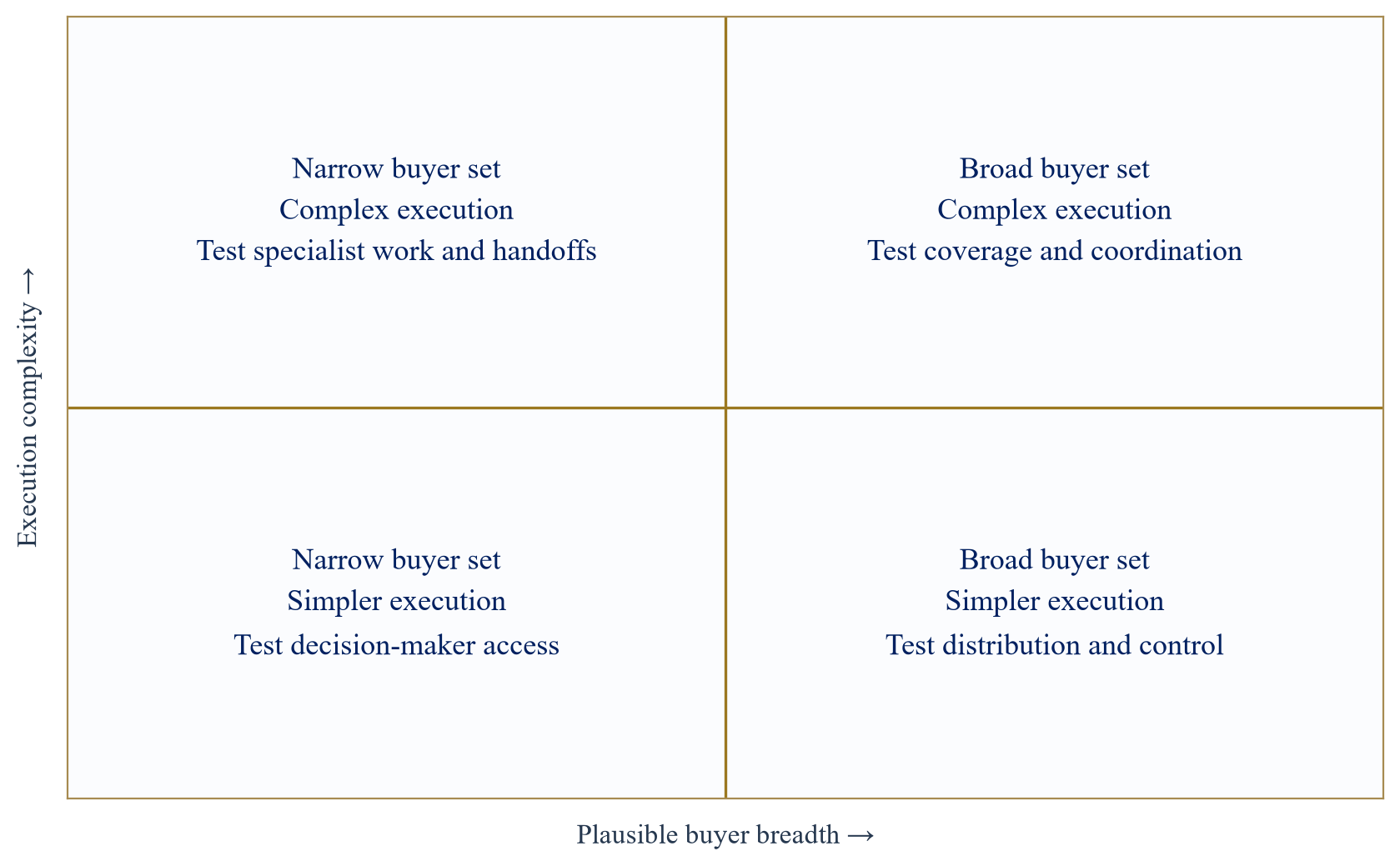
Author-developed qualitative map. Quadrants identify questions to test, not adviser rankings or transaction-value thresholds.
18 State the empirical test that remains unavailable
The central research question is whether adviser scale changes seller outcomes after considering fees and transaction characteristics. This paper has no private UAE mandate-level dataset to answer it. A credible study would need owner consent, confidentiality controls, a defined sampling frame and records for completed, withdrawn and unsuccessful mandates. Completed public announcements alone omit the denominator and can create a misleading picture of performance.
An observation should link a seller mandate to the pre-appointment adviser proposal, named team, transaction perimeter, buyer route, fee contract, process events and final outcome. Adviser scale would need several measures: balance-sheet-backed financing access, geographic network, sector specialists, staff hours and deal-team seniority are different variables. Boutique specialisation should be defined by the service and market addressed, not only by firm headcount. Outcomes should include cash proceeds, contingent value, fee-adjusted proceeds, elapsed time at distinct stages, abandonment and owner objectives.
Selection bias is unavoidable in a simple comparison. Larger deals may choose global institutions because of complexity, and strong targets may receive better staffing offers. Smaller specialist firms may accept difficult mandates that large firms decline. A prospective, pre-specified design could record each owner's initial alternatives and decision reasons. Matching or regression on observed characteristics would help describe associations; it would not automatically create a causal estimate. Identification would require careful attention to unobserved deal quality and adviser choice.
The analysis should examine interactions rather than search for one universal deal-size cutoff. It could test whether cross-border buyer breadth, financing dependence, sector complexity or confidentiality modifies the relationship between adviser structure and net outcomes. It should report missingness, confidentiality-driven exclusions and sensitivity to fee definitions. No threshold, coefficient, close-rate improvement or uplift is claimed here. The proposed design is a research agenda, not a completed empirical result.
19 Keep claims and transaction data in separate evidence classes
A seller's file will combine public records, adviser assertions, confidential references, modelled proceeds and executed documents. Those sources have different evidentiary value. A public regulator register can show a firm's recorded status in a jurisdiction at a date, subject to the register's scope. A public announcement may confirm that a transaction occurred, but may not reveal the fee, team's tasks or the seller's net proceeds. A confidential reference may describe team conduct while reflecting the adviser's choice of referee.
The board should label each claim in its internal file by source and date, without exposing confidential material in a publication. A buyer relationship can be supported by a permissioned introduction and current role statement. A proposed price uplift is a scenario until a buyer provides a written offer and its conditions are understood. A claimed closing capability can be tested against a workplan, financing route and approvals map. Keeping those classes distinct avoids turning a pitch into a verified outcome.
Research access creates separate duties. A future dataset of mandates would contain client finances, bids, employee details, adviser fees and perhaps material non-public information. Consent should define permitted uses, storage, retention, publication and withdrawal. Aggregate findings should avoid combinations that identify a private deal. A lack of access should be reported as a limitation; it is not a licence to reconstruct private outcomes from visible transactions or invented examples.
The present paper uses only published studies, official records and one public transaction filing for its factual examples. Its three sale contexts, diagrams, matrix and break-even bridge are original analytical devices. They are not Matchpoint client results and should not be read as evidence that one adviser type consistently outperforms another. Legal, tax, accounting and regulatory conclusions depend on the actual parties and jurisdictions.
20 Make an appointment that can be defended later
The final selection memo should open with the seller's objectives and the transaction specification. It should then compare the named teams, demonstrated buyer routes, specialist work, conflicts, relevant permissions, process deliverables and full fee economics. Each material claim should have a source, date and reviewer. Accepted uncertainties should be visible. The preferred adviser can be appointed with conditions on staffing, conflict handling, scope, fee arithmetic, information control and reporting gates.
During execution, the same file can track whether the contracted work is delivered. The adviser should report completed preparation, approved outreach, written buyer responses, bid comparisons, financing evidence and late-stage conditions. The owner should record its own decisions promptly. Where the workplan changes, the parties should agree a revised output and cost before assuming that the original mandate covers it. This makes accountability more useful than a retrospective claim that a brand should have performed better.
An owner may rationally choose a specialist, a global institution or a coordinated group. The answer depends on the asset, buyer universe, financing route, team actually assigned and commercial contract. Published adviser studies provide hypotheses about quality and experience [1–4]; official registers and conflict guidance support particular diligence checks [5, 6, 8]. They do not establish a price threshold for this market. The owner can make a well-supported decision today by buying a defined service with testable work products and transparent economics.
The open research question remains important. A consented cohort could eventually show whether the extra reach and resources of scale are associated with higher fee-adjusted proceeds for certain private sellers, or whether focused attention dominates in others. Until those data exist, the defensible result is a mandate decision that states its assumptions, identifies its people and records how the proposed process is supposed to create value.
References
- Song, W., Wei, J. D. and Zhou, L. “The Value of ‘Boutique’ Financial Advisors in Mergers and Acquisitions.” Journal of Corporate Finance 20, 2013, pp. 94–114. https://www.sciencedirect.com/science/article/pii/S0929119912001277
- Alexandridis, G. et al. “Do Boutique Investment Banks Have the Midas Touch? Evidence from M&As.” European Financial Management, 2024. https://onlinelibrary.wiley.com/doi/10.1111/eufm.12425
- Golubov, A., Petmezas, D. and Travlos, N. G. “When It Pays to Pay Your Investment Banker: New Evidence on the Role of Financial Advisors in M&As.” Journal of Finance 67(1), 2012. https://onlinelibrary.wiley.com/doi/10.1111/j.1540-6261.2011.01712.x
- Chemmanur, T. J., Ertugrul, M. and Krishnan, K. “Is It the Investment Bank or the Investment Banker? A Study of the Role of Investment Banker Human Capital in Acquisitions.” Journal of Financial and Quantitative Analysis, 2019. https://doi.org/10.1017/S002210901800073X
- Dubai Financial Services Authority. “New DFSA Thematic Review: Conflicts of Interest across DIFC Firms.” 9 January 2026. https://www.dfsa.ae/news/new-dfsa-thematic-review-conflict-interest-across-difc-firms
- Dubai Financial Services Authority. Public Register of Firms. Accessed 6 October 2026. https://www.dfsa.ae/public-register/firms
- KORE Group Holdings, Inc. Definitive Merger Proxy Statement, financial-adviser fee disclosure. U.S. Securities and Exchange Commission, 2026. https://www.sec.gov/Archives/edgar/data/1855457/000114036126025086/ny20068726x6_defm14a.htm
- Abu Dhabi Global Market Financial Services Regulatory Authority. Public Registers. Accessed 6 October 2026. https://www.adgm.com/public-registers/fsra
- Bao, J. and Edmans, A. “Do Investment Banks Matter for M&A Returns?” Review of Financial Studies 24(7), 2011. https://doi.org/10.1093/rfs/hhr004
- “European Banking M&As: The Role of Financial Advisors.” Review of Quantitative Finance and Accounting, 2024. https://link.springer.com/article/10.1007/s11156-024-01287-z
About the Author
Chennakeshav (CK) is a corporate finance and investment banking executive with 25+ years of global experience in deal origination, structuring and execution across M&A, growth capital and corporate strategy. He has led value-creation mandates for founders, corporates and funds — bridging the boardroom view to hands-on execution and close.
His career spans Morgan Stanley, HSBC, Lloyds Banking Group, EWEC, ADQ portfolio companies and Emirates Growth Fund, across TMT, real estate, fintech, deeptech, cleantech, infrastructure and energy. He has partnered with C-suite leaders, private equity and venture funds, sovereign wealth funds and family offices to finance complex fund raises and scale-up ventures, and has led M&A due diligence, post-merger integration and business-transformation initiatives to create value.
At Matchpoint Partners he is Managing Partner, leading the firm's corporate finance, M&A and capital-raising practice. He holds an MBA from London Business School, an engineering degree from VTU and a Master of Laws (LLM, in progress) from UCL London.
An active start-up mentor, CK mentors at Techstars, DIFC FinTech Hive, Startup Grind, Founder Institute and IN5, serves as Entrepreneur Mentor in Residence (EMiR) at London Business School, and judges the Entrepreneurship World Cup.
