

1. The transaction decision before the clock starts
An accelerated sale can preserve operations and employment, yet workforce and pension issues can also stop the process after a buyer has invested time and credibility. The board needs to know which employees transfer, what amounts are already owed, which consultations or notices are required, whether critical people will remain, and whether a pension scheme or regulator can affect structure, timing or value. These are transaction questions because each answer changes the perimeter, the funding requirement, the buyer's liabilities and the probability of completion.
The first decision is whether the proposed route is capable of a lawful and operational transfer within the available liquidity. A share sale, asset sale, pre-pack, administration sale, solvent accelerated sale and closure create different consequences. The legal entity employing each person, the location where work is performed, the pension arrangement and the identity of the business being transferred all matter. Management should avoid assuming that payroll moves simply because assets, contracts or customers move.
This paper proposes an evidence-led control system. It begins with perimeter and authority, converts workforce and pension facts into quantified scenarios, and links consultation, funding, retention and transfer milestones to the sale timetable. Qualified employment, pensions, insolvency, tax and regulatory advisers determine the applicable law. The framework gives the board and buyer a common operating record for making decisions under pressure.
2. Why workforce uncertainty destroys transaction value
Employees carry customer knowledge, licences, system access, production capability, safety responsibilities and the practical memory of how a business operates. A buyer may acquire assets and contracts yet fail to obtain the people required to deliver them. Rumour, unpaid wages, unclear management authority or a poorly explained transfer can accelerate departures before completion. The resulting loss may appear first as service failure, delayed billing, quality defects or a customer termination rather than an explicit labour cost.
Transaction teams therefore need a consolidated exposure map. The map covers people required to transfer, employees likely to be redundant, accrued and contingent employment claims, pension contribution status, defined benefit obligations, trustee and regulator engagement, immigration dependencies, collective arrangements, insurance and management incentives. It also records the evidence quality and the date at which each figure was tested. This converts a diffuse human-resources workstream into a board-level transaction control.
3. Define the sale perimeter before counting liabilities
The perimeter should identify the selling entities, transferring business, retained operations, buyer, jurisdictions, sites, contracts, systems and proposed closing mechanism. The employee map then assigns each person to a legal employer, payroll, work location, business activity and proposed destination. Shared-service employees, matrix managers, secondments, agency workers, contractors and people working across several businesses require deliberate treatment. A cost-centre allocation alone may not establish legal or operational attachment.
The pension perimeter should identify every occupational, contract-based and statutory arrangement connected to the relevant entities or employees. The register distinguishes defined benefit, defined contribution, hybrid, insured, trust-based, unfunded and overseas arrangements. It records participating employers, controlled-group or group relationships, active and deferred members, contribution schedules, guarantees, security, indemnities, administration dependencies and any open dispute or regulatory engagement.
Perimeter decisions should be version-controlled. A buyer may initially seek all operations and later exclude a site, liability or jurisdiction. Each change can alter employee allocation, consultation groups, pension covenant, costs and separation requirements. The board should require an updated workforce bridge whenever the perimeter changes. The bridge states who moves, who remains, who may be redundant, what claims arise, what funding is needed and what buyer obligation changed.
Table 1. Proposed workforce and pension perimeter register
| Field | Evidence | Transaction use | Escalation trigger |
|---|---|---|---|
| Employing entity | Contract, payroll and corporate records | Allocate employees and claims | Records conflict or employer is outside perimeter |
| Assigned business | Role, activity, manager and revenue evidence | Test operational transfer | Shared or disputed allocation |
| Employment terms | Contract, policies, collective terms and amendments | Price and transfer obligations | Missing or non-standard terms |
| Pension arrangement | Scheme rules, provider data and participation records | Identify transfer and funding work | DB participation or contribution arrears |
| Criticality | Service, licence, customer and system dependency | Retention and continuity plan | No trained replacement within timetable |
| Jurisdiction | Work location, governing law, visa and payroll | Determine local process | Cross-border or sponsored-worker dependency |
The register requires legal and specialist validation for the relevant transaction and jurisdictions.
4. Establish authority and protect the decision record
Accelerated conditions do not remove directors' duties, employment obligations, trustee responsibilities or insolvency-practitioner authority. The board should approve a workforce and pension mandate that identifies who can propose changes, communicate with employees, negotiate retention, contact trustees, commit funding and share personal data. If an office holder is appointed, the control system must reflect the authority created by the relevant insolvency process.
The decision record should connect each action to facts, advice and financial consequences. It includes the proposed transaction route, affected population, consultation analysis, cash availability, claim estimates, pension position, buyer request, alternatives considered and approval. A later challenge may turn on what management knew at the time and whether it followed a reasonable process. Contemporaneous records are more useful than a retrospective narrative assembled after completion.
Authority should be narrow enough to prevent contradictory commitments. Managers can explain current operations and gather concerns, while changes to terms, redundancy proposals, buyer assurances, trustee mitigation and settlement positions should follow defined approval limits. Every message should distinguish current facts from proposals and conditions. The same approved data should feed the board pack, buyer diligence, employee process, pension engagement and weekly cash forecast.
5. Build the evidence room around decisions
The workforce data room should answer the buyer's operational and liability questions without releasing unnecessary personal data. A staged structure can begin with anonymised headcount, roles, locations, pay bands, tenure, vacancies, contractors, absence, turnover and critical skills. Later access can include controlled individual records where lawful, necessary and appropriately protected. The purpose of each disclosure should be recorded.
Data quality is a transaction variable. Payroll may not reconcile to the HR system. Employees may work for a different entity from the one invoicing customers. Contribution reports may lag cash payments. Legacy promises may sit in letters or collective agreements. Management should preserve each source, assign an owner, record the cut-off date and maintain an exception log. The buyer needs a traceable bridge from source records to the figures used in the bid and completion plan.
6. Employment transfer analysis is route specific
UK guidance explains that TUPE can protect employees when a business or part of a business changes employer, including continuity of employment and many existing terms. Whether the rules apply depends on the facts and legal route. Insolvency can change how particular protections operate, and the buyer's proposed measures may create information or consultation requirements. The transaction team should obtain current advice rather than use a generic transfer assumption [1][2].
A share sale generally leaves the legal employer unchanged at completion, although post-close integration, restructuring and benefit changes can create separate issues. An asset sale may require analysis of which organised economic activity transfers and which employees are assigned to it. A carve-out can expose mixed roles, shared services and systems that the parties must separate or support through transitional arrangements.
The model should maintain alternative populations until the legal and operational analysis converges. One scenario can assume transfer, another retention by the seller and a third redundancy or re-engagement. Each route has different cash, consent, consultation, service and buyer-value consequences. The board should approve the perimeter only when the selected population is compatible with the legal mechanism and the buyer's operating plan.
7. Information and consultation must enter the timetable
UK Government guidance requires relevant information to be given to trade union or employee representatives before a covered transfer and consultation about measures that affect employees. The permitted direct-consultation route depends on workforce and transfer size. For transfers completing from 1 July 2024, the guidance describes circumstances in which employers with fewer than 50 employees or transfers involving fewer than 10 employees may consult directly when no existing representatives are in place [3].
Collective redundancy consultation is a separate analysis. Acas states that collective consultation is required where an employer proposes 20 or more redundancies at one establishment within 90 days. Advance notification to the Redundancy Payments Service is also a distinct obligation, and the HR1 process carries its own timing and compliance consequences [4][5]. A sale timetable that ignores these steps can create liabilities or make the proposed completion sequence unworkable.
The transaction plan should map affected groups, representatives, required information, proposed measures, election mechanics, consultation start, decision gates, notice requirements and communications. The process should remain genuine. Management should keep alternatives open while consultation is ongoing and document how proposals change in response to information received. The buyer must provide timely information about measures it envisages so the seller can run an informed process.
8. Employee liability information requires disciplined preparation
UK guidance states that the outgoing employer normally must provide specified employee information to the incoming employer at least four weeks before a transfer. The information includes core employment details and certain disciplinary, grievance and legal-action information [6]. An accelerated sale may have less commercial time than this. The parties need qualified advice on the timetable, available steps and transaction protections.
The seller should prepare the underlying records before a buyer is selected. A standard pack can include the employee population, employment particulars, continuous-service dates, pay, hours, holiday, benefits, collective agreements, family-leave status, disciplinary and grievance matters, litigation, adjustments, sponsorship and relevant measures. Each field needs a source and exception status. Missing contracts or uncertain service dates should be visible rather than silently normalised.
The buyer should reconcile information to payroll, organisation charts and operational requirements. A warranty does not replace the ability to pay people or deliver services on the first payroll after close. The completion plan needs payroll files, bank authority, tax records, benefit enrolment, timekeeping, leave balances and named owners. Where personal data is shared, the parties should use purpose limitation, access controls and current data-protection advice.
9. Quantify employee claims before negotiating price
The claims inventory should separate amounts already earned from amounts triggered by a proposed action. Accrued wages, holiday, expenses, commission and pension deductions require source reconciliation. Notice, redundancy, protective awards, unfair-dismissal exposure, discrimination claims, transaction bonuses, retention payments and change-of-control terms require scenario analysis. Each claim should show gross amount, employer taxes, timing, legal priority, insurance or government recovery route, and who bears it under the transaction documents.
In insolvency, statutory schemes may meet eligible employee claims within legal conditions and limits. UK Insolvency Service guidance identifies separate payment components and, for dismissals on or after 6 April 2026, a weekly-pay cap of GBP 751 and a maximum statutory redundancy payment of GBP 22,530. Excess amounts may remain claims in the insolvency [7]. These figures can change, and a live transaction should use the applicable date and current guidance.
The deal model should avoid treating government-supported claims as costless. Timing, eligibility, documentation, employee cash stress and estate recoveries still matter. The Insolvency Service requires case setup information and a reference before eligible employees can apply. Its guidance also instructs insolvency practitioners to contact the service when a business sale follows case submission and employees may transfer [8]. Accurate population and transfer data therefore affect both employee outcomes and estate administration.
Table 2. Proposed employee claims inventory
| Claim category | Primary source | Modeling basis | Transaction question |
|---|---|---|---|
| Wages and holiday | Payroll, time and leave records | Earned to cut-off plus taxes | Paid pre-close, assumed or claimed? |
| Notice and redundancy | Contract, tenure and proposal | Route-specific statutory and contractual case | Which entity and process bears cost? |
| Bonus and commission | Plan rules and performance data | Earned, discretionary and triggered amounts | Does completion accelerate payment? |
| Protective or litigation exposure | Process record and claims | Probability-weighted case range | Can process repair reduce risk? |
| Retention and transition | Critical-role plan and signed terms | Cash timing and completion condition | Which roles must stay through transfer? |
| Pension deductions and contributions | Payroll, provider and bank evidence | Reconciled arrears and correction cost | What must be funded before or after close? |
Amounts, eligibility, priority and payer require current legal, tax and insolvency advice.
10. Pension contributions require cash reconciliation
Defined contribution arrangements can appear simpler than defined benefit schemes, yet unpaid or misallocated contributions create immediate credibility and compliance problems. The company should reconcile employee deductions, employer contributions, payroll files, provider submissions and bank payments for each pay period. A schedule should identify timing differences, true arrears, rejected files, refunds, leavers and employees on statutory leave.
UK guidance states that employers must pay minimum workplace-pension contributions on time and backdate missed payments. Insolvency technical guidance also describes routes through which trustees may claim certain outstanding employer or employee contributions from the National Insurance Fund, subject to statutory limits and conditions [9][10]. The transaction team should confirm the exact position with the scheme, provider, insolvency practitioner and advisers.
The buyer needs a clean opening position. A completion account or purchase-price mechanism should distinguish contributions belonging to pre-close payroll from post-close obligations. The transition plan should preserve payroll codes, employee elections, provider access, data interfaces and communications. A cash reserve may be appropriate where reconciliation is incomplete. The reserve should respond to evidence and legal allocation rather than a broad percentage of payroll.
11. Defined benefit exposure changes the stakeholder map
A defined benefit scheme introduces trustees, advisers, The Pensions Regulator and potentially the Pension Protection Fund as important stakeholders. The economic issue is the employer's ability to support promised benefits and the effect of the transaction on that support. A sale may remove assets, cash flows, guarantees or group companies from the covenant. It may also preserve a viable employer, improve funding or create a new support package.
The board should assemble a pension transaction pack early. It identifies sponsoring and participating employers, scheme membership, funding measures, security, contingent assets, group support, contribution schedules, recent actuarial information, covenant assessments, trustee governance and transaction effects. It should show the proposed flow of sale proceeds and financing, including new security or distributions that could affect the scheme.
The analysis should test the pension outcome under each executable route: immediate insolvency, accelerated going-concern sale, share sale, asset sale, regulated apportionment or other restructuring. The relevant legal measures and valuation bases differ. A headline scheme deficit in financial statements is one input and should not be presented as the transaction settlement amount or insolvency claim without specialist analysis.
12. Trustee engagement should begin with evidence
The Pensions Regulator expects trustees to understand and manage events that may affect a defined benefit scheme, including employer distress, restructuring and corporate transactions. Its guidance highlights timely member communications, covenant impact and contingency planning [11]. Trustees must act for scheme beneficiaries and need sufficient information to evaluate the proposed transaction and alternatives.
Management should prepare before approaching trustees. The pack should explain liquidity, transaction route, perimeter, buyer funding, proposed security, sale proceeds, downside case, milestones and requested decision. It should also identify commercially sensitive information and the proposed confidentiality protocol. Incomplete disclosure can slow the process, while unsupported optimism can reduce trust.
The engagement plan should include information requests, adviser access, meeting cadence, decision authority and the effect of delay. Trustee proposals may include cash, security, guarantees, information rights, profit sharing, priority or restrictions on distributions. Each proposal should be tested against the company's liquidity and the value preserved by the sale. The board should document why the agreed position is reasonable relative to executable alternatives.
13. Clearance is a defined process and not a transaction approval
The Pensions Regulator describes clearance as a voluntary process for obtaining assurance that it will not use specified contribution-notice or financial-support-direction powers in relation to the event described. The regulator also states that clearance does not approve the transaction and does not cover materially different circumstances or its other powers [12]. Management should obtain specialist advice on whether an application is relevant and feasible within the timetable.
The decision should start with the proposed act and its effect on the scheme's employer covenant, resources and insolvency position. The regulator's examples show how sponsor substitution, increased borrowing, asset extraction or inadequate mitigation can engage material-detriment, employer-insolvency or employer-resources considerations [13]. The actual statutory analysis is fact-specific.
An accelerated process requires early preparation because the application, evidence, trustee position and transaction terms must align. A late request for comfort can conflict with signing or funding deadlines. The sale plan should include a clearance decision gate, responsible advisers, information dependencies and a route if clearance is not sought or cannot be obtained in time. Transaction documents should avoid implying that a clearance statement is broader than its terms.
14. Pension Protection Fund scenarios need separate modeling
The Pension Protection Fund protects eligible defined benefit scheme members when the employer fails and the scheme cannot provide promised benefits, subject to the governing rules. Its insolvency guidance explains assessment-period and creditor-recovery considerations, while claims guidance describes the scheme-deficit claim on a buy-out-related basis and the section 75 process in relevant cases [14][15]. Qualified advisers should determine the position for the actual scheme and event.
The transaction model should distinguish at least three pension routes. In a rescue sale, the existing sponsor or a new support arrangement may continue. In an insolvency sale, the operating business may transfer while the scheme enters an assessment process. In another restructuring, liabilities or support may be apportioned under a legally available mechanism. Each route affects cash, claims, governance, member communications and buyer obligations.
PPF involvement is not a substitute for transaction planning. The sale team still needs accurate entity mapping, employee data, scheme records, trustee coordination and an explanation of what happens to benefits and contributions. Public or employee statements should use current official information and specialist review. The board should avoid promising benefit outcomes that depend on eligibility, funding tests or later determinations.
15. Cross-border operations require country-level workstreams
Employment transfer, redundancy, consultation, pension, immigration and data rules vary by country. A multinational seller should create one country sheet per employing entity and work location. The sheet identifies the local transaction mechanism, affected population, representative bodies, timing, government filings, pension or end-of-service arrangements, visa dependencies, data restrictions, buyer prerequisites and local advisers.
In the United States, the Department of Labor explains that WARN can continue to apply in some bankruptcy circumstances, including where a debtor in possession continues operating. Application depends on the employer, event, thresholds, exceptions and state law [16]. Defined benefit sponsors may also face PBGC processes. PBGC states that distress termination requires specified financial tests, notices and filings, and can create controlled-group liability for unfunded benefit obligations [17].
UAE private-sector employment is governed by Federal Decree Law No. 33 of 2021 as amended, with specific rules on contracts, termination, end-of-service and employer obligations [18]. A cross-border transaction should use the actual establishment, free-zone or financial-centre regime and current local advice. The global control system creates consistent evidence and deadlines while leaving legal conclusions at country level.
16. Immigration status can become a closing dependency
Sponsored workers may hold roles that are essential to licences, customer delivery, engineering, healthcare, technology or site operation. A transaction can change the sponsor, employing entity or licence position. The workforce map should therefore identify visa type, sponsor, expiry, dependants, work location, role and the approvals or applications required for continuity.
UK sponsor guidance states that mergers, takeovers and similar changes can require reporting within defined periods and that a sponsor licence itself is not transferable. The consequences depend on the ownership change and employee movement [19]. Other jurisdictions have different systems. Management should not assume that an employment transfer automatically preserves immigration permission.
The transaction timetable should include sponsor readiness, licence applications, employee communications, travel constraints, document collection and contingency staffing. The buyer should demonstrate its ability to employ or sponsor the relevant population. If approval timing extends beyond completion, the parties need a lawful interim arrangement. The valuation should reflect any delay, duplication, relocation or retention cost required to keep critical functions operating.
17. Critical-role retention must be evidence based
Retention decisions often become emotional during distress. Management may nominate a long list of indispensable people, while buyers may seek broad commitments before confirming the operating model. A disciplined process scores roles by customer dependency, licence or safety requirement, system access, revenue contribution, replacement time, team leadership and transaction knowledge. It then distinguishes the role from the current individual.
The retention pack should state the required service, minimum period, deliverables, proposed payment, trigger, clawback, tax treatment, funding source and alternative. Payments should be coordinated with insolvency, employment, lender and buyer constraints. A promise that cannot be funded or authorised can worsen attrition and credibility.
Retention is broader than cash. Employees may need clarity on role, reporting line, location, benefits, visa, professional standing and the buyer's strategy. A staged approach can provide operational facts early, confirm proposals when approved and issue binding terms only from the authorised employer. The board should monitor acceptance, departures, absence, workload and coverage gaps weekly.
Table 3. Proposed critical-role retention score
| Dimension | Question | Scale | Evidence |
|---|---|---|---|
| Customer dependency | Could departure impair a material account or service? | 1 to 5 | Account map and service obligations |
| Regulatory dependency | Is the role required for licence, safety or control? | 1 to 5 | Licence and responsibility matrix |
| Replacement time | Can a qualified replacement start within the sale period? | 1 to 5 | Labour market and succession evidence |
| Knowledge concentration | Is critical system or process knowledge undocumented? | 1 to 5 | Process map and access register |
| Transaction dependency | Is the person needed for diligence, separation or transition? | 1 to 5 | Workstream plan and buyer requests |
| Behavioural risk | Is there verified evidence of departure or disengagement risk? | 1 to 5 | Direct discussion and current facts |
Scores prioritise review and do not predict individual behaviour.
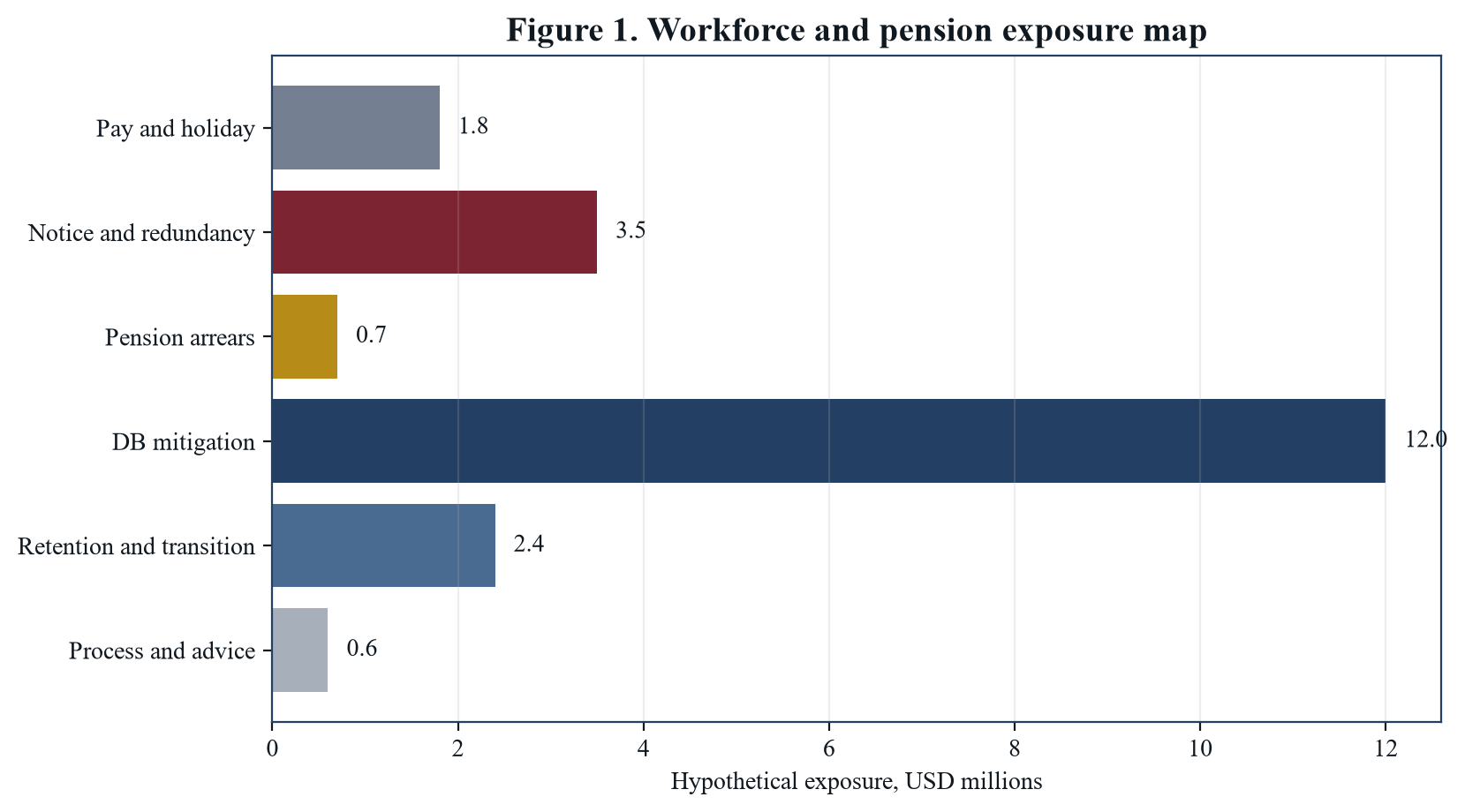
Author assumptions in USD millions. Amounts illustrate categorisation and have no empirical calibration.
18. Scenario model and limitations
The hypothetical case uses a company with 420 employees, a USD 100 million starting transaction-value benchmark and USD 15 million of unrestricted cash. Six workforce and pension exposure categories total USD 21 million: USD 1.8 million of pay and holiday, USD 3.5 million of notice and redundancy, USD 0.7 million of pension contribution arrears, USD 12 million of defined benefit mitigation, USD 2.4 million of retention and transition cost, and USD 0.6 million of process and advice cost.
The model compares an uncosted transfer, a late perimeter reset and an evidence-led workforce plan. It deducts assumed workforce and pension leakage, transaction delay and execution cost from the same headline value. It also presents thirteen-week cash paths after different workforce decisions. Every amount, path and score is an author assumption. No input is calibrated to observed transaction data, labour outcomes or pension settlements.
The model demonstrates how to make exposures visible. It does not estimate the value, solvency, legal liabilities, employee behaviour, scheme funding, regulatory action or completion probability of any company. A live model should use verified employee records, actuarial and covenant advice, current law, signed buyer terms, funding commitments and scenario-specific tax and priority analysis.
Table 4. Hypothetical workforce-route assumptions
| Route | Workforce and pension leakage | Delay effect | Execution cost | Modeled net value |
|---|---|---|---|---|
| Uncosted transfer | 22.0 | 8.0 | 1.0 | 69.0 |
| Late perimeter reset | 14.0 | 5.0 | 3.0 | 78.0 |
| Evidence-led plan | 6.0 | 2.0 | 4.0 | 88.0 |
All figures are author assumptions in USD millions and have no empirical calibration.
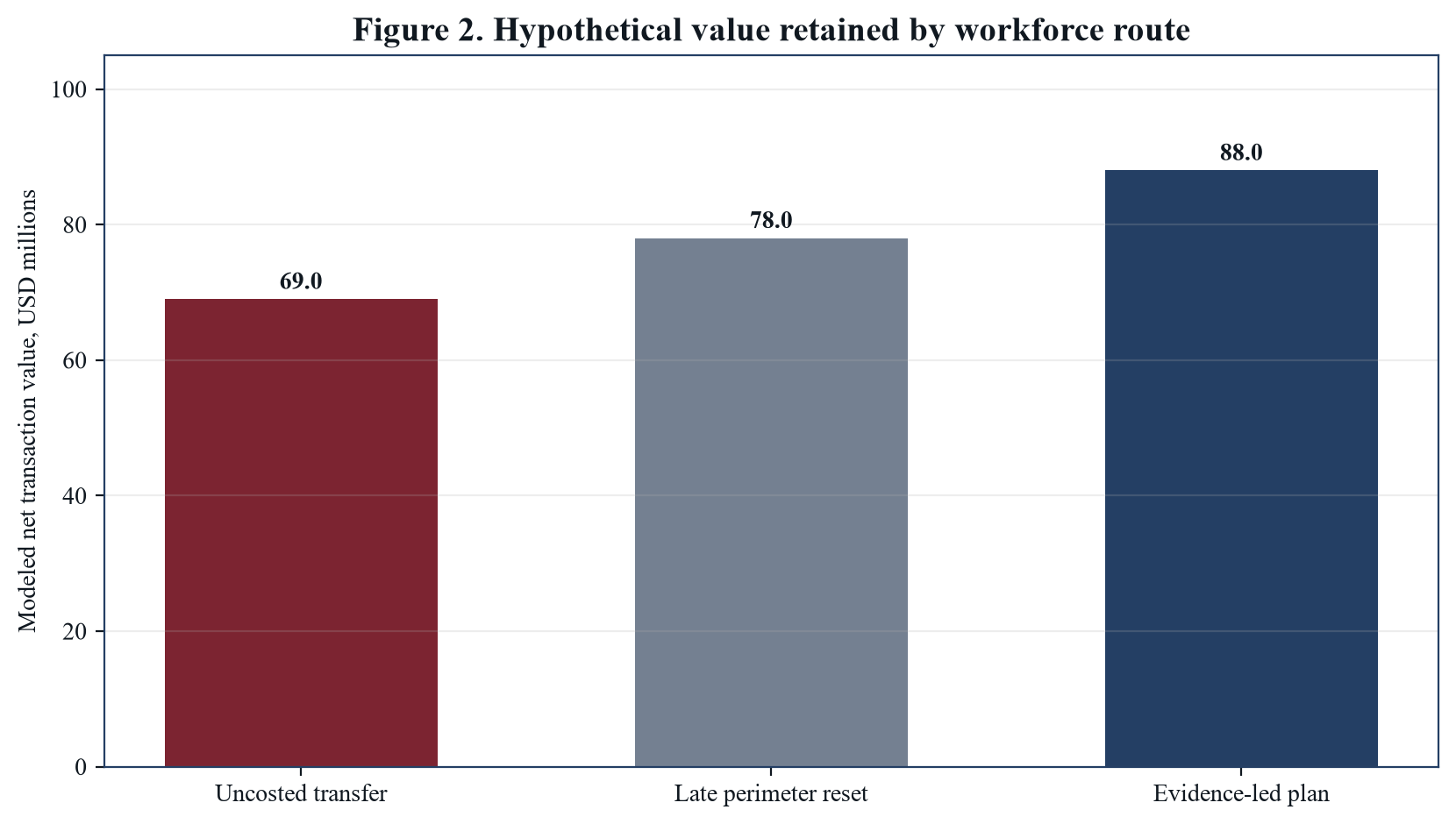
Author assumptions. Modeled values illustrate a decision method and are not valuation conclusions.
19. Why the uncosted route fails in the model
The uncosted route assumes that employees will transfer, liabilities will be manageable and pension issues can be resolved after selection of the buyer. It spends only USD 1 million on execution control. The model then applies USD 22 million of workforce and pension leakage and USD 8 million of delay, leaving USD 69 million of modeled net value.
The mechanism is practical. Missing employee allocation forces late diligence. The buyer discovers arrears, consultation requirements or shared roles after submitting a bid. Trustees receive incomplete information and request mitigation without time for evidence-led negotiation. Critical employees see uncertainty and leave. Payroll, benefits or sponsorship cannot operate on day one. Each problem may be individually manageable, while their combined timing can break the sale.
The apparent saving from limited preparation therefore increases option loss. The buyer may reduce price, exclude liabilities, demand escrow, delay completion or withdraw. The seller incurs professional and retention costs after bargaining power has weakened. In a live case, management should replace these assumed deductions with a dated issue log and probability-weighted executable routes.
20. Why a late perimeter reset remains expensive
The late-reset route recognises workforce problems after initial buyer engagement. Management narrows the perimeter, changes employee allocation, negotiates transitional services and begins consultation. The model assumes USD 14 million of workforce and pension leakage, USD 5 million of delay and USD 3 million of execution cost, producing USD 78 million of modeled net value.
The route improves the outcome because it addresses visible problems. It remains expensive because decisions occur after buyer expectations, employee rumours and funding plans have formed. A changed perimeter can require new diligence, financing approvals, contract analysis and valuation. Employees initially told that they may transfer can receive a different message. Pension trustees may need to reassess covenant impact and mitigation.
Some late changes are unavoidable. New facts, buyer conditions or regulator responses can require a revised route. The control objective is to maintain scenario readiness before that happens. Management should know the alternative population, separation cost, retention requirement, consultation path and cash effect. A prepared reset protects more value than a reactive redesign.
21. The evidence-led route protects conditional value
The evidence-led route invests USD 4 million in analysis, retention, process and transition. It assumes USD 6 million of residual workforce and pension leakage and USD 2 million of delay, producing USD 88 million of modeled net value. The USD 19 million difference from the uncosted route and USD 10 million difference from the late reset are outputs of the stated assumptions rather than forecasts.
Value is preserved through earlier decisions. Employee and pension records reconcile before buyer reliance. Alternative transfer populations are modeled. Consultation and notification steps enter the timetable. Trustees receive a coherent covenant and transaction pack. Critical roles receive funded, authorised proposals. Payroll, benefits, immigration and systems have day-one owners. The buyer can price known issues instead of charging for uncertainty.
The route still carries risk. Employees may leave, a scheme may require more support, consultation may change the proposal, or liquidity may expire. Management should monitor decision evidence rather than assume the plan works. Each signed retention agreement, trustee position, employee response, claim calculation and funding commitment should update the cash and transaction case.
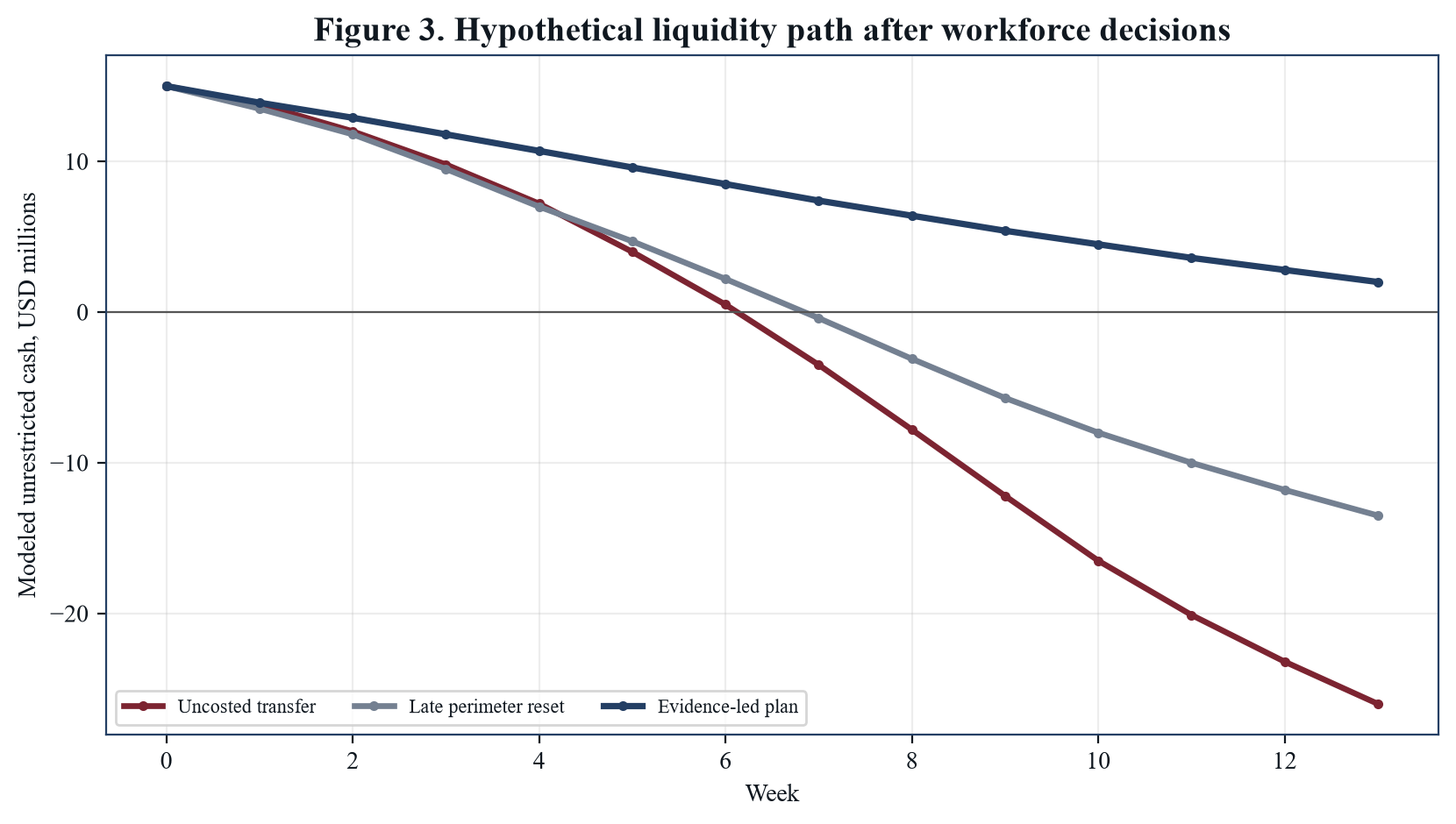
Author assumptions. Negative balances indicate that additional funding or an earlier transaction decision would be required.
22. Link workforce decisions to the weekly cash forecast
The weekly cash forecast should include payroll, taxes, benefits, pension contributions, arrears, redundancy, notice, retention, adviser costs, trustee mitigation, system separation and transition services. It should state when each amount becomes payable, who authorises it and whether it depends on a sale milestone. Gross accounting accruals are insufficient when liquidity depends on payment sequence.
Employee outcomes can also change receipts. Departures may delay delivery or invoicing. Customer concern can reduce orders. A retention payment may protect a collection or commissioning milestone. Buyer reimbursement may arrive only after completion. The workforce model should therefore connect roles to operational and cash drivers, not only costs.
The board should receive a bridge between prior and current cash assumptions. A newly identified transfer population, revised consultation timetable, pension request or buyer measure should flow through the thirteen-week model. The bridge records source evidence and owner. If the company lacks funding for the lawful process or operating continuity, the board needs an earlier route decision rather than a communication plan built on unavailable cash.
23. Design employee communications around process truth
Employees need clear information about current employment, pay, the proposed transaction, consultation, potential measures, available support and the next update. Management should avoid promising transfer, continued employment, unchanged terms or a completion date before those outcomes are supportable. It should also avoid silence when payroll failure or operational changes are already visible.
Communications should be coordinated across managers, representatives, pension trustees, buyers and public statements. Each message has a purpose, source, approval, audience and response route. Questions should be logged because they can reveal missing evidence, vulnerable groups, retention risk or incorrect assumptions. The company should answer consistently while respecting confidential, personal and transaction-sensitive information.
Pension communications require particular care. The Pensions Regulator expects trustees to explain the impact of significant events, the employer's ability to support the scheme and action being taken, while addressing transfer-scam risks where relevant [11]. Company and trustee messages should align on verified facts and distinct responsibilities. Neither should state outcomes that remain subject to scheme rules, regulatory processes or transaction conditions.
24. Buyer diligence should test operating continuity
The buyer should evaluate whether the acquired workforce can operate the business on day one and through the first hundred days. The review covers role coverage, leadership, licences, shifts, customer ownership, system access, payroll, benefits, health and safety, labour relations, visas, retention, vacancies, contractors, service providers and planned measures. A headcount spreadsheet alone cannot answer these questions.
The buyer should test liabilities and process quality. It reconciles population data to payroll and contracts, reviews claim calculations, identifies litigation and grievances, assesses consultation and representative arrangements, and examines pension contributions and defined benefit exposure. It should obtain specialist advice on transfer, insolvency and pension consequences for the proposed route.
Diligence findings should become completion conditions, price adjustments, escrows, indemnities, covenants, transitional services or operating actions only when the chosen mechanism is executable. Broad protection can be illusory when the seller has no residual value. The buyer's strongest protection may be funding a clean transition, narrowing the perimeter or solving a critical operational dependency before close.
25. Transaction documents must reflect the real allocation
The sale agreement should align with the workforce and pension model. Definitions of employees, assumed liabilities, excluded liabilities, accrued amounts, transfer date, benefits, pensions, consultation, information, indemnities and cooperation should match the verified population and process. Schedules need version control so that last-minute employee changes do not create inconsistent documents.
Completion mechanics should address payroll cut-off, salary payments, holiday, bonuses, expenses, tax records, pension contributions, benefit enrolment, employee notices, data transfer, system access, records custody and responsibility for claims. The agreement should also describe how the parties will handle employees whose status is disputed or changes before completion.
Pension provisions require scheme-specific drafting. They may address participation, cessation, contribution payments, trustee agreements, security, mitigation, guarantees, data and cooperation with regulators or protection funds. A generic exclusion of pensions does not resolve statutory, controlled-group, covenant or employee issues. Qualified advisers should ensure the contractual allocation fits the transaction route and applicable law.
26. Day-one readiness protects the buyer's investment
Day-one planning should start before signing where confidentiality permits. The buyer needs an opening organisation, decision rights, payroll and bank authority, HR and pension-provider access, system credentials, safety and licence coverage, employee contacts, manager scripts and a first-week operating calendar. The seller needs a retained organisation and separation plan for people who do not move.
Shared services create hidden dependencies. Payroll processing, HR information systems, timekeeping, benefits administration, occupational health, learning records, recruitment, immigration and pension administration may sit in another group entity. A transitional-services agreement should state service, data, owner, duration, cost, security, exit milestone and failure response. The buyer should test whether the provider can continue if the wider group is distressed.
The first payroll is a critical control. The parties should reconcile opening balances, bank files, tax setup, deductions, contributions and leavers. A rehearsal can identify missing records or access. Employees should know who employs them, who pays them, where to direct questions and what remains unchanged or under consultation. Operational confidence begins with accurate execution.
27. Risk control matrix
The workforce workstream can fail through an incorrect transfer population, late consultation, unsupported communication, unpaid claims, pension arrears, inadequate trustee engagement, unfunded retention, lost sponsorship, data breach or failed payroll. Each failure mode needs an early indicator, control, evidence owner and board escalation threshold.
The dashboard should focus on exceptions. It shows unreconciled employees, missing contracts, payroll variances, consultation milestones, notices, critical-role vacancies, unsigned retention terms, contribution arrears, trustee requests, regulatory steps, funding gaps and day-one readiness. Aggregate completion percentages should not conceal a single role or approval capable of stopping operations.
Independent review should test the connection between source records, legal analysis, financial model and transaction documents. The board should see which conclusions are verified, conditional or unresolved in plain language. The purpose is a current decision record, not a polished data room that hides uncertainty.
Table 5. Proposed workforce and pension risk-control matrix
| Failure mode | Early indicator | Control | Evidence retained |
|---|---|---|---|
| Incorrect transfer population | HR, payroll and operational maps disagree | Multi-source perimeter reconciliation | Versioned employee bridge |
| Late consultation or notice | Timetable lacks representative and filing dates | Legal-process calendar and board gate | Notices, minutes and response log |
| Unfunded employee claims | Cash forecast excludes route-triggered cost | Claims inventory linked to weekly cash | Calculation and funding approval |
| Pension covenant deterioration | Sale removes support or grants new priority | Covenant assessment and mitigation workstream | Trustee pack and agreed terms |
| Critical-role attrition | Departure signals or unsigned retention terms | Role score, succession and funded offer | Decision and acceptance record |
| Day-one payroll failure | Missing bank, data or provider access | Rehearsal and cut-over checklist | Reconciliation and sign-off |
Controls require adaptation to the company, transaction route and jurisdictions.
28. Ten-business-day implementation roadmap
Days one and two establish authority, advisers and transaction perimeter. The team freezes source data, identifies employing entities and jurisdictions, reconciles headcount to payroll, inventories pension arrangements and maps the buyer's proposed route. Treasury confirms the cash available for payroll, contributions, claims and process costs. The board approves communication and negotiation limits.
Days three to five build the employee and pension evidence packs. Legal and operational owners test transfer populations, consultation and notification steps. Finance calculates accrued and scenario-triggered claims. Pensions specialists reconcile contributions, identify defined benefit covenant effects and prepare trustee engagement. Management scores critical roles and drafts funded retention and continuity actions.
Days six to ten convert evidence into decisions. The company begins required processes, gives controlled buyer access, engages trustees where appropriate, resolves priority exceptions and rehearses day-one payroll and communications. The board reviews the route model, liquidity, unresolved legal issues and completion conditions. The ten-day period creates the first controlled system; it does not replace longer statutory, trustee, regulatory or employee processes.
Table 6. Proposed ten-business-day workforce and pension roadmap
| Period | Core action | Required output | Board gate |
|---|---|---|---|
| Days 1 to 2 | Confirm authority, perimeter and liquidity | Mandate, entity map and cash envelope | Approve route assumptions |
| Days 3 to 5 | Reconcile people, claims and schemes | Employee bridge, claims inventory and pension pack | Approve engagement plan |
| Days 6 to 8 | Start controlled processes and buyer diligence | Notices, consultation record and exception log | Fund or revise mitigants |
| Days 9 to 10 | Test transfer and day-one readiness | Updated model, signed actions and cut-over plan | Continue, restructure or stop |
Mandatory legal, regulatory, consultation and scheme timetables remain controlling.
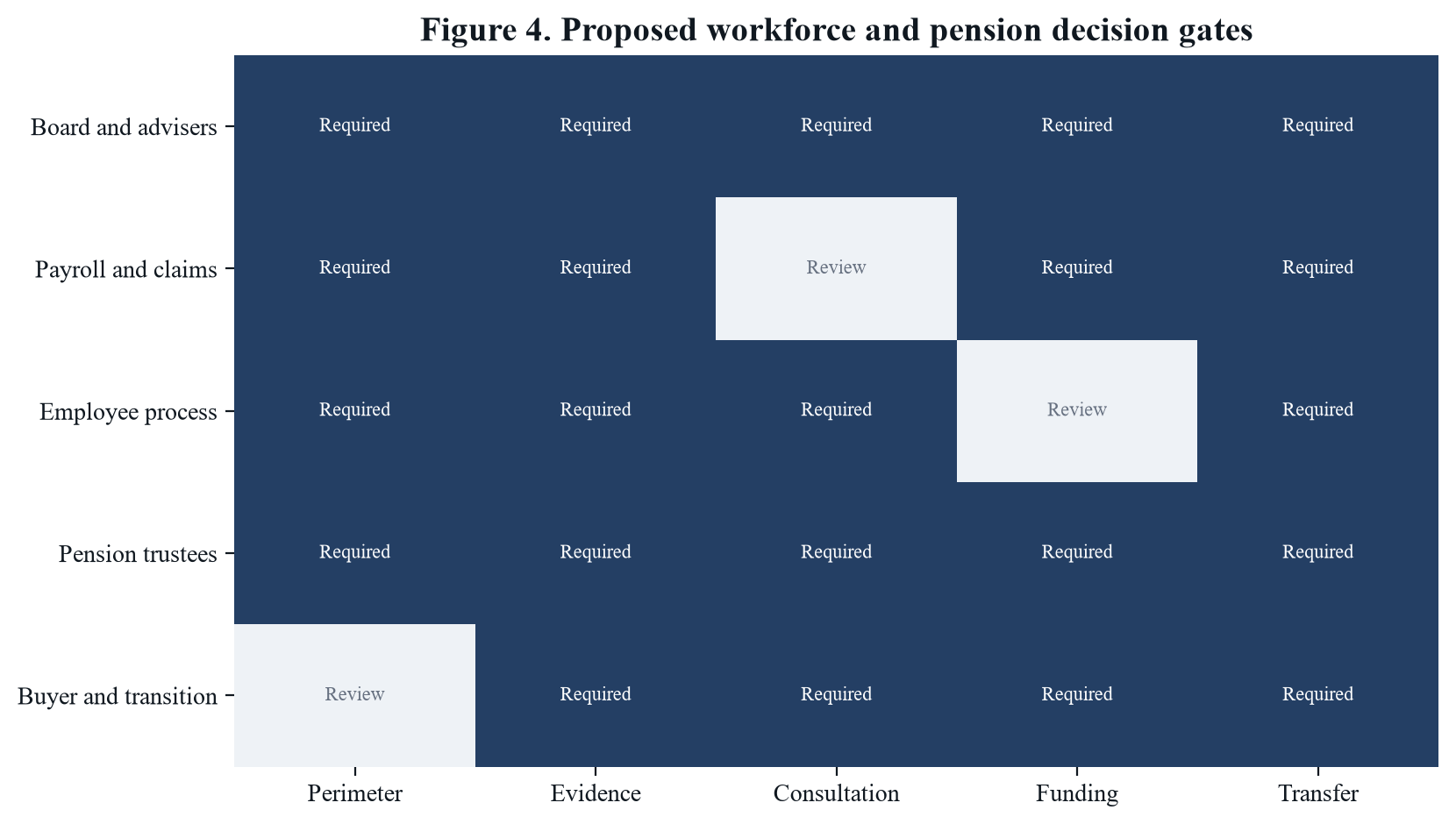
Proposed workflow. Applicable legal, regulatory, trustee and employee processes determine actual sequencing.
29. Board reporting and stop conditions
The board pack should combine transaction, workforce, pension and liquidity evidence. It shows the current perimeter, employee bridge, claims range, pension position, consultation status, critical roles, buyer measures, funding, completion dependencies and downside alternatives. Every material change should have an owner, evidence date and decision deadline.
Stop conditions can include inability to pay the next payroll, absence of authority for a proposed commitment, a transfer analysis inconsistent with the buyer's operating plan, failure to begin a required process, loss of a critical licensed role, an unresolved sponsor or pension issue, a data breach, or a buyer request that creates an unfunded liability. A stop condition may require a different route rather than termination of the sale.
The board should minute alternatives and the effect on employees, pension stakeholders, creditors and transaction value. A pressured timetable increases the value of explicit gates. Management can move quickly when it knows which evidence permits progress and which exception requires specialist review or a revised perimeter.
30. Role of technology and AI
Authorised technology can reconcile HR, payroll, pension-provider and transaction records, identify duplicate or missing employees, classify contracts, calculate scenario ranges and maintain a changing perimeter. It can compare consultation and completion calendars, detect inconsistent dates, route exceptions and generate draft schedules from approved source data.
Natural-language systems can help extract employment terms, change-of-control clauses, pension references, grievances and litigation from documents. They can prepare questions, anonymised summaries and draft communications. Outputs require human validation because classification errors can affect rights, claims, data protection, employee trust and transaction decisions. Access should follow purpose, confidentiality and least-privilege controls.
The system should preserve source links, versions, model assumptions, reviewer decisions and released text. It should not autonomously select employees, decide transfer status, calculate final legal entitlements, communicate redundancies, negotiate trustee mitigation or change employment terms. Qualified and accountable people remain responsible for every decision and communication.
31. How the framework travels across jurisdictions
The framework's portable elements are entity mapping, source reconciliation, scenario modeling, decision gates, communication control, liquidity integration and day-one readiness. These elements help a multinational team compare countries without pretending that legal outcomes are uniform. Each country workstream supplies its own rules, advisers, timetable, employee bodies, pension or benefit system and filing requirements.
A cross-border accelerated sale needs a central owner who can see sequencing conflicts. One country may require early disclosure while another depends on confidentiality. Immigration approval may lag completion. Pension engagement may affect financing. The central control system identifies these conflicts early and escalates them to qualified advisers and the board.
32. Limitations
This paper provides a general transaction decision framework. It is not employment, pensions, insolvency, regulatory, immigration, data-protection, accounting, tax, investment or valuation advice. The cited materials apply in their stated jurisdictions and contexts and may change. Each company and scheme requires current professional analysis based on its documents, facts, transaction route and governing law.
All workforce counts, costs, exposures, transaction values, delays, cash paths and scores in the hypothetical model are author assumptions without empirical calibration. They do not estimate market averages, employee behaviour, claim outcomes, pension liabilities, regulatory action, transaction value, completion probability, solvency or recovery. The model excludes many relevant factors, including tax, currency, multi-employer schemes, collective bargaining detail, insurance, litigation outcomes and buyer financing conditions.
Management should rebuild every schedule from verified records and preserve alternative scenarios. The framework can improve decision quality and execution evidence. It cannot guarantee employee retention, trustee agreement, regulatory treatment, pension protection, funding or a completed sale.
33. Conclusion
Workforce and pension issues should enter an accelerated sale before buyer outreach and price negotiation. The board needs a verified perimeter, employee bridge, claims inventory, pension map, consultation calendar, critical-role plan and day-one operating design. Each element should connect to the weekly cash forecast and the chosen legal route.
The central discipline is evidence-led sequencing. Management prepares alternative populations, begins required processes at the correct time, engages trustees with a coherent transaction pack, funds critical actions and updates the model as facts change. Buyers receive decision-useful evidence and executable transition plans. Employees receive accurate information through authorised channels.
A company that controls this workstream can see whether its proposed sale is operationally and financially possible. It can price uncertainty, protect essential roles, address pension stakeholders and choose a different route before liquidity disappears. The result is a more credible accelerated process and a clearer record of how workforce continuity and long-term obligations were considered under pressure.
References
- UK Government. Business transfers, takeovers and TUPE. Accessed 6 September 2026. https://www.gov.uk/transfers-takeovers
- UK Government. Business transfers, takeovers and TUPE: transfers of employment contracts. Accessed 6 September 2026. https://www.gov.uk/transfers-takeovers/transfers-of-employment-contracts
- UK Government. Business transfers, takeovers and TUPE: information about employees during transfers. Accessed 6 September 2026. https://www.gov.uk/transfers-takeovers/information-about-employees-during-transfers
- UK Government. Business transfers, takeovers and TUPE: consulting and informing. Accessed 6 September 2026. https://www.gov.uk/transfers-takeovers/consulting-and-informing
- Advisory, Conciliation and Arbitration Service. Collective consultation for redundancy. Accessed 6 September 2026. https://www.acas.org.uk/collective-consultation-redundancy
- UK Government. Form HR1: advance notification of redundancies. Accessed 6 September 2026. https://www.gov.uk/government/publications/redundancy-payments-form-hr1-advance-notification-of-redundancies
- The Insolvency Service. Explaining your redundancy payments. Accessed 6 September 2026. https://www.gov.uk/guidance/explaining-your-redundancy-payments
- The Insolvency Service. Setting up a case for redundancy payments: guidance for insolvency practitioners. Updated 2 April 2026; accessed 6 September 2026. https://www.gov.uk/guidance/case-set-up-guidance-for-insolvency-practitioners
- UK Government. Workplace pensions: what employers can and cannot do. Accessed 6 September 2026. https://www.gov.uk/employers-workplace-pensions-rules
- The Insolvency Service. Technical guidance for official receivers: employment law and insolvency. Accessed 6 September 2026. https://www.gov.uk/guidance/technical-guidance-for-official-receivers/58-employment-law-and-insolvency
- The Insolvency Service. Technical guidance for official receivers: pensions. Accessed 6 September 2026. https://www.gov.uk/guidance/technical-guidance-for-official-receivers/57-pensions
- The Pensions Regulator. Deal with an employer event that causes concern to members. Accessed 6 September 2026. https://www.thepensionsregulator.gov.uk/trustees/communicate-to-members/employer-events-that-could-cause-concern-to-members/deal-with-an-employer-event-that-causes-concern-to-members
- The Pensions Regulator. Clearance. Accessed 6 September 2026. https://www.thepensionsregulator.gov.uk/en/document-library/scheme-management-detailed-guidance/communications-and-reporting-detailed-guidance/clearance
- The Pensions Regulator. Material detriment test: examples. Accessed 6 September 2026. https://www.thepensionsregulator.gov.uk/en/document-library/scheme-management-detailed-guidance/administration-detailed-guidance/material-detriment-test
- Pension Protection Fund. General guidance on insolvency and the assessment period. Accessed 6 September 2026. https://www.ppf.co.uk/-/media/PPF-Website/Files/Trustees-and-advisers/Insolvency-and-restructuring/General-guidance-on-insolvency-and-the-assessment-period.pdf
- Pension Protection Fund. Guidance Note 10: Claims. Accessed 6 September 2026. https://www.ppf.co.uk/-/media/PPF-Website/Files/Trustees-and-advisers/Insolvency-and-restructuring/Guidance-Note-10---Claims.pdf
- United States Department of Labor. WARN Act bankruptcy fact sheet. Accessed 6 September 2026. https://webapps.dol.gov/elaws/eta/warn/fs2e.asp
- Pension Benefit Guaranty Corporation. Distress terminations. Accessed 6 September 2026. https://www.pbgc.gov/employers-practitioners/plan-terminations/distress
- UAE Government. Employment laws and regulations in the private sector. Accessed 6 September 2026. https://u.ae/en/information-and-services/jobs/employment-in-the-private-sector/employment-laws-and-regulations-in-the-private-sector
- UK Government. Workers and Temporary Workers: sponsor guidance, Part 3. Published March 2026; accessed 6 September 2026. https://assets.publishing.service.gov.uk/media/69aaaf82c78869bf8eb8a46f/Sponsor-guidance-Part-3-compliance-03-26-v1.0.pdf
