

Introduction
Renewable-power and utility assets often produce long-duration contracted or regulated cash flows. A yield company packages those assets into an equity vehicle that can distribute part of the cash while retaining access to public or private capital. The model can lower a sponsor's cost of capital, recycle mature assets, broaden ownership and create a platform for acquisitions. It can also create pressure to preserve a headline distribution when cash should remain in the business.
The underlying assets are rarely simple annuities. Wind and solar output vary. Hydrology changes. Contract counterparties can weaken. Equipment ages. Project debt amortises. Refinancing costs move. Taxes, working capital, reserve requirements and minority interests affect cash movement. Growth projects require equity before they produce cash. A parent company can report accounting profit while receiving less cash from subsidiaries, or report an accounting loss while contracted projects continue to remit cash. A distribution policy therefore has to govern a cash system rather than apply a percentage to net income.
The policy question matters as capital demand rises. The International Energy Agency estimated total energy investment of USD 3.3 trillion in 2025, including USD 2.2 trillion for clean technologies. It also estimated annual grid investment near USD 400 billion and power-sector battery investment above USD 65 billion. A vehicle that distributes too much can lose the capacity to fund repowering, storage, interconnection or resilience. A vehicle that retains cash without an accountable allocation framework can lose the investor constituency that valued predictable income.
Public evidence provides a useful warning. XPLR Infrastructure announced in January 2025 that it would suspend common-unit distributions for an indefinite period and move from an acquisition-and-distribution model towards retained-cash investment and capital-structure simplification. Clearway Energy's filings explain that dividends remain subject to board discretion, cash available for distribution, reserves, financing restrictions and operating volatility. Brookfield Renewable states that its contracted portfolio and growth initiatives support distributions, while the board retains discretion and the broader financing model combines corporate capital with asset-specific non-recourse debt. The cases differ in structure and strategy. Together they show that distribution resilience is created before the declaration date through governance, capital structure and portfolio design.
1. Define the yield-company proposition
A yield company is an ownership and capital-allocation model rather than a single legal form. It may be a corporation, partnership, business trust or other holding vehicle. It normally owns interests in operating assets with contracted, regulated or otherwise visible cash flows. The parent receives distributions after asset-level operating costs, taxes, debt service, reserves and capital requirements. It then pays corporate costs, parent-level debt service and other obligations before the board considers a distribution to equity holders.
The investor proposition can combine current income, distribution growth, asset appreciation and acquisition optionality. Those components require different sources of value. Current income depends on existing asset cash flows. Distribution growth can come from contractual escalation, operating improvement, debt amortisation, repowering or acquisitions. Asset appreciation may depend on falling discount rates, scarce interconnection, improved contracts or development rights. Acquisition optionality depends on capital access and underwriting discipline.
The board should state which components define the strategy and which are conditional. A policy that promises both a high current yield and rapid distribution growth can require continuous external financing. When the equity price falls, issuing shares to fund acquisitions can become dilutive. When interest rates rise, debt-funded acquisitions may fail the required return. A credible proposition states the hierarchy among resilience, distribution, deleveraging and growth.
2. Map cash from the asset to the investor
The cash path begins at the operating asset. Revenue may arise under a power purchase agreement, feed-in tariff, capacity contract, regulated tariff, availability payment, merchant sale or environmental attribute. Cash is reduced by operating costs, taxes, lease payments, maintenance, working capital, project debt service and contractual reserves. Only then can the asset distribute cash to its immediate owner.
The holding structure can contain several layers. Joint ventures may distribute only after partner approvals. Project finance documents can block distributions when coverage ratios fail or defaults occur. Tax-equity arrangements can allocate cash differently from accounting earnings. Foreign-exchange controls or withholding taxes can delay or reduce remittances. Minority interests receive their contractual share before cash reaches the listed parent.
At the parent, corporate costs, interest, preferred distributions, hedging settlements, development spending and parent-level reserves further reduce capacity. Cash available for distribution is therefore a management-defined or contractual measure that requires transparent reconciliation. Clearway Energy's 2025 filing defines the measure through adjustments to operating performance, affiliate distributions, maintenance capital, interest, taxes, debt amortisation and other items. The definition is useful because it connects operating assets to parent cash. It remains a non-GAAP measure and requires governance over adjustments.
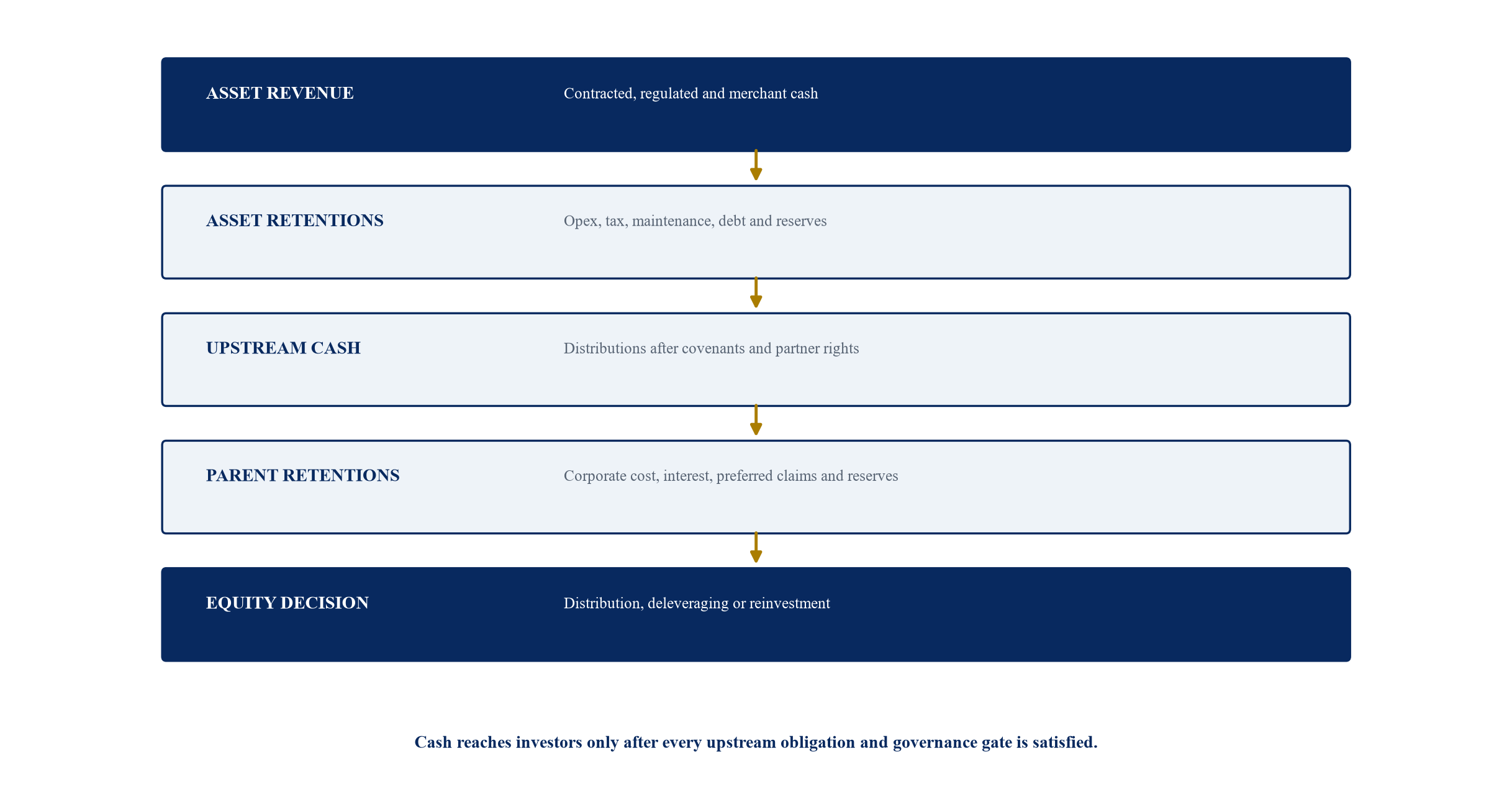
Each layer can restrict, delay or redirect cash. The board should approve definitions and minimum reserves before setting the distribution.
3. Separate earnings, operating cash and distributable cash
Net income includes depreciation, fair-value movements, impairment, deferred tax and other non-cash items. Operating cash flow reflects cash movements but can be affected by working capital and classification choices. Project distributions reflect the legal and financing capacity of subsidiaries. Cash available for distribution attempts to measure the amount available at the parent after specified recurring obligations.
The board should approve a written definition and a reconciliation from audited financial statements. Adjustments should be consistent across periods. Maintenance capital should reflect the expenditure required to preserve safe and reliable output, rather than a narrow cash label. Development expenditure should be classified according to strategy and probability of recovery. Proceeds from asset sales should be separated from recurring operating cash unless the business model explicitly depends on recycling assets.
The policy should also distinguish declared distributions from funded distributions. A distribution funded through new parent debt, equity issuance or asset-sale proceeds may be legally payable and economically unsustainable. A useful disclosure shows operating cash received, recurring parent obligations, one-off inflows, growth investment, financing flows and the resulting distribution coverage.
4. Establish the capital-allocation hierarchy
The hierarchy begins with safety, legal compliance and asset integrity. Required operating expenditure, taxes, debt service and maintenance capital come before discretionary distributions. Contractual reserves and prudent liquidity follow. The board then considers leverage, refinancing, committed growth capital and distributions.
The order should be explicit because every item can be described as important. A sponsor may favour acquisitions that expand the platform. Income investors may favour distributions. Lenders may favour deleveraging. Management remuneration can reward growth. A published hierarchy creates a reference point for decisions during both favourable and difficult periods.
A practical hierarchy has five gates. The solvency gate asks whether the entity can lawfully distribute. The asset gate confirms that safety, maintenance and contracted obligations are funded. The financing gate tests covenants, liquidity and refinancing. The resilience gate funds reserves for plausible operating and market stress. The value gate compares distributions, debt reduction, repowering, acquisitions and other uses on a risk-adjusted basis.
Table 1. Distribution-policy architecture
| Policy dimension | Board question | Minimum evidence | Typical consequence |
|---|---|---|---|
| Legal capacity | Is the distribution permitted under company law and governing documents? | Solvency analysis, retained earnings and legal confirmation | Block or reduce declaration |
| Asset integrity | Are safety, maintenance and lifecycle obligations fully funded? | Asset-management plan, maintenance forecast and reserve balances | Retain cash at asset level |
| Financing capacity | Do asset and parent covenants permit cash movement? | Compliance certificates, liquidity forecast and maturity schedule | Preserve liquidity or repay debt |
| Resilience | Can the portfolio absorb plausible production, price and counterparty stress? | Multi-year downside cases and reserve policy | Increase buffer or smooth payout |
| Growth | Do committed projects have funded equity and acceptable returns? | Approved capital plan and probability-weighted commitments | Retain cash for defined investments |
| Investor distribution | What recurring cash can be distributed without weakening the first five tests? | Reconciled distributable cash and coverage range | Declare within the policy range |
The policy should assign a metric, decision owner and disclosed consequence to each dimension.
5. Govern the distribution formula
A fixed payout ratio can be applied to cash available for distribution, free cash flow or another defined measure. A residual policy can distribute cash after approved uses. A progressive policy can target annual growth. A hybrid can set a payout range and a minimum coverage ratio, with the board retaining discretion.
The formula should include a base period, adjustment rules, reserve treatment and exceptional items. A quarterly formula based only on current cash can transmit seasonal volatility to investors. A rolling twelve-month measure can smooth seasonality while remaining responsive. A multi-year planning model can link the distribution to contracted cash and scheduled debt service. The choice should match asset characteristics and reporting reliability.
The board should avoid an automatic escalator that ignores capital needs. A growth target can guide planning, yet every declaration should pass the current gates. Brookfield Renewable's public distribution record shows how long-term distribution growth can be supported by contracted generation, diversified capital sources and board discretion. XPLR's 2025 suspension illustrates how a previous acquisition-and-distribution model can be reset when retained cash offers greater strategic value.
6. Set coverage and reserve requirements
Coverage measures the cash available relative to the distribution. A ratio close to 1.0 leaves limited capacity for error. A higher ratio provides protection, although the appropriate level depends on contract duration, production volatility, leverage, asset concentration, maintenance profile and access to liquidity.
The policy should define both a base coverage range and a stress threshold. It should also specify whether committed but undrawn growth equity is deducted before coverage. A company can report attractive current coverage while carrying a large near-term funding requirement. The board should view the distribution alongside the full sources-and-uses plan.
Reserves should have stated purposes. Operating reserves address working capital and timing differences. Debt-service reserves are often contractual. Major-maintenance reserves support predictable lifecycle events. Distribution reserves can smooth seasonal or temporary cash variation. Contingency reserves address plausible unplanned events. A generic cash balance does not show whether cash is genuinely available.
7. Integrate project-finance restrictions
Yield companies often own assets financed through non-recourse project debt. These facilities can restrict distributions before commercial operation, during defaults or when debt-service coverage falls below a threshold. They can require cash sweeps, reserve top-ups or lender consent. A portfolio with strong aggregate economics can still face parent cash scarcity if several projects trap cash at the same time.
The board pack should include a cash-trap map by project, with covenant headroom, next test date and cure options. Forecasting should model correlations. A regional weather event may affect several assets. Interest-rate or foreign-exchange movements can affect multiple financings. A common offtaker can concentrate credit exposure. Treating every asset as independent understates portfolio stress.
The parent should maintain sufficient liquidity for corporate obligations that continue when subsidiaries cannot distribute. Parent debt should be sized against stressed upstream cash. Debt maturity should be considered before distribution growth because refinancing at an unfavourable point can transfer value from equity holders to lenders.
8. Distinguish maintenance from growth capital
Maintenance capital preserves the asset's existing capacity, safety and contract performance. Growth capital expands capacity, extends life, improves efficiency or creates new revenue. The distinction can be judgemental. A wind-turbine repowering can combine replacement and expansion. A battery retrofit can protect market relevance and create new revenues. A digital-control upgrade can be required for reliability and also reduce cost.
The board should approve classification principles linked to engineering evidence. Understating maintenance capital inflates distributable cash. Treating every enhancement as maintenance can obscure investment returns. The policy should show both accounting classification and economic purpose.
Lifecycle plans should extend beyond the current contract. An asset with a high distribution today may require substantial expenditure before contract renewal. Decommissioning, land restoration and equipment disposal should also be reflected where applicable. The distribution should not consume cash needed to honour end-of-life obligations.
9. Make growth funding explicit
Growth can be funded through retained cash, new equity, parent debt, project debt, asset sales, joint ventures or sponsor contributions. Each source has a cost and execution risk. A yield company dependent on regular equity issuance is exposed to market price. A fall in valuation can make acquisitions dilutive and interrupt the growth model.
The policy should distinguish committed growth, probable growth and optional pipeline. Committed growth has signed obligations and should be included in liquidity planning. Probable growth may warrant contingent capacity. Optional pipeline should compete for capital rather than reduce distribution capacity automatically.
Acquisition underwriting should use the marginal cost of capital and include integration, financing, tax, hedging and governance costs. A transaction can increase cash available per share in the first year and still destroy value through leverage, terminal assumptions or weak asset quality. The board should examine net present value, downside resilience and strategic fit alongside near-term accretion.
10. Control sponsor and related-party conflicts
Many yield companies have a controlling sponsor that develops assets, provides services, nominates directors or offers acquisition opportunities. The relationship can create pipeline visibility and operating capability. It can also create conflicts over asset pricing, timing, service fees, financing and the use of capital.
Independent review is essential for related-party transactions. The board should establish a conflicts committee with authority, information access and independent advice. Valuation should use consistent methods and transaction-specific evidence. The committee should consider alternatives, including declining the transaction, buying a different asset, repaying debt or retaining cash.
Clearway Energy's 2025 proxy describes its controlled-company status and the governance exemptions available under New York Stock Exchange rules. It also describes a Corporate Governance, Conflicts and Nominating Committee. The disclosure illustrates why investors need to understand both formal control and the mechanisms used to review conflicts.
11. Align management incentives
Compensation tied only to asset growth, cash available for distribution or distribution growth can create bias. Management may favour acquisitions, optimistic adjustments or high payouts. A balanced framework can include per-share cash generation, leverage, availability, safety, maintenance delivery, return on invested capital and total shareholder return over a multi-year period.
Metrics should use definitions consistent with public reporting. Adjustments require committee oversight. Outcomes should reflect both quantity and quality of cash flow. Cash from asset sales, temporary working-capital release or under-maintenance should not receive the same weight as recurring contracted cash.
The board should review whether incentive horizons match asset lives. Renewable and utility assets operate for decades. A three-year award remains short relative to the consequences of acquisition pricing, repowering and maintenance decisions. Deferral and clawback provisions can improve accountability where law and market practice permit.
12. Use a recurring governance calendar
Distribution governance should operate throughout the year. The annual strategy review sets the policy range, leverage objective, capital plan and downside cases. Quarterly meetings update actual cash, covenant headroom, liquidity, asset performance and project commitments. A pre-declaration review confirms legal capacity and current evidence. An event-driven process responds to material outages, counterparty deterioration, financing changes or acquisitions.
The finance function should own the cash reconciliation. Asset management should certify maintenance and operating requirements. Treasury should certify liquidity, covenant and refinancing conditions. Risk should challenge scenarios and correlations. Legal and company secretarial functions should confirm authority and process. The board retains the declaration decision.
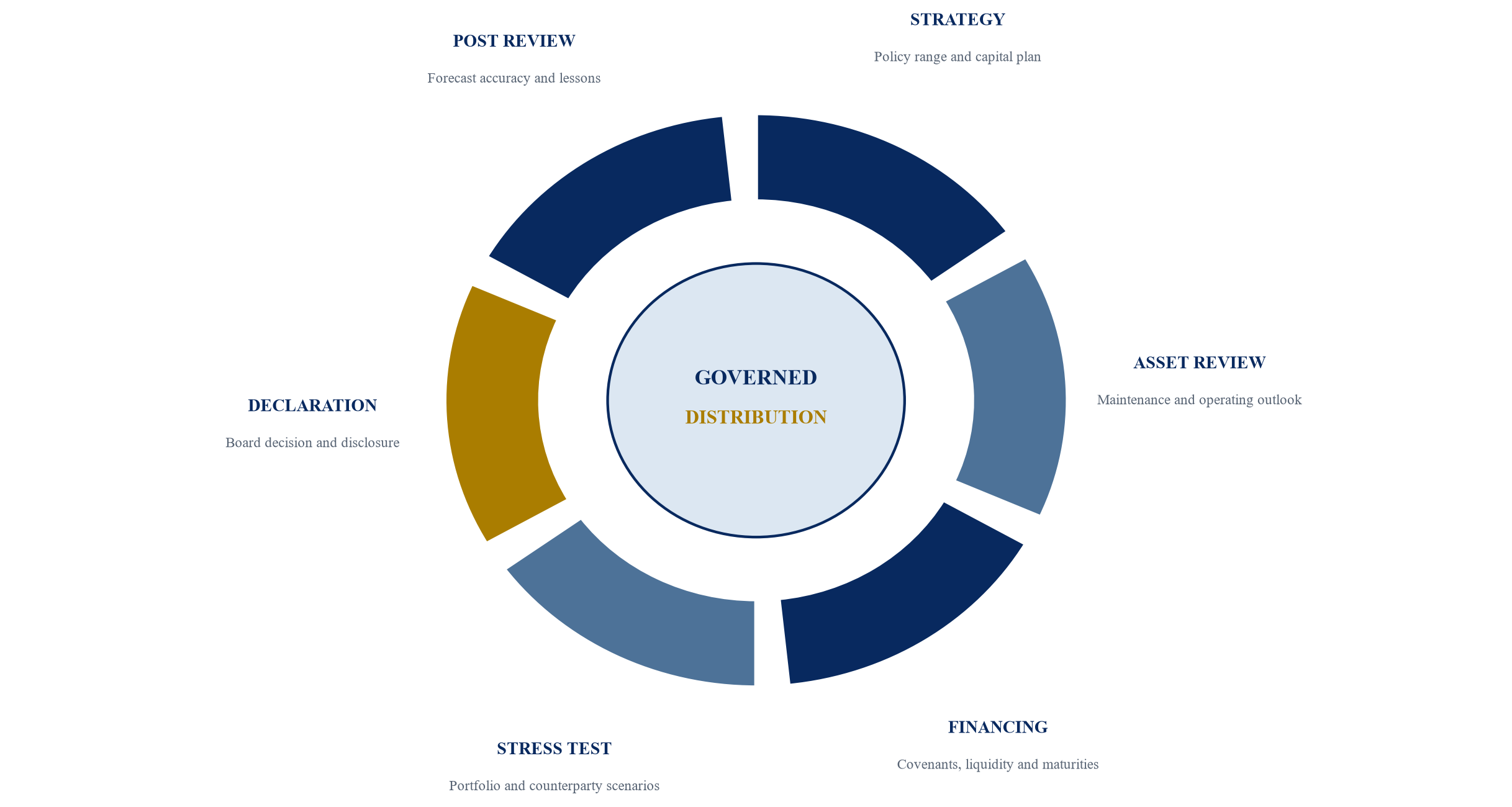
The declaration is the final decision in a continuous process of asset, financing and risk review.
13. Build the board information pack
The pack should reconcile statutory accounts to cash available for distribution and then to the proposed declaration. It should show asset-level distributions, trapped cash, parent cash, reserves, debt, hedges, committed capital and downside results. Variances from prior forecasts should be explained.
The pack should include a multi-year view. A one-quarter test can miss a refinancing wall or maintenance cycle. It should show distributions under base, moderate-downside and severe-but-plausible cases. The scenario assumptions should be visible: production, prices, inflation, interest rates, foreign exchange, outage duration, counterparty delay and capital costs.
Decision rights should be recorded. Management recommends. Committees review audit, conflicts, risk and remuneration matters within their mandates. The board declares. Minutes should record the evidence considered, material judgements and reasons for departures from policy.
14. Design the reset protocol before stress
A distribution reduction can damage investor confidence. Delay can damage the balance sheet further. A reset protocol establishes thresholds and options before management faces immediate market pressure.
Triggers can include coverage below the policy floor, insufficient liquidity, covenant headroom below a defined buffer, a refinancing gap, a material counterparty default, unresolved asset integrity expenditure or a committed investment without funding. The trigger should cause a review rather than an automatic public action where legal and factual judgement is required.
The response ladder can begin with discretionary spending restraint and reserve use, then asset-level remediation, financing action, distribution moderation and a full strategic reset. Communication should explain the reason, duration, priorities and conditions for reinstatement. A vague promise to restore growth can weaken credibility.
Table 2. Illustrative trigger and response ladder
| Indicator | Normal condition | Review condition | Escalated condition | Governance response |
|---|---|---|---|---|
| Forward distribution coverage | Within approved range | Approaches policy floor | Falls below floor in base forecast | Reforecast, retain cash and reconsider declaration |
| Parent liquidity | Covers approved horizon and contingencies | Buffer declines materially | Unfunded obligation within horizon | Treasury plan and board escalation |
| Covenant headroom | Comfortable under downside | One or more assets approach trigger | Cash trap or default risk | Restrict upstream assumptions and engage lenders |
| Maintenance funding | Fully reflected in plan | Scope or cost uncertainty rises | Critical work lacks funding | Prioritise asset integrity before distribution |
| Growth commitments | Fully funded | Funding depends on market access | Committed equity has no secure source | Rephase, partner, finance or reduce distribution |
| Counterparty exposure | Within approved limits | Credit indicators deteriorate | Payment default or contract dispute | Increase reserves and update recovery assumptions |
Thresholds require portfolio-specific calibration. The table provides governance logic rather than investment guidance.
15. Treat market signalling carefully
Yield-company valuations can be sensitive to distribution expectations. Investors may capitalise the distribution through a yield, making small changes appear to have large equity-value effects. Management can therefore become reluctant to reset an unsustainable policy.
The board should communicate the economic framework rather than a distribution number alone. Disclosure can include the definition of cash available for distribution, reconciliation, coverage, capital priorities, material restrictions and forward commitments. Forecasts should use ranges and assumptions that can be governed. Any non-GAAP measure should be presented consistently with applicable securities rules.
XPLR's 2025 announcement stated that suspending distributions would remove the need for equity issuance and allow retained cash to fund selected financing buyouts, existing-asset investments and other opportunities. The announcement demonstrates a strategic reset linked to identified uses of cash. Its investment outcome remains company-specific and should be assessed through subsequent filings rather than assumed from the announcement.
16. Account for interest rates and refinancing
Higher interest rates affect yield companies through several channels. Project debt refinancing can reduce upstream cash. Parent borrowing can become more expensive. Investor-required dividend yields can rise, reducing the equity price and increasing the cost of issuing shares. Acquisitions that appeared accretive under cheaper capital can become uneconomic.
The policy should include a refinancing reserve and a maturity schedule. Floating-rate exposure should be shown after hedging. Debt amortisation should be reconciled to the cash measure. Interest-rate scenarios should affect both cash flow and the valuation used for capital-allocation decisions.
Brookfield Renewable's public filings illustrate a financing approach built around substantial asset-specific non-recourse debt, corporate debt and other forms of capital. The structure diversifies funding, while the consolidated debt burden and maturity profile still require oversight. The lesson is structural: non-recourse financing can contain risk at the asset, yet the parent depends on the cash that remains after that financing.
17. Integrate contract and counterparty risk
Long-term contracts improve visibility and can support financing. They do not remove risk. Offtakers can delay payment, seek renegotiation or enter insolvency. Contract terms may not cover all operating costs. Curtailment, change in law, force majeure and termination provisions affect cash.
Clearway Energy's filings describe how the PG&E bankruptcy prevented certain assets from making distributions for a period. This illustrates the difference between contracted revenue and remittable cash. The board should monitor counterparty concentration, security, payment performance and legal remedies. A distribution reserve should reflect recovery time, not only expected loss.
Contract expiry is another risk. A project can distribute strongly near the end of an above-market contract while its post-contract economics weaken. The policy should deduct credible re-contracting, repowering or decommissioning requirements before treating late-contract cash as recurring.
18. Reflect portfolio concentration and correlation
Diversification works when risks are genuinely different. Assets in several legal entities can still share weather, technology, offtaker, grid, supplier or regulatory exposure. A single turbine fleet issue can affect multiple projects. A regional transmission constraint can reduce several plants. A common sponsor service agreement can create operational concentration.
The risk model should identify common drivers and stress them together. The board should see distributions by geography, technology, contract, counterparty, financing and remaining life. Concentration limits can guide acquisitions and reserve sizing.
A distribution policy based on average historical volatility can understate tail events. Scenario analysis should include lower production, delayed remittances, cost inflation, outage, interest-rate and foreign-exchange shocks. The combined scenario should remain severe yet plausible and transparently described.
19. Preserve regulatory and public-service obligations
Some yield-company portfolios include regulated utilities or essential infrastructure. Rate regulation can affect both the amount and timing of cash flows, as IFRS Foundation materials on rate-regulated activities explain. Service obligations, affordability and capital commitments can take priority over distributions.
The policy should identify cash that is legally or economically dedicated to regulated operations. It should avoid extracting distributions that weaken reliability or create unfunded customer obligations. Where public owners or regulators influence dividends, roles should be explicit and conflicts managed.
The OECD's work on dividend payments by state-owned enterprises links dividend policy to capital structure, profitability, future capital expenditure and sustainable financial structure. The same logic applies to private or mixed-ownership yield vehicles holding essential assets. Distribution discipline supports both investor credibility and service resilience.
20. Evaluate acquisitions and dropdowns
An acquisition should pass a full investment case. The board should review asset quality, contract durability, operating capability, financing, tax, hedging, maintenance, terminal value and integration. A sponsor dropdown also requires conflict review and evidence that the price and terms are fair to the vehicle.
Per-share accretion is a useful output, not a sufficient decision rule. Accretion can be created through leverage, optimistic terminal value or lower reserves. The acquisition should improve risk-adjusted value and preserve distribution resilience under downside.
The funding plan should be committed before closing. Reliance on a future equity issuance creates market risk. Bridge debt can become permanent. The policy should deduct committed acquisition funding from cash availability and disclose the effect on coverage.
21. Use asset recycling without disguising recurring cash
Asset sales can release capital, crystallise value and rebalance a portfolio. The World Bank's asset-recycling guidance emphasises governance, transparency and clear reinvestment objectives. A yield company can use disposals to fund growth, repay debt or return capital.
Sale proceeds should be separated from recurring distributable cash. A special distribution may be appropriate where the board decides the capital is surplus. A recurring distribution funded by regular disposals can be sustainable only if asset replacement, development expenditure and portfolio life are reflected transparently.
The board should compare sale value with the present value of retained cash, taxes, transaction costs and replacement opportunities. It should also consider concentration and strategic capability after the sale.
22. Illustrative portfolio case
Consider an illustrative renewable-infrastructure holding company with wind, solar, storage and flexible-generation assets. The figures below are hypothetical and are used only to demonstrate the framework. They do not describe a company, transaction or forecast.
The portfolio receives USD 610 million of asset-level cash before parent uses. Asset-level debt amortisation, maintenance capital, taxes, minority distributions and reserve movements reduce upstream cash to USD 420 million. Parent costs, interest and preferred claims reduce recurring cash available for distribution to USD 330 million. The board identifies USD 70 million of committed repowering equity and a USD 35 million liquidity-buffer increase. Policy cash after those items is USD 225 million.
Management proposes a USD 210 million distribution. The base coverage ratio is 1.07 times using policy cash. A moderate downside reduces policy cash to USD 180 million, creating 0.86 times coverage. The proposal therefore fails the resilience gate unless the board can demonstrate a temporary timing difference supported by designated reserves and a credible recovery path.
Table 3. Illustrative distribution-capacity bridge
| Cash-flow item | Base case | Moderate downside | Governance treatment |
|---|---|---|---|
| Asset cash before financing and reserves | 610 | 535 | Starting operating cash |
| Asset debt, maintenance, tax and minority claims | (190) | (205) | Paid or retained before upstream distribution |
| Upstream cash to parent | 420 | 330 | Subject to project restrictions |
| Parent cost, interest and preferred claims | (90) | (100) | Recurring parent obligations |
| Recurring cash available for distribution | 330 | 230 | Reconciled policy measure |
| Committed repowering equity | (70) | (70) | Approved funded commitment |
| Liquidity-buffer increase | (35) | (20) | Board-approved resilience reserve |
| Policy cash after priority uses | 225 | 140 | Capacity before common distribution |
| Proposed common distribution | (210) | (210) | Board proposal |
| Coverage | 1.07x | 0.67x | Downside fails the policy gate |
All amounts are hypothetical USD millions. The case demonstrates governance and does not represent an investment recommendation or observed company data.
The board has four principal choices. It can reduce the distribution, rephase the repowering where technically and contractually feasible, secure committed financing, or use a designated reserve if the stress is temporary. It should avoid assuming an uncommitted equity issuance. The decision should consider asset integrity, return from repowering, liquidity and investor communication.
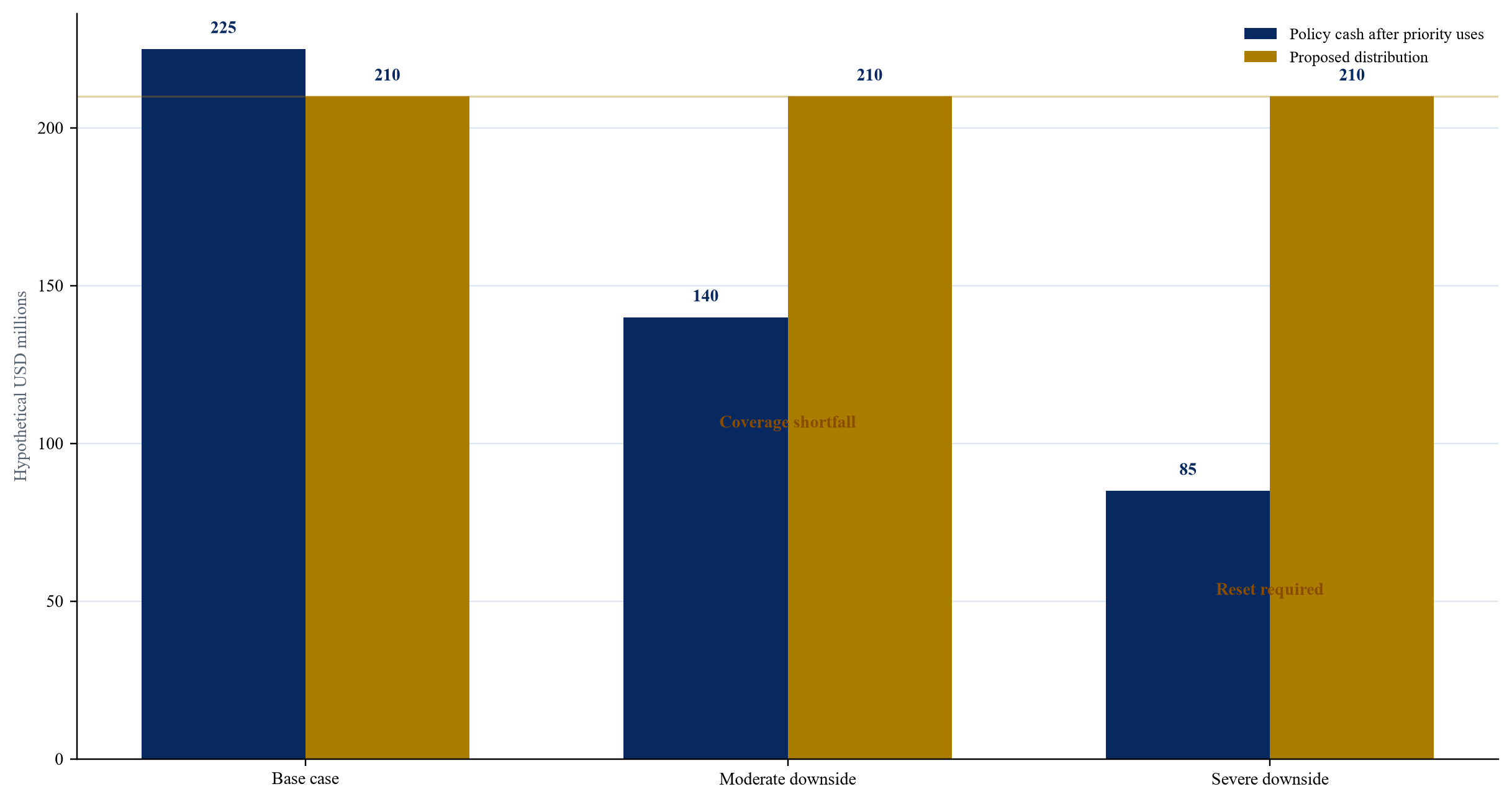
Hypothetical policy cash and proposed distribution in USD millions. The chart shows why a base-case declaration requires downside testing.
23. Value the distribution policy
Investors can value a yield company through discounted cash flow, dividend discount, trading multiples and sum-of-the-parts analysis. Distribution policy affects each method through cash timing, growth, risk and financing.
A higher near-term distribution can increase current yield and reduce retained investment. If the policy raises leverage or maintenance risk, the required return can rise and offset the cash benefit. A lower distribution can create value when retained cash earns a return above the cost of capital. It can destroy value when retained cash funds weak acquisitions or accumulates without accountability.
The board should compare marginal uses of cash. Debt reduction offers a measurable financing benefit and optionality. Repowering can extend asset life and improve output. Acquisitions can diversify or grow cash. Distributions return capital to investors. The analysis should use consistent risk-adjusted assumptions and recognise execution constraints.
24. Prepare transaction governance
Distribution policy is material in an acquisition, listing, minority investment or refinancing. Buyers and lenders should diligence the definition of distributable cash, historical reconciliations, reserves, maintenance plans, covenants, sponsor agreements and board authority. They should test whether past distributions relied on debt, equity or asset sales.
Transaction documents should align with the policy. Debt covenants, preferred instruments, shareholder agreements and acquisition commitments can create competing cash claims. Representations should address compliance and disclosure. Forecasts should identify board discretion and avoid presenting a target as a guarantee.
In a separation or carve-out, the new vehicle needs stand-alone treasury, reporting, risk and asset-management capability. Service agreements with the sponsor should contain performance, pricing, data and termination terms. A policy inherited from a larger group may not fit the new capital structure.
25. Implement disclosure controls
The cash available for distribution reconciliation should be controlled with the same discipline applied to other material public metrics. Source systems, responsible owners, review steps and adjustment approvals should be documented. Changes in definition should be explained and comparative periods addressed.
Forecast ranges should use consistent assumptions and governance. The audit committee should understand material non-GAAP adjustments. The board should receive the full cash bridge rather than a headline ratio. Investor materials should distinguish policy, guidance and legal obligation.
The company should disclose material cash traps, refinancing needs, committed capital and related-party transactions in accordance with applicable rules. Transparency reduces the risk that investors interpret a distribution target as unconditional.
26. A practical decision framework
The board can apply seven questions each quarter. First, what cash has legally reached the parent and what remains restricted? Second, are safety, maintenance, tax and debt obligations funded? Third, does liquidity remain adequate through the planning horizon? Fourth, what committed growth capital must be reserved? Fifth, how does the proposed distribution perform under transparent downside cases? Sixth, are sponsor conflicts independently reviewed? Seventh, does the decision remain consistent with the published hierarchy and long-term value?
A negative answer should trigger analysis and an explicit response. Management should not close the gap through an uncommitted financing assumption. The board can approve an exception where evidence supports it, and the exception should be recorded with duration and corrective action.
The framework supports a stable distribution when the portfolio can fund it. It also supports retention, reduction or suspension when capital structure, asset integrity or value creation requires a different choice. Discipline is demonstrated through the quality of the decision and disclosure.
Conclusion
A yield company turns infrastructure cash flows into an equity proposition. Its distribution is the result of asset performance, financing contracts, reserve policy, capital commitments and board judgement. A headline payout target cannot substitute for governance of those components.
The strongest policy starts with a reconciled cash definition and a clear hierarchy. It funds safety and maintenance, respects asset-level restrictions, preserves liquidity, accounts for committed growth and tests downside coverage. It manages sponsor conflicts, aligns incentives and establishes a reset protocol before stress.
Public cases show the range of possible outcomes. Clearway describes a board-discretionary policy supported by cash available for distribution, reserves and financing compliance. Brookfield Renewable links distribution growth to contracted cash flows, asset diversity and a broad financing system. XPLR suspended distributions and redirected retained cash when its capital-allocation model changed. Each case reflects its own facts. The common lesson is that resilience depends on capital-allocation discipline.
A credible yield company can distribute significant cash and continue investing. It earns that credibility through transparent definitions, conservative buffers, independent governance and evidence-based decisions. Those mechanisms allow income, growth and infrastructure stewardship to coexist over the asset life.
Frequently Asked Questions
1. What is cash available for distribution?
Cash available for distribution is a company-defined measure intended to estimate recurring cash that can support equity distributions after specified operating, financing, tax, maintenance and other adjustments. The definition varies. Investors should use the company's reconciliation and examine adjustment governance.
2. Should a yield company distribute a fixed percentage of cash?
A payout range can improve transparency. The percentage should operate within legal, maintenance, covenant, liquidity, reserve and growth-funding gates. Board discretion remains necessary because asset and financing conditions change.
3. How much distribution coverage is adequate?
The answer depends on contract quality, portfolio diversification, production volatility, leverage, maintenance, refinancing and liquidity. The board should approve both a normal range and downside threshold based on portfolio-specific analysis.
4. Can a distribution be funded with debt?
A company may have legal capacity to borrow and distribute. Repeated debt-funded distributions weaken economic sustainability unless supported by a deliberate capital-structure plan and durable future cash. Disclosure should distinguish operating coverage from financing proceeds.
5. How should sponsor dropdowns be reviewed?
Independent directors or a conflicts committee should evaluate valuation, terms, alternatives, funding and downside resilience with access to independent advice. The vehicle should be able to decline a transaction that does not create risk-adjusted value.
6. What should trigger a distribution reset?
Potential triggers include inadequate forward coverage, weak liquidity, covenant pressure, unfunded maintenance, a refinancing gap, counterparty default or committed growth without secure funding. The policy should define the review process and response ladder before such events occur.
7. Are asset-sale proceeds recurring distributable cash?
Sale proceeds are capital receipts. They can fund debt reduction, reinvestment, acquisitions, buybacks or a special return of capital. Treating them as recurring operating cash requires a transparent asset-recycling model that reflects replacement cost and portfolio life.
8. What is the board's central distribution-policy duty?
The board should allocate cash in the long-term interest of the company within applicable law and governing documents. It should base the declaration on reliable cash evidence, asset obligations, financing constraints, downside resilience, conflicts governance and alternative uses of capital.
References
- International Energy Agency. World Energy Investment 2025. https://www.iea.org/reports/world-energy-investment-2025
- International Energy Agency. Global investment in clean energy and fossil fuels, 2015-2025. https://www.iea.org/data-and-statistics/charts/global-investment-in-clean-energy-and-fossil-fuels-2015-2025
- Organisation for Economic Co-operation and Development. G20/OECD Principles of Corporate Governance 2023. https://doi.org/10.1787/ed750b30-en
- Organisation for Economic Co-operation and Development. OECD Guidelines on Corporate Governance of State-Owned Enterprises 2024. https://doi.org/10.1787/18a24f43-en
- Organisation for Economic Co-operation and Development and World Bank. Dividend Payments by State-Owned Enterprises, 2024. https://www.oecd.org/content/dam/oecd/en/publications/reports/2024/05/dividend-payments-by-state-owned-enterprises_b96d196c/975b5e78-en.pdf
- Organisation for Economic Co-operation and Development. Global Corporate Sustainability Report 2024. https://www.oecd.org/content/dam/oecd/en/publications/reports/2024/03/global-corporate-sustainability-report-2024_d8e1e8b4/8416b635-en.pdf
- World Bank Group. Asset Recycling Guidelines, 2023. https://ppp.worldbank.org/sites/default/files/2023-09/Asset%20Recycling%20Guidelines%20Final%20August2023%20Publication.pdf
- World Bank Group. Public Sector Governance of Asset Recycling. https://ppp.worldbank.org/create-necessary-setting-public-sector-governance-asset-recycling
- World Bank Group. Re-investment Mechanisms for Asset Recycling. https://ppp.worldbank.org/re-investment-mechanisms
- IFRS Foundation. Reporting the Financial Effects of Rate Regulation. https://www.ifrs.org/projects/completed-projects/2026/rate-regulated-activities/dp-reporting-financial-effects-of-rate-regulation/
- U.S. Securities and Exchange Commission. XPLR Infrastructure strategic repositioning, Exhibit 99.1, 28 January 2025. https://www.sec.gov/Archives/edgar/data/1603145/000160314525000003/nepq42024exhibit99.htm
- U.S. Securities and Exchange Commission. XPLR Infrastructure Form 8-K, 23 January 2025. https://www.sec.gov/Archives/edgar/data/1603145/000160314525000003/nep-20250123.htm
- U.S. Securities and Exchange Commission. XPLR Infrastructure 2025 Form 10-K. https://www.sec.gov/Archives/edgar/data/1603145/000160314526000007/xplr-20251231.htm
- U.S. Securities and Exchange Commission. XPLR Infrastructure full-year 2025 results, Exhibit 99.1. https://www.sec.gov/Archives/edgar/data/1603145/000160314526000004/xplrq42025exhibit99.htm
- U.S. Securities and Exchange Commission. Clearway Energy 2024 Form 10-K. https://www.sec.gov/Archives/edgar/data/1567683/000156768325000007/cwen-20241231.htm
- U.S. Securities and Exchange Commission. Clearway Energy 2025 Form 10-K. https://www.sec.gov/Archives/edgar/data/1567683/000162828026010952/cwen-20251231.htm
- U.S. Securities and Exchange Commission. Clearway Energy 2025 Proxy Statement. https://www.sec.gov/Archives/edgar/data/1567683/000110465925023538/tm252389-2_def14a.htm
- U.S. Securities and Exchange Commission. Clearway Energy full-year 2025 results, Exhibit 99.1. https://www.sec.gov/Archives/edgar/data/1567683/000162828026010641/exhibit991-clearwayenergyi.htm
- U.S. Securities and Exchange Commission. Brookfield Renewable Partners 2025 Form 20-F. https://www.sec.gov/Archives/edgar/data/1533232/000153323226000011/bep-20251231.htm
- U.S. Securities and Exchange Commission. Brookfield Renewable 2025 Annual Report. https://www.sec.gov/Archives/edgar/data/1533232/000153323226000012/bep2025annualreport.htm
About the Author
Chennakeshav (CK) is a corporate finance and investment banking executive with 25+ years of global experience in deal origination, structuring and execution across M&A, growth capital and corporate strategy. He has led value-creation mandates for founders, corporates and funds — bridging the boardroom view to hands-on execution and close.
His career spans Morgan Stanley, HSBC, Lloyds Banking Group, EWEC, ADQ portfolio companies and Emirates Growth Fund, across TMT, real estate, fintech, deeptech, cleantech, infrastructure and energy. He has partnered with C-suite leaders, private equity and venture funds, sovereign wealth funds and family offices to finance complex fund raises and scale-up ventures, and has led M&A due diligence, post-merger integration and business-transformation initiatives to create value.
At Matchpoint Partners he is Managing Partner, leading the firm's corporate finance, M&A and capital-raising practice. He holds an MBA from London Business School, an engineering degree from VTU and a Master of Laws (LLM, in progress) from UCL London.
An active start-up mentor, CK mentors at Techstars, DIFC FinTech Hive, Startup Grind, Founder Institute and IN5, serves as Entrepreneur Mentor in Residence (EMiR) at London Business School, and judges the Entrepreneurship World Cup.
