

1. Treat the TRF as a balance-sheet decision
The temporary repatriation facility is often described through one comparison: a reduced charge today versus the ordinary tax that could arise if historic foreign income and gains are later remitted to the United Kingdom. That comparison is necessary and incomplete. A family cannot decide sensibly until it knows whose income or gain is involved, whether that person is eligible, where the value now sits, what the current asset derives from, what foreign tax was paid, whether a trust distribution or benefit is involved, how a mixed fund will be treated, and when sterling may actually be needed in the United Kingdom [1-5].
The relevant unit of analysis is therefore the family balance sheet rather than one bank transfer. That balance sheet may include offshore cash, investment portfolios, private-company shares, property, partnership interests, insurance policies, loans, trusts, foundations, jointly held assets and business investment relief holdings. The legal owner can differ from the economic beneficiary. The original foreign income or gain can have been transformed through purchases, sales, transfers and reinvestment. An account can contain several years and several types of value. The family may also have post-6 April 2025 income taxed on the arising basis alongside historic amounts that remain subject to remittance rules [1,6-9].
The board or family council should begin with four questions. First, what amount could be designated with supportable evidence? Second, what amount is likely to be remitted, consumed, invested or transferred in the United Kingdom over the relevant planning horizon? Third, what tax, liquidity, foreign-tax-credit and opportunity costs arise under each path? Fourth, which governance and banking arrangements keep the chosen path executable after the filing is made?
A good answer can be selective. A family may designate one pool fully, another partially and a third not at all. It may designate value while leaving it offshore. It may preserve clean capital for near-term spending and designate historic income that supports a later property purchase, succession payment or investment. The decision should remain traceable to evidence and purpose. A percentage applied to an unverified total creates false precision.
Table 1. Family TRF decision diagnostic
| Gate | Decision question | Minimum evidence | Failure signal | Required action |
|---|---|---|---|---|
| person | who would be chargeable on a future remittance and can that person elect? | residence history, prior returns and remittance-basis claims | family wealth is treated as one taxpayer | build a person ledger |
| source | what pre-6 April 2025 income, gain, capital payment or benefit is present? | tax-year records, computations, statements and trust schedules | amount is estimated from a current balance | reconstruct source and derivation |
| ownership | who legally and beneficially owns the account, asset or structure? | title, account mandate, agreements and trust records | ownership follows family convention only | obtain legal confirmation |
| location | where is value held and through which banks, custodians, entities or trustees? | current asset and account map | an intermediary or joint holder is missing | reconcile the map |
| economics | what is the expected use, ordinary-tax exposure and TRF charge? | scenario model with explicit assumptions | the model assumes all value will be remitted | model selective paths |
| liquidity | how will the charge and UK needs be funded without an unintended remittance? | sterling plan, account composition and payment route | charge is funded from undesignated income | redesign the funding route |
| execution | can records, election, account treatment and future remittance be defended? | adviser memorandum, return workpapers and evidence index | conclusion exists without transaction evidence | close evidence gaps |
Each line requires person-specific UK advice. The table is a governance tool and does not determine eligibility or tax treatment.
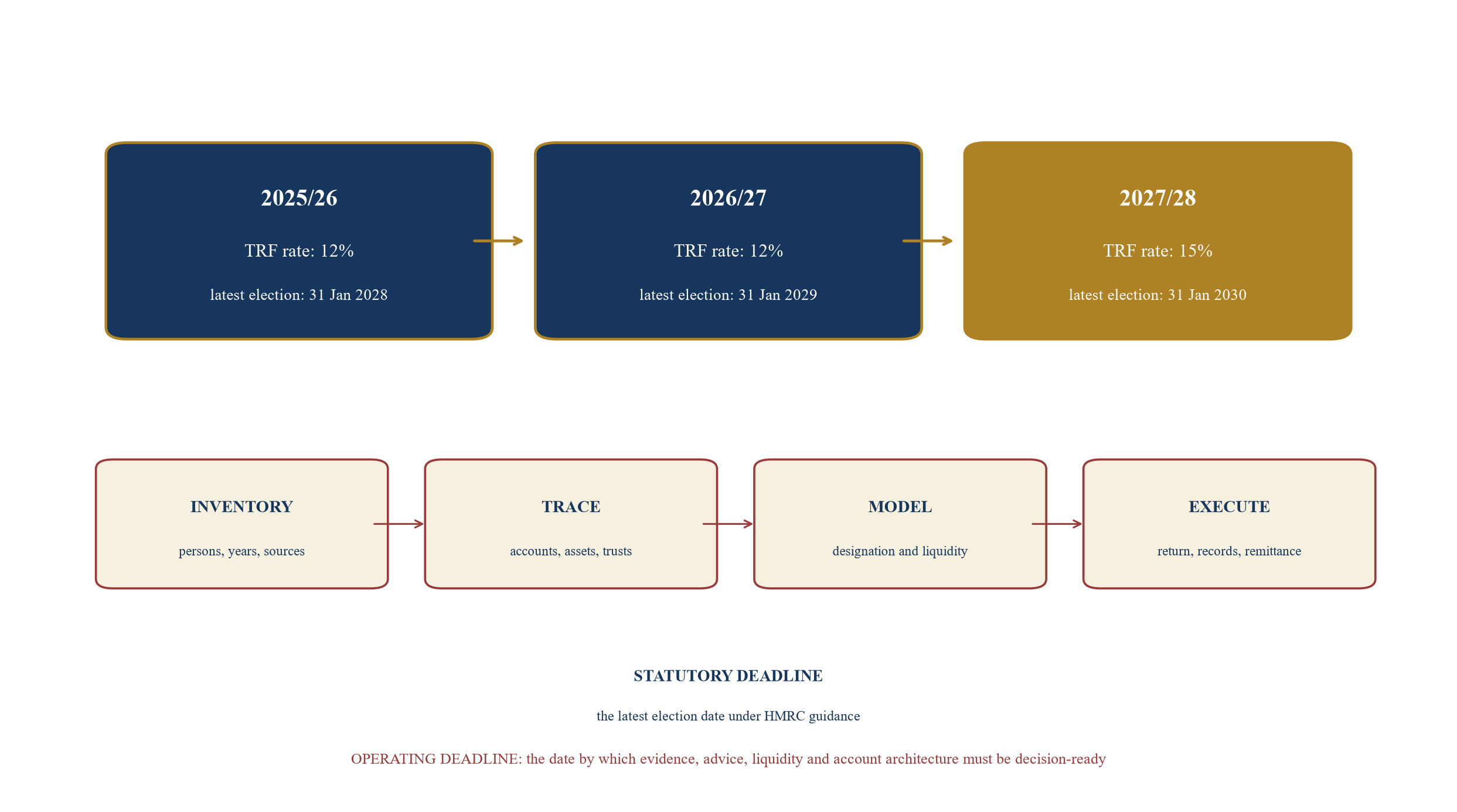
Election deadlines follow HMRC guidance. The operating gates are a management planning model and should be adapted to the family's facts.
2. Read the timetable precisely
The TRF applies for three tax years: 2025/26, 2026/27 and 2027/28 [1,2]. HMRC states that a designation for the first two years attracts a 12 percent charge and a designation for 2027/28 attracts a 15 percent charge [1,10]. The amount is charged on capital and is not characterised as income tax or capital gains tax, although the collection mechanism uses the income-tax system [10]. No foreign tax credit is available against the TRF charge [1].
The final designation year ending on 5 April 2028 is not the same as the latest date on which an election can be made. The election is made in the relevant Self Assessment return. HMRC's time-limit guidance states that the latest dates are 31 January 2028 for a 2025/26 election, 31 January 2029 for a 2026/27 election and 31 January 2030 for a 2027/28 election [11]. The guidance also explains when an election can be amended and when it can no longer be withdrawn. Families should obtain advice on the exact filing and amendment position before relying on those long-stop dates.
The economic date still matters. An amount designated for 2026/27 is charged at 12 percent, while an amount designated for 2027/28 is charged at 15 percent. Deferring the designation year can therefore increase the charge even if the amount and sterling value remain constant. Foreign-exchange movements, portfolio transactions, trust distributions, account transfers and new deposits can also change the work required to identify and protect the amount. Evidence can become harder to retrieve when banks close systems, advisers change and estates or companies reorganise.
Management should run three clocks. The statutory clock records tax years, filing deadlines and amendment limits. The evidence clock records when source documents, computations, trust accounts, bank data and ownership records can be obtained and validated. The liquidity clock records when the charge, family spending, property, investment, succession or business commitments require cash. The earliest binding clock should set the operating plan.
The timetable should also recognise the difference between an election, payment and remittance. The return records the designation for the relevant tax year. The charge follows the Self Assessment process. The designated amount can remain offshore or be remitted, subject to the applicable rules and evidence. These events can therefore occur on different dates and through different accounts. The implementation schedule should assign a control owner to each event and should reconcile the return, tax account, bank statement and capital ledger after completion.
Return preparation should include a change log from the date of the technical memorandum to the date of filing. New income, asset sales, trust payments, gifts, account transfers or residence changes can alter the facts. The adviser should confirm whether the original conclusion remains valid. A dated model that is detached from later transactions should not be used as the filing basis.
Table 2. TRF year, rate and execution implications
| Designation year | TRF rate | Latest election date stated by HMRC | Principal operating question | Evidence priority |
|---|---|---|---|---|
| 2025/26 | 12% | 31 January 2028 | is an earlier-year election still available and supportable? | close historic records and return workpapers |
| 2026/27 | 12% | 31 January 2029 | which pools merit 12% designation before the final rate year? | complete asset derivation and trust matching |
| 2027/28 | 15% | 31 January 2030 | which residual pools justify final-year designation? | preserve final election, account and remittance evidence |
| after the TRF period | ordinary remittance rules for undesignated historic amounts | no new TRF year | which historic foreign income and gains remain exposed on remittance? | maintain a permanent undesignated-capital register |
Dates and rates are drawn from HMRC guidance available in August 2026. Individual filing and amendment positions require professional confirmation.
3. Establish eligibility person by person
HMRC's public guidance states that an individual must be UK resident in the tax year of designation and must previously have used the remittance basis [1,12]. The election must be made by the individual who would be chargeable if the relevant foreign income or gains were remitted [12,13]. These conditions require a person-specific analysis. A spouse, adult child, settlor, beneficiary or joint account holder cannot be assumed to share another person's eligibility.
The family office should create a residence and tax-history ledger for every relevant individual. It should record UK residence for each tax year, split-year treatment, remittance-basis use, claims, returns, foreign income and gains, nominated amounts, remittance-basis charges, trust positions, joint interests, deaths, gifts and changes of capacity. Copies of returns and computations should be retained. A status summary without the underlying filings is insufficient for a material election.
Eligibility also interacts with the asset. The individual must be able to designate qualifying overseas capital. Historic foreign income and gains that arose when the person used the remittance basis can qualify, subject to the detailed rules. The TRF can also apply to specified capital payments and benefits from non-UK trusts during the TRF period where amounts are matched to pre-6 April 2025 income or gains [3,14-20]. The person, event and source pool must therefore be analysed together.
Authority and capacity need controls. A family member may be elderly, absent, under a power of attorney, involved in an estate, or subject to trustee and protector decisions. The governance file should identify who can obtain records, instruct advisers, approve an election, sign a return, move funds and operate accounts. Legal advice should confirm how powers, fiduciary duties and confidentiality apply. A technically attractive designation that cannot be authorised or documented is not executable.
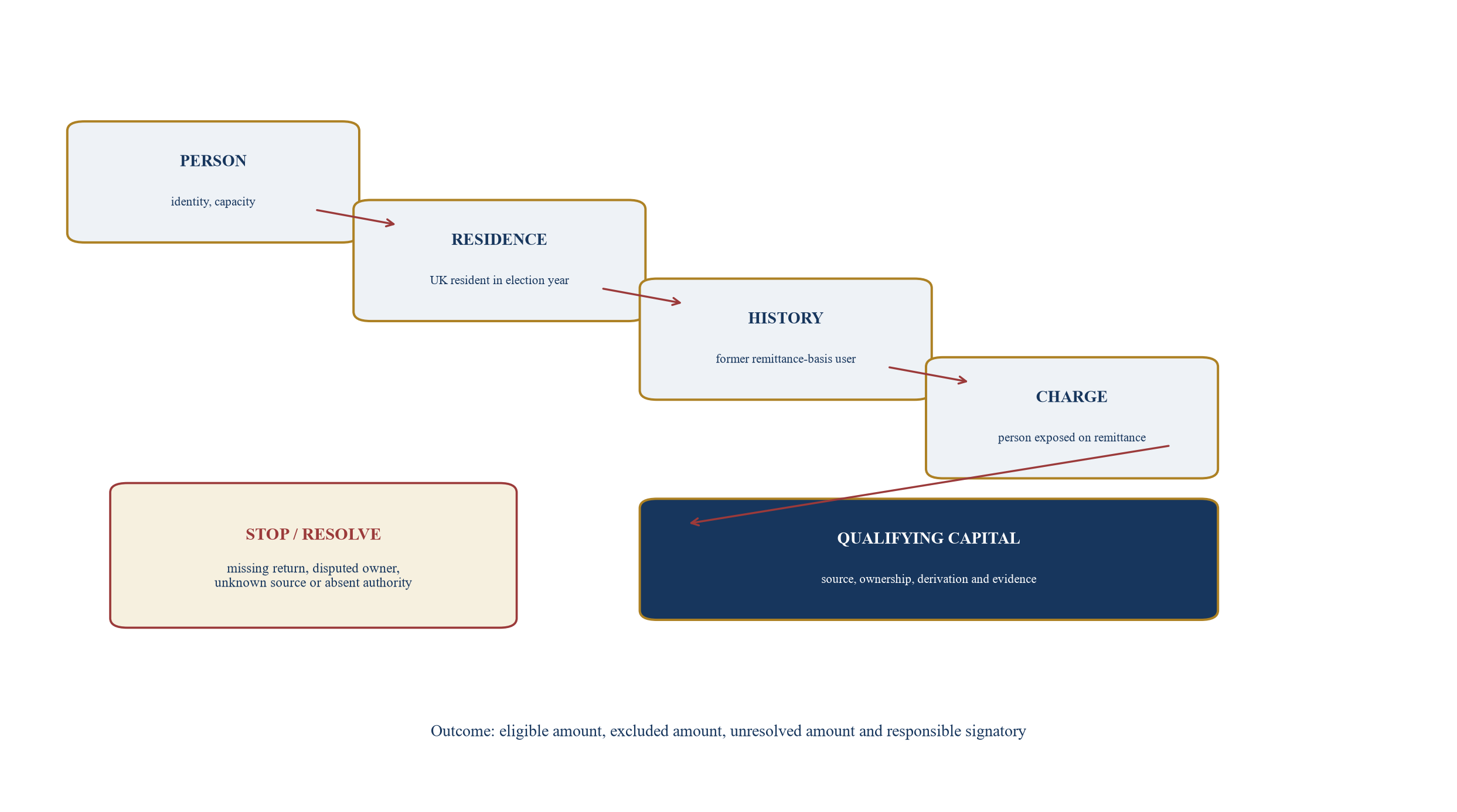
Each gate requires qualified UK advice. Passing one gate does not establish the result at the next gate.
4. Build one reconciled family balance sheet
The balance-sheet build should begin with current existence and work backwards to tax source. Bank statements, custody records, property titles, company registers, partnership statements, insurance schedules, loan documents, trust accounts and portfolio reports establish what exists now. Tax returns, computations, dividend vouchers, sale agreements, payroll records, fund statements and historic bank data establish how the value arose. Transaction records connect the two.
Every item receives a unique identifier and a defined owner. The record captures legal owner, beneficial owner, account or asset, jurisdiction, institution, currency, current value, acquisition date, original funding, income and gain years, tax paid, remittance-basis treatment, transfers, derivation, current composition, restrictions and evidence quality. Joint assets are split only after legal and tax review. Trust and company assets remain distinct from personal assets unless a specific rule attributes or matches value to the individual.
Reconciliation should be cash-and-asset based. Opening balances plus additions, income, gains, disposals, transfers, expenditure and closing balances should reconcile for each material pool. A current balance alone does not show the historic foreign income or gain available for designation. An asset bought with mixed funds can retain the character of the ingredients from which it derives. A sale can create a new gain in addition to the historic ingredients. Exchange rates can differ according to whether foreign income, gains or uncertain-origin amounts are being quantified [1,12,21].
The family council should receive a coverage report. It shows total mapped value, amounts supported by complete evidence, amounts supported by partial evidence, unresolved amounts, assets outside scope and values awaiting adviser conclusion. The report should avoid turning unresolved values into a single eligible total. Material uncertainty should lead to additional reconstruction, a narrower designation or a documented decision not to designate until the position is supportable.
Table 3. Asset, source and evidence register
| Asset or account | Person / legal owner | Historic source | Current composition | Evidence status | Decision status |
|---|---|---|---|---|---|
| offshore bank account | named individual or joint holders | income, gains, clean capital by tax year | cash plus later interest and transfers | complete / partial / unresolved | designate, hold or investigate |
| investment portfolio | individual, company or trustee | subscriptions and reinvested proceeds | securities, cash and distributions | custody plus tax-lot reconciliation | full or partial asset designation analysis |
| non-UK property | registered owner | purchase funds, debt and capital improvements | property and embedded gain | title, completion file and funding trail | derivation and disposal pathway |
| private-company interest | shareholder or holding entity | subscription, acquisition or reorganisation | shares, loans and distributions | company records and valuation support | ownership and remittance-use analysis |
| trust distribution / benefit | beneficiary with trustee involvement | matched trust income or gains | cash, asset, loan or use benefit | trustee pool and matching schedule | adviser-led eligibility analysis |
| business investment relief holding | investor | historic foreign income and gains invested in UK business | shares or loan instrument | claim, investment and current holding | designation and disposal sequencing |
Values and classifications remain provisional until confirmed by qualified advisers and reconciled to source records.
5. Classify every pound by tax character
The operating ledger should distinguish at least five categories. The first is clean capital whose remittance does not derive from untaxed foreign income or gains, subject to confirmation. The second is pre-6 April 2025 foreign income or gains that may be qualifying overseas capital. The third is TRF capital created by a valid designation and payment of the charge. The fourth is historic foreign income or gains that remain undesignated. The fifth is post-6 April 2025 income and gains, which generally enter the arising-basis or FIG-regime analysis under the post-reform rules [1,22-24].
These categories should not be blended in management reporting. A bank balance can contain several of them, and a current asset can derive from several. The ledger records both nominal amount and evidence basis. It should show the relevant tax year, type of income or gain, foreign tax, sterling conversion rule, ownership and transactions that changed form or location. Where the source cannot be identified, the file should state the uncertainty and the advice conclusion rather than assign a convenient category.
Classification drives action. Clean capital can support spending or payment of a charge, subject to the verified facts. TRF capital can be preserved for future UK remittance. Undesignated historic income and gains remain exposed under the remittance rules when used in or for the United Kingdom. Post-2025 amounts may already have been taxed or relieved under a different regime and should not be casually mixed with historic pools. Trust-derived amounts require separate matching and attribution work.
The classification should survive the banking process. Payment instructions, account names, transfer references and supporting workpapers should point to the ledger. If a family office moves funds through a concentration account, treasury platform or custody cash account, the movement should preserve traceability. Operational convenience should not erase the evidence needed to explain the transaction years later.
6. Resolve uncertain origin through governed evidence
HMRC guidance includes funds of uncertain origin within the discussion of qualifying overseas capital, subject to the detailed statutory rules [1,21,25]. This does not make uncertainty harmless. A designation amount still needs a defensible basis, and a later compliance review can test the records. Management should therefore distinguish evidential uncertainty from legal uncertainty.
Evidential uncertainty arises when the family believes an amount derives from historic foreign income or gains but records are incomplete. The reconstruction may use archived statements, tax returns, bank confirmations, custody data, contracts, trustee accounts, company records, foreign tax certificates and consistent transaction evidence. Legal uncertainty arises when the facts are known but the classification, matching, ownership or charging rule is unclear. That question requires a reasoned adviser conclusion.
The evidence hierarchy should prioritise contemporaneous primary records. A current recollection or management schedule can help direct the investigation; it should not be presented as source proof. Secondary summaries should reconcile to underlying transactions. Assumptions should be explicit, narrow and sensitivity-tested. If a range is possible, the decision model should show the range rather than convert it to one point estimate.
An evidence committee can govern material judgments. Its record states the question, facts, sources reviewed, missing data, adviser, conclusion, financial consequence, residual uncertainty and approval. The committee should be separate from the person rewarded for maximising the amount designated. The purpose is disciplined decision-making, not the creation of a predetermined answer.
7. Compare designation economics with explicit scenarios
The basic economic comparison starts with the TRF charge on the amount designated and the ordinary UK tax that could apply if the same historic foreign income or gain were remitted without designation. The comparison must then add foreign-tax-credit treatment, timing, probability of remittance, investment return on the charge, exchange-rate exposure, compliance cost, transaction cost, liquidity constraints and the value of future flexibility. No foreign tax credit is available against the TRF charge [1,10].
A designation can have value even without an immediate remittance because designated capital can be remitted later without a further charge on that amount [1,3]. The option is useful when future UK spending or return is plausible and hard to time. The option is less valuable where the amount is unlikely ever to be used in or for the United Kingdom, where ordinary remittance tax would be modest after available credit, or where the family must sell strategic assets or incur expensive financing to pay the charge.
The model should separate decision variables from facts. Facts include the supported qualifying amount, designation year, stated TRF rate, ownership and current location. Management assumptions include the chance and timing of remittance, ordinary effective tax on an undesignated remittance, investment return, funding cost and exchange rate. Sensitivities should show how the result changes when those assumptions move.
The model should also test partial designation. Families can choose the amount designated [1]. A ranked approach can place near-term UK liquidity first, then high-probability future needs, then strategic optionality, leaving low-probability pools undesignated. The ranking should incorporate evidence quality and operational separability. A smaller, well-supported designation can be more valuable than a larger designation that creates a disputed evidence and liquidity position.
The finance view should calculate the break-even ordinary-tax rate or remittance probability under the approved assumptions. It should also disclose variables the calculation excludes. A nominal rate comparison can overstate value when a large foreign-tax credit would have been available and can understate value where an early designation preserves access to a clearly identified pool for decades. The committee should review cash cost, expected value and downside separately rather than compress them into one return metric.
Tax decisions can affect portfolio construction. Paying a charge reduces investible capital today; reserving an undesignated pool for offshore use can constrain future UK spending; selling an illiquid asset can alter risk and control. The investment committee should record how the tax choice changes liquidity, concentration and return expectations without treating tax saving as investment performance.
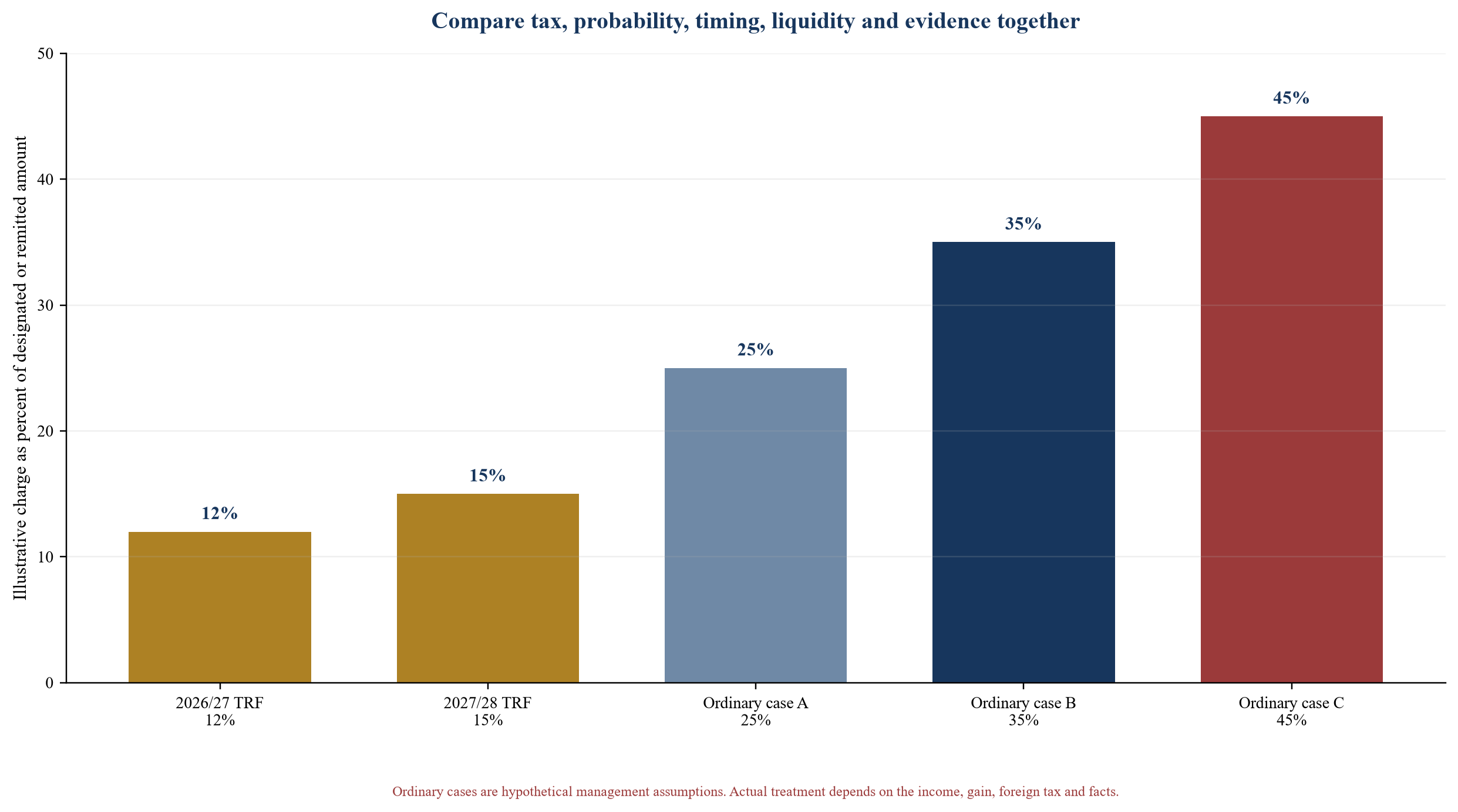
All amounts and ordinary-tax rates are management assumptions for illustration. The figure is not a tax computation or recommendation.
8. Design mixed-fund and account architecture
A mixed fund contains more than one kind of income, gain or capital, or amounts from more than one tax year. From 6 April 2025, a fund can also become mixed when it contains TRF capital and another kind of income or capital [8,26]. The composition matters because the remittance and offshore-transfer rules determine what is treated as leaving the fund. A family office should obtain account-specific advice before moving value.
HMRC guidance provides that TRF capital in a mixed fund can be remitted to the United Kingdom in priority to other kinds of income and gains [26,27]. It also describes a special overseas TRF capital account that can receive qualifying transfers of TRF capital from a mixed fund, subject to conditions and nomination requirements [28-31]. The account is intended to support traceability and reduce the risk that TRF capital is consumed in offshore transfers.
The account design requires discipline. A prohibited sum can breach the TRF deposit rule. HMRC describes a remedy for specified breaches and limits on how often breaches can be remedied within a tax year [31]. Returned payments, refunds, dividends, transfers from the wrong account or automated sweeps can therefore matter. Interest credited to the account receives specific treatment under the guidance [29]. Treasury should configure the account, disable inappropriate sweep arrangements and retain daily monitoring.
The family should create a payment map before designation. It identifies the source account, current composition, designated amount, any transfer to a nominated TRF capital account, the account used to pay the charge, future UK destination and supporting evidence. The charge itself needs care. HMRC states that using undesignated pre-6 April 2025 foreign income or gains to pay the charge can create an ordinary remittance; families should use verified clean capital or appropriately designated funds under professional advice [10].
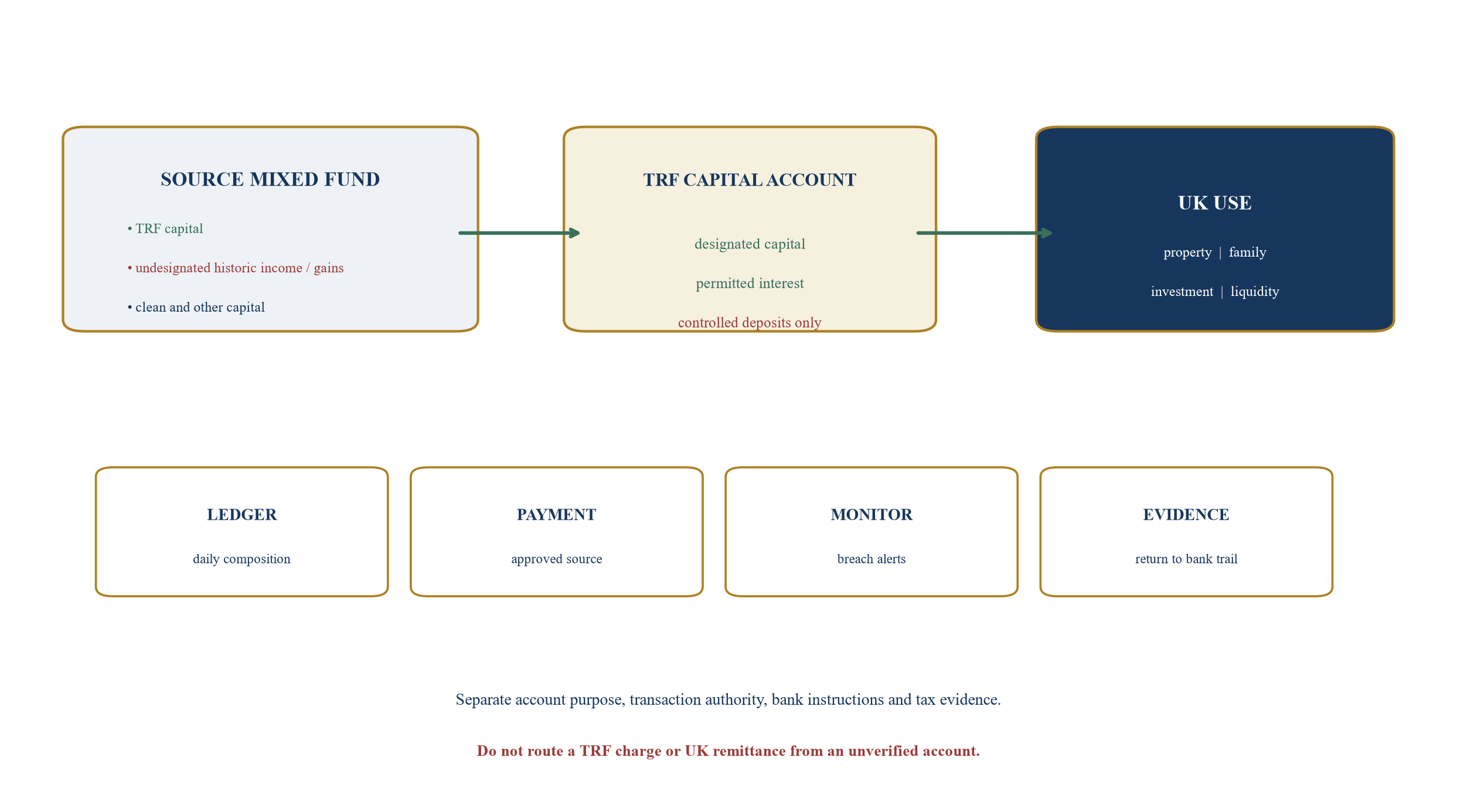
The diagram is a management control model. Actual mixed-fund and TRF-account treatment requires UK tax advice.
9. Analyse assets, investments and derivation
Qualifying value may sit in an asset rather than cash. HMRC guidance addresses assets derived from foreign income and gains and explains that the amount required to designate an asset can follow the underlying pre-6 April 2025 foreign income and gains from which it derives [32]. A current market value is therefore not automatically the designation amount. The original funding, later additions, debt, improvements, reinvestment and gains require analysis.
Property illustrates the issue. A villa purchased with historic foreign income, later improved with clean capital and sold after 6 April 2025 can contain several tax components. Private-company shares can reflect subscriptions, reorganisations, loans, dividends and sale gains. A portfolio can include purchases from mixed funds, distributions, switches and currency movements. An insurance policy can contain premiums from several pools and later gains. Each asset needs a derivation schedule that follows source value through changes of form.
Business investment relief holdings add another path. HMRC states that former remittance-basis users can continue to make qualifying investments with pre-6 April 2025 foreign income and gains after 6 April 2025 and that the ability to make a business investment relief claim ends after 5 April 2028 [1]. TRF guidance covers designations involving business investment relief and mixed-fund investments [33-38]. Families should model the designation, continued investment, disposal, withdrawal and remittance sequence before acting.
Valuation and tax source should remain distinct. A valuation can establish current economic value for family governance or liquidity. The designation computation follows the statutory amount and supporting tax records. If an asset must be sold to fund the charge, the sale can create a new tax event and transaction cost. The scenario model should show these separately so that the family does not treat a higher asset value as costless liquidity.
10. Govern trust distributions and benefits separately
The TRF includes detailed provisions for specified capital payments and benefits from non-UK trusts that are matched to pre-6 April 2025 foreign income or gains [3,14-20]. This area requires trustee-level records and specialist advice. A beneficiary cannot determine the result from the cash amount received. The analysis may depend on the type and timing of the payment or benefit, the trust's historic income and gains, matching rules, the beneficiary's eligibility and the source from which the payment derives.
The family office should request a trust data pack. It includes the trust deed and amendments, settlor and beneficiary details, residence, trustee accounts, income and gains pools, capital-payment schedules, benefits, loans, distributions, tax returns, underlying entities, asset derivation and prior matching. The trustee or its adviser should reconcile the relevant pools before a beneficiary makes an election. Where two designations or interacting reliefs may be required, the advice should explain each step and charge [14,19].
Timing matters. The TRF can apply to specified trust capital payments and benefits received during the three-year TRF period when matched to pre-6 April 2025 pools [14-20]. A distribution after the period can therefore have a different outcome. A proposed distribution should enter a pre-action approval process covering trustee power, fiduciary purpose, beneficiary eligibility, matching, foreign tax, UK residence, cash need, designation year, filing and evidence.
Governance should respect legal separation. Trustee decisions belong to the trustee under the trust instrument and applicable law. The family council can express objectives and liquidity needs; it should not record the trust as a personal bank account. Communications, advice and approvals should preserve trustee independence, confidentiality and the evidential trail.
11. Map joint ownership, gifts and family transfers
Family wealth is frequently held through joint accounts, nominee arrangements, gifts, informal loans and assets purchased for another relative's use. The TRF analysis cannot assign value according to family convention alone. Legal ownership, beneficial ownership, source, control and the person exposed to a remittance charge must be established. The record should show who contributed each amount, who received income, who can withdraw, whether a gift was completed, and whether another person is a relevant person under the remittance rules [1,39-41].
A joint account should be reconciled contribution by contribution where material. Equal legal title may not establish equal economic source. Transfers between spouses or family members can affect ownership and remittance consequences. Gifts to third parties can still create a remittance in specified circumstances when value is later used to benefit a relevant person [1,39]. The family should obtain advice before reorganising ownership simply to facilitate a designation or transfer.
The transaction register should capture donor, recipient, date, asset, market value, consideration, purpose, legal documents, tax advice, bank route and later use. Loans should have principal, interest, term, repayment, security and capacity records. A family company or foundation should have corporate authority and accounts. These documents support both the tax file and the wider succession and governance record.
Family communication also matters. One member's designation may affect shared liquidity, portfolio allocation or succession expectations. The family council should document which costs are personal, which are borne collectively, how benefits are allocated and whether reimbursement is required. This does not determine tax treatment. It prevents an unrecorded economic transfer from emerging after the election.
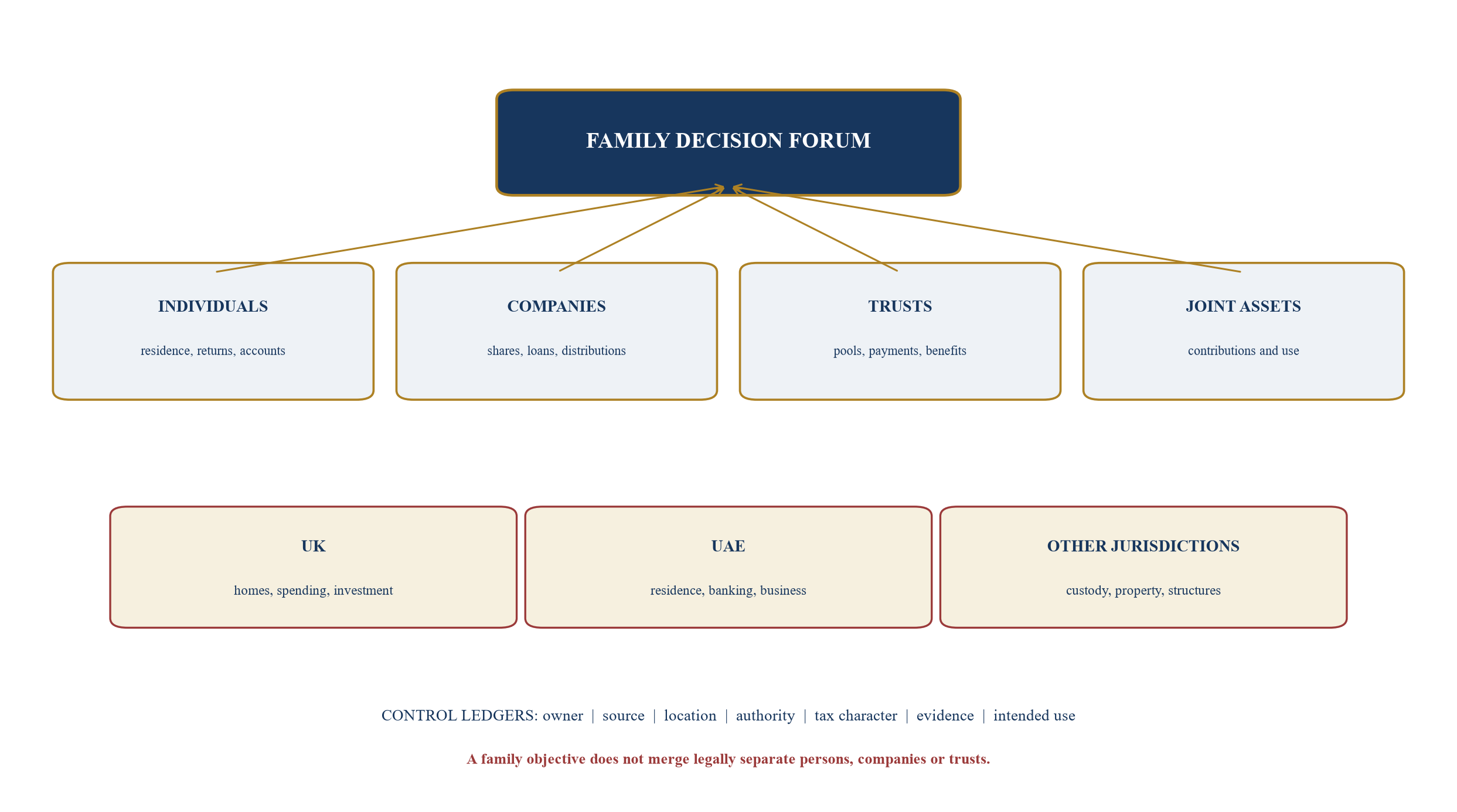
The map separates legal containers from family objectives. Ownership and tax treatment require legal and tax confirmation.
12. Connect the UK decision to UAE residence evidence
Some eligible families will live, work or hold assets in the United Arab Emirates while considering the TRF. UAE residence evidence should be built for its own legal and treaty purposes. It does not by itself determine UK residence, TRF eligibility or remittance treatment. UK residence is tested under the statutory residence test, and treaty residence can require a separate analysis where both states regard an individual as resident [42-46].
The UAE's domestic tax-residence rules include routes based on physical presence and routes that consider the person's usual or primary place of residence and centre of financial and personal interests. Official guidance explains the evidence required for a UAE tax residency certificate, including entry and exit reports, identification, residence, employment or business, family and financial connections depending on the route [47,48]. The UK-UAE treaty contains a sequence for dual-resident individuals involving permanent home, centre of vital interests, habitual abode, nationality and competent-authority agreement [45].
The family should keep a contemporaneous evidence calendar for each person. It should record travel days, UK and UAE homes, workdays, employment, directorships, family location, schools, clubs, healthcare, banking, utilities and material ties. The conclusion should be prepared by qualified advisers and updated when facts change. A visa or residency certificate is an important document within the file; it is not a substitute for the complete UK and treaty analysis.
UAE natural-person Corporate Tax also needs a separate boundary. The Federal Tax Authority states that wages and qualifying personal investment income are outside Corporate Tax, while a natural person carrying on a business or business activity can enter the regime when the applicable turnover threshold is met [49,50]. Family-office, consulting, investment-management or trading activities should be reviewed on their actual facts. Personal and business accounts should remain distinct.
13. Sequence liquidity, charge payment and UK use
The designation decision can create an immediate charge and a long-dated benefit. Treasury should model both. For each proposed amount, the cash-flow schedule should show the designation year, sterling amount, charge, source of charge funding, payment date, future UK remittance, intended use, investment return forgone, foreign-exchange exposure and minimum liquidity reserve.
Charge funding is a control point. HMRC explains that an overseas payment of the TRF charge using undesignated pre-6 April 2025 foreign income or gains can itself be an ordinary remittance. The remittance-basis-charge payment exemption does not apply to the TRF charge [10]. The family should identify verified clean capital, UK funds or appropriately designated amounts under advice and should document the exact route before payment.
The UK-use plan should rank needs by timing and certainty. Examples include property acquisition, mortgage repayment, education, living costs, investment, business capital, tax, estate equalisation and emergency liquidity. Each need receives an amount, earliest date, latest date, owner and confidence level. The designation portfolio can then be sized to supported demand rather than an undifferentiated desire for flexibility.
Foreign exchange should be visible. The designation is reported in sterling, and HMRC guidance specifies different conversion principles for foreign income, foreign gains and uncertain-origin amounts [1,12]. The economic model should distinguish the statutory sterling amount from later currency movements. Hedging, conversion and banking fees are commercial decisions with their own risks and should be approved separately.
Table 4. Hypothetical designation and liquidity scenarios
| Scenario | Supported historic amount | Proposed designation | Assumed TRF rate | Assumed UK use | Management decision question |
|---|---|---|---|---|---|
| near-term property | GBP 4.0m | GBP 3.0m | 12% | high-confidence purchase within 24 months | does the option value exceed charge and funding cost? |
| education and family support | GBP 1.2m | GBP 0.8m | 12% | staged spending over five years | which pool offers clean traceability and suitable liquidity? |
| strategic return option | GBP 8.0m | GBP 2.0m | 15% | possible return with uncertain date | what probability and ordinary-tax exposure justify a final-year election? |
| long-term offshore investment | GBP 10.0m | nil or selective | 15% | no planned UK use | does flexibility merit an immediate charge? |
| trust distribution | GBP 5.0m payment | adviser-defined eligible amount | 12% or 15% by year | succession or property funding | are matching, beneficiary eligibility and trustee evidence complete? |
All values, ordinary-tax rates, remittance probabilities and timings are management assumptions. Results require person-specific tax and investment analysis.
14. Use the final 2027/28 year as a residual decision
The 2027/28 designation year is best treated as a residual portfolio review. By then, a well-run family should know what was designated at 12 percent, what was deliberately left undesignated, what new trust payments or benefits arose during the TRF period, what accounts contain TRF capital, what UK liquidity is expected and which evidence gaps remain. The 15 percent year can then address supported residual pools rather than reopen the entire history under time pressure.
The review should begin well before 5 April 2028. The family office should freeze the asset and source register at an agreed date, reconcile transactions since the last review, obtain trustee schedules, confirm residence and election eligibility, test account composition, update liquidity needs and request adviser conclusions. Proposed disposals, distributions or transfers should be screened for their effect on derivation and mixed funds before execution.
The model should compare three final-year choices: designate now at 15 percent, leave undesignated and accept ordinary remittance treatment if later used in the United Kingdom, or avoid UK use while preserving records. A fourth path may be to designate only the amount associated with high-confidence future needs. Each choice should show charge, evidence quality, funding source, expected use, downside and reversibility.
The election file should be ready before the return is submitted. It contains the person ledger, qualifying-capital schedule, asset derivation, trust matching, exchange rates, tax calculation, funding route, bank evidence, approvals and adviser memorandum. The latest statutory election date should remain a contingency rather than the production schedule. Delaying work until the long-stop date can expose the family to missing records, adviser capacity constraints and unreviewed transactions.
15. Create a governance blueprint with clear decision rights
The family council or investment committee should approve objectives, risk appetite, liquidity priorities and cost allocation. It should not replace the individual taxpayer, trustee, company board or qualified adviser. Each legal actor retains its authority. The governance blueprint makes those boundaries visible and establishes how information and decisions move between them.
The responsible individual approves their election and return. The tax adviser determines the technical analysis and filing treatment within the engagement. Trustees decide distributions and trust matters under their duties. Company boards approve corporate transactions. Treasury executes only approved payment routes. Legal advisers confirm ownership, powers and documents. The family office coordinates records, scenarios and implementation without presenting itself as the source of legal conclusions.
Conflicts should be documented. One family member may receive the flexibility created by a designation while another bears the charge through a shared pool. A trustee may have beneficiaries with different interests. An adviser may have prepared historic returns that are now being reconstructed. The governance record should state the conflict, information barriers, independent input and approval route.
The committee pack should include decisions rather than raw volume. It contains eligible, unresolved and excluded amounts; designation options; charge and liquidity; evidence gaps; trust actions; account architecture; UK and UAE residence summary; red flags; adviser opinions; and the exact approvals requested. Minutes should record the chosen path and rejected alternatives. They should avoid claiming certainty beyond the evidence.
Table 5. Family governance and decision-rights blueprint
| Actor | Core responsibility | Decision evidence | Prohibited shortcut | Escalation |
|---|---|---|---|---|
| individual taxpayer | approve election, return and use of personal assets | signed return, advice and personal ledger | family council assumes consent | unresolved ownership, capacity or eligibility |
| family council | set objectives, liquidity priorities and cost principles | approved decision memorandum | merge separate taxpayers and structures | conflict or unequal economic burden |
| trustee | govern trust distributions, benefits and records | trustee resolution, pools and matching schedule | beneficiary directs trustee as agent | incomplete pools or fiduciary conflict |
| company board | approve dividends, loans, sales and reorganisations | board papers, accounts and legal advice | treat company cash as personal capital | solvency, tax or governance concern |
| tax and legal advisers | determine technical treatment and document basis | dated opinions, computations and filing workpapers | generic rate comparison | material uncertainty or missing facts |
| treasury / bank operator | execute approved accounts, charge and remittance | payment instruction and bank trail | route through convenience account | source composition or authority mismatch |
Roles are illustrative. Legal authority follows the person, governing documents and applicable law.
16. Separate entity architecture from personal tax planning
Families operating between the UK and UAE may use holding companies, family offices, trusts, foundations, partnerships and operating businesses. The TRF applies to individuals and qualifying overseas capital under its detailed rules. A company or trust does not become a personal TRF account because the family controls it. Transactions between the structure and the individual can create dividends, loans, benefits, capital payments, disposals, employment income, management-and-control issues and reporting obligations.
The entity map should show jurisdiction, legal form, owner, settlor, trustee, protector, beneficiaries, directors, business purpose, assets, banking, tax residence, management location, licences and intercompany arrangements. It should identify where strategic and day-to-day decisions are made. The UK-UAE treaty and domestic rules should be reviewed for dual-resident entities and permanent establishments where relevant [45,51]. UAE companies and natural-person businesses should be assessed under the UAE Corporate Tax framework and transfer-pricing rules [49-53].
The personal designation plan should not drive a transaction that damages the business. A dividend may weaken working capital or loan covenants. A share sale can change control. A loan repayment can affect liquidity. A reorganisation can require consent, valuation and tax analysis. The board should approve the corporate action on its own merits and document the connection to family liquidity.
Substance and record alignment matter. Board minutes, contracts, bank instructions, accounting entries, tax returns and family-office schedules should describe the same transaction. An entity labelled as UAE-managed while material decisions are taken elsewhere creates risk beyond the TRF. The architecture review should therefore combine personal tax planning with corporate governance and operating reality while preserving the separate conclusions.
17. Build an eighteen-month execution programme
The programme begins with a ninety-day evidence sprint. Days 0 to 30 establish the relevant people, residence history, prior remittance-basis claims, entities, trusts, accounts and current assets. Days 31 to 60 retrieve statements, returns, computations, titles, trustee records and transaction documents. Days 61 to 90 reconcile sources, classify evidence, identify missing records and instruct advisers on the highest-value questions.
The next phase converts evidence into decisions. Months 4 to 6 complete source and derivation schedules, trust matching, joint-ownership analysis, mixed-fund composition and charge-funding routes. Months 7 to 9 model designation scenarios and future UK needs. Months 10 to 12 obtain final advice, approve account architecture and decide the 12 percent designation portfolio where available. The final six months monitor transactions, implement elections and prepare the residual 2027/28 review.
The workstream should use gates. Gate one confirms that every relevant person and legal container is mapped. Gate two confirms that supported, unresolved and excluded amounts reconcile to current assets. Gate three approves the economic model and funding route. Gate four approves the election and return workpapers. Gate five verifies that designated capital, account transactions and future remittances remain traceable.
Progress reporting should show decision coverage. Useful measures include percentage of current value mapped, percentage of proposed designation supported by primary evidence, unresolved high-value items, trust pools reconciled, mixed funds with daily composition records, charge funding verified, adviser opinions complete and approved elections filed. Activity counts alone can conceal that the largest or most complex pools remain unresolved.
Quality assurance should be independent of the preparer for material elections. A reviewer should trace a sample of proposed designations from the return schedule back through the tax computation, source ledger, account or asset records, ownership evidence and transaction history. The review should test arithmetic, dates, exchange rates, duplicate inclusion, excluded post-2025 amounts, trust matching and the payment route. Exceptions remain open until corrected, accepted by the responsible adviser or removed from the proposed election.
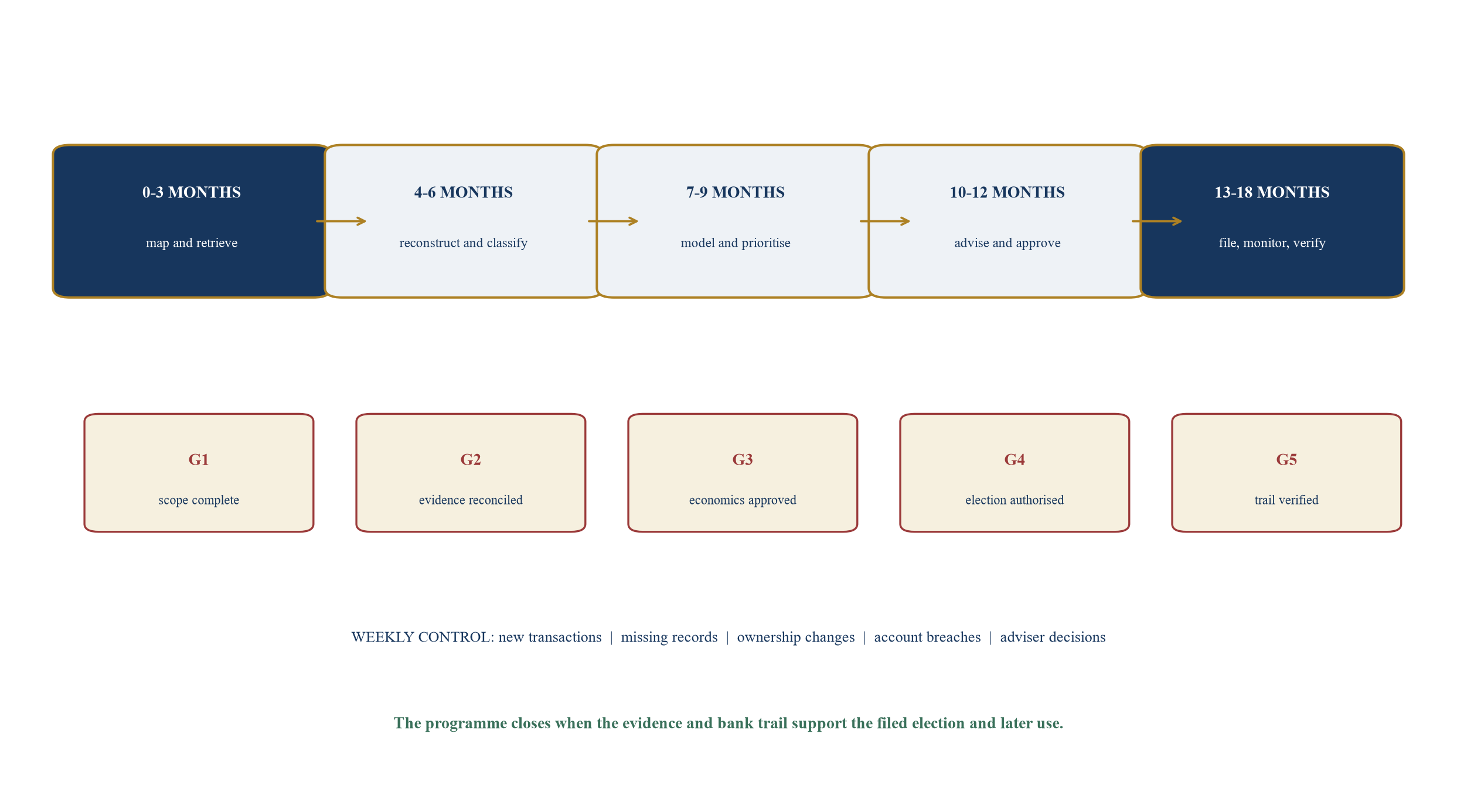
Timing is a management planning model. Filing dates, transactions and adviser requirements may require a different sequence.
18. Test the framework through hypothetical family cases
Case one considers a UK-resident former remittance-basis user with GBP 6 million of supported historic foreign dividend income in a segregated account and a planned GBP 2 million UK property purchase. The management model compares a GBP 2 million designation in 2026/27 at 12 percent with leaving the amount undesignated. The decision depends on the verified ordinary remittance treatment, foreign tax, funding source and purchase probability. The framework favours sizing the election to the supported need before considering optional excess.
Case two considers a mixed portfolio funded by historic income, gains and clean capital, with incomplete tax-lot records. The current market value is GBP 12 million. The family should not designate the current value by assumption. It reconstructs subscriptions, disposals, income, gains and transfers, identifies the underlying amounts, tests asset derivation and obtains advice. The unresolved portion remains separate in the decision pack.
Case three considers a capital payment from a non-UK trust during 2027/28. The trustees have historic gain and income pools, and the beneficiary previously used the remittance basis. The trustee and beneficiary advisers reconcile matching, eligibility and any derived amount before the beneficiary decides whether to designate. The trustee records its independent purpose and authority. The family models the 15 percent charge and future UK use without treating the gross payment as automatically eligible.
Case four considers a UAE-resident family member who may return to the UK after several years. The person can make a TRF election only if UK resident in the designation year and otherwise eligible [1,12]. UAE residence evidence and return optionality do not create eligibility. The family needs advice on UK residence, possible split-year treatment, treaty position, temporary non-residence, the four-year FIG regime on a later return and inheritance-tax residence rules [42-46,54-57]. These are separate conclusions in one mobility plan.
19. Recognise red flags and limitations
Several red flags should stop execution. They include a missing prior tax return, disputed beneficial ownership, an unsupported current-balance estimate, a trust distribution without reconciled pools, a joint account without contribution history, a charge funded from an unverified offshore account, a proposed transfer that changes mixed-fund composition, an account nominated without deposit controls, or an adviser opinion based on facts that have since changed.
Other red flags concern governance. A family office may direct a trustee without respecting fiduciary authority, treat a company account as personal, allocate the charge without consent, or suppress uncertainty to reach a larger designation. A well-controlled process records uncertainty, conflicts and rejected alternatives. It does not promise that designation prevents all later tax. Income or gains generated after designation can have their own tax treatment, and use of designated assets can create new events [22,32].
The framework also has limitations. It does not calculate the tax of a specific person, interpret a trust deed, establish ownership, determine residence, select investments, value assets, advise on foreign tax, or replace filing work. Official guidance and legislation can change. The relevant facts can change through residence, death, gifts, divorce, transactions, trust decisions, company actions, bank movements and currency conversion. The advice should be refreshed before execution.
Commercial outcomes remain uncertain. A designation creates a tax and liquidity position; it does not guarantee investment return, migration success, family agreement or a future UK need. The family should evaluate the decision within its wider portfolio, succession, residence, banking and business strategy. The evidence file should remain usable even if the chosen path changes.
Table 6. Pre-election and post-election transition checklist
| Stage | Required evidence | Control test | Owner | Stop condition |
|---|---|---|---|---|
| scope | relevant people, entities, trusts, accounts and assets | completeness reconciles to current balance sheet | family office | material person or container missing |
| eligibility | residence, prior remittance-basis use and charging position | adviser confirms person-specific eligibility | individual and tax adviser | return or status unresolved |
| quantification | source, derivation, trust matching and exchange rates | supported amount reconciles to primary evidence | tax adviser | material unexplained difference |
| economics | charge, ordinary-tax scenario, liquidity and future use | assumptions and sensitivities approved | family council | funding or purpose unsupported |
| execution | election, return, payment route and bank instructions | signatures, authority and workpapers complete | individual, adviser and treasury | unverified source account |
| aftercare | TRF capital ledger, account monitoring and remittance evidence | transaction trail remains complete | treasury and family office | prohibited deposit or unreconciled movement |
The checklist supports governance. Qualified advisers determine the required legal, tax and filing steps.
20. Make the decision before the evidence decides it
The final TRF year is a finite policy window and a longer filing process. HMRC's guidance makes the final rate and election dates clear: 15 percent for 2027/28 designations and a latest election date of 31 January 2030 for that year [10,11]. The family should still set an earlier operating deadline. Evidence reconstruction, trust matching, ownership, mixed funds, liquidity and account controls cannot be compressed safely into a return-filing instruction.
The strongest decision architecture has five outputs. It produces a person ledger that establishes who may elect. It produces a reconciled asset and source register that separates supported, unresolved and excluded amounts. It produces an economics model that treats future UK use, ordinary tax, foreign tax, timing and liquidity as explicit variables. It produces a governance memorandum that assigns legal authority and manages conflicts. It produces an execution file that connects the return to payment, bank accounts and later remittances.
The decision can then be selective and durable. The family can designate the pools with evidence and a credible use case, preserve clean capital, leave low-probability pools undesignated, and retain records for every category. It can coordinate UK and UAE residence evidence without confusing one regime for another. It can keep companies and trusts legally separate while integrating their information into the family plan.
The practical objective is defensible flexibility. A filed election without a maintained ledger can become difficult to use. A ledger without an economic decision can consume time without creating value. The family needs both. Work should begin while records, advisers and transaction history remain accessible, and each action should be approved before the movement of money or assets changes the facts.
Sources and further reading
- HM Revenue & Customs, HS264: Remittance of pre-6 April 2025 foreign income and gains and the temporary repatriation facility, published 6 April 2026. Official source
- HM Revenue & Customs, RDRM71000: Temporary repatriation facility introduction, updated 7 April 2026. Official source
- HM Revenue & Customs, RDRM72100: Qualifying overseas capital overview, updated 7 April 2026. Official source
- HM Revenue & Customs, RDRM72200: Personal foreign income and gains, updated 7 April 2026. Official source
- HM Revenue & Customs, RDRM72000: Qualifying overseas capital contents, updated 7 April 2026. Official source
- HM Revenue & Customs, RDRM35210: Mixed funds overview, updated 7 April 2026. Official source
- HM Revenue & Customs, RDRM35420: Offshore transfers and composition, updated 7 April 2026. Official source
- HM Revenue & Customs, RDRM75100: Mixed funds and the TRF, updated 7 April 2026. Official source
- HM Revenue & Customs, RDRM75200: Ordering rules for TRF capital, updated 7 April 2026. Official source
- HM Revenue & Customs, RDRM73400: TRF charge, updated 7 April 2026. Official source
- HM Revenue & Customs, RDRM73320: Designation time limits, updated 7 April 2026. Official source
- HM Revenue & Customs, RDRM73310: Making a designation, updated 7 April 2026. Official source
- HM Revenue & Customs, RDRM73200: Eligibility for the TRF, updated 7 April 2026. Official source
- HM Revenue & Customs, RDRM72400: Capital payments made by non-resident settlements, updated 7 April 2026. Official source
- HM Revenue & Customs, RDRM72500: Trust income and benefits contents, updated 7 April 2026. Official source
- HM Revenue & Customs, RDRM72450: Supplementary charge on capital payments made by non-resident settlements, updated 7 April 2026. Official source
- HM Revenue & Customs, RDRM74600: Foreign employment income received on or after 6 April 2025, updated 7 April 2026. Official source
- HM Revenue & Customs, RDRM72550: Benefits matched with relevant foreign income, updated 7 April 2026. Official source
- HM Revenue & Customs, RDRM72560: Offshore income gains guidance, updated 7 April 2026. Official source
- HM Revenue & Customs, RDRM72600: Post-2024/25 income and pre-6 April 2025 gains matching, updated 7 April 2026. Official source
- HM Revenue & Customs, RDRM73500: Quantifying designated qualifying overseas capital, updated 7 April 2026. Official source
- HM Revenue & Customs, RDRM73600: Exemptions and reliefs from further tax charges, updated 7 April 2026. Official source
- HM Revenue & Customs, HS266: Foreign income and gains regime 2026. Official source
- HM Revenue & Customs, RFIG41000: Foreign income and gains regime introduction, updated 3 July 2026. Official source
- HM Revenue & Customs, RDRM72300: Amounts of uncertain origin, updated 7 April 2026. Official source
- HM Revenue & Customs, RDRM75000: Mixed funds contents, updated 7 April 2026. Official source
- HM Revenue & Customs, RDRM75400: Offshore transfers from mixed funds containing TRF capital, updated 7 April 2026. Official source
- HM Revenue & Customs, RDRM75300: TRF capital account contents, updated 7 April 2026. Official source
- HM Revenue & Customs, RDRM75310: Transfers to a TRF capital account, updated 7 April 2026. Official source
- HM Revenue & Customs, RDRM75320: Nominating a TRF capital account, updated 7 April 2026. Official source
- HM Revenue & Customs, RDRM75340: Breaches of the TRF deposit rule, updated 7 April 2026. Official source
- HM Revenue & Customs, RDRM74300: Assets derived from foreign income and gains, updated 7 April 2026. Official source
- HM Revenue & Customs, RDRM74700: Business Investment Relief and TRF contents, updated 7 April 2026. Official source
- HM Revenue & Customs, RDRM74710: Business Investment Relief overview, updated 7 April 2026. Official source
- HM Revenue & Customs, RDRM74720: Business Investment Relief investments, updated 7 April 2026. Official source
- HM Revenue & Customs, RDRM74730: Designating Business Investment Relief investments, updated 7 April 2026. Official source
- HM Revenue & Customs, RDRM74740: Disposals of Business Investment Relief holdings, updated 7 April 2026. Official source
- HM Revenue & Customs, RDRM74750: Mixed fund Business Investment Relief investments, updated 7 April 2026. Official source
- HM Revenue & Customs, RDRM33000: Remittances and relevant persons contents. Official source
- HM Revenue & Customs, RDRM33200: Relevant persons. Official source
- HM Revenue & Customs, RDRM33500: Gift recipients and remittances. Official source
- HM Revenue & Customs, RDR3: Statutory Residence Test notes, updated 11 June 2026. Official source
- HM Revenue & Customs, RFIG20000: Statutory Residence Test overview, updated 3 July 2026. Official source
- HM Revenue & Customs, RFIG21030: Split-year treatment and priority rules, updated 3 July 2026. Official source
- HM Revenue & Customs, 2016 UK-UAE Double Taxation Convention. Official source
- HM Revenue & Customs, HS302: Dual residents. Official source
- United Arab Emirates Ministry of Finance, Cabinet Decision No. 85 of 2022 and Ministerial Decision No. 27 of 2023 on tax residency. Official source
- United Arab Emirates Federal Tax Authority, Issuance of Tax Certificates for Tax Residency, updated 6 April 2026. Official source
- United Arab Emirates Federal Tax Authority, Taxation of Natural Persons under the Corporate Tax Law. Official source
- United Arab Emirates Federal Tax Authority, Registration of Natural Persons for Corporate Tax. Official source
- United Arab Emirates Federal Tax Authority, Corporate Tax General Guide. Official source
- United Arab Emirates Federal Tax Authority, Corporate Tax FAQs. Official source
- United Arab Emirates Ministry of Finance, Federal Decree-Law No. 47 of 2022 on the Taxation of Corporations and Businesses. Official source
- HM Revenue & Customs, Inheritance Tax if you are a long-term UK resident. Official source
- HM Revenue & Customs, IHTM47020: Long-term UK residence test, updated 7 April 2026. Official source
- HM Revenue & Customs, Check if you can claim the four-year foreign income and gains regime. Official source
- HM Revenue & Customs, RFIG21510: Temporary non-residence introduction, updated 3 July 2026. Official source
- Finance Act 2025, including Schedule 10 on the temporary repatriation facility. Official source
