

1. INTRODUCTION
A relocation from the United Kingdom to the United Arab Emirates can be commercially substantial, personally durable and well evidenced. A later return to the UK can still activate a separate set of rules for income and gains realised while the individual was abroad. The temporary non-residence rules are designed around that return. Their operation depends on the individual's residence history before departure, the sequence of residence periods after departure, the exact time before sole UK residence resumes, and the legal character of each transaction completed during the intervening period [1-7].
This creates an option-management problem. A principal may intend to remain in the UAE for the long term while preserving the ability to return for family, health, business or educational reasons. The return option has economic value. It can also carry a contingent UK tax exposure. A disposal, close-company distribution, pension withdrawal, chargeable-event gain, released participator loan or remittance may be received during the UAE period. The UK analysis can change when the principal later resumes sole UK residence within the statutory window [6-13].
The central control is a dated residence-period map. Flights, visa dates and tax-year labels each provide evidence. None supplies the full legal conclusion on its own. HMRC's current guidance defines residence periods to include full tax years and the UK or overseas parts of split years. The temporary period begins after the last residence period of sole UK residence and ends before the first new residence period of sole UK residence. HMRC's published examples show that a person can be outside the temporary non-residence rules after more than five exact years even without completing five whole tax years abroad [3-5].
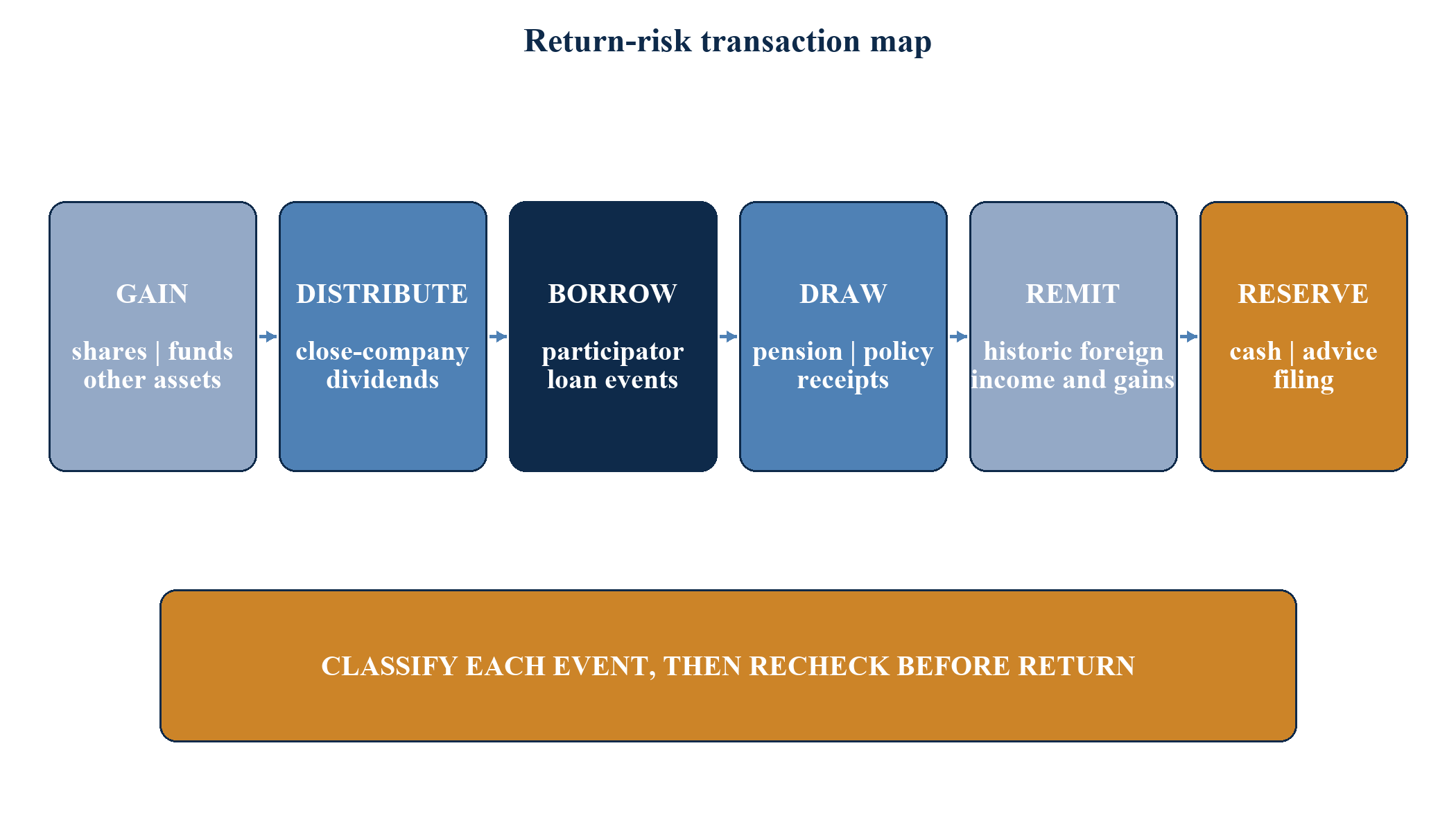
The return decision therefore needs two ledgers. The residence ledger measures the statutory clock and monitors the facts that can cause UK residence to resume. The transaction ledger classifies every material income, gain, withdrawal, distribution, loan event and remittance during the UAE period. The ledgers meet at a pre-return gate. Qualified advisers can then determine whether the temporary non-residence conditions apply, which items fall within the relevant provisions, what foreign-tax relief may be available, what reporting is required and how much cash should be reserved.
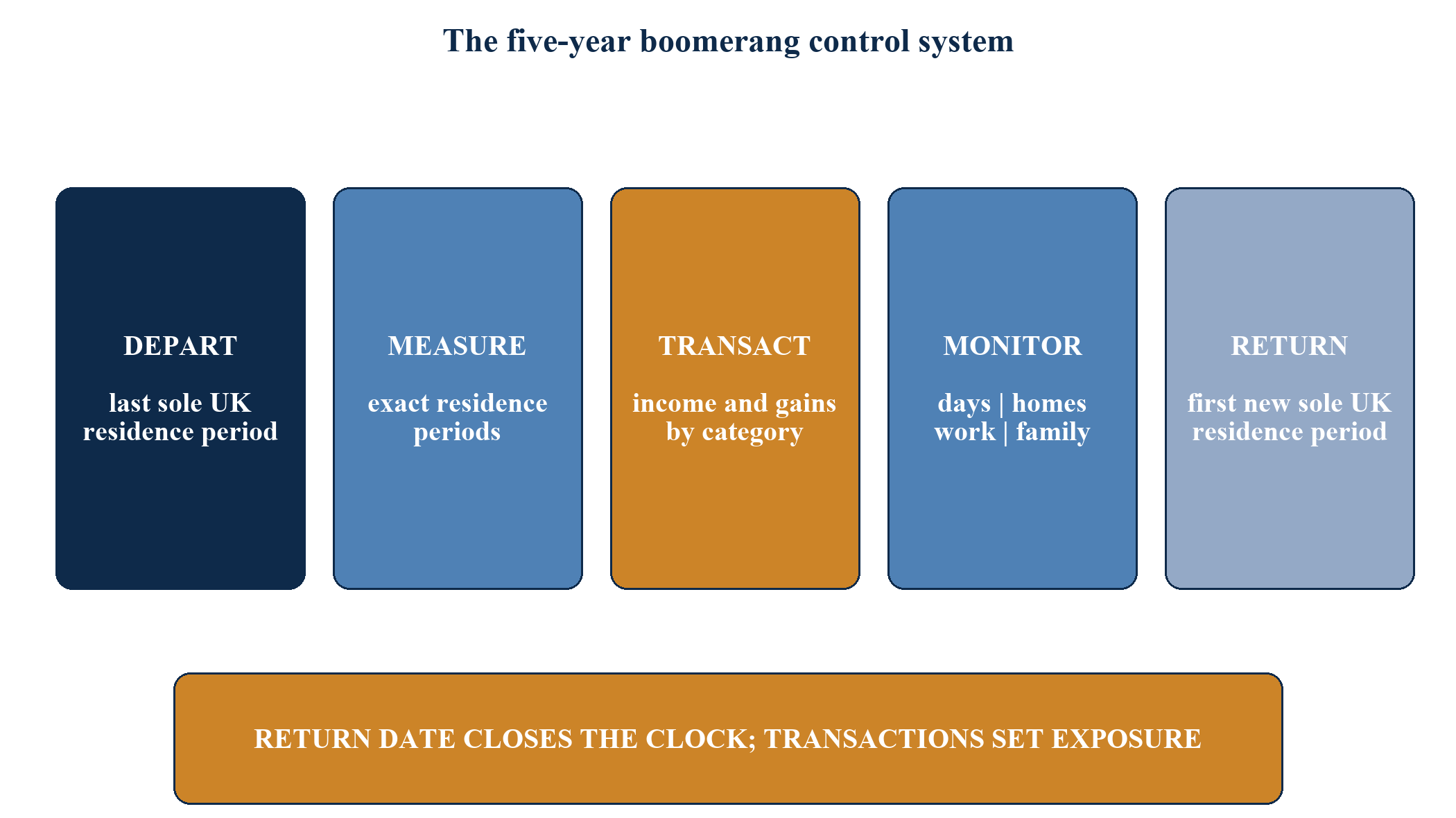
The framework in this paper has six outputs: an exact residence history; a prospective statutory residence test calendar; a transaction and extraction register; a UAE domestic and treaty evidence file; a return-risk liquidity reserve; and a signed pre-return memorandum. These outputs preserve mobility. They also give family members, boards, trustees, lenders and advisers a common chronology.
| Control domain | Core question | Required output |
|---|---|---|
| departure | when did the last residence period of sole UK residence end? | residence history, split-year analysis and dated evidence |
| duration | what is the exact length of the intervening periods without sole UK residence? | day-precise clock with adviser conclusion |
| return | when could sole UK residence resume under domestic and treaty rules? | forward calendar, ties register and trigger map |
| transactions | which income, gains and withdrawals arose during the UAE period? | event-by-event legal and tax classification |
| evidence | which UK, UAE and treaty facts are contemporaneously supported? | indexed source documents and annual certificates |
| liquidity | what cash could be required if the return charge applies? | scenario range, foreign-tax-credit file and segregated reserve |
2. THE LEGAL ARCHITECTURE
2.1 The return charge follows a residence sequence
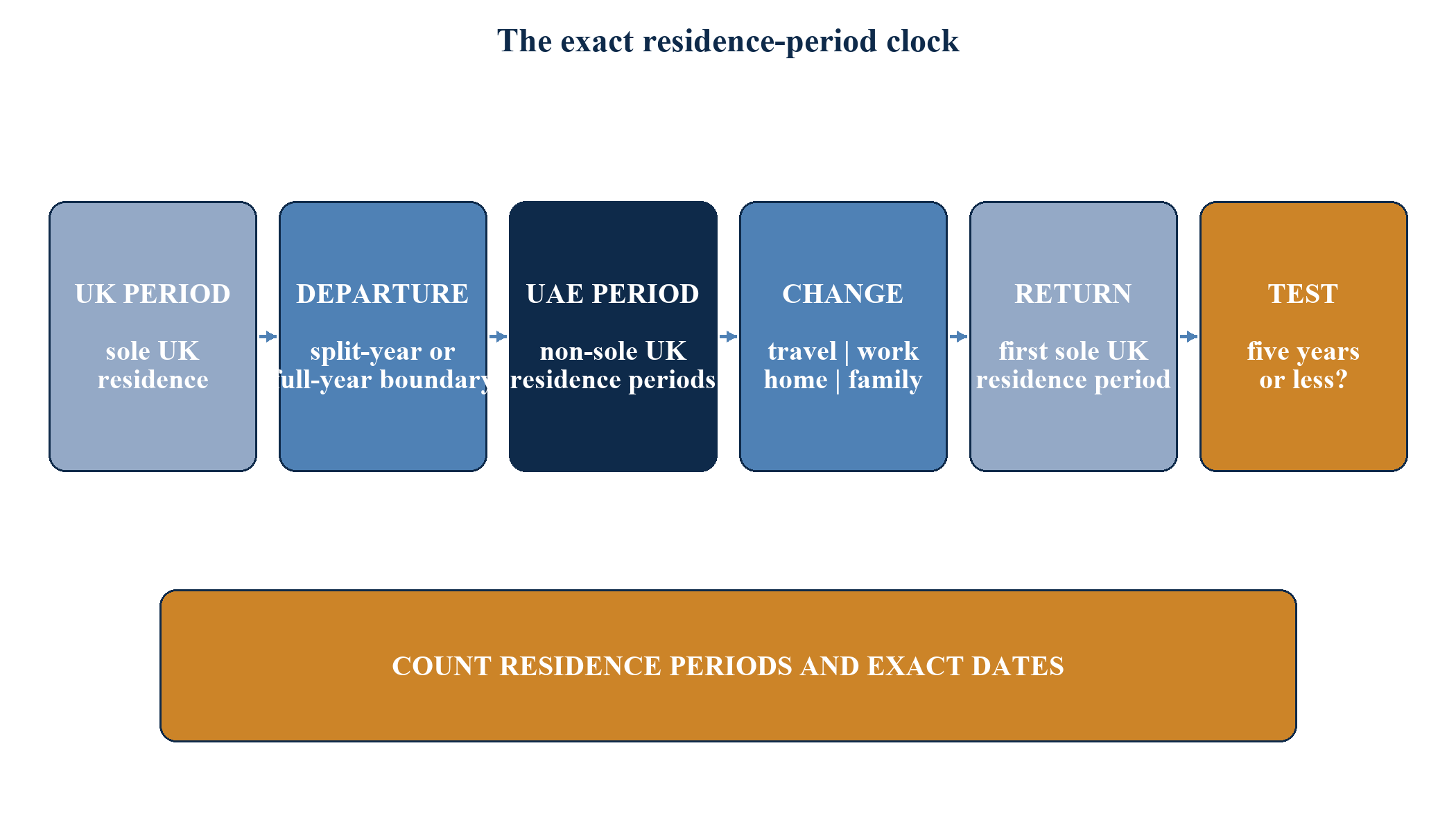
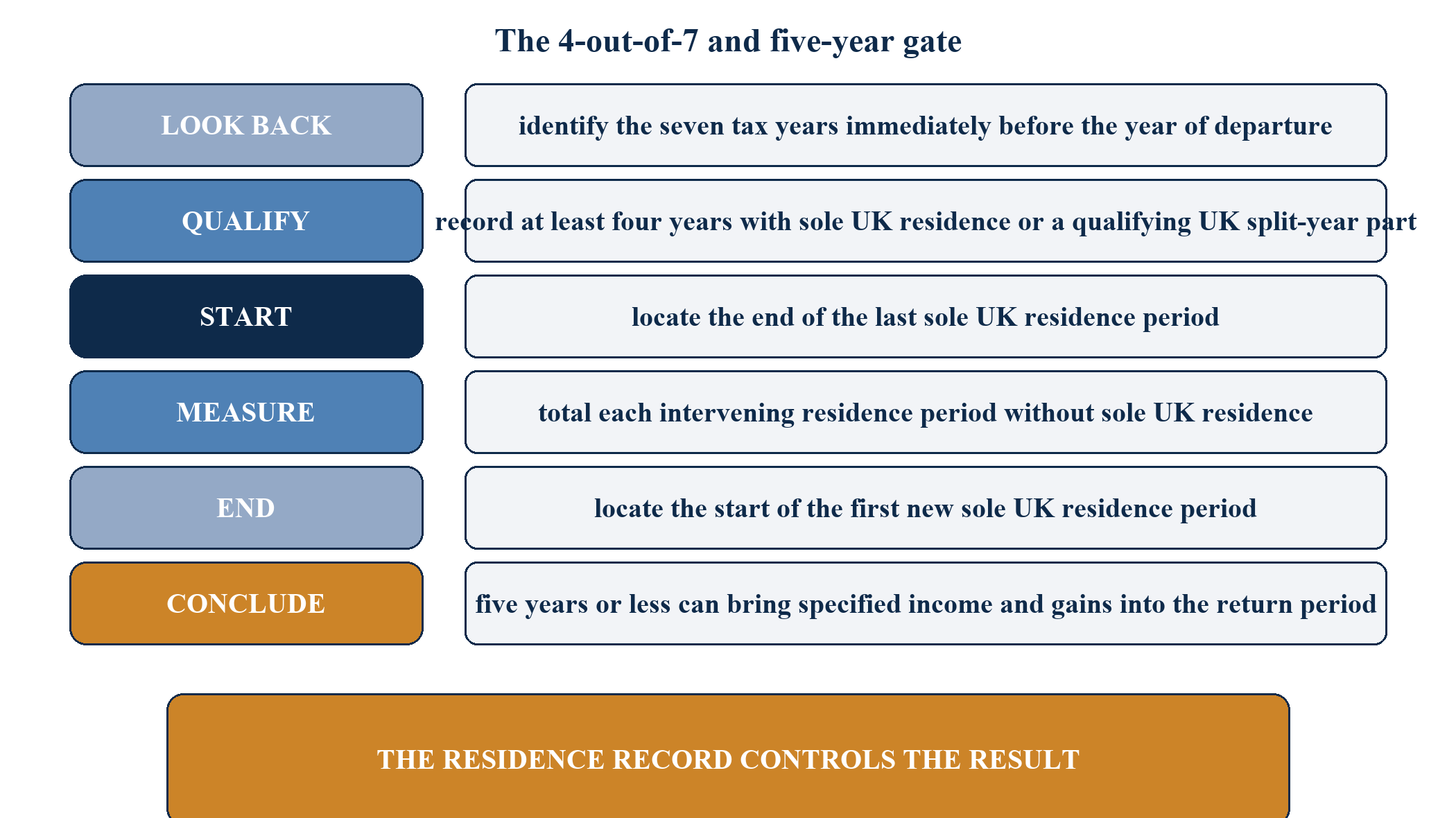
HMRC describes temporary non-residence as a sequence beginning with a residence period in which the individual had sole UK residence, followed by one or more residence periods in which the individual did not have sole UK residence, and ending when a new period of sole UK residence begins. At least four of the seven tax years immediately before the year of departure must contain the required sole UK residence. The intervening period must be five years or less [2-5].
Each element deserves a separate conclusion. The pre-departure look-back establishes whether the person is within the population covered by the rules. The start date establishes the first day of the intervening period. The end date establishes the last day. The length test compares the resulting duration with five years. The transaction provisions then decide which receipts or gains can be treated as arising in the period of return.
This sequence explains why return planning starts well before a return flight. A person can become UK resident because of days, work, homes or ties. Split-year treatment applies only where the statutory conditions for a relevant case are satisfied. Treaty residence can affect whether a residence period is one of sole UK residence. Each of these conclusions uses facts that can arise before the family regards the move as complete [1,3-5,14,20].
2.2 Sole UK residence is a defined concept
For a full tax year, sole UK residence requires UK residence for that year and no period during which the person is treaty non-resident. For a UK part of a split year, the same concept is applied to that UK part. A residence period can therefore change because domestic residence changes, split-year treatment applies, or the treaty assigns the person to the UAE during a period of dual domestic residence [3,14,20].
The treaty analysis is fact sensitive. Under Article 4 of the UK-UAE convention, an individual who is resident in both states is assigned by a sequence involving a permanent home, centre of vital interests, habitual abode, nationality and, if necessary, mutual agreement [14]. A UAE tax residency certificate is important evidence for an applicable period. The certificate and the domestic UAE evidence do not substitute for the treaty's full test.
2.3 The 4-out-of-7 test
The look-back covers the seven tax years immediately preceding the year of departure. A qualifying year can be a full tax year of sole UK residence or a split year containing a residence period of sole UK residence. The record should identify each year, its domestic status, any treaty status, any split-year case and the supporting advice [2,7].
A long-term UK resident will often satisfy this condition. A recent arrival may not. HMRC's guidance on the four-year foreign income and gains regime also notes that a person who becomes temporarily non-resident during the first four years after coming to or returning to the UK will generally lack the required four qualifying years [21]. That outcome still requires a fact-specific residence history.
2.4 The five-year limit
The five-year limit measures the total intervening residence periods without sole UK residence. HMRC's current manual states that the person does not need five complete tax years of non-residence to be outside the temporary non-residence provisions. The examples measure from the relevant start date to the date immediately before the period of return [5].
A policy that says "stay away for five UK tax years" can therefore be both overly conservative and unsafe. It may defer a permitted return longer than the law requires in one fact pattern. It may also fail to identify an earlier return caused by UK residence or a treaty change in another. The controlled approach calculates the exact dates and refreshes the conclusion as facts develop.
| Question | Evidence | Decision owner |
|---|---|---|
| what was the final period of sole UK residence? | returns, SRT analyses, treaty conclusions and split-year file | UK residence adviser |
| which seven years precede the year of departure? | annual residence schedule | UK residence adviser |
| which four years qualify? | full-year and split-year conclusions | UK residence adviser |
| when did the intervening period begin? | statutory analysis linked to actual facts | UK residence adviser |
| when could the period of return begin? | forward SRT calendar and treaty analysis | UK and treaty advisers |
| is the exact intervening period five years or less? | day-precise computation and assumptions | lead tax adviser |
3. RESIDENCE CONTROL AFTER DEPARTURE
3.1 The Statutory Residence Test remains annual
The UK Statutory Residence Test determines residence for each tax year through automatic overseas tests, automatic UK tests and, where required, the sufficient ties test. Prior-year residence affects several thresholds. Day counts interact with UK work, available accommodation, family presence and other statutory ties [1].
The annual analysis should be prospective and retrospective. The prospective calendar sets limits for UK days and workdays based on known facts. The retrospective review confirms actual travel, work, accommodation and family circumstances after the tax year ends. Both are necessary because a schedule can change when a meeting, illness, school decision, home renovation, board appointment or working pattern changes.
3.2 Split-year treatment changes the clock boundary
UK residence is normally determined for the whole tax year. The split-year rules divide a qualifying year into an overseas part and a UK part for specified purposes. They apply automatically where the statutory conditions for a case are met; they are not a general election [1].
For the temporary non-residence analysis, the overseas and UK parts are residence periods. The departure clock can begin after the UK part of a departure year. The return clock can end immediately before the UK part of a return year. The exact dates therefore need the final split-year conclusion, including any conditions that depend on later facts within the year.
3.3 Work is both commercial and residential evidence
Principals often retain board roles, investment committees, advisory work, transaction responsibility or family-office oversight in the UK. The SRT contains specific concepts for full-time work abroad, sufficient hours, UK workdays and significant breaks [1]. The tax analysis should use actual duties, hours and locations. A job title, payroll entity or remote-work policy provides part of the evidence.
The work register should record date, location, hours, capacity, entity, purpose and supporting documents. Board minutes should reflect where decisions were actually made and who participated. Expense claims, calendars, access logs and communications can corroborate the record. Company-residence and permanent-establishment questions may need a separate entity-level analysis.
3.4 Homes and family facts can change quickly
The availability and use of accommodation can matter under the automatic UK tests and sufficient ties test. Family presence can create a family tie for relevant individuals. A retained UK home may also be relevant to the treaty permanent-home analysis. The correct record is person specific. Spouses can have different day counts, work patterns, homes and treaty conclusions.
Changes should be logged when they happen. Examples include a tenancy ending, a UK property becoming available, a child changing schools, a spouse returning earlier, a care obligation starting, or the principal taking a UK-facing executive role. Each event can affect future day limits and the possible start of a period of return.
3.5 Treaty residence is a separate layer
Domestic residence in both the UK and the UAE creates a treaty question for taxes covered by the convention. Article 4 first considers a permanent home. If a home is available in both states, it considers the centre of vital interests. Habitual abode, nationality and mutual agreement follow where earlier tests do not resolve the position [14].
The treaty file should be renewed when material facts change. It should cover each available home, family pattern, employment, active businesses, investment decision-making, social connections and expected duration. Treaty residence for one period should not be assumed for a later period with different facts.
| Evidence domain | Core records | Review cadence |
|---|---|---|
| presence | passport, entry-exit reports, tickets and reconciled day calendar | weekly and at travel booking |
| work | diary, time records, contracts, board minutes, expenses and access logs | weekly |
| homes | title, tenancy, utilities, access, occupation and family use | monthly and on change |
| family | person-specific residence, education, care and travel facts | monthly and on change |
| UK ties | family, accommodation, work, 90-day and country-tie register | monthly |
| treaty | permanent home and centre-of-vital-interests evidence | quarterly and on material change |
4. THE FIVE-YEAR CLOCK
4.1 Build the timeline from residence periods
The calculation should begin with a table of residence periods. Each row records the start date, end date, domestic UK status, treaty status, split-year status and whether the period has sole UK residence. The table then identifies the last qualifying period before departure and the first qualifying period on return [3-5].
The calculation should use actual dates. Leap years, travel dates and split-year boundaries can affect the answer. A return booked close to the boundary should be reviewed before travel. The review should allow for the possibility that UK residence begins earlier than the principal expects because the relevant SRT facts already exist.
4.2 The flight date can differ from the statutory start
A person may physically leave before or after the last residence period of sole UK residence ends. A departure year without split-year treatment can leave a different statutory boundary from the travel date. Treaty non-residence can also affect sole UK residence. HMRC's examples expressly distinguish physical departure from the year and period used for the temporary non-residence analysis [5].
The relocation pack should therefore include a travel chronology and a statutory chronology. The two chronologies should reconcile. Differences should be explained by the applicable residence, split-year or treaty rules.
4.3 The return date can also differ from the flight date
A principal may visit the UK many times while remaining non-UK resident. A later visit, working pattern or accommodation change can cause UK residence for a tax year. Split-year treatment may place the start of the UK part on a specific date. The temporary period ends immediately before the first new residence period of sole UK residence [4,5].
An intended return in June can therefore be preceded by a statutory return in April or by full-year UK residence from 6 April, depending on the facts and applicable rules. The pre-return gate should run before a material change in travel, work or homes.
4.4 Treaty non-residence can affect the length
HMRC's capital gains guidance confirms that both the start and end of the temporary period are determined by reference to residence periods of sole UK residence. Treaty non-residence can prevent a period from being one of sole UK residence [3,20]. A treaty conclusion should be supported for the relevant taxes and period.
The presence of a UAE certificate assists the evidence. The treaty applies its own definition and tie-breaker. The certificate's period, purpose and underlying facts should match the period being analysed.
4.5 A controlled calculation
The exact-date clock should be prepared and signed by the relevant adviser. It should state the law and HMRC guidance used, the residence periods, the assumed return facts, the earliest date on which sole UK residence may resume, the sensitivity to split-year treatment and the next review trigger.
| Timeline field | Required entry | Control |
|---|---|---|
| last sole UK period | exact start and end | link to SRT and treaty conclusion |
| year of departure | tax year containing the relevant last period | reconcile to HMRC definition |
| 4-out-of-7 years | each qualifying year identified | attach annual status schedule |
| intervening periods | every period without sole UK residence | include split-year parts |
| first new sole UK period | expected start and assumptions | forward SRT and treaty review |
| exact duration | years, months and days | independent calculation check |
| sensitivity | facts that could move the boundary | named owner and trigger date |
5. TRANSACTIONS THAT CAN BOOMERANG
5.1 Capital gains and offshore income gains
HMRC states that a capital gain arising while an individual is temporarily non-resident can be chargeable in the period of return if it is not already charged under another provision. The detailed rules include exclusions and attribution provisions that require asset-specific analysis [7,13].
The disposal register should record acquisition date, ownership, asset type, jurisdiction, disposal date, legal contract, proceeds, base cost, connected parties, any foreign tax and the advice conclusion. Assets acquired during the temporary period can have different treatment from pre-departure assets. UK land and certain UK property-rich entities can be taxed under non-resident rules independently of a later return.
The sale agreement date may matter for capital gains. An unconditional contract generally fixes the disposal date when the contract is made, even if completion follows later. Conditional contracts, options, earn-outs and reorganisations can require separate analysis. A bank receipt date cannot be used as a universal proxy for the tax event.
5.2 Close-company distributions
Temporary non-residence rules can charge distributions received from a close company, or an overseas company that would be close if UK resident, where the individual is a material participator or an associate within the relevant pre-departure period [10]. The company, participator status, distribution date, reserves and payment route should be reviewed for every extraction.
For individuals who become UK resident on or after 6 April 2026 following temporary non-residence, HMRC states that the charge applies to the full dividend or distribution, including the part relating to trade profits that arose during the temporary period. Foreign tax paid may be creditable subject to the applicable rules and evidence [10,18,19].
Interposing steps can be relevant. HMRC's manual describes arrangements involving overseas trusts or shell companies where it is reasonable to suppose that a purpose was avoiding the return charge. The payment can be treated as made directly in the circumstances described by the legislation [10]. The event register should capture economic benefit as well as the immediate payer.
5.3 Loans to participators
HMRC's temporary non-residence manual includes loans to participators released or written off [11]. A principal should maintain a shareholder-loan ledger covering advances, repayments, releases, write-offs, benefits, security, interest and connected-party movements. A board description such as "capital reorganisation" does not determine the individual's tax treatment.
Any proposal to release or settle a loan during the UAE period should be reviewed before execution. The review should cover the company charge, individual charge, benefit-in-kind rules, distributions treatment, treaty position and later return.
5.4 Pension income and lump sums
HMRC identifies a range of pension-related income, lump sums and gains within the temporary non-residence rules, including specified flexible withdrawals, employer-financed retirement benefit scheme payments, relevant steps under disguised remuneration rules, certain treaty-relieved UK pension lump sums, and specified taxable property income and gains of a pension scheme [8].
Pension decisions therefore belong in the return-risk register. Each withdrawal should be classified by scheme, jurisdiction, payment type, treaty treatment, UK tax withheld, foreign tax, allowance use and adviser conclusion. Ordinary living-cost withdrawals can have different treatment from large flexible drawdowns or lump sums.
5.5 Chargeable-event gains
Chargeable-event gains on life insurance policies, capital redemption policies and life annuity contracts can fall within the temporary non-residence rules [12]. The policy register should record provider, policy type, owner, insured life, inception, premiums, assignments, part surrenders, full surrender, maturity, gain certificate and advice.
An investment committee should request a tax review before surrendering or assigning a policy while a UK return remains possible. Product documents can describe investment performance and surrender value without addressing the principal's later return.
5.6 Remitted foreign income
Historic remittance-basis rules can apply where relevant foreign income is remitted to the UK during temporary non-residence. HMRC's guidance treats relevant amounts as remitted in the period of return in the circumstances set out in the legislation [9]. Changes from 6 April 2025, including the foreign income and gains regime and temporary repatriation facility, create additional classification work for former remittance-basis users [21-23].
Bank accounts should be tagged by source and tax history. Transfers used to buy or maintain UK property, pay UK expenses, support family or provide collateral can require analysis. Clean capital, previously taxed income, historic foreign income, foreign gains and mixed funds should be kept distinguishable.
| Event category | Minimum data | Pre-return question |
|---|---|---|
| asset disposal | asset, acquisition, contract, gain, tax and proceeds | can the gain be attributed to the period of return? |
| close-company distribution | company, participation, reserves, date, route and foreign tax | does the distribution provision apply after the 2026 change? |
| participator loan | balance, advance, release, repayment and benefit | has any release or write-off created a return charge? |
| pension receipt | scheme, payment type, treaty, withholding and use | is the receipt within a specified temporary non-residence provision? |
| policy event | policy, premiums, event, gain certificate and owner | is a chargeable-event gain brought into the return period? |
| remittance | source year, account composition, route and UK use | is historic foreign income treated as remitted on return? |
6. THE 2026 DISTRIBUTION RESET
6.1 The post-departure trade-profits change
The UK government published a measure closing the post-departure trade-profits treatment for relevant close-company dividends from 6 April 2026. HMRC's updated manual states that, for individuals who return to UK residence on or after that date after temporary non-residence, the charge applies to the full relevant dividend or distribution, including the portion related to trade profits arising during the period abroad [10,18,19].
This change matters to owner-managed companies that continue generating profits after a shareholder relocates. A distribution sourced economically from post-departure trading can still fall within the return charge when the statutory tests are satisfied. The company should retain the reserves analysis and foreign-tax evidence, while avoiding a planning conclusion based solely on the year in which profits arose.
6.2 Material participation and the reference period
The distribution rule looks at whether the person was a material participator, or an associate of one, at a point within the departure year or the three previous tax years, using the UK part where split-year treatment applies [10]. Ownership, voting power, loan relationships, options, trusts and associates should be included in the fact pack.
A later dilution or transfer does not erase the historical participation test. The cap table should show each change and its effective date. Trust, foundation and family-company interests require transparent legal and beneficial ownership analysis.
6.3 Foreign-tax credit evidence
HMRC's July 2026 example allows foreign tax paid on a relevant dividend to be offset against UK income tax due on return, subject to the applicable rules and claim. The individual must provide the foreign tax amount on the Self Assessment return [10].
The UAE does not generally impose personal income tax on an individual's investment income. A person may still incur foreign tax in another jurisdiction through withholding, residence or source rules. The credit file should identify the taxpayer, income item, tax jurisdiction, legal basis, payment evidence, finality and exchange rate.
6.4 Company cash and personal liquidity
A distribution made during the UAE period can finance a home, investment portfolio or family office. A later UK charge may arise after the cash has been invested or spent. Return planning should therefore reserve liquidity when a material distribution is within the risk perimeter.
The reserve can be held in cash or highly liquid assets. The amount should be based on a qualified scenario computation and updated for rates, allowances, foreign-tax credits, currency and return timing. The reserve is a governance control rather than an admission that a charge applies.
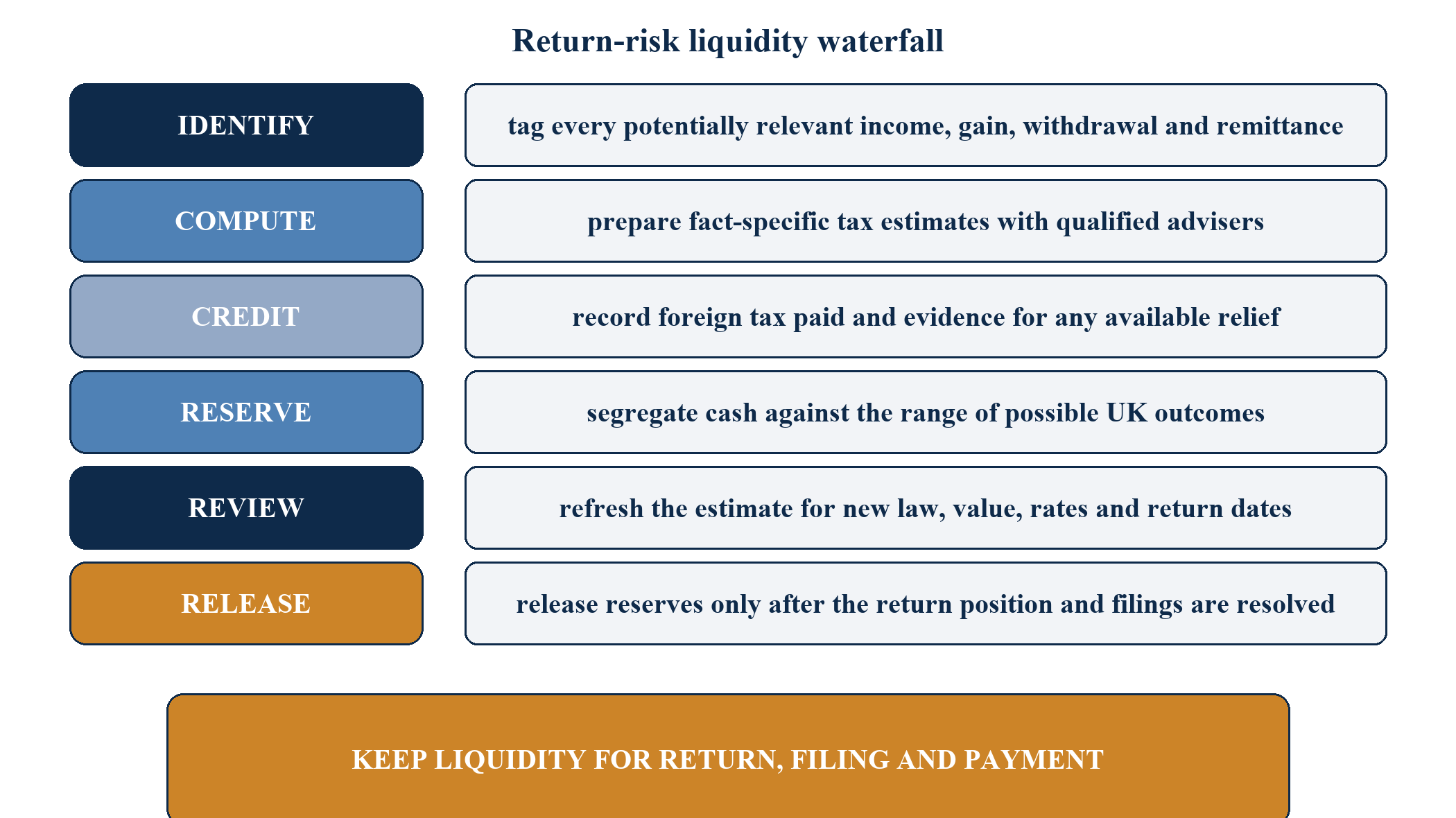
| Reserve input | Base record | Refresh trigger |
|---|---|---|
| gross relevant amount | transaction ledger | new receipt or corrected valuation |
| estimated UK tax | adviser computation | rate, law or return-date change |
| foreign-tax credit | assessment and payment evidence | refund, appeal or final assessment |
| filing costs | adviser scope | complexity or jurisdiction change |
| currency buffer | designated reporting currency | material exchange-rate movement |
| reserve release | signed conclusion and completed filing | final liability and payment resolved |
7. UAE RESIDENCE, TREATY AND EVIDENCE
7.1 UAE domestic residence routes
The UAE domestic rules include physical presence of 183 days or more in a consecutive twelve-month period; physical presence of at least 90 days with additional residence, employment or business conditions; and a route based on the usual or primary residence and centre of financial and personal interests [15,16]. The FTA's current certificate guidance lists evidence for each route.
The presence calendar should use the UAE rules for counting days, including the treatment of part-days described in the FTA guide. Entry-exit reports should be reconciled to passport stamps and travel records. The selected twelve-month period should be clearly identified.
7.2 A certificate is an evidence product
The FTA requires different materials according to the route. For a natural person relying on 183 days, the evidence includes identity or passport and entry-exit material. The 90-to-182-day route also requires evidence of UAE employment, business or a permanent place of residence. The primary-residence and centre-of-interests route requires a fuller personal and economic evidence package [15].
A treaty-purpose certificate can have additional requirements based on the convention. The application period should align with the UK analysis. A certificate obtained for one twelve-month period should not be extended by assumption to another.
7.3 The UK-UAE treaty tie-breaker
Article 4 of the convention resolves dual residence for individuals through permanent home, centre of vital interests, habitual abode, nationality and mutual agreement [14]. The order matters. The analysis should identify every home available to the individual, the closer personal and economic relations, the pattern of living, and nationality.
Family, business and investment facts should be described as they actually operate. A UAE visa, home and bank account support the file. Continuing availability of a UK home, a spouse or children in the UK, regular UK work and strategic business decisions can also be relevant.
7.4 UAE natural-person Corporate Tax
The FTA states that a natural person's employment income, personal investment income and real-estate investment income are outside UAE Corporate Tax when the relevant conditions are met. A natural person carrying on a business or business activity in the UAE can be within Corporate Tax when turnover exceeds the applicable threshold [17].
The return-risk review should therefore separate personal investment activity from UAE business activity. Licensing, turnover, operating roles and business records need their own analysis. UAE residence and UAE Corporate Tax are related factual systems with different legal questions.
7.5 Evidence should be contemporaneous
The strongest file is built as events occur. Tenancies, utilities, entry-exit reports, employment, trade licences, board minutes, tax registrations, school records and social or professional memberships should be retained under a dated index. Retrospective reconstruction can leave gaps and inconsistencies.
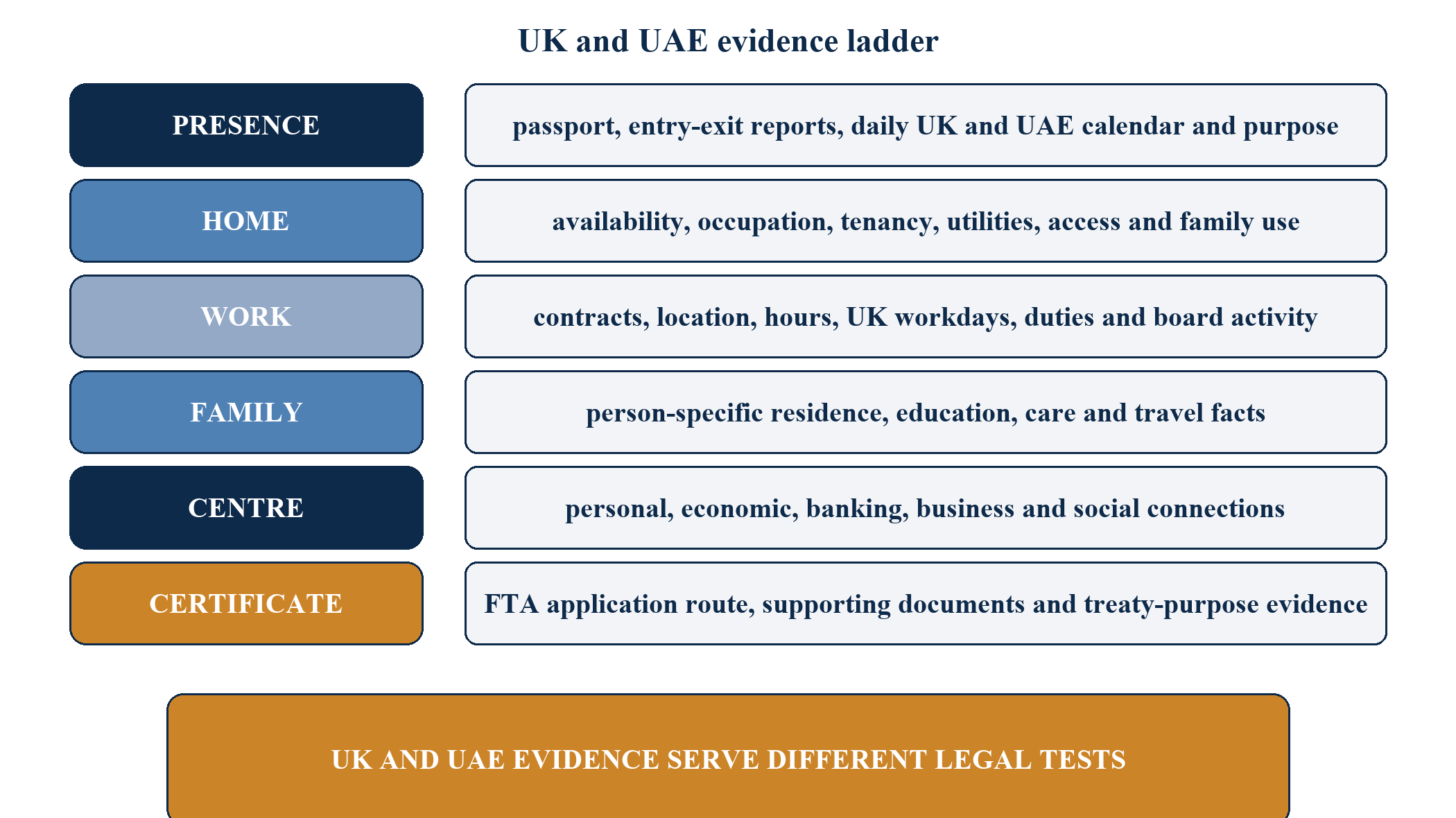
| Evidence layer | UAE file | UK comparison |
|---|---|---|
| identity and presence | Emirates ID, visa, passport and entry-exit report | passport and reconciled UK day count |
| home | tenancy or title, utilities and continuous availability | every UK home, access and occupation |
| work and business | contract, salary, licence, turnover and premises | UK workdays, board role and business activity |
| family | residence, education and household pattern | family tie and centre-of-interests facts |
| personal and economic centre | banking, investment, social and professional connections | continuing UK personal and economic relations |
| official conclusion | FTA certificate and underlying application | SRT, split-year and treaty memorandum |
8. THE PRE-RETURN DECISION
8.1 Activate the gate before facts change
The pre-return gate should begin before booking a long stay, taking UK accommodation, starting UK work or relocating close family. The review window should leave enough time to obtain advice, collect documents, value transactions, compute scenarios and decide whether to return, defer, stage or redesign the plan.
A standing trigger policy can require review at least 120 days before an intended return and immediately after any material change. The exact lead time is a management assumption and should be adapted to the family's facts.
8.2 Reperform residence from first principles
The adviser should test the current and next tax years under the SRT, all potentially relevant split-year cases, and the treaty where dual residence may arise. The output should identify the expected first residence period of sole UK residence and the earliest alternative date under adverse but plausible facts.
The 4-out-of-7 and exact five-year computation should then be refreshed. A second reviewer should check dates, leap years, split-year boundaries and treaty periods.
8.3 Freeze the transaction ledger
Every material event from the start of the intervening period to the expected return should be included. The ledger should reconcile to bank statements, custody reports, company accounts, tax returns, pension statements, policy certificates, trust records and legal documents.
Events should be classified by applicable provision. Open items should carry an owner and due date. The adviser should distinguish amounts already taxed in the UK, amounts taxable under separate non-resident provisions, amounts potentially brought into the return period, and amounts outside the reviewed provisions.
8.4 Compute and fund the range
Worked computations should state assumptions, rates, reliefs, credits and currency. They should include a base case and sensitivities for the earliest and latest plausible return dates. The output should show cash timing, filing year and documentation requirements.
The family should identify a liquidity source that does not depend on a distressed sale. Company distributions, borrowing, portfolio liquidation and insurance each have their own tax, governance and timing implications.
8.5 Approve the return
The decision memorandum should record the personal reason for return, residence conclusion, temporary non-residence conclusion, transaction exposure, reserve, filing plan, unresolved risks and approvals. It should state any conditions, such as delaying UK work or retaining documents.
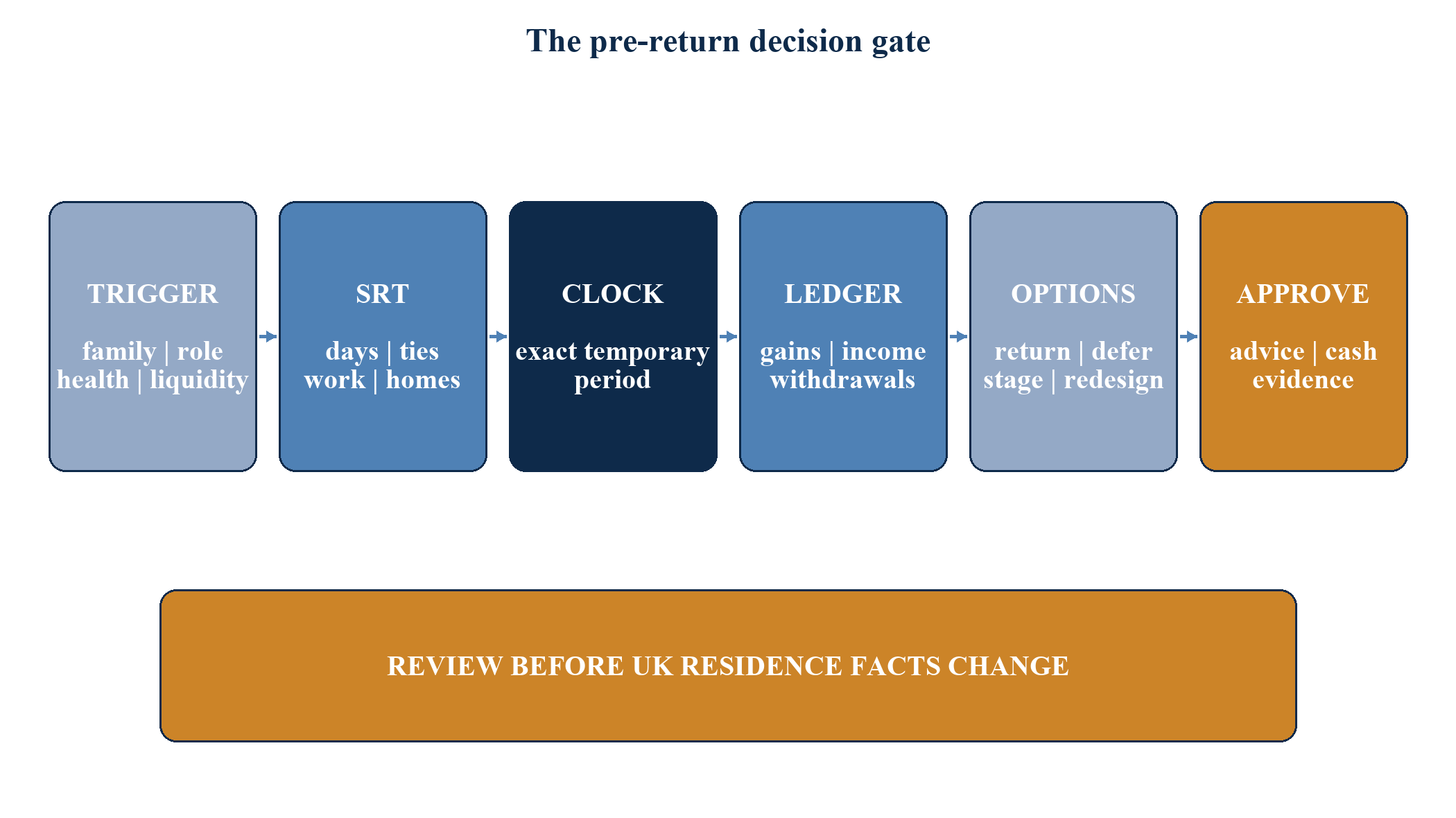
| Gate | Required conclusion | Stop condition |
|---|---|---|
| return objective | why, when and who returns | date or household plan remains undefined |
| SRT and treaty | expected first sole UK residence period | material residence fact is unresolved |
| exact clock | duration of intervening period | split-year or treaty boundary is unverified |
| event ledger | complete list and classification | accounts and legal records do not reconcile |
| computation | liability range and credit evidence | material item lacks a tax conclusion |
| liquidity | funded reserve and payment path | return would create a forced-sale risk |
| approval | signed adviser and family governance record | advice or authority is incomplete |
9. FOUR RETURN PATHS
9.1 Path one: early return within the window
An early return may be necessary for family, health or business reasons. The pre-return review should accept the personal objective and quantify its tax consequences. Transactions completed during the UAE period need item-by-item analysis. The residence change may also affect future worldwide income, gains and inheritance-tax exposure.
The control response is to accelerate the ledger, computations and cash reserve. A return should not be delayed by a generic rule where the family objective is urgent. The decision record should show the consequences and the chosen funding plan.
9.2 Path two: return after more than five exact years
A person may choose to return after the temporary period exceeds five years. The boundary should be verified using the applicable residence periods, including split-year and treaty status [5,20]. The plan should include a buffer for travel, work, homes and family changes that could create an earlier period of sole UK residence.
Remaining outside the temporary non-residence window does not remove other UK tax rules. UK land, UK-source income, company residence, anti-avoidance provisions, remittances and future UK residence still require analysis.
9.3 Path three: remain in the UAE
A principal may continue UAE residence with regular UK visits. The annual SRT, UAE residence and treaty evidence should remain active. Transactions should remain tagged because future plans can change.
The family should avoid releasing all return-risk reserves merely because the current intention is to stay. A future return can be driven by events outside the principal's control. Reserve policy should use a documented probability and consequence assessment.
9.4 Path four: different family members return at different times
Spouses, adult children, trustees and principals can have separate residence positions. One person's return can change another person's family or accommodation tie. It can also change the centre-of-vital-interests evidence.
The family map should show each person's days, homes, work, nationality and expected return. Shared assets and company distributions should be attributed to the correct legal and beneficial owner. One household narrative should not replace individual conclusions.
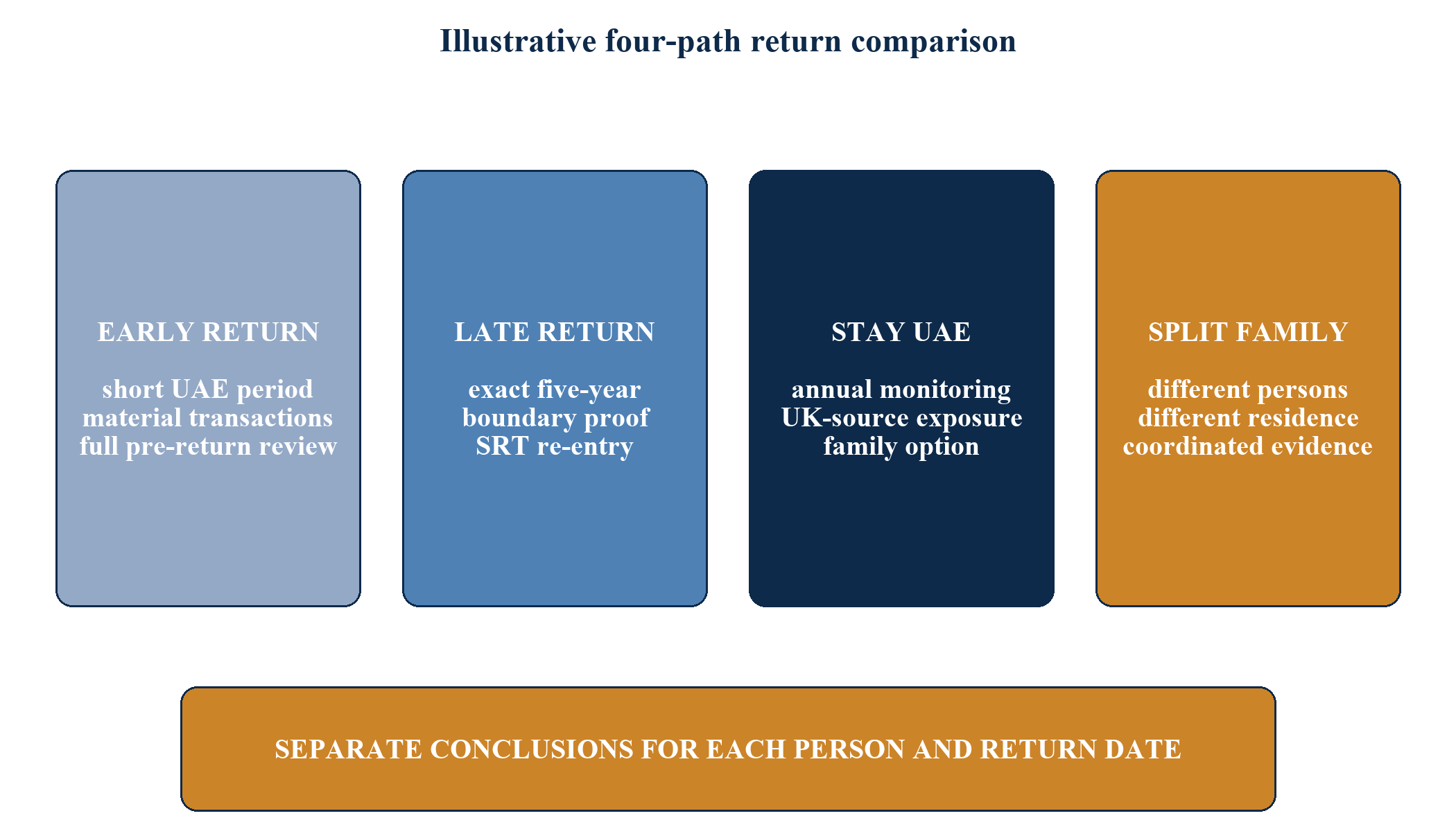
| Criterion | Early return | Return after boundary | Remain UAE | Split-family return |
|---|---|---|---|---|
| central question | which items are brought into the return period? | is the exact period safely more than five years? | how is the option to return preserved? | when does each person's residence change? |
| main evidence | full event ledger and residence file | exact-date computation and buffer | annual residence and transaction monitoring | person-specific calendars and family map |
| liquidity | potentially immediate reserve | retain until boundary and review complete | probability-weighted reserve policy | reserves allocated by owner and event |
| governance | accelerated approval | boundary sign-off before travel | annual reapproval | coordinated but separate conclusions |
| continuing risk | other UK taxes and future residence | UK-source and other anti-avoidance rules | unexpected personal event | interaction of family and accommodation ties |
10. GOVERNANCE, LIQUIDITY AND RECORDS
10.1 One chronology, several legal conclusions
The master chronology should contain travel, residence periods, homes, work, family changes, transactions, distributions, loans, pensions, policies, remittances and advice dates. Each event can feed several legal analyses. The chronology creates a shared factual base.
The chronology should have version control. A correction should preserve the prior entry, reason, evidence and approver. Adviser memoranda should reference the version used.
10.2 Evidence ownership
Each evidence class needs a named owner. The principal owns the truth of travel and work records. A family-office controller can reconcile statements and ledgers. The company secretary can retain board and distribution documents. Trustees and policy providers can supply event records. Qualified advisers own legal conclusions within their engagement scopes.
The evidence index should show document date, source, period, owner, storage location and review status. Personal records should be access controlled.
10.3 Liquidity governance
Return-risk liquidity should sit within the family's broader asset-allocation and cash-flow plan. The reserve amount is a scenario input. It should be traceable to specific transactions and adviser computations.
The investment policy can specify permitted instruments, currency, duration, credit quality and release authority. The reserve should remain sufficiently liquid for the expected filing and payment schedule.
10.4 Annual assurance
An annual assurance meeting should close the residence year, reconcile the transaction ledger and approve the next year's calendar. It should review law and guidance changes, company distributions, major disposals, pension or policy events, remittances, family movements and return intentions.
The meeting minutes should distinguish verified facts, adviser conclusions and management assumptions. Open issues should have owners and dates.
10.5 Communications
External descriptions should accurately reflect the facts. Bank, immigration, tax, corporate and regulatory filings can be read together by authorities and counterparties. Inconsistent addresses, roles, business locations or residence claims create avoidable questions.
| Governance role | Responsibility | Evidence |
|---|---|---|
| principal | disclose travel, work, homes, family and transactions completely | signed quarterly fact confirmation |
| family-office controller | reconcile bank, custody, company and tax records | transaction ledger and exception report |
| company secretary | retain board, participation, loan and distribution history | minute book, cap table and payment records |
| UK tax adviser | SRT, temporary non-residence and computation conclusions | dated memorandum and return support |
| UAE adviser | domestic residence, certificate and business-tax analysis | application file and UAE memorandum |
| decision committee | approve return, liquidity and unresolved risks | signed pre-return decision |
11. WORKED CASES
11.1 Case A: share disposal and return in year four
A principal with a long UK residence history relocates to Dubai and satisfies a departure split-year case. During the second full year abroad, the principal sells shares in a private company acquired before departure. The principal considers returning during the fourth year for family reasons.
The case requires an exact temporary non-residence computation and a disposal review. The sale date, asset history, gain and any foreign tax should be verified. If the principal resumes sole UK residence within five years and the relevant capital-gains provision applies, the gain can be treated as arising in the period of return [7,13]. The family should model the UK charge before the return facts change and preserve liquid funds.
11.2 Case B: post-departure dividend after 6 April 2026
A controlling shareholder moves to the UAE after operating a UK close company for many years. The company earns new trading profits and pays a substantial dividend during the UAE period. The shareholder later returns to UK residence within the temporary window after 6 April 2026.
The distribution analysis should verify close-company status, material participation, the departure-year reference period, payment date, route and foreign tax. HMRC's updated guidance states that the charge can apply to the full relevant distribution, including post-departure trade profits, for a qualifying return on or after 6 April 2026 [10,18,19]. A pre-return computation and reserve are central.
11.3 Case C: pension withdrawal and health-driven return
A principal takes a large flexible pension withdrawal while UAE resident. An unexpected health event leads to a UK return three years later. The pension file contains the scheme statement and payment record but no temporary non-residence advice.
The adviser should classify the withdrawal under the pension provisions, confirm treaty treatment and UK tax paid, and test the return rules [8,14]. The personal need to return can proceed with an informed liquidity plan. The decision memorandum should record the tax range and filing actions.
11.4 Case D: policy surrender and split-family facts
One spouse remains in Abu Dhabi while the other returns to the UK with a child. The UAE-resident spouse surrenders an investment bond. Both spouses retain access to a UK home.
Each spouse needs a separate SRT and treaty conclusion. The returning spouse's presence can affect the other's family tie and centre-of-vital-interests analysis. The policy event requires a chargeable-event review and ownership evidence [1,12,14]. The household should coordinate facts while preserving individual conclusions.
11.5 Case E: return just beyond the boundary
A principal plans to resume UK residence shortly after the fifth anniversary of physical departure. The original departure year included time in the UK and the split-year analysis was never finalised.
The anniversary is not a safe boundary. The adviser should reconstruct the last period of sole UK residence, test split-year treatment and treaty status, and calculate the exact intervening period [3-5,20]. The return date should be approved only after that work and a buffer analysis.
| Case | Critical uncertainty | Required control |
|---|---|---|
| share sale | gain classification and exact return period | legal disposal file, residence clock and reserve |
| dividend | participation, company status and 2026 rule | cap table, reserves, distribution file and computation |
| pension | payment category and treaty treatment | scheme records, adviser classification and liquidity |
| policy and family | individual residence and chargeable-event gain | separate calendars, treaty files and policy certificate |
| boundary return | statutory start and end dates | reconstructed split-year file and independent date check |
12. THE RETURN-CONTROL PROGRAMME
12.1 Initial thirty days
Collect at least seven years of residence history, the departure file, treaty conclusions, UK and UAE homes, work roles, family facts and identity documents. Create the residence-period table and identify evidence gaps.
Open the transaction ledger for the entire intervening period. Reconcile bank, custody, company, pension, policy, trust and property records. Material exceptions should be escalated.
12.2 Days 31 to 60
Obtain the UK residence and exact-clock memorandum. Build the UAE domestic residence and certificate file. Map treaty permanent homes and centre-of-vital-interests facts.
Classify each material transaction into capital gains, distributions, loans, pensions, policy events, remittances, UK-source items or other relevant categories. Record items requiring specialist advice.
12.3 Days 61 to 90
Prepare return scenarios for the earliest plausible date, intended date and a date after the five-year boundary. Model liability ranges, foreign-tax credits, filing timing and liquidity.
Agree a reserve policy. Document permitted assets, currency, owner, reporting and release authority.
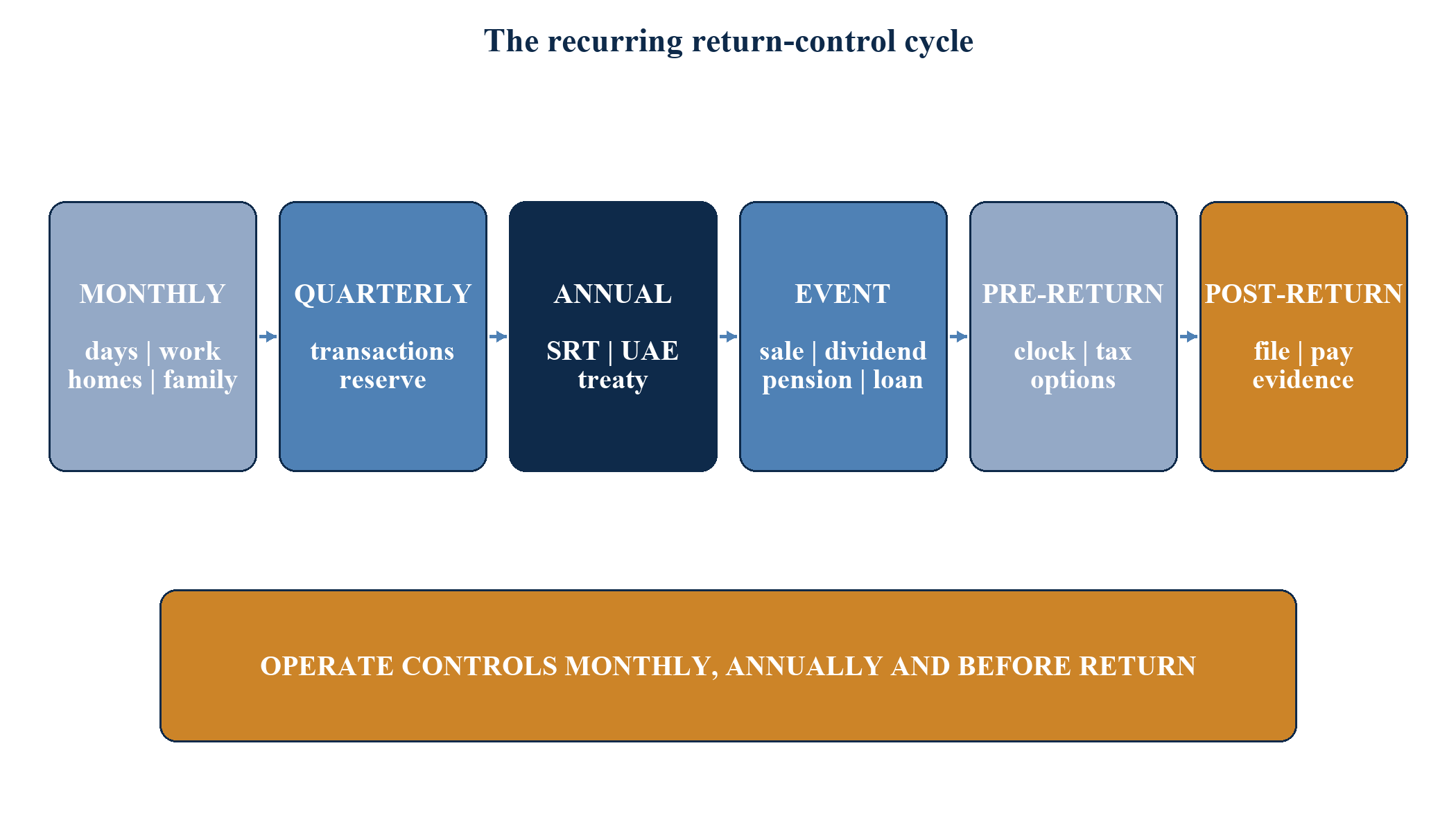
12.4 Ongoing monthly and quarterly controls
Reconcile travel and work monthly. Review homes, family and treaty facts quarterly. Update the transaction ledger after every material event and reconcile it to statements each quarter.
The return intention should be a standing agenda item. A probability change should trigger an adviser review and reserve refresh.
12.5 Annual controls
Close the UK tax-year residence analysis and the relevant UAE twelve-month evidence period. Renew certificates when appropriate. Reperform the 4-out-of-7 and exact-duration schedule.
Review current law and HMRC guidance. The July 2026 distribution update illustrates why an older memorandum can become stale [10].
12.6 Pre-return and post-return
Run the formal gate before UK residence facts change. After return, complete required returns, claims, foreign-tax-credit support and payments. Preserve the residence and transaction files with the final filings.
| Cadence | Deliverable | Escalation trigger |
|---|---|---|
| weekly | travel and work records | missing trip, workday or evidence |
| monthly | UK ties and home register | new accommodation, family or work fact |
| quarterly | transaction ledger and reserve | material event or liquidity gap |
| annual | SRT, UAE residence and treaty review | status differs from plan |
| event-driven | specialist advice before execution | sale, dividend, loan, pension, policy or remittance |
| pre-return | signed decision memorandum | unresolved clock, event or funding issue |
| post-return | filing and payment reconciliation | assessment, credit or documentation difference |
13. LIMITATIONS AND RISK BOUNDARIES
This paper provides a framework based on official materials available in August 2026. Tax law, rates, guidance and treaty interpretation can change. HMRC manuals state HMRC's interpretation and should be read with the legislation. Individual circumstances can produce outcomes outside the examples.
The temporary non-residence rules contain detailed conditions, exclusions, attribution rules and interactions with other provisions. The treatment of an asset or receipt depends on legal ownership, acquisition date, source, company status, participation, contract terms, scheme rules, policy terms, remittance history, foreign tax and other facts.
Residence is person specific and year specific. A UAE tax residency certificate is important evidence for the period and purpose for which it is issued. The UK SRT, split-year rules and treaty must still be applied to the full facts.
The worked cases are hypothetical and contain no tax-rate computation. They illustrate process controls. They do not predict an authority's decision or an individual's liability.
The governance cadence, lead times and liquidity buffers are management assumptions. A family office should adapt them to transaction size, document quality, personal circumstances and adviser availability.
14. CONCLUSION
The five-year boomerang is a return-contingent exposure. Its control starts with a day-precise residence-period map and a complete transaction ledger. The pre-departure 4-out-of-7 test identifies whether the rules can apply. The exact interval between sole UK residence periods determines whether the return is within the five-year limit. The transaction provisions determine which income and gains require further analysis.
The 2026 change for relevant close-company distributions makes extraction policy especially important for owner-managed businesses. Capital gains, loans, pensions, policies and remittances also need their own registers. UAE domestic residence, the FTA certificate and the UK-UAE treaty strengthen the evidence file when aligned with actual homes, work, family and economic relations.
A formal pre-return gate gives the principal four controlled choices: return with a funded tax and filing plan; defer until the residence boundary is verified; stage personal and commercial changes within the law; or redesign the return plan. The decision should follow qualified advice and a signed factual record.
APPENDIX A. RESIDENCE FACT PACK
| Domain | Required information | Evidence |
|---|---|---|
| seven-year history | domestic status, treaty status and split-year treatment | returns, advice and travel records |
| departure | physical move, home, work and split-year facts | travel, tenancy, contracts and memorandum |
| UAE presence | daily calendar and twelve-month test period | FTA entry-exit report and passport |
| UK presence | days, workdays and exceptional circumstances | travel and contemporaneous explanation |
| homes | availability, occupation and family use in both states | title, tenancy, utilities and access |
| work | duties, hours, locations, employer and boards | contracts, diaries, payroll and minutes |
| family | spouse, partner, minor children, education and care | person-specific records |
| treaty | permanent home, vital interests, habitual abode and nationality | treaty memorandum and certificate |
APPENDIX B. TRANSACTION AND EXTRACTION REGISTER
| Event | Legal owner | Date | Gross amount | Foreign tax | Category | Advice | Reserve |
|---|---|---|---|---|---|---|---|
| asset disposal | |||||||
| close-company distribution | |||||||
| shareholder-loan release | |||||||
| pension withdrawal | |||||||
| policy surrender or assignment | |||||||
| remittance to the UK | |||||||
| trust or foundation benefit | |||||||
| property transaction |
APPENDIX C. EXACT-DATE CLOCK
| Residence period | Start | End | UK domestic status | Treaty status | Sole UK residence? | Evidence |
|---|---|---|---|---|---|---|
| final pre-departure period | ||||||
| departure-year overseas part | ||||||
| full year one | ||||||
| full year two | ||||||
| full year three | ||||||
| full year four | ||||||
| full year five | ||||||
| return-year UK part |
Calculation controls:
- Identify the year of departure under the applicable definition.
- Mark each of the seven preceding tax years and the four qualifying years.
- Identify the exact end of the final residence period of sole UK residence.
- Identify the exact start of the first new residence period of sole UK residence.
- Calculate the intervening duration in years, months and days.
- Record split-year and treaty assumptions.
- Perform an independent date check and retain the signed conclusion.
APPENDIX D. UK AND UAE EVIDENCE INDEX
| Document | Period | Source | Owner | Supports | Review status |
|---|---|---|---|---|---|
| passport and travel log | presence | ||||
| FTA entry-exit report | UAE presence | ||||
| Emirates ID and visa | UAE identity and residence | ||||
| UAE tenancy or title | permanent or primary home | ||||
| UK home records | SRT and treaty | ||||
| employment and work log | SRT and centre of interests | ||||
| board records | work and company decisions | ||||
| family residence records | family tie and treaty | ||||
| UAE tax residency certificate | domestic or treaty evidence | ||||
| adviser memorandum | legal conclusion |
APPENDIX E. PRE-RETURN APPROVAL
| Question | Conclusion | Evidence | Adviser | Approval |
|---|---|---|---|---|
| when will sole UK residence resume? | ||||
| is the intervening period five years or less? | ||||
| does the 4-out-of-7 condition apply? | ||||
| are all gains and income events reconciled? | ||||
| which items may be treated as arising on return? | ||||
| what foreign-tax credits are supported? | ||||
| what returns and claims will be required? | ||||
| is the liquidity reserve fully funded? | ||||
| do family, company and trustee records align? | ||||
| has the return decision been signed before facts change? |
APPENDIX F. QUESTIONS FOR ADVISERS
- Which residence period is the final period of sole UK residence before departure?
- Which four of the seven preceding tax years satisfy the look-back condition?
- Which split-year cases apply on departure and possible return?
- Can treaty non-residence change the start or end of the temporary period?
- What is the earliest date on which a new period of sole UK residence can begin?
- Is the exact intervening period five years or less under the reviewed facts?
- Which disposals during the UAE period fall within the capital-gains provisions?
- Which companies are close companies and when was the principal a material participator or associate?
- How does the 6 April 2026 distribution change apply to each dividend?
- Have any participator loans been released, written off or indirectly settled?
- Which pension receipts and policy events require temporary non-residence analysis?
- Have historic foreign income or gains been remitted during the period abroad?
- Which foreign taxes are available for credit and what evidence is required?
- Which UAE residence route and certificate period apply?
- What liquidity should be reserved before the return?
- Which filings, claims and payments will be required in the period of return?
REFERENCES
[1] HM Revenue & Customs. RDR3: Statutory Residence Test notes. Updated 11 June 2026. https://www.gov.uk/government/publications/rdr3-statutory-residence-test-srt/guidance-note-for-statutory-residence-test-srt-rdr3
[2] HM Revenue & Customs. RFIG21510: Temporary non-residence introduction. Updated 3 July 2026. https://www.gov.uk/hmrc-internal-manuals/residence-and-fig-regime-manual/rfig21510
[3] HM Revenue & Customs. RFIG21520: Meaning of residence and sole UK residence. Updated 3 July 2026. https://www.gov.uk/hmrc-internal-manuals/residence-and-fig-regime-manual/rfig21520
[4] HM Revenue & Customs. RFIG21540: Start and end dates for a period of temporary non-residence. Updated 3 July 2026. https://www.gov.uk/hmrc-internal-manuals/residence-and-fig-regime-manual/rfig21540
[5] HM Revenue & Customs. RFIG21550: Meaning of year of departure and period of return. Updated 3 July 2026. https://www.gov.uk/hmrc-internal-manuals/residence-and-fig-regime-manual/rfig21550
[6] HM Revenue & Customs. RFIG21560: Tax when returning to the UK after temporary non-residence. Updated 3 July 2026. https://www.gov.uk/hmrc-internal-manuals/residence-and-fig-regime-manual/rfig21560
[7] HM Revenue & Customs. HS278 Temporary non-residents and Capital Gains Tax 2026. Published 6 April 2026. https://www.gov.uk/government/publications/temporary-non-residents-and-capital-gains-tax-hs278-self-assessment-helpsheet/hs278-temporary-non-residents-and-capital-gains-tax-2026
[8] HM Revenue & Customs. RFIG21580: Temporary non-residence and pension income. Updated 3 July 2026. https://www.gov.uk/hmrc-internal-manuals/residence-and-fig-regime-manual/rfig21580
[9] HM Revenue & Customs. RFIG21590: Temporary non-residence and remitted foreign income. Updated 3 July 2026. https://www.gov.uk/hmrc-internal-manuals/residence-and-fig-regime-manual/rfig21590
[10] HM Revenue & Customs. RFIG21600: Distributions from closely controlled companies. Updated 3 July 2026. https://www.gov.uk/hmrc-internal-manuals/residence-and-fig-regime-manual/rfig21600
[11] HM Revenue & Customs. RFIG21610: Loans to participators released or written off. Updated 3 July 2026. https://www.gov.uk/hmrc-internal-manuals/residence-and-fig-regime-manual/rfig21610
[12] HM Revenue & Customs. RFIG21620: Chargeable event gains. Updated 3 July 2026. https://www.gov.uk/hmrc-internal-manuals/residence-and-fig-regime-manual/rfig21620
[13] HM Revenue & Customs. RFIG21630: Capital gains and offshore income gains. Updated 3 July 2026. https://www.gov.uk/hmrc-internal-manuals/residence-and-fig-regime-manual/rfig21630
[14] HM Revenue & Customs. 2016 UK-UAE Double Taxation Convention, Article 4. https://www.gov.uk/government/publications/united-arab-emirates-tax-treaties/2016-uk-uae-double-taxation-convention
[15] United Arab Emirates Federal Tax Authority. Issuance of Tax Certificates for Tax Residency. Updated 6 April 2026. https://tax.gov.ae/en/services/issuance.of.tax.certificates.aspx
[16] United Arab Emirates Ministry of Finance. Cabinet Decision No. 85 of 2022 and Ministerial Decision No. 27 of 2023 on tax residency. https://mof.gov.ae/en/news/following-cabinet-decision-85-of-2022/
[17] United Arab Emirates Federal Tax Authority. Basis of taxation for a natural person. Updated 2026. https://tax.gov.ae/en/taxes/corporate.tax/corporate.tax.topics/basis.of.taxation.natural.person.aspx
[18] HM Revenue & Customs. Post-departure trade profits. Published 26 November 2025. https://www.gov.uk/government/publications/temporary-non-residence-rules-post-departure-trade-profits/post-departure-trade-profits
[19] Finance Act 2026, UK Public General Act 2026 c.11. https://www.legislation.gov.uk/ukpga/2026/11/contents
[20] HM Revenue & Customs. CG26680: temporary non-residence, double taxation agreements and the length of the period. Updated 2026. https://www.gov.uk/hmrc-internal-manuals/capital-gains-manual/cg26680
[21] HM Revenue & Customs. RFIG44000: qualifying new resident and the foreign income and gains regime. Updated 3 July 2026. https://www.gov.uk/hmrc-internal-manuals/residence-and-fig-regime-manual/rfig44000
[22] HM Revenue & Customs. Temporary Repatriation Facility guidance. Updated 7 April 2026. https://www.gov.uk/hmrc-internal-manuals/residence-domicile-and-remittance-basis/rdrm71000
[23] Finance Act 2025, UK Public General Act 2025 c.8. https://www.legislation.gov.uk/ukpga/2025/8/contents
ABOUT THE AUTHOR
Chennakeshav Adya is an Independent Researcher. His work focuses on capital, transactions, corporate strategy, family-enterprise governance and cross-border decision frameworks. This paper is independent research prepared for Matchpoint Insights.
