

1. INTRODUCTION
A family can live across London and the United Arab Emirates without sharing one tax-residence answer. UK residence is tested for each individual and each UK tax year. UAE domestic tax residence is tested for each individual by reference to UAE law and a relevant twelve-month period. The UK-UAE tax convention adds a further residence analysis where both states regard the same person as resident. A spouse, partner or child can therefore affect another person's UK statutory ties while remaining subject to a separate residence conclusion of their own [1-4,11-14].
This paper develops a control framework for families who establish a UAE base while retaining a UK home, UK schooling, UK employment, family members or regular UK travel. The central problem is coordination. A principal may satisfy an automatic overseas test while a spouse remains UK resident. A child in UK education may engage the family-tie rules after the statutory education exception is tested. A furnished London property can remain relevant as a UK home, available accommodation or treaty permanent home. Remote work performed during UK visits can create workdays even when the employment contract and payroll remain outside the UK [1-10].
Residence governance should begin with four separate records. The first is a person-by-person residence map. The second is a property register that records availability and actual use of every home. The third is a daily travel and work ledger. The fourth is an evidence index for domestic residence, treaty residence and tax-residency certificates. These records should be reconciled monthly and concluded annually by appropriately qualified advisers.
The framework treats mobility as a family system. Travel decisions, school calendars, accommodation access, business duties and care obligations interact. A late flight, a child visit, a newly available bedroom or several hours of work in the UK can change the facts used in the statutory tests. A family policy based only on a headline day limit is therefore incomplete. The controlled approach identifies the applicable test, counts the relevant days and ties, records exceptions precisely, and maintains a documented route to correction when plans change.
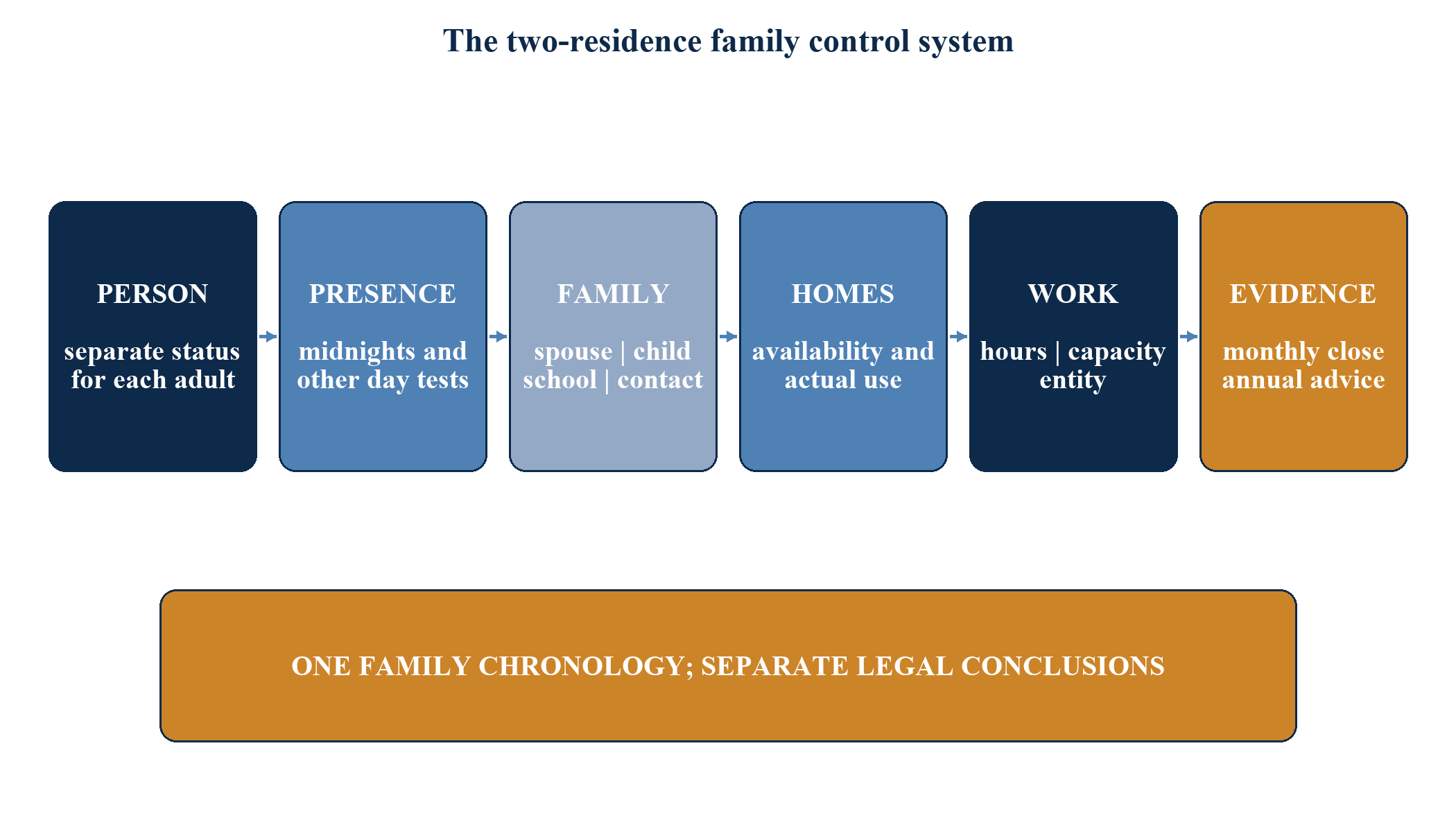
| Control domain | Governing question | Required output |
|---|---|---|
| person | what is each family member's domestic and treaty residence status? | individual residence memorandum for each relevant period |
| presence | where was each person at midnight and what did they do in each state? | reconciled daily calendar with entry-exit evidence |
| family | which spouse, partner or minor-child facts engage the UK family tie? | family-tie schedule and child-contact record |
| property | which homes and accommodation were available and actually used? | property availability and occupation register |
| work | which UK days included more than three hours of work? | location-specific work ledger and supporting records |
| evidence | which facts support UK, UAE and treaty conclusions? | indexed, retained and annually refreshed evidence file |
2. THREE RESIDENCE QUESTIONS
2.1 UK domestic residence
The Statutory Residence Test determines whether an individual is UK resident for a tax year. HMRC's published sequence considers the 183-day rule, the automatic overseas tests, the automatic UK tests and, when none of those gives an answer, the sufficient ties test. The tests are applied to the facts of the individual. One family member's result does not automatically determine another's [1,2].
The order matters. An individual who spends 183 days or more in the UK is resident. Subject to that rule, meeting an automatic overseas test establishes non-residence without proceeding to the automatic UK or sufficient-ties tests. If no automatic overseas test applies, the automatic UK tests are considered. The sufficient-ties test supplies the answer only after the automatic tests have been addressed [1,2].
Prior residence changes the sufficient-ties thresholds. HMRC distinguishes a person who was UK resident in one or more of the three preceding tax years from a person who was not UK resident in any of them. Split-year treatment still counts as UK residence for this prior-year question [2]. A family calendar should therefore carry a rolling three-year residence history as well as current-year facts.
2.2 UAE domestic residence
UAE Cabinet Decision No. 85 of 2022 establishes three routes for a natural person to be a UAE tax resident for domestic purposes. A person may qualify because the UAE is the person's usual or primary place of residence and the centre of the person's financial and personal interests. A second route applies at 183 days or more of physical presence within a relevant twelve consecutive months. A third route applies at 90 days or more where the person is a UAE national, a GCC national or holds a valid UAE residence permit and also has a permanent place of residence, employment or business in the UAE [12,13].
The UAE Federal Tax Authority publishes evidence requirements for the different routes. These can include passport and identity documents, entry-exit reports, tenancy or title documents, utilities, employment or business evidence, income evidence, family information, professional or social connections and a written explanation of financial and personal interests. The evidence depends on the route claimed and the purpose of the certificate [12-14].
The relevant UAE period may be a selected twelve-month period rather than the UK tax year from 6 April to 5 April. A residence dashboard should therefore maintain both calendars. A certificate for one period should not be treated as proof for a different period without reviewing the supporting facts.
2.3 Treaty residence
The UK-UAE convention becomes relevant when the individual is resident in both states under their domestic rules for a period and for taxes covered by the convention. Article 4 first asks whether a permanent home is available in only one state. If a permanent home is available in both states, the analysis moves to the state with which personal and economic relations are closer; the centre of vital interests. Habitual abode, nationality and mutual agreement follow if the earlier tests do not resolve the case [11].
Treaty residence is an analytical conclusion. A UAE tax-residency certificate provides evidence and may be required for a treaty claim. The full tie-breaker remains sensitive to available homes, family life, work, business interests, investment management, social connections and the pattern of living in each state [11-14].
Split-year treatment is a UK domestic mechanism and does not itself determine treaty residence. HMRC states that split-year treatment does not affect whether an individual is regarded as UK resident for double-taxation-agreement purposes [10]. Domestic and treaty conclusions should therefore appear on separate lines in the annual residence memorandum.
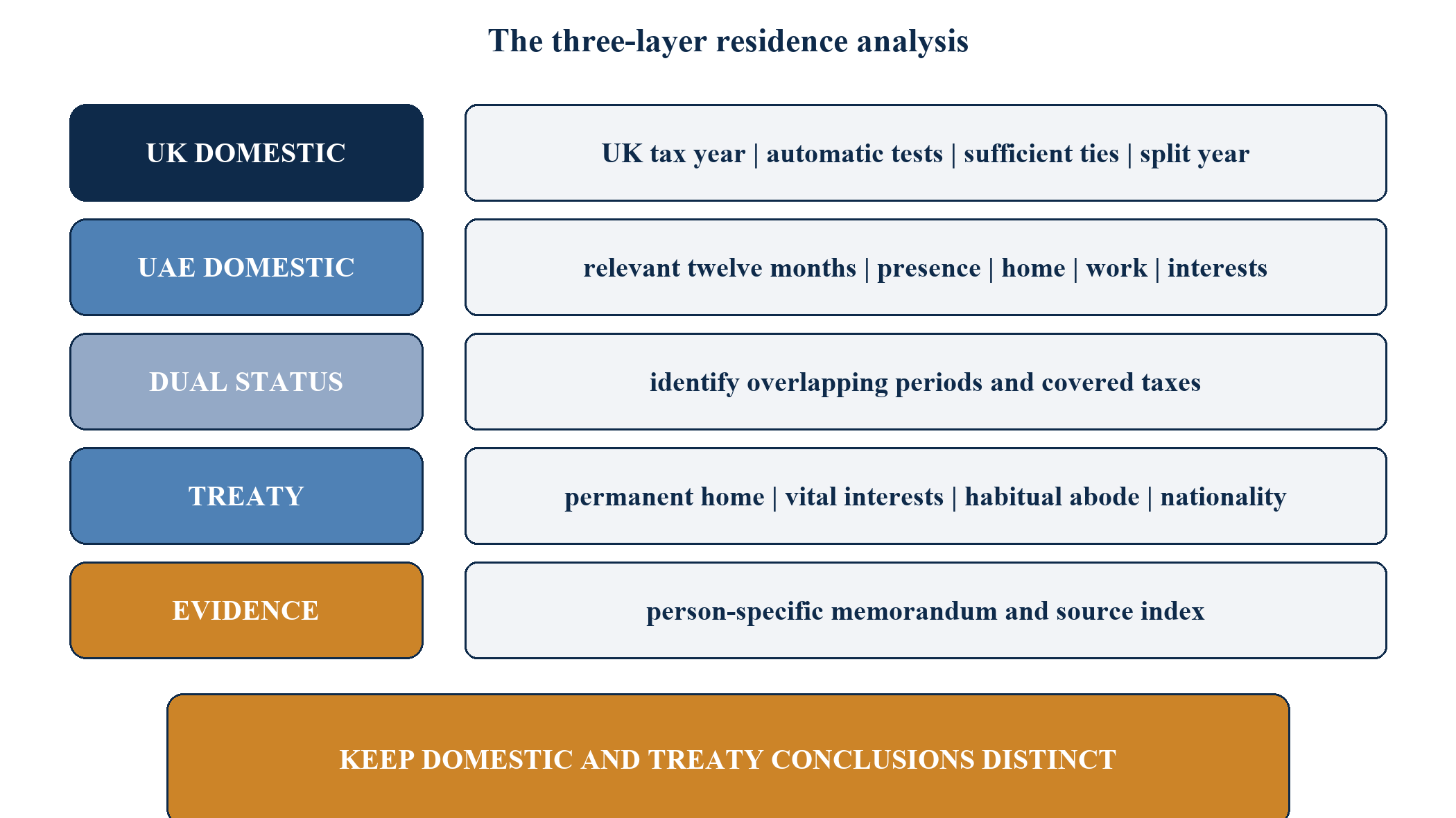
| Layer | Period | Core evidence | Output |
|---|---|---|---|
| UK domestic | UK tax year | days, work, homes, family and prior residence | SRT conclusion and split-year analysis |
| UAE domestic | relevant consecutive twelve months | presence, home, residence permit, employment, business and interests | domestic residence conclusion and certificate file |
| treaty | overlapping dual-residence period | permanent homes, personal and economic relations, habitual abode and nationality | Article 4 memorandum and relief position |
3. THE PERSON-BY-PERSON METHOD
3.1 A family is not one taxpayer
Each adult needs an individual chronology. Each child's residence and presence can also matter in their own right and as a fact in an adult's family-tie analysis. The family register should list legal relationships, dates of birth, nationality, immigration status, schools, employment, directorships, homes used, planned travel and expected changes. Sensitive information should be access-controlled and retained only for lawful tax, legal and administrative purposes.
The analysis should then be run independently for each adult. A principal may work full-time overseas and remain below the relevant UK thresholds. A spouse may spend substantially more time in the UK, work in the UK or retain a different home pattern. The spouse's UK residence can create a family tie for the principal. The principal's non-residence does not transfer to the spouse.
3.2 Residence years roll forward
The SRT is annual. A conclusion for one tax year should be closed after the facts for that year are complete, while the next year's control calendar starts before 6 April. The rolling file should show the previous three UK residence conclusions because they determine which sufficient-ties table and which set of ties apply [2].
A departure year may qualify for split-year treatment if all conditions of one of the statutory cases are met. HMRC explains that split-year treatment applies automatically when the criteria are satisfied and that priority rules apply where more than one case is available [10]. The family should retain the detailed case analysis, since the split date can differ among spouses.
3.3 Immigration status serves a different purpose
Immigration permission can support lawful residence and UAE certificate evidence. It does not decide the UK SRT. A UAE residence visa, Emirates ID or property ownership document should be placed in the evidence file as one item within the UAE and treaty analysis. UK residence remains governed by the statutory tests and the relevant facts.
The control memo should avoid shorthand statements such as "resident because a visa was issued" or "non-resident because departure was registered." It should identify the legal test, the period, the supporting facts and the adviser conclusion.
3.4 The family-residence map
The map uses one row per person and one column per relevant month. Each cell records expected country, midnight days, homes, school or work location, material UK ties and confidence level. The map should link to the daily evidence rather than replace it.
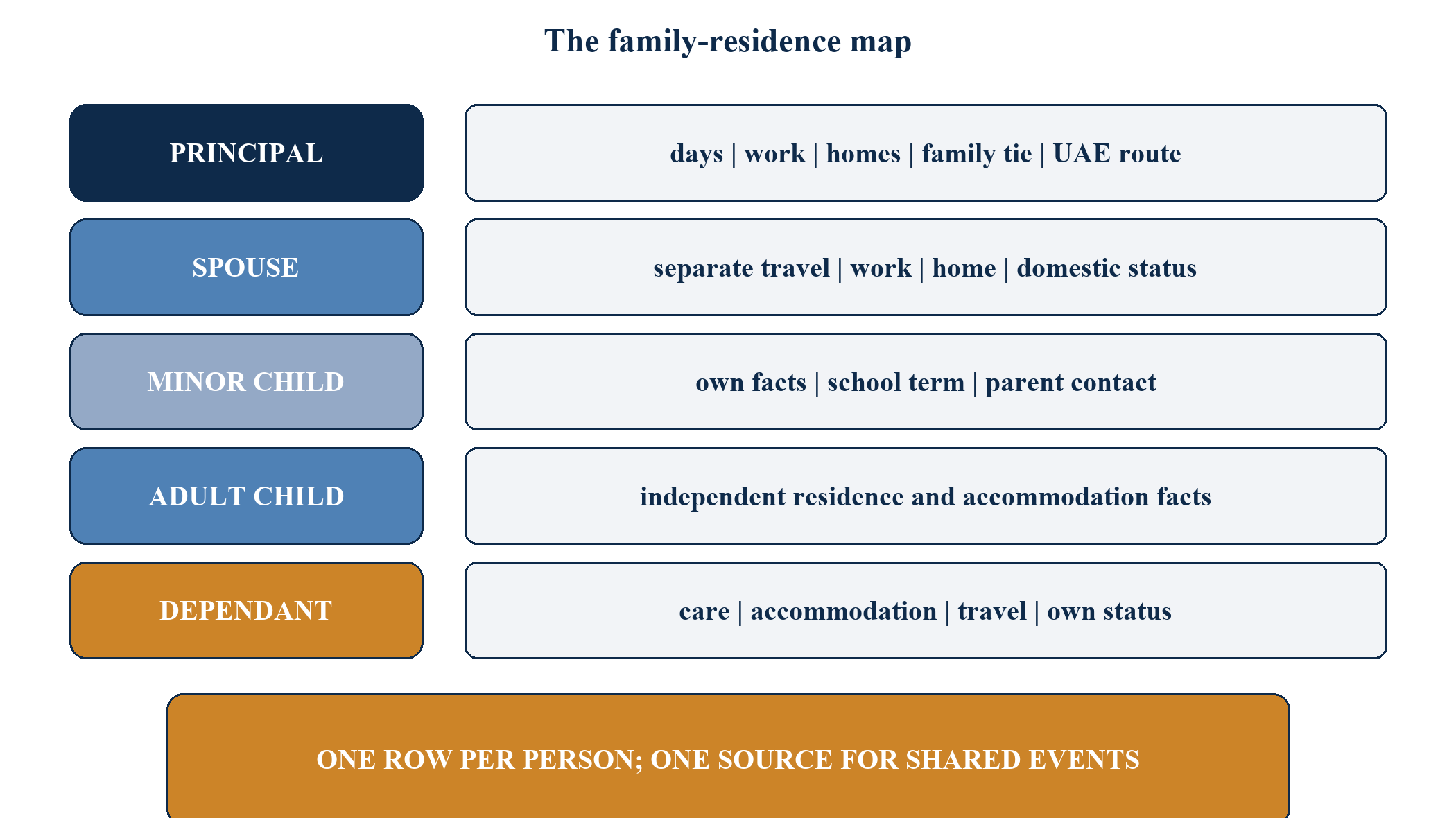
| Person | UK domestic status | UAE domestic route | Treaty question | Primary control risk |
|---|---|---|---|---|
| principal | annual SRT conclusion | presence or centre-of-interests route | dual residence if both states apply | UK workdays, accommodation and family tie |
| spouse or partner | separate annual SRT conclusion | separately evidenced UAE route | separate Article 4 analysis | different travel, home and work pattern |
| minor child | fact-specific residence and presence | immigration and living pattern | usually reviewed with guardians | education exception and parent-contact days |
| adult child | separate adult analysis | separate UAE route | separate treaty analysis | UK home, work and independence |
| dependent relative | separate person where relevant | separate residence facts | separate treaty analysis | accommodation, care and travel pattern |
4. FAMILY TIES AND CHILDREN
4.1 Who can create a family tie
HMRC states that an individual has a family tie if a husband, wife or civil partner is UK resident, unless the couple are separated; if a partner with whom the individual is living as spouses or civil partners is UK resident; or if a child under 18 is UK resident, subject to the statutory qualifications [3]. The relevant family member must be UK resident in their own right for the year.
Separation has a defined meaning in HMRC's guidance. It covers separation under a court order, by deed or in circumstances likely to be permanent [3]. Families should obtain legal advice where relationship status is relevant. Temporary geographic separation between London and Dubai should not be described as legal separation without a proper basis.
4.2 Contact with a minor child
HMRC's guidance provides that a UK-resident child under 18 does not create a family tie where the individual spends time with that child in person in the UK on fewer than 61 days in the relevant tax year. Any day or part of a day on which the individual sees the child in person in the UK counts for this purpose [3].
The child-contact register should therefore be separate from the midnight day count. A parent can see a child during a UK day without being present at midnight. The day can be relevant to the family-tie threshold even when it is not a UK presence day for the ordinary midnight count. The register should record date, location, purpose and corroborating evidence.
4.3 Children in full-time education
The legislation and HMRC guidance contain a specific rule for children in full-time education in the UK. Broadly, the child may be treated as non-UK resident for the family-tie question where the child spends fewer than 21 days in the UK outside term time, subject to the precise statutory conditions [4]. Travel days and term dates require careful treatment.
The education exception should be calculated, not assumed. The file should contain the school's published term dates, boarding arrangements, travel schedule, days outside term time, where the child stayed and the parent's contact record. International schools, examination periods, induction days, sports programmes and unexpected closures can make an informal school-calendar estimate unreliable.
4.4 Spouses with different schedules
One spouse can create a family tie for the other by being UK resident. The underlying UK residence conclusion for the spouse therefore becomes an input into the principal's sufficient-ties test. The family's annual workflow should close the spouse's status before finalising the principal's family-tie conclusion where the answer depends on it.
This dependency calls for a household review rather than a joint residence conclusion. The files remain person specific. The workflow identifies where one person's conclusion feeds another's test.
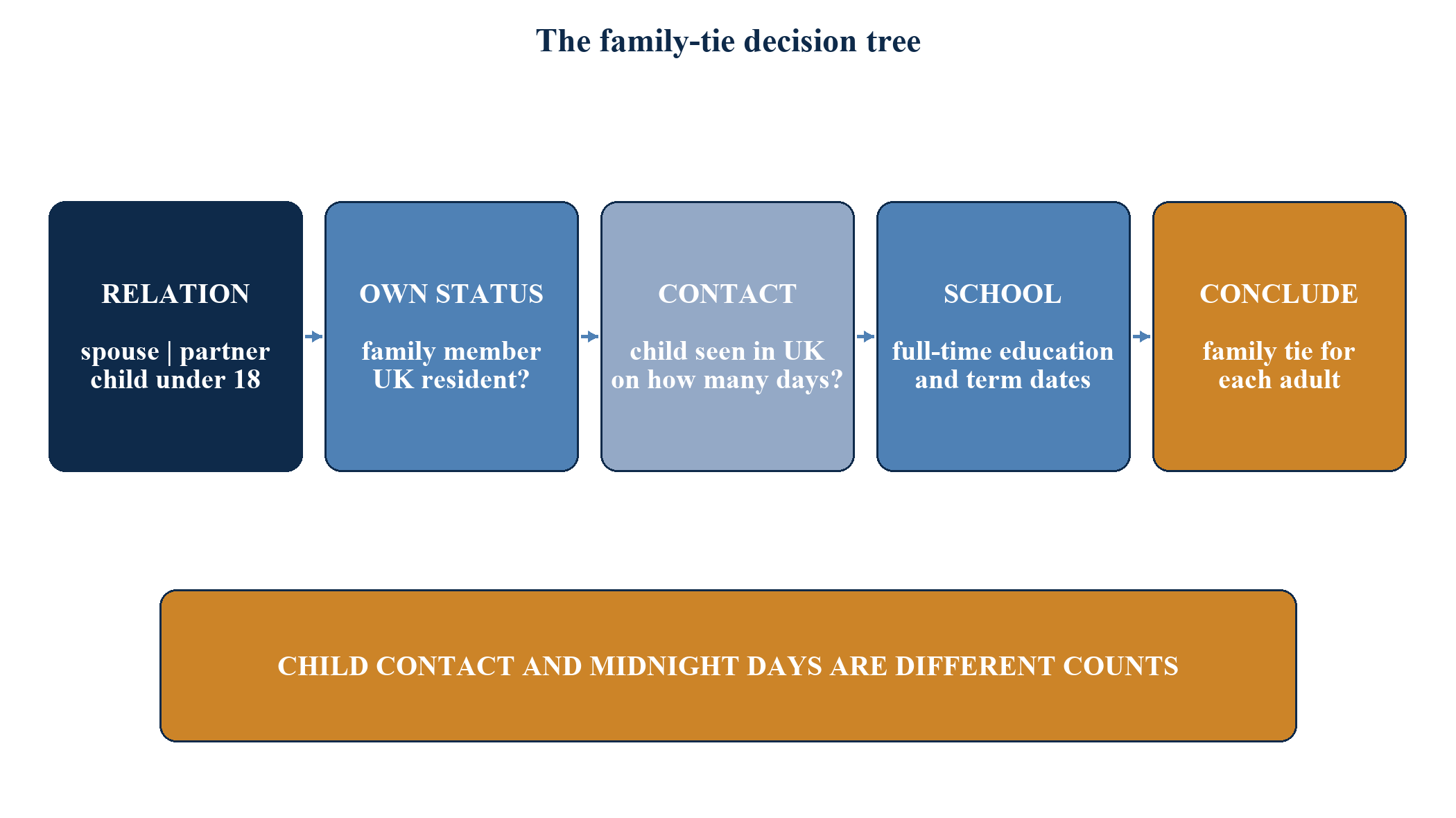
| Decision | Question | Evidence |
|---|---|---|
| relationship | is there a spouse, civil partner, qualifying cohabiting partner or child under 18? | legal and household records |
| own residence | is that family member UK resident in their own right for the year? | separate residence memorandum |
| child contact | for a minor child, did in-person UK contact reach the statutory threshold? | child-contact register |
| education | does the full-time-education rule apply after counting days outside term time? | school calendar, boarding and travel records |
| conclusion | does the individual have a family tie for the relevant year? | signed family-tie schedule |
5. TWO HOMES AND AVAILABLE ACCOMMODATION
5.1 Home and accommodation are related concepts
The SRT uses homes in the automatic UK tests and available accommodation in the sufficient-ties test. HMRC explains that accommodation can be more transient than a home and does not require the same degree of stability or permanence [5,6]. A property can therefore be relevant even when the family does not regard it as its main home.
The property register should not rely only on ownership. It should record the legal right to occupy, actual availability, commercial letting arrangements, family access, keys, bedrooms, personal possessions, utilities and nights spent. A property owned by the individual but genuinely let to an unconnected tenant without access may present different facts from a vacant property kept ready for visits.
5.2 The accommodation tie
HMRC states that an accommodation tie arises where a place to live in the UK is available for a continuous period of at least 91 days and the individual spends at least one night there. Where the accommodation is the home of a close relative, at least 16 nights are required. Gaps in availability of fewer than 16 days count towards the continuous period [5].
The definition of close relative for this purpose includes a parent or grandparent, brother or sister, and a child or grandchild aged 18 or over, including specified relationships through marriage, civil partnership and adoption [5]. A friend's guest room, a corporate apartment or a property occupied by a spouse should be analysed on its own facts.
The 91-day availability period can extend across the tax-year boundary, provided the statutory conditions for the relevant year are met. The property register should therefore maintain continuous availability dates rather than reset every 6 April.
5.3 The automatic UK home test
HMRC's second automatic UK test can apply where there is a period of at least 91 consecutive days, at least 30 of which fall in the tax year, during which the individual has a UK home; the person spends sufficient time in that home; and the person has no overseas home or is present in each overseas home on fewer than 30 days in the tax year [6]. HMRC describes sufficient time in the UK home as presence on at least 30 days in aggregate during the tax year [6].
This test uses presence at a home, even for a short part of a day, rather than only midnight presence. A home-use ledger should therefore record daytime presence as well as overnight stays. Families with a lightly used Dubai property and a frequently used London home should test the overseas-home days carefully.
5.4 Treaty permanent homes
Article 4's permanent-home question serves a different legal function from the SRT home and accommodation tests. A property may be relevant to more than one analysis, with different criteria. The treaty file should describe whether a home is continuously available to the individual for personal use and should document both UK and UAE homes [11].
The centre of vital interests follows if permanent homes are available in both states. A retained UK family home can therefore remain significant even where the individual is non-UK resident under the SRT. The treaty conclusion should weigh personal and economic relations on current facts.
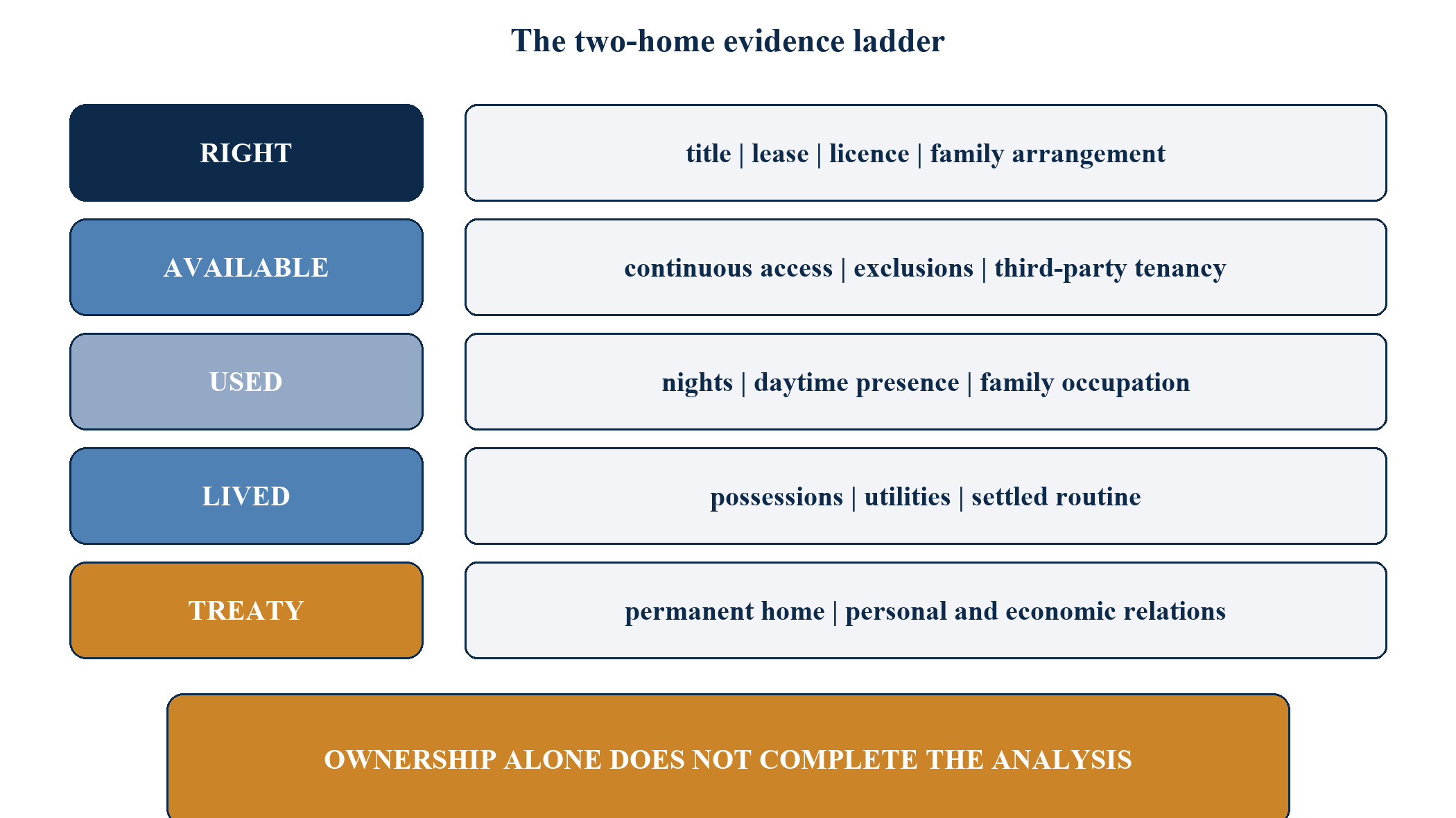
| Evidence item | UK property | UAE property |
|---|---|---|
| legal interest | title, lease, licence or family arrangement | title, registered tenancy or licence |
| availability | third-party letting, access restrictions, keys and notice | continuous access, furnished status and occupancy |
| use | overnight nights and any daytime presence | overnight nights and any daytime presence |
| household | spouse, children, relatives and personal possessions | spouse, children, relatives and personal possessions |
| services | utilities, council tax, insurance and maintenance | utilities, municipality records, insurance and maintenance |
| purpose | investment, visits, work, schooling or settled living | primary living, work, business or investment |
6. WORK, BOARDS AND REMOTE DUTIES
6.1 The UK work tie
HMRC states that the work tie applies where an individual does more than three hours of work in the UK on at least 40 days in the tax year. The days need not be consecutive [7]. The location of the employer and the place of payroll do not replace the location and duration of actual work.
A workday ledger should capture all duties, including meetings, document review, calls, correspondence, training, travel that counts as work and board responsibilities. HMRC's record-keeping guidance recommends detailed diaries or timesheets showing hours, location and the nature of work, together with contracts and information on work breaks and leave [9].
6.2 Full-time work overseas
One automatic overseas test addresses sufficient-hours work overseas. HMRC identifies conditions including sufficient hours overseas, no significant break from overseas work, fewer than 31 UK days on which more than three hours of work are performed, and fewer than 91 UK days in the year [8]. The detailed calculation requires the statutory method and should be prepared by a qualified adviser.
Executives with portfolio roles need particular care. Investment committees, boards, advisory mandates, founder responsibilities and personal investment management may involve different capacities. The ledger should identify the entity and capacity for each duty and should retain board packs, minutes, calendars, email records and travel documentation.
6.3 Family travel can become work travel
A parent may return to the UK for a school event and then perform work from the London home. The day can enter the child-contact record, the home-use record and the work ledger. The control system should capture the same event in each relevant register without double-counting the person's ordinary UK presence days.
Remote work policies should set a pre-clearance threshold. A planned two-hour review can extend beyond three hours after calls and correspondence are added. The completed record should show actual time. Calendar entries alone may omit preparation, follow-up and travel that constitutes work.
6.4 Entity-level risks
Individual residence analysis does not resolve the residence, permanent-establishment, payroll, withholding, social-security or regulatory position of an employer, company, partnership, trust or fund. A principal who makes strategic decisions from the UK can create issues for an entity even while managing personal SRT limits.
The family work ledger should feed a separate entity-risk review. Board protocols should reflect genuine governance and actual decision-making locations. Tax documentation should not be written to manufacture a result that conflicts with how the business operates.
| Work control | Minimum field | Supporting evidence |
|---|---|---|
| date and country | physical location for each work period | travel and device-access records |
| duration | start, end and total time | diary, timesheet and calendar |
| capacity | employee, director, partner, trustee or investor | appointment and contract |
| entity | company, fund, trust or personal activity | board or transaction file |
| activity | meeting, review, call, correspondence or travel | agenda, minutes and work product |
| threshold | whether UK work exceeded three hours | reviewed daily conclusion |
7. DAY COUNTING AND THRESHOLDS
7.1 Midnight days and other day concepts
The ordinary SRT day count generally focuses on presence in the UK at the end of the day, subject to statutory rules. Other tests use different concepts. The family-tie child-contact test can count any day or part-day in-person contact in the UK. The home test can count presence at a home for any part of a day. The work tie counts days with more than three hours of UK work [3,6,7].
One calendar should therefore store several flags for each date: UK at midnight; UK arrival and departure time; UK work hours; presence in each home; contact with a minor child; term-time status; and exceptional-circumstances evidence. A dashboard that stores only nights will miss legally relevant information.
7.2 Sufficient-ties thresholds
For a person who was UK resident in one or more of the preceding three tax years, HMRC's current table provides that more than 15 and no more than 45 UK days require at least four ties; more than 45 and no more than 90 days require at least three; more than 90 and no more than 120 days require at least two; and more than 120 days require at least one [2].
For a person who was not UK resident in any of the preceding three tax years, more than 45 and no more than 90 UK days require all four applicable ties; more than 90 and no more than 120 days require at least three; and more than 120 days require at least two [2]. The automatic tests still need to be considered in the statutory sequence.
The rolling three-year history can therefore change the permitted combination of days and ties. A family member who has remained non-resident for three complete tax years may move to the second table in a later year. The conclusion should be updated on 6 April and whenever a relevant tie changes.
7.3 The 90-day and country ties
The 90-day tie considers whether the individual spent more than 90 days in the UK in either of the two previous tax years. The country tie is relevant to a person who was UK resident in one or more of the preceding three tax years and asks whether the UK is the country in which the individual spends the greatest number of days [2]. The detailed statutory rules and tie-breaks require careful application.
The residence dashboard should store prior-year day counts and a country-by-country presence total. A UAE-focused calendar that ignores travel to other countries can be insufficient for the country-tie analysis.
7.4 Deeming and exceptional circumstances
The SRT contains a deeming rule for certain individuals with previous UK residence, UK ties and more than 30 qualifying days. It can treat some additional days as UK days even where the person is not present at midnight. The full conditions should be tested rather than applying a simple night count [1].
Exceptional-circumstances provisions can disregard a maximum of 60 days for specified day-count purposes when the statutory conditions are met. HMRC stresses that 60 days is a limit rather than an allowance. Its guidance also identifies tests for which exceptional-circumstance days cannot simply be removed, including components of the family, accommodation, work and home tests [15]. The evidence file should record what happened, why the person could not leave and what mitigation was attempted.
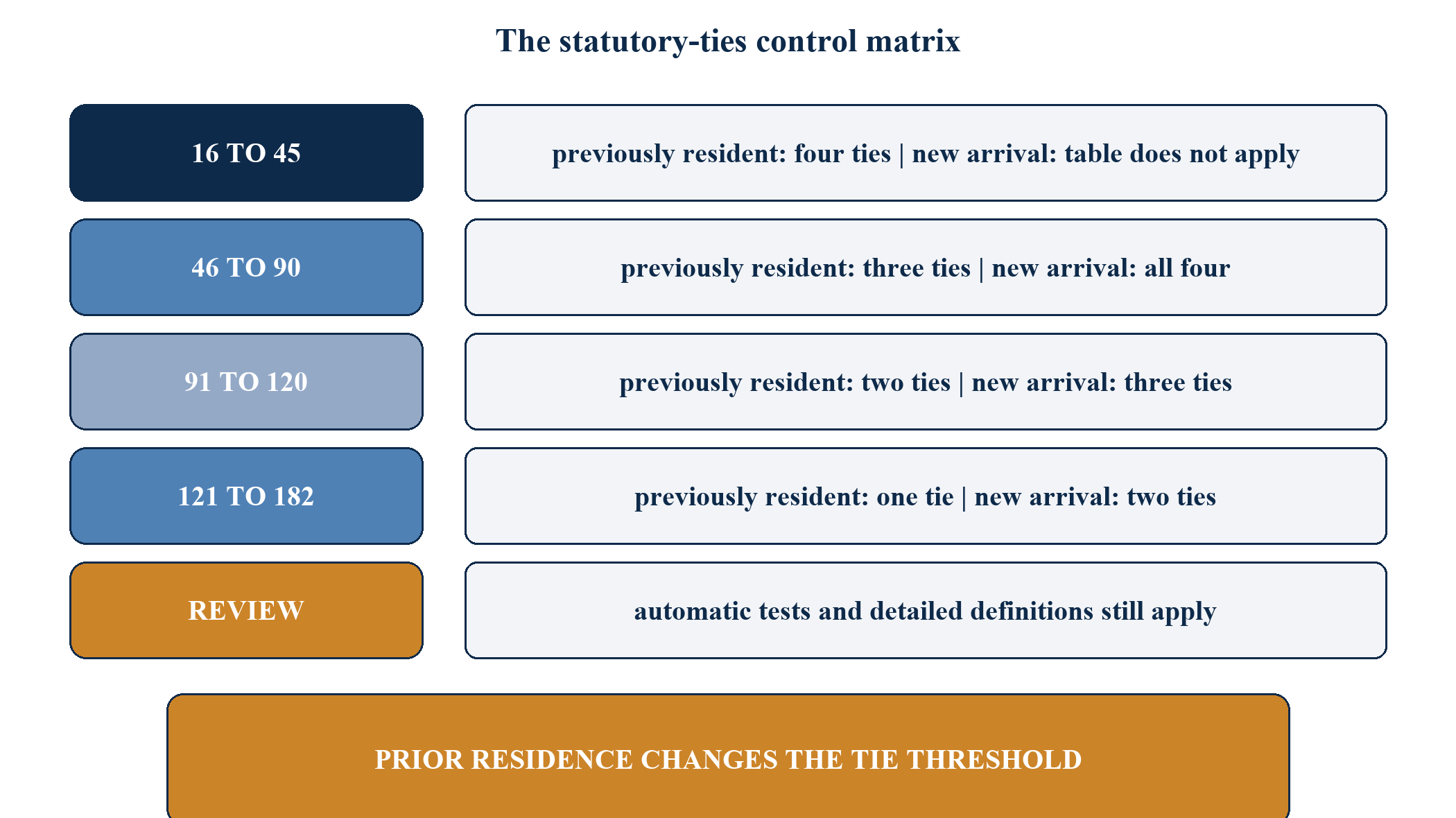
| UK days | Previously resident in one of prior three years | Not resident in any prior three years |
|---|---|---|
| 16 to 45 | at least four ties | no residence under this table |
| 46 to 90 | at least three ties | all four applicable ties |
| 91 to 120 | at least two ties | at least three ties |
| 121 to 182 | at least one tie | at least two ties |
8. THE EVIDENCE ARCHITECTURE
8.1 Presence evidence
The daily calendar should reconcile passport stamps, airline records, boarding passes, hotel invoices, card transactions, mobile-location records where lawfully retained, and official entry-exit reports. Evidence quality varies. The file should identify the primary record, corroborating record and any unresolved discrepancy.
UK and UAE dates can differ around overnight flights. The ledger should record local arrival and departure times and the person's location at the end of each UK day. It should also record time spent in homes, work and child contact where those facts are relevant.
8.2 Family evidence
The family file should contain relationship records, person-specific residence conclusions, school term dates, boarding records, travel, contact days and care arrangements. A parent should not rely on another family member's recollection at year end. The information should be captured contemporaneously and reviewed with appropriate privacy protections.
Material changes require a trigger. Examples include a spouse taking a UK role, a child moving from boarding to day school, a new care obligation, separation, a dependent relative moving into a UK home, or an adult child making accommodation available.
8.3 Home evidence
The property file should include title and tenancy documents, letting-agent instructions, tenant agreements, licences, utility records, insurance, keys and access, periods of vacancy, rooms retained for personal use, personal possessions, repairs, and occupation by family members. Availability should be stated as a dated fact with a supporting reason.
A commercial tenancy should be reviewed for actual rights of access. A property described as an investment can still be accommodation if the individual can live there when in the UK. A hotel pattern or standing family arrangement can also be relevant on its facts [5,6].
8.4 Work evidence
The work file should reconcile diaries, timesheets, emails, board materials, contracts, expenses, building-access records and device logs. It should identify duties above and below three hours. The methodology should be consistent across the year and should retain enough information for an adviser to reproduce the conclusion [7-9].
8.5 UAE certificate evidence
The FTA publishes distinct document lists for natural persons qualifying through the 183-day route, the 90-day route and the primary-place-and-centre-of-interests route. A treaty-purpose application can require identity, residence and UAE-income evidence and may refer to the underlying domestic-law conditions where the treaty definition does so [13,14].
The certificate index should record application type, claimed route, period, documents submitted, approval date, certificate number, treaty purpose and expiry or renewal date. It should preserve the evidence that existed at the time of application.
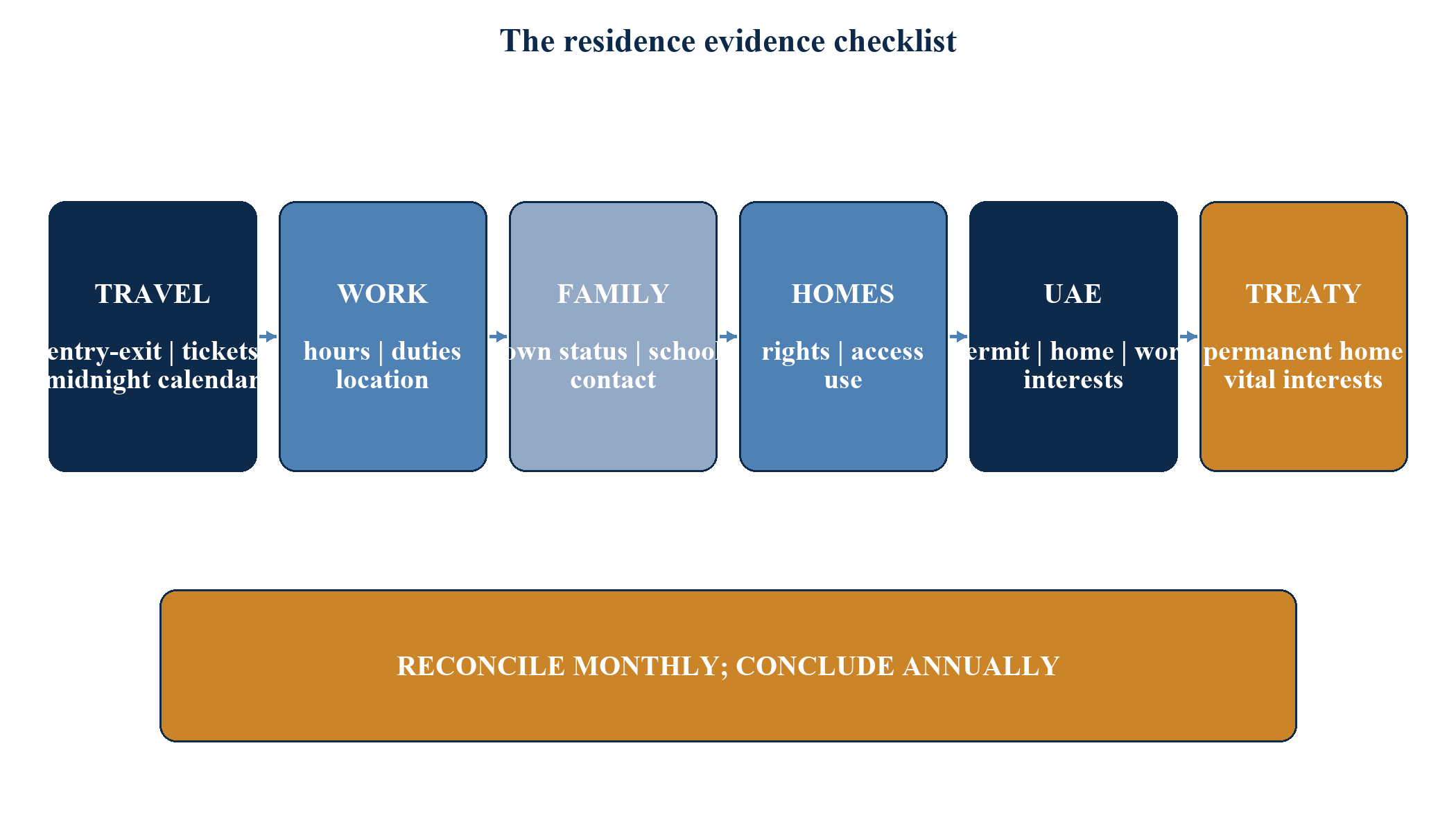
| Evidence pack | Monthly control | Annual conclusion |
|---|---|---|
| travel | reconcile movements and midnight locations | signed UK and UAE day counts |
| work | reconcile hours, duties and locations | UK workday total and overseas-work test |
| family | update residence, school and contact records | family-tie conclusion for each adult |
| homes | update availability and use | SRT home, accommodation and treaty-home analysis |
| UAE | track presence, permit, home, work and interests | domestic route and certificate application |
| treaty | update personal and economic connections | Article 4 memorandum for dual-residence periods |
9. FOUR FAMILY CONFIGURATIONS
9.1 The coordinated move
Both spouses relocate to the UAE, establish a settled home, move their ordinary work and social life, and educate their children in the UAE. A retained UK property is commercially let without access. UK travel is controlled and documented. This configuration can produce a relatively clear evidence pattern, subject to each person's actual days, work and residence history.
The control focus remains individual. One spouse may travel more frequently or retain a UK-facing role. The property tenancy may end. A child may return for education. The annual review should test the facts rather than carry the initial conclusion forward.
9.2 The London-school configuration
The parents establish a UAE base while a minor child attends school in the UK. The education rule and the parent's contact days become central. The school calendar must be reconciled to the child's days outside term time and the parent's in-person contact in the UK [3,4].
The UK accommodation used by the child may also be available to a parent. The property register should record legal and practical access. The parent's work during school visits should be captured separately. The result may differ between parents because contact, nights and work are person specific.
9.3 The split-spouse configuration
One spouse lives principally in Dubai while the other remains substantially in London. The London spouse's UK residence can create a family tie for the Dubai spouse [3]. The retained London home may also create accommodation or treaty-home questions. Visits for family reasons can include work and home presence.
The family should prepare two residence memoranda and a dependency schedule showing how the London spouse's conclusion affects the Dubai spouse. The treaty centre-of-vital-interests analysis should address the genuine personal and economic pattern.
9.4 The commuting principal
The family establishes its main household in the UAE, while the principal travels regularly to the UK for board and transaction work. The overseas-work conditions, UK work tie, accommodation, country tie and entity-level issues require active control [2,5,7-9].
Pre-clearance should cover each trip's expected UK days, work hours, home use and family contact. Actual data should be reconciled immediately after travel. A cumulative dashboard should show headroom against all relevant limits.
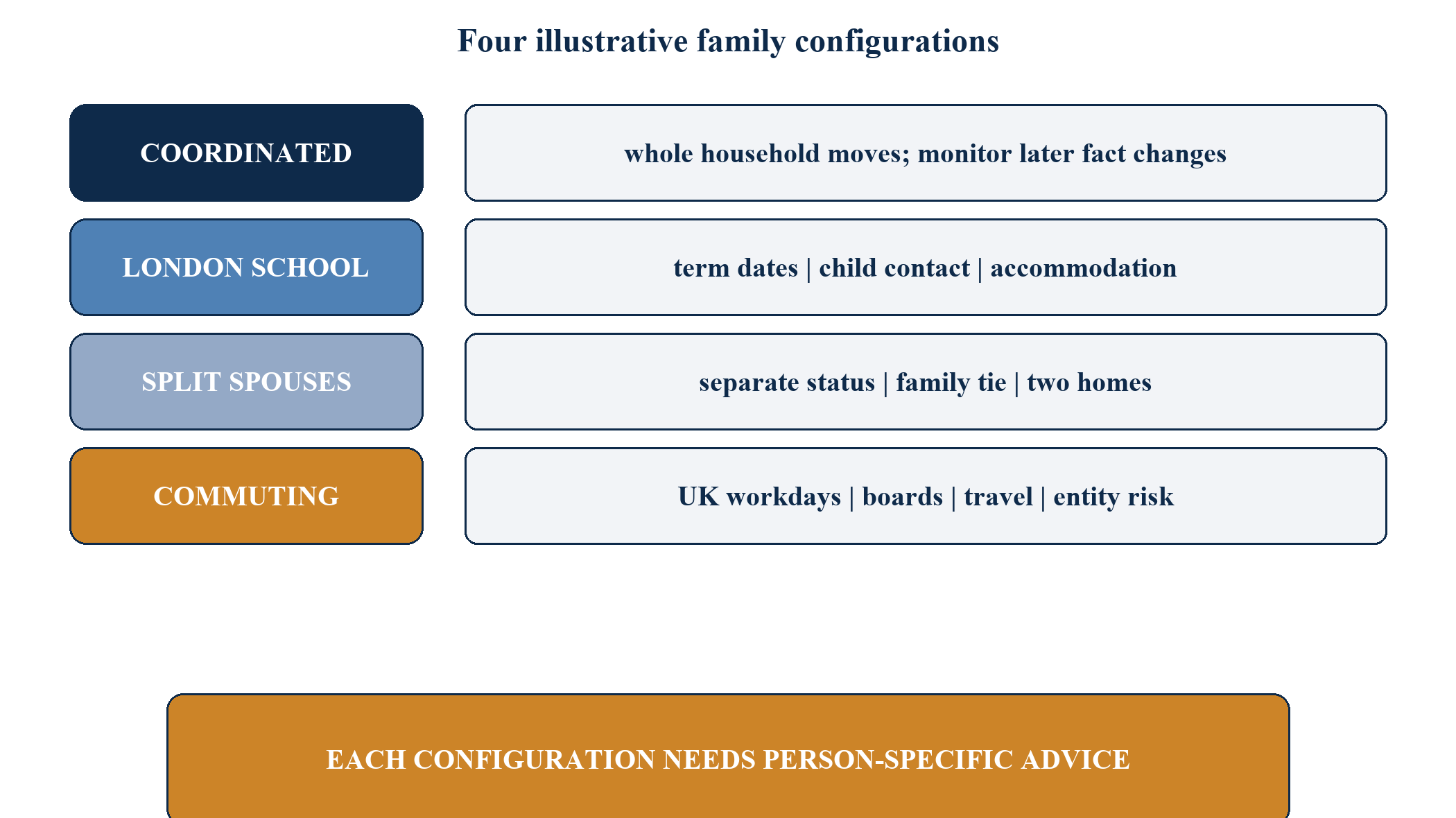
| Configuration | Main residence pressure | Primary control |
|---|---|---|
| coordinated move | facts drift after a clean departure | monthly household change review |
| London school | child education, contact days and accommodation | term-date and contact-day ledger |
| split spouses | UK-resident spouse and two permanent homes | separate memoranda and family-tie dependency |
| commuting principal | UK workdays, travel and board activity | trip pre-clearance and actual-hours reconciliation |
10. WORKED CASES
10.1 Case A: retained London home and UAE household
Assume that Mira and Dev move to Dubai with their two children. Both adults work mainly in the UAE. Their London property is retained, furnished and available to them. They spend several nights there during visits. The children attend school in Dubai. The facts are hypothetical and no residence conclusion is stated.
The property can be relevant to the accommodation tie because it is available for a continuous period and used overnight [5]. It can be relevant to the automatic UK home test depending on the full 91-day period, UK-home presence and presence in each overseas home [6]. It can also be a permanent home for Article 4 [11]. Each adult's UK days, prior residence, work and ties should be analysed separately.
The control response is to create separate adult calendars, record every night and daytime presence at both homes, document Dubai home use, and calculate the applicable sufficient-ties table. The treaty memorandum should address both permanent homes and the centre of vital interests if dual domestic residence arises.
10.2 Case B: UK boarding school
Assume that Samira relocates to Abu Dhabi while her 15-year-old child attends a UK boarding school. The child spends some holidays in the UAE and some weekends with relatives in the UK. Samira visits the child in the UK and occasionally works during those trips. The facts are hypothetical.
The analysis should begin with the child's residence in their own right. It should then apply the full-time-education rule, counting days in the UK outside term time under the statutory method [4]. Samira's in-person contact with the child in the UK should be counted separately because any part-day can be relevant to the 61-day threshold [3]. Her work hours and accommodation use require their own registers.
The control response is a school-year dataset with official term dates, boarding and travel records, contact days and locations. Every visit receives a work-hours entry and a home-use entry. The annual memorandum states the family-tie conclusion and the assumptions that support it.
10.3 Case C: spouse returns first
Assume that Omar remains in Dubai while his spouse returns to London, resumes UK employment and occupies the family home. Omar visits regularly but continues to manage business from the UAE. The facts are hypothetical.
The spouse's UK residence is determined separately. If the spouse is UK resident, that status can create a family tie for Omar [3]. The London home may be available accommodation for Omar, and it may be a treaty permanent home [5,11]. UK work during visits can create a work tie if the statutory threshold is reached [7].
The control response is a change-event review before the spouse's return. It updates both residence forecasts, property availability, family tie, treaty connections and Omar's UK travel limits. The review also considers whether business decisions taken during UK visits create entity-level issues.
10.4 Case D: caring for a parent
Assume that Leena lives and works in the UAE and returns to the UK more frequently to care for a parent. She stays at the parent's home and performs some remote work. The facts are hypothetical.
The parent's home can become an accommodation tie if it is available for the continuous period and Leena spends at least 16 nights there because a parent is a close relative [5]. Her UK workdays should be counted on actual hours [7]. Exceptional circumstances may be relevant only where the statutory conditions are met and should not be assumed from the existence of a serious family situation [15].
The control response is a care-event log, availability record for the parent's home, night count, work ledger and travel evidence. Qualified advice should be obtained before relying on exceptional-circumstances treatment.
10.5 Case E: global travel with two bases
Assume that Arun has homes in London and Dubai and spends substantial time in several other countries. He is not present in either home for a large part of the year. The facts are hypothetical.
The SRT analysis needs UK days, prior residence, all ties and country-by-country totals. The automatic UK home test requires actual presence in each relevant home [6]. The treaty habitual-abode analysis considers the pattern where permanent homes and centre of vital interests do not resolve dual residence [11].
The control response is a global calendar covering every country, every home-presence day, all work and all family contacts. The treaty file should avoid equating property ownership with habitual abode.
11. GOVERNANCE AND DECISION RIGHTS
11.1 The family residence committee
Complex families benefit from a small residence committee with clear authority. Participants may include the principal, spouse, family-office chief financial officer, executive assistant, UK tax adviser, UAE tax adviser and immigration counsel. Trustees, company secretaries and investment professionals can join where an event affects their responsibilities.
The committee should approve the annual residence plan, review monthly exceptions, commission adviser conclusions and authorise material changes. It should not replace professional advice. It creates one chronology and assigns responsibility for obtaining that advice.
11.2 Monthly close
Within five business days after month end, the administrator should reconcile travel, midnight locations, work hours, home use and child contact. Unresolved items should be listed with an owner and deadline. The dashboard should show actual totals, forecast totals and headroom against each applicable threshold.
Threshold headroom should include a management buffer approved by the family. The buffer is an operational choice rather than a legal safe harbour. The legal conclusion remains based on actual statutory limits and facts.
11.3 Event-driven review
The committee should reconvene before a material event. Triggers include a spouse or child moving country, a school change, a property becoming available, a UK role, a board appointment, an extended visit, illness, a care obligation, relationship change, or a plan to return to the UK.
Pre-event review matters because residence facts can change before the family regards the event as complete. The review should state the latest safe decision date, information required and any limits on work, travel or accommodation pending advice.
11.4 Annual sign-off
After 5 April, the UK annual file should reconcile final data and contain the adviser-approved SRT and split-year conclusions. The UAE file should cover the relevant twelve-month period, domestic route and certificate evidence. Any dual-residence period should have a treaty memorandum.
The sign-off pack should identify uncertainties, corrections, filing positions and retained evidence. It should be version controlled. Later changes should be documented through an amendment note rather than overwriting the chronology.
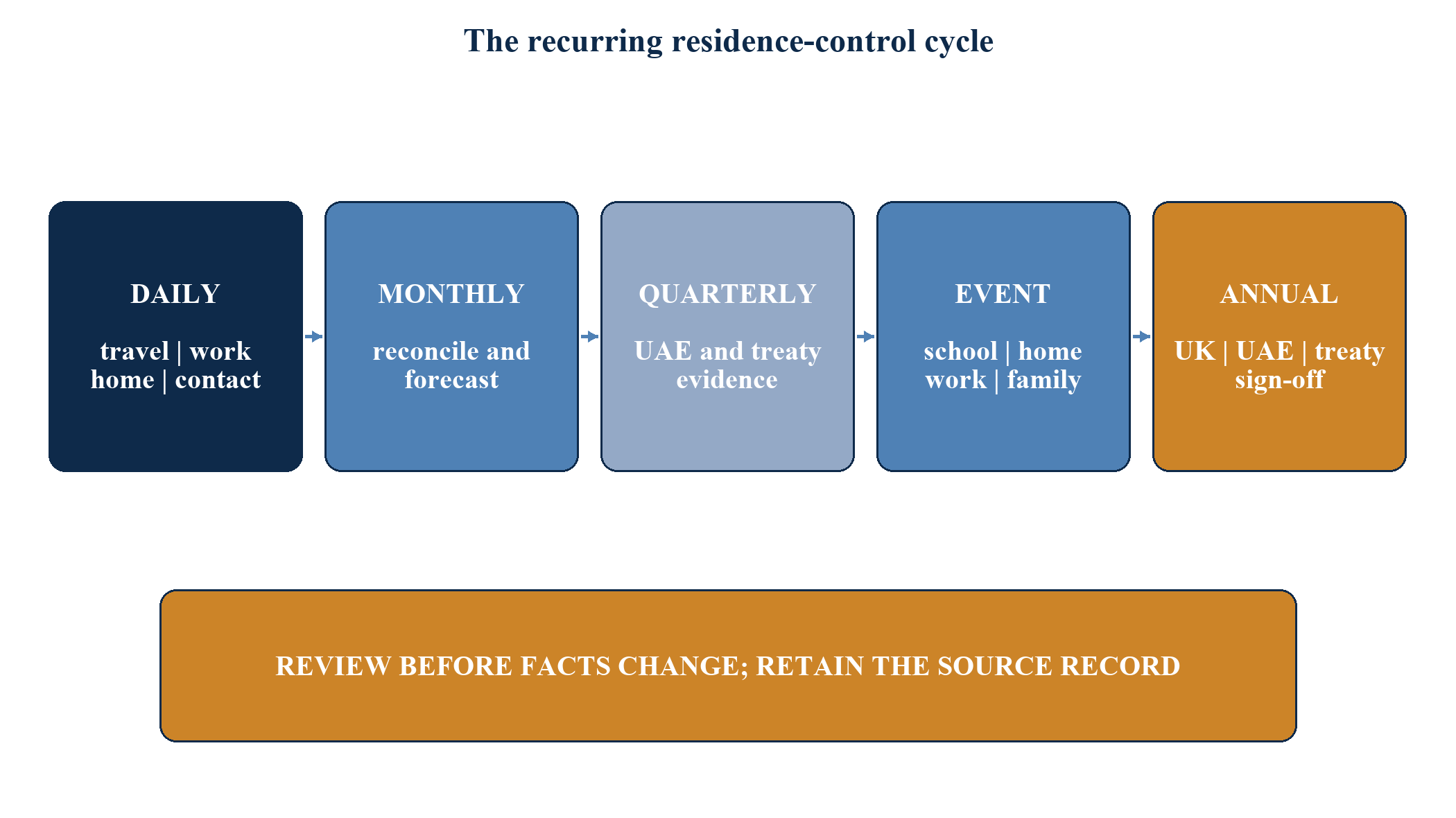
| Cadence | Action | Owner |
|---|---|---|
| daily | capture travel, work, home use and child contact | individual and administrator |
| monthly | reconcile evidence and refresh forecasts | family-office controller |
| quarterly | review UAE and treaty substance | UK and UAE advisers |
| event driven | assess school, home, work, health and family changes | residence committee |
| annually | conclude UK, UAE and treaty status | qualified advisers |
12. IMPLEMENTATION ROADMAP
12.1 First 30 days
Create the family register, rolling residence history, property register, travel ledger and work ledger. Collect the prior three UK residence conclusions, passports, UAE identity and visa records, property documents, employment contracts and school calendars. Identify missing evidence and appoint a responsible owner.
Commission an initial UK SRT forecast for each adult. Determine which automatic tests may apply and which sufficient-ties table would apply if needed. Prepare a UAE domestic-residence pathway for each adult and identify the intended tax-residency-certificate period and purpose.
12.2 Days 31 to 60
Build the family-tie schedule, child-contact register and term-time calculation where relevant. Complete the availability and use record for each UK and UAE property. Reconcile UK workdays and global country totals.
Prepare the first treaty evidence map. List permanent homes, family locations, employment, active businesses, investment management, banking, social and professional relations and the pattern of habitual living. Identify facts that could move the centre of vital interests.
12.3 Days 61 to 90
Run the first monthly close and investigate discrepancies. Test a planned UK trip through the pre-clearance process. Set escalation thresholds for UK days, workdays, home use, child contact and changes in family status.
Approve the annual sign-off timetable. Store source documents in a controlled repository and record retention, privacy and access rules. Schedule the UAE certificate application when the relevant criteria and evidence are available.
12.4 Ongoing operation
Every travel booking should be checked against current headroom. Every UK visit should have a stated purpose, expected work hours, accommodation and family contact. Actual facts should be reconciled promptly after return.
The family should refresh legal and tax advice when law, guidance or facts change. HMRC's Residence and FIG Regime Manual was updated in July 2026, illustrating the need to check current material at each annual review [16]. UAE application requirements and fees should also be checked on the FTA's current service page [13].
| Phase | Deliverable | Acceptance criterion |
|---|---|---|
| establish | person, property, travel and work registers | all relevant people and periods covered |
| analyse | UK, UAE and treaty pathway | legal tests and advisers identified |
| evidence | indexed source documents | every material fact traceable |
| operate | monthly close and trip pre-clearance | discrepancies assigned and resolved |
| conclude | annual signed memoranda | domestic and treaty outcomes separately stated |
13. LIMITATIONS AND RISK BOUNDARIES
This paper provides a control framework and general research. It does not determine any person's residence, tax liability, immigration position or treaty entitlement. The worked cases use hypothetical facts and omit many variables. Residence outcomes depend on complete person-specific facts, applicable law, the taxes concerned and current official guidance.
The SRT contains detailed definitions and special rules for work, homes, days, international transport workers, exceptional circumstances, deeming, split years, death and other situations. This paper focuses on the family, home and work issues most likely to arise in a two-residence household. It should be read with the legislation, official guidance and qualified advice [1-10,15,16].
UAE domestic tax residence and certificate procedures can change. The FTA decides certificate applications on the documents and conditions applicable to the applicant. A certificate does not resolve every UK domestic or treaty question. Treaty relief depends on the convention, the tax and the facts of the relevant period [11-14].
Family and location data are sensitive. Governance should follow applicable privacy, employment, education and data-protection law. Evidence collection should be proportionate, lawful, access-controlled and subject to an appropriate retention policy.
The management buffers, committee cadence and register design in this paper are proposed controls. They do not alter statutory thresholds. Qualified UK and UAE tax, legal, immigration, corporate and regulatory advisers should approve the family's specific framework.
14. CONCLUSION
Two residences create several overlapping tests. The durable control is a person-by-person chronology supported by daily evidence. The UK analysis applies the statutory sequence and the relevant day and tie rules. The UAE analysis identifies the applicable domestic route and evidence. The treaty analysis addresses any period of dual domestic residence through Article 4.
Family facts deserve their own registers. A spouse's UK residence can affect another spouse's family tie. A child's education and parental contact require different day counts. Homes must be tested for actual availability and use. Work must be recorded by location, duration and capacity.
A monthly close, event-driven review and annual adviser sign-off allow a family to preserve mobility while keeping its residence position reproducible. The objective is a documented decision process that remains current as people, homes, schools, work and travel plans change.
APPENDIX A. FAMILY RESIDENCE REGISTER
| Field | Required entry | Evidence owner |
|---|---|---|
| legal name and date of birth | verified identity | family administrator |
| relationship | spouse, partner, child or dependent relative | legal adviser where needed |
| nationality and permits | current citizenship and immigration documents | immigration counsel |
| prior UK residence | at least three preceding tax years | UK tax adviser |
| current UK status | forecast and final SRT conclusion | UK tax adviser |
| UAE route | 183 days, 90 days plus condition, or primary place and centre | UAE tax adviser |
| treaty status | period and Article 4 conclusion | treaty adviser |
| material changes | work, school, home, care or relationship | individual and administrator |
APPENDIX B. DAILY PRESENCE AND ACTIVITY LEDGER
| Field | Description |
|---|---|
| date | one row for every calendar date |
| country at midnight | location at end of UK day |
| arrival and departure | local timestamps and route |
| UK work hours | actual duties and total time |
| UK home presence | each home and any part-day presence |
| UAE home presence | each home and any part-day presence |
| child contact | in-person UK contact and duration |
| school status | term time or outside term time where relevant |
| evidence | ticket, entry-exit report, diary, invoice or other record |
| reviewer | person who reconciled the entry and date |
APPENDIX C. PROPERTY AVAILABILITY REGISTER
| Field | Control question |
|---|---|
| property | which address and jurisdiction? |
| legal interest | who owns, leases or licenses it? |
| availability start and end | when could the individual live there? |
| interruptions | were gaps at least 16 days and legally effective? |
| occupiers | who lived there and on what basis? |
| access | keys, notice, rooms and practical ability to stay |
| overnight use | how many nights did the person spend there? |
| daytime use | on how many days was the person present? |
| close-relative home | does the special 16-night threshold require review? |
| evidence | tenancy, title, utilities, access, agent and travel records |
APPENDIX D. FAMILY-TIE WORKPAPER
- Identify each spouse, civil partner, qualifying partner and child under 18.
- Conclude the UK residence status of each relevant family member in their own right.
- Record whether any relationship is legally separated under the applicable definition.
- Count each day or part-day of in-person UK contact with a minor child.
- For a child in full-time UK education, retain official term dates and count days outside term time under the statutory method.
- State the family-tie conclusion separately for each adult.
- Cross-reference the conclusion to the sufficient-ties table and annual residence memorandum.
APPENDIX E. UK TRIP PRE-CLEARANCE
| Question | Planned answer | Actual answer |
|---|---|---|
| UK arrival and departure | ||
| UK midnight days | ||
| workdays above three hours | ||
| UK accommodation | ||
| presence at UK homes | ||
| child-contact days | ||
| effect on family tie | ||
| effect on country totals | ||
| entity-level work review | ||
| adviser clearance and conditions |
APPENDIX F. QUESTIONS FOR ADVISERS
- Which automatic overseas and UK tests apply to each adult for the current year?
- Which sufficient-ties table applies, and how many ties does each adult have?
- Does a spouse, partner or minor child create a family tie for either adult?
- Does the full-time-education rule apply to any child, and how should outside-term-time days be counted?
- Which UK properties constitute homes or available accommodation for each person?
- Does the second automatic UK home test require a detailed home-presence calculation?
- Which duties count as UK work and which days exceed three hours?
- Does either adult meet the sufficient-hours overseas test and all associated conditions?
- Which UAE domestic-residence route applies to each adult for the intended period?
- What evidence is required for the intended UAE tax-residency certificate?
- Does dual domestic residence arise, and how does Article 4 assign treaty residence?
- Could any work pattern affect an employer, company, trust, fund or partnership?
- Which filings, claims and disclosures are required in each jurisdiction?
- Which future events require the residence analysis to be repeated before action?
REFERENCES
[1] HM Revenue & Customs, RDR3: Statutory Residence Test notes, updated 11 June 2026. https://www.gov.uk/government/publications/rdr3-statutory-residence-test-srt
[2] HM Revenue & Customs, RFIG20510-RFIG20520: Sufficient ties and number of ties, Residence and FIG Regime Manual, updated 3 July 2026. https://www.gov.uk/hmrc-internal-manuals/residence-and-fig-regime-manual/rfig20510 and https://www.gov.uk/hmrc-internal-manuals/residence-and-fig-regime-manual/rfig20520
[3] HM Revenue & Customs, RFIG20530: Definition of a family tie, Residence and FIG Regime Manual, updated 3 July 2026. https://www.gov.uk/hmrc-internal-manuals/residence-and-fig-regime-manual/rfig20530
[4] HM Revenue & Customs, RFIG20540: Full-time education of children and the family tie, Residence and FIG Regime Manual, updated 3 July 2026. https://www.gov.uk/hmrc-internal-manuals/residence-and-fig-regime-manual/rfig20540
[5] HM Revenue & Customs, RFIG20550: Accommodation tie, Residence and FIG Regime Manual, updated 3 July 2026. https://www.gov.uk/hmrc-internal-manuals/residence-and-fig-regime-manual/rfig20550
[6] HM Revenue & Customs, RFIG20330-RFIG20340: Second automatic UK test and time spent in homes, Residence and FIG Regime Manual, updated 3 July 2026. https://www.gov.uk/hmrc-internal-manuals/residence-and-fig-regime-manual/rfig20330 and https://www.gov.uk/hmrc-internal-manuals/residence-and-fig-regime-manual/rfig20340
[7] HM Revenue & Customs, RFIG20560: Work tie, Residence and FIG Regime Manual, updated 3 July 2026. https://www.gov.uk/hmrc-internal-manuals/residence-and-fig-regime-manual/rfig20560
[8] HM Revenue & Customs, RFIG20140: Third automatic overseas test, Residence and FIG Regime Manual, updated 3 July 2026. https://www.gov.uk/hmrc-internal-manuals/residence-and-fig-regime-manual/rfig20140
[9] HM Revenue & Customs, RFIG21930: Record keeping for working hours and location, Residence and FIG Regime Manual, updated 3 July 2026. https://www.gov.uk/hmrc-internal-manuals/residence-and-fig-regime-manual/rfig21930
[10] HM Revenue & Customs, RFIG21010-RFIG21030: Split-year treatment, Residence and FIG Regime Manual, updated 3 July 2026. https://www.gov.uk/hmrc-internal-manuals/residence-and-fig-regime-manual/rfig21010
[11] HM Revenue & Customs, 2016 UK-UAE Double Taxation Convention, in force from 25 December 2016. https://www.gov.uk/government/publications/united-arab-emirates-tax-treaties/2016-uk-uae-double-taxation-convention
[12] United Arab Emirates, Cabinet Decision No. 85 of 2022 on Determination of Tax Residency, unofficial English translation published by the Federal Tax Authority. https://www.tax.gov.ae/Datafolder/Files/Legislation/Corporate%20Tax/Cabinet%20Decision%2085%20of%202022%20-%20For%20publishing.pdf
[13] UAE Federal Tax Authority, Issuance of Tax Certificates for Tax Residency, service page updated 6 April 2026. https://tax.gov.ae/en/services/issuance.of.tax.certificates.aspx
[14] UAE Federal Tax Authority, Tax Resident and Tax Residency Certificate; Tax Procedures Guide TPGTR1, 18 October 2024. https://tax.gov.ae/Datafolder/Files/Guides/VAT/VAT%20Guides/Tax-Resident-and-TRC--18-10-2024.pdf
[15] HM Revenue & Customs, RFIG22230: Exceptional circumstances and day-counting tests, Residence and FIG Regime Manual, updated 3 July 2026. https://www.gov.uk/hmrc-internal-manuals/residence-and-fig-regime-manual/rfig22230
[16] HM Revenue & Customs, Residence and FIG Regime Manual update record, updated 3 July 2026. https://www.gov.uk/hmrc-internal-manuals/residence-and-fig-regime-manual/updates
ABOUT THE AUTHOR
Chennakeshav Adya is an independent researcher. His work examines cross-border capital, family-enterprise decisions, private markets and the governance systems that connect strategy with implementation.
