

1. INTRODUCTION
For a founder preparing to move from the United Kingdom to the United Arab Emirates, 6 April can appear to be a bright line. It is the first day of the UK tax year, and several business and succession changes took effect on 6 April 2026. Business Asset Disposal Relief moved to 18 percent for qualifying disposals. The highest rate of Business Relief became subject to a GBP 2.5 million allowance for relevant transfers and deaths. The date can also appear to offer a simple way to separate UK residence from a later sale.
The legal and commercial sequence is more demanding. A share disposal under an unconditional contract is generally dated when the contract is made, even if completion and payment follow later [4]. Split-year treatment applies only if a statutory case and its conditions are satisfied [7]. Certain gains and close-company distributions received during a period of temporary non-residence can enter the UK charge on return [13,14]. A founder's departure does not by itself relocate the company, its board, its central management and control, its UK operations or its tax residence [20-24]. Succession exposure can continue after departure through the long-term residence rules [5,17].
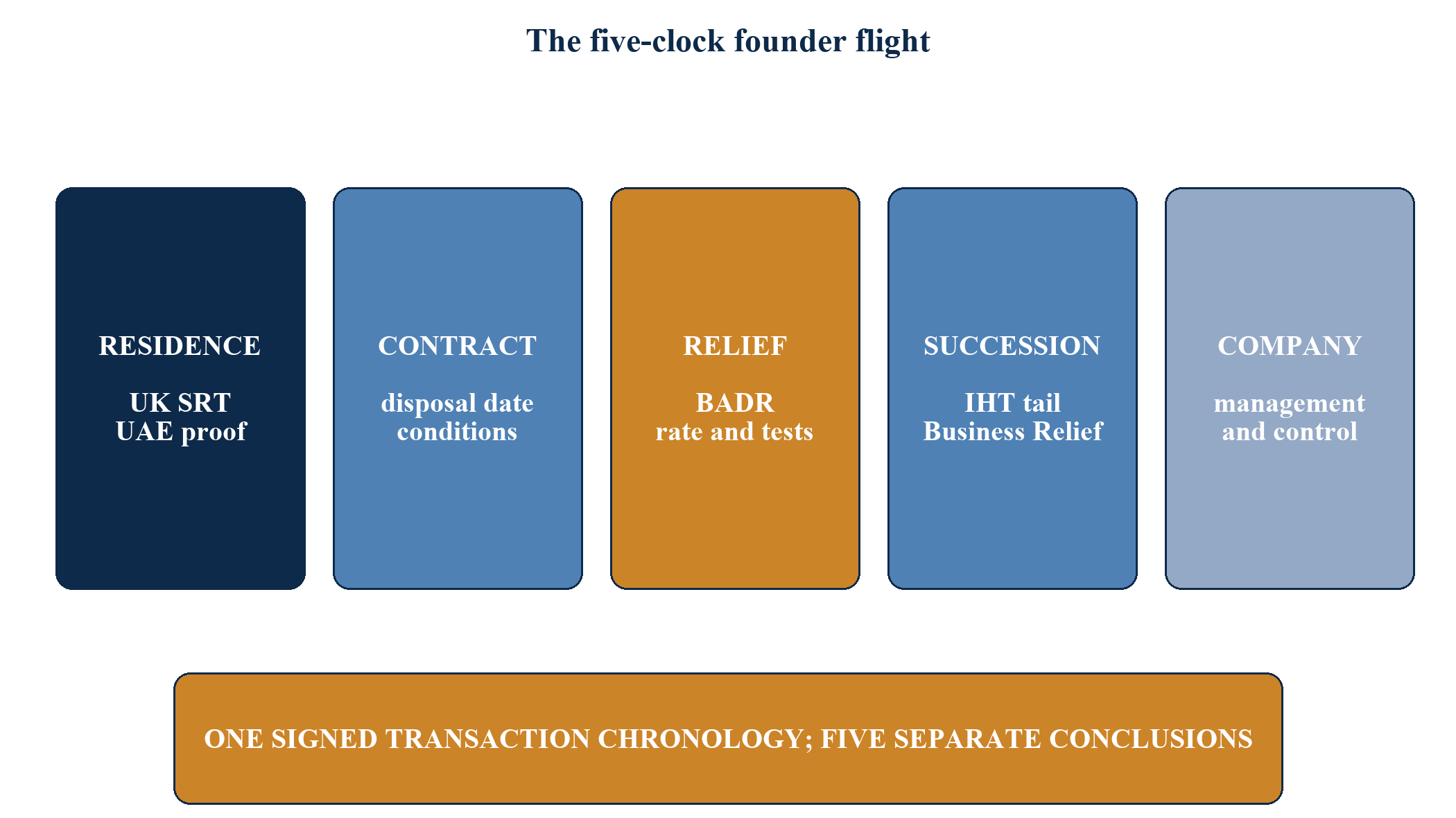
The founder therefore faces five clocks:
- the residence clock for the founder and each relevant family member;
- the contract clock that determines the legal disposal date and the treatment of deferred consideration;
- the relief clock for Business Asset Disposal Relief and other transaction provisions;
- the succession clock for long-term residence, Business Relief, ownership and liquidity; and
- the company clock for management, control, operations and migration.
These clocks interact, but they do not answer one another. A UAE residence certificate can support UAE domestic or treaty residence. It does not establish UK non-residence. A completed UAE move can improve the factual basis for a UK residence conclusion. It does not change a disposal date already fixed by an earlier unconditional contract. A sale may create personal liquidity. It does not resolve governance, succession or the tax character of an earn-out. A founder may be non-UK resident while the company remains UK resident and operationally centred in Britain.
This paper develops a transaction-sequencing framework for founders who are considering a UAE move before, during or after a sale or succession event. It uses official materials available through 3 August 2026. It focuses on the control questions that should be answered before heads of terms, exclusivity, restructuring, distributions, signing, completion, succession transfers or return travel change the facts.
| Clock | Question | Required output |
|---|---|---|
| residence | where is each person resident under UK and UAE domestic rules and any applicable treaty? | daily calendar, tie register, home and work evidence, adviser conclusion and certificate file |
| contract | what event fixes the disposal date and what consideration arises? | signed chronology, legal-condition analysis and consideration schedule |
| relief | which conditions and rate apply to each part of the transaction? | eligibility memorandum, lifetime-use record and tax computation |
| succession | which assets remain within inheritance-tax scope and how is tax funded? | twenty-year residence history, Business Relief review and liquidity plan |
| company | where is the company resident, managed, controlled and operating? | board map, authority matrix, location evidence and migration analysis |
2. THE 6 APRIL 2026 RESET
2.1 Business Asset Disposal Relief at 18 percent
HMRC states that Business Asset Disposal Relief applies at 18 percent to qualifying disposals made on or after 6 April 2026. The rate was 14 percent for qualifying disposals from 6 April 2025 to 5 April 2026 [1,2]. The ordinary Capital Gains Tax rate for an individual paying the higher or additional rate is generally 24 percent for gains that do not attract a special rate, subject to the detailed rules [3]. The annual exempt amount is GBP 3,000 for 2026 to 2027 [3].
The difference between 14 and 18 percent matters, yet it is only one component of the decision. Eligibility must be established for the shares or business being disposed of. HMRC's conditions can include the nature of the company or group, the founder's office or employment, voting and economic rights, the holding period and the lifetime limit [1,2]. Options, reorganisations, dilution, preference rights, investment activities and changes to employment can alter the analysis.
A founder should maintain a relief file before a sale process begins. The file should include the cap table for the relevant period, articles of association, shareholder agreements, option and preference terms, employment or office records, group accounts, business-activity analysis, earlier relief claims and the founder's lifetime-limit record. Buyer diligence can expose defects after the commercial timetable has accelerated. The relief file gives advisers time to identify them before signing.
2.2 A simple rate comparison
Consider a hypothetical founder with a GBP 1 million gain that fully qualifies for Business Asset Disposal Relief and falls within the available lifetime limit. A disposal taxed at 14 percent produces GBP 140,000 of tax before other adjustments. An 18 percent rate produces GBP 180,000. The arithmetic difference is GBP 40,000. This illustration excludes the annual exempt amount, losses, other gains, transaction costs, elections, anti-forestalling rules, residence and every fact-specific eligibility question.
The example shows the value of timing analysis. It does not show that an accelerated disposal was commercially desirable, legally effective or available. A rushed transaction can change valuation, warranty exposure, consideration mix, buyer financing and execution risk by more than the tax-rate difference. The board and shareholder record should distinguish commercial reasons from tax assumptions.
2.3 Business Relief after 6 April 2026
For deaths and relevant lifetime transfers on or after 6 April 2026, HMRC guidance describes a GBP 2.5 million allowance for the highest rate of Agricultural Property Relief and Business Relief. Qualifying value within the allowance can receive 100 percent relief; qualifying value above the allowance can generally receive 50 percent relief. Unused allowance can be transferred between spouses or civil partners under the stated conditions [5,6]. Detailed qualification and ordering rules apply.
The change affects more than an eventual tax computation. It can alter the funding need for a founder's estate, the role of insurance, the availability of company cash, the design of shareholder agreements, the allocation of voting and economic rights and the balance between holding, gifting and selling. A family should obtain a current business valuation and an adviser-reviewed qualification analysis. The valuation and qualifying status can move over time.
Consider a hypothetical estate holding GBP 10 million of qualifying unlisted business property, with the full GBP 2.5 million allowance available and no transferable spouse allowance included. The first GBP 2.5 million receives 100 percent relief. The remaining GBP 7.5 million receives 50 percent relief, leaving GBP 3.75 million of taxable value before exemptions, nil-rate bands, liabilities, other reliefs and the applicable Inheritance Tax computation. The worked arithmetic does not predict an estate's actual liability.
2.4 Long-term residence replaces domicile as the main entry point
From 6 April 2025, the UK introduced a long-term residence framework for the overseas-asset scope of Inheritance Tax. HMRC describes a person as generally long-term resident when UK resident in at least ten of the twenty tax years immediately preceding the relevant tax year. After departure, the overseas-asset exposure can continue for between three and ten tax years depending on the residence history [17-19]. Trust, transfer and transitional rules require specialist review.
A founder who moves in anticipation of succession should therefore build a twenty-year residence schedule. The schedule should cover each complete UK tax year, any split-year position, supporting returns and advice, earlier periods abroad, trust additions, gifts, company reorganisations and relevant deaths. Physical departure and UAE residence do not by themselves end the UK succession workstream.
2.5 The policy gate
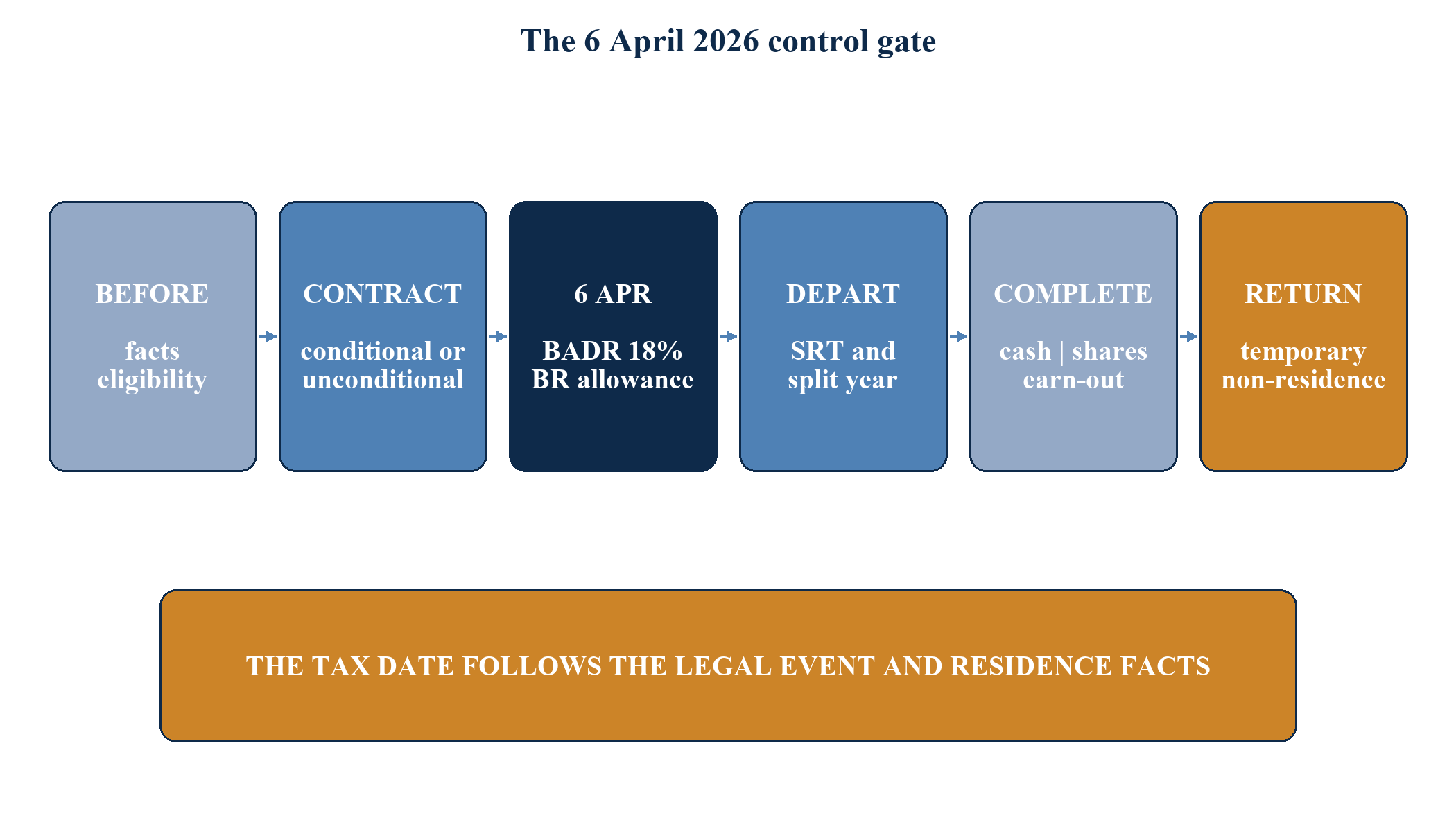
The 6 April reset creates a review date. It does not create a universal departure date. The founder's control group should review:
- whether a transaction already exists for UK tax purposes;
- whether Business Asset Disposal Relief conditions are met and documented;
- whether a share exchange, earn-out, option or distribution creates additional dates;
- whether split-year treatment is available and robust;
- whether temporary non-residence changes the return economics;
- whether succession exposure remains after departure;
- whether company control, employment and board activity stay in the United Kingdom; and
- whether the UAE evidence file supports the intended domestic and treaty positions.
| Change | Effective point | Founder control |
|---|---|---|
| four-year foreign income and gains regime | 6 April 2025 | understand return options and future eligibility after ten years of non-residence [16] |
| long-term residence for Inheritance Tax | 6 April 2025 | prepare twenty-year history and post-departure tail analysis [17-19] |
| Business Asset Disposal Relief at 18 percent | qualifying disposals from 6 April 2026 | fix disposal date and document relief eligibility [1-4] |
| GBP 2.5 million Business Relief allowance | relevant transfers and deaths from 6 April 2026 | update valuation, qualification and estate liquidity [5,6] |
| expanded temporary non-residence treatment of close-company distributions | returns on or after 6 April 2026 under the described rules | model distributions and the return gate [14] |
3. THE FOUNDER SALE SEQUENCE
3.1 Begin with the commercial transaction
A defensible sequence starts with the transaction that the founder genuinely intends to complete. The buyer process, valuation, financing, regulatory approvals, management retention, warranty package, escrow, earn-out, rollover and completion conditions should be mapped before tax dates are overlaid. The sequence should preserve commercial coherence and comply with company-law and director-duty requirements.
The first output is a transaction chronology. It identifies each document and event from initial approach through final settlement. The chronology should state whether the event is expected, drafted, negotiated, approved, executed, effective, satisfied, waived or completed. It should also identify who controls the event and which adviser has confirmed its legal effect.
3.2 The chronology has several gates
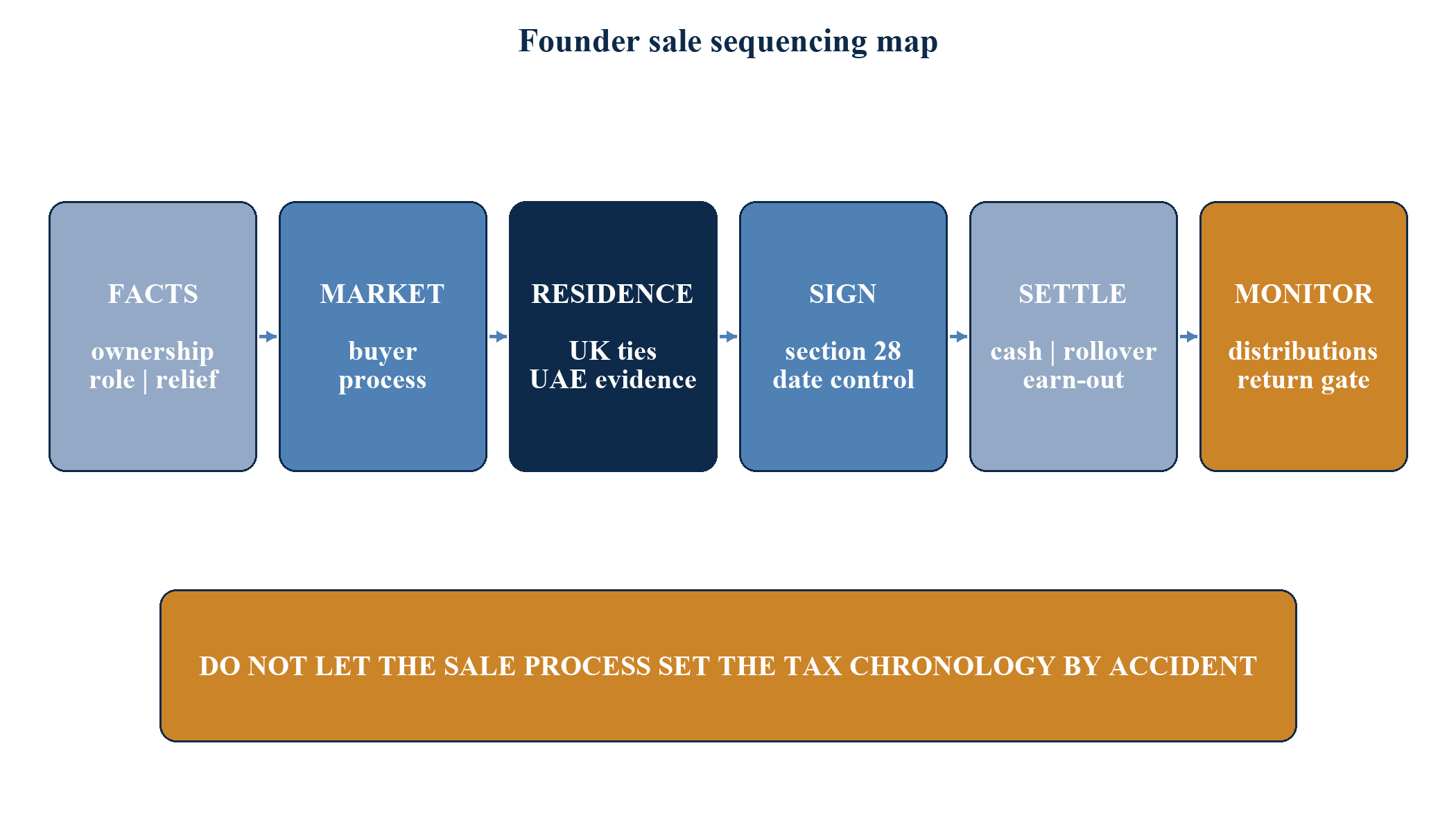
An indicative timeline can include:
- founder objectives and shareholder alignment;
- vendor due diligence and relief-file review;
- adviser appointments and valuation work;
- buyer approach, information memorandum and management presentations;
- non-binding offers and exclusivity;
- tax and residence fact review;
- heads of terms and financing confirmation;
- regulatory, competition, lender and shareholder approvals;
- share-purchase agreement negotiation;
- signing and the analysis of every condition;
- completion, payment, escrow and debt settlement;
- rollover shares, loan notes, earn-out and retention arrangements;
- post-completion distributions and employment; and
- the founder's future UK travel and return decision.
Each item can create its own tax, legal or evidence question. The founder should avoid describing signing and completion as interchangeable. They can fall in different tax years and different residence periods.
3.3 Heads of terms and exclusivity
Heads of terms can be stated to be non-binding while particular provisions, such as confidentiality, exclusivity, costs or governing law, are binding. Their tax effect depends on the legal rights created and the later transaction. The chronology should record the executed text, legal advice and the commercial actions taken under it.
Exclusivity also changes bargaining power. A founder who delays a transaction to support a relocation may give the buyer additional leverage or create financing risk. The decision paper should show the expected value, timing, certainty and consequences under each path. A lower projected tax charge can be outweighed by price erosion, financing cost, leakage, warranty exposure or loss of the buyer.
3.4 Signing, conditions and completion
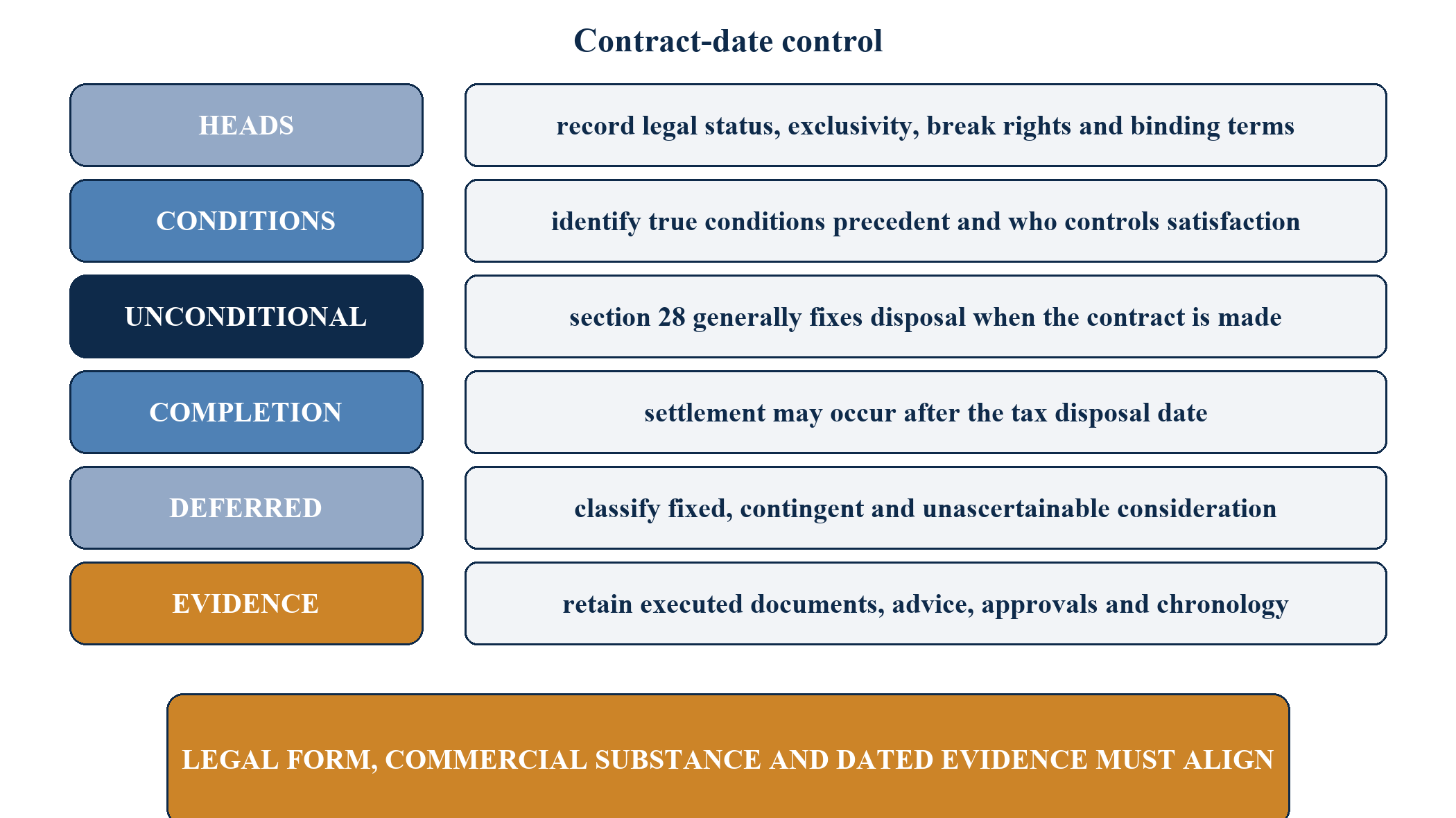
HMRC's Capital Gains Manual explains that an unconditional contract generally fixes the date of disposal when the contract is made under section 28 of the Taxation of Chargeable Gains Act 1992. Where the contract is conditional, the date is generally when all conditions are satisfied [4]. Describing a clause as a condition precedent does not settle the tax analysis. Lawyers and tax advisers should examine whether the condition is a true condition affecting the existence of the obligation or a completion requirement within an already unconditional bargain.
The founder needs a condition schedule. For every stated condition, it records the party responsible, satisfaction evidence, waiver right, long-stop date, materiality, effect of failure and tax analysis. The schedule is signed off before the transaction document is executed.
3.5 Consideration is a second sequence
Sale proceeds may include cash at completion, fixed deferred cash, contingent cash, escrow, retention, purchaser shares, loan notes, management equity, options and earn-out rights. HMRC distinguishes ascertainable future consideration from unascertainable consideration. Fixed or calculable amounts can be treated differently from rights whose amount depends on future events [12,15]. Earn-out rights satisfied in shares or debentures can engage specific share-exchange provisions when their conditions are met [15].
The consideration schedule should therefore record:
- legal form and issuer;
- amount or valuation method;
- when entitlement arises;
- payment date and currency;
- contingency and performance conditions;
- whether the founder remains an employee or director;
- forfeiture and leaver provisions;
- security, escrow and buyer credit risk;
- tax character and disposal date advised; and
- residence and return implications when the amount is received or disposed of.
3.6 Reorganisations and clearances
A pre-sale share exchange, insertion of a holding company, demerger, purchase of own shares, capital reduction or other reorganisation can have several tax and company-law consequences. Applicable statutory clearances address defined provisions and depend on accurate facts and implementation matching the application. The clearance is not a general approval of the transaction. The founder should keep the application, supporting documents, response and executed-step comparison in the data room.
Transactions in securities and share-exchange anti-avoidance rules can be relevant where value is extracted, ownership changes or arrangements have tax advantages. Current specialist advice should precede implementation. A sequence designed around an assumed clearance should include time to amend or abandon the structure if clearance is unavailable.
| Sale stage | Critical question | Evidence |
|---|---|---|
| preparation | do the shares and founder satisfy relief conditions? | cap table, articles, role, group and business-activity file |
| buyer process | can commercial timing accommodate residence and approval work? | process letter, bids, financing and critical path |
| heads | which provisions are binding? | executed heads and legal opinion |
| signing | is the contract conditional or unconditional for section 28? | signed agreement and condition analysis |
| completion | which legal, cash and governance events occur? | completion agenda, funds flow and board records |
| deferred value | how are escrow, earn-out, rollover shares and loan notes treated? | consideration schedule and valuation |
| post-completion | what work, distribution and return events remain? | employment, board, travel and tax calendar |
4. DISPOSAL DATE AND CONTRACT CONTROL
4.1 Why the date matters
HMRC identifies several consequences of the disposal date. It can determine the tax year, tax rate, payment deadline, annual exempt amount, residence position and relief conditions [4]. In a founder move, the date can sit on the boundary between UK residence periods and between the 14 and 18 percent Business Asset Disposal Relief rates.
The tax date can precede the day on which the founder receives cash. A founder who leaves the United Kingdom after signing an unconditional sale agreement may have left after the relevant disposal. A completion statement showing a later date does not resolve that issue.
4.2 Unconditional and conditional contracts
The contract team should prepare a plain-language note that answers four questions:
- What legal obligation exists at signing?
- Which conditions affect whether that obligation comes into existence?
- Which requirements regulate completion of an existing obligation?
- Who can waive or control each item?
Tax and legal advisers should review the final execution version, including side letters, disclosure letters, option agreements, rollover documents and financing arrangements. A conclusion based on an earlier draft can become stale when the final negotiation changes the condition structure.
4.3 Options, puts, calls and locked-box terms
An option can create rights at grant and a later disposal sequence when exercised. HMRC guidance notes that the tax treatment of options and section 144 can affect the relevant contract analysis [4]. Put and call arrangements, drag rights, pre-emption rights and compulsory-transfer provisions should be included in the chronology.
A locked-box price mechanism fixes economic value by reference to an earlier balance-sheet date, while legal ownership can transfer later. The locked-box date does not automatically become the founder's disposal date. Completion accounts, leakage covenants and value accrual also require separate analysis. The transaction memorandum should avoid using the accounting reference date as a tax conclusion.
4.4 Deferred and contingent proceeds
HMRC explains that future payments are ascertainable when amounts are known or calculable and the events establishing the amount have occurred by the disposal date. Unascertainable consideration depends on future events that have not yet occurred [12]. A profit-based earn-out is a common example. The initial value of a right to unascertainable consideration and later part disposals can create further calculations [12,15].
The founder should commission a contemporaneous valuation where required. The file should preserve the forecast, discount rate, probability assumptions, buyer credit assessment, performance definition and later outcomes. Management retention and employment-related securities rules also require review where the founder continues working for the buyer [15].
4.5 Rate, residence and payment are different columns
Every consideration item should carry at least four dates:
- the legal disposal or entitlement date;
- the valuation date;
- the receipt or settlement date; and
- any later disposal date for the right, share or security received.
The tax rate and residence analysis is assigned to the legally relevant event, not the day cash reaches the bank. A finance team that tracks only cash receipts can miss the earlier tax event.
4.6 Contract-control checklist
Before execution, the founder's deal committee should receive:
- final execution copies and a version-control report;
- a section 28 analysis signed off by advisers;
- a schedule of all conditions and waiver rights;
- a disposal-date conclusion for each asset and consideration component;
- the Business Asset Disposal Relief conditions and lifetime-limit record;
- a residence conclusion for the relevant period;
- a temporary non-residence and return analysis;
- a funds-flow and currency plan;
- evidence requirements for the UK and UAE files; and
- board and shareholder approvals that accurately record the commercial rationale.
| Document or event | Date recorded | Legal effect reviewed | Tax owner |
|---|---|---|---|
| heads of terms | signature and effective dates | binding and non-binding provisions | lead tax adviser |
| exclusivity | start, expiry and extension | rights and termination | transaction counsel |
| share-purchase agreement | signing and effectiveness | conditionality and section 28 | transaction tax counsel |
| conditions | satisfaction and waiver | consequence of each condition | deal counsel |
| completion | legal transfer and funds | ownership, payment and releases | completion team |
| earn-out | grant, measurement and payment | right, valuation and later disposal | tax and valuation advisers |
| rollover equity | issue, vesting and sale | share exchange and employment terms | tax and incentives advisers |
5. UK RESIDENCE, SPLIT YEAR AND RETURN
5.1 The Statutory Residence Test
HMRC's RDR3 guidance sets out automatic overseas tests, automatic UK tests, the sufficient ties test, split-year treatment and temporary non-residence [7]. Residence is tested using statutory facts. A visa, a declared intention or an overseas home does not answer the UK test by itself.
A founder's tie profile may include family, accommodation, work, ninety-day and country ties. Prior UK residence changes the sufficient-ties analysis. A person can be UK resident at fewer than 183 UK days. The control file should calculate days and ties in real time and retain source evidence for travel, work and home availability.
5.2 Founder workdays and continuing roles
A sale process can create substantial UK work immediately before or after departure. Management presentations, negotiations, board meetings, buyer integration and retained employment should be recorded by date, location, hours and capacity. The founder may act as shareholder, director, employee, consultant or seller on different days. Each role can have separate UK and UAE consequences.
The day-count system should integrate calendars, travel records, board packs and expense data. It should record exceptional circumstances separately and route them to advisers. A reconstructed spreadsheet prepared after a challenge has weaker evidential value than a contemporaneous record supported by third-party documents.
5.3 Split-year treatment
UK residence is ordinarily determined for the tax year as a whole. Split-year treatment applies only when one of the statutory cases and its conditions is satisfied [7]. A founder should identify the proposed case, the expected split date, the facts needed through the remainder of the year and the consequences if a condition changes.
The transaction chronology should show the UK part, overseas part and each legal sale event. A disposal in the overseas part may still require review under temporary non-residence, UK land, attributed-gain or other provisions [8]. Split year is a conditional conclusion, not a label attached automatically to a mid-year flight.
5.4 Temporary non-residence
HMRC guidance states that capital gains arising during temporary non-residence can be charged in the period of return under the applicable provisions [13]. Close-company distributions can also be affected. HMRC's updated guidance for returns on or after 6 April 2026 describes treatment that can include the full distribution under the specified conditions, including post-departure trade profits, and contains rules addressing interposed entities [14].
The founder needs a pre-return gate that covers planned UK days, homes, work, distributions, gains, earn-out payments, share sales, loans, pensions and other relevant receipts. The gate is activated before actions change the residence facts. A return caused by family or medical circumstances still requires a prompt review of the resulting statutory position.
5.5 Treaty residence
The UK-UAE Double Taxation Convention defines residence for treaty purposes and contains a sequence for dual-resident individuals, including permanent home, centre of vital interests, habitual abode and nationality, followed by competent-authority procedures where necessary [10]. Treaty residence is a further analysis after domestic residence conclusions.
The evidence file should state which conclusion each document supports:
- UK domestic residence;
- UAE domestic residence;
- treaty residence;
- entitlement to a particular treaty provision; and
- administrative evidence for a bank, buyer, custodian or authority.
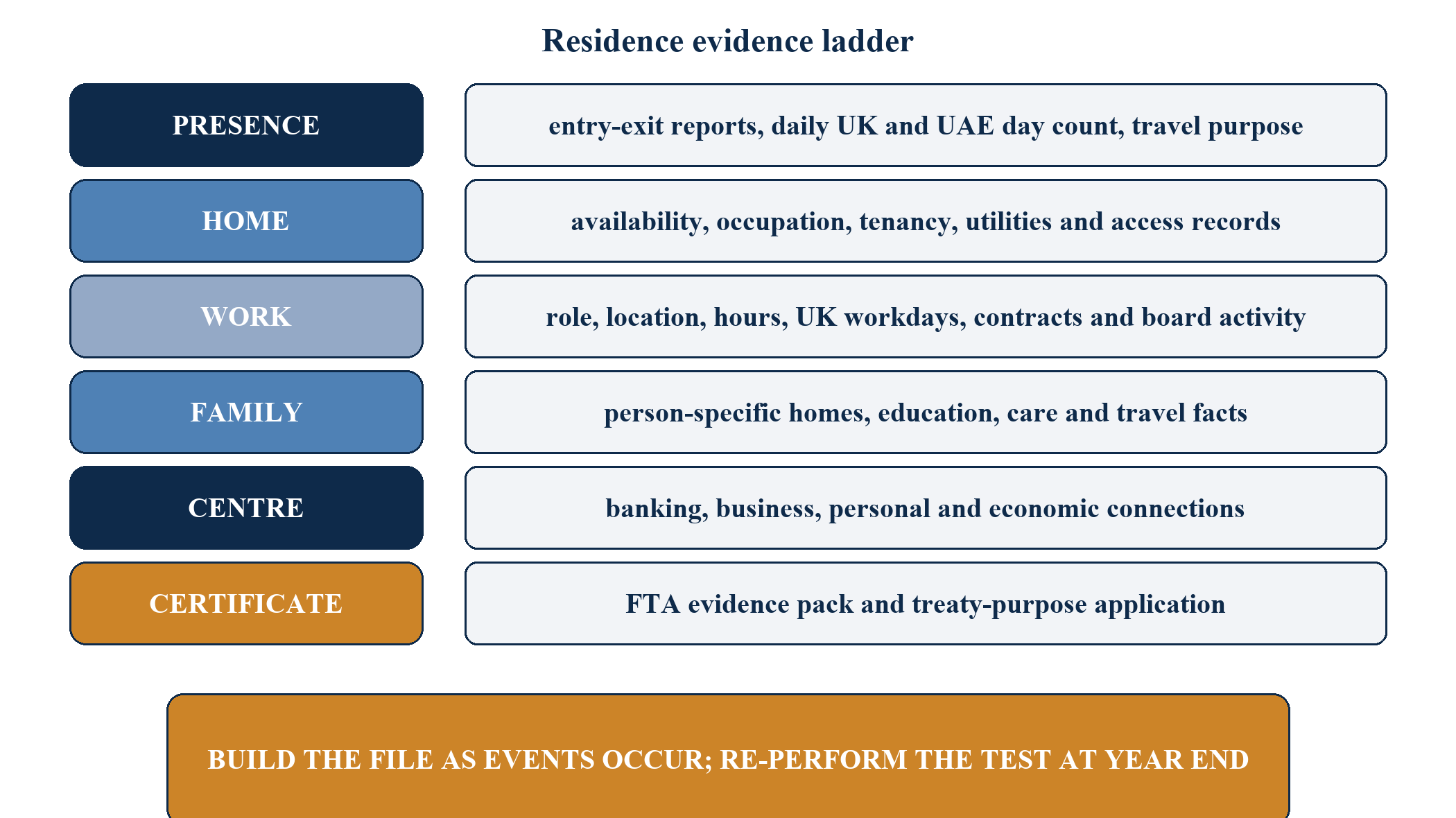
| Evidence domain | Example records | Owner | Review frequency |
|---|---|---|---|
| presence | passports, entry-exit reports, tickets and travel calendar | tax coordinator | weekly |
| homes | title, tenancy, utilities, access and occupancy | family office | monthly and on change |
| work | contracts, location, hours, board and expense records | founder and company secretary | weekly |
| family | person-specific residence and travel facts | private family file | monthly and on change |
| UAE residence | visa, Emirates ID, home, work and FTA materials | UAE adviser | quarterly |
| treaty | permanent home and centre-of-interests analysis | treaty counsel | on major change |
| return | UK days, home, work and transaction triggers | lead tax adviser | before material return |
6. UAE RESIDENCE AND EVIDENCE
6.1 UAE domestic tests
UAE Cabinet Decision No. 85 of 2022 and Ministerial Decision No. 27 of 2023 establish domestic tax-residence tests. The Ministry of Finance states that all days or parts of days in the UAE count for the stated thresholds. A permanent place of residence need not be owned, but it must be continuously available. Centre of financial and personal interests is assessed through factual connections [8,9].
The Federal Tax Authority's Tax Residency Certificate service describes evidence for different routes. The materials include a route based on at least 183 days, a route based on 90 to 182 days combined with specified UAE connections, and a route based on primary residence and centre of financial and personal interests [11]. A treaty-purpose certificate can require the relevant treaty and period to be identified.
6.2 Evidence has to match the route
A founder should select the intended residence route with advisers and construct the file around its elements. The file can include identity, visa, Emirates ID, entry-exit reports, home, utility, employment, company, banking and family records. The evidence should be dated and internally consistent.
Bank statements and company documents can support connections. They can also expose inconsistencies if addresses, tax self-certifications, signatory locations and board records contradict the stated arrangement. The founder should update financial institutions accurately when tax residence changes and retain confirmations.
6.3 UAE natural-person Corporate Tax
The Federal Tax Authority distinguishes wages, personal investment income and real-estate investment income from business or business activity for natural-person Corporate Tax. A natural person can fall within Corporate Tax where UAE business turnover exceeds AED 1 million in the calendar year, subject to the rules [25].
A founder who begins providing advisory services, charging management fees, operating a family office, investing as a licensed business or holding executive responsibilities should classify the activity. Visa status, licensing, VAT, regulated activity and Corporate Tax are separate workstreams. The description on an invoice or residence visa does not settle every one of them.
6.4 Treaty certificates and buyer diligence
A buyer, paying agent or bank may request a tax residence certificate, self-certification or legal opinion. The founder should provide documents that answer the requested question without overstating their effect. A UAE certificate is part of the evidence for UAE or treaty purposes. The UK analysis remains grounded in the Statutory Residence Test, split-year and other applicable rules.
The data room should include a controlled residence folder. Personal data access should be limited. The folder contains the adviser-approved conclusions and supporting documents needed for the transaction, while detailed family records remain in the private tax file unless disclosure is necessary and lawful.
7. SUCCESSION AND CAPITAL
7.1 A sale and succession plan can compete
A founder may be deciding whether to sell, gift, retain or divide the company. A sale can create liquid assets and remove future Business Relief on the shares. Retention can preserve business ownership while leaving the estate exposed to valuation, qualification and liquidity risk. Gifting can change control and create tax, governance and family consequences. The correct sequence depends on objectives, facts and advice.
The founder should articulate the intended ownership outcome before selecting a tax structure. Questions include:
- should the next generation own, control or only benefit economically;
- which family members can govern the business;
- whether the founder needs liquidity or continuing control;
- whether a strategic or financial buyer is credible;
- how tax and debt would be funded on death or transfer;
- which assets and rights qualify for relief;
- how long worldwide assets remain within UK scope after departure; and
- what happens if the family returns.
7.2 The succession ledger
The succession ledger records each material asset, owner, value, base date, debt, intended recipient, governance right, relief status, evidence, liquidity source and review date. It should contain an explicit uncertainty field. A relief classification under review is recorded as such until advisers conclude it.
The ledger should also record the founder's twenty-year residence history and the projected length of any post-departure inheritance-tax tail. Trust additions, gifts, reorganisations and retained benefits require their own transaction records. The family office should prevent a residence plan from being treated as a substitute for a succession plan.
7.3 Business Relief qualification
HMRC guidance describes qualifying business and company interests and exclusions, including issues relating to businesses that mainly deal in securities, stocks or shares, land or buildings, or making or holding investments [6]. Ownership periods, replacement property and binding-contract rules can also matter. A holding company or mixed group requires careful activity analysis.
The relief file should include accounts, management information, asset use, investment holdings, surplus cash analysis, group structure, trading activity and adviser conclusions. It should be refreshed when the business changes materially, acquires property, accumulates cash, sells a division or moves toward sale.
7.4 Liquidity and control
An estate tax estimate is only one number. The family must determine when cash may be required, which assets can be realised, who has authority, how the company continues and whether borrowing or insurance is available. Shareholder agreements can restrict transfers or impose valuation mechanisms. Lenders may control distributions. Key-person risk may reduce value at the exact moment liquidity is needed.
The succession capital plan should include cash reserves, insurance, committed credit, dividend capacity, sale options, estate administration needs and operating-company resilience. Each source has an owner, evidence, trigger and tested availability.
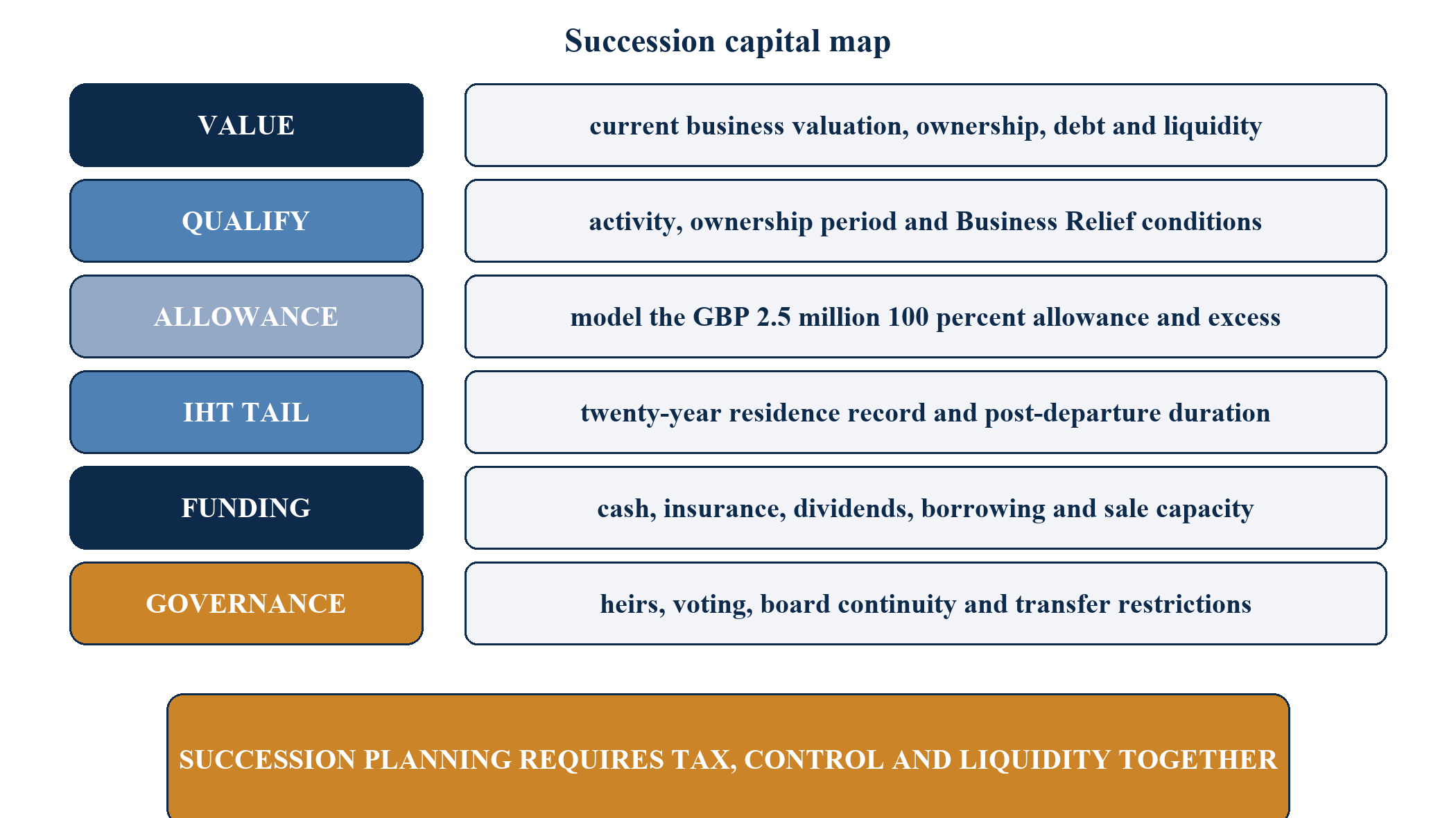
| Workstream | Core evidence | Decision |
|---|---|---|
| residence tail | twenty-year UK residence schedule | projected overseas-asset scope after departure |
| business value | current independent valuation and sensitivities | funding range and ownership trade-off |
| relief | activity, ownership and allowance analysis | qualifying status and residual taxable value |
| governance | articles, shareholder agreement, will and powers | control during incapacity, death and transition |
| liquidity | cash, insurance, debt and disposal capacity | funded tax and family obligations |
| family outcome | capabilities, interests and consent | ownership, control, benefit and sale path |
8. COMPANY RESIDENCE, MANAGEMENT AND CONTROL
8.1 The shareholder and company are separate taxpayers
HMRC guidance states that a company can be UK resident by incorporation or through central management and control, subject to treaty provisions and detailed rules [20]. A founder's personal move does not by itself change the company's residence. The company can remain UK resident while its shareholder is resident elsewhere.
The founder should separate personal evidence from company evidence. Personal travel and homes belong to the residence file. Board authority, strategic decisions, executive location, contracts, employees, premises and records belong to the company-control file.
8.2 Central management and control
Central management and control concerns the highest level of control of the business. Formal board meetings are relevant, but the factual location of real decision making matters [20]. A founder who continues to direct strategy from Dubai while a UK board simply records decisions can create a different risk from a genuinely empowered UK board.
The company should map reserved matters, delegated authority, executive responsibilities, board composition, meeting locations, information flows and signatory controls. Minutes should record actual deliberation and decisions. Governance should reflect commercial reality and directors' duties.
8.3 Treaty dual residence
The UK-UAE treaty includes company-residence provisions and a competent-authority process for persons other than individuals in dual-residence cases [10]. Treaty application requires specialist analysis. A company should avoid assuming that overseas meetings or an overseas holding company automatically resolve residence.
The company file should identify incorporation, domestic residence under each jurisdiction, treaty analysis, permanent establishments, payroll, transfer pricing, VAT, licensing and regulatory status. Changes to one component can affect others.
8.4 Company migration and exit charges
HMRC manuals describe company migration procedures and chargeable-gains consequences where a company ceases to be UK resident. An exit charge can arise through deemed disposal and reacquisition at market value immediately before migration, subject to applicable provisions and exceptions [21-24]. HMRC also describes arrangements for liabilities and notices connected with migration.
Moving the company can therefore create tax, governance, financing, lender, regulatory and customer consequences. The founder should obtain a separate company-migration feasibility study. It should show assets, unrealised gains, UK permanent-establishment exposure, people, contracts, intellectual property, financing, licences and operational substance.
8.5 Transferring a business out of a company
HMRC guidance emphasises that a company and its owners are separate legal persons and that moving assets or a business out of the company can create tax consequences [26]. A founder cannot treat personally owned shares, company cash, intellectual property and operating assets as one pool. Any transfer needs legal authority, valuation, tax analysis and documented consideration.
The sale chronology should therefore show whether the buyer acquires shares or assets. An asset sale can leave cash and liabilities in the company. A share sale transfers the company subject to the agreement. Post-sale extraction, liquidation or distribution is a separate workstream.
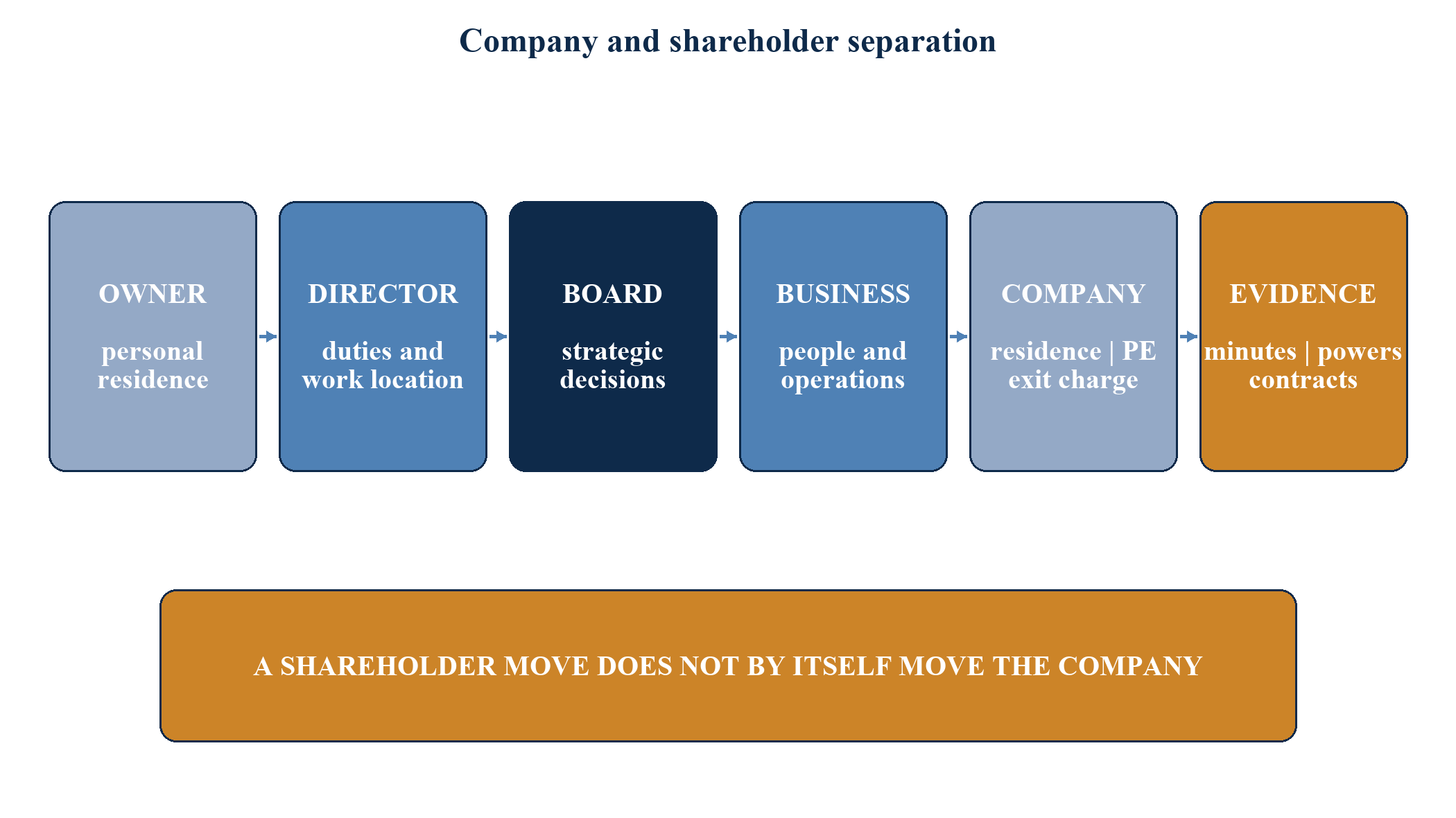
| Domain | Personal file | Company file |
|---|---|---|
| residence | SRT, UAE residence and treaty position | incorporation, central management and control, treaty position |
| work | founder role, days and remuneration | payroll, directors, employees and operating locations |
| decisions | personal investment and shareholder choices | board, executive authority and reserved matters |
| assets | shares, loans and sale consideration | business assets, IP, cash, contracts and liabilities |
| tax | gains, income, distributions and succession | Corporation Tax, exit, PE, transfer pricing and VAT |
| evidence | homes, travel, family and certificates | minutes, contracts, delegations, premises and records |
9. FOUR FOUNDER PATHS
9.1 Path one: sell while UK resident
The first path keeps the founder's residence position stable through signing and completion. The transaction team calculates the UK tax outcome, confirms Business Asset Disposal Relief eligibility, and treats a later UAE move as a separate decision. This path can reduce residence and temporary non-residence uncertainty during the sale. It can also expose the qualifying gain to the applicable UK rate.
The path may suit a founder who prioritises execution certainty, has substantial UK family and work ties, or cannot create robust UAE facts before the buyer's deadline. The decision paper should quantify the advised tax outcome, the commercial cost of delay and the personal cost of a rushed move. It should also address the treatment of rollover equity, deferred proceeds and post-sale employment.
9.2 Path two: establish non-residence before the disposal
The second path creates a genuine UAE base and a supportable UK non-residence or split-year position before the relevant disposal. It requires the contract team to prevent the sale from becoming unconditional before the intended point. It also requires person-specific UK ties, workdays, homes and family facts to support the residence conclusion.
This path carries execution risk. A buyer can accelerate signing, a condition can be removed, travel can change, UK work can increase or the family facts can remain centred in Britain. The founder should have a commercial fallback that remains viable if the tax residence conclusion changes.
9.3 Path three: staged consideration
The third path combines cash at completion with rollover shares, loan notes, escrow or an earn-out. It can align buyer and seller incentives, bridge valuation differences or retain founder participation. It also creates multiple assets, dates, valuations and potential income or capital questions [12,15].
The transaction should not be described as a single future payment stream. Each component needs a separate tax and residence analysis. Continued employment, performance conditions and forfeiture can affect the character of value received. Buyer credit and liquidity risk also matter. The founder's personal cash plan should distinguish gross headline value from cash available after tax, escrow, debt, retention and reinvestment.
9.4 Path four: retain for succession
The fourth path retains the company and focuses on family transition. It requires Business Relief qualification, long-term residence, valuation, governance and liquidity work. A family that does not intend to sell still needs an exit-readiness file because death, incapacity, shareholder conflict or a buyer approach can force decisions under time pressure.
The founder should identify who can own, vote, govern and operate the business. Economic benefit and control can be separated through appropriate legal arrangements, subject to tax and company-law advice. The family should test whether the next generation wants the role and whether independent management can preserve value.
9.5 Comparing the paths
The paths are compared across advised after-tax value, transaction certainty, time, residence robustness, company disruption, succession fit, family feasibility and return exposure. Scores are founder-specific. A generic ranking would hide the facts that drive the result.
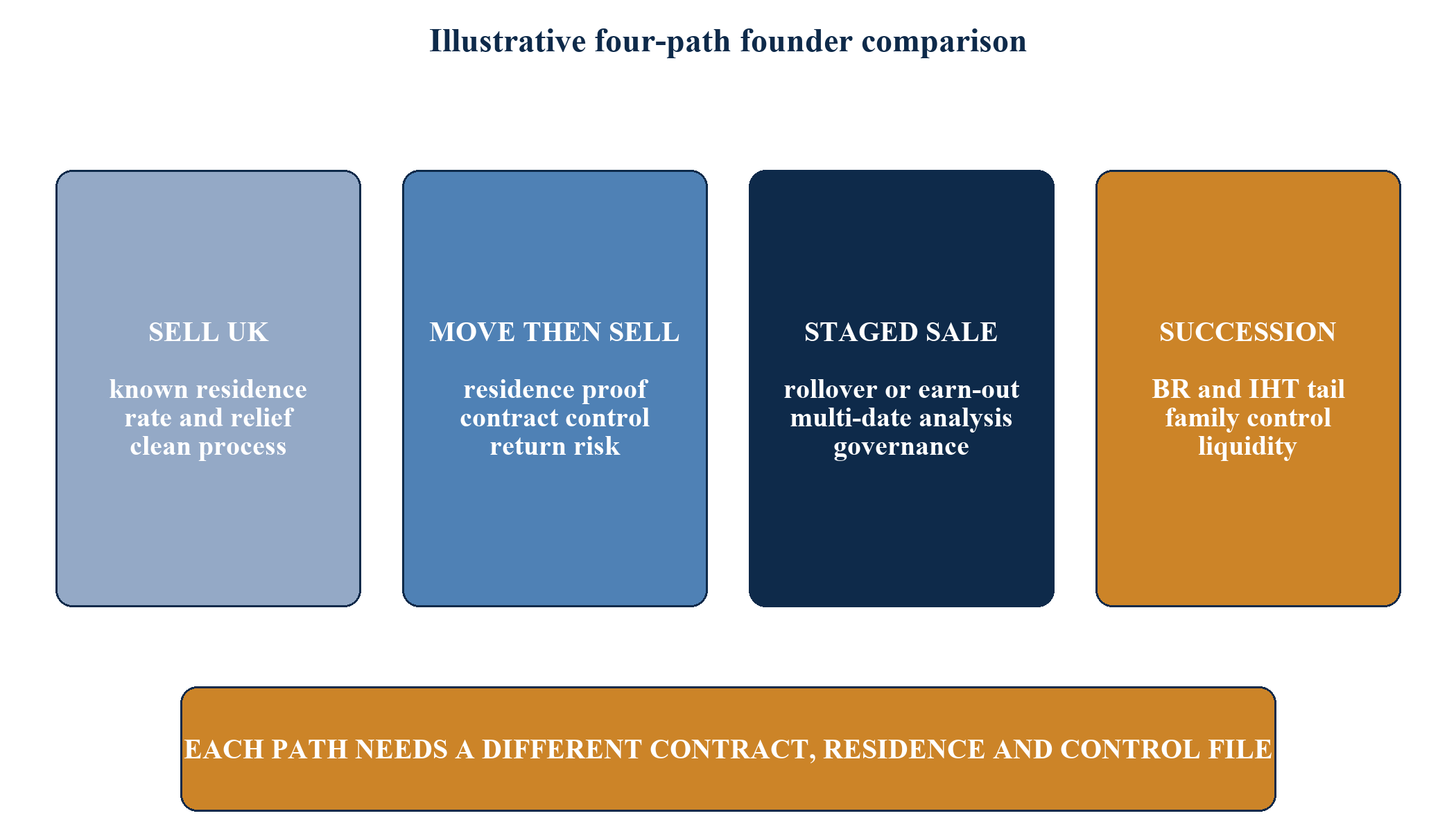
| Criterion | Sell UK | Move then sell | Staged sale | Succession |
|---|---|---|---|---|
| primary tax question | UK rate and relief | residence, section 28 and return | multi-date consideration treatment | IHT scope and Business Relief |
| commercial risk | timing and buyer price | relocation delay and buyer certainty | valuation and buyer credit | business continuity and family capability |
| evidence burden | relief and transaction | residence plus transaction | transaction, valuation, employment and residence | residence history, qualification and governance |
| liquidity | usually highest at completion | depends on completion and structure | distributed over time | requires separate funding plan |
| return sensitivity | lower for completed sale | temporary non-residence can be central | payments and later disposals require review | continued ownership and family ties remain |
10. DECISION TREE AND GATES
10.1 Gate one: define the intended outcome
The founder signs a one-page objective before advisers model structures. It states the desired sale, retention or succession result; minimum acceptable value; required control; family constraints; buyer timetable; UAE commitment; return expectations; and unacceptable legal, tax or reputation risks. This creates a stable reference point when options multiply.
10.2 Gate two: establish facts
The fact pack covers ownership, role, company activity, earlier transactions, residence history, homes, work, family, trusts, gifts, pensions and other material assets. Each fact is supported, pending or disputed. Advisers should avoid modelling a favourable conclusion from facts that the founder cannot evidence.
10.3 Gate three: freeze the legal chronology
Before heads or the sale agreement is signed, the legal team produces a version-controlled chronology. It identifies binding provisions, conditions, waivers, approvals, completion mechanics, consideration rights and post-completion obligations. The tax team maps each legal event to the relevant rule.
10.4 Gate four: conclude residence
The UK adviser applies the Statutory Residence Test and split-year rules. The UAE adviser applies the domestic residence rules and prepares the certificate evidence route. Treaty counsel reviews dual residence where relevant. The conclusion includes sensitivities for UK days, work, homes and family changes.
10.5 Gate five: test relief and anti-avoidance
Business Asset Disposal Relief, share-exchange treatment, transactions in securities, employment-related securities, distributions, loans and other relevant provisions are reviewed. Statutory clearances are obtained where appropriate. The implemented transaction is compared with the facts presented in the clearance application.
10.6 Gate six: test succession
The family office completes the twenty-year residence history, Business Relief analysis, business valuation, estate liquidity schedule and governance plan. This gate applies even when a sale is expected because the transaction can fail or be delayed.
10.7 Gate seven: test the company
The company board reviews residence, central management and control, permanent establishments, people, payroll, transfer pricing, licensing, VAT and contractual obligations. A separate migration study is required if the company itself is intended to leave UK residence.
10.8 Gate eight: approve implementation
The decision committee receives a written comparison of paths, current advice, open uncertainties, commercial consequences, evidence readiness and fallback plan. Approval is conditional on specific documents and dates. Any material change sends the affected workstream back through the gate.
| Gate | Required deliverable | Release authority |
|---|---|---|
| objective | founder mandate and non-negotiables | founder and family governance lead |
| facts | signed fact pack and evidence index | lead advisers |
| chronology | execution-version legal sequence | transaction counsel |
| residence | UK, UAE and treaty conclusions | qualified advisers |
| transaction tax | rate, relief, consideration and clearance analysis | transaction tax counsel |
| succession | residence tail, relief and liquidity plan | private-client counsel |
| company | board-approved control and migration analysis | company board |
| implementation | owners, dates, fallback and monitoring | decision committee |
11. WORKED CASES
11.1 Case A: the rate boundary
A hypothetical founder owns all ordinary shares in a UK trading company and has worked as its director for more than two years. The base case assumes the full gain qualifies for Business Asset Disposal Relief, the lifetime limit is available and no other adjustment applies. A GBP 1 million qualifying gain produces GBP 140,000 at 14 percent or GBP 180,000 at 18 percent. The difference is GBP 40,000.
The decision committee compares that arithmetic with the commercial price, buyer certainty, warranty exposure, financing and timing. If accelerating the deal reduces price by more than GBP 40,000 or weakens protections, the tax-rate comparison does not establish the preferred path. Advisers must also confirm which contract date fixes the disposal.
11.2 Case B: departure before signing
A hypothetical founder moves to Dubai during a UK tax year and expects split-year treatment. The family obtains a UAE home, the founder begins working overseas and a buyer is negotiating the sale. The founder signs an agreement during the proposed overseas part.
The analysis cannot stop at the signing date. The UK adviser confirms the relevant split-year case and all conditions. Transaction counsel determines whether the agreement is unconditional or when the conditions are satisfied. The team considers UK workdays, home availability, family ties, attributed gains and temporary non-residence. The UAE adviser builds the domestic residence and certificate evidence. The result depends on those facts and current advice.
11.3 Case C: earn-out and continued management
A hypothetical sale provides 60 percent cash at completion, 20 percent rollover equity and an earn-out of up to 20 percent based on two years of profit. The founder remains chief executive and can forfeit part of the package on an early departure.
The headline price is divided into components. Advisers classify the earn-out right, value it where required, analyse the rollover and review employment-related securities and earnings provisions. The residence calendar covers continuing UK work and board activity. The founder's liquidity plan uses cash actually available after tax, escrow and debt rather than the maximum headline price.
11.4 Case D: succession without sale
A hypothetical founder holds GBP 10 million of qualifying unlisted company shares. The full GBP 2.5 million allowance is assumed available, and no spouse transfer is included. Applying 100 percent relief to GBP 2.5 million and 50 percent relief to GBP 7.5 million leaves GBP 3.75 million of taxable value before exemptions, liabilities and the tax rate.
The family obtains a current valuation and qualification opinion. It prepares the founder's twenty-year residence history, models the post-departure tail, tests insurance and borrowing, updates governance and identifies successors. The worked arithmetic is a funding input rather than an estate-tax conclusion.
11.5 Case E: moving the company
A hypothetical founder becomes UAE resident and begins making strategic company decisions from Dubai. The UK company retains staff, customers and premises in Britain. The board meets formally in London, but directors regularly implement the founder's instructions without independent deliberation.
The company needs a factual central-management-and-control review. Formal meeting location alone may not reflect where the highest-level control occurs. If company migration is contemplated, the board obtains an exit-charge, treaty, permanent-establishment, people, regulatory and financing study [20-24]. The founder's personal residence conclusion remains a separate analysis.
| Case | Principal uncertainty | Control response |
|---|---|---|
| rate boundary | disposal date and relief eligibility | final-document review and relief file |
| departure before signing | split year, contract date and return | daily calendar, condition schedule and pre-return gate |
| earn-out | valuation, tax character and later receipts | consideration-by-consideration analysis |
| succession | relief qualification, residence tail and liquidity | valuation, twenty-year history and funded plan |
| company move | real control, treaty and exit charge | board evidence and migration feasibility study |
12. THE 180-DAY FOUNDER PROGRAMME
12.1 Days 1 to 30: objectives and facts
The founder appoints UK private-client, transaction-tax and corporate advisers and UAE tax, legal and immigration advisers. The team signs the objective, assembles the cap table, articles, shareholder agreement, options, accounts, residence history, homes, work pattern, family facts, trusts and earlier relief claims. A document index identifies gaps.
The company begins vendor due diligence without representing a tax or residence conclusion to buyers. The founder's daily travel and work record starts immediately.
12.2 Days 31 to 60: maps and eligibility
Advisers prepare the Business Asset Disposal Relief file, twenty-year residence schedule, Business Relief review, initial valuation, company-control map and UAE residence route. The family office builds the transaction and succession ledgers. The board confirms director duties, reserved matters and decision authorities during the process.
12.3 Days 61 to 90: path selection
The decision committee compares a UK sale, move-before-sale, staged consideration and succession path. It uses advised tax ranges, commercial price, probability of completion, time, family feasibility, governance and return exposure. Open assumptions are shown explicitly.
Buyer communications and heads of terms preserve the chosen timetable where commercially acceptable. Counsel identifies binding provisions and likely conditions before execution.
12.4 Days 91 to 120: residence and contract readiness
The founder implements the advised UAE residence steps and maintains UK controls. The transaction team prepares the section 28 analysis, condition schedule, consideration map and clearance applications. The company implements board and delegation arrangements that reflect its intended residence and commercial reality.
12.5 Days 121 to 150: signing and settlement preparation
Advisers review the final execution documents. The founder receives an updated residence conclusion based on actual days, work and family facts. The completion team prepares the funds flow, tax reserve, currency, banking, escrow, debt and evidence archive. Succession documents and liquidity remain current in case the transaction does not complete.
12.6 Days 151 to 180: audit and monitoring
After signing or completion, the team confirms every relevant date and consideration item. The founder's UK and UAE evidence files are reconciled. The board audits management and control. The pre-return gate is activated for the applicable period. Earn-out, employment, rollover and distribution dates are added to the monitoring calendar.
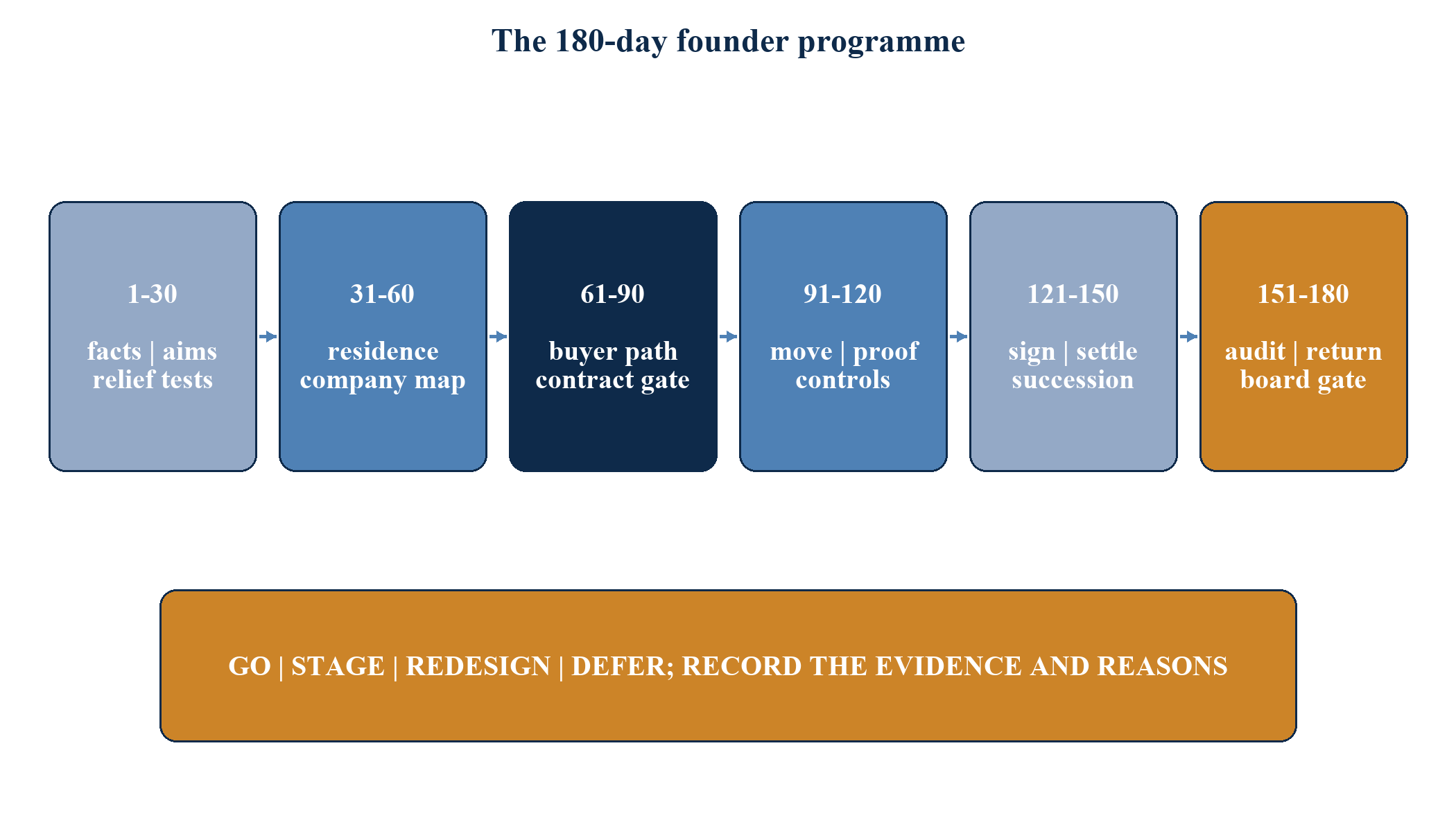
| Phase | Deliverable | Stop condition |
|---|---|---|
| 1-30 | objective and verified fact pack | material ownership, role or residence facts missing |
| 31-60 | relief, residence, succession and company maps | advisers cannot support a core eligibility assumption |
| 61-90 | path decision and fallback | commercial or family plan remains infeasible |
| 91-120 | residence evidence and contract controls | legal date or residence outcome remains uncontrolled |
| 121-150 | execution-ready advice and funds flow | final documents differ materially from reviewed drafts |
| 151-180 | post-event audit and monitoring | dates, consideration or return controls are unreconciled |
13. GOVERNANCE AND EVIDENCE
13.1 One chronology
The founder's personal tax advisers, company board and transaction team should use one controlled chronology. It records objective events and links to executed documents. Each adviser can add a conclusion within their scope. The chronology avoids conflicting dates across tax memoranda, completion statements, board minutes and residence files.
13.2 Evidence ownership
Every critical record has an owner, alternate, storage location, retention period and review date. The company secretary owns board records. Transaction counsel owns executed deal documents. The tax coordinator owns the day calendar and adviser conclusions. The family office owns private residence and succession records. Access is limited according to purpose.
13.3 Change control
The following events trigger re-review:
- a revised or additional sale document;
- removal, satisfaction or waiver of a condition;
- a change in consideration, rollover or employment;
- unplanned UK travel or work;
- a UK or UAE home becoming available or unavailable;
- a family member's location changing materially;
- a distribution, loan or capital reorganisation;
- a change in board authority or executive location;
- a decision to return to the United Kingdom; or
- a relevant change in legislation or official guidance.
13.4 Claims and communications
The founder, company and advisers should use precise language in buyer diligence, bank forms, tax returns and public communications. A person can be resident in more than one jurisdiction under domestic rules before a treaty is considered. The phrase "moved to Dubai" does not establish the date or legal result. Records should state facts and the specific adviser conclusion they support.
13.5 Annual re-performance
Residence and company-control conclusions should be re-performed after the end of the relevant period and whenever facts change. Business Relief qualification and business valuation should be refreshed periodically. The return gate remains active throughout the period identified by advisers. A completed sale does not end monitoring when deferred consideration, retained employment or rollover equity continues.
14. LIMITATIONS AND CONCLUSION
This paper provides a control framework rather than a tax opinion. It does not model every UK or UAE tax, trust, pension, immigration, company-law, securities, employment, regulatory, sanctions or accounting provision. The worked cases use hypothetical assumptions. Actual outcomes depend on current law, legal documents, residence facts, asset history, ownership, valuation, relief conditions, treaty interpretation and professional advice.
Official guidance can change. The source cut-off for this paper is 3 August 2026. Founders should confirm current legislation, guidance, rates and administrative practice before action. HMRC manuals describe HMRC's interpretation and practice; legislation and binding authority remain central to legal advice.
The 6 April founder flight is best understood as a sequencing problem. The founder must align five clocks without allowing one to substitute for another. Residence requires days, ties, homes, work and family facts. Disposal timing requires contract analysis. Relief requires eligibility evidence. Succession requires a twenty-year history, valuation and funded liquidity. Company residence requires real governance and control.
A robust process produces six permanent records: a signed founder fact pack, a transaction chronology, a residence evidence file, a relief memorandum, a succession ledger and a company-control map. These records make the decision reviewable. They also preserve the ability to change course when the buyer, family, law or operating facts change.
The founder should approve the move or transaction only after qualified advisers have concluded the relevant questions and the evidence exists. The date 6 April can organise the timetable. The legal and factual sequence determines the result.
APPENDIX A. FOUNDER FACT PACK
| Domain | Required information | Evidence |
|---|---|---|
| ownership | direct, indirect, trust and option interests | cap table, registers, articles and agreements |
| role | director, employee, consultant and shareholder capacities | contracts, payroll and board records |
| relief history | earlier claims and lifetime-limit use | returns, computations and HMRC correspondence |
| residence | at least twenty UK tax years and current facts | returns, travel, homes, work and family records |
| company | activities, assets, group, people and locations | accounts, management information and organisation chart |
| transaction | buyer, timetable, structure and consideration | process materials, bids and draft documents |
| succession | wills, gifts, trusts, heirs and governance | legal documents and adviser memoranda |
| UAE | visa, home, work, business and presence | official identity, entry-exit and supporting records |
APPENDIX B. TRANSACTION DATE REGISTER
| Event | Planned date | Actual date | Legal effect | Tax conclusion | Evidence owner |
|---|---|---|---|---|---|
| initial approach | |||||
| exclusivity | |||||
| heads of terms | |||||
| clearance application | |||||
| sale agreement signing | |||||
| each condition satisfied | |||||
| completion | |||||
| escrow release | |||||
| earn-out grant and payment | |||||
| rollover issue and sale | |||||
| founder employment change | |||||
| material UK return |
APPENDIX C. RESIDENCE CONTROL CALENDAR
For each day, record country at midnight, arrival and departure, UK hours, work location, work hours, capacity, home availability, family location, exceptional event, source document and reviewer. Summarise the record monthly against the advised Statutory Residence Test thresholds and the selected UAE residence route. Preserve original third-party evidence.
| Monthly review | Status | Evidence gap | Owner | Due date |
|---|---|---|---|---|
| UK days and workdays | ||||
| UK homes and access | ||||
| family and accommodation ties | ||||
| UAE presence and home | ||||
| UAE work or business | ||||
| board and executive activity | ||||
| transaction events |
APPENDIX D. SUCCESSION LEDGER
| Asset | Owner | Value date | Relief status | Residence scope | Intended outcome | Liquidity source |
|---|---|---|---|---|---|---|
| operating-company shares | ||||||
| shareholder loans | ||||||
| UK property | ||||||
| UAE property | ||||||
| listed portfolio | ||||||
| private funds | ||||||
| trusts or foundations | ||||||
| insurance and pensions |
APPENDIX E. PRE-RETURN GATE
Activate the gate before the founder materially increases UK presence, accepts UK work, makes a UK home available, changes family arrangements, receives or becomes entitled to a distribution, disposes of an asset, receives earn-out value, exercises an option, changes a loan, restructures ownership or returns for a prolonged period.
| Question | Adviser conclusion | Evidence | Approval |
|---|---|---|---|
| will UK residence arise in the current tax year? | |||
| does split-year treatment change? | |||
| does temporary non-residence apply? | |||
| which gains or distributions can enter charge on return? | |||
| does the return affect UAE domestic or treaty residence? | |||
| does UK work affect employment or company obligations? | |||
| do home and family facts alter the ties analysis? |
APPENDIX F. ADVISER QUESTIONS
- Which legal event fixes the disposal date for each consideration component?
- Which Business Asset Disposal Relief conditions are satisfied, and what evidence supports each one?
- Does any reorganisation or extraction require statutory clearance?
- Which split-year case is expected to apply, and which future facts can cause it to fail?
- Which temporary non-residence provisions apply if the founder returns?
- How are close-company distributions, earn-outs, rollover shares and loan notes treated?
- How long does the Inheritance Tax long-term residence tail continue?
- Which business interests qualify for Business Relief after 6 April 2026?
- Where is the company centrally managed and controlled in fact?
- Would company migration create an exit charge, permanent establishment or regulatory consequence?
- Which UAE domestic residence route and evidence set apply?
- Is dual residence possible, and how does the UK-UAE treaty apply to the relevant tax?
REFERENCES
[1] HM Revenue & Customs. Business Asset Disposal Relief. Updated 2026. https://www.gov.uk/business-asset-disposal-relief
[2] HM Revenue & Customs. HS275 Business Asset Disposal Relief 2026. Updated 2026. https://www.gov.uk/government/publications/entrepreneurs-relief-hs275-self-assessment-helpsheet/hs275-business-asset-disposal-relief-2026
[3] HM Revenue & Customs. Capital Gains Tax rates and allowances. Updated 2026. https://www.gov.uk/capital-gains-tax/rates
[4] HM Revenue & Customs. Capital Gains Manual CG14250: date of disposal. Updated 31 July 2026. https://www.gov.uk/hmrc-internal-manuals/capital-gains-manual/cg14250
[5] HM Revenue & Customs. Work out how to apportion Agricultural and Business Relief for Inheritance Tax. Updated 2026. https://www.gov.uk/guidance/work-out-how-to-apportion-agricultural-and-business-relief-for-inheritance-tax
[6] HM Revenue & Customs. Business Relief for Inheritance Tax: what qualifies. Updated 2026. https://www.gov.uk/business-relief-inheritance-tax/what-qualifies-for-business-relief
[7] HM Revenue & Customs. RDR3 Statutory Residence Test. Updated 11 June 2026. https://www.gov.uk/government/publications/rdr3-statutory-residence-test-srt
[8] United Arab Emirates Ministry of Finance. Tax residency rules and Ministerial Decision No. 27 of 2023. https://mof.gov.ae/en/news/following-cabinet-decision-85-of-2022/
[9] United Arab Emirates Ministry of Finance. Ministerial Decision No. 27 of 2023 on implementation of certain provisions of Cabinet Decision No. 85 of 2022. https://mof.gov.ae/wp-content/uploads/2023/03/Ministerial-Decision-27-of-2023-of-Tax-Residency.pdf
[10] HM Revenue & Customs. 2016 UK-UAE Double Taxation Convention. https://www.gov.uk/government/publications/united-arab-emirates-tax-treaties/2016-uk-uae-double-taxation-convention
[11] United Arab Emirates Federal Tax Authority. Issuance of Tax Certificates. Updated 6 April 2026. https://tax.gov.ae/en/services/issuance.of.tax.certificates.aspx
[12] HM Revenue & Customs. Capital Gains Manual CG14881 and CG14940: ascertainable and unascertainable deferred consideration. Updated July 2026. https://www.gov.uk/hmrc-internal-manuals/capital-gains-manual/cg14881 and https://www.gov.uk/hmrc-internal-manuals/capital-gains-manual/cg14940
[13] HM Revenue & Customs. Residence and FIG Regime Manual RFIG21630: temporary non-residence and capital gains. Updated 3 July 2026. https://www.gov.uk/hmrc-internal-manuals/residence-and-fig-regime-manual/rfig21630
[14] HM Revenue & Customs. Residence and FIG Regime Manual RFIG21600: distributions from closely controlled companies. Updated 3 July 2026. https://www.gov.uk/hmrc-internal-manuals/residence-and-fig-regime-manual/rfig21600
[15] HM Revenue & Customs. Capital Gains Manual CG58005 and CG58010: earn-out rights and shares or securities. Updated July 2026. https://www.gov.uk/hmrc-internal-manuals/capital-gains-manual/cg58005 and https://www.gov.uk/hmrc-internal-manuals/capital-gains-manual/cg58010
[16] HM Revenue & Customs. Check if you can claim the four-year foreign income and gains regime. Published 6 April 2025. https://www.gov.uk/guidance/check-if-you-can-claim-the-4-year-foreign-income-and-gains-regime
[17] HM Revenue & Customs. Inheritance Tax if you are a long-term UK resident. Updated 2026. https://www.gov.uk/guidance/inheritance-tax-if-youre-a-long-term-uk-resident
[18] HM Revenue & Customs. Inheritance Tax Manual IHTM47001: long-term UK residence. Updated 2026. https://www.gov.uk/hmrc-internal-manuals/inheritance-tax-manual/ihtm47001
[19] HM Revenue & Customs. Inheritance Tax Manual IHTM47020: long-term resident tail. Updated 2026. https://www.gov.uk/hmrc-internal-manuals/inheritance-tax-manual/ihtm47020
[20] HM Revenue & Customs. International Manual INTM154050: company residence. Updated 2026. https://www.gov.uk/hmrc-internal-manuals/international-manual/intm154050
[21] HM Revenue & Customs. International Manual INTM120070: company migration. Updated 2026. https://www.gov.uk/hmrc-internal-manuals/international-manual/intm120070
[22] HM Revenue & Customs. Company Taxation Manual CTM34195: company migration arrangements. Updated 2026. https://www.gov.uk/hmrc-internal-manuals/company-taxation-manual/ctm34195
[23] HM Revenue & Customs. Capital Gains Manual CG13430: companies ceasing UK residence. Updated 2026. https://www.gov.uk/hmrc-internal-manuals/capital-gains-manual/cg13430
[24] HM Revenue & Customs. Capital Gains Manual CG42370: exit charge and market value. Updated 2026. https://www.gov.uk/hmrc-internal-manuals/capital-gains-manual/cg42370
[25] United Arab Emirates Federal Tax Authority. Basis of taxation for a natural person. Updated 2026. https://tax.gov.ae/en/taxes/corporate.tax/corporate.tax.topics/basis.of.taxation.natural.person.aspx
[26] HM Revenue & Customs. Transfer a business out of a company. Updated 2026. https://www.gov.uk/guidance/transfer-a-business-out-of-a-company
[27] Finance Act 2026. UK Public General Act 2026 c.11. https://www.legislation.gov.uk/ukpga/2026/11/contents
[28] Finance Act 2025. UK Public General Act 2025 c.8. https://www.legislation.gov.uk/ukpga/2025/8/contents
ABOUT THE AUTHOR
Chennakeshav Adya is an Independent Researcher. His work focuses on capital, transactions, corporate strategy, family-enterprise governance and cross-border decision frameworks. This paper is independent research prepared for Matchpoint Insights.
