

1. Separate cash and tax
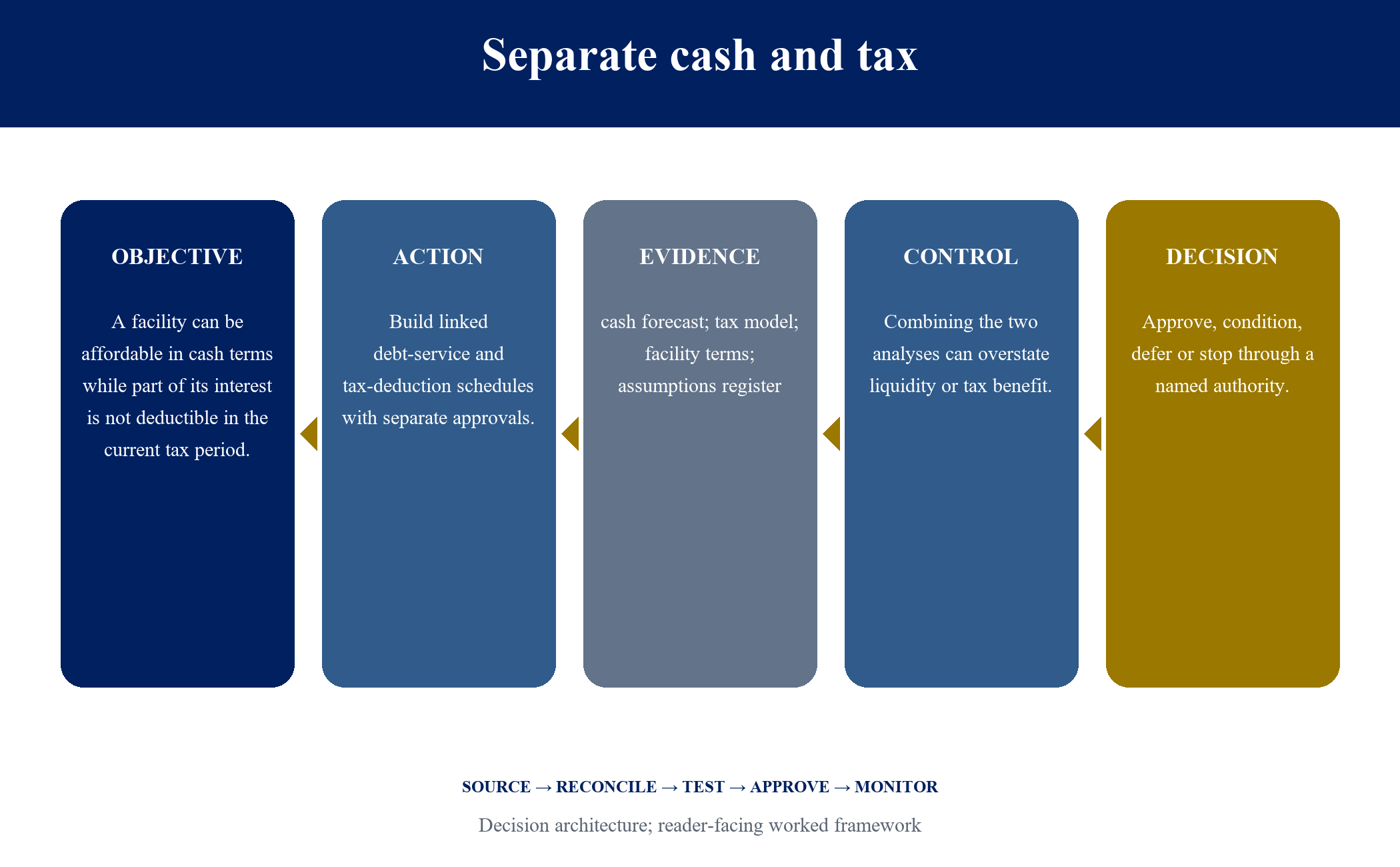
A facility can be affordable in cash terms while part of its interest is not deductible in the current tax period. This matters in the 30% cap because the economics, legal rights, operating evidence and timing can move on different clocks. A useful analysis therefore begins with the decision being made, the party authorised to make it and the date on which the evidence is expected to be current. The work should distinguish source facts, management representations, analytical assumptions and professional judgement so that a reviewer can see where each conclusion originates.
The recommended workstream is to build linked debt-service and tax-deduction schedules with separate approvals. The team should translate that instruction into named owners, dated gates and a common set of definitions. A base case should describe the expected path; a downside case should test weaker operating performance or slower execution; and a delay case should test what happens when a required approval, document, counterparty or financing event arrives later than planned. Any decision threshold used in the model should be recorded as a management choice unless it comes directly from a cited rule or contract.
The decision framework has four layers. First, define the commercial objective and non-negotiable constraints. Second, assemble the minimum source record and reconcile it to the numbers used in the analysis. Third, compare executable alternatives under consistent assumptions, including cost, control, liquidity, timing and downside. Fourth, approve the route, its conditions and the fallback. This sequence keeps a transaction from moving ahead on an attractive headline while unresolved implementation questions remain outside the decision paper.
1.2 Evidence and controls
The minimum evidence for this module is cash forecast; tax model; facility terms; assumptions register Each item should have an owner, effective date, source location and review status. Where information is produced through a model or transformation, the file should preserve the original input, calculation logic and output version. The reviewer should be able to reproduce the material conclusion without relying on a presentation slide, an uncited summary or the memory of the person who prepared it.
Control quality can be tested through three questions. Does the source support the stated fact? Does the calculation use the approved definition? Does the proposed action remain within the authority and risk limits already granted? An exception to any of these tests should enter a dated register with a named resolver and a stop, proceed or conditional-proceed decision. Completion means that the evidence and decision have been accepted by the accountable owner; document production alone is an intermediate output.
The principal failure mode is that combining the two analyses can overstate liquidity or tax benefit. The response is to make the vulnerable assumption visible, test a plausible adverse state and identify the earliest observable warning indicator. The analysis should also state what remains outside its scope and which legal, tax, regulatory, accounting, valuation, technical or investment conclusions require qualified advice. This creates a practical boundary between a research framework and a conclusion for a particular company, investor, lender, family or transaction.
| Control question | Required record | Decision response |
|---|---|---|
| What is being decided? | Build linked debt-service and tax-deduction schedules with separate approvals. | Approve objective and authority. |
| What proves the case? | cash forecast; tax model; facility terms; assumptions register | Reconcile and sign off. |
| What can fail? | Combining the two analyses can overstate liquidity or tax benefit. | Test downside and escalation. |
2. Identify net interest expenditure
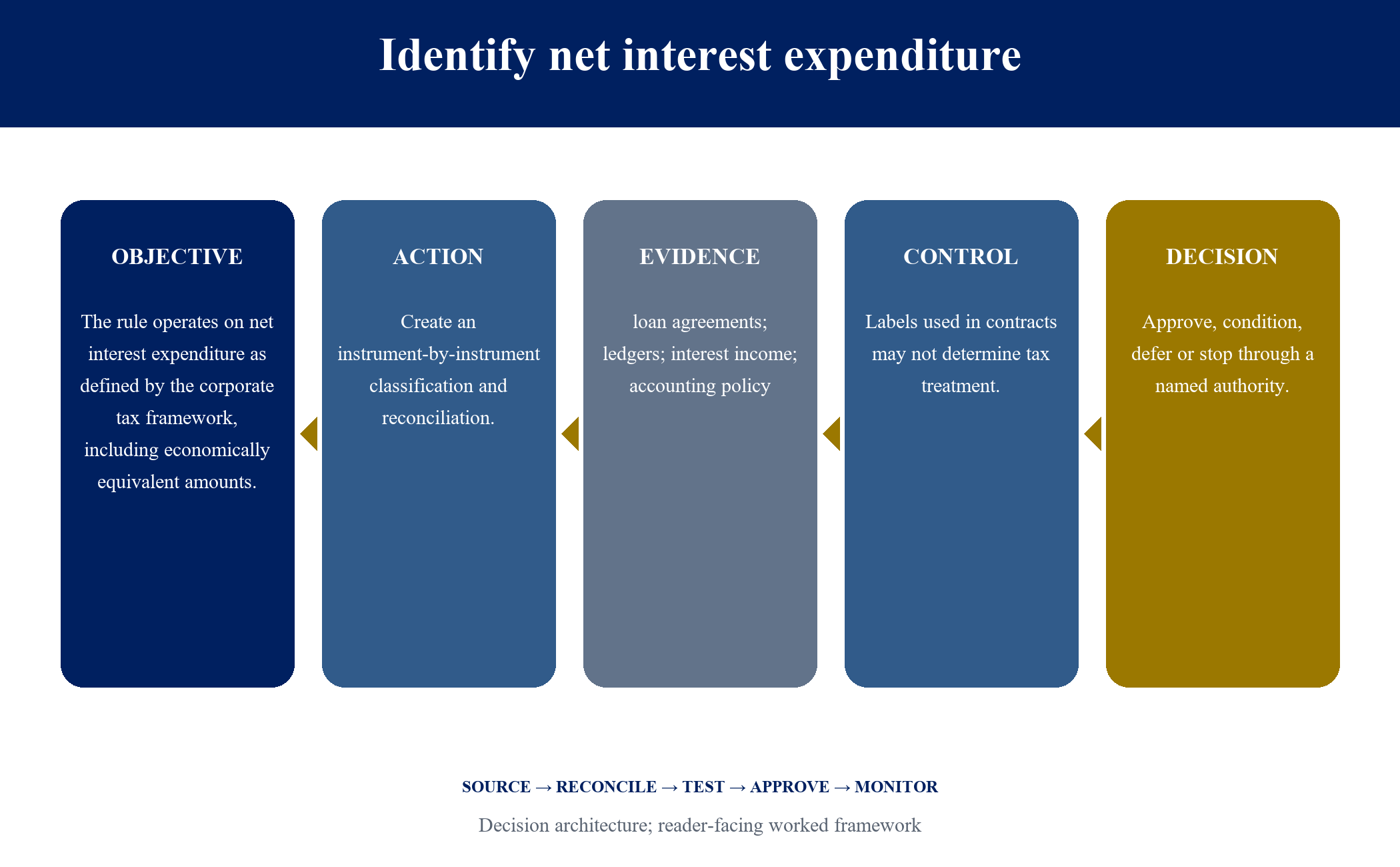
The rule operates on net interest expenditure as defined by the corporate tax framework, including economically equivalent amounts. This matters in the 30% cap because the economics, legal rights, operating evidence and timing can move on different clocks. A useful analysis therefore begins with the decision being made, the party authorised to make it and the date on which the evidence is expected to be current. The work should distinguish source facts, management representations, analytical assumptions and professional judgement so that a reviewer can see where each conclusion originates.
The recommended workstream is to create an instrument-by-instrument classification and reconciliation. The team should translate that instruction into named owners, dated gates and a common set of definitions. A base case should describe the expected path; a downside case should test weaker operating performance or slower execution; and a delay case should test what happens when a required approval, document, counterparty or financing event arrives later than planned. Any decision threshold used in the model should be recorded as a management choice unless it comes directly from a cited rule or contract.
The decision framework has four layers. First, define the commercial objective and non-negotiable constraints. Second, assemble the minimum source record and reconcile it to the numbers used in the analysis. Third, compare executable alternatives under consistent assumptions, including cost, control, liquidity, timing and downside. Fourth, approve the route, its conditions and the fallback. This sequence keeps a transaction from moving ahead on an attractive headline while unresolved implementation questions remain outside the decision paper.
2.2 Evidence and controls
The minimum evidence for this module is loan agreements; ledgers; interest income; accounting policy Each item should have an owner, effective date, source location and review status. Where information is produced through a model or transformation, the file should preserve the original input, calculation logic and output version. The reviewer should be able to reproduce the material conclusion without relying on a presentation slide, an uncited summary or the memory of the person who prepared it.
Control quality can be tested through three questions. Does the source support the stated fact? Does the calculation use the approved definition? Does the proposed action remain within the authority and risk limits already granted? An exception to any of these tests should enter a dated register with a named resolver and a stop, proceed or conditional-proceed decision. Completion means that the evidence and decision have been accepted by the accountable owner; document production alone is an intermediate output.
The principal failure mode is that labels used in contracts may not determine tax treatment. The response is to make the vulnerable assumption visible, test a plausible adverse state and identify the earliest observable warning indicator. The analysis should also state what remains outside its scope and which legal, tax, regulatory, accounting, valuation, technical or investment conclusions require qualified advice. This creates a practical boundary between a research framework and a conclusion for a particular company, investor, lender, family or transaction.
| Control question | Required record | Decision response |
|---|---|---|
| What is being decided? | Create an instrument-by-instrument classification and reconciliation. | Approve objective and authority. |
| What proves the case? | loan agreements; ledgers; interest income; accounting policy | Reconcile and sign off. |
| What can fail? | Labels used in contracts may not determine tax treatment. | Test downside and escalation. |
3. Calculate adjusted EBITDA
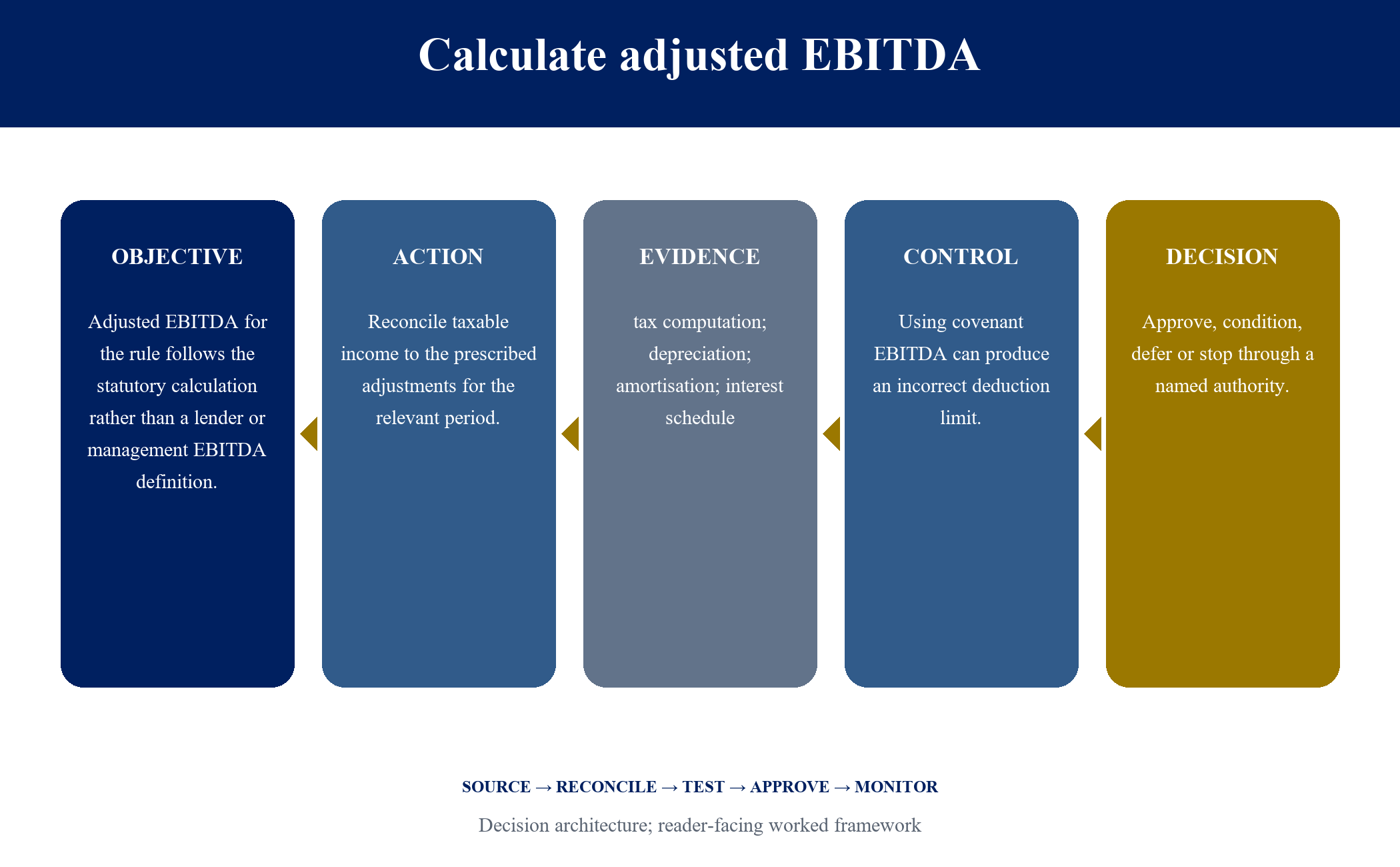
Adjusted EBITDA for the rule follows the statutory calculation rather than a lender or management EBITDA definition. This matters in the 30% cap because the economics, legal rights, operating evidence and timing can move on different clocks. A useful analysis therefore begins with the decision being made, the party authorised to make it and the date on which the evidence is expected to be current. The work should distinguish source facts, management representations, analytical assumptions and professional judgement so that a reviewer can see where each conclusion originates.
The recommended workstream is to reconcile taxable income to the prescribed adjustments for the relevant period. The team should translate that instruction into named owners, dated gates and a common set of definitions. A base case should describe the expected path; a downside case should test weaker operating performance or slower execution; and a delay case should test what happens when a required approval, document, counterparty or financing event arrives later than planned. Any decision threshold used in the model should be recorded as a management choice unless it comes directly from a cited rule or contract.
The decision framework has four layers. First, define the commercial objective and non-negotiable constraints. Second, assemble the minimum source record and reconcile it to the numbers used in the analysis. Third, compare executable alternatives under consistent assumptions, including cost, control, liquidity, timing and downside. Fourth, approve the route, its conditions and the fallback. This sequence keeps a transaction from moving ahead on an attractive headline while unresolved implementation questions remain outside the decision paper.
3.2 Evidence and controls
The minimum evidence for this module is tax computation; depreciation; amortisation; interest schedule Each item should have an owner, effective date, source location and review status. Where information is produced through a model or transformation, the file should preserve the original input, calculation logic and output version. The reviewer should be able to reproduce the material conclusion without relying on a presentation slide, an uncited summary or the memory of the person who prepared it.
Control quality can be tested through three questions. Does the source support the stated fact? Does the calculation use the approved definition? Does the proposed action remain within the authority and risk limits already granted? An exception to any of these tests should enter a dated register with a named resolver and a stop, proceed or conditional-proceed decision. Completion means that the evidence and decision have been accepted by the accountable owner; document production alone is an intermediate output.
The principal failure mode is that using covenant EBITDA can produce an incorrect deduction limit. The response is to make the vulnerable assumption visible, test a plausible adverse state and identify the earliest observable warning indicator. The analysis should also state what remains outside its scope and which legal, tax, regulatory, accounting, valuation, technical or investment conclusions require qualified advice. This creates a practical boundary between a research framework and a conclusion for a particular company, investor, lender, family or transaction.
| Control question | Required record | Decision response |
|---|---|---|
| What is being decided? | Reconcile taxable income to the prescribed adjustments for the relevant period. | Approve objective and authority. |
| What proves the case? | tax computation; depreciation; amortisation; interest schedule | Reconcile and sign off. |
| What can fail? | Using covenant EBITDA can produce an incorrect deduction limit. | Test downside and escalation. |
4. Apply the higher threshold
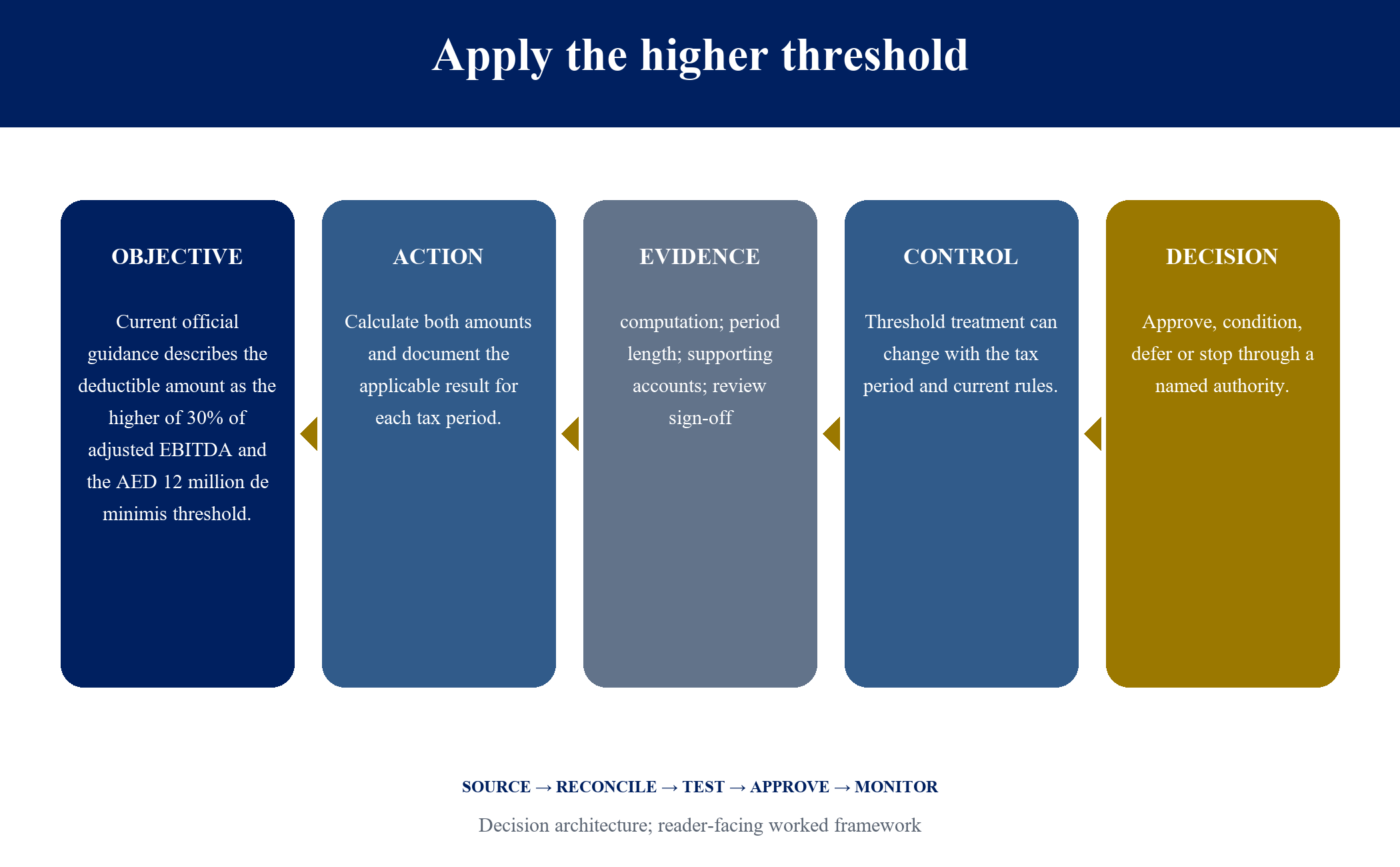
Current official guidance describes the deductible amount as the higher of 30% of adjusted EBITDA and the AED 12 million de minimis threshold. This matters in the 30% cap because the economics, legal rights, operating evidence and timing can move on different clocks. A useful analysis therefore begins with the decision being made, the party authorised to make it and the date on which the evidence is expected to be current. The work should distinguish source facts, management representations, analytical assumptions and professional judgement so that a reviewer can see where each conclusion originates.
The recommended workstream is to calculate both amounts and document the applicable result for each tax period. The team should translate that instruction into named owners, dated gates and a common set of definitions. A base case should describe the expected path; a downside case should test weaker operating performance or slower execution; and a delay case should test what happens when a required approval, document, counterparty or financing event arrives later than planned. Any decision threshold used in the model should be recorded as a management choice unless it comes directly from a cited rule or contract.
The decision framework has four layers. First, define the commercial objective and non-negotiable constraints. Second, assemble the minimum source record and reconcile it to the numbers used in the analysis. Third, compare executable alternatives under consistent assumptions, including cost, control, liquidity, timing and downside. Fourth, approve the route, its conditions and the fallback. This sequence keeps a transaction from moving ahead on an attractive headline while unresolved implementation questions remain outside the decision paper.
4.2 Evidence and controls
The minimum evidence for this module is computation; period length; supporting accounts; review sign-off Each item should have an owner, effective date, source location and review status. Where information is produced through a model or transformation, the file should preserve the original input, calculation logic and output version. The reviewer should be able to reproduce the material conclusion without relying on a presentation slide, an uncited summary or the memory of the person who prepared it.
Control quality can be tested through three questions. Does the source support the stated fact? Does the calculation use the approved definition? Does the proposed action remain within the authority and risk limits already granted? An exception to any of these tests should enter a dated register with a named resolver and a stop, proceed or conditional-proceed decision. Completion means that the evidence and decision have been accepted by the accountable owner; document production alone is an intermediate output.
The principal failure mode is that threshold treatment can change with the tax period and current rules. The response is to make the vulnerable assumption visible, test a plausible adverse state and identify the earliest observable warning indicator. The analysis should also state what remains outside its scope and which legal, tax, regulatory, accounting, valuation, technical or investment conclusions require qualified advice. This creates a practical boundary between a research framework and a conclusion for a particular company, investor, lender, family or transaction.
| Control question | Required record | Decision response |
|---|---|---|
| What is being decided? | Calculate both amounts and document the applicable result for each tax period. | Approve objective and authority. |
| What proves the case? | computation; period length; supporting accounts; review sign-off | Reconcile and sign off. |
| What can fail? | Threshold treatment can change with the tax period and current rules. | Test downside and escalation. |
5. Track carried-forward amounts
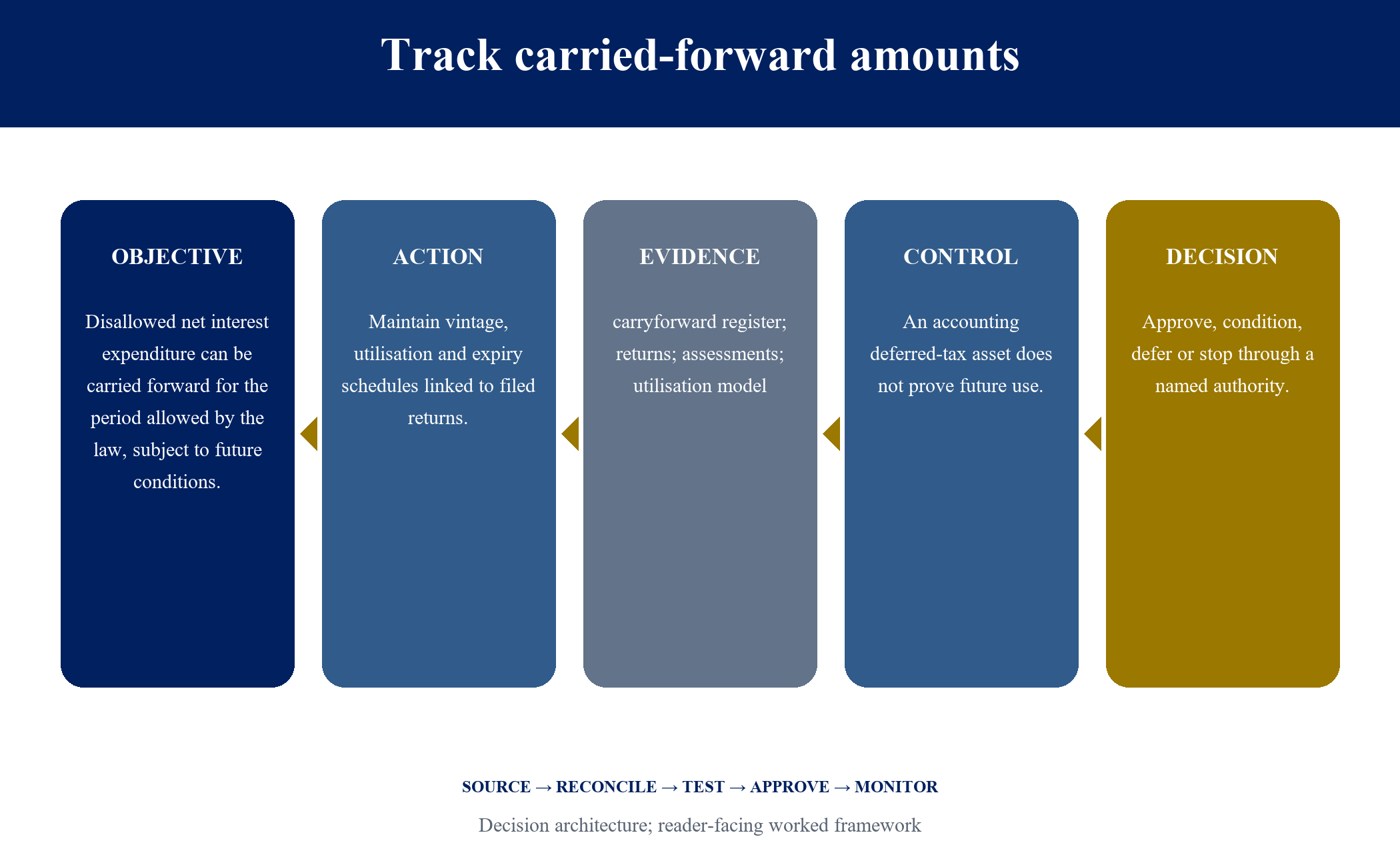
Disallowed net interest expenditure can be carried forward for the period allowed by the law, subject to future conditions. This matters in the 30% cap because the economics, legal rights, operating evidence and timing can move on different clocks. A useful analysis therefore begins with the decision being made, the party authorised to make it and the date on which the evidence is expected to be current. The work should distinguish source facts, management representations, analytical assumptions and professional judgement so that a reviewer can see where each conclusion originates.
The recommended workstream is to maintain vintage, utilisation and expiry schedules linked to filed returns. The team should translate that instruction into named owners, dated gates and a common set of definitions. A base case should describe the expected path; a downside case should test weaker operating performance or slower execution; and a delay case should test what happens when a required approval, document, counterparty or financing event arrives later than planned. Any decision threshold used in the model should be recorded as a management choice unless it comes directly from a cited rule or contract.
The decision framework has four layers. First, define the commercial objective and non-negotiable constraints. Second, assemble the minimum source record and reconcile it to the numbers used in the analysis. Third, compare executable alternatives under consistent assumptions, including cost, control, liquidity, timing and downside. Fourth, approve the route, its conditions and the fallback. This sequence keeps a transaction from moving ahead on an attractive headline while unresolved implementation questions remain outside the decision paper.
5.2 Evidence and controls
The minimum evidence for this module is carryforward register; returns; assessments; utilisation model Each item should have an owner, effective date, source location and review status. Where information is produced through a model or transformation, the file should preserve the original input, calculation logic and output version. The reviewer should be able to reproduce the material conclusion without relying on a presentation slide, an uncited summary or the memory of the person who prepared it.
Control quality can be tested through three questions. Does the source support the stated fact? Does the calculation use the approved definition? Does the proposed action remain within the authority and risk limits already granted? An exception to any of these tests should enter a dated register with a named resolver and a stop, proceed or conditional-proceed decision. Completion means that the evidence and decision have been accepted by the accountable owner; document production alone is an intermediate output.
The principal failure mode is that an accounting deferred-tax asset does not prove future use. The response is to make the vulnerable assumption visible, test a plausible adverse state and identify the earliest observable warning indicator. The analysis should also state what remains outside its scope and which legal, tax, regulatory, accounting, valuation, technical or investment conclusions require qualified advice. This creates a practical boundary between a research framework and a conclusion for a particular company, investor, lender, family or transaction.
| Control question | Required record | Decision response |
|---|---|---|
| What is being decided? | Maintain vintage, utilisation and expiry schedules linked to filed returns. | Approve objective and authority. |
| What proves the case? | carryforward register; returns; assessments; utilisation model | Reconcile and sign off. |
| What can fail? | An accounting deferred-tax asset does not prove future use. | Test downside and escalation. |
6. Test exclusions and special cases
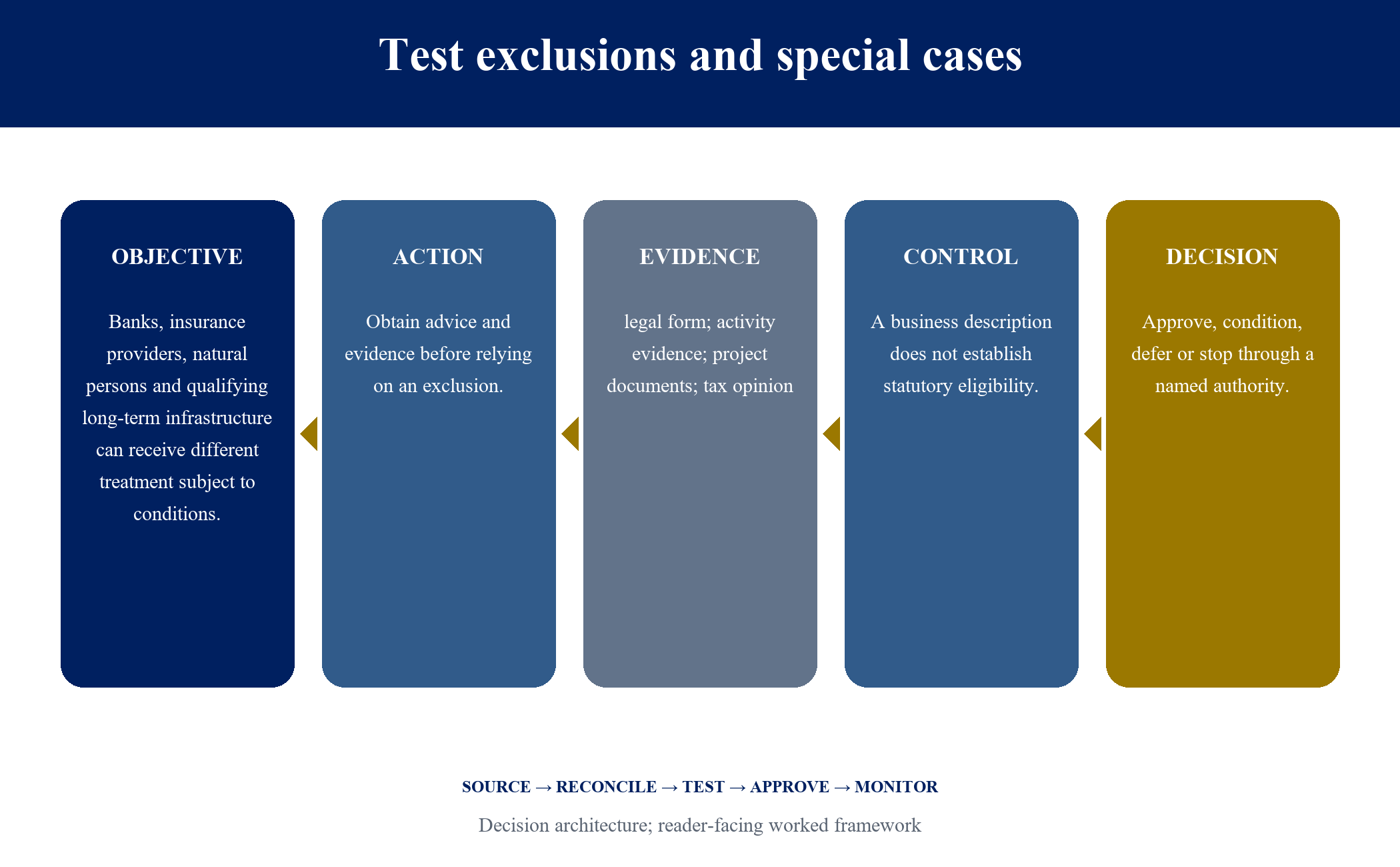
Banks, insurance providers, natural persons and qualifying long-term infrastructure can receive different treatment subject to conditions. This matters in the 30% cap because the economics, legal rights, operating evidence and timing can move on different clocks. A useful analysis therefore begins with the decision being made, the party authorised to make it and the date on which the evidence is expected to be current. The work should distinguish source facts, management representations, analytical assumptions and professional judgement so that a reviewer can see where each conclusion originates.
The recommended workstream is to obtain advice and evidence before relying on an exclusion. The team should translate that instruction into named owners, dated gates and a common set of definitions. A base case should describe the expected path; a downside case should test weaker operating performance or slower execution; and a delay case should test what happens when a required approval, document, counterparty or financing event arrives later than planned. Any decision threshold used in the model should be recorded as a management choice unless it comes directly from a cited rule or contract.
The decision framework has four layers. First, define the commercial objective and non-negotiable constraints. Second, assemble the minimum source record and reconcile it to the numbers used in the analysis. Third, compare executable alternatives under consistent assumptions, including cost, control, liquidity, timing and downside. Fourth, approve the route, its conditions and the fallback. This sequence keeps a transaction from moving ahead on an attractive headline while unresolved implementation questions remain outside the decision paper.
6.2 Evidence and controls
The minimum evidence for this module is legal form; activity evidence; project documents; tax opinion Each item should have an owner, effective date, source location and review status. Where information is produced through a model or transformation, the file should preserve the original input, calculation logic and output version. The reviewer should be able to reproduce the material conclusion without relying on a presentation slide, an uncited summary or the memory of the person who prepared it.
Control quality can be tested through three questions. Does the source support the stated fact? Does the calculation use the approved definition? Does the proposed action remain within the authority and risk limits already granted? An exception to any of these tests should enter a dated register with a named resolver and a stop, proceed or conditional-proceed decision. Completion means that the evidence and decision have been accepted by the accountable owner; document production alone is an intermediate output.
The principal failure mode is that a business description does not establish statutory eligibility. The response is to make the vulnerable assumption visible, test a plausible adverse state and identify the earliest observable warning indicator. The analysis should also state what remains outside its scope and which legal, tax, regulatory, accounting, valuation, technical or investment conclusions require qualified advice. This creates a practical boundary between a research framework and a conclusion for a particular company, investor, lender, family or transaction.
| Control question | Required record | Decision response |
|---|---|---|
| What is being decided? | Obtain advice and evidence before relying on an exclusion. | Approve objective and authority. |
| What proves the case? | legal form; activity evidence; project documents; tax opinion | Reconcile and sign off. |
| What can fail? | A business description does not establish statutory eligibility. | Test downside and escalation. |
7. Analyse related-party debt
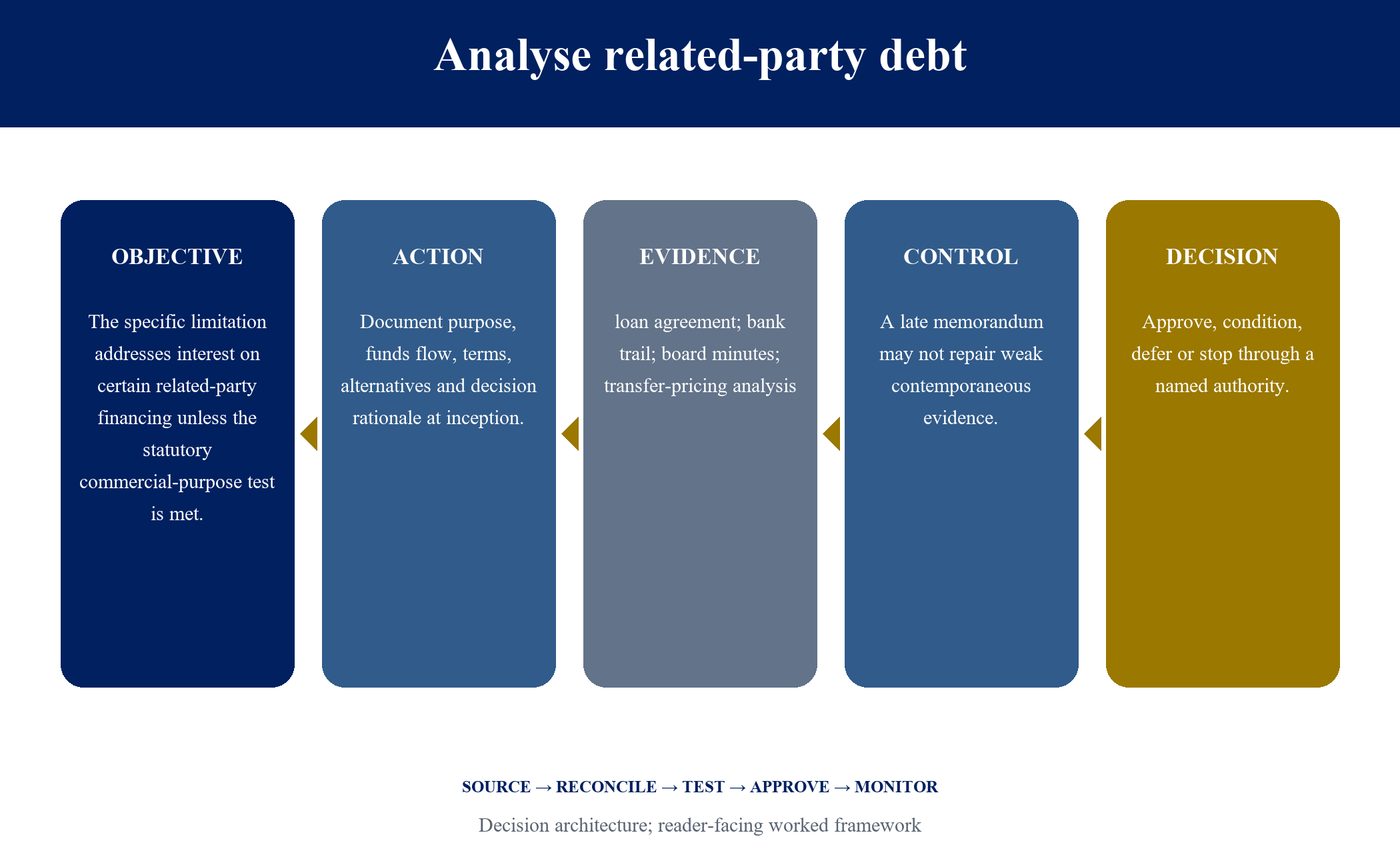
The specific limitation addresses interest on certain related-party financing unless the statutory commercial-purpose test is met. This matters in the 30% cap because the economics, legal rights, operating evidence and timing can move on different clocks. A useful analysis therefore begins with the decision being made, the party authorised to make it and the date on which the evidence is expected to be current. The work should distinguish source facts, management representations, analytical assumptions and professional judgement so that a reviewer can see where each conclusion originates.
The recommended workstream is to document purpose, funds flow, terms, alternatives and decision rationale at inception. The team should translate that instruction into named owners, dated gates and a common set of definitions. A base case should describe the expected path; a downside case should test weaker operating performance or slower execution; and a delay case should test what happens when a required approval, document, counterparty or financing event arrives later than planned. Any decision threshold used in the model should be recorded as a management choice unless it comes directly from a cited rule or contract.
The decision framework has four layers. First, define the commercial objective and non-negotiable constraints. Second, assemble the minimum source record and reconcile it to the numbers used in the analysis. Third, compare executable alternatives under consistent assumptions, including cost, control, liquidity, timing and downside. Fourth, approve the route, its conditions and the fallback. This sequence keeps a transaction from moving ahead on an attractive headline while unresolved implementation questions remain outside the decision paper.
7.2 Evidence and controls
The minimum evidence for this module is loan agreement; bank trail; board minutes; transfer-pricing analysis Each item should have an owner, effective date, source location and review status. Where information is produced through a model or transformation, the file should preserve the original input, calculation logic and output version. The reviewer should be able to reproduce the material conclusion without relying on a presentation slide, an uncited summary or the memory of the person who prepared it.
Control quality can be tested through three questions. Does the source support the stated fact? Does the calculation use the approved definition? Does the proposed action remain within the authority and risk limits already granted? An exception to any of these tests should enter a dated register with a named resolver and a stop, proceed or conditional-proceed decision. Completion means that the evidence and decision have been accepted by the accountable owner; document production alone is an intermediate output.
The principal failure mode is that a late memorandum may not repair weak contemporaneous evidence. The response is to make the vulnerable assumption visible, test a plausible adverse state and identify the earliest observable warning indicator. The analysis should also state what remains outside its scope and which legal, tax, regulatory, accounting, valuation, technical or investment conclusions require qualified advice. This creates a practical boundary between a research framework and a conclusion for a particular company, investor, lender, family or transaction.
| Control question | Required record | Decision response |
|---|---|---|
| What is being decided? | Document purpose, funds flow, terms, alternatives and decision rationale at inception. | Approve objective and authority. |
| What proves the case? | loan agreement; bank trail; board minutes; transfer-pricing analysis | Reconcile and sign off. |
| What can fail? | A late memorandum may not repair weak contemporaneous evidence. | Test downside and escalation. |
8. Model tax groups
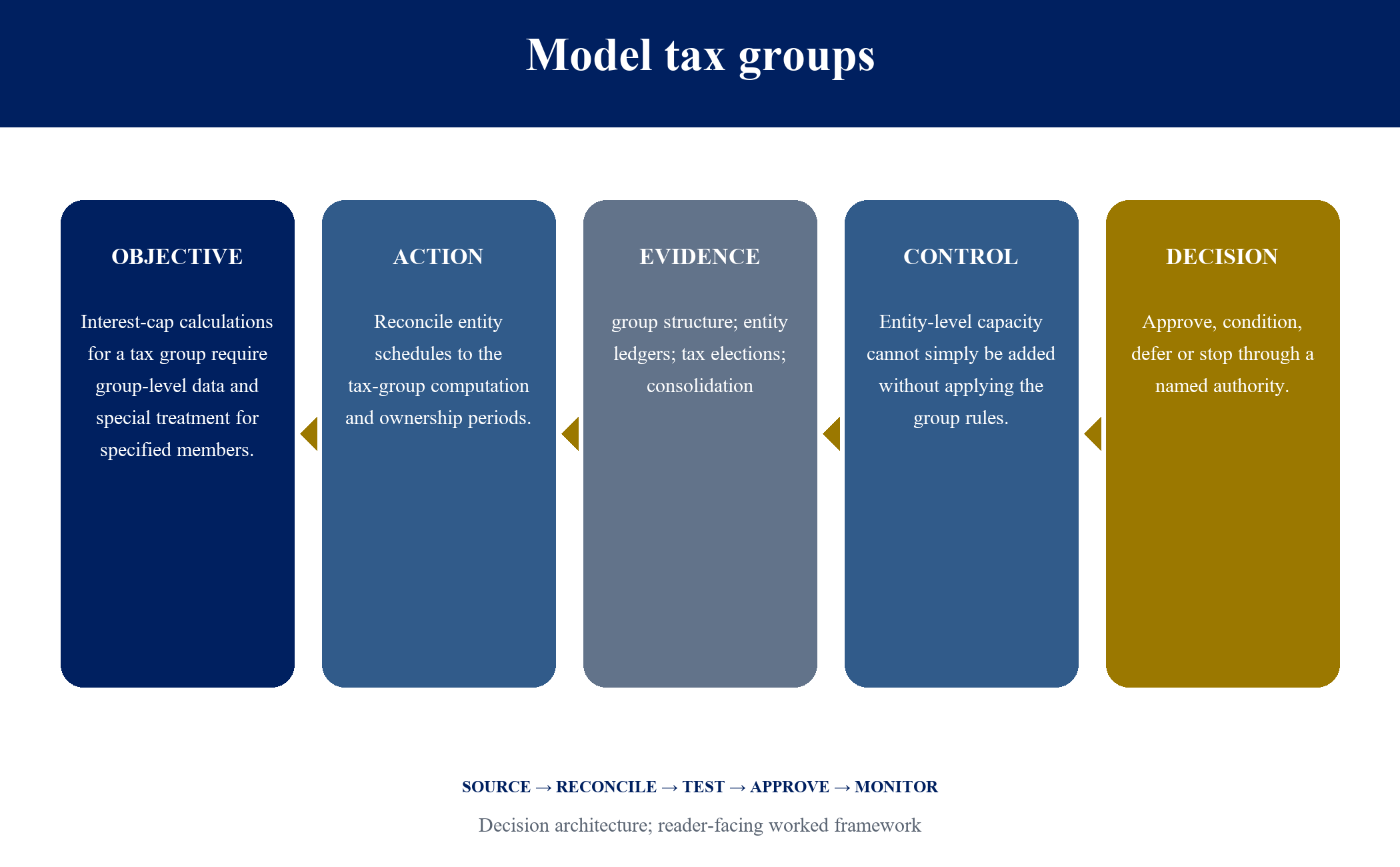
Interest-cap calculations for a tax group require group-level data and special treatment for specified members. This matters in the 30% cap because the economics, legal rights, operating evidence and timing can move on different clocks. A useful analysis therefore begins with the decision being made, the party authorised to make it and the date on which the evidence is expected to be current. The work should distinguish source facts, management representations, analytical assumptions and professional judgement so that a reviewer can see where each conclusion originates.
The recommended workstream is to reconcile entity schedules to the tax-group computation and ownership periods. The team should translate that instruction into named owners, dated gates and a common set of definitions. A base case should describe the expected path; a downside case should test weaker operating performance or slower execution; and a delay case should test what happens when a required approval, document, counterparty or financing event arrives later than planned. Any decision threshold used in the model should be recorded as a management choice unless it comes directly from a cited rule or contract.
The decision framework has four layers. First, define the commercial objective and non-negotiable constraints. Second, assemble the minimum source record and reconcile it to the numbers used in the analysis. Third, compare executable alternatives under consistent assumptions, including cost, control, liquidity, timing and downside. Fourth, approve the route, its conditions and the fallback. This sequence keeps a transaction from moving ahead on an attractive headline while unresolved implementation questions remain outside the decision paper.
8.2 Evidence and controls
The minimum evidence for this module is group structure; entity ledgers; tax elections; consolidation Each item should have an owner, effective date, source location and review status. Where information is produced through a model or transformation, the file should preserve the original input, calculation logic and output version. The reviewer should be able to reproduce the material conclusion without relying on a presentation slide, an uncited summary or the memory of the person who prepared it.
Control quality can be tested through three questions. Does the source support the stated fact? Does the calculation use the approved definition? Does the proposed action remain within the authority and risk limits already granted? An exception to any of these tests should enter a dated register with a named resolver and a stop, proceed or conditional-proceed decision. Completion means that the evidence and decision have been accepted by the accountable owner; document production alone is an intermediate output.
The principal failure mode is that entity-level capacity cannot simply be added without applying the group rules. The response is to make the vulnerable assumption visible, test a plausible adverse state and identify the earliest observable warning indicator. The analysis should also state what remains outside its scope and which legal, tax, regulatory, accounting, valuation, technical or investment conclusions require qualified advice. This creates a practical boundary between a research framework and a conclusion for a particular company, investor, lender, family or transaction.
| Control question | Required record | Decision response |
|---|---|---|
| What is being decided? | Reconcile entity schedules to the tax-group computation and ownership periods. | Approve objective and authority. |
| What proves the case? | group structure; entity ledgers; tax elections; consolidation | Reconcile and sign off. |
| What can fail? | Entity-level capacity cannot simply be added without applying the group rules. | Test downside and escalation. |
9. Compare financing structures
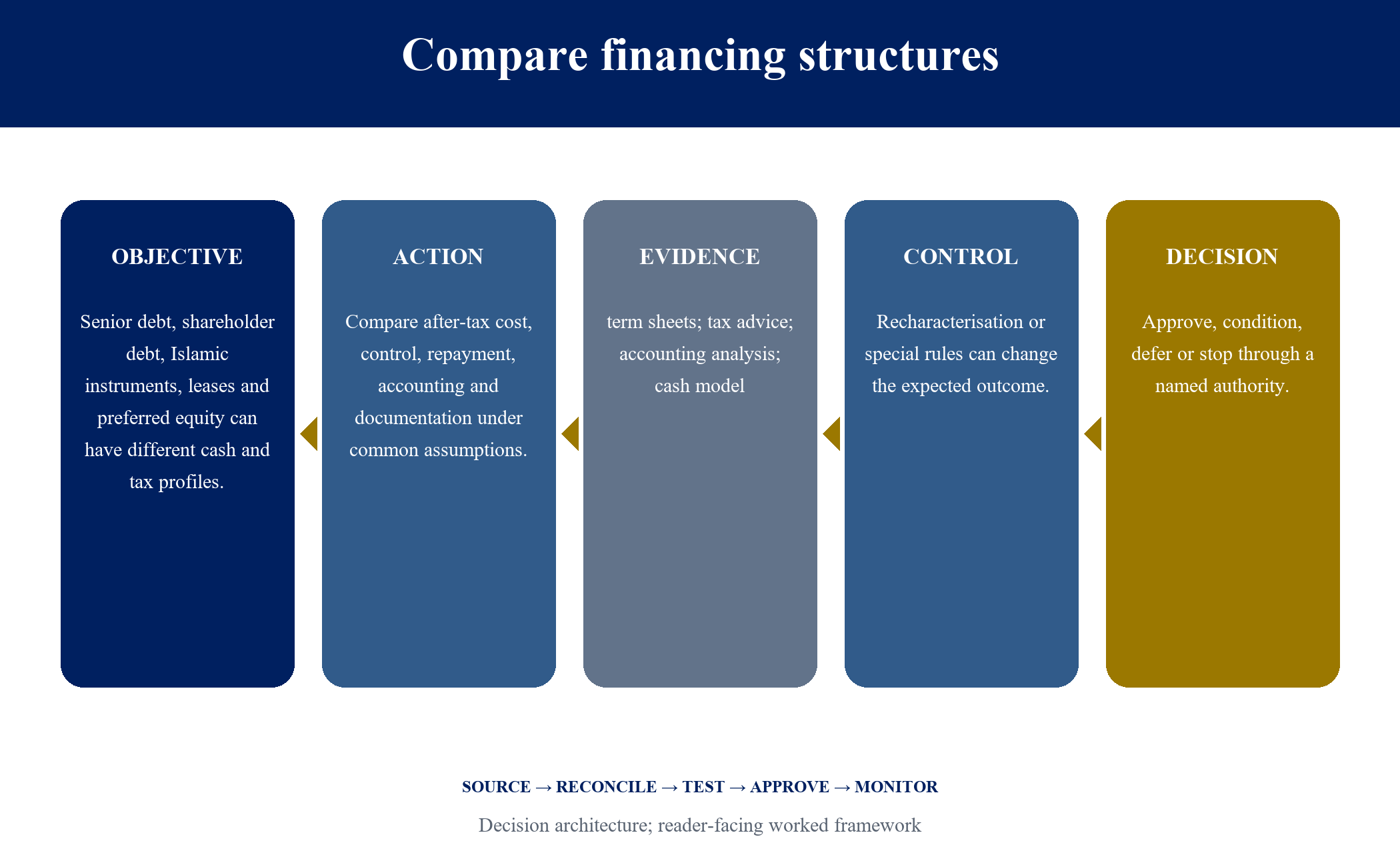
Senior debt, shareholder debt, Islamic instruments, leases and preferred equity can have different cash and tax profiles. This matters in the 30% cap because the economics, legal rights, operating evidence and timing can move on different clocks. A useful analysis therefore begins with the decision being made, the party authorised to make it and the date on which the evidence is expected to be current. The work should distinguish source facts, management representations, analytical assumptions and professional judgement so that a reviewer can see where each conclusion originates.
The recommended workstream is to compare after-tax cost, control, repayment, accounting and documentation under common assumptions. The team should translate that instruction into named owners, dated gates and a common set of definitions. A base case should describe the expected path; a downside case should test weaker operating performance or slower execution; and a delay case should test what happens when a required approval, document, counterparty or financing event arrives later than planned. Any decision threshold used in the model should be recorded as a management choice unless it comes directly from a cited rule or contract.
The decision framework has four layers. First, define the commercial objective and non-negotiable constraints. Second, assemble the minimum source record and reconcile it to the numbers used in the analysis. Third, compare executable alternatives under consistent assumptions, including cost, control, liquidity, timing and downside. Fourth, approve the route, its conditions and the fallback. This sequence keeps a transaction from moving ahead on an attractive headline while unresolved implementation questions remain outside the decision paper.
9.2 Evidence and controls
The minimum evidence for this module is term sheets; tax advice; accounting analysis; cash model Each item should have an owner, effective date, source location and review status. Where information is produced through a model or transformation, the file should preserve the original input, calculation logic and output version. The reviewer should be able to reproduce the material conclusion without relying on a presentation slide, an uncited summary or the memory of the person who prepared it.
Control quality can be tested through three questions. Does the source support the stated fact? Does the calculation use the approved definition? Does the proposed action remain within the authority and risk limits already granted? An exception to any of these tests should enter a dated register with a named resolver and a stop, proceed or conditional-proceed decision. Completion means that the evidence and decision have been accepted by the accountable owner; document production alone is an intermediate output.
The principal failure mode is that recharacterisation or special rules can change the expected outcome. The response is to make the vulnerable assumption visible, test a plausible adverse state and identify the earliest observable warning indicator. The analysis should also state what remains outside its scope and which legal, tax, regulatory, accounting, valuation, technical or investment conclusions require qualified advice. This creates a practical boundary between a research framework and a conclusion for a particular company, investor, lender, family or transaction.
| Control question | Required record | Decision response |
|---|---|---|
| What is being decided? | Compare after-tax cost, control, repayment, accounting and documentation under common assumptions. | Approve objective and authority. |
| What proves the case? | term sheets; tax advice; accounting analysis; cash model | Reconcile and sign off. |
| What can fail? | Recharacterisation or special rules can change the expected outcome. | Test downside and escalation. |
10. Integrate transfer pricing
Related-party pricing and deductibility require distinct analyses that should reconcile to one factual record. This matters in the 30% cap because the economics, legal rights, operating evidence and timing can move on different clocks. A useful analysis therefore begins with the decision being made, the party authorised to make it and the date on which the evidence is expected to be current. The work should distinguish source facts, management representations, analytical assumptions and professional judgement so that a reviewer can see where each conclusion originates.
The recommended workstream is to benchmark terms and preserve the commercial and functional evidence for the arrangement. The team should translate that instruction into named owners, dated gates and a common set of definitions. A base case should describe the expected path; a downside case should test weaker operating performance or slower execution; and a delay case should test what happens when a required approval, document, counterparty or financing event arrives later than planned. Any decision threshold used in the model should be recorded as a management choice unless it comes directly from a cited rule or contract.
The decision framework has four layers. First, define the commercial objective and non-negotiable constraints. Second, assemble the minimum source record and reconcile it to the numbers used in the analysis. Third, compare executable alternatives under consistent assumptions, including cost, control, liquidity, timing and downside. Fourth, approve the route, its conditions and the fallback. This sequence keeps a transaction from moving ahead on an attractive headline while unresolved implementation questions remain outside the decision paper.
10.2 Evidence and controls
The minimum evidence for this module is agreements; comparables; functional analysis; board approval Each item should have an owner, effective date, source location and review status. Where information is produced through a model or transformation, the file should preserve the original input, calculation logic and output version. The reviewer should be able to reproduce the material conclusion without relying on a presentation slide, an uncited summary or the memory of the person who prepared it.
Control quality can be tested through three questions. Does the source support the stated fact? Does the calculation use the approved definition? Does the proposed action remain within the authority and risk limits already granted? An exception to any of these tests should enter a dated register with a named resolver and a stop, proceed or conditional-proceed decision. Completion means that the evidence and decision have been accepted by the accountable owner; document production alone is an intermediate output.
The principal failure mode is that arm's-length pricing does not by itself establish deductibility. The response is to make the vulnerable assumption visible, test a plausible adverse state and identify the earliest observable warning indicator. The analysis should also state what remains outside its scope and which legal, tax, regulatory, accounting, valuation, technical or investment conclusions require qualified advice. This creates a practical boundary between a research framework and a conclusion for a particular company, investor, lender, family or transaction.
| Control question | Required record | Decision response |
|---|---|---|
| What is being decided? | Benchmark terms and preserve the commercial and functional evidence for the arrangement. | Approve objective and authority. |
| What proves the case? | agreements; comparables; functional analysis; board approval | Reconcile and sign off. |
| What can fail? | Arm's-length pricing does not by itself establish deductibility. | Test downside and escalation. |
11. Protect covenants and distributions
Tax disallowance can reduce cash available for debt service and distributions even when covenant EBITDA is unchanged. This matters in the 30% cap because the economics, legal rights, operating evidence and timing can move on different clocks. A useful analysis therefore begins with the decision being made, the party authorised to make it and the date on which the evidence is expected to be current. The work should distinguish source facts, management representations, analytical assumptions and professional judgement so that a reviewer can see where each conclusion originates.
The recommended workstream is to add tax sensitivities to fixed-charge, leverage and distribution tests. The team should translate that instruction into named owners, dated gates and a common set of definitions. A base case should describe the expected path; a downside case should test weaker operating performance or slower execution; and a delay case should test what happens when a required approval, document, counterparty or financing event arrives later than planned. Any decision threshold used in the model should be recorded as a management choice unless it comes directly from a cited rule or contract.
The decision framework has four layers. First, define the commercial objective and non-negotiable constraints. Second, assemble the minimum source record and reconcile it to the numbers used in the analysis. Third, compare executable alternatives under consistent assumptions, including cost, control, liquidity, timing and downside. Fourth, approve the route, its conditions and the fallback. This sequence keeps a transaction from moving ahead on an attractive headline while unresolved implementation questions remain outside the decision paper.
11.2 Evidence and controls
The minimum evidence for this module is covenant model; tax forecast; dividend policy; headroom analysis Each item should have an owner, effective date, source location and review status. Where information is produced through a model or transformation, the file should preserve the original input, calculation logic and output version. The reviewer should be able to reproduce the material conclusion without relying on a presentation slide, an uncited summary or the memory of the person who prepared it.
Control quality can be tested through three questions. Does the source support the stated fact? Does the calculation use the approved definition? Does the proposed action remain within the authority and risk limits already granted? An exception to any of these tests should enter a dated register with a named resolver and a stop, proceed or conditional-proceed decision. Completion means that the evidence and decision have been accepted by the accountable owner; document production alone is an intermediate output.
The principal failure mode is that untested tax cash can erode covenant headroom. The response is to make the vulnerable assumption visible, test a plausible adverse state and identify the earliest observable warning indicator. The analysis should also state what remains outside its scope and which legal, tax, regulatory, accounting, valuation, technical or investment conclusions require qualified advice. This creates a practical boundary between a research framework and a conclusion for a particular company, investor, lender, family or transaction.
| Control question | Required record | Decision response |
|---|---|---|
| What is being decided? | Add tax sensitivities to fixed-charge, leverage and distribution tests. | Approve objective and authority. |
| What proves the case? | covenant model; tax forecast; dividend policy; headroom analysis | Reconcile and sign off. |
| What can fail? | Untested tax cash can erode covenant headroom. | Test downside and escalation. |
12. Build acquisition and refinancing models
Transaction debt should reflect purchase accounting, integration, interest timing and refinancing scenarios. This matters in the 30% cap because the economics, legal rights, operating evidence and timing can move on different clocks. A useful analysis therefore begins with the decision being made, the party authorised to make it and the date on which the evidence is expected to be current. The work should distinguish source facts, management representations, analytical assumptions and professional judgement so that a reviewer can see where each conclusion originates.
The recommended workstream is to calculate tax and cash outcomes across base, downside and delayed-synergy cases. The team should translate that instruction into named owners, dated gates and a common set of definitions. A base case should describe the expected path; a downside case should test weaker operating performance or slower execution; and a delay case should test what happens when a required approval, document, counterparty or financing event arrives later than planned. Any decision threshold used in the model should be recorded as a management choice unless it comes directly from a cited rule or contract.
The decision framework has four layers. First, define the commercial objective and non-negotiable constraints. Second, assemble the minimum source record and reconcile it to the numbers used in the analysis. Third, compare executable alternatives under consistent assumptions, including cost, control, liquidity, timing and downside. Fourth, approve the route, its conditions and the fallback. This sequence keeps a transaction from moving ahead on an attractive headline while unresolved implementation questions remain outside the decision paper.
12.2 Evidence and controls
The minimum evidence for this module is sources and uses; pro forma tax model; facility schedule Each item should have an owner, effective date, source location and review status. Where information is produced through a model or transformation, the file should preserve the original input, calculation logic and output version. The reviewer should be able to reproduce the material conclusion without relying on a presentation slide, an uncited summary or the memory of the person who prepared it.
Control quality can be tested through three questions. Does the source support the stated fact? Does the calculation use the approved definition? Does the proposed action remain within the authority and risk limits already granted? An exception to any of these tests should enter a dated register with a named resolver and a stop, proceed or conditional-proceed decision. Completion means that the evidence and decision have been accepted by the accountable owner; document production alone is an intermediate output.
The principal failure mode is that a model that assumes immediate full deduction can overstate equity returns. The response is to make the vulnerable assumption visible, test a plausible adverse state and identify the earliest observable warning indicator. The analysis should also state what remains outside its scope and which legal, tax, regulatory, accounting, valuation, technical or investment conclusions require qualified advice. This creates a practical boundary between a research framework and a conclusion for a particular company, investor, lender, family or transaction.
| Control question | Required record | Decision response |
|---|---|---|
| What is being decided? | Calculate tax and cash outcomes across base, downside and delayed-synergy cases. | Approve objective and authority. |
| What proves the case? | sources and uses; pro forma tax model; facility schedule | Reconcile and sign off. |
| What can fail? | A model that assumes immediate full deduction can overstate equity returns. | Test downside and escalation. |
13. Establish the evidence file
Tax positions require contemporaneous contracts, calculations, approvals and source records. This matters in the 30% cap because the economics, legal rights, operating evidence and timing can move on different clocks. A useful analysis therefore begins with the decision being made, the party authorised to make it and the date on which the evidence is expected to be current. The work should distinguish source facts, management representations, analytical assumptions and professional judgement so that a reviewer can see where each conclusion originates.
The recommended workstream is to maintain a period-specific interest file with accountable owners and review dates. The team should translate that instruction into named owners, dated gates and a common set of definitions. A base case should describe the expected path; a downside case should test weaker operating performance or slower execution; and a delay case should test what happens when a required approval, document, counterparty or financing event arrives later than planned. Any decision threshold used in the model should be recorded as a management choice unless it comes directly from a cited rule or contract.
The decision framework has four layers. First, define the commercial objective and non-negotiable constraints. Second, assemble the minimum source record and reconcile it to the numbers used in the analysis. Third, compare executable alternatives under consistent assumptions, including cost, control, liquidity, timing and downside. Fourth, approve the route, its conditions and the fallback. This sequence keeps a transaction from moving ahead on an attractive headline while unresolved implementation questions remain outside the decision paper.
13.2 Evidence and controls
The minimum evidence for this module is source ledger; calculations; agreements; advice; sign-offs Each item should have an owner, effective date, source location and review status. Where information is produced through a model or transformation, the file should preserve the original input, calculation logic and output version. The reviewer should be able to reproduce the material conclusion without relying on a presentation slide, an uncited summary or the memory of the person who prepared it.
Control quality can be tested through three questions. Does the source support the stated fact? Does the calculation use the approved definition? Does the proposed action remain within the authority and risk limits already granted? An exception to any of these tests should enter a dated register with a named resolver and a stop, proceed or conditional-proceed decision. Completion means that the evidence and decision have been accepted by the accountable owner; document production alone is an intermediate output.
The principal failure mode is that disconnected spreadsheets weaken auditability. The response is to make the vulnerable assumption visible, test a plausible adverse state and identify the earliest observable warning indicator. The analysis should also state what remains outside its scope and which legal, tax, regulatory, accounting, valuation, technical or investment conclusions require qualified advice. This creates a practical boundary between a research framework and a conclusion for a particular company, investor, lender, family or transaction.
| Control question | Required record | Decision response |
|---|---|---|
| What is being decided? | Maintain a period-specific interest file with accountable owners and review dates. | Approve objective and authority. |
| What proves the case? | source ledger; calculations; agreements; advice; sign-offs | Reconcile and sign off. |
| What can fail? | Disconnected spreadsheets weaken auditability. | Test downside and escalation. |
14. Govern annual re-performance
EBITDA, interest, group composition and rules can change between financing approval and filing. This matters in the 30% cap because the economics, legal rights, operating evidence and timing can move on different clocks. A useful analysis therefore begins with the decision being made, the party authorised to make it and the date on which the evidence is expected to be current. The work should distinguish source facts, management representations, analytical assumptions and professional judgement so that a reviewer can see where each conclusion originates.
The recommended workstream is to reperform the model quarterly and before material draw, amendment or transaction. The team should translate that instruction into named owners, dated gates and a common set of definitions. A base case should describe the expected path; a downside case should test weaker operating performance or slower execution; and a delay case should test what happens when a required approval, document, counterparty or financing event arrives later than planned. Any decision threshold used in the model should be recorded as a management choice unless it comes directly from a cited rule or contract.
The decision framework has four layers. First, define the commercial objective and non-negotiable constraints. Second, assemble the minimum source record and reconcile it to the numbers used in the analysis. Third, compare executable alternatives under consistent assumptions, including cost, control, liquidity, timing and downside. Fourth, approve the route, its conditions and the fallback. This sequence keeps a transaction from moving ahead on an attractive headline while unresolved implementation questions remain outside the decision paper.
14.2 Evidence and controls
The minimum evidence for this module is updated forecast; covenant certificate; tax review; decision log Each item should have an owner, effective date, source location and review status. Where information is produced through a model or transformation, the file should preserve the original input, calculation logic and output version. The reviewer should be able to reproduce the material conclusion without relying on a presentation slide, an uncited summary or the memory of the person who prepared it.
Control quality can be tested through three questions. Does the source support the stated fact? Does the calculation use the approved definition? Does the proposed action remain within the authority and risk limits already granted? An exception to any of these tests should enter a dated register with a named resolver and a stop, proceed or conditional-proceed decision. Completion means that the evidence and decision have been accepted by the accountable owner; document production alone is an intermediate output.
The principal failure mode is that a one-time structuring exercise can become stale. The response is to make the vulnerable assumption visible, test a plausible adverse state and identify the earliest observable warning indicator. The analysis should also state what remains outside its scope and which legal, tax, regulatory, accounting, valuation, technical or investment conclusions require qualified advice. This creates a practical boundary between a research framework and a conclusion for a particular company, investor, lender, family or transaction.
| Control question | Required record | Decision response |
|---|---|---|
| What is being decided? | Reperform the model quarterly and before material draw, amendment or transaction. | Approve objective and authority. |
| What proves the case? | updated forecast; covenant certificate; tax review; decision log | Reconcile and sign off. |
| What can fail? | A one-time structuring exercise can become stale. | Test downside and escalation. |
15. Use a board decision gate
The board should see pre-tax cost, after-tax cost, liquidity, covenant and downside implications together. This matters in the 30% cap because the economics, legal rights, operating evidence and timing can move on different clocks. A useful analysis therefore begins with the decision being made, the party authorised to make it and the date on which the evidence is expected to be current. The work should distinguish source facts, management representations, analytical assumptions and professional judgement so that a reviewer can see where each conclusion originates.
The recommended workstream is to approve financing through a standard paper with explicit limitations and adviser dependencies. The team should translate that instruction into named owners, dated gates and a common set of definitions. A base case should describe the expected path; a downside case should test weaker operating performance or slower execution; and a delay case should test what happens when a required approval, document, counterparty or financing event arrives later than planned. Any decision threshold used in the model should be recorded as a management choice unless it comes directly from a cited rule or contract.
The decision framework has four layers. First, define the commercial objective and non-negotiable constraints. Second, assemble the minimum source record and reconcile it to the numbers used in the analysis. Third, compare executable alternatives under consistent assumptions, including cost, control, liquidity, timing and downside. Fourth, approve the route, its conditions and the fallback. This sequence keeps a transaction from moving ahead on an attractive headline while unresolved implementation questions remain outside the decision paper.
15.2 Evidence and controls
The minimum evidence for this module is board paper; scenarios; professional advice; conditions Each item should have an owner, effective date, source location and review status. Where information is produced through a model or transformation, the file should preserve the original input, calculation logic and output version. The reviewer should be able to reproduce the material conclusion without relying on a presentation slide, an uncited summary or the memory of the person who prepared it.
Control quality can be tested through three questions. Does the source support the stated fact? Does the calculation use the approved definition? Does the proposed action remain within the authority and risk limits already granted? An exception to any of these tests should enter a dated register with a named resolver and a stop, proceed or conditional-proceed decision. Completion means that the evidence and decision have been accepted by the accountable owner; document production alone is an intermediate output.
The principal failure mode is that headline tax savings can dominate the underlying commercial decision. The response is to make the vulnerable assumption visible, test a plausible adverse state and identify the earliest observable warning indicator. The analysis should also state what remains outside its scope and which legal, tax, regulatory, accounting, valuation, technical or investment conclusions require qualified advice. This creates a practical boundary between a research framework and a conclusion for a particular company, investor, lender, family or transaction.
| Control question | Required record | Decision response |
|---|---|---|
| What is being decided? | Approve financing through a standard paper with explicit limitations and adviser dependencies. | Approve objective and authority. |
| What proves the case? | board paper; scenarios; professional advice; conditions | Reconcile and sign off. |
| What can fail? | Headline tax savings can dominate the underlying commercial decision. | Test downside and escalation. |
Primary and authoritative sources
- Federal Tax Authority, Interest Deduction Limitation Rules CTGIDL1. https://tax.gov.ae/en/content/interest.deduction.limitation.rules.ctgidl1.aspx
- Federal Tax Authority, Interest Deduction Guide PDF. https://tax.gov.ae/Datafolder/Files/Guides/CT/Interest-Deduction-guide.pdf
- Federal Tax Authority, General Corporate Tax Guide. https://tax.gov.ae/Datafolder/Files/Guides/CT/CT%20General%20Guide%20-%20EN%20-%2010%2009%202023.pdf
- UAE Ministry of Finance, Interest Capping Decisions. https://mof.gov.ae/en/news/ministry-of-finance-issues-new-decisions-relating-to-tax-grouping-interest-capping-and-unincorporated-partnerships/
- Federal Tax Authority, Corporate Tax FAQ. https://tax.gov.ae/en/faq.aspx?keyword=Will+my+interest+expenditure+be+fully+deductible%3F+
- UAE Corporate Tax Law. https://uaelegislation.gov.ae/en/legislations/1582
