Introduction
An ultra-premium landbank, a trophy parcel of land in a prime Gulf location held for future development or appreciation, is among the most distinctive financing challenges in real estate. The asset is extremely valuable, highly illiquid, generates no income during the hold, and may be held for several years before it is developed or sold. Financing it requires capital that can fund a large, long-dated, income-free position against the security of the land alone, and in the Gulf the developer or investor financing such a position frequently faces a direct choice between two routes: a Shariah-compliant Sukuk and a conventional private credit facility.
This paper conducts a structured comparison, a cost-of-capital showdown, between these two routes. Both can fund the acquisition and hold of ultra-premium landbank, and both are readily available in the deep Gulf capital market, but they are not equivalent. They differ in their all-in cost, in the speed with which they can be arranged, in the flexibility of their structures, in the pool of investors they reach, and in the signal that using each sends to the market. The choice between them is therefore a genuine strategic decision rather than a mere technicality, and it rewards a careful analysis of the trade-offs.
The central finding, developed through the paper, is that the land Sukuk is frequently competitive on, and sometimes cheaper than, conventional private credit on an all-in basis, and that it reaches a wider pool of compliant capital and carries a positive signalling value, while conventional private credit is faster to arrange and more flexible in its structuring. The decision therefore turns on the financier priorities: a financier that prioritises cost and investor reach should lean toward the Sukuk, while one that prioritises speed and flexibility should lean toward private credit. The most sophisticated financiers, as the paper concludes, run both routes in competition.
Sukuk: Structure and Economics
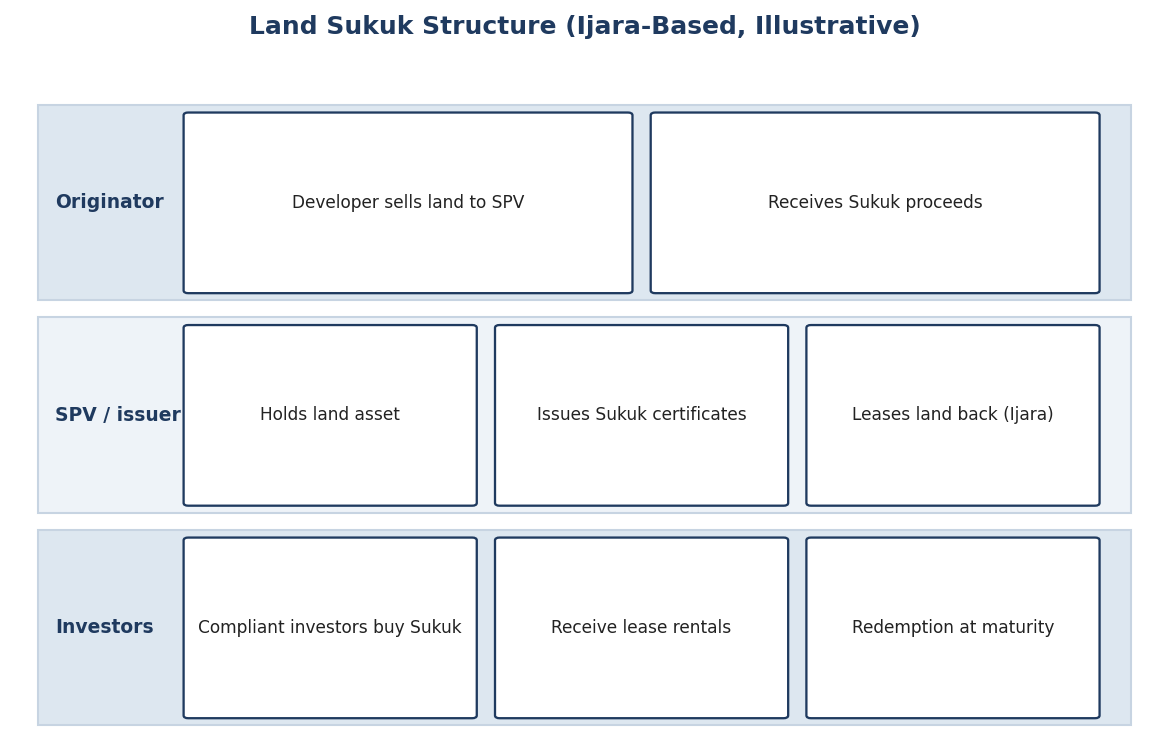
A land Sukuk is a Shariah-compliant instrument that replicates the economic function of debt while satisfying the requirements of Islamic finance, and for landbank it is commonly structured on an Ijara, or lease, basis. Figure 3 sets out the typical structure. The developer sells the land to a special-purpose vehicle, which issues Sukuk certificates to compliant investors and uses the proceeds to pay the developer, then leases the land back to the developer under an Ijara, with the lease rentals providing the return to the Sukuk investors and a final payment redeeming the certificates on maturity.
Figure 3. Land Sukuk Structure, Ijara-Based
Indicative schematic. Specific structures vary and require specialist Shariah and legal input. Not transaction-specific.
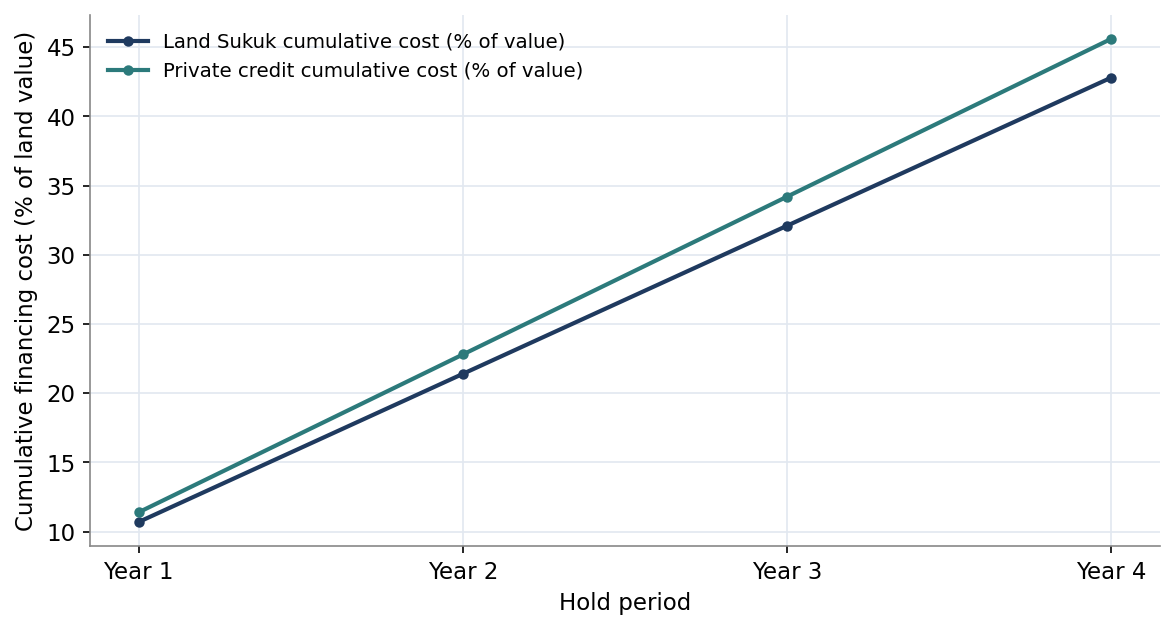
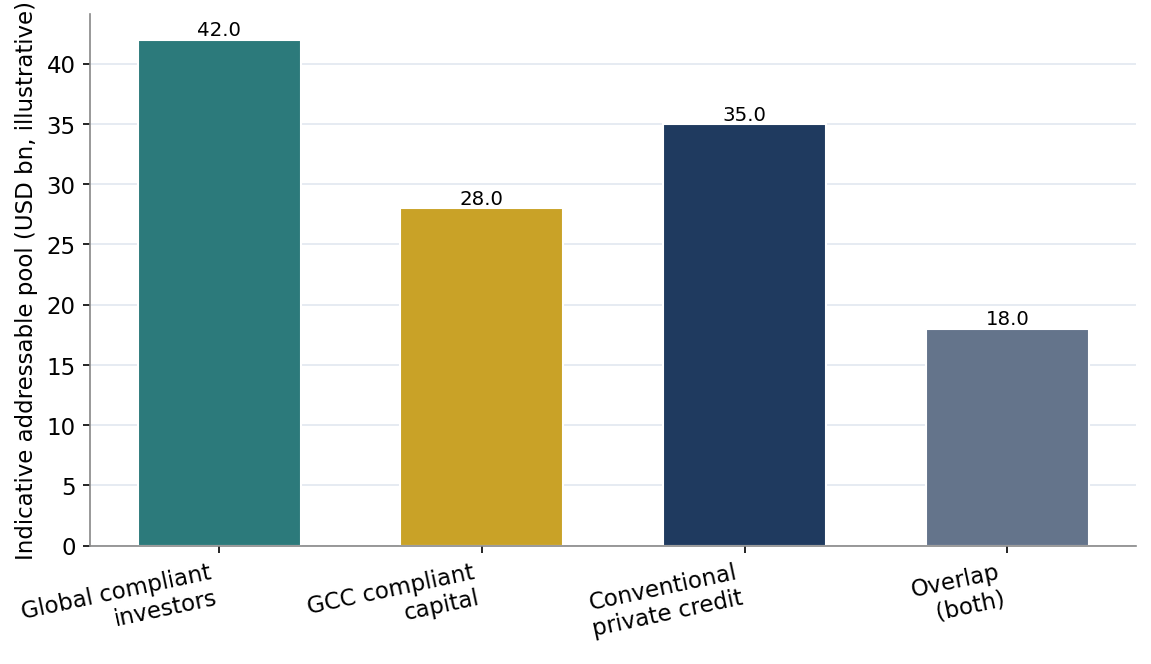
The economics of the Sukuk are driven by the profit rate, the equivalent of the interest rate in a conventional facility, which is set by the compliant investor market and the quality of the asset and the originator. Because the compliant investor base in the Gulf is deep and competitive, and because the Sukuk is backed by the land asset held in the special-purpose vehicle, the profit rate can be attractive, often below the margin a conventional private credit fund would require. The principal cost disadvantage of the Sukuk is its structuring cost: the establishment of the special-purpose vehicle, the Shariah board approval, the specialist legal documentation and the issuance process add a cost that a simpler conventional facility avoids.
The structuring cost of a Sukuk is largely fixed rather than proportional, which means it is more easily absorbed by a large issuance than a small one. For an ultra-premium landbank, where the financing quantum is large, the fixed structuring cost is spread across a large principal and adds only modestly to the all-in cost, which is one reason the Sukuk is particularly competitive for large, high-value parcels. For a smaller financing, the same structuring cost would be a larger proportion of the total and would erode the Sukuk advantage, which is why the Sukuk route is most attractive at the larger end of the landbank market. The scale of ultra-premium landbank therefore plays to the Sukuk strength.
Conventional Private Credit: Structure and Economics
A conventional private credit facility for landbank is, in structure, simpler than a Sukuk: a private credit fund or a syndicate lends to the developer against a first charge over the land and a pledge of the shares in the holding vehicle, with the loan repaid from the eventual development or sale. There is no special-purpose vehicle issuing certificates, no Shariah board, and no lease structure; the facility is a straightforward secured loan, which makes it faster to arrange and simpler to document than a Sukuk.
The economics of the facility are driven by the margin the private credit provider requires, which reflects the return its own investors demand, the risk of the income-free land hold, and the competitive conditions of the private credit market. This margin is typically higher than the profit rate on a comparable Sukuk, because private credit funds target a higher return than the compliant investor base requires, and because the private credit provider is not accessing the deep, lower-cost pool of compliant capital. The principal cost advantage of private credit is its low structuring cost: because the facility is a simple secured loan, the arrangement and documentation cost is modest, which partly offsets the higher margin.
The defining strengths of conventional private credit are speed and flexibility. A private credit fund can underwrite and document a landbank facility quickly, often in a few weeks, because the structure is simple and the fund can decide and act without the issuance process a Sukuk requires. And the facility can be tailored flexibly to the specific situation, with bespoke drawdown schedules, deferred or accrued cost, and customised security, because it is a privately negotiated bilateral arrangement rather than a market issuance. These strengths make private credit the preferred route where speed or flexibility is paramount, even at a higher all-in cost, and they are the principal counterweight to the Sukuk cost and reach advantages.
| Dimension | Land Sukuk | Conventional private credit |
|---|---|---|
| Base rate / margin | Lower (~8.5%) | Higher (~9.5%) |
| Fees | Moderate | Moderate-high |
| Structuring cost | Higher (fixed) | Lower |
| All-in cost | ~10.7% | ~11.4% |
| Speed to fund | Slower (8-12 wks) | Faster (3-5 wks) |
| Flexibility | Moderate | High |
| Investor reach | Wider (compliant + some conv.) | Narrower |
| Signalling | Positive (market endorsement) | Neutral |
The Decision Framework
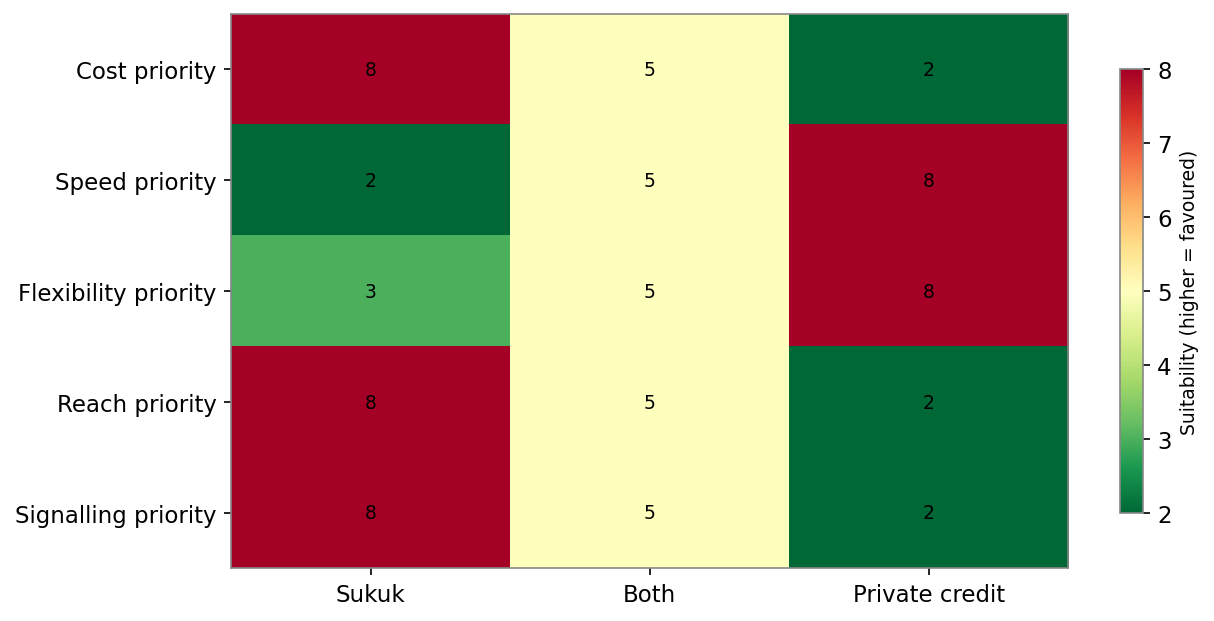
The decision framework matches the route to the financier dominant priority, and Figure 5 presents it as a suitability matrix across priorities.
Figure 5. Route Suitability by Dominant Priority
Indicative suitability of each route by the financier dominant priority. Not transaction-specific.
The matrix shows the Sukuk favoured where cost, investor reach or signalling is the dominant priority, and conventional private credit favoured where speed or flexibility dominates, with a middle ground where the priorities are balanced and either route, or a dual-track process, is appropriate. The framework is deliberately simple because the underlying logic is simple: identify the dimension that matters most for the specific financing, and choose the route that wins on that dimension, unless the cost difference is large enough to override a secondary priority. In practice the cost difference is usually modest, so the secondary priorities, speed, flexibility, reach and signalling, frequently decide the choice.
Applying the framework requires the financier to be honest about its true priority, which is not always obvious. A financier may believe its priority is cost, when in fact a looming acquisition deadline makes speed the binding constraint; or it may believe its priority is speed, when in fact it has ample time and the cost saving and reach of the Sukuk would serve it better. The discipline of the framework is to force an explicit identification of the dominant priority, tested against the actual circumstances of the financing, rather than allowing the choice to be made by habit or by whichever route is most familiar. A financier that defaults to the route it always uses, without this analysis, frequently chooses sub-optimally.
The framework also points to the value of keeping both routes open until the priority is clear. A financier that commits early to one route forecloses the other, and if its priority later shifts, perhaps a deadline emerges, or the planned timeline relaxes, it may find itself committed to the wrong route. A financier that develops both routes in parallel, deferring the commitment until the priority is clear, preserves its optionality and can choose the route that best serves the priority as it crystallises. This is the logic of the dual-track process examined in Section 16, which is the framework recommendation for financiers with the time and capacity to pursue it.
Risk Considerations
Both routes carry the fundamental risk of financing an income-free, illiquid asset over a long hold, but they distribute and manage that risk somewhat differently. The principal risk in both is that the eventual development or sale, which repays the financing, is delayed or realises less than expected, leaving the financier exposed to an asset that cannot be quickly or fully realised. Both routes manage this through the security over the land and through a financing quantum set conservatively against the land value, leaving an equity cushion that absorbs a shortfall.
The Sukuk carries a specific structural risk in the requirement that the structure remain compliant and that the special-purpose vehicle and Ijara arrangement function as intended, which depends on careful structuring and ongoing compliance. A defect in the compliance or the structure could impair the instrument, which is why specialist Shariah and legal input is essential and why the structuring cost is higher. The conventional private credit facility carries instead the risk that its narrower investor base and bilateral nature give the financier less competitive tension and potentially less favourable terms, and that a single provider relationship is more concentrated than a placed Sukuk.
The rate environment is a risk common to both routes but worth noting because of the long hold. Because the dirham is pegged to the dollar, both the Sukuk profit rate and the private credit margin are influenced by the dollar rate environment, and a financing arranged in a low-rate environment may look expensive if rates fall, or cheap if they rise, over the hold. A financier should consider whether to fix or float the cost, and whether the structure allows refinancing if the rate environment improves, because over a multi-year hold the rate environment can change materially. Both routes can be structured with fixed or floating costs, and the choice should reflect the financier rate view and its tolerance for rate risk over the hold.
Indicative Case Studies
Three indicative cases show the framework applied. The figures are synthetic and constructed for analytical clarity, not drawn from any specific transaction.
Case A: ultra-premium Sukuk
Case A is the financing of a large, ultra-premium trophy land parcel held for a patient, multi-year development. The financier prioritises cost and investor reach, has ample time, and intends to build a relationship with the compliant market for future financings. It issues a land Sukuk, achieving a competitive all-in cost, accessing the deep compliant investor base, and earning the positive signalling of a successful placement. The structuring cost and the eight-to-twelve-week timeline are acceptable given the patient hold, and the Sukuk is the clear choice for this large, unhurried, cost-sensitive financing.
Table 2. Case A: Ultra-Premium Sukuk
Large, patient, cost-sensitive financing suits the Sukuk. Not transaction-specific.
Case B: speed-driven private credit
Case B is the financing of a trophy parcel that must be acquired quickly, against a competing bidder and a short deadline. The financier prioritises speed above cost, and cannot wait the weeks a Sukuk would take. It uses a conventional private credit facility, arranged in a few weeks, securing the land in time at a higher all-in cost. The cost premium over a Sukuk is the price of the speed, and it is worth paying because the alternative is losing the parcel entirely. The case illustrates speed as the decisive priority, where the Sukuk cost advantage is irrelevant because the Sukuk cannot be arranged in time.
Table 3. Case B: Speed-Driven Private Credit
Time-critical acquisition suits private credit. Not transaction-specific.
Case C: dual-track competitive process
Case C is a financier with moderate time and a large financing that runs both routes in parallel, inviting a Sukuk arrangement and a private credit facility to compete. The competition disciplines both bids: the private credit provider sharpens its margin knowing it faces a cheaper Sukuk alternative, and the Sukuk arranger sharpens its terms knowing it faces a faster private credit alternative. The financier ultimately selects the Sukuk at an all-in cost lower than either route would have offered without the competition, having used the private credit bid as leverage. The case illustrates the dual-track process delivering the best of both.
Figure 7. All-in Cost and Time to Fund by Case
Synthetic figures for analytical comparison. Not a forecast.
| Attribute | Detail | Note |
|---|---|---|
| Priority | Cost and reach | Patient hold |
| Route | Land Sukuk (Ijara) | Compliant investor base |
| All-in cost | ~10.2% | Competitive |
| Time to fund | ~10 weeks | Acceptable |
| Outcome | Cost + reach + signal | Strong fit |
Sensitivity and Scenario Analysis
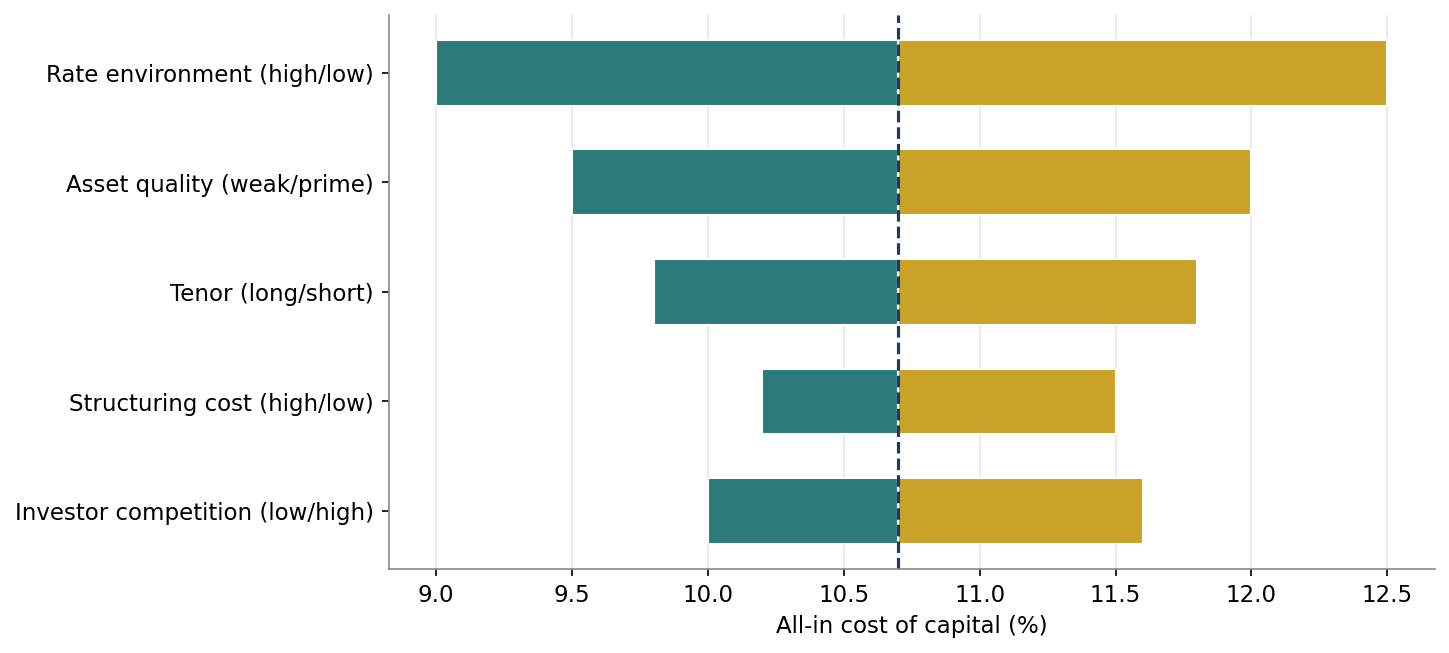
A tornado analysis identifies the variables that most influence the all-in cost of capital for an ultra-premium landbank financing. Figure 8 presents the result.
Figure 8. Sensitivity of All-in Cost to Key Variables
Each bar shows the all-in cost when the labelled variable moves to its low or high case. Dashed line is the base case. Indicative.
The analysis shows that the rate environment and the asset quality dominate the all-in cost, with the tenor, structuring cost and investor competition also significant. The prominence of the rate environment reflects the dollar peg and the long hold, since both routes price off the dollar rate and a higher-rate environment raises the cost of both. The asset quality matters because a prime, well-located, clearly-titled parcel attracts keener pricing from both compliant and conventional financiers than a more marginal one. The investor competition variable captures the benefit of the dual-track process: more competition for the financing lowers its cost, which is the mechanism the dual-track process exploits.
Figure 9. All-in Cost of Both Routes Across the Rate Environment
Both routes price off the dollar rate; the Sukuk advantage persists across the range. Not a forecast.
Figure 9 shows how the all-in cost of both routes varies with the rate environment, and it reveals an important feature: the Sukuk cost advantage over private credit persists across the range of rate environments, because both routes move together with the dollar rate while preserving their relative positions. This means the choice between the routes is largely independent of the rate environment, since a change in rates affects both similarly. The rate environment determines the absolute cost of the financing, but the relative attractiveness of the two routes, and therefore the choice between them, depends on the cost difference and the non-cost dimensions, which are largely unaffected by the rate level.
Table 4. Scenario Matrix for the Route Choice
The route follows the dominant priority and the time available. Not a forecast.
| Attribute | Detail | Note |
|---|---|---|
| Priority | Speed | Competing bidder, deadline |
| Route | Conventional private credit | Fast bilateral facility |
| All-in cost | ~12.5% | Premium for speed |
| Time to fund | ~4 weeks | Secures the parcel |
| Outcome | Speed wins | Cost premium justified |
Implementation Roadmap
Decompose and compare the genuine all-in cost of both routes, including base rate, fees and amortised structuring cost, rather than comparing headline rates.
Identify the dominant priority for the specific financing, cost, speed, flexibility, reach or signalling, tested against the actual circumstances and timeline.
Assess the asset quality and the financing scale, since large, prime parcels favour the Sukuk and time-critical or bespoke situations favour private credit.
Where time and scale permit, run a dual-track process, developing both routes in parallel to discipline pricing and preserve optionality.
Engage specialist Shariah and legal advisers early for the Sukuk route, since the structuring and approval drive its timeline.
Structure the financing to accommodate the income-free hold and to facilitate the eventual development or sale that will repay it, under whichever route is chosen.
Consider the rate environment and whether to fix or float the cost over the long hold, and whether to preserve the ability to refinance if rates improve.
A practical caution about the dual-track process is that it must be genuine to be effective. Providers are sophisticated and can detect a sham process in which the outcome is predetermined and one route is merely being used to extract a concession from the other, and a provider that senses it is being used in this way will disengage or decline to sharpen its terms. The financier must therefore be genuinely willing to proceed with either route, and must conduct the process with the integrity that keeps both providers engaged. A genuine dual-track process delivers the competitive benefit; a cynical one does not, and may damage relationships the financier will need again.
Conclusion
The choice between a Shariah-compliant Sukuk and a conventional private credit facility for ultra-premium landbank is a genuine strategic decision, not a technicality. This paper has shown that the two routes are close on all-in cost, with the Sukuk frequently marginally cheaper, and that they differ meaningfully on the other dimensions: the Sukuk wins on cost, investor reach and signalling, while conventional private credit wins on speed and flexibility. The right choice therefore depends on the financier dominant priority for the specific financing, and the framework in this paper matches the route to that priority.
The central practical conclusion is that, wherever time and scale permit, the financier should run a dual-track process that puts the two routes in competition, capturing a lower cost and better terms than either route would offer in isolation. The financier that internalises these lessons, comparing on a true all-in basis, identifying its dominant priority, keeping both routes open, and running a competitive process, will consistently finance its landbank on better terms than the financier that chooses by habit or assumes the Sukuk is dearer. In the deep and competitive Gulf market, where both the compliant and conventional pools are mature, the contest between the routes is real and the rewards of running it well are substantial, and the frameworks in this paper are intended to help financiers capture them.
| Scenario | Dominant priority | Time available | Indicated route |
|---|---|---|---|
| Patient large hold | Cost and reach | Ample | Sukuk |
| Time-critical buy | Speed | Scarce | Private credit |
| Balanced, large | Cost, with time | Moderate | Dual-track to Sukuk |
| Bespoke structure | Flexibility | Moderate | Private credit |
Limitations and Directions for Further Research
This paper is framework-oriented and relies on indicative data, and its conclusions are directional rather than precise. The cost decompositions, structuring costs and timelines are calibrated to observable conditions but are not empirical estimates, and they vary with the asset, the originator, the rate environment and market conditions. The Sukuk structuring discussion is general and requires specialist Shariah and legal advice for any specific transaction.
Several extensions would strengthen the analysis. An empirical study of realised all-in costs for land Sukuk and conventional private credit facilities across a sample of Gulf transactions would replace the indicative comparison with data. A detailed analysis of the structuring cost and timeline of land Sukuk, and how standardisation is reducing them, would sharpen the speed and cost-of-structuring comparison. And a study of how dual-track processes have performed in practice, and how much pricing benefit the competition delivers, would quantify the central recommendation. Each is a natural subject for a later paper in this series.