

1. Introduction
An acquisition premium is a payment for expectations. The buyer may expect access to customers, distribution, licences, talent, technology, procurement scale, operating density, financing capacity or a stronger competitive position. The transaction price captures part of those expectations at signing, while the operating organisation must create the cash after closing. A board that approves the premium without a measurement architecture accepts an asymmetric position: the seller receives value at completion and the buyer retains the execution risk.
Synergy language can hide several different propositions. A gross opportunity estimates what might be possible. An executable initiative identifies actions that management can control. A run-rate measure annualises a current improvement. An accounting result reflects recognition and allocation under the applicable reporting policies. Realised cash shows what entered or remained in the group after implementation costs, working capital, tax and timing. These measures answer different questions. Treating them as interchangeable inflates confidence and weakens accountability.
The synergy ledger is the buyer's controlled record of acquisition value. It starts before the binding offer and remains active through ownership. Every material value claim has one identity, a documented baseline, a counterfactual, a calculation rule, named owners, dependencies, timing, costs, risks and evidence. Every change is dated and approved. The ledger allows the board to see which part of the premium depends on management action, which part is already present in the target, which part has moved to the seller through price and which part remains exposed.
The framework is relevant to GCC family groups, holding companies, strategic corporates and financial sponsors. These buyers may operate across legal entities, jurisdictions, related-party arrangements and different management-information systems. A ledger does not remove this complexity. It gives the complexity a common evidence structure. The objective is disciplined value capture rather than a favourable retrospective narrative.
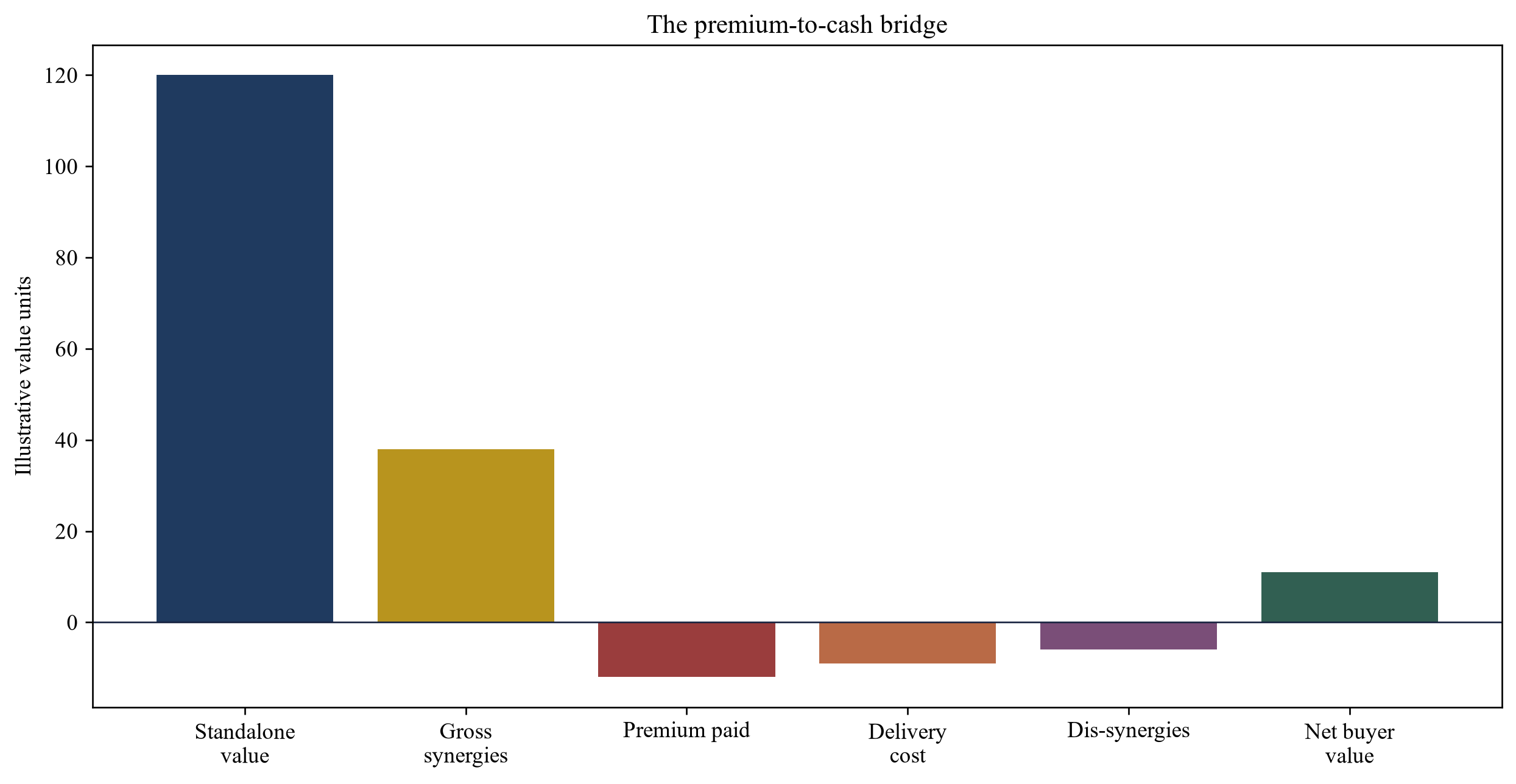
Management framework. The bridge separates the seller's value at completion from the buyer's post-closing execution burden.
2. Define the value perimeter before price
The deal team should define the value perimeter while the acquisition thesis is still capable of changing. The perimeter states which benefits belong to the target on a standalone basis, which arise only from ownership, which require a combination with the buyer and which depend on a future strategic option. This distinction protects the valuation from paying the seller for value that the buyer must fund and execute.
Standalone value includes the target's maintainable cash flows under a credible independent plan. Improvements already funded, contracted or controlled by the target may belong in that plan when the evidence supports them. Ownership value arises from capabilities or decisions available to the buyer after completion. Combination value depends on interaction between the businesses. Option value depends on future choices whose timing, probability and capital requirements remain uncertain. The board should see these categories separately.
The value perimeter also defines exclusions. General market growth, inflation, currency movement and a recovery already embedded in forecasts do not become acquisition synergies merely because results improve after closing. Financing choices should remain visible as financing effects. Purchase-accounting movements and consolidation eliminations can change reported results without representing operating value. A rigorous perimeter prevents these effects from being credited to integration teams.
Price discipline requires a sharing rule. The buyer may transfer part of expected value to the seller to secure control, address competition or reflect negotiating leverage. The investment committee should approve the maximum seller share under base and downside cases. A deal can remain strategically attractive while becoming financially unattractive because too much future value has been capitalised into the offer.
Table 1. Acquisition-value perimeter
| Value category | What it represents | Evidence required | Treatment in price |
|---|---|---|---|
| Standalone value | Maintainable target cash flows without buyer action | Historical quality, contracts, forecast drivers and required investment | Primary valuation base |
| Target-controlled improvement | Action already funded and controlled by the target | Approved plan, owner, capacity and dated milestones | Probability-weighted within standalone plan |
| Ownership value | Benefit available because the buyer controls capital or decisions | Legal ability, authority, implementation plan and cost | Buyer value; seller share explicitly approved |
| Combination value | Benefit from integrating buyer and target capabilities | Joint baseline, dependency map and operating design | Buyer value after cost and dis-synergy |
| Strategic option | Future choice created by ownership | Trigger, capital requirement, expiry and scenario value | Separately disclosed; normally excluded from base case |
| Market movement | External change affecting both businesses | Independent market evidence | Kept outside synergy reporting |
The classification is approved before the final offer and revisited when diligence changes the evidence.
3. The anatomy of a synergy record
Each synergy record should be capable of independent challenge. The title describes an operating outcome rather than a broad aspiration. The baseline identifies the relevant quantity, period, perimeter and source. The counterfactual states what management expects without the initiative. The formula explains how the benefit is calculated. The owner controls delivery; the finance owner controls measurement. Dependencies state what must occur first. Implementation cost, working capital, tax and capital expenditure connect the initiative to cash.
The baseline is often the weakest field. Historical cost can be distorted by one-off activity, foreign exchange, related parties, temporary vacancies, deferred maintenance or inconsistent allocation. Revenue baselines require customer, product, geography, channel, price, volume and retention detail. Procurement baselines require quantities, specifications, supplier terms and rebates. Workforce baselines require filled roles, vacancies, contractors, incentives and statutory obligations. Finance should approve the baseline before the initiative receives value credit.
The counterfactual is equally important. Results after closing combine the initiative with market changes, standalone performance, management action and random variation. A measured saving against an obsolete budget can overstate value. A measured revenue gain against the prior year can understate value when the market declines. The ledger records the method selected: frozen baseline, indexed baseline, matched control, unit economics, cohort analysis or another approved approach.
Evidence matures through stages. A hypothesis can enter the ledger during target screening. Diligence adds source documents and management access. The integration plan identifies actions and resources. Delivery evidence shows contracts, headcount, pricing decisions, migrated customers or changed processes. Finance validates the calculation. The board receives the current confidence stage rather than one undifferentiated headline number.
Table 2. Minimum fields in a synergy ledger
| Field | Control question | Typical evidence |
|---|---|---|
| Initiative identity | Is this one distinct source of value? | Unique identifier, workstream and description |
| Baseline | What amount exists before the action? | Source-system extract, contract, payroll or invoice data |
| Counterfactual | What would occur without the action? | Approved forecast, index or comparison cohort |
| Formula | How is value calculated? | Volume, price, cost, timing and probability rules |
| Ownership | Who delivers and who validates? | Executive owner, workstream owner and finance controller |
| Dependencies | Which decisions or systems must occur first? | Legal, technology, customer, people and regulatory milestones |
| Cost to achieve | What cash and capacity are required? | Separation, integration, adviser, capex and retention budgets |
| Timing | When do run-rate and cash appear? | Monthly phasing and critical path |
| Risks and dis-synergies | What can reduce or delay value? | Attrition, disruption, stranded cost and execution scenarios |
| Evidence and approval | Why should the board rely on the number? | Source links, validation status and dated approvals |
Specialist evidence may add fields. Every material change retains its prior version and approval history.
4. Build a clean baseline and counterfactual
The ledger should preserve the commercial reality of both businesses before integration changes it. The buyer creates a baseline data book with common definitions, controlled extracts and reconciliation to financial reporting. The book contains volume and price, customer and product contribution, procurement categories, headcount and compensation, facilities, technology cost, capital expenditure, working capital and tax. Differences in charts of accounts and management allocation remain visible.
Baseline normalisation follows explicit rules. A one-off cost is removed only when evidence shows that it will not recur and no replacement cost is necessary. A vacancy is not an immediate saving if the role is needed to operate. Supplier rebates are included when the relevant purchasing conditions are met. Revenue is attributed to the relevant entity and period, with intercompany activity eliminated separately. Each adjustment carries a source, owner and approval.
The counterfactual should reflect the most credible path without the synergy programme. For a procurement initiative, the counterfactual may index current unit prices for inflation and volume. For a cross-sell initiative, it may follow matched customer cohorts and existing conversion. For workforce efficiency, it may model the roles needed to support the standalone operating plan. The method should be stable enough to measure performance and flexible enough to reflect a documented structural change.
Finance should lock the first approved baseline after closing and require change control. New information can correct an error; it should not rewrite the starting point to preserve a favourable outcome. A change record explains the cause, quantitative effect, approver and treatment of prior reporting. The board sees original, corrected and current values where the distinction is material.
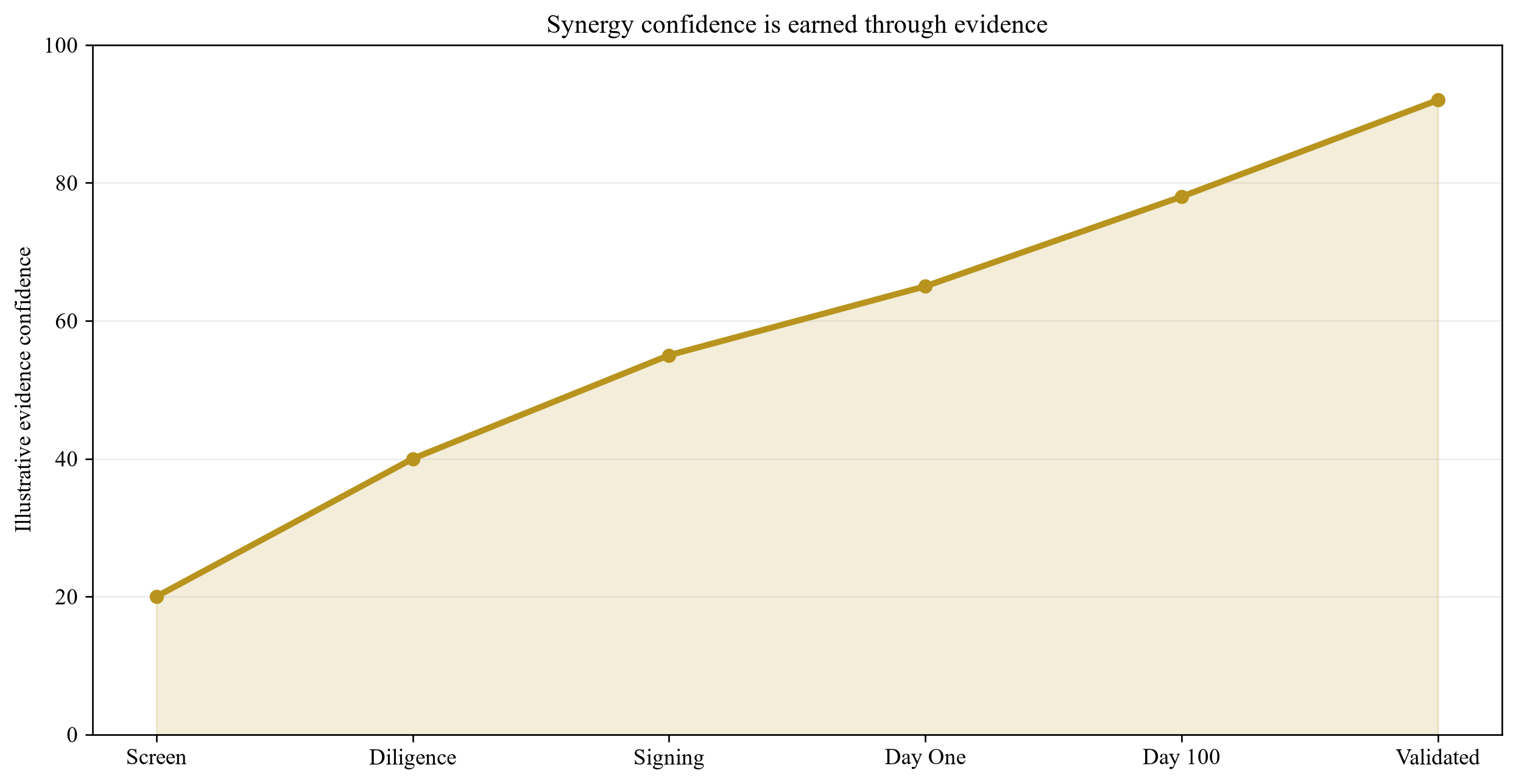
Illustrative management scoring. Confidence increases only when the specified evidence is present.
5. Classify revenue, cost, capital and option value
Revenue synergies need a customer-level route to value. The ledger identifies the customer segment, proposition, decision-maker, sales capacity, conversion assumption, price, contribution margin, churn risk and timing. Gross revenue is not synergy value. The relevant measure connects incremental gross profit to selling cost, onboarding cost, working capital, capital expenditure, cannibalisation and retention. Existing pipeline should not be counted again merely because the buyer owns the target.
Cost synergies require an operating action and a released resource. A negotiated unit-price reduction creates value when purchase volumes, specifications and service levels remain comparable. Headcount value requires an approved role decision, consultation and an operating model that can perform without the capacity. Facility value depends on exit rights, relocation costs and continuity. Technology value depends on licence terms, migration, decommissioning and cyber or operational risk. A budget reduction without resource release remains a target rather than realised value.
Capital synergies can arise through working-capital discipline, lower inventory, improved receivables, asset utilisation, capital-expenditure prioritisation or financing. The ledger distinguishes a permanent reduction in operating capital from a temporary collection push. It separates operating value from capital-structure effects. Financing benefits may be important to equity value, while they should not disguise a weak operating case.
Option value should be governed through triggers. A new geography, product, licence or platform may create future choices. The ledger records the option's required investment, earliest exercise date, decision gate, competitive window and abandonment condition. Until the option becomes an executable initiative, the board sees scenario value separately from committed base-case value.
Table 3. Measurement rules by synergy class
| Class | Primary operating measure | Cash bridge | Frequent overstatement |
|---|---|---|---|
| Cross-sell | Incremental retained gross profit by customer cohort | Selling cost, onboarding, working capital and tax | Counting all post-close sales or existing pipeline |
| Pricing | Net realised price after mix, discounts and churn | Collection timing, rebates and tax | Using list-price movement |
| Procurement | Comparable unit cost times controlled volume | Contract timing, rebates, inventory and transition cost | Applying a percentage to total spend |
| Workforce | Released loaded cost for approved roles | Notice, retention, recruitment, systems and timing | Treating vacancies as savings |
| Facilities | Avoided occupancy and service cost | Exit, fit-out, move and double-running cost | Ignoring lease constraints |
| Technology | Decommissioned run cost and avoided future spend | Migration, licences, security and parallel operation | Counting licences before systems close |
| Working capital | Sustainable reduction at normal service level | Actual cash release and recurrence testing | Claiming a temporary collection drive |
| Financing | Reduction in expected funding cost or required equity | Fees, covenants, refinancing and tax | Treating leverage as operating synergy |
The approved measure should reflect contribution and cash rather than the largest available headline.
6. Put dis-synergies and costs in the same ledger
Integration can destroy value while creating it. Customer disruption, supplier resistance, loss of key employees, slower decisions, systems downtime, duplicated management, brand confusion and regulatory constraints can reduce the expected benefit. The ledger records these effects with the same discipline as positive value. A workstream cannot report a gross saving while another part of the organisation absorbs the resulting cost without a visible bridge.
Cost to achieve includes advisers, severance, retention, relocation, systems migration, contract termination, rebranding, training, process redesign, temporary labour, double running and capital expenditure. The cost profile often precedes the benefit. Liquidity planning should therefore use monthly cash timing rather than a run-rate ratio. The board approves a funded delivery envelope and understands which costs remain unavoidable if an initiative stops.
Stranded cost deserves a separate record. A business may remove activity while shared overhead remains. A seller may cease allocating corporate cost to a carved business, leaving the buyer to create the missing function. A target may end a supplier contract while a minimum commitment remains. The ledger tracks both gross resource removal and net consolidated effect.
Dis-synergy scenarios should change price and protection before signing when evidence allows. A customer whose consent is required can affect valuation, conditions precedent, an earn-out or a retention plan. A system separation requirement can affect completion timing and transitional services. Recording these items only after closing transfers avoidable risk to the buyer.
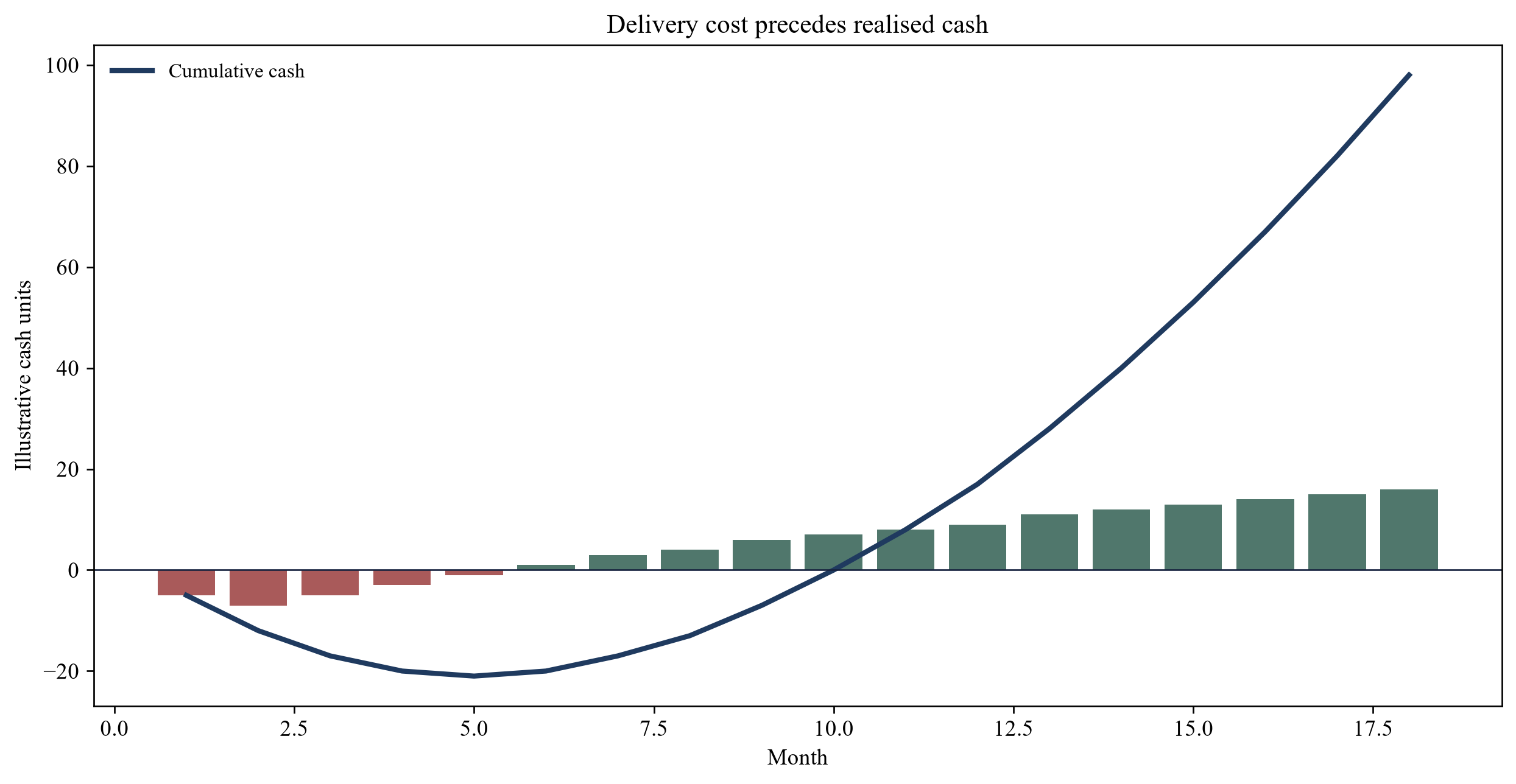
Illustrative model. Early implementation costs can produce a cash trough before cumulative benefits become positive.
7. Connect the ledger to valuation and the agreement
The transaction model and the synergy ledger should share identifiers. Every synergy line in the valuation links to a ledger record. The model carries gross value, probability, timing, tax, implementation cost and terminal assumptions. The board can therefore remove, delay or resize an initiative and see the price and return effect. A model line labelled simply synergies prevents meaningful challenge.
The buyer should calculate the net present value of executable initiatives and compare it with the premium. The comparison includes downside cases and the approved seller share. A premium can be covered in the base case while failing under modest delay or attrition. The board should know the number of initiatives on which the return depends and whether they share common dependencies.
Diligence findings flow into both the ledger and the sale and purchase agreement. A customer dependency can influence a condition, warranty, indemnity, covenant, escrow or contingent consideration. A working-capital opportunity can influence the completion mechanism. A management dependency can influence retention or deferred value. Counsel determines legal drafting; the ledger retains the commercial rationale and quantification.
The agreement can also protect the measurement environment. Pre-completion conduct covenants, access rights, information obligations and restrictions on leakage preserve the baseline. Earn-out measures require precise definitions, accounting policies, decision rights and dispute procedures. The ledger should never substitute for the agreement, while it can reveal where the agreement needs economic precision.
Table 4. How value evidence changes transaction terms
| Evidence issue | Valuation response | Potential transaction response | Ownership response |
|---|---|---|---|
| Customer concentration | Downside revenue and margin case | Consent, retention-linked consideration or protection | Executive sponsor and account plan |
| Unverified procurement saving | Lower probability and delayed timing | Information access and conduct covenant | Category diligence and supplier negotiation |
| Working-capital deficit | Equity-value and liquidity adjustment | Completion accounts and normal-level definition | Daily cash and collections control |
| Key-person dependency | Lower cash-flow confidence | Retention, deferred value or condition | Delegation, documentation and succession |
| Systems separation | Cost and schedule increase | Transitional services and milestone protection | Migration office and continuity testing |
| Regulatory remedy risk | Reduced or excluded combination value | Condition precedent, long-stop and conduct rules | Standalone capability until approval |
Qualified legal, tax and accounting advisers determine the appropriate mechanism for each transaction.
8. Govern Day One and the first 100 days
Day One should preserve the evidence required to manage value. Finance locks the baseline data, integration leadership confirms owners, and management communicates the decision cadence. Critical customer, supplier, people, technology and cash controls become active. The ledger distinguishes initiatives that can start immediately from those restricted by legal separation, consultation, regulatory approval, contract or system readiness.
The first 100 days convert hypotheses into executable plans. Each initiative receives a charter with scope, owner, milestones, resources, risks and acceptance criteria. A value-capture office consolidates workstream reports, resolves duplicates and tests dependencies. Finance validates the baseline and reporting method before a benefit becomes part of the committed forecast.
Initiative sequencing matters. A rapid systems consolidation can jeopardise customer continuity. A procurement action can require product requalification. Workforce change can remove the people needed for migration. The ledger records dependency links so the steering committee sees the value at risk when one milestone moves. The programme should protect franchise value before accelerating extraction.
Management incentives should use measures within the executive's control and should not reward gross opportunity. The board can combine delivery milestones, validated run-rate, realised cash and operating-health indicators. Customer retention, service, safety, compliance and employee continuity provide guardrails. Remuneration decisions remain subject to applicable governance, employment and disclosure requirements.
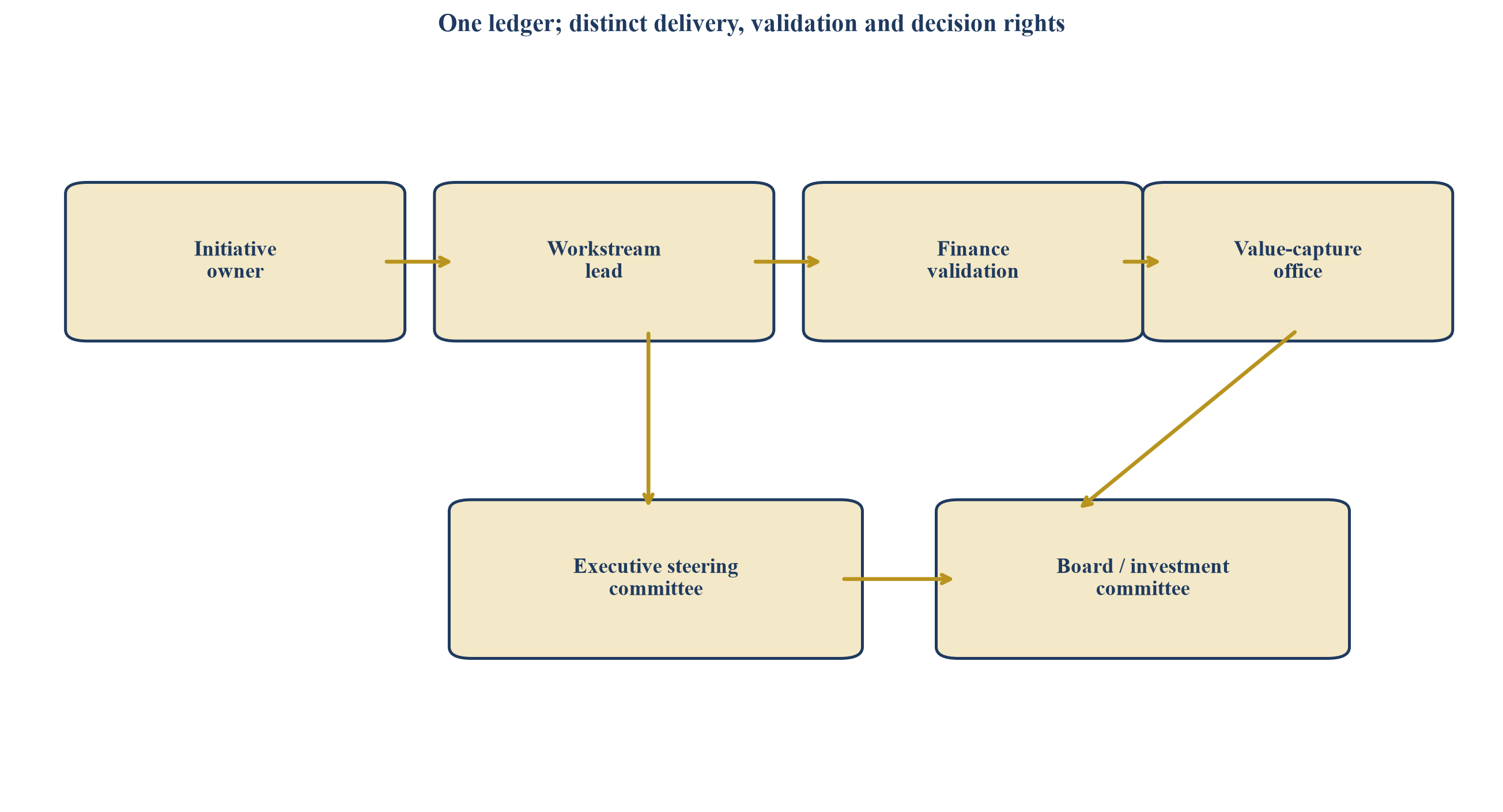
Management framework. Finance validates measurement while executive owners remain accountable for operating delivery.
9. Report run-rate, accounting result and realised cash
The monthly board bridge should start with the original approved deal case. It then shows diligence changes, Day-One corrections, scope changes, delivery variance, timing variance, implementation cost, dis-synergy, realised cash and revised forecast. Original value is never overwritten. The bridge explains why the current case differs and which decision is required.
Run-rate measures the current annualised effect of an initiative. It can provide an early signal while remaining vulnerable to seasonality, temporary action and incomplete cost. Accounting results follow the group's reporting policies and may include acquisition accounting, amortisation, impairment, restructuring and consolidation effects. Realised cash connects operating change to actual receipts, payments, capital and tax. The board should receive all three with clear definitions.
IFRS 3 establishes the acquisition method for business combinations, including recognition and measurement of identifiable assets and liabilities and goodwill. IAS 36 requires goodwill to be tested for impairment at the relevant cash-generating-unit level and sets the recoverable-amount framework. The management ledger does not determine accounting treatment. It can strengthen the evidence used to compare acquisition objectives, operating performance and recoverability, while qualified accountants and auditors retain their responsibilities.
The ledger should reconcile to management reporting at defined control points. Revenue initiatives reconcile to invoices and customer records. Procurement initiatives reconcile to contracts, purchase orders and received quantities. Workforce initiatives reconcile to payroll and organisation records. Working-capital initiatives reconcile to ledgers and bank movement. Finance records residual differences and does not force an allocation where evidence is insufficient.
Table 5. Monthly board value bridge
| Measure | Original case | Current approved | Delivered to date | Board question |
|---|---|---|---|---|
| Gross opportunity | Initial estimate | Evidence-adjusted potential | Not applicable | Has the opportunity changed? |
| Committed run-rate | Approved initiatives | Latest executable forecast | Validated annualised effect | Which dependencies threaten delivery? |
| Cost to achieve | Deal-case budget | Current funded forecast | Cash spent and committed | Is remaining value funded? |
| Dis-synergies | Downside allowance | Current quantified forecast | Observed effect | Which franchise risks require action? |
| Realised cash | Deal-case phasing | Current cash forecast | Bank- and ledger-supported effect | Does cash support the investment thesis? |
| Net present value | Approved valuation | Reforecast using current timing | Not a period measure | Does expected value still cover the premium? |
Values remain in original, approved and current columns so the board can see changes through time.
10. A retained value-capture office
A retained value-capture office provides continuity from diligence through ownership. The office maintains the ledger, baseline book, dependency map, meeting cadence, decision log and board bridge. It coordinates workstreams and specialist input while leaving operating accountability with management and accounting conclusions with finance and auditors.
The retained model is useful when the buyer has several portfolio companies, an active acquisition pipeline or limited permanent integration capacity. The team can preserve methods and lessons across transactions, maintain comparable definitions and help management focus on a small number of material decisions. The retainer should define capacity, deliverables, exclusions, confidentiality, conflicts, specialist budgets, response times and termination.
The weekly cadence includes initiative review, finance validation, risk and dependency resolution and steering decisions. The monthly cadence adds a full bridge to the approved deal case. The office records what management accepted, which evidence was used and how the decision changed value. It should remain independent enough to challenge optimism and close enough to operations to understand constraints.
Success fees linked only to reported synergy can create measurement incentives. Commercial terms should support accurate reporting, timely challenge and durable value. Where performance-linked economics are used, definitions, baselines, validation and conflict management require particular care and compliance with applicable professional obligations.
Table 6. Retained value-capture-office outputs
| Cadence | Output | Decision enabled | Evidence of completion |
|---|---|---|---|
| Continuous | Controlled synergy ledger and source index | Current view of each initiative | Version history and linked evidence |
| Weekly | Dependency, risk and decision pack | Resource and sequencing action | Named decision, owner and due date |
| Monthly | Original-to-current value bridge | Board challenge and corrective action | Approved bridge and forecast |
| Gate-based | Baseline, charter and validation approvals | Move from hypothesis to committed plan | Dated finance and executive approval |
| Quarterly | Premium coverage and cash review | Capital allocation and impairment indicators | Updated downside and recoverability evidence |
| Post-programme | Benefits review and lessons register | Improve the next acquisition | Closed initiatives and retained evidence |
The exact scope depends on transaction size, management capacity, reporting systems and regulatory context.
11. Illustrative GCC acquisition
Consider a GCC business-services group acquiring a regional specialist for an illustrative enterprise value of AED 260 million. The target has maintainable EBITDA of AED 26 million. The buyer identifies AED 18 million of gross annual run-rate opportunity from cross-selling, procurement, duplicated corporate functions and technology. These figures are hypothetical and do not describe a client, company or market forecast.
The initial model treats the opportunity as one line. The ledger separates it into twelve initiatives. Diligence finds that AED 4 million of the cross-sell case relates to existing target pipeline and belongs in the standalone forecast. A procurement initiative depends on customer product approval and moves back six months. Two proposed role reductions would remove capacity needed for a systems migration, so their timing changes. A facility exit has a break cost and twelve months of double running.
The evidence-adjusted gross opportunity becomes AED 13 million. Cost to achieve is AED 9 million over eighteen months. The downside includes AED 3 million of customer and delivery risk. The buyer's price committee reduces the value attributed to synergies and changes its maximum offer. A key customer consent becomes a completion condition, and the systems dependency enters the first-100-day plan.
After closing, the ledger locks customer, spend, headcount and technology baselines. Finance validates a procurement saving when the new contract applies to comparable specifications and received volume. A workforce initiative receives credit when roles leave payroll and the replacement operating model meets service levels. Cross-sell value uses retained gross profit by customer cohort after selling and onboarding cost. The monthly bridge shows run-rate improving before cumulative cash turns positive because implementation spend occurs first.
At Month 12, validated run-rate reaches AED 9 million and realised cash remains lower because several benefits started mid-year. The board sees the gap as timing rather than failure. It also sees one delayed initiative whose dependency now threatens the terminal case. Management funds a specific remediation plan and removes an unsupported option from the base case. The ledger preserves the original thesis, the changes and the evidence for every decision.
12. Implementation roadmap
The buyer can establish the ledger in five steps. First, appoint an executive sponsor, value-capture lead and finance validator. Second, approve the value perimeter, benefit classes, baseline rules, counterfactual methods and change control. Third, convert each material valuation line into a unique initiative record. Fourth, connect diligence findings, transaction protections and first-100-day actions to those records. Fifth, run weekly validation and monthly board bridges from the original case.
The minimum technology can be simple if governance is strong. A controlled register, source repository, calculation model and dashboard can support one transaction. Larger programmes may need workflow, access controls, interfaces to finance and automated evidence capture. Technology choice should follow the decisions and control requirements. A complex dashboard cannot compensate for a weak baseline.
The first review should challenge duplicates and dependencies. Revenue and procurement workstreams may claim the same volume. Workforce and technology initiatives may share the same role or system. Capital benefits may be counted in both cash and valuation without the correct timing. A cross-workstream reconciliation removes overlaps before the board relies on the headline.
The programme should close initiatives deliberately. A delivered initiative retains its evidence and enters normal operating reporting. A stopped initiative records the reason, sunk cost, residual obligation and effect on the deal case. An expired option leaves the base case. The ledger remains available for the post-investment review and future transactions.
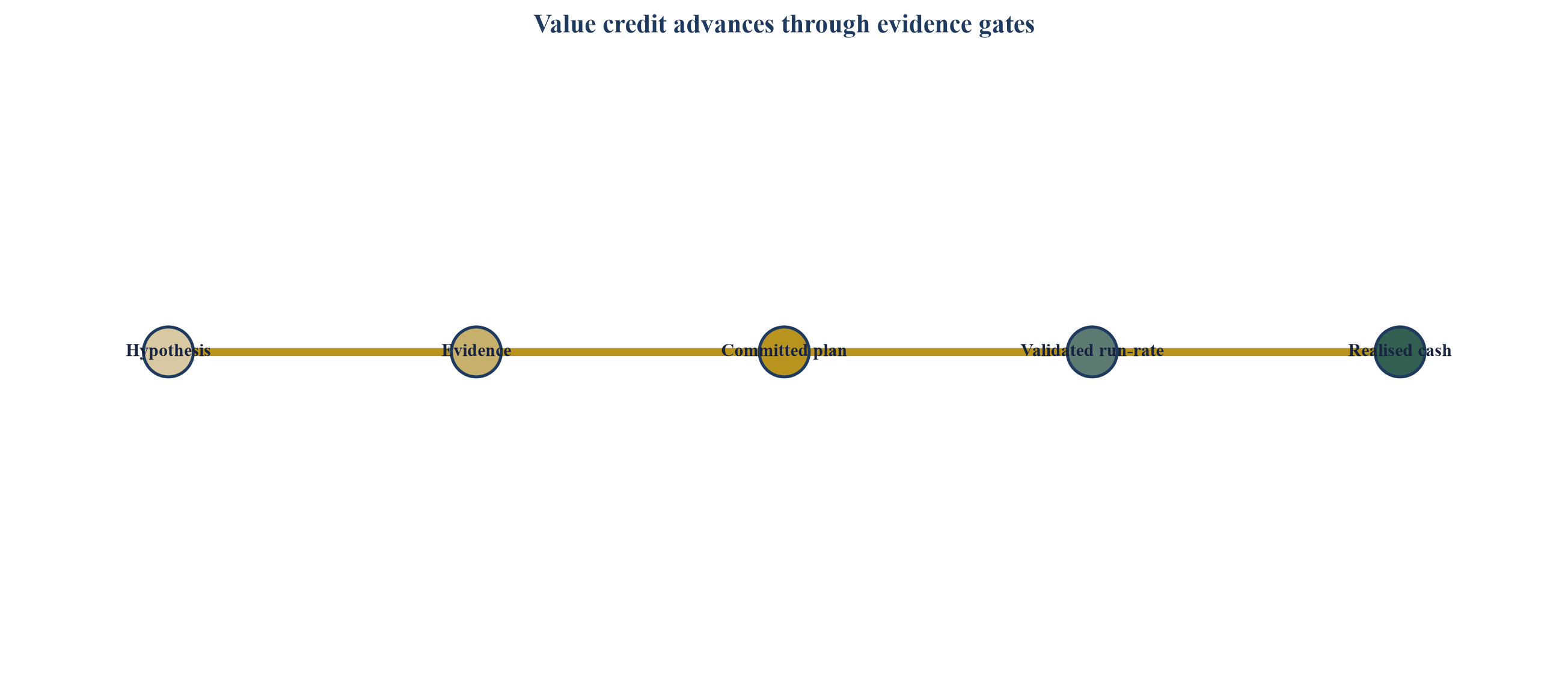
Management framework. A value claim receives forecast credit only after its baseline and executable plan are approved.
13. Limitations and further research
The synergy ledger is a management framework. It does not establish fair value, accounting recognition, legal rights, tax treatment, regulatory approval or investment suitability. These matters require transaction-specific work by qualified professionals. A precise ledger can still contain uncertain assumptions. Its purpose is to make those assumptions visible, owned and revisable.
Measurement becomes difficult when businesses change rapidly, markets move, products overlap or several initiatives interact. Counterfactual performance cannot always be observed. Attribution may therefore remain approximate. The board should prefer a transparent range with a stated method to a precise number unsupported by evidence.
The framework can also create administrative burden. Materiality thresholds should concentrate work on value that affects price, liquidity, risk or the board's decisions. Small operational improvements can remain within ordinary performance management. The ledger should not become a parallel accounting system.
Further research could compare disclosed synergy expectations, implementation costs, cash timing and subsequent performance across GCC transactions. Useful evidence would include revisions from announcement to closing, dependencies identified during diligence, customer and employee outcomes, the relationship between premium and validated cash, and the use of post-investment reviews. Longitudinal data could help distinguish disciplined optimism from systematic overstatement.
14. Conclusion
An acquisition premium creates an obligation to manage value with the same discipline used to negotiate price. The synergy ledger meets that obligation by converting broad claims into controlled initiatives with baselines, counterfactuals, formulas, owners, costs, dependencies, risks and evidence.
The ledger begins before the binding offer, changes the transaction model when diligence changes the facts and follows each material initiative through Day One, the first 100 days, validated run-rate and realised cash. It preserves dis-synergies and implementation costs in the same view. It allows finance to validate measurement, management to own delivery and the board to see whether expected value still covers the premium.
A retained value-capture office can sustain this discipline across transactions and portfolio companies. The final outcome is an accountable chain from acquisition thesis to cash: what the buyer expected, what it paid, what management changed, what evidence supports the result and what the board decided next.
References
- IFRS Foundation. IFRS 3 Business Combinations. https://www.ifrs.org/issued-standards/list-of-standards/ifrs-3-business-combinations/
- IFRS Foundation. IAS 36 Impairment of Assets. https://www.ifrs.org/issued-standards/list-of-standards/ias-36-impairment-of-assets/
- IFRS Foundation. Exposure Draft: Business Combinations, Disclosures, Goodwill and Impairment. https://www.ifrs.org/projects/work-plan/goodwill-and-impairment/exposure-draft-and-cl-bcdgi/
- UAE Securities and Commodities Authority. Annual Report 2024. https://www.sca.gov.ae/assets/download/27cc1e3b/sca-annual-report-english-2024.aspx
- Capital Market Authority, Saudi Arabia. Corporate Governance Regulations. https://cma.org.sa/en/RulesRegulations/Regulations/Documents/CorporateGovernanceRegulations1.pdf
- Capital Market Authority, Saudi Arabia. Merger and Acquisition Regulations. https://cma.org.sa/en/RulesRegulations/Regulations/Documents/Merger%20and%20Acquisition%20Regulations.pdf
- UAE Legislation. Federal Decree-Law No. 36 of 2023 Regulating Competition. https://uaelegislation.gov.ae/en/legislations/2117
- UAE Legislation. Cabinet Decision No. 3 of 2025 concerning economic-concentration thresholds. https://uaelegislation.gov.ae/en/legislations/2788
- Ellahie, A., Huang, X., Tuna, A. I., and Vincenzi, R. Are Merger Synergy Disclosures Credible? 2026. https://papers.ssrn.com/sol3/Delivery.cfm/6815098.pdf?abstractid=6815098
- Paugam, L., Wang, Y., Stolowy, H., and Binder, C. The Construction of Financial Value: Crafting Synergy Estimates in Acquisitions. 2026. https://papers.ssrn.com/sol3/Delivery.cfm/6149046.pdf?abstractid=6149046
- Barrios, J. M., Fujiy, B. C., Lisowsky, P., and Minnis, M. Measurement Matters: Financial Reporting and Productivity. NBER Working Paper 34536, 2025. https://www.nber.org/papers/w34536
- Bloom, N., and Van Reenen, J. Measuring and Explaining Management Practices Across Firms and Countries. NBER Working Paper 12216. https://www.nber.org/papers/w12216
- McKenzie, D. J., and Woodruff, C. Business Practices in Small Firms in Developing Countries. World Bank Policy Research Working Paper 7405. https://documents.worldbank.org/en/publication/documents-reports/documentdetail/812381467999130334
About the Author
Chennakeshav Adya is an independent researcher and corporate finance practitioner with more than twenty years of international experience across business strategy, transformation, investment banking, family-office operations, risk, technology and cross-border transactions. His research focuses on practical decision systems for private capital, corporate finance and transaction execution. The views expressed in this paper are his own.
Appendix A. Synergy Record Template: . Identity and economics
- Initiative identifier, title, class and workstream.
- Standalone baseline, approved counterfactual and source period.
- Gross opportunity, executable value, timing and probability.
- Implementation cost, working capital, capital expenditure, tax and cash profile.
- Premium coverage and downside sensitivity.
. Delivery and evidence
- Executive owner, workstream owner and finance validator.
- Dependencies, milestones, resources and acceptance criteria.
- Customer, supplier, workforce, technology and regulatory guardrails.
- Source links, calculation model, version history and approval dates.
- Run-rate, accounting and realised-cash measures.
Appendix B. Board Gate Questions: . Before the binding offer
- Which value belongs to the target without buyer action?
- Which value requires control, combination or a future option?
- Which initiatives have source-supported baselines and executable owners?
- How much expected value has moved to the seller through the premium?
- Does the downside case cover cost, dis-synergy, delay and common dependencies?
. During ownership
- Which changes from the original deal case are supported by new evidence?
- Which initiative is material to premium coverage and exposed to delay?
- How do validated run-rate, accounting result and realised cash differ?
- Which dis-synergy or implementation cost requires board action?
- Does the current evidence support the remaining acquisition thesis?
