

1. The perimeter is the first valuation decision
A carve-out separates a business from a larger organisation and transfers it to a new owner or an independent structure. The transaction may concern a subsidiary, division, product line, geographic operation, portfolio of contracts or selected assets and liabilities. The legal documents define what transfers. The business must still be able to invoice, collect cash, pay employees, serve customers, control data, obtain supplies, operate technology and comply with licences immediately after completion.
Three perimeters need to agree. The legal perimeter lists shares, assets, liabilities, contracts, employees, intellectual property and obligations that transfer. The operating perimeter describes the capabilities, resources, authorities and services required to function. The financial perimeter defines the revenues, costs, assets, liabilities, cash flows and allocations used to represent historical and future economics. A difference among these perimeters is a source of price risk, execution risk or transition cost.
IFRS 5 requires separate presentation for qualifying disposal groups and discontinued operations and focuses attention on which assets, liabilities and results belong to the component.[1] SEC staff guidance accepts carve-out financial statements in defined circumstances where identifiable assets and liabilities exist and reasonable allocation bases are available.[2] The guidance also recognises that historical information may omit future operating expenses of an autonomous entity and requires limitations and material assumptions to be explained.[3] These principles support a practical management rule: historical allocation is evidence about the past; standalone cost is a designed view of the future.
The separation team should create a perimeter ledger at the start of the process. Each line records the item, current owner, user, legal transfer treatment, Day-One treatment, future-state owner, cost, data dependency, consent requirement, control consequence and evidence. The ledger becomes a common reference for the sale and purchase agreement, disclosure process, standalone model, transition services agreement, separation plan and board papers.
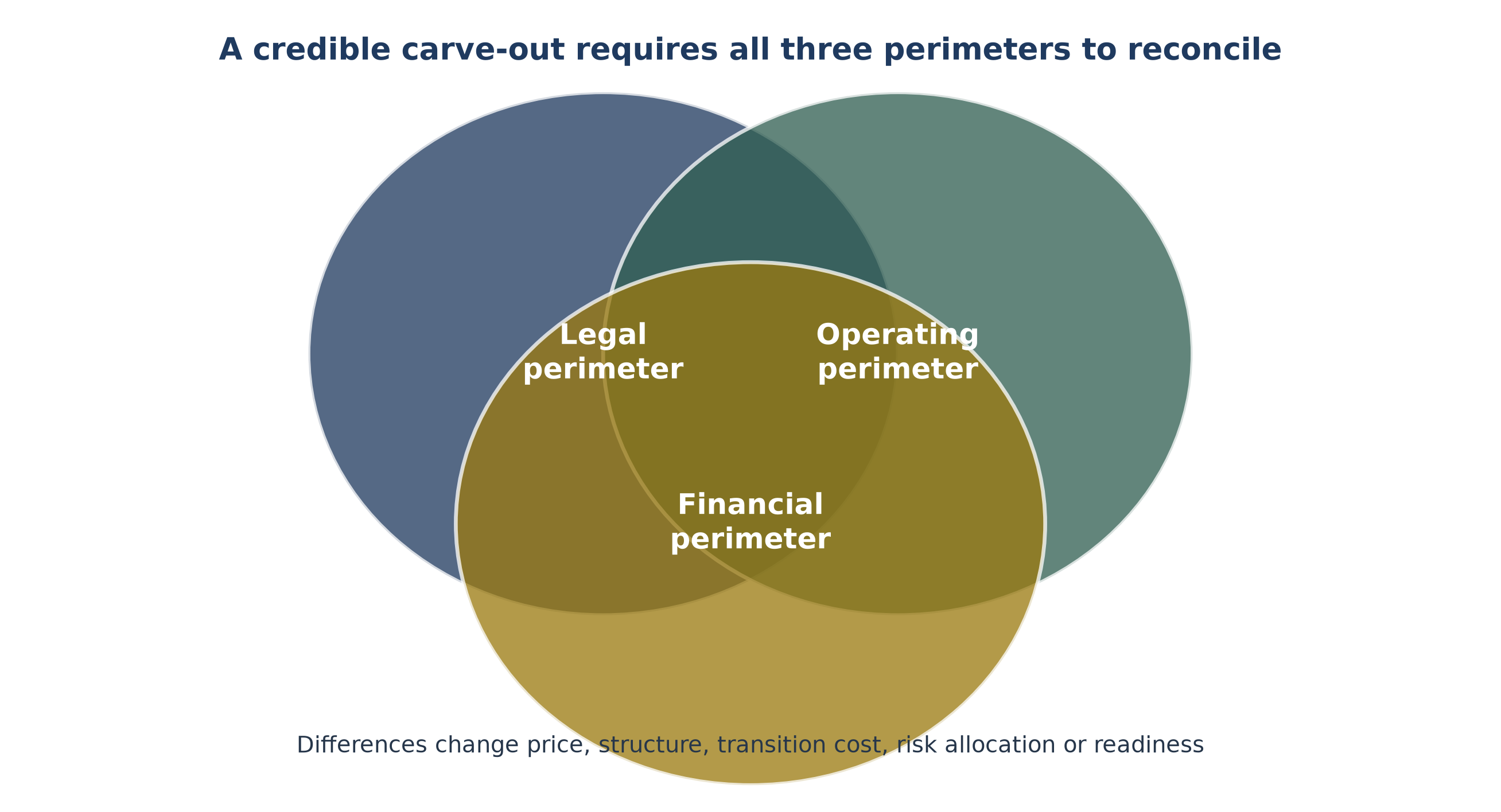
Management framework. Each difference among the legal, operating and financial perimeters requires an explicit treatment.
2. Establish governance before the transaction calendar accelerates
The carve-out requires a separation management office with a written charter. Its authority should cover the master plan, dependency register, perimeter ledger, issue and decision logs, Day-One evidence, transition services, cost model, leakage ledger and executive reporting. Legal, tax, accounting, technology, employment and regulatory specialists retain responsibility for their professional advice. Business leaders retain responsibility for customers, operations and people.
Seller and buyer have related but distinct objectives. The seller wants value certainty, controlled information sharing, continuity for the retained group, a bounded transition burden and a clean exit. The buyer wants a viable business, transparent costs, access to required services, control of data and customers, and a credible route to independence. Management of the carved business needs authority, resources, clarity and an achievable operating model. Governance should surface these interests and record where the transaction documents allocate them.
The office should use stage gates. Perimeter confidence precedes a reliable standalone model. The standalone model precedes committed valuation and financing. The transition-services catalogue precedes drafting of measurable service terms. Day-One design precedes testing. Exit planning begins before a transition service starts. Each gate identifies required evidence, decision owner, unresolved exceptions and the economic consequence of proceeding.
Pre-completion information sharing and coordination need legal control. When seller and buyer are actual or potential competitors, clean-team arrangements, restricted data sets and legal review may be required. The office records the permitted purpose, recipient, access method, retention period and decision right for sensitive information. Operational preparation should remain within the transaction documents and applicable competition, privacy and sector requirements.
Table 1. Separation governance and evidence
| Governance layer | Primary decision | Controlled evidence | Escalation trigger |
|---|---|---|---|
| Board or investment committee | Approve perimeter, value, risk and reserved matters | Transaction thesis, value bridge, red risks and readiness opinion | Material value change, inability to separate or unacceptable liability |
| Executive steering committee | Resolve cross-functional priorities and resources | Master plan, dependency map, leakage ledger and decision log | Missed critical path, service failure or unresolved ownership |
| Separation management office | Integrate the separation system | Perimeter ledger, plan, evidence index, risk and issue logs | Dependency with no owner, due date or accepted treatment |
| Workstream leaders | Deliver operating outcomes | Tests, reconciliations, approvals and acceptance records | Failed test, capacity shortfall or control weakness |
| Specialist advisers | Provide qualified advice | Written advice, filings, opinions and conditions | Change in facts, jurisdiction or transaction structure |
The transaction's governing documents and applicable law determine actual authority.
3. Build a dependency register before designing transition services
An entanglement exists when the carved business depends on the seller or retained group for a resource, service, authority, contract, system, licence, data set, facility, person or control. The team should identify dependencies through process walks, system and contract inventories, interviews, data lineage, payment flows, customer journeys, closing calendars and incident histories. A general functional checklist is useful; detailed evidence determines the actual perimeter.
Each dependency receives one of five treatments: transfer, duplicate, replace, terminate or bridge temporarily. Transfer may require consent, novation, migration or assignment. Duplication creates a separate capability using current design. Replacement selects a new provider, system or process. Termination removes a dependency that the future business does not need. A bridge becomes a transition service with a defined exit.
The register should record incoming and outgoing dependencies. The carved business may rely on parent treasury, cybersecurity, payroll, procurement, legal, tax, insurance and enterprise systems. The retained group may rely on the carved business for shared facilities, specialist employees, customer contracts, manufacturing capacity, licences or data. An incomplete outgoing view can damage the seller after completion.
Criticality is assessed through consequence and recovery time. A delayed brand redesign is different from inability to pay employees, authenticate users, ship a regulated product or collect customer cash. The team should identify the maximum tolerable outage, workaround, test method, control owner and decision deadline. NIST contingency-planning guidance provides a useful structure for business-impact analysis, recovery strategies, testing and plan maintenance, while implementation remains specific to the organisation.[4]
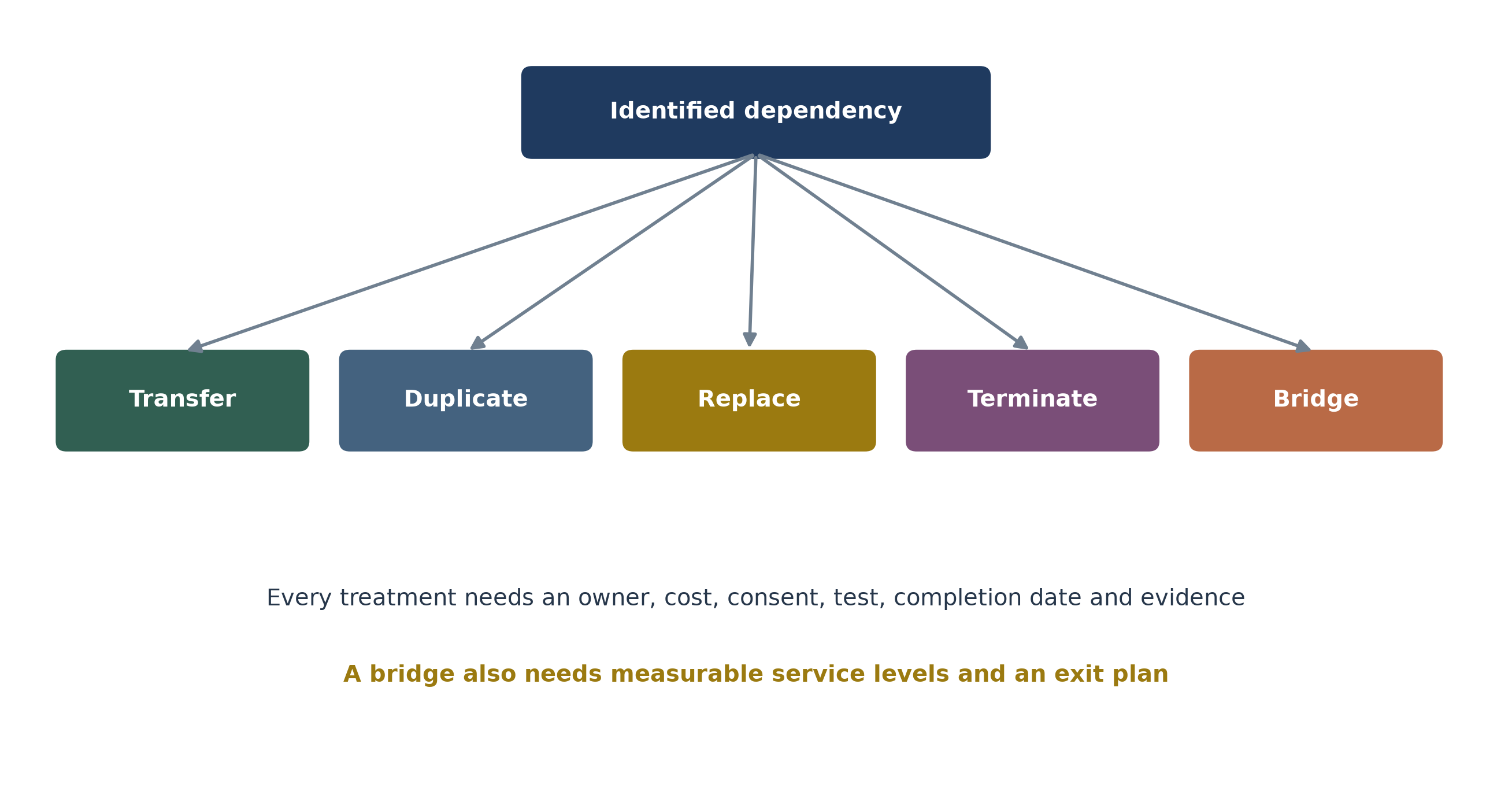
Management framework. Specialist and legal review determine whether a dependency can be transferred, duplicated, replaced, terminated or bridged.
4. Separate historical allocation, standalone run-rate and separation cost
The cost model needs three views. Historical attributed cost shows direct costs and allocated shared costs in the seller's records. Standalone run-rate estimates the recurring cost of operating the business under the buyer's intended model. One-time separation cost estimates the temporary expenditure required to reach that model. Mixing these views can overstate EBITDA, underfund separation or create disagreement after signing.
Direct costs are usually traceable to the business. Shared costs require documented allocation. An allocation basis should reflect the consumption or driver of the service, such as headcount, transaction volume, sites, users, revenue, computing demand or management effort. The basis should be consistent, reproducible and disclosed. An allocation that makes historical reporting possible may still be unsuitable for forecasting autonomy.
Standalone run-rate starts from the required capability. The team decides whether each capability will be built internally, purchased, shared under a long-term agreement, supplied through the buyer or discontinued. It estimates service volume, unit cost, minimum viable capacity, control requirements, local presence, escalation support and management overhead. Dis-synergies such as lost purchasing scale, duplicated leadership, separate insurance or reduced credit terms belong in the model.
One-time separation cost includes data extraction, system cloning or implementation, licences, contract novations, facility changes, recruitment, retention, branding, legal-entity formation, consulting, audit, tax work, cyber remediation, cutover support and stranded-cost removal. Cost timing matters because cash may be required before the carved business produces distributable cash. Seller and buyer need a funding schedule and approval thresholds.
Table 2. Cost taxonomy for a carve-out
| Cost class | Question | Typical evidence | Valuation or execution effect |
|---|---|---|---|
| Direct historical cost | What did the business itself consume? | Ledgers, invoices, payroll and contracts | Historical profitability and quality of earnings |
| Allocated shared cost | Which parent cost was attributed and on what basis? | Allocation policy, drivers and reconciliations | Comparability and transparency |
| Standalone recurring cost | What will autonomous operation require? | Future operating model, supplier quotes and staffing | Future EBITDA and financing capacity |
| One-time separation cost | What must be spent to reach autonomy? | Project plan, estimates, bids and contingency | Purchase price, funding and completion mechanics |
| Stranded seller cost | Which retained cost remains after the sale? | Contracts, headcount, property and exit plan | Seller's net proceeds and value case |
| Transition-service cost | What temporary service and exit support is required? | Service catalogue, volume, price and duration | Cash flow, risk allocation and exit incentive |
The model should state currency, timing, tax treatment, contingency and ownership for every material line.
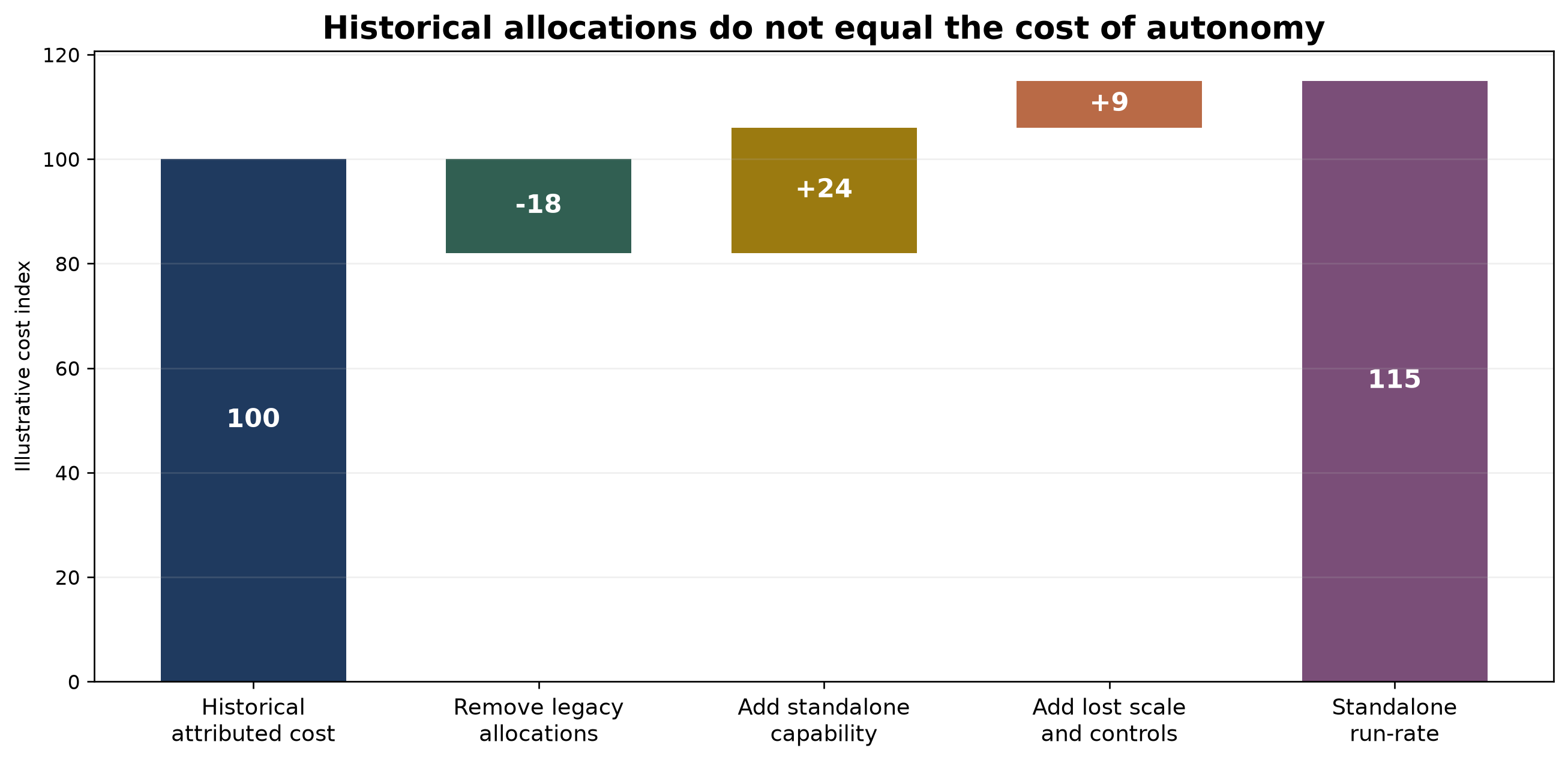
Illustrative management bridge. Amounts are not transaction data.
5. Design transition services as controlled bridges
A transition services agreement, or TSA, allows one party to provide defined services after completion while the recipient builds or connects its future-state capability. Common services include finance operations, payroll, human resources, information technology, cybersecurity, procurement, facilities, logistics, tax support, regulatory reporting and customer administration. A TSA can protect continuity; an open-ended or poorly specified TSA can preserve dependency and generate dispute.
The service catalogue is the operational core of the agreement. Each service needs a description, users, locations, systems, inputs, outputs, hours, volumes, service levels, control requirements, data rules, excluded activities, price, tax treatment, term, extension mechanism, change process, incident route, liability treatment and exit criteria. The catalogue should identify subcontractors and fourth-party dependencies where relevant.
Pricing should be explicit. Cost-based pricing may use an agreed cost pool and allocation basis. Fixed pricing provides budget certainty but needs volume assumptions and change rules. Market pricing may be appropriate where comparable providers exist. The agreement should address currency, indirect tax, withholding, pass-through cost, extraordinary support and late changes. Pricing can include incentives for timely exit, subject to legal and commercial advice.
Service levels should measure outcomes the recipient can observe. Payroll completion, invoice processing, system availability, access provisioning, incident response, close deadlines and report delivery can be tested. Broad obligations to provide services consistently with past practice may need supporting baselines and exceptions. The recipient also has dependencies, such as timely data, authorised instructions and access to personnel. These reciprocal obligations belong in the service design.
Exit plans should be attached to each material service before it begins. The plan identifies future provider, data extract, knowledge transfer, testing, parallel run, acceptance, cutover, rollback, decommissioning and evidence. The service cannot be considered exited merely because the contract date arrives. The future capability should operate at accepted performance and control levels.
Table 3. Minimum transition-service design
| Dimension | Required definition | Acceptance evidence |
|---|---|---|
| Service | Activity, users, geography, systems, inputs and outputs | Approved service description and process map |
| Performance | Hours, volume, quality, availability and response | Reports, reconciliations and incident records |
| Control | Access, approvals, segregation, retention and audit | Control matrix and test results |
| Economics | Price, allocation, tax, pass-through and change | Invoice model and agreed drivers |
| Duration | Start, term, extension and termination | Critical path and approved decision dates |
| Exit | Future provider, migration, testing and cutover | Exit plan, acceptance test and handover record |
| Governance | Owners, meetings, escalation and dispute | Governance calendar and decision log |
Contract wording and liability allocation require qualified legal advice.
6. Treat Day One as an evidence gate
Day One is the first operating day under the completed transaction. The objective is controlled continuity under the new ownership and contractual structure. Structural optimisation can follow when authority, evidence and resources support it. The readiness plan should be organised around outcomes rather than departmental activity.
Authority means valid directors, signatories, powers, delegated limits, banking access, system administrators and licensed responsible persons. Cash means opening balances, payment instructions, payroll funding, collection accounts, working-capital facilities and reconciliation. People means employment documentation, work permits, payroll, benefits, communications, reporting lines and critical-role coverage. Customers and suppliers need valid contracts, consent treatments, ordering routes, invoicing details, service continuity and issue contacts.
Technology readiness includes identities, networks, applications, devices, interfaces, backups, monitoring, incident response, cybersecurity controls and support. Data readiness includes lawful access, migration, retention, deletion, cross-border transfer, customer commitments and evidence of separation. Property and operational readiness include access, utilities, safety, inventory, logistics, insurance and permits. Finance and control readiness include ledgers, chart of accounts, opening balances, approvals, close procedures, tax records and management reporting.
UAE employment processes require formal offers, contracts and work permits, and official guidance describes consent and Ministry approval requirements for changes to employment terms.[5] MoHRE's cancellation procedure also requires defined filings and employee acknowledgement in applicable cases.[6] The precise route depends on structure, jurisdiction and workforce facts. The separation plan should avoid assuming that employees or sponsorship arrangements transfer automatically.
The readiness opinion should state which controls passed, which operate under approved temporary arrangements, which failed and which require a board waiver. Evidence may include executed documents, screenshots, sample transactions, reconciliations, test records, approval logs and signed acceptance. A green status without evidence is a reporting opinion.
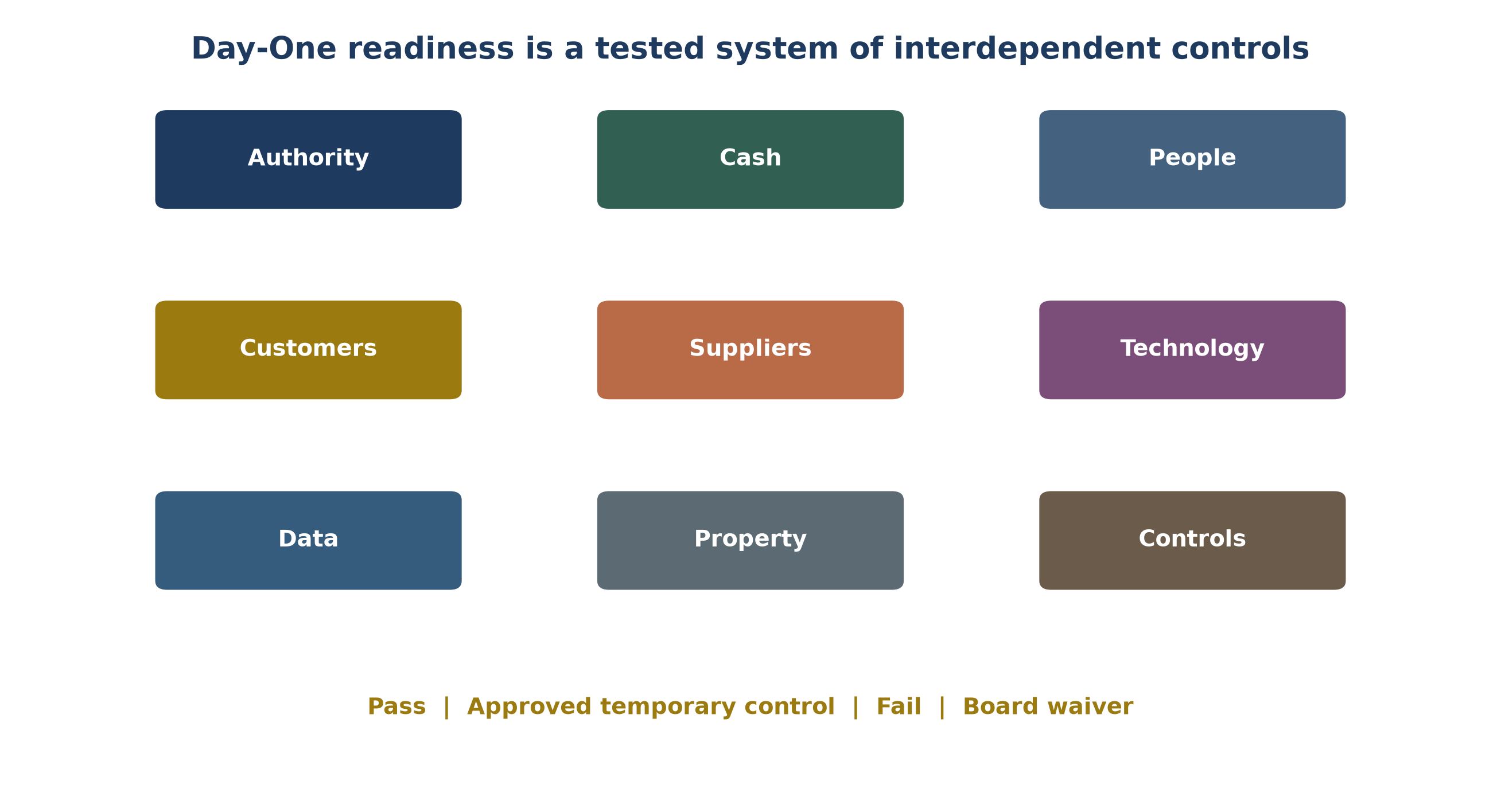
Management framework. Every domain requires an owner, test and accepted evidence.
Table 4. Illustrative Day-One readiness evidence
| Domain | Minimum Day-One outcome | Example test | Evidence owner |
|---|---|---|---|
| Authority | Valid governance and delegated decisions | Approve and record a reserved transaction | Company secretariat and legal |
| Cash | Receive, reconcile and pay safely | Customer receipt, supplier payment and payroll sample | Finance and treasury |
| People | Employees know employer, role, pay and escalation | Contract and payroll sample; critical-role roster | Human resources |
| Customer | Service and invoicing continue | Order-to-cash walk and customer-contact test | Commercial operations |
| Supplier | Purchase and delivery continue | Purchase-to-pay walk and consent sample | Procurement and operations |
| Technology | Users access supported, secure systems | Identity, application, backup and incident test | Technology and security |
| Data | Data is accessible and controlled lawfully | Access, transfer, retention and deletion sample | Data owner and legal |
| Control | Transactions are authorised and reported | Approval, posting, close and reconciliation sample | Finance and internal control |
Actual evidence depends on the jurisdiction, sector, operating model and transaction documents.
7. Make technology and data separation a business decision
Technology separation can determine the transaction timetable. The carved business may use a parent identity domain, enterprise resource planning instance, customer platform, data warehouse, cloud tenant, security operations centre, network, endpoint tools, software licences and vendor agreements. Interfaces can connect hundreds of processes. A simple application list does not describe these dependencies.
The architecture decision should be made capability by capability. Options include cloning a current environment, migrating to the buyer's stack, implementing a new system, using a managed service or operating temporarily under a TSA. The decision considers speed, cost, control, data, licensing, scalability, cyber exposure, change capacity and eventual exit. A fast clone may preserve legacy complexity. A rapid implementation may create operational risk. A long TSA may delay control and autonomy.
Data separation needs a data-product view. The team identifies the business purpose, system of record, fields, history, quality, legal basis, contractual restrictions, localisation, recipient, transfer method, validation, retention and deletion evidence. Shared master data and combined records require a rule for partitioning, reference access or replacement. Copies, archives, backups, logs and derived data need treatment.
Cybersecurity controls should operate through the transition. Privileged access, remote support, service accounts, keys, certificates, security monitoring and incident responsibilities deserve explicit ownership. The cutover plan should include freeze rules, rehearsal, rollback, escalation and evidence preservation. A clean legal separation with shared privileged access remains an operational dependency.
8. Separate contracts, licences, people and property deliberately
Contracts can transfer by assignment, novation, consent, replication, subcontracting or another legally advised mechanism. The team records change-of-control provisions, anti-assignment language, termination rights, pricing changes, guarantees, data obligations, service levels and dependencies. Customer and supplier communications should align with consent requirements and commercial strategy.
Licences, registrations and permits may attach to a legal entity, facility, product, activity or responsible person. The future business needs an inventory of issuing authority, holder, scope, conditions, renewal, transferability, lead time and Day-One treatment. Regulated operations may require approval before control changes or activities move. The plan should include a stop condition where lawful operation cannot be evidenced.
People separation combines legal process and operating design. The roster identifies employees, employer, role, location, visa or work-permit status, compensation, benefits, leave, incentive, pension or gratuity treatment, intellectual-property obligations, data access, criticality and proposed future role. Shared employees require a decision about transfer, secondment, service provision, replacement or temporary support. Communication should be accurate, timed and consistent with legal advice.
Property treatment includes owned and leased premises, access, utilities, permits, security, maintenance, shared areas, equipment, inventory and environmental or safety obligations. Co-location after completion requires rules for access, confidentiality, safety, cost and exit. Physical separation can have the same critical path as technology.
Table 5. Consent and transfer control
| Item | Current holder | Transfer mechanism | Third-party action | Day-One bridge | Evidence |
|---|---|---|---|---|---|
| Customer contract | Seller entity | Novation or consent | Customer approval | Seller collection or subcontracting if lawful and agreed | Executed consent and billing test |
| Software licence | Parent group | New licence or assignment | Vendor approval | TSA access | Licence, user test and exit date |
| Work permit | Current employer | Cancellation and new permit process | Authority and employee actions | Legally advised interim arrangement | Approved permit and contract |
| Facility | Parent or landlord | Lease, sublease or new premises | Landlord consent | Transitional occupancy | Executed document and access test |
| Sector licence | Licensed entity | Approval, amendment or new licence | Regulator | Restricted operating model if permitted | Licence and conditions register |
This is an operating register structure, not legal advice.
9. Integrate tax, legal entity and financial control design
The transaction structure affects which assets, liabilities and contracts move and how the transfer is taxed. UAE Federal Tax Authority guidance explains that Business Restructuring Relief may allow a qualifying transfer of an entire business or an independent part of a business without an immediate gain or loss for corporate-tax purposes, subject to conditions and potential clawback.[7] The guidance states that it is not legal or tax advice and that circumstances must be considered. The carve-out office should translate specialist advice into transaction steps, evidence, ownership and post-completion obligations.
The entity plan should cover incorporation, ownership, governance, banking, registrations, accounting, tax, invoicing, customs, transfer pricing, payroll, licences, insurance and reporting. Each entity needs a readiness date and opening balance sheet. Intercompany arrangements should state service, price, term, authority and documentation. The organisation should avoid using a new legal entity as evidence that operational capability exists.
Opening balances need a controlled bridge from the seller's records to the carved entity. The team defines assets, liabilities, provisions, working capital, cash, debt, intercompany balances, tax positions, leases, employee obligations and contingent items. Reconciliations should connect the purchase agreement, completion mechanism, statutory books and management reporting. Disputed items belong in a resolution process with preserved evidence.
10. Govern value leakage through a dedicated ledger
Value leakage occurs when economic value moves outside the agreed transaction case or is destroyed during separation. It can arise through revenue disruption, customer loss, weaker pricing, supplier changes, inventory problems, delayed collections, stranded cost, duplicated cost, separation overruns, tax, failed controls, service penalties, talent loss, delayed exit from TSAs or unresolved liabilities.
The leakage ledger records the baseline, event, economic mechanism, gross exposure, probability, mitigation, owner, due date, contractual treatment, accounting treatment, cash timing and evidence. It distinguishes actual cash loss, forecast risk, timing shift and accounting reclassification. Finance validates material amounts. The board sees both the gross transaction value and the net separation economics.
Leakage controls should begin before signing. A weak perimeter can generate purchase-price uncertainty. A missing consent can reduce revenue or delay completion. An understated standalone cost can make the buyer's valuation unsustainable. A slow TSA exit can reduce both buyer value and seller focus. The office treats each issue as a decision with an explicit economic consequence.
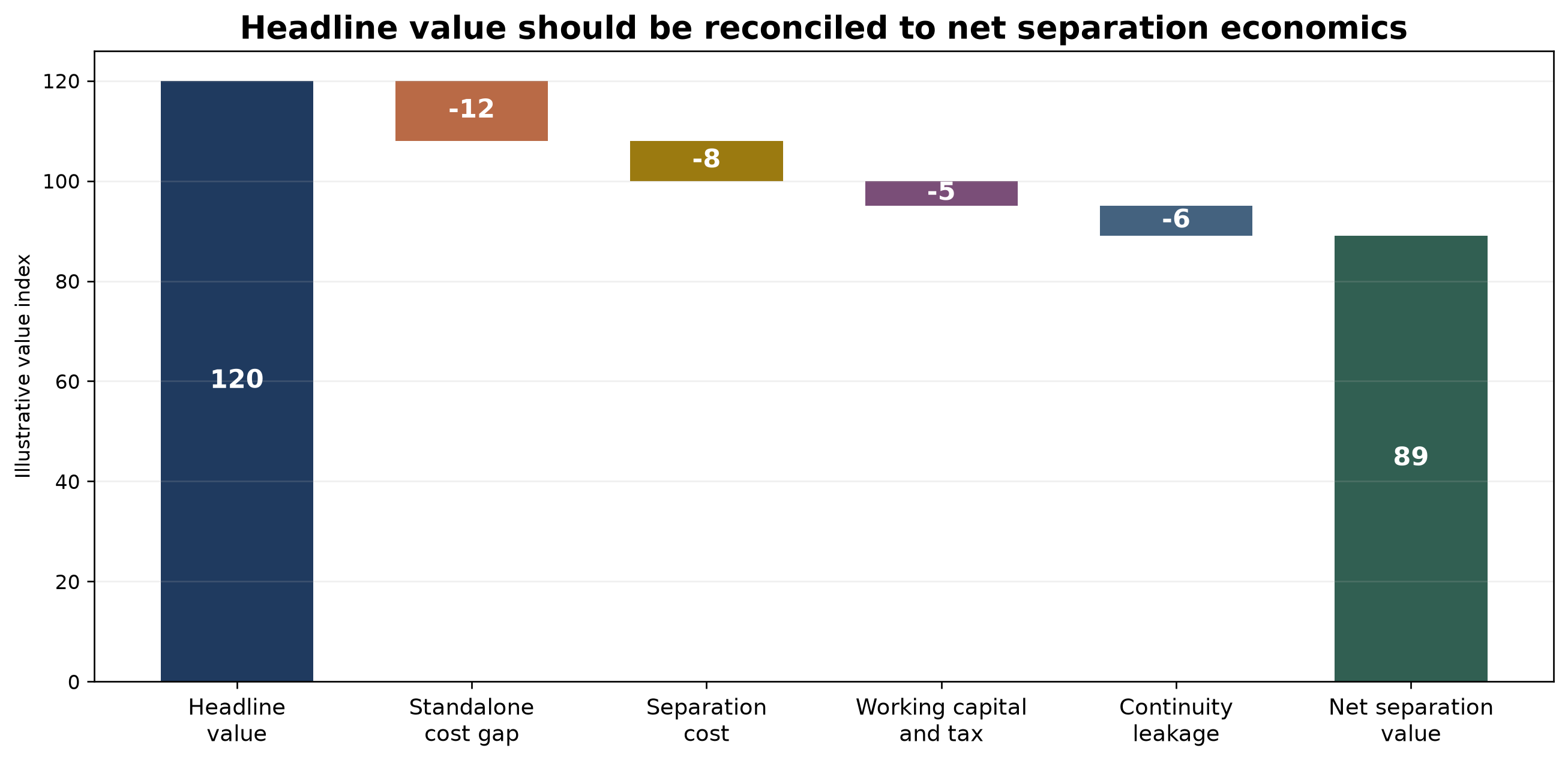
Illustrative management bridge. Amounts are not transaction data.
Table 6. Leakage-ledger fields
| Field | Purpose | Board use |
|---|---|---|
| Baseline and counterfactual | Define the economic reference | Test whether the issue changes the approved case |
| Event and mechanism | Explain how value changes | Select mitigation, structure or contractual protection |
| Gross exposure and probability | Size the risk consistently | Allocate contingency and decision attention |
| Cash timing | Distinguish permanent loss from timing | Plan liquidity and completion funding |
| Owner and due date | Establish accountability | Escalate unresolved critical-path actions |
| Contractual treatment | Connect the issue to the transaction documents | Evaluate price, indemnity, covenant or condition |
| Evidence and approval | Preserve the decision trail | Validate reported value and accepted residual risk |
Finance should control measurement rules for material items.
11. Worked case: a GCC services division becomes independent
Consider a multi-country services division sold by a diversified group. The division has its own customers and operating staff. It shares the parent's treasury, payroll, cyber monitoring, enterprise resource planning, procurement contracts, office space, insurance and brand. Several customer contracts sit in parent entities. Historical financial statements allocate central cost by revenue and headcount.
The perimeter review finds that customer cash is collected into parent bank accounts, supplier credit depends on group guarantees and critical staff use parent-sponsored work permits. The technology review finds a shared identity domain and a combined customer database. The initial standalone model removes the seller's allocation but does not include a replacement finance team, security operations, separate insurance or lost purchasing scale. The initial transaction case therefore overstates autonomous EBITDA.
The separation office rebuilds the cost model capability by capability. It adds minimum finance, technology, security and governance capacity, receives quotes for insurance and systems, and models supplier terms under standalone credit. It classifies system implementation, data extraction, branding, legal entities and permit work as one-time separation cost. The buyer uses the revised run-rate in valuation and financing.
The TSA catalogue covers payroll, ERP, cybersecurity monitoring, treasury operations, procurement, facilities and contract administration. Each service has a volume, service level, cost, owner and exit date. Payroll exits after new permits, contracts and parallel-run acceptance. Treasury exits after bank accounts, mandates, payment files, collection instructions and working-capital facilities pass testing. Cybersecurity exits after identities, logging, incident response and managed-service controls are accepted.
The Day-One plan uses temporary controls for customer collection and selected systems. These controls are written into the transaction and service arrangements. The readiness opinion identifies two red items: an unapproved sector registration in one jurisdiction and incomplete data partitioning for a combined customer platform. Completion in that jurisdiction is deferred until the licence is obtained. Access to the combined platform is restricted and monitored while a legally approved data-separation plan is executed.
The board receives a value bridge showing headline consideration, standalone cost correction, one-time separation cost, working-capital effect and residual leakage risk. It also receives the TSA exit critical path. This integrated view allows price, completion conditions, funding and transition obligations to be decided together.
12. A retained carve-out office
Many organisations divest businesses intermittently. They may have strong functional leaders and advisers without a permanent separation-management system. A retained carve-out office supplies the integrated governance, evidence and decision cadence while management and specialists retain their authority.
The office can begin with a paid perimeter and standalone-cost diagnostic. The diagnostic produces a perimeter confidence assessment, dependency heat map, initial standalone bridge, separation-cost range, TSA candidate list, Day-One critical path and board questions. A recurring mandate then maintains the master plan, evidence index, leakage ledger, decision log, TSA design, readiness testing and executive reporting.
The mandate should define deliverables, acceptance criteria, information rights, client responsibilities, specialist interfaces, capacity, reporting cadence, confidentiality and fees. The office should not certify legal, tax, accounting, employment, technology or regulatory conclusions outside its competence. It should convert qualified advice into owned actions and visible decisions.
Table 7. Illustrative retained carve-out office cadence
| Cadence | Output | Decision enabled |
|---|---|---|
| Daily during cutover | Critical incidents, tests and decisions | Continue, pause, rollback or escalate |
| Weekly | Master plan, dependencies, red issues and leakage | Resource and priority decisions |
| Fortnightly | Standalone model, separation cost and TSA exit | Value, funding and commercial decisions |
| Monthly board cycle | Readiness opinion and net separation value | Approve gates and accept residual risk |
| Post-completion | TSA performance, exit and handover | End services and transfer accountability |
The actual cadence depends on transaction size, complexity and timetable.
13. Board questions before approval
The board should ask whether the legal, operating and financial perimeters reconcile; whether material differences have documented treatments; whether the standalone model includes minimum viable capacity and lost scale; whether separation costs and contingencies are funded; whether customer, supplier, employee, licence, data and property dependencies have evidence; whether each TSA has measurable service levels and an exit plan; whether Day-One controls have passed testing; and whether residual leakage is included in the value decision.
The board should also ask which facts remain dependent on third-party consent, regulatory approval or specialist advice. A timetable should distinguish management targets from legal or regulatory deadlines. A readiness waiver should state the exception, consequence, temporary control, owner, expiry and authority.
14. Conclusion
A carve-out creates a new operating reality. The value case depends on the business receiving the assets, people, authority, services, data, contracts, licences, cash and controls required to operate. Historical accounts, legal drafting and functional plans provide essential inputs. The separation office connects them into one governed system.
The three-perimeter test makes the first economic gaps visible. The dependency register converts entanglement into treatment. The standalone model distinguishes future recurring cost from historical allocation and one-time separation cost. Transition services become measurable bridges with planned exits. Day-One readiness becomes an evidence gate. The leakage ledger shows the board how separation changes net value. Together, these controls create a disciplined route from a sale agreement to an autonomous business.
References
- [1] IFRS Foundation, [IFRS 5: Non-current Assets Held for Sale and Discontinued Operations](https://www.ifrs.org/issued-standards/list-of-standards/ifrs-5-non-current-assets-held-for-sale-and-discontinued-operations/), accessed August 2026.
- [2] United States Securities and Exchange Commission, Division of Corporation Finance, [Financial Reporting Manual, Topic 2, section 2065](https://www.sec.gov/corpfin/cf-manual/topic-2), accessed August 2026.
- [3] United States Securities and Exchange Commission, Division of Corporation Finance, [Financial Reporting Manual, Topic 3, section 3290](https://www.sec.gov/about/divisions-offices/division-corporation-finance/financial-reporting-manual/frm-topic-3), accessed August 2026.
- [4] National Institute of Standards and Technology, [Contingency Planning Guide for Federal Information Systems, SP 800-34 Rev. 1](https://csrc.nist.gov/pubs/sp/800/34/r1/final), May 2010.
- [5] The Official Platform of the UAE Government, [Job offers and the employment process](https://u.ae/en/information-and-services/jobs/employment-in-the-private-sector/job-offers-and-work-permits-and-contracts/expatriates-employment-in-private-sector), updated June 2026.
- [6] UAE Ministry of Human Resources and Emiratisation, [Cancellation of Work Permits and Employment Contracts](https://www.mohre.gov.ae/en/services/cancellation-of-work-permits-and-employment-contracts-2022), accessed August 2026.
- [7] UAE Federal Tax Authority, [Business Restructuring Relief, Corporate Tax Guide CTGBRR1](https://tax.gov.ae/Datafolder/Files/Guides/CT/Business%20Restructuring%20Relief%20-%2017%2004%202024.pdf), April 2024.
- [8] United States Securities and Exchange Commission, [Amendments to Financial Disclosures about Acquired and Disposed Businesses](https://www.sec.gov/newsroom/press-releases/2020-118), May 2020.
About the Author
Chennakeshav Adya, Independent Researcher
The author develops decision frameworks at the intersection of corporate finance, strategy and execution. This paper is general research and does not constitute legal, tax, accounting, regulatory, employment, technology, cybersecurity, valuation or investment advice.
Appendix A: Carve-out diagnostic evidence request
1. Transaction thesis, proposed perimeter and legal-entity chart. 2. Historical financial statements, ledgers, management accounts and allocation policies. 3. Customer, supplier, property, licence, insurance and financing registers. 4. Employee roster, employer records, work-permit status and critical-role assessment. 5. Application, infrastructure, interface, identity, data and vendor inventories. 6. Process maps for order-to-cash, purchase-to-pay, record-to-report, hire-to-retire and incident response. 7. Shared-service catalogues, cost pools, service volumes and performance evidence. 8. Proposed standalone operating model, organisation and supplier quotations. 9. Separation initiatives, cost estimates, dependencies, tests and decision dates. 10. Draft TSA, transfer, consent, migration, cutover and exit plans.
Appendix B: Minimum Day-One gate
- Governance, directors, delegations and signatories are valid.
- Bank accounts, cash, collections, payments and payroll are tested.
- Customer and supplier continuity is evidenced.
- Employment, permits, benefits and communications follow qualified advice.
- Licences, registrations, insurance and property access support lawful operation.
- Technology identities, applications, interfaces, backups and incident routes are tested.
- Data access, transfer, retention and deletion are controlled.
- Opening balances, approvals, reconciliations and close processes are ready.
- Transition services have owners, service levels, pricing, escalation and exit plans.
- Red exceptions have temporary controls, expiry dates and authorised waivers.
