

1. Control changes before the organisation is integrated
A transaction can complete in a moment. Integration cannot. Legal title may pass when the completion documents are released, consideration is transferred and required conditions are satisfied. The acquired company still has its own people, contracts, bank mandates, licences, systems, customers, suppliers, policies and operating history. The buyer gains authority over an organisation whose detailed dependencies may remain only partly understood.
The first integration risk is confusion between ownership and readiness. A board resolution can change directors. It does not automatically change the authority configured in a bank portal, the administrator of a cloud tenant, a government licence, a customer service queue or the supervisor named in an employment process. A group reporting instruction can request a consolidated close. It does not reconcile charts of accounts, accounting policies, intercompany balances and access rights. The integration management office, or IMO, creates a controlled bridge between these states.
The office begins before completion. Its starting inputs are the acquisition thesis, diligence findings, transaction documents, regulatory conditions, financing arrangements, ownership plan and known Day-One obligations. It converts these inputs into actions, dependencies, decision rights and evidence. The IMO does not assume that every diligence observation requires integration. Some matters affect price or contractual protection. Some require remediation while the acquired business remains operationally independent. Some support deliberate preservation of the target's capabilities.
The Gulf context makes the bridge especially important. A transaction may involve several legal entities, free-zone and mainland operations, national and expatriate workforces, sector licences, cross-border data, related-party services and family ownership. UAE and Saudi rules differ by jurisdiction and sector. Current UAE competition legislation and Saudi economic-concentration guidance show that control, approval and conduct obligations can affect transaction timing and permissible coordination.[1][2][3] The office therefore treats regulatory analysis as a workstream with continuing decision rights rather than a closing checklist that disappears after legal advice is issued.
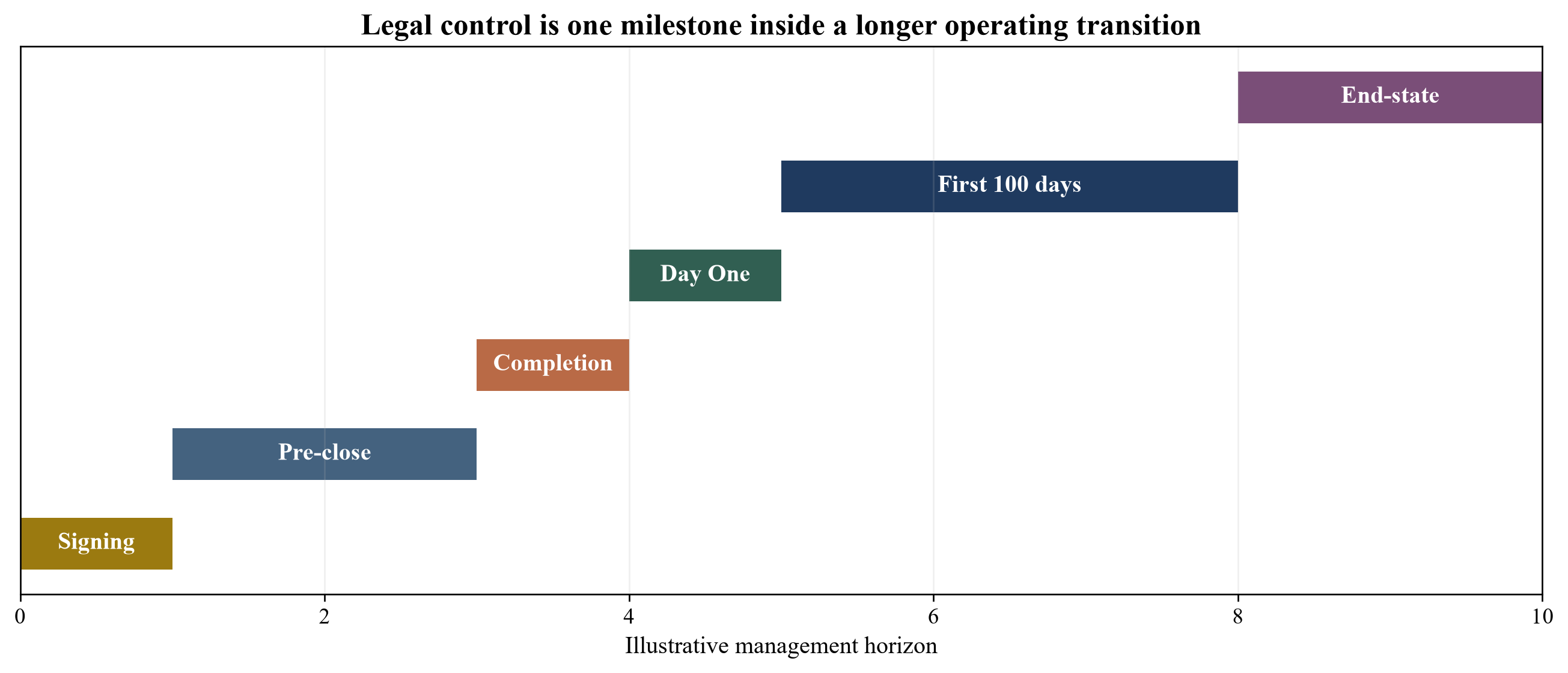
Management framework. Actual duration and permitted activity depend on the transaction documents, regulation and operating facts.
2. Define the integration thesis before building a plan
The acquisition thesis explains why ownership should create value. The integration thesis states which operating changes are required to realise that value and which capabilities should remain protected. The distinction prevents a generic plan from replacing the reasons the board approved the transaction.
An acquisition for customer access may need limited front-office change and extensive back-office integration. A capability acquisition may need strong retention, protected product autonomy and selective access to the buyer's distribution. A consolidation acquisition may require common procurement, systems, facilities and management processes. A regulated-market entry may prioritise licences, governance, local leadership and compliance. Each thesis implies a different integration perimeter, pace and risk.
The office converts the thesis into five classes of outcome. Continuity outcomes preserve service, cash, safety, authority, data and compliance. Value-preservation outcomes protect customers, critical employees, intellectual property and supplier capacity. Value-capture outcomes deliver revenue, cost, capital or risk improvements. Capability outcomes transfer knowledge or build a stronger operating model. Structural outcomes establish the intended legal, governance, technology and organisational end-state.
Each outcome receives an accountable executive, a workstream owner, a finance validator, a due date, a baseline and a measure. The IMO records exclusions. When the board intends to preserve a brand, operating unit, system or management process, the exclusion is stated so that functional teams do not integrate it by default. When a benefit remains an option, the plan identifies the future trigger and does not treat the option as committed value.
Table 1. Integration-thesis translation
| Acquisition rationale | Required integration outcome | Capability to protect | Early evidence | Board question |
|---|---|---|---|---|
| Customer access | Coordinated account ownership and cross-sell rules | Target relationships and local service | Named accounts, consent requirements, retention data | Can access improve without disrupting trust? |
| Operating scale | Common procurement and shared-service leverage | Local operating responsiveness | Spend baseline, service catalogue, capacity | Which scale benefit survives implementation cost? |
| Capability acquisition | Talent retention and knowledge transfer | Product team, methods and culture | Critical-role map, IP ownership, delivery backlog | Which change would damage the capability acquired? |
| Market entry | Governance, licences and local operating authority | Local compliance and customer knowledge | Licence conditions, responsible managers, control rights | Is the buyer ready to operate within local requirements? |
| Consolidation | Portfolio simplification and duplicated-cost removal | Revenue continuity and critical controls | Entity map, cost baseline, customer dependencies | Which structural actions can wait until stability is proven? |
The approved thesis determines the plan. Workstream activity without a linked outcome receives challenge before resources are committed.
3. Charter the integration management office
The IMO needs a written charter approved by the executive sponsor and acknowledged by the board or investment committee. The charter states the office's purpose, term, scope, authority, reporting line, workstreams, materiality rules, escalation thresholds, information rights, confidentiality obligations and relationship with advisers. Without a charter, the office can become an administrative reporting layer with responsibility for outcomes it cannot control.
The office owns the integration system. It maintains the master plan, dependency map, issue log, decision log, risk register, readiness evidence, meeting cadence and board dashboard. It verifies that each initiative has an owner and that decisions occur at the correct level. It challenges gaps, duplication and unsupported status claims. It does not replace functional management. Finance owns financial records and controls. Technology owns secure system operation. Human resources manages employment processes with qualified advice. Legal counsel owns legal advice. Business leaders own customer and operating results.
The executive sponsor resolves cross-functional priorities and secures resources. The steering committee approves material plan changes within delegated authority and escalates reserved matters. Workstream leaders deliver outcomes and maintain evidence. The IMO lead integrates their plans and prepares decisions. An independent finance validator controls benefit measurement. Internal audit or another assurance function may review selected controls without assuming delivery ownership.
The charter should define completion. The office does not close because one hundred days have elapsed. It closes or changes form when operating responsibility has transferred, material initiatives have entered normal governance, temporary controls have been removed or formalised, open risks have owners, and the board has accepted the remaining value and timetable. Long-duration systems or legal-entity changes may continue within separate programmes.
Table 2. Minimum IMO charter
| Charter element | Required definition | Evidence |
|---|---|---|
| Purpose | Continuity, value, capability and end-state outcomes | Approved integration thesis |
| Scope | Entities, functions, geographies and exclusions | Scope map and legal-entity schedule |
| Authority | Decisions delegated to sponsor, committee and workstreams | Authority matrix and board resolutions |
| Information rights | Data, systems and meetings available to the office | Access register and confidentiality rules |
| Escalation | Materiality, urgency and stop conditions | Threshold schedule and escalation route |
| Term | Start, review points and closure criteria | Mobilisation and handover plan |
| Assurance | Finance validation, legal review and control testing | Assurance calendar and evidence owner |
| Reporting | Weekly steering and monthly board outputs | Dashboard, value bridge and decision log |
Reserved matters and specialist responsibilities remain subject to the buyer's governing documents and applicable law.
4. Separate decision rights from meeting attendance
Integration slows when many people attend meetings and nobody knows who may decide. The office designs decision rights before the cadence begins. Each material question has a recommender, evidence providers, advisers, a decision owner, consulted parties, implementation owners and a deadline. The record shows the authority supporting the decision and any condition attached to it.
The acquisition agreement and regulatory conditions can restrict pre-completion activity. The target may remain an independent competitor until completion. Information sharing and planning require legal guidance, clean-team protocols where appropriate and respect for applicable competition rules. The IMO should record whether an action is permitted before completion, permitted only through a controlled process, or deferred until control passes. Saudi guidance treats the ability to exert decisive influence over strategic or operational decisions as relevant to control.[3] This reinforces the need for fact-specific legal advice on the boundary between preparation and premature exercise of control.
After completion, corporate authority still matters. A group executive may propose a policy while the acquired entity's board, licensed manager, shareholder or authorised signatory retains the formal decision right. The office maps these layers. It also distinguishes a recommendation from an instruction, an approval from implementation and a reported status from independently verified evidence.
Urgent decisions receive a defined fast path. A customer service failure, payroll risk, cyber incident or regulatory deadline may not wait for the next steering meeting. The fast path identifies the incident lead, executive authority, legal and specialist contacts, communication channel and retrospective review. Emergency authority has a time limit and an evidence requirement.
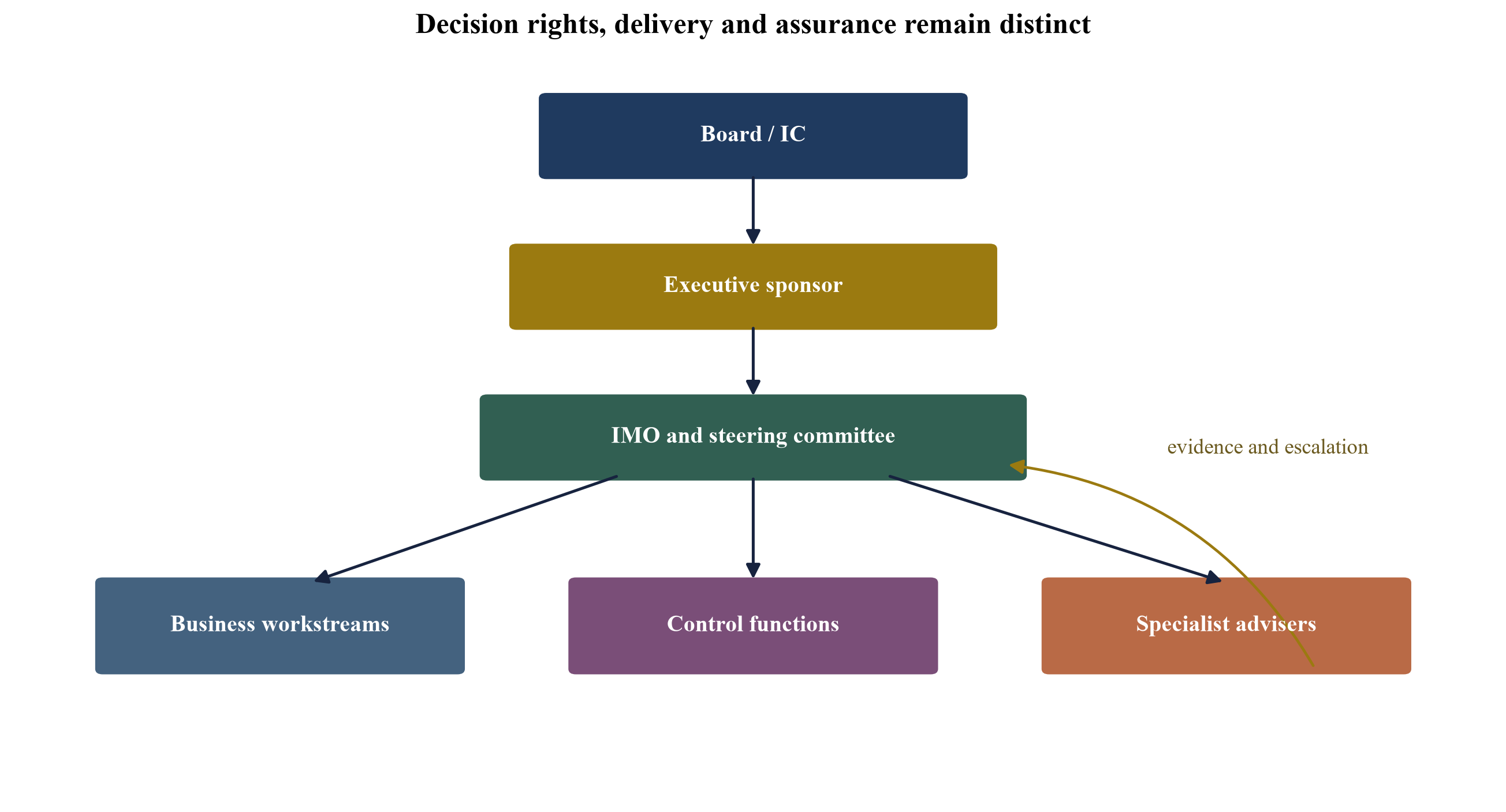
Management framework. The feedback loop returns new evidence and exceptions to the correct decision level.
5. Build Day One around continuity
Day One is the first operating period under the new control environment. Its objective is controlled continuity. The buyer confirms that the acquired business can lawfully receive instructions, serve customers, pay employees and suppliers, access cash, protect data, maintain safety, comply with licences and communicate with stakeholders. Structural integration can follow when evidence supports it.
The Day-One register covers legal and governance authority, treasury, payroll, customer operations, supplier operations, technology, cyber security, facilities, health and safety, insurance, communications, regulatory reporting and incident escalation. Each item has a named owner, required evidence, test date, status, workaround and stop condition. Green means tested and evidenced. Amber means a controlled workaround exists with an owner and expiry. Red means the business cannot rely on the process.
The office distinguishes information from execution. A spreadsheet of bank accounts does not prove that authorised users can release a payment. A list of employees does not prove that payroll data, approvals and funding are ready. A system inventory does not prove that administrators and service accounts are known. A customer list does not prove that service ownership and communication routes are operational. Readiness testing uses low-risk transactions, controlled walkthroughs, access checks and reconciliations.
Continuity planning should include manual and alternate processes where the primary route may be disrupted. NIST contingency guidance describes a coordinated approach involving alternate equipment, alternate processing, alternate locations and recovery planning.[4] The IMO applies this principle proportionately to transaction transition. A temporary manual control should have dual approval, a reconciliation owner, a volume limit, an end date and a migration plan.
Table 3. Day-One continuity register
| Domain | Day-One question | Minimum evidence | Red condition |
|---|---|---|---|
| Governance | Can the entity receive and evidence valid decisions? | Resolutions, delegated authorities, responsible-manager record | No lawful or documented authority |
| Treasury | Can critical payments be approved, released and reconciled? | Tested access, mandates, funding, beneficiary controls | Payroll or critical obligation cannot be funded |
| Customers | Can orders, service and escalation continue? | Named account ownership, service queue, incident path | Material customers have no operating owner |
| People | Can employees work, be paid and receive reliable information? | Payroll test, role map, communication and help route | Payroll, safety or work-authority failure |
| Technology | Can critical systems operate and recover? | Access tests, backup evidence, service contacts | Critical system unavailable without workaround |
| Suppliers | Can essential inputs continue? | Contract and purchase authority, payment path, inventory view | Critical supply interruption without alternative |
| Compliance | Are licences, filings and obligations under control? | Obligation calendar, adviser confirmation, owner | Required approval or licence is absent |
| Communications | Can verified messages reach each stakeholder group? | Approved messages, spokespeople, contact lists | Conflicting or unauthorised external communication |
Evidence is transaction-specific. Amber status requires an approved workaround, owner and expiry.
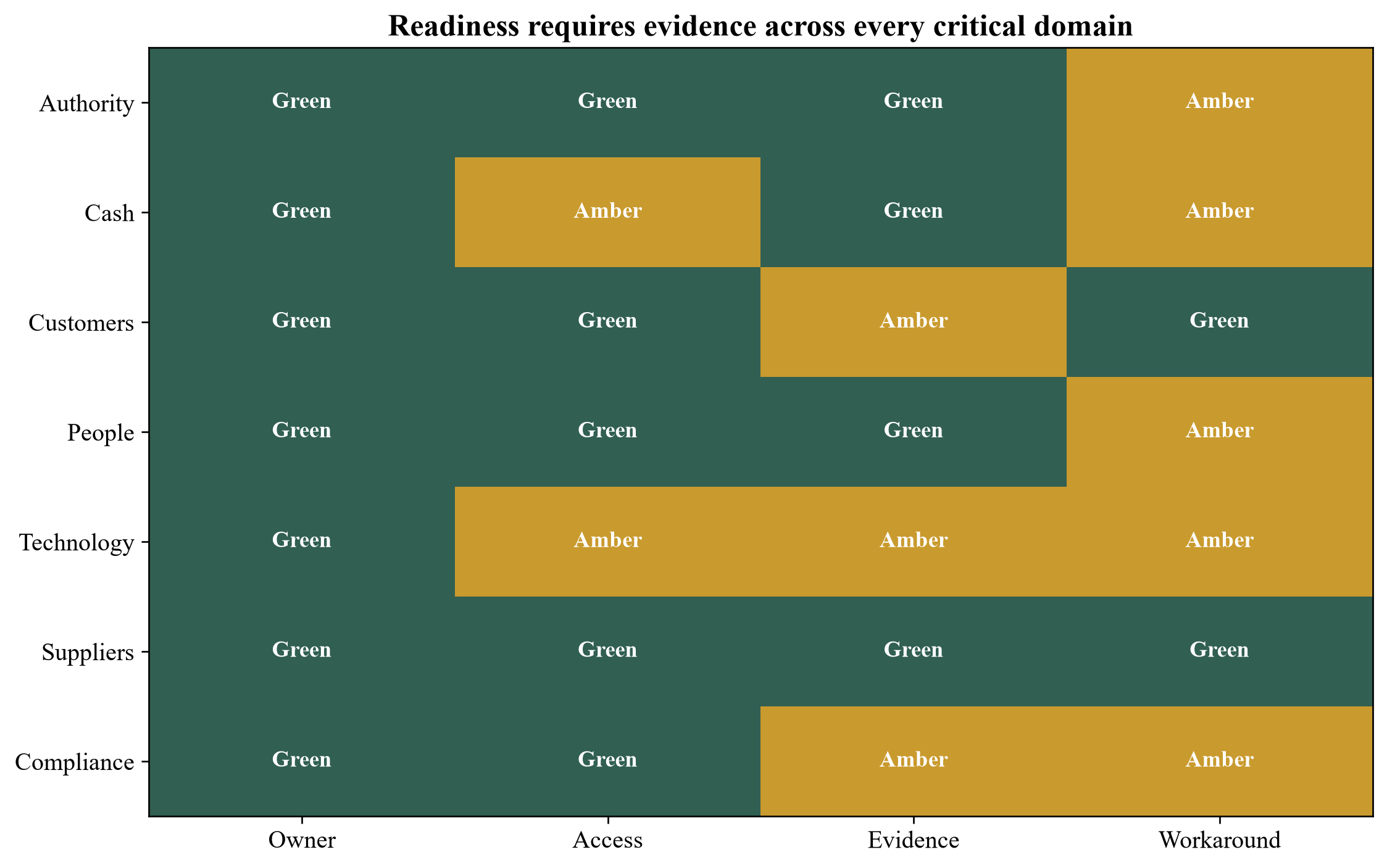
Illustrative management case. Status values do not describe a client or actual transaction.
6. Convert diligence into an integrated action system
Diligence reports often separate commercial, financial, tax, legal, technology, operations and people findings. Integration requires one disposition system. The office records each material finding once and links it to the transaction model, contractual protection, completion condition, Day-One control, first-100-day initiative, specialist advice or decision to accept the risk.
An issue statement should describe an observable condition and consequence. “Technology risk” is too broad. “The customer-order platform depends on one administrator account whose recovery process has not been tested” supports an owner, evidence request, interim control and deadline. “Customer concentration” becomes specific when the office identifies accounts, contract rights, relationship owners, renewal dates, service dependencies and the value at risk.
The issue log and decision log serve different purposes. The issue log records a condition, evidence, consequence, owner, action and status. The decision log records the question, alternatives, evidence considered, authority, decision, conditions, date and implementation owner. A closed issue can require several decisions. A decision can affect several workstreams. The dependency map links both.
The office applies materiality to avoid administrative overload. An item is material when it can affect continuity, value, liquidity, safety, legal or regulatory compliance, reputation, a board commitment or the critical path. Lower-level actions remain within workstream plans. Materiality can be quantitative, qualitative or time-sensitive.
Table 4. Integrated issue and decision control
| Record | Minimum fields | Closure evidence | Governance use |
|---|---|---|---|
| Issue | Condition, source, consequence, owner, action, due date, status | Test, reconciliation, executed document or accepted risk | Weekly exception control |
| Decision | Question, alternatives, recommendation, authority, date, conditions | Signed approval and implemented action | Accountability and audit trail |
| Dependency | Predecessor, successor, lead time, constraint, owner | Completed prerequisite and tested handoff | Critical-path management |
| Assumption | Statement, source, confidence, expiry, sensitivity | Replaced by evidence or retained with approval | Deal-case and plan integrity |
| Change | Original baseline, proposed change, effect, approver | Updated plan and communicated ownership | Scope, cost and value control |
The office preserves prior versions and evidence links so status changes remain traceable.
7. Control the critical path through dependencies
Workstream plans become credible when their dependencies are visible. A customer migration may depend on contract rights, product mapping, pricing rules, data consent, system capacity, staff training and communication. A legal-entity merger may depend on tax advice, creditor steps, licence transfers, employee processes, bank changes, system changes and statutory approvals. A cost initiative may depend on service continuity and cannot be scheduled from a financial target alone.
The IMO maintains a dependency register and network. Each dependency identifies the providing workstream, receiving workstream, required output, acceptance criterion, planned date, lead time, contingency and consequence of delay. The receiving owner confirms acceptance. This prevents one team from reporting completion when another team cannot use the output.
Critical-path review focuses on decisions and evidence. A late milestone may have no material consequence when float remains. An apparently on-time milestone may threaten the programme when its evidence is incomplete. The steering committee receives the few dependencies that can change continuity, value or timetable, together with the required decision.
The office also looks for common dependencies. Several initiatives may rely on the same technology release, employee consultation, customer consent, finance data or regulatory decision. Counting each initiative independently can overstate deliverability. The network exposes concentration and supports sequencing.
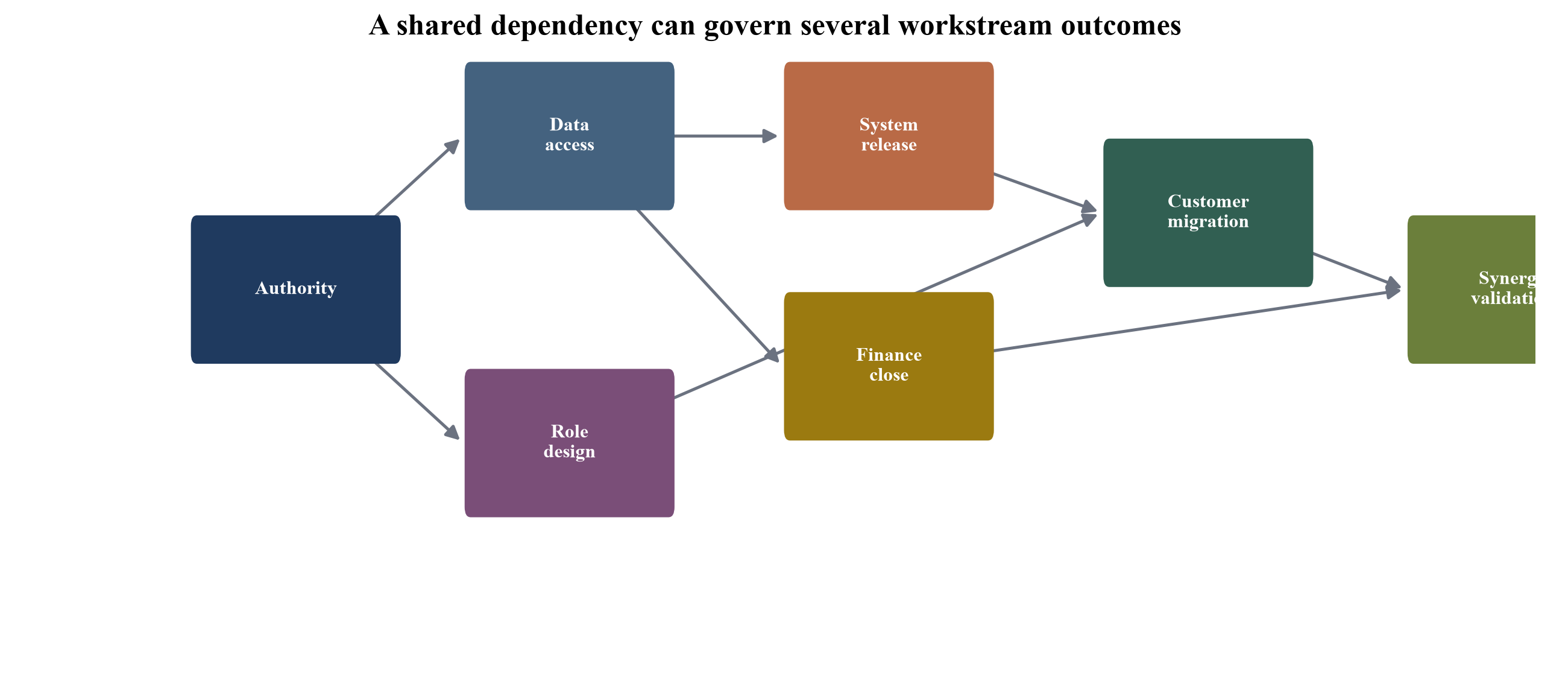
Management framework. Shared dependencies reveal where one delay can affect several value and continuity outcomes.
8. Establish finance, accounting and liquidity control
Finance provides the common measurement layer for integration. The first priority is liquidity and authority. The office confirms bank accounts, debt facilities, guarantees, signatories, payment processes, cash forecasts, critical obligations and funding routes. It distinguishes legal ownership of cash from operational access. It identifies restrictions, security interests, trapped balances and intercompany funding requirements.
The close process needs a controlled bridge between the target's records and group reporting. Finance maps charts of accounts, accounting policies, reporting periods, systems, consolidation entries, intercompany balances and material estimates. It assigns ownership for opening balances, purchase accounting, tax, treasury, management reporting and the first consolidated close.
IFRS 3 requires the acquirer to recognise and measure acquired identifiable assets and liabilities, non-controlling interests and goodwill or a bargain purchase under the acquisition method.[5] IAS 36 governs impairment testing and connects subsequent evidence to the carrying amount of relevant assets and cash-generating units.[6] The IMO does not make accounting determinations. It ensures that operational workstreams supply the data, ownership plans and performance evidence required by qualified finance and accounting teams.
The integration budget separates transaction cost, integration cost, restructuring cost, capital expenditure, retention cost and ordinary operating expenditure. The board sees committed, incurred, forecast and cash-paid amounts. Each cost links to an initiative or continuity requirement. This avoids presenting gross synergies without the resources required to deliver them.
The value bridge starts with the approved deal case. It records diligence changes, completion adjustments, implementation cost, dis-synergies, operating variance, validated run-rate and realised cash. The synergy ledger described in the companion framework can serve as the initiative-level record. Finance validates measurement while the IMO governs delivery and dependencies.
9. Protect customers and commercial momentum
Customers experience integration through service, people, pricing, contracts, communication and product decisions. A corporate announcement has limited value when account ownership is unclear or service deteriorates. The commercial workstream begins with a customer-risk map: revenue, margin, contract term, change-of-control rights, renewal date, service dependencies, relationship strength, open issues and intended communication.
The office segments accounts by value and transition risk. Named executives own critical relationships. Communications state what changes, what remains stable, who can answer questions and how customer data will be handled. The business avoids unsupported promises about product, pricing, systems or personnel. Customer feedback enters the issue log and can change sequencing.
Cross-sell and pricing initiatives require a baseline and operating readiness. Sales teams need product eligibility, target-account rules, incentives, customer consent, delivery capacity and reliable reporting. A revenue synergy is not ready because two customer lists have been combined. The office requires evidence that the proposition can be sold, fulfilled, measured and supported.
Commercial continuity measures include service levels, order backlog, renewal movement, complaints, customer attrition, sales-pipeline conversion and pricing exceptions. These measures are compared with a credible counterfactual. Market changes and ordinary seasonality remain separate from integration effects.
10. Govern people, authority and implicit contracts
Employees carry customer knowledge, operational routines, relationships and technical capability. Integration changes their view of authority, career path, incentives, location, workload and organisational identity. Silence can create rumours while premature certainty can create commitments the buyer cannot keep.
The people workstream builds a critical-role map, not only a list of senior titles. A critical role controls a customer, licence, system, process, relationship or body of knowledge whose loss would affect continuity or value. The map identifies role, incumbent, dependency, retention risk, successor, documentation status, proposed owner and legal or regulatory constraint.
Current empirical research using merger events and employee-review data reports deterioration in employee satisfaction after mergers, particularly in non-contractible dimensions of work experience.[7] The evidence comes from a specific study design and geography. It supports close attention to implicit expectations, trust and local management practice. The IMO tracks workload, regretted attrition, vacancy, absence, retention actions, leadership appointments, decision clarity and employee questions.
Employment action requires qualified local advice. UAE Federal Decree-Law No. 33 of 2021 and its executive regulation govern private-sector employment within their scope.[8][9] Saudi Arabia's Ministry of Human Resources and Social Development publishes the Kingdom's Labor Law and related requirements.[10] Entity transfers, contract changes, benefits, termination, consultation, localisation, visas and work authority remain fact-specific. The office records advice, approvals, affected populations and implementation evidence.
Communication follows decision readiness. Each message has an audience, purpose, approved facts, sender, channel, timing and feedback route. Leaders explain the transaction rationale and the next decision horizon. They acknowledge open questions and commit to a date or process for resolution. The office maintains one source of approved information and a record of material commitments.
11. Integrate technology and data through controlled releases
Technology integration can create scale and visibility. It can also disrupt revenue, weaken security and destroy evidence. The technology workstream starts with critical services, identities, administrators, data flows, interfaces, vendors, recovery arrangements, cyber incidents, licences and end-of-life risks. It maps business impact before selecting a target architecture.
Identity is an early control. The buyer needs verified administrators, privileged accounts, service accounts, authentication methods, joiner-mover-leaver processes and emergency access. Access follows least privilege and approved roles. Shared credentials and unrecorded administrator paths receive remediation. A mass migration waits until recovery, logging, capacity and rollback have been tested.
Data integration requires purpose, authority, quality and provenance. Customer, employee, supplier and financial data may be subject to contractual, regulatory and privacy constraints. The office records the legal and operational basis for transfer, data owners, fields, quality issues, retention, access, encryption and reconciliation. A consolidated dashboard should not become a new uncontrolled copy of sensitive data.
Releases use gates: design approval, data and security review, user acceptance, performance and recovery tests, communication, cutover approval, reconciliation and post-release review. A rollback plan has an owner and trigger. The IMO treats a successful deployment as incomplete until the business process and data reconcile.
12. Sequence operations, suppliers and legal entities
Operating integration covers sites, production, inventory, procurement, quality, health and safety, logistics, facilities and third parties. The office identifies critical inputs and single points of failure. It maps contracts, minimum volumes, change rights, credit limits, insurance, permits, service levels, inventory buffers and alternate sources.
Procurement savings depend on specification, volume, timing, supplier capacity and switching cost. A lower quoted price can reduce value when it increases lead time, quality risk or working capital. The workstream validates total cash and operating effect. It also preserves relationships needed for continuity during ownership change.
Legal-entity simplification is a separate programme. It may reduce governance, tax, finance and administrative complexity while requiring approvals, creditor processes, licence changes, employee actions, asset transfers, contract novation, bank changes and system work. The IMO uses a readiness gate and does not place the customer or payroll process on an untested critical path.
The end-state operating model defines which decisions, services, capabilities and data belong at group, business-unit and local-entity levels. It states service levels, cost allocation, accountability and exception rights. A shared-service transfer becomes complete when the receiving team can deliver the service and the local entity can govern it.
Table 5. Workstream evidence and handoff
| Workstream | Primary outcome | Acceptance evidence | Normal owner after handoff |
|---|---|---|---|
| Finance | Controlled liquidity, close and reporting | Tested payments, reconciled close, approved policies | CFO and entity finance |
| Commercial | Customer continuity and executable growth | Named ownership, customer evidence, delivery capacity | Commercial leadership |
| People | Clear authority and retained critical capability | Role decisions, payroll, communications, succession | Business and HR leadership |
| Technology | Secure, recoverable critical services | Access, recovery, reconciliation and release evidence | CIO or technology leadership |
| Operations | Safe and reliable product or service delivery | Capacity, quality, supplier and incident controls | COO or operating leadership |
| Legal and compliance | Governed obligations and approvals | Entity, licence, filing and obligation evidence | Legal and compliance owners |
| Value capture | Validated initiatives and cash bridge | Baseline, owner, cost, evidence and finance validation | Business owners and CFO |
Completion is based on accepted evidence. A percentage reported without acceptance criteria is insufficient.
13. Run a cadence that produces decisions
The integration cadence has three levels. Workstreams manage actions and evidence several times each week. The IMO runs a weekly control cycle covering readiness, critical path, issues, decisions, resources, value and communications. The steering committee meets on material exceptions and decisions. The board receives a monthly view of thesis, continuity, value, risk and required authority.
The weekly pack should be short enough to use. It contains an executive summary, top decisions, Day-One or 100-day readiness, critical dependencies, material risks, customer and people signals, budget, value bridge and changes from the prior week. Supporting detail remains in controlled registers. Status follows evidence and acceptance criteria.
The meeting begins with decisions due, followed by red continuity items and dependencies. Amber items receive attention when their expiry or consequence approaches. Green status is sampled for evidence. The office records the decision and implementation owner before the meeting closes. Minutes do not substitute for the decision log.
The board dashboard separates leading and lagging indicators. Leading measures include milestone readiness, dependency completion, decision ageing, critical-role coverage and customer contact. Lagging measures include attrition, service failure, cash delivery, realised cost, customer retention and financial performance. Organisational health prevents a narrow value dashboard from hiding damage to the business.
Table 6. First-100-day KPI cockpit
| Dimension | Leading measure | Outcome measure | Escalation example |
|---|---|---|---|
| Continuity | Critical controls tested | Service, payroll and payment failures | Any uncontained critical failure |
| Customers | Critical accounts contacted | Retention, renewal and complaint movement | Material account at risk without owner |
| People | Critical roles with decisions | Regretted attrition and vacancy | Loss of role affecting continuity or thesis |
| Delivery | Dependencies accepted on time | Milestones completed with evidence | Critical path moves beyond approved tolerance |
| Value | Initiatives with validated baseline | Run-rate and realised cash | Premium coverage falls below board case |
| Cost | Approved resources mobilised | Incurred and cash-paid integration cost | Forecast exceeds delegated authority |
| Control | Decisions and issues within age | Audit, compliance and reconciliation exceptions | Unresolved legal or control breach |
Measures and thresholds are approved for the transaction. Illustrative categories are shown without client data.
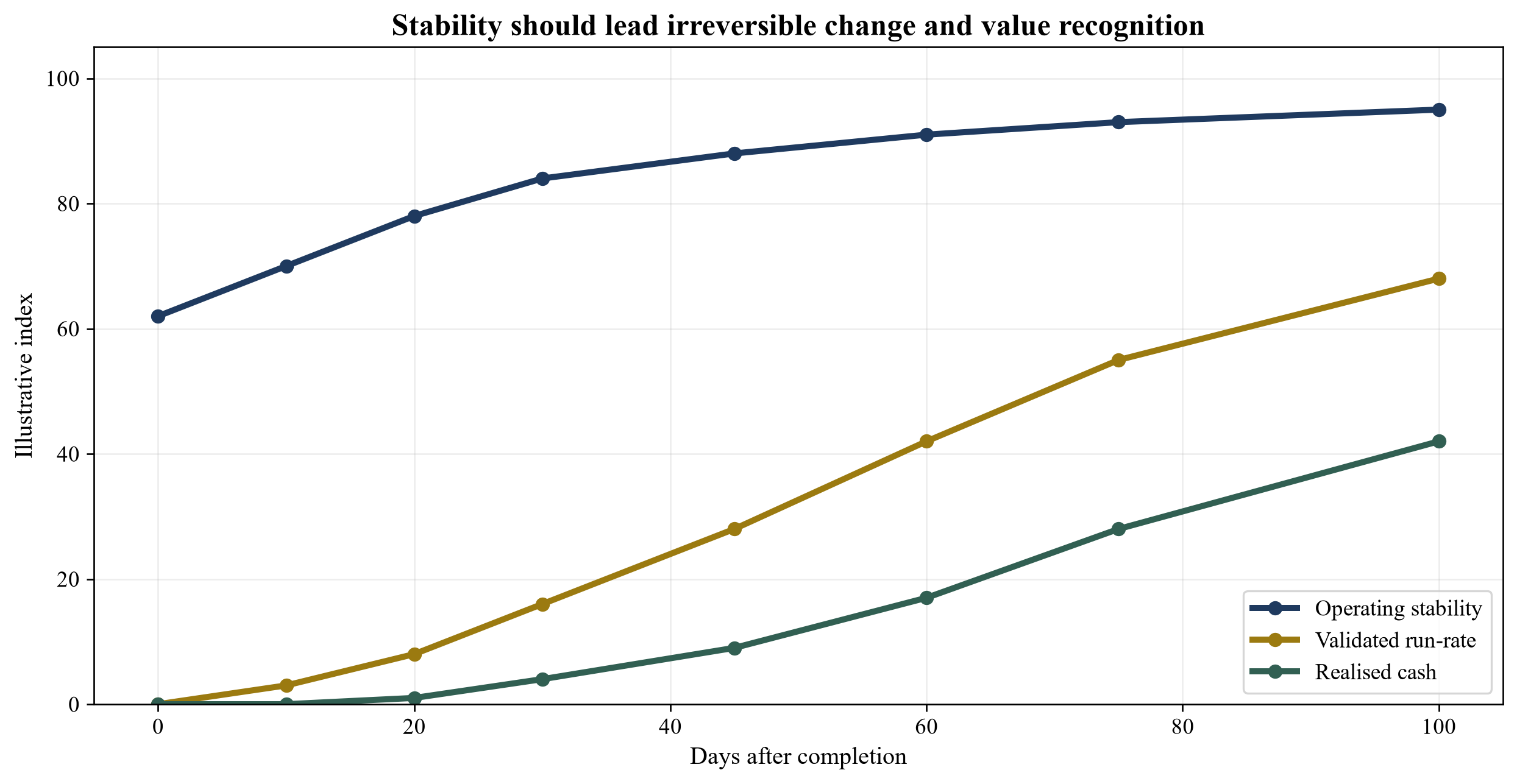
Illustrative management pattern. Actual outcomes depend on the transaction, market and execution evidence.
14. Use the first 100 days as a sequence of gates
The first one hundred days are a management horizon. They do not guarantee completion. The office uses gates to decide whether the organisation is ready for the next level of change.
The completion gate confirms legal authority, funds flow, regulatory conditions, transaction documents and Day-One ownership. The Day-One gate confirms critical continuity controls and stakeholder communication. The 30-day gate confirms the operating baseline, leadership, issue disposition, detailed plan and resources. The 60-day gate tests value delivery, customer and employee outcomes, system releases and emerging risks. The 100-day gate assesses stability, validated value, end-state decisions, remaining programme and transition to normal governance.
Each gate has a decision pack and an explicit outcome: proceed, proceed with conditions, hold, re-sequence, reduce scope, increase resources or stop an initiative. The office preserves the evidence and explains changes from the approved deal case. A gate is useful when it can change the plan.
The 100-day review includes a post-investment view. Empirical studies of mergers report different outcomes depending on sample, method and horizon. One established study of large US industrial mergers found improvement in asset productivity and operating cash flow relative to industry benchmarks.[11] A later close-bid study found acquirer underperformance relative to losing bidders over subsequent years.[12] These findings do not predict a specific GCC transaction. They reinforce the need for a defined counterfactual, a long enough measurement horizon and a board record of what changed after approval.
15. Adapt governance to GCC entities and stakeholders
GCC integration is not one legal template. The office maintains a jurisdiction, entity and licence map. For each entity it records legal owner, board, managers, permitted activities, regulators, bank accounts, tax registrations, employees, data, material contracts, sites, responsible persons and reserved decisions. Specialist advice identifies which changes require approval, notification, consultation or document amendment.
Saudi listed-company transactions operate within the Capital Market Authority's merger and acquisition regulations and corporate governance framework where applicable.[13][14] UAE transactions can engage federal competition law, relevant thresholds, sector regulators, free-zone rules and entity requirements.[1][2] The office records the applicable source and current adviser conclusion. It avoids applying a conclusion from one entity or jurisdiction to another without review.
Family and founder-owned businesses require deliberate governance transition. Authority may have operated through relationships and tacit knowledge. The buyer should document decisions and dependencies while preserving the commercial value of those relationships. Founder access, retention, transition services, restrictive obligations and succession need clear rights, timelines and communication.
Language, culture and time zone affect execution. The plan identifies the authoritative version of a decision, required translations, local communication owners, holiday calendars and site coverage. Stakeholder mapping includes customers, employees, regulators, lenders, landlords, free-zone authorities, suppliers, joint-venture partners and family shareholders as applicable.
16. The retained integration-office model
An intermittent acquirer may not need a permanent large corporate-development and integration team. A retained IMO can provide a repeatable operating system before and after completion. The mandate is defined by decisions and deliverables: mobilisation, integration thesis, Day-One readiness, master plan, dependency control, steering cadence, board reporting, value bridge and handover.
The retained team should remain small. A lead coordinates the office and steering committee. A programme controller maintains the plan, evidence and decision records. A finance lead controls budget and value measurement. Specialists join for legal, tax, accounting, people, technology, cyber, operations or communications questions within their professional scope. Client executives retain decisions and operating ownership.
The retainer can be structured in phases. A pre-close phase establishes the thesis, clean planning boundary, Day-One register and governance. A Day-One phase runs readiness and incident control. A 100-day phase manages dependencies, decisions and value. A transition phase hands work to line management and preserves the post-investment record. Scope, team, meeting load, geography and specialist needs determine the commercial terms.
The mandate should state exclusions and evidence. The office does not provide legal, tax, audit or regulated advice unless separately qualified and engaged. It does not guarantee completion, synergy or financial performance. It provides governance, analysis, coordination and evidence so authorised decision-makers can act with a clearer record.
Table 7. Retained integration-office service cadence
| Phase | Recurring output | Decision supported | Handover condition |
|---|---|---|---|
| Pre-close mobilisation | Thesis, charter, workstreams, Day-One register | Is the buyer ready to assume control? | Permitted plan and owners approved |
| Completion and Day One | Command cycle, readiness evidence, issue escalation | Can critical operations continue safely? | Critical controls tested or governed workaround active |
| Days 2 to 30 | Baseline, detailed plan, leadership and dependency map | Is the operating plan executable? | Resources and acceptance criteria approved |
| Days 31 to 60 | Workstream control, customer and people signals, value bridge | Which initiatives should accelerate or change? | Evidence supports the next sequence |
| Days 61 to 100 | End-state decisions, benefit validation, risk transition | What remains inside normal management or a longer programme? | Board accepts owners, value and residual risk |
| Post-100-day transition | Handover pack and post-investment review | Can the IMO close or reduce scope? | Registers, owners and review dates transferred |
The scope is tailored to the transaction. Specialist services require the appropriate engagement and qualifications.
17. Limitations and further research
The framework is a management architecture. It cannot determine the correct legal, tax, accounting, regulatory, employment, technology, cyber or valuation treatment. Those determinations require current facts and qualified advisers. The one-hundred-day horizon may be too short for regulatory, system, legal-entity, property or workforce changes. The office should preserve the critical path beyond the initial horizon.
Status systems can create false confidence. A green dashboard can hide weak acceptance criteria or untested evidence. A large number of red items can hide the few that determine continuity. The office therefore combines status with evidence sampling, dependency analysis, incident data and direct operating feedback.
Attribution remains difficult. Market movement, ordinary management action, the acquisition, integration initiatives and random variation interact. The value bridge should disclose its counterfactual and method. It should use ranges when evidence does not support precision.
Further research could examine integration outcomes across GCC transactions using comparable measures for customer retention, critical-role attrition, operating stability, implementation cost, validated run-rate, realised cash and timetable. Useful studies would distinguish family-owned, sponsor-backed, listed and cross-border acquisitions. They would also test whether formal dependency and decision systems improve outcomes after controlling for transaction and management characteristics.
18. Conclusion
The integration management office gives legal control an operating system. It translates the acquisition thesis into continuity, value, capability and structural outcomes. It establishes decision rights, readiness evidence, workstream ownership, dependencies, issue and decision records, financial control, stakeholder communication and a board cadence.
The first discipline is continuity. Customers, employees, cash, data, suppliers, licences and safety remain under control while the buyer learns. The second is evidence. Milestones are complete when the receiving owner accepts the output and the business process works. The third is value. Each initiative connects to the deal case, resources, dependencies and cash. The fourth is handover. Temporary governance ends when normal management has accepted ownership and the board understands the remaining value and risk.
A retained IMO can provide this discipline to an acquirer that does not maintain a permanent integration function. The result is a traceable first-100-day record: what the board approved, what the organisation protected, what management changed, what value the evidence supports and what remains to be decided.
References
- UAE Legislation. Federal Decree-Law No. 36 of 2023 Regulating Competition. https://uaelegislation.gov.ae/en/legislations/2117
- UAE Legislation. Cabinet Decision No. 3 of 2025 concerning economic-concentration thresholds. https://uaelegislation.gov.ae/en/legislations/2788
- General Authority for Competition, Saudi Arabia. Economic Concentration Review Guidelines. https://gacbep.gac.gov.sa/cms/b9376edc-79a1-4573-a36d-4f3effaba838.pdf
- National Institute of Standards and Technology. SP 800-34 Rev. 1: Contingency Planning Guide for Federal Information Systems. https://csrc.nist.gov/pubs/sp/800/34/r1/upd1/final
- IFRS Foundation. IFRS 3 Business Combinations. https://www.ifrs.org/issued-standards/list-of-standards/ifrs-3-business-combinations/
- IFRS Foundation. IAS 36 Impairment of Assets. https://www.ifrs.org/issued-standards/list-of-standards/ias-36-impairment-of-assets/
- Cai, W., Prat, A., and Yu, J. Mergers and Non-contractible Benefits: The Employees' Perspective. NBER Working Paper 34920, 2026. https://www.nber.org/papers/w34920
- UAE Legislation. Federal Decree-Law No. 33 of 2021 Regulating Labour Relations. https://uaelegislation.gov.ae/en/legislations/1541
- UAE Legislation. Cabinet Resolution No. 1 of 2022 concerning the Executive Regulation of Federal Decree-Law No. 33 of 2021. https://uaelegislation.gov.ae/en/legislations/1547
- Ministry of Human Resources and Social Development, Saudi Arabia. Labor Law: Definitions and General Provisions. https://www.hrsd.gov.sa/en/%D8%%D9%84%D8%AA%D8%%D8%%D9%8A%D9%81%D8%%D8%AA/%D8%%D9%84%D8%%D8%AD%D9%83%D8%%D9%85-%D8%%D9%84%D8%%D8%%D9%85%D8%
- Healy, P. M., Palepu, K. G., and Ruback, R. S. Does Corporate Performance Improve After Mergers? NBER Working Paper 3348. https://www.nber.org/papers/w3348
- Malmendier, U., Moretti, E., and Peters, F. S. Winning by Losing: Evidence on the Long-Run Effects of Mergers. NBER Working Paper 18024. https://www.nber.org/papers/w18024
- Capital Market Authority, Saudi Arabia. Merger and Acquisition Regulations. https://cma.org.sa/en/RulesRegulations/Regulations/Documents/Merger%20and%20Acquisition%20Regulations.pdf
- Capital Market Authority, Saudi Arabia. Corporate Governance Regulations. https://cma.org.sa/en/RulesRegulations/Regulations/Documents/CorporateGovernanceRegulations1.pdf
- IFRS Foundation. Business Combinations, Disclosures, Goodwill and Impairment project. https://www.ifrs.org/projects/work-plan/goodwill-and-impairment/
About the Author
Chennakeshav Adya is an independent researcher and corporate finance practitioner with more than twenty years of international experience across business strategy, transformation, investment banking, family-office operations, risk, technology and cross-border transactions. His research focuses on practical decision systems for private capital, corporate finance and transaction execution. The views expressed in this paper are his own.
Appendix A: A. First-100-day calendar
. Pre-close and completion
- Approve the integration thesis, scope, exclusions and IMO charter.
- Confirm clean-planning boundaries, confidentiality and information rights with counsel.
- Convert diligence findings into the integrated issue, decision and action system.
- Complete the Day-One register, critical-role map, stakeholder map and dependency baseline.
- Test authority, treasury, payroll, customer service, technology, supplier and incident routes.
- Confirm completion mechanics, approvals, funds flow and communication release.
. Days 1 to 30
- Operate the Day-One command cycle and close or govern every critical workaround.
- Validate leadership, decision rights, workstream ownership and the first consolidated reporting timetable.
- Lock the operating, cost, customer, people, cash and value baselines with finance.
- Confirm customer and critical-employee communication, feedback and escalation.
- Approve detailed initiative charters, resources, dependencies and acceptance criteria.
- Conduct the 30-day gate and re-sequence the plan using current evidence.
. Days 31 to 60
- Deliver controlled operational, commercial, technology and organisational releases.
- Reconcile integration budget, implementation cash and the value bridge.
- Review customer retention, critical-role risk, operating incidents and supplier continuity.
- Validate benefits only when baseline, owner, evidence and finance method are approved.
- Escalate common dependencies and changes to premium coverage or the end-state.
- Conduct the 60-day gate and approve acceleration, hold or corrective action.
. Days 61 to 100
- Complete priority initiatives with acceptance evidence and transfer recurring controls to line management.
- Approve the end-state operating model, longer programmes and legal-entity timetable.
- Close temporary access and workarounds or convert them into governed controls.
- Prepare the post-investment review, residual-risk map and updated value case.
- Conduct the 100-day gate, approve owners and review dates, and define IMO transition.
Appendix B: B. Board gate questions
. Before completion
- Which operating outcomes are required by the acquisition thesis?
- Which capabilities and relationships must remain protected?
- Can the buyer lawfully plan and communicate each pre-close action?
- Can every critical Day-One process operate with valid authority and tested access?
- Which diligence findings change the plan, price protection, resources or decision to complete?
. At Day One
- Can the business serve customers, protect people, pay obligations and meet regulatory requirements?
- Which amber workarounds are active, who owns them and when do they expire?
- Are incident, customer, employee and regulatory communications controlled?
- Which action would be unsafe or irreversible before more evidence is available?
. At 30, 60 and 100 days
- Does current evidence still support the acquisition and integration theses?
- Which dependency now governs continuity, value or timetable?
- How do validated run-rate, realised cash, operating performance and organisational health differ?
- Which initiative should accelerate, change, hold or stop?
- Which remaining risks and programmes have accepted owners, resources and board review dates?
