

1. Introduction
The Gulf has become a significant destination and source of institutional capital. The International Monetary Fund has documented an increase in GCC cross-border investment and the region's expanding use of sovereign investment capacity to support economic diversification.[1] The same research notes that mandates and allocation mechanisms vary across institutions. This diversity matters because a sovereign wealth fund, pension fund, insurer, endowment, family office and corporate treasury can view the same opportunity through different objectives, liabilities, risk tolerances and approval structures.
The implementation gap begins after a board or investment committee approves an allocation theme. The mandate may state an ambition such as building Gulf private-market exposure, investing alongside strategic partners or increasing access to regional growth. Execution requires a more precise set of instructions. The team needs eligible strategies, jurisdictions, legal forms, concentration limits, liquidity constraints, return objectives, currency treatment, responsible-investment expectations, governance rights and approval authorities. Without that translation, sourcing begins before the institution agrees how to decide.
Private markets add dependencies. Institutional Limited Partners Association guidance shows the breadth of manager diligence across organisation, strategy, governance, track record, terms, operations, risk and reporting.[2] A legal review can depend on a completed commercial review. Know-your-client onboarding can depend on an approved vehicle and beneficial-ownership record. Treasury cannot reserve capital until expected calls and currency are known. Each workstream can therefore wait for another.
The Gulf Allocation Office is designed to remove avoidable waiting. It is a temporary programme office that runs investment, risk, legal, tax, operations, finance and data workstreams against one decision calendar. It owns the evidence register and makes unresolved conditions visible. It does not replace the board, investment committee, risk function, legal advisers, tax advisers, regulated managers, administrators, custodians or banks. Each party retains its authority and professional responsibility.
The 90-day period is an implementation horizon. It creates urgency and a measurable critical path. It does not create a commitment deadline. An opportunity that fails a gate is paused, resized, restructured or declined. An external regulatory approval, negotiation, transfer, subscription or funding process can require more time. The office records the dependency and protects the institution from converting calendar pressure into investment risk.
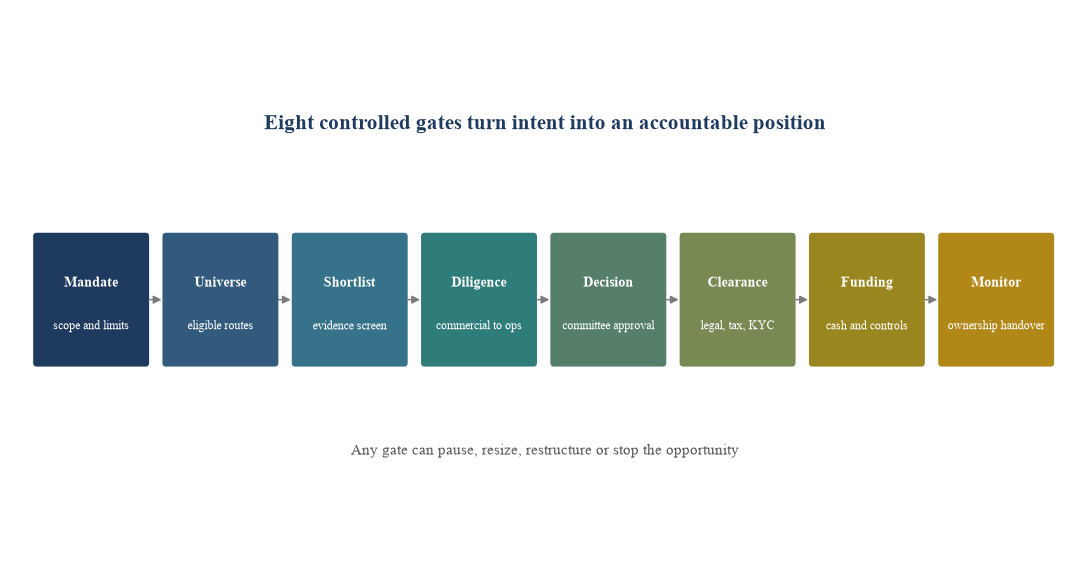
Author framework. A commitment advances only when the evidence required at each gate is accepted by the accountable decision owner.
2. The implementation proposition
The office begins with an institutional question: what must be true before the institution may commit capital? The answer belongs in a mandate implementation charter. The charter converts the board resolution and investment policy into testable boundaries. It records what the office may recommend, what it may negotiate, what requires committee approval and what remains outside scope.
The charter should identify the strategic purpose. A Gulf allocation can seek financial return, portfolio diversification, inflation protection, access to private-company growth, long-duration contracted cash flow, local market knowledge or strategic partnerships. Several objectives can coexist, yet the decision pack should state their order. A project selected for domestic-development impact requires a different benchmark and governance analysis from a global-return allocation.
The International Forum of Sovereign Wealth Funds describes the Santiago Principles as a framework for governance, investment and risk-management practices, with objectives that include sound governance, operational controls, accountability and investment based on economic and financial risk and return considerations.[3] The principles are voluntary and apply to sovereign wealth funds. Their separation of owner, governing body and operational management provides a useful governance reference for other institutional investors when adapted to their own law and mandate.
The OECD Core Principles of Private Pension Regulation call for a rigorous investment process, a written investment policy and clear allocation of operational and oversight responsibilities.[4] These elements support the office design. The governing body sets policy and accepts material exceptions. The investment team develops the recommendation. Independent risk, legal, tax, compliance and operations functions challenge the evidence within their mandates. Finance and treasury verify the funding route. The committee records the decision and conditions.
The office also sets an evidence hierarchy. Executed governing documents, audited financial statements, administrator records, custodian records, regulatory registers and independent legal opinions carry more weight than marketing material. Manager representations require validation against primary documents where material. External datasets require source, date, coverage and methodology. Management estimates are identified as assumptions and subjected to sensitivity analysis.
Table 1. Minimum mandate implementation charter
| Charter field | Required decision | Evidence owner | Example control |
|---|---|---|---|
| Strategic purpose | Financial, diversification, liability, development or partnership objective | Board or governing body | Objectives are ranked and connected to measurable outcomes |
| Eligible exposure | Strategy, instrument, geography, sector and legal form | Investment policy owner | Every opportunity maps to an approved exposure category |
| Allocation limits | Programme, manager, vehicle, sector, country, currency and vintage limits | Risk and investment teams | Look-through concentration is calculated before approval |
| Return framework | Benchmark, hurdle, fee basis, currency and measurement method | Investment and performance teams | Benchmark is selected before outcome review |
| Liquidity limits | Unfunded commitments, call coverage, lock-up and facility use | Treasury and risk | Stressed coverage remains above policy minimum |
| Decision rights | Recommend, challenge, approve, sign, fund and monitor authorities | Governance owner | No person approves and independently validates the same control |
| Stop conditions | Legal, integrity, valuation, liquidity, concentration and evidence failures | Applicable control function | A red condition has a named resolution authority |
| Reporting standard | Frequency, metrics, valuation, incidents and escalation | Operations and risk | Manager reporting maps to the institution's data model |
The charter should be approved before the opportunity universe is screened.
3. Governance and decision rights
Execution speed depends on decision clarity. A responsibility matrix should distinguish the accountable decision owner from contributors and reviewers. The investment lead is accountable for the commercial thesis and manager recommendation. Risk is accountable for independent risk review and limit testing. Legal counsel is accountable for legal analysis and document advice. Tax specialists are accountable for tax analysis. Compliance owns sanctions, anti-money-laundering and related onboarding controls within the institution's framework. Treasury owns cash availability and settlement readiness. Operations owns booking, data, valuation feeds and ongoing reporting capability.
The committee owns the capital decision. Its paper should show the recommendation, counter-case, key sensitivities, unresolved items and proposed conditions. Conditional approval has a precise meaning: capital cannot be funded until named conditions are evidenced and signed off by the authorised function. A condition should never be recorded as a general request to complete diligence. It should state the missing item, acceptance standard, owner and expiry date.
Conflict management forms part of the architecture. The OECD's 2023 corporate-governance principles emphasise disclosure and management of conflicts across the investment chain.[5] The office should record placement fees, advisory relationships, co-investor relationships, board roles, political exposure, related-party transactions and personal interests. The conflict register should identify mitigation and the decision body that accepted it.
The evidence register is the programme's source of truth. Each claim in the decision paper links to a source document, data extract, expert report or recorded assumption. Version, date, reviewer and status are preserved. A committee member should be able to trace a material return, risk, legal or liquidity claim to its evidence without reconstructing the diligence process from email.
Exceptions require equal discipline. The log records the policy or standard, the proposed departure, the reason, the incremental risk, mitigating controls, approving authority, expiry and monitoring obligation. Permanent exceptions return to the policy owner. Transaction-specific exceptions expire with the decision or are incorporated into monitoring.
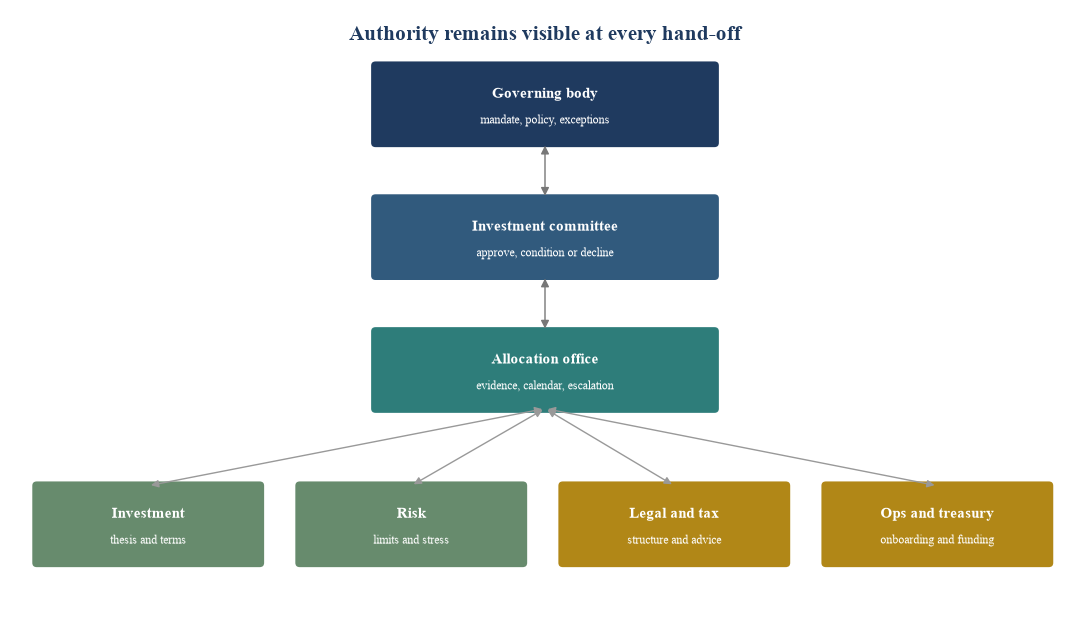
Author framework. Challenge functions retain their authority while the programme office coordinates evidence and timing.
4. The 13-week critical path
The programme runs several workstreams in parallel and keeps decisions sequential. Week 1 confirms the charter, governance and baseline portfolio. Weeks 1 to 3 build the opportunity universe and screen it against mandate fit. Weeks 3 to 5 establish the shortlist and open data rooms. Weeks 4 to 9 carry out commercial, financial, operational, legal, tax, compliance, risk and technology diligence. Weeks 8 to 10 complete the decision paper and committee challenge. Weeks 9 to 12 negotiate documents, complete onboarding and validate funding. Week 13 supports signing, funding or a formally recorded extension.
Parallel work requires entry criteria. Legal review can begin with draft governing documents, term sheets and structure charts. Full negotiation starts after commercial viability is established. Onboarding can collect standard institutional documents early, while final account opening waits for approved entities and authorised signatories. Treasury can model calls before final terms, then lock the funding plan when notice mechanics and currency are known.
Weekly control meetings should focus on decisions and dependencies. A status report includes each gate, evidence completeness, open red and amber items, decisions due in the next two weeks, external dependencies and the critical path. Task counts are less informative than the age and materiality of unresolved conditions.
The programme calendar should respect governance lead times. Committee papers require circulation periods. Legal opinions require confirmed facts. Regulators, administrators, custodians and banks operate to their own service levels. Holiday periods and multi-jurisdiction signatories can affect closing. These dependencies are captured at launch rather than discovered during the final week.
The office should define a clock-stop rule. The 90-day clock can remain a management measure, while an opportunity is classified as awaiting external evidence, internal decision, manager remediation or documentation. This classification preserves transparency. It also prevents a nominal on-time close from concealing an unresolved condition.
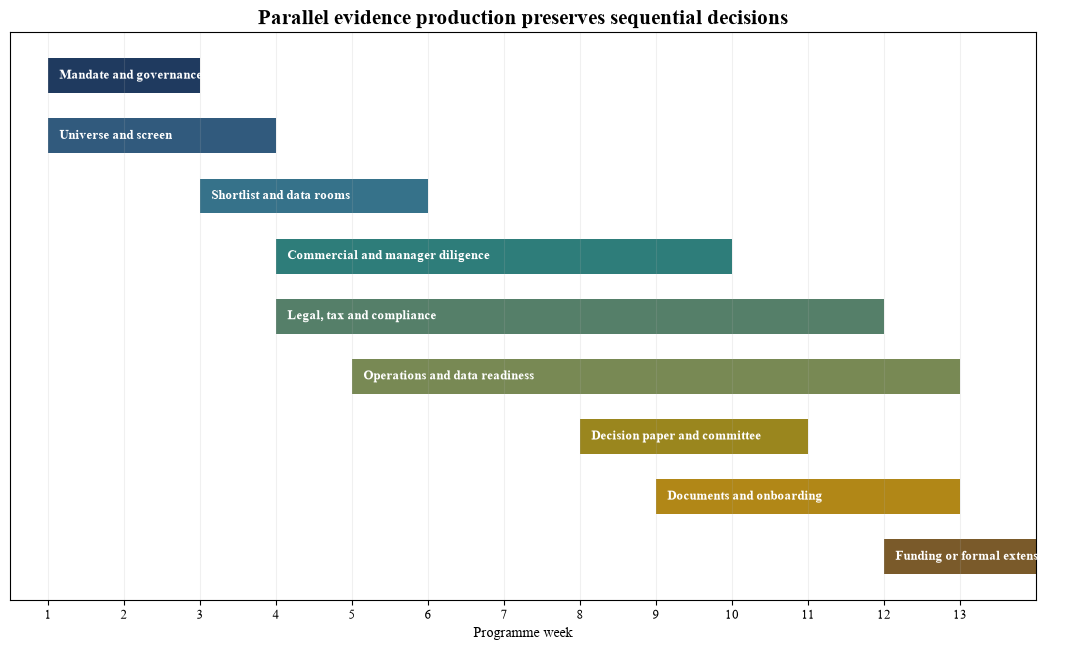
Author framework. Timing is indicative; governing documents, regulation, tax, onboarding and counterparties can require a longer period.
Table 2. Eight stage gates and acceptance criteria
| Gate | Decision | Minimum acceptance evidence | Output |
|---|---|---|---|
| Mandate acceptance | Is the instruction executable? | Approved charter, limits, decision rights and liquidity rules | Signed implementation brief |
| Opportunity universe | Which routes are eligible? | Exposure map, sourcing record, conflicts and mandate screen | Governed longlist |
| Shortlist | Which opportunities merit full diligence? | Initial terms, team, strategy, track record and red-flag screen | Approved shortlist and budget |
| Diligence | Is the investment case supported? | Commercial, financial, operational, legal, tax, compliance and risk evidence | Evidence register and issue log |
| Investment decision | Does the case clear policy and hurdle? | Decision paper, counter-case, sensitivities and independent challenge | Approve, condition, resize or decline |
| Clearance | Can the institution lawfully and operationally proceed? | Final legal, tax, KYC, sanctions, documents and service-provider readiness | Closing clearance certificate |
| Funding readiness | Can capital be provided without breaching liquidity rules? | Call schedule, cash source, currency, approvals and settlement controls | Treasury funding instruction |
| Monitoring handover | Can the position be governed after close? | Booked position, data feeds, reporting calendar, valuation and escalation owner | Active monitoring file |
Acceptance criteria are adapted to the institution, strategy and applicable law.
5. Building the opportunity universe
The universe should begin with exposure routes rather than manager names. The institution identifies the economic exposure it seeks and the legal routes available: listed securities, segregated accounts, open-ended funds, closed-ended funds, co-investments, direct investments, joint ventures, private credit, infrastructure concessions, real estate vehicles or strategic partnerships. Each route is mapped to liquidity, governance, resourcing, tax, regulation, currency and concentration.
Gulf opportunities can span onshore jurisdictions and financial centres. A structure can involve an ADGM, DIFC or other vehicle, an offshore feeder, a local operating company and assets across several GCC states. The structure diagram should show ownership, manager, adviser, general partner, administrator, custodian, bank accounts, auditors, valuation provider and material delegates. Applicable-law and regulatory conclusions come from qualified advisers and current official rules.
ADGM guidance states that a fund in ADGM must be managed by an ADGM fund manager or an eligible foreign fund manager and describes Public Fund, Exempt Fund and Qualified Investor Fund categories.[6] This illustrates why vehicle classification affects manager permissions, investor eligibility, marketing, documentation and onboarding. Other jurisdictions have their own regimes. The office records the applicable regime rather than transferring one centre's rules to another.
The longlist screen should be simple enough to apply consistently. It tests mandate fit, expected return source, downside, liquidity, governance rights, team capability, track-record relevance, terms, operational maturity, conflicts and evidence availability. A high expected return cannot compensate for a prohibited structure or an unresolved integrity concern. A strong manager name cannot substitute for strategy-level evidence.
Sourcing should be documented. The register records who introduced the opportunity, the relationship, any fee, exclusivity, allocation constraint and competing process. This record supports conflict review and later assessment of whether the institution has broad market coverage or a narrow intermediary channel.
6. Manager and investment diligence
The diligence process follows the risk of the strategy. ILPA's Due Diligence Questionnaire standardises common areas of inquiry and seeks to reduce duplicative requests across limited partners, general partners and advisers.[2] The office can use the ILPA structure as a baseline for private funds and add modules for Gulf jurisdiction, currency, local operations, strategic alignment, technology, cyber resilience, sanctions, related parties and co-investment.
Organisation diligence covers ownership, governance, key-person risk, succession, remuneration, compliance, service providers, business continuity and financial resources. Strategy diligence tests the addressable opportunity, sourcing advantage, underwriting method, portfolio construction, value-creation plan and exit routes. Track-record diligence reconstructs cash flows, attribution, write-offs, unrealised value, leverage, benchmarks and the relationship between the team presented and the investments realised.
Terms diligence covers fees, carry, preferred return, hurdle, catch-up, recycling, subscription facilities, fund expenses, key-person provisions, removal, no-fault suspension, extensions, conflicts, advisory committee rights, reporting, valuation and transfer. The economic model should show gross-to-net performance across base, downside and delay cases.
Operational diligence evaluates cash controls, segregation of duties, administrator and custodian arrangements, valuation governance, cybersecurity, data lineage, incident management, outsourcing and business continuity. A strategy can be commercially attractive and operationally unsuitable for the institution. Operational findings therefore reach the committee as decision conditions, not as a post-close administrative list.
The evidence standard changes with materiality. A key-person claim is checked against employment, ownership and attribution records. A realised track record is reconciled to audited or administrator evidence where available. An unrealised valuation is tested against the valuation policy, latest operating information, comparable evidence and subsequent events. A pipeline is treated as potential rather than invested exposure.
Table 3. Integrated diligence workstreams
| Workstream | Core evidence | Principal challenge | Decision output |
|---|---|---|---|
| Commercial | Market, pipeline, competition, sourcing and exit routes | Is the opportunity repeatable and investable at the proposed scale? | Addressable opportunity and deployment range |
| Team and governance | Ownership, roles, attribution, succession and conflicts | Does the responsible team control the claimed results and decisions? | Key-person and governance assessment |
| Performance and valuation | Cash flows, audited records, marks, write-offs and benchmarks | How much value is realised, comparable and repeatable? | Reconstructed track record and valuation confidence |
| Terms and alignment | Governing documents, fees, carry, rights and remedies | Do economics and controls align the parties across scenarios? | Negotiation schedule and term exceptions |
| Legal, tax and regulatory | Structure, opinions, permissions, tax and enforceability | Can the investor enter, hold, fund and exit as intended? | Advice, conditions and prohibited routes |
| Operations and technology | Cash controls, delegates, cyber, continuity and data | Can the position be administered and reported within policy? | Operational risk rating and remediation |
| Portfolio and liquidity | Concentration, correlation, calls, currency and exit capacity | Does the total portfolio remain resilient after commitment? | Size recommendation and funding reserve |
The list is a programme framework and does not replace advice or strategy-specific diligence.
7. From diligence to an investment decision
The decision paper should state the investment proposition in terms that can later be monitored. It identifies the expected return sources, downside pathways, manager actions, liquidity profile, portfolio role and conditions required for success. Each material claim links to the evidence register. The paper includes a counter-case prepared with independent challenge.
Expected returns should be shown net of fees, carry, taxes assumed in the model, hedging cost and implementation reserves. Scenario analysis should vary deployment, operating performance, leverage, refinancing, exit timing, terminal value and currency. For a fund, the model includes commitment pacing, capital calls, distributions and residual value. For a direct asset, it includes operating cash flow, financing, capex, valuation and exit.
Valuation governance matters from entry. The IPEV Guidelines describe best practice for reporting private-capital investments at fair value.[7] The institution should confirm the manager's policy, valuation frequency, inputs, independence, challenge process and back-testing. The committee should see which assumptions are observable and which are management estimates.
Performance reporting also requires a pre-agreed method. The GIPS Standards for Asset Owners provide a framework for fair representation and full disclosure of investment performance and require policies, procedures, defined asset-owner boundaries and applicable valuation practices for organisations claiming compliance.[8] An institution does not need to claim GIPS compliance to benefit from clear data definitions, consistent benchmarks and reproducible calculations.
The committee outcome belongs in a decision record. Approval identifies amount, vehicle, currency, conditions, signatories, funding route and monitoring owner. A resize states the binding risk or liquidity constraint. A deferral states the evidence needed and expiry. A decline records the principal reasons without creating an invitation to reopen the same case without new evidence.
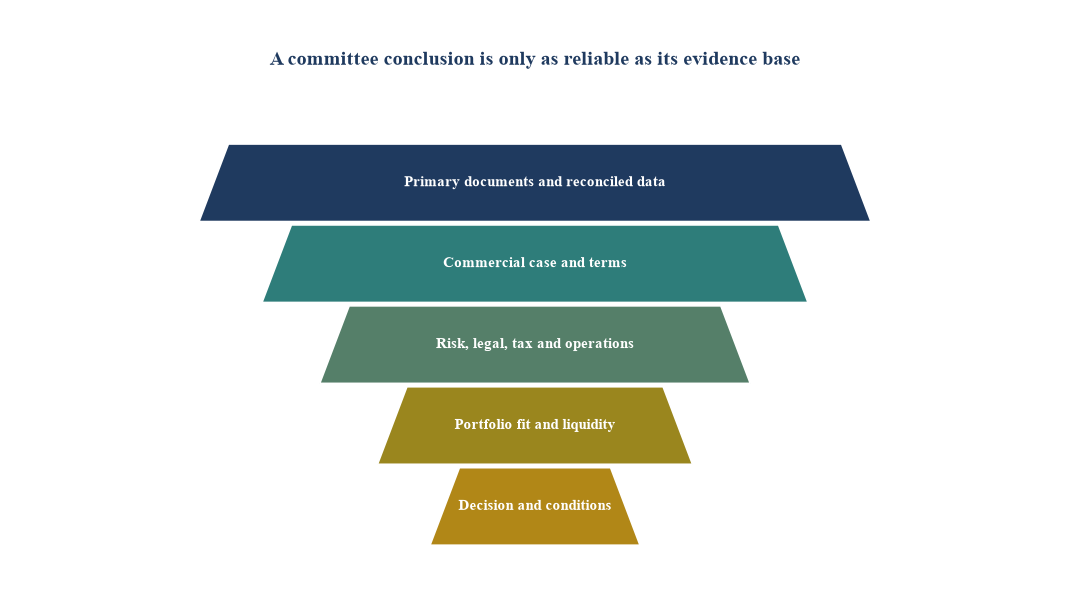
Author framework. Higher layers depend on validated evidence beneath them.
8. Legal, tax, compliance and operational clearance
Commercial approval permits finalisation; it does not authorise funding by itself. The closing-clearance stage confirms that the approved investment and the documents presented for signature are the same transaction. Material changes to economics, governance, leverage, liquidity, structure or counterparties return to the authorised decision body.
Legal work examines capacity, authority, governing law, enforceability, liability, transfer, default, confidentiality, information rights, side letters, dispute resolution and termination. Tax work examines the investor, vehicle, asset, cash-flow and exit consequences under applicable law and treaties. Regulatory work examines permissions, investor classification, marketing, ownership, reporting and any sector restrictions. Qualified advisers provide conclusions for the relevant facts and jurisdictions.
Compliance completes counterparty identification, beneficial ownership, sanctions, politically exposed person and adverse-information checks under the institution's policy and applicable law. The office tracks evidence dates and refresh requirements. A completed questionnaire is an input; risk acceptance belongs to the authorised compliance function.
Operations proves that the institution can hold the investment. The security or vehicle is created in the book of record. Static data, bank instructions, authorised signatories, custody, administrator feeds, valuation frequency, accounting treatment, performance benchmark, document storage and incident escalation are confirmed. A dry run of the capital-call process can reveal account, approval or time-zone issues before money is due.
Cyber and data controls deserve explicit review where portals, virtual data rooms or automated reporting are used. The institution should know which data are collected, where they are stored, who can access them, how instructions are authenticated and how a compromised communication channel would be detected. Payment instructions should be independently verified through an approved channel.
Table 4. Closing clearance certificate
| Clearance item | Acceptance evidence | Owner | Stop condition |
|---|---|---|---|
| Approved economics | Final documents reconcile to committee decision and side letter | Investment and legal | Material term change without approval |
| Legal capacity and authority | Entity documents, authority, signatories and legal advice | Legal | Capacity, enforceability or authority concern |
| Tax treatment | Written advice based on final structure and investor facts | Tax | Unaccepted tax leakage, filing or permanent-establishment risk |
| Regulatory status | Current official registers, permissions and investor eligibility | Legal or compliance | Missing permission or prohibited distribution |
| Counterparty integrity | Completed identity, ownership, sanctions and risk acceptance | Compliance | Prohibited counterparty or unresolved integrity concern |
| Operational readiness | Book of record, accounts, data, valuation and reporting controls | Operations | Position cannot be booked, valued or reconciled |
| Funding readiness | Approved cash source, settlement instruction and call controls | Treasury | Liquidity breach or unverified payment instruction |
Each item is signed off by the function authorised under the institution's policies.
9. Funding and liquidity readiness
Private-market commitments create contingent liquidity obligations. The commitment amount is not the same as the first cash outflow. Calls can accelerate when markets present attractive opportunities or a subscription facility matures. Distributions can slow during weak exit markets. Currency and collateral needs can rise at the same time. The funding plan should therefore use a total-portfolio stress rather than the manager's expected call schedule alone.
The Financial Stability Board recommends incorporating liquidity risks from margin and collateral calls into governance, defining risk tolerance, maintaining contingency funding plans and testing extreme but plausible stresses.[9] The specific report addresses non-bank market participants in derivatives and securities markets. Its governance, stress-testing and operational-preparedness principles are relevant to an institutional liquidity framework when appropriately adapted.
The office constructs monthly cash-flow scenarios for at least the next twelve months and annual scenarios through the investment period. Sources include cash, contracted inflows, saleable assets after haircuts, expected distributions after stress and committed facilities after covenants. Uses include capital calls, operating obligations, collateral, debt service, currency needs and other committed programmes.
Facilities can manage timing. Their capacity, maturity, covenants, collateral, draw conditions, pricing and renewal risk should be visible. A facility should not be counted at face value when a stress could reduce availability or create a covenant conflict. The funding paper identifies primary and contingency sources for every expected call.
Treasury also controls execution. Payment instructions are verified independently. Currency is purchased under approved limits. Call notices are checked against the governing documents, commitment balance and authorised account. Settlement confirmation returns to operations and the position record.
10. Worked programme example
Consider an institution with a USD 300 million Gulf allocation envelope. It evaluates three hypothetical opportunities: a diversified private-credit fund, an infrastructure co-investment vehicle and a growth-equity fund. The office recommends commitments of USD 45 million, USD 35 million and USD 25 million respectively. The USD 105 million total represents 35 percent of the approved envelope. The uncommitted envelope preserves capacity for later vintages and remediation of concentration.
The base twelve-month funding model assumes USD 55 million of cash and maturing short-duration assets, USD 60 million of saleable liquid assets after ordinary haircuts and USD 35 million of expected private distributions. Sources total USD 150 million. Expected calls and portfolio obligations total USD 78 million, giving 1.92 times coverage.
The combined stress applies management assumptions for demonstration. Cash and maturing assets remain USD 55 million. Saleable liquid proceeds fall to USD 53 million after a larger haircut. Private distributions fall to USD 18 million. A committed facility contributes USD 10 million after applying its draw conditions and internal limit. Sources total USD 136 million. Calls and obligations rise to USD 90 million. Coverage is 1.51 times.
The institution's hypothetical policy minimum is 1.25 times. The stressed case clears that assumption by 0.26 times. The result does not establish that the commitments are suitable. Manager, strategy, legal, tax, regulatory, valuation, operational and concentration evidence must still clear their gates. A different institution could apply another minimum or exclude facilities from qualifying sources.
The office also tests a delayed-close case. If the infrastructure vehicle requires six additional months for regulatory or documentation work, the approved amount remains conditional and its reserve remains visible. The committee can hold the amount, reallocate it or allow the approval to expire. No funding occurs solely because the programme reaches day 90.
Table 5. Hypothetical programme and twelve-month liquidity model
| Item | Base case | Combined stress | Control interpretation |
|---|---|---|---|
| Cash and maturing short-duration assets | 55 | 55 | Verified balances and maturity dates required |
| Saleable liquid assets after haircut | 60 | 53 | Stress uses a larger price and execution haircut |
| Expected private distributions | 35 | 18 | Stress delays or reduces exits |
| Qualifying committed facility | 0 | 10 | Included only after draw and covenant tests |
| Total available sources | 150 | 136 | Sum of controlled sources |
| Calls and portfolio obligations | 78 | 90 | Stress accelerates calls and other requirements |
| Twelve-month coverage | 1.92x | 1.51x | Compared with hypothetical 1.25x policy minimum |
| Proposed new commitments | 105 | 105 | Funding remains subject to every applicable gate |
USD millions. All figures are management assumptions created to illustrate the framework; they do not represent a client, fund, manager or forecast.
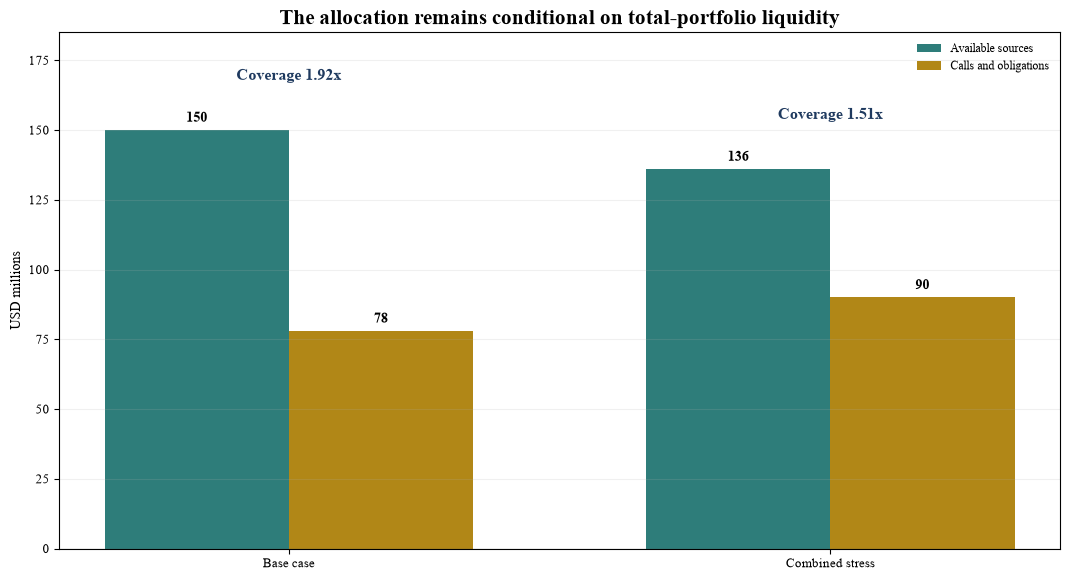
USD millions. The figures are illustrative management assumptions and do not represent a client portfolio or market estimate.
11. Handover and post-close monitoring
A funded commitment creates an operating obligation. The closing file should move into a monitoring file without losing evidence, conditions or ownership. The handover includes executed documents, side letters, approvals, contact matrix, bank instructions, commitment balance, expected calls, benchmark, valuation policy, reporting calendar, key-person terms, advisory committee rights and escalation thresholds.
The first reporting cycle tests data quality. Operations reconciles the manager statement, administrator data, custodian record and ledger. Performance validates cash-flow dates, fees, valuations and benchmark. Risk tests limits and liquidity. Investment reviews the thesis and operating indicators. Legal and compliance track continuing obligations and material changes.
ILPA's updated Reporting Template, released in 2025, seeks more uniform reporting of fees, expenses and carried interest, while its related performance work supports greater transparency and comparability.[10] The institution should map manager reporting into its own controlled data model and preserve source records. Standardisation does not remove the need to understand strategy-specific metrics.
The monitoring plan should define events that return the investment to committee. Examples include key-person activation, manager ownership change, strategy drift, material valuation change, covenant breach, delayed reporting, cyber incident, regulatory action, litigation, sanctions exposure, unexpected leverage, capital-call variance or a stressed liquidity breach. The threshold and decision owner are agreed before close.
Annual review reconnects the position to the original mandate. The institution compares realised and unrealised results, risk, liquidity, fees, governance performance and portfolio role with the approved case. Lessons from the programme update the charter, diligence request and stage-gate criteria for the next vintage.
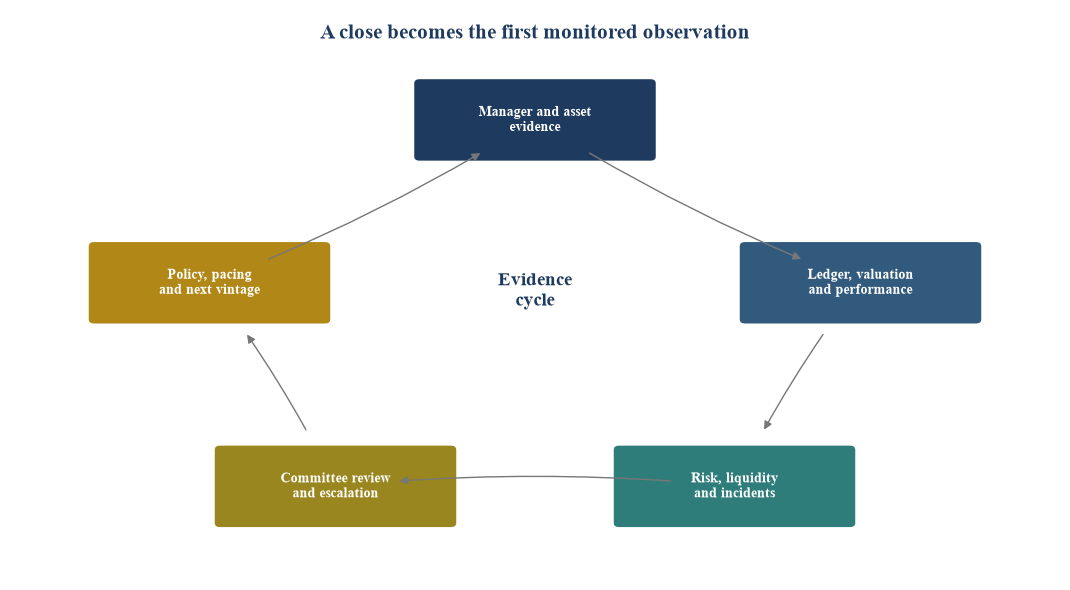
Author framework. Monitoring evidence returns to allocation policy and the next commitment decision.
12. Failure modes and stop conditions
An allocation office earns credibility through the opportunities it stops as well as those it completes. The stop-condition register should distinguish remediable evidence gaps from structural failures. A missing administrator report can be requested. A prohibited counterparty, absent legal capacity or unresolved integrity concern can terminate the process under policy.
Mandate drift occurs when an attractive opportunity does not fit the approved exposure. The correct response is a separate policy decision, not a creative relabelling of the asset. Benchmark drift occurs when the return case changes after performance evidence is seen. The office locks the benchmark protocol before final modelling.
Diligence compression occurs when a timetable causes workstreams to accept representations without validation. The evidence register exposes this risk by showing source quality and open items. Commercial enthusiasm cannot sign off an independent control.
Conditional approvals can accumulate. A condition that remains open near closing should be escalated with a clear consequence. Waiver authority should be as visible as approval authority. A temporary workaround requires an expiry, monitoring control and owner.
Funding risk can emerge late when calls, distributions or liquid-market conditions change. The office refreshes the liquidity model at committee approval, document execution and every funding notice. A prior coverage result is not treated as permanent.
Table 6. Principal failure modes and controls
| Failure mode | Observable signal | Programme control | Potential outcome |
|---|---|---|---|
| Mandate drift | Opportunity requires a new label or exception to fit | Independent mandate mapping and policy-owner review | Resize, separate policy decision or decline |
| Evidence substitution | Marketing claim replaces primary or reconciled record | Evidence hierarchy and source-quality flag | Request evidence, reserve value or stop |
| Benchmark selection after results | Comparator changes when relative return is weak | Pre-approved benchmark protocol | Recalculate and refer exception |
| Diligence compression | Red issues become broad post-close actions | Gate acceptance criteria and condition expiry | Extend, condition or decline |
| Legal or regulatory mismatch | Structure or permissions differ from the approved case | Final document and official-register reconciliation | Restructure or stop |
| Operational unpreparedness | Position cannot be booked, valued or reconciled | Pre-close operational dry run | Delay funding |
| Liquidity deterioration | Stressed coverage falls below policy | Refresh at approval, signing and call | Resize, defer or activate contingency plan |
| Weak handover | Conditions and evidence disappear after close | Monitoring certificate and named owner | Remediate before funding or escalate |
The response depends on materiality, policy and applicable professional advice.
13. Implementation toolkit
The office can be launched with ten controlled artefacts. These are the mandate charter, governance and responsibility matrix, opportunity register, standard evidence request, data-room index, diligence issue log, decision paper, closing-clearance certificate, funding plan and monitoring handover. Each artefact has an owner, version, approval status and retention location.
A small secretariat maintains the calendar and evidence. Specialists remain accountable for their conclusions. This arrangement concentrates programme discipline without concentrating professional judgement in one person. Senior escalation focuses on decisions that can change the critical path.
Technology should support traceability. A workflow can assign owners, due dates and access. A data model can map manager reporting into the institution's ledger and performance system. Automation can check completeness, reconcile identifiers and identify stale documents. Human review remains necessary for investment judgement, legal advice, tax analysis, valuation challenge, integrity decisions and exceptions.
Key programme metrics include days from mandate to shortlist, evidence completeness at committee circulation, age of red conditions, decision turnaround, document exceptions, onboarding defects, funding exceptions and first-quarter reporting breaks. These measures reveal process quality. A high close count is not a sufficient measure because the office must preserve the right to decline.
The programme should end with a lessons review. The institution records which evidence arrived late, which controls duplicated work, which external dependencies caused delay and which claims failed validation. The next programme begins with an improved data request, calendar and charter.
14. Limitations
This paper provides a governance and execution framework for general information. It does not provide investment, legal, tax, accounting, valuation, regulatory, compliance or cybersecurity advice. Institutions should obtain qualified advice for their facts, governing documents and jurisdictions.
The 90-day schedule is indicative. Regulatory approvals, legal negotiations, tax analysis, manager response, external service providers, bank onboarding, holidays, multi-jurisdiction signatures and investment complexity can require more time. A longer process can be the correct outcome when evidence or authority remains incomplete.
The worked programme uses hypothetical commitments, sources, uses, stress assumptions and a policy minimum. The figures do not estimate a typical Gulf programme and do not represent a client, manager, fund or market forecast. Production analysis requires the institution's verified portfolio, liabilities, facilities, governing documents and decision rules.
Standards cited in this paper have defined scopes. The Santiago Principles apply voluntarily to IFSWF members. GIPS compliance has formal requirements. ILPA documents are industry templates and guidance. FSB recommendations address specified financial-stability risks. ADGM material addresses its regulatory framework. Users should apply each source only within its scope and current version.
15. Conclusion
A Gulf allocation becomes investable through a chain of governed decisions. The board defines the purpose and limits. The investment team develops the case. Independent functions challenge risk, law, tax, compliance, valuation, operations and liquidity. The committee approves an amount and conditions. Treasury funds only after clearance. Operations and risk maintain the position after close.
The 90-Day Gulf Allocation Office makes that chain visible. Eight gates, a 13-week critical path, one evidence register and a controlled exception process reduce avoidable waiting. Parallel work creates speed while accountable functions retain their authority.
The hypothetical programme shows the role of portfolio liquidity. USD 105 million of proposed commitments can clear a 1.51 times stressed coverage assumption and still fail another gate. Funding is the final consequence of a supported decision, not the measure of programme success.
The durable output is an institutional operating system. It produces an auditable decision, a clean closing file, a monitored position and better evidence for the next allocation. Capital moves when the mandate, investment case, controls and funding capacity agree.
References
- International Monetary Fund, Gulf Cooperation Council Diversification: The Role of Foreign Investments and Sovereign Wealth Funds, IMF Working Paper 2025/174, 5 September 2025. https://www.imf.org/en/publications/wp/issues/2025/09/05/gulf-cooperation-council-diversification-the-role-of-foreign-investments-and-sovereign-569546
- Institutional Limited Partners Association, Due Diligence Questionnaire 2.0 and related user materials, November 2021. https://ilpa.org/resources-tools/resource-library/due-diligence-questionnaire/
- International Forum of Sovereign Wealth Funds, Santiago Principles. https://www.ifswf.org/santiago-principles
- OECD, Recommendation of the Council on Core Principles of Private Pension Regulation, investment governance provisions. https://legalinstruments.oecd.org/public/doc/344/fa84ef90-e2bd-4171-802a-b5c15aa3106d.html
- OECD, G20/OECD Principles of Corporate Governance 2023, Institutional Investors, Stock Markets, and Other Intermediaries. https://www.oecd.org/en/publications/2023/09/g20-oecd-principles-of-corporate-governance-2023_60836fcb/full-report/component-6.html
- Abu Dhabi Global Market Financial Services Regulatory Authority, Getting Started Guide with FSRA, funds section, 2025. https://assets.adgm.com/download/assets/Getting%2BStarted%2BGuide%2Bwith%2BFSRA.pdf/a8c5b07a589a11efa1111ed8b674bcd6
- International Private Equity and Venture Capital Valuation Board, IPEV Valuation Guidelines 2025. https://www.privateequityvaluation.com/Valuation-Guidelines
- CFA Institute, GIPS Standards for Asset Owners and Handbook. https://www.gipsstandards.org/standards/gips-standards-for-asset-owners/
- Financial Stability Board, Liquidity Preparedness for Margin and Collateral Calls: Final Report, 10 December 2024. https://www.fsb.org/2024/12/liquidity-preparedness-for-margin-and-collateral-calls-final-report/
- Institutional Limited Partners Association, ILPA Reporting Template, updated 2025. https://ilpa.org/industry-guidance/templates-standards-model-documents/ilpa-templates-hub/ilpa-reporting-template/
- Bank for International Settlements, The Rise of Private Markets, BIS Quarterly Review, December 2021. https://www.bis.org/publ/qtrpdf/r_qt2112e.htm
- International Monetary Fund, Sovereign Wealth Funds Need Legal Clarity as Their Scale and Mandates Expand, 21 July 2026. https://www.imf.org/en/blogs/articles/2026/07/21/sovereign-wealth-funds-need-legal-clarity-as-their-scale-and-mandates-expand
About the Author
Chennakeshav Adya, Independent Researcher
Chennakeshav Adya writes on private capital, investment governance, corporate finance and transaction execution. This paper is independent research for general information. It is not investment, legal, tax, accounting, valuation or regulatory advice.
Appendix A. Programme Artefacts: Controlled documents
1. Mandate implementation charter with policy references and limits. 2. Governance and responsibility matrix with approval and waiver authorities. 3. Opportunity register with source, conflicts, stage and disposition. 4. Standard evidence request adapted to strategy and jurisdiction. 5. Data-room index with document owner, version, date and reviewer. 6. Diligence issue and condition log with materiality and expiry. 7. Investment-committee paper with counter-case and sensitivities. 8. Closing-clearance certificate signed by authorised functions. 9. Funding plan with primary and contingency cash sources. 10. Monitoring handover with data, valuation, incidents and review calendar.
Appendix B. Committee Questions: Questions before funding
1. Which approved objective does the investment serve, and how will success be measured? 2. Which mandate boundaries and look-through limits apply? 3. Which return sources are supported by realised evidence, and which depend on management estimates? 4. Which benchmark was selected before outcome review? 5. Which commercial, legal, tax, regulatory, compliance, operational and valuation issues remain open? 6. Which conditions must be satisfied before signing and before funding? 7. How do expected calls interact with the total portfolio under a combined stress? 8. Which assets, inflows or facilities provide primary and contingency liquidity? 9. Which event returns the investment to committee after close? 10. Which function owns every representation in the decision record?
