

1. Introduction
Sovereign capital has become an important participant in global private markets, infrastructure, real estate, technology and strategic industry. Sovereign wealth funds range from savings and stabilisation vehicles to pension reserve funds and development or strategic investment institutions. Their legal forms, mandates, owner relationships, risk tolerances and disclosure practices differ. The International Forum of Sovereign Wealth Funds therefore describes the Santiago Principles as a principle-based framework for governance, investment and risk management rather than a uniform operating code.[1]
International institutions can value a sovereign partner for several reasons. The partner may have local market knowledge, origination capability, government and industry relationships, long-duration capital, operating expertise or the ability to assemble a larger transaction. OECD research on sovereign and strategic investment funds notes that joint platforms can pool expertise, share diligence and monitoring costs, improve deal flow and combine local informational advantages with institutional capital.[2]
Those advantages create a governance task. The same transaction can serve different purposes for each participant. An international pension fund may pursue risk-adjusted return and liability diversification. A sovereign savings fund may pursue long-term national wealth. A development platform may also consider domestic capacity, employment, infrastructure or sector formation. A specialist manager may seek performance fees, portfolio growth and future fundraising. The parties can agree on the asset while holding different views on pacing, leverage, procurement, related-party relationships, disclosure, follow-on investment and exit.
The relevant question is whether the partnership will remain governable when the easy assumptions fail. The co-investors should know who may approve the annual budget, appoint management, change strategy, refinance debt, transact with an affiliate, disclose information, fund a cost overrun, accept a government concession change, sell the asset or continue holding it. They should also know which decisions are affected by foreign investment screening, sanctions, foreign-subsidy review, tax, sector regulation or public accountability.
This paper presents a controlled process for answering those questions. The framework applies to a single direct transaction, a joint investment vehicle or a repeat co-investment platform. It does not assume that any sovereign institution follows the same mandate or governance model as another. Every partner, asset, vehicle and jurisdiction requires evidence and advice based on its current facts.
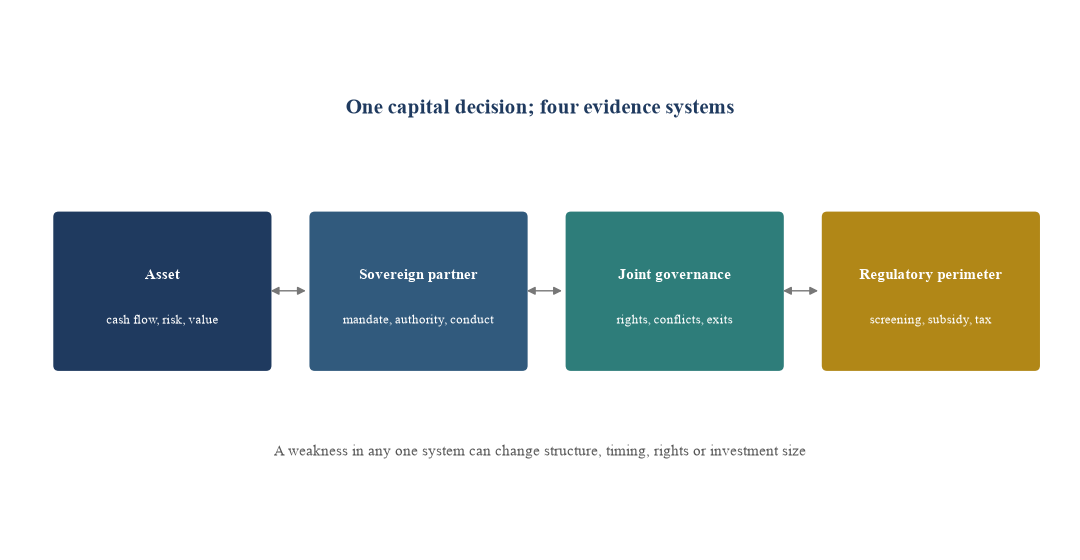
Author framework. An approval is supported only when the asset, partner, joint governance and regulatory perimeter are each understood.
2. Start with mandate compatibility
A co-investment should begin with a partner-governance memorandum. The memorandum records why the institution is investing, why a sovereign partner is involved, what the partner is expected to contribute and which objectives are binding. It distinguishes an investment rationale from a relationship rationale. It also distinguishes financial objectives from development, strategic or policy considerations that may belong to another participant.
The Santiago Principles state that sovereign wealth funds should have a clear legal framework, publicly disclosed policy purpose, sound governance, operational controls, accountability and investment policies consistent with their objectives.[1] The principles apply voluntarily to member sovereign funds. For an external co-investor, they provide a useful set of questions. What is the sovereign institution's legal basis? Who is the owner? Which body sets the mandate? Which body approves the transaction? Is operational management able to make investment decisions within the mandate? Which public disclosures, parliamentary controls, audit requirements or owner approvals may apply?
The institution also examines its own authority. Its investment policy may restrict direct investments, control positions, development exposure, single assets, emerging markets, state-connected counterparties, illiquid assets or foreign currency. The proposed asset can fit the portfolio while the proposed governance role exceeds delegated authority. A board seat, veto right, control arrangement or follow-on obligation may create responsibilities that a passive fund commitment does not.
Compatibility should be expressed through tests. The asset must serve an approved portfolio objective. The target return and risk should be evaluated on the institution's own basis. Strategic benefits attributed to the sovereign relationship should be described separately and should not substitute for financial evidence where the institution's mandate requires financial return. Public-policy objectives affecting asset decisions should be disclosed and allocated to an authorised decision process.
Time horizon is another compatibility test. Sovereign investors can have patient capital, yet their holding period is determined by mandate, policy and transaction facts. An international institution may have a closed-end allocation, annual liquidity targets or a defined exit horizon. The governance documents should reconcile these clocks. A statement that both parties are long-term investors does not answer what happens if one must sell in year five and the other seeks to hold for twenty years.
Table 1. Partner-governance memorandum
| Field | Required evidence | Decision question | Control output |
|---|---|---|---|
| Legal identity and mandate | Constitutive law, governing documents, official disclosures and authority record | Which entity invests, and under whose authority? | Verified counterparty and authority map |
| Investment purpose | Approved policy, transaction paper and stated objectives | Which financial and strategic objectives apply? | Ranked objectives and prohibited trade-offs |
| Capital role | Proposed equity, debt, guarantee, development support or operating contribution | What is each party providing beyond cash? | Contribution schedule with deliverables |
| Decision horizon | Approval calendar, holding policy, liquidity limits and review cycle | Can the parties decide and hold on compatible timelines? | Decision calendar and exit assumptions |
| Governance capacity | Responsible team, committees, delegates and advisers | Who can negotiate, approve, sign, fund and monitor? | Responsibility and escalation matrix |
| Disclosure perimeter | Public reporting, confidentiality, audit and regulatory duties | Which information may or must be disclosed? | Information-classification protocol |
| Relationship boundary | Other mandates, introductions, procurement and public-sector contacts | Which relationship benefits are part of the case? | Conflict and attribution record |
The memorandum is approved before detailed asset diligence and is updated when the proposed structure changes.
3. Diligence the sovereign partner as an institution
Partner diligence is distinct from customer or beneficial-ownership onboarding. It examines whether the partner can enter, govern, fund and remain accountable for the investment. The work begins with legal identity, ownership, mandate, decision authority, authorised signatories and the relationship between owner, governing body and investment management.
The IFSWF explains that the Santiago Principles promote economic and financial investment considerations, appropriate disclosure, accountability and sound risk management.[1] Membership or a published self-assessment is relevant evidence. It is not a substitute for transaction diligence. The institution should read the applicable self-assessment, annual report, investment policy disclosures, audit information and transaction authority materials. It should reconcile public descriptions with the entity named in the proposed documents.
Decision authority should be traced from mandate to signature. The co-investor needs to know whether approval comes from an investment committee, board, ministerial body, owner representative or delegated manager. Conditions or reservations in that approval should be visible. The governance documents should state what happens if an approval expires, a delegated authority changes or a new owner instruction conflicts with the joint vehicle's obligations.
Funding capacity requires evidence. A sovereign institution's scale does not establish that a specific vehicle has an unconditional allocation. The institution should confirm committed amount, currency, funding source, call mechanics, internal approvals and any appropriation or owner dependencies. Where capital is provided through a subsidiary, platform or managed account, the analysis follows the chain to the funding entity and the contractual obligation.
Conduct and integrity diligence covers sanctions, anti-bribery, anti-money-laundering, politically exposed persons, litigation, regulatory findings, public controversy and material conflicts under applicable law and policy. Sovereign ownership by itself is not a negative finding. The analysis should remain factual and based on current official records, credible evidence and the institution's risk framework.
Operating capability matters after close. The partner should identify its deal team, portfolio owner, legal and risk contacts, representatives on boards or committees, information-security controls and incident process. A relationship led only by senior sponsors can become fragile when routine decisions move to teams with different incentives or incomplete records.
4. Opportunity allocation and conflicts
Co-investments create allocation questions before they create board questions. The lead party or manager may have several funds, managed accounts, strategic partners and affiliated vehicles. The institution should know why the opportunity is being syndicated, why it has received the proposed allocation, how expenses are shared, how follow-on opportunities are allocated and whether any participant has preferential economics or information.
ILPA Principles 3.0 recommends a written framework for allocating co-investment opportunities, interests and expenses, disclosure of prioritisation, mitigation of conflicts, treatment of follow-on investments and disclosure of differentiated economics.[3] It also states that suitable opportunities should first be allocated to the fund when they fit its strategy and it has available commitments. These principles address GP-led private-market arrangements. Their transparency logic is also useful where a sovereign platform or strategic sponsor controls deal flow.
An opportunity-allocation protocol should identify the source of the transaction, the allocation capacity, the parties considered, the reason for each allocation and any relationship condition. The protocol should cover over-subscription, under-subscription, reduced transaction size and later syndication. It should also state whether a participant may transfer or warehouse part of its allocation.
Expenses should follow a written rule. Broken-deal costs, diligence fees, transaction fees, director costs, advisers, insurance and platform overhead can be allocated pro rata, by use or under another disclosed formula. The rule should apply consistently to affiliates. A related-party adviser should be appointed through an approved conflict process with scope, fee and performance oversight.
Political or relationship considerations can create additional conflicts. A public authority, state-owned enterprise, concession counterparty, development agency or other government-linked party may interact with the asset. The investment vehicle should record which decisions are commercial and which require an external public process. The sovereign co-investor should not be assumed to control another state body. Any representation about government support, permits, tariffs, procurement, offtake or policy stability requires primary evidence from the competent authority.
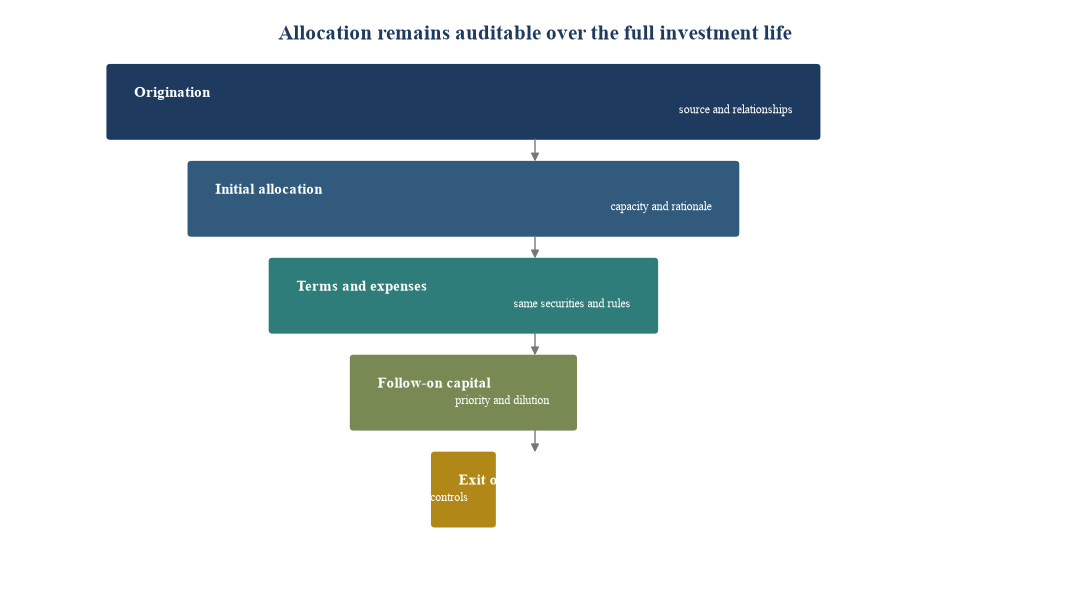
Author framework. The chain preserves evidence from origination through later capital and exit decisions.
5. Underwrite the asset independently
A co-investment is an asset decision. The partner relationship can improve access and information, yet the international institution remains responsible for its own underwriting under its mandate. The investment paper should therefore separate facts supplied by the sovereign partner, facts supplied by the asset or manager, independently verified evidence and stated assumptions.
Commercial diligence covers market demand, competition, customers, suppliers, regulation, permits, technology, operations, management and exit routes. Financial diligence reconstructs historical earnings and cash flow, capital expenditure, working capital, debt, tax, contingent liabilities and the bridge from reported results to the investment model. Legal diligence addresses ownership, contracts, disputes, land or concession rights, environmental matters, intellectual property and enforceability.
Infrastructure and strategic assets often depend on government decisions. Tariffs, concessions, land, licences, procurement, subsidies, tax incentives or offtake may influence value. The institution should identify the competent public body, legal instrument, term, change process and remedy. A sovereign co-investor's participation should not be modelled as a guarantee of continued policy, licence renewal or favourable treatment unless a legally effective instrument provides it.
The downside case should test the features that make the partnership attractive. Local access can reduce sourcing friction, but it can also create concentration in one jurisdiction or policy environment. Patient capital can support long-duration assets, but it can also delay an exit. Strategic operating relationships can accelerate growth, but they can introduce related-party pricing or procurement questions. Each claimed advantage receives a measurable hypothesis and a failure condition.
Valuation needs independent governance. Entry price, leverage, terminal value, discount rate, comparable set and operating assumptions are approved with the investment. Subsequent valuations should follow a documented policy and should identify the party responsible for preparation, review and dispute resolution. Where one co-investor supplies services, contracts or financing that affect value, the valuation process should test the terms as related-party inputs.
Table 2. Four-track diligence matrix
| Track | Core questions | Primary evidence | Required output |
|---|---|---|---|
| Asset | What produces cash flow, downside protection and exit value? | Contracts, financial records, operating data, permits and independent reports | Underwriting case, downside and valuation range |
| Sovereign partner | Does the entity have mandate, authority, funding and operating capacity? | Constitutive documents, approvals, official disclosures and authority records | Partner-governance memorandum and clearance |
| Joint system | Can the parties decide, fund, monitor and exit under divergent interests? | Term sheet, shareholders agreement, policies and committee schedules | Governance term sheet and reserved-matters schedule |
| Regulatory perimeter | Which approvals, filings, disclosures and restrictions apply? | Current law, official guidance, regulator records and qualified advice | Regulatory map, conditions and closing calendar |
The workstreams run in parallel and converge before the governance and regulatory gate.
6. Design decision rights before negotiating documents
Governance rights should be allocated by decision type. Ownership percentage alone rarely produces a complete decision system. Day-to-day operations can be delegated to management. Annual budgets, business plans, financing, acquisitions, disposals, senior appointments, related-party transactions, material litigation, changes in strategy, distributions, valuation policy and exit decisions may require board, committee or shareholder approval.
The reserved-matters schedule should use thresholds and consequences. A general veto over material matters invites disagreement about materiality. A schedule can define monetary thresholds, percentage deviations, leverage limits, contract duration, related-party scope and time periods. It should also state what happens when consent is withheld: management continues under the prior budget, a temporary budget applies, an independent expert determines a technical point, senior sponsors meet or an exit process begins.
Board composition should reflect competence as well as capital. Each party can nominate representatives, while independent directors or specialist committee members can support audit, risk, remuneration or conflicts. Directors' duties depend on applicable law and the vehicle. Nominee directors should receive advice on their obligations to the company and on information they may share with the appointing investor.
Information rights require a matrix. The international institution may need financial statements, operating metrics, risk reports, valuation files, incident notices, ESG information and access for its auditors or regulators. The sovereign partner may have public-accountability or state-audit obligations. The asset may hold commercially sensitive, personal, critical-infrastructure or national-security information. The matrix classifies data, permitted recipients, purpose, retention, cyber controls, regulator access and escalation for prohibited disclosure.
Conflicts need a standing process rather than case-by-case improvisation. A related-party transaction should be identified early, supported by terms and benchmarking, reviewed by non-conflicted decision makers and recorded. The process should cover affiliates of each investor, portfolio companies, government-linked counterparties, directors, advisers and financing providers.
Deadlock architecture should preserve the asset. The first stage is a defined management or committee process. The second stage is escalation to senior representatives with a fixed information pack. Technical disputes can go to an expert. Fundamental disputes can lead to a buy-sell, transfer, structured sale or other agreed remedy. The parties should test the remedy against regulation, affordability, minority protection and the risk of forcing a sale during market stress.
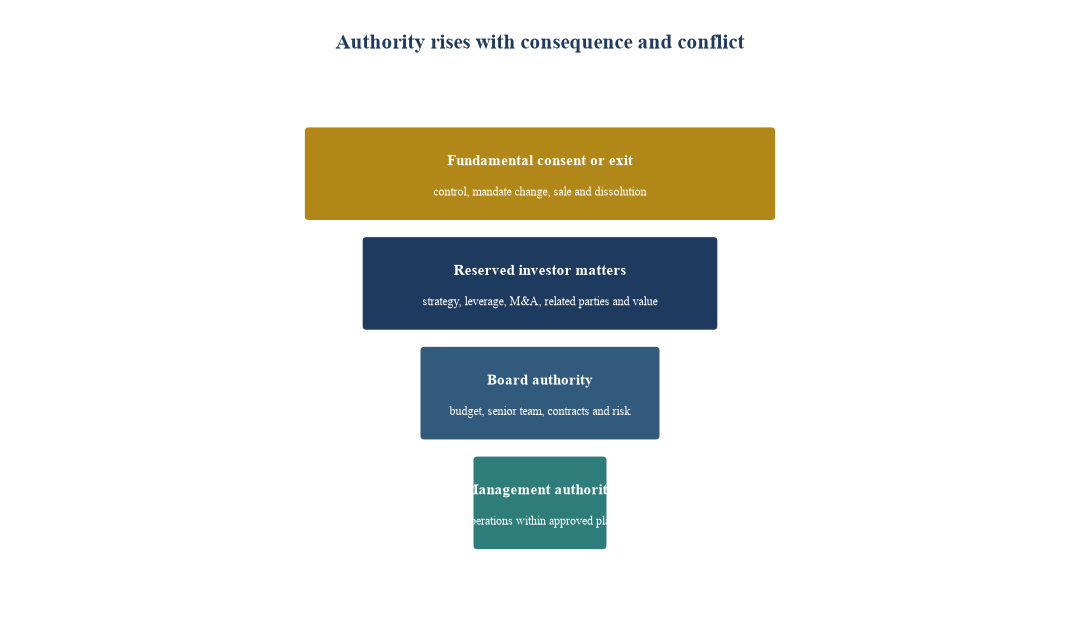
Author framework. Decisions move upward with financial impact, strategic consequence, conflict or irreversibility.
Table 3. Reserved-matters design
| Decision class | Illustrative matters | Decision rule | Deadlock or breach response |
|---|---|---|---|
| Operating | Contracts and expenditure within approved budget | Management under delegated authority | Board review of variance and remediation |
| Board | Annual plan, material contracts, financing within limits and senior appointments | Majority or specified board threshold | Prior plan continues for defined period |
| Conflict | Related-party transaction, affiliate service or investor opportunity | Non-conflicted committee or directors | Independent benchmark, expert or rejection |
| Strategic | Acquisitions, disposals, material capex, leverage above limit and business change | Enhanced board or shareholder consent | Sponsor escalation and structured resolution |
| Fundamental | New securities, control change, amendment of rights, sale, merger or liquidation | Class consent or unanimous reserved vote | Transfer, buy-sell or agreed sale process |
| Emergency | Safety, regulatory breach, insolvency or critical service failure | Defined temporary authority with notice | Ratification, investigation and time-limited action |
Thresholds and voting rules should be tailored to the asset, ownership and applicable law.
7. Map the cross-border regulatory perimeter
Foreign investment screening can affect transaction structure and timetable even when the international institution holds a minority interest. The United States Committee on Foreign Investment in the United States can review certain control transactions and certain non-controlling investments that provide access, rights or involvement in specified U.S. businesses. U.S. Treasury guidance states that mandatory declarations can apply where a foreign government obtains a substantial interest in specified businesses and in certain critical-technology transactions.[4]
CFIUS may request information about indirect foreign investors, including limited partners, their jurisdictions, ultimate ownership and governance or contractual rights.[5] A co-investment team should therefore map ownership, control, information access, board rights and side arrangements at the start. The filing analysis belongs to qualified counsel based on current law and the transaction facts.
The United Kingdom's National Security and Investment Act created mandatory notification for specified acquisitions in sensitive sectors, a voluntary notification route and a call-in power for qualifying acquisitions or assets.[6] A transaction involving voting rights, control or influence can require analysis beyond the headline ownership percentage. Closing conditions should reflect any mandatory clearance or voluntary filing decision.
The European Union Foreign Subsidies Regulation adds a separate issue. The European Commission can investigate financial contributions from non-EU governments to companies active in the EU. For concentrations, notification applies above the stated turnover and foreign-financial-contribution thresholds, and the transaction cannot close while review is pending.[7] The definition of financial contribution is broader than a subsidy finding and can include capital, loans, guarantees, tax measures and other transfers. The parties need a disciplined record of relevant contributions over the applicable period.
Tax treatment can depend on control, commercial activity, vehicle type and investment rights. In May 2026, the U.S. Treasury and Internal Revenue Service issued additional proposed guidance addressing applicability dates for proposed Section 892 rules affecting sovereign investors, including questions around debt acquisition and effective control of commercial entities.[8] Proposed rules and transitional relief require current advice. The governance package should preserve tax-sensitive limits and require approval before rights or activities change.
Sanctions, export controls, anti-bribery, competition, sector regulation, data protection and critical-infrastructure rules may also apply. A regulatory map lists every jurisdiction, competent authority, filing or approval, responsible adviser, information requirement, timing assumption and consequence. The investment committee should see which items are legal conclusions, which are pending and which are transaction conditions.
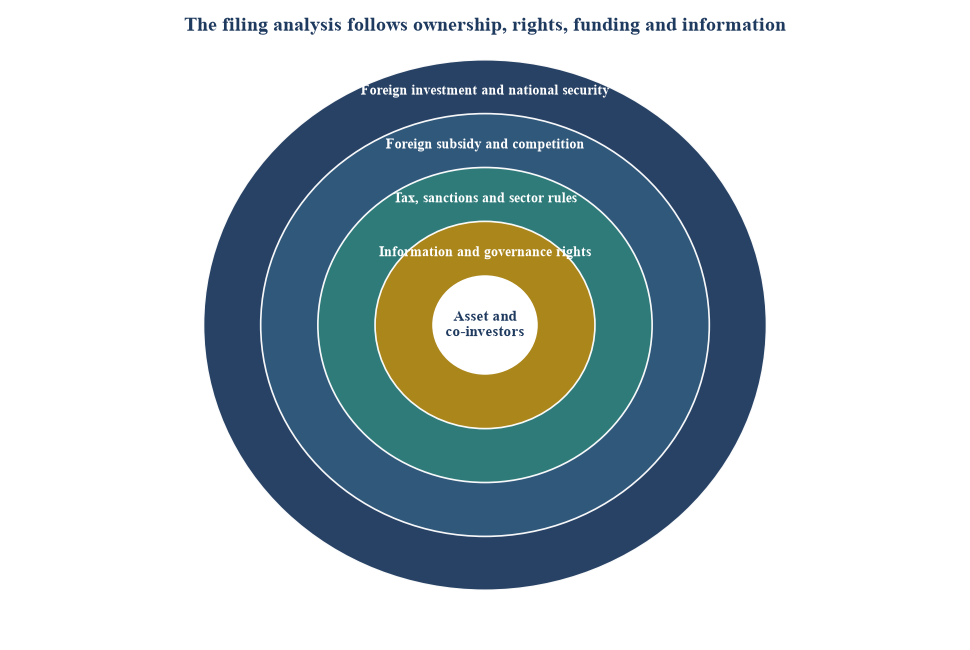
Author framework. Each ring can alter rights, information, timing, economics or closing certainty.
8. Economics, follow-on capital and dilution
The economic agreement begins with price and securities. Co-investors participating in the same tranche should understand whether they hold the same instrument, priority, coupon, liquidation preference, conversion, governance rights and transfer conditions. Any differentiated fee, carry, management charge, transaction fee, syndication fee or expense arrangement should be disclosed and modelled.
Follow-on capital is a frequent stress point. The asset may require growth capital, covenant support, cost-overrun funding, rescue finance or regulatory capital. The shareholders agreement should define who can call capital, the approval threshold, notice, use of proceeds, instrument, valuation, maximum commitment and consequence of non-participation. Emergency funding should have a narrow definition and a later ratification process.
Dilution rules should be modelled before signing. A non-participant may be diluted at fair value, under a pre-agreed formula or through a senior instrument. Each design changes incentives. A severe penalty can coerce participation beyond an institution's authority. A weak consequence can allow one party to benefit from another's rescue capital. An independent valuation or pre-agreed pricing mechanism can reduce dispute.
Leverage requires joint controls. The parties should approve initial debt, hedging, security, covenants and refinancing limits. A sovereign partner's credit standing should not be assumed to support vehicle debt unless it provides an enforceable commitment. Guarantees, letters of support or government-related offtake should be analysed according to their legal terms.
Distribution policy connects value to liquidity. The vehicle should define reserves, debt service, capex, working capital, regulatory requirements and distribution tests. An investor with a longer horizon may prefer reinvestment. Another may require distributions. The annual plan should show the decision rule rather than leaving the issue to sponsor preference.
Exit rights deserve early design. Transfer restrictions, rights of first offer, rights of first refusal, tag-along, drag-along, permitted transfers, public-offering rights, minimum price or return conditions and buyer eligibility can interact. A sovereign partner may have policy or national-security concerns about certain buyers. The international institution may have a fixed liquidity horizon. The exit architecture should define a process that can produce market evidence without giving one party an indefinite block.
9. Worked transaction model
Consider a hypothetical infrastructure platform acquiring and expanding a regulated service asset. The model assumes an enterprise value of USD 600 million funded with USD 300 million of debt and USD 300 million of equity. The sovereign platform funds USD 150 million of equity, an international institution funds USD 90 million and a specialist manager funds USD 60 million. Equity ownership is therefore 50 percent, 30 percent and 20 percent.
The base case assumes annual distributable cash of USD 42 million after operating costs, tax, debt service, maintenance capital and required reserves. The downside case assumes USD 24 million. The recovery case assumes USD 54 million after a delayed expansion. These are stated assumptions for governance illustration. They do not estimate an actual asset or sector.
At ownership percentages, the international institution would receive USD 12.6 million in the base case, USD 7.2 million in the downside and USD 16.2 million in recovery before any investor-level tax or other leakage. The model does not calculate an investment return because entry date, holding period, exit proceeds and intermediate cash flows are not specified.
The downside also assumes a USD 60 million equity requirement for covenant support and essential capex. A pro rata call would be USD 30 million for the sovereign platform, USD 18 million for the international institution and USD 12 million for the manager. The institution's governance question is whether it has authority and liquidity to provide the USD 18 million, whether the capital call meets the approved conditions and how dilution works if a party does not participate.
The five-gate model treats funding as the last step. Gate one confirms mandate compatibility. Gate two clears partner authority and integrity. Gate three completes independent asset underwriting. Gate four agrees governance and obtains regulatory advice or approvals. Gate five confirms documents, operations and funding. A failure can lead to remediation, resizing, restructuring or decline.
Table 4. Hypothetical USD 600 million co-investment
| Item | Sovereign platform | International institution | Specialist manager |
|---|---|---|---|
| Equity contribution; total 300 | 150 | 90 | 60 |
| Equity ownership; total 100% | 50% | 30% | 20% |
| Base distributable cash; total 42 | 21.0 | 12.6 | 8.4 |
| Downside distributable cash; total 24 | 12.0 | 7.2 | 4.8 |
| Recovery distributable cash; total 54 | 27.0 | 16.2 | 10.8 |
| Pro rata downside follow-on; total 60 | 30 | 18 | 12 |
USD millions. All figures are management assumptions for illustrating governance; they do not represent a client, asset, transaction or forecast.
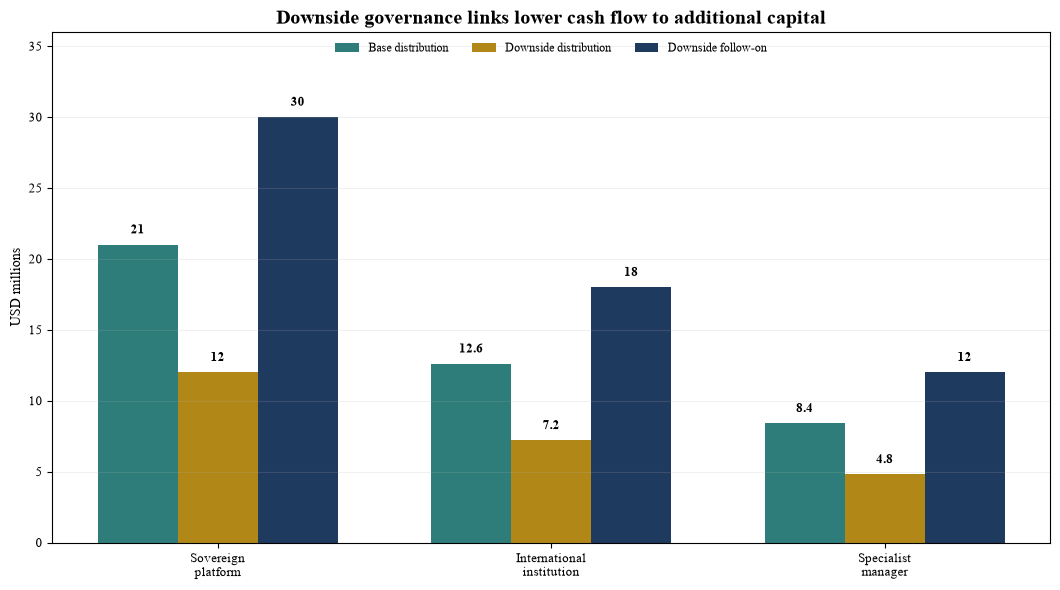
USD millions. The figures are stated assumptions for illustrating governance and are not an investment forecast.
10. Information, valuation and monitoring
The monitoring compact translates the investment case into a recurring evidence package. It identifies financial statements, budget variance, operating metrics, debt and covenant information, capex, safety, regulatory matters, litigation, related-party transactions, valuation, cyber incidents, material contracts and sustainability information. It specifies frequency, source, preparer, reviewer and escalation threshold.
Information rights should support the institution's accounting, valuation, risk, performance, regulatory and governing-body obligations. They should also respect data restrictions. Critical infrastructure, personal data, export-controlled information, commercially sensitive contracts or government information may require ring-fenced access, clean teams, redaction or regulator-only channels. The agreed architecture should be operational before close.
Valuation governance should separate preparation, challenge and approval. The parties can appoint an independent valuation agent, require periodic external valuation or use a documented process with dispute rights. The International Private Equity and Venture Capital Valuation Guidelines provide a best-practice reference for fair-value reporting in private capital.[9] The selected policy should be adapted to applicable accounting and reporting requirements.
The investment thesis becomes a monitoring scorecard. Revenue, volume, tariff, utilisation, margin, capex, debt, project milestones, customer concentration and policy dependencies are compared with the approved case. A strategic benefit should be measured separately from financial performance. Unmeasured relationship value should not be used to offset a financial miss in the institution's return record.
Incident reporting requires time limits. Safety, fraud, corruption, sanctions, cyber, regulatory breach, covenant breach, material litigation, loss of licence, related-party concern, data compromise and government intervention should trigger notice and an authorised response. The vehicle's confidentiality terms should allow the parties to meet legal and regulatory duties.
Annual governance review tests whether committee composition, information quality, conflicts, reserved matters, related-party activity, funding capacity and exit assumptions remain fit. A change in sovereign mandate, ownership instruction, institutional policy, regulation or asset strategy can require a new approval rather than routine monitoring.
Table 5. Monitoring compact
| Monitoring domain | Minimum evidence | Escalation trigger | Decision owner |
|---|---|---|---|
| Financial and operating | Monthly accounts, KPI pack, budget variance and forecast | Material miss, liquidity concern or control breakdown | Board and investor committee |
| Debt and funding | Covenant certificate, maturities, hedging and capex funding | Breach, refinancing gap or unapproved debt | Board or reserved-matter body |
| Governance and conflicts | Minutes, related-party register, delegations and appointments | Undisclosed conflict, authority change or repeated deadlock | Non-conflicted committee |
| Regulation and integrity | Licence status, filings, sanctions and incident reports | Investigation, breach, restriction or filing failure | Legal, compliance and board |
| Valuation and performance | Valuation file, assumptions, cash flows and benchmark | Material assumption change or valuation dispute | Valuation committee or expert |
| Exit readiness | Buyer universe, restrictions, market evidence and transfer steps | Exit window, policy deadline or buyer restriction | Investors under agreed process |
Measures and escalation thresholds should match the asset and the institution's policies.
11. A twelve-week execution process
The process can be organised over twelve weeks when evidence, advisers and decision makers are available. The schedule is a management framework rather than a promise to close. Investment screening, regulatory review, negotiation, public approvals, financing, technical diligence or data access can require more time.
Weeks one and two establish the partner-governance memorandum, conflicts register, asset information request, regulatory map and decision calendar. Weeks two to six run partner and asset diligence in parallel. Weeks four to seven build the governance term sheet, reserved-matters schedule, information matrix and follow-on waterfall. Weeks six to nine complete investment modelling, independent challenge and regulatory advice.
Weeks eight to ten produce the investment-committee paper and negotiate documents. Weeks ten to twelve complete conditions, approvals, onboarding, cash controls and monitoring handover. A transaction enters a clock-stop category when it awaits an external regulator, material evidence, partner decision or remediation.
The critical-path meeting should focus on decisions and unresolved conditions. Every red item has a precise issue, owner, evidence requirement, due date and consequence. An open question such as confirm governance should be rewritten into a decision such as agree whether the international institution has consent over debt above 55 percent loan-to-value and specify the deadlock remedy.
The investment committee receives a joined-up pack. It contains the asset case, partner memorandum, governance schedule, regulatory map, conflicts, related-party process, economics, follow-on exposure, liquidity analysis, exit architecture and conditions. Separate workstream reports remain available as evidence.
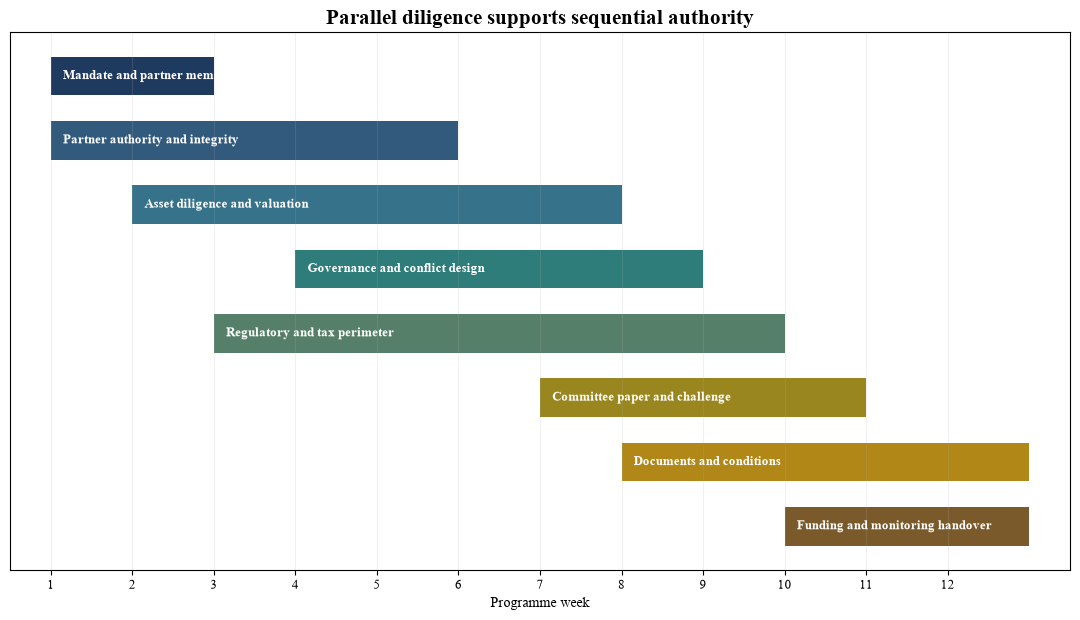
Author framework. Regulatory approval, transaction complexity and external evidence can extend the timetable.
12. Failure modes and stop conditions
Mandate ambiguity is the first failure mode. The parties can use broad language such as strategic partnership, national priority or long-term alignment without deciding which objectives govern a conflict. The partner memorandum should identify the binding investment objective and the authority for any public-policy consideration.
Authority gaps can appear late. A negotiator may lack final approval, a subsidiary may depend on parent funding or a board approval may contain conditions absent from the term sheet. The authority map and closing certificate should reconcile the final transaction with each party's approval.
Relationship underwriting is another risk. A strong institutional name can reduce perceived need for verification. The investment team should evidence cash flow, contracts, permits, financing and value independently. Any government support or relationship benefit is modelled only when an enforceable or otherwise verified basis exists.
Governance can be over-engineered. A long reserved-matters list can slow operations and create informal workarounds. Rights should follow consequence and conflict. Management needs clear authority within an approved plan, while investors retain consent over changes that materially alter risk, value, control or mandate.
Information asymmetry can persist when the local partner receives operating or government information first. The information matrix should define simultaneous reporting, incident notice and access. Restrictions should be identified in diligence so that the institution can decide whether the remaining information is sufficient.
Follow-on coercion occurs when the vehicle needs urgent capital and the documents leave pricing or dilution unclear. The parties should know the maximum exposure, approval route, pricing method and consequences before the emergency. A failure to fund should not create an undefined negotiation under covenant pressure.
Exit blockage can destroy liquidity. A right of first refusal, buyer restriction, unanimous sale consent or public-policy concern can delay a market process. The institution should test a realistic sale, including regulatory approvals and permitted buyers, before relying on exit value.
Table 6. Principal failure modes and controls
| Failure mode | Observable signal | Control | Potential outcome |
|---|---|---|---|
| Mandate ambiguity | Financial and strategic purposes are used interchangeably | Ranked objectives and authority record | Clarify, obtain policy approval or decline |
| Partner authority gap | Negotiation entity, approval entity and funding entity differ | Legal identity and authority map | Condition, restructure or stop |
| Relationship underwriting | Support or access is asserted without evidence | Separate asset and relationship cases | Remove assumption, reprice or decline |
| Allocation conflict | Deal share, expenses or follow-on rights lack a written rationale | Opportunity-allocation protocol | Disclose, revise allocation or stop |
| Governance paralysis | Routine decisions require investor unanimity | Threshold-based delegation and deadlock process | Redesign before signing |
| Regulatory surprise | Ownership, rights or funding trigger late filing analysis | Early regulatory perimeter map | Extend, modify rights or stop |
| Follow-on coercion | Urgent capital has no approved pricing or dilution rule | Follow-on waterfall and exposure cap | Fund under rule, dilute or restructure |
| Exit blockage | Transfer controls remove practical buyer universe | Tested exit architecture | Amend rights, resize or decline |
Outcomes depend on materiality, governing documents, policy and applicable professional advice.
13. Implementation toolkit
The framework can be implemented through twelve controlled artefacts. These are the partner-governance memorandum, legal identity and authority map, opportunity-allocation protocol, conflicts register, four-track diligence plan, governance term sheet, reserved-matters schedule, information-rights matrix, related-party policy, follow-on and dilution waterfall, regulatory map, and funding and monitoring handover.
Each artefact has a named owner, version, evidence source, approval status and retention location. The investment team owns the commercial case. Legal advisers own their advice. Compliance owns the institution's integrity and sanctions assessment. Tax advisers address the actual structure. Operations and treasury own onboarding, booking and funding controls. The programme office coordinates timing and evidence without assuming these professional responsibilities.
The investment committee should receive a condition schedule. Each condition states what is missing, the acceptance standard, owner, decision authority and expiry. A conditional approval does not permit funding until the authorised function records acceptance.
Key programme measures include days to verified authority, evidence completeness, age of red conditions, governance terms unresolved after committee circulation, regulatory dependencies, changes between approval and final documents, funding exceptions and first-quarter reporting breaks. These measures reveal execution quality and support improvement.
After close, the parties should conduct an initial governance review at the first full reporting cycle. The review tests whether information arrives as agreed, committee meetings work, conflicts are recorded, related-party items follow policy, valuations are supported and the institution can meet its own reporting obligations.
14. Limitations
This paper provides a general governance and execution framework. It does not provide investment, legal, tax, accounting, valuation, regulatory, sanctions, compliance, cybersecurity or national-security advice. Institutions should obtain qualified advice for the actual parties, asset, structure, governing documents and jurisdictions.
Sovereign wealth funds and sovereign investment institutions are diverse. The Santiago Principles are voluntary and principle based. A published self-assessment, annual report or membership status does not establish transaction authority, funding or suitability. These matters require current evidence.
Investment-screening, foreign-subsidy, tax and sanctions rules can change. Official guidance cited in this paper describes selected regimes and dates. The legal analysis should use current law and the specific ownership, control, information and funding facts.
The worked model uses hypothetical enterprise value, debt, equity, ownership, distributions and follow-on capital. The figures are stated assumptions for demonstrating governance. They do not represent a client, transaction, asset class, expected return or market forecast.
The twelve-week process is indicative. Regulatory review, public approvals, technical diligence, legal negotiation, financing, data access, holidays and transaction complexity can require more time. Evidence and authority determine readiness.
15. Conclusion
Co-investing with sovereign capital can combine international capital with local knowledge, scale and long-term operating relationships. The partnership becomes institutionally investable when each participant can explain its mandate, authority, contribution, economics, information rights, conflicts, funding exposure and exit route.
Four diligence systems support the decision: the asset, the sovereign partner, the joint governance architecture and the regulatory perimeter. Five gates prevent relationship momentum from substituting for evidence. The process begins with mandate compatibility and ends with funding and monitoring readiness.
The hypothetical transaction demonstrates the practical stress. A 30 percent equity participant contributing USD 90 million can face an additional USD 18 million pro rata call in downside. Its decision rights, liquidity authority and dilution consequences should be clear before the need arises.
Durable governance prepares for divergence. Reserved matters, information, conflicts, related parties, follow-on capital, valuation, deadlock and exit rules should work when performance is weak, policy changes or one party wants a different outcome. The resulting system protects the asset, the relationship and each institution's accountability.
References
- International Forum of Sovereign Wealth Funds, Santiago Principles. https://www.ifswf.org/santiago-principles
- OECD, The Role of Sovereign and Strategic Investment Funds in the Low-carbon Transition, section on collaboration and co-investment platforms. https://www.oecd.org/en/publications/the-role-of-sovereign-and-strategic-investment-funds-in-the-low-carbon-transition_ddfd6a9f-en/full-report/component-10.html
- Institutional Limited Partners Association, ILPA Principles 3.0, Co-Investment Allocations. https://ilpa.org/wp-content/uploads/2019/06/ILPA-Principles-3.0_2019.pdf
- U.S. Department of the Treasury, CFIUS Overview. https://home.treasury.gov/policy-issues/international/the-committee-on-foreign-investment-in-the-united-states-cfius/cfius-overview
- U.S. Department of the Treasury, CFIUS FAQ on indirect foreign investors, limited partners, ultimate ownership and governance rights. https://home.treasury.gov/cfius-faq-item/international-affairs/does-cfius-require-information-on-all-foreign-persons-such-as-limited-partners-in-an-investment-fund-that-would-hold-an-interest-in-a-us-business-whether-directly-or-indirectly-as-part-of-a-transaction
- UK Government, National Security and Investment Act 2021, explanatory material on mandatory notification, voluntary notification and call-in powers. https://www.legislation.gov.uk/ukpga/2021/25/notes/division/2/index.htm
- European Commission, Foreign Subsidies Regulation in a nutshell. https://competition-policy.ec.europa.eu/foreign-subsidies-regulation/about_en
- U.S. Department of the Treasury, Treasury and IRS Issue Section 892 Proposed Regulations to Provide Grandfathering Protection and Transitional Relief to Sovereign Investors, 29 May 2026. https://home.treasury.gov/news/press-releases/sb0512
- International Private Equity and Venture Capital Valuation Board, IPEV Valuation Guidelines 2025. https://www.privateequityvaluation.com/Valuation-Guidelines
- Institutional Limited Partners Association, Due Diligence Questionnaire 2.0. https://ilpa.org/resources-tools/resource-library/due-diligence-questionnaire/
- OECD, Institutional Investor Engagement and Stewardship, 2025. https://www.oecd.org/en/publications/institutional-investor-engagement-and-stewardship_a4902cee-en/full-report/component-4.html
- OECD, G20/OECD Principles of Corporate Governance 2023, Institutional Investors, Stock Markets, and Other Intermediaries. https://www.oecd.org/en/publications/2023/09/g20-oecd-principles-of-corporate-governance-2023_60836fcb/full-report/component-6.html
- International Forum of Sovereign Wealth Funds, 2022 IFSWF Member Self-Assessment Review. https://ifswf.org/2022-ifswf-member-self-assessment-review
- International Monetary Fund, Sovereign Wealth Funds Need Legal Clarity as Their Scale and Mandates Expand, 21 July 2026. https://www.imf.org/en/blogs/articles/2026/07/21/sovereign-wealth-funds-need-legal-clarity-as-their-scale-and-mandates-expand
- European Union, Regulation (EU) 2022/2560 on foreign subsidies distorting the internal market. https://eur-lex.europa.eu/legal-content/EN/TXT/?uri=CELEX%3A32022R2560
About the Author
Chennakeshav Adya, Independent Researcher
Chennakeshav Adya writes on private capital, investment governance, corporate finance and transaction execution. This paper is independent research for general information. It is not investment, legal, tax, accounting, valuation or regulatory advice.
Appendix A. Governance Artefacts: Controlled documents
1. Partner-governance memorandum with ranked financial and strategic objectives. 2. Legal identity, ownership, mandate, approval and signatory map. 3. Opportunity-allocation and expense protocol. 4. Conflicts and related-party register with non-conflicted decision routes. 5. Four-track diligence plan and evidence index. 6. Governance term sheet and board-composition schedule. 7. Reserved-matters thresholds and deadlock remedies. 8. Information-rights, disclosure and data-classification matrix. 9. Follow-on capital, dilution and emergency-funding waterfall. 10. Foreign investment, foreign subsidy, tax and sanctions perimeter map. 11. Closing certificate reconciling final documents with approvals. 12. Funding and monitoring handover with incident thresholds.
Appendix B. Committee Questions: Questions before commitment
1. Which legal entity is the sovereign partner, and what evidence confirms its mandate and authority? 2. Which financial, strategic and public-policy objectives apply to each party? 3. Which asset claims are independently verified, and which remain stated assumptions? 4. Why was this allocation offered, and how are expenses and follow-ons allocated? 5. Which decisions belong to management, the board, non-conflicted directors and investors? 6. Which information can each party receive, share with its owner or provide to regulators? 7. Which related-party relationships can influence revenue, cost, financing, procurement or valuation? 8. Which investment-screening, foreign-subsidy, tax, sanctions or sector approvals apply? 9. What is the institution's maximum follow-on exposure, and what happens if it does not fund? 10. Which practical route allows the institution to exit under a divergent holding horizon?
