

1. The entry decision should allocate capital to an operating system
The decision to enter the UAE is often compressed into a question about legal form: mainland or free zone, subsidiary or branch, acquisition or joint venture. A board needs a wider frame. Market entry creates an operating system that must win customers, obtain licences, hire and retain people, collect cash, protect data, manage counterparties, comply with tax rules and exercise valid authority. The legal vehicle is one component of that system.
The UAE's investment case is supported by observable evidence. The OECD's 2026 Investment Policy Perspectives reports that inward foreign-direct-investment stock exceeded half of GDP by 2024 and that the country had moved from restrictive foreign ownership rules towards a more open framework. The UAE government's 2025 FDI report records USD 45.6 billion of inflows in 2024. The IMF's 2025 Article IV report describes continued expansion of non-oil sectors and an active structural-reform agenda. These indicators justify serious evaluation. They do not establish that every sector, product or entrant has an attractive opportunity.
A robust decision begins with a defined outcome. The company may seek revenue from UAE customers, a GCC regional headquarters, regulated market access, industrial production, government procurement, logistics capacity, talent, capital, intellectual property, a strategic asset or a platform for further acquisitions. Different outcomes favour different routes. A company that needs an immediately licensed workforce and installed customer relationships may value acquisition. A company whose advantage depends on a proprietary process may favour a build. A company that needs complementary assets controlled by a local partner may consider a joint venture.
Entry mode determines which uncertainty the company accepts. Acquisition reduces some market and timing uncertainty while importing target, price and integration risk. A build reduces inherited-liability risk while accepting ramp-up, licence, hiring and customer-conversion risk. A joint venture can share resources and improve access while creating governance, information, transfer-pricing and exit risk. A staged route can purchase evidence before committing full capital, although delay can weaken commercial momentum.
The board should authorise a decision process rather than a preferred answer. Management should prove market attractiveness, demonstrate the entrant's right to win, define the minimum viable operating perimeter, compare routes on a common economic basis and identify a reversible first step. The result should be a choice supported by evidence, explicit assumptions and executable conditions.
Table 1. Entry-mode comparison on a common decision basis
| Route | What the capital buys | Main advantage | Main exposure | Best early evidence |
|---|---|---|---|---|
| acquire | shares or assets, licences, people, customers and installed operations | speed and existing capability | valuation, hidden liabilities, consent and integration | quality of earnings, licence status, customer retention and value-creation plan |
| build | new entity, licences, team, systems, premises and customer acquisition | design control and clean perimeter | slow ramp, execution cost and uncertain conversion | paid pilots, licence path, talent availability and unit economics |
| joint venture | shared entity or contractual platform using complementary assets | access, risk sharing and local capability | vetoes, leakage, related-party dependency and exit | partner asset verification, aligned economics and enforceable governance |
| branch | registered extension of the foreign company | direct control with limited structural duplication | parent liability and activity constraints | licence fit, tax and banking feasibility |
| distributor or agent | contracted route to customers without a full operating platform | low initial fixed capital and rapid testing | limited control, data and margin ownership | channel economics, contract protection and end-customer evidence |
| staged hybrid | option, minority investment, commercial alliance, build or later acquisition | learning and reversibility | complexity, delay and path dependency | milestones that trigger, resize or stop the next commitment |
The table is a board screen. Legal availability, economics and timing require transaction-specific verification.
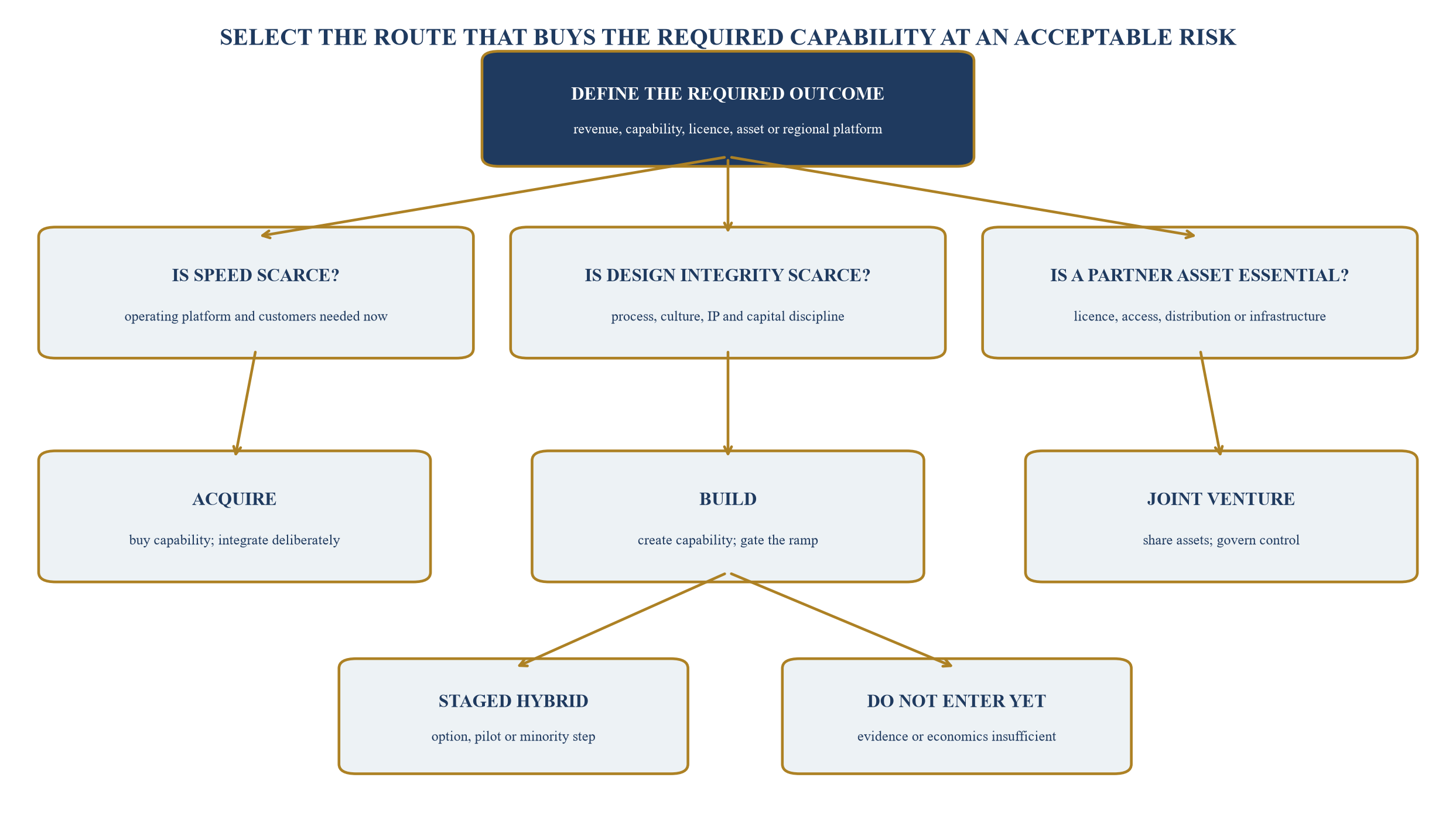
The tree is a management framework. Current laws, licences, transaction facts and commercial evidence determine the available route.
2. Market attractiveness and the right to win are separate tests
Attractive national indicators can coexist with unattractive segment economics. The relevant market should be defined by customer, use case, price point, channel, geography and regulatory perimeter. Management should estimate the serviceable market from identifiable demand rather than applying a market-share percentage to a broad headline. Evidence can include customer budgets, procurement plans, transaction volumes, installed capacity, competitor pricing, licence registers, import data and paid pilot behaviour.
Market attractiveness asks whether sufficient value is available. The right-to-win test asks whether this company can capture value after local costs and competitive response. An entrant can have a strong global brand and lack UAE reference customers, Arabic capability, tender credentials, local delivery capacity or a product configured for local requirements. Another entrant can have modest scale and possess a scarce technology, regulated capability, specialised team or customer relationship that creates a defensible opening.
The screen should test seven dimensions. Demand depth measures recurring addressable spend and customer urgency. Profit-pool quality measures gross margin, working capital, payment risk and capital intensity. Competitive intensity measures concentration, price discipline and the likely reaction of incumbents. Regulatory fit measures ownership, licensing, approvals and conduct obligations. Capability fit measures product, people, delivery and evidence. Route-to-customer measures channels, procurement and trust. Expansion option value measures whether the UAE platform supports wider GCC or international growth.
Each score needs an evidence note and confidence level. A score based on signed customer commitments carries more weight than one based on interviews. A licence opinion from the competent regulator or qualified adviser carries more weight than a setup consultant's generic statement. A margin estimate based on local quotations and delivery design carries more weight than the existing home-market margin. The board should see where evidence is thin.
Management should also test disconfirming evidence. Customer enthusiasm can disappear when the discussion reaches budget authority, implementation responsibility or payment terms. A tender pipeline can be inaccessible without prior local performance, an approved supplier record or ICV credentials. A distributor can report demand while withholding end-customer data. A target's revenue can depend on the founder, a public-sector relationship or a contract that does not survive ownership change. The investment case improves when these risks are investigated before route selection.
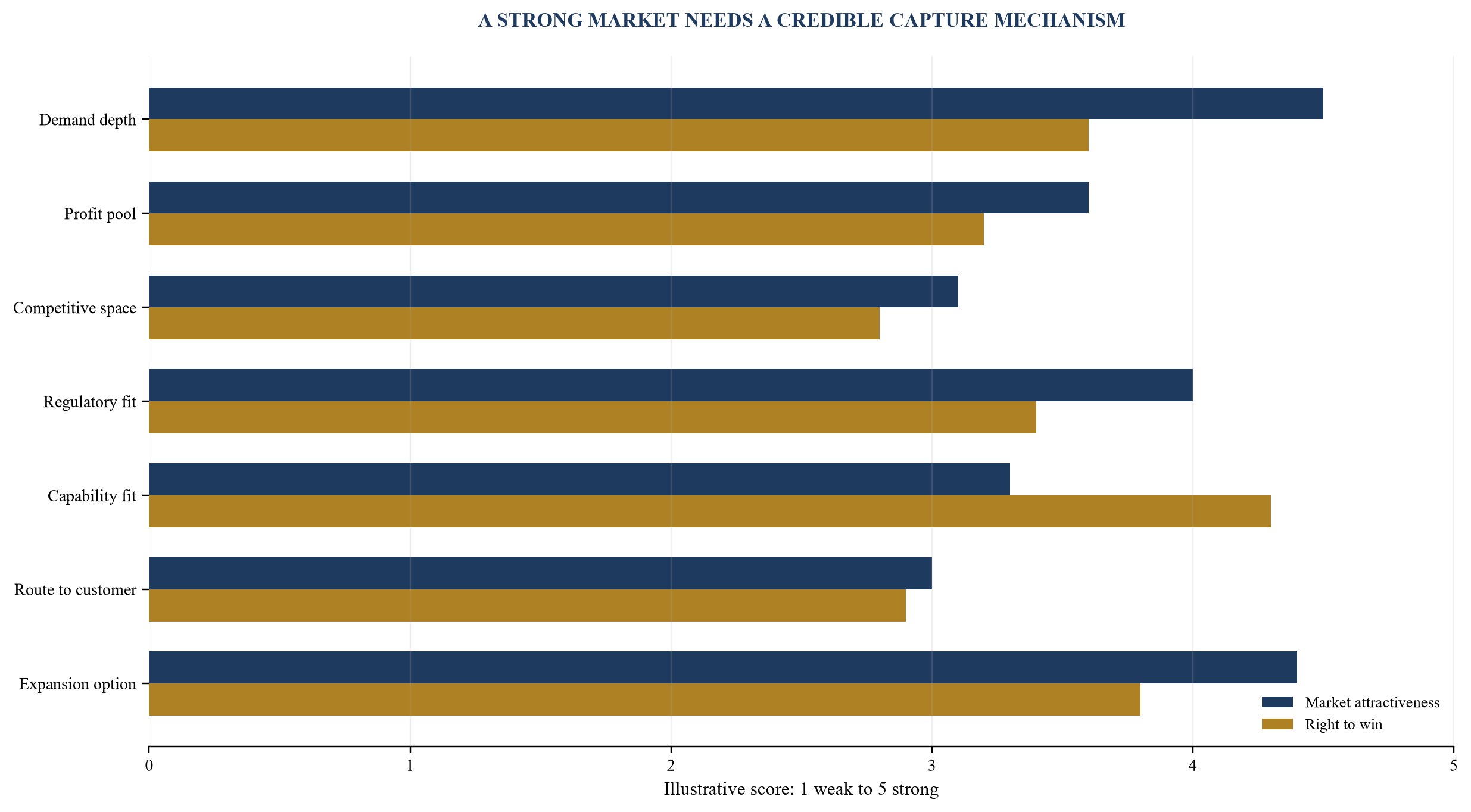
Scores and weights are illustrative management assumptions. Each score requires documented evidence and a confidence assessment.
Table 2. Evidence standard for the market-entry thesis
| Question | Strong evidence | Weak signal | Decision use |
|---|---|---|---|
| who pays? | named budget owners, procurement path and paid demand | broad interest or event attendance | define serviceable customers |
| what problem is urgent? | quantified cost, risk, deadline or regulatory need | general desire to modernise | set value proposition and timing |
| what margin is available? | local price, delivery cost, working capital and payment evidence | home-market margin applied unchanged | build route-level economics |
| why this entrant? | verified capability, reference and differentiation | reputation without local proof | establish right to win |
| what blocks access? | licence, tender, channel and qualification map | generic ease-of-doing-business claim | design the operating perimeter |
| how will incumbents respond? | competitor economics, capacity and contract position | static market-share assumptions | stress-test price and ramp |
| what would disprove entry? | explicit stop conditions and evidence deadlines | commitment before learning | preserve capital and reversibility |
Evidence should be current, attributable and specific to the proposed segment and route.
3. The build route buys design control and requires disciplined gates
A greenfield build creates an operating platform without acquiring an existing business. It can use a mainland company, free-zone entity, regulated entity or branch according to the activity and operating design. The route allows management to select systems, culture, processes, products, contracts and people. It also requires the entrant to create every local capability that the market demands.
The build case is strongest when the business model can be transferred reliably, the entrant owns differentiated intellectual property, suitable targets are unavailable or overpriced, inherited liabilities would be costly, and customers can be won within the available funding runway. It can also suit activities where regulator engagement and infrastructure development are inseparable from the operating model. A build can protect capital by starting with a narrow minimum viable perimeter and expanding after measurable proof.
The business plan should separate legal setup from commercial readiness. Incorporation can be rapid in an appropriate category while sector approval, premises, utilities, visas, banking, product registration, data controls, insurance, supplier qualification and customer onboarding take longer. Dubai's official setup guidance distinguishes mainland and free-zone structures, requires activity and approval checks, and lists documentation for local and foreign-company branches. ADGM requires the applicant to identify business type, legal structure, office and beneficial ownership information. Financial services conducted in or from DIFC require DFSA authorisation, and CBUAE-regulated activities require the relevant licence.
Management should fund the build through evidence gates. Gate one confirms legal and licence feasibility. Gate two confirms a product-market offer with customer evidence. Gate three confirms a fully costed operating design and hiring plan. Gate four releases the main build capital after licences, premises and critical talent have credible paths. Gate five scales spending after paid demand and delivery quality are demonstrated. Capital that is contingent on evidence remains an option rather than a sunk commitment.
The build model should include the full cash curve. Costs can include incorporation, licences, professional advice, premises, fit-out, technology, recruitment, visas, relocation, benefits, product localisation, marketing, bid bonds, inventory, working capital and customer credit. Revenue should be recognised according to the expected sales and collection cycle. A signed contract with a long mobilisation or acceptance period does not fund payroll immediately. The board should see monthly cash headroom, downside scenarios and the point at which another decision is required.
Customer acquisition deserves its own plan. The entrant should identify lighthouse customers, decision-makers, tender calendars, proof requirements and contracting constraints. Where public or national-company procurement matters, local-content and supplier-qualification requirements can change the route. The National ICV programme redirects participating procurement towards local economic contribution and requires audited financial statements for certification. A build can create a stronger future ICV profile through local people, procurement and investment, although the benefit must be verified for the target buyers.
The principal failure mode is overbuilding before demand is proven. A prestigious office, broad licence list and large team can create fixed costs without customer conversion. The solution is a minimum viable operating design linked to revenue evidence, service quality and regulatory obligations. The company should build only the capabilities it needs to win and deliver the first defined customer set, with expansion triggers approved in advance.
4. Acquisition buys time and imports a history
An acquisition can provide revenue, customers, licences, people, contracts, infrastructure, supplier relationships and local knowledge. The route is attractive when these capabilities are scarce or slow to build and when the buyer can improve the platform. The purchase price should be compared with the present value of a greenfield ramp, including foregone contribution, execution risk and the probability of failing to reach scale.
The acquisition thesis needs two linked cases: stand-alone quality and buyer-specific value creation. Stand-alone diligence tests whether the target's earnings, cash, assets, liabilities, licences, contracts and organisation are what the seller represents. Buyer-specific analysis tests what the acquirer can add through products, pricing, procurement, financing, technology, governance, customer access, talent or regional expansion. Synergies should have owners, timing, investment and dependencies. A spreadsheet entry without an operating mechanism is not a synergy.
Quality of earnings should reconcile revenue to contracts, delivery, invoices, collections and recurring behaviour. Customer concentration, related-party transactions, founder relationships, unusual credit terms and working-capital seasonality require attention. Backlog should be tested for enforceability, cancellation, margin and mobilisation cost. Earnings should be adjusted only where evidence supports the change. The buyer should understand cash conversion because a profitable target can consume substantial cash after acquisition.
Licences and contracts can be more valuable than physical assets, and their continuity can be conditional. The buyer should map activity to licence, regulator, responsible person and renewal. Material contracts should be checked for assignment, change of control, ownership restrictions, notice, termination, exclusivity, government eligibility, data, sanctions and pricing. Commercial agency arrangements receive specific protection under Federal Law No. 3 of 2022 and need specialist review. Sector approvals can also influence transaction sequence and ownership.
Competition analysis should begin before signing. Federal Decree-Law No. 36 of 2023 defines economic concentration to include mergers and acquisitions that create direct or indirect control. Cabinet Resolution No. 3 of 2025 sets notification thresholds where combined UAE sales in the relevant market exceed AED 300 million or combined share exceeds 40 percent. The Ministry of Economy and Tourism's current economic-concentration page describes the filing process and records approval, conditional approval and non-objection outcomes. Transaction counsel should confirm scope, exclusions, timing and standstill obligations for the actual deal.
The price mechanism should allocate uncertainty. Completion accounts, locked-box terms, earn-outs, escrow, holdbacks, warranties, indemnities, warranty insurance and specific covenants each address different risks. An earn-out can bridge valuation expectations and create post-close conflict if management control affects the metric. Escrow can support recovery and tie up seller proceeds. A specific indemnity can address an identified exposure and depends on credit support and enforceability. The board should match each mechanism to an evidenced risk.
Integration should be designed during diligence. The buyer needs a Day-One operating model, leadership, authority, customer plan, retention plan, systems approach and 100-day value agenda before signing. Delaying these decisions protects no one. Premature systems consolidation can also destroy value where the target's platform, licence or local relationships are central to the thesis. Integration depth should follow the value-creation logic.
Table 3. Acquisition diligence and value bridge
| Workstream | Evidence question | Value connection | Closing or integration action |
|---|---|---|---|
| commercial | are customers, pricing, backlog and retention durable? | revenue quality and cross-sell | retention plan and customer communication |
| financial | do earnings convert to cash after normal working capital? | enterprise value and funding need | price adjustment and cash controls |
| licences and contracts | will rights and approvals survive ownership change? | licence to operate and revenue continuity | regulator, consent and notice conditions |
| tax and legal | what historic and structural liabilities remain? | downside and post-close cash | indemnity, escrow, insurance or remediation |
| people | who holds customer, technical and regulatory capability? | continuity and growth | retention, role design and succession |
| technology and data | are systems, IP, security and data rights reliable? | scalability, capex and risk | separation, remediation or integration plan |
| value creation | which initiatives have owners, investment and evidence? | buyer-specific return | 100-day plan, milestones and benefit ledger |
The table is an executive diligence architecture. Scope should reflect sector, target and transaction risk.
5. A joint venture is a permanent governance transaction
A joint venture is appropriate when each party contributes an asset that would be costly, slow or impossible for the other to reproduce. Contributions can include technology, brand, customers, licences, facilities, distribution, capital, people, data, land, procurement status or operating capability. The existence of a local partner is not sufficient. The business case should identify the specific partner asset, verify control and availability, price it, and show how the combined platform creates value.
The parties should choose between an incorporated joint venture and a contractual alliance. An incorporated vehicle can own assets, employ people, contract, borrow and hold licences. It requires articles, shareholder arrangements, capital, governance and exit mechanisms. A contractual arrangement can be faster and narrower, although ownership of customers, data, intellectual property, personnel and liabilities must be explicit. The commercial agency rules may be relevant when the arrangement appoints a protected agent.
Economics should follow contributions and risk. Cash is easy to observe. A partner's relationships, licences, personnel or distribution need objective evidence and continuing obligations. An exclusive market right has value only if the partner can perform. Intellectual property should be licensed on defined terms with ownership of improvements and exit use addressed. Related-party services should have scope, pricing, service levels, audit rights and transfer-pricing support.
Control cannot be reduced to shareholding. Board appointment, quorum, reserved matters, budgets, business plans, hiring, bank mandates, information, related-party contracts and technical control determine how the venture operates. A 51 percent shareholder can lack practical control when the other party holds vetoes, systems, data or the customer channel. A 49 percent shareholder can have decisive protections that create joint control. Accounting, competition and regulatory analysis should reflect the rights and facts.
Deadlock mechanisms should create resolution paths before value is impaired. Escalation from management to board and then shareholders can resolve ordinary disputes. Mediation or expert determination can address technical matters. Buy-sell mechanisms, put or call rights and winding-up provisions can resolve fundamental deadlock, although each requires funding and valuation mechanics. A shotgun clause can disadvantage the party with less liquidity. A Russian-roulette mechanism can create unintended outcomes. The parties should design an exit that remains usable under stress.
Information rights are essential. The joint venture should deliver timely financial statements, budgets, forecasts, customer metrics, compliance reports, audit access and board materials. The shareholder should also protect commercially sensitive information and competition-law boundaries. Parent representatives need clear duties when the interests of the venture and appointing shareholder diverge.
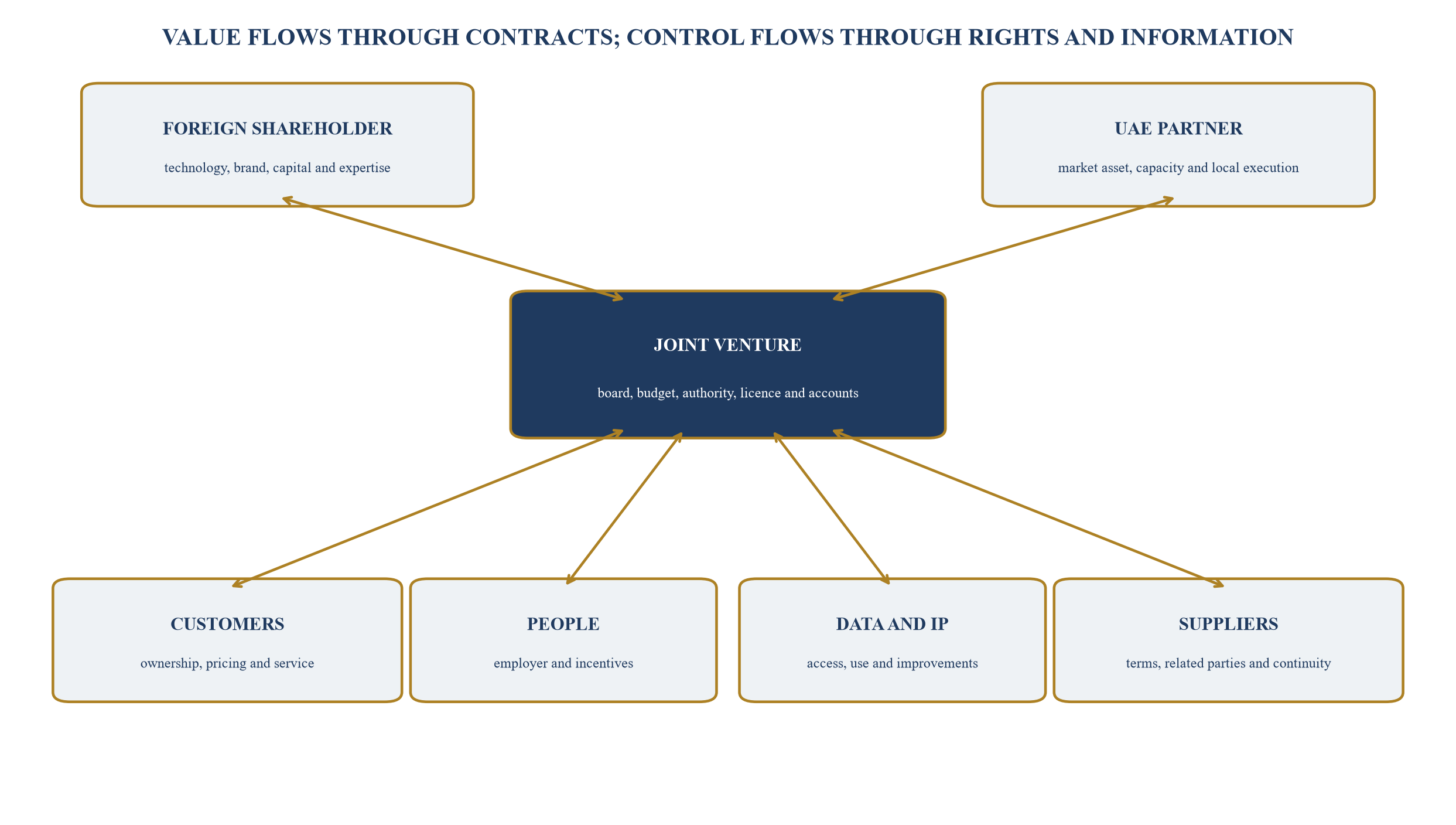
The map illustrates governance dependencies. Actual rights and regulatory treatment depend on the final documents and conduct.
6. Staged routes can purchase information before scale
The three headline routes do not exhaust the available designs. A company can begin with exports, a representative or sales function where permitted, a distributor, a managed-services agreement, a commercial alliance, a minority investment, an option, a joint venture, a branch or a narrow new subsidiary. It can then expand, acquire or consolidate after defined evidence appears. A staged route is valuable when uncertainty is material and learning can change the decision.
The option needs explicit triggers. A distributor arrangement can convert to a direct platform when customer concentration, margin or data justify the change. A minority investment can include a call option after licensing, revenue or governance milestones. A joint venture can permit one party to increase ownership after performance. A build can reserve acquisition capacity if the commercial ramp reveals gaps. Each option should specify price, valuation method, timing, information rights, conditions and treatment of changed circumstances.
Staging also creates path dependency. A distributor may own customer relationships or register trademarks. A joint-venture partner may obtain broad exclusivity. A minority investment can trigger competition or regulatory obligations and restrict later bidders. A short-term lease can constrain licence or hiring plans. A pilot can create data and IP ambiguity. The first step should therefore be documented as part of the intended path, with rights preserved for the next decision.
The option value can be estimated. Management can compare the cost of the first stage with the downside avoided if the market thesis fails and the upside preserved if it succeeds. The estimate should include delay, foregone contribution, duplicated setup, renegotiation and the possibility that a target becomes more expensive. The point is disciplined comparison rather than artificial precision.
A staged route is strongest when milestones are observable and within a reasonable period. Paid revenue, licence approval, verified unit economics, customer retention, talent availability and procurement qualification can serve as triggers. Vanity metrics such as meetings, social engagement or non-binding expressions of interest should not release significant capital.
7. The entity architecture should follow activities, assets and accountability
UAE entry can involve a mainland company, one or more free-zone entities, a branch, a financial-free-zone vehicle, a holding company, a special-purpose vehicle or combinations of these. Entity count should follow genuine operating needs. Each additional vehicle creates governance, accounting, tax, banking, compliance and intercompany requirements. A diagram that looks elegant can become a costly operating burden.
The architecture begins with an activity map. Every product, service, asset, employee, contract, customer, regulator and place of performance should have a proposed entity. The company should confirm that each entity's licensed activities cover the actual revenue model. A broad commercial description in a strategy document does not substitute for the wording and conditions of the issued licence. Dubai's official activity search and setup guidance, ADGM's permitted-activity framework and regulator rulebooks provide starting points for verification.
Foreign ownership is widely available, subject to the activity and competent authority. The Ministry of Economy and Tourism states that investors of different nationalities can own companies fully across economic activities identified by competent local authorities, with strategic-impact activities subject to separate rules. Cabinet Resolution No. 55 of 2021 identifies strategic-impact categories including security and defence, financial activities, currency printing, telecommunications, pilgrimage services and fisheries-related services. A foreign investor in a controlled category can face regulator-specific ownership, board and other conditions.
A branch preserves direct parent control and can reduce duplication. It also exposes the parent directly to branch liabilities and may lack the separateness expected by investors or lenders. A subsidiary can ring-fence operations, admit local or financial partners, borrow, grant security and support an exit. A holding company can centralise ownership and future investment while adding substance, governance and intercompany obligations. The board should choose the simplest architecture that performs the required functions and remains financeable.
The contract map should match the entity map. Customer contracts, employment, licences, leases, banking, insurance, technology, IP and suppliers should sit with the entity that performs the activity and bears the associated risk. Intercompany arrangements need services, pricing, payment, data, IP and responsibility that reflect actual conduct. A contracting entity without people or capability can create tax, regulatory and enforceability concerns.
The authority map completes the design. Directors, managers, authorised signatories, regulatory officers, bank users, procurement approvers and system administrators should be identified by entity. The board should know where cash, data, contracts and risk are controlled. Delegated authorities should enable local execution within approved limits and preserve escalation for material commitments.
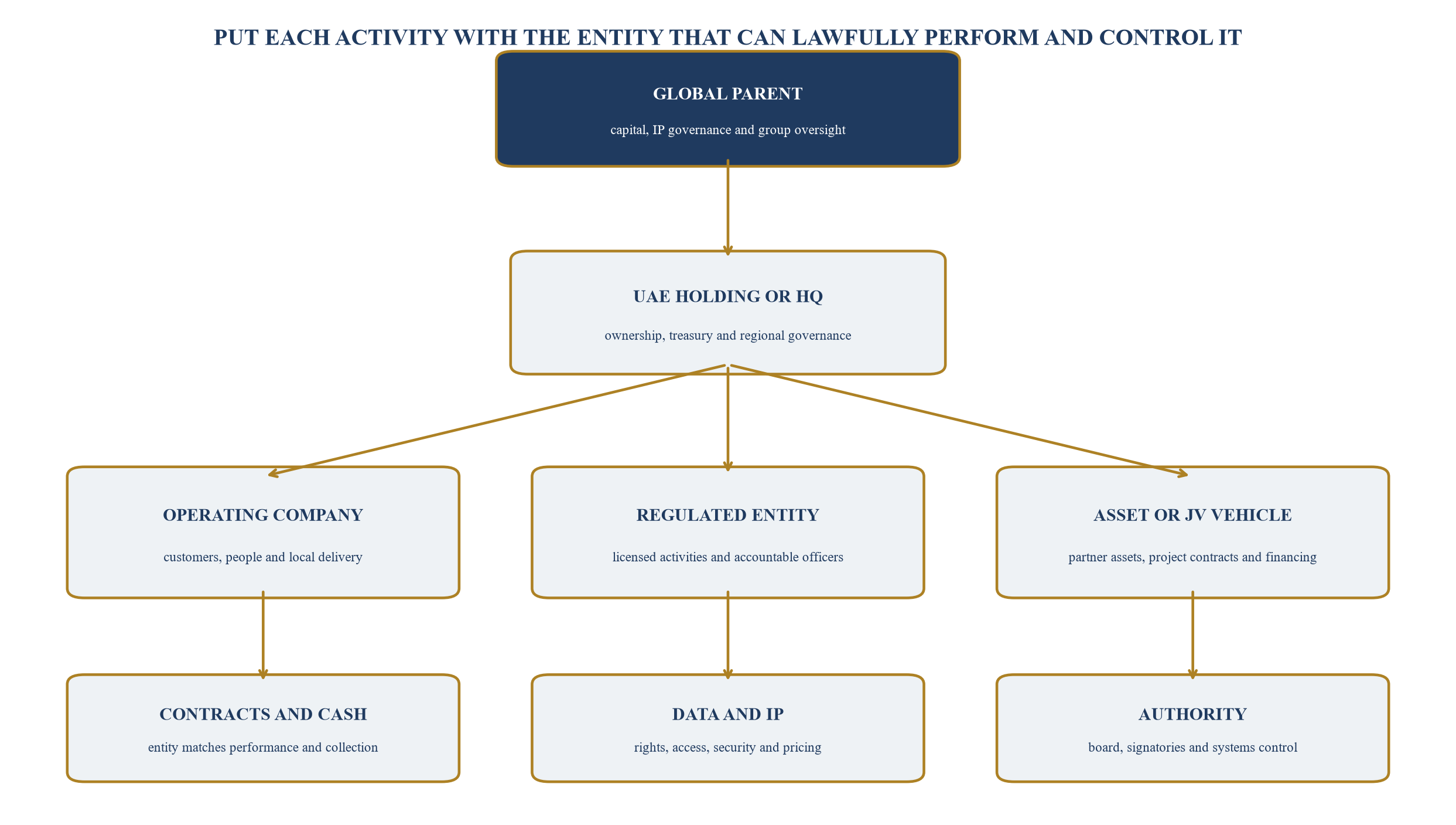
The structure is illustrative. Entity purpose and intercompany arrangements require legal, tax, regulatory and transfer-pricing review.
8. Regulation and competition belong on the critical path
Regulatory analysis begins with the product and customer, not the desired entity name. Financial services, banking, lending, payments, insurance, funds, virtual assets, healthcare, education, telecommunications, defence, transport, energy and other sectors can require approvals beyond a trade licence. The company should identify the competent federal, emirate and free-zone authorities and the sequence between entity registration and sector approval.
The Central Bank of the UAE's current licensing framework states that it licenses, governs and supervises licensed financial institutions. Its rulebook includes legal-form, minimum-capital, ownership and application requirements. The DFSA states that a firm conducting financial services in or from DIFC requires authorisation specifying the activities it can perform. ADGM directs financial-services applicants to complete the authorisation process before registration. These frameworks show why regulated entrants should build the operating model, governance, capital and responsible-person plan before filing.
Acquisitions and some joint ventures require early competition analysis. The UAE competition law applies to conduct and concentrations in relevant product and geographic markets, including digital markets. The current threshold resolution uses UAE sales in the relevant market and market share. A global transaction below a parent-company materiality threshold can still require local analysis. An international deal team should collect UAE turnover, customer, product, market-share and control information before signing.
The board should create a regulatory critical-path register. Each approval should identify authority, legal basis, applicant, prerequisite documents, responsible person, expected evidence, restrictions on pre-approval conduct and the transaction condition it supports. Timing used in the business case should be a management estimate until confirmed. Where the approval is uncertain, the company should preserve a fallback entity, route or sequence.
Gun-jumping and premature integration are practical risks. An acquirer should not exercise control over the target before required approvals and closing. Joint-venture partners should manage competitively sensitive information through defined teams and protocols where applicable. Build teams should avoid marketing or performing regulated services before authorisation. Signing, closing and operational activation should have separate checklists.
Regulatory readiness continues after entry. Licences can impose capital, insurance, reporting, governance, conduct, audit, cybersecurity, outsourcing, data, premises and responsible-person obligations. These recurring costs belong in route economics. A route that obtains approval fastest can be unattractive if the long-term compliance model does not fit the business.
9. Tax should be modelled as cash, conduct and compliance
The UAE corporate-tax system affects each route differently. The FTA's general materials state that UAE branches of UAE businesses are included in the parent or head office's taxable income and return. Free-zone entities can obtain a zero percent rate on qualifying income only when the statutory conditions are met. Transfer-pricing rules apply to transactions with related parties and connected persons. An acquisition can involve participation exemption, tax-group, loss, financing and purchase-price considerations. A joint venture creates related-party and governance questions. A build creates initial-loss, substance and permanent-establishment questions.
The board should see an after-tax cash bridge rather than a tax-rate comparison. The bridge starts with operating contribution and deducts local delivery cost, working capital, capex, financing, transaction or setup cost, compliance, tax and repatriation friction. It should include the cost of maintaining substance and reliable records. A route with a favourable headline treatment can produce weaker cash if it creates inefficient contracts, duplicated staff or restricted market access.
Free-zone analysis should trace income by activity, customer, counterparty and permanent establishment. The FTA's guide explains qualifying activities, excluded activities, adequate substance, de minimis requirements and treatment of permanent establishments and immovable property. The entity should have people, assets, expenditure and decision-making appropriate to its activities. A free-zone address does not determine the tax result by itself.
Transfer pricing should follow functions, assets and risks. A UAE company that negotiates, sells, delivers and bears customer risk should receive an arm's-length return consistent with those functions. A joint venture buying technology or management services from shareholders needs written agreements, benefit evidence and pricing support. A new regional headquarters should document services, decision-making and charges. The FTA's transfer-pricing guide addresses business restructurings, intangibles and changes in functions and risk.
Acquisition modelling should test share and asset routes, participation exemption, inherited tax positions, acquisition financing, interest limitations, purchase-price allocation, tax losses and transaction taxes or fees. Federal tax and relevant emirate or free-zone rules must be considered with origin-jurisdiction consequences. Business Restructuring Relief can apply to qualifying transfers when statutory conditions are met. It should be analysed step by step rather than assumed.
Tax administration is an operating workstream. Registration, return, payment, transfer-pricing files, financial statements, VAT, customs and tax-residency evidence need owners and systems. The FTA's July 2026 guide and legislation pages show continuing development of guidance and compliance requirements. The entry design should support accurate data and timely filings from the first transaction.
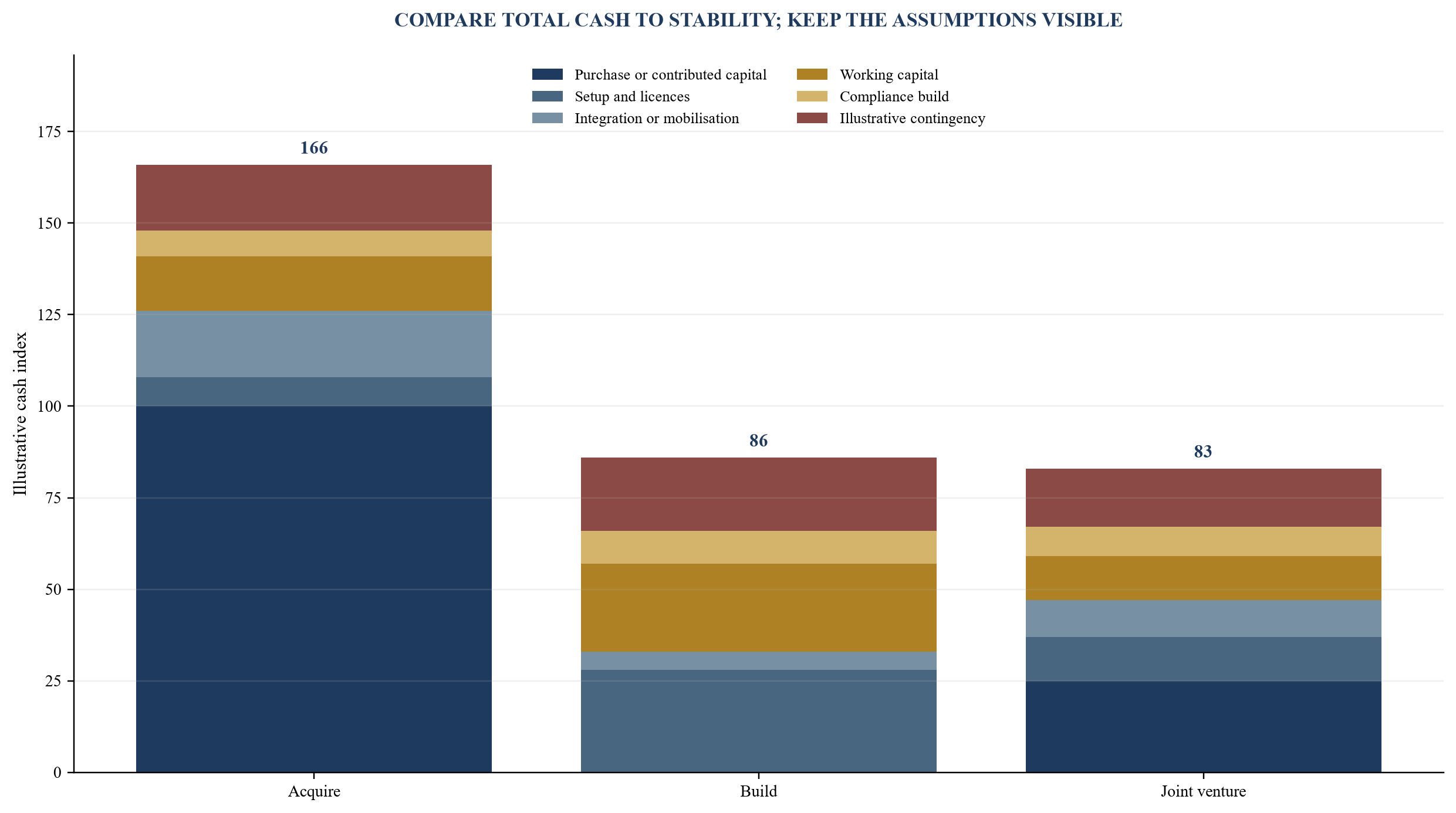
Values are management assumptions expressed as an index. They are not forecasts, market data or a transaction recommendation.
Table 4. Tax and cash bridge by entry route
| Issue | Acquire | Build | Joint venture |
|---|---|---|---|
| entry cash | purchase price, fees, refinancing and integration | setup, capex, recruitment, working capital and ramp losses | contributed cash, assets, services and mobilisation |
| tax focus | share or asset route, historic positions, financing and participation | residence, free-zone treatment, losses, permanent establishment and customs | related parties, contribution values, service charges and distributions |
| accounting focus | consolidation, purchase-price allocation and provisions | capitalisation, pre-opening cost and revenue recognition | control, joint control, equity accounting and related parties |
| cash risk | locked cash, debt, leakage and working-capital adjustment | slow collections, capex overrun and delayed revenue | cash calls, partner default and distribution restrictions |
| documentation | diligence, SPA, tax covenant and structure steps | registrations, intercompany policy and compliance calendar | valuation, shareholder agreement, services and transfer pricing |
| board test | value remains under downside and integration cost | runway reaches evidence gate with contingency | economics remain aligned under underperformance and deadlock |
Outcomes require current advice for the proposed entities, transactions and jurisdictions.
10. People and leadership can change the preferred route
Entry plans often treat talent as an implementation detail. In capability-led businesses, people determine the route. A target can be attractive because a regulated officer, technical team, founder or customer-facing group is difficult to reproduce. A build can be preferable when the company's culture and operating method are central to differentiation. A joint venture can fail when employees serve two masters or when each shareholder withholds its strongest people.
The people map should identify roles required for licensing, sales, delivery, finance, risk, technology and governance. Each role needs a source, location, employment entity, visa or work permit, compensation, start date and backup. MOHRE's published labour law states that work cannot be undertaken without the appropriate work permit within its scope. Financial centres and other regimes can have separate employment frameworks. Employment advice should reflect the entity and workplace.
Acquisition diligence should identify who creates value and why they remain. Retention should cover compensation, role, authority, purpose and future opportunity. A cash bonus can retain a person through a date and fail to preserve motivation or customer trust. The buyer should test whether relationships belong to the institution, an individual or the selling shareholder. Founder transition should specify customer, regulator, employee and decision responsibilities.
A build needs a hiring sequence linked to demand and approval. Hiring an entire team before licence or customer proof can consume runway. Hiring too late can delay authorisation and delivery. Critical regulatory and leadership roles may need early commitments with conditional start dates. Recruitment assumptions should use current local evidence on availability, notice periods, relocation and compensation.
A joint venture should allocate employees clearly. Secondments can provide early expertise and create ambiguity about employer, supervision, confidentiality, cost, appraisal and return. Permanent transfer can improve commitment and create benefit or service-continuity issues. The venture should own a coherent organisation, with a chief executive accountable to the venture board rather than informal shareholder instructions.
The Day-One people certificate should confirm contracts, work permits, payroll, benefits, health insurance, reporting lines, delegated authority, confidentiality, data access, incentive plans and critical-role coverage. A route is not operationally ready when the entity exists and employees cannot lawfully work or access the systems required to serve customers.
11. Procurement and local capability affect revenue quality
The route to revenue varies by customer. Private customers can purchase through negotiated contracts and still require local licences, insurance, credit terms and delivery capacity. Government and national-company procurement can require registration, prequalification, bid bonds, performance guarantees, local content, references and audited accounts. A global sales pipeline should be converted into an account-level procurement map.
The National ICV programme is material in participating procurement. MoIAT states that the programme redirects government and participating national-company procurement expenditure towards local manufacturing, products, services and investment. Its certification service requires a valid business licence, audited financial statements and other documents according to company size. The score can influence competitiveness where a buyer applies the programme. Management should verify whether each target customer uses ICV and how the proposed route affects the score.
Acquisition can provide supplier history, audited accounts and local spending that support qualification. The buyer should confirm that certificates and registrations survive ownership change and that the historic score reflects the post-close business. A build can develop a deliberate local-procurement and workforce profile over time. A joint venture can combine a partner's local infrastructure with the entrant's technology, although the economic contribution and tender eligibility need to sit in the bidding entity.
Working capital should be modelled from procurement rules. Tender deposits, guarantees, mobilisation, retention, milestone acceptance and long payment terms can consume cash. Factoring or bank facilities may require receivable eligibility, customer acknowledgement and security. Acquisition can import existing facilities and covenants; a build may need sponsor funding until banking history is established; a joint venture should allocate funding obligations before a bid is submitted.
Commercial teams should own contract quality as well as bookings. The dashboard should distinguish signed orders, executable backlog, mobilised work, accepted revenue, invoiced amounts and collected cash. This discipline makes route economics comparable and exposes customer or procurement dependencies before capital is committed.
12. Technology, data and intellectual property should be designed into entry
Technology is part of market access, operating efficiency and control. A build can deploy the group's preferred architecture from the start. An acquisition can supply installed systems and data while importing technical debt, cybersecurity exposure and licence constraints. A joint venture can depend on shareholder systems and become difficult to separate. The route decision should include the cost and control of the digital operating model.
The UAE Personal Data Protection Law provides a federal framework for personal-data processing within its scope. ADGM and DIFC maintain separate data-protection regimes for relevant entities. The company should identify controller and processor roles, data categories, purposes, legal bases, hosting, transfers, security, retention and breach processes. Customer contracts and sector rules can add requirements.
Acquisition diligence should test ownership and use rights for software, source code, models, datasets, domains, cloud accounts, licences and cybersecurity tools. The buyer should understand administrative access, third-party dependencies, incidents, penetration tests, backups and recovery. A warranty about IP ownership does not replace asset-level verification. Integration should preserve evidence and availability while risks are remediated.
A build should define the minimum technology stack for licensing, finance, sales, delivery, data protection and customer service. Group systems may need local configuration, data-transfer analysis, Arabic support, integration with payment or identity systems, and regulator approval. The budget should include security, testing, support and compliance rather than software subscriptions alone.
A joint venture should document which party owns background IP, which party can use it, who owns improvements, how data can be accessed, what happens on exit, and how services are priced. Access should be technically enforceable and auditable. A venture that relies on a shareholder's platform needs continuity provisions if the relationship deteriorates.
Technology can also create route options. A digital pilot can test demand before a full build where regulations permit. Data from pilots can refine pricing and service design. A target's data can improve the acquisition thesis only when rights, quality and usability are verified. The board should treat data as an asset with legal, technical and commercial conditions.
13. Financing should support the route and the downside case
Each route has a different funding profile. Acquisition requires purchase consideration, fees, refinancing, integration and working capital. Build requires staged equity or sponsor debt through a ramp with uncertain collections. A joint venture requires agreed initial capital, future cash calls, bankability and remedies when one shareholder cannot or will not fund. The board should finance the downside case rather than the headline plan.
Acquisition financing should be sized to resilient cash flow after normalisation and integration investment. Security, guarantees, financial assistance, dividend capacity, tax, covenant headroom and regulatory capital need review. Lenders should understand the target, integration plan and post-close structure. The company should avoid relying on synergies to meet near-term debt service before the mechanism and timing are proven.
A build can use milestone funding. The sponsor commits enough cash to complete the next evidence gate and maintains contingency for delay. Local facilities can become available after banking history, contracts, receivables or assets exist. Working-capital facilities should match the invoicing and collection cycle. A revolving line cannot solve a structurally unprofitable ramp.
Joint-venture documents should state who funds, when, in what instrument and with what consequence. Equity, shareholder loans, external debt and guarantees affect economics and control. Default remedies can include dilution, loss of voting rights, shareholder loan conversion, buyout or termination. A punitive dilution mechanism can become unenforceable or commercially destructive if drafted without proportionality and advice.
Treasury readiness is an entry gate. Bank accounts, Know Your Customer documentation, signatories, payment limits, foreign exchange, merchant services, trade finance and fraud controls should be ready before revenue or payroll depends on them. A company can be incorporated and unable to transact while a bank completes onboarding. The programme should maintain a cash-continuity plan and avoid unverified timing assumptions.
The capital structure should preserve strategic flexibility. Excessive acquisition debt can prevent investment in value creation. An overcapitalised build can encourage premature spending. A joint venture funded entirely by one shareholder can create misaligned incentives. The board should define future funding needs, ownership consequences and exit capacity before approving the first commitment.
14. Route economics need one model and several decision states
The board should compare acquire, build and joint venture through one model with route-specific assumptions. The model should use monthly or quarterly cash flows through a stable operating state, followed by a steady-state period and exit or terminal assumptions where relevant. It should show capital invested, revenue, gross margin, operating cost, working capital, capex, tax, financing and residual value.
The acquisition case starts with purchase consideration and includes debt, fees, working-capital adjustment, integration and remediation. It should separate stand-alone performance from buyer initiatives. The build case starts with setup and includes licensing, recruitment, capex, customer acquisition, ramp losses and working capital. The joint-venture case includes contributed assets and services at supportable values, cash funding, related-party charges, dividend restrictions and exit economics.
Probability should be applied to observable states rather than buried in a discount rate. Management can define a base state, delayed state, underperformance state and stop state. Each state should have triggers and actions. The build stop state can cap losses if paid demand is absent by a defined evidence date. The acquisition downside state can include customer loss, remediation and slower integration. The joint-venture downside state can include deadlock, partner underperformance and funding disputes.
The model should calculate value of information. A six-month pilot can cost money and reduce the probability of a much larger mistaken commitment. Acquisition diligence can delay signing and avoid a liability or reveal a price adjustment. Regulatory pre-engagement can identify an unavailable licence before the company signs a lease. These activities create economic value when they change a decision.
Sensitivity should focus on variables that the route changes: time to first cash, sustainable gross margin, customer retention, working-capital days, licence timing, integration cost, hiring pace, partner performance and terminal optionality. Macroeconomic scenarios should be added where they affect demand or funding. The output should reveal the route preferred under each plausible state and the assumptions that reverse the answer.
The board should reject false precision. A net-present-value difference smaller than the uncertainty in customer retention or licence timing does not establish superiority. Decision quality comes from understanding mechanisms, downside, evidence and reversibility. The selected route should remain acceptable under conservative assumptions and have clear management actions when conditions change.
15. Governance converts the route into controllable execution
Governance begins before a vehicle exists. The parent board should appoint a sponsor, approve the objective, define risk appetite, set capital limits and establish decision rights. A steering committee should integrate commercial, legal, finance, tax, regulatory, people, technology and operations. The programme director should own the critical path and evidence register.
Each route requires a different governance design. Acquisition needs signing and closing authorities, clean-team controls, integration governance, target board transition and a value-creation office. Build needs capital-release gates, licence and hiring authority, local management delegation and customer-exception controls. A joint venture needs shareholder, board and management rights, reserved matters, information, related-party controls and deadlock mechanisms.
Reserved matters should protect value without paralysing operations. They can cover business plan, budget, capital, debt, acquisitions, disposals, material contracts, related-party transactions, senior appointments, litigation, distributions, IP and changes to the business. Thresholds should reflect materiality. Ordinary operating decisions should sit with accountable management inside the approved plan.
Information supports control. The board should receive route-specific metrics: acquisition customer retention, integration, cash and value initiatives; build licence progress, paid demand, hiring, delivery and runway; joint-venture partner obligations, related-party performance, cash calls, customer ownership and governance exceptions. Evidence should be accessible and auditable.
Conflicts require protocols. An investor director can owe duties to the venture under applicable law while also representing a shareholder. Related-party contracts should be approved through transparent procedures. Competitive information should be protected. Management should document abstentions, independent review and pricing support where appropriate.
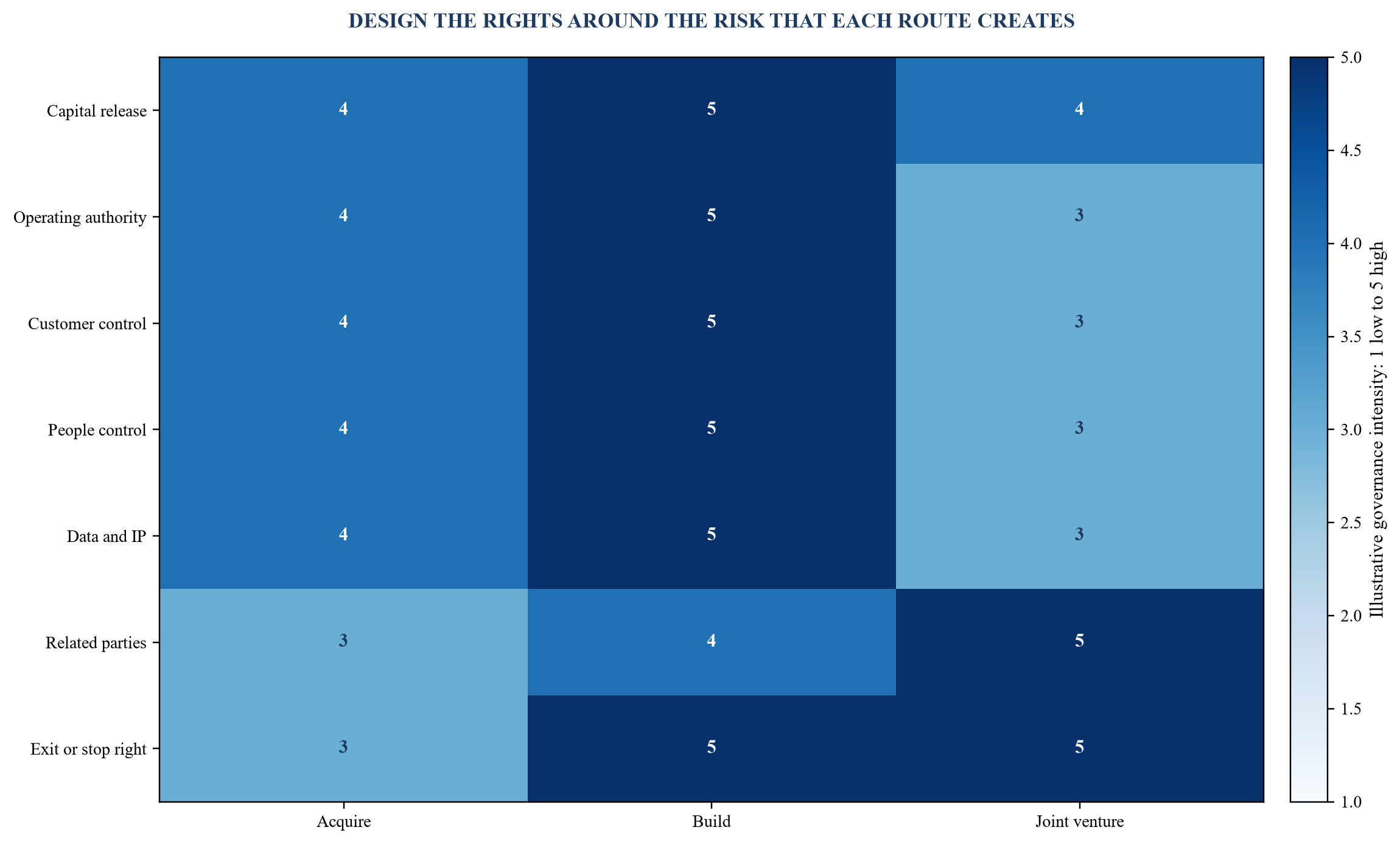
The matrix is an illustrative design. Rights, duties and approval thresholds require transaction-specific documentation.
Table 5. Governance and control design by route
| Control domain | Acquire | Build | Joint venture |
|---|---|---|---|
| board | transition target authority and align with buyer governance | establish local board and delegated limits | allocate seats, quorum, chair and independent input |
| budget | protect integration and value-creation investment | release capital against evidence gates | approve plan, cash calls and variance remedies |
| management | retain capability and establish clear post-close roles | hire in sequence and empower local delivery | appoint management accountable to the venture |
| customers | manage consent, retention and ownership | own pipeline, contracting and service data | define origination, account ownership and non-compete |
| IP and data | verify rights, access and integration | configure lawful group access and local controls | license background IP and allocate improvements |
| related parties | identify inherited arrangements and remove leakage | document group services and pricing | approve shareholder services, pricing and performance |
| exit | integration can reduce separability | stop, resize, sell or scale at defined gates | transfer, put, call, buy-sell and deadlock mechanics |
The table identifies design questions. It does not determine legal control or accounting treatment.
16. A 270-day programme should end each phase with evidence
The 270-day sequence in this paper is an illustrative management design. It is not a claim about statutory or regulator processing time. A simple commercial build can progress faster. A regulated acquisition or complex joint venture can take longer. The sequence helps the board separate thesis, route choice, commitment, launch and stabilisation.
Days 0 to 30 define the outcome and evidence plan. Management identifies target customers, segment, value proposition, regulatory perimeter and required capability. It creates the initial market-attractiveness and right-to-win screen. The board approves the decision process, capital-at-risk limit and disconfirming tests.
Days 31 to 60 create the route alternatives. The team develops acquisition, build, joint-venture and staged cases on one economic model. Legal and regulatory advisers map licences, ownership, competition, entity and transaction constraints. Finance builds cash and downside states. The gate confirms that at least two executable routes or one route and a credible pause option remain.
Days 61 to 120 collect decisive evidence. Acquisition teams screen targets and conduct initial diligence. Build teams validate customers, licence paths, premises and talent. Joint-venture teams verify partner assets, economics and governance. Management obtains customer, regulator, bank, supplier and labour evidence. The board selects a preferred route and fallback.
Days 121 to 180 negotiate and design. An acquisition enters confirmatory diligence, financing and transaction documents. A build completes incorporation, licensing, hiring and systems design in the permitted sequence. A joint venture completes contributions, shareholder documents, operating contracts and approvals. The company builds the Day-One operating model and implementation budget.
Days 181 to 225 close or launch. Conditions are verified, funds are available, authority is valid, licences are in place for the activities beginning, people can work, customers can contract, data controls operate and banks can transact. Communications follow confirmed facts. Any condition waived by the board has a defined consequence, mitigation, owner and expiry.
Days 226 to 270 stabilise and re-underwrite. The company measures customer retention or conversion, service quality, cash, people, compliance and route-specific value milestones. The board compares actual evidence with the investment case. It can release the next build tranche, accelerate integration, require joint-venture remediation, resize the platform or exercise a stop right.
Table 6. Illustrative 270-day entry programme and board gates
| Period | Core work | Required evidence | Board decision |
|---|---|---|---|
| days 0 to 30 | define segment, outcome, risk appetite and evidence plan | named demand, preliminary licence map and right-to-win hypothesis | fund route evaluation |
| days 31 to 60 | build acquire, build, joint-venture and staged cases | comparable cash model, constraints and fallback | approve routes for validation |
| days 61 to 120 | target, customer, regulator, partner, talent and bank validation | decisive evidence and disconfirming findings | select preferred route and reserve option |
| days 121 to 180 | diligence, negotiation, structure and operating design | financeable documents, licences, governance and Day-One plan | authorise commitment subject to conditions |
| days 181 to 225 | close, incorporate or launch permitted operations | closing certificate, funds, authority, people, systems and contracts | activate the platform |
| days 226 to 270 | stabilise, measure and re-underwrite | actual cash, customer, compliance and capability performance | scale, remediate, resize or stop |
Timing is a management assumption. Applicable approval periods and transaction deadlines must be confirmed.
17. The board decision rule
The board should choose acquisition when time and installed capability are valuable, an appropriate target is available, the licence and contract perimeter can survive ownership change, the price is supported by stand-alone quality, and a funded integration plan converts buyer capabilities into cash. The route should remain acceptable after customer, remediation and synergy downside.
The board should choose build when the company's model can be transferred, control over design and culture is valuable, customer evidence supports the ramp, licence and talent pathways are credible, and staged capital reaches a defined stable state with contingency. The programme should contain stop and resize rights before major fixed cost is committed.
The board should choose a joint venture when a verified partner asset is essential, the combined economics are superior, contributions and obligations can be measured, governance supports timely operation, related-party dependencies are controlled, and exit remains usable. Shareholding, rights, information and actual conduct should support the intended control model.
The board should use a staged route when learning can materially change the decision and the first step preserves future options. Milestones should be observable, contracts should protect customers, data and IP, and the cost of delay should be visible. The board should defer entry when demand, regulatory feasibility, economics, partner quality or capability remains unsupported.
The final paper should answer ten questions. Who pays? What urgent problem is solved? Why can this entrant win? Which licence and entity are required? What capability must exist on Day One? What total cash reaches stability? What changes the route preference? Which approvals and consents are critical? Who controls customers, people, cash, data and IP? What evidence triggers scale, remediation or exit?
The practical conclusion is that entry mode is a portfolio of rights, capabilities, cash flows and risks. The board should select the route that creates the required operating system at an acceptable total cost, with evidence-led gates and a credible response to failure. The UAE platform should be designed for actual customers, regulation and execution rather than a generic incorporation promise.
18. Limitations and professional-use boundary
This paper reflects official sources available in August 2026. UAE laws, resolutions, regulator rules, guidance, licensing practice, free-zone requirements, fees and competition procedures can change. Current requirements should be verified with the competent authorities and qualified advisers immediately before a transaction, filing or operating decision.
The correct route depends on sector, product, customer, ownership, target, partner, activities, assets, financing, contracts, people, data, tax profile and jurisdictions. Foreign ownership can be available and remain subject to strategic-impact, sector or local-authority conditions. Competition notification and regulatory approval require transaction-specific analysis.
All scores, weights, values, scenarios, thresholds and programme periods in this paper are management assumptions for decision design. They are not forecasts, market data, promised results or evidence that a specific entry is viable. Commercial demand, retainer potential, revenue and valuation outcomes remain uncertain until supported by signed contracts, delivery and collected cash.
The paper does not constitute legal, tax, regulatory, employment, immigration, data-protection, accounting, financing, investment or other professional advice. Boards should obtain advice based on current law and the complete facts. Management remains responsible for due diligence, approvals, capital allocation, implementation and evidence that the UAE operation performs the activities represented to customers, regulators, banks and investors.
Sources and further reading
- OECD, Investment Policy Perspectives in the United Arab Emirates, 2026 Official source
- OECD, Investment Policy Perspectives in the United Arab Emirates, Full Report, 2026 Official source
- UAE Government, Foreign Direct Investment in the UAE Official source
- International Monetary Fund, United Arab Emirates 2025 Article IV Consultation Official source
- UN Trade and Development, World Investment Report 2025 UAE Fact Sheet Official source
- UAE Legislation, Federal Decree-Law No. 32 of 2021 on Commercial Companies Official source
- Ministry of Economy and Tourism, Full Ownership in Economic Sectors Official source
- Ministry of Economy and Tourism, Strategic Impact Activities Official source
- Dubai Digital Authority, Starting a Business in Dubai Official source
- Invest in Dubai, Search Business Activities Official source
- ADGM, Setting Up a Business Official source
- ADGM Registration Authority, Registration and Incorporation Official source
- Dubai Financial Services Authority, Authorisation Services Overview Official source
- Central Bank of the UAE, Licensing Official source
- Central Bank of the UAE Rulebook, Chapter Two Licensing Official source
- UAE Legislation, Federal Decree-Law No. 36 of 2023 Regulating Competition Official source
- UAE Legislation, Cabinet Resolution No. 3 of 2025 on Competition Ratios and Thresholds Official source
- Ministry of Economy and Tourism, Economic Concentration Official source
- Federal Tax Authority, Corporate Tax General Guide Official source
- Federal Tax Authority, Free Zone Persons Guide Official source
- Federal Tax Authority, Transfer Pricing Guide Official source
- Federal Tax Authority, Business Restructuring Relief Guide Official source
- Federal Tax Authority, Exempt Income and Participation Exemption Guide Official source
- Ministry of Industry and Advanced Technology, National In-Country Value Program Official source
- Ministry of Industry and Advanced Technology, Issuing an ICV Certification Official source
- UAE Government, Data Protection Laws Official source
- Ministry of Human Resources and Emiratisation, Federal Decree-Law No. 33 of 2021 Regulating Employment Relationships Official source
- UAE Legislation, Federal Law No. 3 of 2022 Regulating Commercial Agencies Official source
- Singapore Economic Development Board, Five Steps to Setting Up a Business in Singapore Official source
- UK Department for Business and Trade, Invest in the UK Official source
- Australian Government, Business Investments and Foreign Investment Guidance Official source
- United States Department of Commerce, SelectUSA Investor Guide Official source
- World Trade Organization, United Arab Emirates Trade Policy Review 2022 Official source
