

1. A country thesis must become a sector thesis
The UAE offers several attributes that can justify board attention: open trade, extensive transport infrastructure, specialised economic zones, active investment-promotion bodies, a sophisticated financial system and a policy agenda aimed at non-oil growth. A country narrative can explain why management should investigate the market. It cannot decide whether a particular company should commit capital, which activity should be licensed, how customers will be won or which operating model will produce an acceptable return.
A useful entry thesis begins with a defined profit pool and a specific customer problem. The board should identify who buys, why the problem is urgent, how purchasing authority works, which incumbent alternatives exist, what evidence a buyer needs, how long procurement and collection take and which regulatory permissions govern the activity. The same country can support attractive economics for one activity and weak economics for an adjacent activity. Sector labels alone remain too broad. Financial technology may include a software vendor outside the regulated perimeter, an outsourced service provider, a payments institution, a credit platform or a virtual-asset business. Each has a different approval path and capital model.
The Organisation for Economic Co-operation and Development reports that inward foreign-direct-investment stock exceeded half of UAE gross domestic product by 2024. It also reports concentration in wholesale, retail and real estate and comparatively limited representation in knowledge-intensive activities. This combination matters. It signals a meaningful capital base and continued diversification opportunity. It also requires management to test whether policy priority has translated into addressable customers, qualified talent, supplier capability, finance, infrastructure and transaction volume for the proposed activity.
The board should therefore frame entry as a sequence of reversible commitments. Early spending purchases evidence. Later spending builds operating capacity after the evidence meets an approved standard. A distributor test, customer-design partnership or restricted service scope may establish demand before a full entity and team are funded. A regulated business may require earlier incorporation and licensing expenditure; its proof plan should still separate formal approval from commercial validation. The objective is a decision system that makes uncertainty visible and limits capital exposure until the next proof state is reached.
Table 1. The board standard for a UAE sector-entry thesis
| Decision field | Board question | Required evidence | Capital consequence |
|---|---|---|---|
| customer problem | which buyer owns the problem and budget? | interviews, procurement map, paid test or executed commercial evidence | fund discovery before fixed capacity |
| profit pool | where is economic value created and retained? | addressable accounts, price architecture, cost-to-serve and collection evidence | size the opportunity using verified segments |
| regulatory perimeter | which activity, permission and regulator apply? | written classification, current rule, approval sequence and adviser review | gate regulated expenditure and launch |
| entry mode | which route provides control at acceptable risk? | route comparison, partner diligence, ownership and governance rights | stage entity, partnership or acquisition capital |
| operating substance | what people, premises, systems and decisions belong locally? | organisation design, substance plan, service flows and transfer-pricing analysis | fund capability linked to real functions |
| commercial proof | which result justifies scale? | signed customers, usage, delivery quality, collections and renewal indicators | release scale capital only after review |
Thresholds, owners and acceptable evidence should be approved for the specific business and activity.
2. Formal openness and practical accessibility are separate tests
The UAE has materially liberalised foreign ownership. Official policy allows full foreign ownership across many economic activities, subject to strategic-impact activities and the conditions of the relevant licensing authority. The legal question is activity-specific. The commercial question is broader: whether the company can obtain the correct licence, reach customers, satisfy procurement and localisation expectations, hire qualified people, move data and funds lawfully, and operate with enough control to protect its economics.
Strategic classifications remain important. Defence, financial services and telecommunications illustrate activities where sector regulation, security approvals, ownership conditions or prudential requirements can override a general ownership narrative. A software company selling to banks may have a different perimeter from a company that holds customer money or provides a regulated financial service. A connectivity platform may depend on telecommunications licensing or licensed partners. A healthcare technology provider may require facility, professional, product, data and insurer-related assessments even when its corporate form is straightforward.
Practical accessibility also depends on procurement structure. Government-related entities and large local groups may use vendor-registration, information-security, local-content, performance-bond, insurance, track-record and payment-term requirements. An entrant may need a local delivery team and reference customer before the opportunity becomes commercially accessible. The board should distinguish an addressable market shown in public statistics from a serviceable market defined by eligibility and from an obtainable market supported by evidence of conversion.
Administrative design is decentralised across federal and Emirate-level institutions. The OECD identifies the advantage of tailoring and the challenge of variability. Management should map every authority touching the operating chain: economic licence, sector regulator, free-zone authority, municipality, customs, tax, employment, immigration, data, environment, product standards and any client-specific approval. A single incorporation quotation rarely captures the complete approval sequence.
3. Build an institutional map before choosing an entity
Entity selection is often discussed as a choice between mainland and free zone. That framing is incomplete. The first decision is the activity and regulatory perimeter. The second is the customer and contracting model. The third is the operating substance required to deliver. The legal entity should follow those facts.
A mainland company may provide broad access to onshore contracting and local premises, subject to activity and licence requirements. A free-zone entity may provide a specialised ecosystem, a recognised legal framework, customs or logistics advantages, or a regulatory environment designed for a particular activity. A financial institution in the Dubai International Financial Centre or Abu Dhabi Global Market enters a distinct legal and regulatory architecture. A company based in another free zone may need a distributor, branch, dual-licence arrangement or mainland entity for specific onshore activity. Current authority rules should be checked before commitment.
The institutional map should show decisions and dependencies, not merely logos. The economic-development authority or free-zone registrar governs establishment. A sector regulator may govern permission to operate. The Federal Tax Authority governs corporate tax, value-added tax and related administration. Employment and immigration authorities affect workforce mobilisation. Customs and standards bodies affect imported products. Data-protection obligations may arise under federal law, a free-zone regime, sector rules and contractual requirements. Banks and payment providers impose onboarding and transaction-monitoring controls that influence time to cash.
The map should also identify which facts require external opinions. Management owns the business case. Qualified counsel should confirm legal perimeter, ownership and contracts. Tax advisers should confirm corporate-tax, value-added-tax, withholding, permanent-establishment and transfer-pricing analysis. Sector specialists should confirm permission requirements. The board should receive concise conclusions, named dependencies, remaining uncertainties and the consequence of an adverse interpretation.
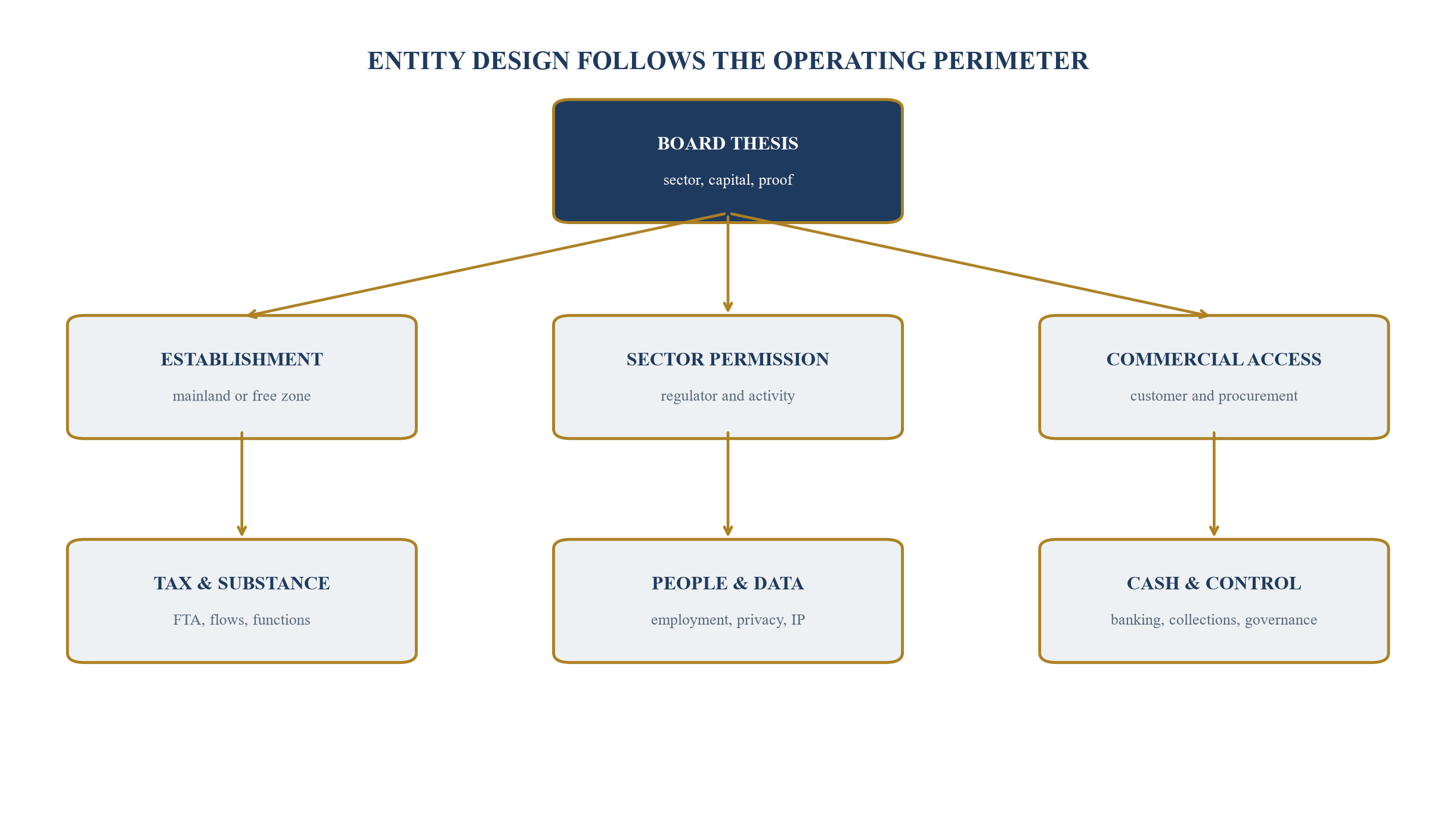
The map is a governance aid. Applicable authorities vary by Emirate, zone, activity and transaction.
4. Screen sectors through value, access and executability
A sector-attractiveness screen should integrate five dimensions. Demand asks whether a defined customer segment has an urgent, funded problem. Access asks whether the entrant can reach and contract with those customers. Advantage asks whether the company brings differentiated technology, capability, assets, relationships or cost. Economics asks whether price, delivery cost, working capital, tax and capital intensity can support the required return. Executability asks whether licensing, people, infrastructure, partners and governance can be assembled within an acceptable period and budget.
Scoring should force discussion rather than manufacture precision. A one-to-five score can reveal where directors disagree, provided every score has evidence and an owner. Management should record the source date, limitations and confidence level. A policy announcement may strengthen strategic alignment while leaving customer budgets and procurement timing unproven. A signed design partnership may support customer need while leaving repeatable unit economics unknown. A successful transaction by another entrant may show feasibility without establishing comparable economics.
The screen should include disconfirming evidence. Management should search for closed tenders, delayed licences, failed launches, customer churn, price pressure, talent shortages, bank-onboarding friction and partner disputes. These data can be difficult to obtain. The diligence plan should identify interviews, adviser checks and commercial tests capable of reducing the uncertainty. A thesis that survives only because adverse evidence was excluded is not ready for capital.
The board can use three decision bands. An investigation band funds research and customer discovery. A validation band funds a bounded market test, licence analysis and partner diligence. A build band funds the approved operating model after primary risks meet their proof thresholds. All cut-offs are management assumptions. The board should revise them when new facts change risk, strategic importance or the value of delay.
International comparison can improve the screen when it is tied to the same operating facts. Singapore, the United Kingdom and India publish investment and establishment information through their official investment bodies. Those materials help management identify alternative locations, sector ecosystems and administrative routes. A reliable comparison should use the same activity, customer segment, capital structure, delivery model and time horizon in every jurisdiction. Comparing a regulated UAE platform with an unregulated distributor in another country would distort the result.
The comparison should separate market opportunity from hub value. A location may support direct domestic revenue, regional management, product development, treasury, manufacturing, logistics or access to investors. Each function has a different evidence standard. Regional headquarters value may depend on air connectivity, senior talent, time zones, banking and governance. Manufacturing value may depend on utilities, land, logistics, supplier depth, offtake and export rules. A technology hub may depend on research talent, compute, data, intellectual-property protection and customer collaboration.
Management should then calculate the cost of uncertainty. Delay has a cost when customers are ready and a competitor can establish relationships. Premature commitment has a cost when licensing, demand or delivery economics remain unproven. The board can compare these costs through staged options: reserve a name, commission perimeter advice, sign a conditional partner agreement, run a paid test, prepare an application, or negotiate an acquisition option before releasing full capital. Every option should have a deadline and a decision consequence.
Scenario design should remain transparent. The base case, downside and upside should state assumptions for customer conversion, price, time to permission, hiring, collection, fixed cost and capital requirement. Management should identify the evidence that would move an assumption between scenarios. This turns the model into a live decision instrument. It also makes the investment committee discussion more useful because debate focuses on observable facts and controllable actions.
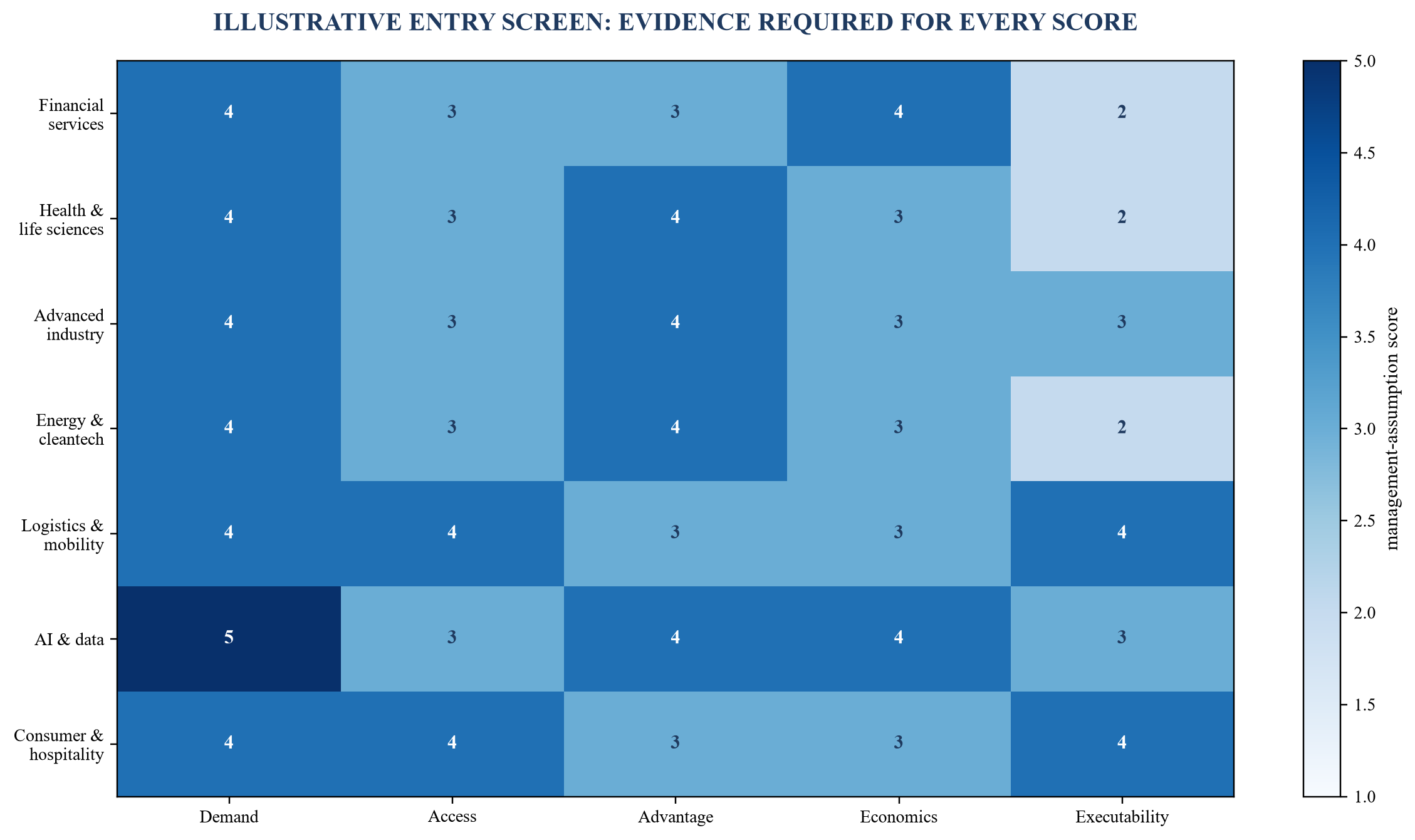
Scores are illustrative management assumptions and are not market ratings.
Table 2. Sector-specific entry questions
| Sector | Commercial proof | Regulatory and operating dependency | Early value test |
|---|---|---|---|
| financial services and fintech | regulated buyer demand, integration economics and recurring revenue | CBUAE, DFSA or FSRA perimeter; outsourcing, data, AML and capital requirements | paid institution-led pilot with written perimeter analysis |
| healthcare and life sciences | provider, payer or patient value with measurable workflow benefit | facility, professional, product, clinical, insurance and health-data rules | controlled deployment with clinical and economic measures |
| advanced manufacturing | offtake, yield, local-content value and export competitiveness | industrial licence, standards, land, utilities, environment and customs | qualified sample, costed process and customer validation |
| energy and clean technology | contracted demand, bankable savings or capacity value | land, grid, permitting, offtake, equipment standards and project finance | site-specific technical and commercial feasibility |
| logistics and mobility | volume density, route economics and service reliability | customs, transport permissions, warehousing, free-zone and data integration | bounded lane or customer cohort with collection evidence |
| AI, data and digital infrastructure | workflow adoption, accuracy, security and compute economics | data rights, cybersecurity, sector rules, hosting, telecom and IP | production-like test with named controls and buyer outcome |
| consumer, hospitality and services | repeat demand, location/channel fit, basket and margin | activity licence, premises, product, tourism, employment and franchise rules | small-format or channel test with cohort economics |
The table identifies diligence questions; it does not rank sectors or recommend an investment.
5. Financial services and fintech require perimeter-first design
The UAE supports financial-services ecosystems across onshore markets, the Dubai International Financial Centre and Abu Dhabi Global Market. The Central Bank of the UAE, Dubai Financial Services Authority and Financial Services Regulatory Authority each publish licensing frameworks for activities within their jurisdictions. An entrant should define the proposed service at the level of functions, assets, customers, data, money flows and contractual responsibility before choosing an entity or describing itself as unregulated technology.
The perimeter analysis should test whether the company advises, arranges, deals, manages, safeguards, transmits, lends, insures, operates a market, provides payment services or performs outsourced functions for a regulated institution. It should identify who contracts with the end customer, who holds money or assets, who makes decisions, where the service is performed and which entity bears liability. Marketing language, product architecture and commercial incentives should match the legal conclusion.
Commercial proof in financial services also differs from a generic software pilot. A bank or regulated institution may require security review, model governance, data localisation, vendor-risk assessment, business continuity, audit rights and integration testing. Procurement can extend beyond the business sponsor. The proof plan should map every approval owner, expected evidence and the point at which a paid commitment becomes possible. Revenue recognition and collection should reflect acceptance criteria and implementation obligations.
Entry choices include selling software to licensed firms, partnering with an institution, obtaining a permission, acquiring a licensed platform or forming a joint venture. Each route changes control, time, capital, compliance and economics. An acquisition can accelerate capability and customer access; it also transfers conduct, technology, financial-crime, data and governance liabilities. The board should require regulatory and operational diligence proportionate to the proposed route.
6. Healthcare entry connects clinical value to a fragmented buying chain
Healthcare and life-sciences entry can involve federal and Emirate-level health authorities, facility licences, professional permissions, product registration, clinical evidence, payer rules, data protection and procurement. The commercial chain may include patients, providers, insurers, distributors, employers and government entities. The party benefiting clinically may differ from the party funding adoption. A viable thesis identifies both.
The first test is the use case and care setting. A clinical technology, medical device, digital-health platform, hospital service, laboratory business and pharmaceutical product face different evidence and approval requirements. Management should specify the patient pathway, decision maker, standard of care, data generated, professional responsibility and intended claim. The product and its marketing should remain within the approved scope.
Commercial proof should combine outcome, workflow and economic evidence. Clinical benefit without integration may fail to produce adoption. Administrative efficiency without reliable clinical governance may create unacceptable risk. A pilot should define baseline performance, participating cohort, consent and privacy controls, clinical oversight, implementation resources, outcome measures, economic measures and escalation rules. A positive result should be followed by a procurement and reimbursement plan rather than assumed to convert automatically.
Partner selection needs diligence. A distributor may provide registration knowledge and market access while reducing direct customer control. A joint venture may contribute facilities, relationships or licences while creating governance and exit dependencies. An acquisition may provide an established platform with legacy liabilities. The board should test rights to data, intellectual property, customer relationships, regulatory correspondence and future product expansion.
7. Manufacturing converts policy support into plant-level economics
The UAE's Operation 300bn strategy targets a larger industrial contribution to gross domestic product by 2031 and identifies priority areas including technology, healthcare, food security and infrastructure-related industries. Policy direction can improve the opportunity set. The investment case still depends on a plant-level model: offtake, product specification, yield, input cost, energy and water, logistics, customs, labour, land, maintenance, working capital and the cost of meeting quality and environmental standards.
An entrant should begin with an offtake and capability map. Which customers can qualify the product? What specifications, audit rights, samples and certifications are required? How long does qualification take? What minimum volume is credible? Which inputs are imported, locally sourced or exposed to commodity and currency risk? What output can be exported competitively from the chosen location? The model should include ramp-up losses and reject assumptions as management estimates.
Local-content programmes may affect procurement competitiveness and supplier strategy. The Ministry of Industry and Advanced Technology publishes information on the National In-Country Value programme. The board should identify which contracts reward local expenditure, Emiratisation, investment or other recognised contributions; it should also confirm the applicable scoring and certification requirements directly. A localisation plan should create genuine operating capability and should not rely on labels alone.
The preferred entry mode may be a greenfield facility, contract manufacturing, tolling, joint venture, acquisition or phased combination. Greenfield investment provides design control and requires a longer proof path. Contract manufacturing tests demand and specification with lower fixed capital but can limit process control and margin. An acquisition may provide customers, people, licences and plant; diligence should focus on asset condition, environmental matters, product liability, quality systems, customer concentration and hidden capital expenditure.
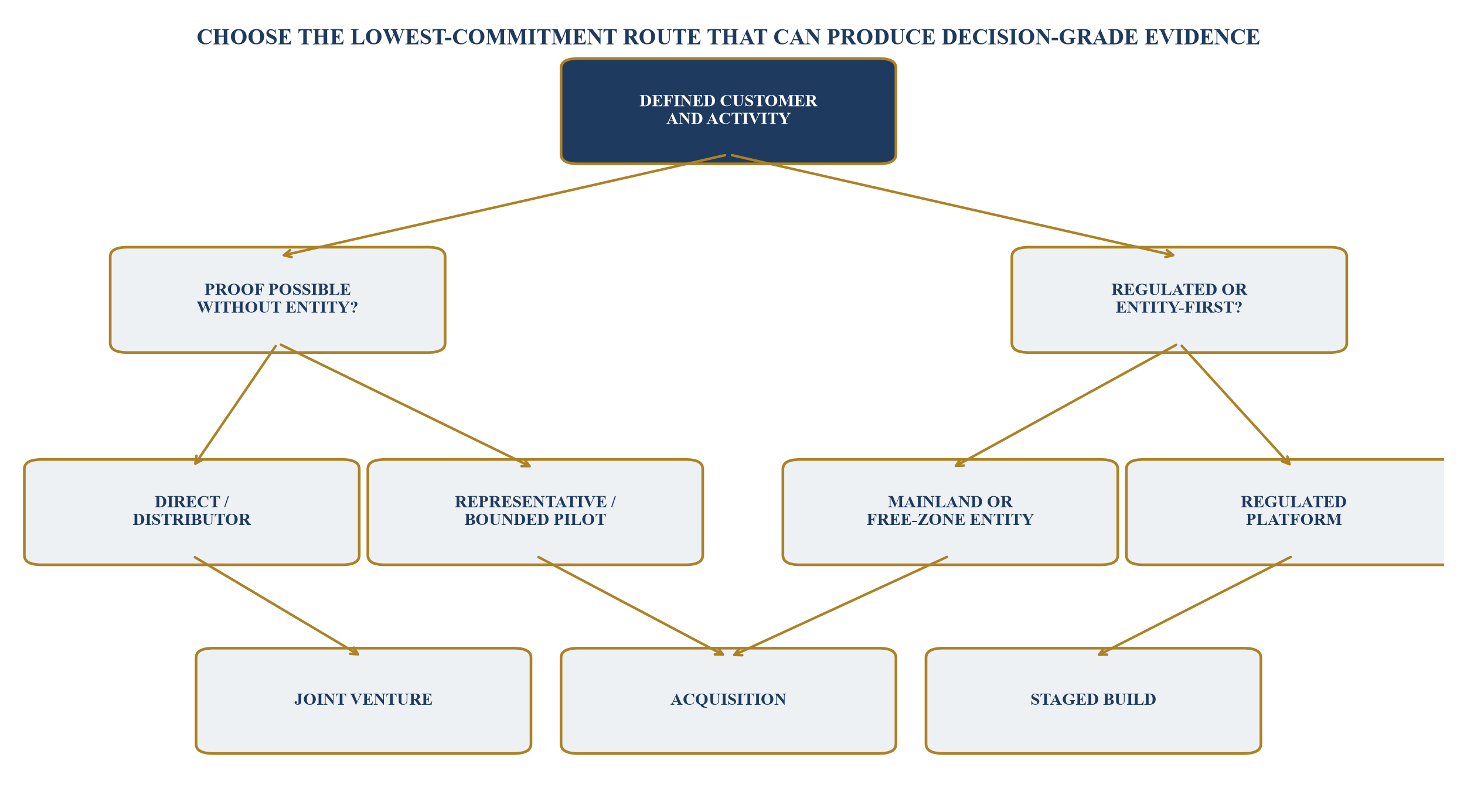
The sequence is illustrative. Legal and regulatory advice is required for the selected activity.
8. Energy and clean technology require infrastructure-grade diligence
The updated UAE Energy Strategy 2050 sets policy ambitions for a lower-emissions energy system, clean-energy investment and energy efficiency. A commercial entry thesis must convert those objectives into a project, service or product with an identified buyer, bankable revenue mechanism, permitted site, available grid or utility capacity, supply chain and financing plan.
Energy opportunities often have long dependency chains. A distributed-energy project may require land rights, interconnection, metering, equipment approvals, construction permissions, an offtake arrangement, insurance, maintenance and finance. An efficiency service may depend on a credible baseline and a contract that allocates performance risk. A technology supplier may require bankability evidence, warranties, local service capability and acceptance by engineers, lenders and insurers.
The board should separate technology risk, construction risk, market risk, counterparty risk and regulatory risk. Each should have an owner, mitigation and evidence standard. A strong technology does not resolve an unavailable connection. A signed memorandum does not establish creditworthy offtake. An attractive tariff does not establish delivery capacity. The investment model should include delay, curtailment, degradation, replacement, working-capital and foreign-exchange assumptions where relevant.
Entry may occur through product distribution, project development, engineering services, a joint venture, acquisition of a local platform or direct investment in operating assets. The chosen route determines whether returns arise from equipment margin, development fee, recurring service, asset yield or capital gain. Management should model these separately and protect against using a high-value recurring multiple for a business whose economics are mainly one-off construction or trading.
9. Logistics and mobility reward network density and execution discipline
The UAE's ports, airports, roads, free zones and customs systems support logistics and trading activity. Commercial success depends on lane density, customer mix, asset utilisation, service reliability, customs capability, warehouse economics, technology integration and working capital. A top-down trade statistic does not establish profitable volume for a particular route or service.
The entry thesis should define the operating node. A freight-forwarding service, cold-chain operator, last-mile platform, warehouse, maritime service, aviation supplier and mobility technology have different permissions and capital requirements. The customer promise should be measurable: transit time, loss reduction, temperature compliance, inventory visibility, customs clearance, asset utilisation or cost. The pilot should capture exceptions and rework as well as average performance.
Working capital needs close attention. Customers may demand extended payment terms while carriers, customs, fuel, landlords and employees require earlier payment. Growth can therefore consume cash. The board should model invoice approval, disputes, duties, deposits, guarantees, inventory and seasonal peaks. Collections evidence should be part of commercial proof.
Digital integration can improve visibility and control; it creates data, cybersecurity and interoperability dependencies. Management should identify who owns shipment data, which systems provide the record of truth, how manual overrides are governed and what occurs during an outage. A technology claim should be assessed through service outcomes and unit economics rather than feature count.
10. Artificial intelligence and data entry begins with a controlled use case
The UAE National Strategy for Artificial Intelligence 2031 identifies priority applications across energy, logistics, tourism, healthcare and cybersecurity. The policy environment creates openings for capability providers and industry-specific solutions. Commercial adoption still depends on a defined workflow, authorised data, measurable performance, security, human accountability and total cost of ownership.
An AI entrant should state what decision or task the system supports, which data it uses, where that data originates, the legal basis and contractual rights, how performance is measured, who reviews outputs and which harm could arise from error. Generic productivity claims provide weak evidence. A production-like test should compare the system with the current process using representative data and agreed measures such as accuracy, time, cost, loss, conversion or service quality.
Data location and cross-border processing require legal and sector-specific analysis. Federal personal-data-protection law, free-zone regimes, health or financial-sector rules and client contracts may apply. The architecture should reflect the strictest relevant constraint. Cybersecurity, model access, logging, incident response, intellectual-property rights and supplier concentration should be part of buyer diligence.
Compute economics can change the commercial model. Management should measure inference or training cost, latency, availability, human-review load, implementation effort and support. A promising demonstration may become unattractive at production volume. The price model should allocate usage and performance risk consciously. The company should also plan for model, vendor and regulatory change so that customer value is not tied to an unsupported dependency.
Table 3. Entry-mode comparison
| Route | Control | Initial capital | Speed to evidence | Principal dependency | Governance focus |
|---|---|---|---|---|---|
| direct cross-border sales | moderate | low | potentially fast | ability to contract, deliver and collect lawfully | tax presence, data, contract and service responsibility |
| distributor or agent | lower | low to moderate | fast when partner is capable | partner incentives, capability and customer access | territory, exclusivity, audit, pricing and termination |
| bounded pilot or representative presence | moderate | low to moderate | designed for learning | scope must remain within permission | data, liability, conversion rights and proof criteria |
| mainland subsidiary | high | moderate | medium | activity licence and local operating build | delegated authority, substance and cash control |
| free-zone entity | high within approved scope | moderate | medium | zone fit and onshore route | qualifying activity, substance, contracting and tax |
| regulated entity | high | high | slower | permission, capital, governance and approved persons | prudential, conduct, AML, technology and reporting |
| joint venture | shared | moderate to high | medium | partner contribution and aligned incentives | reserved matters, deadlock, funding, IP and exit |
| acquisition | high after closing | high | potentially fast | target quality and approval | diligence, integration, inherited liabilities and earn-out |
Relative assessments are management assumptions and should be replaced with transaction-specific evidence.
11. Telecommunications and digital infrastructure retain strategic constraints
Telecommunications is a strategic-impact activity. The Telecommunications and Digital Government Regulatory Authority publishes licensing requirements and conditions that can include security approvals and foreign-ownership limitations unless approval is granted. A company should not assume that a general foreign-ownership rule applies to a regulated communications service.
The perimeter should distinguish telecommunications service, connectivity resale, infrastructure, managed service, equipment, software and data-centre activity. Each can touch different permissions, standards and contracting requirements. The operating design should map spectrum or network dependencies, lawful access, cybersecurity, service availability, data flows, equipment approval and customer responsibility.
Digital infrastructure investment also depends on power, land, cooling, fibre, water, equipment lead times, construction capability, anchor customers and financing. A demand narrative based on AI adoption should be translated into contracted capacity, customer credit, utilisation ramp, energy cost and service-level obligations. Technical design and financing cannot be separated because redundancy, efficiency, location and expansion options affect capital cost and revenue.
Partnerships may accelerate access to sites, networks and customers. The board should examine exclusivity, minimum commitments, change control, service credits, data rights and termination. A partner that unlocks entry can become a concentration risk. Architecture and contracts should preserve reasonable switching and multi-vendor options where possible.
12. Consumer, hospitality and professional services need granular location economics
Consumer demand in the UAE spans residents, business travellers and tourists with varied income, language, nationality and channel preferences. A national population figure or tourism total cannot substitute for a catchment, cohort and channel model. Retail, restaurants, hospitality, education, business services and professional services each require a precise buying context.
A consumer entry thesis should define location, format, assortment, price, traffic source, conversion, basket, repeat behaviour, gross margin, shrinkage, rent, labour, delivery commissions and working capital. A digital channel may test demand before a physical rollout, provided fulfilment and acquisition costs are included. A franchise can provide brand and operating systems while imposing fees, sourcing limits and approval obligations. The agreement should be evaluated alongside unit economics.
Hospitality and tourism propositions depend on property, operator, brand, distribution, seasonality, staffing and service quality. The board should distinguish asset return from operating return and brand value. A management contract, lease, franchise, acquisition or greenfield development allocates risk differently. Customer-review evidence and occupancy require context; rate, commission, ancillary spend and cost per occupied unit shape cash flow.
Professional services depend on reputation, senior attention, licensing, independence rules where applicable, talent utilisation and collection. A local entity without local relationships or delivery depth can create overhead before revenue. A staged model may begin with named cross-border mandates that are lawful to deliver, followed by a resident team once the demand case is established.
13. Tax and substance should follow the value chain
The UAE corporate-tax framework changed the economic analysis of entity selection. The Federal Tax Authority explains that a qualifying free-zone person may benefit from a zero rate on qualifying income when all applicable conditions are satisfied. Free-zone location alone does not establish the outcome. The business must analyse qualifying status, income category, de minimis rules, substance, transfer pricing, audited financial statements and any other current requirements.
The board should start with the value chain. Which entity owns intellectual property? Which people make key decisions? Where are services performed? Who contracts, invoices and collects? Which assets and risks belong to each entity? What transactions occur with related parties? The legal form, operating reality, accounting and tax documentation should align. A structure designed before the operating model may create complexity, disputes and stranded costs.
Value-added tax, customs, permanent-establishment risk, withholding outside the UAE, employment taxes in other jurisdictions and treaty eligibility may also matter. An international group should map customer and supplier flows across every relevant country. Tax should be integrated into price, margin, cash timing and governance rather than appended to a completed plan.
Substance also affects credibility. Banks, regulators, customers and counterparties may expect qualified personnel, premises, systems and decision-making proportionate to the activity. The board should approve which functions genuinely move to the UAE, which remain shared and how service agreements allocate cost and responsibility. Management should document changes as the business grows.
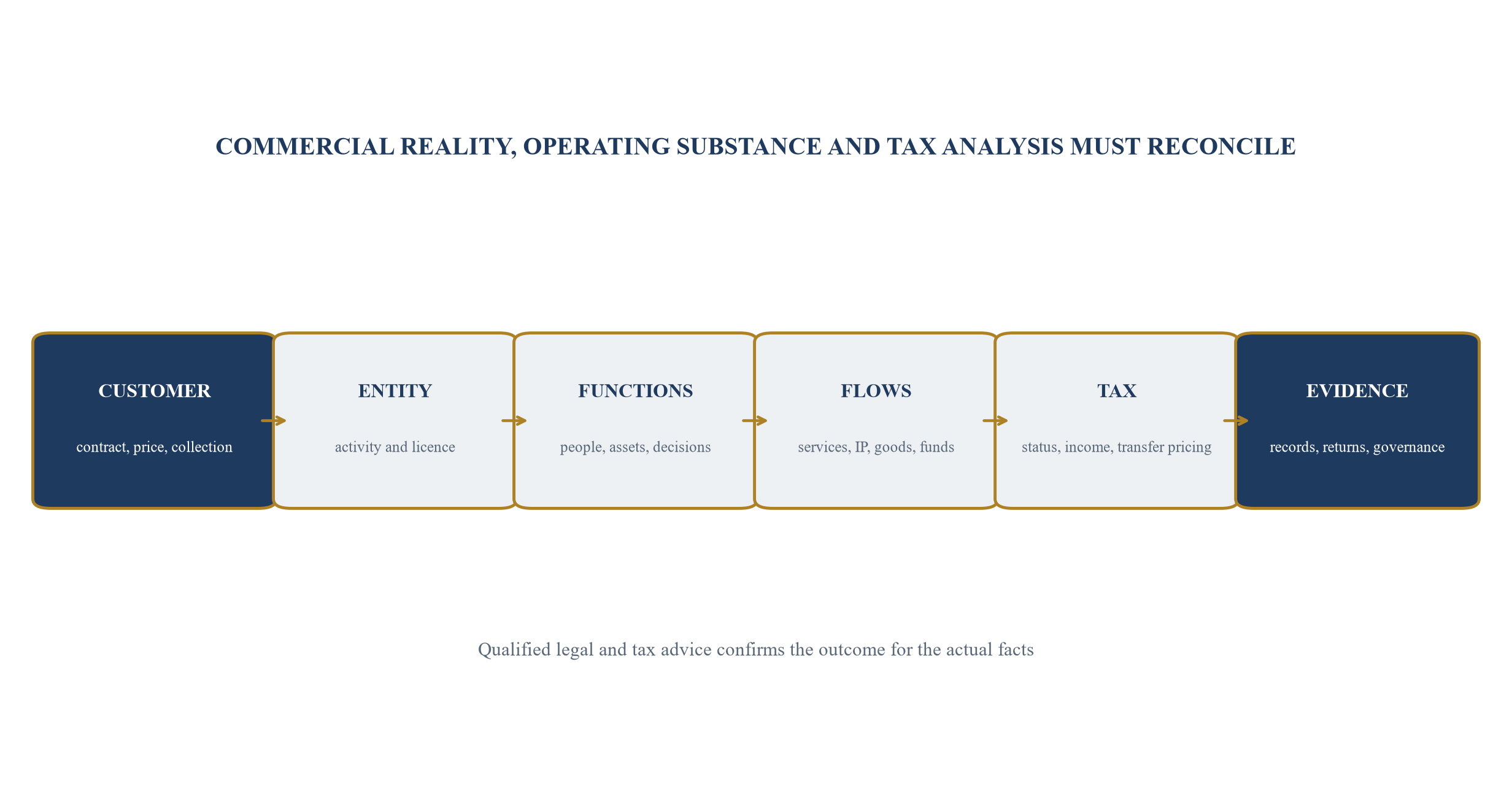
The bridge identifies questions for qualified advice. It does not state a tax outcome.
Table 4. Tax and regulatory decision register
| Topic | Fact to establish | Evidence | Decision owner |
|---|---|---|---|
| activity and licence | exact functions, customers, assets and money flows | product map, contracts and written perimeter analysis | business sponsor with counsel |
| ownership | strategic classification and authority conditions | current legislation and authority confirmation | board with counsel |
| corporate tax | entity status, income type, substance and related-party flows | tax memorandum, model and compliance calendar | CFO with tax adviser |
| value-added tax and customs | supply location, registration, import and recovery | transaction map and adviser analysis | finance and supply chain |
| transfer pricing | functions, assets, risks and intercompany pricing | functional analysis and agreements | CFO and group tax |
| data and cybersecurity | data categories, rights, location, access and incident duties | data map, security design and legal review | technology and legal leaders |
| employment and immigration | employing entity, role, visa, benefits and mobility | workforce plan and current requirements | HR and legal leaders |
Every conclusion requires current transaction-specific review by qualified advisers.
14. Commercial proof must precede a scale decision
Commercial proof is evidence that a defined customer will adopt, pay for and continue using the proposition on economics the company can deliver. A memorandum of understanding, letter of interest or unpaid pilot may support demand discovery. It should be described accurately. A scale decision normally needs stronger evidence: a paid engagement, executed contract, verified usage, acceptance, collection and credible repeat or expansion indicators.
The proof plan should specify the customer segment and buying committee. It should identify the economic buyer, user, technical approver, security reviewer, procurement team, legal reviewer and payment approver. For government-related or regulated customers, additional vendor-registration and compliance steps may apply. The plan should measure elapsed time at each gate because sales-cycle duration affects cash needs and the value of the opportunity.
Pricing tests should reflect total delivery. Discounts, free implementation, bespoke development, local hosting, warranties, performance bonds, insurance, travel, senior attention and extended payment terms can reduce the value of a contract. The board should review contribution margin and cash conversion alongside headline contract value. A first reference customer may justify deliberate investment; the exception should be explicit and bounded.
The company should keep a proof register. Each claim records the source, owner, date, definition, limitation and decision relevance. Management assumptions remain labelled in the internal decision pack. External communications should state evidence accurately without disclosing internal classifications. The register supports investor diligence, board oversight and learning across market tests.
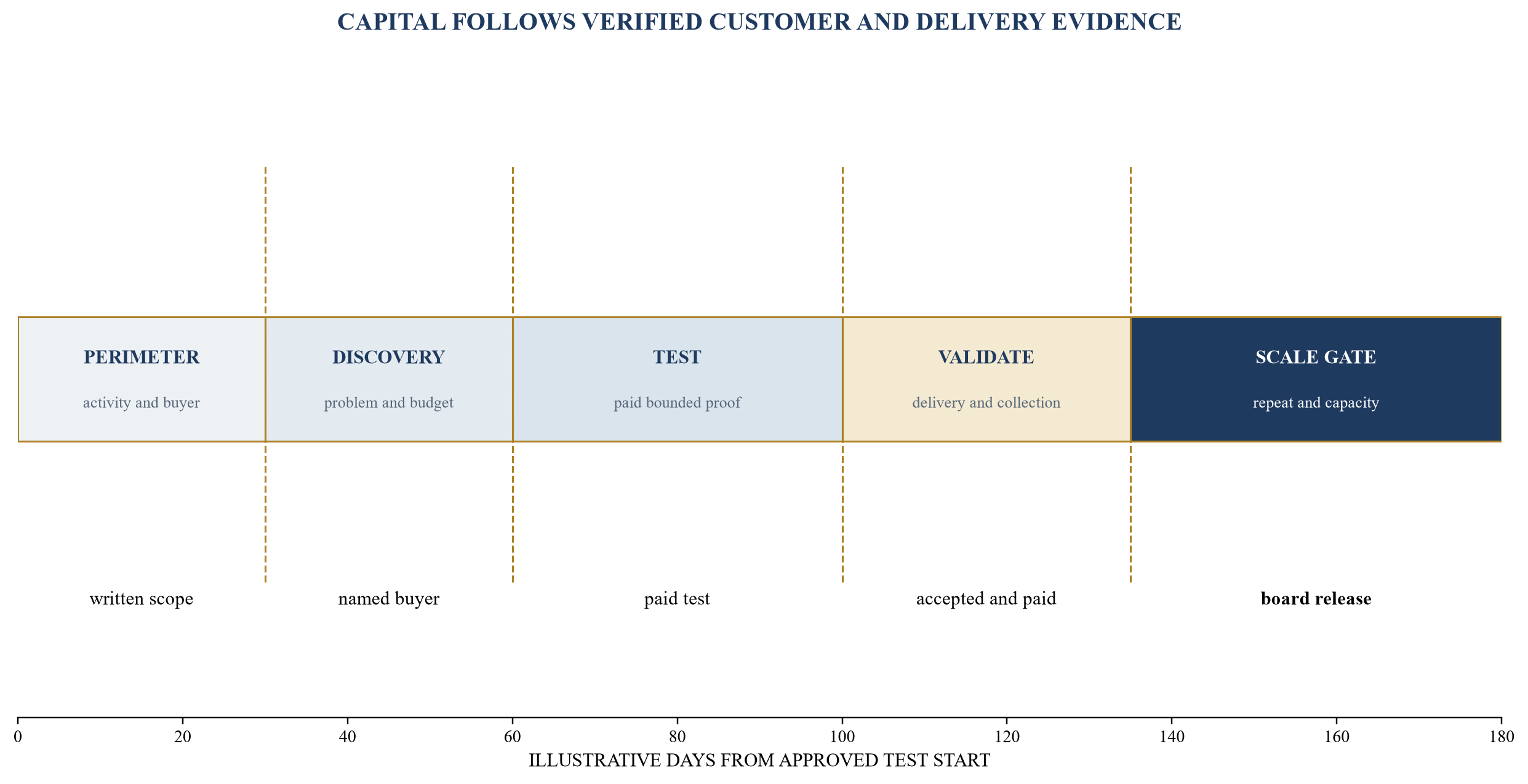
Timings and thresholds are illustrative management assumptions.
Table 5. Commercial proof register
| Claim | Stronger evidence | Common limitation | Review question |
|---|---|---|---|
| buyer urgency | budget owner confirms consequence and timing | enthusiasm without authority | who can approve spend and by when? |
| willingness to pay | executed paid scope at intended price logic | exceptional discount or free work | what price applies after the test? |
| product value | agreed baseline and measured customer outcome | self-reported benefit without source data | can the result be reproduced? |
| delivery capability | accepted work, issue log and measured resource load | founder-intensive delivery | what capacity is needed for the next cohort? |
| unit economics | reconciled revenue, direct cost and support effort | excluded implementation or local cost | which costs change with volume? |
| cash conversion | approved invoice and cash receipt | contract value without collection | what causes approval or payment delay? |
| repeatability | second customer, renewal or expanded use | one relationship-driven exception | which conditions are transferable? |
Evidence categories should be tailored to the sector and transaction.
15. Joint venture and acquisition decisions require explicit control economics
A local partner can contribute customers, licences, assets, distribution, land, talent, procurement eligibility or reputation. Those contributions should be translated into verifiable obligations, governance rights and economics. A broad promise of access is difficult to value and enforce. The board should identify named resources, milestones, decision rights, funding commitments and consequences for non-performance.
Joint-venture design should cover scope, exclusivity, territory, business plan, capital calls, intellectual property, data, customer ownership, staffing, related-party transactions, reserved matters, deadlock, transfer restrictions and exit. The operating model should show which party controls pricing, delivery, cash, compliance and hiring. Minority protection and information rights should reflect the actual risk exposure. A venture should not depend indefinitely on personal relationships that have no institutional counterpart.
Acquisition can provide operating substance and faster market access. Diligence should extend beyond financial statements and licences. Customer contracts may be non-transferable or change on control. Revenue may depend on the seller. Technology and data rights may be incomplete. Employees may expect retention awards. Regulatory correspondence, sanctions, anti-money-laundering controls, tax positions, litigation, environmental matters and cyber incidents can transfer value or liability.
The purchase price should be connected to a verified standalone case, identified synergies and integration cost. Earn-outs and deferred consideration can bridge uncertainty; they create measurement and control questions. The buyer should define accounting policies, customer attribution, management authority and access to data before signing. The board should retain a walk-away threshold grounded in risk-adjusted value.
16. Capital design should match evidence and reversibility
Entry capital should be divided into discovery, validation and build tranches. Discovery funds sector research, customer interviews, regulatory classification, adviser work and partner screening. Validation funds a bounded commercial test, detailed entity and tax design, licence preparation and initial operating capability. Build capital funds the approved entity, team, systems, inventory, premises or acquisition after the proof gate.
The capital model should include one-time establishment cost, recurring fixed cost, variable delivery cost, licence and advisory cost, deposits, guarantees, insurance, technology, tax compliance, working capital and contingency. Management should model time to invoice and cash, not only time to contract. Delays should have predefined responses: rescope, extend within a cap, change route, partner, acquire, pause or stop.
Reversibility has value. A limited test may cost more per unit and preserve the option to avoid a larger mistake. A long lease, exclusive distribution agreement or broad hiring plan can reduce reversibility before demand is proven. Regulated and infrastructure businesses may require earlier fixed commitment; the board should compensate through stronger pre-commitment evidence, milestone-linked contracts and explicit downside planning.
The investment case should show return under a range of management assumptions and should identify which facts drive the result. Price, conversion, gross margin, sales cycle, utilisation, regulatory timing and working capital often matter more than a single market-size number. Sensitivity analysis should guide the evidence plan by showing which uncertainty deserves the next unit of diligence spending.
17. Governance converts a thesis into an accountable programme
The board should appoint one executive owner for the entry thesis and named owners for commercial, regulatory, tax, finance, people, technology and data workstreams. A steering group can integrate decisions; it should not diffuse accountability. Each workstream needs a decision, evidence requirement, budget, deadline, dependency and escalation rule.
The monthly board pack should show the original thesis, new evidence, exceptions, spend, cash exposure, regulatory status, customer pipeline by proof stage, delivery metrics, partner obligations and decisions required. Changes to definitions should be visible. Management should state which assumptions remain untested and which evidence reduced or increased confidence.
Delegated authority should cover incorporation, banking, contracts, hiring, adviser instructions, capital expenditure, partner commitments and regulatory submissions. New entities need bank mandates, accounting, tax registration, records, insurance, data controls and a compliance calendar before revenue scales. Intercompany services and intellectual-property arrangements should reflect actual operating functions.
The stop decision deserves equal design. The board should define conditions that cause a pause, redesign or withdrawal: unresolved permission, insufficient customer evidence, unacceptable economics, partner failure, material delay, inability to bank or collect, security weakness or capital exposure above the approved limit. A disciplined stop can preserve capital and learning for a different route.
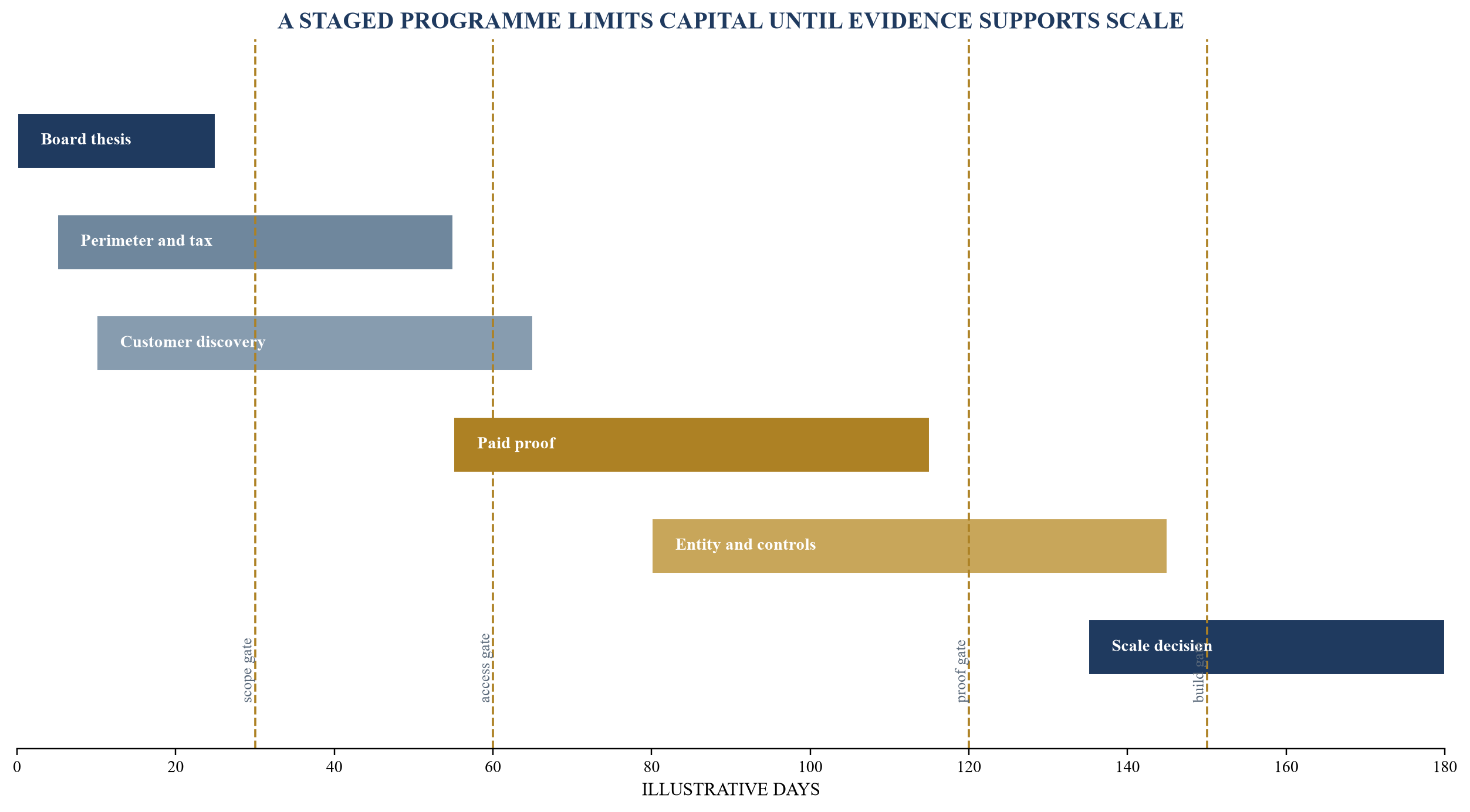
Activities, timing and gates are illustrative management assumptions.
Table 6. Board implementation plan
| Phase | Core work | Required output | Board gate |
|---|---|---|---|
| days 0 to 30 | define activity, sector segment, customer problem and capital envelope | thesis, institutional map, initial risk and evidence register | approve validation scope and limits |
| days 31 to 60 | confirm perimeter, tax questions, entry routes and target accounts | adviser conclusions, route comparison and customer-access plan | approve paid proof and licence preparation |
| days 61 to 120 | conduct paid test, partner diligence and operating design | customer outcome, delivery economics, collections and partner evidence | approve, redesign or stop |
| days 121 to 150 | establish selected entity and minimum controls where approved | licence path, governance, banking, people, data and compliance readiness | confirm launch conditions |
| days 151 to 180 | test repeatability, capacity and cash needs | second-cohort evidence, unit economics, forecast range and funding plan | approve scale capital or bounded extension |
| ongoing | reconcile evidence, risk, spend and legal obligations | monthly board pack and decision log | continue only within delegated authority |
Timing, expenditure limits and proof thresholds are management assumptions for approval.
18. The decision rule is commercial reality supported by evidence
The UAE offers a substantial and evolving investment platform. Ownership liberalisation, policy support and specialised ecosystems expand the range of possible entry routes. The board's task is to identify where those conditions combine with customer access, differentiated capability, acceptable regulation, operating substance and economics that justify capital.
The framework in this paper uses a clear sequence. Define the customer problem and activity. Map the institutional and regulatory perimeter. Screen the sector through demand, access, advantage, economics and executability. Select the lowest-commitment entry route capable of producing decision-grade evidence. Connect tax and substance to the actual value chain. Test commercial adoption, delivery and collection. Release scale capital only after the evidence reaches an approved standard.
Sector differences matter. Financial services require perimeter-first product design. Healthcare requires clinical, workflow and payer alignment. Manufacturing requires offtake and plant-level economics. Energy requires infrastructure-grade diligence. Logistics requires density and working-capital control. AI requires authorised data, production performance and governance. Telecommunications retains strategic restrictions. Consumer and service businesses require granular cohort and location economics.
The board should treat entry as an accountable operating programme rather than an incorporation exercise. The programme needs named owners, bounded capital, current professional advice, evidence registers, customer proof, governance and a designed stop decision. This discipline cannot remove market uncertainty. It gives directors a transparent basis for deciding which uncertainty to fund, which route to pursue and when commercial reality supports a larger commitment.
Sources and further reading
- Organisation for Economic Co-operation and Development, Investment Policy Perspectives in the United Arab Emirates: Executive Summary Official source
- Organisation for Economic Co-operation and Development, Trends and Impacts of FDI in the UAE Official source
- Organisation for Economic Co-operation and Development, Building a Cohesive Framework for Investment Promotion and Facilitation Official source
- Organisation for Economic Co-operation and Development, Navigating the Legal Framework for Investment Official source
- Organisation for Economic Co-operation and Development, FDI Regulatory Restrictiveness Index Official source
- International Monetary Fund, United Arab Emirates: 2025 Article IV Consultation Official source
- UAE Ministry of Economy and Tourism, Full Foreign Ownership Across Economic Sectors Official source
- UAE Legislation, Cabinet Resolution Concerning Activities with Strategic Impact Official source
- Federal Tax Authority, Corporate Tax Guide on Free Zone Persons Official source
- Federal Tax Authority, Free Zone Corporate Tax FAQ Official source
- Central Bank of the UAE, Licensing Official source
- Central Bank of the UAE Rulebook, Licensing of Financial Activities Official source
- Dubai Financial Services Authority, Authorisation Services Overview Official source
- Abu Dhabi Global Market, Setting Up FAQ Official source
- UAE Ministry of Health and Prevention, Invest in Health Official source
- UAE Ministry of Industry and Advanced Technology, Operation 300bn Official source
- UAE Ministry of Industry and Advanced Technology, Industrial Investment Guide 2026 Official source
- UAE Ministry of Industry and Advanced Technology, National In-Country Value Programme Official source
- UAE Ministry of Energy and Infrastructure, Updated UAE Energy Strategy 2050 Official source
- Telecommunications and Digital Government Regulatory Authority, Telecommunications Service Licensing Official source
- Government of Dubai, Starting a Business Official source
- Invest in Dubai, Search Business Activities Official source
- Abu Dhabi Investment Office, Investor Journey Portal Official source
- UAE Artificial Intelligence Office, National Strategy for Artificial Intelligence 2031 Official source
- UAE Artificial Intelligence Office, Guiding Principles on AI Policy Official source
- UAE Legislation, Federal Decree-Law on Personal Data Protection and Related Legislation Official source
- Singapore Economic Development Board, How to Set Up in Singapore Official source
- UK Department for Business and Trade, Invest in the UK Official source
- UK Department for Business and Trade, UK Investment Sectors Official source
- Invest India, Consolidated Foreign Direct Investment Policy Official source
