

1. The headquarters decision is an operating architecture
A regional headquarters is valuable when it improves decisions, customer access, talent deployment, capital allocation, risk control and execution across a defined geography. An address alone cannot create that value. The board must decide which functions will be performed, which executives will hold authority, which risks will be controlled, which assets and data will be used, how the headquarters will be compensated and which evidence demonstrates that the arrangement operates as designed.
The tax architecture follows those facts. A group may have a UAE parent, holding company, service company, treasury function, intellectual-property owner, free-zone entity, mainland operating company, permanent establishments and joint ventures. Each entity can have a different corporate-tax position. For an in-scope multinational group, the GloBE system then computes income and covered taxes on a jurisdictional basis, applies exclusions and adjustments, and determines whether a top-up is due. The board therefore needs one model that reconciles legal entities, management accounts, statutory accounts, tax returns, consolidation data and the functions performed by real people.
The UAE Ministry of Finance states that the Domestic Minimum Top-up Tax applies to constituent entities located in the UAE that belong to multinational groups with consolidated global revenue of at least EUR 750 million in at least two of the four fiscal years immediately preceding the tested year. The rules apply for fiscal years starting on or after 1 January 2025. Cabinet Decision No. 142 of 2024 provides the domestic framework and adopts a jurisdictional effective-tax-rate calculation aligned with the OECD GloBE rules. Ministerial Decision No. 96 of 2026 adopts current Commentary and Agreed Administrative Guidance for fiscal years beginning on or after 1 January 2025.
This scope gate has strategic consequences. A group below the revenue threshold still needs ordinary corporate-tax, transfer-pricing, substance and regulatory analysis. A group close to the threshold should build a monitoring trigger because acquisitions, disposals, organic growth and fiscal-year changes can alter the test. A group clearly in scope needs operational readiness across finance, tax, legal, technology and business teams. The first board question is therefore factual: which entities and joint ventures are in the group, what is the tested revenue history, where are they located for GloBE purposes, and which exclusions may apply?
Table 1. The board scope and data screen
| Decision field | Board question | Evidence required | Owner |
|---|---|---|---|
| consolidated revenue | did group revenue reach EUR 750 million in at least two of the preceding four fiscal years? | audited consolidated statements, acquisition and disposal history, fiscal-year records | group finance |
| group perimeter | which entities, permanent establishments, joint ventures and minority structures enter the analysis? | legal-entity register, consolidation mapping, ownership data and agreements | legal and consolidation |
| location | where is each constituent entity located for GloBE purposes? | incorporation, residence, permanent-establishment and management facts | tax and legal |
| excluded entities | do any government, pension, non-profit, investment-fund, real-estate or ownership-chain exclusions apply? | legal status, purpose, activities, ownership and current rule analysis | tax counsel |
| accounting standard | which acceptable financial accounting standard and consolidation data support GloBE income? | chart of accounts, consolidation package, policy manuals and adjustments | controllership |
| covered taxes | which current and deferred taxes are included, allocated or adjusted? | tax provision, ledgers, returns, deferred-tax schedules and uncertain-tax positions | tax accounting |
| filing entity | which UAE entity will register, file, pay and coordinate the information return? | entity capability, systems, authorisations and governance resolution | group tax |
The screen is a governance aid. The statutory rules and current professional advice govern the final position.
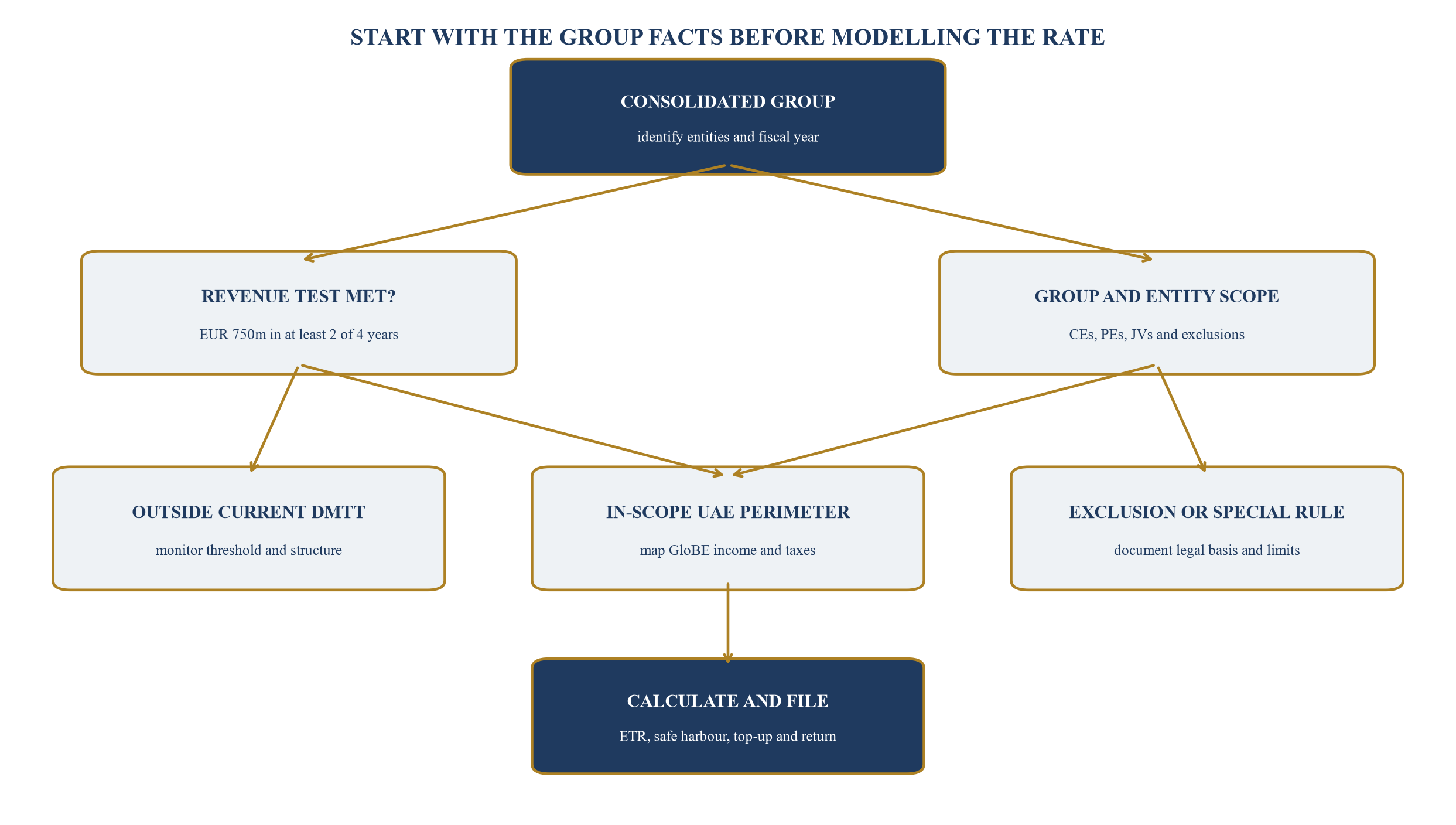
The tree summarises the initial gate. The statutory definitions, exclusions, transition rules and group facts require professional review.
2. Three tax layers must reconcile
The first layer is ordinary UAE corporate tax. The corporate-tax law, implementing decisions and Federal Tax Authority guidance determine taxable income, rates, exemptions, reliefs, free-zone treatment, loss use, transfer pricing and administration. A qualifying free-zone person may benefit from a zero rate on qualifying income when all conditions are satisfied. Other taxable income can be subject to the applicable corporate-tax rate. These outcomes remain entity-specific and depend on current facts and rules.
The second layer is UAE DMTT. Cabinet Decision No. 142 of 2024 computes a jurisdictional effective tax rate using adjusted covered taxes divided by net GloBE income. If that rate is below the minimum rate, the top-up percentage is applied to excess profit after the substance-based income exclusion, with additional current top-up tax where applicable. The calculation has detailed rules for accounting income, covered taxes, deferred tax, losses, ownership, investment entities, joint ventures, reorganisations, safe harbours and transition.
The third layer comprises foreign GloBE charges. The OECD rule order generally gives a qualified domestic minimum top-up tax the first opportunity to collect domestic top-up tax. An Income Inclusion Rule can charge a parent entity on low-taxed constituent entities. An Undertaxed Profits Rule operates as a backstop. The UAE Ministry of Finance announced that the UAE DMTT received transitional qualified status and qualified status for the QDMTT safe harbour in the OECD central record. Group teams should still confirm the applicable year, current central record, safe-harbour conditions and treatment in every relevant parent jurisdiction.
The three layers should appear in one tax bridge. The ordinary corporate-tax provision is the starting point rather than the answer. Finance needs a mapping from local accounts to GloBE income, from current and deferred tax to covered taxes, and from entity results to the UAE jurisdictional computation. The bridge should identify permanent differences, timing items, tax credits, uncertain positions, intragroup allocations and prior-year adjustments. Any unexplained residual should have an owner and resolution date.
This architecture also protects the business case from false precision. A headline rate can be commercially important and remains only one variable. The cash value of an incentive depends on whether the group is in scope, how the mechanism enters covered taxes or GloBE income, whether a safe harbour applies, the timing of use, eligibility, refundable status, administrative certainty and the cost of creating the qualifying substance. The board should approve after-tax economics using a range supported by current advice and documented assumptions.
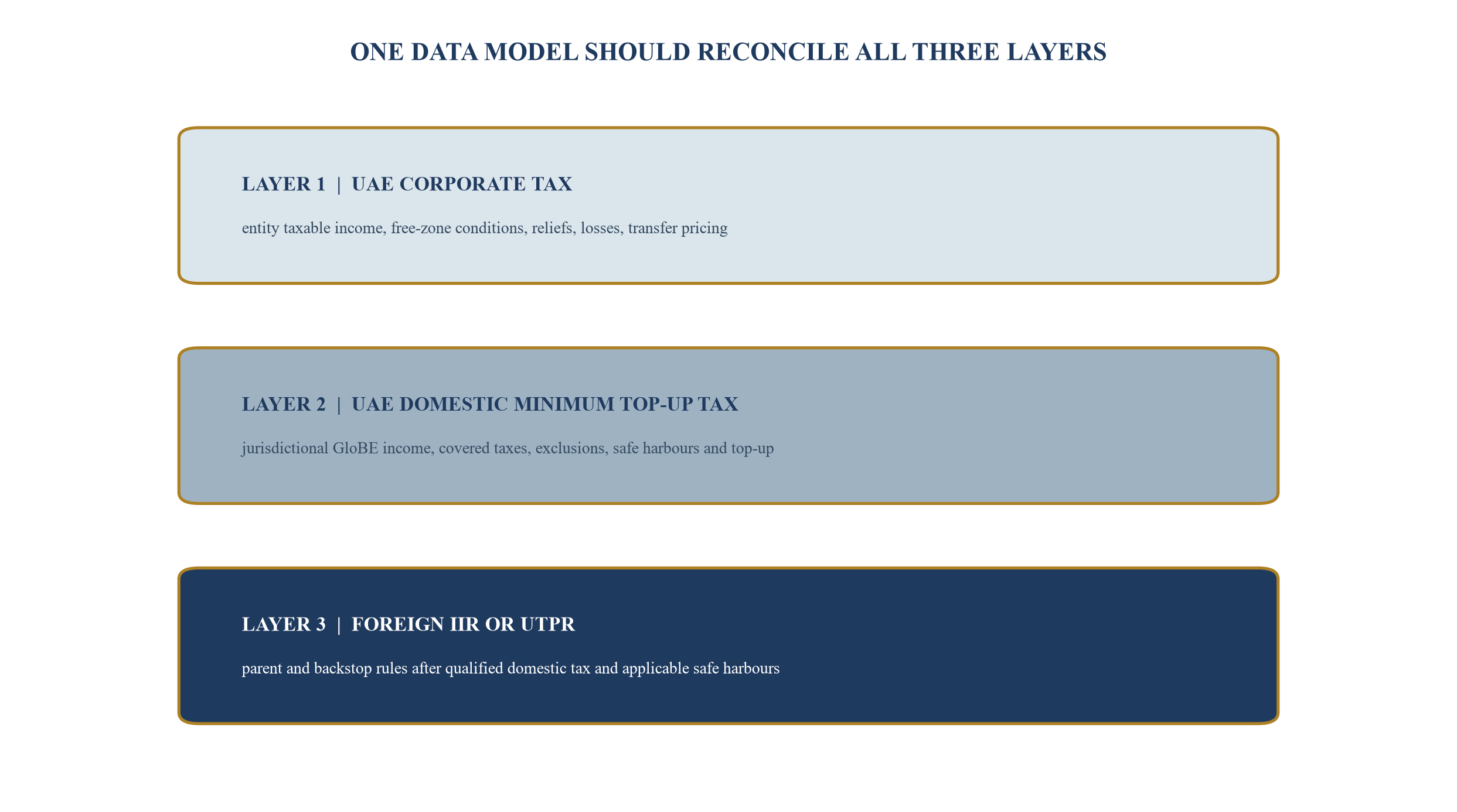
The architecture shows the reconciliation sequence. It does not determine the tax position of a specific group.
3. The effective-tax-rate bridge is jurisdictional
GloBE effective tax is calculated at jurisdictional level, subject to special rules. The unit of analysis is therefore wider than a single UAE company. A profitable service company can be blended with another UAE constituent entity that has losses, tax credits, different income characteristics or deferred-tax movements. The board pack should show both entity contributions and the consolidated UAE jurisdictional result so that management can understand which facts drive the rate.
GloBE income begins from financial accounting net income or loss and then applies prescribed adjustments. Covered taxes also begin from financial accounts and are adjusted for items including allocations, deferred tax and uncertain positions. The numerator and denominator therefore differ from cash tax divided by statutory profit. A group cannot reliably estimate exposure by multiplying local accounting profit by the gap between a headline rate and 15 per cent.
Cabinet Decision No. 142 provides a top-up sequence. The jurisdictional top-up percentage is the positive difference between the minimum rate and the effective tax rate. That percentage applies to excess profit, which is net GloBE income reduced by the substance-based income exclusion. Additional current top-up tax may then be included. Qualified domestic top-up tax is designed to collect the resulting domestic amount under the applicable rules and safe harbours.
The substance-based income exclusion recognises a formulaic return linked to eligible payroll and tangible assets. It does not prove broader operational substance, transfer-pricing alignment or commercial purpose. It also does not exempt the full return of a headquarters. The board should maintain two separate analyses: the statutory exclusion computation; and the operating-substance case demonstrating how functions, assets, risks and decisions support the business and intercompany pricing.
Table 2 presents a simplified management bridge. The numbers are management assumptions for decision design. They exclude numerous statutory adjustments and are not a tax calculation. The purpose is to show how ordinary tax, covered taxes, GloBE income, the substance-based income exclusion and domestic top-up relate. Tax specialists should replace every assumption with validated entity and jurisdictional data.
Table 2. Simplified jurisdictional effective-tax bridge
| Bridge item | Base management case | Downside management case | Board interpretation |
|---|---|---|---|
| UAE GloBE income before detailed adjustments | 120.0 | 150.0 | denominator requires accounting-to-GloBE reconciliation |
| adjusted covered taxes | 12.0 | 10.5 | numerator requires current, deferred and allocation analysis |
| illustrative jurisdictional effective tax rate | 10.0% | 7.0% | rate is covered taxes divided by net GloBE income |
| minimum rate | 15.0% | 15.0% | statutory minimum used in the simplified bridge |
| illustrative top-up percentage | 5.0% | 8.0% | positive gap before detailed statutory adjustments |
| assumed substance-based income exclusion | 20.0 | 18.0 | formula depends on eligible payroll and tangible assets |
| illustrative excess profit | 100.0 | 132.0 | net GloBE income less assumed exclusion |
| indicative domestic top-up before other adjustments | 5.0 | 10.6 | sensitivity output for governance; not a tax liability |
Values are management assumptions in AED millions for decision design; they are not forecasts, tax advice or statutory calculations.
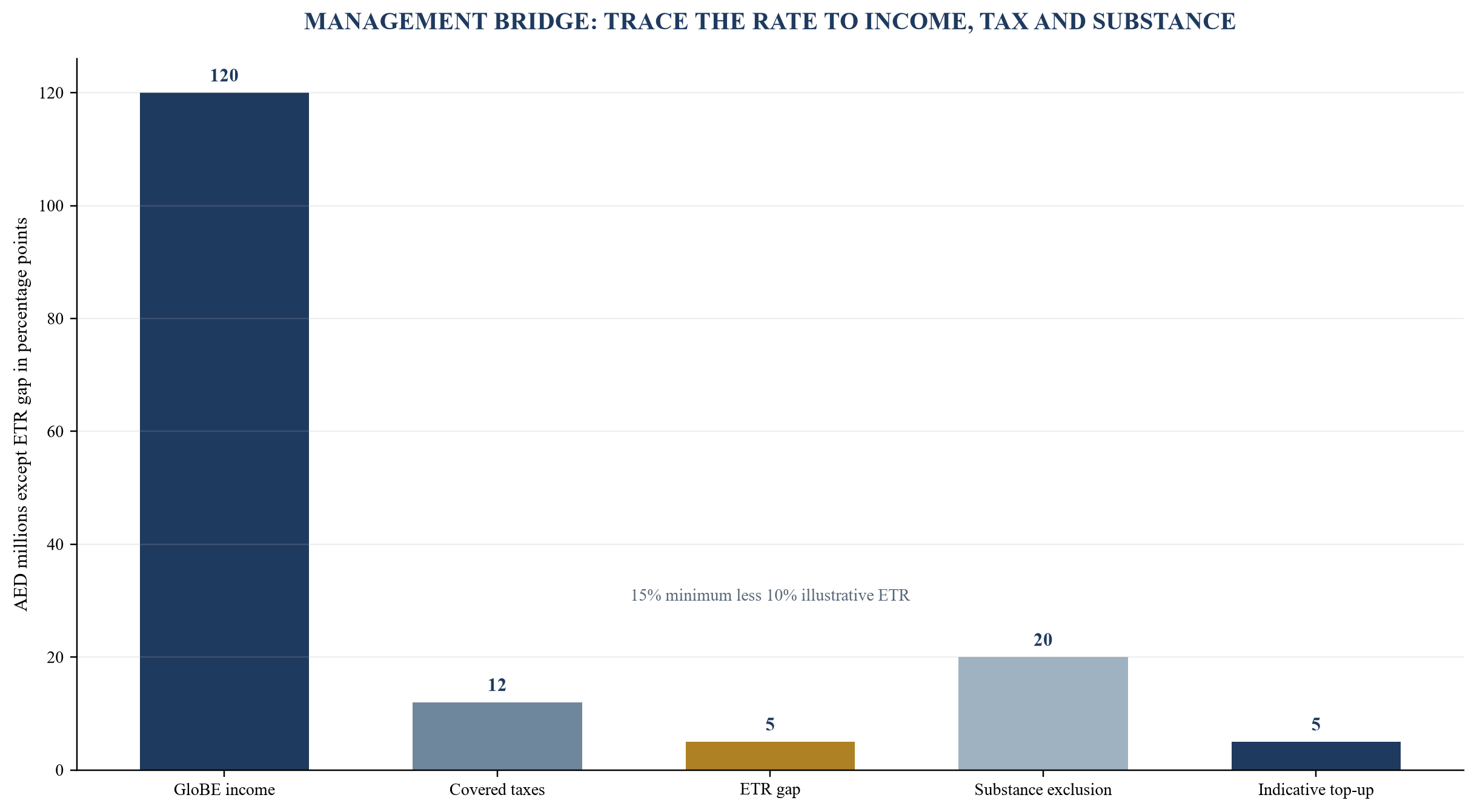
The values are management assumptions for decision design and omit statutory adjustments, elections, safe harbours and special rules.
4. De minimis and safe harbours are controlled gates
Cabinet Decision No. 142 includes a de minimis exclusion for a jurisdiction when average GloBE revenue is less than EUR 10 million and average GloBE income or loss is a loss or less than EUR 1 million, subject to the detailed conditions. A board should avoid treating this as a permanent exemption. Group composition, growth, acquisitions and volatile profitability can change eligibility. The supporting averages and entity perimeter should be documented each year.
The decision also recognises safe harbours, including the transitional country-by-country-reporting safe harbour. The OECD Side-by-Side package released in January 2026 introduced a simplified effective-tax-rate safe harbour, extended the transitional CbCR safe harbour by one year, introduced a substance-based tax-incentives safe harbour and established Side-by-Side arrangements for eligible systems. The package leaves qualified domestic minimum top-up taxes unaffected. Eligibility, implementation and domestic adoption should be confirmed for the applicable fiscal year.
A safe harbour is a compliance pathway with conditions and evidence. Management should establish a gate for each jurisdiction: applicable safe harbour; qualifying period; data source; election; owner; reviewer; documentation; filing consequence; and the trigger that would require a full calculation. A safe-harbour conclusion based on late or unreliable country-by-country data can produce a costly remediation cycle.
The group should also avoid designing the headquarters solely around a temporary relief. The operating model can last for many years; safe harbours and transition percentages can change. The investment case should therefore show economics under the current relief, under a full GloBE calculation and under a stress case in which the relief is unavailable. The board can then identify decisions that remain attractive across regimes.
5. Substance has three different meanings
Substance is used in tax and corporate discussions to describe several distinct tests. The first is the GloBE substance-based income exclusion, a formula linked to eligible payroll and tangible assets. The second is adequate substance under the UAE free-zone corporate-tax regime, which can require core income-generating activities, assets, qualified employees and operating expenditure in the free zone, subject to the applicable conditions. The third is functional substance for transfer pricing and governance: the people who perform functions, use assets, control risks and make decisions.
These tests overlap in facts and serve different purposes. A payroll number used in the GloBE exclusion does not establish that an executive genuinely controlled a commercial or financial risk. A board minute does not demonstrate that the company had the systems, information, experience and authority to make the decision. A premises lease does not prove that core income-generating activity occurred there. Management should maintain separate evidence files connected by one operating model.
The headquarters function map begins with decisions. Strategy includes market selection, product priorities, budgets and capital allocation. Commercial leadership includes pricing, key-account approval, channel policy and contract exceptions. Treasury includes liquidity, funding, hedging, bank mandates and guarantees. People leadership includes organisation design, senior hiring and performance. Technology includes architecture, data access, cyber risk and product governance. Risk and compliance include policy, monitoring and escalation. Each decision should have a named role, delegated authority, information set, meeting cadence and durable record.
The map then traces service flows. A UAE headquarters may charge group entities for management, strategic, treasury, technology, procurement or shared services. The agreements should reflect actual services, benefits, allocation keys, pricing method and evidence of delivery. Shareholder activities and duplicative services require careful treatment. The Federal Tax Authority transfer-pricing guide applies the arm's-length principle to domestic and cross-border related-party transactions. The advance-pricing-agreement programme creates a potential route for prospective certainty, subject to scope, eligibility and current procedures.
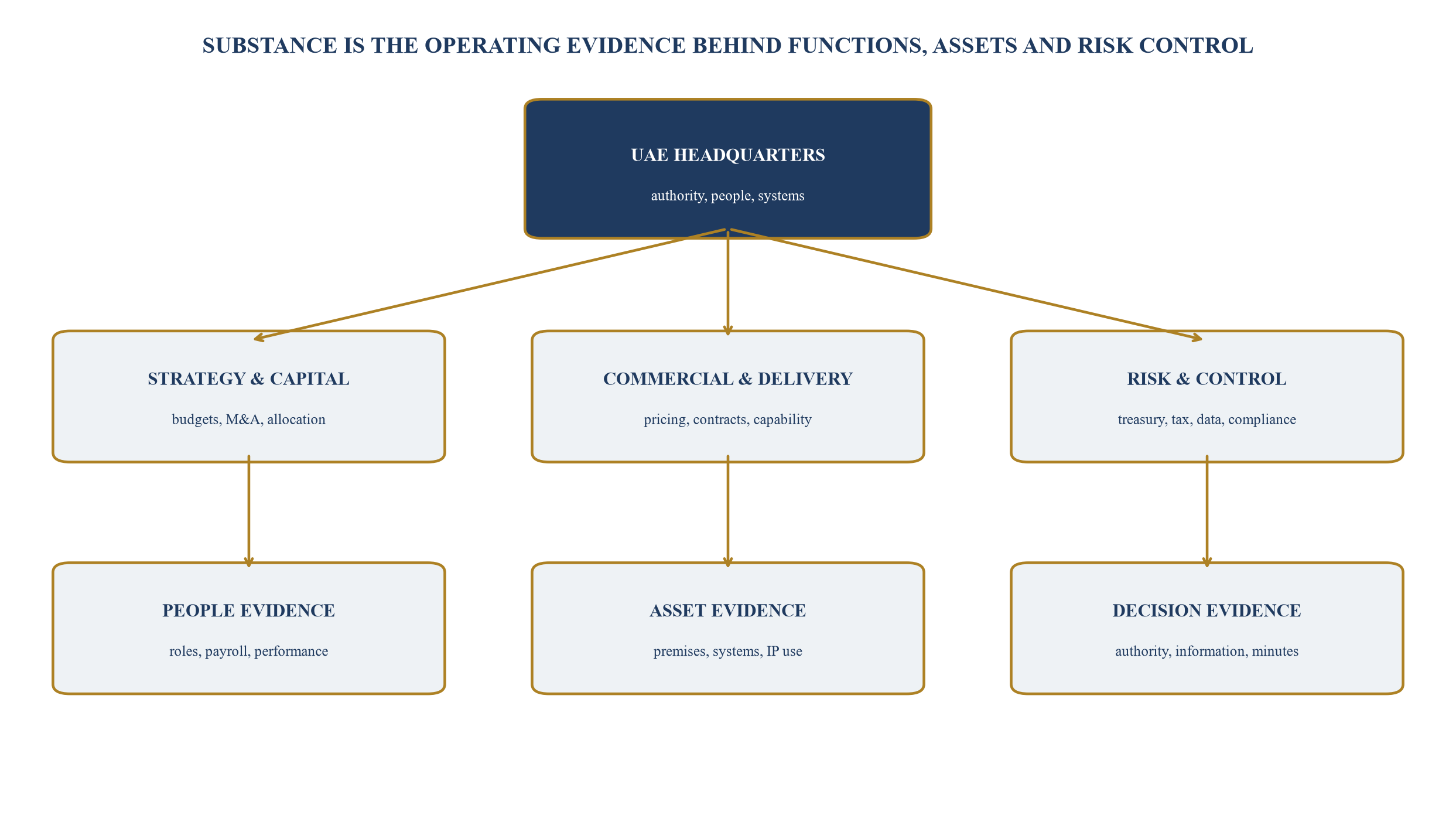
The map identifies evidence categories. Actual functions, risks, assets and pricing must be supported by group facts and professional analysis.
6. The regional-headquarters entity map follows the value chain
Management should model at least four headquarters structures before selecting one. A single UAE operating headquarters can centralise authority and services, with branches or subsidiaries for regulated or local-market activities. A UAE holding company with a separate service headquarters can separate ownership from operations. A dual-hub model can allocate functions between the UAE and Saudi Arabia or another location. A distributed model can retain key functions in existing jurisdictions while the UAE platform develops in stages.
The choice should follow customer markets, executive availability, regulatory permissions, contractual flows, financing, intellectual property, existing tax attributes, exit plans and the cost of change. A single entity can simplify governance while mixing income streams with different regulatory or free-zone treatment. Separate entities can make activities clearer while increasing administration, transfer pricing, banking and intercompany reconciliation. A dual-hub design can improve market access and create duplication or unclear authority if functions are not sharply allocated.
The entity map should show ownership, legal form, tax residence, permanent establishments, licences, bank accounts, employees, directors, contracts, intellectual property, funding and service flows. It should also show which entity earns revenue from external customers and which entity bears delivery, warranty, credit, foreign-exchange, regulatory and employment risks. If the map cannot be explained in one board page, the design may be too complex to operate reliably.
M&A can alter the map quickly. Acquiring a UAE or regional business can add constituent entities, historical tax positions, losses, deferred tax, data systems and related-party arrangements. The transaction can also affect the consolidated revenue threshold, purchase accounting and GloBE attributes. A pre-close model should identify the first reporting period, data owners and Day One controls. The legal steps may qualify for corporate-tax relief only when detailed conditions are met; any relief analysis should be performed before implementation.
Table 3. Regional-headquarters operating-model options
| Model | Strategic strength | Core risk | Evidence before approval |
|---|---|---|---|
| single UAE operating headquarters | concentrated authority, talent and regional services | mixed activities, regulatory perimeter and income character | activity map, licence analysis, service flows and tax model |
| UAE holdco plus service headquarters | ownership and operating roles can be separated | extra administration, pricing and cash-flow complexity | purpose, governance, funding, agreements and benefit evidence |
| UAE and Saudi dual-hub | functional proximity to two major markets | duplication, split authority and permanent-establishment exposure | function allocation, licence duties, RHQ rules, people and pricing |
| distributed regional model | preserves existing capability and allows staged migration | weak centre, inconsistent controls and fragmented data | target operating model, decision rights and migration gates |
| acquisition-led headquarters | immediate platform, people, licences and customers | inherited liabilities, integration and purchase-accounting effects | tax, finance, legal, regulatory, technology and operating diligence |
| joint-venture headquarters | partner access and shared investment | deadlock, information rights, value leakage and exit constraints | contribution proof, reserved matters, funding, service and exit terms |
The comparison is a decision framework. Entity, tax and regulatory outcomes depend on specific facts and current law.
7. Free-zone treatment and DMTT require separate tests
The Federal Tax Authority describes conditions under which a qualifying free-zone person can receive a zero corporate-tax rate on qualifying income. The guide covers qualifying activities, excluded activities, adequate substance, permanent establishments, intellectual property, immovable property, de minimis requirements and compliance. Management should test the legal entity, income stream and activity rather than assume that registration in a free zone determines the result.
For an in-scope multinational group, a zero ordinary corporate-tax outcome can contribute to a UAE jurisdictional effective rate below 15 per cent. The DMTT computation can then impose domestic top-up tax after the applicable GloBE adjustments, exclusion and safe harbours. The commercial value of the free zone may still include industry ecosystem, legal framework, facilities, customs, ownership, administration, talent access and regulatory design. The board should separate those operating benefits from the tax-rate narrative.
The free-zone model also requires boundary discipline. Mainland permanent establishments, foreign permanent establishments, excluded activities, non-qualifying income and transactions with related parties can change the ordinary tax result. Transfer-pricing requirements apply to related-party dealings. The board pack should show each revenue stream, customer type, delivery location, activity classification, entity, contract, pricing method and expected corporate-tax treatment.
A robust investment case should therefore present at least three tax outcomes: qualifying treatment is available as designed; part of the income is taxed at the ordinary rate; and qualifying status or an assumed condition is unavailable. The DMTT layer should be calculated separately under each scenario. This exposes the decisions that affect economics and prevents the business plan from depending on one untested classification.
8. Incentive quality is more important than the headline percentage
An incentive can reduce a tax liability, generate a refund, subsidise expenditure, accelerate a deduction, provide cash, lower employment cost, provide land or infrastructure, support financing, or improve procurement access. These mechanisms have different accounting, cash and GloBE consequences. The board should value the instrument that the company can lawfully claim and operate, not the largest percentage in a promotional statement.
The UAE launched Phase 1 of its research and development tax-incentives programme in March 2026. The Ministry of Finance states that qualifying businesses can receive a non-refundable R&D tax credit of up to 50 per cent on qualifying expenditure of up to AED 5 million, subject to the legislation and conditions. Cabinet Decision No. 215 of 2025 and Ministerial Decision No. 24 of 2026 establish definitions, eligibility, utilisation, pre-approval and detailed requirements. The ministerial decision states that the credit is non-refundable and can be used against corporate-tax and/or top-up-tax liability in accordance with the relevant decisions.
The design matters for a headquarters with regional innovation functions. Management should identify qualifying R&D projects, objectives, technical uncertainty, eligible staff, expenditure, ownership of results, benefit rights, pre-approval, records and claims. The programme should be evaluated alongside ordinary tax, DMTT and the OECD's 2026 substance-based tax-incentive safe harbour. Eligibility for that safe harbour should never be assumed from the domestic label; the exact incentive and current OECD criteria require analysis.
An incentive-quality matrix should score eight factors: strategic fit; eligible base; nominal value; cash timing; refundability or transferability; ordinary-tax treatment; GloBE treatment; and administrative certainty. A ninth factor is durability, including sunset dates and political or legislative change. A tenth is operating cost, including people, systems, compliance and foregone alternatives. Scores are management assumptions and should be supported by primary legislation and specialist advice.
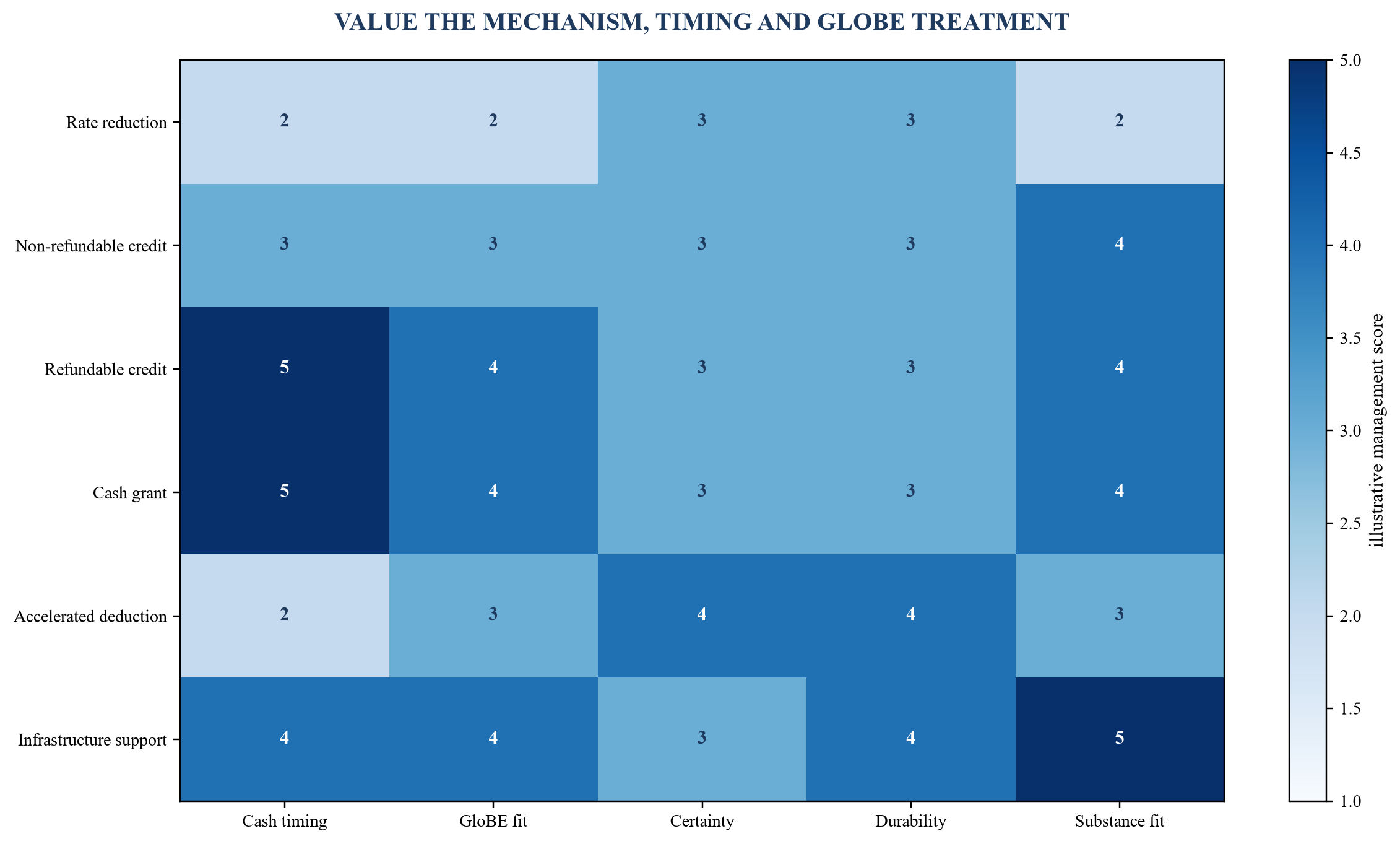
Scores are illustrative management assumptions. Current legislation and group-specific GloBE analysis govern the outcome.
Table 4. Incentive taxonomy and diligence questions
| Mechanism | Economic question | GloBE diligence | Operating evidence |
|---|---|---|---|
| rate reduction or exemption | how much ordinary tax is reduced and for how long? | effect on adjusted covered taxes and jurisdictional ETR | qualifying activity, income, substance and continuing conditions |
| non-refundable tax credit | can the credit be fully used and when? | classification, ordering, covered-tax and safe-harbour treatment | eligible project, expenditure, approval, computation and carry-forward |
| refundable tax credit | when is cash received and what conditions can reverse it? | qualified refundable status and accounting treatment | claim evidence, payment record and continuing eligibility |
| direct grant | what eligible cost and milestone does the grant fund? | accounting-income treatment and relevant incentive guidance | award, milestone, expenditure, audit and clawback controls |
| accelerated deduction or allowance | what is the timing value and deferred-tax consequence? | deferred-tax recast, recapture and transition analysis | asset register, qualifying use and tax schedule |
| payroll or employment support | what is the net cost of qualifying roles? | covered-tax or income treatment and substance interaction | role, employee, payroll, location and performance records |
| land, infrastructure or financing support | what cash, capacity or risk benefit is delivered? | accounting treatment and any income adjustment | contract, valuation, use, performance and termination terms |
Treatment is described at a high level. The specific programme and current GloBE guidance require analysis.
9. Saudi Arabia adds a functional and procurement overlay
Saudi Arabia's Regional Headquarters programme is a joint initiative of the Ministry of Investment and the Royal Commission for Riyadh City. Official materials invite international companies to locate a regional headquarters in the Kingdom. Zakat, Tax and Customs Authority rules and guidance describe tax incentives for licensed regional headquarters, including a 30-year zero income-tax rate on qualifying income and a zero withholding-tax rate on specified payments related to mandatory and optional activities, subject to the rules, eligible activities and anti-avoidance provisions.
A group serving both the UAE and Saudi Arabia should design from functions and market obligations. The analysis should identify which activities the Saudi licence requires or permits, which functions genuinely belong in Saudi Arabia, which functions remain in the UAE, how contracts and services flow, and where executives exercise authority. The answer may support a dual-hub model, a Saudi headquarters with UAE operating entities, a UAE headquarters with Saudi operating presence, or another structure. The programme label does not determine the best allocation.
The tax analysis should connect Saudi ordinary tax, RHQ incentive rules, transfer pricing and GloBE with the UAE DMTT and parent-jurisdiction rules. A zero Saudi rate on qualifying income may create a low-taxed result that needs to be evaluated under the Saudi domestic-minimum-tax position, foreign IIR or UTPR, safe harbours and the current OECD central record. The group should use Saudi professional advice and current official materials for the relevant year.
The operating analysis is equally important. Government procurement, customer access, leadership proximity, talent, banking, systems and travel can create real value from Saudi presence. Duplication can destroy that value if both hubs maintain overlapping executives, committees and service teams. The board should require a function-by-function allocation, service-level model, cost budget and performance measures before approving a dual structure.
10. Singapore, the United Kingdom and Hong Kong provide implementation comparators
Singapore implemented an Income Inclusion Rule and Domestic Top-up Tax for financial years beginning on or after 1 January 2025. The Inland Revenue Authority of Singapore describes the same EUR 750 million threshold test and provides registration requirements for in-scope groups. Its public materials also address the 2026 safe-harbour changes. Singapore therefore provides a useful comparator for how another headquarters jurisdiction connects investment policy with Pillar Two compliance.
The United Kingdom introduced Domestic Top-up Tax and Multinational Top-up Tax for accounting periods beginning on or after 31 December 2023. HM Revenue & Customs publishes registration, reporting, software, manual and statutory guidance. The UK experience demonstrates that operational readiness includes a registered filing member, appropriate software, data governance, returns and information exchange. Groups migrating or reallocating headquarters functions from the UK should model both exit and continuing UK exposures using current advice.
Hong Kong implemented the global minimum tax and Hong Kong minimum top-up tax from 2025. The Inland Revenue Department provides a dedicated portal, registration, notification, return and GloBE information-return guidance. Hong Kong is a useful comparator for groups evaluating Asian and Middle Eastern headquarters because both business-platform value and compliance architecture matter.
The comparison should use consistent fields: scope date; IIR; domestic top-up tax; UTPR; qualified status; safe harbours; filing deadline; information-return mechanics; incentive design; ordinary corporate tax; substance; talent; customer access; and operating cost. A tax-only comparison can favour an arrangement that cannot deliver the required executive, commercial or technical functions. A business-only comparison can overlook significant compliance and tax cash flows.
Table 5. Official implementation comparator
| Jurisdiction | Official implementation signal | Headquarters design question | Evidence to refresh |
|---|---|---|---|
| United Arab Emirates | DMTT effective for fiscal years starting on or after 1 January 2025; transitional qualified status announced | which UAE entities and functions enter the jurisdictional computation? | MoF decisions, FTA guidance, OECD central record and group data |
| Saudi Arabia | RHQ tax rules provide incentives for qualifying licensed activities | which mandatory and optional functions genuinely operate in Saudi Arabia? | MISA licence, ZATCA rules, current Pillar Two position and contracts |
| Singapore | IIR and DTT effective for financial years starting on or after 1 January 2025 | how do incentive, substance and compliance systems compare? | IRAS guidance, registration, return and safe-harbour updates |
| United Kingdom | domestic and multinational top-up taxes apply for periods beginning on or after 31 December 2023 | what continuing UK parent, entity, people and reporting exposures remain? | HMRC manual, notices, filings, residence and permanent-establishment analysis |
| Hong Kong | global minimum tax and HKMTT implemented from 2025 | does the hub support the target Asian value chain at an acceptable compliance cost? | IRD legislation, portal, qualification and filing guidance |
The table is a high-level August 2026 screen. Management should verify current legislation, qualification and filing rules for each group and fiscal year.
11. Transfer pricing converts substance into defensible economics
The transfer-pricing model should explain why the headquarters earns its return. A strategic service provider may receive a cost-based return when it performs routine support. An entrepreneur controlling material risks and owning valuable assets may require a different method. A treasury centre, procurement hub, intellectual-property owner or regional distributor has its own functional profile. Labels and contracts cannot substitute for the conduct of the parties.
The functional analysis should identify activities, decision authority, capability, assets, data, risks and financial capacity. For each material risk, management should document who sets policy, receives information, makes decisions, monitors outcomes and can bear the financial consequence. If UAE executives lack information or authority, the group should avoid allocating control to the UAE entity. If the functions genuinely move, the transition plan should address people, systems, contracts, intangibles and possible exit or transfer taxes in other jurisdictions.
The pricing method should use reliable comparables or another supportable approach. Management-service allocations should link to benefits and exclude shareholder or duplicative activity. Treasury charges should reflect funding, guarantees, credit, liquidity and risk control. Intellectual-property returns should reflect development, enhancement, maintenance, protection and exploitation functions. Distribution returns should reflect market development, inventory, credit, warranty and regulatory responsibilities.
Documentation needs to reconcile with DMTT. The service fee affects the UAE GloBE income and the counterparty jurisdiction. A transfer-pricing adjustment can alter both tax and GloBE results. Advance-pricing agreements can improve certainty for qualifying transactions, while the board should account for application scope, time, data and bilateral coordination. The tax model should include sensitivities for pricing outcomes and disputes.
12. Data architecture is a board control
Pillar Two compliance requires data that tax teams may not historically control. Entity-level financial accounts, consolidation adjustments, deferred tax, ownership, payroll, tangible assets, intragroup transactions, tax credits, elections and country-by-country-reporting data need consistent definitions. Acquired businesses may use different charts of accounts and systems. Joint ventures may provide limited access. The headquarters should sponsor a data model before the first filing period closes.
Cabinet Decision No. 142 states that the UAE top-up-tax return is generally due 15 months after the reporting fiscal year, with 18 months for the first transition year. It also requires the Pillar Two Information Return within the applicable 15-month period and provides for registration, payment, records, assessments, penalties and joint and several liability for specified domestic groups and joint-venture groups. These deadlines should be confirmed against current rules and the group's precise transition year.
The control framework should cover data ownership, source system, extraction, transformation, manual adjustments, evidence, review, versioning, access, retention and submission. Each GloBE field should map to an accounting or tax source. Manual spreadsheets should have locked logic, change logs and independent review. The final return should reconcile to the group consolidation, local tax returns and country-by-country report, with explained differences.
Technology can improve collection and validation. It cannot determine legal classification without accountable review. The board should receive readiness metrics: entities mapped; fields sourced; automated controls; unresolved technical positions; safe-harbour status; return owner; adviser review; filing dry run; and payment funding. High data completeness with unresolved legal positions should remain an amber status.
13. M&A and reorganisations can change the result mid-cycle
An acquisition can push a group over the revenue threshold, add a low-tax jurisdiction, change ownership of constituent entities, create purchase-accounting adjustments and disrupt safe-harbour data. The diligence scope should therefore include GloBE status, historic revenue tests, entity location, tax attributes, elections, transitional items, data quality, filing history and potential joint liability. The buyer should also determine who controls the first post-close return and which warranties, covenants or indemnities address the risk.
The target's headquarters functions need operating diligence. Management should identify where executives, risk control, intellectual property, customer authority, treasury and data actually reside. A post-close plan that moves these functions to the UAE can affect transfer pricing, residence, permanent establishments, exit charges and regulatory permissions. The financial model should include restructuring cost, duplicate teams, systems integration and the time required to establish credible substance.
UAE corporate-tax legislation provides reliefs for qualifying group transfers and business restructuring when conditions are met. Ministerial Decision No. 133 of 2023 addresses transfers of a business or independent part in exchange for shares or ownership interests and includes conditions and clawback rules. The availability of relief should be confirmed before signing or implementing the steps. DMTT and GloBE reorganisation rules require separate analysis.
A transaction committee should approve a GloBE Day One pack: scope conclusion; filing entity; opening data; tax provision; entity map; safe-harbour assessment; purchase-accounting ownership; integration controls; adviser positions; and first 100-day deadlines. This pack converts a complex technical issue into accountable execution.
14. The scenario model should reveal decisions
The headquarters model should show operating value before tax. Management should quantify faster decisions, improved customer conversion, lower travel or duplication, better treasury, shared services, talent access, risk control and acquisition capacity. Each benefit needs a baseline, measurement method, owner and timing. Costs include executives, staff, premises, technology, advisers, licences, relocation, travel, duplicated functions, tax compliance and transition.
The tax module should then present ordinary corporate tax, DMTT and any foreign top-up by jurisdiction. It should distinguish cash tax, accounting tax expense and uncertain positions. Incentives should be shown by mechanism and timing, with utilisation constraints and compliance cost. The model should contain explicit toggles for DMTT scope, safe-harbour eligibility, free-zone status, R&D-credit eligibility, substance-based income exclusion and transfer-pricing outcomes.
At least three cases are useful. The operating-led case assumes the hub creates measurable value and receives supportable income. The constrained case assumes slower migration, duplicated cost and partial incentive use. The adverse-tax case assumes an expected treatment is unavailable and top-up tax is higher. These cases are management assumptions, not forecasts. They should be updated when contracts, appointments, approvals and tax opinions provide better evidence.
The board decision should be based on after-tax net present value, cash exposure, payback range, strategic option value and downside. A positive result driven mainly by an unconfirmed incentive should be gated. A positive result supported by customer value, talent, decision speed and risk control can remain attractive even when tax outcomes are stressed.
15. Governance should join tax, finance and operations
The programme needs one executive sponsor and a cross-functional steering group. Tax owns technical interpretation and returns. Finance owns the accounting data and model. Legal owns the entity and contract map. Human resources owns roles, relocation and payroll evidence. Business leaders own functions and customer outcomes. Technology owns systems, data and access. Internal audit or an independent reviewer tests controls.
Delegated authority should identify who may approve entities, appoint directors, sign intercompany agreements, submit registrations, make elections, commission opinions, claim incentives and release payments. The board should reserve decisions that change the operating model, transfer intellectual property, move senior authority, create material permanent-establishment risk or rely on a significant uncertain tax position.
The quarterly pack should include scope; effective-tax bridge; safe-harbour status; incentive claims; substance evidence; related-party pricing; data readiness; filings; cash tax; disputes; acquisitions; changes in law; and action owners. The pack should show movements from the prior quarter. The board should be able to trace any material tax benefit to a current rule, a factual condition and an operating owner.
Governance also requires professional boundaries. This paper supplies a decision framework. Qualified advisers should confirm legal and tax positions. Management should retain the formal advice, supporting facts, decision minutes and implementation evidence. Where the advice depends on assumptions, the owner should monitor whether conduct continues to match those assumptions.
16. A 180-day programme can create decision-grade readiness
The first 30 days establish scope. Management validates the revenue test, group perimeter, fiscal years, UAE entities, joint ventures, ownership, exclusions and filing obligations. Finance inventories data sources and closes high-risk gaps. Legal maps entities, licences and contracts. The sponsor defines the intended headquarters functions and the strategic outcomes.
Days 31 to 60 create the baseline model. Tax reconciles ordinary corporate tax to a preliminary GloBE bridge. The team assesses safe harbours, free-zone treatment, transfer pricing and incentives. Business leaders allocate functions and decisions. Human resources maps roles and planned moves. Technology designs the data model and controlled workflow.
Days 61 to 120 test and implement. Advisers review technical positions. The group updates agreements, delegation, policies and governance where appropriate. Finance runs a calculation dry run. The R&D team maps qualifying projects and approval requirements. Transaction teams add GloBE fields to diligence. The steering group resolves discrepancies between stated functions and operating conduct.
Days 121 to 180 complete readiness. The filing entity is authorised. Data controls are tested. A return and information-report dry run is reviewed. Payment funding and joint-liability implications are approved. The board receives the final headquarters case, including operating benefits, tax range, incentive evidence, implementation cost and residual risk. Any unproven item has an owner, deadline and decision consequence.
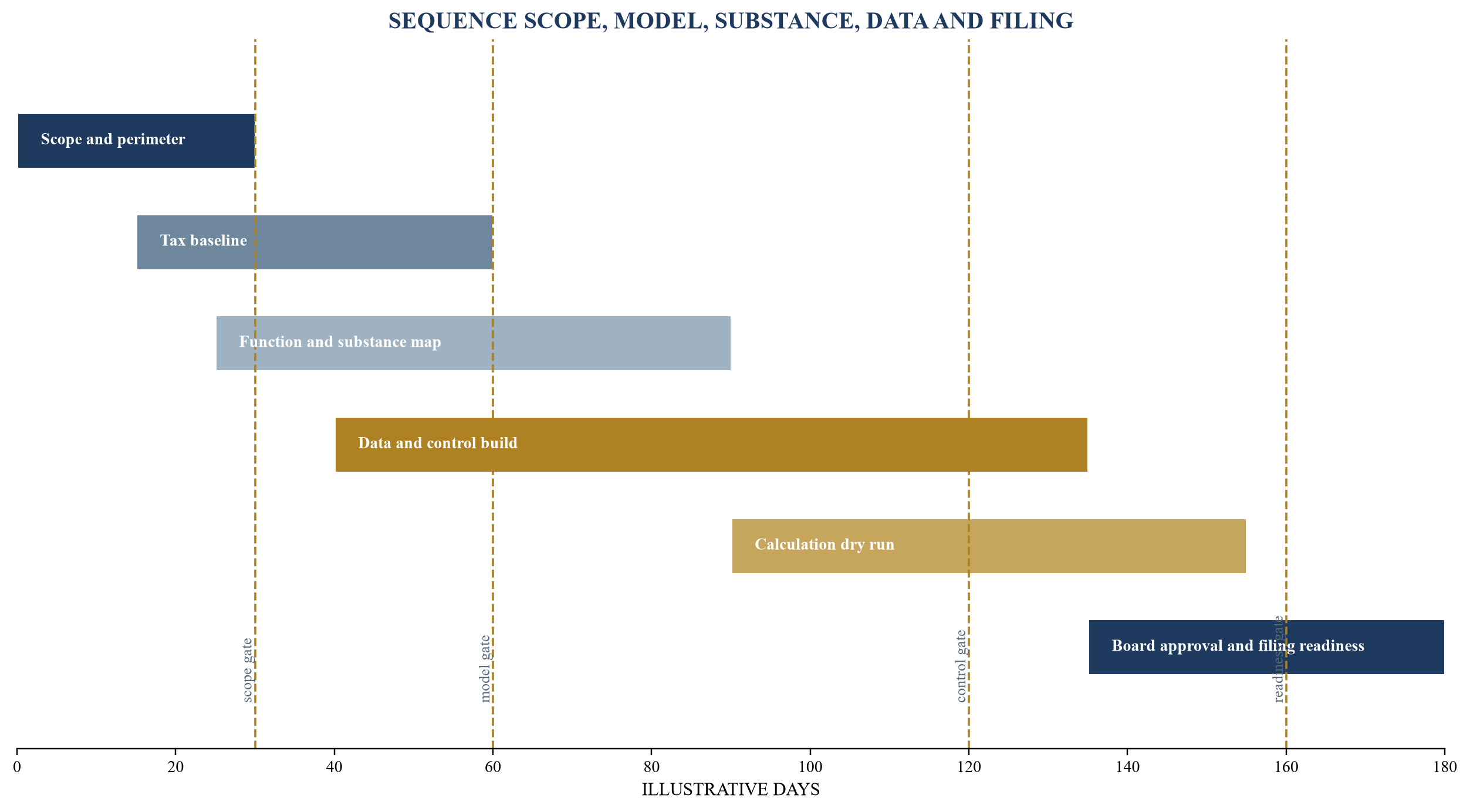
Timing and gates are illustrative management assumptions and should be adapted to the group fiscal year and filing obligations.
Table 6. Implementation owners and gates
| Phase | Core output | Executive owner | Approval gate |
|---|---|---|---|
| days 0 to 30 | revenue test, group perimeter, entity map and obligation register | CFO and group tax director | board confirms scope and resources |
| days 31 to 60 | ordinary-tax baseline, preliminary GloBE bridge and safe-harbour assessment | group tax and controllership | tax committee approves technical workplan |
| days 31 to 90 | headquarters function, people, risk, asset and service-flow map | regional CEO and legal | executive committee approves operating model |
| days 40 to 135 | field dictionary, source systems, controls and evidence repository | CFO and chief information officer | control owner certifies data readiness |
| days 90 to 155 | dry-run calculation, incentive analysis, return workflow and payment plan | group tax director | independent review closes material exceptions |
| days 135 to 180 | board case, delegated authority, filing entity and readiness certificate | CFO and audit committee | board approves launch or remediation plan |
| ongoing | quarterly monitoring, acquisition updates, law changes and post-filing review | steering committee | exceptions escalate under approved thresholds |
Timing, thresholds and deliverables are management assumptions for programme design.
17. The board decision rule
The headquarters should proceed when three cases align. The operating case should show defined functions, decision rights, customer or regional value, capable people and measurable outcomes. The tax case should reconcile ordinary corporate tax, DMTT and foreign GloBE exposure using current law, reliable data and reviewed assumptions. The implementation case should show systems, controls, filings, adviser support, budget and executive accountability.
The board should pause when scope is unresolved, data cannot support a reliable calculation, intended functions lack real authority, an incentive is unconfirmed, transfer pricing does not match conduct, or the after-tax case depends on one fragile assumption. A pause can fund a bounded remediation: obtain an opinion, recruit a role, change a contract, improve data, run a calculation or redesign the entity map. The next decision should have a date and evidence standard.
The board should reject a structure that produces no credible operating value, relies on artificial conduct, cannot be administered or creates risk outside approved appetite. DMTT narrows the usefulness of rate-led planning for in-scope groups. It increases the value of operating design, expenditure-based support, genuine substance, data quality and predictable governance.
The framework leads to a practical conclusion. The best regional-headquarters model is the one the group can operate, evidence, price, govern and report. The jurisdictional effective-tax rate is an output of that system. A disciplined board starts with scope, joins the three tax layers, maps substance, values incentives by mechanism, stress-tests the result and funds implementation only when the operating and tax facts are aligned.
18. Limitations and professional-use boundary
Pillar Two rules are detailed and continue to evolve through domestic legislation, OECD Commentary, Administrative Guidance, safe harbours, qualification processes and information-return standards. This paper reflects official sources available in August 2026 and cannot capture every entity type, election, transition rule, ownership structure, accounting treatment or jurisdictional interaction. Current law and guidance should be checked for the applicable fiscal year.
The worked values, scores, timelines and thresholds are management assumptions for decision design. They are not forecasts, promised outcomes, statutory calculations or evidence of a particular group's tax liability. The comparator jurisdictions are included to structure questions. They do not represent a location recommendation.
The analysis does not constitute legal, tax, regulatory, transfer-pricing, accounting, investment or other professional advice. A group should obtain advice based on its consolidated financial statements, entity perimeter, ownership, functions, assets, risks, tax attributes, incentive eligibility, transaction history and filing jurisdictions. Management remains responsible for implementing approved positions and preserving evidence that actual conduct matches the operating model.
Sources and further reading
- UAE Ministry of Finance, Top-up Tax Official source
- UAE Ministry of Finance, Cabinet Decision No. 142 of 2024 on Top-up Tax on Multinational Enterprises Official source
- UAE Ministry of Finance, Ministerial Decision No. 96 of 2026 on Commentary and Agreed Administrative Guidance Official source
- UAE Ministry of Finance, OECD Transitional Qualified Status for UAE DMTT Official source
- UAE Ministry of Finance, Financial Legislation Register Official source
- OECD, Global Minimum Tax Official source
- OECD, Global Anti-Base Erosion Model Rules and Administrative Guidance Official source
- OECD, Global Anti-Base Erosion Model Rules Official source
- OECD, Commentary to the Global Anti-Base Erosion Model Rules Official source
- OECD, Administrative Guidance on the Global Anti-Base Erosion Model Rules, July 2023 Official source
- OECD, Side-by-Side Package, January 2026 Official source
- OECD, Global Minimum Tax Implementation Toolkit Official source
- OECD, Central Record and Further Administrative Guidance, May 2026 Official source
- OECD, GloBE Information Return, January 2025 Official source
- Federal Tax Authority, Corporate Tax Guide on Free Zone Persons Official source
- Federal Tax Authority, Corporate Tax General Guide Official source
- Federal Tax Authority, Transfer Pricing Guide Official source
- Federal Tax Authority, Advance Pricing Agreements Guide Official source
- Federal Tax Authority, Decision No. 2 of 2025 on Clarifications and Directives Official source
- UAE Ministry of Finance, Cabinet Decision No. 215 of 2025 on R&D Tax Credit Official source
- UAE Ministry of Finance, Ministerial Decision No. 24 of 2026 on R&D Tax Credit Official source
- UAE Ministry of Finance, Phase 1 of Research and Development Tax Incentives Programme Official source
- UAE Ministry of Finance, Corporate Tax Decisions on Intra-Group Transfers and Restructuring Relief Official source
- UAE Ministry of Finance, Ministerial Decision No. 133 of 2023 on Business Restructuring Relief Official source
- Saudi Ministry of Investment, Regional Headquarters Programme Official source
- Saudi Zakat, Tax and Customs Authority, Regional Headquarters Tax Rules Official source
- Saudi Zakat, Tax and Customs Authority, Guideline for Regional Headquarters in Saudi Arabia Official source
- Inland Revenue Authority of Singapore, GloBE Rules and Domestic Top-up Tax Official source
- HM Revenue and Customs, Domestic Top-up Tax and Multinational Top-up Tax Official source
- Hong Kong Inland Revenue Department, Global Minimum Tax and Hong Kong Minimum Top-up Tax Official source
