

1. Redomiciliation is a continuity project with operational conditions
Redomiciliation is the legal process by which a company changes its jurisdiction of incorporation while retaining its identity as a body corporate. The destination registrar issues a certificate of continuation or equivalent evidence. The company then becomes subject to the destination law. Where the regime is effective, the company does not need to transfer every asset and liability into a newly incorporated vehicle merely to change domicile. Singapore's official guidance describes retention of corporate history and identity, existing contracts, assets and liabilities, and legal rights and obligations. Hong Kong's current regime similarly states that re-domiciliation does not create a new legal entity or disturb business continuity, property, rights, obligations, liabilities, contracts or legal processes.
The UAE offers several routes whose legal basis, eligible entity types, activities and regulatory perimeter differ. ADGM guidance describes continuation as migration from one jurisdiction to another and requires the origin law to permit outward continuation. DIFC identifies a Continued Company as an existing company transferred into DIFC and issues a Certificate of Continuation. DMCC and RAK ICC publish business-transfer or migration pathways. The mainland Commercial Companies Law also contains conversion provisions that preserve legal personality when a company changes legal form within its scope. These routes cannot be treated as interchangeable. A destination can admit one corporate form and reject another; a regulated business may need prior regulator consent; and the origin jurisdiction may prohibit or condition outward migration.
Legal identity is the foundation of continuity rather than the whole execution plan. A long-term contract may contain a covenant requiring notice when incorporation changes. A facility agreement may define redomiciliation as a reorganisation, disposal, change in jurisdiction or event requiring majority-lender consent. A licence may be personal to the licensee or restricted to a particular place of establishment. A bank may treat the new registry certificate as a material Know Your Customer event. An insurer may need endorsements to the named insured, address, governing law or territorial scope. Data that remains in the same cloud environment may still move under a different controller registration and cross-border transfer analysis.
The board should therefore approve two linked propositions. The legal proposition asks whether the same entity can continue from the origin into the chosen UAE regime without an interruption or prohibited step. The operating proposition asks whether the company can keep serving customers, paying staff, accessing cash, complying with licences and exercising authority throughout the transition. Both propositions need evidence. A certificate without operational readiness creates disruption; operational preparation without a valid legal route creates execution risk.
Table 1. Route comparison for a UAE corporate move
| Route | Corporate identity | Main execution burden | Typical decision trigger |
|---|---|---|---|
| statutory continuation | same entity if both regimes permit and the destination accepts the applicant | origin authorisation, destination filing, creditor and regulator steps, post-continuation deregistration | preserving history, contracts and liabilities is central |
| new UAE subsidiary | new legal entity under UAE law | new contracts, licences, employees, bank accounts, tax and operating arrangements | local market entry can be ring-fenced |
| new UAE holding company | new parent with existing business retained below | share exchange, approvals, financing and tax analysis | governance, fundraising or regional ownership needs redesign |
| share acquisition or merger | identity depends on transaction structure | due diligence, purchase or merger documents, competition, financing and integration | ownership change is part of the strategic objective |
| asset and business transfer | assets and liabilities move selectively | assignments, novations, consents, employees, licences and tax | liabilities or business perimeter must be separated |
| branch registration | foreign company remains the same legal person | local registration, licence, tax, establishment and operating controls | limited UAE presence is required without changing domicile |
The comparison is a decision screen. Eligibility and legal effect require current advice in the origin and proposed destination jurisdictions.
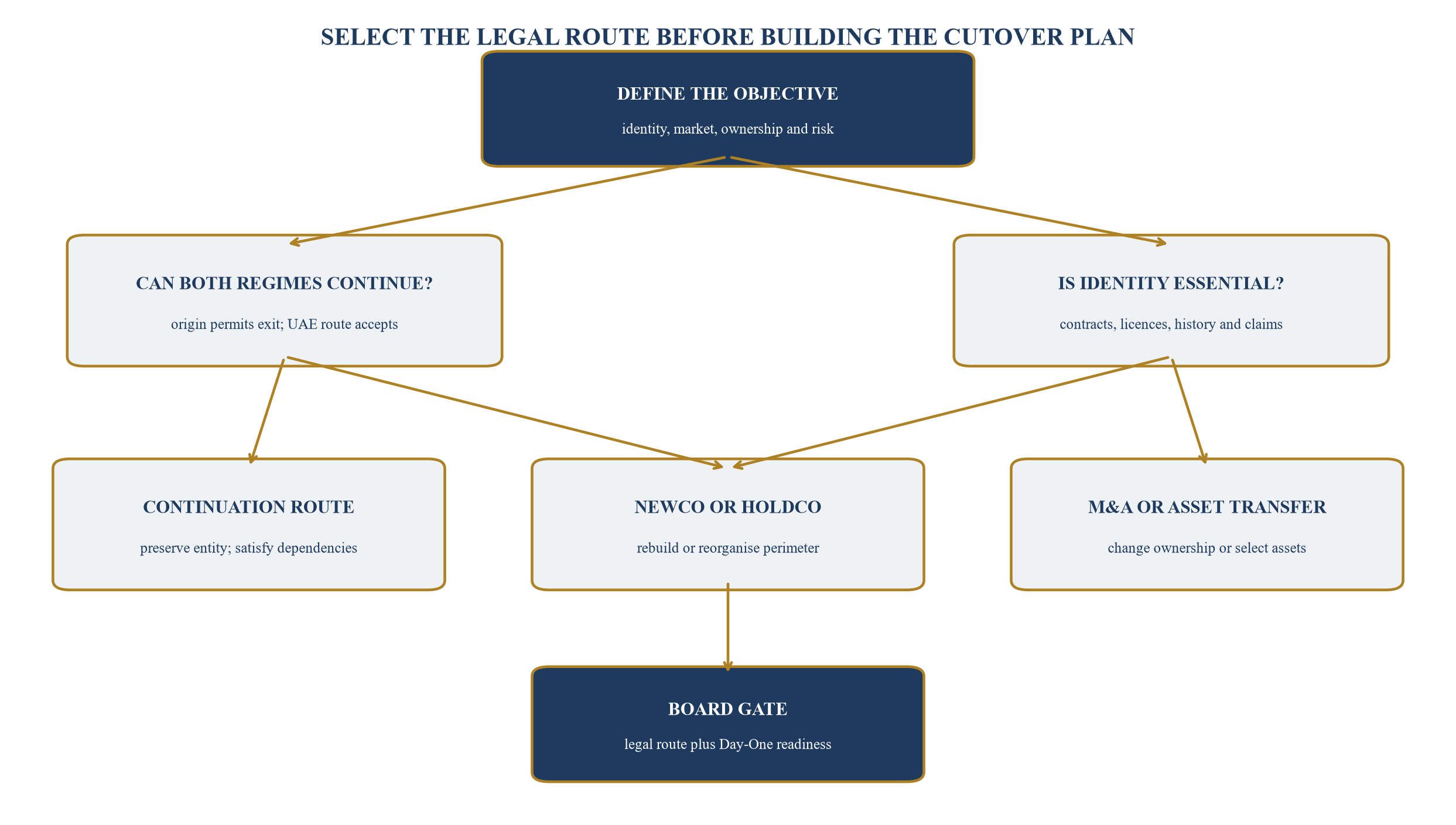
The decision tree is a management screen. Current origin law, destination rules and regulator requirements determine the available route.
2. The first gate is legal eligibility in two jurisdictions
Continuation needs a lawful exit and a lawful entry. ADGM guidance states that an applicant incorporated outside ADGM must be authorised under its home law to apply for continuation outside that jurisdiction. DIFC materials use the same core logic. The board therefore needs counsel in the origin jurisdiction and destination counsel working from one facts pack. A permissive destination cannot cure a prohibited outward migration. A permissive origin cannot force a UAE registrar to accept an ineligible form, activity or ownership profile.
The eligibility pack should begin with the current certificate of incorporation, constitutional documents, amendments, register extracts, good-standing evidence, ownership register, directors and officers, registered charges, financial statements, solvency position, litigation schedule, licences and regulator correspondence. It should identify the company's original incorporation date, any prior migrations and every jurisdiction in which it is registered as a foreign company. The applicant should confirm that its first financial year and filing history satisfy the relevant rules, that no insolvency or enforcement process blocks the move, and that the board and shareholders can approve the proposed continuation under the constitution and applicable law.
Solvency is a central creditor-protection mechanism. ADGM's published guidance calls for a statement of solvency and information specified by its regulations. DIFC regulations address insolvency-related restrictions and require the prescribed application and articles of continuation. Singapore and Hong Kong official materials likewise use financial-health, integrity, creditor-notice and deregistration requirements. These comparator regimes show a common policy: continuity should not enable a company to evade creditors, conceal insolvency or abandon regulatory obligations.
The origin workstream should also test the exact evidence required to remove the company from its existing register after the UAE certificate is issued. Some regimes provide a limited post-continuation period for proof of deregistration. Management should avoid a gap in which neither registrar considers the entity compliant or a period in which both jurisdictions impose active filing obligations unexpectedly. The timetable should include translations, notarisation, legalisation or apostille requirements where applicable. Document expiry periods should be tracked because a certificate or declaration prepared too early may need to be renewed.
The destination workstream should test the proposed name, entity type, activity, registered office, directors, secretary, authorised signatories, beneficial owners, data-protection registration and commercial licence. Regulated financial services, funds, insurance, virtual assets, professional activities, defence, healthcare, education, telecoms and other controlled sectors can require separate approval. DIFC regulations expressly address prior DFSA consent for certain authorised persons and funds seeking continuation. ADGM's regime and commercial licensing rules also need to be read with any FSRA requirements. A board should treat regulator consent as a critical-path dependency rather than an administrative filing.
Table 2. Eligibility and evidence screen
| Gate | Evidence | Failure signal | Executive owner |
|---|---|---|---|
| origin authority | legal opinion, statute, constitution and board powers | outward continuation is prohibited or conditional | general counsel |
| destination eligibility | registrar pre-clearance, entity and activity mapping | form, activity or ownership is not admitted | company secretary |
| corporate approvals | board and shareholder resolutions, consents and minutes | approval threshold or class right is unresolved | chair and general counsel |
| solvency and creditor protection | accounts, cash forecast, contingent liabilities and declaration | inability to support required solvency statement | CFO |
| good standing | register extract, filings, fees and enforcement search | overdue filing, strike-off risk or unresolved penalty | company secretary |
| regulated status | regulator mapping, licences and consent pathway | approval is unavailable before target date | compliance officer |
| post-continuation exit | origin deregistration steps and evidence deadline | double-registration or loss of recognition risk | programme director |
Requirements vary by origin, destination, entity type and regulated status. The table is a diligence checklist.
3. The certificate preserves the entity; the dependency map preserves the business
The legal effect of continuation should be translated into a dependency map. The map starts with the company at the centre and then records the systems that recognise it: customers, suppliers, employees, regulators, lenders, banks, insurers, intellectual-property offices, landlords, utilities, payment providers, auditors, tax authorities, data processors and courts. Each dependency receives a rule, evidence item, owner and cutover condition.
Continuity can reduce the need for assignment because the legal person remains the same. The conclusion for a specific contract still depends on its terms and governing law. A contract can define a change in jurisdiction as a reorganisation or deemed assignment. A licence can prohibit transfer even when no new legal person is created. A counterparty can have a notice right, termination right or consent right tied to residence, tax status, control, sanctions, credit profile, insurance or regulatory classification. The company should avoid a blanket statement that all contracts continue automatically.
The new UAE Civil Transactions Law, Federal Decree-Law No. 25 of 2025, contains a current framework for assignment of rights and debts. It states that a creditor may assign a right unless law, agreement or the nature of the obligation prevents it, and it addresses effectiveness against the debtor and third parties. Those provisions matter most when the selected route actually transfers rights or debts. In a statutory continuation, they remain part of the legal backdrop for contracts that require amendment, restructuring or transfer. The company's legal team should distinguish continuation of the entity from any associated transfer of business, debt, IP or contract.
The dependency map also needs a temporal dimension. Some actions must occur before the board resolution; some after shareholder approval; some after conditional destination approval; and some only after the certificate becomes effective. Updating a bank account before legal effectiveness may be impossible. Waiting until after effectiveness to obtain a critical customer consent can create revenue interruption. The programme therefore needs conditions precedent, conditional consents, escrowed documents, pre-agreed communications and a controlled effective time.
The strongest design is a single Day-One readiness certificate supported by workstream evidence. It should confirm that critical contracts are valid or appropriately consented, drawdown and payment authority remains available, required licences are effective, payroll and visas are operable, insurance covers the continued entity, tax registrations are addressed, data processing is lawful, and directors and signatories can act. A red status on any critical dependency should prevent legal effectiveness unless the board accepts a documented contingency and the law permits it.
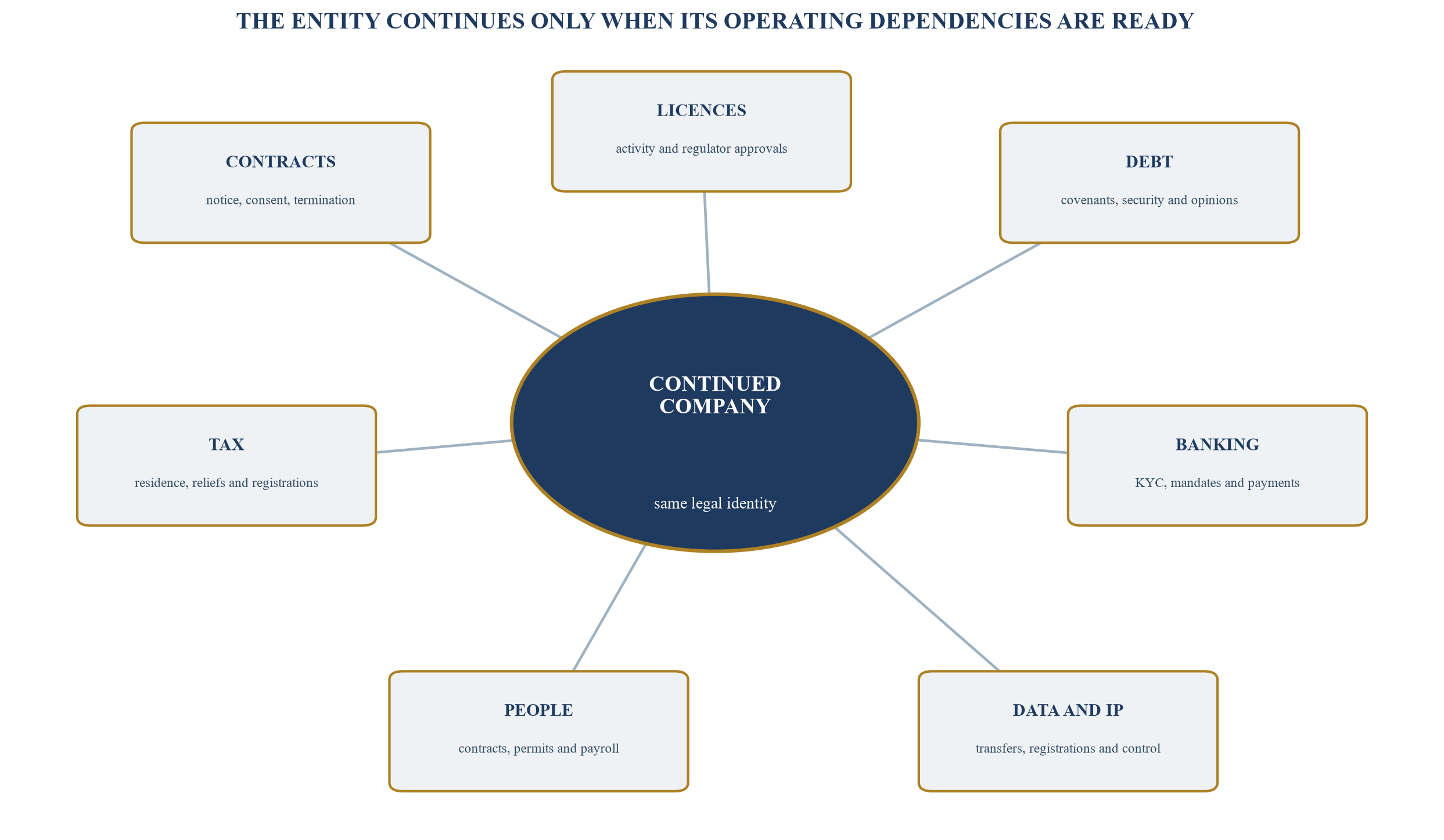
Identity continuity is the centre of the map. Each surrounding dependency still needs a current legal and operational test.
4. Contract protection starts with classification rather than document volume
A company with thousands of contracts cannot review every clause at the same depth before selecting a route. It can classify the population quickly and then apply legal review where value and interruption risk are highest. The first classification separates revenue contracts, strategic supplier contracts, financing documents, leases, licences, technology agreements, data-processing agreements, employment and incentive arrangements, insurance, joint ventures and government contracts. The second identifies governing law, counterparty, value, remaining term, renewal, criticality and system of record. The third searches for clauses associated with assignment, novation, reorganisation, merger, change of control, domicile, residence, notice, termination, sanctions, tax, confidentiality, data transfer and dispute resolution.
The legal team should define outcomes that are precise enough to manage. "No issue" should mean counsel has concluded that continuation does not trigger a relevant restriction and that any notice can be satisfied within the timetable. "Notice" should identify recipient, form, delivery method, timing and proof. "Consent" should identify the approving party, decision standard, escalation path and required consideration. "Amendment" should include agreed drafting and signing authority. "Novation" should be reserved for a transfer to another legal person or another situation requiring replacement of a party. "Terminate or replace" should quantify the operating and financial consequence.
Counterparties should be approached in a sequenced manner. A premature announcement can create concern before the board has a feasible route. A late approach can leave critical consent outside the closing timetable. The company can use a short continuity memorandum explaining that the legal entity, ownership and obligations remain, subject to the specific transaction facts. The memorandum should state the proposed effective date, destination, registered information, service-continuity plan and requested acknowledgement. It should avoid claiming a legal outcome that counsel has not confirmed.
Change-of-control clauses require special discipline. Redomiciliation without a share transfer may leave ownership unchanged. Some definitions extend beyond share ownership to board control, governing jurisdiction, management or a reorganisation. A parallel insertion of a UAE holding company, refinancing, employee-equity rollover or investor round can create a control event even when continuation alone would not. The legal review should therefore test the complete transaction sequence, including steps that occur before and after the certificate.
The commercial team should protect negotiation leverage. Counterparties may request price changes, guarantees, deposits, security, audit rights or early renewal as the price of consent. The board needs parameters for what management can concede. A critical-customer consent can be worth more than the apparent legal issue because the revenue relationship may be hard to replace. A non-critical supplier should not be allowed to delay the programme when an equivalent vendor can be onboarded under UAE terms.
Table 3. Contract and consent register
| Contract class | Key clause tests | Required output | Escalation trigger |
|---|---|---|---|
| customers | assignment, domicile, control, sanctions, tax, service location | continue, notify, consent, amend or replace | revenue or licence-to-operate risk |
| suppliers and technology | assignment, hosting, data, subcontracting, payment | continuity confirmation and vendor cutover | sole source or operational dependency |
| leases and utilities | permitted use, address, guarantor, deposit and notice | premises and service continuity | site unavailable on Day One |
| joint ventures | reserved matters, shareholder control, transfer restrictions | partner approval and governance amendment | veto or default risk |
| insurance | named insured, territory, governing law, notification | endorsement or replacement cover | gap in mandatory or material coverage |
| government and regulated contracts | eligibility, localisation, licence and approval | authority or counterparty confirmation | public-law or regulatory breach |
| employment and incentives | employer identity, plan rules, payroll and benefits | continuity or replacement documentation | employee loss or benefit acceleration |
Priorities and thresholds are management assumptions. Contract interpretation requires counsel in the relevant governing law.
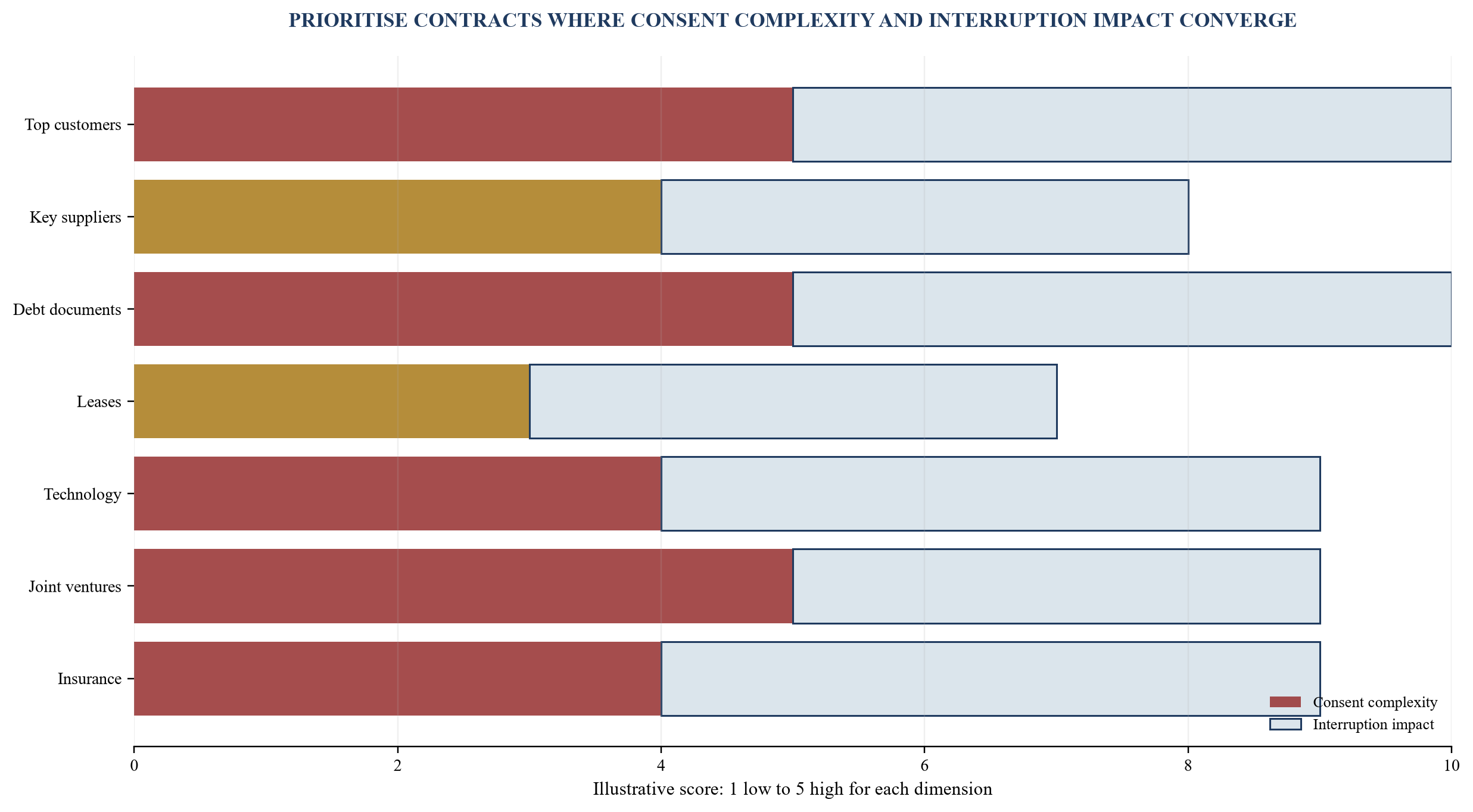
The scores are illustrative management assumptions for triage. Legal conclusions must come from the actual contracts and governing law.
5. Debt and security can turn a corporate move into a financing transaction
Debt documents often create the hardest execution gate because lenders underwrite a legal and operational perimeter. Redomiciliation can change governing company law, insolvency forum, registration of charges, financial-assistance rules, distribution capacity, tax residence, reporting, enforcement routes and account arrangements. A facility agreement may require consent to a merger, consolidation, reorganisation, change of jurisdiction, disposal, change of business, amendment of constitutional documents or movement of assets. Even when the borrower remains the same entity, the lender can require evidence that its rights continue and remain perfected.
The company should build a facility-by-facility map covering borrower, guarantors, security providers, lenders, agent, maturity, outstanding amount, undrawn availability, covenants, material adverse effect, events of default, change-of-control and reorganisation provisions. It should list security over shares, bank accounts, receivables, inventory, equipment, intellectual property, real estate, insurance proceeds and contracts. Each item needs an origin-law and destination-law perfection analysis.
UAE Federal Law No. 4 of 2020 creates a framework for security rights in movable property and an electronic register. It covers material and intangible assets, including receivables, bank accounts, instruments, equipment, business elements and goods, subject to the statute and implementing rules. DIFC and ADGM have their own relevant legal and registry frameworks. The programme must identify whether an existing registration continues, needs amendment, requires a new filing or must be released and re-perfected. The company should not assume that legal identity alone preserves priority in a different registry system.
Lender consent should be requested with a complete credit case. The pack should explain continuity of the borrower, business rationale, destination law, tax and cash-flow effect, licence position, contract continuity, governance, financial reporting, security plan, bank accounts and legal opinions. If the move creates no deterioration in leverage, cash flow, collateral or lender control, management should show that directly. If the move changes risk, the company should price the request and evaluate refinancing alternatives before it is dependent on one consent.
Guarantees and hedging need equal attention. A guarantor can be outside the continuing entity, and its guarantee may contain changes-in-law or confirmation requirements. Interest-rate or currency hedges can be linked to the facility and affected by account, tax or documentation changes. Treasury should confirm settlement instructions, payment systems, authorised dealers and withholding-tax analysis. Existing charges should be searched immediately before effectiveness and again after filing, because a late security interest or enforcement action can change the closing assumptions.
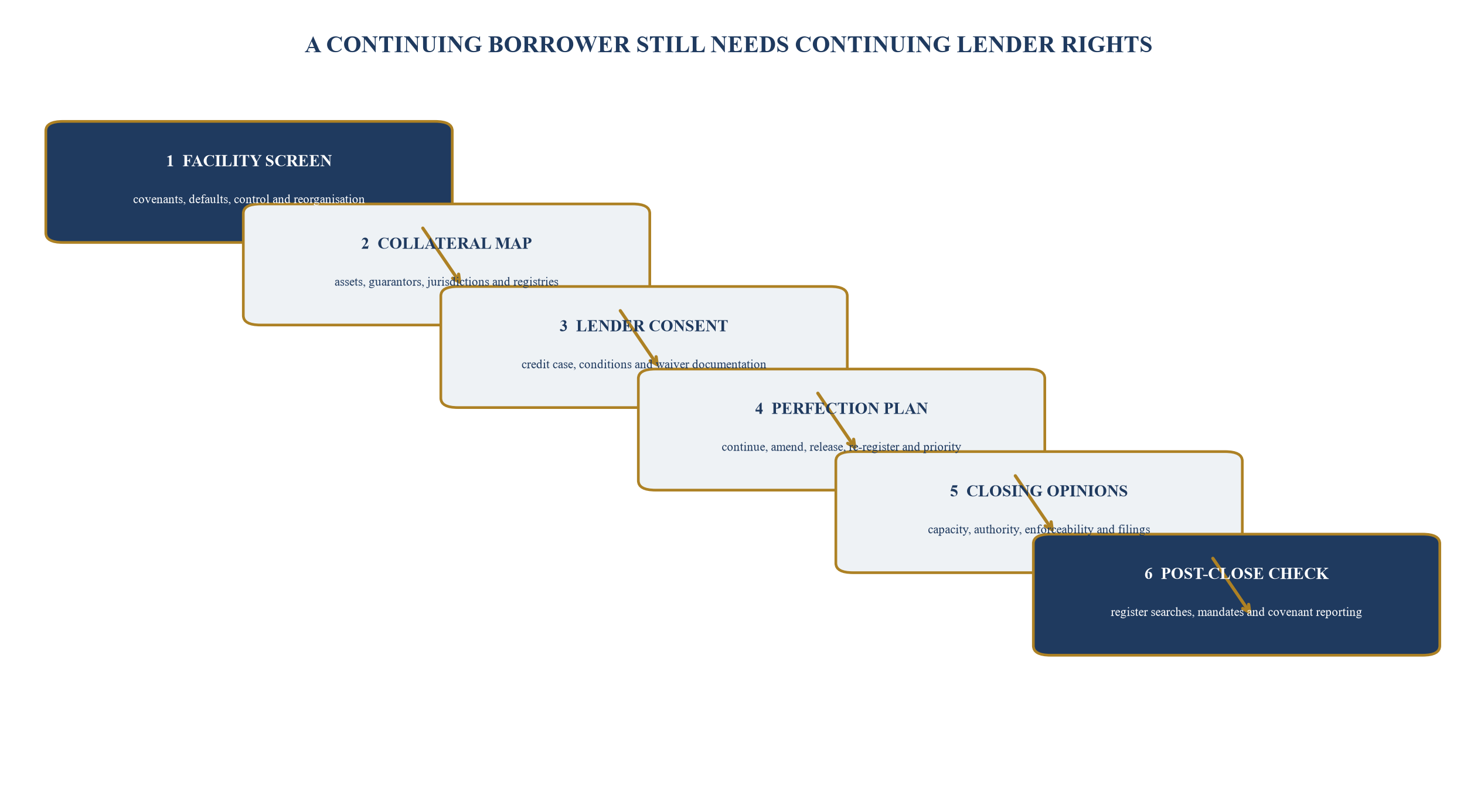
The waterfall is an execution sequence. Facility terms, security law and registrar practice determine the required actions.
6. The destination should fit the business rather than the address
The UAE destination decision requires more than selecting an emirate or free zone. The company should match legal form, permitted activities, regulator, court system, office requirements, visa capacity, tax profile, financing needs, investor expectations and operating geography. ADGM and DIFC offer common-law-based financial-centre frameworks with their own company, insolvency, data-protection and court systems. DMCC provides a published business-transfer pathway within its commercial ecosystem. RAK ICC offers continuation for relevant international business companies through registered agents. Mainland and other free-zone alternatives may be better for activities that require local market access, government procurement, industrial premises or particular licences.
The market-attractiveness screen should score only evidence that matters to the business. A financial-services company may prioritise regulator fit, fund structures, court system and access to professional talent. A trading company may prioritise customs, warehousing, port access and supplier infrastructure. A technology company may emphasise talent, data, intellectual property, investor familiarity and option-plan administration. An industrial company may need land, utilities, environmental approvals and local content. A group headquarters may prioritise governance, banking, tax, regional connectivity and senior employees.
The chosen legal form should support the capital strategy. A future equity raise can require familiar share classes, pre-emption rules, employee options, security registration and exit mechanics. A future debt raise can require lender-recognised insolvency and collateral rules. A joint venture can require enforceable reserved matters and transfer restrictions. A family-owned business can prioritise succession and ownership continuity. The redomiciliation decision should be tested against the next financing, acquisition, dividend, restructuring and exit rather than the present state alone.
Licensing scope must match actual revenue activity. A company should map every product, service, customer type and place of performance to permitted activities. The commercial licence issued with continuation may enable local operations and still exclude a regulated service. A foreign registration can remain necessary in jurisdictions where the company continues to do business. Destination selection should therefore produce a licence map by entity and jurisdiction, including renewal dates, responsible persons and ongoing conditions.
The board should insist on a documented second-best option. If the preferred destination cannot accept the entity or cannot issue a required licence by the target date, the programme should know whether to use another UAE regime, establish a subsidiary, retain the origin entity and add a branch, or move in stages. This option value reduces the cost of discovering a regulatory blocker late.
7. Tax analysis should follow the legal steps and business functions
Redomiciliation can alter corporate-tax residence, filing obligations, tax periods, group relief, transfer pricing, withholding-tax exposure, indirect tax, permanent establishments and access to treaty benefits. The UAE Corporate Tax Law treats a juridical person incorporated, established or otherwise recognised in the UAE as a Resident Person for corporate-tax purposes. The Federal Tax Authority's general guide also addresses foreign juridical persons that are effectively managed and controlled in the UAE. A continued company therefore needs an effective-date tax map across the origin, UAE and every operating jurisdiction.
The tax team should model each legal step separately. A pure statutory continuation may preserve legal identity while creating deemed disposals, exit taxes, rebasing or residence consequences under the origin law. A preliminary share exchange, asset transfer, debt pushdown, IP transfer or holding-company insertion can have distinct tax results. UAE Business Restructuring Relief may apply to qualifying transfers under Article 27 of the Corporate Tax Law when all conditions are met. The FTA guide explains the covered transaction types, legally compliant condition, taxable-person conditions, accounting-standard condition, valid commercial reasons, net-book-value treatment and clawback. Management should not assume that a redomiciliation automatically qualifies.
Free-zone status requires a separate analysis. The FTA's Free Zone Persons guide explains qualifying income, excluded activities, adequate substance, de minimis requirements, permanent establishments, immovable property, qualifying intellectual property and compliance. A company that continues into a free zone does not receive a zero rate on all income by virtue of its address. Its activities, customers, transactions, substance and compliance determine the result. Transfer-pricing rules apply to related-party transactions, and the continued company may need new functional analyses and intercompany agreements that match actual conduct.
Tax residence should align with governance. UAE Cabinet Resolution No. 85 of 2022 sets rules for tax residence. Board location, senior management, commercial decisions, people, systems and records can affect the factual picture. A legal migration with management retained entirely elsewhere can create dual-residence or treaty questions. The governance workstream should define where strategic and commercial decisions are made and preserve reliable minutes and supporting evidence.
The cutover also needs administrative tasks: corporate-tax registration, tax-residency certificate planning, VAT and customs updates, payroll tax or social-security analysis outside the UAE, transfer-pricing documentation, tax-group assessment, loss and credit review, and origin deregistration. The company should document uncertain positions and obtain advice before filing. The business case should show a range of tax outcomes, professional costs and compliance capacity. It should not depend on an unconfirmed tax saving.
Table 4. Tax and regulatory issue register
| Issue | Decision question | Evidence | Board gate |
|---|---|---|---|
| residence and effective date | when does UAE residence begin and origin residence end? | laws, certificates, governance facts and tax advice | no unmanaged dual-residence period |
| restructuring relief | does each transfer meet statutory conditions and commercial-purpose tests? | step plan, valuations, accounts and elections | relief opinion and clawback controls |
| free-zone regime | which income qualifies and what substance is required? | activity, customer, transaction and people map | sustainable qualifying profile |
| transfer pricing | do functions, assets, risks and prices match conduct? | functional analysis, agreements and benchmarking | reviewed policy before first period |
| indirect tax and customs | which registrations, supplies and imports change? | VAT, customs, warehouse and invoice flows | invoicing and import continuity |
| competition and licences | does the sequence create concentration or regulatory approvals? | control analysis, turnover, licences and filings | required clearance before effectiveness |
| tax administration | which returns, certificates, records and payments are due? | compliance calendar and responsible owners | operational tax account and funding |
The register identifies workstreams. It is not a tax or legal conclusion for a particular company.
8. Governance continuity means rebuilding the authority system deliberately
Control is exercised through rights, information and behaviour. The continued company needs valid shareholders, directors, officers, committees, authorised signatories, bank mandates, powers of attorney, system permissions and delegated authorities from the effective moment. The old constitution may need amendment to comply with the destination law. The destination articles can change board composition, quorum, reserved matters, distributions, share transfers, director duties or record-keeping. Every governance instrument should be reconciled before closing.
The board should prepare an authority bridge. The left side records the pre-continuation authority: shareholders, board, committees, executives, signatories, approval limits and powers of attorney. The right side records the required post-continuation authority. The middle contains the documents and actions that preserve or replace each authority. These can include new articles, board and shareholder resolutions, director consents, committee terms, delegated-authority schedules, bank mandates, regulator appointments and system-access tickets.
Reserved matters need transaction-wide review. A joint-venture shareholder agreement can require consent to changing jurisdiction, registered office, business, articles, tax residence, auditors, bank accounts or financing. Investor rights may be embedded in side letters, subscription agreements or preference-share terms. Employee option plans may define eligible company, jurisdiction, tax treatment or board authority. A redomiciliation resolution should not override a contractual veto or class right.
The board also needs to determine where decisions will be made after continuation. A UAE company should have a governance model that reflects its purpose and tax position. This can include a calendar of UAE board meetings, information delivered to directors, local executive roles, signing protocols and escalation paths. Minutes should record the substance of decisions, alternatives, conflicts, adviser input and implementation authority. Boilerplate minutes prepared after the event weaken evidence of genuine control.
The first post-continuation board meeting should be prepared as part of closing. The agenda can adopt the destination articles, confirm officers, approve bank and tax registrations, ratify necessary contracts, confirm insurance, approve data-protection responsibilities, adopt accounting policies and establish the compliance calendar. Legal counsel should determine which actions occur automatically, which require confirmation and which cannot be taken until the certificate is effective.
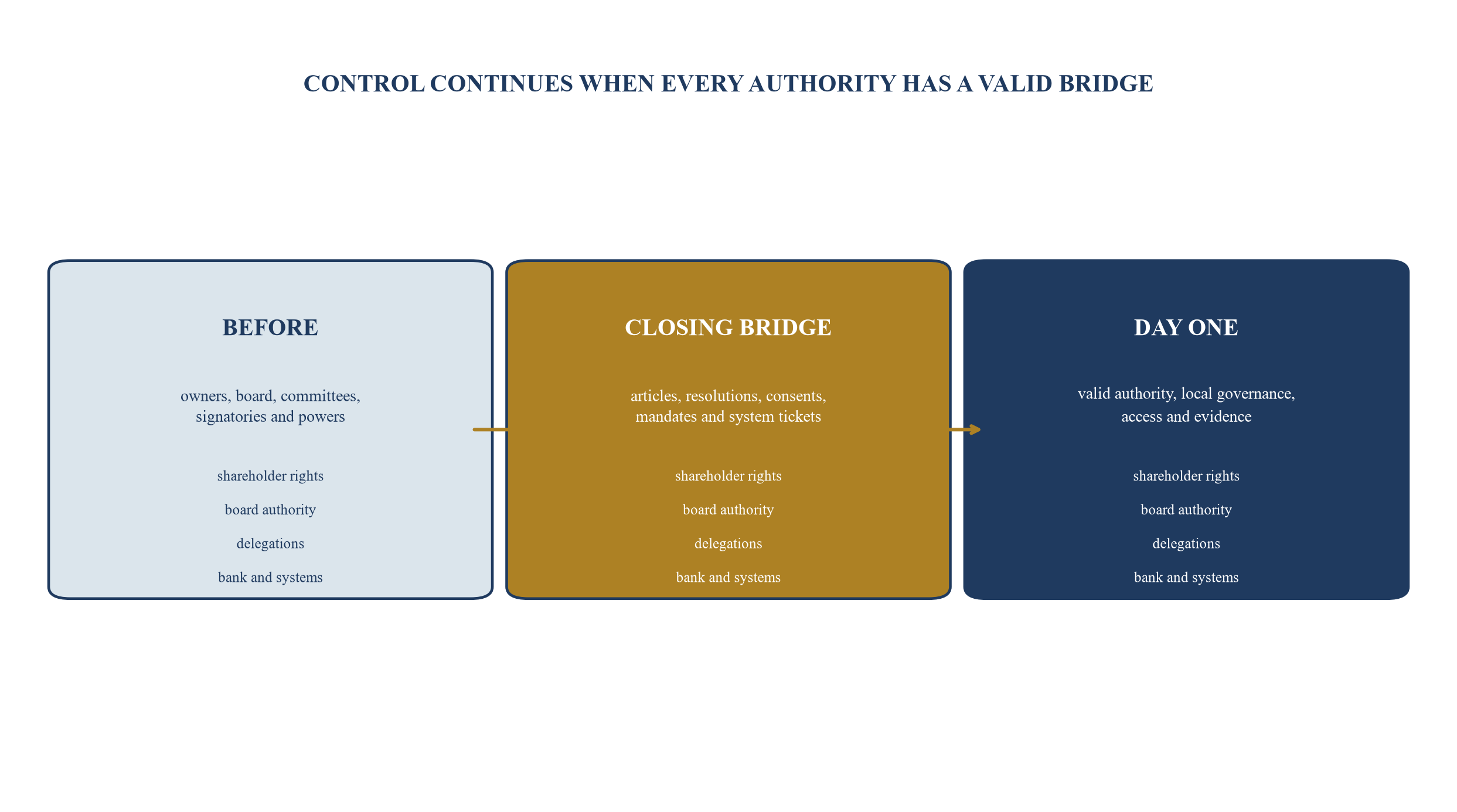
The bridge maps authority before and after continuation. Specific documents depend on the constitution, agreements and destination law.
9. Banking and treasury should be treated as critical infrastructure
A bank account can remain legally owned by the same company and still become temporarily unusable during a material Know Your Customer update. The Central Bank of the UAE's current customer-due-diligence framework requires identification and verification of legal persons, beneficial owners, persons acting on behalf of the customer, source of funds or wealth where relevant, expected activity and ongoing monitoring. A change of domicile, constitutional documents, address, directors, signatories, business model or ownership evidence can trigger a full refresh.
The treasury team should engage each bank under a controlled disclosure plan. The pack should include the continuation rationale, origin and destination certificates, articles, register extracts, board and shareholder resolutions, ownership chart, beneficial-owner documents, licences, tax information, expected account activity, source-of-funds narrative and authorised signatories. Banks may request certified or legalised documents and can have different internal lead times. The programme should track receipt, review questions, mandate approval and online-banking access separately.
Cash continuity needs a fallback. The company should forecast payroll, taxes, critical suppliers, debt service and customer receipts across the cutover. It should confirm which accounts can send and receive funds, whether payment gateways and merchant acquirers recognise the updated entity, and whether direct debits, standing instructions, letters of credit, guarantees or trade-finance instruments require amendment. A concentration of cash in one account under review can make an otherwise successful continuation operationally unsafe.
Treasury should coordinate with tax and legal teams on account location, currency, hedging, intercompany loans, cash pooling and financial assistance. A destination-law restriction or transfer-pricing issue can affect upstreaming and funding. A lender can require controlled accounts or account security. New local accounts may need to be opened before existing accounts can be updated, subject to bank policy and corporate authority.
The Day-One certificate should include evidence that signatories can transact, maker-checker rules are active, payment limits match the delegated-authority schedule, beneficiaries have been migrated and fraud controls have been retested. Cybersecurity teams should review any domain, email, device or administrator changes. A redomiciliation announcement can increase business-email-compromise risk because counterparties expect new addresses and payment instructions. Independent callback verification and dual approval should be mandatory for changes to bank details.
10. People continuity requires contracts, permissions and confidence
Employees experience the move through their employer record, payroll, immigration, benefits, incentive plans, management structure and job security. Statutory continuation may preserve the employer's identity; the applicable labour, immigration and pension rules can still change when the work location and employer registration change. UAE Federal Decree-Law No. 33 of 2021 and its executive regulation govern private-sector labour relations within their scope. The executive regulation includes provisions on work permits and transfer of workers. DIFC and ADGM have their own employment frameworks for relevant entities.
The people workstream should segment staff into employees moving to the UAE, employees remaining abroad, internationally mobile executives, directors, consultants and outsourced personnel. Each group needs an employer, work location, contract, payroll, tax and social-security analysis, immigration status, benefits, data-processing basis and reporting line. Remote workers can create permanent-establishment, payroll, employment-law and data risks in the country where they remain.
The company should prepare an employee communication that explains what is changing, what is continuing, the proposed effective date, who is affected and where questions will be answered. Communications should follow confirmed legal advice. Employees should not be asked to sign replacement contracts that waive accrued rights without a clear reason and review. Retention measures should target roles whose loss would threaten licences, customer service, systems, finance or regulator approval.
Incentive plans need a separate legal and tax review. Options, restricted shares, carried interest, bonuses and phantom equity can reference the original jurisdiction, company law, tax residence, securities exemptions or exit definitions. The continued company may need plan amendments, participant notices, board approvals or updated tax withholding. A holdco insertion or share exchange can affect vesting, exercise price, valuation and change-of-control provisions.
Day-One readiness should confirm payroll funding, bank files, work permits, health insurance, pensions where applicable, employment contracts, leave balances, employee records, HR system access and grievance channels. The programme should preserve documentary continuity for service dates and accrued entitlements. Management should monitor attrition, offer acceptance, permit status and critical-role coverage during the first 90 days.
11. Data and intellectual property do not move merely because the company does
The company's datasets and intellectual property can be legally owned by the continuing entity and still require regulatory and contractual updates. The UAE Personal Data Protection Law creates a federal framework for processing personal data within its scope. ADGM and DIFC operate separate data-protection regimes for entities in their jurisdictions. ADGM guidance addresses controller obligations, records of processing, data-protection impact assessments, security, breach management and international transfers. The chosen destination determines the principal UAE framework and can leave other laws applicable to customers, employees and processing outside the UAE.
The data team should map controller, joint-controller and processor roles before and after continuation. Customer and employee privacy notices may name the old jurisdiction, address, regulator or legal basis. Data-processing agreements can restrict transfers, subprocessors, hosting locations or controller changes. Standard contractual clauses or other safeguards may need to be updated when data flows to or from jurisdictions that do not have an adequacy decision under the relevant regime. The system architecture should be reviewed at the level of actual data flows rather than vendor headquarters.
Records of processing should identify categories of data, purposes, legal bases, recipients, retention, security, transfers and responsible owners. A continuation can be a suitable trigger for a data-protection impact assessment where systems, hosting, identity management or high-risk processing changes. The company should update incident-response contacts and ensure the appropriate UAE authority can be notified within the applicable legal requirements.
Intellectual-property registers need asset-level analysis. Patents, trademarks, designs, domain names, software, source code, licences, open-source obligations and trade secrets should be inventoried. An official register may require a change of proprietor address or domicile even when ownership remains with the same legal person. Licence agreements can include territorial, tax, control and assignment provisions. Security over IP can require new or amended registrations. Intercompany licences should be aligned with transfer pricing and actual development, enhancement, maintenance, protection and exploitation functions.
Access control is part of ownership. The continued company should retain administrative access to domains, repositories, cloud environments, encryption keys, certificates, app stores and escrow. Credentials registered to departing employees or an obsolete email domain can create a practical loss of control. The Day-One test should include recoverability and dual administration for every critical digital asset.
12. Competition, sanctions and sector regulation can change the sequence
Redomiciliation without an ownership change may fall outside a conventional merger-control filing. The complete transaction can include a share exchange, holding-company insertion, acquisition, merger or joint venture that creates an economic concentration. UAE Federal Decree-Law No. 36 of 2023 applies to economic activities in the UAE and activities outside the UAE that affect competition in the UAE. Its definition of economic concentration includes transactions that enable direct or indirect control. Cabinet Resolution No. 59 of 2026 provides the current executive regulation, effective from 30 July 2026. Counsel should assess the current notification tests, timing and transaction sequence.
Sanctions and export controls require a jurisdiction-by-jurisdiction review. The destination, banks, shareholders, directors, customers, suppliers, goods, software and payment currencies can change the screening perimeter. A contract or financing document may require representation that the company is not organised in a sanctioned jurisdiction or owned or controlled by restricted persons. The continuation file should preserve screening evidence and identify licences or disclosures that must be renewed.
Sector regulation can be decisive. Financial services, funds, insurance, payments, virtual assets, healthcare, education, telecoms, energy, defence, aviation, maritime, transport, food, pharmaceuticals and professional services can require authority consent or new operational conditions. The company should map regulator, licence, approved persons, capital, insurance, reporting, systems, outsourcing, data location and premises. A commercial licence does not replace sector authorisation.
The regulator engagement strategy should be transparent and complete. Management should avoid presenting continuation as a clerical address change when governance, ownership, systems or control also change. The submission should explain the business rationale, legal effect, group structure, financial resources, key persons, customer protection, continuity plan and requested effective date. Open issues should have owners and response deadlines.
The closing sequence should follow the slowest mandatory approval. Conditional approvals can be useful if their conditions are measurable and can be satisfied before effectiveness. If one regulator cannot coordinate with the origin registrar, counsel should design a staged route that keeps the licensed entity operational. The board should understand the cost of a dual-entity transition and the conditions for eventually simplifying the structure.
13. Accounting and audit continuity support the legal record
The continued company should preserve its accounting history, books, records and audit trail. The destination regime can impose a new accounting standard, filing deadline, auditor-registration requirement, financial-year convention or record location. The programme should map the last origin filing, continuation effective date, first UAE reporting period, comparative information, audit appointment and consolidation treatment.
Management should agree with the auditor how the continuation is presented in the financial statements. A pure continuation of the same entity is economically different from a business combination or asset transfer. A preliminary reorganisation can create new reporting entities or common-control questions. The accounting memo should address legal form, substance, opening balances, tax, share capital, reserves, foreign currency, leases, employee benefits, provisions, contingencies and subsequent events. It should identify material judgements and required disclosures.
The chart of accounts and enterprise systems should keep transaction history accessible. Vendor and customer master records can require address, tax and bank updates. Invoice templates need the correct legal name, registration number, licence and tax information from the effective date. Purchase orders and automated contracts should be updated in advance and activated at the cutover. The company should avoid creating duplicate customer accounts that obscure receivables or credit history.
Audit evidence supports several workstreams. Solvency declarations, lender consent, regulator approval, tax positions and bank onboarding can depend on current statements and management accounts. The CFO should establish a closing balance sheet and liquidity forecast at a defined date. Contingent liabilities, guarantees, litigation and off-balance-sheet commitments should be reconciled with the legal diligence pack.
Document retention must survive the move. The company should copy and validate corporate records, tax files, contracts, security filings, payroll data, board materials, audit workpapers available to management and regulator correspondence. Access rights should be tested after any system or domain change. A controlled archive should record the origin register state immediately before continuation and the destination register state immediately after.
14. Comparator regimes reveal the quality of a robust continuation process
Singapore and Hong Kong provide useful official comparators because both describe continuity directly and publish structured eligibility and post-registration requirements. Singapore requires a foreign entity to be authorised under its origin law, financially healthy and compliant with specified requirements. Its official process includes certified corporate documents, financial statements, a Singapore constitution and post-approval registration of existing charges, deregistration evidence and new certificates. Hong Kong's regime, effective from 23 May 2025, preserves legal identity and continuity while requiring corporate background, integrity, creditor protection and solvency evidence. It also gives a period for origin deregistration evidence and has prior-assessment considerations for certain regulated financial institutions.
The United Kingdom's 2026 consultation provides a policy comparator. The UK government describes the current cost and commercial risk of creating a new legal identity and transferring assets and contracts. The proposed inward regime is intended to allow a foreign company to change incorporation while maintaining legal identity. Because it remains a consultation rather than an implemented route as of the source date, it should not be presented as a currently available migration procedure.
The UAE regimes should be compared at the level of legal effect, eligibility, creditor protection, regulator consent, charges, data, tax and post-continuation obligations. A glossy "business transfer" label does not answer these questions. The company should obtain the current statute, regulations, application checklist and registrar confirmation for the chosen route.
Comparator analysis also improves programme design. Creditor notices, solvency evidence, charge registration and proof of deregistration recur across mature regimes because they protect third parties and establish a clean chain of corporate existence. The board should treat them as governance controls even when one jurisdiction's exact process is lighter. A formal register of outstanding obligations after the certificate helps prevent premature closure of the programme.
Table 5. Selected jurisdictional continuation comparison
| Regime | Continuity statement | Key eligibility or protection feature | Post-registration focus |
|---|---|---|---|
| ADGM | foreign body corporate continues as an ADGM company | origin authorisation, prescribed documents and solvency statement | origin cessation evidence, licences, charges and compliance |
| DIFC | transferred company is established as if incorporated under DIFC law | prescribed application, articles and regulator consent where relevant | commercial licence, registers, governance and regulated status |
| DMCC or RAK ICC | published transfer or migration pathways for eligible businesses | route-specific entity, document and agent requirements | licence, registry, banking and operational updates |
| Singapore | history, identity, contracts, assets, liabilities, rights and obligations retained | size, financial health, origin authority and good faith | charges within 30 days and deregistration evidence within 60 days |
| Hong Kong | no new legal entity; continuity of property, obligations, contracts and proceedings | company type, integrity, creditor notice and solvency | origin deregistration evidence within 120 days |
| United Kingdom proposal | proposed inward route would maintain legal identity | design remains subject to consultation and legislation | current availability must be checked before planning |
The table summarises official materials available in August 2026. It is not a complete legal comparison or recommendation.
15. A 180-day programme should be built around evidence gates
The programme period in this paper is an illustrative management design, not a statement of registrar or regulator processing time. A simple unregulated company can move faster; a regulated or leveraged group can take longer. The value of the 180-day frame is that it separates feasibility, consent, preparation, closing and stabilisation.
Days 0 to 30 establish feasibility. The company appoints the steering committee, confirms the strategic objective, obtains origin and destination legal screens, identifies the destination shortlist and freezes the preliminary transaction perimeter. Finance confirms solvency and liquidity. Legal begins the contract, dispute and security inventory. Tax creates the step plan. The board gate asks whether at least one lawful and commercially viable route exists.
Days 31 to 60 select the route and open critical approvals. The board chooses the destination and fallback. Counsel prepares the continuation documents and approval matrix. Regulatory pre-engagement begins. Lenders, key customers, joint-venture partners and insurers receive sequenced requests. The bank KYC pack is prepared. Tax and accounting memoranda move from issues lists to proposed positions. The gate asks whether critical counterparties and authorities have a credible path to approval.
Days 61 to 120 complete the operating build. The company finalises articles, governance, delegated authority, licence applications, contract amendments, security documents, employee arrangements, data and IP updates, bank mandates, system changes and communications. Teams rehearse the cutover and quantify contingencies. The gate asks whether every critical dependency is green or has an approved workaround.
Days 121 to 150 execute the legal and operational closing sequence. Documents are signed or placed in escrow, conditions are verified, the destination application is completed, funding is available and the effective time is controlled. Immediately after issuance, the company activates governance, licences, banking, tax, payroll, systems and communications in the prescribed order. Origin deregistration steps begin when legally permitted.
Days 151 to 180 stabilise and close exceptions. The company confirms registry status, security filings, account access, receipts, payments, payroll, tax, regulatory submissions, contract notices, data records and employee support. The steering committee reviews incidents and unresolved actions. The board receives a closure report and keeps a residual compliance calendar for post-continuation filings and monitoring.
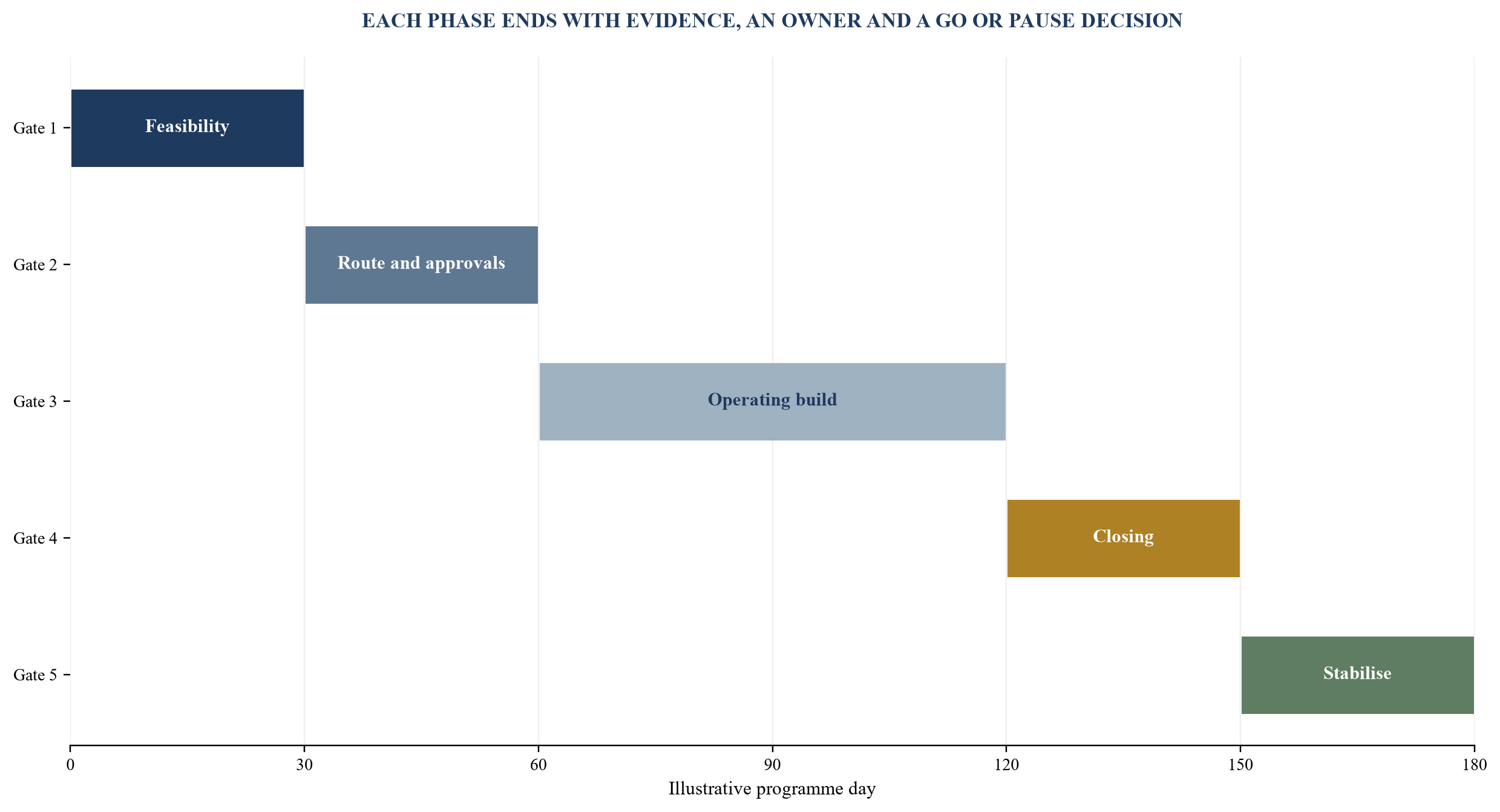
The timing is a management assumption for programme design. Statutory and regulatory deadlines must be confirmed for the chosen route.
Table 6. Implementation owners and evidence gates
| Phase | Core output | Executive owner | Approval gate |
|---|---|---|---|
| days 0 to 30 | legal feasibility, destination shortlist, entity and dependency map | CEO and general counsel | board confirms viable route and fallback |
| days 31 to 60 | route selection, approvals, lender and critical-consent plan | programme sponsor | steering committee confirms approval path |
| days 61 to 90 | articles, governance, tax, banking, people and data designs | CFO and COO | design authority closes material gaps |
| days 91 to 120 | signed or escrowed documents, system build and cutover rehearsal | programme director | critical dependencies green or mitigated |
| days 121 to 150 | continuation filing, effective-time control and Day-One activation | general counsel | authorised closing certificate |
| days 151 to 180 | origin deregistration, register checks and operating stabilisation | COO and company secretary | board accepts closure and residual calendar |
| ongoing | filing, licence, covenant, tax and control monitoring | compliance committee | exceptions escalate under approved thresholds |
Timing and deliverables are management assumptions for programme design.
16. The board dashboard should measure readiness rather than activity
A long task list can create the appearance of progress while one unresolved consent threatens the entire move. The dashboard should focus on dependencies and evidence. A critical item is one whose failure can invalidate the legal route, breach financing, interrupt material revenue, block a licence, prevent payments, stop payroll or remove authority. Each critical item needs an owner, required evidence, target date, current status and contingency.
The board can use five status categories. Green means the required evidence exists and has been independently checked. Amber means a defined action is outstanding with a credible completion path. Red means the dependency can block or materially impair the move. Blue can identify an item that is legally post-continuation but must remain on the residual calendar. Grey means outside the transaction perimeter. Teams should avoid reporting percentage complete without explaining the status of critical dependencies.
The financial dashboard should show one-time professional and operational costs, recurring compliance costs, cash headroom, consent fees, refinancing cost, tax range, employee costs, systems cost and contingency. Savings or valuation benefits should be evidenced and sensitivity-tested. Commercial demand, future mandates and valuation uplift remain uncertain until supported by actual contracts, cash flows and market evidence.
The risk dashboard should cover legal route, creditor protection, regulatory approval, contract interruption, debt and security, tax, banking, people, data, IP, cyber, accounting and reputation. Each risk should have a specific trigger and response. "Legal risk" is too broad to manage. "Origin registrar will not issue evidence before lender consent" is a dependency that can be sequenced and escalated.
The board should receive a draft closing certificate at least one meeting before the intended effective date. The certificate should list conditions precedent, conditions subsequent, waived items, legal opinions, regulator approvals, lender consents, critical contract outcomes, bank readiness, licence status, insurance, tax registrations, governance documents, people readiness, data controls and system rehearsal. Any waiver should state the consequence, mitigation, owner and expiration.
17. The board decision rule
The board should proceed when the legal route is available, the origin and destination requirements align, creditor protection is satisfied, required approvals are achievable, critical contracts and financing can continue, governance is valid, and the Day-One operating model is funded and tested. The business case should remain acceptable under a conservative tax outcome and reasonable delay.
The board should pause when eligibility is unresolved, solvency evidence is incomplete, a critical regulator or lender has not provided a credible path, security priority cannot be preserved, a major customer can terminate, tax assumptions dominate the case, banking continuity is uncertain, or authority cannot be activated at effectiveness. A pause should have a defined remediation, owner, evidence standard and next decision date.
The board should reject the proposed route when origin law prevents outward continuation, the destination cannot license the activity, creditor protection is compromised, the structure depends on concealment or artificial conduct, operational continuity cannot be maintained, or the cost and risk exceed the strategic value. Rejection of one route can lead to a subsidiary, branch, holding-company or staged alternative.
The core conclusion is practical. Redomiciliation is valuable when continuity reduces transaction burden and the company deliberately revalidates every external system that recognises it. The board should select the route from verified law and business requirements, preserve contracts through clause-level triage, preserve lender rights through consent and perfection, align tax with functions, rebuild authority, protect banking and people, and close only when Day One has been rehearsed.
18. Limitations and professional-use boundary
Corporate continuation is jurisdiction-specific. The availability, legal effect, eligible entity types, regulator consents, creditor protections, document requirements, fees, processing times and post-continuation obligations can change. This paper reflects official sources available in August 2026. Current origin and destination law should be checked immediately before any board approval or filing.
Contract continuity depends on the actual document, governing law, facts and complete transaction sequence. Financing, security, tax, competition, labour, immigration, data-protection, intellectual-property, accounting and regulatory outcomes require specialist analysis. A certificate of continuation should not be treated as evidence that every commercial dependency has been satisfied.
All scores, thresholds, cost categories and programme periods in this paper are management assumptions for decision design. They are not forecasts, promised outcomes, statutory deadlines or evidence of a specific company's readiness. Comparator jurisdictions are included to improve the quality of questions and do not constitute a jurisdiction recommendation.
The analysis does not constitute legal, tax, regulatory, employment, immigration, data-protection, accounting, banking, investment or other professional advice. A company should obtain advice based on its origin law, proposed destination, constitutional documents, contracts, financing, assets, liabilities, licences, people, data, tax profile, ownership and operating model. Management remains responsible for approvals, implementation and evidence that the company operates as represented.
Sources and further reading
- UAE Legislation, Federal Decree-Law No. 32 of 2021 on Commercial Companies Official source
- UAE Legislation, Federal Decree-Law No. 37 of 2021 Concerning the Commercial Register Official source
- UAE Legislation, Federal Decree-Law No. 25 of 2025 Promulgating the Civil Transactions Law Official source
- UAE Legislation, Federal Decree-Law No. 50 of 2022 Promulgating the Commercial Transactions Law Official source
- ADGM Registration Authority, Guidance on Continuance into ADGM Official source
- ADGM, Regulations and Rules Official source
- ADGM Registration Authority, 2026 Commercial Legislation Amendments Official source
- DIFC Registrar of Companies, Continued Companies and Certificates of Continuation Official source
- DIFC, Companies Regulations 2018 Official source
- DIFC, Handbooks, Continuation Checklists and Corporate Action Templates Official source
- DMCC, Transfer a Business Official source
- RAK ICC, Transfer of Domicile and Continuation Official source
- UAE Legislation, Federal Decree-Law No. 47 of 2022 on Corporate and Business Tax Official source
- Federal Tax Authority, Business Restructuring Relief Guide CTGBRR1 Official source
- Federal Tax Authority, Corporate Tax General Guide Official source
- Federal Tax Authority, Free Zone Persons Guide CTGFZP1 Official source
- Federal Tax Authority, Transfer Pricing Guide CTGTP1 Official source
- Federal Tax Authority, Tax Resident and Tax Residency Certificate Guide TPGTR1 Official source
- UAE Legislation, Cabinet Resolution No. 85 of 2022 on Tax Residence Official source
- Central Bank of the UAE, Customer Due Diligence Rulebook Official source
- Central Bank of the UAE, Beneficial Ownership Identification and Verification Official source
- UAE Legislation, Federal Decree-Law No. 45 of 2021 on the Protection of Personal Data Official source
- ADGM Office of Data Protection, Guidance on Data Protection Regulations 2021 Official source
- UAE Legislation, Federal Decree-Law No. 33 of 2021 Regulating Labour Relations Official source
- UAE Legislation, Cabinet Resolution No. 1 of 2022 Executive Regulation of Labour Relations Official source
- UAE Legislation, Federal Decree-Law No. 36 of 2023 Regulating Competition Official source
- UAE Legislation, Cabinet Resolution No. 59 of 2026 Executive Regulation of Competition Official source
- UAE Legislation, Federal Law No. 4 of 2020 Regarding Securing the Rights in Movables Official source
- Accounting and Corporate Regulatory Authority of Singapore, Transferring a Foreign Entity Registration Official source
- Hong Kong Companies Registry, Company Re-domiciliation Regime Overview Official source
