

1. Define the investment decision before selecting the structure
The investment decision is whether the buyer can acquire lawful and durable control of a business, obtain reliable information, protect cash, fund operations, meet debt obligations and realise value through an executable exit. Country growth, strategic access and headline valuation are context. The board requires evidence that the legal and operating rights purchased will produce accessible cash under central and downside conditions.
The mandate should state the target perimeter, countries, sectors, licences, ownership sought, local-partner role, purchase-price currency, maximum cash commitment, proposed debt, minimum liquidity, required governance, integrity standard, protected matters and exit horizon. It should also identify the assumptions that can invalidate the transaction. Examples include a missing operating licence, undisclosed beneficial owner, prohibited foreign control, non-transferable concession, reliance on unofficial payments, inability to upstream cash or an acquisition-debt schedule unsupported by accessible cash flow.
Approval should proceed through evidence gates. An indicative offer can rely on bounded assumptions. Signing requires confirmed ownership, regulatory path, integrity clearance, financing and contractual protection. Closing requires satisfied conditions, verified funds flow, completed security and operational control. Post-close capital releases should follow licences, bank control, reporting, integration and compliance milestones.
The board should record pause and rejection conditions before competitive pressure rises. A transaction becomes difficult to stop after management has announced strategic intent, spent substantial diligence cost or negotiated exclusivity. Pre-agreed gates preserve decision quality.
2. Use the Africa Acquisition Pre-Commitment Framework
The framework has eight gates: jurisdiction permission, legal and beneficial ownership, governance and local-partner control, integrity and compliance, currency and cash mobility, acquisition-finance resilience, political and dispute protection, and exit executability. Each gate produces a factual conclusion, unresolved issues, contractual response, financing consequence, responsible owner and deadline.
The gates must be connected. A licence condition can determine the permitted shareholder. That shareholder can influence board rights, related-party contracts and bank mandates. Those rights can affect dividend approval and debt service. A treaty or political-risk policy can protect a defined sovereign action while leaving commercial currency depreciation or partner misconduct uncovered. An exit right can be economically meaningless when the buyer lacks a lawful transferee, valuation mechanism or accessible sale proceeds.
The analysis should be entity-specific. The target group may contain operating companies, licence holders, property companies, distribution entities, joint ventures and offshore holding companies. Each has its own shareholders, directors, accounts, taxes, currency, contracts, permits, creditors and cash. Consolidated accounts do not establish ownership or cash access.
The framework should remain active after completion. Licences, exchange controls, sanctions, beneficial ownership, political conditions, banking capacity and shareholder relationships can change. The original diligence file becomes a monitored control register rather than a closing archive.
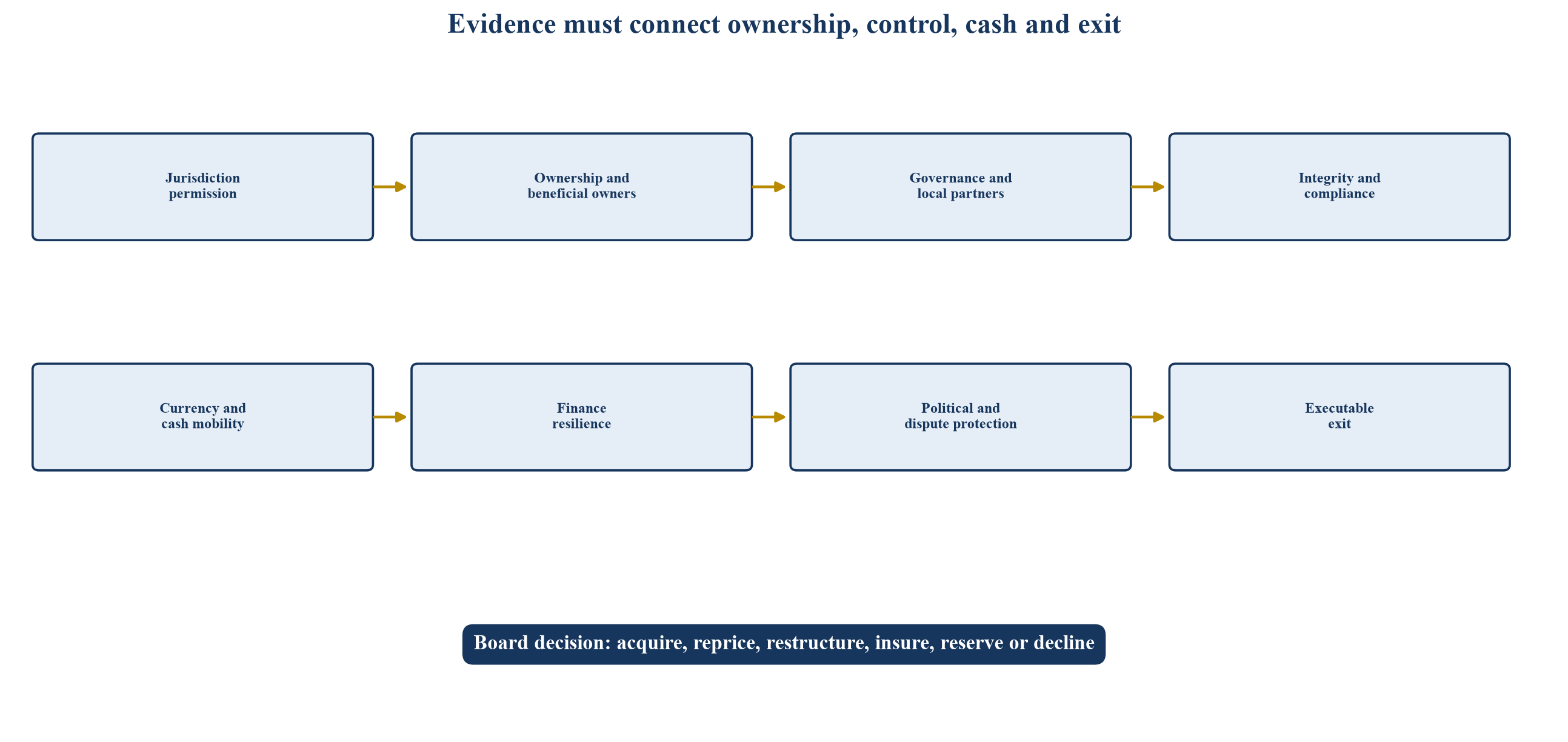
The framework is a proposed decision system and requires country-specific professional advice.
3. Treat Africa as a portfolio of distinct jurisdictions
The target cannot be diligenced through an Africa-wide legal conclusion. Incorporation, foreign ownership, land, exchange control, competition approval, sector licences, labour, tax, security, insolvency and dispute enforcement vary by country. Regional institutions and agreements matter, but their status, domestic implementation and practical administration must be tested in each relevant jurisdiction.
The country screen should identify the target's legal form, sector regulator, investment authority, central bank, competition authority, company registry, tax authority, land registry and courts or arbitral framework. It should state which rules apply to the acquisition, ongoing ownership, financing, dividend, related-party payment, refinancing and exit. Local counsel should distinguish enacted law, effective regulation, published guidance and observed administrative practice.
Macroeconomic averages also conceal material variation. The African Development Bank's 2026 outlook projects different growth paths across regions and highlights financing, inflation, exchange-rate and debt pressures.[1][2] The IMF's April 2026 regional outlook similarly emphasises country heterogeneity and significant downside risks.[3] These sources support a portfolio-level context; they do not replace target-country evidence.
The board should compare countries through a common diligence taxonomy while preserving local conclusions. A red flag in one jurisdiction should not contaminate an unrelated country automatically, and a favourable result in one country should not be transferred to another without evidence.
4. Verify the chain of legal ownership
The share register is the starting point, not the conclusion. The buyer should reconcile incorporation records, amendments, share certificates, allotments, transfers, shareholder agreements, nominee arrangements, pledges, options, convertible instruments, employee interests, probate matters and court orders. Every link from the operating company to the selling shareholder should be supported by valid documents and registry evidence where available.
The team should identify inconsistencies between statutory records, audited accounts, tax filings, licence applications, bank know-your-customer files and management representations. Historic reorganisations require particular care because a defective transfer, unpaid stamp duty or missing consent can create a title problem many years later. Informal founder arrangements may also sit outside the official register.
The purchase agreement should define the exact securities acquired and require delivery of title evidence, releases, waivers and updated registers. Conditions precedent should address missing approvals, liens, pre-emption rights and disputed holdings. Indemnities can allocate loss but may provide limited value when the seller lacks recoverable assets or a defect prevents lawful control.
The buyer should obtain a closing ownership memorandum that can be re-performed by an independent reviewer. It should identify the source, date and custodian of each fact and the residual risks that remain after completion.
5. Establish the ultimate beneficial owners and control relationships
Legal shareholders may not reveal the natural persons who ultimately own, control or benefit from the target. FATF guidance calls for adequate, accurate and up-to-date beneficial-ownership information and supports a multi-pronged approach using more than one source.[4] The buyer should therefore combine registers, corporate documents, declarations, bank records, litigation searches, credible public sources and direct interviews.
The analysis should trace ownership percentages, voting arrangements, nominee relationships, trusts, family links, powers of attorney, financing rights and de facto influence. It should identify politically exposed persons, sanctioned parties, public officials, state-related entities and close associates where legally relevant. A minority holder may exercise control through licence access, customer relationships, appointment rights, debt, land or operational dependence.
The buyer should reconcile beneficial owners with source of wealth and source of funds for material shareholders. Unexplained intermediaries, rapid transfers, circular ownership, bearer-like instruments, side letters and resistance to disclosure require escalation. The review should also cover key suppliers, agents and local partners when their relationships create integrity or continuity risk.
Completion should require a certified ownership schedule and continuing notification covenant. The target should maintain current information and notify changes before voting, payment or transfer. The buyer's monitoring should reflect the risks of the specific jurisdiction and relationship.
6. Confirm foreign-investment and sector permissions
Foreign ownership may be permitted generally and restricted in a specific sector, licence, asset class or region. The buyer should identify ownership caps, local-participation requirements, investment registration, minimum capital, national-security review, fit-and-proper tests, land restrictions, localisation obligations and approvals triggered by indirect control.
The analysis should distinguish approval of the acquisition from permission to operate after closing. A regulator may approve a change of control subject to capital, governance, employment, technology, data or service conditions. A concession or government contract may terminate or require consent. A beneficial-owner change can trigger a filing even when the immediate shareholder remains the same.
The AfCFTA Protocol on Investment was adopted in 2023 and contains investment-facilitation, sustainable-development and investor-obligation elements.[5] Its legal status and domestic effect should be verified for the jurisdictions involved. Bilateral treaties and comprehensive economic agreements require the same status check. A signed instrument that is not in force should not be treated as current protection.
The conditions schedule should identify authority, legal basis, submission, decision maker, timetable, dependencies, appeal and long-stop consequence. The financing plan must reflect the risk that approval is delayed, conditional or refused.
| Decision area | Evidence required | Failure consequence | Transaction response |
|---|---|---|---|
| Foreign ownership | Statute, regulation, licence and regulator confirmation | Unlawful control or forced restructuring | Change perimeter, partner structure or decline |
| Change of control | Filing, consent and timetable | Closing delay or licence breach | Condition precedent and long-stop right |
| Legal title | Registers, certificates, transfers and lien releases | Defective acquisition | Cure, escrow, reprice or decline |
| Beneficial ownership | Multi-source identity and control evidence | Integrity, sanctions or hidden-control risk | Enhanced diligence and closing condition |
| Land and key assets | Title, lease, consent and encumbrance searches | Loss of operating base or collateral | Separate asset remedy and value adjustment |
| Exit transfer | Transfer rules, pre-emption and approval path | Trapped investment | Put, tag, buyer criteria and alternative exit |
The matrix is illustrative and requires current country-specific legal advice.
7. Diligence the local partner as an operating dependency
A local partner can contribute market knowledge, licences, land access, relationships, distribution and credibility. The same relationship can create hidden control, related-party leakage, key-person dependence and compliance exposure. The buyer should value the partner's contribution as a documented operating capability rather than a general statement of access.
The diligence should map every function that depends on the partner: permits, customers, suppliers, banks, government interfaces, staff, premises, data and dispute management. Each dependency needs a contract, service standard, substitute route and transition plan. Payments to the partner or related entities should have defined services, arm's-length pricing, invoice evidence and approval controls.
The shareholder agreement should address board appointment, quorum, reserved matters, budgets, information, bank mandates, related-party transactions, dividends, transfer, default, deadlock, non-compete, confidentiality and dispute resolution. Reserved matters should protect value without making routine operations unmanageable. The buyer needs practical access to systems, people and records, not only veto rights.
The partner relationship should be tested under disagreement, incapacity, regulatory investigation and attempted exit. A partnership that works only while personal trust remains strong is not a complete control system.
8. Map formal and informal governance
The board pack may show a conventional governance structure while decisions occur through founders, family councils, government relationships or dominant customers. Diligence should compare constitutional documents and policies with observed practice. Interviews, approval samples, bank instructions, contract files, internal audit reports and meeting minutes help reveal where authority actually sits.
IFC's Corporate Governance Methodology assesses board structure, disclosure, minority treatment, control environment, stakeholder engagement and commitment to governance.[6] The buyer can use these dimensions to grade current practice and design a post-close improvement plan. The assessment should reflect the company's ownership type and complexity.
The buyer should identify who appoints executives, approves cash, sets prices, selects suppliers, hires relatives, negotiates with regulators and controls data. It should review conflicts, related-party transactions, whistleblowing, internal audit and external-auditor independence. The analysis should include subsidiaries and joint ventures where value or cash is concentrated.
The closing governance package should assign decision rights from day one. It should include the board calendar, committee terms, delegated authorities, bank mandates, reporting timetable, conflict procedures and reserved-matter thresholds. Gaps that cannot be closed immediately need an action plan and capital-release consequence.
9. Convert governance rights into cash control
Board representation does not automatically control cash. The buyer should map every material bank account, signatory, payment platform, cash collection route, treasury arrangement, mobile-money channel and petty-cash process. It should identify accounts held outside the group, informal customer collections, supplier netting and related-party settlements.
The closing plan should establish dual authority, approved banks, payment thresholds, vendor verification, beneficiary-change controls, reconciliations and daily liquidity visibility. The buyer should preserve enough local autonomy for operations while requiring independent evidence for high-risk transactions. Emergency payments need a logged process rather than informal override.
Cash control also depends on accounting integrity. The buyer should test revenue recognition, receivable existence, inventory, payroll, tax, manual journals and consolidation. A profitable target can consume cash through undocumented advances, related-party balances, disputed receivables or unrecorded obligations. Completion accounts and locked-box protections require reliable source records.
The acquisition lender should receive reporting that reconciles local accounts, cash, debt, upstreaming and covenant calculations. A consolidated number without entity and currency detail can conceal a shortfall at the debt-service entity.
10. Run integrity diligence as a value and continuity test
Integrity diligence should cover shareholders, directors, executives, agents, key suppliers, government counterparties and material customers. It should investigate corruption, fraud, sanctions, money laundering, tax evasion, procurement misconduct, human-rights issues, litigation, debarment and adverse regulatory history. IFC describes integrity due diligence as critical to working with reputable and sustainable partners.[7]
The team should review how licences, public contracts, customs clearances, tax settlements and land rights were obtained. High-risk commissions, success fees, cash payments, charitable contributions, gifts, politically connected intermediaries and unexplained consulting contracts require evidence. A warranty does not repair a licence obtained through misconduct or preserve a public contract after an investigation.
Findings should be linked to valuation, financing, insurance, contract rights and post-close controls. The buyer may require termination of an agent, remediation of books, voluntary disclosure, enhanced monitoring, escrow, indemnity or exclusion of an asset. Some findings should cause the transaction to stop because the legal, reputational or continuity risk cannot be bounded.
The diligence record should separate substantiated facts, unresolved allegations and management explanations. Decision makers need the evidence and limitation behind each conclusion.
11. Verify customer and government revenue
Revenue concentration can become political or compliance risk when the target depends on government, state-owned enterprises, licences, concessions or public procurement. The buyer should validate contract award, authority, budget, performance, invoicing, acceptance, disputes, arrears and termination rights. Renewal probability should be treated as an assumption until supported.
Government receivables may have long or uncertain collection periods. The model should distinguish recognised revenue, approved invoices, disputed amounts and collected cash. It should test whether assignment, factoring or security is allowed. Public counterparties may have sovereign immunity or special dispute rules, and a state-owned entity is not automatically backed by the state.
Private customers require similar work on ownership, credit, currency, termination and related parties. A customer introduced by the local partner may not remain after a governance dispute. Customer interviews and contract confirmations can test the commercial relationship without compromising confidentiality.
The investment case should show value before uncommitted renewals and identify the cash effect of losing the largest customer. Purchase-price mechanisms, earn-outs and seller retention can allocate uncertainty when the evidence cannot support full value at closing.
12. Build a country-by-country currency ledger
The group should be modelled by transaction currency, functional currency, debt currency, tax currency, dividend currency and buyer reporting currency. Revenue may be priced in dollars while collected in local currency. Costs may reprice faster than contracts. Cash can exist in a bank account without being legally convertible or practically transferable.
The currency ledger should show opening cash, operating receipts, payments, tax, capital expenditure, local debt, distributable amount, conversion requirement, approval, bank route, expected delay, rate and final hard-currency receipt. It should identify official and permitted market mechanisms. Informal conversion routes should not support valuation or debt service.
The IMF's 2026 regional outlook reports significant heterogeneity and continued exposure to exchange-rate and financing shocks.[3] The AfDB also identifies exchange-rate depreciation and market volatility as risks to fiscal and debt conditions.[2] These observations support scenario design; target-country treasury evidence determines the actual assumption.
Natural hedges, local-currency borrowing, pricing clauses and hard-currency revenue can reduce mismatch. The board should test availability, cost, counterparty and timing rather than assuming a theoretical hedge can be executed at modelled terms.
13. Separate convertibility, transferability and depreciation
Currency risk has distinct components. Depreciation changes value. Inconvertibility prevents lawful conversion of local currency into an approved hard currency. Transfer restriction prevents the movement of hard currency outside the host country. Bank liquidity, documentation and administrative delay can also obstruct cash without a formal prohibition.
MIGA describes coverage for losses caused by government action or inaction that prevents legal conversion or transfer; its product does not cover currency depreciation.[8][9] The buyer should understand covered events, waiting periods, exclusions, documentation, subrogation and eligible investment. Commercial bank delay, insufficient local cash, tax disputes or incomplete paperwork may fall outside cover.
The model should apply separate assumptions for exchange rate, conversion availability, transfer timing and cost. A 20 percent depreciation with immediate transfer produces a different debt-service outcome from a stable rate with six months of trapped cash. The liquidity reserve should address timing even when value is protected eventually.
The sale agreement and financing documents should allocate pre-closing trapped cash, post-closing conversion restrictions and hedge settlements. The buyer should avoid paying full hard-currency value for cash that cannot be accessed.
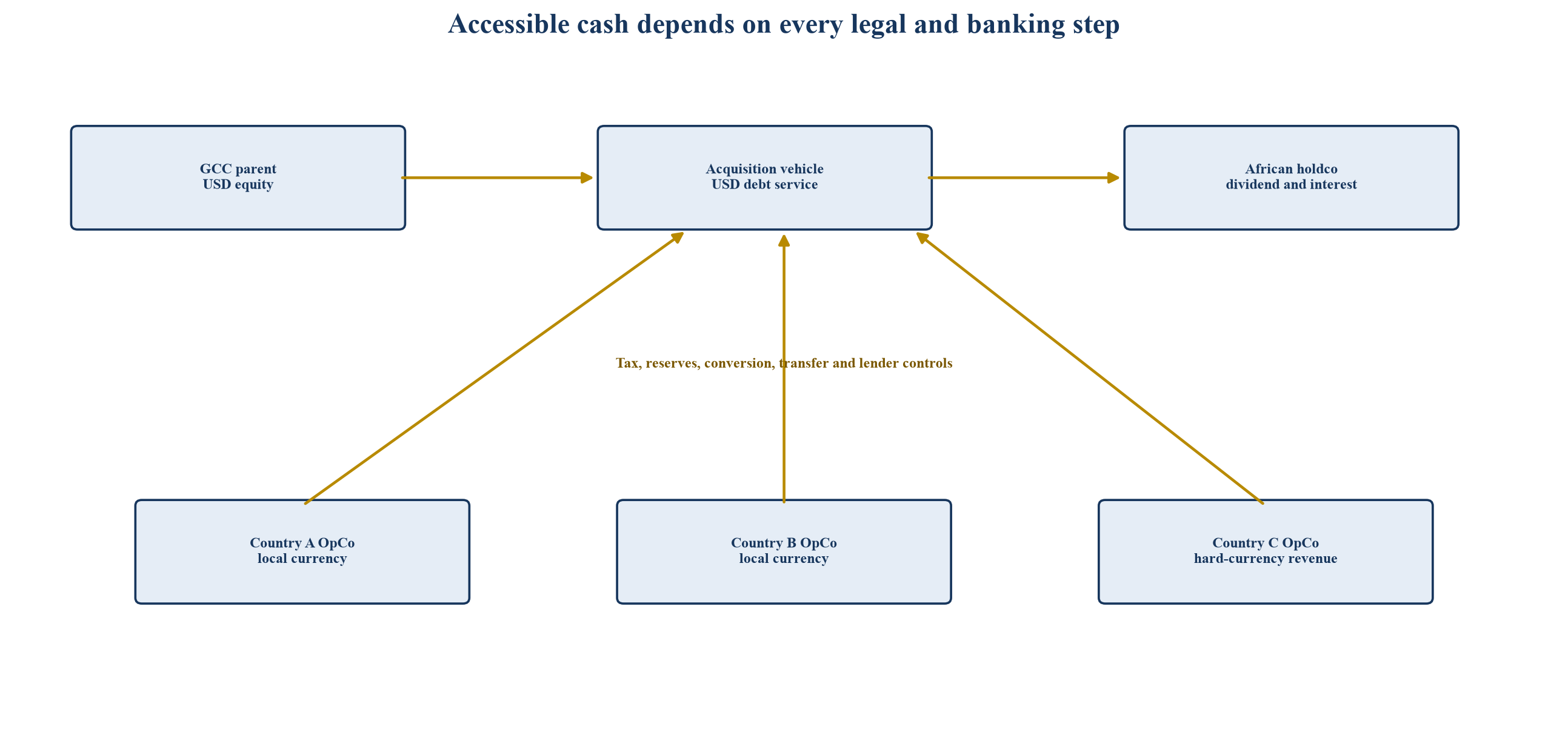
The entities, amounts and flows are hypothetical management assumptions.
14. Prove each lawful cash-extraction route
The buyer should model dividends, intercompany interest, service fees, royalties, loan repayment, capital reduction and asset sale separately. Each route needs a legal basis, transfer-pricing support, tax treatment, approval, documentation, bank process, timing and covenant status. A route used in one country may be unavailable or costly in another.
Dividends require distributable reserves, accounts, solvency, board or shareholder approval and sometimes regulatory consent. Interest requires valid debt, arm's-length terms, deduction capacity and withholding analysis. Service and royalty payments require genuine benefit, documentation, pricing and any required registration. Capital reductions can take longer and may require creditor protection.
The model should begin with local operating cash and deduct tax, working capital, maintenance capital expenditure, licence capital, local debt service, restricted cash and prudent reserves. It should then apply legal and tax leakage before calculating cash received by the acquisition borrower. Consolidated free cash flow is not a substitute for this bridge.
Management should maintain at least two lawful routes where practical. Dependence on a single annual dividend can create debt-service timing risk. The financing package may need a reserve or parent support while the distribution cycle matures.
| Route | Required evidence | Principal risk | Model treatment |
|---|---|---|---|
| Dividend | Reserves, solvency, accounts, approvals and bank documents | Timing, restriction and withholding | Use only after lawful distribution date |
| Intercompany interest | Registered debt, pricing, deduction and withholding analysis | Recharacterisation or blocked payment | Apply caps, tax leakage and covenant limits |
| Service fee | Actual service, benefit, invoice and transfer pricing | Disallowance or integrity concern | Include only evidenced recurring services |
| Royalty | Owned or licensed IP, registration and arm's-length rate | Licence challenge or high withholding | Scenario until documentation is complete |
| Loan repayment | Valid principal, cash and approval | Priority dispute or capital-control restriction | Separate principal from income return |
| Capital reduction or sale | Corporate process, creditor protection and buyer funds | Long timetable and approval uncertainty | Treat as exit or exceptional liquidity |
Availability and tax treatment require current entity-specific advice.
15. Size acquisition debt from upstreamable cash
Acquisition debt should be sized from cash that can lawfully and practically reach the borrower after local obligations. EBITDA, consolidated free cash flow and local bank balances are diagnostic measures. Scheduled interest and principal require cash at the debt-service account on the due date.
The financing model should include country and entity bridges, distribution dates, withholding, conversion delay, reserve requirements and covenant restrictions. It should identify hard-currency revenue and natural hedges. Debt denomination should follow accessible cash, and local working capital should be funded locally where feasible to avoid competing with acquisition debt.
The capital structure should preserve flexibility for regulatory delay, customer loss, depreciation and trapped cash. Lower leverage, longer grace, sculpted amortisation, cash reserves, permitted local facilities and parent cure rights can improve resilience. A cheap bullet can create severe refinancing risk if the exit market is uncertain.
Lenders should receive the same ownership, licence, governance, currency and integrity findings as the investment committee. Security and guarantees cannot compensate for an operating model that lacks cash mobility. Debt documents should define permitted distributions and local liquidity in a way that remains operationally viable.
16. Model a correlated downside rather than isolated sensitivities
The hypothetical transaction assumes a USD 180 million enterprise value for a regional services platform. The buyer acquires 70 percent and funds USD 160 million of total uses through USD 90 million of equity and USD 70 million of debt. The target produces USD 32 million of EBITDA and USD 21 million of cash before distributions. Central-case deductions for tax, maintenance investment, working capital and local reserves leave USD 14.0 million upstreamable.
Annual debt service is assumed at USD 9.5 million, producing 1.47-times central coverage. The correlated downside combines 15 percent local-currency depreciation, a 90-day conversion delay, two percentage points of additional tax and transfer leakage, USD 2.0 million more local liquidity retention and a 10 percent decline in revenue from one government customer. Upstreamable cash falls to USD 7.8 million and coverage to 0.82 times.
The remedial structure reduces acquisition debt to USD 55 million, funds more working capital locally, holds a USD 6 million debt-service reserve, diversifies distributions and obtains eligible political-risk protection. Assumed annual debt service falls to USD 8.0 million and upstreamable cash recovers to USD 9.4 million, producing 1.18-times coverage.
All values are hypothetical management assumptions. The model demonstrates method and does not estimate a real company or market.
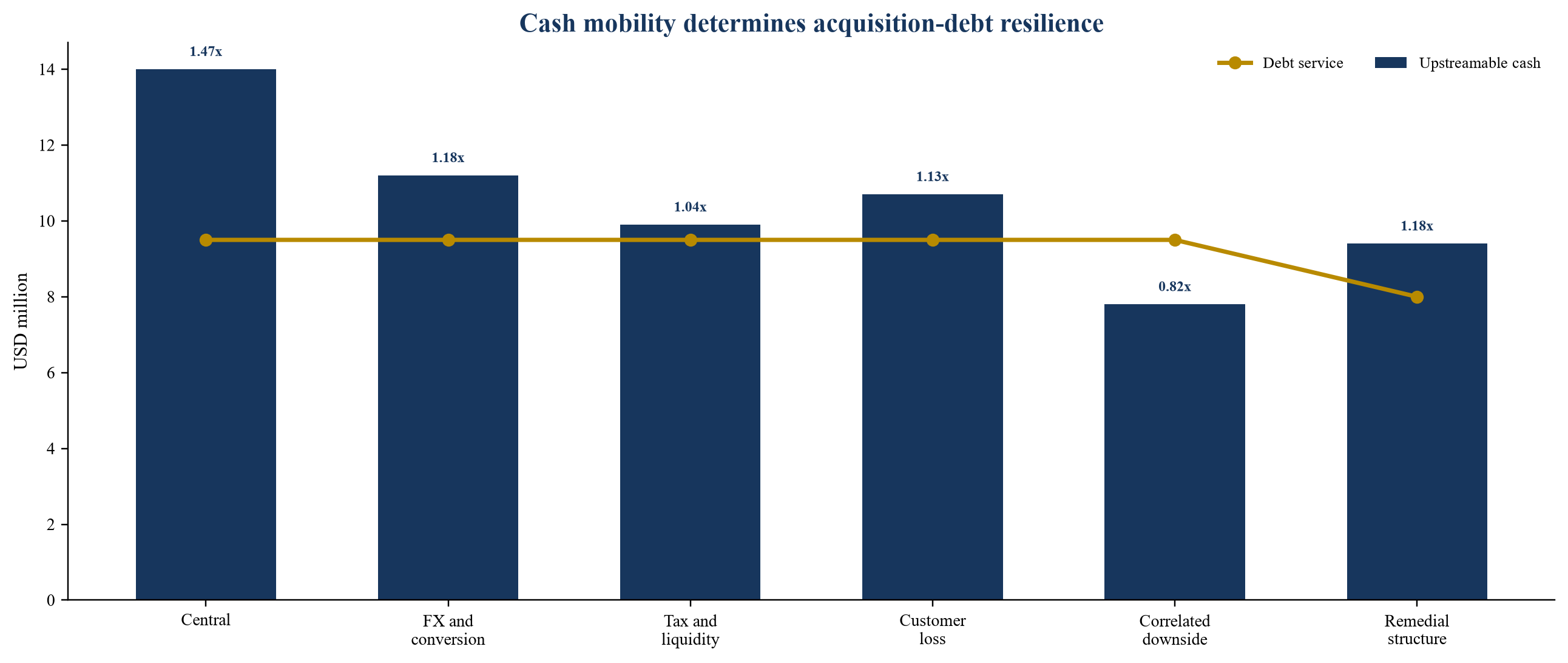
All values are hypothetical management assumptions and are not forecasts.
17. Build the security package around enforceable recovery
The security map should identify shares, bank accounts, receivables, property, equipment, licences, insurance, intercompany claims and material contracts by owner and jurisdiction. Each item needs a security instrument, perfection step, priority, consent, enforcement route and expected net recovery. A group-level statement that assets are secured is insufficient.
Local law may constrain upstream guarantees, financial assistance, corporate benefit, security over regulated assets, foreign-currency obligations or enforcement by a foreign lender. The target's directors may owe duties that prevent unrestricted support for acquisition debt. Minority shareholders and existing creditors can also limit the available package.
Share security can provide control value when the licence and ownership remain transferable after enforcement. Asset security may disrupt operations or require regulatory approval. Account control is useful only when collections enter the controlled account. Receivables security depends on valid invoices, assignment rules and customer set-off.
The lender should receive legal opinions, filings, releases and a post-closing completion register where appropriate. Recovery values should incorporate time, tax, employee claims, prior liens, continuity cost and forced-sale discount. Security supports repayment discipline; it does not create cash flow.
18. Use political-risk protection for defined sovereign perils
Political-risk insurance and guarantees can address specified events such as expropriation, transfer restriction, breach of contract, war, civil disturbance and non-honouring by eligible public obligors.[8] The buyer should identify the precise exposure, insured party, investment, host country, tenor, waiting period, exclusions, claim evidence and recovery process.
Coverage should be aligned with the legal structure and cash flows. An offshore holding company, shareholder loan, acquisition facility and operating equity may have different eligibility. The policy should recognise material restructurings, refinancing and permitted transfers. The buyer should understand how local remedies, arbitration, subrogation and consent obligations affect a claim.
Political-risk cover does not replace commercial diligence. It may exclude depreciation, ordinary counterparty default, management fraud, voluntary breach, pre-existing disputes or losses caused by the insured party. Deductibles and delayed payment still require liquidity. The model should show gross loss, uninsured portion, timing and debt-service effect.
Insurance value should be compared with structural alternatives: smaller exposure, local financing, diversified countries, reserve accounts, phased acquisition, minority entry or contractual options. The investment committee should approve the combination that addresses the actual risk at acceptable cost.
19. Preserve treaty and dispute rights without overstating them
Investment treaties and national laws may provide substantive and procedural protections. Availability depends on the instrument's status, investor nationality, investment definition, ownership, substantial business activity, timing, exclusions and compliance with host-state law. The buyer should not restructure solely around a treaty conclusion without tax, governance and anti-abuse analysis.
The AfCFTA investment protocol includes defined scope, investor obligations and state regulatory space.[5] Bilateral instruments vary, and some signed agreements are not yet in force. Counsel should verify the exact text, dates, reservations, termination and dispute provisions for the proposed structure.
Commercial contracts should specify governing law, forum, service, interim relief, evidence, language and enforcement. Arbitration can provide a neutral process while enforcement against assets remains a separate task. Government and state-owned counterparties require analysis of authority, immunity and waiver.
The diligence file should include a dispute map for shareholder, seller, partner, customer, regulator, lender and state-related claims. Each route should identify remedy, forum, timetable, cost, asset location and operational consequence. A theoretical claim with no practical recovery should not support value.
20. Integrate tax, transfer pricing and substance
The acquisition structure should be tested on purchase taxes, capital gains, withholding, interest deductions, transfer pricing, indirect taxes, permanent establishment, controlled foreign company rules and exit tax. The model should show cash tax by entity and distinguish confirmed treatment from positions requiring ruling, election or future evidence.
Intermediate holding companies need legitimate commercial purpose, governance, people, records and decision-making appropriate to their functions. Treaty access and beneficial ownership are fact-dependent. The buyer should avoid assuming that incorporation in a familiar jurisdiction delivers the intended tax or investment protection.
Intercompany loans, services, royalties and guarantees should have written terms, arm's-length pricing and actual conduct. The target should be able to produce invoices, benefit evidence, allocation keys and approvals. Related-party payments can attract scrutiny and create reputational risk when the local business carries cost without demonstrable value.
The investment committee should review after-tax upstreamable cash, not only the accounting tax rate. A structure with a lower nominal rate can produce less accessible cash after withholding, trapped losses, compliance cost and distribution delay.
21. Diligence environmental, social and community liabilities
The buyer should assess land acquisition, resettlement, labour, health and safety, community impacts, pollution, water, biodiversity, security arrangements and supply-chain practices. OECD guidance sets out a risk-based due-diligence process for identifying, preventing, mitigating, tracking and communicating adverse impacts.[10] IFC Performance Standards provide another established reference for environmental and social risk management.[11]
Historic liabilities can survive a share acquisition and affect licence, operations, financing and exit. The team should review permits, incidents, remediation, worker claims, community grievances and independent assessments. Reliance on legal compliance alone may miss operational or stakeholder risks that can interrupt the business.
The action plan should identify immediate conditions, funded remediation, monitoring and accountable executives. Material issues should be reflected in price, escrow, insurance, indemnity and capital expenditure. Some impacts require engagement and remedy rather than a simple contractual allocation to the seller.
The buyer should align public commitments with verified data. Unsupported ESG claims can create regulatory, financing and reputation exposure. Reporting should distinguish baseline, target and independently verified outcome.
22. Design the information and data-control architecture
The buyer needs reliable access to financial, operational, customer, regulatory and compliance data. Diligence should identify systems, ownership, hosting, cybersecurity, privacy, data localisation, licences, integrations and manual workarounds. A founder-controlled spreadsheet or outsourced platform can be a critical operating dependency.
The closing plan should define data access, administrator rights, backups, incident response, retention and separation from seller systems. Customer and employee data transfers require lawful basis and appropriate safeguards. Cross-border access may be restricted even when the buyer owns the company.
Management reporting should reconcile local ledgers to group accounts and cash. The minimum pack should include profit and loss, balance sheet, cash flow, bank reconciliation, receivables, payables, tax, debt, covenants, licence status, related parties and compliance incidents. Data quality exceptions should be visible and time-bound.
Technology can improve control while creating concentration risk. The buyer should test system outage, cyber incident, administrator departure and vendor termination. A transaction should not rely on future digital transformation to make currently unverifiable cash or ownership evidence reliable.
23. Protect key people and operating knowledge
The target may depend on a founder, government-relations executive, technical licence holder, sales leader or local partner. The buyer should identify the decisions, relationships, credentials and knowledge held by each person. Retention value should be linked to documented responsibilities and transition deliverables.
Employment contracts, incentives, restrictive covenants, change-of-control rights and succession should be reviewed under local law. A retention payment cannot cure an unethical relationship or replace a required professional licence. The buyer should distinguish genuine institutional capability from access concentrated in one individual.
The first 100 days should transfer authority, customer knowledge, regulatory calendars, bank processes, supplier terms and incident history. Deputies should be appointed and systems documented. Board oversight should monitor key-person concentration until the operating model becomes repeatable.
The downside model should include the loss of key people and related revenue or delay. Seller rollover and earn-out can support transition when aligned with governance and compliance. Incentives should avoid rewarding short-term revenue obtained through unacceptable conduct.
24. Test exit routes at entry
Exit diligence should identify strategic sale, sponsor sale, local listing, international listing, partner buyout, put, recapitalisation and orderly wind-down. Each route needs a plausible buyer universe, transfer permission, regulatory process, valuation method, financing path, tax treatment, currency conversion and timetable.
Shareholder documents should address pre-emption, rights of first refusal, tag, drag, put, call, deadlock and default. Rights should include notice, valuation, payment security and enforcement. A put against an undercapitalised partner has little economic value. A drag right can fail when the licence requires local ownership or regulator approval.
The buyer should test whether the holding structure remains attractive to a future purchaser and whether security can be released. Data quality, audited accounts, compliance history and environmental liabilities affect saleability. Exit preparation begins during integration through clean governance and evidence.
Sale proceeds require their own cash-mobility analysis. The model should identify whether proceeds are received onshore or offshore, in which currency, subject to which tax and transferable through which bank process. Political-risk cover may not protect a voluntary sale at a depreciated rate.
| Exit route | Required conditions | Principal blockage | Pre-entry protection |
|---|---|---|---|
| Strategic sale | Transferable licence, clean title, buyer approval and audited data | Foreign-control or competition restriction | Pre-clear buyer categories and consent path |
| Sponsor sale | Financeable cash flow, governance and management depth | Trapped cash or weak controls | Build lender-grade reporting and cash bridge |
| Local listing | Eligible issuer, free float, governance and market liquidity | Limited depth or timetable | Early exchange and adviser assessment |
| Partner buyout | Funded buyer, valuation and enforceable payment | Counterparty lacks finance | Security, instalment protection and fallback buyer |
| Put or call | Clear trigger, price and enforcement | Illiquid obligor or dispute | Guarantee, escrow or third-party funding |
| Recapitalisation | Debt capacity and dividend permission | Conversion or distribution limits | Local debt options and reserve planning |
Ratings should be replaced with transaction-specific evidence.
25. Use a risk heat map tied to actions
The risk register should separate probability, severity, detectability, timing and controllability. A low-probability licence cancellation may deserve more attention than a frequent but small working-capital variance. Each rating should cite evidence and identify the person authorised to change it.
Risks should be assigned to price, contract, financing, insurance, integration or rejection. Title defects require cure. Cash-transfer delays require reserve and timing responses. Customer concentration affects value and earn-out. Partner dependence affects governance and substitution. Political perils may support insurance. Unbounded integrity risk may require the buyer to decline.
The register should record leading indicators: licence deadlines, bank conversion queue, payment delay, related-party balances, customer renewal, audit exceptions, employee departures and community grievances. The board needs trends and trigger breaches rather than a static closing score.
Risk acceptance should identify the approving body, rationale, exposure cap and review date. A residual risk that cannot be measured should remain open. Competitive tension should not convert missing evidence into a favourable assumption.
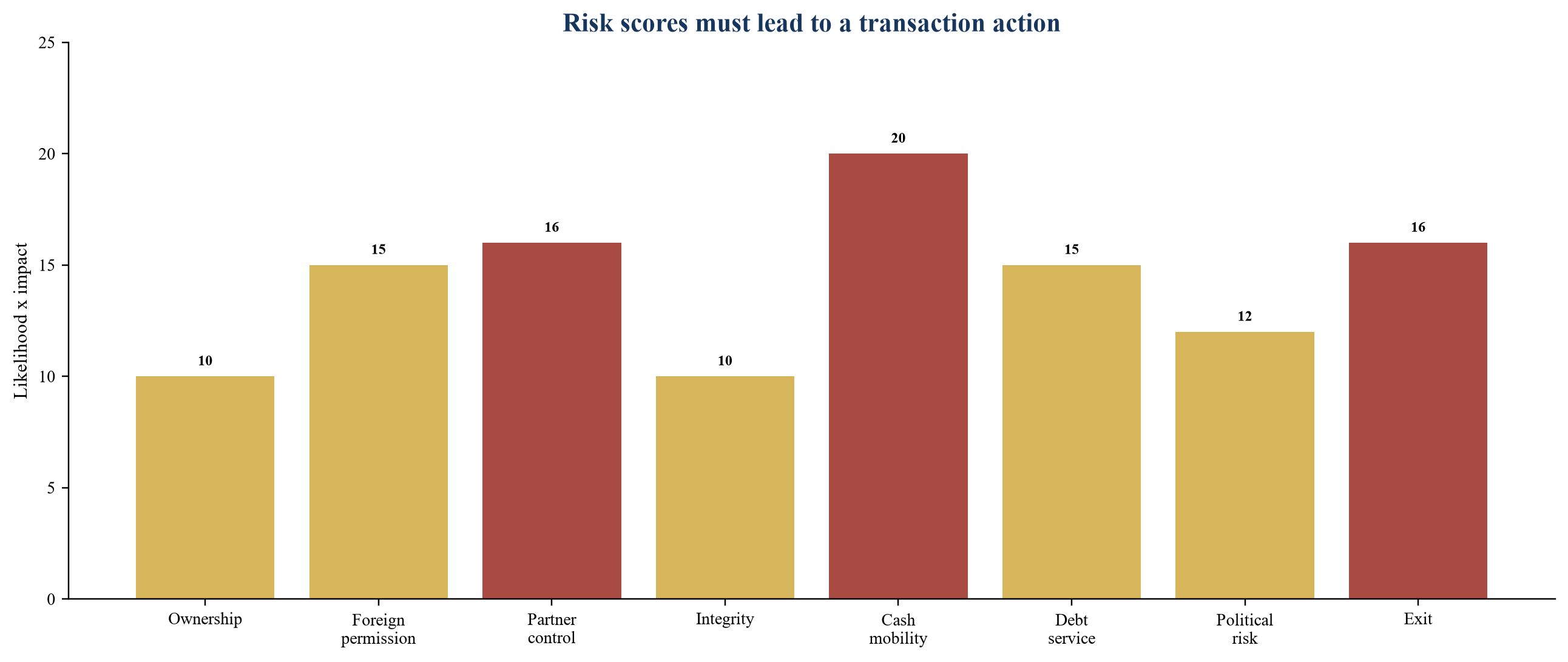
Scores are hypothetical and should be replaced by transaction evidence.
26. Sequence diligence around value-threatening questions
The first phase should answer permission, ownership, beneficial ownership, integrity, licence, cash mobility and customer concentration. These issues can invalidate the transaction and should precede detailed optimisation. The buyer should avoid spending weeks on integration design while a fundamental control or cash question remains unresolved.
The second phase should verify financial quality, tax, operations, people, technology, environmental and social matters, financing and security. Findings should update the model continuously. Diligence streams should share a common issue log so a legal restriction that affects revenue, cash or debt appears in every relevant work product.
The third phase should convert findings into price, conditions, covenants, indemnities, escrow, insurance, reserves and post-close actions. Every proposed remedy should be tested for practical enforceability and seller capacity. A long list of warranties can create false comfort when recovery is unlikely.
The investment committee should receive a short decision book supported by the full evidence room. It should distinguish verified facts, hypothetical management assumptions and unresolved questions. Each unresolved question needs a maximum exposure and a decision consequence.
27. Build a 180-day execution roadmap
Days 1 to 30 should define the investment mandate, country and sector screen, target perimeter, buyer return requirements and rejection conditions. Days 31 to 60 should complete ownership, beneficial-owner, licence, partner, integrity and cash-mobility screens before a binding value position.
Days 61 to 90 should complete confirmatory financial, commercial, tax, operational, environmental, social and technology diligence. The team should build entity and currency cash bridges, identify security and political-risk options, and test central and correlated downside cases.
Days 91 to 120 should negotiate the purchase agreement, shareholder arrangements, financing, insurance and regulatory submissions. Days 121 to 150 should finalise approvals, closing evidence, bank mandates, reporting, integration controls and the first 100-day budget. Days 151 to 180 should close only when conditions are met, then verify ownership, cash, licences, governance and systems in operation.
Milestone funding preserves leverage. Deferred consideration, seller rollover or phased acquisition can address evidence that matures after closing. The board should avoid releasing value merely because the calendar reached a target date.
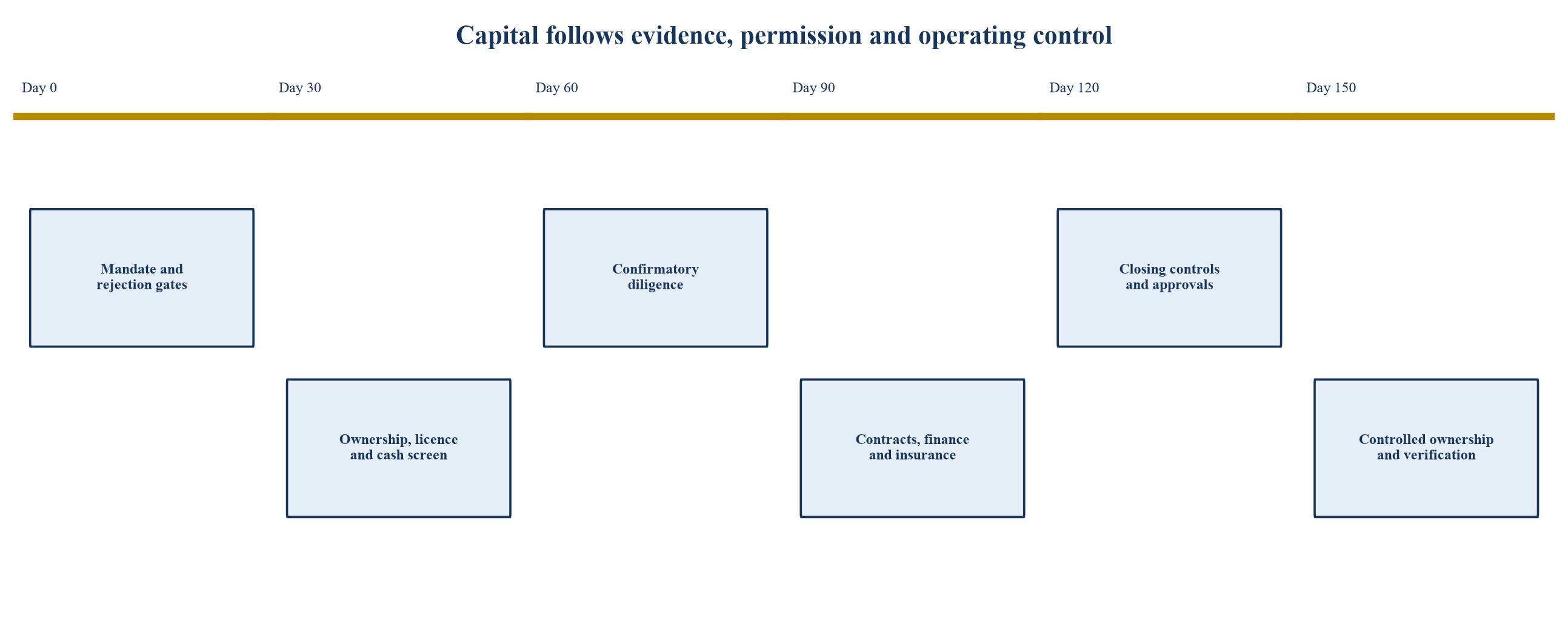
The sequence is illustrative and should be adapted to transaction and regulatory timetables.
28. Govern the first 100 days as a control transfer
The first 100 days should verify that contractual rights operate in practice. The buyer should confirm registers, licences, board appointments, bank mandates, cash balances, customer ownership, employee authority, systems access, tax status, insurance and security. Any difference from the closing file should be escalated immediately.
The operating plan should prioritise cash visibility, compliance, customer continuity, people retention and regulatory relationships. Cost reduction and integration should follow an understanding of local dependencies. Rapid centralisation can disrupt collections, licences or customer trust when it removes functions before substitutes are ready.
The governance calendar should include weekly liquidity, monthly performance, quarterly risk and licence reviews, and board approval for related parties, capital expenditure, financing and distributions. Internal audit should test high-risk cash, procurement and agent processes early.
Seller and partner obligations should be tracked against escrow, earn-out and transition payments. A missed deliverable should lead to a documented remedy. The buyer should preserve evidence for warranty, insurance and dispute claims while maintaining operational continuity.
29. Use an investment memorandum that can reject the acquisition
The final memorandum should state what the buyer is acquiring, why value exists, how legal control is obtained, where cash is generated, how it reaches debt and shareholders, which political and commercial risks remain, and how the investment can be exited. It should show evidence by entity, country, currency and date.
The committee should receive the ownership chart, beneficial-owner file, permission matrix, partner-dependency map, governance assessment, integrity findings, customer evidence, entity cash bridges, tax analysis, security package, political-risk options, dispute map, environmental and social plan, downside model and exit matrix. Assumptions should be visibly separated from verified facts.
Approval should specify maximum purchase price, equity, debt, reserve, conditions, insurance, governance rights and post-close capital. It should identify matters delegated to management and matters that require renewed committee approval. Waivers should record evidence, exposure and compensating control.
The governing principle is that ownership, control, cash and exit must reconcile. A strategic market position has limited value when the buyer cannot lawfully control the business, access its cash or sell its interest. Disciplined pre-commitment diligence converts regional ambition into a bounded transaction decision.
| Approval area | Evidence required | Committee decision |
|---|---|---|
| Ownership and permission | Clean title, beneficial owners, foreign-control and licence path | Approve perimeter or require cure |
| Governance and partner | Board, information, cash, related-party and substitution controls | Approve rights and transition plan |
| Integrity and conduct | Risk-based diligence, agent and public-contract evidence | Remediate, protect or decline |
| Currency and cash | Entity bridges, conversion, transfer, tax and reserve | Approve accessible cash assumptions |
| Financing and security | Upstreamable cash, covenants, guarantees and enforceability | Size debt and liquidity reserve |
| Political and dispute risk | Cover, treaty status, contract forum and recovery route | Insure, restructure or accept capped risk |
| Exit | Transfer permission, buyer routes, valuation and proceeds mobility | Approve exit plan and protections |
| Implementation | Conditions, 100-day controls, owners and budget | Release capital by milestone |
The checklist supports governance and does not replace specialist advice.
Sources
- African Development Bank, African Economic Outlook 2026, 26 May 2026. Read the primary source
- African Development Bank, Africa's growth holds firm amid global turbulence, 26 May 2026. Read the primary source
- International Monetary Fund, Regional Economic Outlook for Sub-Saharan Africa: Hard-Won Gains Under Pressure, April 2026. Read the primary source
- Financial Action Task Force, Guidance on Beneficial Ownership of Legal Persons, 10 March 2023. Read the primary source
- UNCTAD Investment Policy Hub, Protocol on Investment to the Agreement Establishing the AfCFTA, adopted 19 February 2023. Read the primary source
- International Finance Corporation, Corporate Governance Methodology Tools. Read the primary source
- International Finance Corporation, IFC's Due Diligence Process. Read the primary source
- Multilateral Investment Guarantee Agency, MIGA Investment Guarantee Guide, 30 May 2023. Read the primary source
- Multilateral Investment Guarantee Agency, Currency Inconvertibility and Transfer Restriction Product. Read the primary source
- OECD, Due Diligence for Responsible Business Conduct. Read the primary source
- International Finance Corporation, Performance Standards on Environmental and Social Sustainability. Read the primary source
- African Export-Import Bank and AfCFTA Secretariat, Operational Roll-out of the Pan-African Payment and Settlement System, 28 September 2021. Read the primary source
- African Export-Import Bank, Pesalink and PAPSS Unlock Cross-Border Payments in Local Currencies in Kenya, 26 February 2026. Read the primary source
- Financial Action Task Force, Guidance on Beneficial Ownership and Transparency of Legal Arrangements, 11 March 2024. Read the primary source
- Financial Action Task Force, The FATF Recommendations. Read the primary source
- International Finance Corporation, Corporate Governance Development Framework. Read the primary source
- OECD, Responsible Business Conduct. Read the primary source
- International Centre for Settlement of Investment Disputes, ICSID Convention, Regulations and Rules. Read the primary source
- United Nations Commission on International Trade Law, Convention on the Recognition and Enforcement of Foreign Arbitral Awards. Read the primary source
- World Bank, Worldwide Governance Indicators. Read the primary source
- World Bank, Enterprise Surveys. Read the primary source
- African Union, Agreement Establishing the African Continental Free Trade Area. Read the primary source
