

1. Define the financing decision
The financing decision is whether a specific export contract can be converted into cash with acceptable risk, cost and control. The decision begins with the commercial obligation and follows every dependency from purchase order to irrevocable payment. It asks who must perform, which evidence proves performance, which institution carries each risk, when cash becomes available, and what happens when an assumption fails.
Management should approve a financeability mandate before committing production capacity. The mandate should state the maximum cash exposure, acceptable recourse, target margin after financing and insurance, required buyer contribution, minimum bank or sovereign support, permitted jurisdictions, documentary standard, foreign-exchange assumptions and exit route. These limits prevent the sales process from creating an obligation that treasury cannot fund.
The decision should contain stop conditions. Examples include an unconfirmed issuing bank, a payment obligation dependent on discretionary acceptance, insufficient export-credit capacity, prohibited counterparties, an unsupported origin requirement, unavailable insurance, unacceptable port or route exposure, or a downside liquidity requirement above the approved limit. A stop condition is a governance control rather than a forecast of failure.
2. Start with the corridor rather than the invoice
An Africa-GCC transaction crosses several systems. Goods, services, title documents, payment instructions, currencies, licences, insurance and data may travel through different jurisdictions and institutions. The commercial route may be direct while the financial route uses correspondent banks, reinsurers, export credit agencies and development finance institutions. The structure should map both routes.
The African Development Bank estimated unmet trade-finance demand in Africa at USD 74 billion to USD 92 billion in 2024. It also found that foreign-currency liquidity shortages had become the principal constraint cited by surveyed African financial institutions. These findings support a transaction-level focus on liquidity, confirmation and risk distribution rather than a simple assessment of end-buyer solvency [1].
The corridor map should identify the exporter, buyer, end user, issuing bank, confirming bank, lender, insurers, carriers, inspection agents, customs authorities, payment systems and ultimate funding source. It should also identify economic dependencies such as imported components, local-content obligations, tax clearances, permits and the availability of hard currency. The map becomes the basis for diligence and conditions precedent.
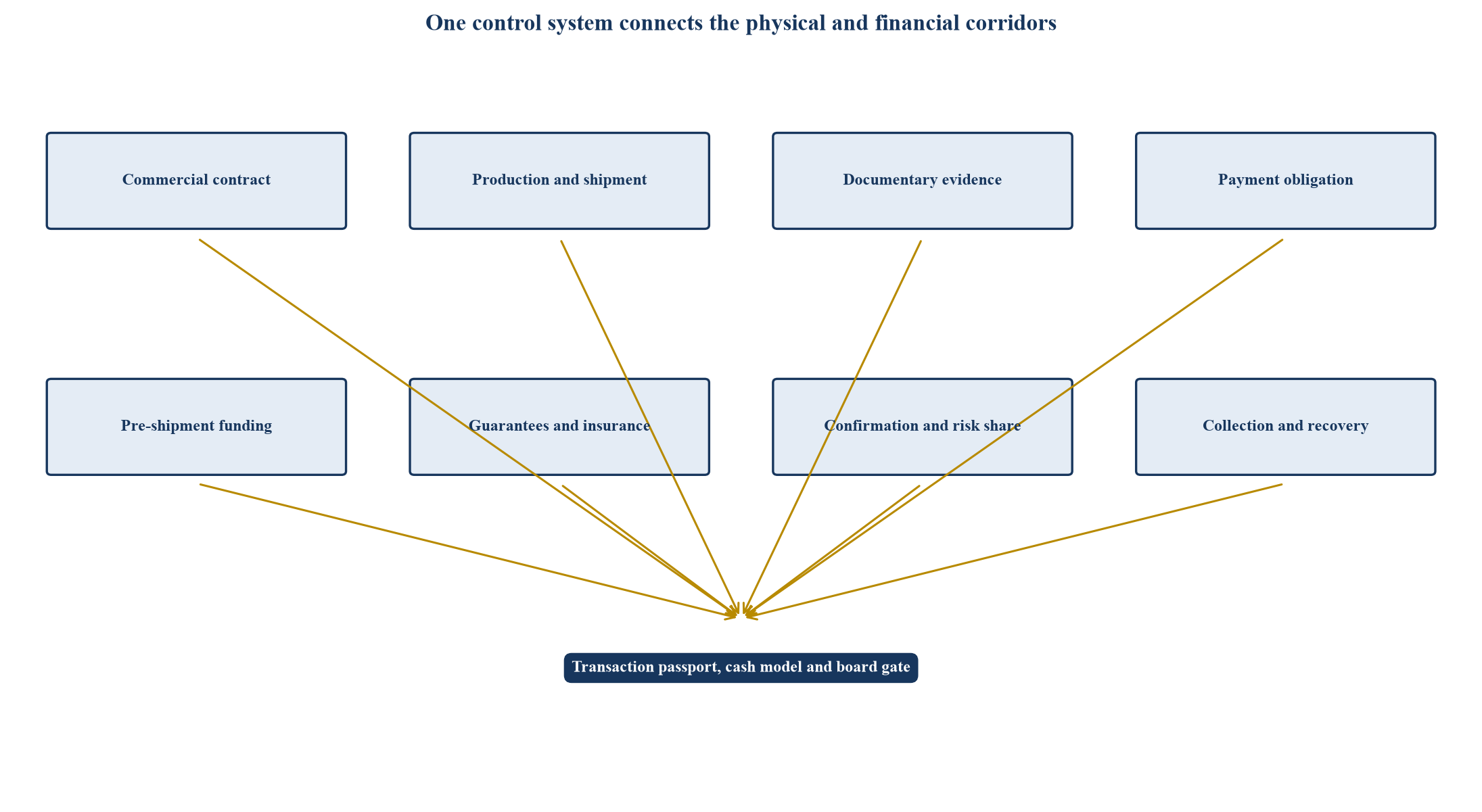
The framework links commercial performance, documentary evidence, risk distribution and cash conversion.
3. Build a transaction passport
The transaction passport is a controlled record of the facts that every participant needs. It should contain the parties and beneficial owners, goods and services, values, currencies, origin, destination, transport route, delivery terms, payment milestones, financing instruments, banks, insurance, licences, security, tax treatment, sanctions screening, documentary requirements and approval status.
Each fact needs a source, owner and verification date. A sales presentation cannot substitute for executed contract terms. A pro forma invoice cannot establish legal title. A carrier schedule cannot prove that a route will remain available. The passport distinguishes supplied information from independently verified evidence and records every unresolved dependency.
The passport should be version-controlled from bid through final collection. Amendments to price, route, buyer, bank, specification, delivery or documents can alter credit and compliance outcomes. A lender should receive the same controlled data used by operations, legal, logistics and treasury.
| Evidence block | Required content | Primary owner | Financing consequence if incomplete |
|---|---|---|---|
| Parties | Legal identity, ownership, authority, screening and role | Legal and compliance | No approval or utilisation |
| Contract | Scope, price, milestones, acceptance, termination and dispute terms | Commercial director | Payment right may be conditional or disputed |
| Goods and services | Specification, origin, classification, licences and warranties | Operations | Customs, sanctions or insurance failure |
| Logistics | Incoterm, route, carrier, ports, inspection and title document | Logistics director | Documentary mismatch or uninsured delay |
| Payment | Currency, instrument, bank, tenor, confirmation and charges | Treasurer | Unfunded foreign-exchange or bank risk |
| Risk support | Guarantees, insurance, ECA or DFI participation and recovery rights | Finance director | Exposure exceeds lender appetite |
| Security | Assignment, account control, inventory and receivables rights | Lender counsel | Borrowing base becomes unavailable |
| Cash model | Cost curve, collections, fees, taxes and downside liquidity | Chief financial officer | Facility size or tenor is inadequate |
The entries show the minimum control fields; actual requirements depend on the contract and jurisdictions.
4. Select the instrument from the failure mode
Instrument selection should begin with the failure that must be controlled. A documentary credit addresses a bank's independent payment undertaking when compliant documents are presented. Confirmation can shift issuing-bank and country risk to a confirming bank. Credit insurance can protect an eligible receivable against specified commercial or political events. Pre-shipment finance funds eligible production costs. Receivables purchase accelerates cash after a qualifying payment right exists.
No single instrument covers every dependency. A confirmed credit does not finance production before shipment unless the lender advances against it. Political-risk insurance may not cover a commercial dispute over performance. A guarantee can protect the buyer and increase the exporter's contingent exposure. Supply-chain finance depends on approved payables and therefore may begin too late for a capital-intensive exporter.
The structure should allocate each risk to the participant able and willing to carry it. Pricing should follow the allocated risk, evidence and tenor. Management should reject a structure that appears inexpensive because an uncovered risk has been left with the exporter without liquidity or recovery capacity.
| Financing need | Candidate instrument | Core evidence | Principal residual risk |
|---|---|---|---|
| Production before shipment | Pre-shipment revolving facility | Confirmed order, cost budget, eligibility and progress evidence | Performance and cost overrun |
| Payment at shipment | Confirmed documentary credit | Complying documents under stated rules | Documentary discrepancy |
| Deferred buyer payment | Post-shipment discounting or insured receivables purchase | Unconditional receivable or accepted instrument | Dilution, dispute and policy exclusion |
| Distributor inventory | Distributor or borrowing-base finance | Inventory, sales, controls and collections | Sell-through and collateral enforceability |
| Advance payment | Advance-payment guarantee plus controlled use | Advance receipt, guarantee and expenditure controls | Guarantee call and misuse of proceeds |
| Performance obligation | Performance guarantee or standby credit | Defined obligation, cap, expiry and demand terms | On-demand call risk |
| Country or transfer exposure | Political-risk insurance or DFI risk participation | Eligible investment or receivable and covered event | Waiting period, exclusions and recovery |
| Local-currency collection | Hedging, local funding or approved payment rail | Currency convertibility, settlement and repatriation plan | Basis, convertibility and transfer delay |
Suitability is indicative and requires transaction-specific legal, credit, compliance and insurance review.
5. Turn the contract into a financeable asset
The contract is financeable when payment rights are clear, measurable, assignable where required and supported by evidence that a third party can verify. Ambiguous milestones, subjective acceptance, unlimited set-off, broad buyer discretion, changeable specifications and unbounded warranty obligations weaken the asset. Treasury and lenders should review these terms before signature.
Payment milestones should align with verifiable value creation. An advance can fund mobilisation. Progress payments can correspond to manufacture or inspection. Shipment payment can rely on transport and title documents. Commissioning payment should use an objective test, defined cure procedure and deemed acceptance where commercially appropriate and legally valid. Retention should have a cap, expiry and release mechanism.
The contract should also state governing law, dispute process, taxes, currency, force majeure, change control, title, risk transfer, insurance, sanctions clauses and termination economics. These provisions influence lender rights and the survival of receivables. Qualified counsel in the relevant jurisdictions should confirm enforceability and assignment.
6. Assess the buyer and the payment chain separately
A strong buyer does not automatically create a financeable payment. The obligation may depend on budget release, ministry approval, central-bank allocation, acceptance certification, project-company cash flow or an issuing bank with limited international lines. Credit analysis should therefore assess the entire payment chain.
The review should cover the buyer's legal capacity, ownership, audited performance, payment history, procurement authority, funding source, debt obligations, litigation and operational ability to accept the goods. For public or sovereign-linked buyers, it should distinguish the operating entity from the state and establish whether any guarantee or budget support is legally binding.
The issuing bank requires its own assessment. Capital, liquidity, asset quality, foreign-exchange access, correspondent relationships, sanctions exposure and documentary capability determine whether another bank will confirm or fund its undertaking. The WTO and IFC found that correspondent-bank line limits, compliance requirements and response times materially constrained trade finance in surveyed West African markets [2].
7. Make a documentary credit workable before issuance
A documentary credit should be reviewed as an operating document before it is issued. The exporter should test whether every required document can be produced in the required form, language, number and time. Conditions that refer to facts outside the exporter's control or require buyer-issued evidence can make the credit commercially unusable.
The credit should identify the applicable ICC rules, amount, tolerance, availability, expiry, presentation place, shipment period, tenor, confirming arrangements, reimbursement, charges and required documents. UCP 600 applies when the credit expressly incorporates it. Its framework separates the documentary undertaking from the underlying sale contract and defines the roles of issuing, advising, nominated and confirming banks [3].
Document preparation should begin before shipment. The commercial invoice, packing list, transport document, origin certificate, inspection certificate, insurance document and any technical certificate should be reconciled against the credit and the contract. A discrepancy protocol should state who can amend, waive, cure or accept the exposure.
8. Use confirmation and risk participation deliberately
Confirmation substitutes the confirming bank's undertaking for specified issuing-bank and country risks when the exporter presents compliant documents. The decision depends on the issuing bank, country, tenor, amount, transaction, sanctions profile and available line. It should be secured before production if confirmation is a condition of financeability.
Where a confirming bank lacks sufficient appetite, a development finance institution or export credit agency may provide funded or unfunded risk participation. The African Development Bank's trade-finance programme uses liquidity and risk-mitigation products to expand eligible bank capacity. Its risk-participation arrangements can support transactions that commercial institutions cannot hold alone [4].
Risk distribution should be documented across the full tenor, including manufacturing, shipment, deferred payment and claims periods. Management should know which participant bears default, transfer restriction, political event, documentary non-compliance and dispute risk. A participation that begins only after compliant presentation does not cover production exposure.
9. Build a controlled pre-shipment borrowing base
Pre-shipment finance converts an eligible order into funding for materials, labour, subcontractors, freight preparation and other approved costs. The lender should not advance merely because a contract exists. It should establish a borrowing base linked to eligible expenditure, progress, buyer support, margin, title and the expected takeout.
The facility can use a percentage of eligible costs subject to caps by order, buyer, country, supplier and stage. Disbursements may go directly to approved suppliers or through a controlled operating account. Progress evidence can include purchase orders, invoices, inspection reports, production records and inventory. Ineligible costs, related-party payments and unapproved variations should be excluded.
The takeout should be visible from day one. It may be drawing under a confirmed credit, receipt of an insured receivable, refinancing after acceptance or payment from the buyer. The lender should stress delays and determine when the order ceases to provide sufficient liquidity coverage.
10. Match facility tenor to the production and collection clock
Facility maturity should follow the physical and documentary critical path rather than the contractual delivery date alone. Procurement delays, inspection, shipping, customs, installation, acceptance, document presentation and bank examination can each extend the cash cycle. An instrument that matures before collection creates a refinancing event at the point of highest exposure.
The base schedule should show weekly or monthly costs, advances, borrowing-base availability, guarantee collateral, financing fees, taxes and collections. It should identify peak debt and minimum liquidity. The downside schedule should combine correlated delays because port congestion, document problems and foreign-exchange shortages may occur together.
The facility should include extension mechanics, cure periods and a fallback source. Automatic renewal is uncommon and should not be assumed. A committed contingency line, sponsor liquidity or insured refinancing route may be required where interruption would strand high-value goods.
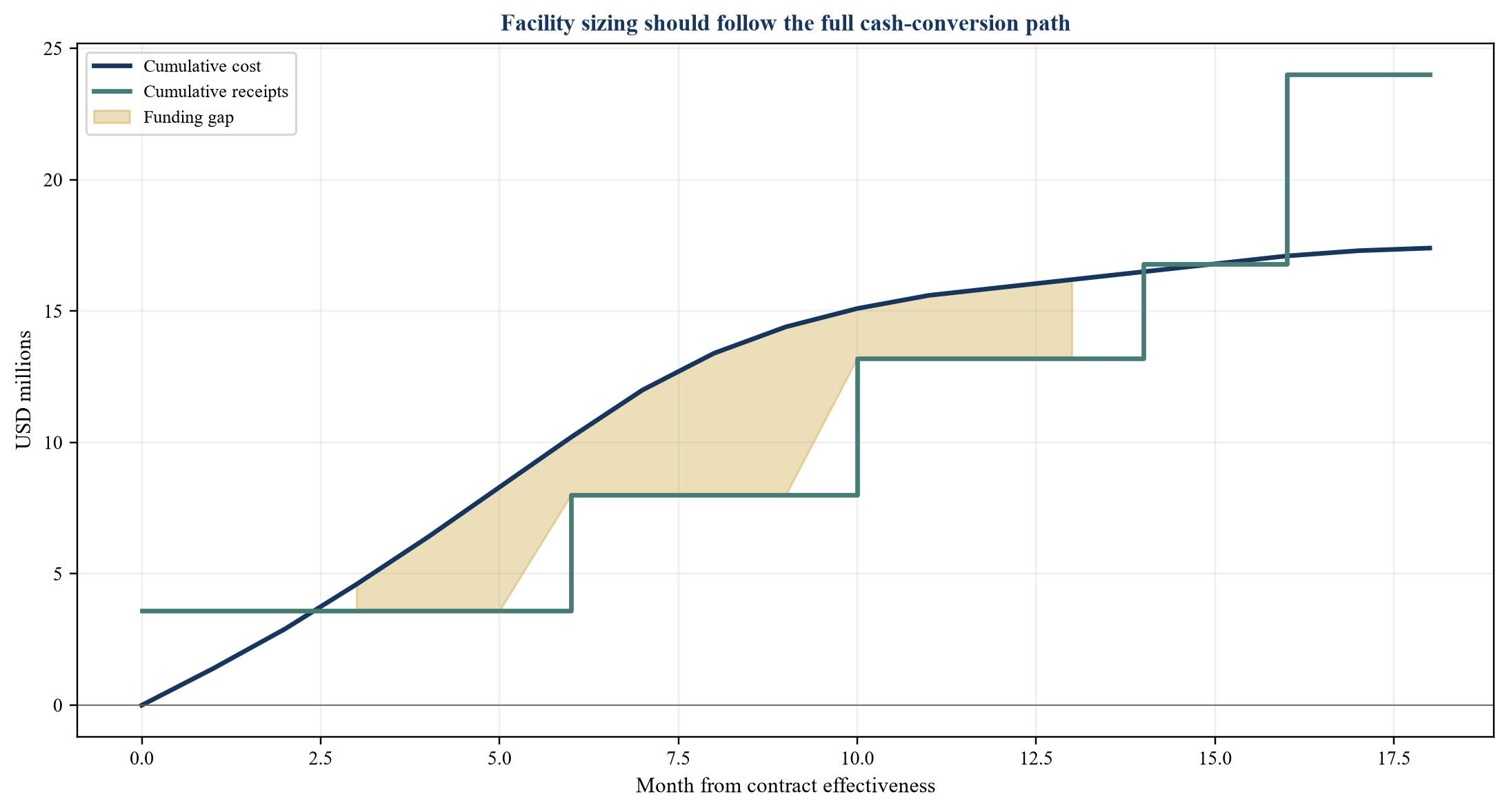
Amounts and timing are illustrative management assumptions for a USD 24 million export contract.
11. Define the post-shipment asset precisely
Post-shipment finance requires a clear asset. It may be a complying presentation under a documentary credit, an accepted bill, an approved invoice, a certified milestone or an insured receivable. The lender should identify when the asset arises, which defences or deductions apply, how it can be assigned, and where payment will be made.
Discounting can be with or without recourse. Without-recourse treatment depends on the exact risks transferred and the transaction's accounting and legal facts. Management should avoid using the commercial label as a substitute for analysis. The purchase agreement should address dilution, disputes, set-off, fraud, sanctions, taxes, repurchase events and collections.
Collections should flow to a controlled account. Payment instructions must be authenticated and protected against fraud. Reconciliation should match the invoice, currency, payer, value date, charges and facility allocation. Unidentified or short payments need rapid investigation because they can signal a dispute or diversion.
12. Use insured receivables as risk transformation
Credit insurance can transform an eligible receivable by covering defined commercial and political risks. The policy, buyer limit, country limit, waiting period, deductible, maximum liability, exclusions, reporting and recovery obligations determine the value. An insurance indication is not equivalent to binding cover.
The insured transaction must remain within policy terms throughout its life. Changes to the buyer, contract, tenor, currency, shipment, route or payment schedule may require consent. Overdue reporting, collection conduct and loss-mitigation duties should have named owners. The lender should receive a valid assignment or loss-payee interest where required.
Etihad Credit Insurance reported AED 16.2 billion of insured turnover in 2024 and described support for infrastructure and energy transactions in African markets. It also reported coverage across more than 100 countries and a portfolio combining short-term credit, medium- and long-term obligations and political risk [5]. Eligibility and capacity remain transaction-specific.
13. Structure advance-payment and performance guarantees
An advance can reduce peak funding, but the buyer may require an advance-payment guarantee. A performance guarantee, warranty guarantee or standby letter of credit may also be required. These instruments create contingent liabilities that affect bank lines, collateral and liquidity.
Guarantee wording should define the applicant, beneficiary, amount, reduction, expiry, demand requirements, governing rules, governing law and counter-guarantee chain. URDG 758 provides an internationally used framework for demand guarantees when incorporated [6]. Management should understand whether the instrument is on demand and what evidence accompanies a valid demand.
The finance model should include issuance fees, cash margin, collateral, foreign-exchange effects and the possibility of a disputed call. Guarantee reduction should track verified performance. Open-ended expiry or ambiguous return conditions can leave contingent exposure after the commercial obligation has ended.
14. Separate political risk from commercial performance
Political-risk cover may address transfer restriction, currency inconvertibility, expropriation, political violence, breach of contract by a public counterparty or other defined events. It does not normally convert poor performance or a commercial dispute into an insured loss. The policy language and applicable facts control.
The exporter should identify the exact risk event, waiting period, evidence, mitigation duty and recovery path. It should determine whether cover protects the equity exposure, loan, receivable, contract frustration or guarantee call. Different instruments may cover different parts of the same transaction.
Country assessment should be dynamic. Elections, fiscal stress, reserve levels, commodity prices, conflict, border controls, port disruption and regulatory changes can affect payment and logistics. A watchlist should use observable indicators and pre-agreed actions rather than generic country ratings alone.
15. Treat foreign-exchange availability as a financing condition
A buyer can hold sufficient local currency and remain unable to pay in the contract currency. The structure should establish how hard currency is sourced, allocated and transferred. It should identify the responsible institution, supporting documents, timing, priority rules and fallback.
The cash model should distinguish exchange-rate risk from convertibility and transfer risk. A hedge can protect an exchange rate when an instrument is available. It cannot create hard currency or regulatory permission. Local-currency pricing may reduce one exposure while increasing another through devaluation, funding cost or basis risk.
The African Development Bank's recent survey identified foreign-currency shortages as the most frequently cited constraint on trade-finance growth among surveyed African banks during 2020-2024 [1]. This evidence supports making foreign-exchange readiness a condition precedent rather than a closing assumption.
16. Design settlement and currency fallbacks
The payment architecture should state the primary currency, account, bank and message route. It should also define acceptable alternatives if the primary route becomes unavailable. Alternatives may include another authorised bank, approved local-currency settlement, netting, a regional payment system or refinancing with a development institution. Each alternative needs legal and compliance approval before use.
The Pan-African Payment and Settlement System expanded its network during 2024 and has continued to develop mechanisms for cross-border settlement in African currencies. Afreximbank reported 15 connected central banks and 144 commercial banks at the end of 2024, while a 2025 announcement described broader connectivity through national switches and commercial banks [7][8]. Availability for a specific Africa-GCC transaction requires confirmation with participating institutions.
Payment instructions should not change through informal email alone. Call-back, dual approval, verified bank details and anti-fraud controls protect both parties. A fallback should preserve traceability, contractual discharge and lender control.
17. Make logistics evidence part of credit control
Trade finance depends on documents that arise from physical performance. The financing team should therefore understand the shipment route, carrier, freight forwarder, port, transhipment, insurance, inspection and customs process. Documentary requirements should match what the route can produce.
Incoterms allocate specified delivery costs and risks, but they do not determine title, payment or every legal consequence. The contract should separately address those matters. The selected term should align with the exporter's ability to control carriage and provide the documents required by the payment instrument.
The evidence chain should reconcile purchase order, packing, serial numbers, weight, origin, inspection, transport, insurance, customs and delivery. Exceptions should enter a controlled discrepancy log before presentation. The ICC has published guidance on transport documents and on-board notation under UCP 600 [9].
18. Control ports, routes and cargo concentration
Route risk can create both delay and loss. The review should examine port capacity, congestion, seasonal disruption, security, piracy, war-risk zones, transhipment, sanctions restrictions, storage, demurrage and inland transport. Cargo concentration may exceed a carrier, warehouse or insurance limit even when the overall transaction is insured.
Management should define route alternatives, decision deadlines and incremental cost. A route change may alter documentary compliance, insurance, origin evidence, delivery date, tax and sanctions exposure. Lenders and insurers may need prior consent.
The finance model should include demurrage, storage, re-routing, inspection and delay costs. These costs can consume the gross margin while leaving the contract value unchanged. A contingency reserve linked to observable route triggers is more reliable than a uniform percentage allowance.
19. Finance services and commissioning evidence
Engineering, software, installation and commissioning create evidence challenges because value may not be represented by a transport document. Payment should rely on objective deliverables, certificates, logs or milestones that can be verified independently where appropriate.
The contract should define acceptance tests, responsible witnesses, measurement, notice, cure, partial acceptance and deemed acceptance. A buyer-controlled certificate without a deadline can turn a completed service into an unfinanceable receivable. The structure should seek balanced evidence while respecting legitimate performance requirements.
Service costs often continue after shipment. The facility should reserve liquidity for mobilisation, local labour, accommodation, bonds, taxes, spare parts and defect correction. Final payment should not be treated as pure margin until these obligations and retention are funded.
20. Integrate sanctions and financial-crime controls
Trade transactions can involve multiple parties, vessels, ports, intermediaries, goods, currencies and documents. Screening at onboarding is insufficient. The control plan should rescreen relevant parties and elements at defined events, including contract amendment, shipment, document presentation, payment and route change.
The review should understand the goods, end use, end user, ownership, source of funds, pricing, quantity, route and economic purpose. It should test for trade-based money-laundering indicators such as inconsistent values, unusual routing, duplicate documents, unexplained third parties or goods inconsistent with the parties' businesses. FATF describes a risk-based approach and recognises trade-based money laundering as a significant vulnerability [10][11].
Escalation should be independent from sales. A hold must stop shipment or payment where required. Records should show the data screened, lists used, decision, approver and rationale. Qualified compliance and legal advice should address applicable laws and contractual rights.
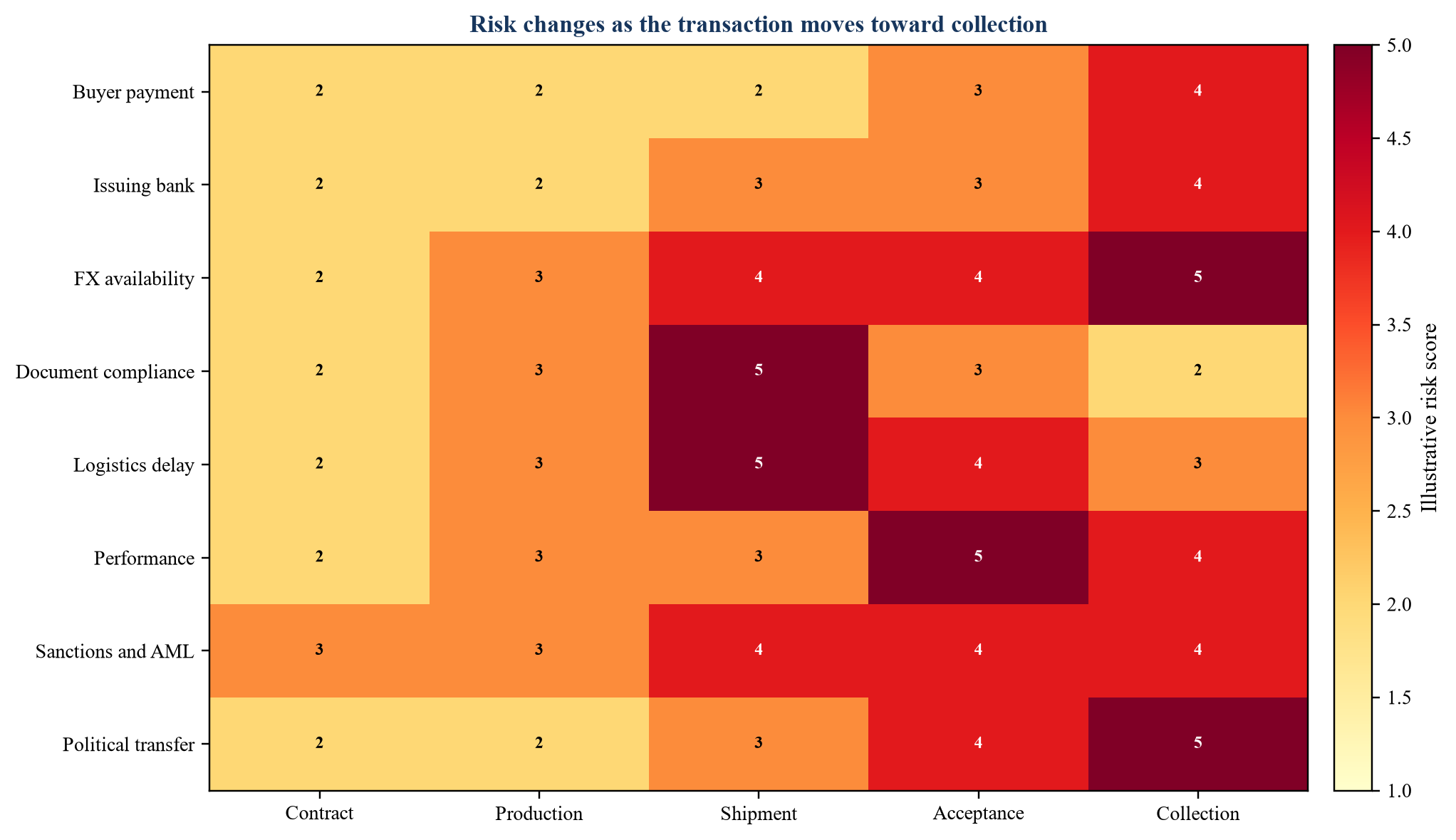
Scores are illustrative management assumptions and do not represent a country or counterparty rating.
21. Use digital documents where law and participants support them
Digital trade documents can reduce transmission time, improve data reuse and create stronger control over document status. Legal recognition, platform reliability, bank acceptance, insurer acceptance and interoperability determine whether the benefit is available in a specific transaction.
The UNCITRAL Model Law on Electronic Transferable Records provides principles of non-discrimination, functional equivalence and technology neutrality for records such as electronic bills of lading, bills of exchange and warehouse receipts. It focuses on reliable methods for identity, integrity and exclusive control [12]. Enactment and practical acceptance vary by jurisdiction.
The project should map each document from source data to final presentation. It should identify the system of record, authorised issuer, signature, control, amendment, transfer, retention and fallback to paper. A digital document that one critical bank cannot accept may add duplication rather than remove friction.
22. Coordinate export credit and development-finance capacity
Export credit agencies, development banks and multilateral institutions can provide insurance, guarantees, direct lending, refinancing, risk participation and technical support. The structure should approach them with a complete transaction passport and a precise request. A broad request for support delays underwriting.
The submission should show development and commercial rationale, parties, goods, origin, local content, environmental and social matters, amount, tenor, repayment, bank roles, security, risks, mitigants and proposed participation. Eligibility should be checked before the commercial contract becomes fixed.
Afreximbank reported USD 17.9 billion of bank-related trade-finance disbursements in 2024 and described its contribution to narrowing Africa's trade-finance gap [13]. The Islamic Trade Finance Corporation and other institutions also provide trade-finance programmes across member countries [14]. Actual capacity, mandate and pricing require transaction-specific engagement.
23. Build the cash model from uses and evidence
The cash model should begin with contract uses rather than facility size. Uses include materials, labour, suppliers, freight, insurance, duties, taxes, guarantees, advisers, financing fees, contingency, commissioning, retention support and recovery costs. Timing should follow the operating plan.
Sources include buyer advance, sponsor equity, pre-shipment debt, supplier credit, documentary-credit proceeds, receivables discounting, insurance recoveries and final collection. Each source should have conditions, availability, currency, cost, maturity and control. An undrawn source is not liquidity when a condition cannot be satisfied.
The model should reconcile commercial margin to cash margin. Profit can coexist with a severe funding peak. Financing cost should be calculated on amount and time, including commitment fees, confirmation, insurance, guarantees, hedging and cash collateral. Tax and withholding assumptions require qualified advice.
24. Stress correlated delay rather than isolated variables
Stress testing should combine events with a plausible connection. Foreign-exchange scarcity may delay a credit, which delays confirmation, production and shipment. Port congestion may delay documents and acceptance. A technical defect may delay certification and trigger a guarantee concern. Independent single-variable sensitivities can understate liquidity need.
The downside should show peak funded requirement, minimum liquidity, facility maturity headroom, covenant effect, guarantee exposure and margin erosion. It should also show management actions, their timing and their own dependencies. Cutting production spend may breach the contract and reduce the value of the receivable.
The board should approve the maximum exposure under the chosen downside and a point at which it will stop, restructure or seek additional support. Scenario analysis is a decision tool, not a claim about probability.
| Measure | Controlled case | Central case | Correlated downside |
|---|---|---|---|
| Contract value | USD 24.0m | USD 24.0m | USD 24.0m |
| Buyer advance | 20% | 15% | 10% |
| Pre-shipment advance rate | 85% of eligible cost | 80% | 65% |
| Shipment delay | 15 days | 45 days | 120 days |
| Acceptance delay | 20 days | 60 days | 150 days |
| Peak funded requirement | USD 5.6m | USD 7.9m | USD 12.8m |
| Cash-conversion cycle | 132 days | 176 days | 287 days |
| Financing and risk cost | USD 0.9m | USD 1.4m | USD 2.7m |
| Contribution after finance | USD 4.4m | USD 3.7m | USD 2.0m |
Every amount, percentage and outcome is an illustrative management assumption.
25. Price the complete risk and operating burden
Commercial pricing should include the cost of capital, bank fees, confirmation, insurance, guarantees, cash margin, hedging, documentary work, inspections, logistics contingency, taxes, local support and management time. These costs should be linked to the structure rather than applied as an unexplained margin.
The price should also reflect risk retained by the exporter. If acceptance remains subjective, a portion of the contract value is exposed to dispute. If foreign-exchange support is uncertain, tenor can extend. If insurance has a deductible and waiting period, liquidity must cover both. Management should decide whether the margin compensates for these exposures.
Contract variation should trigger repricing or another economic remedy where appropriate. A change in route, delivery date, specification, currency or payment instrument can increase cost after the headline price has been agreed. The change-control clause should preserve the ability to recover documented effects.
26. Align security with the cash-conversion chain
Security should support control and recovery without assuming rights that local law does not recognise. It may include assignment of receivables, account control, inventory security, title retention, pledge of documents, guarantees, insurance proceeds and sponsor support. Perfection and enforcement require jurisdiction-specific advice.
The lender should map security to each stage. Before shipment, value may sit in raw materials, work in progress and supplier advances. After shipment, value may sit in goods, documents, insurance rights and receivables. After acceptance, the payment obligation may become the principal asset. The security package should evolve with that transition.
Recovery planning should identify where assets and records are located, who controls them, and what practical action is possible. A theoretical security interest over specialised equipment may have limited value if it is incomplete, installed abroad or difficult to resell.
27. Establish transaction governance
The transaction needs one accountable executive and a control team spanning commercial, finance, treasury, legal, compliance, logistics, operations, tax and insurance. The team should maintain the passport, conditions precedent, cash model, risk register, document schedule and decision log.
Decision rights should distinguish recommendation, approval, execution and verification. Sales should not certify documentary compliance. Operations should not approve its own milestone evidence where independent confirmation is required. Treasury should control payment instructions and facility draws. Compliance should retain independent hold authority.
The board or delegated committee should approve material changes in exposure, recourse, currency, tenor, counterparty, route or security. Reporting should focus on exceptions, cash exposure and approaching decisions. A large activity log can conceal the few issues that determine collection.
28. Use a gated execution roadmap
Execution should progress through commercial screening, indicative financeability, contract alignment, credit underwriting, instrument issuance, production funding, shipment readiness, presentation, acceptance, collection and closure. Each gate should specify evidence, owner and approval.
The financing work should begin during bid design. Waiting until contract signature can leave the exporter with a binding obligation and no workable facility. Bank, insurer and agency discussions should use controlled information and should not be presented as commitments before written approval.
The roadmap should incorporate long-lead items such as buyer due diligence, issuing-bank line approval, insurance capacity, environmental and social review, local security, licences and digital-document acceptance. These dependencies should determine bid validity and long-stop dates.
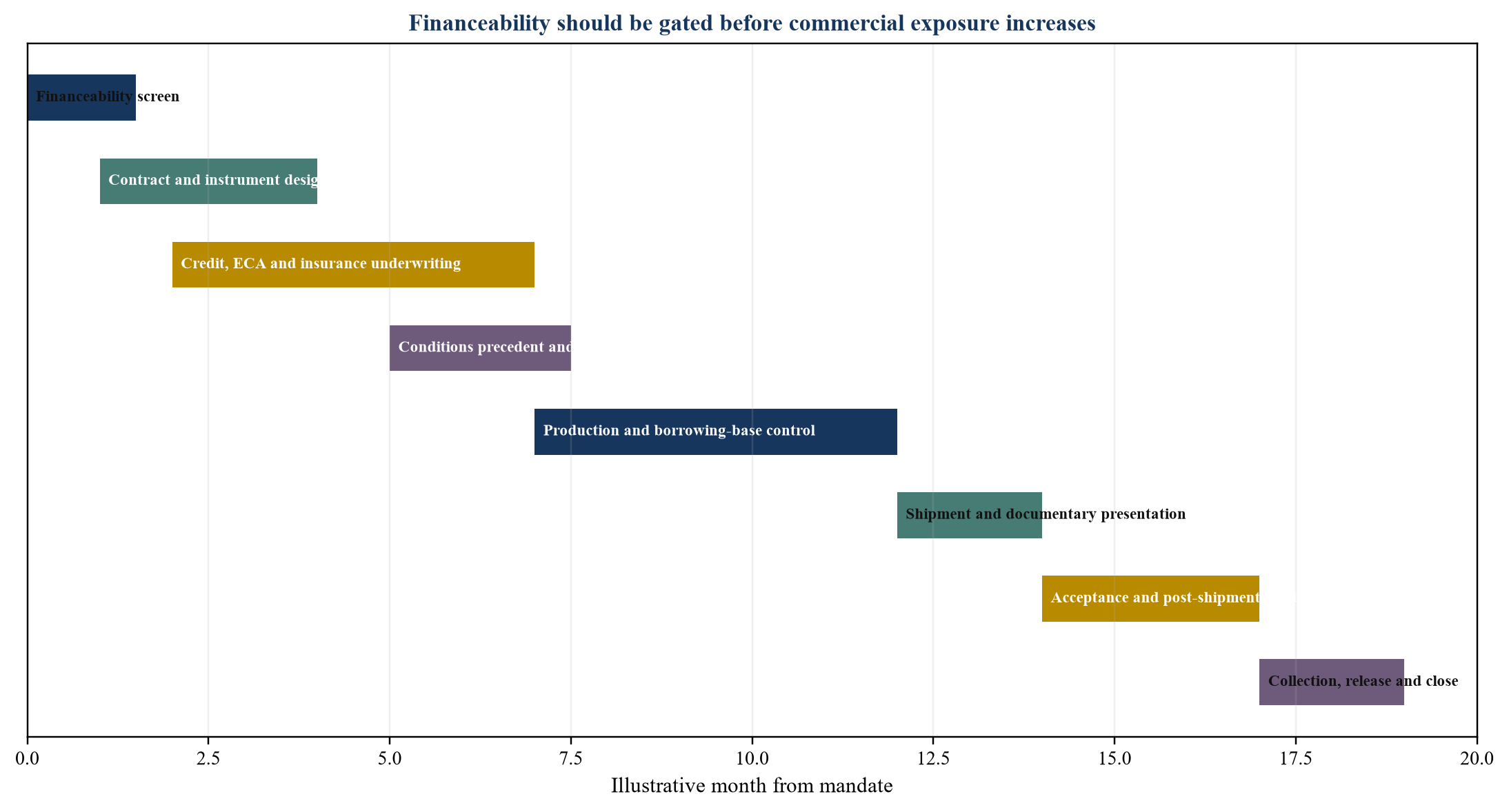
Timing is an illustrative management assumption and should be rebuilt for each transaction.
29. Convert approvals into conditions precedent
Conditions precedent should establish that the approved structure exists before the lender advances or the exporter increases exposure. They should be specific, objectively testable and allocated to an owner. A generic requirement for documents satisfactory to the lender should be translated into an execution checklist.
The list should cover corporate authority, contract effectiveness, buyer advance, payment instrument, confirmation, insurance, guarantees, security, accounts, licences, sanctions and compliance, route, supplier contracts, budget, hedging, legal opinions and required agency approvals. Waivers should record the exposure, interim safeguard, expiry and approving authority.
Conditions subsequent should be limited and monitored. Repeated deferral can transform a controlled exception into structural risk. Each item needs a long-stop and consequence.
| Gate | Evidence | Owner | Release condition |
|---|---|---|---|
| Contract | Executed contract and financeability schedule | General counsel | Payment and acceptance terms match approval |
| Buyer support | Advance received and payment instrument effective | Treasurer | Funds cleared; instrument authenticated |
| Bank support | Confirmation and reimbursement operative | Relationship bank lead | Amount and tenor cover approved exposure |
| Risk support | Insurance or risk participation bound | Insurance lead | Policy, limits and assignment verified |
| Security | Accounts, assignments and local perfection complete | Lender counsel | Enforceability evidence accepted |
| Operations | Cost budget, suppliers and production plan approved | Operations director | Borrowing-base controls operational |
| Compliance | Parties, goods, route and purpose cleared | Compliance officer | No unresolved hold or prohibited element |
| Liquidity | Base and downside sources funded or committed | Chief financial officer | Downside peak within approved limit |
The checklist is a governance example and not a legal closing list.
30. Monitor leading indicators through collection
The dashboard should show peak cash exposure, borrowing-base headroom, contract progress, document readiness, issuing-bank status, confirmation availability, foreign-exchange readiness, logistics status, guarantee exposure, insurance compliance, overdue items and forecast collection. It should distinguish verified facts from management assumptions.
Leading indicators include late buyer approvals, document drafts not agreed, supplier delay, inspection failure, bank-response delay, line utilisation, reserve decline, route disruption, overdue policy reporting and unexplained payment changes. Each indicator needs a threshold and action.
The dashboard should continue after shipment. Collection, warranty, retention, guarantee release, insurance reporting and facility closure remain material. The transaction ends only when cash is collected, contingent exposures are released, security is discharged, documents are retained and lessons are recorded.
31. Apply the framework with proportionate judgement
The framework is intended for material cross-border contracts where working capital, documentary risk, foreign exchange and country exposure can determine commercial value. A smaller transaction may use a simplified passport and cash model. A project or sovereign financing may require a broader legal, environmental, technical and debt structure.
The model does not replace lender underwriting, export-credit eligibility, insurance terms, legal analysis, sanctions review, tax advice or operational diligence. Public data can describe market conditions but cannot establish the credit quality or compliance status of a specific transaction. Every source and assumption should be refreshed at execution.
The core discipline is to make the payment path as engineered as the product. A contract becomes financeable when rights, evidence, institutions, liquidity and remedies form one coherent system. That system gives management a basis to decide whether to bid, how to structure, how much cash to commit, and when to stop.
A practical implementation can begin with a five-day financeability screen. The commercial team supplies the draft contract, buyer details, scope, price, route and requested payment terms. Finance converts the operating plan into a monthly sources-and-uses model. Legal and compliance identify mandatory approvals and prohibited elements. Treasury tests issuing-bank, confirmation, currency and settlement capacity. The output is a short decision record stating the viable structure, open evidence and commercial terms that must change.
The next stage is a controlled market sounding. Management gives selected banks, insurers and eligible agencies the same transaction passport and clearly labels information that remains provisional. Responses are recorded by amount, tenor, recourse, pricing, collateral, eligibility, conditions and approval status. Indicative interest should not be described as committed capacity. Differences between responses often reveal which transaction assumptions are weak or unclear.
Contract negotiation and financing design should then proceed together. The exporter's proposed payment milestones, acceptance tests, document schedule, guarantee wording, change control and termination economics are tested against the instruments that fund them. The cash model is refreshed after every material negotiation change. Commercial approval should require finance and legal confirmation that the final draft remains within the approved risk and liquidity limits.
Before manufacture begins, the team should run a closing rehearsal. It verifies that accounts are open, instruments authenticated, insurance bound, guarantees issuable, suppliers approved, licences available, security executable and reporting systems operational. It also rehearses one failure scenario, such as a delayed confirmation or unavailable route, to confirm that decision rights and fallback liquidity work in practice.
During execution, a weekly transaction-control meeting should use one evidence pack. The meeting resolves exceptions and forward decisions; it should not reconstruct facts from competing spreadsheets. The pack should reconcile production progress, eligible costs, debt, guarantee utilisation, documentary readiness, logistics, compliance, collections and forecast liquidity. Each unresolved exception receives an owner, action, date and escalation threshold.
After collection, management should close the financial and operating perimeter. It obtains release of guarantees and security, closes unused limits, confirms insurer and lender reporting, archives the evidence chain, resolves tax and fee accruals, and compares realised cash conversion with the approved case. Lessons should update bid criteria, contract standards, bank and insurer selection, document templates and corridor risk limits for the next transaction.
Sources
- African Development Bank, Trade Finance Supply in Africa: Post-COVID Trends and Emerging Opportunities, 2026. Read the primary source
- World Trade Organization and International Finance Corporation, Trade Finance in West Africa, 2022. Read the primary source
- International Chamber of Commerce, Uniform Customs and Practice for Documentary Credits UCP 600. Read the primary source
- African Development Bank, Financial Solutions and Trade Finance Programme. Read the primary source
- Etihad Credit Insurance, Annual Report 2024 results, 27 May 2025. Read the primary source
- International Chamber of Commerce, URDG 758 Uniform Rules for Demand Guarantees. Read the primary source
- African Export-Import Bank, Annual Report 2024. Read the primary source
- African Export-Import Bank, PAPSS and Interstellar unveil African Currency Marketplace, 7 July 2025. Read the primary source
- International Chamber of Commerce, Guidance papers on UCP 600, 28 March 2023. Read the primary source
- Financial Action Task Force, The FATF Recommendations, amended June 2026. Read the primary source
- Financial Action Task Force, Trade-Based Money Laundering. Read the primary source
- United Nations Commission on International Trade Law, Model Law on Electronic Transferable Records, 2017. Read the primary source
- African Export-Import Bank, African Trade and Development Report 2024, Trade Finance chapter. Read the primary source
- International Islamic Trade Finance Corporation, Annual Report 2024. Read the primary source
- African Development Bank, De-risking trade finance in transition states in Africa, 14 October 2024. Read the primary source
- African Development Bank, Trade Finance Demand and Supply in Africa: Evidence from Kenya and Tanzania, 2022. Read the primary source
- International Chamber of Commerce, Application of ICC trade finance rules in the context of the Middle East conflict, 20 April 2026. Read the primary source
- International Chamber of Commerce, Export financing: a comprehensive guide, 2026. Read the primary source
- International Chamber of Commerce, Wolfsberg and BAFT, Trade Finance Principles. Read the primary source
- United Nations Commission on International Trade Law, Guide on legal issues relating to the use of distributed ledger technology in trade, 2025. Read the primary source
