

1. Frame the corridor financing decision
The financing decision is whether a linked set of logistics assets can generate durable, controlled cash flows under a common risk and governance architecture. The decision is broader than whether a terminal, warehouse or road has strategic value. It asks whether the corridor has enforceable rights, sufficient cargo, executable interfaces, affordable capital and a credible recovery path when performance diverges from plan.
The board mandate should define the economic perimeter, target customers, countries, assets, concession term, capital ceiling, leverage range, currency policy, minimum liquidity, minimum coverage ratios and phase gates. It should also define which benefits belong in the financing case. Wider economic benefits can justify public support, but lenders require cash that the project company can lawfully collect and retain.
The decision should contain stop conditions. Examples include an unsigned concession, inaccessible land, an unsupported traffic study, no binding anchor-customer arrangements, a port upgrade without inland capacity, tariffs that cannot be adjusted, currency mismatch without protection, unresolved environmental or resettlement obligations, or a downside case below the approved liquidity and coverage thresholds. A stop condition is a governance control. It does not predict that a project will fail.
2. Treat the corridor as one operating system
A corridor connects maritime access, terminal handling, customs, storage, road or rail capacity, border procedures, digital data, payment systems and final delivery. Each component may have a different owner, regulator, contract, currency and performance standard. Financing one component without mapping the others can create a stranded or underused asset.
The World Bank's Logistics Performance Indicators 2.0 use operational movement data and identify persistent time penalties at ports, transshipment hubs and inland checkpoints. The World Bank also states that sustainable improvement requires coordinated changes in infrastructure, trade facilitation and logistics services [1]. Its port performance work identifies weaker hinterland connectivity and limited automation as continuing constraints in Sub-Saharan Africa [2].
The corridor model should therefore map physical, contractual, cash and data flows. Physical cargo may move through a port, warehouse and inland depot. Contractual rights may sit across a concession, lease, customer agreement and access protocol. Cash may be collected by several entities. Data may pass through customs, port-community and operator systems. Bankability requires these routes to reconcile.
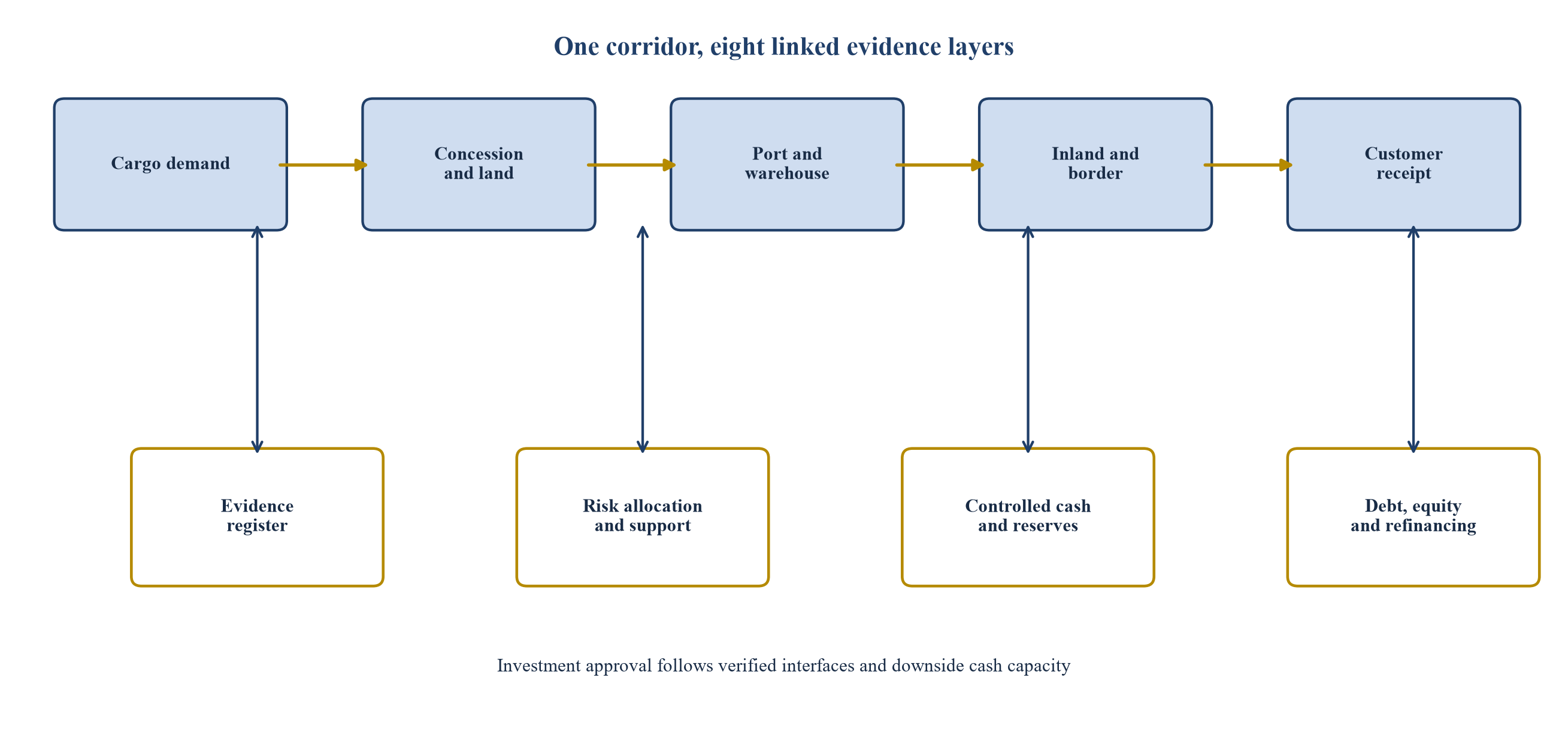
The framework connects cargo, rights, operating interfaces, evidence, cash collection and financing controls.
3. Define the investable perimeter
The project company should hold only assets, rights and obligations that can be governed and financed together. A perimeter that is too narrow may omit the inland dependency that determines cargo conversion. A perimeter that is too broad may combine unrelated public works, social infrastructure and speculative real estate with the cash-generating logistics assets.
The perimeter should be tested across ownership, access, revenue, control, construction and exit. For each asset, management should identify legal owner, operator, land right, customer, tariff basis, capital requirement, maintenance obligation, insurance, security availability and transfer restriction. Shared assets require an access protocol and cost-allocation method.
Perimeter discipline also applies to phases. Phase one should create a commercially coherent minimum operating corridor. Later phases should be options supported by measured demand. Debt for phase one should not rely on speculative later-phase earnings. Expansion may be funded through a committed accordion only after utilisation, service and coverage tests are met.
4. Separate strategic value from bankable cash
Corridors can reduce trade costs, improve resilience, support industrialisation and connect landlocked markets. Those benefits may support policy approval and public investment. They do not automatically produce cash available for debt service.
The African Union has called for integrated multimodal corridors linking production zones to markets and for stronger private-capital mobilisation [3]. Its AfCFTA work uses corridor assessments to identify infrastructure, systems and coordination gaps [4]. The International Transport Forum recommends combining transport investment with trade facilitation, regional data sharing and resilience measures [5]. These priorities strengthen the strategic case.
The financial case should identify cash by payer, contract and collection route. Sources may include handling charges, storage, throughput commitments, lease income, rail or trucking fees, digital-service charges and availability payments. Every source should be tested for legal entitlement, volume basis, tariff change, currency, credit quality, collection evidence and termination rights.
5. Build a cargo-demand evidence hierarchy
Traffic forecasts often mix very different levels of certainty. The financing model should classify throughput as contracted, evidenced, contestable or speculative. Contracted cargo is supported by enforceable minimum-volume or take-or-pay commitments. Evidenced cargo is supported by historical movement, production, consumption or trade records. Contestable cargo may shift from another route based on price and service. Speculative cargo depends on future projects or uncommitted market growth.
The base debt case should use contracted and conservatively evidenced cargo. Contestable cargo can support an upside case or expansion gate. Speculative cargo should not support opening leverage. The demand report should reconcile cargo origin, destination, commodity, seasonality, containerisation, route, ship or rail capacity, customer decision rights and competing corridors.
Anchor customers can improve bankability, but concentration creates renewal and bargaining risk. The structure should test the anchor's credit, commitment period, termination rights, price adjustment, performance conditions, parent support and replacement market. The lender should receive periodic evidence that commitments remain effective.
6. Use observed performance as the operating baseline
Throughput volume alone does not demonstrate corridor performance. The baseline should include vessel waiting, berth productivity, yard dwell, customs clearance, warehouse occupancy, truck turnaround, rail-cycle time, border delay, damage, service reliability and collection time.
The World Bank's Container Port Performance Index focuses on vessel time in port and warns that performance can be influenced by route changes, weather and geopolitical events beyond a terminal's control [2]. The 2023 Logistics Performance Index found that large delays often occur at ports, airports and multimodal facilities; it also reported that digitalisation can materially shorten port delays [6].
The operating baseline should distinguish controllable and external delay. Contracted service standards can govern controllable performance. Reserve, insurance, route-diversification and force-majeure mechanisms should address external disruption. Mixing the two can create either weak accountability or excessive operator risk.
7. Design the concession for financeability
The concession is the core asset for many port and logistics investments. It should grant sufficient duration, exclusivity or defined access, tariff rights, land use, construction rights, security, step-in, compensation, change-in-law protection and transferability. Its remaining life should extend beyond debt maturity and allow recovery of lifecycle investment.
The World Bank's port PPP guidance identifies demand and revenue allocation as a central structuring issue because user charges depend on actual throughput [7]. Its port risk module also highlights financial-close risk, operating performance, lifecycle cost and environmental and social obligations [8].
The financing review should test termination compensation under authority default, operator default, prolonged force majeure and political events. Compensation should be measurable and payable through an enforceable process. Direct agreements should give lenders notice, cure and step-in rights. Public-law and procurement advice is jurisdiction-specific and should be obtained from qualified advisers.
8. Align land, permits and access rights
Ports and warehouses require secure land, marine access, road or rail connections, utilities, environmental approvals, customs status and construction permits. A concession can be complete while a critical access right remains outside its perimeter.
The conditions-precedent register should identify each right, issuer, evidence, expiry, transferability and dependency. Land should be free of incompatible claims or accompanied by a funded and lawful resolution plan. Utility capacity should be evidenced by connection agreements. Road and rail interfaces should have access, dispatch and maintenance protocols.
Where the public authority retains responsibility for access works, completion should be tied to measurable milestones, long-stop dates and remedies. Lenders may require a completion support arrangement, delayed-draw mechanism or alternative route. The model should reflect the cost and time of temporary access rather than assuming immediate public delivery.
9. Integrate environmental and social bankability
Logistics infrastructure can affect coastal systems, fisheries, communities, labour, biodiversity, air quality and traffic safety. These issues are both impact matters and financing dependencies. A weak assessment can delay permits, construction, lender approval and insurance.
IFC's Benin terminal disclosure illustrates the depth of environmental and social review expected for significant port investment, including impact assessments, emergency response, labour processes, stakeholder engagement and site inspection [9]. The World Bank port module identifies environmental and social management systems, spill response and shore-power considerations among relevant mitigants [8].
The project should maintain a commitments register linking each obligation to owner, budget, schedule, evidence and lender reporting. Land acquisition and resettlement require particularly careful legal and social processes. The financial model should include mitigation, monitoring, remediation and contingency costs rather than treating them as off-model obligations.
10. Phase capital expenditure against verified demand
Large corridors often combine mandatory rehabilitation, capacity expansion and strategic options. These categories should be separated. Mandatory work preserves safe operations. Capacity expansion responds to evidenced demand. Strategic options prepare land or design for later growth.
Gulf operators are using phased commitments in African logistics. AD Ports Group announced USD 251 million for Luanda terminal and logistics development over 2024 to 2026, with potential investment rising to USD 379 million over the concession term and market demand [10]. Its Pointe Noire project described a phase-one investment of approximately USD 220 million [11]. DP World has described a phased port and logistics portfolio across Africa, including investments in Dar es Salaam, Maputo and Ndayane [12][13][14].
Each phase should have a scope, budget, completion test, utilisation threshold and funding plan. Expansion debt should become available only when the project satisfies coverage, volume, permit and contract tests. This protects the initial project from overbuilding and preserves financing capacity for measured growth.
| Phase | Capital purpose | Minimum evidence | Financing response |
|---|---|---|---|
| Stabilise | Safety, rehabilitation and critical equipment | Condition survey, scope, permits and funded completion plan | Equity and committed senior draw |
| Connect | Warehousing, inland node and interface works | Access rights, anchor contracts and interface agreements | Senior or blended debt after conditions precedent |
| Expand | Additional terminal or logistics capacity | Sustained utilisation, service performance and coverage | Accordion or refinancing subject to tests |
| Option | Land, design and future technology | Strategic case and limited at-risk budget | Equity-funded option; excluded from opening debt case |
The gate descriptions are a proposed governance framework and require project-specific calibration.
11. Build the completion architecture
Completion should be defined across construction, operations and interfaces. Physical completion alone may not establish commercial completion. The project may need testing, customs approval, systems integration, trained staff, safety certification, road or rail readiness and initial customer acceptance.
The completion package should include fixed or bounded construction contracts, performance security, insurance, independent engineer certification, cost-to-complete testing, contingency, delay liquidated damages and sponsor support. Interface completion should be demonstrated through end-to-end cargo trials from vessel or origin to inland delivery.
Debt drawdown should follow verified expenditure and completion progress. Retention and reserve mechanisms should protect unfinished work. A delayed component should trigger an updated cost-to-complete and liquidity test. Completion support should terminate only after agreed technical, operating and financial tests are met.
12. Allocate interface risk explicitly
Interface risk appears when one party's performance depends on another party's system, asset or approval. Examples include berth availability, customs release, warehouse receipt, rail dispatch, truck access, border clearance and customer delivery.
The contract matrix should identify the event, responsible party, evidence, service level, compensation, cure, escalation and lender consequence. Each interface should have one accountable owner and a shared operating protocol. Duplicate responsibility can leave gaps because each party assumes the other will act.
The model should quantify the cash effect of interface failures. Port congestion may extend dwell and reduce throughput. Customs delay may increase storage revenue while harming customer service and working capital. Rail unreliability may shift cargo to more expensive trucking. The financing case should use the net effect, including penalties, additional operating cost and lost future cargo.
13. Choose the revenue model
Corridor revenue can be user-paid, availability-based or hybrid. User-paid structures expose the project to volume, mix and collection. Availability payments can reduce demand risk but create public-credit, performance-deduction and fiscal-appropriation risk. Hybrid structures can combine a minimum service payment with variable cargo revenue.
The choice should reflect who controls demand, whether tariffs are regulated, the public authority's fiscal capacity, customer credit and the asset's strategic role. A public guarantee should address a clearly defined obligation. Broad guarantees can transfer commercial risk without improving operating discipline.
Tariffs should be indexed to relevant costs and currencies where legally permitted. The contract should specify review timing, caps, floors, pass-through items and dispute resolution. The financial model should test delayed tariff adjustment and collection leakage.
14. Contract anchor customers without trapping the platform
Anchor customers can support initial utilisation, financing and operating design. Their contracts should define committed volume, minimum revenue, capacity reservation, service levels, credit support, indexation, term, termination and remedies.
The platform should preserve multi-user access and the ability to serve new cargo. Exclusive rights can improve anchor commitment while limiting growth and creating regulatory concerns. Capacity allocation should be transparent and consistent with the concession.
The financing model should show anchor revenue separately from spot and growth revenue. It should test customer default, early termination and volume underperformance. Replacement assumptions should reflect actual customer conversion time and route competition. Debt sizing should not treat an unenforceable letter of intent as contracted revenue.
15. Finance warehouses as operating assets
Warehouses can provide lease income, handling revenue, inventory visibility and cargo retention. Their bankability depends on location, customs status, tenant commitments, fit-out, utilities, inventory type, insurance and alternative use.
The model should distinguish bonded, temperature-controlled, general and specialised facilities. Each has different construction, energy, compliance and tenant risks. Temperature-controlled logistics may justify higher revenue but requires resilient power, maintenance and product-loss controls. IFC has identified temperature-controlled logistics as an investment priority within African transport infrastructure [15].
Warehouse financing can use project debt, real-estate debt, equipment facilities or tenant-backed structures. The chosen route should match lease term, operating risk and residual value. Debt maturity should not assume a lease renewal that has not been contracted.
16. Finance inland terminals and connectivity
Inland terminals can reduce port dwell, consolidate customs processing and extend the gateway into landlocked markets. They require cargo density, land, road or rail access, customs recognition, equipment, information systems and reliable dispatch.
The International Transport Forum recommends bundling hard infrastructure with trade facilitation and data-sharing measures [5]. The World Bank has also highlighted intelligent transport systems, customs procedures and connectivity between Djibouti's port and inland markets [16].
The project should decide whether inland assets sit inside the port concession, a separate project company or a contracted interface. Separate ownership can attract specialised capital but requires durable access and revenue-sharing agreements. The base case should include actual transfer cost and border time.
17. Make digital systems a financing control
Digital port-community, customs, warehouse and transport systems can improve visibility and reduce delay. They also become operational dependencies and sources of cyber, data and vendor risk.
World Bank work on African port digitalisation emphasises logistics platforms and corridor-performance monitoring [17]. UN Trade and Development identifies automation, artificial intelligence and digital port management as tools for reducing waiting time and improving cargo tracking [18].
The digital architecture should connect booking, gate, customs, inventory, dispatch, billing and cash evidence. Lenders should receive reconciled operating data rather than management estimates. The contracts should address data ownership, service levels, cybersecurity, continuity, audit, interoperability and exit. A digital investment should have measurable service and cash outcomes.
18. Address currency and convertibility
Revenue, operating costs, capital expenditure and debt may use different currencies. A corridor may collect local-currency fees while equipment and debt service are denominated in dollars or euros. Convertibility and transfer restrictions can prevent otherwise profitable cash from reaching lenders.
The financing model should separate accounting revenue from available debt-service cash. It should map collection accounts, permitted conversion, taxes, reserves, dividend rules and transfer approvals. Local-currency debt can reduce mismatch when market capacity and tenor are sufficient. Indexed tariffs, blended debt, hedging and reserve structures can address residual exposure.
The downside case should combine currency weakness with delayed tariff adjustment and lower cargo. These stresses are often correlated. The project should define liquidity actions before covenant breach, including expenditure deferral, equity cure, reserve use and temporary distribution lock-up.
19. Match instruments to risk layers
No single instrument should carry every corridor risk. Sponsor equity should absorb development, completion and initial ramp-up risk. Senior debt should fund proven assets and contracted cash flows. Development-finance or blended capital can address long tenor, public-good interfaces, climate resilience and market development. Equipment finance can fund movable assets. Grants or viability support should fund eligible non-commercial elements.
The African Development Bank's support for transport corridors includes concessional grants, sovereign lending and corporate loans. Examples include USD 214.47 million for the South Sudan-Ethiopia-Djibouti corridor, a USD 1 billion loan supporting Transnet's recovery plan, USD 40 million for Mozambique rail and port rolling stock, and a USD 135 million package for Comoros port and trade infrastructure [19][20][21][22]. These are distinct structures serving different risk and policy needs.
Instrument selection should follow risk allocation. Long-life civil works may support amortising project debt. Equipment can use shorter facilities. Working capital should cover receivables and operating cycles. Refinancing can follow completion and operating proof.
| Risk layer | Candidate capital | Evidence required | Primary protection |
|---|---|---|---|
| Development and permitting | Sponsor equity, grants | Rights map, studies, approvals and budget | Staged spend and stop gates |
| Construction and integration | Equity, senior construction debt, DFI debt | Fixed scope, security, engineer review and completion support | Contingency, guarantees and draw control |
| Operating assets | Amortising senior debt, local-currency debt | Throughput, contracts, tariff and collection history | Controlled accounts, covenants and reserves |
| Equipment and working capital | Equipment facility, revolving line | Asset title, utilisation, receivables and inventory evidence | Asset security and borrowing base |
| Expansion | Accordion, bond or refinancing | Utilisation, service performance and coverage | Expansion tests and distribution lock-up |
The allocation is illustrative and does not represent lending terms or investor appetite.
20. Construct the hypothetical financing case
The illustrative platform requires USD 420 million. The uses are USD 240 million for terminal rehabilitation and equipment, USD 90 million for bonded and general warehousing, USD 40 million for an inland logistics hub, USD 20 million for digital and border systems, and USD 30 million for contingency and financing costs.
The assumed sources are USD 120 million of sponsor equity, USD 190 million of senior project debt, USD 60 million of development-finance or blended debt, USD 20 million of equipment and working-capital facilities, and USD 30 million of grants or viability support. The capital structure is a management scenario, not a financing proposal or evidence of available capital.
The base case assumes first-full-year throughput of 620,000 twenty-foot equivalent units, rising to 980,000 in year five. Anchor commitments support 46 per cent of initial throughput. The remaining volume is supported by historical and contestable cargo evidence. Tariffs, costs, tax, currency and utilisation are hypothetical.
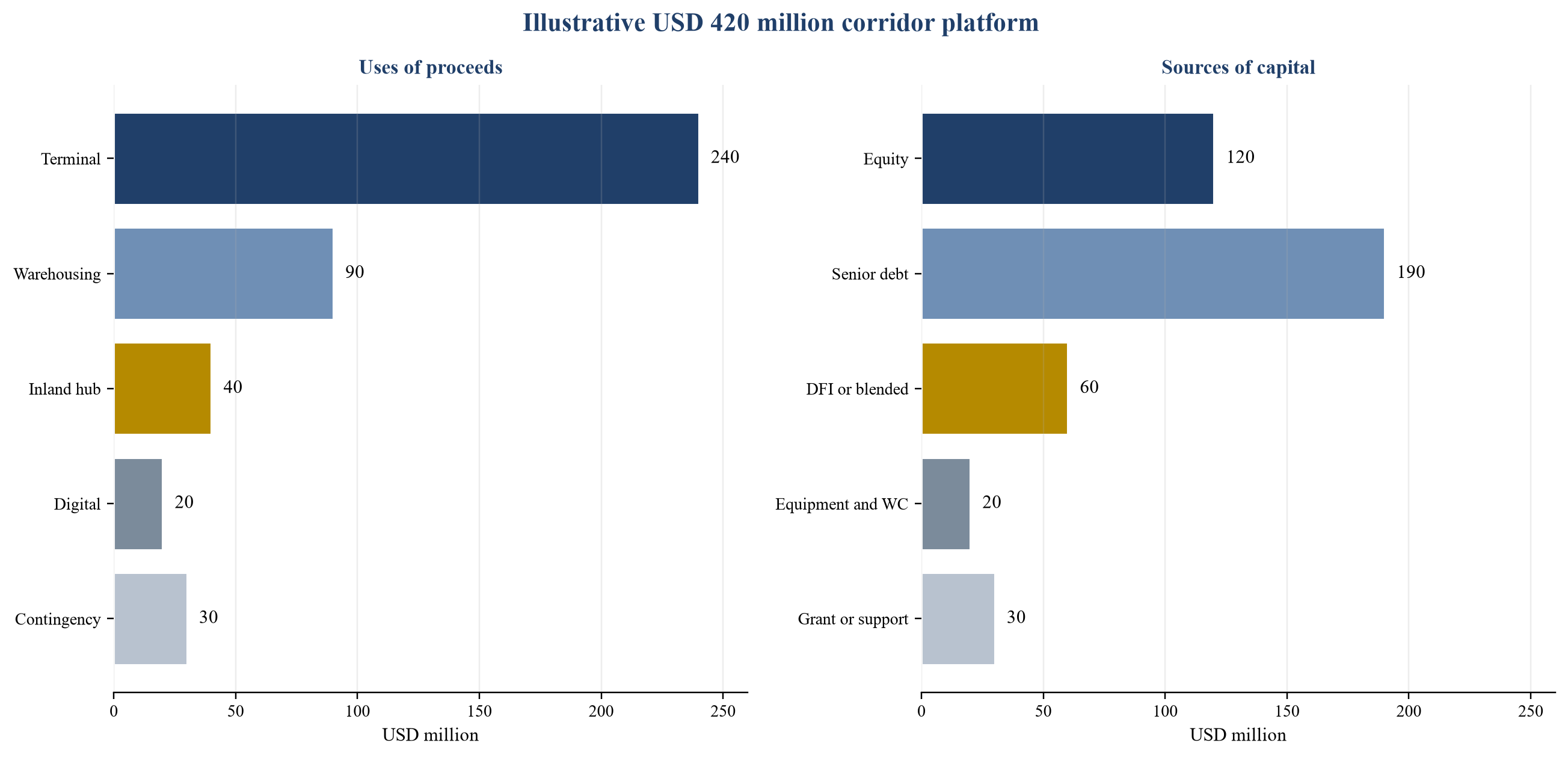
All amounts are USD millions and are illustrative management assumptions.
21. Size debt to resilient cash flow
Debt should be sized to the minimum of cash-flow capacity, concession life, market capacity, security value and stress resilience. A high base-case ratio can hide a weak downside if throughput, tariffs and currency move together.
The central case produces a minimum debt-service coverage ratio of 1.42 times after ramp-up. A lower-throughput case produces 1.23 times. A twelve-month delay with cost overrun produces 1.17 times. A correlated downside combining delay, throughput reduction, currency weakness and higher operating cost produces 1.08 times. These outputs are hypothetical.
The financing structure should include a debt-service reserve, maintenance reserve, distribution lock-up, cash sweep and cure regime. Covenants should use clearly defined cash available for debt service and debt-service concepts. The model should prevent double counting of reserve releases, grants or working-capital facilities.
22. Test correlated downside scenarios
Scenario design should reflect how corridor risks interact. A route disruption can reduce vessel calls, increase congestion and raise cost. Currency weakness can increase imported equipment and debt service while tariffs adjust slowly. Construction delay can postpone revenue and increase interest during construction.
The downside model should test at least completion delay, cost overrun, lower throughput, anchor loss, tariff delay, operating-cost increase, currency weakness, border delay and refinancing stress. The severe case should combine plausible correlated events rather than apply isolated sensitivities.
The action plan should link each threshold to a response. Responses may include deferring expansion, using contingency, drawing reserves, requiring equity, renegotiating service levels, activating alternate inland capacity, increasing collection control or suspending distributions. A scenario without an executable response is only a diagnostic.
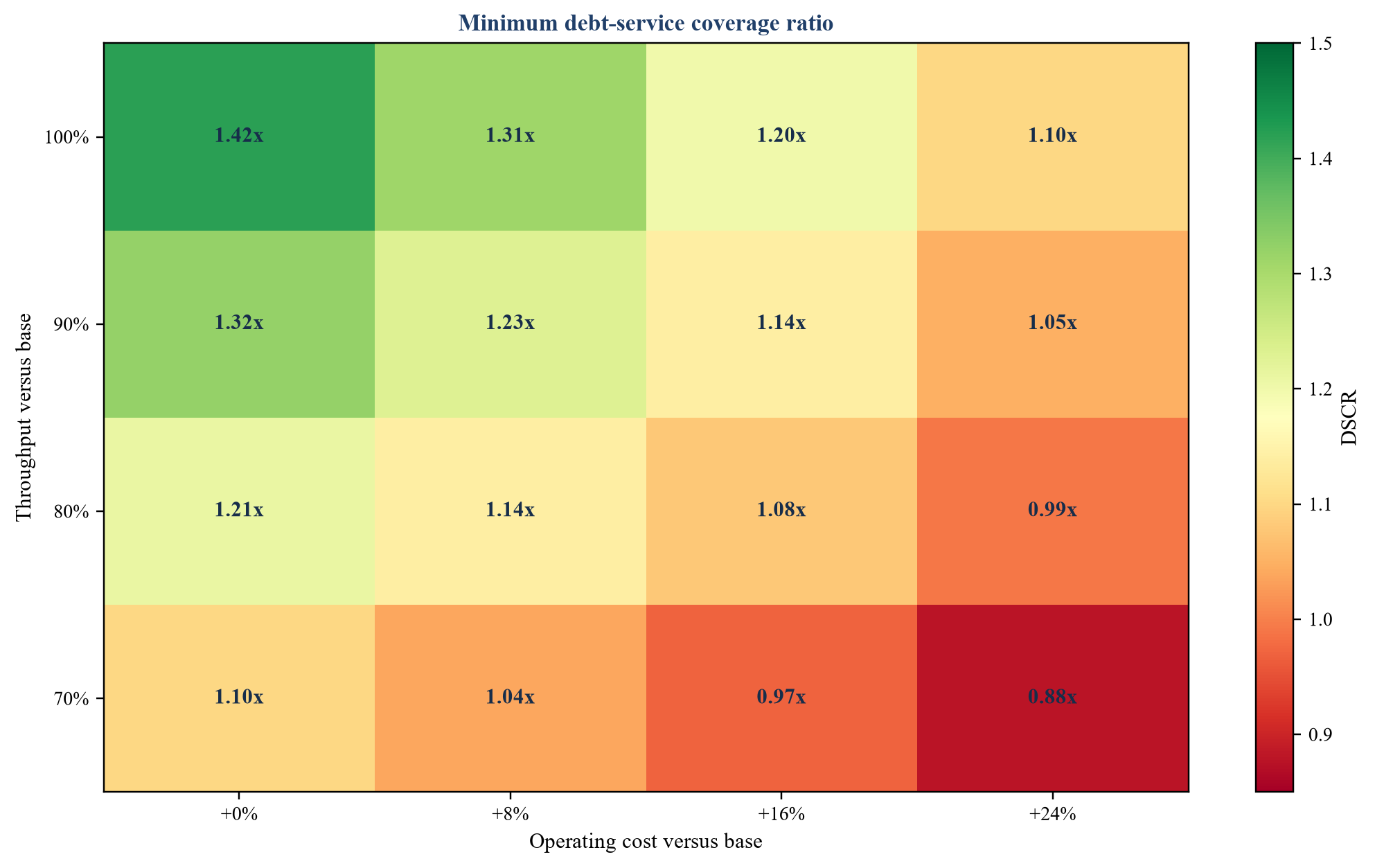
Ratios are illustrative management assumptions and do not represent a credit opinion.
23. Allocate political and public-interface risk
Political and public-interface risks include concession change, expropriation, transfer restriction, delayed public works, tariff intervention, customs policy and permit withdrawal. The structure should allocate each risk to the party able to manage it or support it.
Tools can include direct agreements, change-in-law protection, termination compensation, political-risk insurance, partial risk guarantees, sovereign or sub-sovereign support, escrow and development-finance participation. Each tool has eligibility, pricing, exclusions, claims and tenor constraints. Availability should be verified before the capital structure relies on it.
The project should distinguish a government undertaking from a legally enforceable and budgeted payment obligation. Fiscal approval, appropriation, debt limits and public procurement may affect enforceability. Local legal advice and public-finance diligence are essential.
24. Design controlled accounts and cash governance
Cash governance should follow the operating and financing perimeter. Customer receipts should enter controlled accounts with an agreed waterfall for taxes, operating cost, maintenance, debt service, reserves, permitted capital expenditure and distributions.
Where several operating entities collect cash, the structure should define sweep timing, currency conversion, leakage controls, intercompany charges and insolvency risk. The lender should receive reconciliations from operating records to invoices, bank receipts and the debt-service account.
Reserve use should be rule-based. A debt-service reserve can bridge temporary volatility but should not support a structurally weak case. Maintenance reserves should reflect actual lifecycle plans. Distribution should stop when coverage, completion, reserve or compliance tests fail.
25. Build data and assurance into the financing documents
Corridor assets generate large volumes of operational data. The financing package should specify the data fields, source systems, frequency, reconciliation and assurance that support borrowing, covenants and expansion.
The monthly dashboard should include throughput by customer and cargo type, vessel and truck time, dwell, warehouse occupancy, border time, service failures, invoicing, collection, operating cost, capital expenditure, reserve balances and coverage. Customer commitments and concession compliance should be reported separately.
Independent technical and model assurance should focus on the points that change credit capacity. Excessive reporting can obscure the critical indicators. Lenders and sponsors should agree a concise data dictionary and exception process before first drawdown.
26. Price climate and resilience investment
Ports and corridors face sea-level, storm, flooding, heat, drought, landslide and route-disruption risks. Resilience should be integrated into design, insurance, maintenance and financing rather than added after construction.
UN Trade and Development reports that climate and geopolitical disruption at maritime chokepoints can lengthen routes, raise costs and create congestion [18]. Its 2024 review calls for climate-proofed infrastructure, early-warning systems, alternative routes and balanced contractual allocation of weather-related risk.
The project should identify critical assets, service thresholds, recovery time, alternate capacity and resilience capital. Eligible resilience expenditure may attract development or climate-linked finance. The financial benefit should be measured through avoided downtime, reduced repair cost, lower insurance exposure or protected revenue. Unsupported resilience benefits should remain outside the base case.
27. Plan refinancing from the start
Construction and early ramp-up risk can require expensive or short-tenor capital. Once completion, throughput and collections are proven, the project may refinance into longer-tenor bank, bond or institutional debt.
The refinancing plan should define evidence thresholds, timing, prepayment cost, hedging treatment, reserve release, security transition and gain allocation. It should also test a market-closure scenario. A project should remain viable if refinancing is delayed.
The concession should permit refinancing and security transfer subject to reasonable approvals. Lenders may require direct agreements and continuity of step-in rights. Sponsor distributions should not assume refinancing proceeds before the transaction is executable.
28. Protect multi-user and public value
Corridor platforms often receive exclusive or scarce rights. Governance should preserve service quality, non-discriminatory access, transparent tariffs, safety, local capability and investment obligations.
Multi-user rules should define capacity allocation, related-party transactions, customer prioritisation and dispute resolution. Performance standards should be measurable and compatible with lender cure rights. Public reporting can improve accountability without disclosing commercially sensitive information.
Local procurement, employment and supplier development can support public value when requirements are realistic and funded. Obligations should be specified, measured and included in the cost model. Ambiguous commitments can create disputes and unplanned expenditure.
29. Use a corridor risk heat map
The risk heat map should combine likelihood, financial consequence, evidence confidence and control maturity. High-consequence risks with weak evidence deserve priority even when management considers their likelihood low.
The heat map should cover demand, anchor customers, concession, land, completion, interface, operating cost, currency, convertibility, climate, environmental and social matters, public support, cyber, refinancing and recovery. Each risk should have an owner, action, deadline, evidence and escalation threshold.
Risk scores are decision aids. They do not replace the cash model or legal analysis. The board should receive both the score and the underlying exposure.
| Risk | Likelihood | Consequence | Evidence confidence | Primary control |
|---|---|---|---|---|
| Throughput below base | Medium | High | Medium | Anchor commitments, phased expansion and cash sweep |
| Inland interface delay | Medium | High | Medium | Access agreement, alternate trucking and completion gate |
| Concession or tariff change | Low | High | Medium | Direct agreement, change-in-law and termination protection |
| Currency and transfer stress | Medium | High | Medium | Local debt, indexed tariff, reserves and political-risk support |
| Construction overrun | Medium | High | High | Fixed scope, contingency, security and sponsor support |
| Climate disruption | Medium | High | Medium | Resilient design, insurance, warning and recovery plan |
| Data or cyber outage | Medium | Medium | Medium | Segregation, backup, incident response and manual fallback |
| Refinancing unavailable | Medium | Medium | High | Amortisation, extension options and retained liquidity |
Scores and responses are hypothetical management assumptions for the worked case.
30. Establish decision gates
The programme should use formal gates for development, commercial readiness, financial structure, construction, operations and expansion. Each gate should define evidence, decision owner, unresolved matters and conditions for proceeding.
Gate one confirms the mandate and perimeter. Gate two confirms rights, demand and interfaces. Gate three approves the financing case and risk allocation. Gate four authorises financial close and first drawdown. Gate five confirms technical and commercial completion. Gate six authorises expansion or refinancing.
The investment committee should see the base case, correlated downside, funding plan, evidence gaps, conditions and recovery path. Approval should state which assumptions may change without renewed consent. This creates a controlled bridge from strategic ambition to funded execution.
31. Execute the first 180 days
The first thirty days should reconcile the asset perimeter, concession, land, traffic evidence, anchor customers, capital scope, operating interfaces and public obligations. Management should establish a controlled data room and a single issues register.
Days thirty-one to ninety should develop the traffic and cash model, technical scope, environmental and social plan, contract matrix, support package and lender information memorandum. Independent advisers should challenge demand, cost, schedule, legal rights and model logic.
Days ninety-one to one hundred and eighty should secure indicative terms, negotiate key contracts, close evidence gaps, finalise approvals, complete documentation and test operating reporting. Financial close should occur only when conditions precedent and funding sources reconcile.
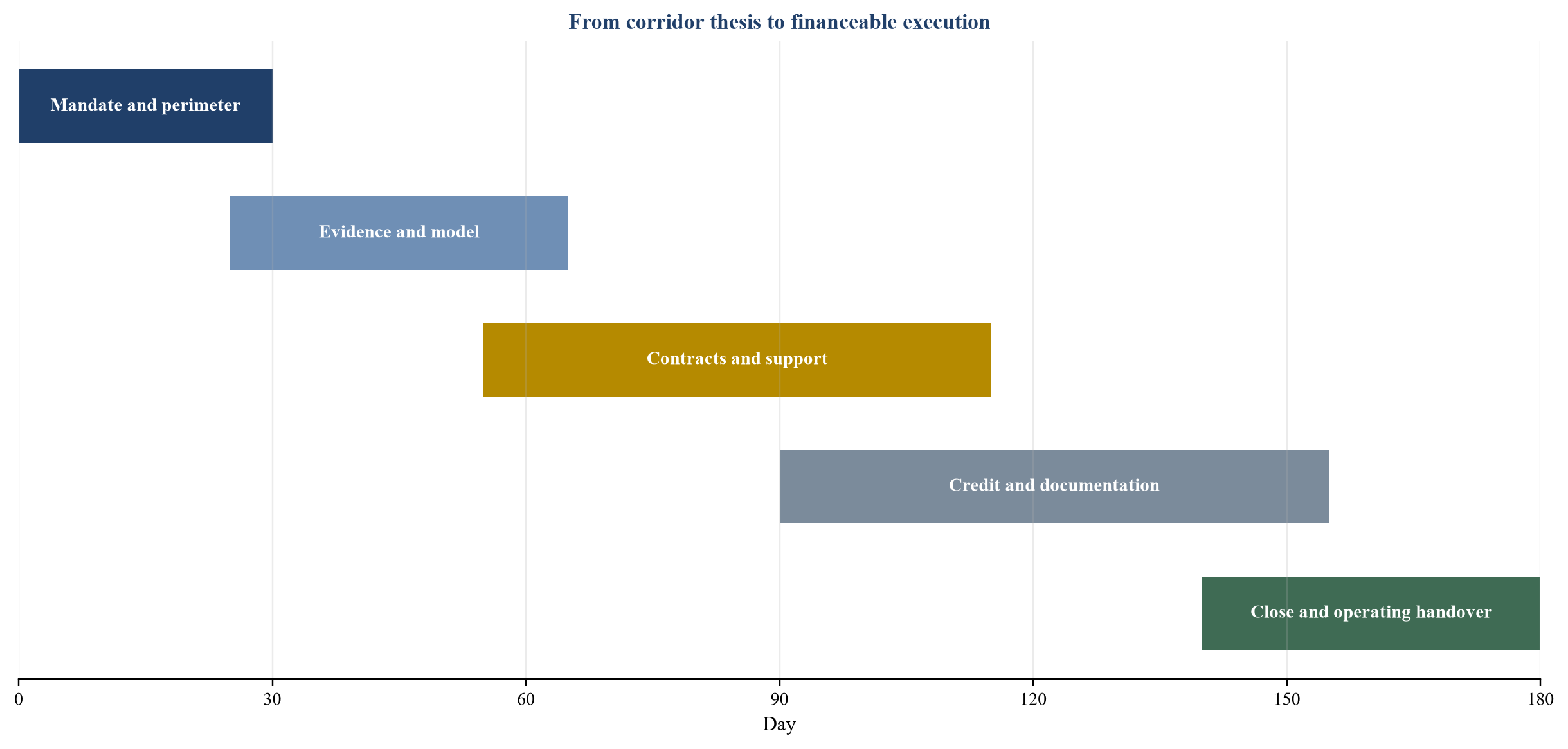
Timing is a hypothetical management assumption and should be rebuilt for each transaction.
32. Apply the bankability checklist
Before approval, management should confirm that the corridor has a defined perimeter, enforceable rights, sufficient concession life, secured land, an integrated operating map, a credible cargo hierarchy, bankable anchor contracts, phased capital expenditure, controlled construction, clear tariffs, currency protection, public-interface remedies, environmental and social plans, digital continuity, controlled accounts, reserves, downside liquidity and a recovery route.
The checklist should show evidence quality and ownership. A document labelled final may still be inadequate if it is unsigned, expired, conditional or inconsistent with the model. The closing data room should contain the executed and reconciled evidence used by the board and lenders.
A corridor becomes financeable when rights, cargo, operations and capital reinforce one another. The discipline is to finance the minimum coherent system, prove performance and expand against evidence.
| Test | Approval question | Minimum evidence | Stop condition |
|---|---|---|---|
| Perimeter | Are all critical assets and interfaces controlled? | Asset, rights and interface map | Critical dependency outside executable control |
| Demand | Is opening debt supported by durable cargo? | Contracted and evidenced throughput | Base case relies on speculative cargo |
| Concession | Do rights outlast debt and permit security? | Executed concession and direct agreement | Inadequate tenor, tariff or step-in protection |
| Completion | Can the full route reach commercial operation? | Cost-to-complete, permits and interface testing | Unfunded gap or missing access right |
| Cash | Can revenue be collected and transferred? | Contracts, accounts, currency and waterfall | Material leakage or trapped cash without remedy |
| Downside | Does the structure retain liquidity and control? | Correlated stress model and action plan | Coverage or liquidity below approved floor |
| Sustainability | Are impacts, resilience and obligations funded? | ESMS, permits, resilience plan and budget | Unresolved material impact or unfunded commitment |
| Exit | Can lenders recover or refinance? | Security, step-in, cure and refinancing plan | Recovery depends on unsupported future value |
Each test requires project-specific evidence and professional advice where applicable.
33. Translate the framework into capital-provider decisions
The same corridor produces different decisions for sponsors, governments, development institutions, commercial lenders and long-term investors. A credible financing process gives each party a defined risk layer and an evidence-based reason to accept it. Sponsors should carry development, integration and early commercial risk because they control the project definition and negotiating strategy. Their equity should fund the work required to convert strategic interest into executable rights, contracts and designs. Equity cannot substitute for unresolved authority, inaccessible land or a revenue model that lacks lawful collection rights.
The public authority should focus support on obligations that arise from public control or public benefit. These can include concession certainty, access rights, customs and border coordination, defined tariff processes, connecting infrastructure, resettlement obligations, targeted viability support and transparent compensation when a public action impairs the project. Support should be conditional, measurable and limited to the approved policy purpose. An open-ended revenue promise can weaken operating discipline and create a contingent liability that is difficult to govern. A defined payment mechanism, evidence standard, cap and termination route makes the obligation more financeable and more accountable.
Development-finance institutions can address risks that commercial debt cannot efficiently carry during the early operating period. Their role may include longer tenor, subordinated or blended capital, political-risk mitigation, environmental and social discipline, local-currency solutions, technical assistance and mobilisation of other lenders. The instrument should solve a diagnosed financing constraint. Concessional capital should have a stated additionality case, a measurable development purpose and a route to crowd in commercial capital as the corridor demonstrates performance. The World Bank, African Development Bank and IFC examples reviewed in this paper show that corridor investment commonly combines physical assets, institutional coordination and operating improvement [3] [8] [11] [19] [20].
Commercial lenders should size debt to controlled cash rather than total strategic value. Their underwriting should test concession life, completion coverage, contracted cargo, collection mechanics, currency mismatch, reserve policy, information rights, security and step-in feasibility. A lender should be able to explain how an adverse operating event becomes a measurable covenant response, a funded cure, a restructuring action or an enforcement route. If the answer depends entirely on sponsor goodwill or future public support, the control architecture remains incomplete.
Institutional investors can enter when construction exposure, demand uncertainty and operating interfaces have reduced to a level consistent with their mandate. Refinancing can replace higher-cost development capital after completion, a stable operating record, audited reporting and demonstrated cash transfer. The transaction should preserve adequate maintenance, resilience and expansion funding. Extracting cash too early can create a superficially attractive distribution while weakening the asset that supports the remaining capital.
Anchor customers also participate in the capital structure through commitments that improve revenue visibility. Their contracts should reflect genuine service value and operating flexibility. Capacity reservations, minimum-volume commitments, deposits, dedicated facilities and service-level remedies can support financing when the customer has authority, credit quality and a credible logistics requirement. Concentration limits, transfer rights, replacement mechanisms and performance conditions protect the platform from becoming dependent on one relationship.
The final approval memorandum should reconcile these decisions in one sources-and-uses table, one risk-allocation matrix, one cash waterfall and one conditions schedule. It should identify the party responsible for each unresolved item, the evidence required, the deadline and the consequence of failure. This turns a broad corridor vision into a controlled transaction. It also gives the board a basis for refusing capital that carries the wrong currency, maturity, security, control or return expectations for the risk being financed.
Sources
- World Bank, Logistics Performance Indicators 2.0 and 2025 report. Read the primary source
- World Bank and S&P Global Market Intelligence, Container Port Performance Index 2020 to 2024. Read the primary source
- African Union, Continental infrastructure agenda and integrated multimodal logistics corridors, 30 April 2026. Read the primary source
- African Union, AU-ECHO 2024 edition, AfCFTA corridor assessments and trade facilitation. Read the primary source
- International Transport Forum, East Africa Freight Transport: Enhancing Regional Connectivity, 2025. Read the primary source
- World Bank, Logistics Performance Index 2023 press release and findings. Read the primary source
- World Bank PPP Resource Center, Public Private Partnerships in Ports. Read the primary source
- World Bank PPP Resource Center, Ports Module and sample risk matrix. Read the primary source
- International Finance Corporation, Benin Terminal environmental and social review summary, project 48522. Read the primary source
- AD Ports Group, Luanda multipurpose port terminal and logistics investment, 23 April 2024. Read the primary source
- AD Ports Group, Pointe Noire terminal partnership and phase-one investment, 6 February 2025. Read the primary source
- DP World, Dar es Salaam port concession and investment. Read the primary source
- DP World, Maputo container terminal capacity expansion, 1 May 2025. Read the primary source
- DP World, Maritime construction at the new Ndayane port in Senegal. Read the primary source
- International Finance Corporation, Investment in Africa Infrastructure Investment Fund 4, 12 January 2024. Read the primary source
- Public-Private Infrastructure Advisory Facility, Annual Report 2024, Djibouti logistics and intelligent transport systems. Read the primary source
- World Bank and SSATP, Africa port digitalisation assessment and corridor monitoring, March 2024. Read the primary source
- UN Trade and Development, Review of Maritime Transport 2024. Read the primary source
- African Development Bank, South Sudan-Ethiopia-Djibouti Transport Corridor Phase II financing, 3 December 2025. Read the primary source
- African Development Bank, Initial disbursement of USD 1 billion loan to Transnet, 6 December 2024. Read the primary source
- African Development Bank, Mozambique rail and port rolling-stock loan, 2 February 2024. Read the primary source
- African Development Bank, Comoros maritime corridor and regional trade facilitation project, 5 August 2024. Read the primary source
