

1. Decide whether the investment is a project or a platform
The first decision is organisational. A project is a defined asset with a contractual perimeter, a construction plan and a cash flow that can support its own financing. A platform is a governed system for originating, developing, financing, operating and recycling a series of assets that share an investment thesis and operating capabilities. Calling a collection of unrelated minority stakes a platform does not create repeatability.
The board should approve a platform only when replication creates measurable advantages. These may include common technical standards, procurement scale, shared development resources, customer or offtaker relationships, central treasury, digital operating systems, reusable contracts, local partner networks and a credible route to portfolio refinancing. The mandate should specify sectors, countries, asset size, development stage, ownership range, return requirements, loss tolerance, leverage, foreign-exchange policy, concentration limits and the conditions for further capital.
The decision should include stop conditions. Examples include dependence on one country or public buyer, no repeatable asset design, no local operating partner, a development pipeline without land or rights, cross-subsidy between assets, unhedged hard-currency debt against local-currency revenue, or a plan that assumes every project reaches financial close. A platform should be approved as an operating and capital-allocation model, not as a label for expansion.
2. Start with the bankability gap
Africa's infrastructure requirement remains much larger than annual investment. The African Development Bank's project-preparation facility describes annual infrastructure needs of USD 130 billion to USD 170 billion and a financing gap of roughly USD 50 billion to USD 100 billion [1]. The World Bank recorded USD 100.7 billion of private participation in infrastructure across low- and middle-income countries in 2024; Sub-Saharan Africa accounted for a much smaller share, with investment concentrated in selected energy and transport transactions [2].
The constraint is not a simple shortage of capital. Projects can remain unfunded because technical studies are incomplete, public rights are uncertain, tariffs are unaffordable, foreign-exchange risk is uncontrolled, procurement is weak, environmental obligations are unresolved or the sponsor cannot fund development and completion. NEPAD-IPPF states that robust preparation converts concepts into bankable projects and reports substantial downstream mobilisation from preparation expenditure [1].
A platform should therefore be designed around the bankability gap it can solve. One platform may standardise distributed energy projects. Another may aggregate water-treatment concessions, data-centre edge facilities, logistics nodes or transport assets. The platform thesis should explain why its repeatable development process can move assets from concept to operating cash flow more reliably than standalone sponsorship.
3. Translate GCC advantages into an investable proposition
GCC investors may bring patient equity, access to regional banks, export-credit relationships, engineering and operating expertise, procurement scale, global customers and experience with large infrastructure systems. African counterparties may bring licences, land, market knowledge, public-sector interfaces, local financing, labour capability and social legitimacy. The structure should convert these contributions into defined rights and obligations.
Recent transactions demonstrate several models. AD Ports Group combined a long-term terminal concession in Luanda with local joint ventures and phased investment [3]. DP World and British International Investment created an Africa platform intended to invest across ports, inland container depots, economic zones and logistics [4]. MIGA executed framework terms covering a distributed renewable-energy portfolio across twenty African countries, illustrating how a portfolio approach can be paired with political-risk protection [5]. These examples evidence structures used by named sponsors; they do not establish expected returns for another platform.
The investment proposition should state what the GCC sponsor contributes at platform level, what remains local, and how value is shared. It should also define related-party procurement, transfer pricing, management fees, operating standards and technology licences. An undefined strategic contribution can become an uncontrolled cost or a governance dispute.
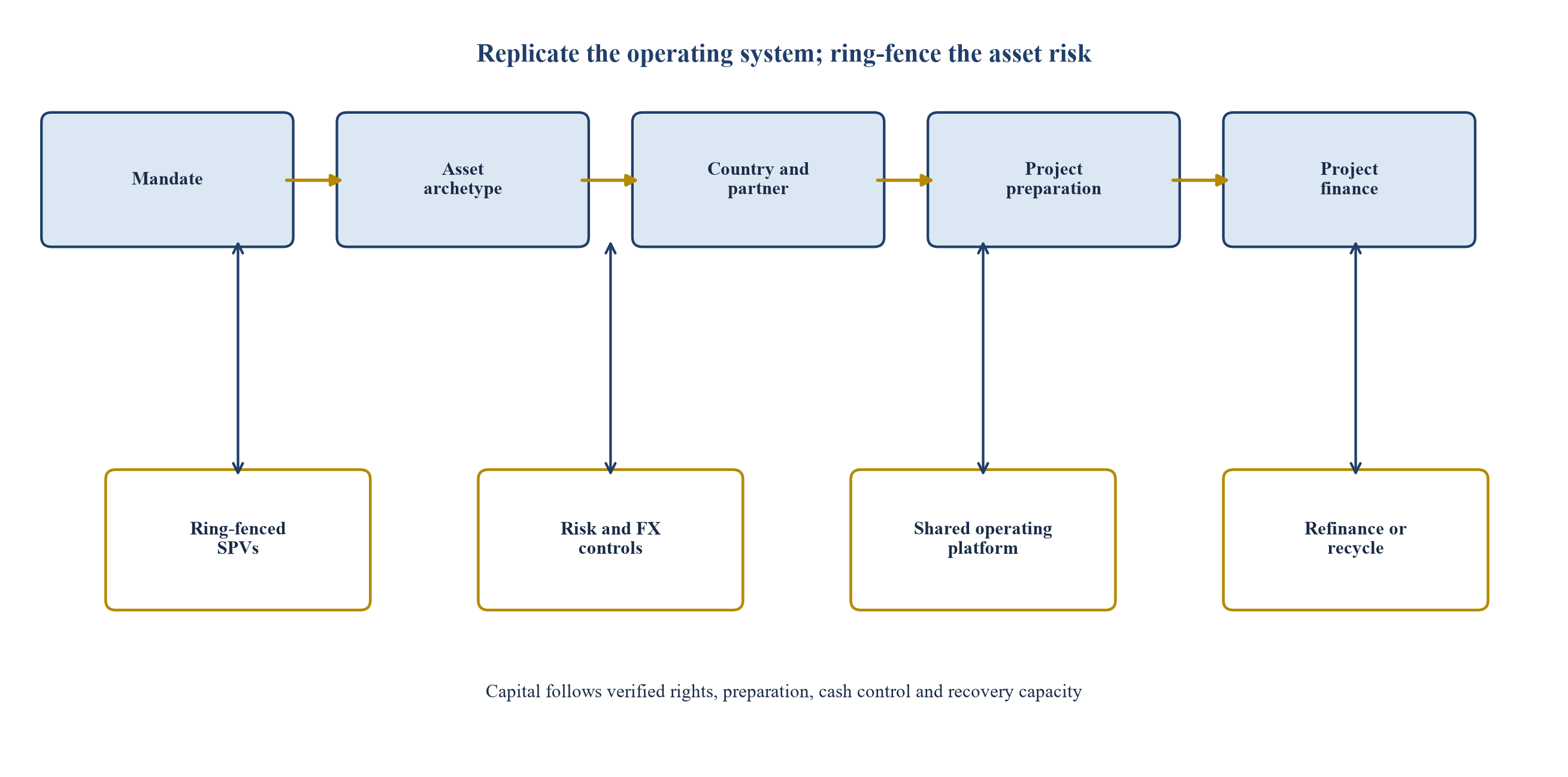
The figure is a proposed governance framework; it does not represent an observed transaction.
4. Define a repeatable asset archetype
Replication begins with an asset archetype. The archetype defines the customer, service, revenue mechanism, legal right, technical design, construction method, operating model, maintenance profile, environmental and social footprint, currency exposure and likely financing structure. It should be narrow enough to standardise and broad enough to create a pipeline.
A distributed solar platform may share equipment specifications, power-purchase agreements, monitoring systems and customer-credit tests. A water platform may share treatment technology and operating procedures while each concession retains its own tariff, source-water and public-authority risks. A logistics platform may combine terminals and inland assets, but each site's throughput and access rights remain distinct. Shared design should reduce development time; it should not erase local conditions.
The archetype memo should identify which elements can be standardised, which require jurisdiction-specific diligence and which cannot be pooled. It should include a reference capital cost, construction period, operating ramp, maintenance profile, revenue model and risk allocation. These are design parameters until supported by project evidence.
5. Select assets through evidence gates
Pipeline size is a weak measure of platform quality. The investment committee needs a staged funnel that removes assets before development expenditure compounds. Each opportunity should pass strategic, legal, technical, commercial, environmental, partner and financing gates.
The strategic gate tests fit with the mandate and replication thesis. The rights gate tests land, concession, licence, access, permits and procurement status. The commercial gate tests payer need, affordability, demand evidence, tariff or payment mechanism and contract authority. The technical gate tests site, resource, design, grid or network interface, construction plan and lifecycle cost. The partner gate tests capability, integrity, ownership, incentives and decision rights. The financing gate tests capital need, currency, leverage capacity, lender appetite and risk-mitigation eligibility.
| Gate | Minimum evidence | Decision question | Stop condition |
|---|---|---|---|
| Mandate | Sector, country, size and ownership fit | Does replication create a platform advantage? | Asset requires a different operating model |
| Rights | Land, licence, concession, permits and procurement path | Can the asset be lawfully built and financed? | Critical right is unavailable or non-transferable |
| Commercial | Demand, payer, tariff, affordability and contract authority | Is revenue durable and collectable? | Revenue depends on unsupported demand or subsidy |
| Technical | Site, design, interface, construction and lifecycle evidence | Can delivery and performance be measured? | Unbounded scope or unresolved interface |
| Partner | Capability, integrity, capital and governance diligence | Does the partner improve execution and legitimacy? | Ownership or decision rights are opaque |
| Finance | Sources, tenor, currency, coverage and mitigation | Can the asset survive the approved downside? | Unhedged mismatch or inadequate completion capital |
The gates are a proposed decision framework and require jurisdiction-specific calibration.
6. Choose countries as a portfolio decision
Country selection should combine asset economics with institutional and portfolio risk. A high-return project can weaken the platform if it duplicates sovereign, currency, offtaker, regulatory or climate exposure already present elsewhere. Country allocation should therefore be approved with explicit limits and scenario tests.
The country screen should cover procurement law, concession enforceability, foreign-ownership rules, security and step-in rights, currency convertibility, repatriation, tax, insolvency, dispute resolution, public-payment history, local-bank capacity, insurance eligibility, environmental standards and community engagement. These factors change over time and require current local advice.
The platform should limit exposure by country, currency, public counterparty and construction period. Limits can be based on committed equity, total capital at risk, projected cash flow or loss under a defined stress. A platform can intentionally enter a higher-risk market when the asset has stronger contracts, risk cover, local-currency funding or lower capital exposure. The decision should be recorded as an exception with compensating controls.
7. Make the local partnership financeable
Local partnerships can improve origination, stakeholder access, delivery and operating legitimacy. They can also create governance, compliance, capital and related-party risks. A memorandum of understanding is not a financeable partnership.
The platform should verify beneficial ownership, funding capacity, technical capability, public relationships, litigation, sanctions, anti-bribery controls, conflicts and performance history. The shareholder agreement should define reserved matters, board composition, budgets, procurement, funding obligations, dilution, defaults, deadlock, transfer, change of control, distributions and exit. Operating and development services should be documented on arm's-length terms.
The local partner's contribution should be measurable. Land or rights require valid title and valuation. Development work requires deliverables, budget and acceptance criteria. Political access cannot substitute for lawful approvals. Sweat equity should vest against milestones. If the partner cannot fund pro rata capital, the structure should state whether shortfalls create dilution, shareholder debt, preferred equity or default.
8. Use a HoldCo and SPV structure deliberately
The typical platform uses a holding company above country companies or asset SPVs. The HoldCo houses strategy, governance, shared capabilities and equity allocation. Each asset SPV holds local rights, contracts, debt, security and cash flows. Country sub-holdings may be useful for regulation, tax, local financing or partner participation. The structure should follow substance and control, with legal and tax advice in each relevant jurisdiction.
Project lenders usually require asset-level ring-fencing. Security may cover shares, accounts, contracts, receivables, insurance and project assets, subject to local law. Cash should remain within the asset waterfall until operating costs, taxes, debt service, reserves and covenants are satisfied. HoldCo distributions should be upstreamed only when permitted.
Cross-guarantees can reduce financing cost but transmit failure. A platform should use them only when the contagion is understood and priced. Development or warehouse facilities may have recourse to HoldCo; construction and operating debt should generally match the risk of the asset it finances. Shared services should be paid through transparent contracts that do not drain protected project cash.
9. Separate development capital from construction capital
Development is a portfolio activity with a high attrition rate. Construction is an asset activity funded after rights, design, contracts and approvals reach a defined standard. Mixing the two can cause project debt to fund speculative expenditure or cause the platform to underreserve the capital needed to move good projects to close.
The platform budget should separate origination, feasibility, environmental and social studies, legal work, engineering, permits, land, bid security, development staff and transaction costs. Each asset should have a development cap and next-stage test. The platform should forecast attrition and timing rather than assuming every opportunity succeeds.
Project-preparation facilities can complement sponsor capital when eligibility is met. Afreximbank and Infrastructure South Africa established a joint facility to accelerate project preparation [6]. The African Development Bank has also emphasised systematic preparation and value-chain approaches to private infrastructure investment [7]. These facilities do not replace sponsor accountability or the need for a credible commercial case.
10. Build a capital stack around risk layers
Equity should absorb development, completion and operating variability that debt cannot bear. Senior project debt should fund predictable construction and operating cash flows. Development-finance or blended debt may address tenor, market, climate, currency or first-transaction constraints. Local-currency facilities can reduce mismatch. Grants or viability support should fund defined public-good or affordability gaps rather than conceal weak economics.
The instrument should match the risk. A guarantee may address government non-payment, transfer restriction, expropriation or breach of contract. A liquidity facility may bridge delayed offtaker payment. An export-credit facility may finance eligible equipment. Mezzanine or preferred equity may bridge leverage and return requirements, but its cash claims must fit the downside. A warehouse facility can finance a pool before refinancing if eligibility, concentration and substitution rules are clear.
| Risk layer | Possible instrument | Core control | Misuse to avoid |
|---|---|---|---|
| Origination and preparation | Sponsor equity, preparation facility, recoverable grant | Stage caps and evidence gates | Funding an unlimited pipeline |
| Construction and completion | Equity, senior project debt, ECA facility | Fixed scope, contingency, completion support | Debt reliance on unfinished rights |
| Public payment and political risk | Guarantee, political-risk insurance, liquidity facility | Covered peril, claims process and exclusions | Treating insurance as revenue |
| Currency mismatch | Local debt, hedging, indexed tariff, reserve | Currency policy and stress test | Open hard-currency debt exposure |
| Ramp and portfolio seasoning | Subordinated debt, preferred equity, warehouse line | Eligibility, concentration and cash sweep | Cross-subsidising weak assets |
| Recycling and expansion | Refinancing, bond, securitisation, asset sale | Stable cash history and disclosure | Refinancing assumed before performance |
Instrument availability, pricing and eligibility require current transaction-specific confirmation.
11. Model the platform as a portfolio of cash-flow islands
Each asset should remain a cash-flow island with its own construction budget, operating model, debt capacity, reserves and failure response. The platform model then consolidates those assets after respecting ring-fenced waterfalls and distribution restrictions. A consolidated earnings number can overstate available cash when profitable assets cannot upstream distributions or when construction assets consume capital.
The model should include asset-level and portfolio-level views. Asset schedules should show capital expenditure, revenue, operating cost, working capital, taxes, debt service, reserves and distributions. The platform schedule should show development expenditure, central cost, HoldCo debt, equity calls, co-investment, dividends, recycling proceeds and liquidity. Intercompany balances should reconcile.
The portfolio case should test construction delay, cost overrun, lower demand, public-payment delay, tariff restraint, foreign-exchange weakness, higher interest rates and partner default. Correlation matters. Currency weakness can coincide with inflation, higher interest rates and public-payment stress. The model should avoid adding separate mild sensitivities that conceal a severe combined outcome.
12. Worked platform scenario
Consider a hypothetical platform with five assets across three African countries: two distributed-energy portfolios, one water-treatment concession, one logistics node and one digital-connectivity network. Total development and construction cost is assumed at USD 600 million. The platform contributes development capability, procurement, treasury and operating systems; local partners hold minority interests and provide licensed development and operating services.
The assumed capital stack contains USD 165 million of sponsor and co-investor equity, USD 300 million of senior project debt, USD 65 million of development-finance or blended debt, USD 35 million of local-currency facilities and USD 35 million of grants, guarantees or viability support. These amounts are hypothetical management assumptions. The grants and guarantees are assumed only for modelling; eligibility, pricing and availability are not verified.
Construction is phased across four years. No more than two assets enter peak construction at the same time. The platform maintains a USD 24 million HoldCo liquidity reserve and asset-level debt-service reserves. The base case assumes that three assets stabilise before the final two draw full senior debt. The minimum portfolio debt-service coverage ratio after stabilisation is 1.46 times. A correlated downside combining six-month delay, 10 percent cost increase, 12 percent revenue reduction and local-currency weakness reduces minimum coverage to 1.12 times before mitigation. A further severe case creates a cash shortfall and requires scope deferral, equity support or restructuring.
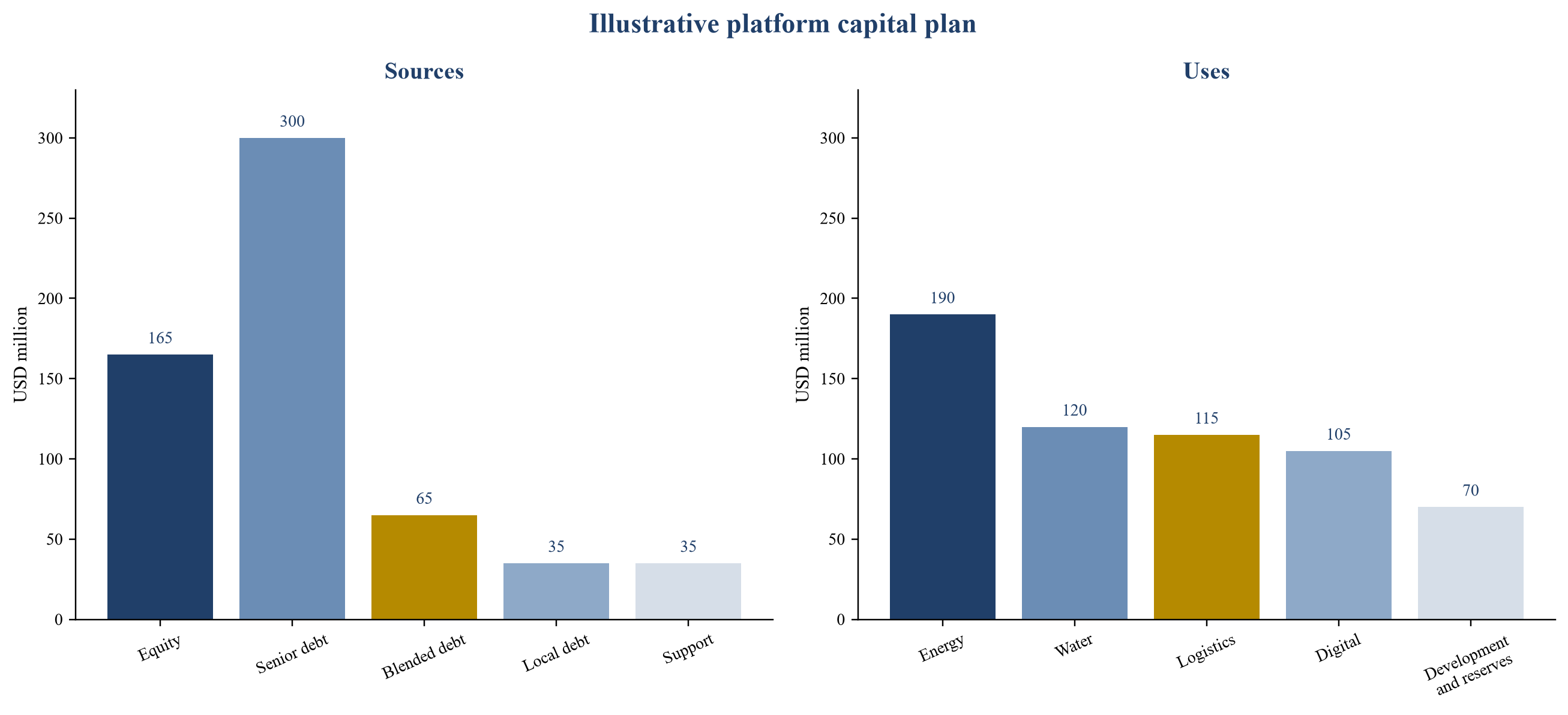
All amounts are hypothetical management assumptions and do not represent an actual transaction.
13. Size debt from cash and recovery
Debt capacity should be the lower of cash-flow capacity and recoverable value after considering the legal and operational characteristics of the asset. Availability-payment, contracted or regulated assets may support higher leverage than merchant or early-ramp assets. A portfolio does not justify leverage merely because its assets are diversified.
The debt case should specify minimum and average coverage, loan life, reserve requirements, distribution tests, cure rights and lock-up triggers. It should also test how debt service responds to local interest rates, base rates, refinancing assumptions and currency. Tail periods between debt maturity and concession expiry support recovery but do not replace current affordability.
Lenders should receive direct agreements, notice and step-in rights where local law and contracts permit. Security enforcement may not preserve value when the lender lacks operating rights, licences or a replacement operator. Recovery analysis should therefore include transfer consents, public-authority rights, cure periods, asset condition, spare-parts access and the availability of a qualified operator.
14. Control foreign-exchange risk at asset and portfolio level
Foreign-exchange risk is a central platform risk because construction equipment and debt may be denominated in hard currency while tariffs are collected locally. A simple conversion of local revenue at the current exchange rate can overstate debt capacity.
The policy should rank mitigants. The strongest is revenue in the debt currency or an enforceable indexed tariff supported by an affordable payer. Local-currency debt removes part of the mismatch but may carry shorter tenor or higher nominal cost. Hedging can protect defined periods when markets and credit lines are available. Offshore reserves and political-risk cover can address transfer constraints but do not repair an unaffordable tariff.
IFC describes local capital markets as an important source of long-term local-currency finance and supports anchor investments, credit enhancements and replicable issuances [8]. Its Joint Capital Market Program links local-currency market development with infrastructure financing [9]. The platform should engage local banks and institutional investors early, especially for operating-stage refinancing.
15. Use guarantees against defined perils
Political-risk insurance and credit enhancement can improve financeability when the underlying project is commercially and technically sound. MIGA covers risks that can include breach of contract, currency inconvertibility and transfer restriction, expropriation, war and civil disturbance, and non-honouring of financial obligations [10]. ATIDI describes similar political-risk cover and can insure qualifying medium- to long-term infrastructure loans, subject to country, due-diligence and policy conditions [11]. ICIEC has supported African infrastructure financing through political-risk and sovereign non-honouring structures [12].
Coverage should be mapped to the exposure. The insured party, amount, tenor, waiting period, exclusions, dispute process, recovery rights and claims evidence should be reflected in finance documents and the model. Insurance proceeds may arrive after a delay and should not be modelled as immediate revenue.
The platform should maintain a guarantee register across assets. It should record insured risks, uncovered risks, expiry, premiums, reporting, consents and actions that could prejudice a claim. The presence of a multilateral insurer may also support policy dialogue, but the board should approve the investment on enforceable rights and cash controls.
16. Allocate construction and interface risk
Construction risk includes design, scope, site, permits, contractor performance, equipment, logistics, inflation, currency, delay and interfaces with public works. A platform may standardise engineering and procurement while each asset retains local site and interface risk.
The completion plan should include a defined scope, verified quantities, procurement status, construction contract, performance security, insurance, independent engineer, contingency, cost-to-complete test and sponsor support. Modular assets may use framework procurement, but the platform should confirm that imported standards comply with local codes and operating conditions.
Interface risks deserve separate treatment. A power asset may depend on grid works; a water asset on intake and distribution; a logistics asset on road access and customs; a digital asset on power, fibre and spectrum. The party responsible for each interface should have a schedule, budget, completion test and remedy. Debt draw should be restricted when a critical interface remains unsupported.
17. Build environmental and social requirements into the model
Environmental and social obligations influence permits, construction, community acceptance, lender eligibility, insurance and operating cost. They should be treated as design and financing inputs. The platform should apply a common management system while preserving asset-specific assessments and commitments.
The asset should maintain a commitments register covering land, resettlement, biodiversity, labour, occupational safety, community safety, emissions, water, waste, grievance mechanisms and monitoring. Each commitment needs an owner, deadline, budget and evidence. The platform should monitor unresolved complaints, incidents, corrective actions and contractor performance.
MIGA's portfolio guarantee for distributed energy across Africa is an example of a portfolio structure subject to World Bank Group environmental and social requirements [5]. ATIDI also states that its underwriting includes environmental and social due diligence [11]. Compliance should be verified independently; the availability of finance does not establish that an asset has met all obligations.
18. Govern shared services and data
Shared services are a core source of platform value. They may include development, engineering, procurement, treasury, reporting, cyber security, maintenance planning, insurance, legal templates and environmental management. They should have measurable service levels, allocation rules and audit rights.
Data should support investment and operating decisions. The platform needs a common asset register, contract register, risk register, budget, construction dashboard, operating indicators, cash forecast and covenant calendar. Data definitions should be consistent across assets. Source systems, owners, refresh cycles and approval rights should be documented.
Technology can improve condition monitoring, energy use, predictive maintenance, billing, loss detection and customer service. It also creates cyber, vendor and continuity risk. The platform should define architecture, access, backups, incident response, data localisation and exit from critical vendors. Technology expenditure should be tied to operating value or control improvement.
19. Prevent contagion
Contagion can arise through guarantees, cross-defaults, shared accounts, reputation, common contractors, common offtakers, related-party claims or emergency capital calls. The platform should map legal and economic contagion before it signs financing documents.
Asset-level debt should avoid unnecessary cross-default to unrelated projects. HoldCo debt may depend on portfolio distributions and therefore needs conservative leverage, liquidity and cure rights. A defaulted asset should not automatically seize cash needed to operate healthy assets. Shared procurement should include alternate suppliers and rights to reassign equipment where lawful.
The platform should maintain a response ladder: asset management intervention, reserve draw, sponsor cure, scope reduction, refinancing, partner replacement, sale, enforcement or orderly exit. The board should know which actions are legally available and how long they take. Recovery assumptions should not rely on immediate sale into a liquid market.
| Risk | Illustrative exposure | Primary control | Escalation trigger |
|---|---|---|---|
| Development attrition | High before rights are secured | Stage caps and kill criteria | Spend exceeds approved stage budget |
| Country and public counterparty | Medium to high | Limits, contracts and risk cover | Payment delay or adverse legal change |
| Foreign exchange | High where revenue is local | Local debt, indexation, hedge and reserve | Coverage breaches under currency stress |
| Construction and interface | High during build | Fixed scope, contingency and completion support | Cost-to-complete exceeds available funding |
| Partner and governance | Medium | Diligence, reserved matters and default rights | Funding, integrity or reporting failure |
| Portfolio contagion | Medium | Ring-fencing and limited cross-default | Asset cure requires healthy-asset cash |
| Refinancing and exit | Medium | Long maturity and multiple exit routes | Debt relies on uncommitted refinancing |
Ratings are illustrative; management should replace them with evidence-based project ratings.
20. Refinance and recycle only after evidence
Operating assets can be refinanced, sold, securitised or contributed to a larger vehicle when cash flows, contracts, compliance and operating performance are demonstrated. Recycling can release sponsor capital for new assets and broaden the investor base.
Africa50's asset-recycling programme with The Gambia transferred operation of the Senegambia Bridge to a dedicated company and released public capital under a long-term arrangement [13]. Africa50 also sponsors an infrastructure acceleration fund intended to mobilise institutional capital [14]. These structures show possible routes for seasoned assets; transaction-specific value depends on rights, performance, debt and market conditions.
The platform should set recycling criteria at entry. These should include minimum operating history, stable revenue, completed environmental obligations, covenant compliance, audited data, remaining asset life, transferability and buyer universe. Sale proceeds should be allocated under a pre-agreed policy covering debt repayment, reserves, distributions and reinvestment.
21. Sequence a 180-day platform build
The first 180 days should establish governance and test the first assets. Days 1 to 30 approve the mandate, limits, archetype and decision rights. Days 31 to 60 screen the pipeline, select jurisdictions and begin partner diligence. Days 61 to 90 approve development budgets, establish HoldCo and SPV architecture and appoint advisers. Days 91 to 120 complete preliminary technical, commercial, legal, environmental and financing work for priority assets. Days 121 to 150 obtain indicative capital and risk-mitigation terms. Days 151 to 180 approve the first full development case and stop or defer weak opportunities.
The platform should avoid building central overhead before the pipeline passes evidence gates. Shared staff and systems should scale with committed assets. Adviser mandates should define outputs and ownership of work product. Early lender and insurer engagement can identify eligibility and documentation requirements before expensive design choices are fixed.
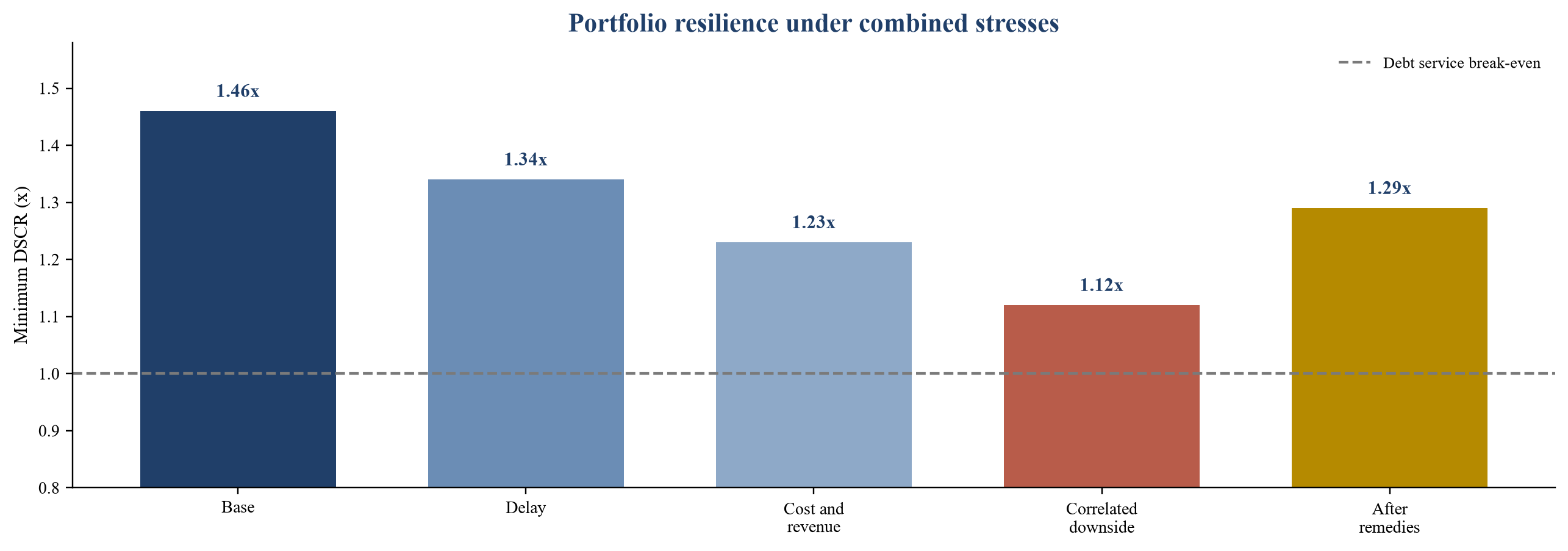
Coverage ratios and actions are hypothetical management assumptions; they are not forecasts.
22. Use an approval memorandum that can survive execution
The final approval memorandum should connect strategy, evidence, capital and controls. It should include the mandate, archetype, country allocation, asset pipeline, local-partner structure, HoldCo and SPV diagram, development budget, sources and uses, downside model, risk-allocation matrix, guarantee plan, environmental commitments, conditions and implementation schedule.
Approval should be conditional when evidence remains outstanding. Each condition should identify the owner, document, deadline, decision consequence and permitted expenditure before satisfaction. Conditions should be tracked to financial close and commissioning rather than recorded once and forgotten.
The platform board should receive a monthly portfolio pack covering development gates, committed capital, liquidity, construction, operating performance, currency, public payments, covenants, environmental and social matters, partner actions and expected equity calls. Quarterly review should revisit country and concentration limits. Annual review should decide whether the platform still has a repeatable advantage or should harvest assets and stop further deployment.
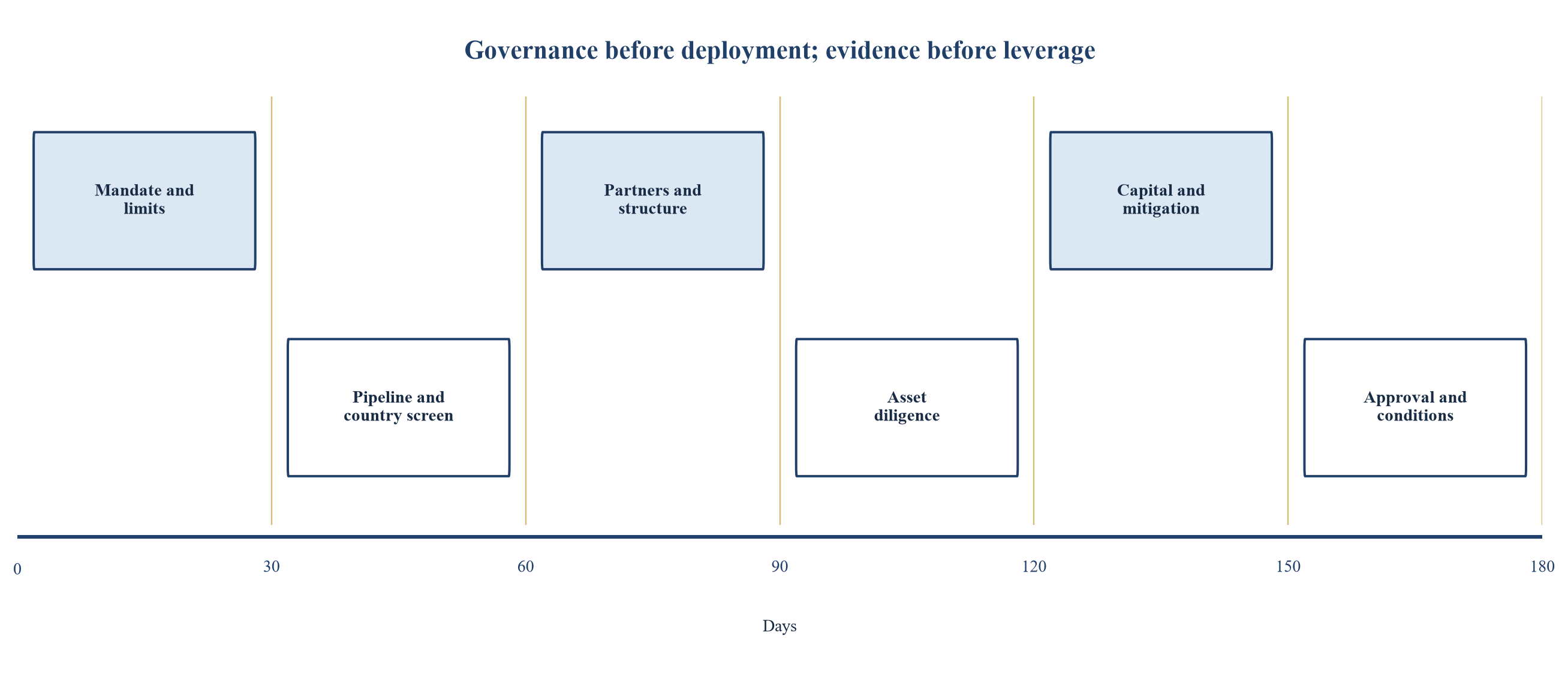
The sequence is a proposed implementation roadmap and must be adapted to the platform and jurisdictions.
| Approval area | Evidence required | Board decision |
|---|---|---|
| Mandate and archetype | Defined sectors, countries, asset model, limits and replication advantage | Approve, narrow or reject the platform scope |
| Asset pipeline | Screened assets with rights, demand, design and stage budgets | Fund preparation by stage |
| Partners and governance | Ownership, capability, integrity, funding and shareholder terms | Approve partner and reserved matters |
| Capital plan | Asset and HoldCo sources, currency, tenor, coverage and reserves | Approve equity cap and financing parameters |
| Risk mitigation | Guarantees, insurance, local financing and uncovered risks | Accept, mitigate or exclude exposures |
| Delivery and compliance | Construction, interfaces, environmental and social commitments | Approve conditions and monitoring |
| Portfolio resilience | Concentration, contagion, correlated downside and liquidity | Approve limits and remedial ladder |
| Recycling and exit | Transfer rights, refinancing criteria, buyers and proceeds policy | Approve exit principles and review dates |
The checklist is a governance aid and does not replace legal, financial, technical or environmental advice.
23. Contract revenue before leverage
Infrastructure cash flow depends on who pays, why the payment is due and whether the project can enforce collection. The platform should classify revenue as availability-based, usage-based, contracted commercial, regulated, merchant or ancillary. Each class has a different diligence and leverage response.
Availability payments require a lawful public obligation, an appropriation or payment mechanism, measurable service standards, deductions, indexation, termination compensation and a credible payment history. Usage-based concessions require demand evidence, tariff authority, elasticity, collection control and a response to lower utilisation. Commercial offtake requires counterparty credit, contract authority, minimum purchase or capacity terms, security and replacement prospects. Regulated revenue requires a transparent methodology and evidence that required tariffs are socially and politically sustainable.
The platform should trace revenue from service to bank account. This includes metering, certification, invoicing, dispute, tax, withholding, collection timing and waterfall. Where the public authority collects revenue, the concession should define remittance and audit rights. Where the SPV collects directly, payment systems and cash security become operating dependencies. Debt sizing should use the most conservative collectable revenue supported by contracts and evidence.
24. Make procurement part of the investment thesis
Procurement can create platform value through standard specifications, volume discounts, approved vendors, spare-parts commonality, training and warranty management. It can also concentrate vendor risk, create local-content conflicts and expose the platform to related-party or integrity concerns.
The procurement policy should distinguish platform frameworks from asset awards. Frameworks can establish technical and commercial terms; each asset should confirm quantity, delivery, local compliance, taxes, logistics, currency, performance security and interface responsibility. Competitive tension should be preserved. Related-party awards require independent benchmarking, conflict approval and transparent disclosure.
Equipment should be selected for lifecycle performance in local conditions. Heat, humidity, dust, water quality, grid quality, transport constraints and maintenance capability can change performance and cost. Warranties should be enforceable in the project jurisdiction or through a creditworthy contracting entity. Critical spares, software access, cyber support and end-of-life obligations should be included in the operating case.
Export-credit finance may be attractive for eligible equipment and services. Its currency, sovereign or bank requirements, local-cost coverage, environmental conditions and procurement restrictions should be tested early. The project should avoid redesigning itself around financing that remains indicative.
25. Connect public value to a payable structure
Infrastructure can create wider benefits that are not captured in project cash flow, including resilience, trade connectivity, employment, emissions reduction, water security, digital inclusion and regional integration. These benefits can justify grants, viability support, guarantees or public co-investment when the government has authority and the support is transparent.
The platform should quantify the public-service requirement and the commercial gap separately. A viability payment may support capital cost where affordable tariffs cannot recover the full investment. An availability payment may purchase a defined service. A grant may fund climate adaptation, connections or project preparation. A guarantee may address a public payment or political peril. Each instrument should have an eligibility basis, budget source, conditions and accountability mechanism.
Public support should be the minimum required to achieve the approved service outcome under a competitive or otherwise lawful process. The model should show whether the project remains viable if support is delayed, reduced or conditional. Benefits such as jobs or economic activity should be presented using documented methodology and should not be counted as cash available for debt service.
26. Match climate resilience to financing and insurance
African infrastructure platforms face physical climate hazards that vary by location and asset type. Flood, drought, heat, coastal erosion, storm, wildfire and water stress can affect design, availability, maintenance, insurance and revenue. A platform-level climate policy should set common methods while each project uses site-specific hazard and vulnerability evidence.
Resilience measures should be integrated before design is fixed. Examples include elevation, drainage, redundant power, water efficiency, cooling, fire protection, route diversity, stronger materials, spare capacity and emergency operating protocols. The appraisal should compare lifecycle cost and avoided interruption rather than treating resilience as an optional premium.
Financing may include climate-linked DFI capital, green or sustainability-labelled instruments, concessional tranches, guarantees or grants when criteria are met. The platform should document use of proceeds, taxonomy alignment, baselines, reporting and verification. Labels do not create bankability. The underlying asset still needs lawful rights, affordable revenue, delivery capacity and downside resilience.
Insurance should be based on current market terms, deductibles, exclusions, limits and claims history. The platform should test the cash impact of uninsured or underinsured loss and the time required to reinstate the asset. A portfolio insurance programme can create purchasing scale, but asset-specific gaps must remain visible.
27. Design an investable reporting package
Future co-investors, lenders and buyers need consistent evidence across assets. The platform should maintain a data room that can support first investment, construction monitoring, refinancing and exit without rebuilding the record each time.
The core package should include corporate documents, beneficial ownership, licences, land, concessions, procurement, material contracts, technical studies, construction records, operating data, environmental and social evidence, insurance, tax, litigation, financing, budgets, models, accounts and board approvals. Documents should have owners, version control, expiry alerts and access permissions. Sensitive government, customer and employee data requires appropriate protection.
Reporting should reconcile management accounts, project models, bank statements and covenant calculations. Capital expenditure should reconcile to contracts, certificates and payments. Operating indicators should reconcile to invoices and collections. Forecast revisions should identify the source of variance rather than overwrite prior assumptions.
An investable platform also needs a clear equity story. It should demonstrate repeatable origination, conversion from development to operations, disciplined attrition, controlled central cost, asset-level returns, portfolio liquidity and a credible recycling route. Management should present realised evidence separately from pipeline estimates and hypothetical scenarios.
28. Align incentives across the platform lifecycle
Incentives should reward conversion of evidence into durable operating value. Origination bonuses based only on signed memoranda or pipeline size can encourage weak opportunities. Development incentives should reflect rights secured, diligence quality, budget discipline and progression through approved gates. Construction incentives should reflect safety, quality, timing, cost and performance. Operating incentives should include availability, collection, lifecycle maintenance and compliance.
Management equity or carried participation should be documented with vesting, leaver, clawback, valuation and change-of-control terms. Local partner economics should reflect capital and performance. Development fees should not allow value to be extracted before the platform demonstrates investable assets. Related-party operating fees should remain payable only for delivered services and should be subordinated or reduced when project cash is under stress.
The platform should also align decision horizons. A development team may favour rapid pipeline growth; lenders prioritise downside protection; public authorities prioritise service and affordability; local partners may prioritise influence and distributions; long-term equity requires lifecycle value. The governance framework should make these differences explicit and resolve them through documented rights, measurable milestones and transparent cash allocation.
29. Preserve optionality without financing speculation
Platforms often create value by securing sites, rights, designs or partnerships before full demand is visible. This optionality should be funded and governed as development risk. It should not be presented as contracted backlog or included in opening debt capacity.
Each option should have a holding cost, expiry date, exercise conditions and maximum further exposure. Management should identify the evidence that converts it into an investable asset, such as an executed concession, anchor contract, tariff approval, grid allocation, resource study or permit. If the evidence does not emerge by the deadline, the platform should release the option or seek explicit reapproval.
Optionality can also sit within operating assets. Reserved land, modular design, expandable networks and accordion facilities may support later growth. Expansion should remain conditional on demand, service performance, permits, funding and coverage. This approach preserves strategic flexibility while protecting the first phase from speculative capital expenditure.
The central discipline is simple: replicate capabilities while preserving asset accountability. GCC capital can support African infrastructure at scale when the platform converts strategic relationships into lawful rights, prepared projects, controlled local partnerships, risk-matched finance and transparent operating evidence. The board should release capital in stages, treat downside liquidity as a design requirement and preserve several routes to refinance, recycle or exit.
Sources
- African Development Bank, NEPAD-IPPF, Why Project Preparation Matters. Read the primary source
- World Bank, Private Participation in Infrastructure 2024 Annual Report. Read the primary source
- AD Ports Group, Luanda multipurpose terminal concession, local joint ventures and phased investment, 23 April 2024. Read the primary source
- DP World, partnership with CDC Group, now British International Investment, to create an Africa investment platform. Read the primary source
- MIGA, CrossBoundary Energy C&I Africa Portfolio, framework terms covering investments in twenty countries, 30 June 2025. Read the primary source
- Afreximbank, Joint Project Preparation Facility with Infrastructure South Africa, 15 September 2025. Read the primary source
- African Development Bank, value-chain approach to private infrastructure investment, 27 February 2025. Read the primary source
- International Finance Corporation, Creating Efficient Capital Markets in Africa. Read the primary source
- International Finance Corporation, Joint Capital Market Program. Read the primary source
- MIGA, Investment Guarantee Guide, 30 May 2023. Read the primary source
- African Trade and Investment Development Insurance, Political Risk and Investment Insurance. Read the primary source
- ICIEC, risk mitigation for the Lagos-Calabar Coastal Highway financing. Read the primary source
- Africa50, USD 100 million asset-recycling programme with The Gambia, 15 October 2024. Read the primary source
- African Development Bank, investment in Africa50 Infrastructure Acceleration Fund I. Read the primary source
- World Bank PPP Resource Center, Infrastructure Finance. Read the primary source
- World Bank PPP Resource Center and Global Infrastructure Hub, Blended Finance in Infrastructure, February 2024. Read the primary source
- International Finance Corporation, IFC in Africa, FY2024 investment and mobilisation overview. Read the primary source
- MIGA, SETRAG Gabon guarantee for equity and quasi-equity investment. Read the primary source
- MIGA, Breach of Contract Coverage and Cameroon Kribi local-currency project-finance example. Read the primary source
- ICIEC and African Development Bank, risk participation supporting environmental and social projects in Cote d'Ivoire, 31 January 2024. Read the primary source
- African Development Bank, Ten-Year Strategy 2024 to 2033. Read the primary source
- Africa50, Corporate Profile and investment portfolio. Read the primary source
