

1. Debt capacity is determined by cash location, legal ownership and route to the borrower
Acquisition models often begin with consolidated EBITDA, net debt and cash. That view is useful for valuation and group reporting, but a lender receives payment from a defined borrower or guarantor through a defined account. Cash held by another group company cannot service acquisition debt until a lawful and operationally executable transfer occurs. The distinction becomes decisive when the target has operations in several countries, regulated subsidiaries, minority shareholders, local working-capital needs or financing agreements that restrict distributions.
IAS 7 defines cash equivalents by their purpose of meeting short-term cash commitments and requires reconciliation of cash and cash equivalents to the statement of financial position [1]. A reported balance can therefore be genuine accounting cash while remaining unavailable for an acquisition facility. IFRS disclosures also recognise that restrictions can affect a group's ability to access or use assets. Credit underwriting must go beyond existence and measurement to analyse ownership, distribution capacity, transferability, timing and leakage.
The cash-access question has five layers. First, the legal entity holding the cash must own it without trust, escrow, customer-money or other restrictions. Second, local company law and constitutional documents must permit a dividend, capital reduction, loan or fee. Third, tax and transfer-pricing rules determine the gross-up, withholding, deductibility and documentation consequences. Fourth, foreign-exchange rules, banking procedures and regulatory approvals determine whether the transfer can be converted and remitted. Fifth, existing debt documents, security, minority protections and regulatory capital requirements determine whether the company may release the cash without breaching another obligation.
The sequence matters. A tax-efficient route that is prohibited by a local loan agreement has no debt-service value. A legally available dividend that requires audited accounts, board approval and a central-bank process may be valuable in a long-term plan but unavailable for a closing-day sources-and-uses gap. A cash pool can provide routine liquidity while still excluding regulated or exchange-controlled subsidiaries. Underwriters should therefore assign both an accessible amount and an earliest reliable access date.
The proposed framework uses four cash categories. Tier 1 cash is in the borrower's debt-service account or can be moved there on demand under tested arrangements. Tier 2 cash is distributable and transferable within a short, documented period without material third-party consent. Tier 3 cash may become available after tax, audit, approval, covenant cure or refinancing conditions. Tier 4 cash is operationally required, legally restricted, regulated, minority-protected or otherwise unavailable within the financing horizon. Only Tier 1 should automatically offset opening debt. Tier 2 can support near-term liquidity with an execution reserve. Tiers 3 and 4 require separate treatment.
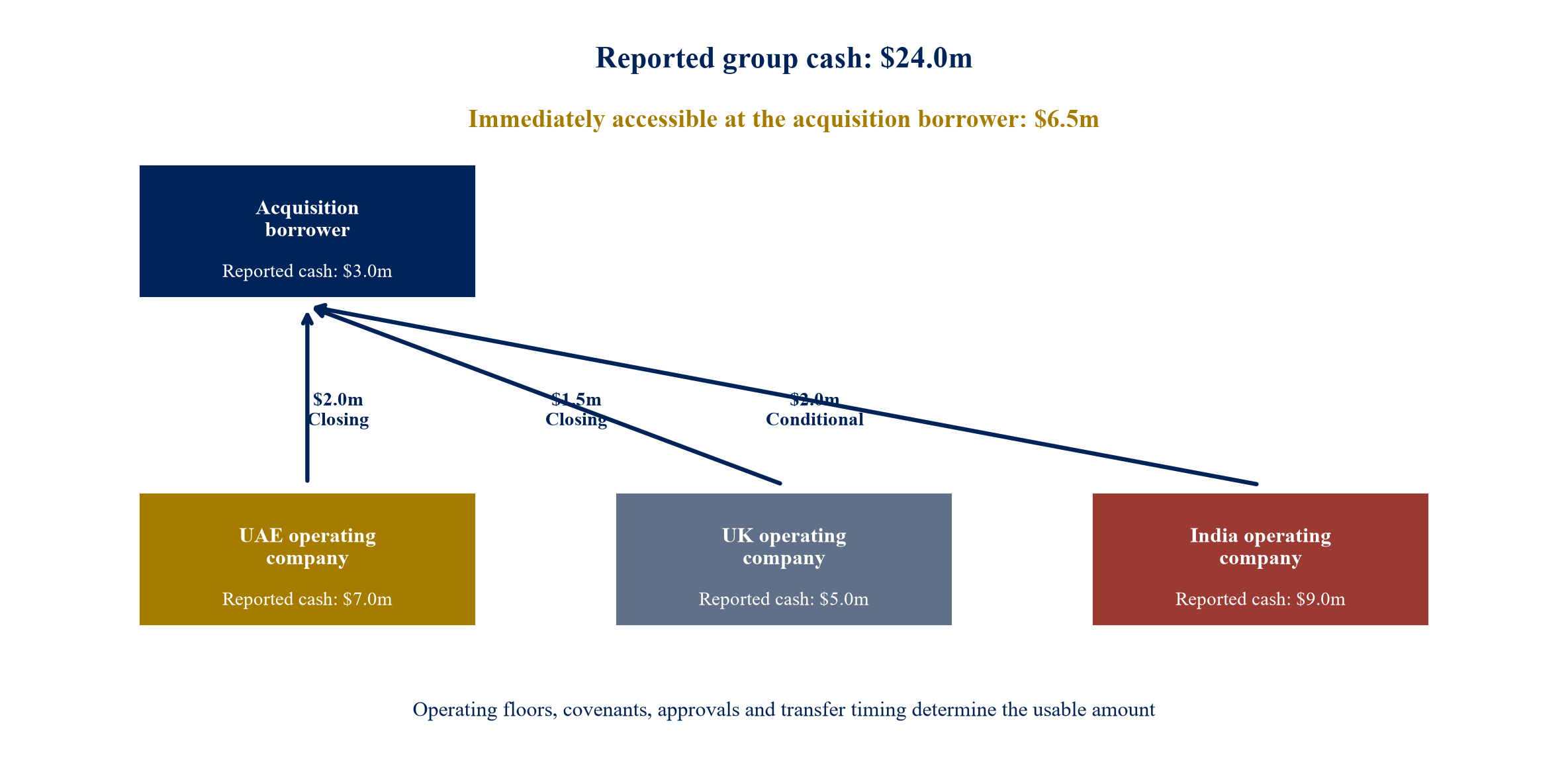
The map is author-designed. Amounts and classifications are hypothetical author assumptions.
This classification changes the role of due diligence. The objective is not a single trapped-cash number. The objective is a route register showing each holder, currency, legal restriction, operating reserve, upstream method, tax cost, required approval, documentary condition, timing range and fallback. The debt model can then distinguish closing cash, ordinary-course upstream cash and contingent recovery.
2. Consolidated cash must be rebuilt as an entity-level accessibility ledger
The starting balance should be reconstructed from bank confirmations, general ledgers and entity records. Consolidated cash may include restricted deposits, customer balances, margin accounts, debt-service reserves, blocked accounts, pledged balances, cash held for taxes, jointly controlled cash, acquisition deposits and amounts in entities outside the security group. Each balance requires a legal owner, bank, account type, currency, purpose and reconciliation date.
An accessibility ledger should classify restrictions by source. Legal restrictions include distribution tests, creditor-protection procedures, capital-maintenance rules and statutory reserves. Contractual restrictions arise from local debt covenants, negative pledges, cash sweeps, shareholder agreements, joint-venture arrangements, concession agreements, project-finance waterfalls and supplier-finance terms. Regulatory restrictions include minimum capital, solvency, liquidity and customer-money requirements. Operational restrictions cover payroll, tax, supplier, inventory and seasonality needs. Tax restrictions include withholding, taxable gains, transfer-pricing adjustments and interest-deduction limits. Exchange and banking restrictions cover conversion, remittance purpose, documentation, approvals and settlement capacity.
The ledger should avoid two common forms of double counting. The first is treating minimum operating cash as both an unrestricted balance and a source of purchase-price funding. The second is counting the same cash through more than one route, such as a dividend and an intercompany loan. Each unit of cash should have one primary treatment in the base case and explicitly defined alternatives in contingencies.
Minimum operating cash deserves transaction-specific analysis. A simple percentage of revenue can miss payroll cycles, VAT or GST dates, seasonal procurement, letters of credit, performance guarantees, margin calls and customer prepayments. Management should build a thirteen-week entity-level cash forecast around closing and a monthly forecast through the first year. The lender should test the historical minimum, peak intra-month draw, downside working-capital need and access to local facilities. A subsidiary with USD 8 million of bank cash and a USD 7 million operating floor contributes only USD 1 million before other restrictions.
Currency also changes accessibility. A local-currency balance may be freely distributable but exposed to conversion timing, bid-offer cost and market liquidity. A hard-currency balance can remain trapped by account purpose or remittance rules. The model should state the conversion rate, settlement date, hedge assumption and stress. Currency translation in consolidated accounts does not establish that the same amount can be delivered to the borrower.
Table 1. Cash-access classification and evidence requirements
| Cash class | Typical characteristics | Minimum evidence | Acquisition-finance treatment |
|---|---|---|---|
| Tier 1: immediately accessible | Held by borrower or transferable on demand through tested arrangements | Bank confirmation, account control, no restriction, tested transfer | May reduce opening funding need or support debt service directly |
| Tier 2: near-term accessible | Distributable and transferable with routine corporate and banking steps | Distributable-reserve analysis, approvals, tax calculation, remittance checklist | Count with timing and execution reserve |
| Tier 3: conditional | Requires audit, consent, refinancing, tax clearance or regulatory process | Condition map, responsible owner, precedent evidence, realistic timeline | Exclude from closing sources; recognise only after conditions are met |
| Tier 4: unavailable | Operational, regulated, pledged, minority-protected or legally blocked | Restriction evidence and periodic review | Exclude from debt capacity within the forecast horizon |
The categories and evidence standards are author-designed. Transaction documents and local advice determine final treatment.
Evidence strength should be graded. A bank statement proves existence but not freedom of use. Audited accounts may support distributable reserves but can be stale at closing. A legal memorandum should identify the precise entity and proposed route. A tax calculation should reconcile gross payment, withholding, treaty claim, deductibility and recipient tax. A banking checklist should name the authorised dealer or remitting bank, forms, supporting contracts and expected settlement time. A board resolution should match constitutional authority and financing covenants. The model should link every accessible amount to this evidence.
3. Upstream routes have different legal, tax, timing and covenant profiles
Dividends are familiar but depend on distributable profits, corporate approvals and shareholder rights. The amount available under company law can differ from the amount of cash on the balance sheet. Interim dividends may require management accounts or solvency statements; final dividends may depend on audited accounts. Minority shareholders may share pro rata or hold consent rights. A dividend can also be blocked by local facility covenants or regulatory capital requirements. The underwriter should calculate capacity by entity and expected declaration date rather than assume consolidated retained earnings are transferable.
Interest on an existing intercompany loan can create a contractual payment path, but its value depends on debt validity, arm's-length terms, withholding, local deductibility, subordination and exchange-control treatment. Creating new intercompany debt immediately before an acquisition can attract corporate-benefit, financial-assistance, thin-capitalisation, transfer-pricing and anti-abuse questions. OECD Action 4 links net interest deductions to economic activity through an EBITDA-based approach, while domestic implementation varies [2]. The acquisition structure should not assume that an interest route produces both cash access and a full tax deduction.
Management or service fees require actual services, benefit to the payer, contractual support, arm's-length pricing and compliance with indirect tax and withholding rules. A fee created only to move cash can be disallowed, recharacterised or challenged under transfer-pricing and anti-avoidance principles. The operational evidence should include scope, personnel, time, deliverables, allocation key and invoice support. Royalties create similar questions around legal ownership, economic activity, benefit, valuation and withholding.
An upstream loan from subsidiary to parent can move liquidity without a dividend, subject to corporate power, financial-assistance rules, related-party approvals, solvency, transfer pricing, withholding on future interest, exchange-control rules and existing covenants. Some jurisdictions restrict loans to overseas affiliates or require that the resident investor meet conditions. India's Overseas Investment framework, for example, governs financial commitments by resident Indian entities and links some debt commitments to existing overseas direct investment and control conditions [3][4]. Transaction counsel must assess the actual direction of payment, entity status and applicable FEMA route.
Capital reduction, share buyback and liquidation distributions can release capital where profits are insufficient. These routes ordinarily require longer lead times, creditor-protection procedures, filings, valuations or court and regulatory steps. They may be valuable for post-closing deleveraging but unreliable for acquisition closing. Asset sale and local refinancing proceeds can also free cash, while introducing execution risk, tax, security-release and consent requirements.
Cash pooling and intercompany current accounts improve routine treasury efficiency when legally permitted. They require account mandates, participant agreements, interest policies, credit limits, insolvency analysis and controls over debit positions. Regulated, project-financed, joint-venture and exchange-controlled entities are often outside the pool. An existing pool should be verified by historic transfers, not inferred from a policy document.
The route register should rank alternatives by certainty and time. A base case can use established dividends and contractual interest with complete evidence. An upside case can include capital reduction or refinancing proceeds after conditions. A contingency case can retain local cash and fund the borrower through equity, a delayed-draw facility or a separate local debt layer. The sources-and-uses model should show which route serves which payment date.
4. Withholding and treaty access affect both cash leakage and structural certainty
Withholding tax is deducted at source from a gross payment and can reduce cash received by the acquisition borrower. Domestic rates, exemptions and treaty limits vary by payment type and jurisdiction. The relevant analysis must identify the payer, recipient, beneficial owner, instrument, source rule, holding period, documentation, claim mechanism and timing. A treaty headline rate is an input rather than a guaranteed outcome.
The OECD Model Tax Convention provides common architecture for dividends, interest and other cross-border income, while bilateral treaties and domestic law govern actual transactions [5]. Treaty access can depend on beneficial ownership, residence, ownership thresholds, holding periods, limitation provisions and anti-abuse rules. The OECD's treaty-abuse work explains the role of beneficial ownership and principal-purpose protections against treaty shopping [6]. A holding company inserted without commercial substance or decision-making capacity can therefore create uncertainty rather than reliable savings.
Cash leakage should be modelled in three layers. The first is source-state withholding collected when payment occurs. The second is recipient-state tax after exemptions, credits and deductions. The third is timing cost when a refund or credit exists but is realised later. A 10 percent withholding that is ultimately creditable can still create a debt-service shortfall if the credit becomes usable after the payment date. The model should distinguish permanent tax cost from timing drag and recoverable tax assets.
UAE corporate-tax guidance states that state-sourced income subject to withholding tax currently carries a 0 percent rate, while participation-exemption conditions determine whether qualifying dividend and disposal income is exempt [7][8]. The conditions and expense treatment require analysis for the actual participation. UAE interest-deduction rules can also affect acquisition structures [9]. A UAE holding borrower therefore needs both source-country tax analysis and UAE recipient analysis; the domestic 0 percent withholding rate does not eliminate withholding imposed by another source country.
The United Kingdom generally does not impose withholding on ordinary company dividends, while yearly interest paid to a non-resident can engage deduction obligations subject to domestic exemptions and treaty relief. HMRC guidance illustrates how treaty rates, beneficial ownership and treaty-shopping concerns affect yearly interest [10]. The debt model should use the payment's legal character and actual treaty procedure. A label in an intercompany agreement is insufficient.
India applies withholding and treaty rules to cross-border payments and uses authorised-dealer banking processes for foreign exchange. Rates can depend on domestic legislation, treaty eligibility, tax identification and documentary compliance. The acquisition team should obtain transaction-specific Indian tax advice and build gross-up, forms, certificates and processing time into the model. It should also test whether interest deductibility, transfer pricing or deemed-distribution rules change the expected economics.
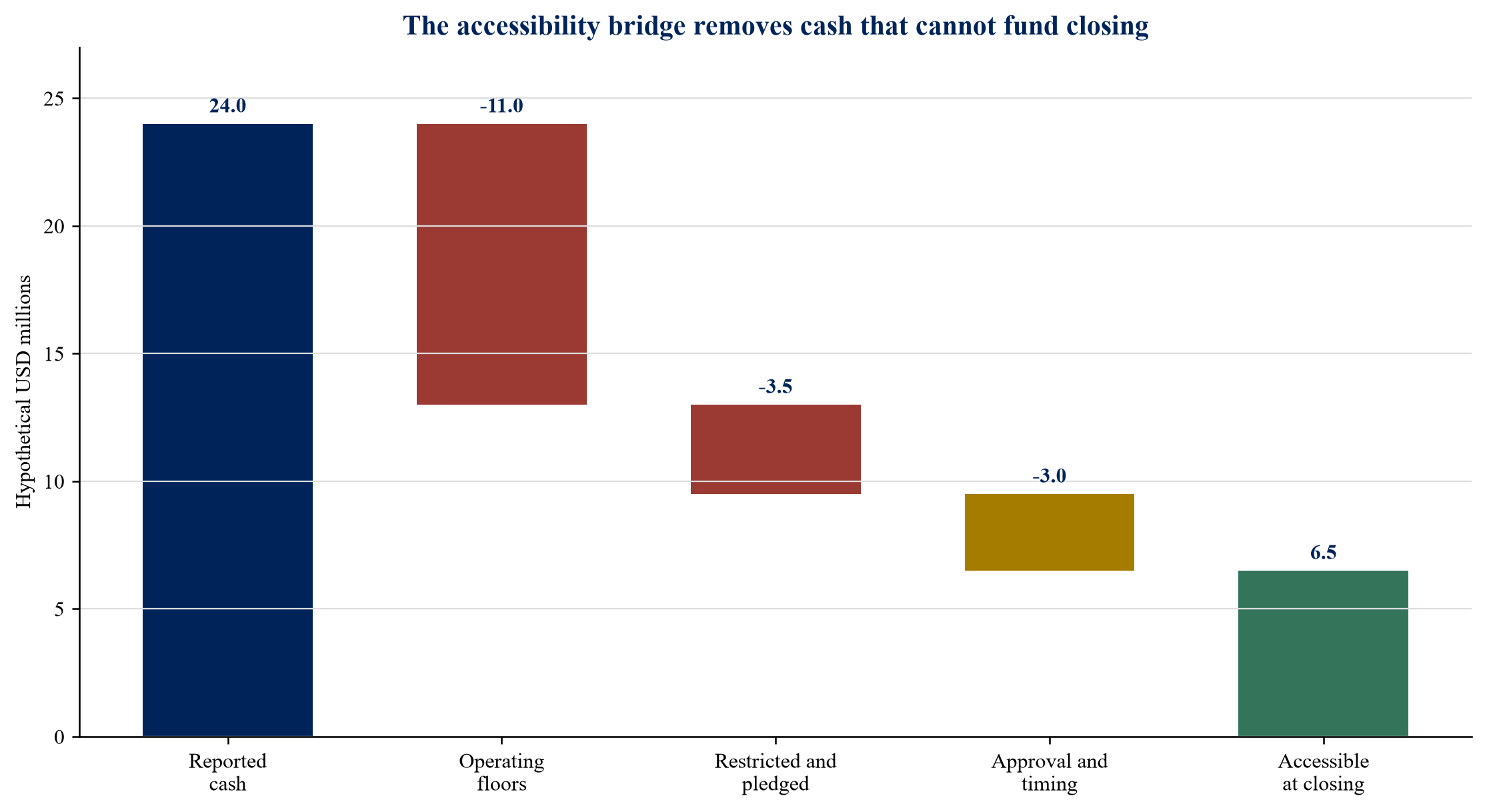
Every value and leakage assumption is hypothetical and author-designed. USD millions.
Tax covenants should allocate responsibility for gross-up, treaty claims, documentation, refunds and changes in law. Lenders should avoid counting a refund as liquidity until the claim, timing and entitlement are supported. Sponsors should understand whether financing documents permit restructuring after closing to improve access. Tax efficiency has value only when the structure remains lawful, documentable and operationally repeatable.
5. Exchange control and remittance execution can create a timing constraint without changing economic value
The IMF's Annual Report on Exchange Arrangements and Exchange Restrictions describes member-country exchange arrangements, restrictions on payments and transfers, capital controls and prudential measures affecting capital flows [11]. The practical implication for acquisition finance is that a lawful economic claim may still require purpose classification, supporting documents, an authorised intermediary, regulatory reporting, currency conversion or approval before funds leave the country.
Current-account and capital-account treatments can differ. Payment for a genuine service, interest on permitted debt, a dividend from approved profits and repayment of capital can follow different rules. Recharacterising one payment as another to accelerate access creates tax, regulatory and enforcement risk. The route register should state the legal category and exact documentation for each transfer.
India provides a useful example of process intensity. The RBI Overseas Investment Directions and Regulations establish rules, reporting and authorised-dealer involvement for overseas investment and related financial commitments [3][4]. Other FEMA directions govern external commercial borrowing, imports, exports, guarantees and current-account transactions. A cross-border acquisition involving an Indian operating company should identify whether funds are moving into India, out of India, between resident and non-resident entities, or under an existing investment structure. Each path can have different conditions.
Even where formal exchange controls are limited, bank execution matters. Remitting banks conduct know-your-customer, sanctions, source-of-funds, purpose-code, tax and document checks. Large or unusual transfers can be escalated. Cut-off times, correspondent-bank paths and local holidays affect settlement. A lender should test the process with the relationship bank before relying on a material distribution for an interest date.
Currency availability can create another constraint. A subsidiary may hold local currency and possess legal authority to remit, while the market cannot provide the required hard currency at the expected time or cost. Official and market exchange rates can differ in some jurisdictions. A prudent model sets a conversion assumption, liquidity limit, transfer window and downside rate. Hedging should match the expected route and timing; an unavailable distribution cannot settle a hedge merely because the accounting cash exists.
The transaction should maintain alternative paths. A local debt facility can retain debt service close to the cash-generating asset. A delayed-draw acquisition line can bridge an approval period. A sponsor liquidity facility can absorb transfer timing. A reserve account can cover several payment periods. Equity can replace a source whose execution is uncertain at closing. These mitigants have a cost, but they convert an unbounded timing risk into a funded contingency.
6. Existing covenants, minority rights and regulated capital create a second perimeter
Cash access can be blocked by agreements even where law and tax permit payment. Local subsidiaries may have revolving facilities, term loans, bonds, project-finance debt, receivables financing, leases or guarantee lines. Their documents may restrict distributions, related-party payments, asset sales, new debt, security, guarantees and cash pooling. Financial covenants can impose a distribution lock-up before an event of default occurs.
The diligence team should build a covenant matrix for each cash-holding entity. It should identify the agreement, creditor, secured assets, guarantors, leverage and coverage tests, distribution conditions, permitted-payment baskets, cure rights, consent requirements, change-of-control effect and cross-default linkage. Testing should use the definitions in each document. Consolidated EBITDA or cash can differ materially from covenant EBITDA and unrestricted cash.
Project-financed and concession assets often use a contractual waterfall. Revenue first funds operating costs, tax, senior debt service, debt-service reserves, maintenance reserves and required ratios before a shareholder distribution. Cash above the operating company's minimum needs can remain trapped until distribution tests are passed. Acquisition leverage above this structure should rely on forecast distributable cash after the full waterfall.
Regulated financial, insurance, utility, telecom or payment subsidiaries may need approval or minimum capital and liquidity after distribution. Management forecasts should include stress buffers above the legal minimum because regulators and boards can require prudence beyond the numerical floor. A base case should not assume that every unit of surplus regulatory capital can be extracted immediately.
Minority shareholders create governance and economic constraints. A dividend may be paid pro rata, reducing the amount retained by the acquisition group. Reserved matters, vetoes, preference rights or shareholder loans may require consent or prior payment. Related-party transfers can face heightened approval standards. The ownership model should calculate both gross subsidiary distribution and net cash received by the borrower.
Table 2. Jurisdiction and entity diligence matrix for cash access
| Diligence dimension | Core question | Required output | Debt-model treatment |
|---|---|---|---|
| Company law and constitution | What amount and route can the entity lawfully approve? | Distributable-capacity and authority memorandum | Cap distribution at the evidenced legal amount |
| Tax and treaty | What withholding, recipient tax, deduction and anti-abuse conditions apply? | Gross-to-net calculation and filing calendar | Apply permanent leakage and timing reserve |
| Exchange and banking | Which approval, purpose code, documents and conversion steps are required? | Bank-confirmed remittance checklist | Assign earliest reliable access date |
| Existing finance documents | Which lock-ups, baskets, ratios, consents or security rights restrict payment? | Entity covenant matrix and consent plan | Exclude locked cash and stress headroom |
| Regulation and minority rights | What capital, solvency, prudential or governance constraints remain? | Regulatory buffer and ownership waterfall | Count only group share after buffers and approvals |
This is a high-level framework. Local legal, tax and regulatory advisers must determine the applicable requirements.
These restrictions should be reflected in the guarantee and security package. A subsidiary excluded from guarantees for legal, tax, regulatory or financial-assistance reasons may also hold meaningful cash. The lender then has structural subordination to local creditors and depends on distributions. Debt capacity should recognise the security perimeter, the cash perimeter and the covenant perimeter as three related but distinct maps.
7. A hypothetical USD 180 million acquisition shows how USD 24 million becomes USD 6.5 million at closing
The model considers a hypothetical cross-border services and technology group with operating companies in the UAE, United Kingdom and India. The transaction has a USD 180 million enterprise purchase price. Target last-twelve-month EBITDA is USD 28 million. Reported consolidated cash is USD 24 million. Every financial amount, tax rate, covenant threshold, transfer time and outcome in this section is an author assumption designed to illustrate the framework.
The purchase-price bridge includes USD 180 million for the enterprise, USD 6 million of transaction costs, USD 4 million to refinance a local facility that changes control, and USD 5 million of opening liquidity. Total uses are USD 195 million. The sponsor proposes USD 83 million of equity, USD 100 million of senior acquisition debt and USD 12 million of target cash. A conventional consolidated model appears to show ample support because the group reports USD 24 million of cash.
The accessibility ledger produces a different answer. USD 3.0 million is held by the acquisition borrower and qualifies as Tier 1. The UAE operating company holds USD 7.0 million, of which USD 4.5 million is required for payroll, suppliers, VAT and guarantee collateral. Of the remaining USD 2.5 million, USD 2.0 million can be transferred through an established route by closing and USD 0.5 million remains as execution reserve. The UK company holds USD 5.0 million; USD 1.5 million can be distributed after its operating floor and board process. The India company holds USD 9.0 million, but USD 5.5 million supports working capital and local facilities, USD 1.5 million is covenant-restricted, and the remaining USD 2.0 million requires a post-closing process that is not reliable for closing uses.
Immediately accessible cash is therefore USD 6.5 million: USD 3.0 million at the borrower, USD 2.0 million from the UAE and USD 1.5 million from the UK. The model excludes the proposed USD 12 million target-cash source and creates a USD 5.5 million closing gap. The gap can be solved by increasing sponsor equity, adding a committed delayed-draw tranche, reducing acquisition debt elsewhere, or negotiating a price and completion-account mechanism. Treating the gap as future free cash flow would leave closing unfunded.
Table 3. Hypothetical sources, uses and opening cash-access bridge
| Item | Reported or proposed | Accessible or funded | Difference |
|---|---|---|---|
| Enterprise purchase price | 180.0 | 180.0 | 0.0 |
| Transaction costs, refinancing and opening liquidity | 15.0 | 15.0 | 0.0 |
| Total uses | 195.0 | 195.0 | 0.0 |
| Sponsor equity | 83.0 | 83.0 | 0.0 |
| Senior acquisition debt | 100.0 | 100.0 | 0.0 |
| Proposed target-cash source | 12.0 | 6.5 | (5.5) |
| Funding gap requiring committed solution | 0.0 | 5.5 | 5.5 |
All amounts are author assumptions. USD millions; rounding differences may occur.
Opening senior leverage is 3.57 times EBITDA before treating cash as debt reduction. Netting the full USD 24 million would imply 2.71 times. Netting only USD 6.5 million of accessible cash implies 3.34 times. The calculation shows why consolidated net leverage can overstate resilience. Cash needed for operations or held behind legal and contractual boundaries cannot be assumed to retire acquisition debt.
The three-year base case starts with USD 28 million of EBITDA and USD 21 million of operating cash flow before acquisition debt service. Entity-level operating floors absorb USD 8 million. Source withholding, banking cost and timing reserves absorb USD 1 million. Local debt and minority distributions absorb USD 2 million. USD 10 million reaches the borrower. If acquisition interest and scheduled amortisation total USD 8 million, cash debt-service coverage is 1.25 times. A consolidated model using all operating cash flow would show 2.63 times and mask the upstream constraints.
The moderate downside reduces EBITDA by 10 percent, increases working-capital absorption by USD 2 million, delays one distribution by a quarter and adds USD 0.5 million of tax and execution leakage. Cash reaching the borrower falls to USD 6.5 million against USD 8 million of debt service, producing 0.81 times coverage. The severe downside reduces EBITDA by 20 percent, triggers a local covenant lock-up and delays exchange conversion. Only USD 3.5 million reaches the borrower, producing 0.44 times coverage. The group remains cash-positive on a consolidated basis in both cases.
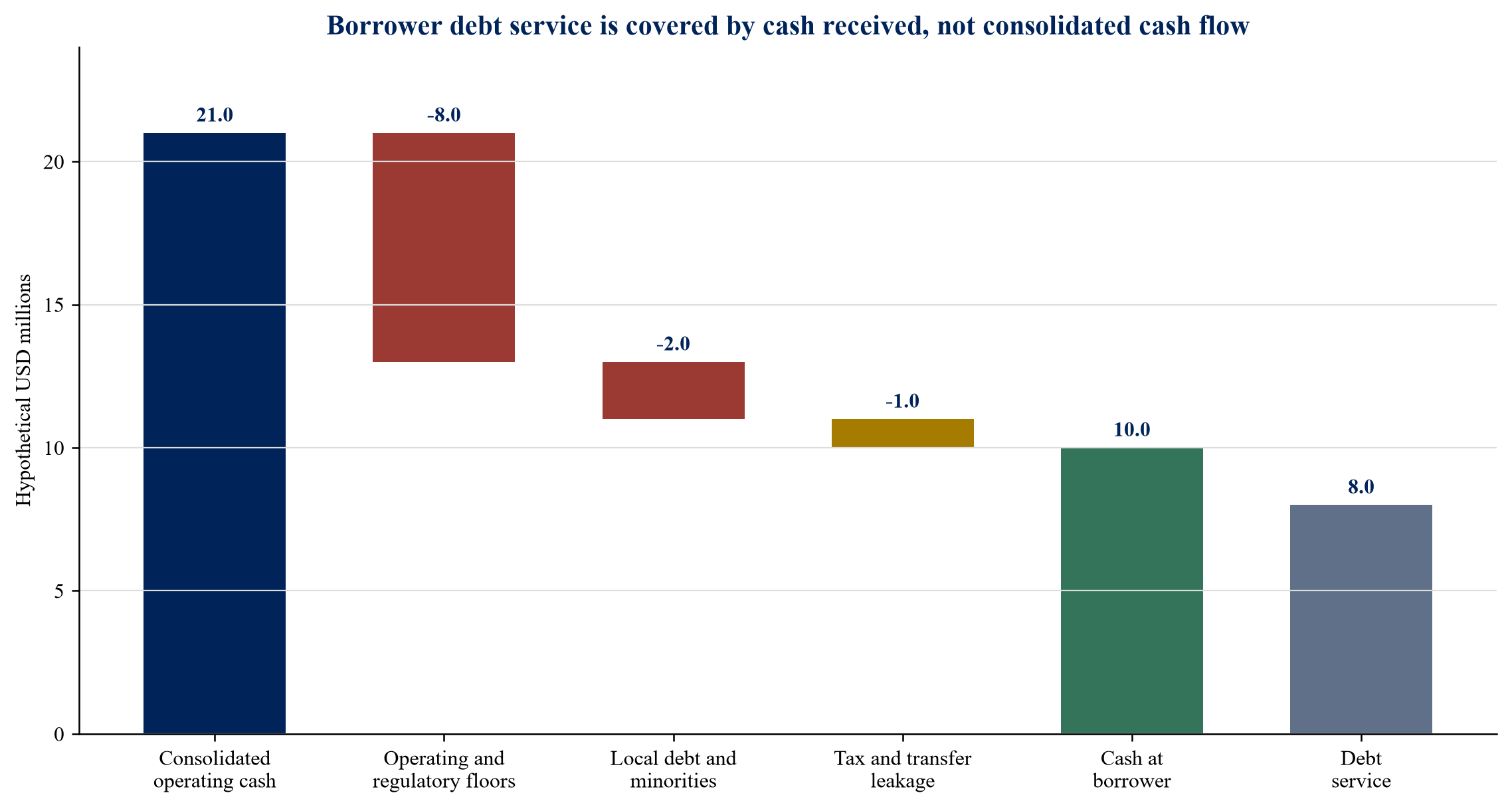
All values are author assumptions. The waterfall distinguishes consolidated operating cash from cash received by the borrower.
The model supports a lower opening debt amount or a larger liquidity facility than consolidated leverage alone suggests. If senior debt is reduced to USD 90 million and the sponsor funds the difference, assumed annual debt service falls to USD 7.1 million. Base-case coverage becomes 1.41 times and moderate downside 0.92 times. A committed USD 5 million debt-service reserve or delayed-draw line then protects the moderate case, while severe downside still requires a distribution lock-up cure, cost response, equity or restructuring.
8. Debt sizing should use an upstreamable-cash coverage test and a consolidated leverage test
Lenders should retain consolidated leverage because enterprise value and total earnings remain relevant. They should add a cash-access test that measures debt service at each borrowing layer against cash legally and operationally available to that layer. The lower of the two capacities should govern sizing unless committed liquidity bridges the difference.
Upstreamable cash begins with entity operating cash flow. It deducts taxes, maintenance capital expenditure, working-capital needs, local debt service, regulatory and operating buffers, minority leakage, withholding, transfer cost and unavailable distributions. It then applies a timing factor based on the probability and date of receipt. A payment expected after the debt-service date should not count for that period. The model should report both annual capacity and intra-year liquidity.
The coverage covenant can use cash received at the borrower, while an information covenant tracks forecast upstream cash. A minimum liquidity covenant can include only unrestricted cash in controlled or approved accounts. Consolidated cash can remain an informational metric. This structure prevents a borrower from satisfying liquidity with balances it cannot use.
Debt amortisation should align with transfer cycles. Semi-annual or annual amortisation may fit jurisdictions where dividends follow audited accounts, provided interest and operating needs remain funded. Quarterly amortisation can be appropriate where cash pooling and intercompany payments are established. A bullet structure reduces periodic transfer pressure but increases refinancing and maturity concentration. The payment profile should follow evidenced cash routes rather than a generic leveraged-finance template.
The model should separate structural and temporary restrictions. Structural trapped cash is unlikely to become available without changing ownership, regulation, financing or corporate form. Temporary trapped cash is expected to become available after a known process. A lender can apply zero credit to structural cash and discounted credit to temporary cash after evidence. The discount should reflect timing, probability, leakage and correlation with the downside scenario.
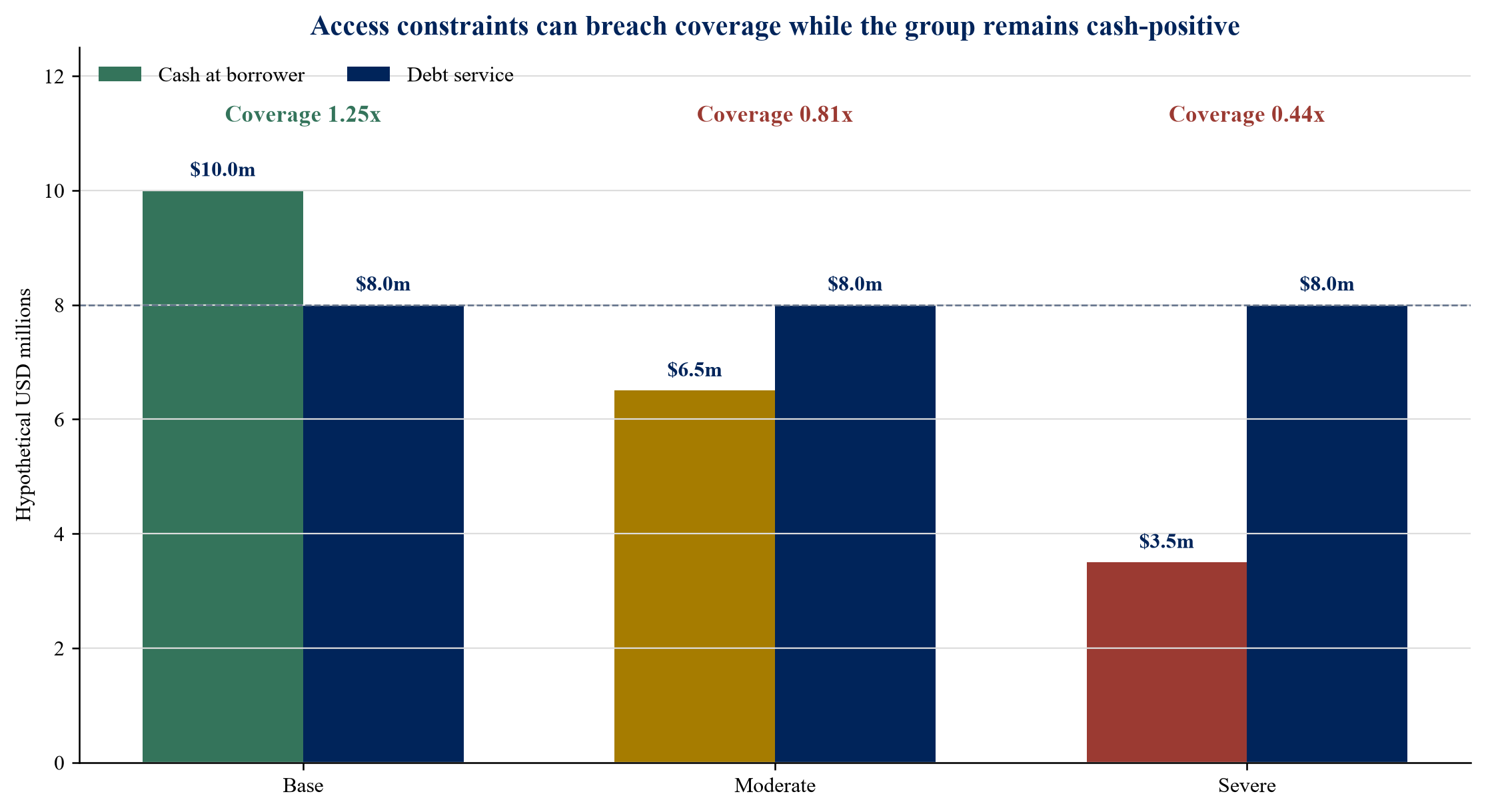
EBITDA, cash-access, leverage and coverage values are hypothetical author assumptions without empirical calibration.
Valuation should also distinguish cash. Purchase-price mechanisms often define cash and debt for completion accounts. The legal definition may include balances that the financing model excludes as inaccessible. Buyers should negotiate treatment for restricted cash, trapped cash, customer money, security deposits and balances required to settle debt-like items. A seller may value cash at face amount because it belongs economically to the group; the buyer may require a discount because the cash cannot fund the purchase or near-term debt service. The SPA and financing model should reconcile these perspectives explicitly.
9. Documentation and governance should convert the access map into enforceable controls
Financing documents should define unrestricted cash, permitted distributions, permitted intercompany payments, material subsidiaries, excluded entities and debt-service accounts consistently with the access model. The definitions should identify currency conversion and valuation. A broad consolidated-cash definition can create misleading covenant headroom if it includes restricted or inaccessible balances.
Conditions precedent should include entity-level bank evidence, distribution-capacity analysis, tax and transfer-pricing memoranda, exchange-control advice, covenant consents, board and shareholder approvals, regulatory confirmation where required, intercompany agreements, account-control documents and a funds-flow memorandum. Closing transfers should be rehearsed with banks. Each step should name the responsible party, required document, currency, account, cut-off and fallback.
Representations should address ownership, absence of undisclosed restrictions, legality of upstream arrangements, tax residence, treaty documentation, arm's-length terms, compliance with exchange rules, no default under local finance documents and accuracy of cash-access reporting. Covenants should preserve the route, maintain filings and approvals, restrict amendments that impair access, require prompt notice of blocks and maintain adequate operating and regulatory capital.
An information package should include monthly entity cash, operating floors, route capacity, actual transfers, withholding, processing time, covenant headroom and exceptions. The borrower should reconcile forecast and actual upstream cash. A missed transfer should be explained by cause rather than rolled into a later period without analysis. Repeated delays should reduce model credit and increase reserves.
Cash-control design must respect local law. The lender may hold security over shares, intercompany receivables or accounts, but perfection, enforcement, financial-assistance and insolvency consequences differ. Local counsel should confirm whether guarantees and security are valid and whether upstream payments remain available before and after a distress event. A route that works in the ordinary course may fail when directors must consider local creditors.
Governance should include a cash-access committee through the first year. Treasury, tax, legal, finance and operating leaders review upcoming debt service, entity forecasts, approvals, treaty documents, covenant tests and transfer execution. The committee owns the access register and reports exceptions to the board and lenders. This creates accountability across functions that otherwise optimise separate objectives.
Table 4. Early-warning indicators and financing responses
| Indicator | Interpretation | Initial response | Escalated response |
|---|---|---|---|
| Entity cash rises while upstream cash falls | New legal, covenant, tax or operating friction may be trapping liquidity | Reconcile route assumptions and obtain evidence | Remove cash credit and fund reserve |
| Distribution approval misses forecast date | Corporate or regulatory process is slower than modelled | Update timing factor and payment calendar | Draw liquidity line or require equity cure |
| Withholding exceeds model | Treaty, characterisation or documentation assumption may be wrong | Recalculate gross-to-net cash and file remedy | Reset debt-service forecast and pricing protections |
| Local covenant headroom narrows | Distribution lock-up may occur before default | Increase reporting and restrict local leakage | Suspend upstream reliance and seek consent or refinance |
| Bank rejects or escalates remittance | Documentation, sanctions or exchange process is incomplete | Resolve checklist and identify alternate bank path | Activate committed contingency funding |
| Borrower liquidity approaches minimum | Cash-access shortfall is reaching the debt-service layer | Preserve cash and stop discretionary payments | Mandatory prepayment, cure or restructuring process |
Thresholds must be calibrated to the transaction. The responses illustrate a graduated control framework.
10. Technology can improve visibility when legal interpretation remains controlled
Entity-level treasury data can be difficult to maintain across banking systems, currencies and accounting platforms. Application programming interfaces and automated bank feeds can collect balances and transactions. Rules engines can classify accounts, apply operating floors, flag restricted balances and calculate route capacity. Workflow tools can track board approvals, tax forms, covenant certificates and bank submissions.
The system should preserve source evidence and reasoning. A balance tagged as accessible should link to the bank account, entity owner, legal route, current distribution test, tax treatment, required documents and last successful transfer. Overrides should record user, date, reason and approval. Model versions should be retained so that lenders can reconstruct why cash received credit at a prior reporting date.
Artificial intelligence can assist with clause extraction, comparison of local facility restrictions, identification of inconsistent definitions and triage of remittance documents. It can also forecast processing time from historic transfers. These uses require human legal and tax review. A language model's classification does not establish distributable reserves, treaty entitlement, regulatory approval or enforceability. Confidential transaction data also requires access controls, approved hosting and retention rules.
Scenario engines can connect entity operations to borrower liquidity. A revenue shock in India may increase working capital, reduce local covenant headroom and delay a distribution. A currency shock may change both translated EBITDA and transfer proceeds. A regulatory buffer increase can reduce cash access despite stable earnings. The system should propagate these effects through the debt-service waterfall rather than apply a uniform consolidated haircut.
The highest-value output is an exceptions dashboard. It shows upcoming payments, expected upstream sources, confidence, missing conditions, owner and contingency. Senior management can act before a payment date. Technology therefore supports governance by making cash-access assumptions visible, testable and time-bound.
11. A 100-day implementation plan can make acquisition liquidity executable
The first 20 days establish the entity and account perimeter. The team reconciles all cash accounts, identifies legal owners, separates restricted balances and maps local facilities, minority rights and regulated entities. Treasury produces thirteen-week forecasts. Legal and tax advisers identify the plausible upstream routes and evidence gaps. The acquisition model stops netting any cash that lacks a route.
Days 21 to 45 validate capacity and process. Company-law advisers calculate distributable capacity. Tax advisers model source withholding, treaty entitlement, recipient tax, deductibility and transfer pricing. Local counsel assesses exchange-control, financial-assistance, guarantee and security constraints. Relationship banks confirm documentary and processing requirements. Existing creditors are approached for required consents.
Days 46 to 70 design the financing response. The sponsor and lenders agree accessible cash, timing factors, debt sizing, reserve accounts, delayed-draw capacity, amortisation, covenants and reporting. The purchase agreement defines cash and debt consistently with the funding plan. Intercompany agreements and board materials are prepared. Each closing transfer receives a named owner and fallback.
Days 71 to 90 test execution. The team completes test transfers where appropriate, validates bank and sanctions workflows, rehearses the funds flow and runs moderate and severe scenarios. Reporting is produced from source systems. Exceptions are resolved or converted into funded contingencies. The board receives a clear statement of which balances support closing and which remain post-closing opportunities.
Days 91 to 100 prepare operating governance. The cash-access committee is established, calendars are aligned to debt-service dates, covenant testing is assigned and evidence is stored in a controlled repository. The first post-closing distribution plan is approved. Management tracks actual transfer amount, tax leakage and processing time against the model.
The implementation can create value beyond initial financing. It reveals surplus local liquidity, unnecessary account fragmentation, avoidable withholding, inefficient intercompany balances and covenant bottlenecks. It also prevents an acquisition from relying on cash that cannot arrive when required. The discipline improves capital allocation and reduces emergency refinancing risk.
12. Conclusion
Acquisition debt is serviced by cash delivered to a defined borrower, not by a consolidated balance displayed elsewhere in the group. Cash can be real, profitable and economically owned while remaining unavailable because of operating needs, company law, tax, exchange control, banking process, local debt, regulation or minority rights. Each constraint changes amount, timing or certainty.
An entity-level accessibility ledger converts this complexity into an underwriting system. It identifies the holder and purpose of every balance, classifies restrictions, maps lawful upstream routes, calculates gross-to-net cash and assigns an earliest reliable access date. The sources-and-uses model then uses immediately accessible cash for closing, discounts conditional cash and excludes structural trapped cash. Debt service is tested against cash received at the borrower alongside consolidated leverage.
The hypothetical transaction demonstrates the consequence. USD 24 million of reported cash produces USD 6.5 million of reliable closing cash. A consolidated operating cash flow of USD 21 million produces only USD 10 million at the borrower in the base case and USD 3.5 million in severe downside. These are assumed values, yet the mechanism is broadly applicable. Legal structure and transfer execution can determine debt capacity as powerfully as EBITDA.
The practical answer is disciplined integration. Legal, tax, treasury, operations and credit teams should share one access register, one evidence standard and one payment calendar. Funding contingencies should cover uncertain routes. Covenants and reporting should measure liquidity where debt is payable. Acquisition finance becomes more resilient when every unit of cash has a verified path, cost and arrival date.
References
- IFRS Foundation. IAS 7 Statement of Cash Flows. Issued Standards. https://www.ifrs.org/content/dam/ifrs/publications/pdf-standards/english/2021/issued/part-a/ias-7-statement-of-cash-flows.pdf
- OECD. Limiting Base Erosion Involving Interest Deductions and Other Financial Payments, Action 4, 2016 Update. https://doi.org/10.1787/9789264268333-en
- Reserve Bank of India. Foreign Exchange Management (Overseas Investment) Directions, 2022. https://www.rbi.org.in/Scripts/BS_ViewMasDirections.aspx?id=12381
- Reserve Bank of India. Foreign Exchange Management (Overseas Investment) Regulations, 2022. https://www.rbi.org.in/Scripts/BS_ViewMasDirections.aspx?id=12380
- OECD. Model Tax Convention on Income and on Capital. https://www.oecd.org/en/topics/oecd-model-tax-convention-on-income-and-on-capital.html
- OECD. Preventing tax treaty abuse. https://www.oecd.org/en/topics/preventing-tax-treaty-abuse.html
- UAE Federal Tax Authority. Basis of taxation for non-residents. https://tax.gov.ae/en/taxes/corporate.tax/corporate.tax.topics/basis.of.taxation.nonresidents.aspx
- UAE Federal Tax Authority. Corporate Tax Guide: Exempt Income, Dividends and Participation Exemption. https://tax.gov.ae/Datafolder/Files/Guides/CT/CT%20-%20Exempt%20Income%20-%20Dividends%20and%20Participation%20Exemption%20-%2016%2010%202023.pdf
- UAE Federal Tax Authority. Corporate Tax Guide: Determination of Taxable Income. Updated 2026. https://tax.gov.ae/en/taxes/corporate.tax/corporate.tax.guides.references.aspx
- HM Revenue & Customs. INTM504010: Double taxation treaties, beneficial ownership and treaty shopping. https://www.gov.uk/hmrc-internal-manuals/international-manual/intm504010
- International Monetary Fund. Annual Report on Exchange Arrangements and Exchange Restrictions 2023. Published 2024. https://doi.org/10.5089/9798400260391.012
- OECD. The 2025 Update to the OECD Model Tax Convention. 2025. https://www.oecd.org/content/dam/oecd/en/publications/reports/2025/11/the-2025-update-to-the-oecd-model-tax-convention_c7031e1b/5798080f-en.pdf
- OECD. Multilateral Convention to Implement Tax Treaty Related Measures to Prevent Base Erosion and Profit Shifting. https://legalinstruments.oecd.org/public/doc/358/body-text.en.html
- IFRS Foundation. IFRS 12 Disclosure of Interests in Other Entities. https://www.ifrs.org/issued-standards/list-of-standards/ifrs-12-disclosure-of-interests-in-other-entities/
- European Central Bank. Guidance on leveraged transactions. May 2017. https://www.bankingsupervision.europa.eu/ecb/pub/pdf/ssm.leveraged_transactions_guidance_201705.en.pdf
- European Banking Authority. Guidelines on loan origination and monitoring. https://www.eba.europa.eu/regulation-and-policy/credit-risk/guidelines-loan-origination-and-monitoring
- Basel Committee on Banking Supervision. Principles for the management of credit risk. https://www.bis.org/bcbs/publ/d591.htm
- United Nations Commission on International Trade Law. Legislative Guide on Secured Transactions. https://uncitral.un.org/sites/default/files/media-documents/uncitral/en/09-82670_ebook-guide_09-04-10english.pdf
- Financial Action Task Force. International standards on combating money laundering and the financing of terrorism and proliferation. https://www.fatf-gafi.org/en/publications/Fatfrecommendations/Fatf-recommendations.html
- UK Government. Tax on UK income if you live abroad: double taxation. https://www.gov.uk/tax-uk-income-live-abroad/taxed-twice
