

1. Underwrite the route-to-cash system
A logistics platform converts orders into planned routes, depot activity, vehicle movements, service events, invoices and collected cash. The acquisition lender should underwrite this operating chain rather than a consolidated earnings number. A failure at one link can affect customer retention, working capital and debt service.
The initial map should identify each material customer, service, origin, destination, depot, warehouse, vehicle class, subcontractor, driver pool, technology platform, billing event and payment account. Dedicated warehousing, shared-user transport, final-mile delivery, specialist fleet and freight forwarding have different economics and integration constraints.
The perimeter should show which assets and contracts sit in each legal entity. Vehicles may be owned, leased or subcontracted. Warehouses can be freehold, leasehold or customer controlled. Customer contracts can restrict assignment or change of control. Software licences, telematics, fuel arrangements and insurance can be held at group level.
The debt model should reconcile this legal perimeter with the cash perimeter. Revenue that sits outside the guarantor group should not support acquisition debt without enforceable upstreaming. Assets with retention-of-title, leasing or finance claims should be separately identified. Customer payments should flow to controlled accounts after closing.
The route-to-cash map also exposes dependence. One depot can serve several contracts. One customer can occupy several sites. One transport management system can dispatch a national network. The lender should know which failure can interrupt several cash flows at once.
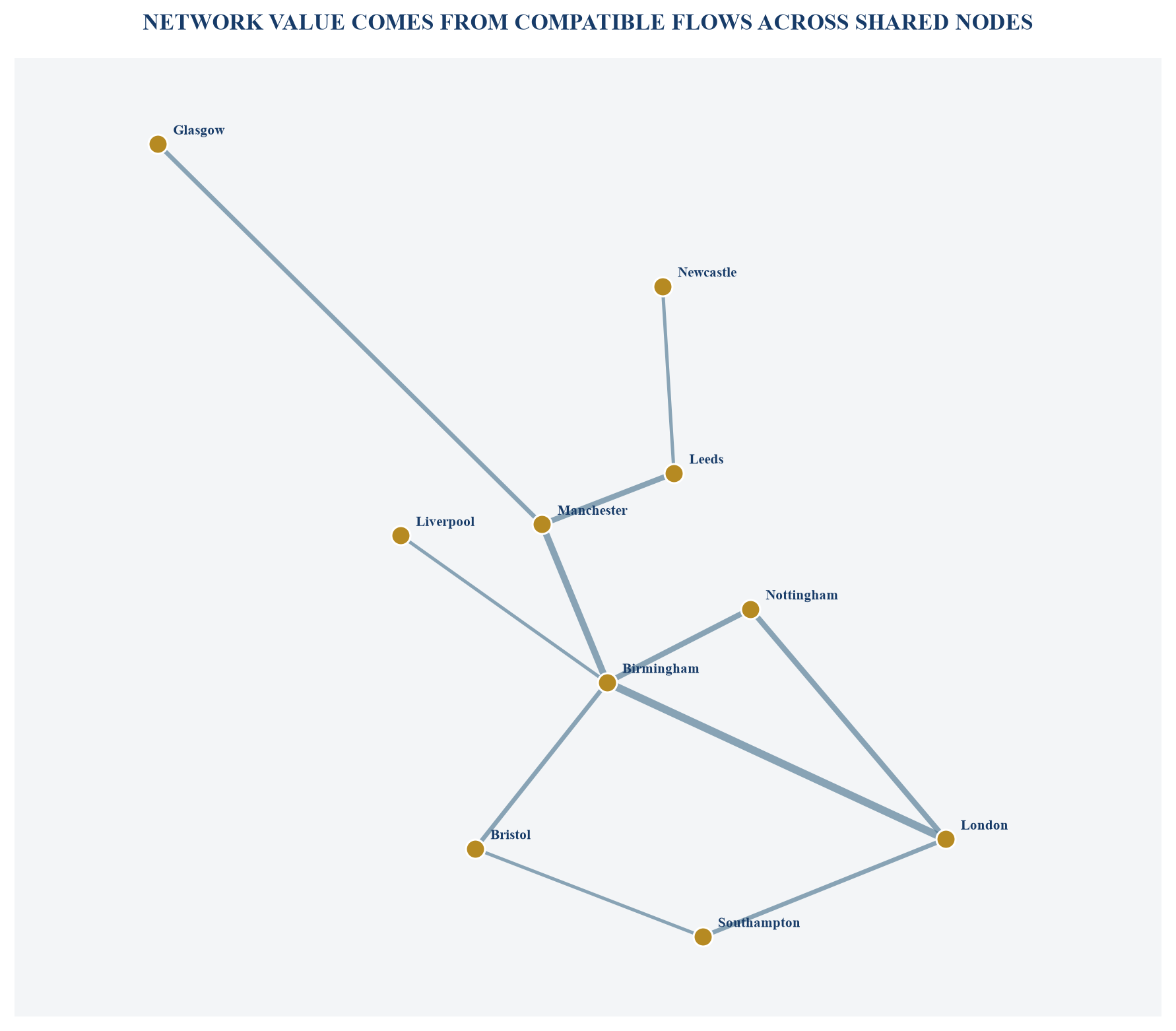
Density depends on compatible volume, time windows, equipment and depot capacity, not the number of plotted locations.
2. Separate market scale from acquisition quality
UK road freight provides a large operating base. DfT reported 19.0 billion vehicle-kilometres travelled by GB-registered HGVs operating in the UK in 2025.[1] Sector scale does not establish the quality of a target's routes, customers or cash conversion.
The lender should segment the target by service model, end market, customer, contract type, depot, region and asset intensity. Dedicated contract logistics can create longer relationships and concentrated renewal risk. Shared-user networks can diversify customers and require strong volume density. Specialist transport can produce higher margins and equipment constraints.
Demand should be supported by customer tenders, order history, contract schedules and operational data. Headline tonnage can decline while revenue grows through higher rates, value-added services or mix. Revenue can grow while contribution falls through wage, fuel, maintenance or subcontractor cost.
Market diligence should test entry and customer switching. The CMA's merger guidelines analyse competitive constraints, customer alternatives, entry, expansion and efficiencies.[4] In logistics, the relevant service can be narrower than a broad national market because customer requirements, scale, sector expertise, automation and geographic coverage differ.
The lender should maintain a market-to-project bridge. It begins with addressable customer spend, identifies tendered services and qualification requirements, and ends with contract-level contribution and renewal timing. Acquisition debt should rely on the last step.
3. Rebuild earnings from customer contracts
Customer concentration should be measured across revenue, contribution, working capital, assets and renewal dates. A customer can produce high revenue and low cash after dedicated fleet, warehouse rent, labour and service credits. Several contracts with one group remain one economic exposure.
Every material contract should be abstracted for scope, term, renewal, pricing, indexation, volume, minimums, change control, service levels, penalties, termination, assignment, change of control, assets, employees, working capital and exit assistance. Side letters and tender commitments should be included.
The quality of indexation matters. Fuel surcharge can pass through diesel changes and exclude electricity, maintenance or insurance. Wage indexation can lag actual labour increases. Open-book arrangements can protect cost and reduce margin upside. Fixed-price contracts can generate operating leverage in either direction.
Contribution should be rebuilt from operational drivers. Loads, stops, miles, dwell time, cube, weight, vehicle type, driver hours, warehouse labour, energy, packaging, subcontractor cost and claims create the economics. Shared overhead allocation should not hide a loss-making contract.
Customer retention should be probability tested around tender dates and service performance. A long historical relationship can end at the next procurement. The downside model should distinguish non-renewal, repricing, partial scope loss and early termination.
Table 1. Customer-contract credit scorecard
| Dimension | Strong evidence | Watch condition | Weak condition | Credit response |
|---|---|---|---|---|
| term | committed term beyond integration | renewal within two years | terminable at convenience | shorten debt and haircut cash |
| pricing | indexed to major cost drivers | partial or lagged index | fixed price with volatile cost | margin stress and reserve |
| volume | minimum or dedicated capacity payment | variable volume | no commitment | lower base case |
| service | stable performance and cure | repeated credits | termination threshold near | cure plan and cash trap |
| assets | customer funds dedicated investment | shared funding | target funds bespoke assets | residual-value haircut |
| change control | priced and documented | backlog of change | informal scope | close condition and reserve |
| renewal | active evidence and competitive position | tender expected | known replacement | exclude from terminal case |
Contract value is based on enforceable economics and renewal evidence.
4. Test route density before booking synergy
Route density can improve vehicle utilisation, backhaul, driver productivity, depot throughput and service coverage. These benefits depend on compatible flows. A morning grocery route cannot automatically absorb an afternoon industrial movement. Vehicle type, temperature control, hazardous-goods rules, customer windows and driver hours can prevent combination.
The density model should use consignment-level data. For each flow it should include origin, destination, time window, frequency, equipment, cube, weight, service requirement and actual cost. The combined network should be re-optimised under operational constraints.
Baseline data should be reconciled across both businesses. Different geocoding, activity definitions and cost allocations can create false overlap. Empty miles, failed delivery, dwell and subcontractor use should be measured consistently.
The lender should require route pilots before recognising material savings. A pilot should preserve service, document distance, time, utilisation and cost, and include seasonal peaks. A desktop optimisation can identify opportunity and cannot prove customer acceptance or depot capacity.
Density can also destroy value. Closing a depot can lengthen stem miles, increase congestion exposure and reduce resilience. Concentrating volume can exceed yard, charging or warehouse capacity. The model should include the cost of operational exceptions.
5. Value depots as operating nodes
A depot's value comes from location, access, capacity, labour, customer proximity, planning rights, lease terms and network role. Property value alone can mislead. A low-rent site can have poor access or require extensive capex. A high-rent urban site can protect service density.
The diligence file should identify freehold, leasehold and customer sites. For leases it should state expiry, breaks, rent review, repair, dilapidations, assignment, change of control and permitted use. Co-located contracts should be mapped to occupancy.
Depot consolidation should include relocation, dual running, redundancy, systems, employee transfer, customer consent, lease exit and operational contingency. Savings begin after implementation cost and service risk.
The network should retain resilience. One national sortation or cross-dock node can create efficiency and a single point of failure. Alternative routing, spare capacity, business continuity and insurance should be tested.
Debt security should distinguish owned property from leased operating rights. A lender can take property security and still lose value if customer contracts or operator licences cannot continue. Direct agreements and continuity rights may be material.
6. Build a synergy evidence hierarchy
Synergies should be classified by evidence and control. Contracted savings have an executed supplier amendment or terminated duplicate cost. Implemented savings have occurred and are visible in current run-rate. Approved actions have named owners, budgets and timelines. Conceptual opportunities remain outside debt capacity.
Cost synergies can include procurement, property, management, systems, insurance, vehicle utilisation and public-company cost. Revenue synergies can include cross-selling, broader tenders and customer introductions. Revenue synergies usually require more time and customer choice and should receive less initial credit.
The GXO offer documentation for Clipper described identified cost synergies and associated non-recurring integration costs.[8] This is an important discipline: gross savings must be paired with cash cost, timing, dis-synergy and implementation risk.
The integration budget should include redundancy, retention, consultants, technology migration, property exit, fleet branding, contract amendments, remedy separation and working capital. A one-time cost that occurs before saving can reduce debt headroom during the critical period.
The lender should maintain a synergy register with owner, baseline, action, cash cost, run-rate saving, evidence, start date, customer dependency and validation. Duplicate savings should be removed. Inflation and business-as-usual improvement should be separated from transaction value.
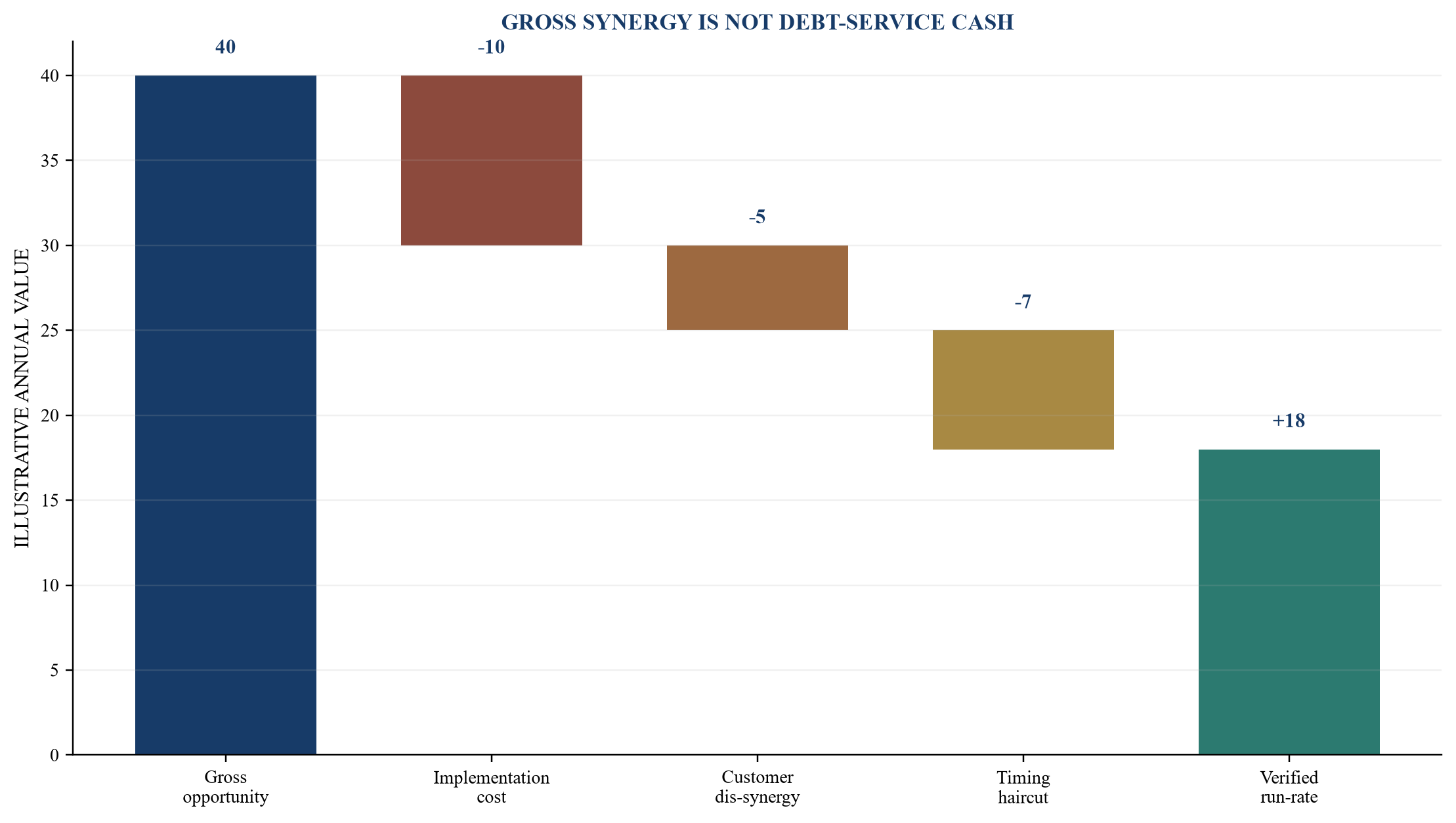
Debt recognition follows cash implementation cost, dis-synergy and evidence haircuts.
7. Stage debt recognition of synergies
Initial leverage should rely on stand-alone earnings adjusted for known customer, fleet, property and working-capital risks. A limited portion of near-certain savings can enter the closing case when action, timing and cost are evidenced. The balance should be released after milestones.
The first release can follow organisational and procurement actions. The second can follow systems migration and network pilots. The third can follow property changes, retained customers and audited run-rate savings. Each release should pass a refreshed downside test.
Debt can be staged through delayed draw, acquisition facility, earn-out funding, revolving availability or permitted add-on. The structure should preserve equity exposure until integration value appears.
Cash sweeps can accelerate deleveraging when synergy exceeds the base case. They can also protect the lender when disposal or remedy proceeds are received. Distributions should remain restricted until leverage and integration tests are satisfied.
Covenants should distinguish management reporting from financial definitions. A synergy add-back can expire, decline over time and require evidence. Unlimited or repeatedly reset add-backs delay recognition of underperformance.
Table 2. Synergy recognition ladder
| Stage | Evidence | Debt recognition | Required protection | Validation |
|---|---|---|---|---|
| concept | overlap hypothesis | none | equity only | management case |
| approved | board plan, owner and budget | limited | funded cost and deadline | integration office |
| contracted | signed supplier or property action | partial | termination and transition control | legal and finance |
| implemented | action complete | substantial | service and customer tests | operating evidence |
| realised | recurring cash saving | full subject to durability | covenant and audit | management accounts |
Credit recognition increases only after named actions produce durable cash.
8. Protect customer retention through integration
Customers should receive a transaction-specific continuity plan. It should address account ownership, service teams, systems, invoicing, data, depot, fleet, change control and escalation. A broad announcement does not manage contract risk.
The buyer should identify customers that overlap, compete or require information separation. Grocery, defence, healthcare and regulated customers can have specific security and operational requirements. Customer consents and tender commitments should be tracked.
Retention should be measured through renewal, scope, service performance, complaints, credits and decision-maker engagement. Revenue alone can remain stable while a customer prepares a tender or removes profitable work.
The lender should identify key customer long-stops. If integration changes systems or sites before renewal, the buyer can incur cost without contract certainty. Staging protects service and preserves optionality.
A customer loss waterfall should show revenue, avoided variable cost, stranded fixed cost, fleet disposal, property exposure, working-capital release and re-leasing time. Debt capacity should reflect the cash effect rather than revenue loss alone.
Table 3. Customer-retention control matrix
| Signal | Green | Watch | Mandatory action | Credit consequence |
|---|---|---|---|---|
| service levels | stable and within target | repeated minor credit | executive recovery plan | distribution lock |
| renewal | documented engagement | tender timetable unclear | retention case and pricing | haircut terminal cash |
| key people | named team retained | account lead departure | replacement and customer contact | reserve |
| systems | tested continuity | interface defect | rollback and dual run | delay synergy release |
| change control | signed and priced | disputed scope | resolve before migration | exclude disputed margin |
| customer consent | obtained | pending | closing or integration condition | holdback |
Retention is evidenced through contract, service and engagement signals.
9. Fund fleet renewal before sizing leverage
Fleet capex is often treated as maintenance and can include growth, replacement, compliance and technology transition. The lender should build a vehicle-level schedule using age, mileage, duty cycle, ownership, lease expiry, maintenance history, emission standard and customer requirement.
Owned fleet creates asset value and replacement cash needs. Operating leases create fixed commitments and return conditions. Hire purchase and finance leases create secured claims. Subcontracting reduces owned capex and can increase variable cost and service dependence.
UK policy is moving toward zero-emission HGVs. Government materials retain the intention to phase out new non-zero-emission HGV sales by weight class and support demonstrator and charging programmes.[12][13] The acquisition model should include vehicle premiums, depot charging, grid capacity, payload, range, residual value and operational transition.
Fleet harmonisation can produce procurement and maintenance savings and require early replacement of usable vehicles. The synergy case should not count procurement savings while omitting transition capex.
The lender should distinguish committed fleet orders from optional plans. Deposits, manufacturer slots, cancellation, grants and financing should be documented. Residual values should be stressed for technology and regulation.
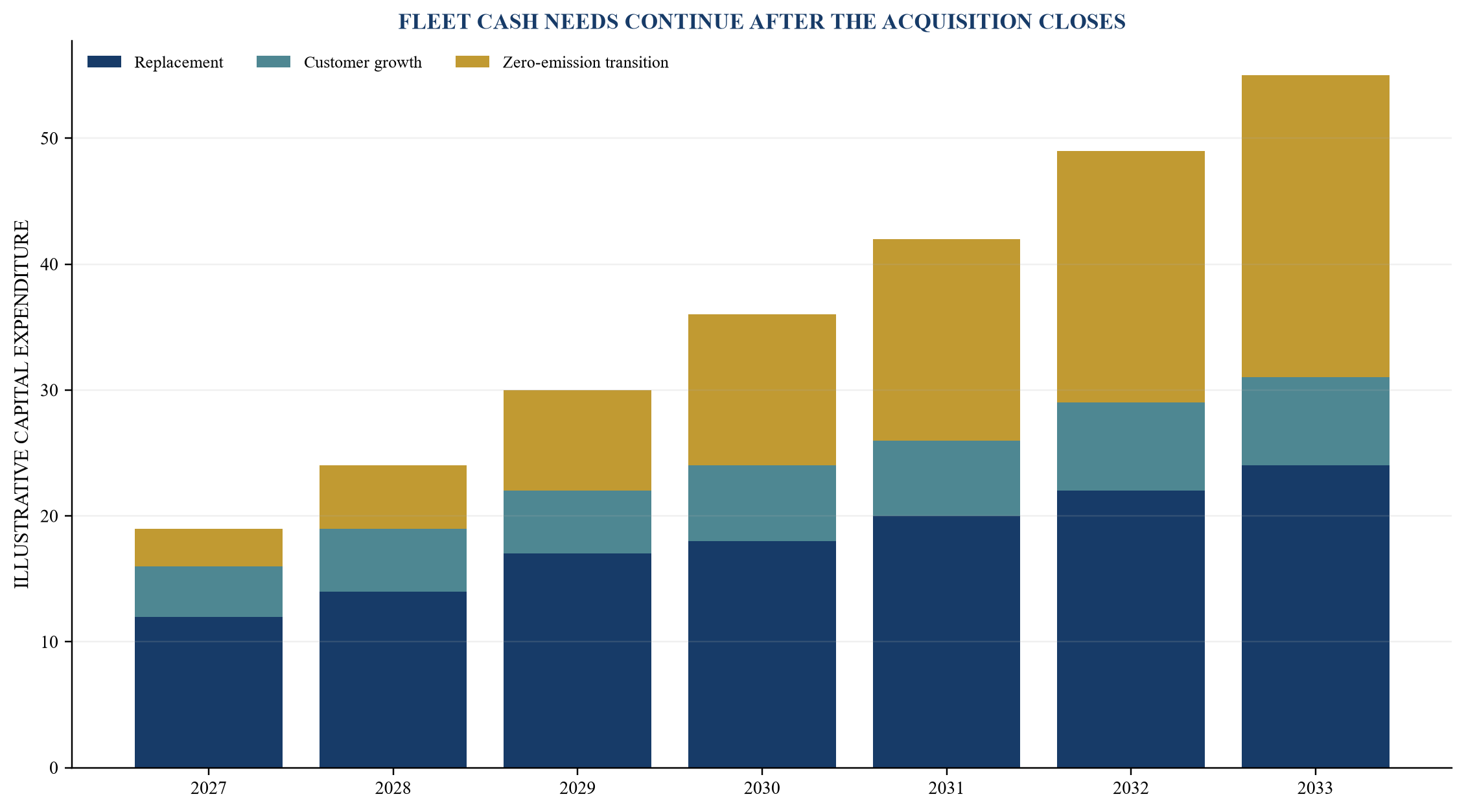
Replacement, customer growth and zero-emission transition create distinct funding needs.
10. Integrate technology without losing dispatch control
Transport management, warehouse management, telematics, labour planning, customer portals, finance and billing systems form the operating nervous system. Integration should preserve dispatch, traceability, proof of delivery, invoicing and customer reporting.
The diligence inventory should state system owner, version, licence, interfaces, data quality, cybersecurity, support, cost and replacement date. Custom code and customer-specific interfaces can create hidden dependency.
The target architecture should distinguish immediate interfaces, medium-term convergence and systems retained for customer or remedy reasons. A single rapid migration can reduce duplicate cost and increase operational risk. Dual running costs cash and can protect service.
Data migration should include master data, route history, rates, driver records, vehicle maintenance, customer specifications, proof of delivery and claims. Reconciliation should be designed before cutover.
Cybersecurity and business continuity should be tested across the combined network. The UK National Cyber Security Centre's supply-chain guidance emphasises understanding dependencies and managing third-party risk.[16] A cyber event during integration can affect several depots and customers.
11. Model working capital by contract
Logistics working capital can change rapidly through fuel, wages, subcontractors, claims, VAT, customer billing and payment terms. The buyer should model each material contract rather than apply a group percentage.
Billing can depend on proof of delivery, KPI agreement, open-book reconciliation or customer purchase orders. Integration can delay invoices through system and master-data errors. Disputed change control can age receivables.
Supplier terms can change after control. Fuel cards, vehicle lessors, insurers and subcontractors can request deposits or shorter payment. Acquisition finance should include this liquidity need.
Seasonality should be tested around retail peaks, agricultural cycles, construction and customer promotions. Higher volume can consume cash before collection. A revolving facility should be sized against the downside peak and not annual average.
The lender should monitor unbilled revenue, aged receivables, deductions, proof-of-delivery backlog, supplier ageing and customer concentration. Cash conversion should be a covenant input during integration.
Table 4. Working-capital diagnostic
| Driver | Evidence | Integration risk | Downside test | Control |
|---|---|---|---|---|
| billing trigger | contract and invoice sample | system mismatch | delayed invoice | dual-process reconciliation |
| proof of delivery | operating records | data migration gap | unbilled backlog | daily exception report |
| customer deduction | remittance history | service dispute | higher ageing | dispute reserve |
| supplier terms | contracts and statements | change-of-control reset | deposit or shorter terms | liquidity buffer |
| peak volume | weekly history | combined seasonality | cash consumption | revolving availability |
| claims | claims register | integration service failure | higher settlement | insurance and reserve |
Contract mechanics determine cash timing through the integration period.
12. Treat competition remedies as a financing variable
Competition analysis can affect timing, control, integration and perimeter. The UK regime requires early assessment of jurisdiction, substantive risk and procedure. The CMA's updated quick guide and jurisdiction guidance describe the current framework.[5][6]
The GXO/Wincanton process illustrates how a completed logistics acquisition can remain subject to investigation, interim measures and final undertakings.[3] The CMA's final materials focused on dedicated grocery warehousing and remedies designed to protect competition.[3][7]
The financing model should identify businesses, contracts, people, assets, data and systems that may need to remain separate or be divested. Synergies involving those operations should be removed until permitted. Separation cost and delayed integration should be funded.
Acquisition documents should allocate regulatory risk, cooperation, remedies and long-stop dates. Financing commitments should survive the expected timetable and specify permitted perimeter changes. A divestiture should have proceeds, cost, tax and debt-prepayment mechanics.
The lender should not assume that ownership permits operational integration. Interim orders can restrict changes. The integration office should include a competition-control workstream with legal approval gates.
Competition risk should be connected to the operational model at service level. A national logistics label can hide narrower customer requirements for dedicated warehousing, sector expertise, automation, temperature control, security or geographic reach. The buyer should map the overlap using the same service definitions used in commercial diligence and avoid assuming that all routes or depots can be combined.
Clean-team arrangements should protect competitively sensitive customer, price, bid and capacity information before integration is permitted. The diligence plan should state who can receive which data, how aggregated analysis is produced and how prohibited operational instructions are prevented. These controls can add time and cost to synergy validation.
The debt documents should include information and consent mechanics for regulatory events. Lenders need prompt notice of investigation, interim measures, remedy proposals, undertakings, appeals and divestiture progress. Material changes to the acquired perimeter should trigger a refreshed leverage and liquidity test.
A remedy business requires enough people, assets, contracts, systems and working capital to remain viable. Carving out a customer contract without the supporting depot, technology or management can reduce sale value and disrupt retained operations. Separation planning should identify stranded cost and transitional-service obligations on both sides.
The refinancing case should exclude earnings subject to mandatory disposal and include only net proceeds supported by a credible sale process. Where final undertakings require a timetable, the capital structure should retain liquidity for execution without forcing a distressed sale.
13. Map people, licences and operational authority
Logistics depends on drivers, planners, warehouse teams, engineers, account managers and licensed transport management. Key-person diligence should identify decision rights, customer relationships, qualifications and retention.
Operator licensing should be mapped by entity and operating centre. Vehicle availability does not permit operation without the relevant licence, transport manager, financial standing and compliance. Changes of entity or site require planned approvals.
Employment integration should account for consultation, transfer, collective arrangements, pension, overtime, agency labour and retention. GOV.UK guidance on TUPE describes employee protections when a business changes owner.[17] Legal advice is required for the transaction.
Labour savings should be paired with service capacity and cash cost. Removing planners before systems converge can reduce network control. Depot closures can increase commute and attrition.
The lender should monitor vacancies, agency use, driver turnover, absence, overtime and training. DfT reported that 26 percent of surveyed HGV businesses reported driver vacancies in the fourth quarter of 2025.[1] Target-specific data should determine the credit response.
14. Define the acquisition funding stack
Sources can include senior term debt, revolving credit, delayed-draw facilities, asset finance, property finance, seller paper, earn-out and sponsor equity. Each should fund a defined risk.
Senior term debt can fund durable stand-alone cash and verified near-term savings. Revolving credit can fund seasonal working capital and integration timing. Asset finance can match vehicles and equipment. Property finance can recognise owned logistics real estate. Equity should absorb customer, remedy and execution risk.
The facility should preserve undrawn liquidity for integration and fleet capex. Funding the full purchase price with term debt and expecting the revolver to absorb all execution volatility can create a liquidity trap.
Acquisition debt should be reconciled with lease liabilities, hire purchase, pensions, deferred consideration, tax, claims and property obligations. Headline net debt can omit operating commitments that consume cash.
The Bank of England's July 2026 report identified continuing vulnerabilities in risky credit markets and refinancing exposure among a subset of leveraged UK corporates.[9] A logistics acquisition should retain interest and maturity headroom under higher funding cost and lower customer contribution.
15. Build debt capacity from downside cash
The base case should begin with stand-alone contract cash, subtract fleet and systems capex, working capital, tax, leases and integration cost, and add only eligible synergy. Debt service is then tested across interest and amortisation.
The downside should combine customer loss, margin compression, delayed synergy, fleet capex, remedy separation, working-capital outflow and higher interest. These events can be related. A delayed systems migration can delay synergy and billing while increasing service credits.
The leverage framework should distinguish closing debt, maximum committed debt and post-integration target debt. Delayed draws can fund value after evidence. Cash sweeps and disposal proceeds can reduce leverage.
Debt headroom should be expressed in cash and time. The lender should know how much liquidity remains, when covenants breach and which actions are available. A ratio alone does not show the operating runway.
Reverse stress should identify the customer or margin loss that consumes headroom. It should state whether the network can remove stranded cost before maturity.
Debt sizing should also separate earnings quality from collateral and liquidity. Contract contribution can support scheduled debt service. Vehicles and property can support recoveries or separate asset finance. Revolving availability protects timing. These sources of protection should not be added together without recognising their conditions and competing claims.
The closing case should use a customer-by-customer cash forecast for the first two years and a contract maturity profile through the debt tenor. A large renewal twelve months after closing creates a different risk from the same renewal in year four. The amortisation schedule should reduce exposure before known renewal cliffs where cash generation allows.
Interest-rate protection should match the debt profile. Hedging a term facility can reduce base-rate volatility while leaving revolving use, leases and asset finance exposed. Break cost, hedge maturity and prepayment should align with the deleveraging plan. The model should show both contractual interest and cash interest after fees and hedging.
The lender should test the effect of integration delay on refinancing. A platform that has not completed systems, property or customer milestones can receive less credit for synergy and face a higher pricing or lower leverage at take-out. Refinancing proceeds should be calculated from then-current earnings and concentration rather than the original acquisition case.
A disposal plan can provide optional deleveraging and should not be treated as certain repayment without identified assets, consents, tax and credible timing. Vehicles can be essential to customer contracts. Property can be operationally critical. A remedy disposal can occur under timetable and buyer constraints. Sale proceeds should be stress tested after separation cost.
The capital structure should preserve a route to correction. Sponsor equity, delayed consideration, earn-out, cash sweep and restricted distributions can absorb variance. Maturity and covenant headroom should give management enough time to retain customers, complete systems and execute asset actions before a payment crisis.
Table 6. Staged acquisition-leverage framework
| Layer | Supported by | Closing treatment | Release condition | Downside protection |
|---|---|---|---|---|
| core term debt | durable stand-alone contract cash | funded at close | scheduled amortisation | customer and coverage covenants |
| revolving liquidity | seasonal working capital | committed and partly undrawn | borrowing-base evidence | cash control and clean-down |
| fleet finance | identified vehicles and equipment | matched to eligible assets | delivery and title | asset security and maintenance |
| delayed acquisition debt | verified integration value | unavailable at close | customer, synergy and leverage milestones | expiry and no-default test |
| sponsor support | customer, remedy and execution risk | funded or committed | released after financial tests | subordination and cash trap |
Debt advances and releases follow the maturity of stand-alone cash and integration evidence.
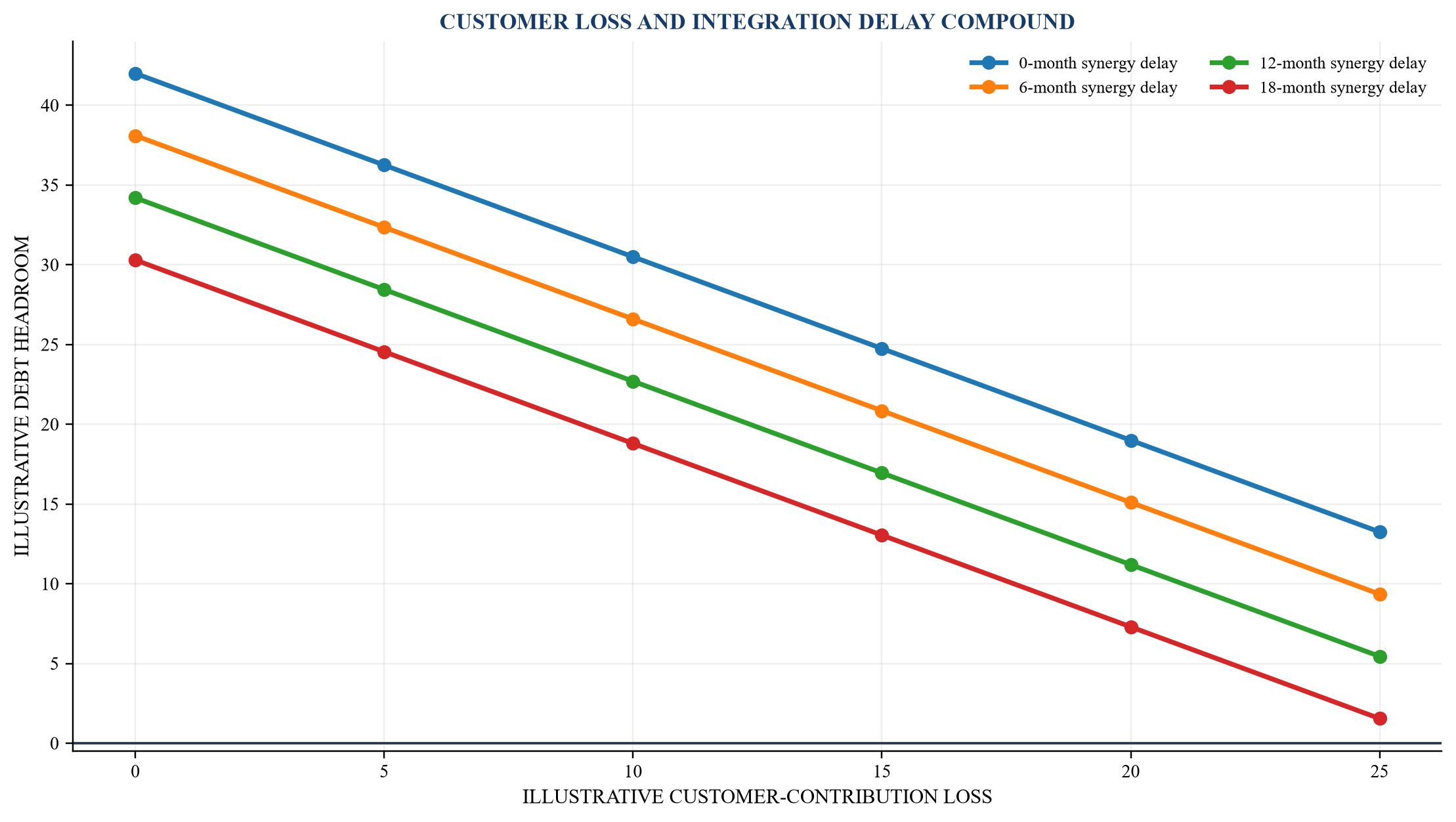
Customer loss and delayed synergy reduce headroom together.
16. Control cash through the integration period
Customer collections should enter controlled accounts. The waterfall should pay critical operating cost, tax, payroll, fuel, leases, debt service, fleet and systems reserves, approved integration cost and distributions.
Integration spending should use a board-approved budget and evidence. Cost overruns should be funded through remaining contingency and sponsor support before additional senior debt. Customer or asset-sale proceeds should follow agreed application rules.
Cash traps should activate on customer loss, service deterioration, liquidity shortfall, delayed synergy, fleet-capex deficit, remedy delay, high leverage and refinancing risk. The cure should address the underlying cause.
Affiliate payments should be documented and subordinated where appropriate. Central procurement and management services can create savings and transfer cash away from the borrower.
The account map should identify every operating account, collection route, financing account, signatory and sweep. Integration often leaves legacy accounts active. Their closure or control should be a milestone.
17. Build security around contracts and continuity
Security can include shares, receivables, accounts, vehicles, equipment, property, insurance and material contracts, subject to law and prior claims. The lender should confirm ownership, priority and enforcement.
Customer contracts may restrict assignment. Vehicle financiers and lessors can hold title or security. Warehouse landlords can have rights over goods or premises. Customer-owned inventory is not borrower collateral.
Direct agreements can provide notice and cure with material landlords, customers, technology providers and asset financiers when available. The objective is continuity, not merely documentary completeness.
The security group should match cash generation. Excluding a profitable subsidiary or property can weaken recovery. Including a regulated or customer-restricted entity can create complexity. The legal analysis should state the consequences.
Recovery planning should identify likely pathways: continue operation, sell contracts, sell fleet and property, appoint a specialist manager or separate business units. Each pathway requires customer, licence, employee and systems continuity.
18. Link covenants to integration causes
Financial covenants can include leverage, interest cover, fixed-charge cover, liquidity and capital expenditure. Integration covenants should track customer retention, synergy evidence, service, fleet, working capital, systems and remedies.
The dashboard should use watch, distribution-lock, mandatory-cure and default levels. A customer tender can trigger a watch. A material service failure can lock distributions. An unfunded fleet plan can require equity. A lost operator licence can be a default.
Synergy add-backs should have an expiry, cap and evidence standard. Realised savings should replace adjustments. Failed actions should reduce covenant EBITDA.
Fleet capex should have a minimum and permitted deferral. Under-spending can temporarily increase cash while weakening service and residual value. The covenant should distinguish efficiency from deferred maintenance.
Reporting should be monthly during integration and include customer, network, service, fleet, cash, synergy and remedy workstreams. Board information should reconcile with lender reporting.
Table 5. Covenant and remedy ladder
| Indicator | Watch | Distribution lock | Mandatory cure | Default |
|---|---|---|---|---|
| customer retention | tender or weak engagement | material contract at risk | retention or replacement plan | material termination and no cure |
| service | recurring minor miss | major KPI breach | funded recovery | licence or contract loss |
| synergy | milestone slips | add-back unsupported | equity or deleveraging | covenant breach uncured |
| fleet | schedule pressure | minimum capex shortfall | funded fleet plan | unsafe or unusable fleet |
| working capital | ageing rises | liquidity buffer breached | equity and collection cure | payment default |
| competition remedy | timetable slips | separation reserve low | fund and execute remedy | final undertaking breach |
The framework intervenes before operating slippage becomes payment default.
19. Govern integration through decision gates
The integration office should have workstreams for customers, network, depots, fleet, systems, people, finance, regulation and communications. Each workstream needs a baseline, owner, budget, dependency and decision rights.
Day-one readiness should protect service, payroll, fuel, insurance, dispatch, customer communication and account control. The first hundred days should validate assumptions rather than force every integration action.
Network changes should proceed through pilot, review and scale. Systems should proceed through design, test, dual run, reconciliation and cutover. Depot actions should follow customer and property analysis. Fleet actions should follow route design and infrastructure readiness.
The board and lenders should receive a decision ledger. It records assumption, evidence, decision, owner, cost, customer impact, financing impact and next review. This creates accountability and prevents synergy from remaining a narrative.
Integration should have stop rules. Service failure, data inconsistency, customer objection, regulatory restriction or inadequate liquidity can pause a change. Preserving value is an execution decision.
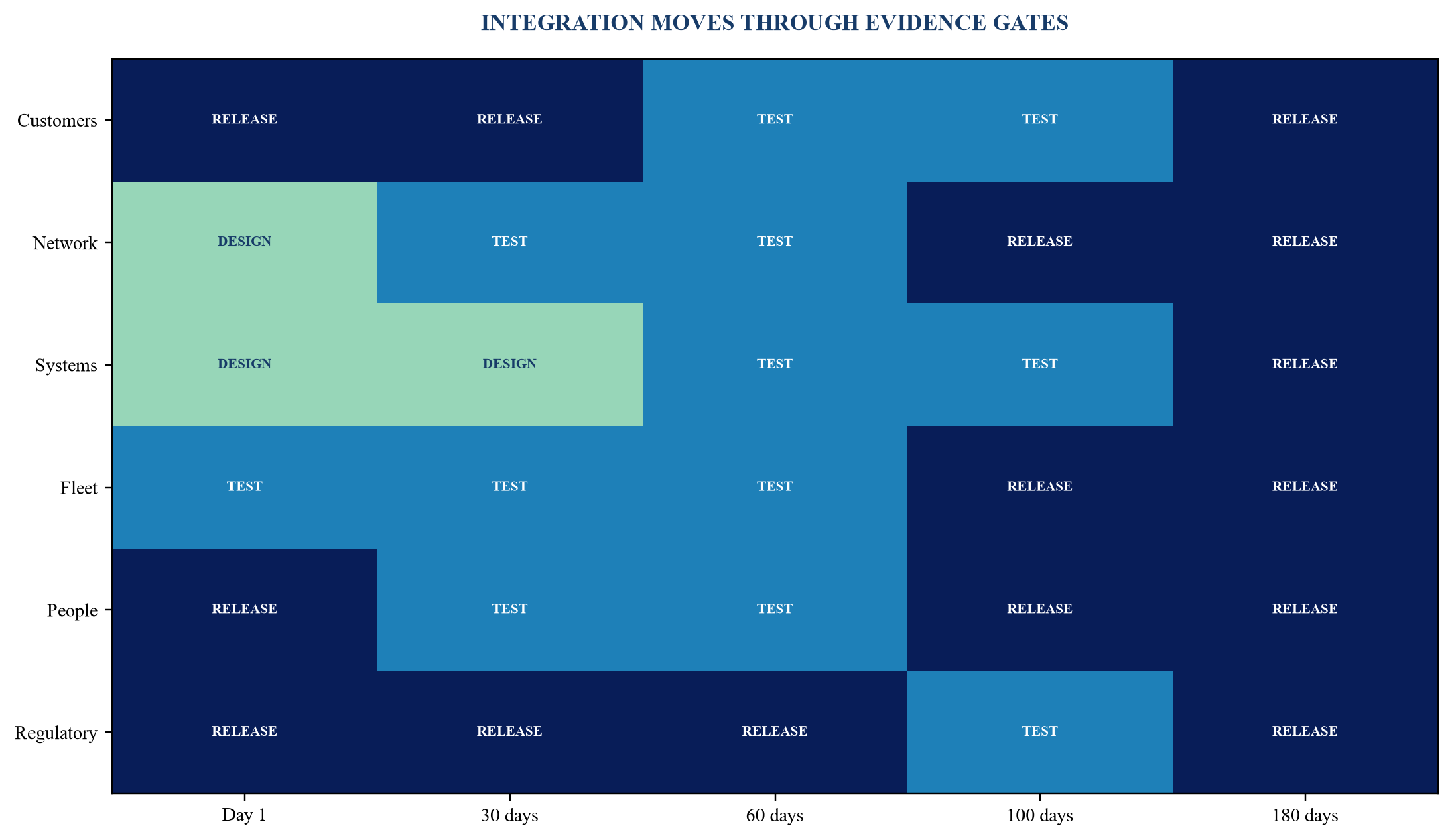
Leverage release follows evidence across customer, network, systems, fleet and regulatory workstreams.
20. Run a 15-day acquisition-finance diagnostic
Day one confirms entities, transaction perimeter and sources. Day two maps customers and contracts. Day three rebuilds contract contribution. Day four maps routes, depots and network density. Day five reviews fleet and asset finance.
Day six reviews systems, data and cyber. Day seven reviews people, licences and employment. Day eight maps working capital. Day nine establishes stand-alone earnings. Day ten builds the synergy register and implementation budget.
Day eleven assesses competition, remedy and separation. Day twelve maps security and accounts. Day thirteen runs combined downside cases. Day fourteen sizes debt, liquidity and fleet funding. Day fifteen produces the credit memo, issue ledger and 120-day execution plan.
Issues should be classified as missing evidence, curable weakness, structural constraint and value opportunity. An unsigned customer amendment is missing evidence. An expiring depot lease can be curable. A non-transferable licence can be structural. A tested backhaul opportunity can create value.
Every issue should change financing. It can alter debt, equity, reserve, covenant, condition, support, maturity, price, security or the decision to stop.
21. Deliver the transaction through a 120-day plan
Days one to twenty establish governance, advisers, clean teams, data room, customer and asset register, stand-alone model and integration principles. The buyer confirms equity, financing and regulatory strategy.
Days twenty-one to fifty complete commercial, operational, fleet, property, technology, legal, competition, tax, pensions, insurance and financial diligence. Customer contribution, cost to complete and working capital are reconciled.
Days fifty-one to eighty negotiate acquisition and financing documents, regulatory controls, integration budget, reserves, security, covenants and reporting. The sources and uses include all known implementation and fleet needs.
Days eighty-one to one hundred and ten close conditions, consents, insurance, hedging, equity, accounts and security. Day-one service and cash are rehearsed. Regulatory separation and clean-team controls are confirmed.
Days one hundred and eleven to one hundred and twenty execute closing and begin evidence-led integration. The first lender report uses current data, realised savings and customer signals. Residual issues have owners and dates.
22. Conclusion
UK logistics acquisitions can create value through network density, broader customer capability, procurement, technology and better asset utilisation. The value is produced through operating decisions after closing.
The financing sequence is practical. Map the route-to-cash system. Rebuild customer contribution. Test compatible density. Value depots as nodes. Establish a synergy evidence hierarchy. Protect customers. Fund fleet, systems and working capital. Incorporate competition remedies. Size debt from downside cash. Release leverage through milestones.
Debt capacity should follow evidence. Contracted savings are stronger than desktop opportunity. Retained customers are stronger than assumed renewals. Tested routes are stronger than plotted overlap. Funded fleet and systems plans are stronger than deferred capex.
When financing, integration and customer continuity are governed together, acquisition debt can support platform growth while preserving an actionable route to lower leverage. The same framework gives boards a clearer view of value creation and failure points before capital is committed.
References
- Department for Transport, “Road freight statistics: 2025,” 27 May 2026, https://www.gov.uk/government/statistics/road-freight-statistics-2025.
- Department for Transport, “Domestic road freight statistics, United Kingdom: 2025,” https://www.gov.uk/government/statistics/road-freight-statistics-2025/domestic-road-freight-statistics-united-kingdom-2025.
- Competition and Markets Authority, “GXO / Wincanton merger inquiry,” case record, final report and final undertakings, https://www.gov.uk/cma-cases/gxo-slash-wincanton-merger-inquiry.
- Competition and Markets Authority, “Merger Assessment Guidelines,” CMA129, updated 3 June 2026, https://www.gov.uk/government/publications/merger-assessment-guidelines.
- Competition and Markets Authority, “A quick guide to UK merger assessment,” CMA18, updated January 2025, https://www.gov.uk/government/publications/quick-guide-to-uk-merger-assessment.
- Competition and Markets Authority, “Mergers: Guidance on the CMA's jurisdiction and procedure,” CMA2, https://www.gov.uk/government/publications/mergers-guidance-on-the-cmas-jurisdiction-and-procedure.
- Competition and Markets Authority, “Final report: GXO acquisition of Wincanton,” 19 June 2025, https://assets.publishing.service.gov.uk/media/685426271203c00468ba2b4e/Final_report_.pdf.
- GXO Logistics, Inc., “Rule 2.7 Announcement relating to the acquisition of Clipper Logistics plc,” synergy and integration-cost information, US Securities and Exchange Commission, https://www.sec.gov/Archives/edgar/data/1852244/000110465922028661/tm227857d1_ex2-1.htm.
- Bank of England, “Financial Stability Report, July 2026,” 7 July 2026, https://www.bankofengland.co.uk/financial-stability-report/2026/july-2026.
- GXO Logistics, Inc., “Annual Report on Form 10-K for the year ended 31 December 2025,” US Securities and Exchange Commission, https://www.sec.gov/Archives/edgar/data/1852244/000185224426000007/gxo-20251231.htm.
- GXO Logistics, Inc., “2026 Proxy Statement,” Wincanton integration and synergy disclosures, US Securities and Exchange Commission, https://www.sec.gov/Archives/edgar/data/1852244/000110465926046343/tmb-20260520xdef14a.htm.
- Department for Transport, “Infrastructure for zero emission heavy goods vehicles and coaches,” https://www.gov.uk/government/calls-for-evidence/infrastructure-for-zero-emission-heavy-goods-vehicles-and-coaches/infrastructure-for-zero-emission-heavy-goods-vehicles-and-coaches.
- Department for Transport, “Boost for British business as government slashes cost of electric lorries,” 6 January 2026, https://www.gov.uk/government/news/boost-for-british-business-as-government-slashes-cost-of-electric-lorries-by-up-to-120000.
- Department for Transport, “Future of Freight: a long-term plan,” https://assets.publishing.service.gov.uk/media/62b9a2ec8fa8f53572e3db68/future-of-freight-plan.pdf.
- Competition and Markets Authority, “Annual Report and Accounts 2025 to 2026,” https://www.gov.uk/government/publications/cma-annual-report-and-accounts-2025-to-2026/annual-report-and-accounts-2025-to-2026.
- National Cyber Security Centre, “Supply chain security guidance,” https://www.ncsc.gov.uk/collection/supply-chain-security.
- UK Government, “Business transfers, takeovers and TUPE,” https://www.gov.uk/transfers-takeovers.
- Driver and Vehicle Standards Agency, “Goods vehicle operator licensing guide,” https://www.gov.uk/government/publications/goods-vehicle-operator-licensing-guide-gv74.
