

1. Define the transaction before estimating recoveries
An NPL transaction begins with the rights being transferred. A whole-loan sale, participation, securitisation, servicing transfer, public asset-management-company transfer and bank-resolution transaction create different claims on borrowers, collateral and cash. The buyer should identify the seller, lender of record, obligor, guarantor, security provider, servicer, collection-account bank, trustee and funding vehicle before assigning a recovery rate. A model cannot repair an unclear legal perimeter.
Build a transaction map for each portfolio. Record the loan agreement, amendments, security, guarantees, payment history, classification date, enforcement status, disputes, settlement offers, write-offs and recoveries. Confirm whether the buyer acquires legal title, economic exposure, servicing authority or a combination. Identify consents, notices, registration, confidentiality and data-transfer steps. The IMF's work on NPL resolution in sub-Saharan Africa stresses that effective resolution depends on supervisory, legal, judicial and market infrastructure, rather than a disposal decision in isolation.[1]
The repayment claim should be stated in cash terms. Contractual principal may include capitalised interest, fees or balances that are disputed, unenforceable or outside the buyer's mandate. Accounting carrying values and prudential provisions answer different questions from a market bid. IFRS 9 measures expected credit losses through probability-weighted discounted cash shortfalls, including the amount and timing of expected recoveries where applicable.[9][10] A transaction model should therefore preserve both amount and timing.
Define the investment committee decisions at the start. These may include eligible perimeter, diligence depth, base recovery curve, downside adjustment, legal budget, servicing plan, currency hedge, funding structure, bid ceiling and walk-away conditions. Each decision needs a named evidence source and owner. The committee should be able to distinguish an observed loan attribute, a calculated metric, a legal opinion, a servicer estimate and an investment assumption.
A portfolio should stop at the first gate when ownership, data rights, cash history or enforceability cannot be established to the required standard. The response may be exclusion, price reserve, seller warranty, escrow, delayed transfer or a separate high-uncertainty pool. Treating every gap as a lower recovery assumption can hide defects that prevent transfer or collection altogether.
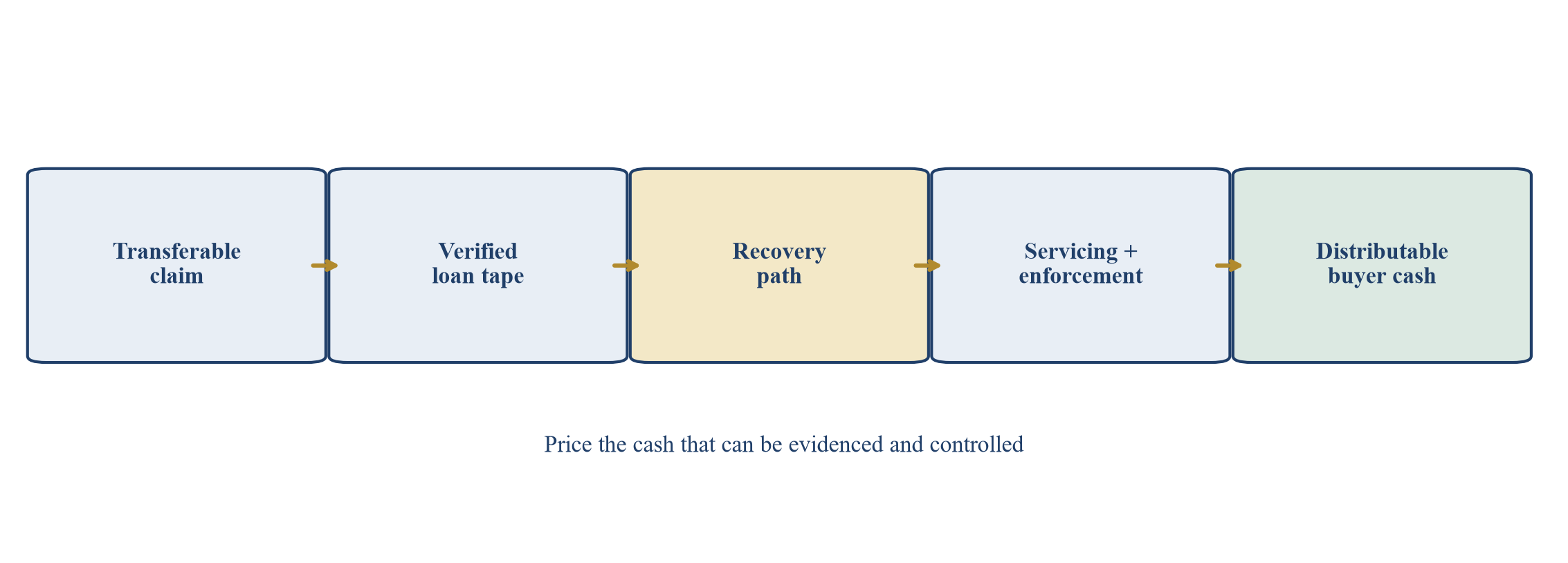
Transaction framework. Each link requires evidence, ownership and a defined failure response.
| Decision | Minimum evidence | Failure signal | Transaction response |
|---|---|---|---|
| transferable perimeter | agreements, title chain, consents, notices and security records | missing title, prohibited transfer or unresolved dispute | exclude or condition closing |
| opening balance | loan ledger, contractual schedule, payment history and general ledger | unexplained balance or duplicate account | reconcile before valuation |
| recovery route | borrower status, collateral, guarantee, legal stage and servicer plan | route not legally or operationally available | use alternative route or zero value |
| timing curve | dated collections, events, costs and censoring treatment | incomplete or outcome-leaking history | restrict model and widen uncertainty |
| servicing continuity | staff, systems, licences, scripts, accounts and transition plan | cash or authority can be interrupted | transition reserve and closing condition |
| bid authority | scenario cash flows, costs, discount rate, funding and sensitivities | price depends on one fragile assumption | lower ceiling or walk away |
The evidence standard should be calibrated to the asset, jurisdiction and transfer structure.
2. Treat Africa as a set of distinct recovery jurisdictions
There is no single African NPL market. Banking law, insolvency, security creation, land registration, court procedure, credit reporting, data protection, foreign-exchange control and debt-collection rules vary across countries. Even jurisdictions sharing a regional legal framework can differ in institutional capacity, record quality, court congestion and practical enforcement. A cross-border portfolio should therefore have a jurisdiction matrix before it has a blended recovery rate.
Current official evidence illustrates different conditions. The Bank of Ghana's 2025 Financial Stability Review reported continuing improvement in asset quality while the NPL ratio remained high, and it presented sector concentration, migration, write-off and recovery information.[17] The South African Reserve Bank's second 2025 Financial Stability Review examined delinquency buckets as potential early-warning indicators of NPLs.[16] The IMF's 2026 assessment of Angola described elevated overdue and Stage 3 exposures and a long legacy tail.[18] These observations support jurisdiction-specific diligence; they do not establish the value of any individual portfolio.
Create a country annex for the legal path that the valuation assumes. It should cover transfer, assignment, notice, security perfection, guarantee enforcement, restructuring, insolvency, collateral sale, limitation periods, consumer or SME protections, licensing, cross-border payment, tax, confidentiality and data transfer. Local counsel should state the applicable law, factual dependencies, expected sequence and material uncertainty. The model should use counsel's route and timing ranges rather than a generic regional label.
The World Bank's principles for effective insolvency and creditor-debtor regimes provide a reference for evaluating enforcement and restructuring infrastructure.[4] The OHADA Uniform Act supplies a common legal basis for collective proceedings across member states, subject to current local implementation and professional advice.[20] These sources can structure questions; they cannot replace jurisdiction-specific diligence.
Macroeconomic variables should enter through defined channels. Inflation can change borrower cash generation and enforcement cost. Currency depreciation can alter local-currency recoveries relative to foreign-currency funding. Interest rates can affect discounting and settlement capacity. Commodity, fiscal or climate shocks may concentrate stress by sector. A scenario should identify the causal transmission and affected segment rather than apply one blanket country haircut.
Cross-border cash needs a practical route. Confirm collection accounts, authorised currencies, conversion process, withholding, remittance approvals, correspondent-bank dependencies and sanctions controls. A recovery that cannot be distributed within the assumed period has a different present value. The transaction model should also separate local-currency asset risk from buyer-funding currency risk.
| Evidence area | Diligence question | Model variable | Control response |
|---|---|---|---|
| transfer and title | can the buyer acquire and evidence the claim? | eligible balance and closing probability | exclusion, consent or escrow |
| security and collateral | is security perfected and realisable? | collateral proceeds, timing and cost | legal opinion and haircut |
| restructuring and insolvency | which route can bind stakeholders? | route probability and recovery sequence | scenario-specific curve |
| courts and administration | how long do comparable steps take in practice? | event-time distribution | range, censoring and delay stress |
| data and confidentiality | what may be shared and used? | model population and data coverage | clean room, minimisation or exclusion |
| currency and remittance | when can cash reach the buyer vehicle? | FX rate, delay and conversion cost | hedge, reserve or local funding |
Qualified local advisers should confirm current law, procedure and transaction applicability.
3. Reconstruct the loan tape before modelling
The loan tape is the transaction's factual spine. Build one controlled identifier that connects the contractual loan, borrower, guarantor, collateral, legal case, servicing action, payment, cost, write-off and bank-account cash. Preserve the seller's original identifiers and create a documented crosswalk. Duplicate, recycled or missing identifiers can create double counting and break the chain from modelled recovery to cash.
Reconcile balances at several levels. Contractual principal, accrued interest, fees, penalties, accounting gross carrying amount, loss allowance, net carrying amount, prudential exposure, charged-off amount and legal claim may differ. The data room should explain each definition and produce a bridge to the general ledger. The bidder should determine which balance the price percentage refers to and avoid comparing bids stated against different denominators.
Payment history needs event-level dates and amounts. Preserve scheduled due dates, receipts, reversals, allocations, settlements, restructurings, write-offs, collateral proceeds and third-party payments. Link collections to bank cash and servicing records. A cumulative recovery field without dates cannot support a timing curve. A status field overwritten each month cannot reconstruct transitions.
Borrower and collateral fields require provenance. Company registration, sector, location, employment, income, turnover, collateral type, valuation date, lien rank, occupancy and guarantee status should include source, date and confidence. Stale collateral values should not be silently treated as current. Missingness may be informative because older or weaker files can contain less complete documentation.
Legal fields should record route, filing date, court, case number, procedural stage, last event, next action, counsel estimate, settlement activity and cost paid. Free text can remain available for review, while controlled fields support portfolio analysis. A legal-status label should be validated against documents and sampled with local counsel.
Data quality should be measured, not described. Report completeness, validity, uniqueness, consistency, timeliness and reconciliation by seller system, product, vintage, jurisdiction and proposed segment. Identify whether a field was available before the outcome it is intended to predict. Data repaired after collections can support accounting reconciliation while remaining unsuitable for model validation.
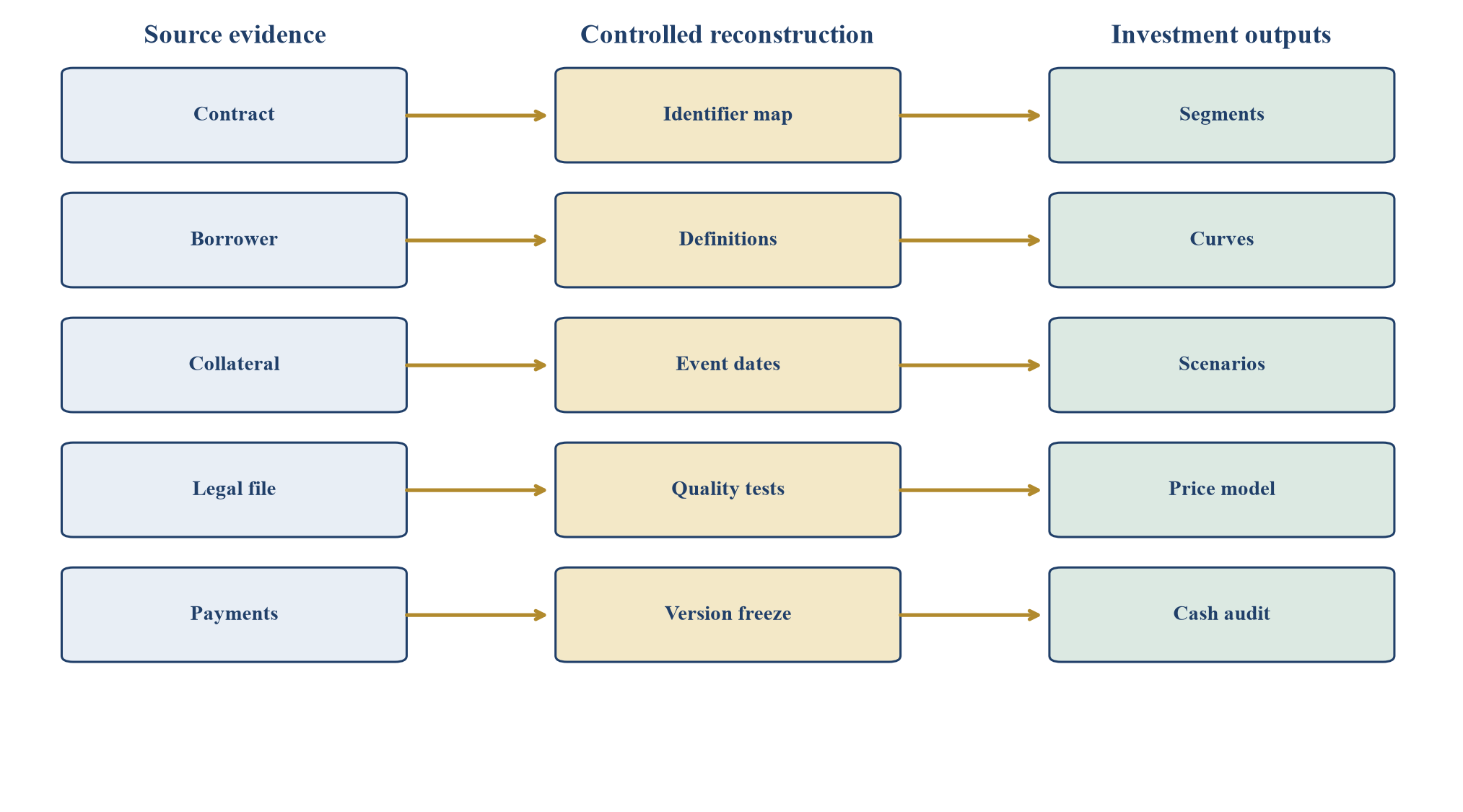
Proposed control architecture. Every projected cash flow remains traceable to source records and actual cash.
| Field group | Required record | Core test | Stop condition |
|---|---|---|---|
| identity and title | borrower, obligor, contract, seller, current owner and transfer status | can each claim be uniquely evidenced? | duplicate or missing title chain |
| balance | contractual, accounting, prudential, charged-off and legal amounts | does the tape reconcile to ledger and documents? | unexplained material difference |
| payments and costs | due, receipt, reversal, allocation, settlement, write-off and expense events | can cumulative cash be rebuilt from events? | undated or unreconciled cash |
| collateral and guarantees | asset, lien, valuation, owner, guarantor and realisation status | is value current and security enforceable? | unverified asset or priority |
| legal process | route, filing, court, stage, event, next action and limitation date | does status match source documents? | expired or unavailable route |
| provenance and quality | source, date, definition, transformation, coverage and exceptions | was the field available and stable? | outcome leakage or uncontrolled repair |
Fields should be retained at event date and linked through controlled identifiers.
4. Segment the portfolio around recoverable cash
Segmentation should create groups that share economically meaningful recovery behaviour. Start with borrower type, product, original balance, arrears age, payment since default, restructuring history, collateral, guarantee, sector, geography, origination channel, documentation quality and legal path. Each split should have a reason connected to amount, timing, cost or route.
Avoid a tree that fragments the portfolio into tiny cells. A segment needs enough observations and exposure to estimate a curve and monitor performance. Hierarchical methods can share information across related groups while retaining jurisdiction and asset differences. Sparse segments should use wider uncertainty, expert constraints or transparent pooled assumptions.
Borrower capacity and willingness should remain distinct. Recent verified payments, active business cash flow, reachable contact details and credible restructuring engagement may support a consensual route. Disputed liability, insolvency, failed contact or depleted collateral can shift the path. These variables require careful treatment because servicing actions influence the outcomes later used for modelling.
Collateral should be segmented by realisable proceeds, not appraisal label alone. Consider lien rank, title, occupancy, condition, location, market depth, valuation age, sale cost, tax and time. A nominally secured portfolio may behave like an unsecured book where perfection is defective or realisation is impractical. Guarantees need their own obligor, documentation and enforcement assessment.
The legal-path segment should describe the route the owner can actually pursue: consensual settlement, restructure, voluntary sale, secured enforcement, insolvency distribution, litigation, guarantee call or unsecured collections. A loan may transition between routes. The model should preserve the reason, authority and date of a change so that post-close performance can be attributed correctly.
Use a transparent segmentation tree before testing machine learning. The baseline makes economic judgement visible and provides a challenger. More complex models should demonstrate stable improvement in timing and amount estimates on out-of-time data, not merely sharper in-sample separation.
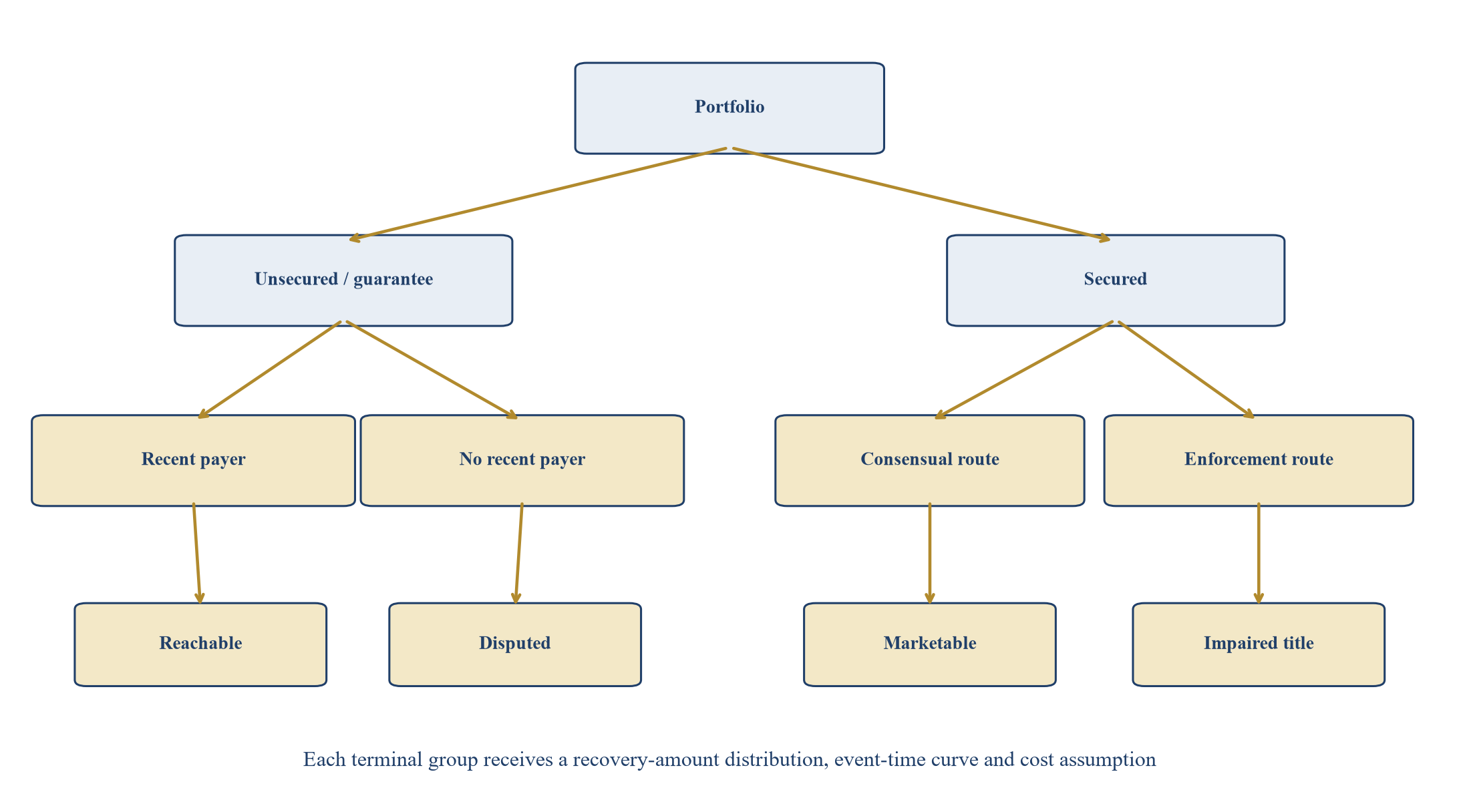
Management framework. Final segments require adequate observations, economic coherence and independent challenge.
5. Build recovery curves that respect time and competing outcomes
A recovery curve should answer how much cash a cohort produces over time. Define the starting event, observation clock, recovery numerator, balance denominator, cost treatment, write-off treatment and end point. Suitable starting events may include default, NPL classification, transfer cut-off or assignment. Curves using different clocks cannot be compared without reconciliation.
Survival analysis handles loans whose final outcome has not yet been observed. Right-censoring prevents an active case from being treated as a zero recovery merely because the data window ends. A cumulative-incidence approach can separate competing outcomes such as cure, settlement, collateral sale, insolvency distribution, write-off or open enforcement. The choice should follow the investment question and be documented.
Estimate both timing and amount. A high ultimate recovery received after a long court process may have lower present value than a smaller early settlement. One architecture predicts the probability of each recovery event by period and a second estimates conditional amount. Another directly estimates expected net cash by period. The validation should show how the components reconcile to observed cohort cash.
Use vintage tables alongside model outputs. Group loans by default quarter, transfer cohort, jurisdiction, segment and legal path. Display gross collection, cost, net collection and remaining balance by months since start. Mature vintages anchor ultimate assumptions; developing vintages test whether the latest book is following or departing from history.
Macro scenarios should modify identified drivers. A downside may reduce business receipts, extend collateral marketing time, weaken prices, increase legal costs or depreciate local currency. Apply the effect to relevant segments and periods. Avoid multiplying the entire portfolio by one unsupported stress percentage.
Back-testing should compare predicted and realised cumulative cash at fixed horizons, event timing, route transitions and costs. Report calibration by material segment. A model that ranks loans correctly can still overstate portfolio price when its cash amounts or timing are miscalibrated.
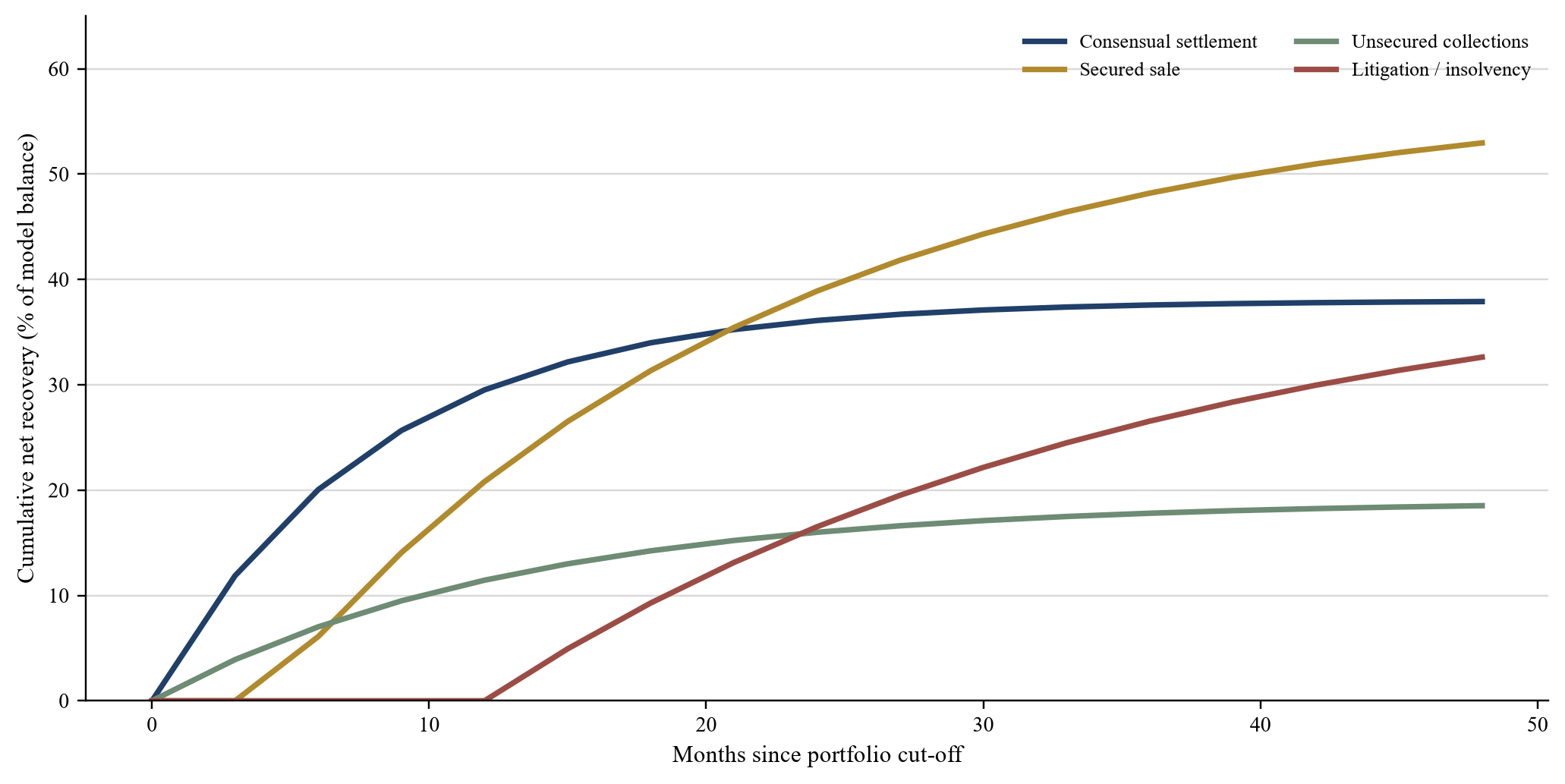
All values are hypothetical modelling assumptions. Curves show timing and dispersion rather than an observed market forecast.
| Design choice | Required definition | Common error | Control |
|---|---|---|---|
| starting event | default, NPL classification, transfer cut-off or assignment | mixing different clocks | cohort-specific origin and bridge |
| denominator | contractual, gross carrying, legal or purchase balance | changing denominator across segments | controlled balance dictionary |
| recovery cash | borrower, guarantor, collateral, settlement and sale receipts | counting non-cash accounting entries | bank-cash reconciliation |
| costs | servicing, legal, tax, asset and sale expense | comparing gross and net curves | separate gross, cost and net series |
| censoring | open cases at data end | treating immature cases as failures | survival or event-time treatment |
| competing outcomes | cure, settlement, sale, insolvency, litigation and write-off | one curve hiding different paths | cause-specific incidence and transitions |
Definitions should be frozen before modelling and reproduced in every back-test.
6. Use machine learning as a challenger to transparent benchmarks
Machine learning may identify nonlinear interactions among borrower, payment, collateral, legal and servicing variables. Gradient-boosted trees, random forests, survival forests and other methods can improve segmentation or timing estimates. The investment question is whether the improvement is stable, economically plausible and useful after uncertainty, cost and governance are included.
Begin with transparent benchmarks. These may include vintage averages, Kaplan-Meier curves, parametric survival models, regularised regression and rule-based segments. Compare out-of-time calibration, cumulative-cash error, ranking, stability and sensitivity. A complex model should retain a measurable advantage on the transaction population, not only a development sample.
Prevent time leakage. Features created after the valuation cut-off can reveal future payments, legal progress or servicer action. Examples include a later status label, updated collateral value, settlement code, case outcome, next-action date or current contactability. Freeze a point-in-time dataset and maintain a feature-availability register. Leakage should invalidate the affected validation result.
Address selection and treatment effects. Historical recoveries reflect which loans received calls, visits, restructurings, legal action or settlements. A model may learn past resource allocation rather than intrinsic recoverability. Separate borrower state from servicing treatment where possible. Use policy records and controlled experiments when available. Avoid claiming causal uplift from observational ranking alone.
Explainability should support the investment committee, servicer and independent validator. Portfolio-level importance can show broad drivers, while loan-level reason codes support sampled challenges. BIS analysis in 2025 noted that explanation techniques can be unstable or misleading, making governance, validation and safeguards essential.[13] An explanation is evidence about model behaviour; it does not prove that the data are correct or the proposed action is lawful.
Maintain human authority over the bid and recovery strategy. Model outputs should inform segment curves and prioritisation within approved boundaries. A person or committee should own changes to legal path, settlement authority, borrower treatment, assumptions and price. Overrides require reason, evidence, approver, time stamp and outcome monitoring.
Monitor drift after transfer. Changes in borrower mix, legal stage, data completeness, servicer action, macro conditions and collection-channel performance can shift calibration. Set thresholds that trigger investigation, reforecasting, reserve changes or strategy review. Preserve the original model and price assumptions so realised performance can be attributed.
| Test | Question | Evidence | Failure response |
|---|---|---|---|
| time integrity | were features available at the valuation date? | source time stamps and feature register | remove leakage and rebuild |
| discrimination | does the model rank future cash or events? | out-of-time concordance and lift | retain benchmark or simplify |
| calibration | do predicted cash and timing match observed cohorts? | horizon and segment back-tests | recalibrate and widen reserve |
| stability | does performance persist across countries, sellers and vintages? | drift and sensitivity analysis | segment, cap reliance or retrain |
| explanation | can material drivers and anomalies be challenged? | global, local and counterfactual review | restrict use and add controls |
| operational use | do outputs improve price or servicing decisions? | documented decision and outcome trail | remove non-actionable complexity |
No single metric establishes investment suitability.
7. Convert legal routes into event-time assumptions
Legal diligence becomes valuation evidence when it identifies the available route, sequence, decision points, costs and timing range. A statement that security is enforceable is incomplete for pricing. The buyer needs to know which instrument creates the right, whether it was perfected, who controls the asset, which notices are required, what defences may apply, and how proceeds reach the collection account.
Create a legal-event taxonomy that works across the portfolio. Events can include demand, notice, filing, service, defence, judgment, appeal, attachment, valuation, auction, sale, distribution and closure. For restructuring or insolvency, record filing, stay, claim admission, creditor vote, plan approval, distributions and termination. Local counsel should map the taxonomy to the applicable procedure and identify events that cannot be standardised.
Estimate distributions rather than one deterministic duration. Historical case data may be incomplete or selected, and court capacity can change. Use observed cases where definitions are reliable, counsel ranges, current process evidence and conservative floors. Preserve open matters as censored observations. Report the number, exposure and maturity behind each estimate.
Costs should follow the route. Separate fixed filing and document expense, variable counsel fees, court and enforcement charges, asset protection, valuation, auction, tax and success fees. Some costs occur before recovery and create liquidity needs. Others are deducted from proceeds. The cash-flow model should reflect payment timing and the party responsible.
Legal route changes require governance. A servicer may move from consensual engagement to litigation, from enforcement to settlement, or from bilateral restructuring to insolvency. Define delegated authority, evidence, expected economics and reporting. A change that materially alters timing or cost should trigger a portfolio reforecast and, where relevant, an approval under the buyer's investment mandate.
Limitation periods, missing original documents and defective security can create cliff effects. These are not ordinary probability adjustments when the claim or remedy may expire. Build an exception register with owner, deadline, remediation, valuation treatment and closing condition. Sample testing should verify that the register matches source documents.
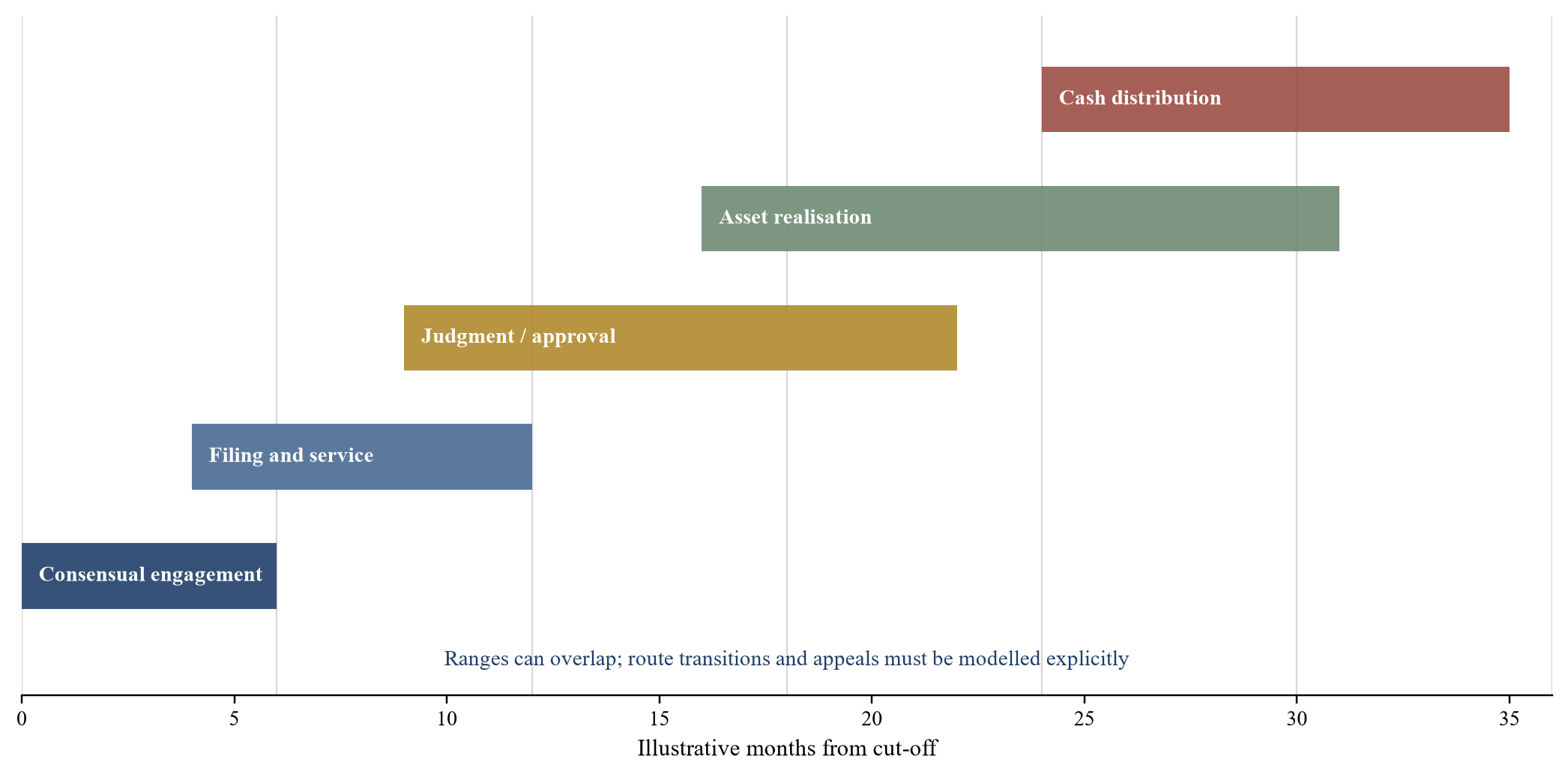
Illustrative sequence. Qualified local counsel should determine the route, events and ranges for each jurisdiction.
8. Reconcile servicing activity to actual cash
Servicing is part of the asset. A portfolio price assumes that someone can contact borrowers, receive payments, negotiate within authority, pursue legal routes, protect collateral, allocate cash and report events. The buyer should assess licences, systems, staff, languages, geographic reach, outsourcing, conduct controls, cyber resilience and continuity. A lower servicing fee is not an advantage if execution capacity is inadequate.
Reconstruct historical treatment. Link calls, messages, visits, promises, settlements, restructurings, legal actions and collateral steps to dated outcomes. Measure contactability, promise-to-pay conversion, kept promises, cure, settlement cash, roll rates, complaint incidence, legal progression and cost. The analysis should distinguish activity volume from cash effectiveness.
Collection cash needs daily or periodic reconciliation. Trace borrower receipt to collection account, servicing allocation, trust or escrow account, waterfall and investor distribution. Investigate suspense, reversals, unidentified cash, commingling, delayed remittance and manual journals. The same control supports the data used for model calibration and the post-close cash claim.
Servicer incentives should align with net present value and borrower treatment. A fee based only on gross collections can encourage expensive or short-term actions. A structure may combine base capacity, net cash, milestone, quality and conduct measures. Settlement authority should include floor, documentation, approval and exception review. Legal referral should consider expected incremental value after cost and delay.
Transition risk deserves its own scenario. Data migration, authority notices, account changes, staffing, vendor onboarding and borrower communication can interrupt cash. Define a cut-over date, parallel run, reconciliation, exception queue and fallback. Hold a transition reserve when the evidence does not support a seamless transfer.
Borrower fairness and complaint handling affect both legitimacy and recovery. Required notices, hardship treatment, dispute resolution, privacy, contact rules and vulnerable-customer procedures depend on local law and policy. The buyer should approve scripts, channels, escalation and audit. A collection strategy that creates legal or conduct defects can destroy value.
9. Translate projected collections into a purchase-price waterfall
The price model should begin with period-by-period gross cash for each segment and scenario. Deduct servicing, legal, asset, tax, data, transition and vehicle costs in the periods incurred. Apply currency conversion, remittance timing and hedge assumptions where relevant. The result is distributable cash to the acquisition vehicle before its financing and required return.
Discount rates should reflect the claim, funding, uncertainty and mandate without double counting. If a recovery curve already includes a downside probability and cost, avoid adding the same risk through an unexplained premium. Show the risk-free or base funding component, illiquidity, operational, legal, country, currency and model uncertainty components used by the committee. Sensitivities should reveal which assumptions drive price.
Use scenario weights only when they are approved assumptions, not disguised forecasts. A central, adverse and severe case can differ in recovery amount, timing, cost, currency and path. The committee should view the price under each case as well as the weighted result. Reverse stress can identify the recovery or delay at which the required return or funding covenant fails.
Add a data and execution reserve. The reserve can respond to missing title, weak cash reconciliation, stale collateral, sparse legal history, model instability, transition risk or concentrated cases. It should have a rationale and, if negotiated, release conditions. A portfolio-wide arbitrary haircut is less informative than itemised uncertainty.
Bridge from the seller's reference balance to the bid. Show ineligible balances, claim adjustments, expected gross recovery, cost, timing discount, uncertainty reserve, acquisition expenses, financing and equity value. The bridge allows seller and buyer to discuss the drivers of the price gap without implying that accounting provision equals market value.
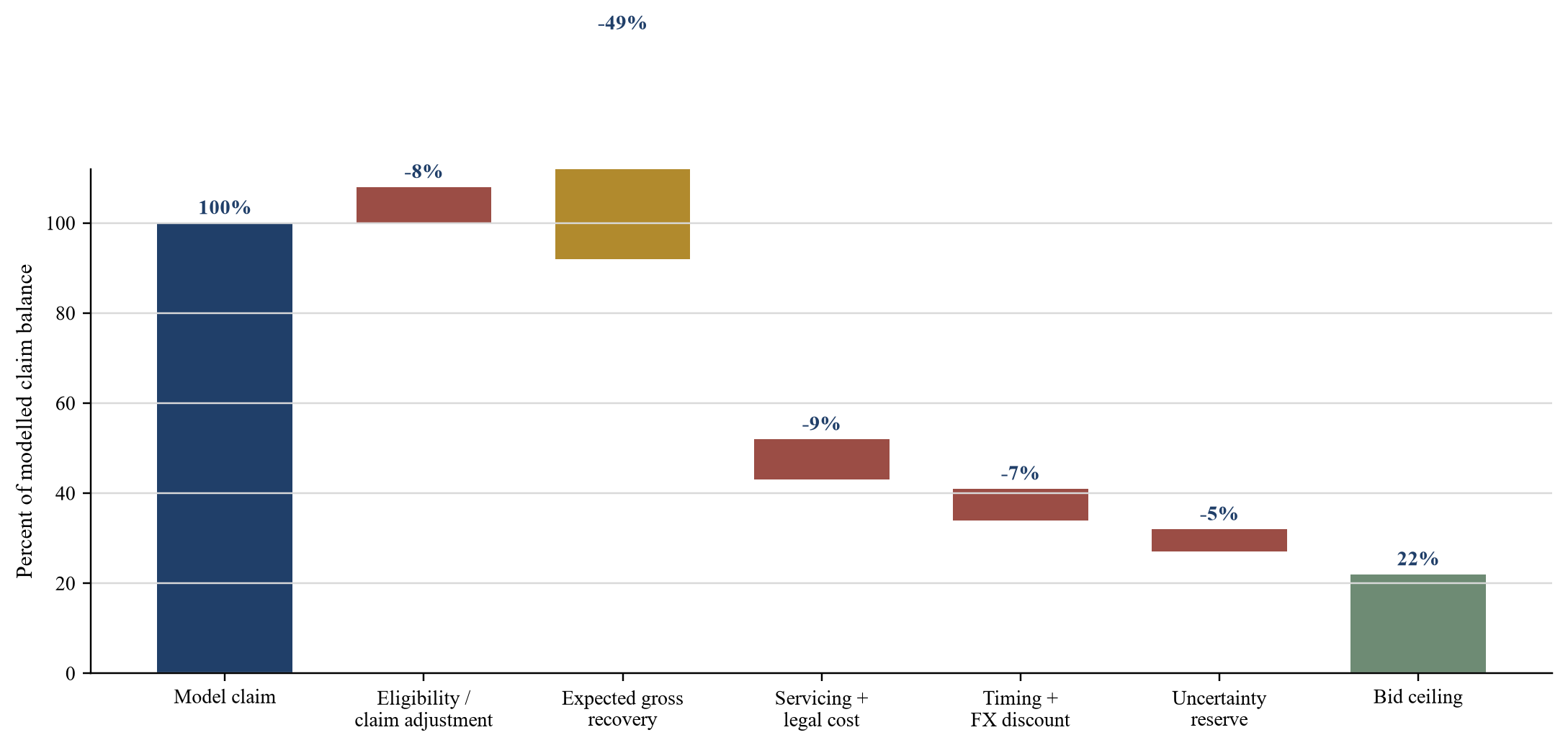
All values are hypothetical and expressed as percentages of the modelled claim balance.
| Layer | Core input | Evidence owner | Challenge question |
|---|---|---|---|
| model claim | reconciled contractual and legal balances | seller finance and buyer diligence | which balance can be transferred and pursued? |
| segment recovery | event-time cash curves and route probabilities | analytics and servicer | are curves mature, calibrated and operationally feasible? |
| collateral and guarantee | net realisable proceeds and timing | valuation, legal and asset teams | are title, priority, condition and market depth evidenced? |
| operating cost | servicing, legal, asset, tax and data expense | servicing and finance | when is cash paid and who bears it? |
| currency and remittance | exchange, hedge, conversion and transfer delay | treasury and local counsel | can cash reach the vehicle as assumed? |
| uncertainty and return | scenario, reserve, funding and required return | investment committee | which risks remain and where are they recognised? |
The waterfall preserves the distinction between observed data, calculated output and committee assumptions.
10. Structure the acquisition vehicle around the cash claim
The acquisition structure should reflect asset ownership, servicing, funding, tax, data and enforcement. A local vehicle may simplify title, accounts and collections in one jurisdiction. A regional or offshore holding structure may support institutional capital but can add transfer, remittance, tax and governance complexity. Legal and tax advisers should test the actual structure.
Map the funds flow at signing, closing and operation. Identify purchase-price sources, seller payment, reserves, fees, hedge collateral, collection accounts, permitted expenses, senior debt, junior capital and equity distributions. Reconcile the waterfall to transaction documents and the valuation model. A dry run should test account names, authorised signatories, cut-off times and evidence of receipt.
Acquisition debt should be sized to downside cash, not the base bid model. Define eligible portfolio, advance, liquidity reserve, concentration, collection-account control, reporting, cash sweep, amortisation and default. Lender protections should remain executable in the local legal and servicing structure. Currency mismatch needs an explicit limit and response.
Representations and warranties should target evidence that the buyer cannot independently confirm. Examples include title, balance, security, payment history, litigation, data accuracy, borrower notices and compliance. Remedies may include repurchase, price adjustment, escrow or indemnity, subject to negotiated limits and enforceability. The valuation should not assume a remedy without testing counterparty capacity and collection.
Servicing agreements should specify authority, standards, data, cash, complaints, settlements, legal referral, subcontracting, audit, cyber incidents, continuity, termination and transfer assistance. A back-up or replacement plan is material when one servicer controls the only operational route to cash. The buyer should own or have durable access to the data and records required for a transfer.
Governance should separate origination of the bid, model development, validation, servicing decisions, valuation marks and cash reconciliation. Conflicts arise when a seller remains servicer, a model vendor is paid by transaction success, or an asset manager controls both assumptions and marks. The committee should record conflicts and mitigating controls.
11. Run diligence as a controlled bid process
A staged process preserves speed without losing evidence. Screening can use portfolio summaries, stratified samples and a data-quality report. Indicative pricing should state data limitations, assumptions and conditions. Confirmatory diligence should receive the loan-level tape, documents, cash reconciliation, legal sample, collateral evidence and servicing history needed to bind the price.
The EBA's NPL transaction data templates are designed to reduce information asymmetry through common loan-level information for screening, diligence and valuation.[6][7] They are an EU standard, not an African legal requirement, yet their field logic offers a useful transaction reference. Adapt the fields to local law, products, currencies, servicing and court routes. Do not import legal definitions without confirming applicability.
Use stratified sampling. Select material balances, every high-value exposure, key segments, jurisdictions, legal stages, collateral types, missing-data patterns and model outliers. Reperform balances, payments, title, security, legal status, valuations and cash. Extrapolate only where the sample design and error pattern support it. Treat systemic errors separately from random errors.
Maintain a bid-assumption register. For every material input, record definition, value or range, source, owner, review date, confidence, sensitivity, approval and post-close monitoring route. The register prevents late changes from entering the model without committee awareness. It also supports negotiation when new data arrive.
Challenge model risk through an independent reviewer. Reproduce the dataset, feature engineering, segments, curves, scenarios and price bridge. Test alternative specifications, exclusions, missingness, delay and cost. Record limitations and overrides. The reviewer should have authority to require a lower reliance or wider reserve.
Set walk-away conditions before final bid. Examples include title defects above tolerance, unreconciled cash, prohibited data transfer, unavailable licences, failed servicing transition, concentrated litigation, unhedgeable currency mismatch, seller-credit weakness or a price that exceeds the approved downside ceiling. A clear condition reduces escalation bias at auction close.
12. Work through a hypothetical multi-jurisdiction portfolio
Consider a hypothetical portfolio offered by a regional banking group. It contains SME, secured commercial and unsecured retail NPLs across three African jurisdictions. The seller reports a modelled claim balance equivalent to USD 240 million. Every figure in this section is a modelling assumption used only to demonstrate the framework.
The tape contains 18,400 accounts. Fifty-eight percent of claim balance is secured, 17 percent benefits from a guarantee and 25 percent is unsecured. The seller's reported cumulative historical recovery is 31 percent, but payment dates and cost allocations are incomplete for older systems. Twelve percent of accounts lack a reliable date of default, and 9 percent of secured balances have collateral valuations older than three years.
The buyer reconstructs the tape. Duplicate and closed accounts reduce the modelled claim by 3 percent. Claims with unresolved title, expired limitation risk or prohibited transfer reduce the eligible perimeter by a further 5 percent. The opening model balance is therefore USD 220.8 million. These adjustments do not imply that every excluded claim has no economic value; they reflect the evidence standard for this hypothetical bid.
Transparent vintage analysis produces three principal paths. Recent-payer restructurings show faster early cash. Secured enforcement produces higher ultimate proceeds with longer dispersion. Unsecured and disputed claims show lower outcomes and stronger dependence on contactability and documentation. A survival-forest challenger improves out-of-time timing error for two material segments, while offering no stable advantage for sparse litigation cohorts. The committee uses the challenger only for the validated segments.
Under the assumed central case, gross nominal recoveries equal 43 percent of model balance over five years. Servicing, legal, asset, tax and data costs equal 9 percent. Timing and currency reduce present value by 7 percent, and a 5 percent uncertainty reserve responds to data gaps, transition and sparse legal history. The resulting unlevered bid ceiling is 22 percent of model balance, or approximately USD 48.6 million.
The adverse case reduces gross recovery to 36 percent, adds six months to selected legal paths, increases costs to 11 percent and applies a weaker currency path. The price that preserves the hypothetical required return falls to 15 percent of model balance. The severe reverse stress asks which combination of recovery delay, cost and currency would prevent full repayment of proposed acquisition debt.
The buyer proposes a local collection-account structure, one servicing platform with country-specific legal panels, a transition reserve, an 18 percent cap on one concentrated commercial sector, and seller remedies for defined title and data breaches. Acquisition debt is sized to the adverse cash curve. Equity distributions stop when cumulative net cash or data-quality tests fall outside the approved path.
The example demonstrates the role of machine learning. The model refines selected timing and segmentation assumptions. Price remains a committee decision based on legal rights, verified cash, costs, currency, servicing capacity, uncertainty and funding. The audit trail records every approved assumption and the evidence supporting it.
13. Operate the portfolio through a ninety-day control plan
The first thirty days establish control. Complete transfer notices, account mandates, data custody, servicer authority, opening-balance reconciliation, borrower-channel testing and critical legal deadlines. Freeze the bid dataset and preserve the seller snapshot. Open an exception register for title, cash, collateral, legal and data defects.
Days thirty-one to sixty validate operating performance. Reconcile daily or periodic collections, test allocation, review contact and settlement activity, compare early cash to the priced curve and inspect conduct. Run the first model-drift and segment review. Escalate variances by exposure and cash impact.
Days sixty-one to ninety complete the first full forecast cycle. Update curves using controlled post-close events, retain the original benchmark, test route transitions and produce central, adverse and reverse stresses. The investment committee reviews servicing strategy, reserves, funding tests and any assumption change.
Independent assurance should sample the complete chain from claim to cash. Select loans across material segments and reproduce title, balance, status, model feature, recovery path, decision, receipt, cost and waterfall. Findings should have an owner, economic impact, remedy and closure evidence.
The operating pack should separate observed cash, calculated metrics, management estimates and unresolved items. Report gross and net recovery, timing, cost, route transition, data quality, collateral, legal progress, complaints, currency, servicer capacity and vehicle liquidity. Link every metric to a definition and source.
Model updates should follow controlled release. Preserve training data, code, parameters, feature definitions, validation, approval, deployment date and rollback. A new model should not rewrite the transaction's original pricing history. Run old and new forecasts in parallel before a material assumption change.
| Control area | Core measure | Decision use | Escalation example |
|---|---|---|---|
| cash | gross and net recovery by segment and month | compare realised cash with priced curve | cumulative shortfall outside approved range |
| route | settlement, cure, enforcement, insolvency and closure transitions | test strategy and timing assumptions | material migration to slower path |
| cost | servicing, legal, asset, tax and data cost per net recovery | protect distributable cash | cost ratio above approved ceiling |
| evidence | title, balance, collateral, legal and data exceptions | control eligibility and reserves | unresolved high-value defect |
| model | calibration, timing error, drift and benchmark comparison | decide reliance and reforecasting | material out-of-time deterioration |
| conduct and capacity | complaints, review ageing, staff caseload and incidents | protect execution and borrower treatment | breached service or conduct threshold |
Definitions, sources, owners and thresholds should be approved before first reporting.
14. Limitations and further research
This framework does not determine whether a loan can be transferred, whether security is enforceable, which collection practice is permitted, or how a transaction should be accounted for or taxed. Those conclusions depend on current facts, contracts and law. Each relevant jurisdiction requires qualified professional advice.
Historical collections are affected by servicing strategy, resource allocation, macro conditions, court capacity and borrower selection. A model built on observational outcomes may predict the results of past treatment rather than the results of a new strategy. Causal claims require stronger design than a predictive back-test.
Machine-learning explanations have limits. Feature importance can vary by method, sample and correlated inputs. Post-hoc explanations may not reproduce the model's actual mechanics. Stable explanation does not establish lawful data use, correct title, fair treatment or cash reconciliation.
Sparse legal outcomes create wide uncertainty. Large corporate claims can be individually material while statistically rare. Portfolio methods should be combined with loan-specific legal and commercial analysis. Jurisdiction pooling needs explicit justification.
The hypothetical transaction is not a forecast or recommended price. Balances, curves, costs, discount rates, reserves, structures and thresholds should be recalibrated to the actual portfolio and mandate. Further research could compare event-time recovery data across African jurisdictions, test privacy-preserving transaction data rooms, evaluate treatment-aware collection models, and study how standardised loan tapes affect price dispersion and bidder participation.
15. Conclusion
An African bank NPL transaction becomes investable when the buyer can trace the proposed price from transferable claim to verified loan tape, recovery path, cost, timing and controlled cash. Jurisdiction, security, servicing, currency and data are integral valuation variables.
Machine learning can improve portfolio segmentation and recovery timing for validated populations. Transparent benchmarks, time-integrity controls, out-of-time calibration, explanation, human authority and post-close monitoring define the boundary of responsible reliance.
The strongest bid process records every material assumption, tests downside cash, prices uncertainty and establishes walk-away conditions. It also carries the same evidence chain into servicing, funding and reporting after closing. This architecture allows investment committees to use sophisticated analytics while keeping the legal claim, borrower treatment and cash outcome auditable.
Appendix A. Transaction Data Request. A1. Claim, portfolio and cash
Loan agreements, amendments, schedules, assignment history, notices, security, guarantees and legal opinions.
Loan-level balances, payments, reversals, restructurings, settlements, write-offs, recoveries, costs and status events with dates.
Borrower, product, origination, sector, geography, currency, channel, servicing and contactability fields.
General-ledger, servicing-system, collection-account, trust, escrow and distribution reconciliations.
Appendix A. Transaction Data Request. A2. Collateral, legal, data and models
Collateral ownership, liens, priority, valuation, inspection, insurance, occupancy, sale and proceeds evidence.
Court, insolvency, restructuring, settlement and guarantee files with event dates, next actions and costs.
Data dictionary, provenance, quality, missingness, migration, access, retention and transfer controls.
Segmentation, curves, code, validation, back-tests, explanations, model changes and investment assumptions.
Appendix B. Bid And Operating Checklist. B1. Before binding the bid
Confirm transferable perimeter, title, security, data rights, licences, notices and closing conditions.
Reconcile model balances and historical collections to documents, ledger and bank cash.
Validate recovery segments, event-time curves, costs, scenarios, currency and price bridge.
Approve servicing transition, SPV, funding, waterfall, reserves, warranties and walk-away conditions.
Appendix B. Bid And Operating Checklist. B2. After closing
Reconcile claims, receipts, costs, accounts and distributions every reporting period.
Compare realised cash and route transitions with the priced curves by material segment.
Monitor data quality, model drift, servicing conduct, legal deadlines, collateral and currency.
Reforecast under central, adverse and reverse stresses and retain the original bid assumptions.
Sources
- International Monetary Fund. Resolving Nonperforming Loans in Sub-Saharan Africa in the Aftermath of the COVID-19 Crisis, Departmental Paper 2021/014. Read the primary source
- International Monetary Fund. The Case for and Against Asset Management Companies in Banking Crises, Departmental Paper 2024/004. Read the primary source
- World Bank Group. Distressed Assets Recovery Program and Public Asset Management Companies: International Experience. Read the primary source
- World Bank Group. Principles for Effective Insolvency and Creditor and Debtor Regimes. Read the primary source
- World Bank Group. Business Ready Methodology, Business Insolvency framework. Read the primary source
- European Banking Authority. Implementing Technical Standards on NPL Transaction Data Templates. Read the primary source
- European Banking Authority. NPL Transaction Templates and Data Dictionary. Read the primary source
- European Central Bank. Recent Developments in Pricing of Non-Performing Loan Portfolio Sales, Financial Stability Review, May 2018. Read the primary source
- IFRS Foundation. IFRS 9 Financial Instruments, impairment and expected credit loss requirements. Read the primary source
- IFRS Foundation. Post-implementation Review of IFRS 9 Impairment: Feedback Analysis on Measuring Expected Credit Losses, March 2024. Read the primary source
- Basel Committee on Banking Supervision. Principles for the Management of Credit Risk, 2025. Read the primary source
- Basel Committee on Banking Supervision. Guidance on Credit Risk and Accounting for Expected Credit Losses. Read the primary source
- Financial Stability Institute. Managing Explanations: How Regulators Can Address AI Explainability, FSI Occasional Papers 24, 8 September 2025. Read the primary source
- National Institute of Standards and Technology. Artificial Intelligence Risk Management Framework 1.0. Read the primary source
- Organisation for Economic Co-operation and Development. OECD Principles on Artificial Intelligence. Read the primary source
- South African Reserve Bank. Financial Stability Review, Second Edition 2025. Read the primary source
- Bank of Ghana. Financial Stability Review 2025. Read the primary source
- International Monetary Fund. Angola: Financial Sector Assessment Program, Financial System Stability Assessment, 2026. Read the primary source
- Central Bank of Kenya. Bank Supervision Annual Reports and Financial Sector Stability Reports. Read the primary source
- Organisation for the Harmonisation of Business Law in Africa. Uniform Act Organising Collective Proceedings for Wiping Off Debts. Read the primary source
- International Finance Corporation. Distressed Asset Recovery Program. Read the primary source
- Financial Action Task Force. Guidance on Beneficial Ownership and Transparency of Legal Arrangements. Read the primary source
