

1. Define the borrower and the repayment source
A credit committee evaluating refrigerated logistics should begin with the legal entity that earns the invoices and incurs the liabilities. A medical-products warehouse borrower may hold valuable health products belonging to customers while owning only its equipment and trade receivables. A distributor may own the medical products and employ another company to transport it. A group may combine both activities through separate subsidiaries. The underwriting file should show these arrangements before anyone totals the goods inside the premises as security for a loan.
This paper examines a proposed revolving facility for a regional medical-products distributor. Its core question is how a temperature-related incident affects the lender's ability to recover advances. The principal example assumes that customers retain ownership of their medical products. The borrower earns product sales, storage and distribution charges and may face quality or delivery claims if it fails to perform its obligations. The health products' full value is therefore a possible source of liability without being an asset available for the borrower to pledge. That asymmetry should be visible in the initial screening memorandum.
A lender's proposed mandate should identify the permitted borrower types, facility purpose, commitment range and maximum exposure to a single operating site or customer. The worked example uses a USD 20 million commitment. It sits within an illustrative USD 10 million to USD 40 million screening range, chosen for analysis and carrying no quality or delivery claim about actual market tickets or borrower demand. The decision still requires a specific financing structure, acceptable permissions and independently examined borrower evidence before an offer can be considered.
Map the repayment source to the verified product delivery. A product or logistics invoice may become payable on a different timetable from a delivery invoice. A customer could accept a delivery while disputing the charge for temperature monitoring, or pay routine invoices while reserving a separate damage quality or delivery claim. The model should retain those distinctions. A single total for revenue, quality or delivery claims and collections cannot explain which cash flows support current availability and which might become contested following an incident.
The proposed approval question is whether the borrower can fund its operations and meet the facility's requirements through a defined adverse event. It should include the period before insurance adjustment, customer settlement or sponsor assistance. No actual borrower accounts, customer contracts, insurance schedules or operating records were supplied for this analysis. The paper consequently sets out an original diligence framework and hypothetical calculations. It does not rank an existing company or certify that a proposed facility would be lawful, appropriately priced or commercially available.
2. Establish the applicable product and operating requirements
WHO guidance for time- and temperature-sensitive pharmaceutical products sets out principles for safe storage and distribution while recognising that national legislation takes precedence. Its controls include qualified storage areas, temperature monitoring, mapping, calibration, alarm management, contingency arrangements, documentation and investigation of excursions.[1] WHO also publishes a temperature-mapping tool for cold-chain equipment and dry stores, reflecting the importance of understanding spatial temperature variation rather than relying on a single convenient sensor.[2]
UNICEF describes an effective cold chain as a continuously controlled sequence from manufacture to administration. Once some vaccines lose potency through inappropriate temperature exposure, that potency cannot be restored.[3] A lender should therefore avoid treating a temperature excursion as an ordinary warehousing variance. Product disposition belongs to authorised quality and regulatory professionals using the applicable product specification, stability evidence and national requirements. Finance should record the resulting eligibility, reserve and cash consequences after that decision.
The Global Fund's procurement and supply-management policies require appropriate selection, procurement, delivery, warehousing, distribution and quality assurance for financed health products.[1] Its pooled procurement tools also show how demand aggregation, order tracking and invoice data can improve market visibility. Those requirements are specific to the relevant programme and procurement route. They provide useful diligence questions without creating a universal collateral rule for every borrower or country.
The regulatory perimeter must be mapped country by country. Confirm the product authorisation, importer or wholesaler licence, premises authorisation, responsible professional, storage and transport requirements, pharmacovigilance or device-vigilance duties, recall powers, labelling rules and any restrictions on assignment or enforcement. The African Medicines Agency framework and regional harmonisation initiatives can support convergence, while national regulators continue to control market access and product disposition in their jurisdictions.[11]
Translate each requirement into a credit control. A licensing gap can suspend eligibility or disbursement. A missing batch record can prevent traceability. A temperature excursion can trigger quarantine pending professional disposition. A recall can eliminate sale value and create reverse-logistics costs. The credit file should identify the evidence, owner, review frequency, exception threshold and funded response for each control. A dashboard indicator creates no product authorisation and should never override a qualified safety decision.
3. Trace custody and responsibility across each handover
Prepare a shipment-level custody map linking the seller or manufacturer, loading team, carrier, receiving warehouse and final customer. The useful unit is a defined consignment with a product identity, quantity, condition record and handover time. Each transfer should connect to a contract and an operational record. This gives the investigator a way to compare the condition accepted by one party with the condition delivered by another. It also permits finance to identify which receivable or potential liability should change after an incident.
The contractual review should distinguish legal title, physical possession and the agreed risk of loss. Counsel should identify the governing law and any mandatory rules that affect the parties' allocation. Ask specifically about preparation and packaging, loading and unloading, subcontracting, declared values, liability limitations and the evidence needed to establish a quality or delivery claim. The paper assigns no universal country-specific compensation cap or quality or delivery claim deadline. Those conclusions require the current applicable rules and the actual transaction documents, including any international carriage element.
| Handover or event | Evidence to inspect | Credit consequence to test |
|---|---|---|
| Acceptance from the customer | Product identity, condition, packaging and signed record | Whether pre-existing damage is being assumed |
| Loading and departure | Responsible party, loading time and temperature trace | Whether the borrower accepts loading exposure |
| Subcontracted journey | Executed subcontract and matching obligations | Whether recovery differs from customer liability |
| Receipt into cold storage | Receipt record, lot location and quarantine status | Whether service invoices remain collectible |
| Release or disposal | Quality decision, authority and disposal record | Timing of quality or delivery claims and loss-related expenditure |
| Settlement or insurance payment | Signed settlement, coverage response and bank receipt | Actual cash recovery and remaining exposure |
Diligence questions only. Each allocation requires the actual contracts and applicable legal assessment.
The map should include transitions that are easy to omit from a transport diagram. Examples include a trailer waiting for a receiving slot, a consignment moved temporarily into another cold room and a delivery refused before unloading. The reviewer should identify which party controls the goods during each interval and whether the insurance period continues. These are proposed incident tests; the analysis does not assert that every borrower uses the same arrangements or experiences the same failure rate.
Subcontracting needs a separate comparison of obligations. If the borrower promises a customer compensation exceeding what it can recover from a carrier, the difference remains an exposure to examine. A subcontractor's limited balance sheet or disputed liability can also delay recovery even where the contractual wording appears aligned. Obtain the executed agreements, evidence of permitted activity, applicable insurance and the operational records necessary to pursue the quality or delivery claim. Model any recovery according to its evidence and timing, with an unresolved quality or delivery claim excluded from available cash.
| Evidence dimension | Eligible evidence | Exclusion or reserve trigger | Accountable owner |
|---|---|---|---|
| ownership | invoice, goods receipt and title record reconcile | consignment, retention of title or competing claim unresolved | finance and counsel |
| identity | product, batch or serial and quantity reconcile | duplicate, missing or inconsistent identifier | warehouse control |
| market status | current authorisation and lawful sale channel | suspension, recall or unauthorised channel | regulatory affairs |
| condition | approved release status and complete storage history | quarantine, damage or unresolved excursion | quality professional |
| shelf life | remaining life exceeds agreed sale and enforcement period | short-dated or expired product | inventory and credit teams |
| value | recent transaction and recoverable-sale evidence | obsolete, concentrated or unsupported price | independent reviewer and lender |
Transaction documents and local law determine the final rules; product-quality decisions remain with authorised professionals.
4. Make temperature and traceability evidence usable for credit decisions
The lender should commission a sample test that follows an invoice back to its shipment records. The sample should include completed journeys, rejected deliveries and at least one incident or complaint if such records exist. The purpose is to see whether the borrower can reconstruct what happened using contemporaneous evidence. A lender should record when there is no incident history available and assess the control demonstration on that basis. An empty quality or delivery claims register alone does not establish that losses were absent or that reporting was complete.
For each sample, connect the product specification to the sensor identifier, calibration record, logger position and timestamp convention. Ask whether readings can be altered, who can export the original record and how missing intervals appear. The same clock should support the door-opening log, warehouse and vehicle movement and handover record. This proposed test concerns evidential continuity. It does not turn a lender into a pharmaceutical-quality certifier or replace a qualified assessment of the product's condition.
An excursion record should explain both the event and the response. The file might include the initial alarm, acknowledgement, communication with the customer, transfer to alternative storage, technical assessment and final disposition. Finance needs a corresponding record of withheld invoices, credit notes, immediate costs, quality or delivery claims notified and funds received. Establish a common incident identifier so that separate teams can reconcile the records without relying on recollection. The identifier should support aggregation where several shipments share one cause.
Common-cause exposure deserves a deliberate test. Several customer accounts may depend on one qualified temperature control circuit, one backup-power arrangement or the same handling team. A conventional customer concentration report could appear diversified while a single operational event affects many invoices. The proposed review groups exposure by physical dependency as well as debtor. It should quantify the amount of trade receivables potentially disputed and the separate value of goods for which liability might arise. These amounts should remain distinct throughout the analysis.
Data access after a default should be addressed before disbursement. Ask who owns the records, whether the borrower can export them and which service agreements continue if invoices to the monitoring provider are unpaid. A recovery plan should include lawful access for the relevant administrator, specialist or appointed service provider. The lender should also budget for maintaining the systems needed to investigate and collect its security. A valuation prepared without those operating dependencies may omit costs that reduce realised recoveries.
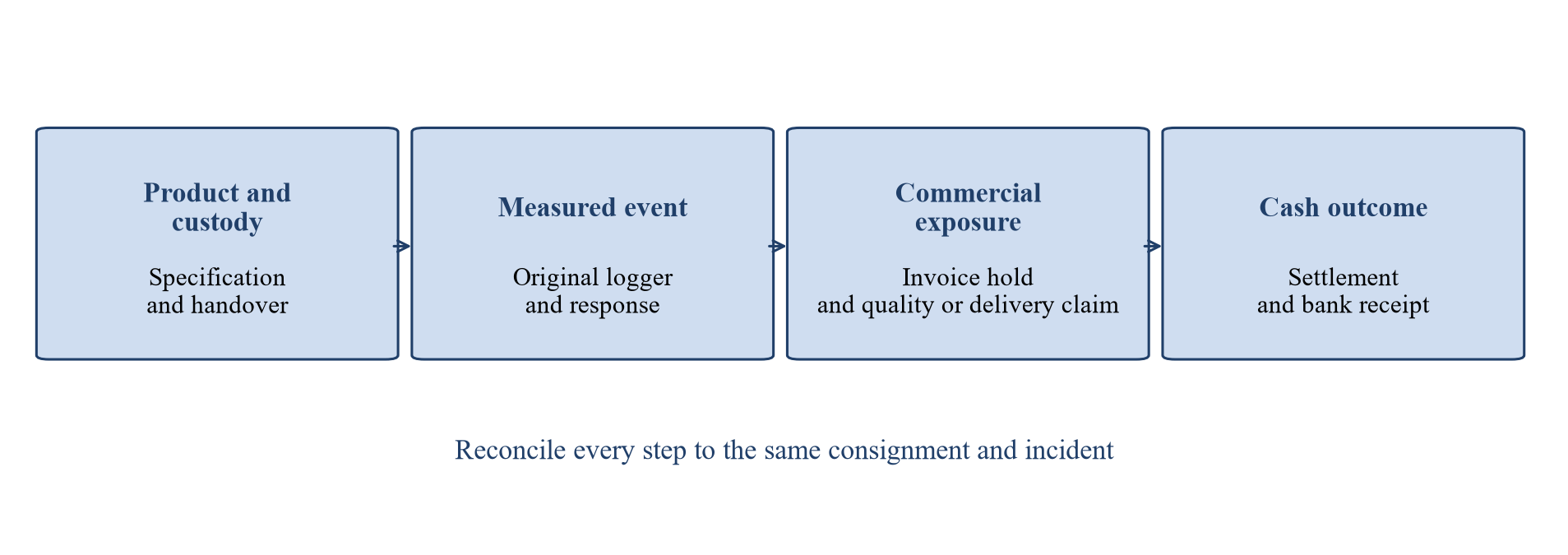
Each connection should be demonstrated for a sample consignment. The diagram is an original diligence framework.
5. Convert demand forecasts into bounded procurement decisions
Demand forecasting matters because both stock-outs and over-stock can destroy value. A stock-out can interrupt treatment and weaken customer relationships. Excess stock can consume liquidity, exceed storage capacity or expire before sale. UNICEF's prescriptive analytics methodology focuses on months of stock and action to prevent both conditions.[11] The lender should examine forecast design, source data, forecast error and the operational response rather than accepting a single demand number.
Segment the forecast by product, presentation, location, payer and demand driver. Routine essential medicines, seasonal products, outbreak-response items, donor-funded programmes, elective diagnostics and specialist products can follow different patterns. Reconcile orders, issues, dispensing or consumption data where lawfully available, returns, back orders and stock movements. Keep tender awards and framework ceilings separate from firm releases. A framework agreement can indicate opportunity without establishing the timing or amount of an enforceable receivable.
Artificial intelligence can combine time series, calendar effects, epidemiological indicators, facility ordering behaviour and supply lead times. Its output should include a range and confidence measure. A forecast should not create borrowing availability. Eligibility should arise from verified ownership, condition, shelf life, lawful sale channels and, for receivables, accepted delivery and payer evidence. Forecasts guide procurement quantities, liquidity buffers and stress tests; observed evidence supports collateral decisions.
Back-test the model at product and location level. Report weighted absolute percentage error only where denominators are meaningful, and complement it with bias, stock-out rate, expiry loss, service level and error by critical product. A low aggregate error can hide systematic under-forecasting of scarce items or over-forecasting of high-value products. Human reviewers should investigate material exceptions and document overrides.
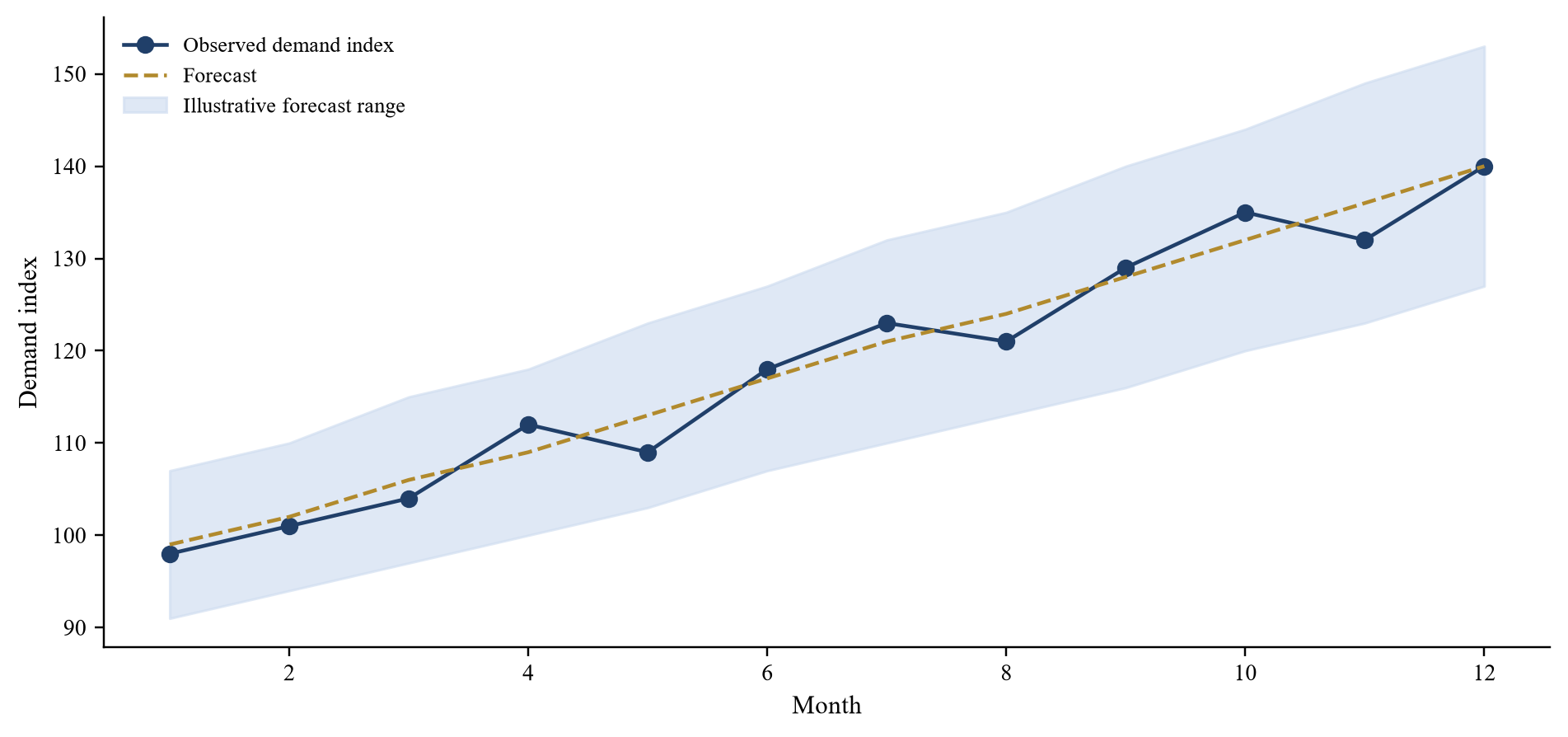
Indexed monthly demand. Values and confidence bands are hypothetical and illustrate forecast governance.
| Forecast element | Evidence and test | Permitted financing use | Prohibited shortcut |
|---|---|---|---|
| baseline demand | orders, issues, consumption and returns | size procurement and liquidity scenarios | treating forecast units as collateral |
| tender or programme demand | executed award, release history and funding evidence | model timing and concentration | treating a ceiling as a firm order |
| epidemiological or seasonal signal | dated authoritative source and back-test | stress safety stock and replenishment | automatic purchasing without review |
| model confidence | error distribution, bias and drift | set ranges and escalation thresholds | presenting a point estimate as certainty |
| override | named approver, reason and expiry | capture accountable judgement | undocumented manual adjustment |
The table separates operational insight from credit eligibility.
6. Build an auditable medical inventory and receivables borrowing base
A borrowing base is the amount a facility permits the borrower to utilise against defined eligible assets after agreed adjustments. It is subject to the commitment limit and the facility's other conditions. The committee should be able to reproduce the calculation from asset records. Every deduction should state its reason and where it enters the formula. Terms such as reserve, exclusion and haircut should be defined in the agreement and model so that the same loss is not deducted twice without an explicit rationale.
The OCC's Asset-Based Lending handbook supplies a separate United States supervisory comparison. Its discussion addresses receivable dilution, inventory ownership, liquidation costs and borrowing-base reserves. It highlights the short liquidation window and preservation needs associated with perishable inventory. These principles inform the proposed tests here; the paper imports no United States statutory security mechanism or market advance rate into country-specific underwriting. [11]
For a logistics borrower, begin with trade receivables that the borrower actually owns. Exclude or separately review unbilled amounts, disputed invoices, related-party balances and sums exceeding agreed concentration limits. Define how customer quality or delivery claims against the borrower affect otherwise valid invoices. Counsel should distinguish an enforceable deduction from an unsupported commercial withholding. Both can affect cash timing, although their legal and ultimate loss characteristics differ. Finance should keep the contractual amount, expected collection and actual receipt in separate fields.
The base certificate should have a reconciliation to the general ledger and a record of changes since the prior certificate. A new incident can require an immediate update even when the normal reporting frequency is monthly. The facility should specify who can impose an adjustment, which evidence supports it and how an exception is resolved. The lender's discretion should be reviewed by counsel and reflected in the operating process. A spreadsheet formula alone creates no contractual right to demand repayment.
7. Work through a hypothetical regional distributor facility
Consider a fictional borrower with USD 26 million of gross trade receivables. Assume four disjoint exclusions: USD 2 million aged beyond the agreed eligibility limit, USD 1.2 million already disputed, USD 0.8 million due from affiliates and USD 2 million above the agreed concentration allowance. The excluded balances total USD 6 million, leaving USD 20 million eligible. The assumption that the categories do not overlap is important. An actual certificate should tag invoices so that overlapping reasons do not create accidental repeated exclusions.
Apply a hypothetical 80% advance rate to the eligible balance and subtract a USD 1 million base reserve. The borrowing base is USD 15 million. The facility commitment is USD 20 million, with USD 12 million drawn in cash and USD 1 million of letter-of-credit usage. Total utilisation is USD 13 million, leaving USD 2 million of availability. The unused commitment is USD 7 million, but the assumed collateral formula limits further utilisation to USD 2 million before other conditions. These are invented contract parameters for the example.
| Calculation | Before incident | After incident |
|---|---|---|
| Gross trade receivables | 26.00 | 26.00 |
| Existing exclusions | 6.00 | 6.00 |
| Additional invoices held by customers | 0.00 | 2.50 |
| Eligible trade receivables | 20.00 | 17.50 |
| Eligible receivables multiplied by 80% | 16.00 | 14.00 |
| Existing reserve | 1.00 | 1.00 |
| Additional distinct quality or delivery claims reserve | 0.00 | 1.50 |
| Borrowing base | 15.00 | 11.50 |
| Utilisation before any cure | 13.00 | 13.00 |
| Availability or required repayment | 2.00 available | 1.50 repayment |
USD millions. Exclusions are disjoint. Customer-owned health products are outside this borrower's collateral calculation.
Now assume that customers temporarily withhold payment of an additional USD 2.5 million of invoices that were previously eligible. Removing these invoices reduces the base by USD 2 million at the assumed advance rate. A separate USD 1.5 million incident reserve addresses a defined residual quality or delivery claims exposure that is outside those held invoices and outside the immediate costs modelled below. The resulting base is USD 11.5 million. With unchanged utilisation of USD 13 million, the assumed agreement requires a USD 1.5 million cure payment.
The reserve is an availability adjustment. It is not itself an additional cash bill. The cure payment, by contrast, is an actual debt repayment under the assumed facility terms. After that repayment, the cash loan balance becomes USD 10.5 million, with the USD 1 million letter of credit still outstanding. Total utilisation then matches the USD 11.5 million base. A reviewer should carry all three entries through the model to avoid confusing a reserve, an accounting provision and a cash settlement.
The facts supporting the extra reserve would need to be examined carefully in an actual credit file. If it covered the same invoice shortfall already removed from eligibility, the committee should identify the duplication and revise the calculation or explain the additional exposure. If the quality or delivery claim later became payable, its cash effect would enter the liquidity forecast at that point. The model deliberately holds it as a distinct contingent exposure, demonstrating the funding consequence of contractual availability controls without treating every control as a realised loss.
8. Finance the collection and replenishment interval
The hypothetical borrower opens the incident month with USD 1.2 million in unrestricted cash. Its normal forecast produces USD 0.15 million of net cash each month after ordinary operating costs, existing financing costs, maintenance and tax. That forecast assumes the ordinary collection schedule. The incident causes USD 0.7 million of immediate customer settlement expenditure, USD 0.4 million of rescue and alternative-storage costs and USD 0.25 million of repair expenditure. These are separate assumed cash items totalling USD 1.35 million.
The USD 2.5 million held invoices were due for collection in month one, so the forecast must remove those receipts. It must also deduct the USD 1.5 million facility cure. Month-one cash before new funding is therefore USD 1.2 million plus USD 0.15 million, less USD 1.35 million, USD 2.5 million and USD 1.5 million. The result is negative USD 4 million. Maintaining a hypothetical minimum cash balance of USD 0.5 million requires USD 4.5 million of new funding before emergency financing costs.
Removing a held invoice from the base and delaying its cash collection capture different effects. The first changes how much the facility permits the company to borrow. The second changes the cash available to pay obligations. Both belong in a coherent liquidity case. The model assumes a temporary hold rather than a permanent write-off. If the customer ultimately pays less, the difference must remain a loss in the forecast and cannot return as a later collection merely to balance the spreadsheet.
For the first recovery scenario, assume the entire USD 2.5 million hold is released in month three after the required evidence is accepted. Assume separately that USD 1 million of insurance proceeds is received at the end of that month. That hypothetical indemnity comprises the USD 0.7 million customer settlement and USD 0.4 million rescue expenditure, less a USD 0.1 million retention; the repair cost is excluded. No actual cover is verified. After three months, the borrower would be USD 0.2 million short of repaying all USD 4.5 million of emergency principal, even before interest and minimum cash. The reserve is not automatically released or redrawn.
Emergency funding has a cost. At an assumed 12% annual simple rate, retaining USD 4.5 million for 90 days costs approximately USD 0.13315 million on a 365-day basis. Paying all principal and interest while retaining USD 0.5 million minimum cash would require approximately USD 0.83315 million of additional funds. Full repayment is therefore infeasible on the assumed receipts alone. The rate is a modelling choice, with no statement about medical supply-chain financing prices or an offer of finance.
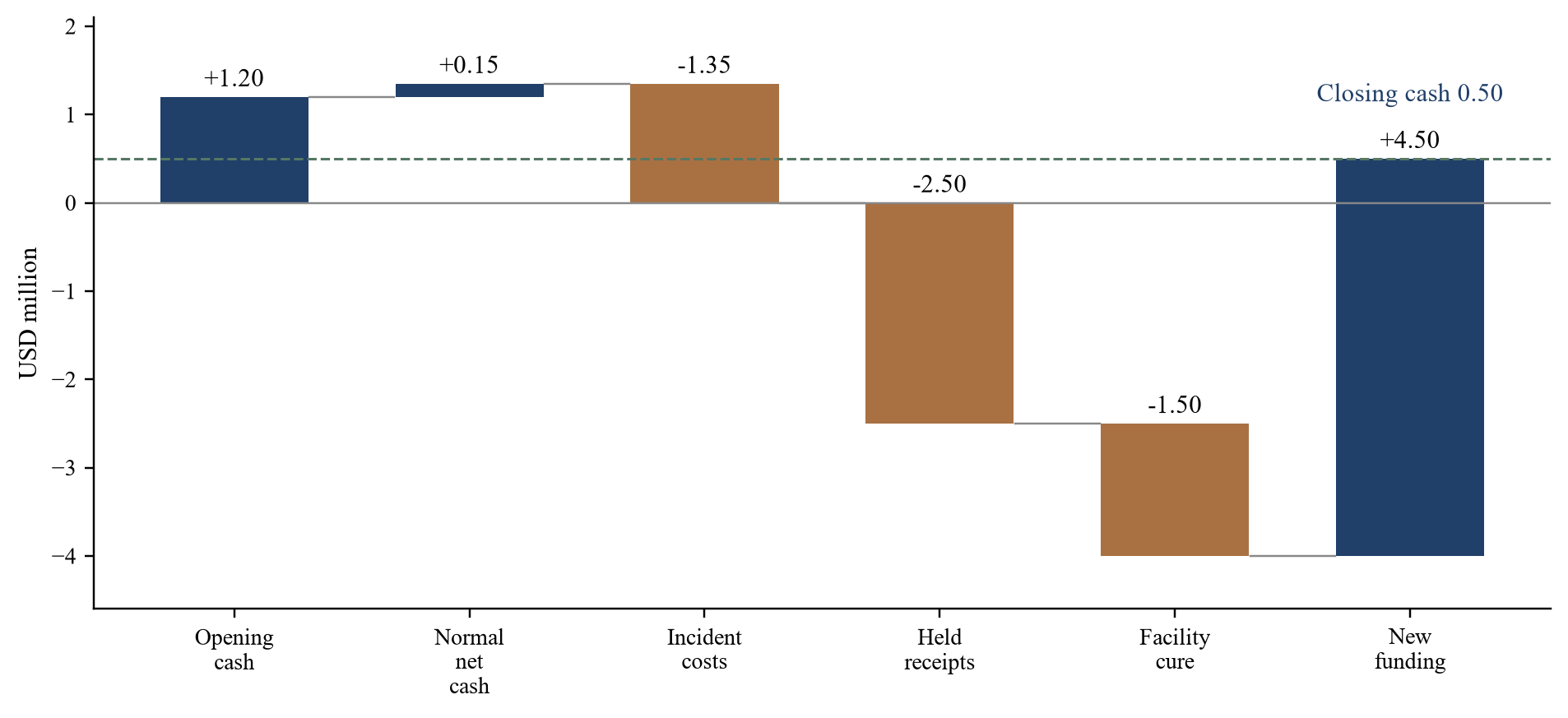
USD millions. The payment hold also reduces borrowing eligibility; reserve deductions are not counted again as cash expenditure. Emergency financing costs are excluded here and assessed separately.
9. Stress payer delay, quality loss and correlated disruption
The sensitivity should begin with variables that change the actual funding requirement. Here those variables are the additional customer payment hold and the distinct incident reserve. Keep the other assumptions constant. If held receipts increase to USD 4 million and the extra reserve remains USD 1.5 million, the borrowing base falls to USD 10.3 million and the cure becomes USD 2.7 million. The minimum cash funding gap rises to USD 7.2 million before emergency financing costs. This is a hypothetical stress, with no estimated probability.
The resulting relationship has a threshold. Until utilisation exceeds the adjusted base, a larger reserve may reduce unused availability without triggering a repayment. Once the threshold is crossed, each additional reserve dollar creates a dollar of cure under the assumed terms. Increasing the customer hold can then affect both collections and the cure. A lender should inspect this transition rather than extrapolating a simple percentage change in revenue into a funding requirement. The shape follows the stated formula and is not an empirical estimate of borrower behaviour.
Insurance timing is a separate dimension. If the assumed USD 1 million payment arrives in month six while held invoices are still released in month three, normal cash generation continues at the same hypothetical monthly rate. After emergency principal repayment, the calculation leaves USD 0.25 million before bridge interest. Interest of approximately USD 0.26630 million over 180 days produces a further shortfall. Retaining minimum cash and repaying principal and interest would require approximately USD 0.51630 million of additional funds. Extra operating months improve this simplified end-date comparison while leaving the earlier funding need intact.
The denial case should assign zero insurance receipt. With the held invoices collected in month three, month-three resources remain USD 1.2 million short of repaying all emergency principal before its interest and the minimum-cash requirement. If the held invoices also become unrecoverable, another USD 2.5 million remains missing. The lender should specify the sponsor funding, revised exposure limit or other response that would be required. An expected insurance receipt should never be inserted as an unexplained balancing item.
Test simultaneous incidents by cause and location. Two customers affected by one cold-store event may not provide independent diversification. A late subcontractor payment could coincide with a customer hold, and the same disputed facts may affect both insurance and contractual recovery. The proposed model should link those dependencies explicitly. It should also show what happens if the residual quality or delivery claim reserve becomes a cash settlement. That payment is absent from the simplified base case and would increase funding needs unless offset by separately evidenced resources.
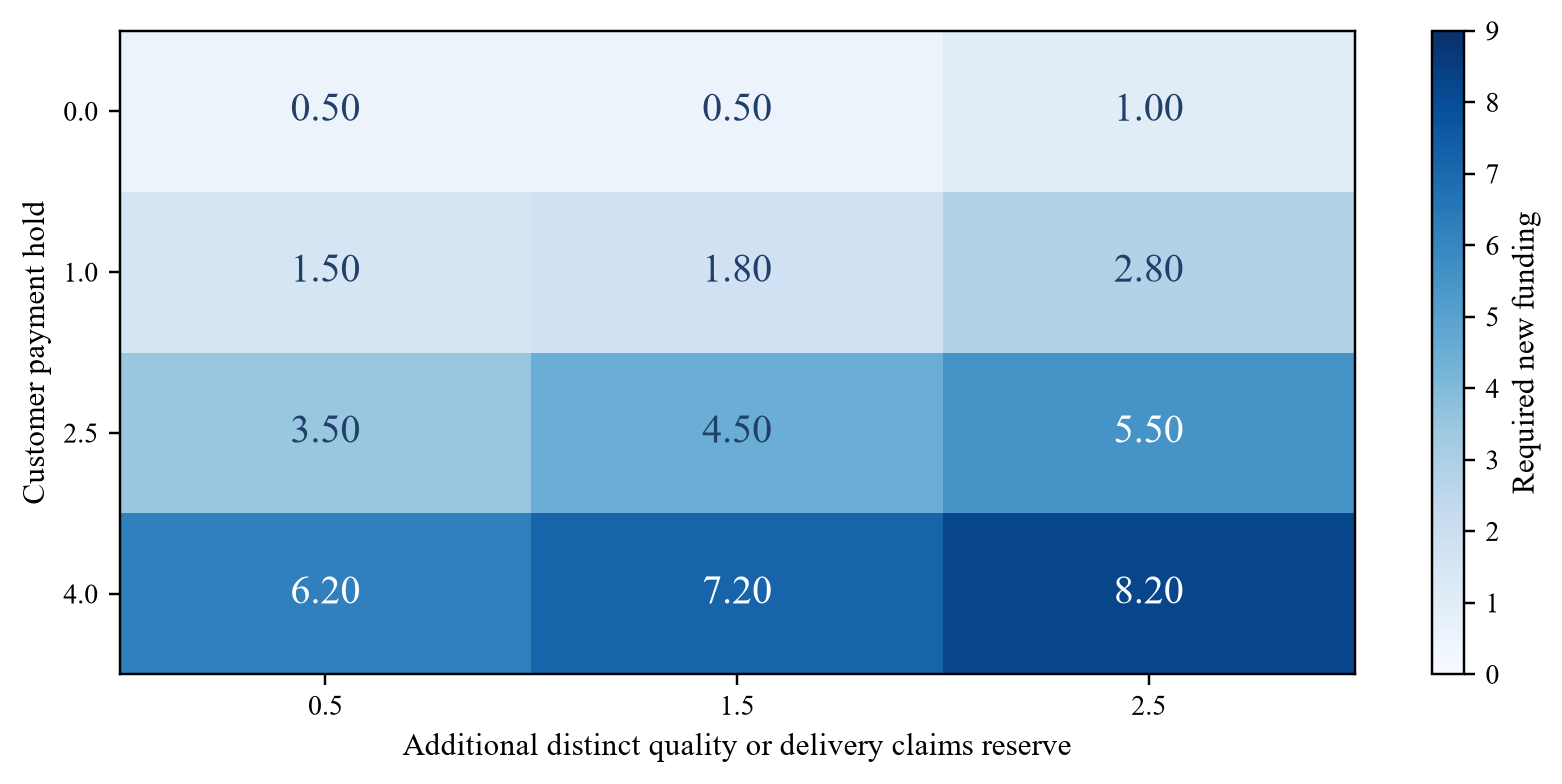
USD millions needed to maintain USD 0.5 million minimum cash before emergency financing costs. All other worked-case inputs remain constant. No loss probabilities are assigned.
10. Value owned medical inventory by recoverable sale path
A distributor that owns temperature-sensitive health products presents a different collateral question. Its stock may be legally available for security subject to the applicable arrangements, yet still have little usable recovery value if it cannot be safely released and sold within its remaining life. The lender should obtain evidence of ownership, any competing rights, product condition and lawful sale channels. A count of pallets should reconcile to lot records and valuation evidence. Physical access alone establishes neither clear title nor a practicable realisation route.
Consider a separate hypothetical stock pool with USD 4 million of recorded value. Assume USD 1.2 million is quarantined and excluded entirely. Of the remaining USD 2.8 million, assume a gross realisation of 55%, yielding USD 1.54 million. Deduct USD 0.18 million for preservation and USD 0.07 million for sale costs. Net realisable value is USD 1.29 million. A further hypothetical 60% advance against that net amount gives USD 0.774 million. Every percentage and cost is assumed, with no appraisal or observed recovery evidence.
The order of operations should be visible. The quality exclusion determines which goods can enter the valuation. The sale discount converts recorded value into a hypothetical gross receipt. Preservation and selling costs reduce that receipt. The lending margin then determines the permitted advance. If an appraiser's net liquidation value already includes particular costs, those costs should not be deducted a second time. The reviewer should obtain the appraisal definitions before combining them with the lender's certificate.
Preservation needs should be tested against the time available for a lawful sale. Ask who continues qualified temperature control, pays utilities, supplies replacement parts and authorises movement if the borrower cannot operate normally. Confirm access arrangements with the warehouse and any relevant landlord or service provider. A proposed recovery case should identify the person capable of implementing it and the funding available for doing so. The model makes no assumption that a lender can take unilateral physical control or sell regulated products without the necessary legal and operational authority.
This inventory calculation is excluded from the borrower facility in the earlier sections. Adding it to the borrower's borrowing base would contradict the assumption that its customers own the medical products. An actual group facility could involve more than one asset-owning company, but guarantees, security, cash movements and insolvency effects would require a separate legal-entity analysis. The committee should receive that analysis before treating assets and liabilities across entities as interchangeable support for the same obligation.
11. Govern artificial intelligence as a credit-control aid
An AI layer can detect duplicate serials, improbable stock movements, missing temperature intervals, unusual order patterns, repeated delivery disputes and forecast drift. It can prioritise records for review and support scenario analysis. The control objective is earlier investigation. A model score should not determine product safety, approve a medicine for sale, diagnose a patient, suspend an essential supply or authorise a loan without accountable human review.
Create a data lineage register covering source system, field definition, owner, update timing, lawful use, transformation and retention. Product identifiers, batch numbers, expiry dates, locations, temperatures, orders, deliveries, invoices and receipts should reconcile across systems. Missingness must be visible. A model should not silently replace absent temperature data with normal readings or treat an unscanned handover as completed delivery.
Set thresholds by consequence. A missing reading for an ordinary warehouse humidity indicator can have a different response from an unobserved interval for a temperature-sensitive vaccine. Product-quality and regulatory specialists should define the operational pathway. Credit professionals should define the eligibility and liquidity pathway. Technology teams should preserve logs, model versions and access controls. Each exception needs a named owner and a time-bound resolution.
Monitor drift and performance after deployment. Compare predicted demand with observed orders and consumption, anomaly alerts with investigated outcomes, and recommended actions with approved decisions. Record false positives that consume scarce operational capacity and false negatives that conceal material exposure. Retire or retrain a model when its intended conditions no longer hold. The governance file should identify who can change a model, approve a new data source and restore the prior process.
| Use case | Model output | Required human authority | Evidence retained |
|---|---|---|---|
| demand forecasting | range and forecast error | supply planner and finance approver | data version, model version and override |
| temperature anomaly | suspected excursion or missing interval | quality professional | original telemetry, calibration and disposition |
| inventory anomaly | duplicate, diversion or improbable movement | warehouse control and internal audit | source records and investigation outcome |
| receivables risk | ageing or dispute exception | credit manager and lender | invoice, acceptance, correspondence and receipt |
| borrowing-base review | proposed exclusion or reserve | authorised lender officer | certificate, rationale, approval and effective date |
AI output remains decision support within the stated use case.
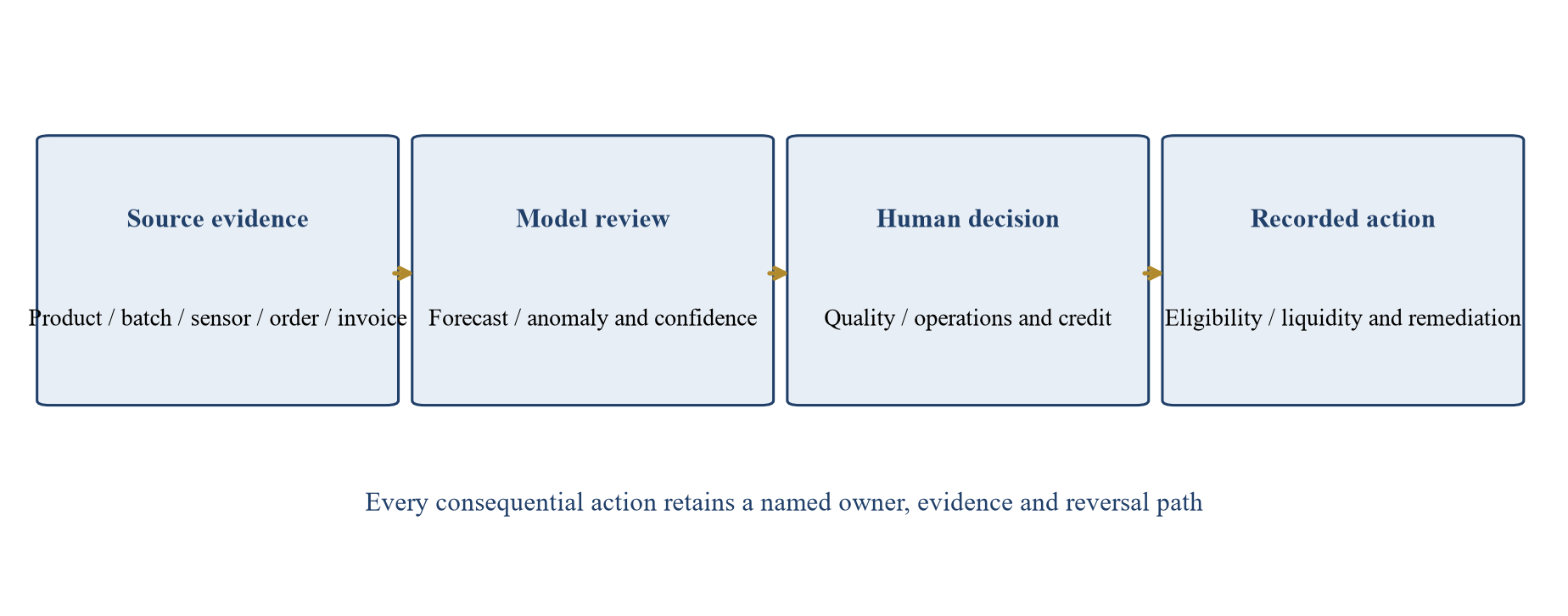
The workflow is conceptual. Product safety and credit authority remain with accountable professionals.
12. Monitor inventory, receivables and liquidity through the operating cycle
After closing, the monitoring design should connect reported availability to operational changes. A proposed certificate should reconcile new invoices, collections, credit notes, exclusions and reserve movements. Its supporting incident register should show open matters, customer responses, evidence gaps and actual recovery receipts. The reporting frequency should reflect the facility's terms and the speed at which an event can affect eligible assets. The committee should require a workable escalation route for a material incident between scheduled certificates.
The monitoring team should test a small number of complete records periodically. Reconstruct the selected receivable, its supporting service, any dispute and the eventual receipt. Compare original information with later amendments and document why a reserve was released. Sample testing should include exceptions selected for their risk characteristics, with the selection method and coverage recorded. The paper prescribes no statistical confidence level or universal sample size. A specialist should design the test in proportion to the pool and the consequences of an undetected problem.
Renewal should consider changes in the operating network. A new subcontractor, product category, storage site or major customer can alter the relationship between liability and recovery. Ask whether the approved insurance, permissions, monitoring process and financing model cover the changed activity. The borrower should demonstrate the new arrangement before increased exposure is accepted. A growth forecast that assumes more medical-product throughput should include the working capital, equipment reliability and incident-response resources needed to support it.
The lender should also retain a documented route for reducing exposure. This might involve lower drawings, additional eligible security, verified sponsor funds or an agreed repayment timetable, subject to the actual documents and law. Each response should be modelled for its effect on operations. A cure that consumes cash required for qualified temperature control could damage the very repayment source the facility depends upon. That potential interaction should be examined in advance, with an appropriately funded and lawful response available for committee consideration.
The worked case leads to a specific conclusion: pending insurance is an uncertain later receipt, and the proposed facility needs an independently funded response to earlier customer holds, operating expenditure and repayment obligations. Approval should follow evidence that the borrower can manage that interval under the agreed stress. The final recommendation should name the residual exposure being accepted and the conditions supporting it. Where those conditions remain unverified, the decision should stay conditional and the model should continue to show the missing funds.
Sources
- World Health Organization. Model guidance for the storage and transport of time- and temperature-sensitive pharmaceutical products. Read the primary source
- World Health Organization. Cold chain equipment and dry store temperature mapping tool. Read the primary source
- UNICEF Supply Division. What is a cold chain? Read the primary source
- The Global Fund. Sourcing and Management of Health Products. Read the primary source
- World Health Organization Regional Office for Africa. Essential medicines and health products. Read the primary source
- UNICEF Supply Division. Preventing in-country stock-risky situations through prescriptive analytics. Read the primary source
- UNICEF Supply Division. Traceability and Verification System. Read the primary source
- UNICEF Supply Division. UNICEF Supply Annual Report 2024. Read the primary source
- The Global Fund. Procurement Tools. Read the primary source
- World Bank Group. Africa Initiative for Medical Access and Manufacturing. Read the primary source
- Office of the Comptroller of the Currency. Comptroller's Handbook, Asset-Based Lending, Version 1.1. Read the primary source
- GS1. Global Traceability Standard. Read the primary source
- Gavi, the Vaccine Alliance. Cold Chain Equipment Optimisation Platform. Read the primary source
- Africa Centres for Disease Control and Prevention. Partnerships for African Vaccine Manufacturing. Read the primary source
- World Bank. Kenya's medical supply agency transforms to improve service delivery and save lives. Read the primary source
- UNICEF Angola. Strengthening vital systems through input planning and logistics management. Read the primary source
- International Finance Corporation. Health in Africa initiative and private health-sector financing resources. Read the primary source
- World Health Organization. WHO Global Model Regulatory Framework for Medical Devices including in vitro diagnostic medical devices. Read the primary source
- World Health Organization. Substandard and falsified medical products. Read the primary source
- United Nations Commission on International Trade Law. Model Law on Secured Transactions. Read the primary source
