

1. Finance safe operating capacity, not headline occupancy
Care-home debt can fail through short periods of operational deterioration that annual averages conceal. Annual EBITDA can combine mature homes with recently opened or recovering sites, strong occupancy with periods of bed unavailability, and normal staffing with temporary agency-labour spikes. The full-year total may appear sufficient while cash falls below the amount needed for wages, suppliers, rent, interest and essential capital expenditure. A lender therefore needs a monthly, and for stressed periods weekly, bridge from admissions and occupied beds to available cash.
The first task is to reconstruct cash generation by site and care category. Residential, nursing, dementia, respite and specialist care can have different admission processes, staffing requirements, fee structures, margins and settlement cycles. Privately funded, local-authority funded and NHS-funded residents can also have different invoicing and collection patterns. A group-level model should preserve those differences before consolidation. It should distinguish cash received in advance from revenue earned and should identify resident funds or deposits that remain refundable or restricted.
Debt capacity should be set against the lowest credible liquidity point after operating costs, taxes, rent, maintenance capital expenditure and the minimum cash needed to trade safely. A variable revolver may fund a predictable trough if its clean-down and repayment source are visible. A term facility should rely on sustainable cash through the cycle. Quality remediation debt should be matched to the work programme and asset recovery rather than used to fill an unexplained operating deficit.
The financing memorandum should state the cash thesis in operational language. For example, a quality-remediation programme may reduce available beds for several months, improve care outcomes and resident experience, and support a gradual recovery in occupancy and average weekly fee. The model should show the bed weeks removed, the displaced contribution, remediation expenditure, the expected admission ramp and the month in which incremental cash becomes available for debt service. Each assumption needs a source, owner and update frequency.
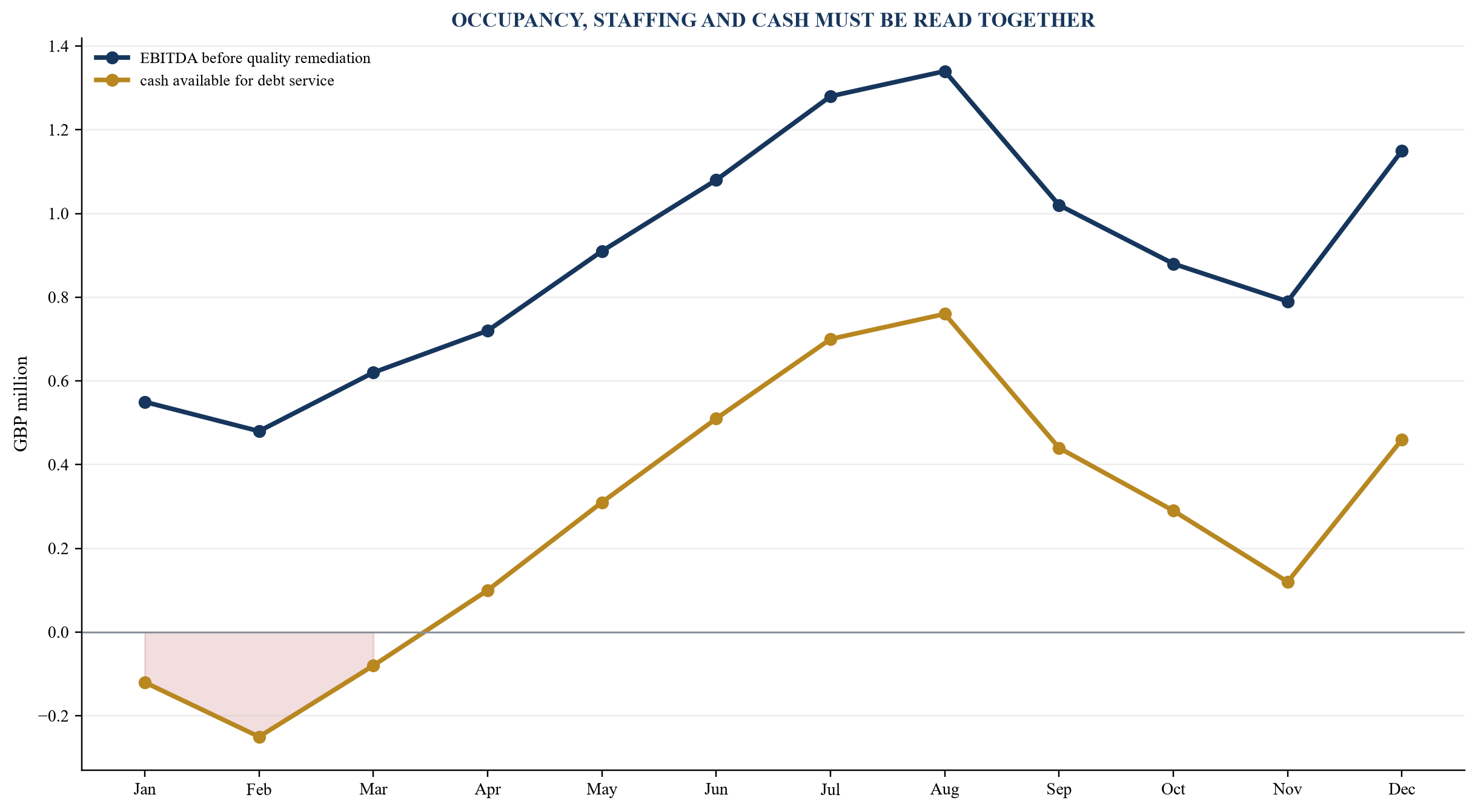
Values are hypothetical GBP millions and demonstrate the difference between EBITDA and cash available for debt service.
2. Define the borrower, property and operating perimeter
A care-home financing can involve an operating company, property-owning company, management company, care brand owner, registered provider, lessee, landlord and holding company. The lender should know which entity owns the property, employs staff, holds licences, contracts with referral and commissioning channels, receives resident, commissioner and local-authority receipts and services the debt. A model that consolidates the group without mapping legal cash paths can attribute value and liquidity to an entity that cannot upstream either.
The security perimeter should be built from verified ownership and contract rights. Freehold, long leasehold, operating lease, management contract and care-management arrangements produce different collateral and control. A lender to the operating company may depend on the continued availability of a care home lease or brand agreement. A property lender may depend on rent from an operating company whose cash flow is highly variable. Change-of-control, assignment, cure, termination and step-in provisions should be reviewed with counsel.
Cash dominion also matters. Admission platforms, payment service providers, merchant cash-advance providers and banks may have set-off, reserve or withholding rights. Resident fee receipts may sit in the operating account while carrying performance or refund obligations. Insurance proceeds for business interruption or property damage may be subject to reinstatement conditions. The financing package should identify each material collection account, payment priority, blocked-account right and permitted leakage.
The perimeter exercise should end with an entity-and-cash map. It should show ownership, asset location, material contracts, debt, guarantees, security, tax groups, leases, intercompany balances and distribution restrictions. The model should use the same perimeter. If EBITDA includes a site or service whose cash cannot reach the borrower, it should not support debt service without a verified legal route.
| Perimeter item | Evidence | Credit question | Financing response |
|---|---|---|---|
| property and lease | title, lease, rent schedule, consents and valuation | who controls the site and for how long? | security, consent, cure and step-in package |
| management and registration | management agreement, registered-provider status and fees | can the operator or registered manager cease during stress? | notice, cure, replacement and continuity provisions |
| admissions and collections | placement contracts, fee agreements and bank statements | when can receipts be delayed, withheld or refunded? | account control, liquidity buffer and reporting |
| licences and compliance | premises, registration, medicines, safeguarding, fire and planning records | can the site continue trading during works and stress? | conditions precedent and compliance undertakings |
| group cash flows | intercompany agreements, tax, guarantees and distributions | can value reach the borrower without leakage? | subordination, cash sweep and restricted payments |
Legal ownership, operating control and cash receipt should be tested separately.
3. Read the care and financing environment into the structure
Private credit can provide speed, bespoke covenants, delayed draws and operational flexibility, yet the structure must reflect current refinancing and sector evidence. The Bank of England's July 2026 Financial Stability Report states that a substantial portion of UK private debt originated in 2021 is due to refinance in the coming year. It also describes amendment-and-extension transactions and payment-in-kind structures as tools used by some borrowers to manage cash-flow pressure, while warning that such measures may be unavailable or unsustainable for others.[1]
The Bank's July 2026 Agents' summary says credit remains available to most firms while banks remain selective, particularly for small and medium-sized businesses. It also reports growth in asset finance and invoice discounting.[2] The Q2 Credit Conditions Survey records a slight reduction in credit availability for small and medium-sized businesses, while overall corporate credit availability was unchanged.[3] These observations support a financing process that proves asset quality, cash visibility and execution control rather than relying on market liquidity.
The July 2026 Monetary Policy Report records Bank Rate at 3.75 per cent and identifies volatile energy prices and continuing inflation uncertainty.[6] Interest expense, hedging and cost sensitivity therefore belong in the monthly base case and downside. The relevant rate is the contractual benchmark plus margin, fees, original issue discount, hedging cost and cash effect of any floor. A headline margin comparison can be misleading when amortisation, call protection, prepayment fees and delayed-draw charges differ.
The credit proposal should show why the chosen instrument fits the problem. A revolving facility may manage predictable resident-flow and funding timing. A delayed-draw term loan may fund certified quality remediation expenditure. Asset finance may fund equipment with identifiable collateral. A super-senior liquidity line may support a restructuring. Payment-in-kind interest may preserve near-term cash but increases principal and exit leverage. Each instrument should have a defined purpose, cap, draw test and repayment source.
4. Reconstruct bed availability, admissions and fees daily
Care-home revenue begins with registered capacity, operationally available beds, occupancy and average weekly fee. The model should adjust for beds that cannot safely accept residents, temporary absences, fee-free periods, local-authority or NHS contribution limits and collection delays. Admissions, resident acuity, funding mix, one-to-one care requirements and ancillary charges determine both revenue and the resources needed to deliver care.
Daily operating data should reconcile to the care-management system, rostering and care-record systems, general ledger, commissioner remittance statements and bank receipts. The lender should test weekends, holiday periods, payroll dates and dates around month end. Admission pace should be compared with prior periods on a like-for-like basis, taking account of beds made unavailable. A higher average weekly fee on fewer available beds can produce weaker cash despite apparent pricing strength.
The Department of Health and Social Care's Capacity Tracker statistics distinguish occupied beds, vacant and admittable beds, reserved beds and non-admittable beds.[2][4] A lender should preserve those states. Headline occupancy can rise because beds have been taken out of available capacity, while economic occupancy can appear stable even when admissions, departures or funding mix deteriorate.
Revenue quality also includes cancellation and refund behaviour, loyalty liabilities, package allocations, taxes and principal-versus-agent judgements. IFRS 15 requires revenue to reflect transfer of promised goods or services for the consideration expected.[7] For credit purposes, accounting revenue should be bridged to cash receipts, collection deductions and future performance obligations. Advance cash may support liquidity only after the associated service, refund and working-capital requirements are understood.
5. Connect workforce capacity to care and contribution
Gross operating profit and EBITDA can conceal cost timing. Labour, utilities, food, laundry, cleaning, distribution, management and central-service charges, referral and administration costs, card fees, insurance, property tax and repair cost should be mapped to the activity that drives them. Fixed, semi-variable and variable elements should be separated. The cost model must reflect statutory pay, agency usage, overtime, employer costs and minimum staffing needed to operate safely.
Skills for Care estimated that adult-social-care vacancies fell to 7.0 per cent in 2024/25, while turnover remained 23.1 per cent and the sector recorded approximately 6.6 million sickness days.[3] Residential care had a lower vacancy rate than homecare, yet a portfolio lender still needs home-level evidence because averages can conceal agency dependence, skill-mix gaps and registered-manager instability.
Utilities exposure deserves a separate bridge. Care-home operations assets use energy for heating, cooling, hot water, heating, hot water, kitchens, laundry, medical equipment and ventilation. The model should distinguish contracted and variable prices, expected consumption, efficiency initiatives, taxes and pass-through. The Bank of England's July 2026 Monetary Policy Report describes energy-price volatility and uncertainty over its effect on UK inflation.[6] A stable annual utility average can therefore understate the cash impact of a price reset during a low-demand month.
Contribution should be calculated by care category, home, care category, funding source and resident cohort where data permit. The lender needs to know which operations produce cash before fixed property cost and which absorb it. Quality remediation should target a verified constraint or revenue opportunity. A remediation programme that does not alter fee, occupancy, contribution or maintenance may improve the asset while failing to improve debt service.
6. Translate occupancy and fee timing into borrowing logic
Resident-flow and funding timing should be represented through a rolling monthly cash bridge with weekly detail across the lowest-liquidity period. The bridge should begin with unrestricted opening cash, add verified collections and permitted facility draws, and deduct payroll, suppliers, rent, taxes, maintenance, quality remediation, interest and mandatory amortisation. The minimum-cash line should reflect the amount required to operate, not an arbitrary percentage of annual revenue.
A variable revolver can be structured around a borrowing base or a fixed sublimit. A borrowing base may use eligible resident, commissioner, NHS and local-authority receivables, adjusted for disputes, concentration, deductions and ageing. The more important constraint may be the timing difference between payroll and supplier outflows and receipt of funded-care income. In that case, the facility should have a clear clean-down or step-down tied to collections and sustainable cash generation.
The draw condition should prevent the revolver becoming permanent loss funding. The borrower should deliver a current cash forecast, compliance certificate and absence-of-default confirmation. Draws above a threshold may require evidence of use and a revised liquidity plan. The facility should distinguish normal variable use from stress use. A breach of the expected repayment curve can trigger enhanced reporting, adviser appointment, distribution lock-up or a liquidity review before a payment default occurs.
Resident-flow and funding timing also affects covenant testing. A quarterly leverage ratio using last-twelve-month EBITDA can remain compliant while cash is exhausted. A fixed-charge or debt-service covenant may capture cash pressure more directly, but definitions must address advance deposits, rent, maintenance and quality remediation. Minimum liquidity is often the fastest early-warning measure. A well-designed package uses complementary tests rather than asking one ratio to explain the whole business.
7. Define quality remediation before committing debt
Quality remediation should start with a scope register that links every work package to a physical asset, cost, timetable, procurement status, approval, operational impact and expected benefit. Resident beds, care servicelic areas, kitchens, mechanical systems, fire protection, lifts, roofs, energy systems and technology have different lead times and dependencies. A single capex line offers little protection against scope growth or spend that cannot be completed.
The base budget should separate building works, furniture, fixtures and equipment, professional fees, taxes, temporary operations, resident decanting, technology, permissions and financing costs. Contingency should be explicit and controlled. Owner changes and latent conditions should be reported separately from ordinary cost variance. Committed cost, certified work, paid cost and forecast-to-complete should reconcile each month.
Regulatory and rating effects belong in the plan. Current GOV.UK guidance states that non-domestic rented property in England and Wales generally needs at least EPC E where the regulations apply, subject to exemptions.[8] A June 2026 government interim response proposes a higher EPC B standard from 2031 for private rented buildings over 1,000 square metres where cost effective.[9] The work programme should identify the current legal requirement, proposed changes, building-specific feasibility and any landlord-tenant allocation.
Business-rates treatment should also be verified. The Valuation Office Agency's 2026 care home guidance explains that care home rateable value reflects expected profit and trading performance, and that the 2026 revaluation took effect from 1 April 2026.[10] Separate GOV.UK guidance states that a property that cannot be used during qualifying repair or quality remediation may be removed from rates until it can be used again, subject to the Valuation Office's assessment.[11] Improvement relief is narrower and does not subsidise general redevelopment.[12]
| Work package | Cost evidence | Operating impact | Draw condition | Completion evidence |
|---|---|---|---|---|
| resident beds | tender, quantity surveyor and supplier orders | beds out of service and temporary rate dilution | approved floor sequence and committed-cost test | practical completion, snagging and beds returned to inventory |
| resident-care areas | design, contractor programme and access plan | resident disruption and temporary bed unavailability | phased access and health-and-safety approval | handover, registration and safe reopening confirmation |
| plant and energy | survey, specification and lifecycle analysis | planned shutdown and commissioning risk | technical adviser approval and contingency | commissioning, warranties and updated asset register |
| kitchen and food service | equipment schedule and workflow plan | temporary production constraint and resident-service risk | operating continuity and food-safety plan | inspections, training and reopening confirmation |
| technology and controls | architecture, vendor scope and migration plan | admission, payments and reporting interruption | testing, rollback and cyber review | acceptance test, access controls and stable interfaces |
Costs and benefits are hypothetical; each live work package requires evidence and certification.
8. Treat unavailable beds as a credit variable
The remediation programme should show the number of beds unavailable by day or week. The critical path must include procurement, permissions, contractor mobilisation, enabling works, structural work, services, fit-out, commissioning, snagging and operational release. The registered manager and admissions team should confirm when beds become unavailable and the evidence required before they can safely accept residents again.
Lost contribution is a financing use. It should be estimated from displaced beds, achievable occupancy, average contribution and alternative placement options. The model should avoid treating all lost revenue as lost EBITDA because some variable costs fall while a bed is unavailable. It should also avoid assuming that residents can be moved to another home. Group assets may accept some referrals, subject to location, care needs, registration conditions, resident choice and safe staffing.
Phasing can reduce the cash trough while lengthening the project and increasing preliminaries. A wider temporary closure can shorten execution but concentrates liquidity, resident-transition and reopening risk. The decision depends on construction constraints, resident safety, staffing, registration conditions and funding timing. The credit case should compare at least two feasible sequences and show the impact on cost, lost contribution, completion risk and debt service.
Delay consequences should be explicit. A four-week slip can extend bed unavailability, delay admissions, trigger contractor disputes, postpone fee and occupancy recovery and consume the contingency or interest reserve. The loan agreement should require prompt notice of critical-path slippage and a revised forecast. Additional draws should depend on remaining contingency and a funded path to completion, not solely on historic spend.
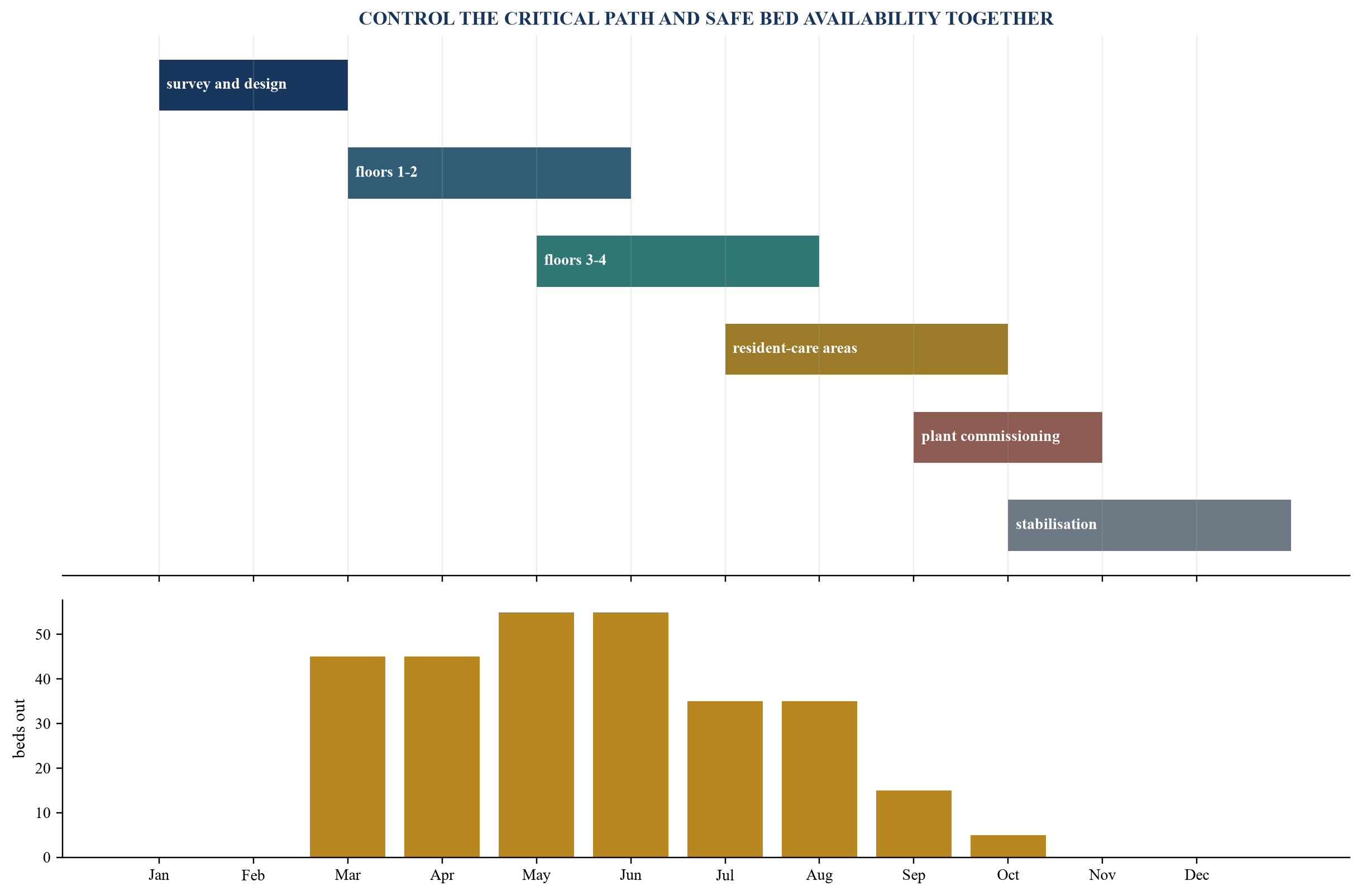
The programme is hypothetical and demonstrates how remediation phasing connects to safely available beds.
9. Control remediation and lifecycle-capex draws
The quality remediation facility should fund verified expenditure within an approved budget. A draw request should include invoices, payment evidence, quantity-surveyor or technical-adviser certification, progress photographs where useful, updated committed cost, contingency use, forecast-to-complete and confirmation that no material delay or dispute has arisen. The lender should retain the right to request further evidence without becoming responsible for the works.
Cost-to-complete is the central control. At every draw date, sources remaining should cover unpaid committed cost, estimated uncommitted cost, required contingency, interest during the works and the minimum operating liquidity through completion. If a gap emerges, the documentation should specify whether equity is injected, scope is reduced, contingency is reallocated or further debt is considered. An unallocated funding gap should stop discretionary draws.
Equity should be demonstrably funded at the agreed priority. First-loss equity before debt can align incentives and protect completion. A proportional funding mechanism may be appropriate for a well-capitalised sponsor, while a late equity contribution creates risk if conditions deteriorate. The structure should also address cost recoveries, insurance proceeds, contractor damages and refunds. These amounts should return to the project account or reduce future debt draws.
Related-party procurement requires special attention. The lender should understand ownership, pricing, scope, conflicts and approval. Material contracts should have clear payment milestones, retention, warranties, performance security and termination rights. The borrower should not accelerate payments, waive claims or change scope materially without the agreed approval. These controls protect completion and cash rather than attempt to manage the project from the lending desk.
10. Separate operating liquidity from remediation funding
Care-home working capital can look favourable because some residents or commissioners pay before suppliers and payroll are settled. That apparent benefit can reverse when advance fees are refunded, publicly funded receipts are delayed, occupancy falls or suppliers shorten terms. The credit model should distinguish recurring operating working capital, resident money linked to future service, tax liabilities, capital-expenditure creditors and overdue trade balances.
The cash forecast should schedule payroll, PAYE and National Insurance, VAT where applicable, corporation tax, rent, business rates, insurance, utilities and major supplier dates. A profitable month can still produce a cash outflow when quarterly or annual payments fall due. Business-rates assumptions and any relief should be verified property by property. The financing case should retain evidence for rateable value, multiplier, relief eligibility and payment dates rather than applying a group-wide assumption.
Supplier stretching should not be presented as permanent financing. Ageing should show current, disputed, deferred and overdue balances by supplier. Critical suppliers may require payment before delivery during stress. The lender should identify which terms reflect normal trade and which reflect arrears. A restructuring model should fund a realistic normalisation path, because a business that achieves covenant compliance by accumulating unpaid suppliers has not restored liquidity.
Quality remediation invoices should be kept outside the operating working-capital line. Otherwise a cost overrun can consume the revolver intended to pay wages and suppliers. The model should allocate each cash outflow to operating, lifecycle capex, quality remediation or financing. Separate accounts and approval workflows can support this distinction. Inter-account transfers should be visible and permitted only under the documented waterfall.
11. Design a reserve architecture that protects continuity
Reserves should have a defined purpose, amount, funding source, permitted use and replenishment rule. A debt-service reserve may cover a specified number of months of interest and scheduled principal. A lifecycle-capex reserve protects essential maintenance. A quality remediation contingency protects completion. A tax reserve prevents cash collected for future payment from being treated as free liquidity. A minimum operating-cash floor protects payroll, food safety, security and resident service.
The size of each reserve should be derived from the monthly forecast and identified risk. A three-month interest reserve is meaningful only if the expected recovery and next cash milestone sit within that period. A reserve that is too small creates false comfort; one that is too large can make the financing uneconomic. The model should show gross liquidity, restricted reserves and freely available liquidity separately.
Release conditions should be objective. A quality remediation contingency may be released after practical completion, final cost certification and expiry of material claim periods. A debt-service reserve may step down after a defined number of compliant test dates and verified stabilisation. A lifecycle reserve should continue if deferred maintenance remains. Distribution lock-up should apply before reserve release where the borrower is below a performance threshold or relying on a waiver.
Reserve leakage can occur through broad permitted-payment definitions, related-party charges, management fees or intercompany transfers. The finance documents should set payment priority and information rights. The account bank and security agent need operational instructions consistent with the agreed waterfall. The borrower also needs enough payment flexibility to trade normally. The design should focus controls on material outflows and preserve a clear emergency process.
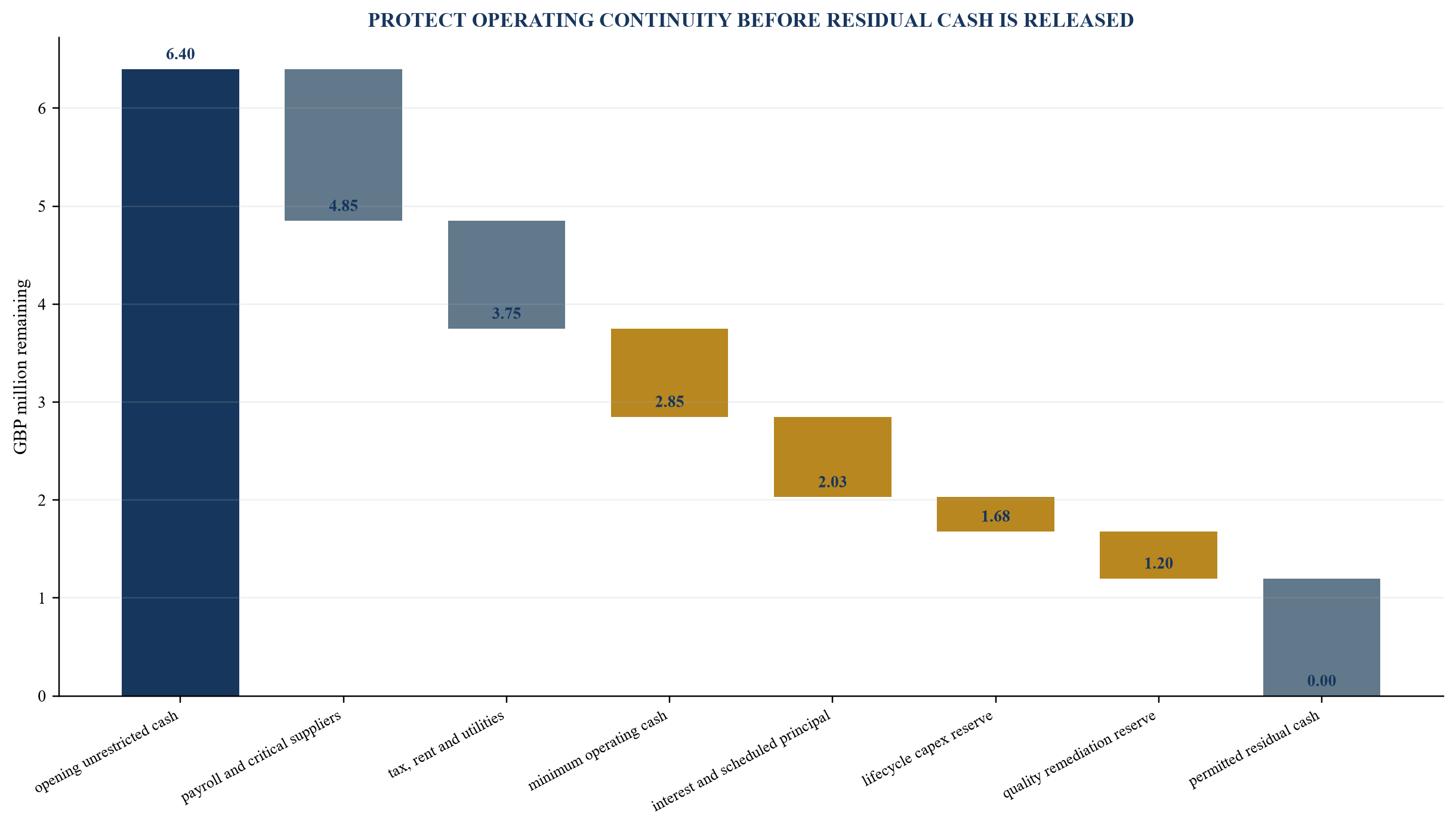
Values are hypothetical GBP millions and show cash priority rather than a recommended reserve amount.
| Reserve | Sizing basis | Permitted use | Replenishment | Release test |
|---|---|---|---|---|
| minimum operating cash | weekly payroll, critical suppliers and safe-operation needs | ordinary trading within approved forecast | first priority from collections | maintained throughout facility life |
| debt-service reserve | scheduled cash interest and principal over defined period | debt service after documented cash shortfall | cash sweep before distributions | compliant tests and verified stabilisation |
| lifecycle capex | asset register, maintenance plan and technical review | essential replacement and compliance works | monthly or quarterly contribution | only against certified lifecycle spend |
| quality remediation contingency | risk-adjusted cost-to-complete | approved changes, latent conditions and delay cost | equity cure or reallocation with approval | final account and completion certification |
| tax and resident obligations | forecast liabilities and refundable advance cash | payment of the relevant obligation | funded as liability accrues | payment or expiry of underlying obligation |
The appropriate amount and release test depend on verified borrower data.
12. Size term debt to sustainable home-level cash flow
Debt sizing should begin with sustainable free cash flow after normal maintenance capital expenditure, cash taxes, lease obligations and working-capital needs. EBITDA is a starting point, not the repayment source. The model should strip out unsupported adjustments, one-off reopening gains, non-cash items and benefits not yet implemented. It should include recurring management, care-management, property and technology costs needed to sustain the revenue case.
Leverage, interest cover and debt-service cover should be tested on monthly and annual views. A low leverage multiple can still create a cash problem if amortisation falls in the trough. A high annual debt-service cover can mask a negative quarter. Amortisation can be sculpted to the cash curve, with a minimum annual repayment and variable instalments. Cash sweep provisions can accelerate deleveraging after a strong season while preserving agreed capex and operating reserves.
Pricing should reflect benchmark risk, margin, floor, fees, original issue discount, hedging, prepayment economics and default interest. The July 2026 Monetary Policy Report records Bank Rate at 3.75 per cent and highlights uncertainty related to energy prices and inflation.[6] The financing should therefore model interest under the contractual base case, an adverse rate case and any cap or swap. Hedge collateral or break cost should be included where relevant.
Exit debt is the final constraint. If the facility relies on refinancing after stabilisation, the model should size the exit using a conservative sustainable cash flow, interest rate and leverage level. The property value should not substitute for operating repayment capacity unless the strategy genuinely includes sale or asset-backed refinancing. A maturity wall that can only be repaid through a favourable market is a risk to be priced and controlled.
13. Treat payment-in-kind and amendment as bridges with endpoints
Payment-in-kind interest can preserve cash during quality remediation or recovery by adding interest to principal. It can also increase exit leverage faster than operating performance improves. The credit model should show the principal balance monthly, including capitalised interest, fees and delayed draws. The borrower should understand the cash and accounting consequences, while the lender should define the period, rate, toggle mechanics and return to cash pay.
An amendment-and-extension can align maturity with a credible recovery plan. The Bank of England's July 2026 Financial Stability Report observes that some borrowers have used extensions and payment-in-kind structures to manage cash challenges, while noting that these measures may not be sustainable in the longer term.[1] The financing should therefore attach the extension to completion, liquidity and stabilisation milestones rather than rely on time alone.
Economic consideration for an amendment can include margin change, fees, additional amortisation, cash sweep, sponsor equity, enhanced security, reporting and governance. The structure should identify what risk is being cured. A fee without revised information or operating controls may compensate economically while leaving the original credit weakness untouched. A sponsor injection can fund completion, but it does not prove that the refurbished business can service debt.
The amendment should also address existing defaults, reservations of rights and waivers. The legal document must specify which breach is waived, for which test date and under what conditions. A temporary waiver should not accidentally amend future definitions. Counsel should examine lender consent thresholds, intercreditor rights, hedging, security, guarantor confirmation and any effect on priorities.
14. Build covenants around occupancy, staffing and quality
A covenant reset begins with definitions. EBITDA should be reconciled from audited or management accounts and adjusted only for items that are measurable, permitted and time-limited. Pro forma benefits from quality remediation, cost saving or new revenue should have evidence, a cap and a sunset. Rent, management and central-service charges, management fees, capitalised costs and lease accounting should be treated consistently between periods and ratios.
IFRS 16 recognises lease liabilities and right-of-use assets for many leases, changing reported EBITDA and indebtedness relative to former operating-lease accounting.[15] A finance covenant may use frozen generally accepted accounting principles, incorporate IFRS 16 or apply a negotiated lease adjustment. The agreement should state the method. The credit assessment should still measure the cash rent and fixed occupancy obligation, even if the covenant presents it differently.
The reset should use a bridge from the old threshold to the lowest credible performance point and then to stabilised performance. The threshold may step down or step up over time depending on ratio direction. Minimum liquidity, capex completion and interest cover may supplement leverage during the works. A covenant holiday should have information, distribution and draw controls. The borrower should not be able to incur more debt or release cash while operating without a performance test.
Equity cure rights require precision. The agreement should state amount, frequency, use, calculation treatment and whether cure proceeds reduce debt or are deemed EBITDA. Repeated deemed-EBITDA cures can preserve ratio compliance without improving cash. A debt-paydown cure aligns liquidity and leverage more directly. Cure rights should not remedy non-financial defaults, information failures or loss of a material licence unless expressly agreed.
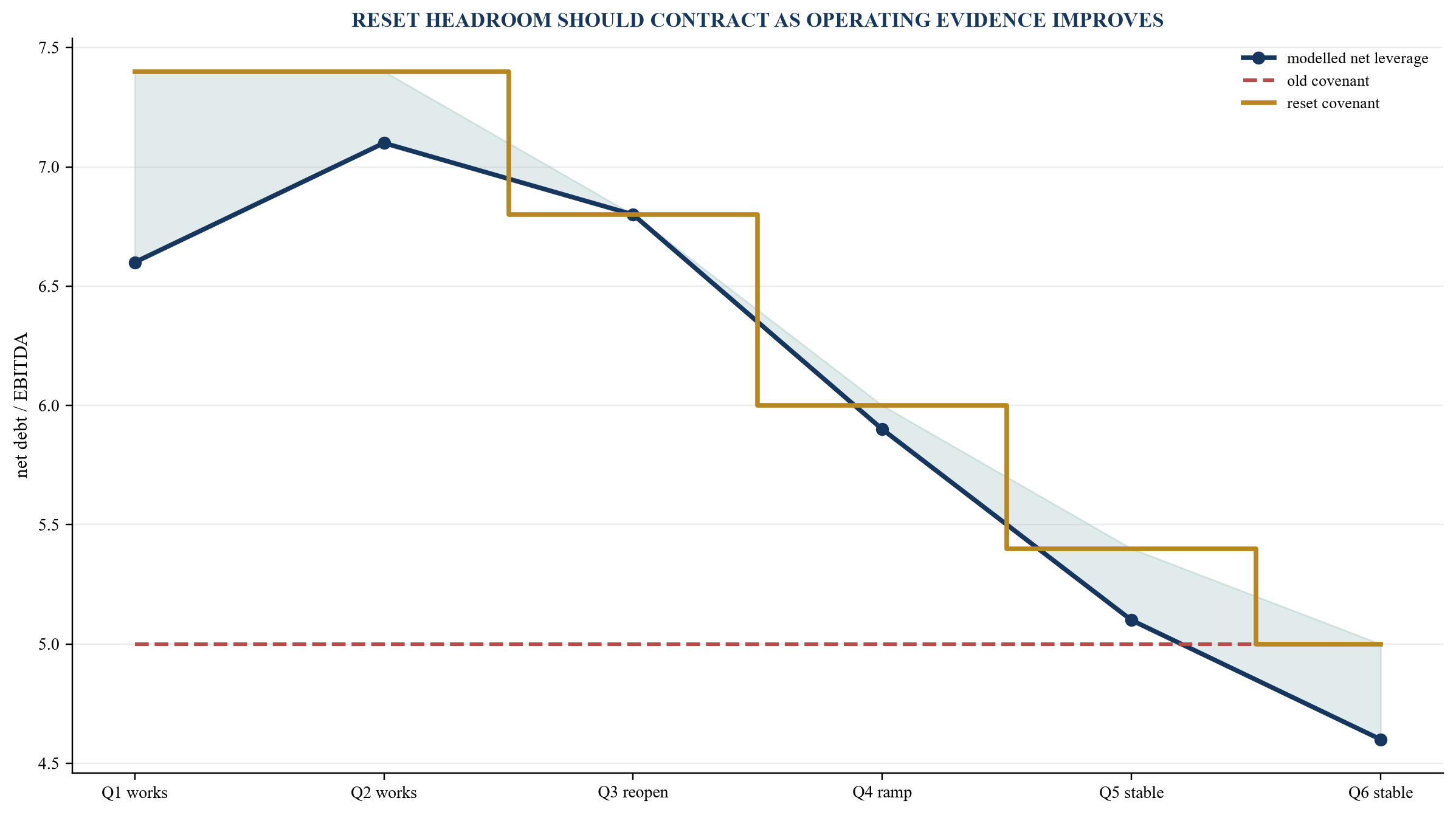
Ratios are hypothetical and show the relationship between quality remediation, temporary headroom and stabilisation milestones.
| Test | During works | Reopening phase | Stabilised phase | Early-warning action |
|---|---|---|---|---|
| minimum liquidity | daily or weekly floor | weekly floor plus reserve test | monthly floor | 13-week cash forecast and distribution lock-up |
| net leverage | temporary stepped threshold or holiday | quarterly stepped threshold | tighter recurring threshold | adviser review, draw stop and cure analysis |
| interest cover | tested on cash interest with agreed adjustments | quarterly test | recurring quarterly test | cash sweep and hedging review |
| capex completion | cost-to-complete and contingency test | snagging and final-account test | lifecycle reserve compliance | stop discretionary scope and fund gap |
| stabilisation | milestone reporting | occupancy, rate, margin and cash milestones | sustained performance over defined periods | enhanced reporting and revised plan |
Thresholds, definitions and remedies are transaction-specific and require legal and accounting review.
15. Make the lender dashboard an accountable control system
The information package should support decisions before liquidity becomes critical. Monthly reporting should include profit and loss, balance sheet, cash flow, liquidity, debt, covenants, capital expenditure, cost-to-complete, registered and available beds, occupancy, average weekly fee, admissions, discharges, agency usage, payroll, incidents, complaints, regulatory actions, supplier ageing and bank statements. The lender should receive site-level and consolidated information with a stable mapping to the model.
During quality remediation or waiver periods, a rolling 13-week cash flow should be updated weekly. Forecast-to-actual variance should distinguish timing from permanent change. Material variances need an explanation, owner and corrective action. Admission pace, safely available beds, staffing fill rates and remediation completion can provide earlier signals than month-end EBITDA. The reporting calendar should align with payroll, tax, rent and interest dates.
Independent review should be proportionate. A financial adviser can validate liquidity and options; a technical adviser or quantity surveyor can certify works and cost-to-complete; a valuer can assess property and trading value; an operational adviser can review the recovery plan. The scope, reliance and information access should be clear. The lender remains responsible for its credit decision, while the borrower remains responsible for operating the business.
Data quality should be tested. Care-management, electronic care-record, rostering, payroll, procurement and accounting systems may use different identifiers and cut-offs. The borrower should document reconciliation, late adjustments and manual journals. Information covenants should require prompt notice of material contract termination, registration issues, safeguarding, fire or safety incidents, cyber events, remediation disputes and loss of a registered or key manager.
16. Connect property obligations and asset value to care cash
Care-home operations property economics depend on tenure and lease terms. A freehold owner faces maintenance, lifecycle capital expenditure and property-value risk directly. A leasehold operator faces rent, service charge, repair, reinstatement and expiry risk. A management-contract operator may have a different fee and control profile. The financing should model the cash obligations under the actual contracts rather than infer them from the accounting presentation.
Rent structures can include base rent, turnover rent, indexation, reviews and deposits. The borrower should model rent during closure, partial trading and stabilisation. Landlord consent may be required for works, finance, security or assignment. If the lender relies on the lease, notice and cure rights can be material. Reinstatement obligations and landlord contributions should be reflected in both sources and uses.
The Valuation Office Agency explains that care home rateable values for the 2026 revaluation are based on expected profit and trading performance and that the revaluation took effect on 1 April 2026.[10] The borrower should reconcile each property's new rateable value, multiplier, transitional relief and actual bill. It should also assess whether works affect the rating list or qualify for any temporary treatment. Credit assumptions should use documented bills or advice, not a broad sector average.
Property valuation should separate trading value, real-estate value and any management or platform value. A credit valuation may use different assumptions and enforcement scenarios from an accounting valuation. The lender should understand who could operate the asset after enforcement, which registrations, leases and commissioning contracts transfer, and what time and capital would be needed to preserve continuity and value.
17. Stress the combined operating and financing plan
The downside should combine risks that can occur together. Lower occupancy, weaker rate, higher labour and energy cost, quality remediation delay, capex overrun, tighter supplier terms and higher interest can compound. A sequence is more useful than isolated sensitivities: works slip, beds remain unavailable into a peak month, admission reviews weaken, cash drops, suppliers shorten terms and the interest reserve is consumed.
At minimum, the model should include a base case, operating downside, remediation downside and severe combined case. Each case should show monthly liquidity, covenant headroom, reserve use, debt balance and cost-to-complete. Management actions should be specific and time-bound. Central-cost reduction, agency-labour controls consistent with safe staffing, phased capital expenditure, asset sale or equity injection should have a quantified cash effect and a decision deadline.
The lender should test whether actions are legally and operationally available. Closing beds may reduce some variable cost while weakening admissions and local-authority relationships. Deferred maintenance may preserve cash briefly while increasing resident-safety, regulatory and asset risk. An asset sale may require consent and take longer than the liquidity runway. A sponsor equity commitment should be supported by capacity and a binding mechanism where relied upon.
The Bank of England's July 2026 Financial Stability Report identifies vulnerabilities in private credit related to leverage, valuation, liquidity and opacity, and describes the potential for tighter conditions to affect corporate borrowers.[1] The stress test should therefore cover lender-side constraints as well as borrower performance. A refinancing assumption should not rely solely on continuing availability of private credit at the same leverage and price.
18. Measure stabilisation with care, workforce and cash milestones
Practical completion is not stabilisation. A remediated care home must return beds to safe use, rebuild its admission pipeline, deliver consistent care, achieve the targeted fee and staffing mix, absorb reopening costs and convert revenue into cash. The stabilisation dashboard should begin before reopening and continue until performance has been sustained for an agreed number of periods. One strong month should not release all protections.
The core measures should include registered beds, safely available beds, occupancy, average weekly fee, contribution per occupied bed, staffing hours, agency usage, vacancy, turnover, incidents, complaints, cash conversion, maintenance and debt-service cover. The dashboard should show plan, actual, prior period and variance. Metrics should be measured on a consistent like-for-like basis, with unavailable beds and exceptional incidents visible.
Release of reserves, margin step-down, distribution permission or covenant tightening can be tied to stabilisation. Conditions should include remediation completion, no funding gap, no default, minimum liquidity, a sustained operating threshold and verified compliance. The measurement period should reflect resident-flow and funding timing and should be long enough to cover admissions, discharges, workforce volatility and commissioner collection patterns.
Recovery should be segmented rather than assessed only through total revenue. A nursing home with high resident acuity, a residential home dependent on local-authority placements and a specialist dementia facility face different admission, staffing and fee dynamics. The dashboard should mirror the actual resident, funding and property mix and should expose site-level deterioration before consolidation obscures it.
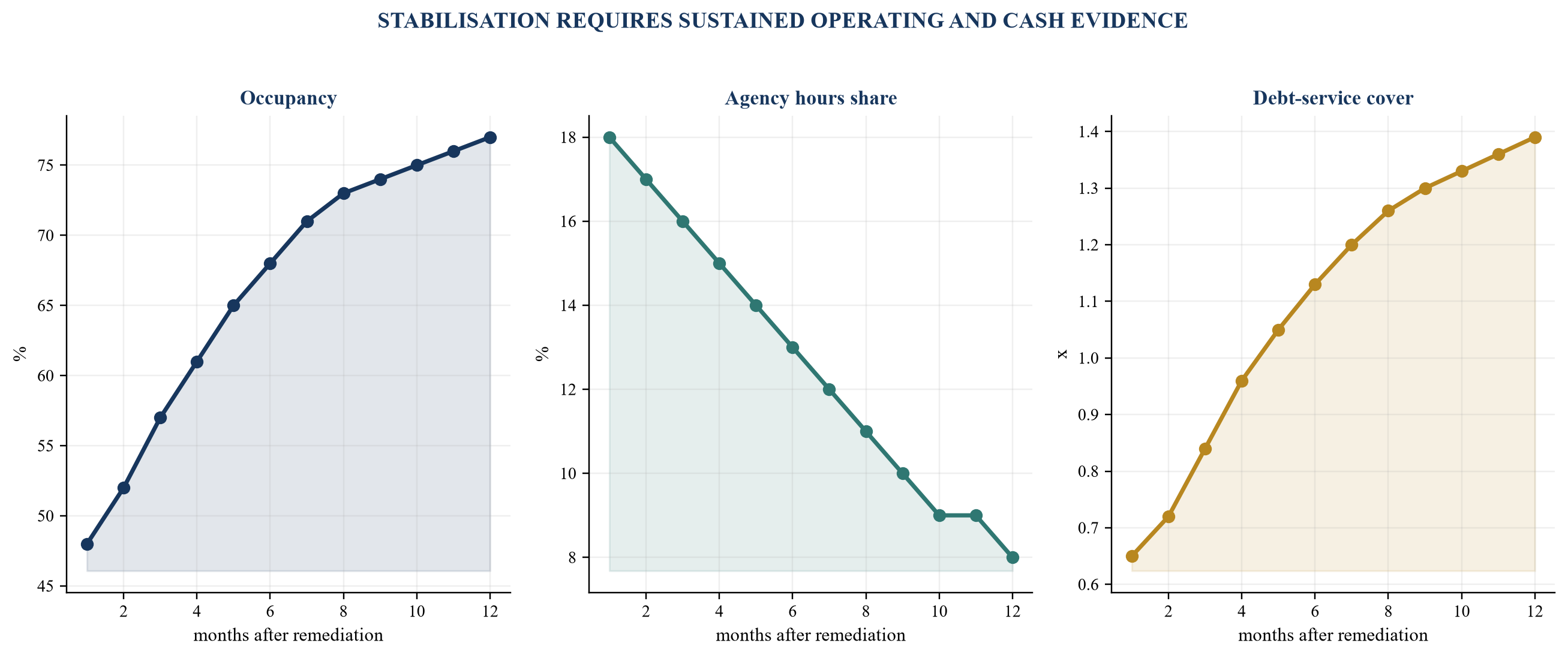
Metrics are hypothetical and show the progression from reopening to a sustainable debt-service profile.
| Milestone | Evidence | Protection affected | Failed milestone response |
|---|---|---|---|
| practical completion | certificates, snagging, licences and beds returned | final quality remediation draw | retain contingency and update cost-to-complete |
| operating ramp | occupancy, rate, contribution and resident measures | information frequency and capex controls | operating review and revised commercial plan |
| cash conversion | bank receipts, supplier ageing and 13-week forecast | liquidity reserve step-down | preserve reserve and increase cash sweep |
| covenant compliance | definitions, calculations and certificate | temporary covenant headroom | cure, waiver or restructuring review |
| sustained stabilisation | agreed metrics across defined periods | margin step-down and permitted distributions | continue protections until evidence is achieved |
The evidence period should cover the relevant variable cycle.
19. Document intervention as an executable control package
The finance documents should translate the model into enforceable definitions, conditions, undertakings, representations, events of default, information rights, security and remedies. The parties should align the model, term sheet, facility agreement, intercreditor agreement, hedging, security and account documents. A covenant threshold is ineffective if its accounting definition differs from the model or if the lender cannot obtain the data needed to test it.
Conditions precedent should cover corporate authority, financial information, property and lease evidence, licences, insurance, security, account control, capex budget, contractor arrangements, technical reports, valuation, tax and legal opinions where appropriate. Subsequent conditions can address items that cannot be completed before closing without weakening essential Day One protection. Each condition needs an owner and deadline.
Part 26A of the Companies Act 2006 provides a restructuring-plan mechanism for companies facing financial difficulty and can bind dissenting classes subject to statutory and court requirements.[18] HMRC guidance states that it considers plans case by case and expects truthful, evidence-backed proposals, realistic forecasts, full tax filings and a viable path to future payment.[19] A consensual amendment may avoid formal proceedings, but the alternatives analysis should be prepared early enough to remain credible.
Accounting for a debt modification requires separate analysis. The IASB's 2026 amortised-cost measurement project is considering how IFRS 9 should address whether a financial-instrument modification is substantial and results in derecognition.[20] Borrowers and lenders should obtain current accounting advice on modification, fees, effective interest, expected credit loss and disclosures. The legal effectiveness of an amendment does not determine its accounting treatment.
20. Implement the system through a ninety-day plan
The first ten business days should establish liquidity control. The borrower should deliver daily cash, a 13-week forecast, account balances, debt, supplier ageing, tax status, payroll, critical contracts, capex status and immediate operational risks. The lender should identify defaults, reservation-of-rights requirements and permitted funding. Advisers should be appointed only to defined workstreams with clear reliance and deadlines.
The next thirty days should rebuild the operating model and quality-remediation case. Site, resident, commissioner and workforce data should reconcile to accounts and cash. Clinical, operational and technical teams should validate scope, schedule, cost-to-complete and compliance. The admissions and finance teams should test placement pipeline, fees, collections and recovery. The financing workstream should compare maturity extension, revolver, delayed draw, asset finance, equity and asset-sale options. The parties should agree the base case, downside and liquidity minimum.
By day sixty, the term sheet and documentation should reflect the verified plan. Sponsor support, reserves, covenant definitions, draw tests, security, reporting, fees and governance should be agreed in principle. Unresolved diligence should be mapped to conditions or specific protections. The borrower should begin the operating actions that do not depend on closing, such as reporting improvements, supplier negotiations and capex controls.
By day ninety, the financing should close only if the sources cover completion, liquidity and debt service under the agreed case. Accounts and reporting should operate from Day One. The first compliance, capex and cash reviews should already be scheduled. The investment committee should retain a one-page control sheet showing the monthly liquidity trough, remaining cost-to-complete, reserve balances, covenant headroom, stabilisation milestones and next decision date.
The durable credit proposition is simple: term debt funds sustainable cash flow; variable liquidity funds a predictable trough; remediation and lifecycle-capex debt funds certified value-creating work; reserves protect continuity; covenants test the recovery path; and information rights allow action before cash is exhausted. A structure that preserves these distinctions gives borrower and lender a shared operating language through the quality remediation and stabilisation cycle.
Sources
- Care Quality Commission. The State of Health Care and Adult Social Care in England 2024/25: Adult Social Care. Read the primary source
- Department of Health and Social Care. Adult Social Care in England, Monthly Statistics: August 2025. Read the primary source
- Skills for Care. The State of the Adult Social Care Sector and Workforce in England 2025. Read the primary source
- Department of Health and Social Care. Adult Social Care Statistics: Background Quality and Methodology. Read the primary source
- Care Quality Commission. Assessment Framework. Read the primary source
- Care Quality Commission. Assessing Quality and Performance. Read the primary source
- Care Quality Commission. Returning to Good: Adult Social Care Services. Read the primary source
- Care Quality Commission. Market Oversight of Adult Social Care. Read the primary source
- UK Government. Care Act 2014. Read the primary source
- UK Government. Health and Social Care Act 2008 Regulated Activities Regulations 2014. Read the primary source
- UK Government. Data Protection Act 2018. Read the primary source
- Information Commissioner's Office. AI and Data Protection Risk Toolkit. Read the primary source
- Department of Health and Social Care. A Plan for Digital Health and Social Care. Read the primary source
- Department of Health and Social Care. People at the Heart of Care. Read the primary source
- NHS England. Data Security and Protection Toolkit. Read the primary source
- National Cyber Security Centre. Guidelines for Secure AI System Development. Read the primary source
- National Institute for Health and Care Excellence. Managing Medicines in Care Homes. Read the primary source
- Nursing and Midwifery Council. The Code. Read the primary source
- Competition and Markets Authority. Care Homes: Consumer Law Advice for Providers. Read the primary source
- Bank of England. Financial Stability Report July 2026. Read the primary source
- Bank of England. Credit Conditions Survey 2026 Q2. Read the primary source
- Bank of England. Agents' Summary of Business Conditions July 2026. Read the primary source
- Financial Reporting Council. IFRS 9 Financial Instruments. Read the primary source
- European Banking Authority. Guidelines on Loan Origination and Monitoring. Read the primary source
- National Institute of Standards and Technology. Artificial Intelligence Risk Management Framework 1.0. Read the primary source
- OECD. Due Diligence Guidance for Responsible Business Conduct. Read the primary source
- Department of Health and Social Care. Adult Social Care Provider Information Provisions. Read the primary source
- Care Quality Commission. Regulation 18 Staffing. Read the primary source
