

1. Define the financing decision
The financing decision is whether a lender can advance against a changing pool of healthcare receivables and recover principal, interest and costs from controlled collections under central and adverse conditions. The decision requires a precise borrower perimeter, an enforceable right to receivables and cash, reliable claim evidence, a sufficiently diversified payer pool and operating capacity to correct legitimate denials. Clinical quality, patient welfare and access to care remain governed through the applicable healthcare framework and professional judgement.
The proposed facility is a revolving borrowing-base structure. Availability is the lower of the committed facility and a calculated amount derived from eligible receivables after advance rates, reserves, concentration limits and other deductions. A denial-prediction model can inform those deductions. It cannot create a receivable, prove contractual entitlement or replace payer adjudication. The credit agreement should identify which claim states qualify, how model outputs affect availability, who can approve overrides and when the model must be suspended.
The board and credit committee should approve a decision statement covering amount, tenor, currency, permitted use, repayment source, security, controlled accounts, reporting frequency, eligibility, concentration, reserves, covenants and default remedies. A provider should separately approve the model's operational purpose, patient-data safeguards and escalation rules. The same analytical output can have different consequences in revenue-cycle management, accounting and lending. Each use requires its own control owner and decision record.
2. Distinguish the claim states
A healthcare receivable should be represented as a sequence of states rather than a single invoice balance. The sequence may include patient eligibility confirmation, pre-authorisation, encounter completion, clinical documentation, coding, claim assembly, submission, acknowledgement, payer edit, adjudication, denial, resubmission, appeal, settlement advice and bank receipt. Local rules, payer contracts and provider systems determine the precise path.
Each transition changes the evidence available to a lender. A completed encounter may support a contract asset or revenue analysis while remaining ineligible collateral until documentation and submission tests are passed. An acknowledged claim proves receipt by the payer but not acceptance. An approved remittance can provide stronger cash evidence while remaining exposed to set-off, audit, recovery or timing risk. A bank receipt is the strongest cash event, subject to reconciliation and control over the collection account.
The financing data model should preserve the claim identifier, patient-safe token, provider entity, facility, service date, submission date, payer, plan, contract, clinical speciality, code family, gross amount, contractual adjustment, denial reason, resubmission, adjudicated amount and receipt. Personally identifiable or sensitive health information should be minimised, protected and used only under valid authority. Lenders generally need financial evidence and auditability; they do not require unrestricted access to clinical records.
| Claim state | Evidence | Primary uncertainty | Illustrative financing treatment |
|---|---|---|---|
| Encounter completed | Clinical and scheduling record | Documentation, eligibility, coding and entitlement remain unresolved | Excluded from borrowing base |
| Claim assembled | Coded claim and internal quality checks | Submission and payer acceptance remain unresolved | Excluded or tracked as pipeline |
| Submitted and acknowledged | Submission record and payer acknowledgement | Edits, denial, adjustment, timing and set-off | Eligible only under conservative criteria and history |
| Adjudicated for payment | Remittance or accepted settlement record | Timing, offset, recovery and operational collection | Higher advance band subject to payer and ageing limits |
| Initially denied but curable | Denial reason, responsible owner and documented cure path | Cure probability, resubmission deadline and final amount | Excluded or separately capped with a high reserve |
| Final denial or disputed entitlement | Final payer decision or unresolved dispute | No reliable ordinary-course collection | Excluded |
| Cash received | Controlled-account bank receipt reconciled to claim | Reversal, clawback or misapplication | Reduces the related advance and supports performance history |
The hierarchy is a transaction-design template. Legal rights, data access and claim states must be verified for each provider, payer and jurisdiction.
3. Separate prediction from adjudication
A denial-prediction model estimates a future operational outcome from information available before payer adjudication. It does not decide whether a service was clinically appropriate, whether a patient should receive treatment or whether a payer is legally obliged to pay. The model's financing purpose should be narrow: estimate initial-denial risk and expected cash timing for a defined claims population, then route the output through approved credit rules.
This separation matters because labels can be misleading. A model trained on historic payer responses learns the combined effect of contract terms, submission quality, coding practice, documentation, payer edits and prior operating behaviour. It does not necessarily measure ultimate economic loss. An initially denied claim may be corrected and paid. A clean first-pass claim may later be adjusted or recovered. The model should therefore produce several outputs: probability of initial denial, reason family, expected curability, expected cure time and expected net collection.
The lender should avoid a single universal score across all payers and services unless evidence supports comparability. Payer rules, benefit plans, provider contracts, clinical specialities and coding practices differ. A score of 0.20 can imply different cash consequences when one payer resolves documentation denials in ten days and another requires a longer appeal. The financing rule should use probability, severity, timing and controllability together.
4. Build the evidence perimeter
The first diligence task is an evidence map covering contracts, claim events, financial records, model inputs and cash. The map should identify the authoritative source for each field, the system owner, refresh frequency, retention period, permitted use, change controls and reconciliation point. Data extracted from a dashboard without lineage is insufficient for a secured financing decision.
Provider contracts and payer manuals define submission windows, coding requirements, tariffs, edits, resubmission, appeals, audit rights, recovery and settlement. Regulatory standards can govern adjudication and electronic claim exchange. The Abu Dhabi claims-adjudication standard, for example, describes payer financial-responsibility determinations and distinguishes simple and complex edits. Saudi NPHIES materials describe electronic claim messaging and denial codes. Transaction counsel and healthcare specialists should determine which current requirements apply to the financed pool.
The evidence map should connect the claim ledger to the general ledger and the bank. Gross charges, contractual adjustments, revenue, receivables, provisions, write-offs, settlements and cash must reconcile by period and payer. A denial model should not be used to bridge an unexplained difference. Reconciliation breaks should be aged, owned and excluded from eligibility until resolved. Material retrospective data changes need an audit trail and approval.
5. Define the outcome labels
Model performance depends on a precise outcome definition. The target can be first-pass denial, partial denial, final non-payment, delayed payment or net cash collected within a defined horizon. These outcomes are related but not interchangeable. Financing generally needs more than first-pass denial because principal is repaid from eventual cash.
A practical design uses linked labels. The first model predicts whether the initial adjudication contains a denial or material reduction. A reason model classifies the likely denial family. A cure model estimates whether the denied amount will be collected after correction or appeal. A time-to-cash model estimates the collection distribution. A severity model estimates the net reduction from the submitted amount. Each label needs a clear observation window and treatment of claims still open at the data cut-off.
Labels should be derived from final claim and cash events rather than manually curated anecdotes. Cancelled claims, duplicate submissions, patient-pay balances, capitation, bundled payments and claims under dispute may require separate treatment. The model inventory should document exclusions and their financing consequence. Claims with an indeterminate label should not be silently assigned to the successful class.
6. Select features with a financing rationale
Features should have an evidenced relationship to the modelled outcome and a lawful, appropriate use. Potential features include payer, plan, facility, speciality, code family, authorisation status, eligibility response, days from service to submission, documentation completeness, historical denial reason, resubmission count, contract version and prior payer turnaround. The use of any sensitive characteristic requires specific legal, ethical and operational review.
The lender should challenge proxy risk. A feature can indirectly encode protected characteristics, clinical complexity or access patterns. The appropriate test is not limited to predictive lift. Governance should consider whether the feature is necessary, whether its use creates an inappropriate financing effect and whether a less sensitive alternative exists. Patient-level clinical content should be minimised. Aggregated operational indicators may be sufficient for financing.
Feature availability at decision time must be proven. Information created after adjudication cannot support a pre-submission prediction. Data leakage produces apparently strong validation and weak live performance. The build record should timestamp every feature, identify its source and demonstrate that it existed before the scored event. Derived fields need reproducible transformation logic and version control.
7. Train and validate by time, payer and service
Random train-test splits can overstate performance when the same payer rules, patients, clinicians or resubmitted claims appear across both sets. Validation should respect time and operational grouping. A model can be trained on earlier periods, calibrated on a later period and tested on the most recent untouched period. Claims from the same episode or resubmission chain should remain in one partition.
Performance should be reported by payer, facility, speciality, claim-value band, denial reason and relevant jurisdiction. Overall discrimination can conceal a failing minority segment. Calibration is central to financing because the predicted probability influences reserves and advance rates. If claims scored at 20 percent denial risk are denied 35 percent of the time, the financing rule understates risk even when ranking remains useful.
The validation report should include sample size, label maturity, missingness, discrimination, calibration, precision, recall, expected cash error, stability and operational capacity. It should compare the proposed model with a transparent baseline, such as payer-by-reason historical rates. Independent review should challenge data lineage, conceptual soundness, implementation, overrides and outcome monitoring. CBUAE model-management expectations provide a useful governance reference for UAE lenders using models in decision-making.
8. Convert predictions into operating action
A prediction has value when an accountable team can act before submission or within the cure window. The action map should link each reason family to a defined control. Eligibility risk can trigger coverage verification. Missing authorisation can trigger an authorisation check. Documentation risk can route the file to a clinical documentation specialist. Coding risk can trigger a qualified coding review. Timeliness risk can escalate a submission deadline.
The control should prevent blind optimisation. Staff should not alter clinically accurate documentation or coding merely to reduce a predicted denial. Any correction must be supported by the patient record, contract and applicable rules. The model should assist prioritisation and quality assurance. Qualified professionals retain responsibility for clinical documentation and coding.
Operational capacity is part of the credit case. If the model identifies 2,000 high-risk claims and the provider can review only 300 before the deadline, predicted curability overstates realised performance. The financing model should cap benefits at demonstrated review capacity. It should record recommendations, actions, overrides, submission outcomes, cure outcomes and cash. These records create the feedback loop for validation and control testing.
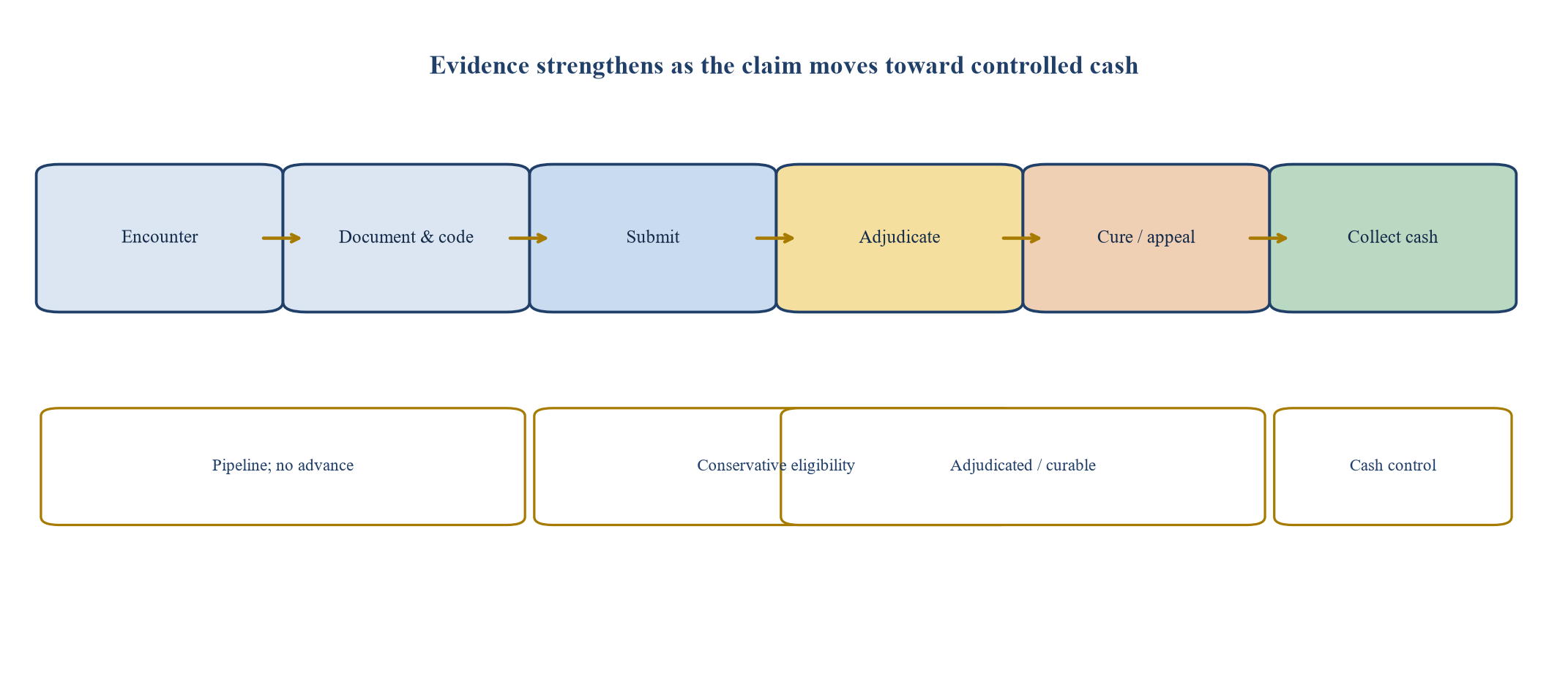
The diagram separates service delivery, claim processing, payer adjudication and financing. It does not determine patient care or payer liability.
9. Design the borrowing-base classes
The borrowing base should classify claims by evidence and risk rather than applying one advance rate to total receivables. A clean submitted claim can qualify when the payer, contract, acknowledgement, ageing, documentation controls and historical performance meet policy. Predicted high-denial claims can be excluded or assigned a lower advance band. Initially denied but demonstrably curable claims can form a separately capped pool after reason, cure deadline and responsible owner are verified.
Eligibility should also address ageing, duplicate claims, related parties, patient-pay balances, disputed services, sanctions, fraud indicators, payer set-off, audit recovery, non-assignment, foreign currency, concentration and jurisdiction. A model score cannot cure a legal or control defect. Excluded claims should remain visible for monitoring so their later outcome informs calibration.
The facility should define score bands and actions in advance. Changes to cut-offs, features or models should pass change control and, where material, lender approval. A provider should not be able to improve availability by unilaterally changing model logic. A lender should avoid treating the model as a guarantee. Availability remains a controlled credit calculation supported by representations, audit rights, field examination and cash dominion.
| Pool | Evidence and risk test | Illustrative advance rate | Additional control |
|---|---|---|---|
| Adjudicated for payment | Remittance evidence, eligible payer, no dispute, within ageing limit | 85% | Payer cap and cash control |
| Clean submitted; low predicted denial | Acknowledged claim, complete evidence, denial probability below 10% | 75% | Performance reserve and weekly reconciliation |
| Clean submitted; medium predicted denial | Acknowledged claim, denial probability 10% to 25% | 55% | Reason-level reserve and review queue |
| High predicted denial | Probability above 25% or critical missing evidence | 0% | Correct before eligibility |
| Denied but curable | Approved reason family, open cure window and responsible owner | 25% within a capped sublimit | Cure-age limit and daily exception list |
| Final denial, duplicate or disputed entitlement | No ordinary-course collection evidence | 0% | Exclude and investigate |
Percentages are hypothetical transaction assumptions. They are not market terms or a recommendation.
10. Build the reserve architecture
Reserves should address expected dilution, initial denial, cure failure, timing, payer set-off, audit recovery, data uncertainty and model risk. These risks overlap, so the lender should define the sequence and avoid both omission and uncontrolled double counting. A base dilution reserve can be calculated from historical gross-to-net collections. A denial reserve can apply to eligible submitted claims by score band. A timing reserve can capture the interest and liquidity effect of delayed cures.
Model uncertainty deserves a separate overlay when performance deteriorates or evidence is incomplete. CBUAE guidance identifies conservative buffers as one response to model uncertainty. The overlay can increase when calibration error, population drift, missing data or override rates breach limits. It should decline only after a documented review and sufficient observed outcomes.
The reserve should use mature cohorts. A recent claim remains unresolved and should not be counted as a successful collection. Cohort curves by submission month show how gross claims convert to adjudicated value and cash over time. The lender can estimate ultimate collections using observed maturity while preserving a conservative tail. Finance and risk teams should reconcile the reserve method to accounting treatment while keeping the credit calculation distinct.
11. Control payer concentration
Payer concentration can create correlated denial, delay and set-off risk. A borrowing base dominated by one payer may contract rapidly after a policy change, system outage, dispute or audit. Concentration should therefore consider more than gross receivables. It should incorporate eligible amount, expected net collection, payment timing, denial correlation, contractual set-off and the lender's enforceability analysis.
A simple payer cap limits eligible receivables from a payer to a percentage of the borrowing base. More advanced limits can reflect payer quality and operating behaviour. A payer with reliable adjudication and settlement can support a higher cap than a payer with volatile edits and long cure cycles, subject to legal review. The methodology should remain understandable and independently challengeable.
The model should also detect hidden concentration. Several plan names may belong to one economic payer or administrator. A provider may depend on one government programme across multiple facilities. Denial reasons can be concentrated in a single contract interpretation. The concentration map should aggregate related entities and common rule dependencies. Correlation matters because simultaneous pool deterioration can defeat diversification assumed from nominal payer counts.
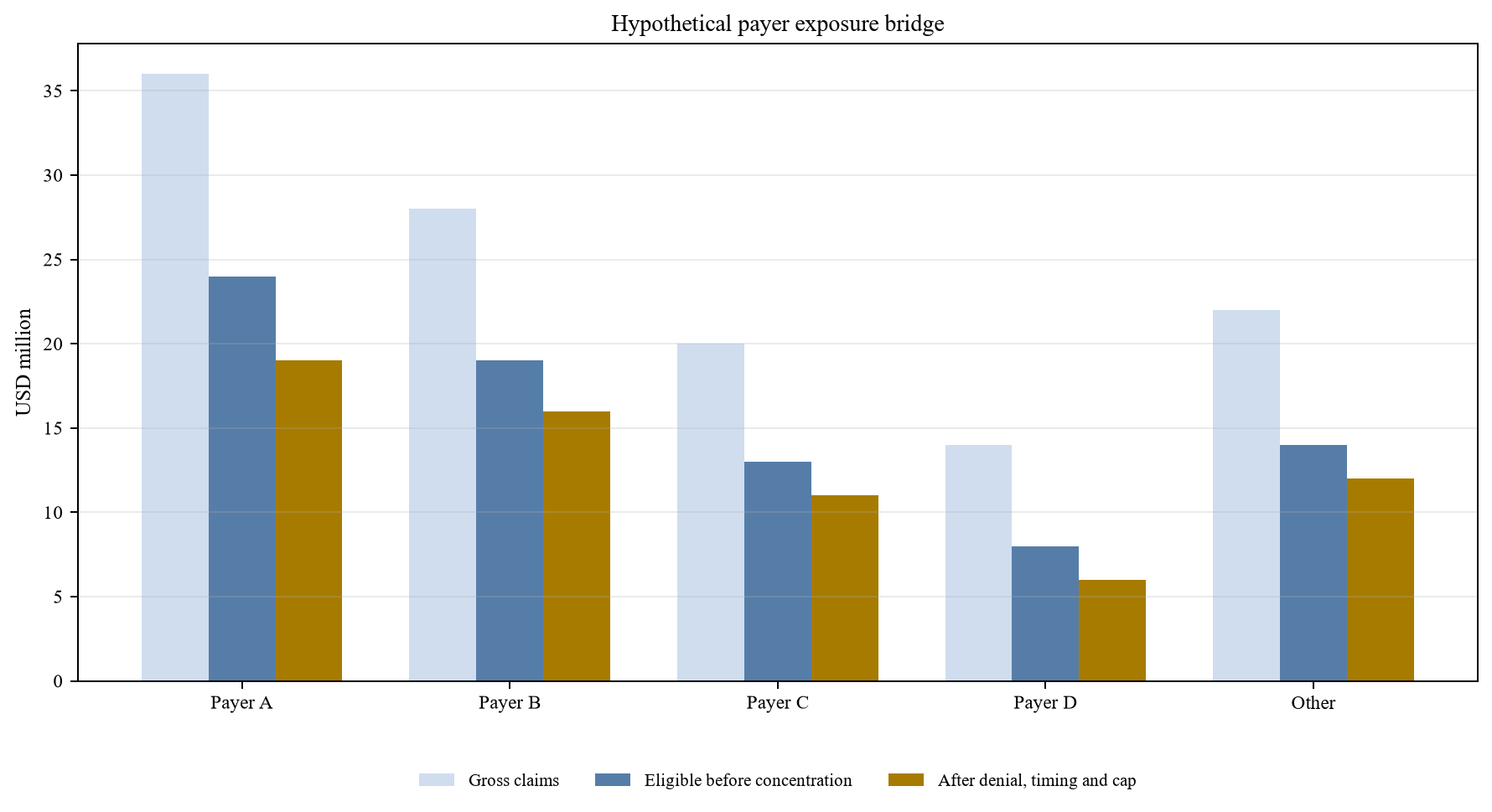
Values are hypothetical and illustrate how gross receivables can differ from financeable exposure.
12. Estimate time to cash
Receivables finance depends on cash timing as well as ultimate loss. A claim collected after 120 days creates more funding need than the same claim collected after 30 days. Time-to-event analysis can estimate the probability of collection through successive periods while handling claims that remain open at the observation date.
Curves should be built by payer, claim state, reason family, facility and material service category. The provider should explain operational discontinuities such as a new contract, tariff, coding system, clearinghouse or revenue-cycle vendor. Historical timing can lose relevance after these changes. The lender should impose a temporary overlay until enough new data matures.
The cash model should reconcile predicted collections with actual controlled-account receipts. It should test late remittance, bulk deductions, partial payment, unmatched cash and recovery. Forecast error should be measured by cohort. Persistent optimism should reduce advance rates or increase reserves. The facility should size liquidity to withstand a delay that affects several payers at once rather than relying solely on an average collection period.
13. Translate the model into a cash waterfall
Collections should flow through a controlled account and be applied through an agreed waterfall. The sequence commonly covers taxes and permitted deductions, operating liquidity where agreed, interest, principal, reserves and excess cash. The exact order depends on the facility and law. The lender needs timely access to bank statements and claim-level remittance reconciliation.
The borrowing base should update at a frequency commensurate with volatility. Daily calculation may be useful for a large, automated pool. Weekly calculation may be adequate when data are reconciled and availability has headroom. Reporting frequency should not exceed control capacity. A rapidly refreshed but unreconciled base can create false precision.
Availability must consider outstanding loans, letters of credit, accrued interest and reserves. A borrowing-base deficiency requires a defined cure, such as cash repayment, additional eligible receivables or lender-approved relief. Cure should not rely on changing the model threshold after deterioration. The model's role is to signal risk early; contractual protection comes from eligibility, cash control, covenants and remedies.
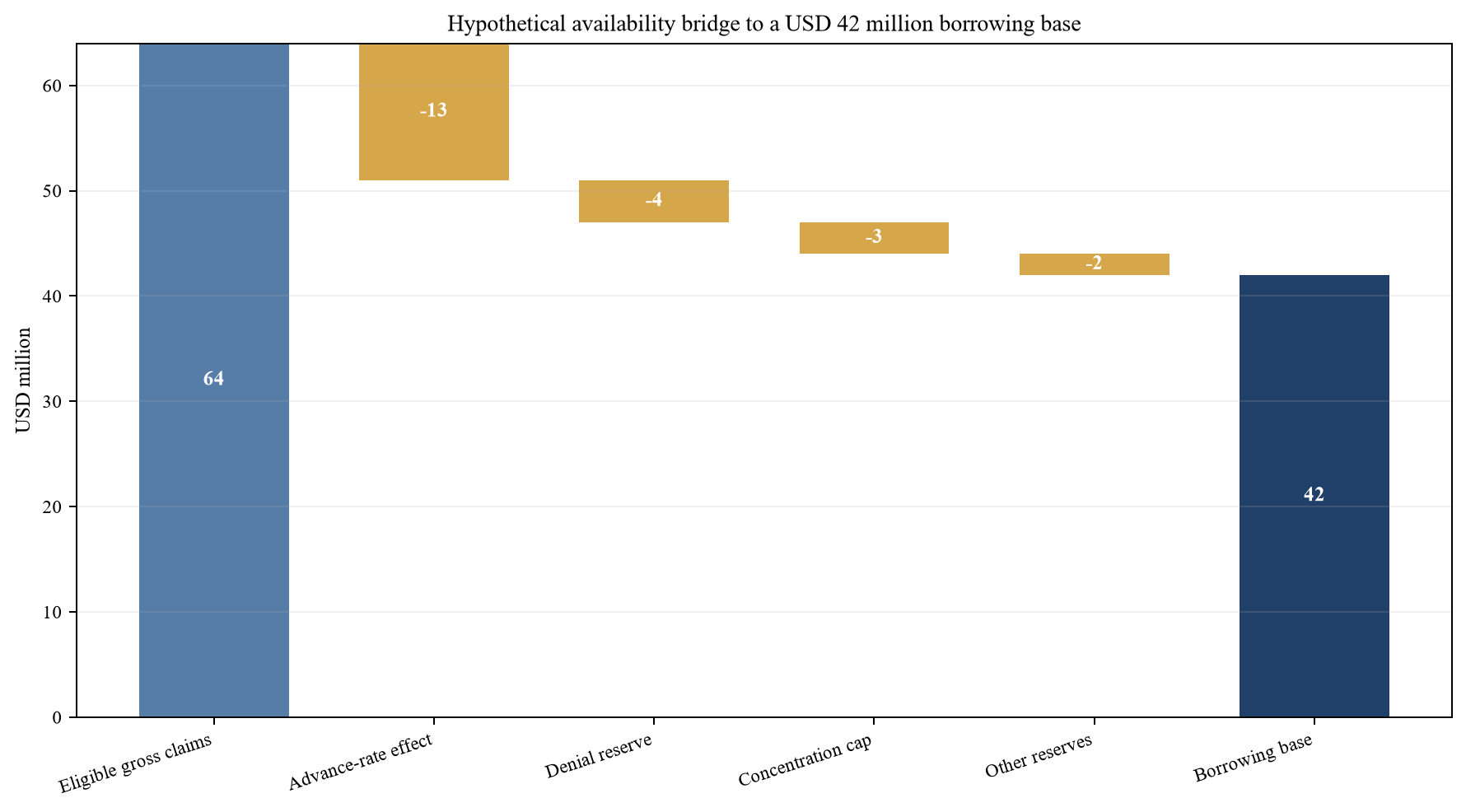
The waterfall uses hypothetical amounts for the illustrative case and does not represent proposed financing terms.
14. Govern the model lifecycle
The model should have an owner, business sponsor, independent validator, data owner, implementation owner and credit-use owner. The inventory should record purpose, scope, version, training period, features, exclusions, outputs, limitations, dependencies, validation, approval, change history and retirement criteria. Third-party technology does not transfer accountability from the lender or provider.
Governance should follow a lifecycle: define, build, validate, approve, implement, monitor, change and retire. NIST's AI Risk Management Framework organises activity around govern, map, measure and manage. WHO guidance for AI in health emphasises autonomy, safety, transparency, accountability, inclusiveness and sustainability. These frameworks are useful anchors while applicable law, regulation and contracts remain controlling.
Material changes include a new payer, contract, code set, claim format, clearinghouse, feature, label, algorithm or threshold. Emergency changes should be time-limited and retrospectively reviewed. Independent validation should test conceptual soundness, data, code, implementation, outcomes and use. The credit committee should understand the model's limits and approve the financing rules, not merely receive a vendor accuracy statistic.
| Control | Evidence | Owner | Trigger |
|---|---|---|---|
| Data lineage | Field dictionary, source mapping and reconciliation | Provider data owner | Missingness, schema or source change |
| Conceptual soundness | Model design, target, features and limitations | Model owner | New version or material use change |
| Independent validation | Replication, calibration, subgroup and implementation tests | Independent validation | Initial approval and scheduled review |
| Credit-use control | Score bands, reserves, caps and override authority | Lender credit risk | Threshold or policy change |
| Performance monitoring | Cohort outcomes, drift, calibration and cash error | Model-risk function | Monthly or faster after breach |
| Suspension and fallback | Approved manual baseline and communication plan | Credit-use owner | Data failure, drift or policy change |
| Privacy and security | Data authority, access, encryption and incident response | Privacy and security owners | New data use or incident |
Owners and approval forums should be adapted to the provider, lender and applicable regulatory framework.
15. Monitor drift and calibration
Population drift occurs when the mix of payers, plans, services, facilities or submission practices changes. Concept drift occurs when the relationship between features and outcomes changes. Both can follow a payer rule update, tariff revision, code-set change, system migration, cyber incident or operating improvement. Drift measures should be interpreted with outcome evidence, not used as automatic proof of failure.
Monitoring should compare predicted and observed denial rates by score band and cohort. It should measure cure rate, time to cash, net collection, override frequency, unresolved exceptions and data quality. Thresholds should distinguish warning, restriction and suspension. A warning can require review and an overlay. A restriction can reduce the model's effect on availability. Suspension should revert to a conservative, pre-approved baseline.
Outcome maturity creates delay. Recent claims have not had enough time to cure or collect. Monitoring should report both early indicators and mature outcomes. A control chart can show calibration error and confidence intervals. Small cohorts should not support aggressive financing changes. The lender should retain a minimum reserve when evidence is insufficient.
16. Control overrides and exceptions
Overrides are necessary because contracts, patient circumstances and claim events can contain information outside the model. They also create governance risk. Every override should record the original output, revised treatment, reason, evidence, approver, amount and later outcome. Overrides should be monitored by user, payer, facility, reason and direction.
A pattern of favourable overrides can inflate availability. A pattern of conservative overrides can reveal a missing feature or policy. Override outcomes should feed model review without allowing operators to relabel history. The lender should set limits and escalation thresholds. High-value claims and unusual services may require mandatory manual review regardless of score.
Exceptions to data or collateral policy should be separated from model overrides. A missing payer acknowledgement is an evidence exception. A score adjustment based on verified new information is a model override. A temporary concentration waiver is a credit exception. Separate registers preserve accountability and help the credit committee see the actual source of risk.
17. Address privacy, security and patient safety
Healthcare claims can contain sensitive personal data. The financing architecture should minimise fields, tokenise identifiers, restrict access, encrypt transfers and log use. Data should remain within approved jurisdictions and systems. The provider, lender and vendors need documented roles, lawful authority, retention, deletion and incident-response obligations. Qualified counsel should assess requirements in each GCC jurisdiction.
The model should never be used to deny or delay medically necessary care. Its stated purpose is financial and operational: identify claims likely to face reimbursement friction and route them for appropriate review. Patient-care decisions remain with qualified clinicians and authorised entities. Governance should test whether incentives from borrowing-base availability could distort documentation, coding or care.
Cyber resilience is part of collateral quality. A ransomware event can stop claims submission, corrupt evidence and delay cash. The facility should test system recovery, immutable backups, manual submission options, clearinghouse dependencies and lender reporting. Availability may need a temporary reserve when source systems or reconciliation are unavailable.
18. Reconcile accounting and credit views
IFRS 15 addresses revenue recognition and variable consideration; IFRS 9 addresses expected credit losses for financial assets, including trade receivables. The accounting conclusion belongs to management, auditors and applicable standards. The borrowing base is a contractual credit calculation. Similar evidence may support both, yet the objectives and thresholds differ.
A provider can recognise revenue before a claim becomes eligible collateral. A lender can exclude an accounting receivable because assignment, evidence, ageing, concentration or control is insufficient. An accounting provision can differ from a financing reserve because the facility protects lender recovery under specified stress and timing conditions. These differences should be bridged and explained.
The monthly control pack should reconcile gross claims, recognised revenue, contractual adjustments, receivables, provisions, eligible collateral, reserves, facility utilisation and cash. It should identify changes from write-offs, payer recoveries, credit notes and reclassifications. The model should not book revenue or provisions automatically unless the accounting policy and controls separately authorise that use.
19. Illustrative provider and facility
The illustrative provider group operates several facilities and submits USD 120 million of annual claims. For demonstration, five payer groups account for the portfolio. The central case assumes a 12 percent initial denial rate. Of the initially denied amount, 65 percent is eventually cured and collected after a median 48 days. These figures are transaction assumptions and do not describe an actual provider.
At the calculation date, USD 78 million of claims are outstanding. Evidence and ageing tests produce USD 64 million of eligible gross claims before advance-rate effects. Advance-rate bands reduce this amount by USD 13 million. Denial and cure reserves deduct USD 4 million, payer concentration deducts USD 3 million and other reserves deduct USD 2 million. The resulting borrowing base is USD 42 million.
The proposed revolving commitment is USD 35 million. Central utilisation is USD 30 million, leaving USD 5 million of committed headroom and USD 12 million of collateral headroom relative to the borrowing base. This distinction matters. Committed headroom supports permitted drawings; collateral headroom shows protection above current utilisation. Both can disappear under correlated stress.
20. Stress the financing case
The first stress raises initial denial from 12 percent to 18 percent and reduces cure from 65 percent to 50 percent. The second extends cure timing from 48 days to 80 days. The third assumes the largest payer delays settlement and increases edits. The fourth assumes a claims-system interruption prevents reliable submission and reconciliation for ten business days. The fifth combines denial, timing and payer concentration stress.
The model should respond through pre-approved rules. Higher predicted denial reduces submitted-claim eligibility. Lower cure performance increases the denial reserve. Slower cash increases the timing reserve and liquidity requirement. A payer event tightens the concentration cap. A system interruption can suspend new model-influenced eligibility until evidence and reconciliation recover.
The combined stress reduces the illustrative borrowing base from USD 42 million to USD 30 million. With USD 30 million drawn, collateral headroom falls to zero. Management actions can include accelerated correction, additional cash, reduced drawings, payer diversification and temporary sponsor support. The facility should not assume that every action is available; each action needs authority, operational capacity and evidence.
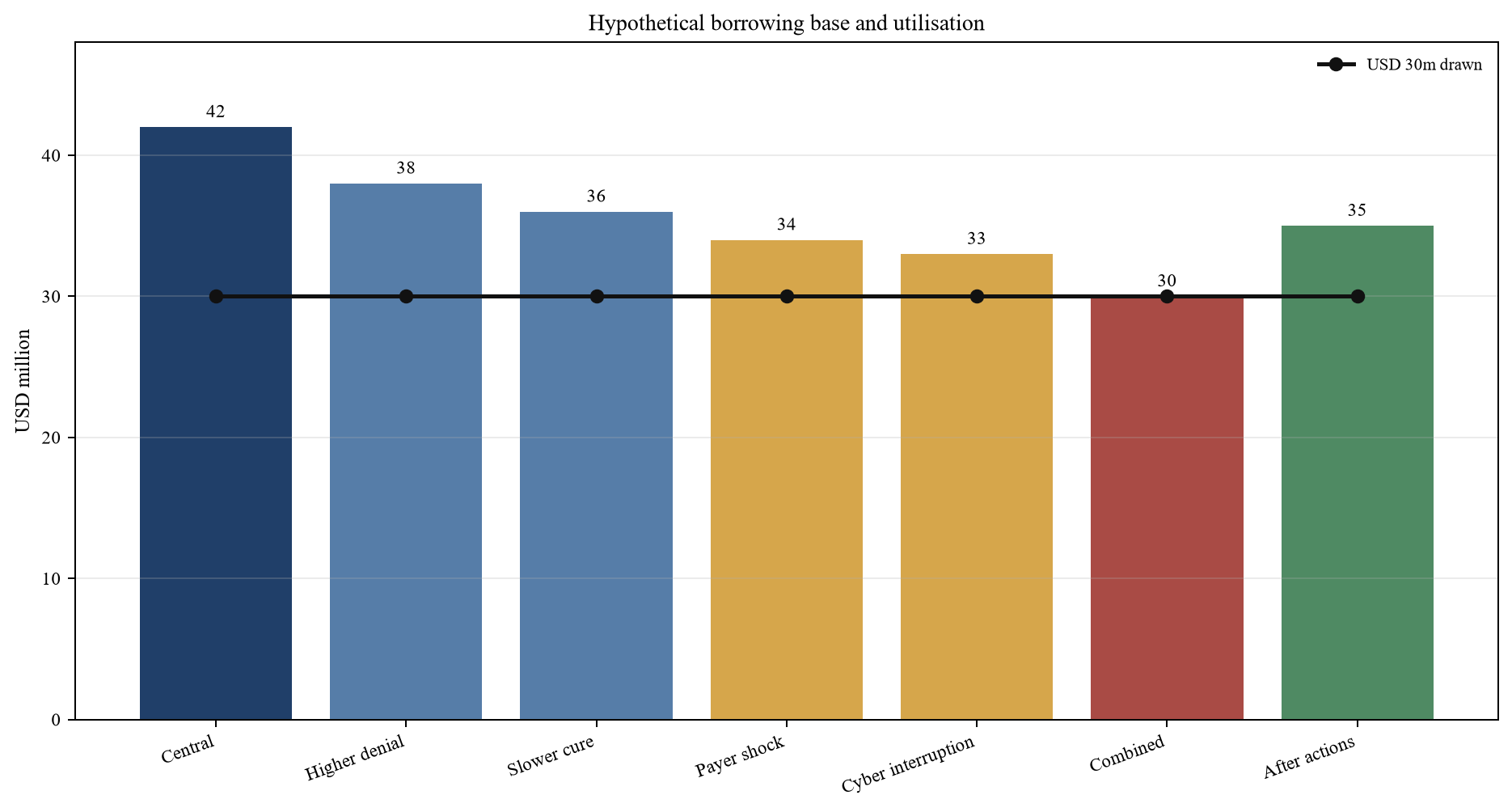
Values are management assumptions for framework demonstration. They are not forecasts or observed results.
21. Link thresholds to action
The facility should translate monitoring into a decision ladder. A green state supports ordinary eligibility and reporting. Amber can require additional review, a model-risk overlay and reduced advance rates for affected cohorts. Red can stop new eligibility for a payer, feature set or model version. A suspension state reverts to a manual or historical baseline. Default and remedy provisions remain governed by the finance documents.
Thresholds should be based on variables that can be measured reliably. Examples include calibration error, missing critical fields, claim-cash reconciliation breaks, cure underperformance, payer ageing, override rate and unresolved high-value exceptions. The threshold pack should state the observation window, minimum cohort size, approver and cure condition. Vague triggers create disputes during stress.
Communication is part of control. Revenue-cycle leaders need a reason-level work queue. Finance needs availability and cash effects. Model risk needs performance and drift. Credit needs concentration, reserves, exceptions and action status. The board needs a concise view of funding resilience and patient-safety safeguards. Each audience should see consistent underlying data with appropriate detail.
| State | Example evidence | Financing action | Operating action |
|---|---|---|---|
| Green | Calibration and cash conversion within approved bands | Ordinary advance rates and reserves | Continue monitoring |
| Amber | Moderate drift, rising denial or delayed cure | Add overlay; reduce affected advance band | Root-cause review and targeted correction |
| Red | Material calibration failure, payer rule shock or major reconciliation break | Stop new eligibility for affected pool | Manual review and executive escalation |
| Suspended | Critical data failure, cyber incident or unauthorised model change | Revert to conservative approved baseline | Restore systems, validate data and obtain reapproval |
| Recovery | Stable evidence across a defined mature period | Remove overlays through documented approval | Close remediation and retain lessons |
Thresholds are hypothetical. A transaction should set them from validated history, risk appetite and legal documentation.
22. Implement in stages
Implementation should begin with a diagnostic. The provider reconciles claim states, denial reasons, contracts, cash and data rights. The lender tests eligibility and concentration without using a predictive model. This establishes the transparent baseline and shows whether the core evidence is financeable.
The second stage is a shadow model. Predictions are produced but do not change availability. Teams compare forecasts with adjudication, cures and cash; test reason-level actions; and measure operational capacity. Independent validation reviews design and implementation. The shadow period should include enough mature cohorts and relevant payer variation.
The third stage is a capped pilot. The model affects a limited pool or reserve within conservative limits. Overrides, exceptions and cash outcomes receive enhanced review. The fourth stage expands only after performance and controls meet approved thresholds. The fifth stage institutionalises monitoring, annual review, field examination, business continuity and model retirement. Expansion is a credit decision supported by evidence, not a reward for technical novelty.
23. Due diligence questions
Credit diligence should ask whether receivables can be legally assigned or charged, whether payer contracts restrict financing, whether set-off or recovery can defeat collections and whether controlled accounts are effective. It should reconcile historic submissions, denials, cures, settlements and cash. It should examine the largest payer rules and recent changes.
Model diligence should ask who owns the target, features and code; whether decision-time availability is proven; whether validation is out of time; how calibration varies by cohort; how leakage is prevented; how third-party tools are controlled; and how suspension works. Data diligence should test completeness, duplicates, retrospective changes, claim-chain linkage and bank reconciliation.
Operational diligence should test the denial work queue, staffing, coding qualifications, appeal deadlines, payer portals, clearinghouse dependencies and cyber recovery. Governance diligence should inspect approvals, validation, monitoring, overrides, privacy and patient-safety controls. The lender should connect every material finding to eligibility, reserve, condition, covenant, pricing, limit or decision to decline.
24. Limitations
Claims-denial prediction is sensitive to local contracts, payer behaviour, code sets, documentation and system configuration. A model that performs for one provider or payer may not transfer. Historical patterns can become obsolete after policy, tariff, technology or operating change. Rare high-value claims may have too little history for reliable statistical treatment.
Prediction cannot establish legal entitlement, clinical appropriateness or ultimate collectability. It can reproduce historic bias or operational weakness. A high apparent accuracy can arise from class imbalance or leakage. Model outputs should remain bounded by evidence, conservative overlays and accountable judgement. Financing benefits depend on provider action capacity and cash control.
The numerical case is hypothetical. It does not estimate an actual provider, payer or facility. Transaction terms require current legal, healthcare, accounting, tax, privacy, cyber, model-risk and credit advice in the relevant jurisdictions. The framework is designed to organise diligence and decision-making; it does not assure financing, collection or model performance.
Performance measures also require careful interpretation. Accuracy can appear high when most claims are paid, even if the model misses a large share of financially important denials. Precision can improve after a threshold change while recall falls. A lender should review calibration, expected cash error and value-weighted outcomes alongside classification measures. Results should be shown with cohort size and observation maturity. Small samples and unresolved claims reduce confidence and should lead to conservative treatment.
The model cannot remove operational bottlenecks. A provider may identify documentation or authorisation risk accurately and still miss the cure window because responsibility is unclear or review capacity is insufficient. Financing policy should recognise demonstrated operating throughput, not theoretical model capacity. Benefits assumed in a cash forecast should be capped by observed interventions and mature collections.
Regional comparability is limited. GCC health systems, insurance arrangements, electronic-claims platforms and data rules differ across jurisdictions. Payer contracts can differ within the same jurisdiction. The paper therefore proposes a control architecture rather than a universal scorecard. Every implementation requires a current contract inventory, legal perimeter, data assessment and payer-specific validation. Cross-border model transfer should be treated as a material change and should pass fresh validation before affecting availability.
25. Conclusion
Healthcare receivables become financeable through a chain of evidence: valid service, documented entitlement, compliant submission, payer adjudication, effective cure and controlled cash. Artificial intelligence can improve early visibility into denial risk when the model is calibrated, explainable, monitored and linked to a real operating response.
The strongest structure treats the prediction as one input to a governed borrowing base. Clean and adjudicated claims receive differentiated treatment. High-risk and unresolved claims are excluded or heavily reserved. Payer concentration, timing, set-off, cyber and model uncertainty remain visible. Human authorities own clinical, operational and credit decisions.
For providers, the framework can align revenue-cycle improvement with liquidity. For lenders, it can provide earlier warning and more granular collateral control. Sustainable value arises from reconciled evidence, conservative transaction design and accountable execution.
Sources
- World Health Organization, Ethics and governance of artificial intelligence for health, 2021. Read the primary source
- World Health Organization, Artificial intelligence for health, 2024. Read the primary source
- World Health Organization Regional Office for Europe, Health data governance in the age of artificial intelligence, 2025. Read the primary source
- National Institute of Standards and Technology, Artificial Intelligence Risk Management Framework 1.0, 2023. Read the primary source
- National Institute of Standards and Technology, AI RMF Core. Read the primary source
- Central Bank of the UAE, Model Management Standards. Read the primary source
- Central Bank of the UAE, Model Risk. Read the primary source
- Central Bank of the UAE, Credit Risk Regulation and Standards, 2024. Read the primary source
- Department of Health Abu Dhabi, Health Insurance Claims Adjudication Standard. Read the primary source
- Department of Health Abu Dhabi, Standard for principles and procedures governing recovery of payment for healthcare services. Read the primary source
- Council of Health Insurance Saudi Arabia, NPHIES Technical and Enabling Provisions. Read the primary source
- Council of Health Insurance Saudi Arabia, Settlement and reconciliation appendix. Read the primary source
- IFRS Foundation, IFRS 15 Revenue from Contracts with Customers. Read the primary source
- IFRS Foundation, IFRS 9 Financial Instruments. Read the primary source
- IFRS Foundation, Post-implementation Review of IFRS 9 Financial Instruments; Impairment, 2023. Read the primary source
- Basel Committee on Banking Supervision, Principles for the Management of Credit Risk. Read the primary source
- Basel Committee on Banking Supervision, Principles for effective risk data aggregation and risk reporting. Read the primary source
- International Organization for Standardization, ISO/IEC 23894:2023 Artificial intelligence; Guidance on risk management. Read the primary source
- International Organization for Standardization, ISO/IEC 42001:2023 Artificial intelligence management system. Read the primary source
- U.S. Food and Drug Administration, Health Insurance Portability and Accountability Act and artificial intelligence resources are jurisdiction-specific reference points only; GCC requirements remain controlling. Read the primary source
- International Finance Corporation, Global Trade Finance Program and working-capital finance resources. Read the primary source
- World Bank, Digital-in-Health: Unlocking the Value for Everyone, 2023. Read the primary source
- OECD, Recommendation of the Council on Artificial Intelligence. Read the primary source
- Financial Stability Board, The Use of Supervisory and Regulatory Technology by Authorities and Regulated Institutions, 2020. Read the primary source
- International Association of Insurance Supervisors, Application Paper on the Supervision of Artificial Intelligence, 2025. Read the primary source
- International Monetary Fund, Fintech Notes and analytical resources on artificial intelligence and finance. Read the primary source
- World Health Organization, Regulatory considerations on artificial intelligence for health, 2023. Read the primary source
- World Health Organization, Guidance on large multi-modal models for health, 2024. Read the primary source
